Why Floodlight Cameras Deter More Than Video Does
Learn how floodlight security cameras improve home security through brightness, motion detection, color night vision, and smart placement.

Before you buy a floodlight security camera, ask a blunt question: Do you want to stop someone in the moment, or do you mainly want footage afterward? Video matters, but it often shows up late in the sequence. Light can interrupt the moment while it is still happening.
That is why a security light and camera should not be judged like a normal outdoor camera with a lamp attached. The floodlight is often the first deterrent. The camera is the record. If the light is aimed badly, too narrow, too dim, or always on until everyone ignores it, even a great video ends up doing cleanup work.
This article explains how brightness, coverage angle, trigger behavior, color night vision, power, and mounting height change the way an outdoor security light with a camera works in a real driveway, side yard, alley gate, or garage approach.
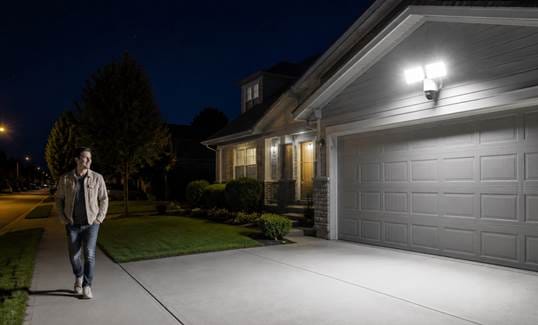
A floodlight camera illuminates a dark home driveway at night.
• Decide whether the goal is deterrence or evidence
• Lumens matter less without coverage
• Motion lighting and steady lighting solve different problems
• Color night vision improves when the light is planned
• Power planning decides how reliable the setup feels
• Mounting height can help or ruin the whole scene
• Conclusion
Decide whether the goal is deterrence or evidence
Most people buy a security camera with a floodlight because they want both prevention and proof. That is reasonable. The problem starts when both goals are treated as the same job.
A camera records. A light changes behavior. Someone walking into a dark driveway may keep moving because the space feels unobserved. A sudden, well-aimed light shifts that feeling before the camera clip becomes useful. It tells the person that the area is active, watched, and not as private as it looked five seconds earlier.
Video still matters. If a package disappears, a car door is checked, or someone circles the side gate, the clip can show timing, clothing, direction, and sometimes a face. But the light is what may stop the person from lingering long enough for the incident to get worse.
That is the main buying logic: use the floodlight to make the space uncomfortable for unwanted activity, then use the camera to understand what happened.
Lumens matter less without coverage
Lumens tell you how much light the fixture can produce. They do not tell you whether the light lands where trouble happens. A bright beam pointed at the garage door may leave the walkway beside it in shadow. A wide wash over the whole yard may feel safer, but make faces look flat and washed out.
Think in zones, not just brightness:
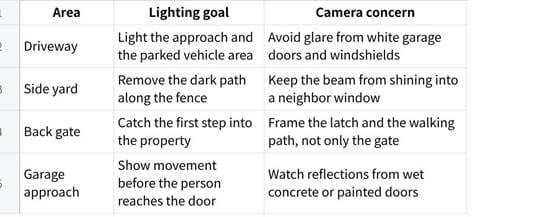
More light is not always better. If the beam bounces off siding, glass, wet pavement, or a white wall, the camera may lower exposure and leave the person darker than expected. A better setup is usually a shaped pool of light across the approach path, with the camera aimed slightly away from the harshest reflections.
Motion lighting and steady lighting solve different problems
Motion-triggered lighting works because it surprises. A dark corner becomes bright right as someone enters it. That change is part of the deterrent.
Steady lighting works differently. It makes a space feel maintained and visible all evening. That can be useful near a business entrance, shared driveway, or apartment parking row where constant darkness invites loitering. The tradeoff is that steady light loses the sudden signal. People get used to it.
For many homes, the better pattern is not all or nothing. Keep a low ambient level where people regularly walk, then let motion push the floodlight brighter when someone enters the key zone. The light no longer feels random, but it still reacts.
The trigger zone matters as much as the light mode. If the floodlight turns on only after someone reaches the door, it is too late. If it catches every passing car, you may turn sensitivity down until the useful events are missed. Spend time on the detection zone. That is where a floodlight camera becomes less annoying and more useful.
Color night vision improves when the light is planned
Black and white infrared footage can be good for motion and shape. It often struggles with color details. A red jacket, a blue hoodie, a dark green car, and a black car can all lose meaning once the scene is reduced to grayscale.
Color night vision has a better chance when there is usable visible light. A floodlight can give the camera enough light to preserve clothing color, vehicle color, and surface detail. That does not mean every clip will look like daytime. Rain, fog, dirty lenses, glare, and distance still matter.
The common mistake is aiming the light and camera at the same reflective target. A person walking past a white SUV may be harder to see if the floodlight hits the vehicle straight on. Move the light panels slightly outward if the fixture allows it. Let the camera see the person, not just the reflection.
For those who want to compare this category, the eufy outdoor light with camera collection is a useful starting point because it keeps the lighting and camera roles together. If you already know you want a floodlight security camera rather than a porch-light-style device, filter by floodlight-style models so you are not comparing across two different use cases.
Power planning decides how reliable the setup feels
A dual-function device uses power for two jobs: illumination and recording. That changes the planning. A camera can often get by with a modest power draw. A floodlight cannot, especially when it needs to brighten a driveway or yard.
Hardwired models make sense where an old exterior light already exists, and the location is right. The fixture has a steady power source, and you are not depending on battery life for repeated night triggers. The catch is installation. If there is no proper junction box, or if wiring is old or unclear, this becomes an electrician conversation rather than a quick weekend swap.
Battery and solar setups can work in lighter-duty areas, but repeated floodlight use drains more energy than short camera clips. A side gate that triggers twice a night is different from a driveway facing a busy sidewalk. Count triggers, not just days.
The eufy Floodlight Camera E340 is an example of a hardwired floodlight camera often used for driveways and garage approaches. Its two adjustable light panels (up to 2,000 lumens) make it easier to put light on the approach path instead of straight into the lens.
Even so, the mounting location and wiring decide whether a hardwired setup feels reliable day to day.
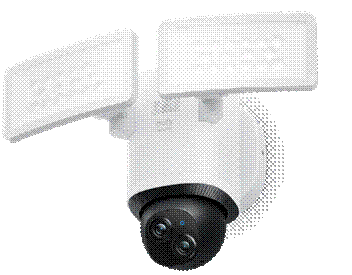
eufy Floodlight Camera E340
Mounting height can help or ruin the whole scene
Mounting too low makes the device easier to tamper with and can throw light straight into someone's eyes. Mounting too high can turn faces into the tops of heads and create long shadows. The right height depends on the wall, the walking path, and how far the subject is from the camera when the light turns on.
Before drilling, stand where the camera will go and look at the scene at night. Not from the ground in daylight. Notice the shiny surfaces: glass doors, parked cars, glossy paint, wet stone, white siding. Those are the places that can bounce light back into the lens.
A few placement checks save frustration:
• Aim the light across the approach path rather than directly at the camera's main subject.
• Keep the camera from staring straight into the brightest part of its own beam.
• Avoid pointing the floodlight into neighboring windows or across a property line.
• Leave enough height to reduce tampering, but not so much that faces disappear.
• Test motion zones after dark, because daytime walking tests do not reveal glare.
The small adjustment that fixes glare is often boring: tilt a panel, move the detection zone, or change the camera preset. Boring fixes still count.
A security light and camera deters best when the light is treated as the first line of action, not a decorative add-on to the lens. Brightness helps, but only if it covers the approach path without blinding the camera or your neighbors. Motion triggers can startle, steady light can make a space feel watched, and color night vision benefits when visible light is aimed with some care.
The camera still has a serious job. It records what happened, lets you review timing, and provides context after an alert. But if your main goal is to make someone leave before there is much to review, plan the floodlight first. Video improves when the light does its job.