4 Simple Ways To Make Home Feel Like You
Learn simple home decor ideas for easy room updates. Display family collections. Build personalized gallery walls. Layer room lighting. Read our guide today.
Making a home feel personal comes down to four specific moves. Building a gallery wall with your own photos and prints, displaying the collections your family already owns, setting up a work corner that actually fits how your household operates, and swapping your lighting for warm-toned bulbs and layered sources.
None of these require a renovation. Each one can be started on a single afternoon with what you already have or a few inexpensive additions.
Most homes look occupied but lack a distinct personal touch. Blank walls often remain bare for months after moving in, while shelves gather random clutter out of sheer habit.
A desk pushed into a corner usually becomes a landing zone for junk mail and school fliers. The most inviting spaces happen when families display authentic artifacts, like a framed finger painting hanging proudly or vacation souvenirs lining a prominent shelf.
Every household accumulates unique interests and hobbies over time. These range from pressed botanical prints and vinyl records to elaborate fantasy worlds and sports memorabilia.
Personalizing a room around these existing items requires zero structural changes and minimal budget. The four strategies ahead outline exactly how to reorganize these belongings to substantially alter a room's atmosphere.
1. Build a Personal Gallery Wall
A blank wall transforms into an unmistakable reflection of your family when you fill it with personal artifacts.
One Los Angeles study observed that homes feature a minimum of 10 family photographs, though researchers note they are much more likely to find 80 to 90 pictures displayed.
Some households even exceed 200 visible images. Mixing these photos with children's drawings, favorite postcards, and handwritten quotes creates visual interest without requiring a unified artistic theme.
A hallway filled with vacation photos looks neatest when housed in uniform black or natural wood borders. Organizing children's artwork chronologically up a staircase looks highly intentional when paired with a consistent mat color.
A living room corner blending art prints and portraits anchors well around a single large 16x20 piece, which you can then surround with smaller frames arranged in an organic cluster.
The primary rule separating a cohesive arrangement from a random assortment is frame finish consistency. Using entirely black, white, or natural wood borders forces disconnected images to belong together.
Selecting a curated set of uniformly finished pieces, like those offered by Americanflat's wall frames, removes guessing from the equation. The photos and certificates command attention instead of competing with chaotic borders.
Standard spacing between frames is 2 to 3 inches for a tight, gallery-like result. While this feels uncomfortably close to most beginners, tight spacing generates necessary visual weight.
Cut paper templates of each frame and tape them to the wall before picking up a hammer. Living with the paper layout for a weekend prevents unnecessary drywall repairs.
2. Display Your Real Family Collections
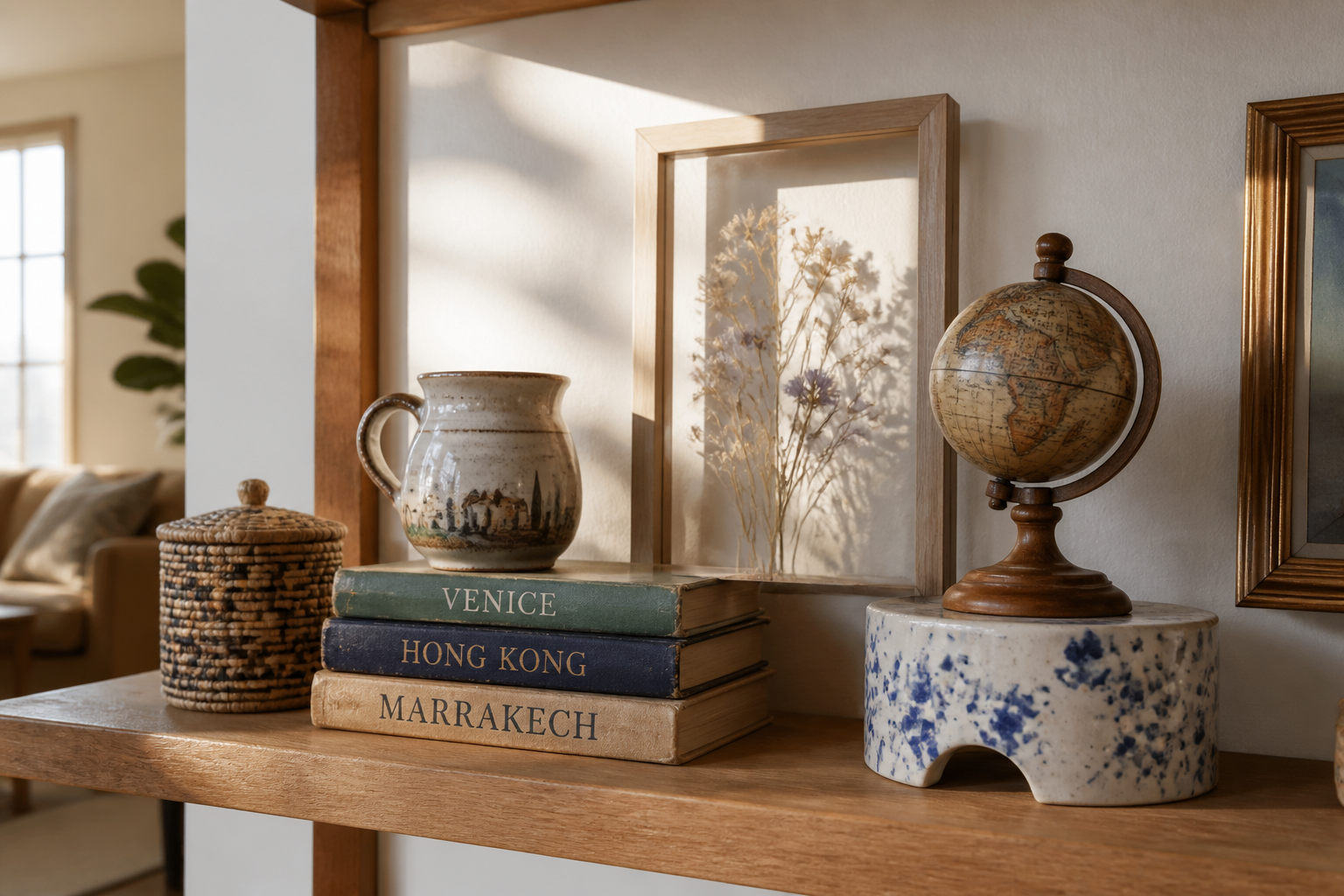
Alt : Decorative shelf with books, globe, jug, and framed flowers
Many households already possess fascinating collections hiding inside closet boxes or securely wrapped in tissue paper.
These items sometimes dictate a room's entire identity, leading a history enthusiast to mount prominent Medieval Collectibles' medieval armor to anchor a gaming or study space.
For smaller hobbies, a dedicated shelf grouping travel ceramics reads as a curated museum display rather than accidental hoarding.
Deep shadow boxes safely hold flat keepsakes like ticket stubs or concert wristbands while maintaining their original context.
Vintage cameras, pressed foliage, or comic figures deserve deliberate visual placement rather than existing as clutter. Identify a single focal object that establishes the color palette and atmosphere for the corner it occupies.
This single conversation piece gives the space an unmistakable personality, dictating which supporting objects surround it.
One well-styled shelf featuring three objects at varying heights does more for a room than dozens of scattered items. Use stacked books or overturned bowls as risers to break up flat sightlines. Restraint forces visitors to actually look at the pieces you value most.
3. Build a Multipurpose Work Corner
Most home office setups fail when they hit actual household routines. Art supplies, charging cables, and work documents constantly fight for surface area.
A functional creative workspace requires internal zones rather than one massive, undifferentiated flat desk.
Designating specific sides of a desk prevents daily frustration. Placing a strip of brightly colored painter's tape across the surface establishes a clear boundary between adult tasks and kid projects.
Install open shelving above the desk for frequently used binders, while keeping chaotic project materials hidden in labeled bins below.
Add one personal anchor to the primary user's side, such as a meaningful potted plant or a framed typography print. Mounting a magnetic board on the adjacent wall keeps permission slips and schedules visible without consuming precious work area.
When children know exactly where their craft supplies live, the corner stops generating friction and becomes a reliable tool.
4. Use Layered Room Lighting
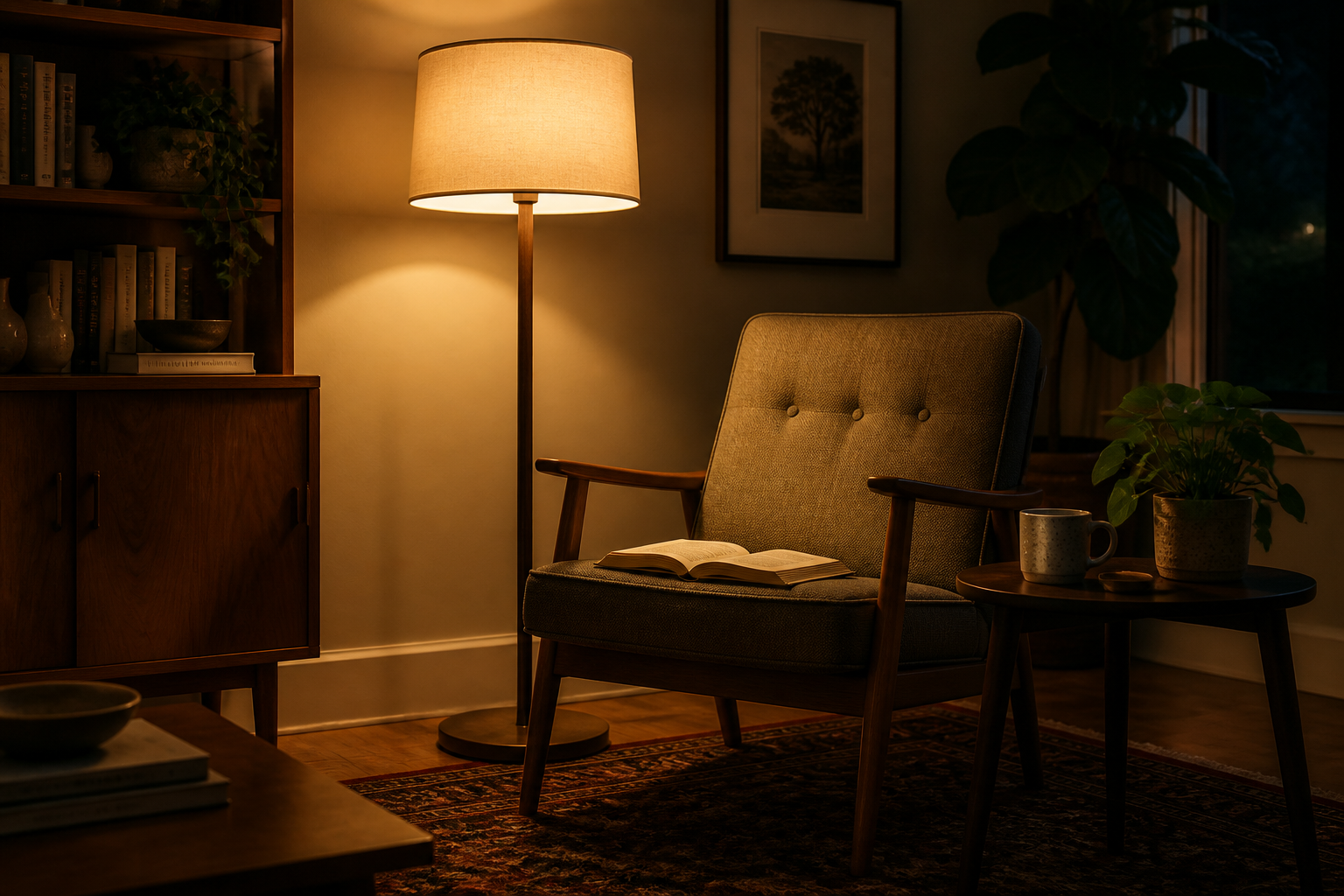
Alt: Cozy reading nook with book, chair, lamp, and plants
Layered lighting allows a room to transition from highly productive daylight to a cozy evening atmosphere. Three independent layers achieve this effect without requiring new wiring.
You need standard overhead ambient light, specific task lighting for reading or typing, and accent lighting to highlight architectural features.
Swapping harsh overhead bulbs for warm-toned options in the 2700K to 3000K range instantly softens a harsh aesthetic.
Placing a dedicated floor lamp beside an armchair creates an inviting reading zone that draws people in. Installing plug-in sconces beside a framed portrait layout makes the entire arrangement look professionally curated.
LED light strips mounted behind monitors provide excellent task illumination for a gaming setup or hobby desk. A paper lantern hung in a child's playroom elevates the atmosphere while using existing plug-in sockets.
Renter-friendly smart bulbs and battery-operated strips leave no trace behind when moving out, yet fundamentally alter how a family experiences the room.
The Bottom Line: Anchor Every Room
Every tailored room relies on a single visual anchor that dictates the surrounding decor. A prominent cluster of framed art establishes a living area, while a heavy historical replica defines a specialized gaming space.
Establishing these primary features prevents every other item in the room from competing for visual attention.
Once you install that central fixture or main display shelf, the rest of the room requires significantly less decoration. Surrounding walls can stay entirely bare without feeling neglected.