
5 Lazy Ways To Build A Healthier Home
Discover healthy home upgrades that require zero remodeling. Improve bedroom air quality. Organize busy daily zones. Read our complete guide for families today.

Building a healthier home comes down to five low-effort upgrades (a smarter bathroom fixture, a dedicated decompression space, cleaner bedroom air, a better-organized entryway, and lower-maintenance surfaces) that improve daily life without a renovation budget or a weekend overhaul.
The average American spends approximately 90 percent of their time indoors, which means the home has quietly absorbed work, school, recovery, and connection in ways it was never originally designed to handle.
Most families want a calmer, cleaner, more restorative space but have no realistic time to gut-renovate.
Building a healthier home does not require demolition. Upgrading key fixtures and creating designated functional zones reduce daily friction automatically.
These specific physical adjustments yield high payoffs over months of use, starting directly in the highest-traffic rooms.
1. Upgrade To Self-Cleaning Bathroom Fixtures
The average household toilet requires cleaning multiple times per week, a task that consumes hours of scrubbing every month. Integrated smart toilets shift how this burden is managed manually.
Instead of relying on traditional cleaning routines, these fixtures manage hygiene through water-based washing and built-in features that activate between uses.
An automatic lid opens upon approach, warm water provides a targeted wash, and a self-cleaning bowl function minimizes residue.
Sensor-based fixtures run this entire sequence passively.
Families seeking improved bathroom hygiene without the constant scrubbing frequently install models like Premier Bidets' TOTO Neorest toilet.
Once installed, this technology reduces both manual cleaning frequency and overall toilet paper consumption.
A busy parent who previously scrubbed surfaces twice a week finds the internal mechanisms handling residue automatically. The hardware takes over the physical maintenance, so the household reclaims those hours.
2. Create A Designated Decompression Space
Most adults in busy households lack a dedicated recovery ritual. Defaulting to the couch and a phone screen merely extends mental stimulation.
This keeps the nervous system engaged with data right until sleep. Families wanting to shift this dynamic can install a home sauna from Sun Home Saunas to establish a rigid boundary between work hours and relaxation.
A designated physical area signals the body to unwind rather than perform.
A 20-minute evening reset involving warmth and darkness shifts cortisol levels and proves the workday has ended.
Bypassing difficult scheduling and commute times transforms recovery into a daily habit rather than an occasional luxury.
The initial setup takes only a few hours. After that, the ritual requires zero planning on the user's part.
A parent working remotely can use a brief evening session as a hard stop to office hours, building a home wellness routine tied directly to a specific physical location.
3. Optimize Bedroom Air And Light Quality
The bedroom dictates whether six to eight hours of overnight restoration actually occurs.
Government research shows that indoor pollutant levels often register several times higher than outdoor concentrations.
The sleeping environment accumulates dust mites, pet dander, and particulate matter from adjacent spaces, directly leading to subtle congestion and fragmented sleep.
Addressing this problem requires no construction or invasive remodeling. Running a highly rated HEPA-grade air purifier overnight handles airborne particulates passively.
Studies demonstrate that true filtration significantly reduces indoor particulate matter concentrations while residents sleep.
Blackout curtains solve a secondary issue by blocking light exposure, while removing heat-generating electronics eliminates background stimulation.
In dry climates, a small humidifier set between 40 and 50 percent relative humidity prevents overnight nasal congestion and skin irritation.
A child who breathes easily and sleeps through the night provides a highly predictable benefit for the whole household.
4. Organize High-Traffic Family Zones
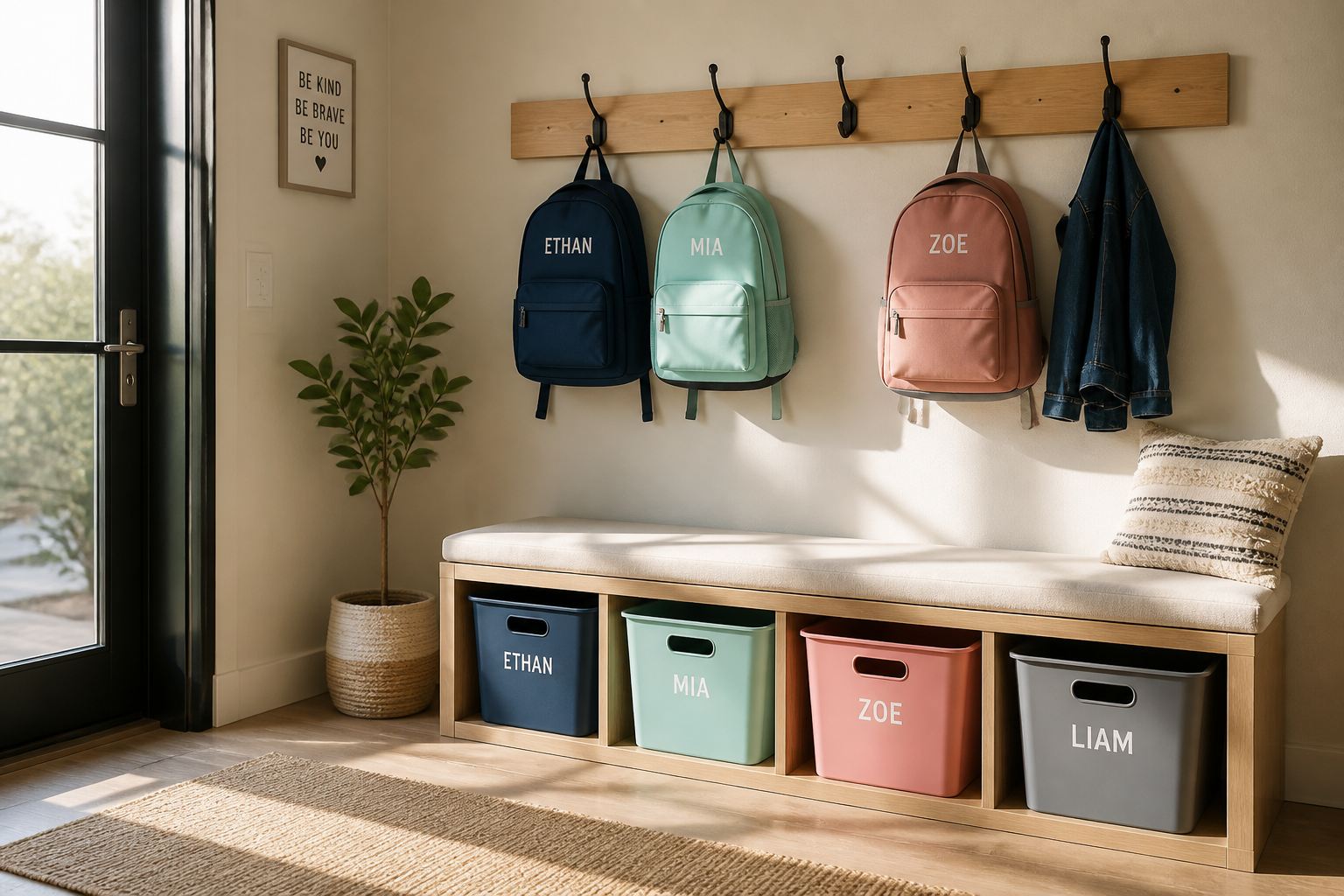
Alt: Backpacks and storage bins organized in a stylish entryway
Visual disorder competes for attention and rapidly depletes mental resources.
Cluttered counters, misplaced items, and surfaces lacking a designated function create measurable cognitive load by mid-morning.
This persistent disorganization compounds into daily stress before anyone even starts a difficult task.
Organizing systems succeed only when they eliminate daily decision-making out of the equation. A labeled bin near the entryway door for each person guarantees an immediate drop zone for bags and sports gear.
A dedicated hook rail positioned at a lower height prevents backpacks from taking over the dining room table.
A single charging station corralling all devices overnight removes the frantic morning search for a phone completely.
In the kitchen, a pantry rotation keeping five breakfast staples on the same shelf cuts early decision fatigue.
Reorganizing the environment creates a friction-free zone where maintaining order takes five minutes or less.
5. Select Low-Maintenance Surfaces And Features
A huge portion of weekly effort goes into maintaining finishes chosen purely for aesthetics. Quartz countertops bypass the annual sealing required by marble while delivering a comparable visual in the kitchen.
Matte finishes on faucets and cabinet hardware hide fingerprints and water spots, eliminating the daily wipe-down cycle polished chrome demands. Luxury vinyl plank flooring resists scratches and mops clean in under ten minutes.
Replacing smooth-gloss tile with a textured alternative obscures hard water deposits, cutting out harsh scrubbing sessions.
Upgrading to LED bulbs in a warm 2700K color temperature creates a calmer ambient mood in living spaces.
These units last up to twelve times longer than incandescent alternatives, meaning the benefit runs for years without further attention.
Reclaiming just twenty minutes of maintenance per fixture adds up to hours of free time every month.
The Bottom Line
None of these five upgrades require a full renovation or a contractor. An integrated smart bidet manages hygiene and cleaning mechanically, significantly dropping the household's weekly toilet paper use.
Adding an indoor or outdoor infrared sauna turns a brief evening reset into a rigid boundary between work mode and recovery mode.
Bedroom air purifiers and blackout curtains run passively overnight.
Entryway organizing systems streamline weekday mornings because they assign a strict physical location to daily gear.
Swapping polished kitchen finishes for matte materials reduces active maintenance time for a decade or more.
Replacing one manual chore with a passive system reclaims immediate time. Address the highest-traffic room first, install the necessary fixtures or storage blocks, and establish the new routine.