
Best Carbon Management Software: 8 Enterprise Platforms Compared for 2026
Best Carbon Management Software: 8 Enterprise Platforms (2026) Meta Description: Compare 8 enterprise carbon management platforms for 2026. Multi-framework reporting, Scope 1-3 tracking and supplier engagement for CSRD, SB 253 and ISSB.

The carbon management market has grown crowded fast, and for an enterprise buyer that crowding is half the problem. A dozen credible platforms now promise audit-ready emissions data and multi-framework reporting, most of them tucked behind quote-based pricing, which makes an honest side-by-side comparison genuinely difficult.
This guide narrows that field to eight platforms worth a serious enterprise evaluation in 2026 and lays out the tradeoffs plainly. It is aimed at sustainability, ESG and risk leaders at large organizations of roughly 3,000 to 50,000 employees who have to satisfy overlapping mandates such as CSRD, ISSB and IFRS S2, CDP, California SB 253 and SB 261, and TCFD-aligned risk reporting.
The eight covered here are Persefoni, Sweep, Watershed, Salesforce Net Zero Cloud, Workiva, IBM Envizi, Sphera and Normative. None is a universal answer, so the goal is to match a platform to how your team actually reports.
The Short Version
- Starting from scratch on a tight budget, Persefoni gives you the lowest-friction entry point, with a free self-service Pro tier spanning Scope 1 to 3 and a GPT-powered Copilot.
- Juggling many frameworks and heavy supplier data, Sweep is the strongest fit, thanks to a Tree data model designed to reuse one dataset across CSRD, SFDR, ISSB, CDP, SB 253/261 and TCFD.
- When Scope 3 and CSRD assurance are the blockers, Watershed earns its place with assurance-ready data, anomaly detection and a guided supplier portal.
- Already all-in on Salesforce, Net Zero Cloud keeps everything in one environment, and its Growth edition is one of the few with a published price.
- Budget expectations matter: Sweep, Watershed, Workiva, Sphera and most others here are quote-based, so a scoped sales conversation is unavoidable.
What Separates a Strong Platform from a Weak One
Feature lists blur together quickly in this category, so the evaluation below leans on the things that actually decide a rollout and an audit.
- Defensible outputs: does the data carry validation, traceability and an evidence trail an auditor can follow, or does it fall apart under scrutiny.
- One dataset, many frameworks: can a single collection effort feed CSRD, ISSB and IFRS S2, CDP, SB 253/261, TCFD and SFDR without rebuilding each time.
- Supplier reality: are there guided surveys, portals and collaboration tools, because Scope 3 supplier data is where most programs stall.
- Fit and friction: governance, integrations, implementation effort and pricing, checked against official vendor and regulator pages accessed January 2026.
A Quick Primer on What This Software Does
Carbon management software exists to turn scattered activity data into a defensible emissions picture. It measures Scope 1, 2 and 3 emissions, aligns that data to the relevant ESG frameworks, and converts the result into targets, scenarios, reduction plans and reports that can withstand assurance.
The platforms that stand out treat those steps as one continuous workflow. The weaker ones leave you exporting between disconnected tools, which is exactly where errors and audit gaps creep in.
1. Persefoni
Strengths
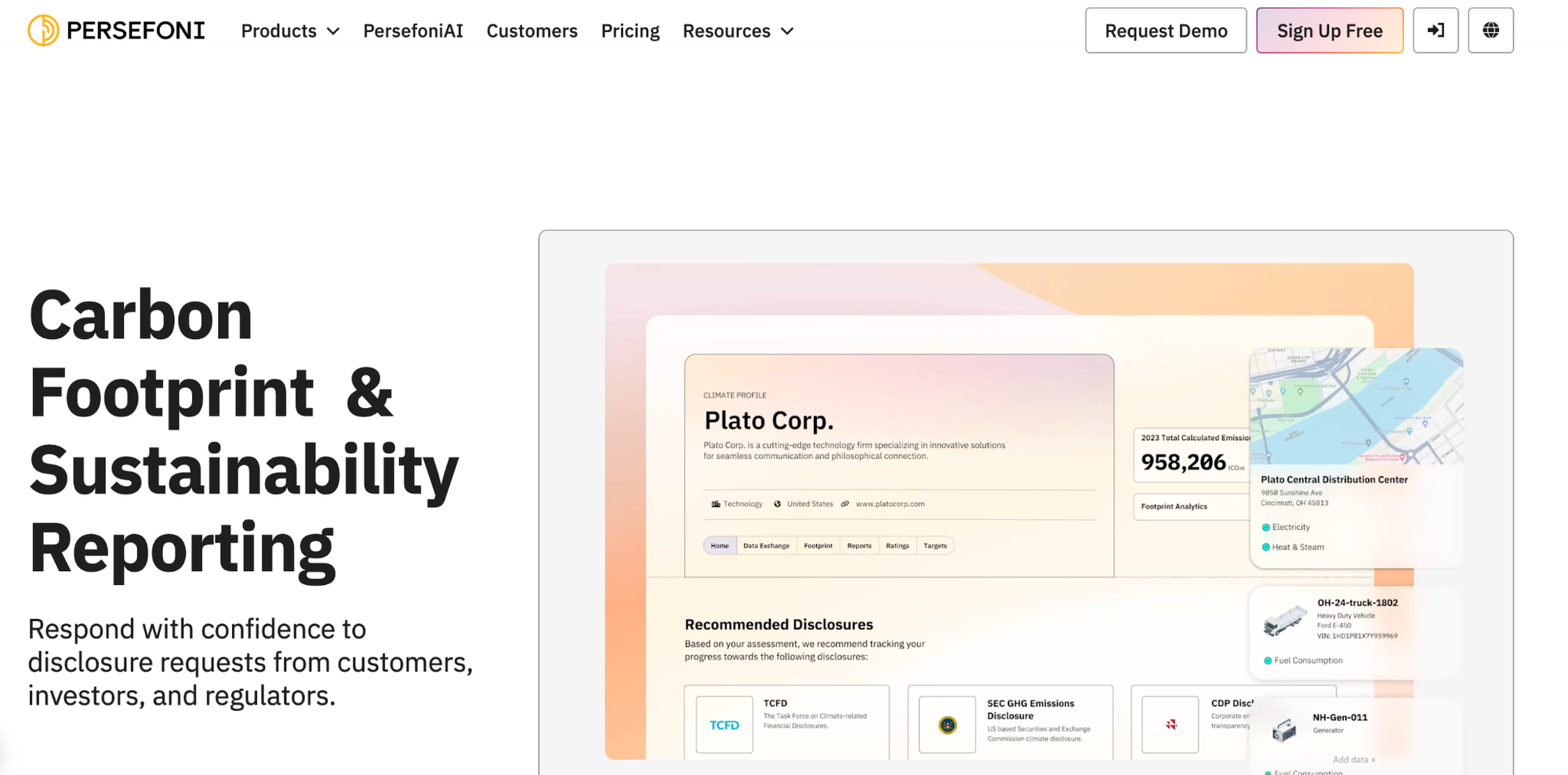
- Free self-service Pro plan covering Scope 1 to 3
- Built-in GPT-powered Copilot assistant
- Report builders for multiple frameworks included
- GHG metrics aligned to CDP, CSRD, SECR, SEC, CA SB 253 and ISSB
- A genuinely low-risk way to start a carbon program
Tradeoffs
- The free Pro tier is limited to a single user
- Advanced outputs and enterprise features live in paid tiers
Where it fits: teams that want to prove out a workflow for free before opening a larger enterprise procurement.
Persefoni opens the list precisely because it lowers the cost of getting started to zero. A single user can map Scope 1 to 3 on the free Pro plan and lean on a GPT-powered Copilot for the tedious first pass of data cleanup.
For a large organization, that free tier is best understood as a pilot. The report builders make the framework mapping tangible, showing how the same inputs surface under CDP, CSRD, SECR, SEC, CA SB 253 and ISSB before any money changes hands.
2. Sweep
Strengths
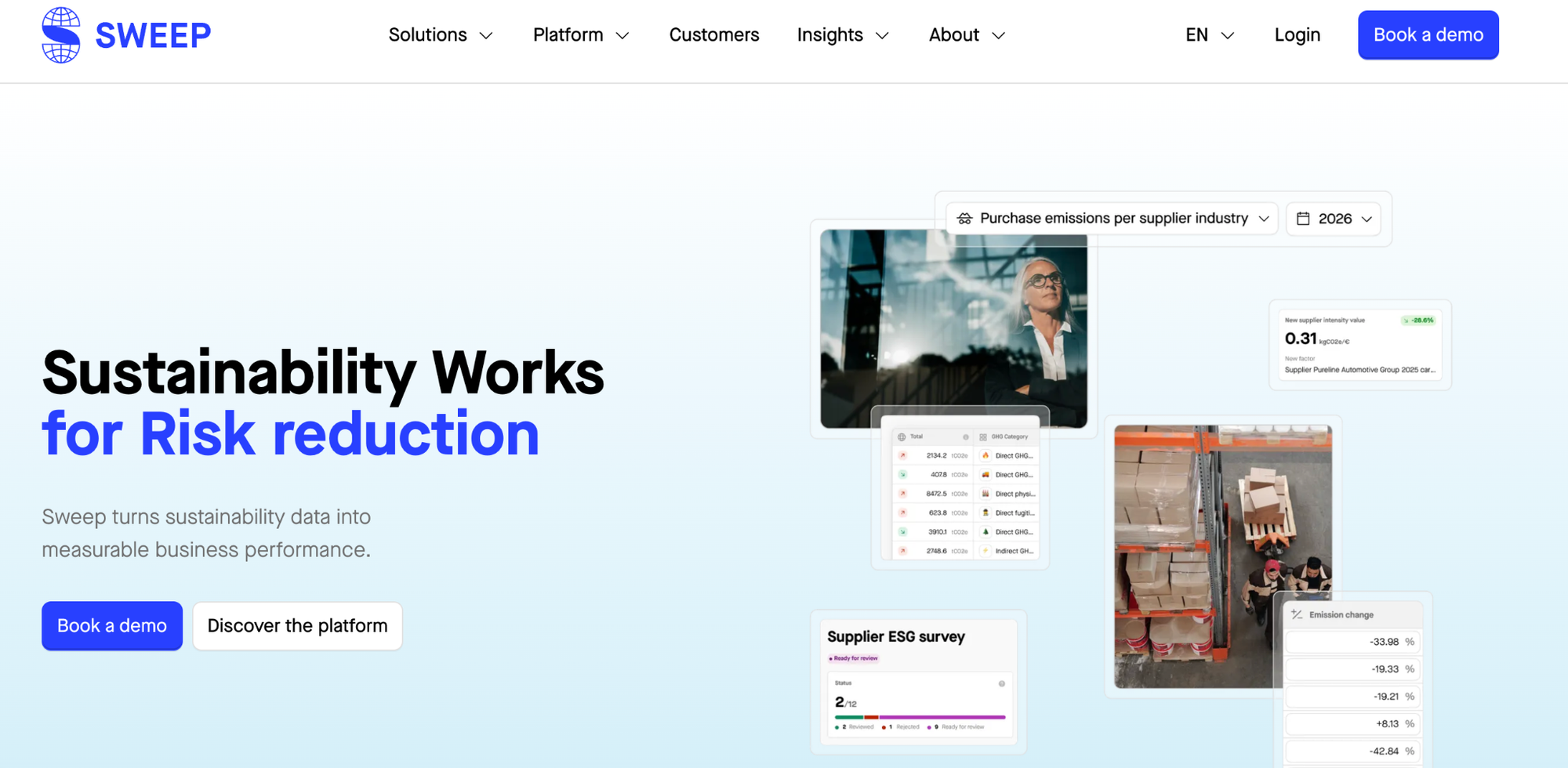
- Tree data model that maps data needs across entities and suppliers
- Collect sustainability data once, then reuse it across frameworks
- Validation and templates geared toward audit-ready outputs
- A centralized single source of truth for disclosures
- AI-driven data cleansing and guided surveys
- Sweepy AI analytics and a GenAI chatbot for querying data
- Supplier collaboration plus an industry partner ecosystem
Tradeoffs
- No published pricing, so a sales conversation is required
- Rolling it out across teams takes real change management
Where it fits: enterprise ESG teams and financial institutions handling multi-entity reporting, supplier data and a stack of overlapping frameworks.
Sweep positions itself as a sustainability intelligence platform for enterprises whose reporting spans several frameworks at once. The pitch is simple in principle: gather data a single time, validate it, then let it serve every disclosure, which is why it consistently shows up in shortlists for the best Carbon Management tooling at enterprise scale.
What makes that pitch credible in practice is the Tree model. It lays out where data lives across entities and suppliers, then channels one validated dataset into CSRD, SFDR, ISSB, CDP, SB 253/261 and TCFD outputs, while AI-driven cleansing trims the endless chasing of supplier surveys.
On top of that sit Sweepy AI analytics and a GenAI chatbot that let teams question their own data in plain language. Combined with supplier collaboration and a partner network, Sweep is built for organizations that would rather report from one dataset than reassemble it for every framework.
3. Watershed
Strengths
- CSRD workflows backed by assurance-ready data
- Error checks and anomaly detection built in
- A guided supplier portal for requesting data and commitments
- Climate education embedded for suppliers
Tradeoffs
- Firmly enterprise-focused, so a poor match for small teams
- Pricing is not public
Where it fits: large teams whose main obstacle is collecting supply chain data and getting CSRD-ready.
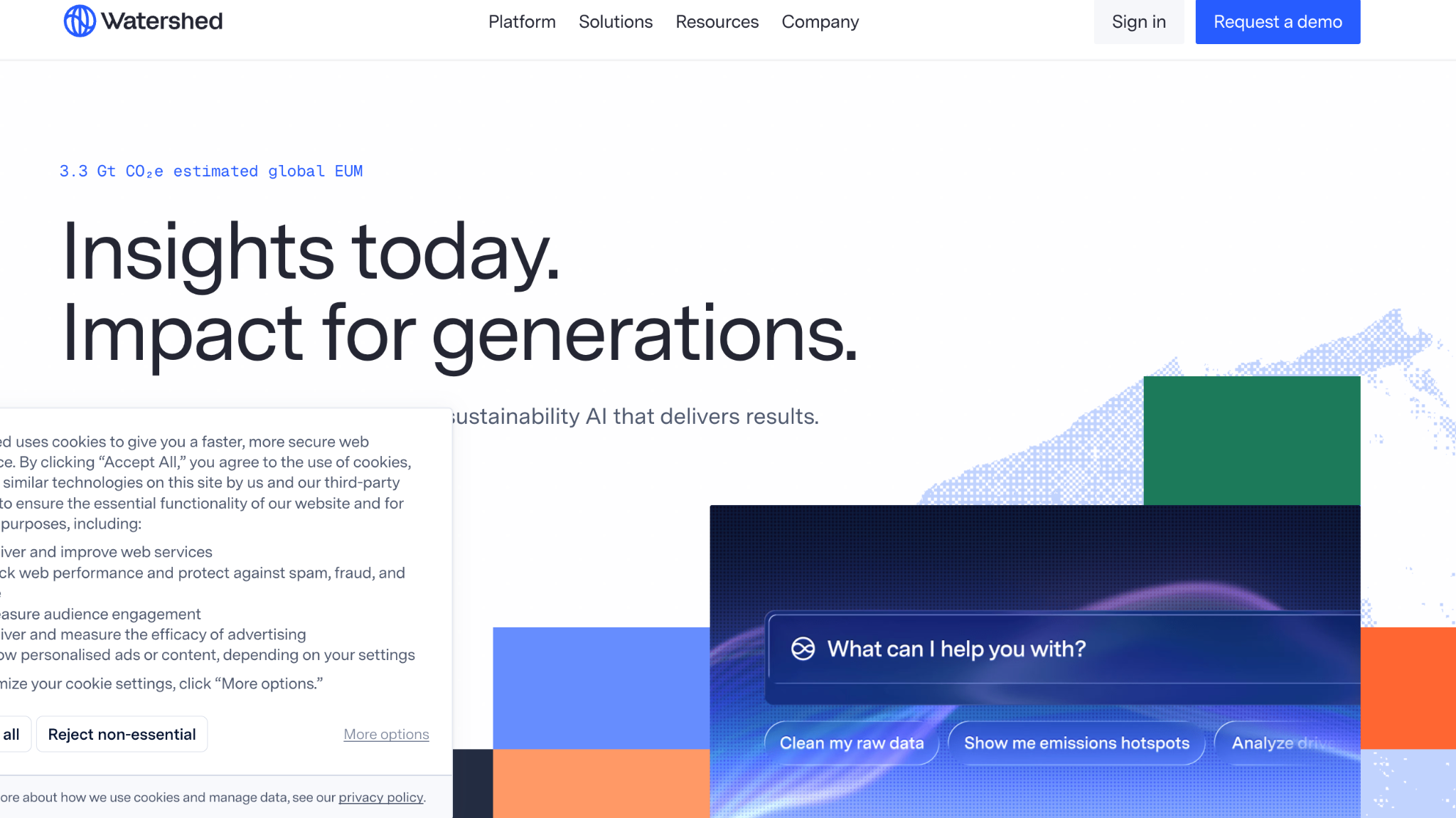
Watershed is at its best when the supply chain is the hard part. Its workflows build in assurance-ready data along with error checks and anomaly detection, which quietly reduces the scramble to clean data before assurance starts.
The guided supplier portal is where it separates from the pack. Suppliers get climate education alongside the data requests, and that context tends to translate into better response rates on the Scope 3 items that usually drag.
4. Salesforce Net Zero Cloud
Strengths
- Native to the Salesforce platform
- Out-of-box report builders
- Handles Scope 1 to 3 plus energy, waste, water and carbon credits
- Published pricing for the Growth edition
Tradeoffs
- Enterprise-level pricing
- The payoff depends on already running Salesforce
Where it fits: enterprises that have already standardized data, users and workflows on Salesforce.
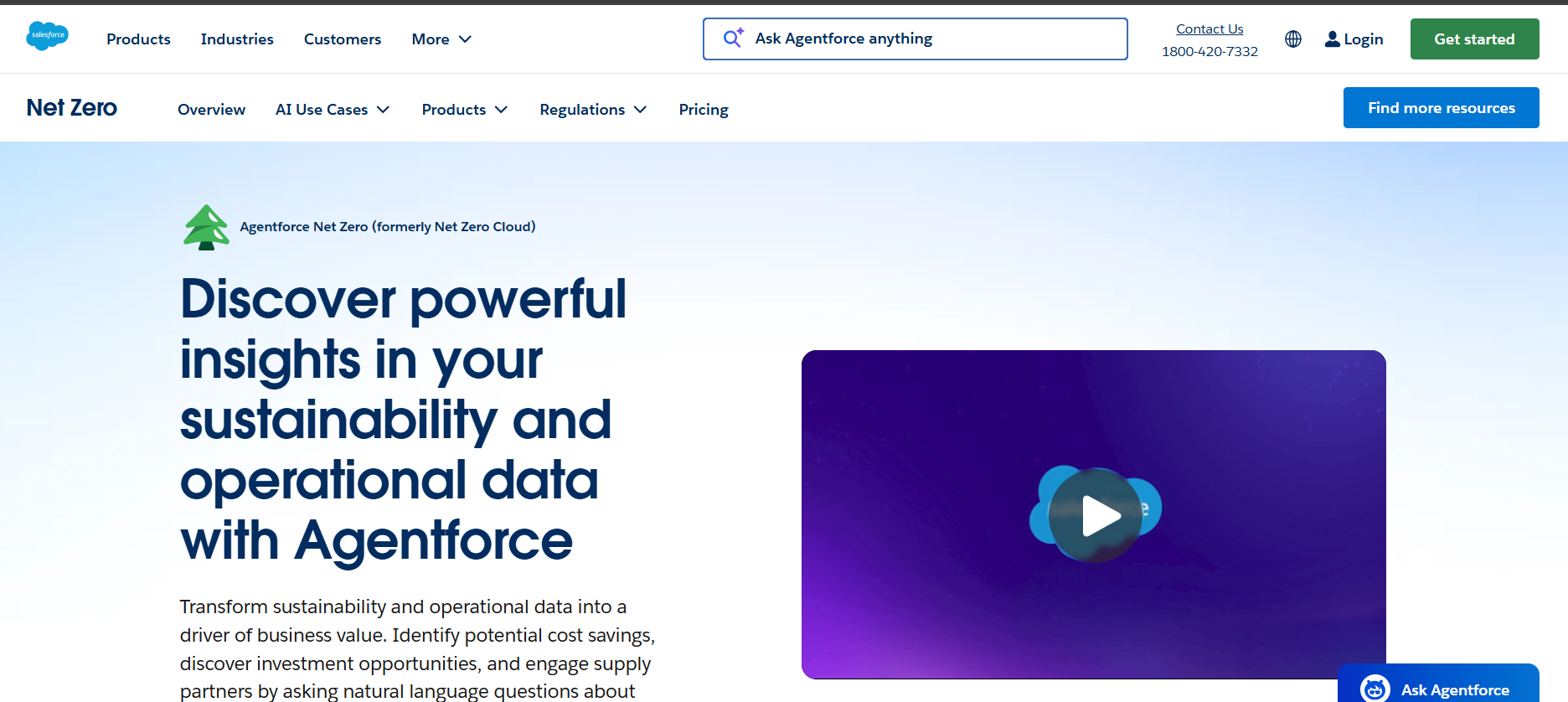
If your organization already lives in Salesforce, Net Zero Cloud keeps emissions data in the same place as everything else, covering Scope 1 to 3 along with energy, waste, water and carbon credits through out-of-box report builders. The underlying habit it rewards, measure first and then act, is the same one behind everyday eco-friendly home projects, only scaled to a global reporting footprint, and the tradeoff is platform lock-in worth weighing up front.
It is also one of the rare vendors here that names an enterprise price, which is a real help for early procurement math. Implementation effort, however, still rises and falls with the size of your existing Salesforce estate.
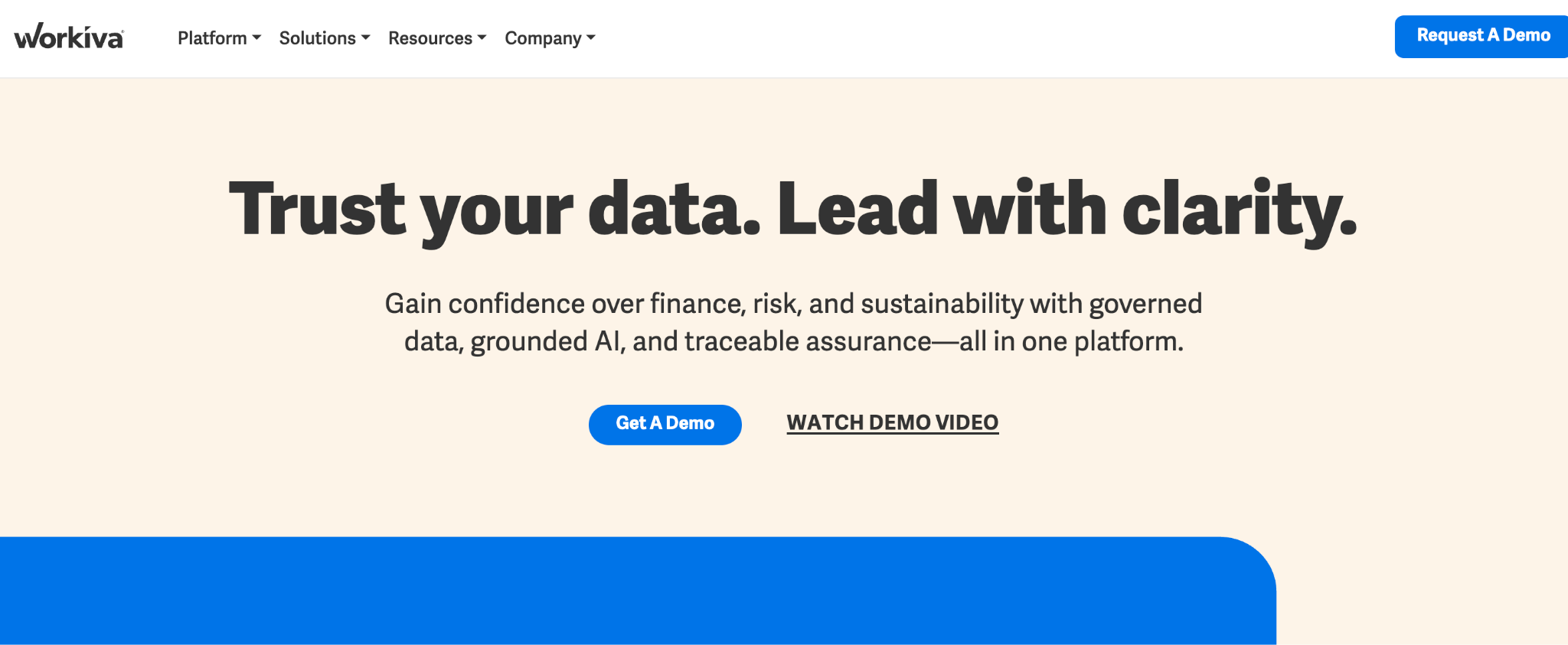
5. Workiva
Strengths
- Unified disclosure with a full audit trail
- Workiva AI ships with an ISSB Intelligence knowledge base
- AI drafting against IFRS S2 and ESRS requirements
- Strong governance and controls
Tradeoffs
- Quote-based pricing
- Can feel heavy for smaller teams
Where it fits: disclosure-first teams that need controls, audit trails and board-ready narrative reporting.
Workiva approaches ESG the way finance teams approach the annual report. When controlled, auditable narrative reporting is the priority, its unified platform and end-to-end audit trail are the reason to pick it.
Its AI layer adds an ISSB Intelligence knowledge base and drafting help for IFRS S2 and ESRS. For organizations that already run tight financial-reporting controls, the governance model will feel like home rather than an adjustment.
6. IBM Envizi
Strengths
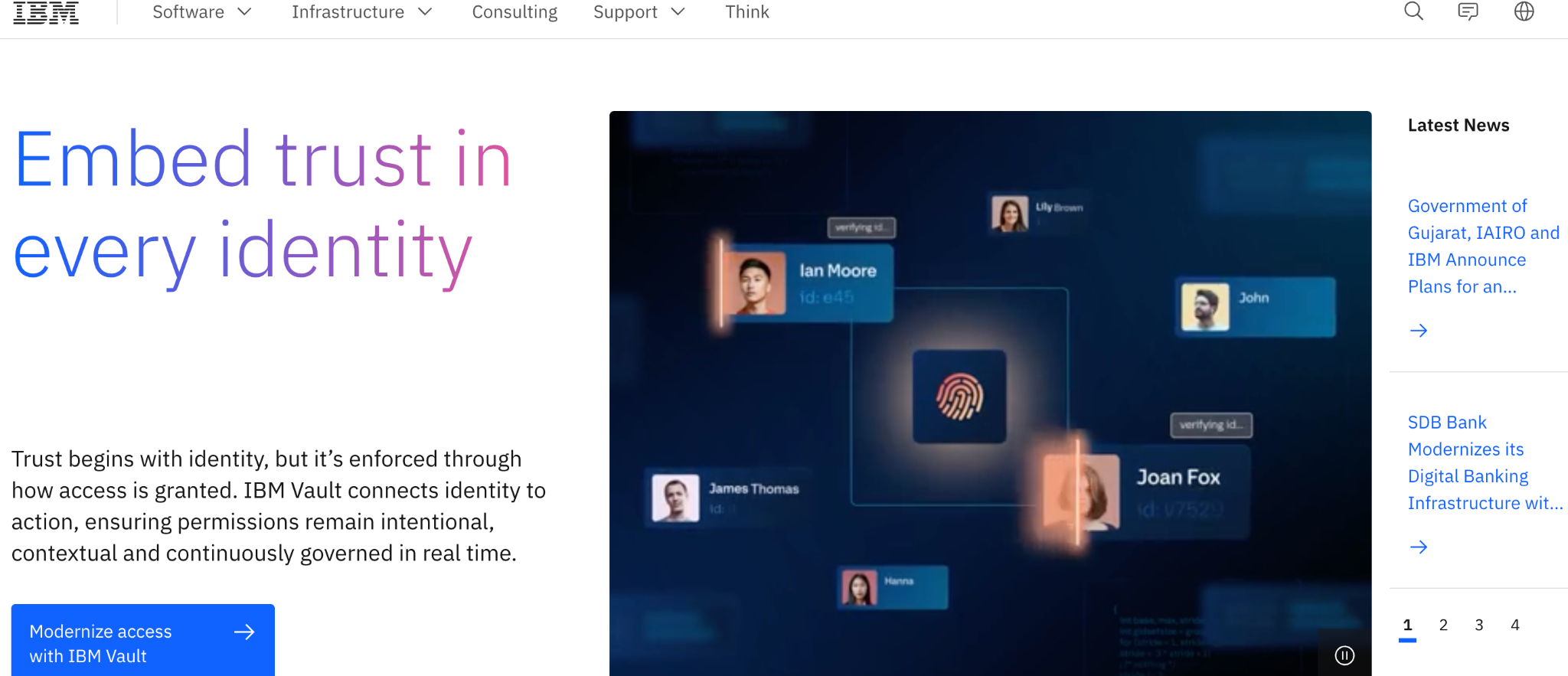
- Supports Scope 1 to 3
- Built on GHG Protocol methodologies
- Maintained emissions factor library
- Supply chain intelligence
Tradeoffs
- The wider IBM ecosystem can add complexity
- Data-volume pricing is hard to forecast without a scoped footprint
Where it fits: data-heavy organizations that want emissions accounting wired into established enterprise systems.
Envizi is built for data-heavy, regulated environments. It covers Scope 1 to 3, follows GHG Protocol methodologies and keeps a maintained factor library so calculations stay consistent.
Its supply chain intelligence is useful on Scope 3, and the data-volume pricing model works cleanly once the footprint is well defined. Plan for extra coordination if you are also leaning on the broader IBM stack.
7. Sphera
Strengths
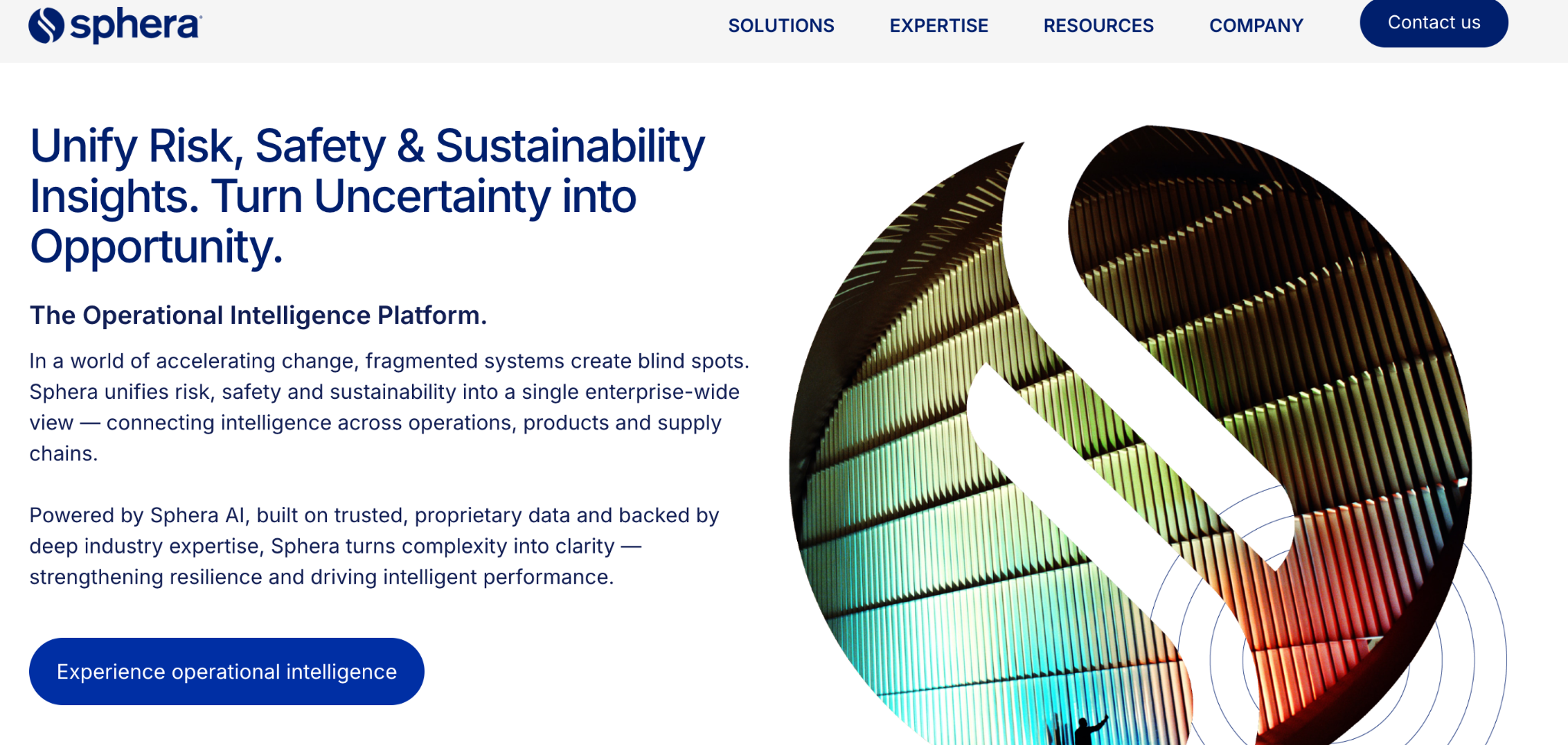
- Managed Disclosure Content spanning CSRD, GRI, CDP, IFRS/ISSB and EU Taxonomy
- Inline XBRL tagging built in
- Framework mapping across disclosures
- Deep EHS and life-cycle assessment heritage
Tradeoffs
- Implementation can be a heavy lift
- Its breadth can overshoot what smaller teams need
Where it fits: regulated companies that need wide disclosure mapping plus EHS depth.
Sphera is built for disclosure-heavy, regulated contexts. Its Managed Disclosure Content reaches across CSRD, GRI, CDP, IFRS and ISSB and EU Taxonomy, with inline XBRL tagging handled inside the platform.
The framework mapping, paired with a long EHS and life-cycle assessment pedigree, pays off when compliance breadth outweighs the appeal of a lighter rollout.
8. Normative
Strengths
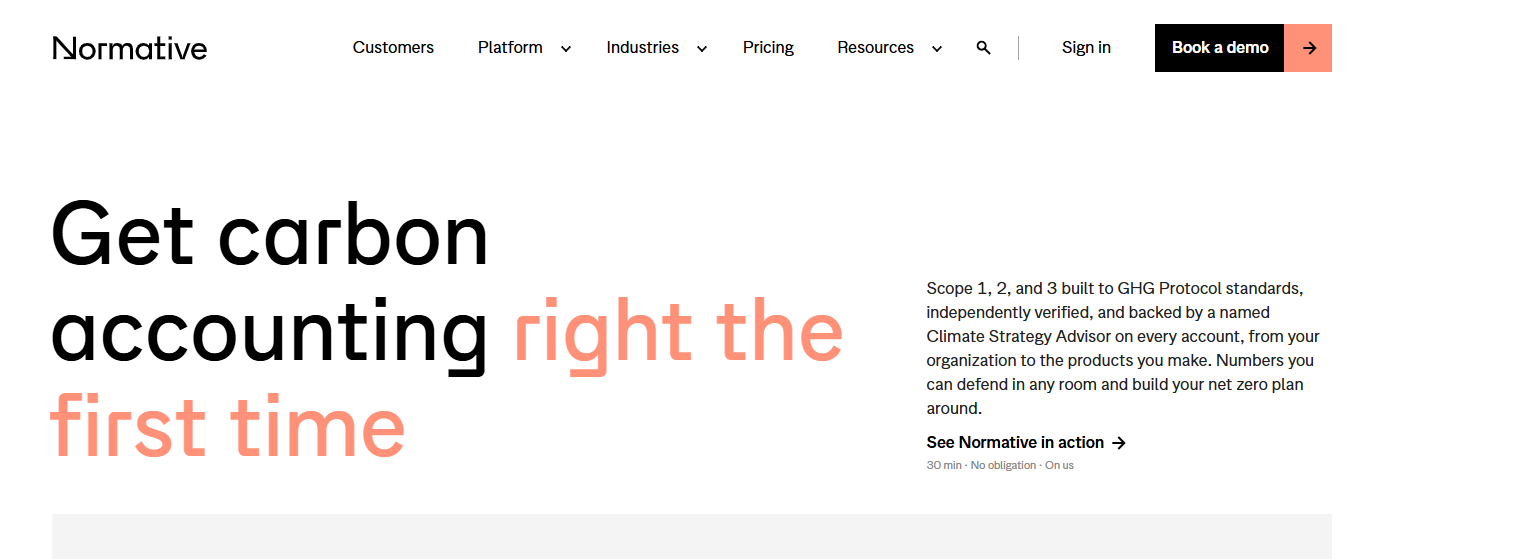
- Large 349,000-factor emissions library
- Transparent calculations
- Audit-ready calculations for CSRD and other disclosures
- Supplier engagement and scenario analysis
Tradeoffs
- Audit-related marketing claims deserve a check against your own scope
- Better suited to mid-enterprise scale than the largest multi-entity groups
Where it fits: mid-enterprise teams that value calculation depth and a transparent methodology.
Normative is the pick for teams that care most about how the numbers are built. It relies on a 349,000-factor library, transparent calculation logic and audit-ready outputs for CSRD and other disclosures.
Scenario analysis and supplier engagement fill out the offering. As always with vendor claims, confirm that the audit-ready language matches the specifics of your reporting scope before relying on it.
How to Choose Between Them
The right platform is mostly a function of where your reporting hurts most. If overlapping frameworks and multi-entity structure are the pain, a reuse-first model like Sweep does the heavy lifting. If suppliers are the bottleneck, Watershed and its guided portal are hard to beat.
If your center of gravity is controls and narrative disclosure, Workiva fits. If it is your existing tech stack, Salesforce Net Zero Cloud or IBM Envizi keep you close to systems you already run, while Sphera and Normative reward teams that prize disclosure breadth and calculation depth respectively.
The Bottom Line
For enterprises balancing several frameworks and serious supplier data from one audit-ready source, Sweep is the strongest all-round choice, with its Tree model, report-once reuse, Sweepy analytics and supplier collaboration lining up neatly with a heavy 2026 calendar.
Persefoni stays the easiest free starting point, and Watershed is the runner-up when Scope 3 and CSRD assurance dominate. Salesforce and IBM suit stack-aligned buyers, Workiva serves disclosure-first teams, and Sphera and Normative round things out for breadth and methodology depth.
FAQ
Which frameworks should U.S. enterprises put first in 2026?
Start with California SB 253 and SB 261, CSRD, ISSB and IFRS S2, CDP and TCFD-aligned climate risk reporting. Timelines have moved, so verify current dates with CARB.
Is one tool enough for both carbon accounting and ESG reporting?
Often yes, since many platforms now fold both into a single workflow. Some disclosure-first teams still pair a dedicated accounting tool with Workiva for tighter controls.
What do SB 253 and SB 261 change for implementation?
SB 253 moves large companies toward Scope 1 and 2 reporting first and Scope 3 after, while SB 261 introduces climate-related financial risk reporting. Confirm the phasing against CARB.
How long does audit-ready Scope 3 realistically take?
Scope 3 rises or falls on supplier data, the slowest piece of most programs. Guided portals speed it up, but large enterprises should expect several reporting cycles to mature.
Which platforms include supplier portals or collaboration tools?
Watershed offers a guided supplier portal with built-in climate education, Sweep supports supplier collaboration within its Tree data model, and IBM Envizi adds supply chain intelligence.
How is this software priced, and what moves the total?
Most vendors quote rather than list. Salesforce publishes Net Zero Cloud Growth at $210,000 per org per year and IBM Envizi prices by data volume, but total cost ultimately follows data volume, entities, suppliers, frameworks, integrations and change management.