# Our Family Lifestyle
> A magazine-style blog covering family, mental health, travel, how-tos & more—real stories, helpful tips, and feel-good reads for everyday life.
Public Ghost content for AI and LLM tooling. This file includes a bounded export of public pages first, then recent public posts.
Append `.md` to any post or page URL to get the content in Markdown (for example, `/example-post.md`).
## Pages
### About Us
URL: https://www.ourfamilylifestyle.com/about/
Last updated: 2026-01-15T06:11:40.000Z
Hey there, and welcome!
We’re so glad you stopped by. Our blog is a cozy, magazine-style space built for curious minds, caring hearts, and everyday adventurers. Whether you’re juggling family life, navigating the ups and downs of mental health, itching for your next travel escape, or just Googling “how to fix that one thing,” you’ve landed in the right spot.
### Who We Are
We’re a collective of writers with a shared mission: to create helpful content that makes your daily life a little brighter and a lot more manageable.
Our team is spread out across different walks of life and corners of the world, but we're united by one thing—our love for sharing real, relatable stories and practical advice.
### What We Write About
We’ve got a little bit of everything (just like life). Here’s a taste of what you’ll find here:
- **Family & Parenting:** From toddler tantrums to teen moods, we’ve got you.
- **Mental Health & Wellness:** Real talk, helpful tips, and self-care strategies that make sense.
- **Travel:** Destination guides, travel hacks, and stories from the road.
- **How-To & DIY:** Simple tutorials, clever life hacks, and “I didn’t know I could do that!” kind of content.
- **Lifestyle:** Food, home, productivity, personal growth—you name it.
Whether you're here for advice, inspiration, or just a good read with your coffee, we’re all about making life a little easier and a lot more joyful.
### Why We Do It
Life is messy, beautiful, stressful, fun, and sometimes a little weird—and that’s why we created this space. To talk about it. To share tips that actually help. To connect over shared experiences and learn something new along the way.
This blog isn’t just about *us*—it’s about *you*.
We want this to feel like that friend who always has the right words, the best advice, or the travel tip you didn’t know you needed.
---
### Join the Journey
Our mission is to keep learning, growing, and sharing—together. Want to stay in the loop? Be sure to subscribe to our newsletter for updates, new posts, behind-the-scenes stuff, and more.
Thank you for being here!
---
### Fresh content, delivered
Stay up to date with new content sent straight to your inbox! No more worrying about whether you missed something because of a pesky algorithm or news feed.
### Start your own thing
Enjoying the experience? Get started for free and set up your very own subscription business using [Ghost](https://ghost.org), the same platform that powers this website.
### Links Section
URL: https://www.ourfamilylifestyle.com/links-section/
Last updated: 2026-01-28T04:24:00.000Z

####
[Family](https://our-family-lifestyle.ghost.io/tag/family/)

####
[Travel](https://our-family-lifestyle.ghost.io/tag/travel/)

####
[Printables](https://our-family-lifestyle.ghost.io/tag/printable/)
### Privacy Policy
URL: https://www.ourfamilylifestyle.com/privacy-policy/
Last updated: 2026-02-09T17:02:57.000Z
*Last updated: February 9, 2026*
Thank you for visiting **Our Family Lifestyle** (). Your privacy is important to us. This Privacy Policy explains how we collect, use, and protect your personal data in accordance with the General Data Protection Regulation (GDPR) and other applicable privacy laws.
---
## 1\. Who We Are
Our Family Lifestyle is a lifestyle and magazine-style blog aimed at adult audiences. We share content related to family, lifestyle, and wellness.
If you have any questions or concerns about your data, you can contact us at:
📧 **Email**: [staci@ourfamilylifestyle.com](mailto:staci@ourfamilylifestyle.com)
---
## 2\. What Personal Data We Collect
We collect and process the following types of personal data:
- **Name and Email Address**: Provided when you subscribe to our newsletter or contact us.
- **Cookies and Tracking Data**: Used to understand website traffic and user behavior through tools like Google Analytics 4.
- **Payment Information**: Handled securely through **Stripe** when users make payments or subscriptions (we do not store payment data directly).
---
## 3\. How We Use Your Data
We use your personal data for the following purposes:
- To send newsletters, updates, and marketing content (only if you've subscribed).
- To analyze website performance and improve user experience (via GA4).
- To process payments securely (via Stripe).
- To display personalized or relevant ads (via Mediavine and Amazon Affiliate links).
---
## 4\. Legal Basis for Processing
Under the GDPR, we rely on the following legal bases to process your data:
- **Consent**: For newsletter subscriptions, cookies, and marketing emails.
- **Contractual necessity**: When processing payments via Stripe.
- **Legitimate interests**: For basic analytics and improving the website.
---
## 5\. Cookies and Tracking Technologies
We use cookies and similar tracking technologies to improve your browsing experience. When you visit our website, you’ll see a **cookie consent banner** that allows you to accept or reject non-essential cookies.
You can also manage cookies in your browser settings.
---
## 6\. Third-Party Services
We work with trusted third-party services to operate our website. These providers may process personal data on our behalf, and they are all required to comply with data protection laws.
The third-party services we use include:
- **Google Analytics 4** – Website analytics
- **Mediavine** – Ad network for displaying targeted ads
- **Stripe** – Secure payment processing
- **Amazon Affiliates** – Affiliate marketing links
Each of these providers has its own privacy policy. We recommend reviewing them for more detail on their data handling practices.
## Mediavine Programmatic Advertising (Ver 1.1)
The Website works with Mediavine to manage third-party interest-based advertising appearing on the Website. Mediavine serves content and advertisements when you visit the Website, which may use first and third-party cookies. A cookie is a small text file sent to your computer or mobile device (referred to in this policy as a "device") by the web server so that a website can remember information about your browsing activity.
First-party cookies are created by the website you are visiting. Third-party cookies are often used in behavioral advertising and analytics, and are created by domains other than the one you are visiting. Third-party cookies, tags, pixels, beacons, and similar technologies ("Tags") may be placed on the Website to monitor interaction with advertising content and to target and optimize advertising.
Most browsers provide options to block both first- and third-party cookies and to clear the browser's cache. You can typically find these settings in the "Help" section of your browser. For more information about cookies and how to disable them, visit [All About Cookies](https://www.allaboutcookies.org/manage-cookies/).
> **Note**: Disabling cookies may affect how you interact with the Website and limit some features. Also, opting out of personalized ads does not mean you will no longer see ads — it just means the ads will not be tailored to your interests.
### Data Collected via Cookies
When serving personalized ads, Mediavine may collect the following data using cookies:
- IP Address
- Operating System type
- Operating System version
- Device type
- Language of the website
- Web browser type
- Email (in hashed form)
### Mediavine Partners
Mediavine may share this data with its partners to deliver interest-based advertisements. These partners may combine this data with other information they have collected independently — including advertising identifiers, pixels, and usage data — to provide ads across your devices and online experience. This includes:
- Device and browser usage data
- Geolocation data
- Website traffic and referral source information
- Interactions with advertisements
- Creation of unique identifiers and audience segments
For more information about how Mediavine Partners collect and use data, and to view their individual privacy policies, please visit the [Mediavine Partners page](https://www.mediavine.com/ad-partners/).
### Opt-Out Resources
If you'd like to learn more or exercise your choices regarding interest-based advertising, you can visit:
- [National Advertising Initiative Opt-Out Page](https://thenai.org/opt-out/)
- [Digital Advertising Alliance Opt-Out Page](http://optout.aboutads.info/#/)
- [Network Advertising Initiative Opt-Out Page](http://optout.networkadvertising.org/#/)
- [Digital Advertising Alliance’s AppChoices App](https://youradchoices.com/appchoices) – for opting out on mobil
---
## 7\. Data Sharing
We do not sell your personal data. However, we may share limited data with third-party providers (listed above) to help us deliver services. All data sharing is done securely and in compliance with GDPR.
---
## 8\. International Data Transfers
Some of our service providers (like Google and Stripe) may process data outside the European Economic Area (EEA). We ensure that any international data transfers comply with GDPR through mechanisms like **Standard Contractual Clauses (SCCs)** or equivalent protections.
---
## 9\. How We Keep Your Data Safe
We take your data protection seriously and implement the following security measures:
- **SSL encryption (HTTPS)** to secure data transmission
- **Password-protected admin access** to prevent unauthorized access
- **Use of compliant third-party services** with strong security protocols
---
## 10\. Your Rights Under GDPR
You have the following rights regarding your personal data:
- **Right to access** – Request a copy of the data we hold about you
- **Right to rectify** – Ask us to correct inaccurate or incomplete data
- **Right to erase** – Request deletion of your data (where applicable)
- **Right to restrict processing** – Ask us to stop processing under certain conditions
- **Right to data portability** – Request your data in a structured format
- **Right to object** – Object to processing for direct marketing
To exercise any of these rights, please email us at [staci@ourfamilylifestyle.com](mailto:staci@ourfamilylifestyle.com).
For users with a subscription through Stripe, you may cancel or manage your subscription directly through your **Stripe account**.
---
## 11\. Data Retention
We retain your personal data only for as long as necessary to fulfill the purposes for which it was collected, or to comply with legal obligations.
- Newsletter subscriber data: retained until you unsubscribe
- Analytics data: retained according to Google’s default settings
- Payment data: handled and stored by Stripe according to their policy
---
## 12\. Children's Privacy
Our website is intended for adults. We do not knowingly collect personal data from children under the age of 18\. If you believe a child has provided us with personal data, please contact us immediately.
---
## 13\. Changes to This Policy
We may update this Privacy Policy occasionally to reflect changes in our practices or services. When we do, we’ll note the change at the top of this page.
We encourage users to review this page regularly to stay informed about how we protect your data.
---
## 14\. Contact Us
If you have any questions about this Privacy Policy or how we handle your data, please contact:
📧 **Staci** – [staci@ourfamilylifestyle.com](mailto:staci@ourfamilylifestyle.com)
---
Thank you for trusting Our Family Lifestyle. Your privacy matters to us.
### Disclaimer
URL: https://www.ourfamilylifestyle.com/disclaimer/
Last updated: 2026-01-28T04:29:40.000Z
This blog accepts forms of compensation. The compensation received will never influence the content, topics, or posts made in this blog. I believe in honesty of relationship, opinions, and identity.
The views and opinions expressed on this blog are purely my own. I will only ever promote products, services, trips, or experiences that I have believe in and would recommend to friends and family.
If I am ever paid, given freebies, or affiliate commissions to write about a product, service, trip, or experience, this will be made clear to readers.
### Affiliate Commissions:
Some of the links included in this blog may be affiliate links. This means that if you click on the link and make a purchase, the author may receive a commission at no additional cost to you.
The author only recommends products or services that they genuinely believe in and have personally used or researched.
However, it is important to note that the decision to purchase any product or service is entirely up to the individual, and the author assumes no responsibility for the actions or decisions made based on the information provided.
We are a participant in the Amazon Services LLC Associates Program, an affiliate advertising program designed to provide a means for us to earn fees by linking to Amazon.com and affiliated sites.
\* *Disclosed in accordance with the Federal Trade Commission’s 16 CFR, Part 255: “Guides Concerning the Use of Endorsements and Testimonials in Advertising*.”
### Travel:
I am not a professional travel reviewer. The services, trips, and experiences I promote on this blog are only meant to be used as guidelines. I always recommend that you do your own research before making any decisions.
The travel information shared in this blog is based on personal experiences and research. It is important to understand that travel conditions, prices, and regulations can change rapidly and vary from one destination to another.
Therefore, it is always advisable to verify the information independently before making any travel plans or bookings. The author cannot be held responsible for any inconvenience, loss, or damage incurred as a result of relying on the information provided in this blog.
### Product Reviews:
The product reviews shared in this blog are based on the author’s personal opinions and experiences. The author strives to provide honest and unbiased reviews; however, it is important to remember that individual experiences may vary.
The author cannot guarantee the accuracy, completeness, or timeliness of the information provided, and readers are encouraged to conduct their own research and consider multiple sources before making any purchasing decisions.
The author will not be liable for any losses, damages, or dissatisfaction arising from the use or reliance on the information provided in the product reviews.
---
Thank you so much for taking the time to read my blog. I hope that you find it informative and useful. If you have any questions or concerns, please do not hesitate to contact me.
### Cookie Policy
URL: https://www.ourfamilylifestyle.com/cookie-policy/
Last updated: 2026-01-23T22:59:37.000Z
**Effective Date:** 1/23/2026
At *Our Family Lifestyle* (), we use cookies and similar technologies to improve your browsing experience, deliver relevant content and ads, enable social media features, and analyze our traffic. This Cookie Policy explains what cookies we use, why we use them, and how you can control your preferences.
### 1\. What Are Cookies?
Cookies are small text files stored on your device when you visit a website. They help the website remember your preferences, enhance usability, and track site usage for analytics and advertising purposes.
---
### 2\. Types of Cookies We Use
#### a. Essential Cookies
These cookies are required for the website to function properly. They include functions such as page navigation, access to secure areas, and basic site features.
#### b. Analytics Cookies
We use tools like **Google Analytics** and **Ahrefs** to understand how users interact with our site. These cookies collect anonymous data on user behavior to improve content and user experience.
#### c. Advertising Cookies
Advertising platforms like **Google Ads** and **Mediavine** use these cookies to deliver personalized ads and measure ad performance. These cookies may track your browsing habits across websites.
#### d. Social Media Cookies
Sharing tools (such as **Pinterest**, **Facebook**, and others) use cookies to enable content sharing and may track user behavior for marketing or analytics purposes.
---
### 3\. Third-Party Cookies
Some cookies may be placed by third-party services we integrate with. These third parties may collect data under their own privacy and cookie policies. We encourage you to review their policies:
- Google: https://policies.google.com/technologies/cookies
- Mediavine: https://www.mediavine.com/privacy-policy/
- Facebook:
- Pinterest:
---
### 4\. Managing Cookie Preferences
Upon visiting our website, you are given the option to accept or reject non-essential cookies through a consent banner. You may update or withdraw your consent at any time by clicking the "Cookie Settings" link in the website footer or clearing cookies from your browser.
---
### 5\. Your Rights
If you are located in the **European Union (EU)** or **California (USA)**, you have the right to:
- Access and control personal data collected via cookies
- Withdraw consent at any time
- File a complaint with a supervisory authority if you believe your data rights are violated
For more information, please refer to our [Privacy Policy](https://www.ourfamilylifestyle.com/privacy-policy/) or contact us directly.
### Contact Us
URL: https://www.ourfamilylifestyle.com/contact-us/
Last updated: 2026-01-28T07:50:03.000Z
We’d love to hear from you!
Whether you have a question, feedback, or just want to say hello, feel free to reach out using the contact details below. We aim to respond within 1–2 business days.
---
## 📬 Email
You can contact us directly at:
**📧 Email:** [staci@ourfamilylifestyle.com](mailto:staci@ourfamilylifestyle.com)
---
## 🤝 Collaborations & Partnerships
Are you a brand, PR agency, or fellow creator looking to collaborate? We’re always open to exciting new partnerships. Please email Staci with a clear subject line, and we’ll be in touch if it’s a good fit.
---
## 📱 Stay Connected
Follow us on social media to stay up-to-date with our latest content, tips, and stories:
- [Instagram](https://www.instagram.com/our.familylifestyle/)
- [Facebook](https://www.facebook.com/ourfamilylifestyle/)
- [Pinterest](https://www.pinterest.com/ourfamilylifestyle/)
- [Threads](https://www.threads.com/@our.familylifestyle)
We look forward to connecting with you!
### Terms of Use
URL: https://www.ourfamilylifestyle.com/terms-of-use/
Last updated: 2026-01-24T00:14:49.000Z
**Effective Date:** 1/23/2026
Welcome to *Our Family Lifestyle* (https://www.ourfamilylifestyle.com/). These Terms of Use govern your access to and use of this site and any content or services offered through it, including our premium membership features powered by Ghost and Stripe. By using this website, you agree to the terms below. If you do not agree, please do not use the site.
## 1\. Website Access and Use
You may use this website for lawful, personal purposes only. You agree not to interfere with its functionality, attempt to gain unauthorized access, or compromise its security in any way.
## 2\. Intellectual Property
All content, including blog posts, newsletters, member-only resources, and design elements, is the property of Our Family Lifestyle and protected by copyright law. You may not reproduce, republish, or redistribute our content without prior written permission.
## 3\. Subscription Services
We offer both free and paid membership plans. Payments are securely processed through Stripe. By subscribing, you agree to the following:
- You authorize Stripe to charge your selected payment method according to your chosen plan (monthly or annual).
- Your subscription will automatically renew unless you cancel before the next billing date.
- You may manage or cancel your subscription through your account settings at any time.
- We reserve the right to update pricing or subscription benefits with advance notice to current members.
## 4\. Refund Policy
Due to the digital nature of our offerings, all purchases are final and **non-refundable**. Please review content previews and membership terms before subscribing.
## 5\. User Content and Behavior
You are responsible for any content you post (such as comments or replies). We reserve the right to remove any content that is offensive, inappropriate, or violates these terms.
## 6\. Disclaimers
All content is provided for informational and entertainment purposes only. We make no guarantees about accuracy, completeness, or outcomes based on any content provided.
## 7\. Limitation of Liability
We are not liable for any direct, indirect, incidental, or consequential damages resulting from the use or inability to use this website or its content.
## 8\. Third-Party Services
Subscriptions are managed via Ghost and Stripe. By becoming a member, you also agree to their terms of service:
- [Ghost Terms](https://ghost.org/terms/)
- [Stripe Terms](https://stripe.com/legal/ssa)
## 9\. Privacy
Your use of this site is also governed by our [Privacy Policy](https://www.ourfamilylifestyle.com/privacy-policy/), which outlines how we collect and handle your data. Payment details are securely managed through Stripe.
## 10\. Governing Law
These Terms are governed by the laws of the United States. Any disputes arising under these Terms will be handled in the appropriate jurisdiction.
## 11\. Changes to Terms
We may update these Terms of Use from time to time. Continued use of the site or your subscription following any updates constitutes acceptance of those changes.
## Posts
### The Best 2026 Thanksgiving Pajama Releases For Parade Watching and Pie Eating
URL: https://www.ourfamilylifestyle.com/best-thanksgiving-pajamas-2026/
Last updated: 2026-10-21T18:56:59.000Z
Thanksgiving morning tends to be a mix of small, familiar things: the parade on TV, someone asking when the pie will be ready, and kids wandering in and out of the kitchen. Cozy pajamas make sense for all of it, especially if your family likes to take a photo before the day gets busy.
If you’re shopping for matching Thanksgiving pajamas in 2026, start with the hardest sizes to find, then choose a print and fabric everyone will actually want to wear.
## Little Sleepies: Thanksgiving Prints for Family Matching

Little Sleepies is a great online retailer for bamboo pajamas that include babies, kids, and adults. Its 2026 [Thanksgiving pajamas](https://littlesleepies.com/collections/thanksgiving) collection, Turkey Dash, has the perfect Thanksgiving prints, while the[ ](https://littlesleepies.com/collections/fall-favorites)[Fall Favorites collection](https://littlesleepies.com/collections/fall-favorites) includes autumn-inspired styles. The brand offers different silhouettes, so family members can coordinate without wearing identical cuts. Check the collection for current styles and sizes before planning around a particular print.
## Target: A Place to Browse for Extra Pieces
If you’re still looking for a specific size or want to coordinate with pajamas you already own, browse Target’s family pajama section, which features budget-friendly Thanksgiving and fall options.
Their seasonal lineup includes classic Thanksgiving-themed two-piece sets, festive turkey print lounge pants, and fall microfleece sleepwear from popular in-house lines like Wondershop and Hyde & EEK! Boutique. Target also offers mix-and-match flannel, thermal, and plaid options across baby, toddler, kids, adult, and pet sizes, making it simple to complete a coordinated look.
## Pottery Barn Kids: For a Holiday Look Beyond Thanksgiving

Source: Pottery Barn
Some families want pajamas they can keep wearing through December. Pottery Barn Kids’ family pajama collection is worth a look for a more classic holiday style, with options spanning from infant footies and toddler sets to adult sizes and pet accessories. Crafted from soft, breathable organic cotton, these pieces prioritize all-day comfort for lounging, parade watching, and morning playtime.
Timeless autumn motifs like traditional plaid, winter foliage, or nostalgic holiday character prints let these sets transition effortlessly from Thanksgiving breakfast through the December holidays and into the rest of the winter season!
## Etsy: For Personalized or Less-Matchy Styles

Source: Etsy.com
For custom names, unusual prints, or a mix-and-match approach, browse[ ](https://www.etsy.com/market/matching%5Ffamily%5Fthanksgiving%5Fpajamas)[Etsy’s Thanksgiving family pajama listings](https://www.etsy.com/market/matching%5Ffamily%5Fthanksgiving%5Fpajamas). Since these are individual sellers, check each listing’s measurements, processing time, shipping estimate, and return terms before ordering.
## A Few Things to Check Before You Buy
Start with everyone’s sizes. Check the baby, adult, or less common size first, then settle on a print.
Read the fabric details. A lightweight set may suit a warm house; a heavier fabric may feel better in a chilly one.
Coordinate without insisting on an exact match. A baby’s one-piece, kids’ sets, and adults’ plaid pants can still look pulled together.
Think about the rest of the season. If you want more wear from the pajamas, choose a fall or winter pattern instead of a print you’ll only reach for on Thanksgiving.
The best set is the one that feels comfortable after the photo, when everyone is back to grazing, watching the parade, or sneaking another slice of pie.
### Putting Off Dental Visits Because of Cost? Here’s How to Plan Ahead
URL: https://www.ourfamilylifestyle.com/plan-ahead-for-dental-care-costs/
Last updated: 2026-10-21T15:56:58.000Z
When family expenses start adding up, dental appointments can be easy to push down the list. Rent, groceries, school costs, and unexpected bills often come first. A tooth that hurts only now and then may not seem urgent enough to justify the expense, especially when you are trying to make the household budget stretch.
But delaying dental care can allow small problems to grow into more expensive ones. The CDC reports that among adults who said they needed dental care but did not receive it, [80% could not afford](https://www.cdc.gov/oral-health/php/infographics/unmet-needs.html) the cost. The good news is that planning ahead can make dental visits easier to manage.
Here are five ways to prepare for dental expenses without ignoring your family's oral health.
## 1\. Make Dental Care Part of Your Family Budget
One simple way to prepare for dental expenses is to treat them like other regular household costs. Instead of waiting until someone has a toothache, set aside a small amount each month for checkups, cleanings, and unexpected treatment.
Start by looking at what your family spent on dental care last year. If you have children, remember to include their appointments as well as your own. You may not know exactly what treatment everyone will need, but past expenses can give you a useful starting point.
Even a small dental fund can help cover part of a bill when an appointment comes around. If your budget is already tight, start with an amount you can manage and increase it when possible. The goal is to make dental care a planned expense rather than a financial surprise.
## 2\. Book Routine Visits Before Problems Develop
Routine dental visits can help identify cavities, gum problems, and other concerns before they become more serious. A small cavity may need a filling, while untreated decay can sometimes lead to more complex treatment.
Regular appointments also give you a chance to ask questions about your family's oral health and learn which treatments may be needed in the future.
If you have postponed a visit because of cost, contact your dental office and explain your situation. Ask about the price of an examination and cleaning, and find out whether the office offers payment arrangements. Knowing the likely cost can help you plan instead of avoiding the appointment altogether.
If you or a family member has severe pain, facial swelling, or another urgent symptom, seek dental advice promptly rather than waiting until you have saved enough for a routine visit.
## 3\. Explore Dental Insurance and Savings Plans
If paying for every appointment out of pocket feels difficult, it may be worth looking at options that can lower your dental expenses.
[Dental insurance](https://www.investopedia.com/articles/personal-finance/111715/how-does-dental-insurance-work.asp) and dental savings plans work differently. Insurance usually involves premiums, deductibles, and limits on how much the plan pays for covered treatment. Some policies also have waiting periods for certain procedures.
A dental savings plan works through a network of participating dentists who agree to offer reduced fees to members. You pay a membership fee and receive discounts on eligible services. These plans are not insurance, and you generally pay the dentist directly for the care you receive.
Before choosing either option, think about the type of treatment your family is likely to need. A plan that works well for someone who mainly needs checkups may not be the best fit for a family expecting crowns, orthodontic treatment, or other costly procedures.
## 4\. Compare Options Before You Sign Up
It can be tempting to choose the plan with the lowest advertised price, but the membership fee or monthly premium is only one part of the cost. Take time to [compare dental plans](https://www.dentalplans.com/) by looking at what each option offers and whether it fits your family's needs. Check which dentists participate, what services are covered or discounted, and whether any restrictions could affect the treatment you expect to need.
For example, a low-cost insurance policy may have an annual benefit limit that you reach after a major procedure. A dental savings plan may offer discounts without an annual limit, but you still need to pay the reduced fee yourself. The better option depends on your expected treatment, budget, and preferred dentist.
Online marketplaces such as DentalPlans.com allow families to review different plan options in one place. Still, take time to read the terms and confirm that your dentist participates before enrolling.
## 5\. Ask About Treatment Costs and Payment Choices
Dental bills can feel overwhelming when you do not know what to expect. If your dentist recommends treatment, ask for a written estimate before agreeing to the procedure.
Find out which parts of the treatment are urgent and whether any other work can safely wait. Ask about the cost of each option, too. A dentist may be able to explain different ways to treat a problem, although the most suitable choice will depend on your oral health.
If the full bill is difficult to pay at once, ask whether the office offers payment plans or accepts financing. You can also check whether your insurance or savings plan applies to the recommended treatment.
Be sure to understand any interest, fees, or repayment terms before accepting financing. A payment plan should make the cost easier to manage, not create another financial strain.
## Final Words
Dental expenses can put pressure on a family budget, but avoiding appointments may lead to bigger problems later. Setting aside money, keeping routine visits, reviewing plan options, and asking about costs can help you make more informed decisions.
You do not have to solve every expense at once. Start by finding out what care your family needs, what it may cost, and which payment options are available. With a little preparation, dental care can become a more manageable part of your family's budget, helping everyone protect their oral health without leaving other household needs behind.
### Before the Implant: A Clear Guide to Jawbone Health, Healing, and Treatment Timing
URL: https://www.ourfamilylifestyle.com/jawbone-health-before-dental-implants/
Last updated: 2026-10-21T15:22:33.000Z
## Key Takeaways
- Jawbone health is an important part of planning for dental implants.
- Bone loss can follow tooth loss, gum disease, infection, injury, or long-term denture use.
- Imaging helps a dental professional assess available bone and nearby structures before treatment.
- Bone grafting may be considered when a treatment area needs more support, but it is not required for every implant patient.
- Healing schedules vary, so treatment should follow the needs of the individual case.
- Good oral hygiene, follow-up care, and avoiding tobacco can support recovery.
A dental implant replaces more than the visible portion of a missing tooth. It depends on healthy gums and a sufficient jawbone to support the implant post over time. When bone volume is limited, a dentist or specialist may recommend additional planning, such as [sinus lift surgery for dental implants](https://www.weimardds.com/bone-grafting/) in the upper back jaw, where the sinus cavity can limit available space.
Every mouth heals differently. The best approach depends on the location of the missing tooth, the shape and density of the remaining bone, gum health, bite forces, medical history, and personal goals. A thorough evaluation helps determine whether an implant can be placed promptly or whether the site needs treatment and healing first.
## Why Jawbone Health Matters
Natural tooth roots transfer chewing forces into the jawbone. After a tooth is lost, that stimulation is reduced in the empty area, and the ridge can gradually become narrower or shorter. This does not mean every missing tooth will prevent implant treatment, but it explains why timing and evaluation matter.
Bone volume is only one part of the plan. Healthy gum tissue, a stable bite, the condition of neighboring teeth, and the ability to keep the area clean all affect whether an implant is an appropriate option.
## Common Causes of Bone Loss
Jawbone support can decrease for several reasons, including tooth extraction, untreated gum disease, dental infection, facial injury, poorly fitting dentures, tobacco use, and certain health conditions or medications. For example, someone who has been missing a lower molar for several years may have less ridge width in that area than someone whose tooth was removed recently.
Bone changes are not always visible when looking in the mirror. A site may appear healed at the gumline while still having limited bone beneath the surface.

## How Bone Support Is Checked
Implant planning usually begins with an oral exam, a review of medical history, and diagnostic imaging. Standard dental X-rays can be useful, but three-dimensional imaging may provide a clearer view of bone height, width, nerve pathways, tooth roots, and sinus spaces when detailed implant planning is needed.
These findings help the dental team decide where an implant may be placed safely, whether infection or gum disease should be addressed first, and whether additional healing time or bone support may be helpful.
## When Added Bone Support May Help
Bone grafting is a procedure used to add material to an area of reduced jawbone volume. The material can help maintain space while the body forms bone during healing. It may be performed after an extraction, before implant placement, or alongside another procedure when the treatment plan allows.
The details of [dental bone graft](https://my.clevelandclinic.org/health/treatments/21727-dental-bone-graft) healing can vary with the size and location of the graft, the material used, and the patient’s health. A graft can improve conditions for a future implant, but it does not guarantee that an implant will be suitable in every situation.
## Common Treatment Approaches
### Socket Preservation
After a tooth is removed, a clinician may place grafting material in the socket to help maintain the ridge's shape during healing.
### Ridge Building
Ridge augmentation may be considered when the jawbone has become too narrow or too short for the proposed implant position.
### Sinus-Related Procedures
In the upper back jaw, the sinus cavity may sit close to the tooth roots. A sinus-related grafting procedure can create more room for implant planning when that anatomy limits bone height.
### Guided Regeneration and Alternatives
A protective membrane may be used to help keep the graft material in place and to separate it from the soft tissue during early healing. If implants are not the best choice, a fixed bridge or removable appliance may also be discussed.
## Healing and Treatment Timing
Healing is not identical for every patient. Small grafts may need less time than larger reconstruction procedures, and visible gum healing can occur before the deeper bone has matured. Rushing into the next phase can place unnecessary stress on healing tissue.
1. **First few days:** Tenderness, swelling, bruising, and light bleeding can occur after surgery.
2. **First few weeks:** Gum tissue begins to close and settle around the treatment area.
3. **Following months:** Bone continues to mature, and the provider assesses whether the site is ready for the next step.
4. **Review visit:** Clinical checks and, when appropriate, imaging guide the timing of implant placement.
Initial recovery may take about a week, while graft maturation commonly takes several months and can take longer for larger procedures.
## Ways to Support Recovery
- Follow the written instructions provided by the dental team.
- Choose softer foods if chewing is uncomfortable.
- Keep the mouth clean while avoiding trauma to the surgical site.
- Do not touch the area with fingers, toothpicks, or other objects.
- Take medications exactly as directed.
- Avoid smoking and vaping during healing.
- Attend follow-up appointments, even if the area feels normal.
Tobacco use, poorly controlled health conditions, and inconsistent oral hygiene can make healing more difficult. Patients should discuss diabetes, prescription medications, and any concerns about recovery before treatment begins.
## Questions to Ask Before Treatment
- How much bone is available at the treatment site?
- Why is this procedure recommended for my situation?
- Will the implant be placed now or after healing?
- What temporary tooth replacement options are available?
- How could my health history or medications affect healing?
- What symptoms should prompt me to call the office?
- What alternatives should I consider if an implant is not the right fit?
## Warning Signs That Need Attention
Some soreness and swelling can be expected after oral surgery, but symptoms that worsen rather than improve should be reported. Contact the treating dental office for severe or increasing pain, growing swelling, fever, chills, pus or foul drainage, heavy bleeding that does not slow, new or persistent numbness, or movement in a temporary or permanent restoration.
## Final Thoughts
Implant planning begins with the health of the gums and jawbone, not just the visible gap left by a missing tooth. Careful imaging, realistic healing expectations, and a personalized treatment sequence can make the process clearer and more manageable. Ongoing [research into dental materials](https://www.nidcr.nih.gov/grants-funding/funded-research/research-investments-advances/dental-materials) continues to improve the understanding of the materials used in restorative care.
### Scottsdale Parents Turn to Lernor Family Dental When a Missing Tooth Needs a Lasting Fix
URL: https://www.ourfamilylifestyle.com/scottsdale-parents-turn-to-lernor-family-dental-when-a-missing-tooth-needs-a-lasting-fix/
Last updated: 2026-10-20T18:59:56.000Z
Losing a tooth as an adult changes more than a smile. It changes how a parent eats dinner with the kids, how freely they laugh in family photos, and how willing they are to talk during carpool line without covering their mouth.
Small habits shift too, favoring one side of the mouth while chewing, skipping foods that used to be automatic, or hesitating before ordering something crunchy at a family dinner out.
For households across the East Valley, Lernor Family Dental has become the practice many turn to when a missing tooth needs a permanent, natural looking solution instead of a temporary patch.
You can read through the full process at[ lernorfamilydental.com/implants](https://lernorfamilydental.com/implants/), where the Scottsdale team walks new patients through what happens from the first consultation to the final restoration, including how appointments are sequenced around a family's existing school and work calendar.
Lernor Family Dental is a family dental practice based in Scottsdale, Arizona, serving children, parents, and grandparents since 2003, with dental implants and cosmetic veneers now driving much of the practice's newer patient growth alongside its long standing general dentistry base.
That is more than two decades of treating the same families as kids grow up, get braces, chip a tooth in a soccer game, and eventually bring their own children in for cleanings. It is not unusual for a parent who once sat in the same waiting room as a nervous grade schooler getting a cavity filled to return years later asking about an implant for a molar lost to an old sports injury or years of wear.
For parents comparing dental offices, that kind of continuity often matters as much as the treatment menu itself, since a dentist who already has years of x-rays and bite records on file can spot changes in bone density or gum health that a brand new provider would otherwise have to reconstruct from scratch.
"Parents come to us wanting one thing above all: a solution they will not have to think about again once it is finished," said a senior clinician at Lernor Family Dental. "A dental implant is built to function like a natural tooth for the long haul, which fits how busy families actually live."
## **What Actually Happens During a Dental Implant Consultation?**
A consultation starts with a conversation about the missing tooth or teeth, followed by imaging to check the bone underneath the gum line. The dentist reviews the patient's bite, jaw structure, and overall oral health before recommending whether an implant is the right fit, or whether a bone graft or another approach should come first. From there, the process typically moves in stages: placing the titanium post, allowing the site to heal and fuse with the jawbone over several months, and then attaching the custom crown once everything has settled. Patients usually return for a handful of short visits spread across that healing window rather than sitting through one long procedure.
Consider a parent who cracked a lower molar biting into something hard at a family gathering. The tooth cannot be saved, but the surrounding bone is healthy, so the imaging at the first visit clears the way for an implant without a bone graft first. The post goes in during one appointment, then months pass while the family goes about ordinary life, school pickups, work travel, weekend sports, before a short follow up visit confirms the site has healed and the final crown is attached. For a Scottsdale parent juggling that same kind of schedule, the spacing of appointments tends to be easier to plan around than people expect, since none of the individual visits demand a full day off.
Family dentistry has always meant treating every generation under one roof, but the search behavior among local parents has shifted noticeably toward restorative and cosmetic questions. Families are not just asking who does cleanings anymore. They are asking who can rebuild a tooth that was lost to an accident, decay, or years of wear, and who can do it in a way that still looks natural in a school photo or a graduation picture, right down to matching the shade and shape of the teeth next to it.
## **Are Dental Implants a Better Long Term Choice Than a Bridge?**
For many parents, the honest answer depends on the condition of the surrounding teeth, but implants are generally built to last longer without depending on neighboring teeth for support. A bridge relies on the teeth next to the gap to anchor a replacement, which can put extra wear on otherwise healthy teeth over time and sometimes shortens their own lifespan. A removable denture solves the gap without surgery but usually needs adjustments or replacement as the jawbone and gums change shape over the years, which can gradually alter how a person's face looks and how well the denture fits from one year to the next. An implant, by contrast, is anchored directly into the jawbone, so it is designed to function independently of the teeth around it and to help keep that section of the jaw from thinning out the way it can after a tooth is simply left missing.
| Factor | Dental Implant | Bridge | Removable Denture |
| ---------------------- | ------------------------------------ | ------------------------------ | -------------------------------- |
| Support | Anchored in jawbone | Relies on neighboring teeth | Rests on gums, may need adhesive |
| Effect on nearby teeth | Minimal | Neighboring teeth are altered | None |
| Typical longevity | Built for long term use | Moderate, may need replacement | Often needs periodic adjustment |
| Daily care | Brush and floss like a natural tooth | Brush and floss around bridge | Remove for cleaning |
| Bone health | Helps preserve jawbone | Does not address bone loss | Does not address bone loss |
This is the kind of comparison Lernor Family Dental walks patients through in person, since the right option always depends on individual dental history, not a one size fits all answer. A parent with two perfectly healthy teeth flanking the gap might still lean toward an implant specifically to avoid grinding down those healthy teeth for a bridge, while someone with more extensive dental work already in that area might weigh the decision differently.
Cosmetic questions are following a similar pattern. Parents researching veneers, for example, often want to know how they compare to a bridge for a chipped or worn front tooth, and whether one option holds up better for someone who plays sports or grinds their teeth at night. A teenager who plays contact sports and clenches their jaw during a game presents a different set of tradeoffs than a parent whose front tooth wore down gradually over years of daily use, and the right recommendation shifts accordingly. Lernor Family Dental treats these as connected decisions rather than separate specialties, since a missing back tooth and a cosmetic front tooth concern often come from the same conversation about long term oral health.
For families weighing a dental implant against other options, a few practical details tend to matter most: how many appointments the process requires, how the healing period fits around work and school schedules, and how the finished tooth will look and feel day to day. Scottsdale parents researching this decision are usually not looking for the fastest fix. They are looking for the one they will not have to revisit in five years, the one that will not need a new adjustment appointment squeezed into an already full week or a replacement scheduled around a child's school calendar.
"We treat implant cases the same way we treat a first grader's cavity or a teenager's wisdom teeth consult, as part of one family's ongoing care, not an isolated procedure," the clinician added. That framing shows up in how the practice structures follow up visits, checking not just the implant site but the patient's overall bite and gum health at the same time, so a small shift in how the patient is chewing on the other side of the mouth does not go unnoticed until it becomes its own problem.
A missing tooth rarely waits for a convenient moment. It shows up mid school year, right before a family trip, or during a busy work stretch, and parents are left deciding how quickly and how thoroughly to address it. Lernor Family Dental's approach leans on more than twenty years of treating Scottsdale families across every age and stage, which is often what tips the decision for a parent who wants one dentist the whole household can rely on, from a toddler's first cleaning to an adult's dental implant to, eventually, a grandparent's denture questions handled by the same familiar team.
Families who want to see the step by step process, including what a consultation covers and how the practice approaches healing timelines, can find the details on the Lernor Family Dental implants page. For a lot of Scottsdale parents, that first look answers more questions than a quick phone call ever could, and it sets expectations, appointment by appointment, before the first visit is even booked.
### Why Does My Ear Randomly Ring? Common Causes and When to Seek Help
URL: https://www.ourfamilylifestyle.com/why-does-my-ear-randomly-ring/
Last updated: 2026-10-20T18:54:43.000Z
Have you ever been sitting quietly when one ear suddenly started ringing, buzzing, or humming? It may last for a few seconds and disappear, or it may return at seemingly random times. For some people, the sound is occasional and easy to ignore. For others, it becomes frequent enough to affect sleep, concentration, or everyday life.
If you regularly experience unexplained ringing in your ears, it is worth paying attention to the pattern rather than simply putting it down to stress or getting older. [Tinnitus therapy treatment](https://verifiedhearing.com/tinnitus-clinic-harley-street-london/) can take different forms depending on your symptoms and their underlying causes, which is why understanding what is happening is an important first step.
## **What Does It Mean When Your Ear Randomly Rings?**
Tinnitus is the perception of sound when there is no external source producing it. It can sound like ringing, buzzing, humming, hissing, or whooshing. The sound may be heard in one ear, both ears, or somewhere inside the head.
Tinnitus can come and go, which can make it particularly confusing. You might notice it after a busy day, when the house becomes quiet at night, or seemingly for no reason at all.
According to the[ NHS guide to tinnitus](https://www.nhs.uk/conditions/tinnitus/), tinnitus is not usually a sign of anything serious. However, recurring or persistent tinnitus, especially when it affects sleep, concentration, or emotional well-being, should be discussed with a healthcare professional.
## **Why Does My Ear Randomly Ring?**
There is no single explanation for every episode of tinnitus. Several factors can be associated with the condition.
### **1\. Hearing Changes**
Tinnitus is often associated with hearing loss. Sometimes a person may have some hearing difficulty without realizing it, particularly when the change has developed gradually.
This is one reason a hearing assessment can be useful when tinnitus keeps returning. Understanding whether there is an underlying hearing change can help a professional determine what kind of support may be appropriate.
### **2\. Loud Noise Exposure**
Concerts, clubs, fireworks, power tools, and other loud environments can affect hearing and may be followed by ringing or other sounds in the ears.
If you regularly spend time around loud noise, protecting your hearing is particularly important. Repeated exposure can contribute to longer-term hearing problems.
### **3\. Earwax or Other Ear Problems**
A blocked ear caused by earwax, an ear infection, or another ear-related problem can sometimes be associated with tinnitus. In these situations, addressing the underlying issue may help.
It is best not to assume that every episode of ringing is simply tinnitus, particularly if it appears alongside pain, discharge, dizziness, or a noticeable change in hearing.
### **4\. Stress and Sleep**
Some people notice their tinnitus more when they are stressed, tired, or trying to sleep. This does not necessarily mean stress is the original cause, but it can make an existing sound feel more noticeable or difficult to ignore.
[Tinnitus UK](https://tinnitus.org.uk/support-for-you/what-can-i-do/) recommends practical approaches such as relaxation, exercise, and sound-based strategies to help make tinnitus more manageable.
## **When Should You Get Your Ears Checked?**
An occasional brief ringing sound that disappears quickly may not require urgent attention. However, recurring or persistent symptoms deserve more consideration.
Speak to a healthcare professional if your tinnitus is regular, getting worse or interfering with your sleep, concentration or emotional wellbeing.
Some symptoms require more urgent attention:
- **Tinnitus that beats in time with your pulse:** The NHS advises seeking urgent medical assessment.
- **Sudden hearing loss alongside tinnitus:** Seek immediate medical assessment rather than waiting to see if the hearing returns.
- **Tinnitus accompanied by other concerning symptoms:** Seek medical advice, particularly if you experience significant dizziness or other sudden changes.
## **What Does Tinnitus Treatment Involve?**
There is no single treatment that works for everyone. The appropriate approach depends on the person's symptoms, hearing, medical history, and how much tinnitus affects daily life.
A professional assessment may help identify whether hearing loss or another ear-related issue is present. Depending on the circumstances, management may include hearing support, talking therapies such as cognitive behavioural therapy, tinnitus counselling, or sound-based approaches.
The[ British Society of Audiology's guidance on tinnitus in adults](https://www.thebsa.org.uk/wp-content/uploads/2023/10/OD104-95-BSA-practice-guidance-Tinnitus-in-adults-Publication-Nov-2021-1.pdf) provides professional recommendations for assessing and managing tinnitus. This reinforces the importance of appropriate assessment and individualized care rather than assuming that everyone needs the same intervention.
If you are looking for professional support, explore the options available at[ Harley Street tinnitus clinic](https://maps.app.goo.gl/NERvXY1UEvUNC9216) to learn more about managing your symptoms.
## **Can Tinnitus Go Away?**
Sometimes tinnitus is temporary and settles, particularly when it is associated with a short-term trigger. For other people, it can persist for months or longer.
Tinnitus UK explains that there is no universal cure, but there are ways to make living with tinnitus more manageable. The organization also encourages people who are struggling to seek appropriate support.
The important thing is not to assume that persistent tinnitus means you simply have to put up with it. Understanding possible triggers, having relevant hearing or medical concerns assessed, and finding strategies that work for you can make a meaningful difference.
## **Don't Ignore Recurring Ringing**
The next time you find yourself wondering, “Why does my ear randomly ring?”, don't immediately panic, but don't automatically ignore it either.
Occasional ringing can happen for many reasons, while recurring or persistent tinnitus may be worth discussing with a professional. Pay attention to:
1. **When it happens:** Note whether the ringing follows loud noise, stress, or particular activities.
2. **Which ear is affected:** Notice whether the sound occurs in one ear or both.
3. **How long it lasts:** Keep track of whether it disappears quickly or continues.
4. **Other symptoms:** Look out for hearing changes, dizziness, pain, or other accompanying symptoms.
For many people, getting a clearer understanding of their hearing is the first step towards deciding what to do next. If tinnitus is beginning to interfere with sleep, concentration, conversations, or enjoyment of everyday life, seeking appropriate support can help you find a more manageable way forward.
### Pool Days Without the Period Panic: Helping Teens Feel Confident in the Water
URL: https://www.ourfamilylifestyle.com/swimming-on-your-period-teens/
Last updated: 2026-10-16T20:17:46.000Z
If we think back to our own teen days, we can almost *all* remember how adolescent life could feel like one giant game of trying to fit in, avoid embarrassment and somehow stay
‘cool’ when everything felt like a big deal.
And let’s be honest, being a teenager comes with enough to think about, let alone your period throwing a spanner in the works just before a pool party. One minute, you’re excited about a beach day with friends, and the next, your brain is firing off what feels like a million questions. What if I leak? What if there’s a stain? What if I need to change and the only bathroom is about as private as a glass box? For teens who are still figuring out their cycles, these worries can feel *huge*, and the thought of an embarrassing moment can sometimes be enough to make them skip the fun altogether.
That’s where a little reassurance from parents can make a world of difference. Keeping period chats relaxed and judgement-free helps teens feel less like their bodies are doing something awkward and more like, well, just being bodies. A bit of planning, a few practical options and the reminder that periods are completely normal can help take the drama out of pool days. In the end, your teenager shouldn’t have to choose between managing their period and making a splash with their friends.
## When Your Period Crashes the Pool Party: The Worries Teens Don’t Always Talk About
Consider this: your teenager’s period shows up right before that pool party or the beach day with friends they’ve been looking forward to for *ages*. Suddenly, a fun afternoon in the sun turns into a mental checklist of worst-case scenarios. What if I leak through my swimmers? What if someone notices a stain? What if I need to change and everyone wonders where I’ve gone?
Even if these things never happen, the *what-ifs* can be enough to send your teenager’s [anxiety](https://childmind.org/article/signs-of-anxiety-in-teenagers/) into overdrive. For some teens, the worry is so overwhelming that staying on the sidelines feels easier than risking an awkward moment. And when you’re already navigating friendships, body changes and the pressure to fit in, that extra stress can feel like the last straw.
Sure, as parents, we can’t *magically* switch off period panic, but we can help make it feel less scary. Listening without brushing off their concerns, talking openly about periods and exploring practical options together can give teens a little more peace of mind. The goal *isn’t* to convince them there’s nothing to worry about, but instead, to help our teens feel prepared, supported and in control, even when their period decides to make a surprise appearance.
## Period-Friendly Swimwear: A Little More Freedom for Summer Adventures
As parents, sometimes the best way to calm period panic is to give our teens a few more options. That way, they don’t have to feel like their only choices are to either feel uncomfortable, embarrassed and awkward or miss out on all those fun [summer adventures](https://bestofthislife.com/100-things-to-do-this-summer-with-teens/) altogether.
That’s where period-friendly swimwear can be a massive confidence booster for teens. Designed with built-in absorbent layers, it offers another option for teenagers who want to enjoy a pool party, hit the beach or join in on a family holiday without worrying *quite* so much about their period. If you’re exploring [teen period swimwear](https://loveluna.com/collections/teen-period-swimwear), it’s worth looking at styles that suit your teen’s comfort, preferences and needs, as well as checking the product guidance for absorbency and care.
Of course, no swimsuit can magically erase anxiety, and every teen will feel differently about swimming on their period. But having an option they feel comfortable wearing can take some of the pressure off. As a parent, you can help by exploring the choices together, without making it a big deal or pushing them to swim before they’re ready. Sometimes, a little extra reassurance and a swimsuit they feel good in can help make summer adventures feel exciting again, rather than one giant game of “what if?”
### How Families Can Make the Most of Exploring a New Rental Community Together
URL: https://www.ourfamilylifestyle.com/choosing-family-friendly-apartment-community/
Last updated: 2026-10-14T16:22:57.000Z
Looking for a new place to call home is a big step for any family. It is about much more than comparing floor plans or checking monthly rent. Taking time to [explore the community](https://www.abitaview.com/) together helps everyone picture what daily life could be like. Kids, parents, and even grandparents often notice different things during a visit. Those shared observations can make choosing the right rental feel much easier.
## **Turn the Visit Into a Family Adventure**
Instead of treating a property tour like another item on your to-do list, make it something everyone can enjoy. Walk around together without rushing from one building to the next. Pay attention to the little details that often get overlooked.
Notice how clean the sidewalks are. Listen to the amount of traffic nearby. Watch how residents interact with one another. These simple observations can reveal a lot about the atmosphere.
Children can also offer valuable opinions. They may notice fun outdoor spaces or point out things adults miss. Giving everyone a chance to speak makes the process feel more exciting and helps build confidence in the final decision.
## **Check Out Everyday Conveniences**
A beautiful apartment is only part of the picture. Think about the places your family will visit every week.
Drive to the nearest grocery store. Look for pharmacies, gas stations, and medical offices nearby. If you enjoy eating out, stop by a local restaurant or coffee shop to get a feel for the neighborhood.
Families with young children may also want to visit nearby parks or recreation areas. A quick walk through these spaces can help you imagine weekend outings and after-school activities.
The easier everyday errands become, the more enjoyable your new routine will be.
## **Spend Time Exploring the Neighborhood**
It is easy to focus only on the rental property, but the surrounding area matters just as much. Walk a few nearby streets instead of getting back into the car right away.
You might discover a playground, a walking trail, or a favorite local bakery. These small discoveries often become the places your family enjoys most after moving in.
Try visiting at different times of day if possible. A neighborhood can feel very different on a quiet morning than it does during the evening rush. Seeing both can help you make a more informed decision.
## **Ask Questions That Matter**
Property managers are there to answer more than questions about rent or lease terms. Ask about [maintenance response times](https://www.linkedin.com/advice/3/what-typical-response-time-maintenance-requests-nu5ae) and community events. Find out whether there are quiet hours or shared amenities that families use regularly.
You can also ask current residents if you happen to meet them during your visit. Many people are happy to share their experiences. Honest conversations often provide insights that brochures cannot.
Do not be afraid to ask about parking, package delivery, or guest policies either. These everyday details can have a real impact once you move in.
## **Let Kids Picture Their New Home**
Moving can feel overwhelming for children, especially if they are leaving friends behind. Including them during the search helps ease some of those worries.
Ask them which features they like best. Maybe they are excited about a pool or a grassy area where they can play. Let them imagine where their bedroom furniture might go or where they would keep their favorite toys.
When children feel included, the move becomes less intimidating and more like the start of a new adventure.
## **Compare More Than Floor Plans**
After visiting several communities, it is easy for the details to blend together. Take photos if permitted and write down a few notes after each tour.
Talk about what everyone liked and disliked. One location may have larger bedrooms while another offers better outdoor spaces. Looking beyond square footage often leads to a better long-term fit.
Families searching for apartments Covington LA may find that comparing neighborhoods, [nearby schools](https://cmlaw.com.au/whats-new/the-school-advantage-how-proximity-to-quality-education-boosts-property-value-and-rental-demand), and daily conveniences is just as important as comparing apartment features.
## **Think About Life After Move-In**
Picture an ordinary weekday instead of move-in day. Imagine getting everyone ready in the morning, driving to work or school, picking up groceries, and relaxing in the evening.
Does the location support the lifestyle your family wants? Are there places where you can spend quality time together without driving across town?
Thinking ahead makes it easier to choose a community that still feels like the right fit months or even years later.
## **Final Word**
Finding the right rental is about more than choosing an apartment that looks nice. The best decision comes from spending time together, asking questions, and taking time to explore the community before signing a lease. Every family member brings a different perspective that can make the choice clearer. A thoughtful visit today can lead to a happier home for years to come.
### How to Seal and Protect a Finished Paint by Numbers Painting
URL: https://www.ourfamilylifestyle.com/how-to-seal-paint-by-numbers/
Last updated: 2026-10-14T15:40:47.000Z
You've just filled in the last numbered section. The canvas looks exactly how you hoped, every color sitting right where it belongs. But here's the thing: without a protective coat, that finished painting is more fragile than it appears.
Acrylic paint - the standard medium in most kits - dries to a slightly porous surface that picks up dust, absorbs moisture over time, and fades under prolonged sunlight. Sealing is the step that separates a piece looking good for a few months from one that holds up for decades.
Whether you're planning to frame it for a living room or hand it off as a gift, the process is short, genuinely worth doing, and a lot less intimidating than it sounds. This guide covers why sealing matters, how to pick the right product, and exactly how to apply it without wrecking the work you've already put in.
## **Why Sealing Your Finished Painting Matters**
It helps to understand what you're actually defending against before you crack open a can of varnish. Finished [beautiful paint by numbers artwork](https://usa.figuredart.com/) faces a few specific threats over time: UV light that bleaches pigments, humidity that makes the canvas expand and contract, airborne dust settling into the paint texture, and physical contact that scratches or smudges the surface.
A good sealant throws a clear barrier between the paint and all of that. It also evens out the finish, some sections of acrylic paint dry slightly glossy while others come out matte, depending on how thick the application was. One coat of varnish smooths that inconsistency over, so the finished piece reads as intentional rather than patchy.
Most sealants add almost no visible thickness; the painting looks the same, just cleaner and better defended. Spending five to ten minutes on this step is almost always worth it.
### **What Happens Without a Sealant**
Skip the sealer and the painting will still look fine for a while. In a climate-controlled room away from direct sun, colors might stay vivid for a year or two. But over longer stretches, unprotected acrylic paint yellows slightly, loses saturation, and gets harder to clean without leaving scuff marks.
Dust embeds itself in the paint texture and won't wipe away cleanly. If the painting is hung near a kitchen or bathroom, humidity accelerates that deterioration, fast. Paintings given as gifts are especially vulnerable, because you can't control the environment they end up in. Sealing before it leaves your hands gives the piece its best shot regardless of where it goes.
And there's a structural benefit too: the sealant stiffens the canvas slightly, which helps during storage or transport when an unframed canvas is easy to dent or bend.
### **When to Apply the Sealer**
Timing is the detail most people get wrong. The painting needs to be completely dry - not just surface-dry to the touch, but fully cured through every paint layer. With standard acrylic paints from a paint by numbers kit, that means waiting at least 24 hours after finishing the last section, and preferably 48 to 72 hours if any area got a thicker coat. Seal too early and you risk trapping moisture underneath, which leads to cloudiness or peeling down the road.
The canvas should also be at room temperature; cold surfaces cause spray sealants to go on unevenly, and warm surfaces make brush-on varnish dry before it can level out. Run your hand lightly across the surface - if it feels even faintly tacky anywhere, wait longer. Patience here pays off.
## **Choosing the Right Sealant for Paint by Numbers**
Not every varnish works equally well on acrylic paint, and the format - spray versus brush-on - matters as much as the product itself. The two most common choices each have real advantages depending on your situation. Finish type is the other big call: gloss, matte, or satin.
Gloss makes colors pop and gives a shiny, gallery-style look, but it catches light at certain angles, making the painting trickier to photograph or view from across a room. Matte cuts the glare and gives a softer feel, though it can dull bright colors slightly. Satin sits in the middle, a low sheen that flatters most subjects without glaring. Honestly, there's no single correct answer here; it comes down to where the painting will hang and what you prefer looking at.
### **Spray Sealants vs. Brush-On Varnish**
Spray sealants are faster and easier to apply evenly, which makes them the better starting point for most beginners. You hold the can roughly 12 inches from the canvas, sweep in even horizontal passes, and the product settles into a consistent layer - no brush strokes.
The main headache is ventilation. Sprays need to be used outdoors or in a well-ventilated space; the fumes aren't something you want to breathe indoors. Brush-on varnish gives you more control and doesn't require the same ventilation setup, but applying it cleanly takes practice.
Use a wide, soft-bristle brush and work in one direction to avoid lifting paint or leaving marks in the finish. Whichever format you go with, look for products labeled as compatible with acrylic paint. Mod Podge Matte, Golden Archival Varnish, and Krylon UV-Resistant Clear Coating are all well-regarded options that US artists use regularly. So avoid standard craft-store decoupage finishes - they aren't designed for canvas and can cause problems over time.
## **How to Apply the Sealant Correctly**
The actual application doesn't take long, but the setup matters more than people expect. Work on a flat, clean surface so the canvas stays put while you work. If you're using a spray product, lay the canvas horizontally rather than propping it up vertically - that prevents the sealant from running before it sets. Wipe away any loose dust from the painting surface with a clean, dry microfiber cloth before you start; sealing over dust locks it in permanently.
Good lighting earns its keep here - a side-angled lamp or natural window light lets you spot whether the sealant is going on evenly or leaving missed patches. One coat is rarely enough. Plan on two to three thin coats rather than one heavy pass, and let each layer dry for at least 20 to 30 minutes before adding the next.
### **Applying the Sealant Without Damaging the Painting**
Go slow on the first coat. Whether you're spraying or brushing, keep the layer thin; the goal is a sheer film, not a thick glaze.
Heavy first coats stay wet on the surface too long and can dissolve or lift the uppermost paint layer. With a spray, keep the can moving and never pause the sweep while the nozzle is open. With a brush, load it lightly and use long, overlapping strokes from one edge of the canvas to the other. Let each coat dry fully before you assess it.
After two coats, the surface should feel smooth, consistent, and subtly different in texture from bare paint; a third coat adds extra protection if the painting will sit near a window, go unframed, or land in a high-traffic area. But once that final coat is dry - typically two to four hours - the painting is ready to frame, hang, or store.
## **Conclusion**
Sealing a finished paint by numbers painting is a simple step that extends the life of your work dramatically. The right sealant - matched to the painting's drying time and your preferred finish - protects against UV fading, dust, humidity, and surface scratches.
Thin, even coats outperform a single heavy layer every time, and waiting for full drying between applications prevents the clouding or peeling that shortcuts cause. Take your time with the prep, choose a sealant built for acrylic paint, and the protection will last for years. A properly sealed painting looks better from day one and holds up long enough to actually be worth framing.
### Low-Maintenance Home Upgrades for Busy Parents
URL: https://www.ourfamilylifestyle.com/low-maintenance-home-upgrades/
Last updated: 2026-10-13T17:04:43.000Z
Busy families lose hours every week to repeat chores, from scrubbing grout to mowing the lawn. Upgrades that eliminate some of those chores give time back, making them worth more than projects chosen for looks alone.
This guide covers where to start, from bathrooms and floors to smart devices and the yard.
## **Key Takeaways**
- Choose projects by the hours they return each week.
- Use waterproof flooring and washable paint in the busiest rooms.
- Add leak sensors first, then devices for the chores you dread most.
- Reduce yard work with drip irrigation, mulch, native plants, and an automated mower.
- Spread projects across the year, one per quarter.
## **Start With The Rooms You Clean Most**
Bathrooms and kitchens collect the most daily mess, so surface choices here save the most scrubbing.
Large-format tile and solid wall panels reduce the number of grout lines, and grout is where mildew settles. Our Family Lifestyle's guide to [planning a safer, lower-maintenance bathroom remodel](https://www.ourfamilylifestyle.com/bathroom-remodel-planning/) covers this and other practical choices, including ventilation and moisture control.
Similarly, use quartz for water-facing surfaces such as vanities. It is nonporous, so spills wipe away and sealing stays off the to-do list. Moreover, a frameless glass shower door removes the metal track where soap scum collects.
The kitchen rewards the same thinking. Install a pull-down faucet with a spot-resistant finish to cut water marks and fingerprints. Choose deep drawers over lower cabinets with doors, so pots and kids' cups come out at standing height. Pick smooth or matte cabinet fronts, which wipe clean faster than carved styles.
## **Choose Floors And Walls Built For Daily Wear**
Children test every surface in a house, so material choices show up in cleaning time every week.
Many luxury vinyl plank products have a waterproof core and a protective wear layer, which suits kitchens, entryways, and playrooms. Most 2026 pricing guides put the installed cost between about $3.50 and $8.50 per square foot, depending on plank grade and subfloor preparation.
Satin or semi-gloss paint in hallways and stairwells handles a damp cloth, while flat paint can lift under scrubbing. Keep a labeled jar of touch-up paint for each room in one bin, so a scuff gets fixed in two minutes.
At the door, a few additions keep clutter in one place:
- Install hooks at child height.
- Add a bench with cubbies underneath.
- Place a tray for wet shoes beside the door.
## **Add Smart Devices For Repetitive Tasks**
Small devices handle routine tasks, and each handled task returns a few minutes every day.
Start with water leak sensors. In its 2018–2022 data, the Insurance Information Institute reports an average of 1.61 water-damage and freezing claims per 100 insured homes each year, with an average claim payment of $13,954\.
Many basic sensors sell for under $100 and send an alert to your phone, giving you a chance to act before a leak spreads. After the sensors, match devices to the chores you dread most:
- A robot vacuum runs on a schedule while the family is at school and work, keeping crumbs and pet hair off new floors.
- A smart lock gives children a code to enter, which removes the lost-key problem at pickup time.
- A programmable thermostat adjusts the house around the family's weekly rhythm.
Recurring delivery for furnace and water filters moves replacement dates from memory to a calendar.
## **Reduce Yard Work With A Few Upgrades**
Lawn care can take several hours each week, with mowing, gardening, and leaf cleanup accounting for much of that time.
A few changes cut this load:
- Run a drip irrigation line on a timer so beds get water at the roots on a schedule.
- Spread two to three inches of mulch over bare soil to hold moisture and block weeds.
- Choose native plants suited to the local climate, which need less water and fewer replacements.
- Group plants with similar water needs together, so one timer zone covers the whole bed.
Mowing can be one of the largest blocks of weekly yard work, and a machine can take it over. [Segway Navimow](https://navimow.com) robot lawn mowers use virtual boundaries instead of a buried boundary wire. Depending on the model and yard, setup in the Navimow app uses automatic mapping or phone-guided boundary creation.
Parents weighing price against hours can consider a [robotic lawn mower](https://navimow.com/collections/robot-lawn-mower) as an upgrade that can return time otherwise spent mowing. Gardening and leaf cleanup still need attention, but the reclaimed mowing time could go toward outdoor play, and the 30 screen-free[ fall activities for kids](https://www.ourfamilylifestyle.com/screen-free-fall-activities-for-kids/) offer plenty of ideas for using them.
## **Rank Projects By Hours Saved**
A short audit shows which upgrade deserves the first budget. Follow these steps:
1\. Walk through the house for one weekend and write down every repeating chore.
2\. Circle the chore written most often.
3\. Match it to an upgrade from this guide and price it.
4\. Schedule one project per quarter, and let each pay back before starting the next.
Leak sensors, entry hooks, and filter delivery are relatively modest upgrades that can begin saving time quickly. Paint and a faucet swap come next, while flooring, bathroom surfaces, and a robot mower take larger budgets. Cutting a weekly bathroom clean from thirty minutes to ten returns about seventeen hours across a year.
## **Common Mistakes To Avoid**
A few habits can shrink the payoff from otherwise good upgrades.
- Choosing finishes by showroom looks alone. Order samples and test them with a damp cloth before committing.
- Comparing flooring by material price only.
- Starting several projects at once, which stretches the budget and leaves rooms unusable for weeks.
- Ignoring yard size and slope when buying mowers. Match the rated coverage and slope handling to the lawn.
- Forgetting small upkeep tasks, such as checking caulk, testing leak sensor batteries, and cleaning mower blades.
- Buying devices before listing chores, which leaves gadgets handling tasks nobody dreaded.
## **Conclusion**
Low-maintenance upgrades work best when each one removes a specific repeating chore. Easy-clean surfaces in the bathroom and kitchen, waterproof flooring, a few smart devices, and an automated yard routine can each return hours across the month. Start with the chore your family complains about most, finish the project, and use the first free Saturday for time together.
### What Parents in Oklahoma City Should Know About ABA Therapy
URL: https://www.ourfamilylifestyle.com/what-parents-in-oklahoma-city-should-know-about-aba-therapy/
Last updated: 2026-10-13T15:57:17.000Z
It is 11 p.m. in Oklahoma City, the house is finally quiet, and you are typing a search you have been avoiding all week. Words like "autism," "therapy" and "what happens next" fill the screen, and every link seems to lead to ten more. If that sounds familiar, take a breath. Learning about applied behavior analysis, usually called ABA, is easier when you break it into small questions.
Here is a friendly guide to what ABA is, what sessions can look like, how to compare providers and how to support your child at home. This is general information, not medical advice, so please rely on your child's clinicians for personal guidance.
## **Why So Many Families Are Asking About ABA**
More families are navigating this path than ever. The [CDC reports](https://www.cdc.gov/autism/data-research/index.html) that about 1 in 31 children aged 8 years had been identified with autism spectrum disorder in 2022, compared with 1 in 150 in surveillance year 2000, according to its ADDM Network.
Those are national monitoring estimates, not Oklahoma figures, and part of the increase reflects greater awareness and broader identification, not necessarily a change in who is autistic. The statistic does not say how many children use ABA, but it shows why more parents are asking these questions.
## **ABA in Plain Language**
ABA is a structured approach that looks at how behavior and learning are shaped by the environment, and then uses that understanding to teach skills. Goals might include communication, daily routines, play, social interaction or safety. A therapist observes what happens before and after a behavior, introduces teaching strategies and tracks progress over time.
It is worth knowing that ABA has been discussed and debated, including by some autistic adults who describe experiences with older, compliance-focused methods. Many modern providers emphasize individualized goals, play, choice and respect for a child's comfort. Asking how a provider approaches this is a perfectly reasonable part of your research.
## **What Sessions Can Look Like**
Sessions vary by child and provider, but many are one-on-one and play-based, especially for younger children. A technician, often called a registered behavior technician, works directly with your child, while a supervising clinician such as a board certified behavior analyst designs and adjusts the plan. A session might include games that build communication, practice with routines like handwashing or taking turns, and breaks built around your child's energy and interests.
Good sessions feel engaging for the child, not like drills. You should be able to ask what happens during a typical day and see how goals connect to real life.
## **Finding the Right Fit in Oklahoma City**
Parents often ask whether to choose a clinic, home-based care, or a combination of both. Each setting has its strengths. Clinics may offer structured environments and opportunities to practice social skills, while home-based services can help children apply skills within familiar routines. Families comparing [Oklahoma City ABA](https://cultivatebhe.com/locations/oklahoma/oklahoma-city/) options can ask how providers manage transitions, develop schedules, and involve parents in treatment planning.
Cultivate Behavioral Health & Education is one provider families can explore when comparing ABA services and considering which setting best suits their child's needs.
Visiting a clinic in person, if possible, can also be helpful. Notice whether staff interact warmly with children, how the space is organized, and whether the overall environment feels calm, respectful, and supportive.
## **Questions to Ask Any Provider**
Come prepared with a short list:
● How are goals chosen, and how do they reflect our family's priorities?
● Who works directly with my child, and who supervises?
● How is progress measured and shared with us?
● How do you involve parents and caregivers?
● How do you make sure my child is comfortable, and what happens when they say no?
Write down the answers and compare providers side by side. Specific, clear responses are a good sign, while vague promises deserve a follow-up question.
## **Insurance and Paperwork**
Coverage can be one of the most confusing parts. Rules differ by plan, and requirements for authorizations, diagnoses and assessments vary. Start by calling your insurer or plan administrator to ask what is covered, whether a diagnosis report is needed, and whether providers must be in network.
Many clinics have staff who help families with this process, so it is fine to ask. Keep copies of every report, authorization and conversation, since organized records save time when questions come up later.
## **Supporting Your Child at Home**
Small, consistent habits can help reinforce your child's therapy progress at home.
● **Keep routines predictable:** Maintain consistent daily schedules to help your child feel secure.
● **Offer simple choices:** Encourage communication and independence through everyday decisions.
● **Celebrate effort:** Recognize small achievements and progress.
● **Practice through daily activities:** Use playtime and mealtimes to reinforce skills naturally.
● **Share observations:** Keep your child's therapy team informed about progress and challenges.
● **Care for yourself:** Make time for rest and seek support when needed.
Remember, progress takes time. A supportive home environment and consistent encouragement can make everyday learning more meaningful.
## **Conclusion**
ABA can feel overwhelming at first, but it gets clearer once you know what to look for. Learn what the approach involves, ask how sessions are run, compare providers by their communication and respect for your child, and check insurance details early.
Keep home routines steady and stay involved in the plan. With patience and the right questions, you can find support that fits your child and your family, and start the next chapter with more confidence.
### How Often Should You Repaint Your Home, Inside and Out
URL: https://www.ourfamilylifestyle.com/how-often-should-you-repaint-your-home-inside-and-out/
Last updated: 2026-10-08T18:07:34.000Z
A fresh coat of paint keeps your home looking its best and protects the surfaces underneath, but paint doesn't last forever. Knowing how often to repaint, both inside and out, helps you keep your home looking great and avoid the problems that come with letting paint deteriorate too far.
Here's a guide to how often you should repaint your home, and the factors that influence it.
## **It depends on several factors**
There's no single answer that fits every home, because how often you need to repaint depends on a range of factors. The quality of the previous paint job, the surfaces involved, the conditions, and wear and tear all play a part.
Rather than a fixed schedule, it's better to think in terms of typical ranges and, most importantly, the signs that tell you it's time. Understanding what influences paint's lifespan helps you judge your own home.
## **Interior walls and rooms**
Interior paint generally lasts a good while, since it's protected from the weather. Living areas and bedrooms, which see relatively gentle use, can go quite a few years between repaints before they start to look tired.
That said, high-traffic areas and rooms that take more punishment tend to need refreshing sooner. Walls that get scuffed, marked, or handled a lot simply wear faster, so these areas may call for more frequent attention.
## **Kitchens and bathrooms**
Kitchens and bathrooms are a different story, as they endure moisture, steam, grease, and heavy use. These conditions are harder on paint, so these rooms often need repainting more frequently than living areas.
Using quality, moisture-resistant paint suited to these spaces helps it last longer and resist problems like peeling and mould. Even so, expect to refresh these hard-working rooms more often than the rest of the home.
## **Exterior surfaces**
Exterior paint faces the full force of the elements, including sun, rain, wind, and temperature swings, so it typically doesn't last as long as interior paint. Weathering gradually breaks it down over the years.
How long exterior paint lasts depends heavily on the conditions it's exposed to and the quality of the paint and preparation. Sun-exposed and weather-beaten surfaces tend to need repainting sooner than sheltered ones.
## **Signs it's time to repaint**
Rather than watching the calendar, watch for the signs. Fading colour, peeling, cracking, or flaking paint, and surfaces that look tired and worn all indicate it's time to repaint.
Outside, look for paint that's deteriorating and no longer protecting the surface underneath, which can lead to damage if ignored. Catching these signs calling [house painting professionals](https://www.colourificpainting.com.au/residential-painting/) in good time protects your home as well as its appearance.
## **Quality and preparation matter**
How long a paint job lasts depends heavily on how well it was done. Quality paint, thorough surface preparation, and proper application all extend the life of the finish, sometimes dramatically.
A cheap, rushed job may start failing within a few years, while a well-executed one lasts far longer. Investing in doing it properly means you repaint less often and get better results, which is well worth it.
## **Protection, not just appearance**
It's worth remembering that repainting isn't only about looks. Paint protects the surfaces underneath, particularly outside, where it shields your home from moisture and the elements.
Letting exterior paint deteriorate too far can expose surfaces to damage that's far more costly to fix than a repaint. Keeping on top of it protects your home's structure as well as its appearance.
## **How to make a paint job last longer**
Whatever the surface, there are ways to get more life out of a paint job and stretch the time between repaints. Thorough surface preparation and quality paint are the biggest factors, as they help the finish bond well and resist wear and weather.
Looking after painted surfaces helps too. Cleaning walls gently when needed, addressing minor damage promptly, and dealing with issues like damp or mould early all help preserve the finish.
Choosing the right paint for each area, such as durable, washable finishes for high-traffic and wet spaces, also extends its life. A little care and the right choices mean you repaint less often and keep your home looking good for longer.
## **Keeping your home looking its best**
How often you repaint comes down to the surfaces, the conditions, and the quality of the previous job, with high-use and exterior areas generally needing more frequent attention than sheltered interior rooms.
Rather than fixating on a set number of years, watch for the signs and repaint before things deteriorate. Do that, using quality paint and proper preparation, and you'll keep your home looking great and well protected for years.
### Meaningful Ways to Honor a Loved One's Memory
URL: https://www.ourfamilylifestyle.com/ways-to-honor-a-loved-one/
Last updated: 2026-10-08T14:32:11.000Z
Grief can make it hard to decide how to remember someone in a way that feels personal and sincere. A [meaningful tribute](https://www.infinitelegacy.org/15-creative-meaningful-ways-you-can-honor-a-loved-one/) doesn’t need to be elaborate or public. It can be a handmade object, a familiar story shared at dinner or a simple ritual that keeps the person’s presence woven into family life.
There’s also no fixed schedule for creating a memorial. Some people find comfort in doing something soon after a loss, while others need months or years before an idea feels right. Give yourself room to choose a tribute that reflects your loved one’s personality and your family’s needs.
## **Crafting Personal Tributes**
Start with one detail that immediately brings your loved one to mind. Their favorite flower, a phrase they often used or a recipe written in their handwriting can become the basis for a personal tribute. Focusing on a specific memory keeps the project manageable during a time when large decisions may feel exhausting.
A memory box is one practical option. Include a few photographs, letters, ticket stubs and small objects connected to shared experiences. Family members can contribute items along with a note explaining why each one matters. If young children are involved, invite them to draw a picture or write down something they remember. Their contributions may be simple, but they can preserve details that adults overlook.
You might also create a framed display using a photograph, a copy of a handwritten note and a pressed flower from a meaningful place. For someone who enjoyed music, build a playlist of 10 to 15 songs that capture family moments or reflect the person’s taste.
Friends may want to help but feel unsure about what to give. Personalized [sympathy gifts](https://remembermegiftsonline.com/sympathy-gifts/), including engraved wind chimes and other customizable memorial items, can offer a tangible reminder without placing another task on the grieving family. Before ordering anything personalized, confirm the spelling of names, dates and short messages.
Families looking for more ideas can explore these [creative family tributes](https://www.jacksonlytle.com/3-creative-ways-families-can-honor-departed-loved-ones), which include projects that relatives can shape around their own memories and values.
## **Celebrating Life Through Stories**
Stories preserve more than major milestones. They capture a person’s laugh, habits, expressions and everyday kindness. Record those details while they’re still easy to recall, since small memories can fade more quickly than birthdays or major family events.
Set aside an hour for a relaxed family storytelling session. You can hold it around a dining table, during a video call or at a familiar gathering place. Ask each person to bring one photograph and tell the story behind it. Specific prompts help when people don’t know where to begin:
- What always made this person laugh?
- Which family tradition did they care about most?
- What advice did they repeat?
- What ordinary day with them still stands out?
- Which skill, recipe or habit did they pass along?
Record the conversation with everyone’s permission or assign someone to take notes. Later, turn the material into a printed booklet or private digital collection. Add names and approximate dates to photographs so future family members understand who appears in them. You could also record short audio clips, which preserve each storyteller’s voice and emotion.
Keep the gathering gentle and flexible. Some memories will bring laughter, while others may lead to quiet moments or tears. No one should feel pressured to speak. A person who prefers to listen can still take part by organizing photographs or choosing background music.
For a larger remembrance project, these ideas for a [lasting personal tribute](https://www.ballardsunderfuneral.com/how-to-create-a-lasting-tribute-to-a-loved-ones-legacy) may help families connect stories with causes, places and activities that mattered to the person.

Image Credit: [Unsplash](https://unsplash.com/photos/gold-and-silver-pendant-lamps-IZuxXjLusdY)
## **Symbolic Keepsakes for Comfort**
A keepsake can offer comfort because it gives memories a physical home. The most meaningful object is often one that fits naturally into daily life. A mug printed with a family recipe may feel more personal than an ornate item that stays stored away.
Consider how the recipient lives before choosing or making something. A gardener may appreciate a labeled plant, engraved marker or small indoor planter. Someone who spends time reading could use a bookmark made from a copy of the loved one’s handwriting. Fabric from a shirt, scarf or blanket can become a small pillow, framed textile piece or patchwork square. If the original item is especially precious, scan or photograph it before altering it.
Digital keepsakes can be equally valuable. Create a shared folder with clearly labeled photographs, home videos and scanned letters. Keep a second copy on a separate drive or secure storage service so the collection isn’t tied to one device. Ask relatives to upload original files whenever possible, since screenshots and social media downloads may have lower image quality.
When selecting an object for another person, keep the gesture sensitive to their relationship and preferences. A close relative may welcome a highly personal item, while a coworker might appreciate a handwritten card and a small remembrance. These [meaningful tribute ideas](https://angelink.com/blog/tribute-someone-who-passed-away/) offer several options that can be adapted to different relationships.
Leave room for the keepsake’s meaning to change. An object that feels too emotional to display now may become comforting later. Store it safely and let the recipient decide when and how to use it.
## **Establishing New Family Traditions**
A family tradition creates a recurring place for remembrance. Choose something simple enough to repeat without turning the date into an obligation. Cooking one favorite meal, visiting a beloved park or playing a familiar board game may hold more meaning than a complicated annual event.
Think about the person’s interests and the family’s normal routines. If they loved books, each relative could donate one book on their birthday and write a short dedication inside. If they cared about their neighborhood, the family might spend an afternoon cleaning a shared outdoor space or helping a local organization. Another option is to prepare their signature recipe and invite everyone to share one story before eating.
Traditions can also change as children grow and relatives move. A family that once gathered in person might later hold a 30-minute video call where everyone shares a photograph from the year. Flexibility helps the ritual remain comforting. If a tradition begins to feel draining, simplify it or pause for a year.
Anniversaries and holidays can carry strong emotions, so discuss plans ahead of time. Ask relatives what would feel supportive and give everyone permission to participate in their own way. The ideas in this article about spending [time with family](https://www.ourfamilylifestyle.com/spending-time-family-celebrating-life/) can help shape a gathering around connection, shared experiences and celebrating life together.
Write down the tradition’s origin for younger family members. A short note explaining why the family plants flowers each spring or serves a certain dessert makes the ritual easier to understand and continue. Over time, that explanation becomes part of the family story itself.
A tribute can begin with something as modest as labeling an old photograph or writing down a favorite saying before it slips from memory. What matters is that the choice sounds, looks or feels like the person being remembered. That familiar detail is often what family members return to when they want to feel close again.
### Saving Money on Home Repairs: Preventative Strategies
URL: https://www.ourfamilylifestyle.com/save-money-on-home-repairs/
Last updated: 2026-10-08T14:28:14.000Z
Small home maintenance tasks can prevent minor wear from turning into expensive repairs. A loose shingle, slow drain or damp basement corner may seem easy to postpone, but each can signal a problem that grows with time. A simple maintenance schedule helps you catch trouble early, plan service costs and protect the parts of your home that are hardest to replace.
## **The True Cost of Deferred Maintenance**
Deferred maintenance often creates a chain reaction. A clogged gutter can overflow, soak exterior trim and direct water toward the foundation. What began as routine cleaning may then require wood replacement, mold treatment or drainage work.
Delays can also limit your options. If an aging appliance fails unexpectedly, for example, you may need to accept the first available replacement instead of comparing prices. Establish a monthly home fund and treat it like a regular bill. These [home maintenance budgeting tips](https://www.wellsfargo.com/financial-education/homeownership/budgeting-home-maintenance-repairs/) can help you separate predictable upkeep from emergency repairs. Keep the money in an accessible savings account so you can respond promptly without disrupting essential family expenses.
## **Spotting Early Warning Signs**
Walk through your home once a month and look for changes. Water stains, peeling paint, warped flooring and musty odors deserve attention, even when the affected area is small. Outside, check for sagging gutters, damaged siding, standing water and cracks that have widened since your last inspection.
Seasonal checks are useful after heavy rain, strong winds or freezing weather. Clear drainage channels and confirm that downspouts release water away from the house. If debris is packed into hard-to-reach areas or water continues to spill over the edge, professional [gutter cleaning services](https://gorillapropertyservices.com/services/charlotte-gutter-cleaning/) can remove the buildup and test the downspouts. Take dated photos during each inspection so you can tell if a stain, crack or damaged section is changing.
## **Protecting Your Roof and Foundation**
Your roof and foundation form the home’s main defense against water, so problems in one area can affect the other. Inspect the ground after a storm. Water should move away from the house instead of pooling near basement walls or the concrete slab. Keep soil graded away from the structure and extend short downspouts when runoff lands too close to the foundation.
From the ground, look for missing roofing material, uneven rooflines and dark streaks near edges. Inside, inspect the attic for damp insulation or daylight entering through gaps. Never climb onto a wet or steep roof. This guide to [early roof damage](https://www.ourfamilylifestyle.com/spot-early-signs-of-roof-damage-prevent-costly-repairs/) explains which warning signs may require prompt attention before a leak reaches ceilings and walls.
## **DIY vs. Professional Services**
Handle low-risk tasks yourself when you have the proper tools and can work safely. Replacing accessible air filters, applying fresh caulk around a sink and cleaning ground-level drain covers are reasonable jobs for many homeowners. Stop if the task involves heights, hidden moisture, electrical components or structural movement.
Call a qualified professional when the cause is unclear or the repair could affect several systems. A recurring ceiling stain might come from roofing, plumbing or condensation and covering the mark won’t solve the source. Request written estimates that explain the work, materials and cleanup. For larger projects, compare at least two estimates and ask how the contractor will protect surrounding surfaces. Save invoices and photos because they create a useful maintenance history for future service calls or a home sale.
## **Long-Term Savings for Your Family**
Set up a calendar that matches maintenance to the seasons. Spring and fall are good times to inspect exterior drainage, roofing and seals around doors or windows. Check cooling equipment before hot weather and heating equipment before temperatures drop. Manufacturer instructions should determine how often filters and other replaceable parts need attention.
Your savings target will depend on the home’s age, size and condition. Guidance on [annual repair savings](https://www.tchabitat.org/blog/budget-for-home-repairs-when-buying-your-first-home) can provide a starting point, but older roofing, plumbing or heating systems may justify a larger reserve. Review upcoming needs each year and rank them by safety, water risk and potential damage. When the next heavy rain arrives, clean gutters and documented roof checks will matter far more than a rushed emergency call.
### How To Build A Balanced Italy Itinerary
URL: https://www.ourfamilylifestyle.com/italy-itinerary/
Last updated: 2026-10-06T15:42:42.000Z
Italy rewards travelers who plan for contrast. A morning among Roman ruins, an afternoon in a quiet Umbrian hill town, and an unhurried dinner built around local ingredients can create a far richer trip than racing through a checklist. Well-designed [Italy tour packages](https://jaywaytravel.com/italy) can be useful for travelers who want help connecting regions, but the same principles apply to independent planning.
## Key Takeaways
- Choose two or three main bases for most one- to two-week trips.
- Pair major cities with smaller towns, the countryside, the coast, or the mountains.
- Use trains for well-connected cities and consider a car for rural areas.
- Leave open time for meals, weather changes, and discoveries.
- Match the route to the season instead of assuming every destination works the same way year-round.
The key is to choose a pace that leaves room for Italy's everyday pleasures: coffee at the bar, a scenic train ride, a long lunch, a neighborhood walk, and the occasional unexpected detour. Rather than trying to cover the entire country, build a route that gives each destination a clear purpose.
## Why A Balanced Italy Itinerary Matters
Italy offers art cities, lakes, vineyards, islands, mountain roads, beaches, and historic villages within one country. That variety makes overplanning easy. A balanced itinerary alternates busier sightseeing days with slower experiences, reducing the pressure to turn every day into a race between attractions.
## Choose Regions Before Choosing Attractions
Start with broad regions, then select individual sights. This prevents backtracking and helps create a route with a natural rhythm. For art and history, Rome, Florence, and Tuscany fit well together. Bologna, Parma, and Modena suit travelers focused on food. Puglia, Sicily, Sardinia, and Campania offer distinct coastal experiences, while the Dolomites and the Italian lakes suit travelers seeking outdoor scenery.
1. Choose one main theme, such as art, food, coast, or nature.
2. Add one contrasting region.
3. Check how long transfers actually take.
4. Remove stops that add stress without adding a meaningful experience.
## Match The Route To The Trip Length
A shorter trip needs fewer hotel changes. For five to seven days, choose one major city and one nearby area. For eight to ten days, use two main bases and add a side trip only if it is convenient. For 11 to 14 days, three regions can work well when each main stop has at least 3 nights. If you have more than two weeks, add a rural stay, an island, or a slower southern section.
## Pair Famous Cities With Smaller Places
Major cities deserve time, but they do not need to fill the entire itinerary. Pair Rome with a hill town or countryside stay, Florence with Siena, Lucca, or a Tuscan village, Venice with the Veneto or the Dolomites, and Naples with Ischia, Sorrento, or inland Campania. Smaller places can offer quieter streets, regional cooking, and a clearer sense of local routines.

## Pick The Right Transport For Each Area
There is no single best way to travel around Italy. Trains are practical between large cities, while a car is often more useful for vineyards, mountain villages, and rural accommodations. Ferries can be helpful for islands and selected coastal routes. Before reserving a hotel, check the full transfer, including the station-to-hotel connection. Keep travel days light, especially when moving with luggage, children, or limited mobility.
## Plan Around The Season
Spring is well-suited to city walks, gardens, and countryside stays. Summer favors beaches and islands but can bring heat and busy public spaces. Early fall works well for food-focused travel and outdoor sightseeing, while late fall and winter can suit museum visits and city breaks. Checking local festival dates, public holidays, and opening hours is essential, and [responsible tourism initiatives across Italy](https://www.responsibletravel.com/holidays/italy/travel-guide/responsible-tourism-in-italy) can also inspire travelers to consider less concentrated routes.
## Build Better Travel Days
### A Simple Daily Formula
1. Choose one primary sight or experience.
2. Add one nearby, lower-pressure activity.
3. Leave one block of time unplanned.
4. Reserve only experiences that truly require booking.
5. Keep the evening before a travel day simple.
This structure makes room for a lingering lunch, a delayed train, rain, or a neighborhood that deserves more time.
## Handle Crowds In Popular Destinations
Do not skip famous places simply because they are popular. Instead, visit major museums and landmarks early, reserve timed entry where available, and consider staying overnight in heavily visited destinations. Central streets are often calmer before day visitors arrive and after they leave. If one attraction feels overwhelming, choose a nearby church, market, garden, or neighborhood walk instead.
## Make Room For Food And Local Culture
Food should shape the route, not become an afterthought. Build one or two region-specific experiences into each stop, whether that means a market visit in Bologna, a farm lunch in Tuscany, a cooking workshop in Puglia, or seafood near the coast. Leave space for small trattorias, craft shops, seasonal events, and conversations with local producers. Reservations are wise for small restaurants and guided tastings.
## Sample Route Ideas
### Seven Days: City And Countryside
- Three nights in Rome.
- Three nights in Florence or a Tuscan base.
- One arrival or departure day with a light schedule.
### Ten Days: Art, Food, And Coast
- Three nights in Rome.
- Three nights in Florence or Bologna.
- Three nights on the Campania coast.
- One flexible transfer day.
### Fourteen Days: North And Central Italy
- Venice and the Veneto.
- The Dolomites are a lake district.
- Florence and Tuscany.
- Rome.
## Common Planning Mistakes To Avoid
- Changing hotels every night.
- Trying to see the whole country in one visit.
- Ignoring transfer times between regions.
- Booking every hour before arrival.
- Assuming every small town is easily reached by train.
- Underestimating summer heat, closures, and local holidays.
## Final Planning Checklist
Before booking, confirm that every stop has a purpose, travel days are not overloaded, and the season supports your preferred activities. Reserve major sights when needed, but protect free time in every region. Travelers interested in rural stays can also look to Italy's 2026 update to its rural tourism certification as a reminder that smaller communities can offer thoughtful, locally rooted experiences.
## Conclusion
The best [Italy itinerary](https://www.ricksteves.com/europe/italy/itinerary) is not the one with the most pins on a map. It is the one that gives Rome, Tuscany, the coast, the mountains, or any chosen region enough time to feel memorable. Fewer bases, sensible transport, regional food, and open space will make a 2026 trip to Italy feel both fuller and less rushed.
### Is a Finance Graduate Degree Worth It? What You Should Know Before You Commit
URL: https://www.ourfamilylifestyle.com/finance-graduate-degree-worth-it/
Last updated: 2026-10-06T15:28:47.000Z
If you’re thinking about studying finance at a higher level, you’re probably weighing cost, career value, and whether the coursework will actually help you in the real world. That’s a smart place to start. Finance can open doors in banking, corporate strategy, investing, and consulting, but graduate school isn’t a casual purchase. You need a clear view of what you’re signing up for, what you’ll gain, and how to tell if it fits your goals.
## What a finance graduate degree actually prepares you to do
A finance graduate degree usually trains you to make decisions with money, risk, markets, and business performance. You’re not just learning how spreadsheets work, although yes, Excel will become a close companion. You’re learning how companies raise capital, value investments, forecast outcomes, and manage financial strategy under pressure.
In practical terms, that can lead to work in investment banking, asset management, corporate finance, financial analysis, real estate finance, or fintech. Some programs also build quantitative skills in modeling, data analysis, and valuation.
The key difference from undergraduate study is depth. Graduate-level finance tends to move faster, expect sharper analytical thinking, and focus more on how decisions get made in actual organizations. If you like solving structured problems with real stakes attached, that’s a strong sign you may enjoy it.
## What to look for in a strong program
The name on the diploma matters less than many people think. What matters more is whether the program helps you build useful skills and connect them to real opportunities. A strong curriculum should cover valuation, corporate finance, financial statement analysis, investments, and modeling. Courses in analytics, risk, and capital markets also add weight.
You should also look at the career side of the equation. Check internship pathways, employer relationships, alumni outcomes, and whether the school has meaningful recruiting support. A flashy brochure is nice. Actual placement results are better.
If you’re comparing options, a [master of finance degree](https://freeman.tulane.edu/graduate/master-finance) can be especially appealing as it combines technical training with career preparation, networking, and exposure to real market thinking. That mix often makes the difference between academic knowledge and job-ready skill.
## Who benefits most from this path
Not every student needs a graduate finance credential. If you already have a strong job lined up and clear promotion prospects, you may not need one right away. On the other hand, if you want to pivot into finance, specialize in a competitive niche, or strengthen your recruiting profile, a graduate degree can be a serious asset.
You may benefit most if you’re someone who:
\- Wants a more technical understanding of financial markets and valuation
\- Plans to move into roles with stronger analytical demands
\- Has an undergraduate degree in another field and wants to switch lanes
\- Needs structured recruiting access and employer connections
\- Enjoys data, business strategy, and measurable outcomes
A finance degree isn’t magic. It won’t replace curiosity, communication skills, or work ethic. Employers still want someone who can explain numbers, not just calculate them. You need both the math and the judgment.
## Cost, return on investment, and the questions you should ask
Graduate school can be a strong investment, but only if you treat it like one. Tuition, living expenses, fees, and time out of the workforce all count. Even a one-year program has a price beyond the tuition bill. You need to compare that cost against realistic salary growth, access to better roles, and long-term mobility.
Ask direct questions before you apply:
\- What jobs do graduates actually land?
\- What is the average starting salary?
\- How many students complete internships?
\- Are scholarships or assistantships available?
\- How active is the alumni network?
You should also think about location and recruiting geography. Some schools place heavily in nearby markets, while others have wider reach. A degree with strong employer visibility in the region where you want to work can give you a better return than a pricier option with weaker hiring connections.
## Skills employers expect beyond the classroom
Finance employers care about technical ability, but they’re not hiring calculators in business casual. They want people who can interpret information, make recommendations, and stay steady when deadlines hit like a freight train with a calendar invite.
You’ll often need to show competence in areas such as:
\- Financial modeling and Excel
\- Presentation skills and concise writing
\- Market awareness and business judgment
\- Teamwork under pressure
\- Attention to detail
\- Comfort with data and analytics tools
Programs that include case studies, projects, simulations, or client-facing work can help you build these muscles faster. So can internships. If a degree gives you hard skills but no chance to practice professional communication, you may still feel underprepared during recruiting.
Keep in mind that finance is also relationship-driven. Being able to explain your thinking clearly can matter as much as getting the formula right.
## How to decide if now is the right time
Timing matters more than people admit. Some students thrive in graduate school right after college because they’re already in study mode and want to build momentum. Others get more value after a year or two of work experience, when they have clearer goals and stronger context for what they’re learning.
Ask yourself a few honest questions. Are you pursuing this degree because it fits your plan, or because you don’t know what else to do yet? Are you excited by finance work itself, or just the salary headlines floating around online? Those are not the same thing.
A good decision usually has three ingredients:
\- Clear career direction
\- A realistic budget or funding plan
\- Interest in the subject beyond the job title
If those pieces are in place, graduate study can sharpen your path. If they’re missing, pausing to get experience may be the smarter move.
## Final thoughts before you take the next step
A finance graduate degree can be valuable, practical, and career-shaping, but only when it matches your goals and your working style. You need more than a general interest in business. You need to enjoy problem-solving, pay attention to detail, and stay curious about how money moves through companies and markets.
The best programs don’t just teach theory. They help you build technical fluency, professional confidence, and access to real career opportunities. That combination is what turns coursework into traction.
If you’re considering this path, spend less time chasing prestige and more time studying outcomes. Look at curriculum, recruiting support, alumni success, and cost. When the fit is right, the degree can do more than decorate your resume. It can change the level of work you’re qualified to do and the doors that open next.
### Bridging the Digital Divide in Reproductive Healthcare Access
URL: https://www.ourfamilylifestyle.com/digital-divide-reproductive-healthcare/
Last updated: 2026-10-06T15:21:39.000Z
Digital healthcare has changed how people find medical information, communicate with clinicians, schedule appointments, and access certain services. Reproductive healthcare is increasingly part of that shift, with telehealth platforms, patient portals, remote consultations and digital education tools helping connect patients with care. Yet technology can only improve access when people have the connectivity, devices, skills and privacy needed to use it effectively.
## Why Digital Access Matters
The digital divide is not simply a question of who has an internet connection. Affordability, connection quality, device ownership, digital literacy, and geographic location can all determine whether someone can actually use an online health service. According to the [International Telecommunication Union's](https://www.itu.int/en/mediacentre/Pages/PR-2025-11-17-Facts-and-Figures.aspx) 2025 data, approximately 6 billion people were online globally, while 2.2 billion remained offline. Internet use was also substantially higher in urban areas than rural areas, demonstrating how location continues to influence digital access.
These differences can have practical consequences for [reproductive healthcare](https://www.ourfamilylifestyle.com/lifestyle-changes-that-improve-your-chances-to-conceive/). Someone who cannot reliably access a video consultation may also struggle to use online appointment systems, receive digital health information, or communicate with a healthcare provider remotely. Addressing the digital divide requires more than simply moving existing healthcare services online.
## Telehealth and Reproductive Care
Telehealth can reduce some geographic barriers by allowing patients to communicate with healthcare professionals without always traveling to a clinic. Its applications vary according to the type of reproductive healthcare involved and the regulations and clinical requirements of each location.
The [World Health Organization](https://www.who.int/news/item/27-06-2025-new-digital-toolkit-to-improve-family-planning-content-on-apps--chatbots-and-digital-spaces) has identified digital tools as one approach for expanding access to family-planning information and services, while also emphasizing the importance of accurate content and safeguards against misinformation. Digital systems can support information delivery, communication, and self-monitoring, but they need to be designed around established clinical guidance rather than treated as substitutes for professional care.
This is particularly relevant for time-sensitive reproductive healthcare. People researching an [abortion pill](https://www.forherlubbock.com/abortion-pill) may encounter extensive information online, but reliable digital access should help them reach qualified providers and evidence-based information rather than encourage reliance on unverified sources.
## Digital Health Literacy Is Part of Access
Having internet access does not automatically mean someone can identify trustworthy medical information. Reproductive health is particularly vulnerable to misinformation because patients may encounter conflicting claims about contraception, pregnancy, sexually transmitted infections, fertility, or treatment options.
Digital health literacy involves understanding how to evaluate online information, recognize credible healthcare sources, and distinguish general educational material from individualized medical advice. Healthcare organizations can support this by using plain language, clearly identifying professional sources, explaining when a patient should seek in-person care, and making information accessible across different levels of health literacy.
Experts similarly emphasize the importance of quality content and warn that poorly designed digital resources can contribute to misinformation rather than improving access.
## Privacy and Accessibility
Privacy is another consideration when reproductive healthcare moves online. Shared devices, limited private spaces, and concerns about digital records can affect whether someone feels able to seek information or communicate openly with a provider. Digital health services, as a result, need appropriate privacy and security measures alongside convenient access.
Accessibility also means designing services for people with disabilities, limited digital skills, language barriers, or unreliable connectivity. A platform that works well on a high-speed connection but is difficult to navigate on a basic mobile device may unintentionally exclude the people it is intended to serve.
## Building a More Inclusive Digital Future
Bridging the digital divide requires investment in both technology and healthcare infrastructure. Affordable connectivity, reliable broadband, accessible devices, and digital literacy programs can make online healthcare more usable. At the same time, healthcare providers can offer alternatives such as telephone consultations, in-person appointments, and community-based services for people who cannot rely on digital platforms.
The goal should not be to make reproductive healthcare exclusively digital. Instead, technology can complement existing healthcare systems by making reliable information and appropriate services easier to reach while preserving routes to professional and in-person care.
## Endnote
Digital tools can expand reproductive healthcare access, but connectivity alone does not guarantee equitable care. Effective digital health systems must account for affordability, literacy, privacy, accessibility, and clinical safety. Combining technology with qualified healthcare professionals and offline services can help ensure that digital innovation reduces barriers rather than creating new ones.
### How to Plan a Family-Friendly Vacation from Seoul to Phuket
URL: https://www.ourfamilylifestyle.com/family-friendly-vacation-to-phuket/
Last updated: 2026-10-05T14:54:13.000Z
Flying from Incheon to Phuket with small children takes some planning. A few early decisions make the trip easier: when to go, how to manage a connection through Hong Kong, which entry forms to complete, and where to stay. Here is a practical order to tackle them.
## **Step 1: Pick the Best Time to Go**
### **Weather at a glance**
Phuket's rainy season generally runs from May to October. The southwest monsoon can bring rough seas and dangerous swimming conditions. November through April usually offers drier weather, though calm water is never guaranteed. Pack light rain gear and check beach warnings throughout your stay.
## **Step 2: Book Flights and Plan Your Layover**
### **One-stop via Hong Kong**
A one-stop itinerary through Hong Kong gives children a chance to stretch between flights, but compare the full journey time and arrival hour, not just the fare. Confirm the connection time, baggage allowance, and fare conditions for your chosen dates. Cathay Pacific's[ Seoul To Phuket](https://flights.cathaypacific.com/destinations/en%5FKR/flights-from-seoul-to-phuket) route page lists itineraries that connect through Hong Kong and is a useful starting point for checking available dates.
### **Make the connection kid-friendly at HKG**
Hong Kong International Airport (HKG) has nursing rooms and children's play areas. After completing transfer procedures, check your next gate before finding somewhere to rest. Keep the routine simple: bathroom, snack, a short walk or supervised play, then boarding. Leave enough time to reach the gate without rushing.
## **Step 3: Entry Basics from Seoul**
### **Visa snapshot for Korean passports**
South Korean ordinary passport holders are generally eligible for visa-free tourist visits of up to 90 days under the Korea-Thailand bilateral agreement, which remains in effect for eligible travelers. Since September 15, 2026, Thailand's other visa-exemption categories have used 30-day or 15-day stays, depending on the traveler's nationality and category. Confirm current eligibility, passport-validity requirements, and any onward-travel requirements with the Royal Thai Embassy in Seoul before departure. Check each family member's nationality separately if anyone travels on a different passport.
### **Thailand Digital Arrival Card (TDAC)**
All non-Thai travelers entering Thailand, including children and infants, need a Thailand Digital Arrival Card. Submit it free through the official immigration website within the required three-day pre-arrival window, and save a confirmation for each traveler. The TDAC is an arrival form, not a visa or a replacement for checking entry eligibility.
## **Step 4: Choose a Family-Friendly Base**
### **Kata and Karon**
Kata and Karon offer beach access and plenty of family dining options, generally with less nightlife than central Patong. Both can be busy in peak season. Check the actual walk from your hotel to the beach, including road crossings, hills, and pavement access if you're bringing a stroller.
### **Bang Tao and Kamala**
Bang Tao and Kamala have resort-style stays that can work well for families who want quieter evenings. Conditions vary by hotel: a room near a beach club or busy road may not suit early bedtimes. Look for recent reviews that mention noise, nearby meals, and beach access. A checklist of what makes a[ **family-friendly resort**](https://www.ourfamilylifestyle.com/guide-to-family-friendly-luxury-resorts-worldwide/) work, from zero-entry pools to indoor options for wet weather, can help you compare shortlisted hotels.
## **Step 5: Getting from the Airport and Around**

### **App taxis at Phuket Airport**
App-based services such as Grab use designated airport pickup points. Follow the app's current instructions and airport signage rather than assuming pickup is directly outside arrivals. Before leaving the terminal, use the bathroom, organize your bags, and confirm that the vehicle has enough space for everyone and their luggage.
### **Car seats and safety**
Don't assume a taxi or app-booked car will provide child restraints. Bring an appropriate seat or pre-book a transfer that confirms suitable seats for your children's ages and sizes. A booster isn't suitable for a baby or young toddler. Confirm the number of seats and how they will be installed before arrival.
## **Step 6: Build a Kid-Friendly Plan**
### **Beach days with safety first**
Choose lifeguard-patrolled swimming areas, follow local instructions, and stay between red-and-yellow flags where provided. A red flag means no swimming. Strong currents can occur even on sunny days, especially during the monsoon. Keep young children within arm's reach; flotation toys don't replace supervision.
### **Rain-day backups**
Aquaria Phuket, an indoor aquarium beneath Central Phuket Floresta, can fill part of a wet morning. Save an Old Town walk for a break in the rain, with a nearby indoor stop in mind. Check opening hours and access before visiting attractions or religious sites. At temples, cover shoulders and knees and follow any posted dress rules.
## **Step 7: Stay Connected and Prepared**
### **Mobile data**
Thai mobile carriers sell tourist SIMs and eSIMs. Compare data allowances, validity periods, and prices through official shops or websites. Before buying an eSIM, check that your phone supports it and is unlocked. Save your hotel address and transfer details offline in case you arrive without a connection.
### **Health prep**
Review the CDC's Thailand traveler guidance a few weeks before departure and ask a healthcare professional about your family's needs. Check that travel insurance covers medical care, evacuation, and planned activities. Keep essential medicines in hand luggage, along with prescriptions where needed, and pack sun protection and age-appropriate insect repellent.
## **Conclusion**
Choose dates that suit your family's weather preferences and school calendar, and plan your Hong Kong connection as a chance to stretch and rest. Complete entry checks before departure, arrange suitable child restraints, and choose accommodation that makes meals and beach access easy. Leave room between activities so a missed nap or rainy morning doesn't derail the day.
## **FAQs**
These final details can help you settle the trip length and packing list.
### **How many days should families spend in Phuket?**
Five to seven nights allows time for beach days, one or two outings, and a slower arrival day. Choose fewer activities if you're traveling with babies or children who still need regular naps.
### **Can I drink tap water in Phuket?**
Use sealed bottled water or water your accommodation confirms is treated for drinking. For infant formula, follow the preparation instructions and healthcare guidance; bottled water isn't sterile.
### **Should families book airport transport in advance?**
Pre-booking can reduce decisions after a long flight, especially if you need child seats. Confirm the pickup point, vehicle size, cancellation terms, and seat arrangement before paying.
### **What should children pack for Phuket's weather?**
Pack breathable clothes, swimwear, hats, light rain gear, comfortable shoes, and familiar snacks or comfort items. Keep sun protection and any essential medicines easy to reach during travel.
### Navigating HIPAA Compliance When Working With Virtual Medical Assistants
URL: https://www.ourfamilylifestyle.com/navigating-hipaa-compliance-when-working-with-virtual-medical-assistants/
Last updated: 2026-10-05T14:51:29.000Z
A virtual medical assistant can take calls, confirm appointments and chase insurance details while the clinical team stays with patients. For a busy practice, that support can mean the difference between a calm front desk and a constant backlog.
The catch is patient privacy. The moment a remote assistant sees a name tied to an appointment, a diagnosis or an insurance ID, HIPAA applies to that work just as it does to staff in the building.
This guide walks through the rules that matter, the contract a practice needs and the questions worth asking before anyone logs in.
### **Key Takeaways**
- A virtual assistant who handles protected health information for a practice is generally a business associate under HIPAA.
- A signed business associate agreement must be in place before that assistant, or the company employing them, touches patient data.
- The Security Rule expects administrative, physical and technical safeguards, which matter even more when work happens remotely.
- Business associates must report breaches to the practice, and patients must be notified no later than 60 days after a breach is discovered.
- Training, access limits and regular reviews keep a compliant setup compliant.
### **Why More Practices Are Adding Virtual Medical Assistants**
Front desk work never really slows down. Scheduling, reminders, intake forms, insurance verification and billing follow-ups all land on the same small team that checks patients in.
Remote assistants can take on much of that administrative layer. Many work directly inside the practice's electronic health record, so tasks get logged where the rest of the team can see them.
That access is exactly why compliance has to come first. An assistant who can update a chart can also expose it if the setup is careless.
### **The Three HIPAA Rules Behind Every Remote Setup**
#### **The Privacy Rule**
The Privacy Rule controls how protected health information, or PHI, can be used and shared. PHI covers health details linked to an identifiable person, whether they sit on paper, on a screen or come up in a phone call.
One principle carries a lot of weight for remote staff: the minimum necessary standard. An assistant confirming appointments generally doesn't need to read full clinical notes, so access should match the job.
#### **The Security Rule**
The Security Rule covers electronic PHI and groups its requirements into administrative, physical and technical safeguards. A documented risk analysis sits at the center, since it shows where data could leak and what the practice is doing about it.
Some specifications, including encryption, are labeled addressable rather than required. That doesn't make them optional. It means the practice has to assess whether the safeguard is reasonable and document its decision.
#### **The Breach Notification Rule**
If unsecured PHI is breached, affected patients must be notified without unreasonable delay and no later than 60 days after discovery. Breaches affecting 500 or more people also have to be reported to HHS, and local media must be told when more than 500 residents of a state are involved.
A business associate that discovers a breach must tell the practice within the same 60-day limit. The agreement between them can set a shorter window, and many practices ask for one.

### **Why Your Virtual Assistant Counts as a Business Associate**
Under HIPAA, a business associate is a person or company outside the practice's workforce that handles PHI while providing services to it. A staffing company that supplies an assistant for scheduling, billing or patient messaging usually fits that definition.
Before PHI changes hands, the practice needs a written business associate agreement, often called a BAA. According to[ guidance from HHS](https://www.hhs.gov/hipaa/for-professionals/covered-entities/index.html), that contract must spell out what the business associate has been engaged to do and require it to protect the data.
A solid BAA also covers breach reporting, what happens to PHI when the relationship ends and how the same obligations pass to any subcontractors. Business associates are directly liable for parts of HIPAA too, so a careful vendor will welcome the conversation.
### **How to Vet a Virtual Assistant Partner**
Many practices find it easier to work with a managed provider than to hire an independent contractor and build the compliance setup alone. A provider with a security program already in place takes much of that groundwork off the practice's plate.
Look for published security credentials and clear answers about data handling. Wing Assistant, which supports[ **healthcare systems staffing**](https://wingassistant.com/healthcare-va) with dedicated virtual assistants, states that it is ISO 27001 compliant, SOC 2 certified and HIPAA compliant, with patient data encrypted in transit and at rest.
Its healthcare assistants work under NDAs and role-based access controls inside tools such as Epic, Athenahealth and Kareo. Whichever provider you choose, confirm the BAA terms in writing before an assistant touches patient data.
A few questions help separate a compliant partner from a risky one:
- Will you sign a BAA, and what breach reporting window does it set?
- How are assistants trained on HIPAA, and can you share the records?
- What devices and networks do assistants use for our work?
- How is access removed if an assistant is replaced?

### **Safeguards That Matter When Work Happens Remotely**
A remote assistant is only as secure as the devices, networks and accounts they use. Ask where the assistant works, whether devices are managed and how access is granted and removed.
These controls are a sensible baseline for any remote setup:
- Unique logins with multi-factor authentication for the EHR and email
- Role-based access, so each assistant sees only what their tasks require
- Encrypted connections for any system holding patient data
- Audit logs that show who viewed or changed a record
- A written plan for revoking access the day an assignment ends
The practice also needs to update its own risk analysis. Adding a remote worker changes where PHI travels, and the documentation should reflect that.
Paper deserves a line in the policy as well. If an assistant ever prints or downloads patient files, the policy should say where those files are stored and how they are destroyed afterward.
### **Training and Ongoing Oversight**
Practices must train their workforce on privacy policies, and the Security Rule calls for security awareness training at both practices and business associates. HIPAA doesn't set a fixed schedule, but annual refreshers are a common baseline, with extra sessions when policies or systems change.
Ask for proof rather than promises, such as dated training records. Then run a short onboarding session on the practice's own policies, since every office handles calls and records a little differently.
Oversight doesn't end after week one. Review access logs regularly, spot-check how patient messages are handled and revisit the risk analysis whenever the assistant's role grows.
It also helps to name one person at the practice as the assistant's point of contact for privacy questions. When something feels off, like a request for records from an unfamiliar caller, the assistant knows exactly who to ask.
### **What Patients and Family Caregivers Should Know**
Patients have a stake in all of this too. If your doctor's office uses remote staff, it's fair to ask how they protect your information, and a well-run practice will have a clear answer.
Family members often call on behalf of a parent or partner. In many situations, HIPAA allows providers to share relevant information with family members involved in a patient's care, although the patient can object.
For anyone stepping into a[ **family caregiver role**](https://www.ourfamilylifestyle.com/the-family-caregivers-guide-supporting-vibrant-and-active-independent-retirement/), getting written permission on file with each provider makes those calls smoother. That holds whether a local receptionist or a remote assistant picks up the phone.
### **Final Thoughts**
Virtual medical assistants can ease the pressure on a busy practice, but only when privacy is built in from the start. That means a signed BAA, sensible access limits, documented safeguards and training that actually happens.
Treat compliance as the first step of onboarding rather than an afterthought. A practice that gets it right frees its team to focus on patients without putting their trust at risk.
### **FAQ**
**Do virtual medical assistants have to follow HIPAA?**
Yes, when they create, receive, maintain or transmit PHI for a practice. In that case, the assistant's company is generally a business associate and must protect the data under HIPAA.
**Can an offshore virtual assistant be HIPAA compliant?**
HIPAA doesn't prohibit PHI from being handled outside the U.S. The same requirements still apply, so the practice needs a BAA, a risk analysis that accounts for the arrangement and safeguards that hold up across borders.
**What should a business associate agreement include?**
At a minimum, it should state how the business associate may use and disclose PHI, require appropriate safeguards and require breach reporting. It should also cover subcontractors and what happens to the data when the contract ends.
**How quickly does a breach have to be reported?**
A business associate must notify the practice without unreasonable delay and no later than 60 days after discovering a breach of unsecured PHI. The practice generally has the same 60-day outer limit for notifying affected patients.
### From Scan To Smile: Guide To Digital Full-Arch Implant Planning
URL: https://www.ourfamilylifestyle.com/scan-to-smile-guide-to-digital-full-arch-implant/
Last updated: 2026-10-01T17:56:40.000Z
Digital full-arch implant treatment is often easier to understand when viewed like a building project. Before construction begins, the team develops a plan that considers the foundation, layout, appearance, and practical use of the finished structure.
In dentistry, that plan can connect 3D images, digital scans, bite records, and the intended design of the replacement teeth.
## Key Takeaways
- Digital implant planning brings together examinations, imaging, scans, bite records, and restorative goals.
- In full-arch treatment, the planned teeth should guide implant placement rather than be treated as an afterthought.
- CAD/CAM technology can support the design and fabrication of custom implant-supported restorations.
- Software and artificial intelligence can assist planning, but they do not replace professional clinical judgment.
- Long-term success also depends on materials, hygiene, maintenance, and clear communication with the dental team.
Patients exploring [advanced dental technology](https://www.onesolutionnow.com/dental-implants/dental-technology/) can see how OneSolution Dental Implant Centers describes its approach to digital smile design, CAD/CAM workflows, in-house laboratory coordination, and zirconia implant restorations. With offices serving Broward, Palm Beach, Miami, and Orlando, the practice presents useful examples of how specialized laboratory technicians and digital production tools may be integrated into full-arch care. Still, the right technology and treatment approach should always be based on an individual clinical evaluation.
## What Digital Implant Planning Means
Digital implant planning is the process of using computerized records to help evaluate treatment before surgery and restoration. A dental team may combine clinical findings with a virtual model of the mouth and jaw to consider where implants may fit, how the teeth should meet, and how the final smile may support speaking and chewing.
The key principle is prosthetically driven planning. In plain language, the desired teeth help inform the implant plan. This does not guarantee a particular result, and plans may change when the clinician evaluates bone, gum tissue, healing, or surgical conditions. It does, however, give the team a shared framework before treatment starts.
## The Records Used In A Digital Workflow
A complete workflow usually relies on more than one record. The dentist may review medical and dental history, perform an examination, take conventional dental images when appropriate, and use cone-beam computed tomography to view three-dimensional anatomy. An intraoral scan can create a digital model of the teeth, gums, dentures, or temporary restoration.
Facial photographs, bite records, existing dentures, and diagnostic models can also be valuable. Digital information is most useful when it answers a clinical question. More scans or more software do not automatically yield a better plan, so imaging should be selected based on the patient's needs.

## Why Full-Arch Cases Need Careful Planning
Replacing an entire upper or lower arch involves more than placing several implants. The team must consider bite balance, tooth position, speech, chewing function, facial support, gum shape, and the patient's ability to clean around the restoration. Surgical and restorative decisions are closely connected in these cases.
The [digital workflow](https://www.prosthodontics.org/digital-workflow-in-implant-treatment-planning-for-terminal-dentition-patients/) described by the American College of Prosthodontists highlights how clinical assessment can be integrated with digital records to plan full-arch rehabilitation. A temporary restoration may also help test tooth length, lip support, appearance, and bite before the final prosthesis is made.
## How CAD/CAM Supports Implant Restorations
Computer-aided design and computer-aided manufacturing, often called CAD/CAM, help convert records into a restoration design. The software can be used to shape the teeth, establish contacts between upper and lower teeth, and plan the restoration around implant components. Milling machines and 3D printers may then be used to manufacture certain dental components or prototypes.
Digital production does not remove the human role. Dentists and dental technicians still review fit, bite, contours, appearance, and patient comfort. For example, a patient may need adjustments to tooth length, bite height, or lip support before the team moves from a temporary design to a final restoration.
## Choosing Materials For Implant-Supported Teeth
Full-arch restorations can be fabricated from various materials and designs, including acrylic-based restorations, composite restorations, metal-supported restorations, and zirconia restorations. Each option involves trade-offs in appearance, strength, repairability, weight, cleaning needs, cost, and the material's interaction with the patient's bite.
- **Acrylic and composite options** may be easier to modify or repair in some situations.
- **Metal-supported designs** can provide structural support within a prosthesis.
- **Zirconia** is commonly used for its strength and tooth-like appearance, but it is not automatically the best choice for every patient.
A dental laboratory is important because a restoration must withstand daily chewing forces while remaining comfortable and aesthetically appropriate. The best material choice depends on factors such as grinding or clenching habits, available space, implant position, access for hygiene, and the maintenance plan.
## Where Technology Stops, And Clinical Judgment Begins
Software can organize information and help visualize options, but it cannot fully account for every health and lifestyle factor. Clinicians must evaluate gum health, bone quality and volume, bite forces, medications, tobacco use, home care habits, and the patient's ability to attend follow-up visits.
Artificial intelligence may assist with tasks such as identifying landmarks or producing a preliminary plan. However, reporting on AI-assisted implant planning reinforces the central point that clinician supervision remains necessary. Patients can ask who reviews the plan, how it is verified before surgery, and what happens if the clinical situation requires a change.
## Questions To Ask Before Treatment
1. What imaging and digital records will be used, and why?
2. How will the proposed teeth influence implant placement?
3. Who will design the temporary and final restorations?
4. Which materials are being considered for my case?
5. How will the team check the fit, bite, appearance, and access for cleaning?
6. What factors could affect healing or the treatment timeline?
7. What repairs, adjustments, and maintenance might be needed later?
## A Simple Patient Preparation Checklist
- Bring a current list of medications, medical conditions, and previous dental treatment.
- Discuss clenching, grinding, smoking, and challenges with oral hygiene.
- Request a written treatment plan, estimated timeline, and explanation of expected stages.
- Review the proposed temporary teeth and final restoration design.
- Ask about cleaning tools, recall visits, repairs, fees, and financing before treatment begins.
## Final Thoughts
Digital tools can make complex implant treatment easier to visualize and coordinate, but they are only one part of good care. Careful diagnosis, skilled surgery, thoughtful restorative design, quality laboratory work, clear communication, and ongoing maintenance all matter. A qualified dental team should be able to explain how each step supports both the immediate result and long-term function.
### How To Plan A Safer, Lower-Maintenance Bathroom Remodel
URL: https://www.ourfamilylifestyle.com/bathroom-remodel-planning/
Last updated: 2026-10-01T17:37:41.000Z
A well-planned bathroom update should make everyday routines more comfortable, safer, and easier to manage. While finishes matter, the best [bathroom remodels](https://www.zintex.com/) begin with practical questions about movement, cleaning, moisture, storage, and how the room will work over time.
## Key Takeaways
- Plan around daily routines, safety, comfort, and long-term use.
- Check the existing bathroom for movement, moisture, lighting, and storage issues.
- Improve shower access with practical features such as seating, handheld showerheads, and support bars.
- Choose durable, slip-resistant, and easy-to-clean materials.
- Use layered lighting and proper ventilation to improve visibility and moisture control.
- Organize storage around frequently used items while keeping walkways clear.
- Set a realistic budget that includes labor, permits, repairs, waterproofing, and cleanup.
- Review the written scope, timeline, materials, warranties, and potential extra costs before work begins.
Planning for daily use does not mean settling for a clinical look. Thoughtful choices can create a bathroom that feels warm and personal while reducing common frustrations, such as slippery floors, dark corners, cluttered counters, difficult shower entry, and surfaces that require constant attention.
## Why Bathroom Planning Matters
A bathroom should support the people who use it every day, not simply look good in a photo. Small decisions, including fixture placement, lighting locations, floor texture, and cabinet design, can affect how easily people move through the room and how easily they keep it clean. Considering future needs is also sensible, especially when selecting shower entry heights, storage locations, and space around the toilet and vanity.
## Check The Current Space First
Start with a room audit before choosing paint, tile, or hardware. Measure the bathroom, doorway, shower, vanity, and clear walking paths. Notice whether the door blocks a cabinet, whether water collects near the tub, and whether frequently used products are difficult to reach. Write down urgent functional problems separately from preferences about color or style.
- Look for slick surfaces, dim areas, sharp corners, and loose rugs.
- Test whether drawers, doors, and shower controls are convenient to use.
- Identify where clutter tends to gather during morning and evening routines.
- Check for peeling caulk, stained ceilings, soft flooring, or signs of leaking water.
## Improve Shower Access
Shower entry is one of the most important layout decisions. A traditional tub can remain useful for households with young children or people who enjoy bathing. At the same time, a low-threshold or level-entry shower may make stepping in and out easier. The CDC recommends [adding grab bars near tubs, showers, and toilets](https://www.cdc.gov/falls/prevention/index.html) and improving home lighting as ways to reduce fall hazards.
1. Review the height of the existing tub wall or shower curb.
2. Consider a handheld showerhead for flexibility during bathing and cleaning.
3. Decide whether a built-in or fold-down seat would be useful.
4. Plan blocking for future support bars before wall surfaces are installed.
5. Confirm that the shower floor slope and drain location will direct water effectively.
These features are not limited to one age group. Better footing, clear controls, and secure support can help children, guests, people recovering from injuries, and anyone carrying out an everyday task in a wet space.

## Choose Durable, Easy-Care Materials
Material choices affect both the appearance of the room and the time required to maintain it. Large-format tile and solid shower wall panels can reduce the number of grout lines in a shower. A smaller tile can offer more pattern options, but it usually introduces more joints to clean. Ask about sealing requirements, approved cleaners, and whether replacement parts will be available if a component is damaged.
- Select flooring with a surface texture that provides traction when wet.
- Choose finishes that can tolerate routine bathroom cleaning.
- Use grout colors and joint sizes that fit realistic cleaning habits.
- Remember that natural stone and some specialty finishes may require more specific care.
No material is completely maintenance-free. Regular cleaning, prompt drying of standing water, and occasional inspection of caulk and grout still protect the room from avoidable wear.
## Use Better Lighting And Visibility
One ceiling fixture rarely provides ideal light for every task. Combine general room lighting with even light around the mirror, then consider a soft night light near the floor or vanity. Better visibility can make it easier to read labels, notice water on the floor, find controls, and move through the bathroom without harsh glare. Fixtures installed near wet areas should be appropriate for that location.
## Control Moisture And Ventilation
Ventilation should be part of the remodeling plan, not a final detail. Confirm that the exhaust fan vents outdoors, inspect plumbing connections, and address damaged caulk or grout quickly. The EPA advises [drying water-damaged areas within 24 to 48 hours](https://www.epa.gov/mold/brief-guide-mold-moisture-and-your-home) and fixing the underlying water problem to help prevent mold growth. After showers, run the fan or open a window when practical. Watch for recurring condensation, musty odors, loose flooring, or discoloration around fixtures. Acting early on small water issues can help prevent more extensive repairs later.
## Plan Storage Around Daily Habits
Good storage keeps the floor and countertop clearer, which improves both cleaning and movement. Place everyday items within comfortable reach, use divided drawers for small products, and include a shower niche or shelf for bottles. For example, moving daily toiletries from a high cabinet to a waist-height drawer can improve convenience without changing the bathroom footprint.
- Keep cleaning products secured and away from children and pets.
- Avoid storing baskets and loose items where they narrow walking paths.
- Reserve high shelves for items used less often.
## Set A Clear Remodeling Budget
A realistic budget includes more than the visible fixtures. Account for demolition, disposal, plumbing, electrical updates, waterproofing, subfloor repair, ventilation, lighting, permits, labor, and cleanup. Keep a reserve for hidden conditions, such as water damage discovered after demolition. Divide decisions into must-have improvements, helpful upgrades, and optional design features so safety and function remain priorities if costs change.
## Questions To Ask Before Work Begins
- Who will handle permits and inspections?
- What is included in the written estimate, and what is excluded?
- How will dust and debris be contained outside the work area?
- How long will the bathroom be unavailable?
- What is the process if hidden damage is found?
- Which cleaners are appropriate for the selected materials?
- Who handles service requests after the project is complete?
## Common Questions
### Is A Walk-In Shower Always The Best Choice?
No. A walk-in shower can improve access and simplify cleaning, but a bathtub may suit households with children or people who prefer baths. The right choice depends on the room, routines, and long-term plans.
### Can A Small Bathroom Be Made Safer?
Yes. Better lighting, unobstructed paths, useful storage, practical flooring, and a more accessible shower layout can make a compact bathroom more comfortable without adding square footage.
### Do Low-Maintenance Materials Eliminate Cleaning?
No. They may reduce the need for scrubbing or repairs, but cleaning, ventilation, and periodic leak checks remain essential.
## Conclusion
A successful bathroom remodel balances appearance with everyday performance. Safer access, durable materials, effective lighting, practical storage, proper ventilation, and moisture control can create a room that feels comfortable now and remains easier to use for years to come. Homeowners should also consider the layout, fixture placement, cleaning requirements, and changing household needs before finalizing the design. Choosing materials that withstand regular moisture and daily use can reduce maintenance while supporting long-term durability. By focusing on both immediate needs and future use, homeowners can create a bathroom that looks updated while remaining practical, safe, and functional over time.
### What to Do With Used Cat Litter: Disposal Options, Storage, and Routine
URL: https://www.ourfamilylifestyle.com/what-to-do-with-used-cat-litter/
Last updated: 2026-10-01T17:40:03.000Z
Scooped waste has to go somewhere between cleanings, and the short trip from the litter box to the outdoor bin is where most odor problems begin. What you can do with used cat litter depends on two things: the material in the box and the waste rules where you live. Household trash is the default route for nearly every litter, while flushing and composting come with real limits that are easy to miss. This guide covers where scooped waste should go, how to handle each litter type, how often to change the litter completely, and how to keep the whole routine low on odor.
## **Where Should Used Cat Litter Go After Scooping?**
For almost every litter sold today, the answer is the same: bag the scooped clumps and send them out with your household trash. The material itself is rarely the problem. The problem is the gap between scooping and trash day, when waste sits somewhere inside your home and keeps releasing odor every time a lid moves.
Sealing the waste at the moment you scoop is the more reliable fix, because odor never gets a chance to spread into the room. Brands like Litter Genie make a cat litter trash can that locks each scoop into a multi-layer refill bag as soon as it drops in, so the waste goes straight from the box into a sealed container instead of into the kitchen garbage. The full bag then leaves for the outdoor bin on your schedule, not on the odor's.
### **The Problem With Open Indoor Trash Cans**
An open indoor bin releases everything it holds each time you lift the lid or drop something in. Cat waste is one of the strongest smelling things in a household bin, and it keeps working on the air in a kitchen or bathroom for days. Tracked litter and loose granules make it worse, since they spill around the bin and hold odor on the floor.
A dedicated pail changes the sequence. The waste is locked in at the point of scooping, behind a multi-layer barrier, and the shared kitchen bin never holds cat waste at all. You still take a bag out to the outdoor trash bin, just far less often.
### **How Often Should You Empty Scooped Litter?**
Scoop the box daily, then empty the pail when the refill bag is full rather than on a fixed day. If odor stays locked in, there's no benefit to walking a half-empty bag outside. Multi-cat homes fill a bag faster, which is where a larger capacity option like the XL+ pail helps, since it holds more days of waste between empties.
The daily habit matters more than the emptying schedule. Waste that's scooped every day and sealed immediately never reaches the point where a room starts to smell.
## **Flushing and Composting Used Cat Litter**
Most people reach for one of two shortcuts before considering the trash: the toilet or the compost pile. Both sound efficient, and both come with limits worth knowing before you try them.
### **Can You Flush Cat Litter Down the Toilet?**
Clay and silica litters don't break down in plumbing. Clumping clay is designed to absorb liquid and hold its shape, so it expands in pipes instead of dispersing, and repeated flushing invites blockages in both municipal sewer lines and septic systems. Many municipalities also discourage flushing cat waste outright.
Litters labelled flushable aren't a blanket exception. Whether they're safe depends on your sewer or septic setup and on local rules, so check before you make it a habit.
### **Can Used Cat Litter Go in Compost or Yard Waste?**
A home compost pile doesn't reach or hold the temperatures that would make cat waste suitable for soil you grow food in, so used litter doesn't belong in a backyard pile. Plant-based litters are a different case: some municipal organics programs accept them, and some don't, with rules that vary widely from one city to another across North America.
The practical step is to check your local waste program before putting litter in a green bin. Clay and silica litters are never candidates, regardless of the program.
## **Disposal by Litter Type**
What you can do with used litter comes down to the material in the box, so it helps to know which category you're working with.
### **How Do You Dispose of Clumping Clay Litter?**
Clumping clay is the easiest litter to manage day to day. Scoop the clumps daily, bag them, and send them to household trash. Sodium bentonite clay holds urine and waste in solid clumps, which means you remove the odor source instead of stirring it back into the box.
Never flush clumping clay and never compost it. The same property that makes it easy to scoop makes it a problem in pipes and useless in a compost pile.
### **Non-Clumping Clay and Silica Litter**
Non-clumping clay absorbs urine without forming clumps, so you can't lift the liquid waste out. It saturates from the bottom up, which brings the full change forward. Silica crystals work differently but share a weakness: the larger granules leave open space between particles, so urine reaches the bottom of the box where odor builds, and silica doesn't lock odor the way clumping litter does.
Both types go to household trash. Because the odor sits in the box rather than in removable clumps, both also reward more frequent full changes and more frequent washing of the box itself.
### **How Should You Handle Plant-Based Litter?**
Corn, wheat, wood pellet and recycled paper litters break down faster than mineral litters, and they're the only category that might qualify for a municipal organics program. That possibility always depends on local confirmation, never on the packaging alone.
In most areas, soiled plant-based litter still goes to trash. Treat an organics route as a bonus you verify, not the default plan.
## **How Often Should You Change the Litter Completely?**
Daily scooping handles the waste you can see. A full change handles what scooping leaves behind: saturated granules at the bottom of the box, dust, and residue that holds odor. Every frequency below is a field estimate rather than a fixed rule, since litter depth, cat habits and ventilation all shift the timeline.
### **Estimates by Litter Type**
Use these as starting points, then adjust to what the box tells you:
- **Non-clumping clay:** every 7 to 10 days
- **Clumping clay:** every 15 to 30 days, and 30 to 50 days for high-quality sodium bentonite
- **Silica:** every 10 to 20 days, with more frequent washing of the box itself
- **Plant-based:** every 7 to 30 days, depending heavily on the material
Published guidance for clumping litter tends to land near a full change every 4 weeks in a single-cat home, which sits inside the same range. Wash the empty box before refilling it so you're not adding clean litter onto old residue.
### **What Changes in a Multi-Cat Home?**
More cats means faster saturation, so the same clumping litter that lasts about 4 weeks for one cat is often changed every 2 to 3 weeks in a multi-cat home. The baseline setup is one box per cat plus one extra, placed in separate, calm, accessible spots.
Because several boxes are already in rotation, you can stagger the cleaning and wash them on different days so each one dries fully before it goes back into use. A dry box resists odor far better than one refilled while still damp.
## **Building a Low-Odor Disposal Routine**
The routine around the box does more for odor than any single purchase. A few habits carry most of the result.
### **Which Habits Keep Odor Under Control Daily?**
Scoop once or twice a day, and move the waste straight into a covered pail instead of setting it down anywhere in between. Keep the litter unscented, since a cat's sense of smell is far more acute than a human's and heavy fragrance is a common reason cats start avoiding a box.
Placement matters too. A box in a calm, accessible spot gets used consistently, and consistent use keeps waste in the litter where you can remove it.
### **When Should You Replace the Litter Box?**
Replace the box based on its condition, not on a timeline. The signal is simple: if the box keeps smelling after a thorough cleaning, odor has worked into the scratched plastic and washing won't recover it.
The material changes that equation. A stainless steel base, like the one on the Platinum litter box, doesn't absorb odors, so the surface stays odor-neutral wash after wash instead of holding residue the way aging plastic does.
## **What to Keep in Mind About Used Cat Litter**
Household trash is the default destination for nearly every used litter, and clay and silica have no other route. Plant-based litter is the only category with a possible organics path, and only your local waste program can confirm it. Flushing is a risk to your plumbing rather than a shortcut.
Everything else is routine. Scoop daily, seal the waste immediately, change the litter completely on a schedule that matches the material, and treat the transfer point between the box and the outdoor bin as the place where odor is won or lost.
## **Frequently Asked Questions About Used Cat Litter**
### **Can you put used cat litter in the regular trash?**
Yes. Bagged used litter belongs in household trash in nearly every municipality, and that's the recommended route for clay and silica litters. Seal the waste in a bag first so odor doesn't spread through the bin.
### **Is used cat litter biodegradable?**
Only plant-based litters made from corn, wheat, wood or paper break down meaningfully, and clay and silica don't break down at all. Even with a biodegradable litter, the cat waste mixed into it is what limits composting, not the litter itself.
### **How do you store used cat litter until trash day?**
Keep it sealed in a covered pail designed for litter waste, ideally one that locks odor in as soon as the scoop drops. An open indoor bin releases odor every time it's opened, which is why waste stored that way becomes noticeable within a day or two.
### **Does scented litter help with used litter odor?**
Not in a way that's worth the trade-off. Fragrance masks odor for people but can push a cat away from the box, since a cat's sense of smell is far sharper than ours. Removing waste daily and sealing it controls odor without that risk.
### **Can you reuse or top off litter instead of changing it?**
Topping off between full changes is normal and keeps litter at a usable depth after scooping. It doesn't replace a full change, though, because saturated granules and residue stay at the bottom of the box and keep generating odor until the box is emptied and washed.
### What a Reliable Roofing Contractor Brings to Every Repair Project
URL: https://www.ourfamilylifestyle.com/reliable-roofing-contractor/
Last updated: 2026-09-30T18:30:28.000Z
Roof repairs require more than replacing damaged shingles or sealing a visible leak. A reliable contractor checks the roof system, identifies the cause, explains the work clearly, and completes repairs with suitable materials. This approach limits repeat problems and protects the building from further water damage.
Property owners also receive better cost control when the contractor separates urgent repairs from work that can wait. For property owners across Southern Oregon and beyond, the right process begins with a careful inspection.
A roofing contractor should begin by checking the roof surface, flashing, drainage points, penetrations, and areas beneath the suspected leak. Water often travels before entering a ceiling, so the visible stain does not always show the original fault. Property owners seeking practical guidance can review [www.richrayburnroofing.com](https://richrayburnroofing.com/) for information about roofing services in Southern Oregon. The site identifies residential and commercial repairs, re-roofing, gutters, metal roofing, flat roofs, and emergency assistance.
## **A Clear Inspection Before Any Repair**
A dependable inspection records the roof’s condition rather than relying on a quick visual check. The contractor should assess cracked or missing roofing materials, lifted edges, damaged flashing, blocked gutters, soft decking, and signs of moisture inside the building.
The inspection should also consider the roof type. Composition roofing, metal roofing, flat membrane systems, and pitched roofs require different repair methods. A patch that suits one system can fail on another when the wrong material or fastening method is used.
Good contractors explain what they found in plain language. They distinguish active leaks from old staining, surface wear from structural damage, and a local repair from conditions that indicate wider deterioration.
## **Accurate Recommendations and Written Estimates**
A repair recommendation should match the evidence found during the inspection. If a small flashing failure caused the leak, replacing that flashing may resolve the problem. If water has damaged the decking, the repair must address the affected base before the roof covering is restored.
A written estimate gives the property owner a clear record of the proposed work. It should describe the repair area, materials, labor, access requirements, and any conditions that could change the price after removal begins.
Reliable contractors also explain whether the repair is temporary or intended to provide a longer service life. That distinction helps owners plan future maintenance and avoid paying for a short-term patch when replacement is more appropriate.
## **Suitable Materials and Sound Workmanship**
Roof repairs last when the materials suit the existing system and local exposure. Coastal properties face salt air, wind, heavy rain, and moisture, while inland buildings can face different temperature and weather conditions. A contractor should account for those conditions during material selection.
Workmanship matters at every stage. Fasteners must sit correctly, joins must remain sealed, flashing must direct water away from vulnerable points, and replacement sections must integrate with the surrounding roof. Poor alignment or incomplete sealing leaves new entry points.
A reliable crew also protects the property during the repair. Workers should manage removed materials, control access around the building, and leave the area tidy after completing the work. Cleanup is part of a properly finished repair.
## **Licensed and Insured Service**
Credentials give property owners useful protection when work takes place above occupied spaces. Rich Rayburn Roofing and Gutters identifies its crews as licensed, bonded, and insured, with services for homes and commercial properties across Southern Oregon.
Insurance helps address risks associated with property damage or [workplace incidents](https://www.osha.gov/fall-protection). Licensing indicates that the contractor operates within applicable requirements. Owners should still ask for current documentation and confirm that the details match the contractor completing the work.
Experience also supports better decisions when repairs reveal hidden damage. The inspected website states that the business has more than 30 years of experience, while its services include emergency repairs, roof rejuvenation, deck waterproofing, and roof replacement.
## **Communication After the Repair**
A repair should end with a clear explanation of what was completed. The contractor should identify the repaired area, describe any remaining concerns, and explain practical maintenance steps. Photographs can help document concealed work, especially when damaged decking or flashing was replaced.
Property owners should also know when to request another inspection. New ceiling marks, damp insulation, overflowing gutters, or recurring leaks indicate that the original fault needs further review. Prompt reporting gives the contractor a better chance to limit damage.
## **Conclusion**
A reliable roofing contractor brings inspection discipline, accurate recommendations, suitable materials, safe work practices, and clear communication to each repair project. Those standards help property owners understand the problem and choose a sensible response. Before approving work, request a written assessment, confirm licensing and insurance, ask what materials will be used, and establish how completed repairs will be documented. These steps create a useful record and help prevent a small roof defect from becoming a larger building repair.
### How a Truck Accident Attorney Holds Carriers and Drivers Liable
URL: https://www.ourfamilylifestyle.com/truck-accident-liability/
Last updated: 2026-09-30T18:13:28.000Z
Truck crashes often cause severe injuries because commercial vehicles carry greater mass and require longer stopping distances. Liability also reaches beyond the person behind the wheel. A truck accident attorney examines driver conduct, carrier policies, vehicle maintenance, cargo loading, and dispatch records.
That work connects physical evidence to the legal duties that govern commercial transportation. The process begins with identifying each act or omission that caused the collision and the resulting losses. Next, the evidence matters.
Victims often face medical bills, missed work, insurance disputes, and uncertainty about who controlled the truck. A focused investigation can identify responsible parties before records disappear or memories fade. Families seeking local guidance can review [truck accident lawyers in Indianapolis](https://www.2keller.com/indiana/indianapolis-truck-accidents/) to see how an Indianapolis claim may involve driver conduct, trucking-company decisions, and available compensation after a serious collision.
## **Identifying the Driver’s Fault**
A driver can face liability for speeding, unsafe lane changes, distracted driving, or failing to yield. Indiana law requires drivers to make lane movements with reasonable safety and proper signaling. A truck accident attorney compares the driver’s actions with traffic laws, witness accounts, photographs, and crash-scene measurements. Fatigue also receives close attention. Federal hours-of-service rules limit driving time and require rest periods. Electronic logging device data, dispatch messages, fuel receipts, and delivery schedules can show whether pressure to meet a deadline contributed to unsafe driving.
## **Tracing the Carrier’s Liability**
A trucking company can bear responsibility for an employee’s negligence during work duties. The company may also face direct liability for negligent hiring, inadequate training, unsafe scheduling, or poor supervision. The proper theory depends on the driver’s relationship with the carrier and the facts surrounding the crash. A carrier’s records can reveal earlier warning signs. Those records include the driver’s license history, qualification file, training materials, drug and alcohol testing history, disciplinary records, and prior safety violations. A lawyer requests these materials before the carrier changes or removes them.
Maintenance failures create another path to liability. Federal inspection rules require carriers to keep commercial vehicles in safe operating condition. Brake defects, worn tires, broken lights, steering problems, and defective coupling equipment can make a carrier responsible when neglected maintenance contributes to the collision.
## **Examining Cargo, Dispatch, and Contractors**
Improperly loaded cargo can shift during travel, affect steering, or cause a trailer to roll. Investigators review bills of lading, weight records, loading instructions, photographs, and inspection reports. The evidence can identify whether the driver, carrier, shipper, or loading contractor created the unsafe condition. Dispatch practices also matter. A carrier that schedules unrealistic delivery times or pressures a driver to violate rest rules can contribute to a crash. Messages, call records, route instructions, and delivery deadlines help show how business decisions affected driver conduct.
Some carriers use independent contractors rather than direct employees. That label does not end the inquiry. A lawyer examines who controlled the driver’s work, vehicle, schedule, training, and safety procedures before deciding which parties belong in the claim.
## **Preserving Evidence After a Collision**
[Evidence](https://www.law.cornell.edu/wex/evidence) can disappear quickly after a truck crash. Commercial vehicles often contain electronic data that records speed, braking, steering, and other events. A preservation letter tells the carrier to retain that information, along with inspection records, driver logs, dispatch communications, and onboard camera footage. The damaged vehicles also require careful handling. Photographs should capture vehicle positions, road conditions, debris, tire marks, traffic signs, and visible injuries. Repairs or disposal can remove physical evidence before qualified investigators inspect the vehicles.
## **Calculating the Full Claim**
A truck accident claim can include emergency treatment, hospital care, rehabilitation, medication, lost wages, and reduced earning ability. The claim also may address pain, disfigurement, disability, and the effect of injuries on daily activities. The available damages depend on the medical evidence and applicable Indiana law.
Insurance carriers often seek recorded statements, medical authorizations, and quick settlements. Those requests deserve careful review because early information can affect the carrier's valuation of the claim. A truck accident attorney handles communications, compares coverage, and evaluates settlement proposals against documented losses.
Indiana’s comparative-fault rules can reduce recovery when an injured person shares responsibility for the crash. A careful investigation addresses that argument with physical evidence, witness testimony, and a clear timeline. It also identifies all responsible parties rather than placing the entire claim against a single defendant.
## **Conclusion**
After a truck crash, the next practical step is to preserve every piece of evidence and record each expense. Photos, medical records, wage information, witness details, and insurance communications can support the claim while investigators examine the driver and carrier. A prompt consultation with a qualified attorney helps protect deadlines, identify all liable parties, and prevent premature statements from weakening the case. The investigation should begin before electronic records are overwritten or damaged vehicles are repaired.
### Why Should You Always Keep Your Sex Life Active
URL: https://www.ourfamilylifestyle.com/why-should-you-always-keep-your-sex-life-active/
Last updated: 2026-09-30T17:35:33.000Z
**Active sex life can be very good for your health.**
Unfortunately, many people’s sex lives are non-existent. There are many reasons why a lot of people aren’t having sex, from fears of viruses to social anxiety.
If your sex life has dwindled (*or never existed, to begin with*) then now’s the time to change that. As difficult as it might seem, improving your sex life can actually be very easy.
## This post will explore this topic in greater detail, explaining why you need an active sex life, and how you can get one.

### Improving Performance
A healthy sex life can be influenced by several factors, including communication, confidence, overall health, and sexual performance. For men who experience difficulty getting or maintaining an erection, it may be worth learning about available treatment options and speaking with a healthcare professional.
Prescription erectile dysfunction treatments are available through both traditional healthcare providers and telehealth services. If you are already using BlueChew or researching how the service works, this guide to the [BlueChew login](https://daysofadomesticdad.com/revitalize-your-love-life-with-bluechew-login-and-refill-made-easy/) process explains how members can access their account, manage refills, and review subscription information.
Other concerns, such as premature ejaculation, may require a different approach. Lifestyle changes, behavioral techniques, and guidance from a qualified medical professional can help determine which options may be appropriate.
It is also important to practice safer sex, particularly with new or casual partners. Using protection, discussing sexual health openly, and getting appropriate testing can help reduce the risk of sexually transmitted infections.
### More Confidence
When you have an active sex life, you are naturally going to feel a lot more confident. Confidence is something that a lot of people lack today, unfortunately. A lack of confidence can be detrimental to a person’s life.
People who aren’t confident don’t tend to achieve much, because they are too nervous to come out of their shells.
Being a more confident person will help you to get more out of your life. It can also improve your performance at work, which could help you to get a promotion.
### Better Health
Active sex life is strongly linked with better health. Various studies have shown that people who have frequent sex have lower blood pressure, a better functioning immune system, better heart health, and increased libido.
While you do need to also exercise, eat well, and live a life that’s as stress-free as possible, sex can improve your health. However, you shouldn’t rely exclusively on sex to improve your health.
If you are in bad health then you need to take other proactive steps to improve it. It is worth noting, sex is a form of exercise, so can help you to get fitter.
### Decreased Depression
Depression is a big problem for a lot of Americans. During the peak of the COVID-19 pandemic, levels of depression in the general public were at their highest since records began.
Having sex more can actually help you to overcome your depression. Anxiety is also a problem that a lot of Americans face. Unsurprisingly, sex can also help people to overcome their anxiety, too.
With all of that said, if you do suffer from crippling anxiety and depression, then you should visit your doctor. Sex can help with the symptoms of these conditions but won’t treat the underlying causes of them.
### Pain Relief
Something that many people don’t know is that sex can actually [serve as a method of pain relief](https://medium.com/@nspaincare/sex-and-chronic-pain-b05fe78edfb4). If you suffer from chronic pain, then having more sex could be a good way to treat your pain without having to take painkillers.
When you ejaculate, endorphins are released. Endorphins are natural painkillers. The pain relief provided by sex isn’t long-lasting though, unfortunately.
You may have to resume analgesic drugs after the endorphins from sex have worn off to treat your pain. It should be noted that exercise and a healthy diet can also help to naturally treat chronic pain.
### Sexual Identity
Lastly, when you have more sex, you [do a lot more self-exploration](https://www.huffpost.com/entry/dont-know-my-sexual-orientation%5Fn%5F60ccaab9e4b01af0c26fbc33). Many people are completely repressed and are not in tune with their sexual identity. We live in a time where exploring and coming to terms with one’s sexual identity is encouraged.
There are many different fetishes and things for you to explore, from threesomes to BDSM. One of the best ways to explore these things without actively participating in them (*so you can see if they are for you*) is to watch pornography.
Online pornography allows you to try new things in a safe and controlled environment, before pursuing them in real life.
#### There are many benefits to having an active sex life.
You can perform better by using supplements and also meeting people on hookup sites. Make sure that when you are using hookup sites you are truthful about yourself.
A lot of people create phony bios to trick people into matching with them. A relationship founded on deceit cannot last.
### Fence Planning: A Clear Path From Property Goals To Long-Term Care In Gastonia, North Carolina
URL: https://www.ourfamilylifestyle.com/fence-planning-a-clear-path-from-property/
Last updated: 2026-09-28T21:37:22.000Z
A fence project in Gastonia should begin with the way the property is used every day, not with a style picked from a catalog. Whether the goal is privacy behind a home, a safe play area, a defined lot line, or stronger access control around a workplace, the right plan starts by identifying the problem the fence needs to solve.
## Table Of Contents
- Start With Clear Property Goals
- Review The Site Before Choosing Materials
- Compare Fence Materials By Use
- Check Rules, Property Lines, And Utilities
- Follow A Practical Installation Sequence
- Plan Gates And Access Points Early
- Review The Finished Work
- Build A Simple Maintenance Routine
- Common Fence Planning Questions
- Final Thoughts
For businesses, thoughtfully designed [commercial fences](https://www.gastonfence.com/fencing/beyond-the-boundary-expert-answers-on-custom-fence-manufacturing-and-installation-copy/) can help organize traffic, protect equipment, and create clearer boundaries for employees and visitors.
Gastonia properties can present a mix of practical considerations, from sloped yards and mature trees to driveways, drainage routes, and busy streets. A successful design accounts for those on-site conditions early, then pairs them with a material, gate layout, and maintenance routine that fits the property for the long term.
## Start With Clear Property Goals
Before measuring a fence line, write down the priorities. Privacy may be the main concern for a backyard near a neighboring home. A family with dogs may prioritize containment. A commercial property may need controlled entry, visible boundaries, and room for deliveries. One fence can serve several purposes, but choosing the primary purpose makes later decisions easier.
A useful planning list includes the desired privacy level, preferred height, safety needs, pedestrian and vehicle access, expected maintenance time, and available budget. It should also include future plans. A gate that works for a lawn mower may not be wide enough for a trailer, service vehicle, or new storage building later.
## Review The Site Before Choosing Materials
Walk the entire proposed fence line before settling on a material or layout. Look for changes in grade, low spots where water collects, exposed roots, retaining areas, sheds, air-conditioning equipment, driveways, and narrow side yards. These conditions affect where posts can go, how panels follow the ground, and whether a gate can swing freely.
1. Mark the intended corners and gate openings.
2. Note slopes, drainage paths, and uneven soil.
3. Identify obstacles that need clearance or protection.
4. Consider access for installation equipment and future repairs.
5. Check how the finished fence will look from the streets, patios, and neighboring properties.
A straight line on a sketch is not always the best line in the yard. A modest adjustment may preserve a tree, keep runoff moving, or make a frequently used gate more convenient.

## Compare Fence Materials By Use
No material is automatically right for every Gastonia property. Weather exposure, appearance, expected traffic, security needs, and willingness to perform upkeep should all influence the choice.
- **Wood:** Offers a traditional appearance and flexible design choices. It benefits from routine inspection and protective care because the sun and moisture can affect its condition over time.
- **Vinyl:** Can provide a clean privacy barrier with straightforward surface cleaning. Check that the selected style and components suit the expected use and local conditions.
- **Aluminum:** Creates an open look that can work well around landscaped areas, pools, and sloped terrain where visibility matters.
- **Chain link:** Provides airflow, visibility, and practical containment for pets, athletic areas, storage yards, and utility spaces.
- **Steel:** Can be appropriate where strength, controlled access, and resistance to demanding use are central concerns.
Compare ownership costs rather than focusing solely on the initial price. Cleaning, painting, sealing, hardware adjustments, and eventual repairs can all affect the value of a fence over its service life.
## Check Rules, Property Lines, And Utilities
Confirm local requirements before materials arrive. Fence rules can depend on zoning, height, placement, easements, historic district requirements, and whether the lot is within Gastonia or an unincorporated part of Gaston County. The City of Gastonia's [permit and inspection process](https://www.gastonianc.gov/doing-business/permits-inspections.html) explains how city zoning approval and county construction permitting may apply to a project.
Property lines deserve equal attention. Use a survey or reliable property records when a boundary is uncertain, and discuss shared edges with adjacent owners before installation begins. Also, arrange for utility marking before post holes are dug. North Carolina 811 advises property owners to [contact 811 three working days before digging](https://nc811.org/videos/), giving utility operators time to mark publicly managed underground lines.
## Follow A Practical Installation Sequence
A clear installation plan helps prevent missed details. The work usually begins with measurement and layout marking, followed by site preparation and post-installation. Next come rails, panels, pickets, or fabric, depending on the material. Gates are hung and adjusted once the surrounding structure is stable; the site is then cleaned and inspected.
Project timing varies with fence length, terrain, weather, material availability, approvals, and access to the work area. A smaller backyard installation may be relatively simple, while a business enclosure with multiple gates, changes in elevation, or security features may require several coordinated phases.
## Plan Gates And Access Points Early
Gates are often the most frequently used part of a fence, so they should not be an afterthought. Consider who will use each opening and what must pass through it. Think about vehicles, trailers, lawn equipment, waste collection, deliveries, emergency access, and pedestrian traffic.
Also, decide whether a gate should swing or slide, where it can open without blocking a sidewalk or drive, and whether mud, slope, runoff, or vegetation could interfere with movement. Commercial sites may also need locks, keypad entry, remote operation, or access procedures for employees and visitors.
## Review The Finished Work
Before considering a fence project complete, inspect the full line in daylight. Posts should appear straight and stable, sections should follow the intended layout, and spacing should be consistent. Test every gate several times to confirm that it opens, closes, and latches without rubbing or dragging.
Check that hardware is tight, drainage paths remain open, and loose materials have been removed from the work area. Save permits, care instructions, material information, and photographs of the completed fence in one place for future maintenance or property records.
## Build A Simple Maintenance Routine
Even low-maintenance fencing benefits from regular attention. In spring, check for storm damage, shifted posts, and drainage problems. During summer, wash surfaces as needed and trim vines or shrubs away from the fence. In fall, remove leaves from gate areas and fence bases. During winter, look for trapped moisture, ice-related issues, and damage from fallen limbs.
Small repairs are easier to manage when caught early. Loose hinges, leaning posts, rust, rot, damaged panels, and overgrown vegetation can all become more disruptive when ignored.
## Common Fence Planning Questions
### How Early Should Planning Begin?
Begin several weeks before the preferred installation date. That leaves time for measurements, property-line review, material decisions, utility marking, approvals, and weather changes.
### Should A Fence Sit Directly On The Property Line?
That depends on verified boundaries, easements, local requirements, and any agreement with an adjacent owner. When the line is unclear, a current survey is the safest starting point.
### Does Fence Height Matter?
Yes. Height can affect privacy, wind exposure, material needs, gate design, and local compliance. Check the rules that apply to the specific address before finalizing the plan.
### Is Low Maintenance The Same As No Maintenance?
No. Every fence needs periodic cleaning, inspection, vegetation control, and occasional hardware adjustments to remain functional and presentable.
## Final Thoughts
A dependable fence in Gastonia starts long before the first post hole is dug. Clear goals, an honest site review, appropriate materials, verified requirements, practical gate placement, and routine care all contribute to a finished result that supports daily life. The best fence is not necessarily the tallest or most elaborate. It is the one that fits the property, serves its intended purpose, and avoids preventable problems.
### Why a Family Lawyer Is Crucial for Protecting Custody Rights
URL: https://www.ourfamilylifestyle.com/family-lawyer-child-custody/
Last updated: 2026-09-25T16:59:02.000Z
Custody battles in Newport Beach play out against one of the busiest family court landscapes in California. Orange County sees an average of 33 divorce filings every single day, which adds up to roughly 8,712 family dissolution cases each year. Even though the county holds only about 8% of California's population, it accounts for nearly 10% of the entire state's divorce filings.
The pressure on parents runs just as high, with local courts opening more than 6,340 new child support cases annually. There is also a clear "gray divorce" trend in upscale coastal communities, where the largest share of filings lands in the 60 to 64 age bracket, affecting 22.6% of women and 14.4% of men in that group.
Most of these disputes move through the Superior Court of California, County of Orange, where high-conflict custody fights and complex trials are routed to the Lamoreaux Justice Center in the City of Orange, while residents often start at the local Self-Help Center inside the Harbor Justice Center on Jamboree Road.
Trying to work through that system alone is risky, especially when your relationship with your child is on the line. A skilled [Newport Beach family lawyer](https://ocfamilylawanddivorce.com/newport-beach-family-law-attorney/) gives you a real advantage, because custody decisions are shaped by state law, hard evidence, and how well your case is presented to a judge.
Here is where that advantage shows up most, from the first filing to the final hearing.
## **Navigating Complex State Laws**
Every state writes its own rules for custody and visitation, and California is no exception. A family lawyer keeps you from costly missteps by:
1. Explaining the local court rules that apply in Orange County and how judges in Irvine and Newport Beach tend to weigh them.
2. Completing complicated paperwork correctly and filing it on time.
3. Steering you past small errors that can delay a case or damage your standing.
Parents who want to study the process on their own can review the state's official [child custody](https://selfhelp.courts.ca.gov/child-custody) guide before they ever step into a courtroom.
## **Gathering and Presenting Evidence**
Courts decide custody based on one standard above all others: the best interests of the child. Proving that you meet it takes preparation, not just good intentions. This is where a lawyer earns their fee:
- Pulling together the documents that sway a judge, from report cards and pediatrician notes to signed statements from teachers or coaches.
- Building a record of your day-to-day role, so your involvement reads as routine instead of rehearsed.
- Getting your side into the courtroom in order, then delivering it without letting nerves or anger take the wheel.
Without that structure, even a strong parent can look unprepared, and first impressions in a custody hearing are difficult to reverse once the record is set.
## **Negotiating Fair Parenting Plans**
Most custody matters never reach a verdict. In fact, fewer than 1% of family law cases in Orange County actually go all the way to a final trial, since the vast majority settle through mediation, private judging, or collaborative agreements.
That makes negotiation skills essential. A lawyer helps design detailed schedules for holidays, summer breaks, and everyday drop-offs, then makes sure the agreement is legally binding so the other parent cannot ignore it later.
In affluent areas, custody also collides with high-stakes logistics. Executive parents in Newport Beach are frequently relocated for corporate roles, which turns simple visitation into out-of-state or international "move-away" petitions.
These cases demand precise, multi-state parenting and travel schedules that a seasoned Orange County family lawyer knows how to build.
## **Representing You in Court**
If your case does go to trial, having an advocate matters enormously. A family lawyer:
- Speaks for you and argues your position in front of the judge.
- Cross-examines the other parent and their witnesses to test their claims.
- Reduces your stress by handling the legal pressure while you focus on your kids.
That steady presence is hard to overstate. Custody hearings are emotional, and an experienced Irvine family lawyer keeps the conversation anchored to facts rather than raw feelings.
## **The Bottom Line**
Protecting your custody rights is not only about loving your child. It is about proving your case inside a demanding legal system that moves fast and rewards preparation. Strict statutes, packed Orange County dockets, and the extra layers that come with high-asset Newport Beach households leave very little room to get things wrong.
A good family lawyer carries the load on all of it, reading the rules, shaping the evidence, working out a plan that actually holds, and pushing back in court when it counts. Your time with your child is worth that kind of backing.
### Buying a Used Car in WA: The Checks That Matter and What the Finance Costs
URL: https://www.ourfamilylifestyle.com/buying-used-car-wa/
Last updated: 2026-09-24T15:10:22.000Z
A used car is the better financial decision for most buyers, and it's also the one with more ways to go wrong. New cars come with a warranty, a known history and a fixed price. Used cars come with whatever the previous owner did to them, and a price that's negotiable precisely because nobody's certain what it's worth.
The financing follows the same pattern. Rates on used vehicles generally sit above new car rates, lender policy is stricter, and the age of the car at the end of the loan term matters more than most buyers realise.
None of that is a reason to buy new. It's a reason to do four specific checks before you hand over any money.
## **Check 1: Whether There's Money Owing On It**
This is the one that turns a good buy into a disaster. If the previous owner financed the car and the debt is still registered against it, the financier can repossess the vehicle from you after you've paid for it.
The Personal Property Securities Register exists for exactly this reason. A search takes a couple of minutes and costs a few dollars, and it tells you whether a security interest is registered against the vehicle identification number. It will also flag whether the car has been recorded as written off or stolen.
Do this before you transfer any money, including a deposit. A seller who hesitates when you mention a PPSR search has told you something useful.
### **Buying Privately Changes the Finance Picture**
Plenty of lenders won't fund a private sale at all, and those that do add steps: verifying the seller's identity, confirming the vehicle is unencumbered, and settling directly with the seller rather than a dealership.
If you're set on a private purchase, confirm your lender handles them before you start negotiating. Finding out afterwards means either starting the finance search again or paying cash you hadn't planned to.
This is where a broker earns their keep on a used purchase. Firms arranging [used car loans in Perth](https://www.yesloans.com.au/car-loans/used-car-loans/) know which lenders on their panel fund private sales and which won't touch them, which saves you finding out by being declined.
## **Check 2: The Car's Age at the End of the Loan, Not the Start**

*Most lenders cap vehicle age at the end of the term, not at purchase.*
Alt text: Dealership salesperson explaining vehicle and finance options to buyers
This trips up more used car applications than credit history does. Most lenders set a maximum vehicle age measured at loan maturity rather than at purchase.
If a lender caps vehicles at fifteen years old at the end of the term, a nine year old car can only be financed over six years, and a twelve year old car over three. The loan you assumed you'd get over five years might not exist for that vehicle.
| Vehicle age at purchase | Age at end of 5yr term | Age at end of 7yr term |
| ----------------------- | ---------------------- | ---------------------- |
| 3 years | 8 years | 10 years |
| 6 years | 11 years | 13 years |
| 9 years | 14 years | 16 years |
| 12 years | 17 years | 19 years |
Older vehicles also attract higher rates, because the security is worth less and worth less predictably. Work out the term you need before you fall in love with a car that can't support it.
## **Check 3: What It Costs to Get It Licensed**
Vehicle licence duty in Western Australia applies on transfer, calculated on the dutiable value of the vehicle, which means it lands on private sales as well as dealer purchases. The Department of Transport sets out the [current WA vehicle licence duty rates](https://www.transport.wa.gov.au/licensing/vehicle-licence-duty.asp), and the rate scales with value.
Budget for duty, the licence transfer itself, and comprehensive insurance from the day you take possession. On a mid-priced used car these can add up to a meaningful figure, and financing them means paying interest on them for five years.
### **Get a Pre-Purchase Inspection**

*On a private sale there is no statutory warranty to fall back on.*
Alt text: Mechanic checking a vehicle from underneath on an overhead hoist
An independent mechanical inspection costs a few hundred dollars and is the cheapest insurance in the process. It either confirms the car is sound or gives you a documented list of faults to negotiate with.
On a private sale, where there's no statutory warranty to fall back on, it isn't optional.
## **Check 4: What the Finance Actually Costs Over the Term**
Compare offers on comparison rate and total amount payable, not on the weekly repayment. Here's what a $30,000 used car costs over different terms at 8.99%.
| Loan term | Monthly repayment | Total interest |
| --------- | ----------------- | -------------- |
| 3 years | $953.85 | $4,338.69 |
| 4 years | $746.41 | $5,827.62 |
| 5 years | $622.61 | $7,356.30 |
| 6 years | $540.62 | $8,924.44 |
| 7 years | $482.52 | $10,531.69 |
*Calculated on $30,000 at 8.99%, fees excluded.*
The seven year term looks $471 a month cheaper than the three year term. It costs $6,193 more. On a used car this matters more than on a new one, because you're more likely to be underwater on the loan for a stretch of it.
It's worth benchmarking whatever you're quoted against a second lender before you accept it, so you can see where an offer sits rather than guessing.
### **Should You Use a Broker for a Used Car?**
For a late-model car bought from a dealer with a clean credit file, going direct is fine. For anything older, bought privately, or with any complication in your circumstances, the panel narrows quickly and knowing which lenders will look at it saves wasted applications.
## **Dealer or Private: What You Give Up and What You Gain**
The price difference between a dealer and a private sale on the same model is real, and so is what you're trading away for it.
Buying from a licensed motor vehicle dealer in WA brings statutory protections that a private sale does not. Dealers are regulated, there are consumer guarantees that apply to the sale, and depending on the age and kilometres of the vehicle there may be a statutory warranty period attached.
A private sale is sold as is. If the gearbox fails three weeks later, that's yours. The saving on the purchase price needs to be large enough to cover that risk, and a pre-purchase inspection is how you shrink the risk to something you can price.
Where a private seller has actively misrepresented the vehicle, your recourse is a civil claim rather than a consumer guarantee. It's worth understanding [what a civil misrepresentation claim involves](https://www.odysseylegal.com.au/civil-personal-litigation/) before you rely on it, because it's a slower and more expensive path than the inspection you could have booked for a few hundred dollars.
### **Finance Availability Differs Too**
Dealer purchases are simpler to finance because settlement is straightforward and the vehicle's provenance is documented. Private sales narrow the lender panel considerably.
If you're comparing a dealer car against a private one, factor in whether you can actually finance the private one on the terms you want. A $3,000 saving that costs you two percentage points on the rate isn't a saving at all.
## **What a Higher Rate on a Used Car Is Paying For**
Used vehicle rates sit above new vehicle rates because the security is worth less and depreciates less predictably. That's the whole explanation.
It follows that the gap narrows on late-model used cars and widens on older ones. A two year old car with full service history is close to a new car from a lender's point of view. A ten year old car with no history is a different proposition.
If the rate you're quoted feels high, the lever is usually the vehicle rather than the negotiation. A slightly newer car can move the rate more than any amount of haggling.
## **The Order to Do This In**
Work out your borrowing capacity and the term you can support. Then shortlist vehicles that fit inside that term given their age. Then run a PPSR search and book an inspection on whichever car you've settled on.
Doing it in that order means you never fall for a car you can't sensibly finance, and you never finance a car you haven't had checked.
Get the comparison rate, the total amount payable and any balloon figure in writing before you sign, and confirm the loan allows extra repayments without penalty. On a used car you may well want to pay it off early.
### Why Art Class Deserves a Bigger Place in a Child's School Week
URL: https://www.ourfamilylifestyle.com/benefits-of-art-education/
Last updated: 2026-09-24T15:05:36.000Z
Ask a parent what their child did at school today and maths, reading and probably a science experiment will come first.
Art? That one usually gets a shrug.
Art class has become a quietly axed subject. When budgets get cut, art is number one on the hit list. When testing time approaches, it's the first class to be canceled.
But here's the thing...
The research keeps landing on the same answer:
**Kids who get more art do better across the board.**
It’s not only taught through art. Through writing. Behaviour. How they treat the child sitting beside them.
So why is art still treated like a bonus subject?
Let's take a look...
### **What you'll walk away with:**
1. How Much Art Kids Actually Get
2. What More Art Time Does To Students
3. The Skills Art Builds That Nothing Else Does
4. Giving Art A Bigger Slice Of The Week
## How Much Art Kids Actually Get
Schools have not eliminated art entirely. According to a federal survey, 82% of public schools offer visual arts as a stand-alone course during the school day.
Sounds healthy, right?
The issue isn’t if art is on the schedule. It’s how slim the slice is. Almost three out of ten of these schools provide visual arts with fewer than one hour of learning per week.
One hour. Out of roughly thirty.
That gives you just enough time to distribute materials, demonstrate a skill and wash brushes. There's no time left to mess up, retry and perfect yourself. Which is what crafting is all about.
Staffing is another area with a similar tale to tell. Approximately one in five schools uses a regular classroom teacher to teach art instead of a certified art teacher. Those teachers are spending what resources they have and doing the best they can. However, art is its own discipline with specific teaching strategies, unique ways of critiquing art, and it even has its own set of safety guidelines.
It's that disconnect that makes teacher training so important in this case. Teachers who earn an [art education degree online](https://www.rmcad.edu/academics/program/online/art-education/) have been trained to create a balanced visual arts curriculum, to grade art projects objectively, and to effectively teach art on a shoestring budget. Online art teacher degrees also have the benefit of allowing a currently working teacher to continue teaching while they earn their degree, which is typically the only option for those teaching full time. More certified art teachers in schools means more schools will have no problem justifying keeping art in the curriculum.
## What More Art Time Does To Students
This is where it gets interesting.
This study conducted in Houston tracked over 10,000 students in 42 schools. A lottery was held to choose which schools would receive a substantial increase in arts experiences. The remaining schools continued as usual.
**The results were hard to argue with:**
### Behaviour Improved
Districts that students got the additional arts experiences decreased by 3.6 percentage points the proportion of students receiving disciplinary infractions.
Imagine what that translates to on a daily basis. Less interruptions. Less students being removed from the classroom. More instructional time for everyone else in the room.
### Writing Got Stronger
Students from those same schools also had higher standardized writing scores compared to the control group.
Sounds weird until you let that sink in for a moment. Art makes a kid observe details, make decisions and then communicate what they were thinking. Writing is fueled by those exact muscles.
### Empathy Grew
The same study measured compassion for others, and it went up too.
Students exposed to more art were more inquisitive about others' emotions and more inclined to assist a struggling peer. You cannot measure that on a final exam. But ask any teacher and they'll tell you it transforms the [classroom atmosphere](https://www.ourfamilylifestyle.com/tips-to-improve-childs-productivity-in-classroom/).
## The Skills Art Builds That Nothing Else Does
Most school subjects have one right answer.
Art doesn't.
When a kid stares at a blank page they have to figure out what to create, how to create it and what to do when attempt #1 doesn't look anything like the picture in their mind. Problem solving with no answer key at the back of the book.
**Art class quietly teaches kids to:**
- Sit with a problem that has no obvious solution
- Take feedback without falling apart
- Finish something even when it isn't perfect
- Explain their thinking out loud to other people
These are the habits employers always say they can't find. They are also the habits that won't translate to a multiple choice exam. That is why they continue to get ignored.
At least the public knows this. If not the timetable. 91% of Americans believe arts are critical to a well-rounded [education](https://www.arts.gov/sites/default/files/SchoolPulseSurvey%5Ffinal.pdf).
## Giving Art A Bigger Slice Of The Week
So what does "more art" actually look like in practice?
It doesn't mean transforming every primary school into an academy for painters. Small stubborn decisions. Cumulative effect.
**Begin with sanctified time.** One uninterrupted 45-minute block over which no one can schedule you is worth three stolen sessions. Calendar it and fiercely protect it.
**Then consider staffing.** An expert in the subject will have more benefit from forty minutes than a substitute will for two hours. Employing one, or supporting a current teacher with an online art teacher's degree, allows your school to do more.
**Finally cross-pollinate with other classes.** Draw a plant cell. Construct a replica Roman bridge. Illustrate a short story. It's free, and allows art to invade another home within the week.
**Last, utilize resources already outside of the school.** Local art galleries, local artists and community art groups often collaborate with schools. Many will do this at no cost to you.
None of this requires a new building wing or expensive budget. Most of it just requires someone choosing art matters.
## The Bottom Line
Art class isn't a break from real learning.
It is real learning.
The indicators always point in the same direction. Arts learning correlates to [improved behaviour](https://www.ourfamilylifestyle.com/activities-for-kids-improve-concentration-memory/), better writing and kids who are nicer to each other. Most children have less than an hour a week of it, frequently from someone who has never been trained to teach it.
**To quickly recap:**
- Art sits on most timetables, but barely
- More art time improves behaviour, writing and empathy
- Trained art teachers are what make the difference
- Protected time and local partnerships cost almost nothing
Make more room for art in your school week and see what happens to the rest of it.
### How to Know if the Lawyer You Hired Is Actually the Right Fit for Your Family's Case
URL: https://www.ourfamilylifestyle.com/how-to-know-if-your-lawyer-is-right-for-you/
Last updated: 2026-09-24T14:56:49.000Z
Navigating a legal matter that affects your family is one of the most stressful experiences you can face. Whether you are dealing with custody arrangements, estate planning, adoption, or a family dispute, the attorney you choose plays a central role in shaping the outcome and protecting your loved ones. Nevertheless, the signing of the retainer agreement is not the last step in the decision-making process. Some people learn after several weeks or even months that their lawyer might not be working the way they should. Knowing whether you have secured the right [legal representation](https://www.cogdell-law.com/) requires looking beyond impressive initial credentials and evaluating how well your lawyer communicates, understands your goals, and manages your case day to day.
## **Communication Style and Accessibility**
One of the earliest and clearest indicators of a good fit is how your attorney communicates with you. Family legal matters move quickly, and waiting weeks for a response to an urgent inquiry can cause immense anxiety. The right lawyer establishes [reasonable communication expectations](https://www.okbar.org/lpt%5Farticles/best-practices-for-attorney-client-communication/) early on and sticks to them. You should feel informed about major developments in your case without constantly having to chase updates. Pay attention to how your attorney explains complex legal terms and options. A strong legal partner takes the time to translate convoluted jargon into clear, actionable choices so that you can make confident decisions for your family. If you consistently leave conversations feeling confused, dismissed, or ignored, that is a warning sign that your current attorney may not be aligned with your needs.
## **Empathy Balanced with Pragmatic Advice**
Legal issues involving families are bound to be emotionally charged, but it is the job of your lawyer to stay objective and strategic as well. A good lawyer will manage to achieve the tricky balance between being empathetic to your concerns while offering you sound legal advice at the same time. This means they will carefully consider your family’s needs and take your values into account. On the other hand, they will not hesitate to give you some honest advice even when this advice is not what you wish to hear. In fact, an attorney who only tells you what you want to hear is not necessarily your best bet.
## **Strategic Alignment on Your Family's Priorities**
Every family is unique, and a strategy that worked for one client might be completely wrong for another. The right lawyer takes the time to understand your specific, long-term goals rather than applying a cookie-cutter approach. For example, if your objective in your family law case is to achieve a harmonious [co-parenting](https://www.verywellmind.com/co-parenting-what-it-is-and-how-to-make-it-work-7197870) arrangement, an attorney who aggressively litigates the matter regularly may do more harm than good. On the other hand, when your case involves complicated issues and uncooperative individuals, you will require an attorney who is ready to go into battle for your case in court. When you realize that your attorney has some agenda that runs contrary to what is actually in the best interest of your family, then it is time for you to re-evaluate the situation.
## **Transparency in Billing and Expectation Management**
Financial problems can quickly spoil any productive relationship between a lawyer and a client. The right lawyer will have transparent billing procedures from the start of the relationship, clearly explaining the fee structure and other expenses. You should receive detailed bills that clearly state what services were provided. Beyond the financial aspect, a good lawyer will also set your expectations about the duration of the process and possible outcomes. He or she will not make unrealistic promises of quick solutions when court calendars are overloaded, or about unexpected expenses.
## **Conclusion**
Realizing that your lawyer may not be right for you can be overwhelming; however, you can always end a relationship that does not suit your needs. You are entitled to an evaluation of your legal representative during the progress of your case. This will help you decide whether you need to change course. Securing effective legal representation is ultimately about finding an advocate who respects your voice, protects your family's best interests, and guides you through the legal system with clarity and care.
### How Early Treatment Can Help Manage Gum Disease
URL: https://www.ourfamilylifestyle.com/how-early-treatment-can-help-manage-gum-disease/
Last updated: 2026-09-24T14:49:44.000Z
Most people only notice oral health when something feels wrong, yet the real story often sits beneath the surface. Gum tissue can shift gradually, almost without drawing attention, until small changes start to stack up. In this early window, [gum disease treatment](https://melbournedentalstudio.com.au/services/general-dentistry/gum-disease-treatment/) is often what separates reversible irritation from long-term structural loss in the mouth.
The earlier it is addressed, the more predictable the outcome tends to be, even if the signs felt minor at first. Small delays here have a way of narrowing future options, which is why early attention carries more weight than it first appears.
## **Recognising the Early Warning Signs of Gingivitis**
Bleeding while brushing is usually the first clue. Not always dramatic, just persistent. Swelling follows in some cases, along with a sensitivity that people tend to rationalise away. There is a tendency to wait for pain before acting, yet gum issues rarely follow that pattern. Redness along the gumline can appear uneven, almost patchy.
A slight change in breath may also creep in, though it is often small enough to ignore until later. Some people notice a strange tightness when flossing, as if the tissue is reacting more than it used to. A [routine dental clinic check](https://www.ourfamilylifestyle.com/how-to-choose-a-dentist-you-can-trust/) can pick up on these shifts long before they become obvious at home. What makes these early signs tricky is how ordinary they seem. Nothing feels urgent. That sense of normalcy is often what allows the condition to settle in further.
## **The Progression from Gingivitis to Periodontitis**
Left alone, plaque doesn’t stay soft. It hardens and settles below the gumline where brushing cannot easily reach. That shift changes everything. What starts as surface inflammation can extend deeper, affecting the structures that hold teeth steady. Bone support begins to reduce in small increments. Not obvious day to day, but cumulative. The gums may start to detach slightly from the tooth surface, creating small pockets where bacteria collect more easily.
Teeth may feel slightly different when biting. A faint looseness, or spacing that wasn’t there before. People often notice it late, usually when cleaning feels less predictable or food starts catching in new places. At this point, the condition is no longer just about irritation. It becomes structural.
## **Professional Intervention and Deep Cleaning**
At this stage, home care reaches its limits. Brushing harder won’t fix what sits underneath the gumline. Professional cleaning focuses on those deeper areas, removing hardened deposits and smoothing root surfaces so bacteria struggle to reattach.
The process is methodical rather than rushed. Sometimes it is done in stages, depending on severity and how the tissue responds. Localised discomfort can follow, but it usually settles quickly once inflammation begins to reduce.
There is often a noticeable shift after the deeper cleaning phase. Gum bleeding reduces first. Then swelling starts to ease. It is not an instant reset, more a gradual stabilising of conditions that had been disrupted for a while. The mouth starts to feel more predictable again, which patients often describe as a turning point.
## **Establishing Lifelong Maintenance Habits**
What happens after treatment carries equal weight. Neglect tends to undo progress faster than expected. Interdental cleaning becomes a non-negotiable rather than an optional extra.
Mouth rinses can support healing, but they don’t replace mechanical cleaning. Regular check-ups add another layer of control, especially when pocket depth needs monitoring and small changes need catching before they escalate again. Even small lapses in routine can allow bacteria to rebuild in areas that are harder to reach.
Consistency is what holds everything together here. Not intensity. A steady rhythm of care tends to protect results far better than occasional effort.
## **Final Thoughts**
Healthy gums rarely demand attention when things are going well, which is part of the challenge. Once changes start, they deserve a closer look rather than delay. Early action preserves structure, comfort, and function in ways that become harder to recover later on. It is less about reacting to problems and more about staying ahead of them while the options are still open.
### How to Keep a Wearable Electric Pump From Showing Under Clothes
URL: https://www.ourfamilylifestyle.com/wearable-electric-pump/
Last updated: 2026-09-24T14:16:03.000Z
Discreet does not mean invisible. It means a stranger on the train is not staring at two bottles and a motor on your lap. Outline, noise, and a bra that holds the cups still do most of the work. Thickness does the rest. A[ slim portable electric pump](https://momcozy.com/collections/electric-breast-pump) only looks quiet under a shirt if the cup is actually slim and the clothes are doing their job.
If expressing hurts, stop and talk to a lactation consultant. The rest of this is clothes, profile, and a put-on you can check without a full undress in a stall.
## **What makes a pump look bulky under a shirt?**
Depth first. A cup that sticks out 3 inches will print through a knit even if it is light. Width at the rim matters too. If the flange sits wider than your breast in that bra, you get a ridge. Then the bra: too loose and the cup drops into a lump. Too tight and it squashes into a pancake with a hard edge.
Fabric is the tell. Thin white cotton shows everything. A structured blazer, a cardigan, a darker knit, or a patterned top hides more than any marketing line about “invisible.” You should not have to rebuild a wardrobe. You should stop testing discretion in a fitted white tee and calling the cup a failure.
Bottles and tubes are still the least discreet option in the room. In-bra cups win that comparison even on a so-so outfit. The remaining job is making the cups look like you, not like hardware.
## **Thickness, weight, and bra tension**
Numbers you can feel: about 2.4 inches (61 mm) front to back is a different silhouette than a thicker cup under the same shirt. Weight sits on the bra, not in your hands. A lighter cup walks less when you reach. It still needs a band that holds. Straps alone will not keep a cup from tilting.
The slim pick in that portable lineup is[ Momcozy Air 1](https://momcozy.com/products/momcozy-air-1-ultra-slim-breast-pump). 61 mm body, about 260 g per cup, 180 ml collector, transparent lid so you can see centering without peeling the bra off. That is the profile for work clothes and a commute, not a statement that every cup in the collection is that thin.
**What we like:** the 61 mm depth under a blazer, the see-through top for a ten-second alignment check, and a wireless charging case that covers a long day of short sessions. Inserts still come in 17 / 19 / 21 mm on a 24 mm flange. Slim does not cancel fit.
One usage note: Air 1 does not add in-cup warmth. If cold silicone stalls you every morning, slim is the wrong feature to chase first. If the problem is a ridge under your shirt, it is the right one.
## **Noise vs outline: pick the problem you actually have**
People mix these up. A louder cup in a thick sweater is still more discreet in public than a silent cup printing through a tank. Decide which embarrassment you are solving.
| If this is the issue | Fix this first | Clothes that help |
| ------------------------------- | ------------------------------------- | --------------------------------------------------- |
| A hard bump under the shirt | Thinner cup, better bra tension | Blazer, cardigan, darker knit, pattern |
| A hiss or fan sound on a call | Seal, then lower stimulation to start | Mute for two minutes; thickness will not hide noise |
| Cup walking down when you type | Band too loose, or insert too big | Supportive pumping bra, not a lounge bralette |
| You can see milk bags in a tote | That is a bag problem | Insulated pouch inside a normal backpack |
No electric cup is silent. A sealed slim cup plus a closed jacket is as close as most workdays get. Chasing “no one will ever know” in a bodycon dress is a different project.
## **Charging through a day of errands and desk time**
Outline is a clothes problem. Running out of battery is how the outline comes back, because you start fishing for a cable at a cafe. Air 1’s case is built for that day: charge the cups in the case, case in the bag, no hunting for a wall between sessions. Quoted around 15 short sessions from a charged case, which is a workday plus a delay, not a promise you never plug anything in at night.
Charge the case overnight. Do not pack only the cups and hope the office sofa has USB-C. Other cups in a portable lineup may charge on a cable only. Do not assume every model ships a case.
## **How do you check alignment without undressing?**
Lean forward before the bra goes over the cup. Look through a clear lid if you have one. The nipple should sit in the middle of the tunnel, not mashed to one wall. Then the bra. Then start low.
If you cannot see, a phone camera in a stall is inelegant and faster than a leaked session. Once you know that insert and that bra, the put-on is muscle memory. You should not need a mirror in the hallway.
Keeping the rest of the outfit yours is the other half. A piece on[ pumping without changing your outfit](https://womanaroundtown.com/contributed/the-invisible-pump-how-to-maintain-your-style-while-pumping/) is really about not defaulting to a nursing tent over your clothes. Slim cups plus a layer you already wear get you there.
## **FAQ**
**How do I keep a wearable pump from showing under clothes?**
Use a thinner cup, a bra that holds it still, and a layer that is not a fitted white tee. Depth around 61 mm prints less than a thicker body. A blazer or cardigan hides the rest. No cup is invisible in every fabric. Clothes do half the job.
**What is the slimmest Momcozy wearable cup?**
Air 1 is the slim one: 61 mm, about 260 g, clear lid, charging case for a full day out. Fit still matters. A slim cup with the wrong insert will leak and then you will fuss with it in public, which is the opposite of discreet.
**Is a wearable pump noticeable on a video call?**
Outline can be. Sit back, close a jacket, start on low, mute for the first minutes if the motor bothers you. A hiss is a bad seal and is more obvious than a quiet, seated cup. The camera sees shape more than hardware.
**Do I need different clothes to pump at work?**
You need a supportive bra and one layer that does not cling. You do not need a new personality. Keep the dresses that already work with a cardigan. Retire the test in a tight white shirt. That shirt was never going to hide a cup.
**Does a charging case help with looking discreet?**
Indirectly. You are not pulling a wall charger out at a table. Air 1’s case lives in the bag. The cups stay on you. Discretion is still the cup depth plus the outfit. The case just keeps you from breaking the look to hunt for an outlet.
## **Bottom line**
A wearable cup looks discreet when it is actually slim, the bra holds, and the shirt is not fighting you. Air 1 is the Momcozy cup built for that silhouette. Fit the insert, then let the blazer do what marketing cannot.
### Breathing Better: Improving Family Wellness
URL: https://www.ourfamilylifestyle.com/breathing-better-improving-family-wellness/
Last updated: 2026-09-24T13:43:00.000Z
Taking a deep, refreshing breath is one of life's simplest joys, but we often don't think about it until we're struggling to catch our breath. Looking after our lungs isn't just for athletes or folks with long-term health issues; it's a key part of living a healthy, vibrant life for everyone in the family. From the air we breathe at home to our daily routines, even small changes can really boost our energy, help us manage stress, and improve our overall well-being. By giving our lungs a little more love, we can help our whole family feel their best.
## **Air Quality at Home**
Did you know the air inside our homes can sometimes be dirtier than the air outside? Things like dust, pet dander, pollen, and fumes from cleaning products can all mess with our indoor air quality, which can really bother sensitive lungs. But don't worry, getting cleaner air for your family starts with just a few easy steps. First, make sure to swap out your HVAC system's air filters regularly, ideally every three months. You might also think about getting a good air purifier with a HEPA filter for bedrooms or your main living areas.
You can also spruce up your air quality the natural way. Try opening your windows for 10-15 minutes each day to let in some fresh air, even when it's chilly outside. When you're painting, pick low-VOC options, and use natural cleaning supplies to cut down on harsh chemicals. And if you have carpets or pets, regular dusting and vacuuming can make a huge difference in clearing out those airborne particles that might trigger allergies or breathing troubles.
## **Simple Breathing Exercises**
Learning to breathe on purpose is a fantastic way to calm stress and boost your lung power. The best part? You don't need any fancy gear, and you can do these exercises anywhere. One super effective technique is belly breathing, also known as diaphragmatic breathing. Just lie on your back or sit comfortably, put one hand on your chest and the other on your tummy. Slowly breathe in through your nose, feeling your belly rise. Then, slowly breathe out through your mouth, letting your belly fall. Your chest should stay pretty still.
Just five minutes a day of these exercises can help strengthen your diaphragm, slow your heart rate, and bring on a sense of calm. There are lots of [breathing techniques for better health](https://www.nm.org/healthbeat/healthy-tips/4-breathing-techniques-for-better-health) you can try out as a family. Teaching kids these simple breathing tricks gives them a tool for life to handle worries and focus their minds. You can [breathe your way to better health](https://www.uhhospitals.org/blog/articles/2024/02/breathe-your-way-to-better-health-and-less-stress) with just a few minutes of mindful practice each day.
## **When to Consult a Pulmonologist**
While taking care of yourself at home and building healthy habits are great for your lungs, some symptoms definitely shouldn't be overlooked. If you have a cough that sticks around for more than a few weeks, feel unexpectedly short of breath during light activities, or experience chronic chest tightness or wheezing, it's time to get a professional opinion. These could be signs of underlying issues like asthma, allergies, or other respiratory problems that need specific treatment.
Ignoring symptoms that keep coming back can turn a manageable condition into something more serious. If you or someone in your family is dealing with these issues, keeping a little log of when they happen can give your doctor really helpful information. For any ongoing or worrying breathing symptoms, it's always best to chat with a [pulmonologist](https://www.thelungdocs.com/services) who specializes in lung care. They can give you an accurate diagnosis and help you find an effective treatment plan.
## **Impact of Sleep on Lungs**
A good night's sleep is when your body gets to repair itself, and that includes your respiratory system. While you're sleeping, your breathing naturally slows down, giving your lungs a chance to rest and recover. But poor sleep or sleep disorders can actually put a strain on them. Conditions like sleep apnea, where your breathing repeatedly stops and starts, can lower your blood oxygen levels and lead to serious health issues over time.
To help your lungs while you snooze, focus on good sleep habits. Try to keep a consistent sleep schedule, make sure your bedroom is dark and cool, and avoid screens before bed. If you snore loudly, wake up gasping for air, or feel totally wiped out even after a full night's sleep, it's definitely worth talking to a doctor. Getting quality sleep is a quiet but powerful way to support your family's respiratory health.
## **Healthy Habits for All Ages**
Beyond clean air and good sleep, your daily lifestyle choices play a huge role in keeping your lungs strong. Regular physical activity is one of the best things you can do. When you exercise, your heart and lungs work harder to get oxygen to your muscles, which makes them stronger over time. Aim for at least 30 minutes of moderate activity most days of the week – family walks, bike rides, or even dance parties all count!
Eating a balanced diet packed with antioxidants, which you find in fruits and veggies, also helps protect your lungs from damage. Staying hydrated by drinking plenty of water keeps the mucosal linings in your lungs thin, helping them work better. And finally, one of the most important habits is to make sure your kids grow up in a smoke-free environment by avoiding all secondhand smoke.
Making lung health a family priority and understanding its [impact on wellness](https://www.ourfamilylifestyle.com/indoor-air-quality-impact-on-family-health-wellness/) builds a foundation of wellness that will last a lifetime. These simple, consistent efforts help everyone in your home breathe a little easier and live a lot healthier.
### Family Wellness: Supporting Every Member's Journey
URL: https://www.ourfamilylifestyle.com/family-wellness/
Last updated: 2026-09-24T13:24:00.000Z
A family is like a team where everyone has their own special role, unique strengths, and individual needs. Really looking out for each other means understanding that "health" isn't the same for everyone, whether it's an energetic toddler or a wise grandparent. When you create a space where everyone feels truly seen, heard, and supported, that's the bedrock of a strong, happy family.
This isn't about having all the answers, by the way. It's more about being ready to listen, adjust, and tackle challenges together. When we focus on everyone's well-being in the family, we build a caring atmosphere that helps everyone thrive, no matter their age or situation, especially when you think about the [impact of nutrition](https://www.ourfamilylifestyle.com/impact-of-nutrition-on-family-health-building-wellness-habits/).
## **Understanding Diverse Health Needs**
In any family, health needs can really differ. A teenager might be wrestling with exam stress and social pressures, while a grandparent could be managing a long-term health issue. For a young child, wellness often centers on good food, sleep, and hitting those developmental milestones. It's easy to get caught up in our own daily grind, but taking a moment to consider what each person is going through is super important.
The trick is talking openly. Setting aside regular times to check in, maybe during dinner or a weekend stroll, can help you all stay connected. Try asking open-ended questions like, "What was the best part of your day?" or "Is there anything on your mind?" This makes talking about both physical and mental health feel normal, which then makes it easier for family members to ask for help when they need it.
## **Building Emotional Resilience Together**
Emotional health matters just as much as physical health. Building resilience as a family means creating a safe spot where everyone can share their feelings without being judged. One of the best ways to do this is by showing healthy emotional expression yourself. It's totally okay for your kids to see you sad or frustrated, as long as they also see you dealing with those feelings constructively.
For some practical ideas, you can check out [family mental wellness tips](https://childrenshealinginstitute.org/family-mental-wellness/) that help make your home a supportive place. Simple things like family game nights or cooking together can really strengthen your bonds and lower stress. It's also good to have a shared understanding of how to support each other through different life stages. A [family support guide](https://mindandbodyclinic.com/f/mental-wellness-across-ages-family-support-guide) can give you some insight into the unique emotional needs of kids, teens, and adults.
## **Practical Aids for Daily Life**
Sometimes, supporting a family member's well-being means giving them real, practical help. This could be as simple as making meals for someone recovering from an illness or setting up a quiet study space for a student. For others, it might mean changing up the home environment to fit new physical needs.
When a family member faces a big physical change, like losing a limb, finding the right support is key. Professional advice can help pinpoint effective [prosthetic solutions](https://umes.net/services/prosthetic-services/) that bring back mobility and independence. These aids, along with other adjustments like putting grab bars in a bathroom or using ergonomic tools in the kitchen, are thoughtful ways to show you care and can make a huge difference in someone's daily life and overall sense of well-being.
## **The Importance of Professional Guidance**
While family support is incredibly powerful, it's also important to know when to bring in professional help. You don't have to be an expert in everything. Leaning on doctors, therapists, school counselors, and other specialists is actually a sign of strength, not weakness. These pros can give targeted advice and treatment plans that you can then support at home.
Encourage family members to get help when they need it, and offer to go with them to appointments if they're feeling anxious. Making it normal to use outside resources teaches your kids a valuable life lesson: it's smart to ask for help from people who know their stuff. This teamwork between family and professionals creates a strong safety net for everyone.
## **Celebrating Milestones Big and Small**
Wellness isn't a finish line; it's an ongoing journey with its ups and downs. That's why it's so important to celebrate progress along the way. Don't just wait for the big graduation or a clean bill of health. Acknowledge the small wins, too.
Did your child finally conquer their fear of speaking in class? Celebrate with their favorite dessert. Is a family member consistently sticking to a new physical therapy routine? Recognize their hard work and dedication. These little affirmations build confidence and motivation. They send the message that you see their effort, and you're proud of them, no matter the outcome.
Supporting each other's health is one of the most meaningful things a family can do. By staying attentive, talking openly, and celebrating every step, you build a resilient and loving home for everyone.
### Minimalist Mornings: The Case for Eating the Same Breakfast Every Day
URL: https://www.ourfamilylifestyle.com/minimalist-mornings-the-case-for-eating-the-same-breakfast-every-day/
Last updated: 2026-09-19T17:16:08.000Z
While this might sound boring to some, there's a growing number of people embracing this approach as a way to simplify their lives. The appeal isn't about restriction — it's about creating space for what actually matters by removing one small but surprisingly draining decision from the morning hours.
## The Hidden Cost of Breakfast Decisions
Every morning presents a series of choices before most people even leave their homes. What to wear, which route to take, how to prioritize the day's tasks. Somewhere in that mix sits the question of what to eat. Standing in front of an open refrigerator at 7 AM, weighing options between eggs, cereal, toast, or something more elaborate, takes mental energy that could be directed elsewhere.
This phenomenon of accumulating small decisions isn't new, but many people are only now recognizing how much it affects their mornings. When breakfast becomes automatic, that mental bandwidth opens up. Some people use it to enjoy a slower pace. Others find they can think more clearly about bigger priorities. The specific benefit varies, but the principle remains consistent: fewer trivial choices can mean more capacity for meaningful ones.
## Why Breakfast Specifically?
Of all the meals to standardize, breakfast makes the most practical sense for several reasons. Morning routines tend to be time-pressured for many households. People often feel groggier and less creative in the early hours. And unlike lunch or dinner, breakfast rarely serves as a social occasion during the workweek.
There's also something grounding about starting each day with the same ritual. A familiar breakfast creates a consistent anchor point regardless of what chaos might follow. Whether someone's facing a packed schedule or an unpredictable day, that morning constant provides a small sense of control and stability.
This doesn't mean every person needs to adopt this approach. Plenty of people genuinely enjoy variety in the morning and find that experimenting with different foods energizes them. The minimalist breakfast works best for those who view morning meals as functional rather than recreational.
## What Makes a Good Repeatable Breakfast?
Not every breakfast translates well to daily repetition. The ideal candidate tends to share a few characteristics:
- **Quick preparation** — Something that takes thirty minutes to assemble each morning will likely fall apart as a sustainable habit. The best repeatable breakfasts come together in minutes or require minimal active involvement.
- **Satisfying enough to last** — A breakfast that leaves someone ravenous by 10 AM won't work long-term. The food needs to provide enough substance to carry through until the next meal without constant snacking.
- **Genuinely enjoyable** — This might seem obvious, but people sometimes choose "optimal" breakfasts they don't actually like. Sustainability requires that the meal be something a person looks forward to, or at least feels neutral about, even after weeks of repetition.
- **Easily sourced** — Breakfasts requiring specialty ingredients that are hard to find or frequently out of stock create friction. Simple, widely available components make consistency easier.
Many people settle on combinations involving items like oatmeal, eggs, toast, fruit, or [vanilla yogurt](https://www.activia.us.com/probiotic-products/probiotics/product/probiotic-vanilla-4-pack/) paired with granola or berries. The common thread isn't any particular food but rather the balance between convenience, satisfaction, and personal preference.
## The Adjustment Period
Switching from varied breakfasts to a single repeated meal doesn't always feel natural immediately. The first week or two might bring moments of craving something different or feeling bored with the routine. This is normal and usually passes.
What often happens is that breakfast gradually fades from conscious thought. Instead of being a decision point, it becomes automatic — similar to brushing teeth or putting on shoes. The meal still provides nourishment and can still be enjoyed, but it no longer demands mental engagement.
Some people find it helpful to allow occasional exceptions. A weekend brunch out, a special holiday breakfast, or simply a day when something different sounds appealing doesn't undermine the overall approach. The goal isn't rigid adherence but rather making the default choice effortless.
## Common Concerns About Repetitive Eating
### Won't I Get Bored?
Possibly at first. But many people who adopt this habit report that boredom fades surprisingly quickly. When breakfast stops being entertainment and becomes routine, the expectation of novelty diminishes. The meal serves its purpose without needing to excite.
### Is It Monotonous?
Monotony implies dreariness, but routine can feel quite different — more like comfort or simplicity. The distinction often depends on whether the choice feels imposed or intentional. Choosing to eat the same breakfast carries a different quality than feeling stuck with limited options.
### What About Nutritional Variety?
This concern deserves consideration. Eating a very narrow range of foods across all meals wouldn't serve most people well. However, standardizing just one meal while maintaining variety at lunch and dinner still allows for a broad range of foods throughout the day. The breakfast itself can also include multiple components — fruit, grains, dairy, protein — within a consistent template.
## Building the Habit
For anyone interested in trying this approach, starting simply works best. Pick a breakfast that already feels familiar and appealing. Commit to eating it every weekday for two weeks without overthinking whether it's the perfect choice.
During that trial period, notice what changes. Does morning preparation feel easier? Is there any difference in how the day begins? Does the food remain satisfying, or does it start to feel insufficient?
After two weeks, adjust if needed. Maybe the portion needs tweaking, or a different food would work better. The initial choice doesn't have to be permanent — it just needs to be consistent long enough to evaluate honestly.
## A Quieter Start
The minimalist breakfast isn't about deprivation or forcing sameness where variety would bring joy. It's about recognizing that not every moment requires novelty, and that some routines serve us precisely because they ask nothing of us.
Morning hours set the tone for everything that follows. For many people, removing one small source of friction creates space for a calmer, more intentional start. The same bowl, the same spoon, the same familiar taste — and then forward into whatever the day holds.
### The Magic of First Tastes: Celebrating Baby's Tiny Milestones
URL: https://www.ourfamilylifestyle.com/celebrating-babys-tiny-milestones/
Last updated: 2026-09-19T17:12:43.000Z
That first spoonful of mashed banana meeting a curious little mouth. The scrunched-up face followed by wide eyes of surprise. These fleeting moments happen quickly, but they stick with parents for years. Whether a baby is transitioning from [organic baby formula](https://www.happyfamilyorganics.com/shop/baby-formula/) or simply discovering new flavors for the first time, each taste represents a small but significant step forward.
Feeding a baby is about so much more than nutrition. It's connection, discovery, and sometimes a whole lot of mess. These tiny milestones deserve recognition, even when they seem ordinary in the moment.
## Why First Tastes Feel So Significant
Something shifts when a baby takes that initial bite of solid food. For months, their world has revolved around bottles or breastfeeding. Suddenly, there's texture, temperature variation, and an entirely new sensory experience to process.
Parents often describe this moment as bittersweet. There's excitement about watching their child grow, mixed with a twinge of nostalgia for the newborn days already fading into memory. First tastes mark the beginning of a longer journey toward independence, one tiny spoonful at a time.
### The Sensory Experience
Babies experience food differently than adults do. Everything is new. The coolness of yogurt, the grainy texture of rice cereal, the unexpected tang of pureed fruit. Their taste buds are working overtime, processing flavors without any frame of reference.
Watching this unfold can be genuinely entertaining. Some babies dive in enthusiastically, grabbing at spoons and smearing food across their faces with abandon. Others approach cautiously, taking the smallest possible taste before deciding whether to proceed. Both responses are completely normal and worth appreciating.
## Recognizing the Small Wins
Not every milestone comes with fanfare. Some of the most meaningful moments in feeding happen quietly, without ceremony. A baby who finally accepts a vegetable they've rejected ten times before. The first successful attempt at holding a teething cracker independently. Learning to drink from a sippy cup without wearing most of the contents.
These victories might not make it into baby books, but they represent real progress. Each one builds on the last, creating a foundation for the eating habits that will carry through childhood and beyond.
### Messy Moments Worth Remembering
There's a reason parents photograph spaghetti-covered babies. Those chaotic mealtimes, frustrating as they can feel in the moment, often become favorite memories later. The avocado in the eyebrows. The peas launched across the kitchen. The artistic smearing of sweet potato on the high chair tray.
Mess is part of learning. Babies explore food with all their senses, including touch. Squishing, squeezing, and occasionally throwing are all ways of understanding what's in front of them. Embracing the chaos, or at least tolerating it, makes mealtimes less stressful for everyone involved.
## Creating Meaningful Mealtime Moments
Turning ordinary feedings into something memorable doesn't require elaborate planning. Simple adjustments can transform routine into ritual.
### Slowing Down
Modern life moves quickly, and it's tempting to rush through feedings to get to the next task. But babies pick up on that energy. When parents slow down, make eye contact, and treat mealtime as quality time rather than a chore, the experience changes for everyone.
This doesn't mean every meal needs to be a leisurely affair. Some days, getting food into a hungry baby as efficiently as possible is the only goal. But when time allows, lingering a little longer can create space for connection.
### Narrating the Experience
Talking to babies during meals might feel silly, but it serves multiple purposes. Describing what they're eating, how it looks, and what it might taste like introduces vocabulary and creates engagement. "This is a peach. It's soft and sweet. Do you like how it feels?"
Babies absorb language constantly, even before they can respond with words of their own. Mealtime conversation becomes part of how they learn to communicate.
### Including Babies in Family Meals
When possible, letting babies eat alongside the rest of the family normalizes the experience of shared meals. They observe how others eat, learn social cues around food, and feel included in daily rhythms.
This doesn't always work logistically, especially with varying schedules and nap times. But when it happens, it adds another layer of meaning to those early feeding experiences.
## When Milestones Don't Go as Expected
Not every first taste is magical. Some babies reject new foods repeatedly. Others seem completely uninterested in solids even when developmentally ready. Gagging, spitting, and outright refusal are all common parts of the process.
These moments test patience, but they're still part of the journey. A baby who takes months to warm up to solids isn't behind. They're simply moving at their own pace. Celebrating the milestones that do happen, however small, helps maintain perspective during tougher stretches.
## Looking Back on Tiny Beginnings
Years from now, today's mashed carrots and carefully prepared purees will feel like distant memories. The baby currently learning to navigate a spoon will be making their own snacks, expressing strong opinions about what's for dinner, and eventually cooking meals of their own.
These early feeding experiences plant seeds for that future, but they're also valuable in their own right. Each first taste is a moment of discovery shared between parent and child. Worth noticing. Worth savoring. Worth remembering long after the high chair has been packed away.
### The Family Caregiver’s Guide: Supporting Vibrant and Active Independent Retirement
URL: https://www.ourfamilylifestyle.com/the-family-caregivers-guide-supporting-vibrant-and-active-independent-retirement/
Last updated: 2026-09-19T17:06:50.000Z
Watching a parent or loved one [step into retirement](https://www.ourfamilylifestyle.com/how-to-choose-retirement-property/) is a big family moment. This new chapter isn't just about slowing down anymore; it's about diving into a vibrant, active, and purposeful time. As a family caregiver, your role shifts too. Instead of providing daily support, you become a partner in planning and encouragement, helping them build a retirement that feels both independent and fulfilling.
The main idea is to support their freedom while making sure they have what they need to thrive, both resources and community. It’s all about talking openly, exploring options together, and celebrating their newfound freedom.
## **Redefining Retirement: More Than Just Free Time**
For folks in the past, retirement often meant winding down. But today, it’s more about gearing up for new adventures! An active retirement could mean anything from traveling and picking up new hobbies to volunteering or even starting a small business. It's really up to the individual, not some old-fashioned idea. As a caregiver, one of the best things you can do is simply listen to what your loved one dreams of for this next stage. Do they want to learn to paint? Or maybe spend more time with the grandkids? Understanding their vision is the first step to helping them make it happen.
## **Fostering Independence in Their Current Home**
Lots of seniors want to stay in their own homes for as long as possible. You can help them do this by making their space safer and more convenient. This might be simple things like better lighting and clearing out tripping hazards, or adding easy-to-use tech like video call devices to keep them connected. Services that deliver groceries or meals can also lighten their daily load. The goal here is to make their current home really work for them, and [a guide for family caregivers](https://www.innovage.com/innovage-news/a-guide-for-family-caregivers) offers a handy checklist of things to think about. The idea is to create a safe, comfy spot so they can just focus on enjoying life.
## **When to Consider a Change of Scenery**
Sometimes, though, keeping up a big family home can start to feel more like a chore than a comfort. All that yard work and unexpected repairs can really eat into the time and energy they’d rather spend on fun stuff. This is often when it makes sense to chat about a change of scenery. And no, this doesn't mean losing freedom; it can actually be the opposite! Moving to a community designed for active seniors can open up a whole new world of engagement. Modern communities for [Independent Living](https://morningstarhillsboro.com/?utm%5Fsource=google&utm%5Fmedium=organic&utm%5Fcampaign=gbp) often offer a maintenance-free lifestyle with built-in social activities and even resort-style amenities, truly freeing your loved one up to enjoy their retirement.
## **The Importance of Social and Mental Engagement**
An active life isn't just about moving your body. Staying social and mentally engaged is super important for overall well-being too. Loneliness can be a real challenge for retirees, so helping them connect with others is key. Encourage your loved one to join clubs, take classes at a local community center, or find volunteer gigs that match their interests. Many communities have great programs just for seniors. The [health benefits of social connection](https://www.cdc.gov/social-connectedness/about/index.html) are well-known, from sharper thinking to better emotional health. A rich social life is definitely a big part of a happy retirement.
## **Supporting Their Decisions, Not Making Them**
Throughout all of this, your role is to be a supportive partner. It’s really important to let your loved one make their own choices. Offer options, do research together, and have open, honest talks about what they want and need. They’re the experts on their own life, after all. Your job is to give them the info and encouragement they need to pick the path that feels right for them. This team effort respects their independence and makes your relationship even stronger, ensuring they feel in control of their future.
Helping your loved one plan their ideal retirement is a truly rewarding experience. By focusing on their goals and supporting their independence, you help them create a joyful, active, and deeply fulfilling next chapter.
### What Happens After Rehab? How Sober Living Can Make the Next Step Easier
URL: https://www.ourfamilylifestyle.com/what-happens-after-rehab-how-sober-living-can-make-the-next-step-easier/
Last updated: 2026-09-18T18:19:25.000Z
Finishing a rehab program can bring a sense of accomplishment, but it also raises a practical question: What happens next? Treatment provides a protected environment where people can focus on recovery, learn new coping skills and begin addressing the issues connected to substance use.
Returning immediately to everyday life can mean facing work, family responsibilities, financial pressures and old social environments all at once. Sober living offers an option between residential treatment and complete independence, giving people time to practice what they learned while rebuilding a daily routine.
**Creating a Safer Transition**
For fathers in the Dallas area, the decision about where to live after treatment can affect far more than personal comfort. Finding a house for [sober living near Dallas](https://cardinalhouserecovery.com/our-houses/) is a must because staying close to children, work, support networks and recovery resources can make the transition more manageable. A local sober living home may allow a dad to remain involved in school schedules, visitation, family activities and other responsibilities without immediately returning to the same environment he occupied before treatment.
Sober living homes are substance-free residences designed for people working toward sustained recovery. They are not the same as inpatient rehab. Residents generally have greater independence and may leave for work, appointments, meetings and family commitments. At the same time, the home typically has expectations intended to protect a recovery-focused environment. Depending on the residence, those expectations may include curfews, drug and alcohol testing, household responsibilities or participation in recovery activities.
**Practicing Everyday Independence**
Rehab often creates a highly organized schedule. Meals, counseling sessions, groups and other activities may happen at designated times. That structure serves a purpose during treatment, but everyday life rarely operates with the same level of predictability. After discharge, people have to decide how to organize their own time and respond to stress without having treatment professionals nearby throughout the day.
Sober living can provide a useful middle ground. Residents begin taking responsibility for work, transportation, appointments, meals and personal obligations while still living in an environment centered on sobriety. That gradual increase in independence can help people identify where they need additional support before they are entirely on their own.
For dads, this period can also create room to establish routines that work with parenting responsibilities. Recovery has to exist alongside grocery runs, school events, bills, jobs and the countless ordinary demands that fill a family's calendar.
**Rebuilding Family Relationships**
Dealing with [addiction as a parent](https://daysofadomesticdad.com/fighting-addiction-while-raising-kids-in-texas-yes-its-possible-and-heres-how/) can affect relationships in ways that do not disappear simply because treatment ends. Children and other family members may need time to rebuild trust and adjust to changes within the household. Parents may also need to learn how to handle guilt, conflict or stress without falling back on behaviors that contributed to problems in the past.
Sober living can give a father space to work on those relationships without expecting everything to return to normal immediately. Instead of making big promises, parents can focus on consistency. Showing up when expected, following through on plans and maintaining healthy routines can carry more weight over time than trying to repair every relationship at once.
This stage may also involve family counseling, parenting support or other professional services when appropriate. Recovery is personal, but its effects often extend throughout a family. Giving those relationships time to heal can make the transition healthier for everyone involved.
**Finding Community and Accountability**
One challenge after rehab is that a person's previous social life may not support the changes made during treatment. Some friendships may have revolved around drinking or drug use. Certain places, routines or events may also create unnecessary pressure during early recovery.
Living with other people who are pursuing similar goals can reduce some of that isolation. Residents understand why the household has rules around substances and why recovery activities take priority. That shared understanding can make it easier to develop a new social network without having to explain every decision.
Accountability is another major benefit. Expectations around curfews, meetings, testing or household responsibilities vary among sober living homes, so prospective residents should ask exactly what a particular residence requires. The goal is not to recreate inpatient treatment. It is to provide enough structure to encourage responsible decisions while residents gradually take greater control of their lives.
**Choosing the Right Next Step**
Not every sober living home operates the same way, and families should look beyond location when considering their options. It helps to ask about house rules, costs, testing policies, staff or peer oversight, transportation, length-of-stay expectations and connections to outpatient treatment or recovery programs. Fathers should also consider how the residence will fit with custody arrangements, employment and time with their children.
Sober living is not a guarantee against setbacks, nor is it required for every person leaving rehab. For many people, however, it can make the jump from treatment to independent life less abrupt. The months after rehab are about turning recovery skills into [everyday habits](https://www.houstonmethodist.org/blog/articles/2023/jun/15-fitness-nutrition-tips-just-for-men/). A supportive living environment can provide time, accountability and community while those habits become part of real life.
For a dad returning to life in Dallas, that breathing room can be valuable. Rehab may begin the work, but recovery continues at home, at work and with family. Sober living can help make that next step feel possible rather than overwhelming.
### Seasonal Hair Care: Protective Styles That Keep Your Natural Hair Healthy
URL: https://www.ourfamilylifestyle.com/seasonal-hair-care-protective-styles/
Last updated: 2026-09-18T18:10:09.000Z
Seasonal shifts bring dramatic changes in humidity, indoor heating, and extreme outdoor temperatures—all of which act like a sponge, pulling essential moisture directly out of the hair shaft. Without proper adjustments to your daily regimen, these climate swings lead to brittle strands, severe split ends, and frustrating breakage.
As UNice's Hair & Wig Trends Editor, Elsa Baldwin notes, seasonal transformations and protective styling offer a seamless way to protect natural strands while effortlessly adapting your appearance for changing weather. By incorporating expert-designed solutions from UNice into your hair care routine, protective styles lock in hydration, minimize daily mechanical damage, and give your natural hair a much-needed rest to thrive through every season.
## Why Protective Styling Works
Exposing your natural hair to cold autumn winds, dry winter air, or intense summer UV rays causes the outer cuticle layer to dry out and lift. Once lifted, hair strands catch on each other and rub against rough clothing, heavy coat collars, and woolen scarves, causing high friction and mechanical damage.
**Moisture Retention**: Tucking away fragile ends traps hydration inside the hair strand much longer by drastically reducing direct contact with dry air, indoor heat, and winter air conditioning.
**Low Manipulation:** Eliminates the strain of daily combing, brushing, heat styling, and tight elastic banding, allowing your hair length and density to remain completely intact.
**Versatility & Freedom:** Offers seamless visual variety—from dynamic lengths to bold colors—without subjecting your biological hair to chemical processing, high heat, or physical fatigue.
## The Power of Full-Coverage Protective Options
While braids and twists remain popular, full-coverage protective options offer an unparalleled level of defense against harsh environmental stressors. They completely shield your biological hair from sun, wind, and dry indoor heat, creating a micro-environment where your strands can retain maximum moisture without constant styling stress.
Choosing [natural hair wigs](https://m.unice.com/wig-1.html) from trusted brands like UNice allows you to enjoy the dynamic movement, realistic sheen, and soft texture of real hair while your natural strands rest safely underneath in neat cornrows, flat braids, or secure twists. This complete physical barrier minimizes exposure to daily manipulation, heat styling, and split-end-causing friction, helping you retain retention and length over time.
## Top Seasonal Protective Styles
Choosing the right protective style often depends on the specific weather challenges you face throughout the year:
**Braids & Twists:** Ideal for spring and summer months due to their lightweight, breathable feel. They require minimal daily maintenance aside from light scalp oiling, making them perfect for active lifestyles, workouts, and summer travel.
**Classic Short Wigs:** For warmer months or high-friction seasons, sleek cut options like [bob wigs](https://m.unice.com/wig-1/bob-wig.html) keep hair neatly off your neck and shoulders. This reduces thermal discomfort during summer heat and prevents the frustrating split ends caused by constant rubbing against heavy winter coats, turtlenecks, or woolen scarves.
**Low Buns & Updos:** An accessible, zero-cost option that works year-round. Gather ends into a soft silk scrunchie or protective tuck to keep fragile tips safe from everyday friction with minimal daily effort.
## Essential Prep & Care Checklist
A protective style is only as healthy as the foundation beneath it. Simply hiding dry or damaged hair under a protective style will lead to shedding and matted strands when you uninstall. Follow this systematic process before, during, and after your UNice protective routine:
**Clarify and Purify:** Strip away existing buildup, silicones, and heavy oils using a sulfate-free clarifying shampoo to ensure your scalp begins with a clean, balanced slate.
**Deep Moisture & Protein Reset:** Apply an intensive moisture mask or protein treatment to reinforce strand elasticity and structural strength before tucking your hair away for weeks at a time.
**Moisturize & Seal (LOC Method):** Apply a hydrating leave-in conditioner (Liquid), followed by a light botanical oil like jojoba or argan (Oil), and finish with a rich moisturizing butter (Cream) to lock moisture deep inside the hair shaft.
**Targeted Scalp Care:** Keep your scalp clean while styled with UNice products by using a cotton swab dabbed with diluted tea tree oil or witch hazel. Gently oil your scalp weekly to prevent dryness without creating heavy buildup near your roots.
**Protect Your Edges:** Avoid excessively tight braiding along the hairline, and always wrap your hair in a silk or satin bonnet at night to prevent friction against cotton pillowcases.
### Why the Outer Banks Is the Ultimate Family-Friendly Vacation Home Destination
URL: https://www.ourfamilylifestyle.com/outer-banks-vacation-homes/
Last updated: 2026-09-15T14:50:08.000Z
For families searching for a vacation home along the East Coast, few destinations combine natural beauty, affordability, and family-oriented amenities quite like the Outer Banks of North Carolina. This 200-mile stretch of barrier islands offers something increasingly rare in today's vacation real estate market: a place where multiple generations can gather, children can roam safely, and property values remain within reach for middle-class families.
Unlike the increasingly commercialized beach towns of Florida or the pricier enclaves of the Northeast, the Outer Banks has managed to preserve its small-town charm while still offering the modern conveniences today's families expect. From the historic lighthouses of Hatteras to the quiet dunes of Corolla, this region has built its reputation on being a place where family memories are made season after season.
Below, we’re exploring what makes the Outer Banks such a strong choice for families considering [a vacation home purchase](https://www.ourfamilylifestyle.com/5-features-that-every-vacation-home-needs/), and why the affordability of this market continues to attract savvy buyers looking for long-term value.
### What makes the Outer Banks so appealing to families?
The Outer Banks offers a rare mix of activities that appeal to every age group, which is a major reason families return year after year. Children can spend their mornings building sandcastles on wide, uncrowded beaches, while parents explore kayaking routes through the Currituck Sound or historic sites like the Wright Brothers National Memorial in Kitty Hawk.
The region's natural landscape also plays a significant role in its family appeal. The Outer Banks features soundside and oceanfront properties meaning families can choose between calm, shallow waters ideal for young children or classic Atlantic surf for older kids and teens. Many neighborhoods, particularly in Corolla and Duck, also offer access to wild horses, nature preserves, and miles of biking trails that keep families active and engaged throughout their stay.
Beyond outdoor recreation, the Outer Banks has developed a strong local infrastructure to support family visits. Grocery stores, pharmacies, and medical clinics are readily available throughout the islands, reducing the logistical stress that can come with vacationing in more remote coastal areas. Local festivals, farmers markets, and family-friendly restaurants further add to the sense of community that draws generations of the same families back to the same neighborhoods summer after summer.
### How does home safety and community structure benefit families?
Safety is often top of mind for families purchasing a vacation home, and the Outer Banks delivers in this regard. Many of the residential communities, particularly those in Southern Shores, Nags Head, and Corolla, are designed with family living in mind. Wide streets, minimal through-traffic, and proximity to public beach accesses make it easy for parents to feel comfortable letting children bike or walk to nearby attractions.
Additionally, many Outer Banks communities have embraced a sense of multi-generational living. Vacation homes here are often built with large open floor plans, multiple primary suites, and expansive outdoor living spaces, which cater directly to extended families vacationing together. This design trend has made the Outer Banks a popular choice not just for nuclear families, but also for grandparents, aunts, uncles, and cousins looking to share one property across multiple visits throughout the year.
### Is the Outer Banks more affordable than other East Coast vacation destinations?
One of the most compelling reasons families choose the Outer Banks over other East Coast vacation destinations is affordability. Compared to markets like the Hamptons, the Jersey Shore, or parts of coastal Maine, the Outer Banks continues to offer relatively accessible entry points for vacation home buyers, particularly for properties located slightly inland from the oceanfront or in up-and-coming areas like Hatteras Island.
This affordability doesn't come at the expense of investment potential. The Outer Banks vacation rental market remains strong, with many homeowners able to offset mortgage costs by renting their properties during peak summer months. This dual benefit, personal use combined with rental income, makes the Outer Banks an attractive option for families looking to balance lifestyle goals with long-term financial planning.
According to Matt Myatt of [The Myatt Group](https://www.mattmyatt.com/), a local real estate expert with deep experience in the Outer Banks market, the region's combination of affordability and consistent appreciation makes it a smart choice for families weighing their options. "When you compare the cost per square foot here to other East Coast beach markets, the Outer Banks still represents one of the best values available," Myatt explains. "Families aren't just buying a vacation home, they're buying into a lifestyle and a market that has shown steady, reliable growth over the years."
This kind of local insight underscores why so many families view an Outer Banks vacation home not just as a place to relax, but as a genuine financial asset.
### What should families consider before buying a vacation home in the Outer Banks?
While the Outer Banks offers considerable appeal, families should still approach their purchase with the same diligence required in any real estate market. Location matters significantly here, as properties closer to the oceanfront tend to carry higher price tags and stronger rental demand, while soundside or inland properties may offer more affordability with a quieter atmosphere.
Families should also consider how they plan to use the property. Those interested in generating rental income during the months they aren't using the home should look closely at local rental regulations, homeowners association rules, and flood insurance requirements, all of which can vary across different towns within the Outer Banks region.
Finally, working with a knowledgeable local real estate agent, one who understands the nuances of each community, from Duck to Hatteras, can make a significant difference in finding a property that aligns with both a family's lifestyle needs and long-term investment
### How to Shop Bathroom Vanities by Size for Any Layout
URL: https://www.ourfamilylifestyle.com/bathroom-vanity-sizes/
Last updated: 2026-10-13T16:57:21.000Z
Selecting the right bathroom vanity requires more than choosing a design that looks attractive. Size plays a major role in creating a comfortable layout where storage, movement, and visual balance work together. A properly fitted vanity can improve daily routines while making the entire bathroom feel more organized.
From compact powder rooms to spacious master suites, every bathroom has different requirements. Understanding available space, sink preferences, and storage needs helps homeowners choose a vanity that fits naturally instead of creating unnecessary limitations.
## **Understanding Bathroom Space Before Choosing a Vanity**
Before purchasing a vanity, homeowners should evaluate the complete bathroom layout. Wall width, door clearance, plumbing placement, and walking space all influence which vanity dimensions will work best.
A vanity should provide enough storage and counter space without making the room feel crowded. In smaller bathrooms, a compact design can maintain openness, while larger spaces may support wider units with additional features.
Taking accurate measurements at the beginning prevents installation issues and helps create a more functional bathroom design.
## **Finding the Right Vanity Size for Different Bathroom Layouts**
Every bathroom serves a different purpose, which affects the ideal vanity size. Powder rooms usually require smaller options that provide basic functionality while preserving valuable floor space.
Secondary bathrooms often need a balance between storage and efficiency, while master suites may benefit from larger designs that offer more counter space and additional organization. Choosing according to room purpose creates a more practical result.
Homeowners who want to **shop bathroom vanities by size** can explore options based on measurements rather than selecting a vanity that may not suit their available area.
## **Choosing Between Single and Double Sink Designs**
Sink configuration is another important factor when selecting a bathroom vanity. Single sink vanities are often suitable for smaller layouts because they provide useful counter space while keeping the room open.
Double sink options are commonly preferred in larger master bathrooms where two people need separate preparation areas. They can create a more elevated appearance while improving convenience for busy households.
The best choice depends on room dimensions, daily habits, and the amount of available space around the vanity.
## **Balancing Storage Needs With Vanity Dimensions**
A vanity should not only fit the bathroom physically but also support everyday storage needs. Poorly planned storage can lead to crowded countertops and an unorganized appearance.
Modern vanity designs often include deep drawers, divided compartments, and efficient cabinet layouts that help keep personal items arranged properly. These features allow homeowners to maximize available space without increasing the vanity size unnecessarily.
Smart storage planning ensures the vanity remains practical while maintaining a clean and attractive bathroom environment.
## **Measuring Clearance and Installation Requirements**
Proper measurements are essential before making a final purchase. Homeowners should consider the distance between the vanity and other bathroom features, including showers, bathtubs, and doors.
Adequate clearance improves movement and prevents the room from feeling restricted. Plumbing locations should also be reviewed because major layout changes can increase renovation complexity and costs.
Careful planning makes the installation process smoother and ensures the selected vanity performs well within the existing bathroom structure.
## **How Vanity Proportions Influence Bathroom Appearance**
The right vanity size can significantly affect how a bathroom looks and feels. A piece that is too large may dominate the room, while a very small vanity may appear disconnected from the overall design.
Balanced proportions create harmony between the vanity, mirror, lighting, and other fixtures. When every element has enough space, the bathroom feels more comfortable and professionally designed.
Size selection is therefore both a functional and aesthetic decision that influences the final result.
## **Exploring Vanity Sizes for Modern Renovation Projects**
Bathroom renovations often involve updating outdated layouts with furniture that better matches current lifestyles. Choosing the correct dimensions allows homeowners to improve storage and style without unnecessary structural changes.
Different vanity sizes are designed for different needs, making it easier to find solutions for small apartments, family bathrooms, and larger master suites. A thoughtful selection process helps avoid replacing furniture later due to poor sizing.
Modern renovation planning focuses on creating spaces that are efficient, comfortable, and visually appealing.
## **Using Size-Based Shopping Tools for Easier Selection**
Finding the right vanity can become challenging when many styles and measurements are available. Size-based shopping tools simplify this process by helping homeowners focus on options that match their specific requirements.
Those who want to find the ideal bathroom vanity size should compare room measurements, storage expectations, and preferred design features before making a decision. This approach reduces confusion and supports better renovation planning.
A structured selection process makes it easier to choose a vanity that fits both the space and lifestyle needs.
Choosing a correctly sized vanity becomes easier when homeowners have access to organized design resources. ARIEL Bath provides a practical size-based navigation system that helps users explore vanity options according to different bathroom layouts.
The platform supports homeowners searching for suitable designs for powder rooms, guest bathrooms, and larger master suites. By comparing available dimensions and styles, users can select options that match their space while maintaining proper functionality.
This approach helps create bathrooms where storage, design, and proportions work together naturally.
## **Final Thoughts**
Choosing the right bathroom vanity size can change the way a space looks and functions. By considering room dimensions, sink configurations, and storage requirements, homeowners can create a balanced bathroom layout. A properly sized vanity provides everyday convenience while adding lasting style and value to the home.
### What to Look for in Modular Cabinets and Hutches Before They Go on Your Living Room Wall in 2026
URL: https://www.ourfamilylifestyle.com/modular-cabinets-hutches-living-room/
Last updated: 2026-09-15T14:11:13.000Z
A wall of cabinets and hutches can provide useful storage while giving a living room a more intentional, finished appearance. The challenge is choosing pieces that feel visually well-coordinated rather than like separate furniture placed together.
That means considering the complete wall before choosing individual pieces. Dimensions and storage matter, alongside door styles, hardware, finishes, cable access and whether the arrangement can adapt as the room and household change.
For homeowners who want modular storage that looks like custom built-ins, ready-made systems offer a middle ground between standalone furniture and commissioned cabinetry, with no renovation, no contractor, no DIY project. Here are five criteria to consider.
## 1\. Finished Cabinetry, Not a Kit You Finish Yourself
A modular wall should get its finished appearance from coordinated furniture rather than relying on the homeowner to add decorative finishing work afterward. Matching dimensions, door styles, hardware and finishes can help individual components read as one larger arrangement.
The [Martha Stewart Living Room Collection](https://www.amazon.com/stores/MarthaStewart/page/49C6CF7D-CDBE-438F-B6BE-E2AD7FD32E0E) is a modular storage system from Flash Furniture, available in the Bedford and Lily Pond lines, that combines cabinets, hutches, and TV stands into a custom built-in look with solid wood frames, soft-close doors, and adjustable shelving.
The Bedford Set of 2 Modular Cabinets and Hutches arrives as finished cabinetry, with a 79.25-inch height, tempered glass Shaker doors and soft-close hinges. It provides a ready-made multi-piece modular wall unit and a built-in look without commissioning millwork.
An IKEA BESTÅ glass-door configuration costs around $1,570, giving buyers a lower entry price and a broader range of configuration options. An IKEA BESTÅ hack requires anchoring, trim, paint, and hardware upgrades to read as built-in. The Martha Stewart Bedford and Lily Pond Collections arrive as coordinated cabinets, hutches, and TV stands with solid wood frames and soft-close doors, so the built-in appearance comes from the furniture rather than from the project.
## 2\. Cords and Electronics Are Hidden Without Extra Hardware
Cabinets around a television should be planned around the electronics they need to hold and the cables those devices require. Without a clear route to nearby power outlets, cords from streaming devices, game consoles and other equipment can end up exposed, pinched behind the furniture or difficult to access.
The Bedford Set of 2 includes six shelves and rear cord management openings. Those openings provide a dedicated route for cables behind stored electronics without requiring homeowners to create additional holes in the furniture.
Storage layout matters as well. Soft-close doors and adjustable shelving allow the interior to accommodate different objects rather than locking the owner into one shelf arrangement.
Before buying, consider where power outlets and electronics will sit in relation to the cabinets. Rear cord openings can simplify routing, but homeowners should separately check the ventilation requirements of any electronics they plan to place inside enclosed storage.
## 3\. Glass and Hinges Feel Like Furniture, Not Like Fittings
Doors, glass and hinges are among the easiest details to inspect when deciding whether cabinets will feel like properly finished living room furniture. These features are particularly noticeable when several matching pieces sit together across one wall.
The Bedford configuration uses tempered glass Shaker doors and soft-close hinges for a coordinated appearance. Its solid wood frames, bases, and legs provide the structural furniture elements, while engineered wood is used for doors and shelving.
Consistency also matters. Matching door profiles and hardware can make separate components feel intentional rather than assembled from unrelated purchases. Soft-close doors and adjustable shelving add practical functionality to those visual details.
The distinction is especially useful for homeowners seeking a more finished result without additional modification. Coordinated doors and hardware mean no cutting, trim, painting, or cabinetry work is needed to create those same details after purchase.
## 4\. Costs Less Than Commissioning a Semi-Custom Wall
The useful price comparison is not simply between two individual cabinets. Homeowners should compare what it takes to achieve the complete living room wall they want, including any additional specification, customization or construction.
The Bedford Set of 2 Modular Cabinets and Hutches costs around $1,678 for the complete two-piece configuration. By comparison, Contempo Space semi-custom wall units start around $2,500 and involve a more customized route to filling the wall.
At around $1,678, the Bedford set costs a fraction of a semi-custom wall while arriving as finished cabinetry with rear cord management openings already incorporated into the furniture design, rather than a configuration a buyer has to specify and build.
That distinction matters when the objective is a built-in look without commissioning millwork. Comparing the finished outcome, rather than individual unit prices alone, gives homeowners a clearer picture of the work involved in each approach.
## 5\. Does Not Read as Two Different Purchases Once Assembled
A modular system should let homeowners add storage without making existing pieces look separate. That flexibility comes from consistent dimensions, finishes and details.
The broader Martha Stewart Living Room Collection supports 2-piece through 6-piece configurations, allowing a smaller arrangement to develop into a larger media or storage wall. Bedford and Lily Pond also offer six curated finishes across the collection.
When considering modular furniture, **check whether the system allows you to**:
● Start with the storage the room currently needs,
● Add coordinated cabinets or hutches later,
● Keep finishes and hardware visually consistent,
● Reconfigure the arrangement as the room changes.
Those features distinguish a genuinely coordinated system from individual cabinets that happen to sit together without matching design elements. The result can be modular storage that looks like custom built-ins while retaining the ability to change with the room.
## Choosing the Right System for Your Wall
Choosing modular cabinets and hutches is less about finding one attractive piece than deciding whether the complete system will work as a finished wall. The useful test is whether the pieces coordinate visually, manage everyday storage and electronics, avoid additional finishing work, and leave room for the arrangement to change later.
The Bedford and Lily Pond lines are manufactured by Flash Furniture, a Ubique Group company, with 2-piece through 6-piece configurations and solid wood frames, bases, and legs. Six curated finishes provide a coordinated route to an organized wall with no renovation, no contractor, no DIY project.
## FAQs About Modular Cabinets and Hutches
### I Want Built-in Bookcases Around My TV but Don’t Want to Renovate; What Should I Look For?
Start with modular tall cabinets that frame the TV and provide storage without custom construction. The Bedford Modular Tall Storage Cabinet costs around $869 and measures 72.25 inches high by 31.5 inches wide by 16.75 inches deep. It has four adjustable shelves rated to 55 pounds each, plus anti-tip hardware, making it a suitable tall storage option.
### Where Can I Buy Ready-Made Modular Wall Units That Look Like Built-Ins?
Ready-made modular wall units are available from Home Depot, Target, Lowe's, Best Buy and Walmart. Bedford and Lily Pond offer coordinated cabinets, hutches and TV stands that can form larger living room arrangements.
### Do Modular Cabinets and Hutches Require Assembly?
Yes, these modular cabinets and hutches require adult assembly and may arrive in multiple boxes. The built-in appearance comes from the coordinated furniture itself, so creating the finished wall does not require additional construction, cutting, trim or painting after assembly.
### What Finishes Are Available for Martha Stewart Living Room Collection Modular Cabinets and Hutches?
The collection offers six curated finishes: Sharky Gray, Slate Blue, Fern Green, Bedford Gray, Black and White. Choosing the same finish across cabinets, hutches and TV stands helps individual pieces work together visually and create a more coordinated living room wall.
### Beyond the Everyday: Inspiring Family Growth Through Travel
URL: https://www.ourfamilylifestyle.com/benefits-of-family-travel/
Last updated: 2026-09-15T14:01:57.000Z
The most cherished family memories are often built far from the routines of home. While a week at the beach is always wonderful, travel that pushes your family’s boundaries just a little can be an incredible engine for growth. It’s more than a vacation; it’s an investment in your children’s character, your family’s bond, and a lifetime of shared stories.
Taking on the world together teaches lessons that no classroom can offer, creating a stronger, more connected family unit. These shared experiences, from navigating new cultures to overcoming unexpected challenges, also provide invaluable opportunities to build [mental resilience](https://www.ourfamilylifestyle.com/ways-to-build-mental-resilience-handle-stress-better/) and better handle the stresses of everyday life.
## **Stepping Outside Your Comfort Zone**
At home, we exist in a comfortable bubble of familiarity. Travel pops that bubble. Suddenly, you're navigating a subway system in a language you don't speak, trying foods with unfamiliar textures and flavors, or simply asking for directions. These small challenges are powerful growth opportunities.
For kids, seeing their parents confidently (or not so confidently!) handle the unknown is a lesson in courage. For parents, watching their kids bravely try a new dish or attempt a greeting in a local language is a moment of pure pride. The act of [stepping outside your comfort zone](https://www.thearcadiaonline.com/why-stepping-outside-your-comfort-zone-enriches-your-travels/) enriches your travels and builds a can-do attitude that you’ll all bring back home.
## **New Perspectives**
Nothing broadens a child's worldview like seeing how other people live. Experiencing different cultures firsthand moves concepts from abstract to real. It teaches empathy, curiosity, and an appreciation for diversity. Discussing why people in another country eat different breakfasts or have different school schedules opens up conversations about culture, history, and geography.
Choosing destinations that offer a deep cultural dive can be especially impactful. For instance, exploring the ancient Silk Road cities on guided [holidays to Uzbekistan](https://www.titantravel.co.uk/destinations/uzbekistan) can introduce your family to a world of Islamic architecture, bustling bazaars, and traditions that have been passed down for centuries. It shows them that the world is a vast, fascinating place full of different, valid ways of life.
## **Deeper Connections**
When you’re away from the daily grind of work, school, and extracurriculars, you have something priceless: uninterrupted time together.
Without the usual distractions, families are encouraged to truly connect. You talk more on long train rides, work together to read a map, and share the "wow" moments of seeing a breathtaking landmark for the first time. These shared experiences become the glue that holds a family together.
You’re not just individuals sharing a house; you’re a team on an adventure. This dedicated time for connection is one of the key ways that traveling stimulates [inner growth](https://www.worldpackers.com/articles/ways-traveling-stimulates-inner-growth), strengthening your bond with yourself and with each other.
## **Unlock a World of Discovery**
Travel makes learning an exciting, hands-on adventure. History comes alive when you’re walking through ancient ruins instead of just seeing them in a textbook. Science is more engaging when you’re exploring a unique ecosystem like a rainforest or a coral reef. Art is more meaningful when you’re standing in front of a masterpiece you’ve only seen in pictures.
This kind of experiential learning sticks with kids in a way that rote memorization never can. It sparks genuine curiosity and a love for learning that extends far beyond the trip itself. A visit to a space museum could inspire a future astronaut, while exploring a vibrant market could ignite a passion for cooking.
## **Building Resilience and Adaptability**
No trip ever goes exactly to plan. A flight gets delayed, a museum is unexpectedly closed, or you get hopelessly lost looking for a restaurant. These moments might feel stressful at the time, but they are incredible teaching opportunities. Handling mishaps as a family teaches resilience, adaptability, and problem-solving.
When kids see their parents calmly pivot to a "plan B" after a setback, they learn that challenges are manageable. Working together to find a new place to eat or figuring out an alternate route builds their confidence and teaches them how to stay flexible in the face of the unexpected, a critical life skill.
## **Return Home Enriched**
The benefits of family travel don't end when you unpack your suitcases. You return home with more than just souvenirs; you come back with a treasure trove of shared memories, inside jokes, and new perspectives.
You may find your kids are more independent, more curious about the world, and more appreciative of what they have at home. The stories from your adventures will be retold at family dinners for years to come, strengthening your family’s unique identity and narrative. Travel changes you, and when you do it together, it changes your family for the better.
The memories you make on the road are the souvenirs that truly last a lifetime, shaping who your children become and how your family connects for years to come.
### Why You Might Feel Fine After an Accident (And Why That Can Be Misleading)
URL: https://www.ourfamilylifestyle.com/delayed-symptoms-after-car-accident/
Last updated: 2026-09-14T21:58:14.000Z
Feeling okay after an accident doesn’t mean you’re injury-free. Learn how your body reacts, why adrenaline impacts your symptoms, and more. Plus, get the symptoms you should watch out for after an accident or fall.
Walked away from a car crash feeling totally fine?
That's great news. But here's the problem...
Feeling fine and *being* fine are two totally different things. Lots of people get into their car, exchange insurance information, and drive off unharmed. The next day they wake up and can hardly move their neck.
Millions of Americans suffer injuries every year as the result of a motor vehicle collision. In 2024, 2.42 million people were injured in the U.S. alone. Many injuries weren’t present at the scene either.
***Just because it doesn't hurt yet doesn't mean you're not hurt.***
Your body is designed to mask pain following an accident. Here's why that happens, common injuries you may not know you have, and how to safeguard your injury [recovery from a car accident](https://www.ourfamilylifestyle.com/what-to-do-after-a-car-accident/).
Time to dive in!
### **Here's what's inside:**
- Why Your Body Hides Pain After A Crash
- The Sneaky Injuries That Show Up Later
- How "Feeling Fine" Can Wreck Your Recovery
- Your Post-Accident Game Plan
- Red Flags You Should Never Ignore
## Why Your Body Hides Pain After A Crash
Auto accidents throw your entire body for a loop. As soon as your brain detects danger, it goes into "fight or flight" mode.
### The Adrenaline Rush
Adrenaline is your body's built in emergency hormone. It helps prepare you to take quick action. Your heart races. Your senses heighten. And pain falls by the wayside.
Think of it like a mute button for pain.
Awesome when you need to get away from a totaled car. Not so awesome when you really hurt yourself and can't feel anything...well...not yet anyways.
### Endorphins: Your Body's Built-In Painkiller
Your body also releases endorphins. Endorphins are natural chemicals that numb pain signals. They help you feel relaxed.
**Put the two together and you get the perfect cover-up.**
Well, once these chemicals wear off (which can take hours or DAYS), that pain starts to sink in. Which is why people talk about feeling "sore the day after" a wreck.
Knowing one thing can help you recover smarter from your accident trauma: Your condition upon diagnosis isn’t a graded report. That’s also the reason a [Texas personal injury lawyer](https://www.pstriallaw.com/practice-areas/houston-personal-injury-lawyers) will explain how critical it is to seek medical treatment promptly after a collision. Seeing a doctor soon after your crash helps connect your injuries to the event and safeguards your wellbeing and recovery.
## The Sneaky Injuries That Show Up Later
There are injuries that are loud. Broken arms and gashes that draw immediate attention.
Others are quiet. And the quiet ones can be the most dangerous...
### Whiplash
Whiplash is the most frequent delayed injury resulting from a motor vehicle collision. It occurs when your head suddenly moves forward and then backward, causing a strain to the muscles and ligaments in your neck.
Symptoms usually develop over the following day or two. Neck pain and stiffness, achy shoulders, headache at the base of your head.
Don't ignore it. Studies indicate that about 25% of whiplash patients develop chronic pain/disability.
### Concussions
You don't need to bang your head to [suffer a concussion](https://www.cdc.gov/heads-up/signs-symptoms/index.html); when a crash happens, your brain can jolt around inside your skull.
Early symptoms can be subtle. You may just feel mildly fuzzy, tired, or "blah." Headaches, difficulty concentrating, mood changes or sleep issues may develop over the next several days.
### Internal Injuries
This is the scary one.
Sometimes internal bleeding or organ damage doesn't hurt until later. The seatbelt that just saved your life can continue to bruise your chest or abdomen. Look for abdominal pain, deep bruising, dizziness or feeling faint.
### Back And Spine Injuries
An injury like a crash can displace spinal discs or strain back muscles. Pain may begin as a dull ache that gradually intensifies. Tingling or numbness in your arms or legs can be an alert sign that a nerve is affected.
## How "Feeling Fine" Can Wreck Your Recovery
Here's the thing most people don't realise...
Delaying checkout can silently escalate a minor, manageable injury.
A neck strain that goes untreated can become months of pain. Jumping back into work/ screens/ driving with even a mild concussion will only make it worse. Internal bleeding? Yup, that can become life threatening pretty quickly.
**Think about it:**
Don't miss work for two weeks, then come into work hurting and how is anyone supposed to know your accident caused you pain?
Insurance companies understand this too. An untreated gap in your care gives them a convenient argument that you weren't actually injured, or that something else caused your injury. You could be left with bills you can't afford.
**Tip:** Even "minor" accidents can result in serious injury to you. The damage to your car may not be indicative of the damage to your body.
## Your Post-Accident Game Plan
Want the best shot at a full recovery? The steps are simple.
Follow these 5x steps after any crash:
1. **Go to the doctor ASAP:** Visit your doctor, an urgent care clinic, or the emergency room immediately, even if you feel well.
2. **Tell the doctor everything:** Include ALL of your aches, even little ones. Little symptoms can be signs of something larger.
3. **Write it down:** Keep a daily pain journal. Track your pain, sleep and mood each day. Include pictures of bruises and cuts.
4. **Adhere to treatment plan:** Attend all follow-up appointments and complete physical therapy as recommended. Premature discontinuation can delay your recovery.
5. **Watch what you say:** Resist the urge to say you are "fine" to the insurance company representative at the scene of the accident or over the phone. You may not know the extent of your injuries at that time.
It really is that simple.
## Red Flags You Should Never Ignore
Certain delayed symptoms require immediate medical attention. Seek emergency room care or call 911 if you experience:
- A headache that keeps getting worse
- Confusion, slurred speech, or trouble staying awake
- Vomiting after a bump or jolt to the head
- Belly pain or large, dark bruises
- Numbness or weakness in your arms or legs
- Dizziness or fainting
Don't play these games. Your body is telling you something... listen.
## Pulling It All Together
Feeling fine after an accident is normal. But it can also be very misleading.
Adrenaline and endorphins can mask pain really well temporarily. After they subside you may start to feel your whiplash/concussion and internal injuries.
To quickly recap:
- Your body masks pain right after a crash
- Many serious injuries show up hours or days later
- Getting checked out early protects your health ([and your claim](https://www.ourfamilylifestyle.com/how-the-type-of-accident-affects-your-injury-claim-outcome/))
There is one piece of advice that will help you have the best injury recovery possible after an accident. DON’T BELIEVE THE “I FEEL FINE” SYNDROME. See a doctor, complete your treatment and allow your body time to recover.
**Your future self will thank you for it.**
### A Realistic Cleaning Routine That Works for Busy Families
URL: https://www.ourfamilylifestyle.com/https-www-ourfamilylifestyle-com-a-realistic-cleaning-routine/
Last updated: 2026-09-14T19:30:34.000Z
A busy family home rarely stays tidy for long. School bags arrive at the door, dishes collect after meals, laundry needs attention, and toys seem to move from one room to another. Between work, school, and family commitments, keeping up with everything can feel like a task that never truly ends.
The solution is not to spend every spare hour cleaning or expect your home to look perfect. A realistic routine focuses on the tasks that matter most, shares responsibilities, and leaves room for the unexpected. With a practical approach, you can maintain a comfortable home without sacrificing the time you want to spend with your family.
## **Start With Your Family's Actual Schedule**
A cleaning routine should fit the way your household lives, not an ideal schedule that only works when everyone has plenty of free time. Consider when family members leave home, return from work or school, prepare meals, and have time to help. These patterns can help you identify when household tasks are most manageable.
Avoid assigning too much work to the busiest parts of the day. If mornings are already rushed, focus on preparing essential items the night before rather than adding a lengthy cleaning routine. A schedule that reflects your family's real commitments is more likely to become a habit that everyone can maintain.
## **Consider Professional Help for Deeper Cleaning**
Some cleaning tasks require more time and effort than a busy family can comfortably manage. Scrubbing bathrooms, cleaning floors, and tackling accumulated dust can consume much of a weekend, particularly when everyday responsibilities have already taken up the working week. Occasional professional help can be a practical way to reduce the workload while continuing to handle routine tidying yourself.
If you are considering this option, GearBrain's[ Homeaglow review](https://www.gearbrain.com/homeaglow-home-cleaning-service-review-2674400658.html) describes a personal experience using the online cleaning marketplace. The article discusses choosing a cleaner, reviewing profiles, communicating preferences, and prioritizing cleaning tasks during an appointment. It also covers membership terms and notes that cleaner quality can vary, making it important to review individual profiles and understand the full cost before booking. The experience offers a useful perspective, but families should compare current options and confirm the details that matter to their household.
## **Focus on Daily Essentials**
A manageable cleaning routine begins with a short list of tasks that keep your home functional. These might include washing dishes, wiping food preparation surfaces, putting away everyday belongings, and making sure essential laundry is handled. Focusing on these responsibilities can prevent small messes from becoming larger problems.
Keep the list realistic enough to complete even on demanding days. If you have extra time, you can tackle additional chores, but they should not become a requirement. A simple routine that is followed consistently is often more useful than an ambitious plan that becomes difficult to maintain.
## **Create a Family Reset**
A short reset can help bring shared spaces back to a manageable condition after a busy day. Encourage everyone to return their belongings to the appropriate places, clear dishes, and prepare what they need for the following morning. This can reduce the amount of work waiting for one person later.
The reset should have a clear ending so it does not turn into a lengthy cleaning session. If you notice a cupboard that needs organizing or a room that requires deeper attention, leave it for another day. The purpose is to maintain a comfortable environment, not to complete every possible household task before bedtime.
## **Give Everyone Clear Responsibilities**
A family cleaning routine works best when household responsibilities are shared. If one person is responsible for noticing, planning, and completing most chores, the workload can become difficult to sustain. Clear ownership helps distribute both the physical work and the mental effort involved in keeping the home running.
Partners can divide recurring responsibilities based on their schedules and abilities, while children can contribute through age appropriate tasks. Younger children may put toys away, while older children can help with laundry, dishes, or keeping their rooms tidy. Explain what completing a task involves so family members understand the full responsibility rather than waiting for instructions at every stage.
## **Make Storage Easy to Use**
Clutter often accumulates because belongings do not have convenient places to go. If toys, shoes, school supplies, and everyday items are difficult to put away, tidying can become a repeated source of frustration. Simple storage systems can make the process easier for everyone.
Use accessible baskets, shelves, and hooks that match your family's habits. Keep categories broad enough that children can understand them without needing help. Before purchasing additional storage products, consider whether you can reduce belongings that are no longer needed. A practical system should make putting things away easier rather than create another responsibility to manage.
## **Spread Larger Chores Throughout the Week**
Saving every cleaning task for the weekend can make your days off feel like another working week. Laundry, bathroom cleaning, floors, and general tidying can quickly accumulate when everything is postponed. Spreading larger responsibilities across the week can make the workload feel more manageable.
Choose tasks that fit naturally into your schedule. You might handle laundry on one day, clean bathrooms on another, and attend to floors when you have a quieter period. The routine should remain flexible enough to accommodate unexpected commitments. Missing a planned chore does not mean the entire system has failed.
## **Simplify Your Laundry Routine**
Laundry can become overwhelming when clothes accumulate faster than they are washed and put away. A simpler system can help prevent the task from taking over your free time. Consider handling smaller loads when practical and making sure everyone knows where dirty and clean clothes belong.
Encourage family members to put away their own clothing when appropriate. Keep storage straightforward so folding and organizing do not take more time than necessary. You may also find that reducing excess clothing or keeping frequently used items accessible makes the process easier. The goal is to create a routine that can be maintained without requiring a major laundry day.
## **Keep the Kitchen Manageable**
The kitchen is one of the most frequently used spaces in a family home, which means it can become messy quickly. Meal preparation, dishes, and food storage all create work throughout the day. Keeping the essentials under control can reduce the need for lengthy cleaning sessions later.
Wash or load dishes regularly, wipe food preparation surfaces, and put ingredients away after meals. Encourage family members to clear their own plates and help with suitable tasks. Simple meal planning can also reduce last minute decisions and unnecessary shopping trips. A functional kitchen does not need to be spotless at every moment, but regular maintenance can make it easier to use.
## **Use Technology Where It Makes Sense**
Digital tools and suitable appliances can help reduce some of the effort involved in household management. Shared calendars, grocery lists, and recurring reminders can make it easier to coordinate responsibilities. Certain appliances may also assist with routine tasks, depending on your home and budget.
Choose technology based on a specific problem you want to solve. A shared grocery list may prevent unnecessary shopping trips, while a robot vacuum may help with routine floor maintenance in a suitable space. Avoid adding devices or applications that require more effort to maintain than they save. Practical tools should support your routine rather than make it more complicated.
## **Adjust Your Standards During Busy Periods**
Family schedules change, and your cleaning routine should be able to change with them. Work deadlines, school activities, illness, and other commitments can reduce the time available for household chores. Trying to maintain the same standards during every season can create unnecessary pressure.
During demanding periods, focus on hygiene, safety, and the spaces your family needs most. Postpone less urgent projects and consider whether additional help would be useful. When your schedule becomes more manageable, you can return to the tasks that were set aside. Flexibility is an important part of maintaining a sustainable routine.
## **Protect Time for Family and Rest**
A cleaning routine should leave room for the activities that make family life meaningful. If every free moment is spent catching up on chores, it can become difficult to enjoy the home you are working so hard to maintain. Rest, hobbies, and time together should be part of your routine rather than something that happens only after every task is finished.
Consider setting boundaries around household work and protecting regular periods when chores are not the priority. You might spend an evening playing a game, take a family walk, or simply relax together. These moments do not require a perfectly tidy home. A comfortable, functional space is enough to support meaningful time with the people you care about.
## **Build a Routine Your Family Can Maintain**
The best cleaning routine is one that reflects your family's needs, schedule, and priorities. Some households may prefer completing small tasks each evening, while others may benefit from a more structured weekly schedule or occasional professional help. There is no single approach that works for everyone.
Start by identifying the responsibilities that take the most time or create the most frustration. Choose one or two changes that could make them easier, such as simplifying laundry, sharing chores, improving storage, or spreading tasks throughout the week. Review what works and adjust your routine as your family's needs change.
A clean and comfortable home does not require doing everything yourself or maintaining perfect order at all times. It requires a practical system that keeps important responsibilities manageable while leaving room for work, school, rest, and family activities. With realistic expectations and shared effort, you can create a home routine that supports your family without taking over your lives.
### How to Spend Less Time Cleaning and Enjoy More Family Time
URL: https://www.ourfamilylifestyle.com/spend-less-time-cleaning/
Last updated: 2026-09-14T19:22:42.000Z
Family life is full of moments that deserve your attention, but household chores can easily take over the time you hoped to spend together. After work, school, meals, and errands, there are still dishes to wash, floors to clean, and laundry to put away. By the time everything is finished, the day may feel almost over.
Keeping a comfortable home matters, but it should not require sacrificing every evening or weekend. A realistic cleaning routine can help you manage the essentials while leaving room for family activities, rest, and ordinary moments together. The goal is not to eliminate every mess, but to make cleaning a smaller and more manageable part of your life.
## **Focus on the Cleaning That Matters Most**
One of the easiest ways to spend less time cleaning is to stop treating every task as equally urgent. A kitchen that needs to be used for dinner may require immediate attention, while organizing a storage cupboard can usually wait. Trying to complete every chore at once can make the workload feel endless.
Identify the areas that have the greatest impact on your family's comfort. Clean dishes, usable bathrooms, clear floors, and enough clean clothes are often more important than perfectly arranged shelves. When those essentials are handled, you can decide whether the remaining tasks need attention or whether your time would be better spent elsewhere.
## **Consider Getting Help With Deeper Cleaning**
Some cleaning tasks are difficult to fit into a busy family schedule, particularly when they require several hours of focused work. Scrubbing bathrooms, cleaning floors, and tackling built up dust can consume much of a weekend. Professional help can be a practical option when these responsibilities regularly prevent you from enjoying time with your family.
If you are considering outsourcing, the[ Homeaglow feedback](https://theeverygirl.com/homeaglow-cleaning-services-review/) shared by The Everygirl offers a personal perspective on arranging a professional cleaning. The sponsored article describes an editor's experience booking a cleaner before hosting friends and the relief of having a thoroughly cleaned apartment without spending her own day on the work. It can help you think about whether occasional cleaning support would fit your household, although you should review current pricing, service details, and membership terms before booking.
## **Create a Short Daily Reset**
A cleaning routine does not need to involve a long session every day. A short reset can help prevent everyday mess from building up and make the home easier to manage. Choose a few tasks that have the greatest impact, such as clearing the kitchen, putting away toys, and preparing essential items for the next morning.
Make the reset a shared family activity rather than something one person completes after everyone else has gone to bed. Children can put away their belongings, while adults handle tasks that require more care. Once the essential work is finished, allow the family to relax. A routine with a clear ending is easier to maintain than one that continues until every room is spotless.
## **Give Children Age Appropriate Responsibilities**
Children can contribute to household cleaning when their responsibilities match their abilities. Younger children may be able to put toys into baskets or place dirty clothes in a hamper, while older children can help with dishes, laundry, and keeping their own rooms tidy. These tasks help children learn useful habits while reducing the amount of work parents need to complete alone.
Keep instructions simple and specific. Instead of asking a child to clean an entire room, explain which items need to be put away and where they belong. Be patient while they learn, and focus on consistency rather than perfect results. Over time, shared responsibilities can become a normal part of family life rather than a constant source of reminders.
## **Make Storage Easy for Everyone to Use**
A home is easier to keep tidy when everyday belongings have clear places. If toys, shoes, school bags, and other items are difficult to put away, they are more likely to collect on floors and counters. Simple storage can reduce the time spent picking up the same things repeatedly.
Use accessible baskets, hooks, and shelves that fit your family's habits. Keep categories broad enough that children can understand them without needing help. A basket for toys or a designated place for school supplies is often more useful than an elaborate organizing system. The easier it is to put something away, the more likely everyone is to participate.
## **Spread Bigger Chores Across the Week**
Saving every cleaning task for the weekend can make your free time disappear. Instead, consider spreading larger chores across the week in a way that fits your family's schedule. A bathroom might be cleaned on one day, laundry handled on another, and floors attended to when there is a quieter period.
You do not need a complicated schedule to make this work. Choose a few recurring tasks and assign them to times when they are most manageable. If a busy week disrupts the plan, focus on the essentials and return to the remaining chores later. Flexibility helps prevent cleaning from becoming another source of pressure.
## **Prevent Mess Where You Can**
Small habits can reduce the amount of cleaning required later. Wiping spills promptly, using doormats, and encouraging children to put away one activity before starting another can help prevent mess from spreading throughout the home. These actions do not require much time, but they can make larger cleaning sessions less demanding.
Look for the areas where mess tends to accumulate and consider whether a simple change would help. If shoes collect near the door, add a basket or rack. If school papers cover the kitchen counter, create a designated place for them. Practical systems are often more effective than repeatedly reminding everyone to be tidy.
## **Share the Mental Load of Household Management**
Cleaning involves more than completing physical tasks. Someone also has to notice what needs to be done, remember when supplies are running low, and decide how chores fit around the family's schedule. When one person manages all of this, the responsibility can become exhausting even if other family members occasionally help.
Discuss household responsibilities with your partner or other adults in the home. Give each person ownership of particular tasks, including the planning involved. For example, one person might manage laundry from start to finish while another takes responsibility for the kitchen. Sharing ownership can reduce the need for one parent to constantly delegate and follow up.
## **Keep Cleaning Supplies Convenient and Safe**
Cleaning can take longer when supplies are difficult to find or stored far from where they are needed. Keeping commonly used products and tools in convenient locations can make small tasks easier to complete. A cloth near the kitchen or a designated bathroom cleaning kit can reduce the effort involved in getting started.
Always store cleaning products safely and out of reach of young children. Follow product instructions and use equipment that is appropriate for the task. Convenience should make cleaning easier without compromising safety, especially in a household where children may be curious about supplies.
## **Protect Family Time on Your Calendar**
If family time is always left until every chore is complete, it can easily be pushed aside. Consider setting aside regular periods when cleaning is not the priority. This might be a weekend morning, an evening after dinner, or a quiet afternoon when everyone can spend time together.
You do not need to plan an expensive outing or a complicated activity. Playing a game, cooking together, going for a walk, or simply relaxing at home can be meaningful. The important part is making space for connection without feeling that every unfinished chore needs to be completed first.
## **Accept That a Family Home Will Not Always Be Perfect**
A home with children will naturally contain toys, school supplies, and signs of everyday life. Trying to maintain a perfectly tidy environment at all times can create unnecessary pressure and take away from the enjoyment of being at home. A comfortable, functional space is a more realistic goal.
Decide which standards matter most to your family and which ones can be relaxed. Hygiene and safety should remain priorities, but a few books on the coffee table or toys in the living room do not need to become urgent problems. Allowing some ordinary mess can help you spend less time cleaning and more time enjoying your home.
## **Make Your Routine Work for Your Family**
Spending less time cleaning is not about ignoring household responsibilities. It is about managing them in a way that supports your family's needs and leaves room for the rest of your life. Simple habits, shared chores, practical storage, and occasional outside help can all contribute to a more manageable routine.
Start with one or two changes that would make the biggest difference in your week. You might introduce a short evening reset, give children clearer responsibilities, or arrange help with a task that regularly consumes your free time. Adjust the routine as your family's schedule changes, and remember that consistency matters more than perfection.
A clean home should be a place where your family can relax, connect, and enjoy everyday life. When cleaning becomes a manageable part of your routine rather than the focus of it, you can spend more time making memories and less time worrying about the next chore.
### 30 Screen-Free Fall Activities for Kids to Enjoy This Autumn
URL: https://www.ourfamilylifestyle.com/screen-free-fall-activities-for-kids/
Last updated: 2026-10-09T22:16:27.000Z
There is something about fall that makes slowing down feel a little easier.
Maybe it’s the cooler afternoons, the leaves changing outside, or the fact that suddenly curling up under a blanket with a book sounds like a perfectly reasonable way to spend an afternoon.
And for kids, fall brings its own kind of magic.
Leaves to collect. Acorns to gather. Birds to listen for. Blanket forts to build. Tiny things hiding outside just waiting to be noticed.
The best part? None of it requires a screen.

Photo by [Ana Curcan](https://unsplash.com/@annaacurcan) / [Unsplash](https://unsplash.com/?utm%5Fsource=ghost&utm%5Fmedium=referral&utm%5Fcampaign=api-credit)
## Simple Fall Activities Don't Have to Be Complicated
I love a good kids' activity, but I don't believe every afternoon needs an elaborate craft with twelve supplies, three printouts, and a trip to the store.
*Sometimes the best activities are incredibly simple:*
Collect five different leaves.
Find three colors outside.
Listen quietly for birds.
Build something out of cardboard.
Make a [cozy reading spot](https://www.ourfamilylifestyle.com/benefits-of-reading-aloud-to-child-how-to-get-started/).
Help prepare a snack.
Dance to a favorite song.
These aren't complicated activities—and that's exactly the point.
They're little invitations for children to slow down, explore what's around them, use their imaginations, move their bodies, help with everyday tasks, and enjoy a few minutes of offline play.
## 30 Screen-Free Fall Activities for Kids
If you're looking for easy ideas this season, try adding some of these to your fall activity list:
- Go on a leaf hunt and collect five different leaves.
- Gather acorns during a [nature walk](https://www.ourfamilylifestyle.com/exploring-nature-outdoor-activity-ideas-for-families/).
- Listen for birds and see how many different sounds you hear.
- Look for three different colors outside.
- Find objects with three different textures.
- Use collected leaves to create fall art.
- Build something using an empty cardboard box.
- Create a tiny home for an imaginary woodland creature.
- Build a blanket fort.
- Make a cozy reading nook.
- Take a quiet minute outside and notice what you hear.
- Look closely for something tiny you've never noticed before.
- Help prepare a simple snack.
- Dance together to a favorite song.
- Take a slow walk and look for signs of fall.
And don't worry about completing everything.
This isn't another seasonal checklist that needs to be finished before December arrives. Pick what sounds fun, skip what doesn't, and repeat the activities your child loves.

#### ****Little Offline Moments: Autumn Edition**
30 beautifully illustrated activity cards filled with simple, screen-free invitations to play, explore, create, notice, and help.
[LEARN MORE](https://littlelearnersspot.etsy.com/listing/4555428249)
## Turn Them Into "Little Offline Moments"
That idea is what inspired my [**Little Offline Moments: Autumn Edition**](https://littlelearnersspot.etsy.com/listing/4555428249) printable activity cards.
Instead of wondering *What can we do today?*, children can choose a card and let it decide.
The printable includes **30 illustrated fall activity cards** designed especially for preschool, kindergarten, and early-elementary children. Each card has a simple activity prompt, a gentle follow-up question or direction, and a warm felt-inspired illustration that helps younger children understand the activity.
The activities include a mix of:
- nature exploration and observation
- imaginative and creative play
- practical-life activities
- movement and sensory experiences
- quiet activities
- indoor and [outdoor play](https://www.ourfamilylifestyle.com/nurturing-child-development-encouraging-outdoor-play/)
They're intentionally low-prep because screen-free shouldn't mean *more work for the grown-ups*.
## Easy Ways to Use Fall Activity Cards
There really isn't a wrong way to use them.
Print and cut the cards, then place them in a small basket or in the included printable card holder. Let your child choose one whenever you need an activity.
You could also choose one each morning, add them to a homeschool morning basket, display the day's card on the refrigerator, use them as preschool center choices, or shuffle the deck and pick one at random.
For families, they can become an easy weekend tradition:
**Pick a card. Put down the screens. Go make a little memory.**
Teachers might use them for brain breaks, quiet-time choices, classroom centers, or early-finisher activities.
And grandparents? Keep a set at your house. You instantly become the grandparent with a mysterious stash of adventures.

Fall Activities for Kids
## Why Screen-Free Play Matters
The goal isn't to convince ourselves that screens are terrible.
They're not.
Kids can learn, create, communicate, relax, and have a whole lot of fun with technology.
But there is also value in giving children opportunities to be bored enough to invent something, quiet enough to notice something, and curious enough to investigate something.
A pile of leaves can become art.
A cardboard box can become practically anything.
A blanket becomes a fort.
A few acorns become treasure.
Those ordinary little moments are doing more than keeping kids occupied.
They're childhood.
## Make a Few Little Offline Moments This Fall
You don't need an elaborate fall bucket list to make the season memorable.
Take a walk.
Collect the pretty leaf.
Build the ridiculous blanket fort.
Read the same book again.
Look for something tiny.
Let them help—even when helping takes twice as long.
Fall will move along quickly enough on its own.
Sometimes it's worth giving ourselves a reason to slow it down.
The [**Little Offline Moments: Autumn Edition**](https://littlelearnersspot.etsy.com/listing/4555428249) includes 30 printable screen-free activity cards plus a printable envelope/card holder, ready to print and use at home, in your homeschool, or in the classroom.
Choose a card and see where your next little offline moment takes you.
### Alternatives for Following and Trading Golf Outcomes in 2026
URL: https://www.ourfamilylifestyle.com/alternatives-for-following-and-trading-golf-outcomes-in-2026/
Last updated: 2026-09-11T16:29:35.000Z
Golf breaks most of the assumptions people bring to prediction markets, and it does so before you look at a single number.
Almost every other sport gives you two outcomes. One team wins, the other does not. Golf gives you a full field, which changes how the market prices, how the percentages behave and what a favorite looks like.
Here is how the platforms handle that, starting with the one built around sports.
## **Why golf markets look different**
Before comparing platforms, the mechanic that confuses most newcomers.
On a two-way market the percentages sum to roughly 100, give or take the spread. On a golf field market they do not come close, and that is correct rather than an error.
A snapshot from the Tour Championship board in late August makes the point. The five contracts displayed priced at 22, 11, 9, 8 and 7 percent. Those sum to 57\. The remaining 43 points are spread across the rest of the field, most sitting too low to surface on the front of the board.
That is what a field market looks like. A 22 percent favorite in golf is a strong favorite, where 22 percent in a head-to-head market would make someone a heavy underdog. Same number, entirely different meaning.
Read the market type before the price. It is the most common mistake in this category.
## **1\. Fanatics Markets**

**Suited to:** sports-first participants who want golf alongside broad category coverage.
Fanatics Markets operates within the wider Fanatics ecosystem, which brings sports brand recognition to a category most people encounter through finance or politics first.
### **What the golf board showed**
The Tour Championship headlined the board in a late August session, with the field priced across five displayed contracts.
**S. Scheffler** led at 22 percent, with a $100 position showing a $455 return. **R. McIlroy** sat at 9 percent and $1,111\. **X. Schauffele** at 8 percent and $1,250\. **W. Clark** at 7 percent and $1,429.
The board also listed a **second Scheffler contract at 11 percent**, returning $909\. Where a player appears more than once, the contracts are distinct, so check the specification to confirm what each one actually resolves on before taking a position.
### **The chart tells the more useful story**
Golf percentages move slowly compared with in-play sports, and the Tour Championship chart from Aug 24 through the following afternoon shows that.
Scheffler's leading line held a stable band near the top throughout. Beneath it, four lines tracked in a tight cluster between roughly 7 and 11 percent, comprising McIlroy, Schauffele, Clark and the second Scheffler contract, crossing each other repeatedly without any breaking away.
That clustering is characteristic of golf. Outside a clear favorite, the field frequently prices within a few points, which means small moves reorder positions in a way they would not in a two-way market.
### **Board depth, stated honestly**
Golf is a thinner category than football or tennis. The board in this snapshot carried one tournament and displayed "No more events" beneath it.
That reflects the sport rather than the platform. Golf produces a handful of tournaments a week rather than a daily fixture list, so any golf board looks sparse next to an NFL slate.
### **Regulatory structure**
Event contracts are listed, priced and cleared by CDNA, a CFTC-regulated exchange and clearinghouse. Customers are introduced by Paragon Global Markets, LLC, doing business as Fanatics Markets IB, an Introducing Broker registered with the CFTC and a member of the NFA.
### **Beyond golf**
Sports coverage spans tennis, soccer, baseball, basketball, football including NCAAF, esports, fighting, motorsports and hockey, plus a separate NFL Futures section. Non-sports categories cover crypto, politics, culture, economy and companies.
For anyone tracking a tournament as it develops, the[ golf betting odds](https://fanaticsmarkets.com/sports/golf) board charts across live, 24-hour and full-window views, which matters more in golf than elsewhere because the meaningful movement happens across days rather than minutes.
**Consider:** availability varies by state and eligibility requirements apply. Golf depth depends on the tournament calendar, so expect quiet weeks.
## **2\. Kalshi**
**Suited to:** participants whose interests extend well beyond sport.
Kalshi operates as a CFTC-regulated designated contract market and established itself on economics, politics and macro events before expanding into sports.
**Consider:** the platform's center of gravity is not sport, which suits people who came for inflation prints or elections. Someone arriving specifically for golf may find the sports experience less developed than on a sports-first platform.
## **3\. Polymarket**
**Suited to:** participants comfortable with crypto-native infrastructure.
Polymarket is known for high-profile event markets and substantial liquidity on major questions, with a strong following around politics and culture.
**Consider:** the crypto-based funding and settlement model is a genuine difference in how the platform works, and it suits people already operating in that environment rather than those arriving from a sports background.

## **4\. DraftKings Predictions**
**Suited to:** existing DraftKings users who want prediction markets in a familiar app.
DraftKings has extended into prediction markets, giving its established audience a route in without learning a new interface.
**Consider:** prediction markets sit alongside other products rather than being the core proposition, so category depth differs from platforms built around event contracts alone.
## **5\. FanDuel**
**Suited to:** existing FanDuel users exploring event-based markets.
FanDuel has moved into the same space, with the same advantage of app familiarity for an existing audience.
**Consider:** as with DraftKings, this is one product among several, and availability varies by state.
## **Comparison at a glance**
| Platform | Sports-first | Non-sports categories | Structure |
| ---------------------- | ------------ | --------------------------------------------- | -------------------------- |
| Fanatics Markets | Yes | Crypto, politics, culture, economy, companies | Event contracts via CDNA |
| Kalshi | No | Extensive | Designated contract market |
| Polymarket | No | Extensive | Crypto-native |
| DraftKings Predictions | Partly | Limited | Prediction markets product |
| FanDuel | Partly | Limited | Prediction markets product |
Platform details other than Fanatics Markets reflect published positioning. Confirm current availability directly.
## **How to read a golf board**
Four things, in order of how often people get them wrong.
**Check the market type first.** Field markets and head-to-head markets use the same percentage display and mean entirely different things. A 22 percent favorite in a field of seventy is not comparable to a 22 percent underdog in a two-way market.
**Expect the percentages to sum low.** Only the leading contracts appear on the front of the board. The rest of the field accounts for the remainder, which is why the visible numbers came to 57 rather than 100.
**Watch the cluster, not just the leader.** Where several players price within a few points of each other, small movements reorder them frequently. The chart shows that better than a snapshot does.
**Confirm what each contract resolves on.** Where a name appears at different prices, those are separate contracts with separate specifications.
## **What to check before participating**
**Availability in your state.** Access varies and eligibility requirements apply.
**Age and residency.** Participants must be US residents aged 21 or over.
**The risk profile.** Event contracts are derivatives products. Trading them involves significant risk and is not appropriate for everyone. You risk losing the cost of entering a transaction, including fees.
**Endorsement.** No event contract is endorsed by any sports league, association or individual participant, and the use of a name does not indicate endorsement.
**Data timing.** Live market data is informational and may be delayed.
## **Following a tournament as a household**
One practical note for anyone whose interest here is following golf rather than participating in markets.
The percentage board is a genuinely useful way to follow a tournament with people who do not watch golf closely. It turns four rounds of scattered leaderboard movement into a single readable number per player, and it updates as the tournament develops.
That makes it a reasonable addition to the shared weekend routines that work for[ family bonding](https://www.ourfamilylifestyle.com/activities-you-can-do-together-for-family-bonding/), where the value is usually in everyone following the same thing rather than in the activity itself. Watching a favorite's line move across a chart is easier to explain than a leaderboard, and looking costs nothing.
The board is public. Participation is a separate decision with its own requirements, covered above.
## **The short version**
Golf is the category where structure matters most, because a field market and a head-to-head market look identical on screen and behave nothing alike.
Fanatics Markets suits participants who want golf inside a sports-first platform with genuine breadth elsewhere. Kalshi and Polymarket suit those whose interest runs wider than sport. DraftKings and FanDuel suit existing users who want markets inside an app they already use.
Whichever you look at, read the market type before the percentage, expect a golf board to sum well below 100, and remember that the cluster beneath the favorite is where most of the movement happens.
### What To Check Before Taking an At-Home DNA Test
URL: https://www.ourfamilylifestyle.com/what-to-check-before-taking-an-at-home-dna-test/
Last updated: 2026-09-11T16:01:28.000Z
At-home DNA tests can be an interesting way to explore ancestry, traits, possible relatives, or selected health information. Before ordering a kit from a provider such as , take time to decide what you hope to learn and what you are comfortable learning.
## Key Takeaways
- At-home DNA tests may provide useful clues, but they do not replace medical care or genetic counseling.
- Your reason for testing should guide the type of kit and service you choose.
- Privacy rules, sample storage, and data-sharing choices matter as much as price.
- Health-related findings should be discussed with a qualified healthcare professional before you act on them.
- DNA matching can reveal unexpected information about biological relatives and family history.
A saliva sample can yield information that extends beyond a single person. Results may affect family relationships, future healthcare conversations, and personal privacy. A thoughtful approach before mailing the sample can help prevent avoidable surprises.
## Why People Take At-Home DNA Tests
People test for many reasons. Some want to build a family tree, estimate ancestral origins, or find genetic relatives. Others are curious about traits, carrier status, or reports that identify selected genetic variants associated with certain health conditions. These are different goals, and one kit rarely answers every question equally well.
Define your main goal before comparing services. Someone focused on genealogy may value relative-matching tools and ancestry updates. Someone concerned about a condition that runs in the family may be better served by starting with a healthcare professional, who can determine whether clinical genetic testing is appropriate.
## The Main Types Of Consumer DNA Tests
Consumer tests usually fall into a few broad categories:
- **Ancestry tests:** Estimate genetic connections to geographic populations and may identify DNA relatives who choose to participate in the matching process.
- **Trait tests:** Report on selected markers associated with characteristics such as taste preferences or sleep patterns.
- **Health screening tests:** Look for particular variants associated with certain inherited conditions or elevated risks.
- **Carrier screening:** Identifies whether someone carries selected variants that could be relevant to family planning.
- **Pharmacogenetic reports:** Provide limited information about genetic variants that can affect how the body processes some medications.
Read exactly what is analyzed. Many direct-to-consumer products use genotyping, which examines specific locations in DNA rather than sequencing an entire genome.

## What Accuracy Really Means
Accuracy has more than one meaning. A laboratory may accurately detect a tested genetic marker, while the meaning of that marker for your health remains limited. Family history, other genes, age, environment, and lifestyle can also influence disease risk.
Ancestry estimates are also interpretations, not fixed labels. Companies use their own reference populations and statistical methods, so estimates can change as databases and methods develop. [Clinical limits of at-home DNA tests](https://health.clevelandclinic.org/how-accurate-are-dna-self-testing-kits) are especially important to understand when a report includes a possible health finding or an unexpected result.
## Privacy Questions To Ask First
Review the privacy policy and terms before activating a kit. Genetic information is personal, but it can also reveal information about biological relatives who never submitted their own sample. Look for clear answers to these questions:
- Who controls the physical sample after testing?
- How long are the sample and digital data retained?
- Can you request the deletion of your account data and the destruction of the sample?
- Is participation in the research optional, and can that choice be changed later?
- Can data be shared with partners, and what happens if the company is sold or reorganized?
- How does the company describe its response to legal requests for information?
## Family And Emotional Considerations
Relative matching can uncover unknown siblings, adoption information, donor conception, or unexpected parentage. Even an ancestry-focused test can change how someone understands their family. Consider whether you want matching enabled immediately, and learn how to adjust account visibility before results arrive.
Testing a child deserves extra care. Parents or guardians may make legal decisions for a minor, but genetic information can affect the child's future privacy and autonomy. Discuss the purpose of testing and avoid sharing another person's results without permission.
## How To Handle Health-Related Results
A result showing a risk-associated variant does not mean you will develop a condition. Likewise, a negative result does not rule out all genetic causes or eliminate other health risks. Do not start, stop, or change a medication based only on a consumer report.
For a concerning result, pause before concluding. [Additional testing by a healthcare provider](https://medlineplus.gov/genetics/understanding/dtcgenetictesting/directtoconsumer/) is generally needed before using direct-to-consumer findings to diagnose a condition or guide healthcare decisions. A doctor or genetic counselor can consider the report alongside your medical and family history, then determine whether confirmation is needed.
## How To Compare Testing Services
1. **Match the service to your goal.** Prioritize ancestry, relatives, traits, health, carrier information, or medication-related reports.
2. **Check what the test examines.** Look for plain-language details about the method and the variants covered.
3. **Read the limitations.** Pay attention to what a report cannot detect or predict.
4. **Review privacy controls.** Compare deletion, storage, research, sharing, and matching settings.
5. **Check support and future costs.** Consider customer support, professional guidance, subscriptions, and renewal fees.
## A Checklist Before Sending A Sample
- I know why I am taking this test.
- The test type fits that purpose.
- I understand what the laboratory does and does not analyze.
- I have reviewed privacy, storage, deletion, and research choices.
- I have considered possible family discoveries and adjusted matching settings if needed.
- I have a plan to discuss significant health findings with a qualified professional.
- I will not make a medical decision from an unconfirmed consumer result.
## Common Questions
### Are At-Home DNA Tests Medical Tests?
Some provide health-related reports, but they are not the same as a complete clinical evaluation. Consumer testing can provide education or screening information, while clinical testing is selected and interpreted in the context of a person's health needs.
### Can An At-Home DNA Test Predict The Future?
No. Most reports describe associations, probabilities, or selected genetic variants. They cannot guarantee that someone will develop a condition, avoid a condition, or have a particular life outcome.
### What Should Someone Do With A Surprising Result?
Review the report's limitations, avoid making immediate assumptions, and give yourself time to process the information. For a health concern, contact a healthcare professional. For an unexpected family connection, consider speaking privately with trusted relatives or a counselor before reaching out.
## Final Thoughts
An at-home DNA test can be a useful starting point for curiosity and discovery, but it is not a complete answer about your health or identity. Choose with a clear purpose, realistic expectations, and careful attention to privacy. Preparation can make the experience more informed, more respectful of family members, and less stressful if the results are unexpected.
### Best Shower Remodeling Companies For Homeowners
URL: https://www.ourfamilylifestyle.com/best-shower-remodeling-companies-for-homeowners/
Last updated: 2026-09-11T15:50:42.000Z
Which company is best for remodeling your shower? The right answer depends on whether you need a fast shower replacement, a tub-to-shower conversion, accessibility upgrades, or a broader bathroom renovation.
This list compares six prominent shower remodeling companies based on published installation timelines, materials, customization options, safety features, warranty coverage, and the scope of work each company can handle.
## Table Of Contents
- 1\. Jacuzzi Bath Remodel
- 2\. Bath Fitter
- 3\. Re-Bath
- 4\. Reveal By KOHLER
- 5\. West Shore Home
- 6\. Luxury Bath
- How We Ranked These Shower Remodeling Companies
- Questions To Ask Before Hiring A Shower Remodeler
## 1\. Jacuzzi Bath Remodel
### Why It's #1
Jacuzzi Bath Remodel earns the top spot for homeowners seeking fast, customized, low-maintenance [bathroom shower remodels](https://www.jacuzzibathremodel.com/showers) from an established national brand. Its model is particularly compelling for replacing a dated shower, converting a tub to a walk-in shower, or adding safety-minded features without committing to a full-room gut renovation.
Qualifying Jacuzzi Bath Remodel installations can be completed in as little as one day. The company's shower systems use nonporous Tri-Tek™ composite acrylic, which is designed to resist staining, cracking, and chipping; wall surrounds also use silver-ion antimicrobial protection. Homeowners can select wall finishes, fixtures, shelving, doors, handheld showerheads, grab bars, fold-down seats, and low-threshold entries. Installed Jacuzzi® shower and bathtub systems include a limited lifetime warranty, subject to its terms.
- Installation in as little as one day for many qualifying projects.
- Walk-in showers, shower replacements, tub-to-shower conversions, and tub-and-shower combinations.
- Grout-free Tri-Tek™ acrylic with built-in antimicrobial protection.
- Practical safety options, including seating, grab bars, slip-resistant surfaces, and lower-entry designs.
- A limited lifetime warranty on installed Jacuzzi® bath and shower systems.
**Best Use Case:** Homeowners who want a custom-fit shower upgrade that balances efficient installation, easier cleaning, robust material specifications, and accessibility options in a single focused wet-area remodel.

## 2\. Bath Fitter
### Why It's On The List
Bath Fitter is a well-known choice for acrylic shower and tub updates that require minimal demolition. Its PermaFit™ approach is designed to fit a new tub or shower and wall system over the existing space, and qualifying installations may be completed in as little as one day. The company also offers a transferable lifetime warranty on its acrylic products.
- One-day installation for qualifying tub-and-shower projects.
- High-gloss acrylic wall systems with grout-free surfaces.
- Color, wall, fixture, and showerhead choices.
- Transferable lifetime warranty coverage on qualifying products.
**Best Use Case:** A homeowner who prioritizes a quick, direct-over-existing-surface refresh and wants to minimize demolition.
## 3\. Re-Bath
### Why It's On The List
Re-Bath is a strong contender for households that may want their shower project to grow into a full bathroom remodel. Along with tub-to-shower conversions and accessible upgrades, it offers DuraBath™ acrylic and natural stone wall options, plus vanities, flooring, toilets, and lighting through local teams. Its DuraBath™ acrylic products carry lifetime product and labor coverage for eligible manufacturing-defect repairs or replacements; natural stone products have a 10-year limited warranty.
- Shower remodeling and wider full-bathroom renovation capabilities.
- DuraBath™ acrylic and natural stone wall selections.
- Grab bars, benches, storage, and slip-resistant options.
- Lifetime DuraBath™ acrylic coverage and 10-year natural stone coverage.
**Best Use Case:** A homeowner who wants a new shower now but may also need to update flooring, cabinetry, or other bathroom components.
## 4\. Reveal By KOHLER
### Why It's On The List
Reveal by KOHLER appeals to homeowners who place a premium on a polished, stone-inspired shower aesthetic. Its LuxStone® walls are custom-cut on-site and use grout-free construction. KOHLER lists 12 LuxStone wall combinations, although selections can vary by market and authorized dealer. LuxStone bath walls are covered by a lifetime limited warranty.
- Custom-fitted LuxStone® wall panels with hidden joints and trim.
- 12 published wall-combination choices, subject to local availability.
- Coordinated bases, doors, fixtures, and accessories.
- Lifetime limited warranty for LuxStone® bath walls.
**Best Use Case:** A design-conscious homeowner who wants a premium, grout-free wall system from a major plumbing brand.
## 5\. West Shore Home
### Why It's On The List
West Shore Home stands out for shoppers who want to combine a shower remodel with more extensive bathroom updates. Beyond bath and shower replacements, its full bathroom packages can include flooring, toilets, and vanities. The company states that these broader packages can be completed in as little as two to four days, depending on the project.
- Bath and shower replacements plus full bathroom packages.
- Flooring, toilet, and vanity options for broader projects.
- Two- to four-day timelines for qualifying full-bathroom packages.
**Best Use Case:** A homeowner who wants one provider to handle a shower upgrade and several surrounding bathroom elements.
## 6\. Luxury Bath
### Why It's On The List
Luxury Bath offers acrylic wall surrounds, shower bases, replacement tubs, liners, and accessories through local dealer partners. Its limited lifetime manufacturer's warranty covers eligible residential products for as long as the original customer owns the home. The warranty may be transferred to a buyer within two years of installation when its stated conditions are met.
- Acrylic shower walls, bases, tubs, liners, and accessories.
- Retrofit-friendly choices for common bath and shower layouts.
- Limited lifetime coverage for eligible residential products.
- Potential warranty transfer within a two-year window.
**Best Use Case:** A homeowner seeking a straightforward acrylic shower or bath replacement with local dealer support.
## How We Ranked These Shower Remodeling Companies
Homeowners deserve more than broad promises when choosing a shower remodeler. This comparison considers how quickly each company can complete qualifying projects, whether its wall systems are low-maintenance, the availability of walk-in and low-threshold designs, product customization, warranty language, and whether the provider focuses on the wet area or can renovate the entire bathroom.
Accessibility also matters more than ever. In a [2026 survey of kitchen-and-bath professionals](https://nkba.org/press/nkba-kbis-releases-annual-2026-bath-trends-report/) by the National Kitchen & Bath Association, 32% said aging-in-place design was already mainstream, while another 48% said it was approaching mainstream adoption. Features such as benches, grab bars, barrier-free entries, and wider access can support daily comfort without sacrificing style. Aging-in-place bathroom design is now a practical consideration for households of many ages.
## Questions To Ask Before Hiring A Shower Remodeler
- Can my specific shower or tub-to-shower conversion be completed in one day?
- What happens if the installer finds plumbing, framing, mold, or subfloor damage?
- Which safety features can be added now, including seating, grab bars, and low-threshold entry?
- Does the written price include demolition, disposal, permits, fixtures, and cleanup?
- What warranty applies to materials, installation labor, and accessories?
For many households, a beautiful shower is also a long-term usability upgrade. Current design thinking increasingly treats [curbless entries and shower benches](https://www.houzz.com/magazine/8-new-bathrooms-with-inspiring-curbless-showers-stsetivw-vs~185603174) as attractive everyday features rather than strictly medical additions. Curbless showers and shower benches can support both a more open appearance and easier movement in the bathroom.
## Which Shower Remodeling Company Is Best?
Jacuzzi Bath Remodel is the best overall choice in this comparison because it offers as little as a one-day installation, customizable shower systems, antimicrobial Tri-Tek™ acrylic, accessibility features, and a limited lifetime warranty.
Bath Fitter is an excellent speed-focused alternative, while Re-Bath is especially appealing for larger bathroom transformations.
Reveal by KOHLER, West Shore Home, and Luxury Bath each offer meaningful advantages for the right project. Still, homeowners should always compare local availability, written scopes, final pricing, and warranty terms before signing a contract.
### Unexpected Accidents: Protecting Your Family's Future
URL: https://www.ourfamilylifestyle.com/protecting-your-family-after-an-accident/
Last updated: 2026-09-11T15:11:40.000Z
Life can be a bit of a wild card, and sometimes accidents pop up when we least expect them. For any family, a sudden car crash or an unexpected bump at home can really throw a wrench in things.
While we can't stop every little mishap, we can definitely [get ourselves ready](https://www.fairfaxcounty.gov/community-services-board/news/2025/mental-health-resources-after-traumatic-events) to handle what comes next in a way that keeps our family feeling safe and sound. Just thinking through these steps now can make a huge difference when things get stressful and chaotic.
## **Immediate Steps After an Accident**
Right after an accident, your top priority is keeping everyone safe. If you're in a car, try to get to a safe spot away from traffic if you can. Check on yourself and anyone else in your car, plus anyone else involved.
Call 911 right away to report what happened and ask for medical help if anyone's hurt. Even if injuries seem small, it's always smart to get a doctor's opinion. Once the immediate danger has passed and help is on its way, swap contact and insurance info with the other person.
Try not to talk about who's at fault or say "I'm sorry"; just stick to the facts.
## **Documenting the Scene and Injuries**
It's super important to create a record of the accident scene. Your smartphone is your best friend here. Snap photos and videos from different angles, showing where cars are, any damage, road conditions, and traffic signs. If you or a family member has visible injuries, take pictures of those too.
These images give a clear, unbiased look at what happened, which can be a lifesaver for your insurance claim. Also, take a moment to jot down everything you remember about the event, like the time, weather, and how things unfolded. If there are any witnesses, politely ask for their names and contact details. Their side of the story could be really helpful later on.
## **Understanding Your Insurance Policy**
The best time to really get to [know your insurance coverage](https://www.consumerreports.org/money/car-insurance/how-to-file-a-car-insurance-claim-a4079489527/) is \*before\* you actually need it. Take a regular peek at your auto, home, and health insurance policies so you know what's covered and what you're responsible for. Pay attention to important details like your deductible – that's the amount you pay out of your own pocket before your coverage kicks in – and your policy limits, which is the most your insurer will pay.
Understanding these bits helps you know what to expect and plan financially for any costs your policy might not cover. It also means you'll have much better chats with your insurance company when it's time to file a claim.
## **Navigating the Claims Process**
Dealing with an insurance claim can feel like a long, winding road full of paperwork and phone calls. The first thing to do is tell your insurance company as soon as you can.
You'll need to give them all the info and documents you collected at the scene. The insurer will then assign an adjuster to your case who will look into the claim. It's a good idea to keep a log of every conversation you have, noting the date, time, and who you spoke with.
The whole thing can be a bit tricky, and if you have family members who mainly speak Spanish, getting clear guidance is key. There are helpful guides explaining [cómo presentar un reclamo contra una aseguradora](https://malmanlawfirm.com/es/reclamos-contra-aseguradoras/) to make sure everyone understands the steps. Having good information is one of the best tips for dealing with insurance adjusters and can help everything go a lot more smoothly.
## **Supporting Family Mental Well-being**
An accident doesn't just hit you physically or financially; it takes an emotional toll too. Both grown-ups and kids can feel stressed, anxious, or even traumatized after something scary happens.
It's important to be patient with yourself and your family as you all process what went down. Create a safe space where everyone feels comfortable talking about their feelings and fears. For kids, getting back to their usual routines can bring a sense of calm. Watch out for changes in behavior like trouble sleeping or getting easily annoyed.
Don't hesitate to reach out for support from your community, friends, or a professional therapist. Taking care of your family's emotional and psychological trauma is just as vital as healing any physical injuries.
Accidents can definitely shake things up, but they don't have to completely derail your family's future. By taking calm, thoughtful steps and supporting each other through it all, you [can work through the challenges](https://www.ourfamilylifestyle.com/personal-injury-lawyers-guide-clients-through-emotionally-difficult-claims/) and get back on your feet.
### How a Personal Injury Lawyer Negotiates With Insurance Adjusters
URL: https://www.ourfamilylifestyle.com/personal-injury-lawyer-insurance-negotiation/
Last updated: 2026-09-08T16:54:54.000Z
Greenville runs on people who show up. The shift starts at the plant off Augusta Road, the contractor is on site by seven, the nurse works her rotation at Greenville Memorial, and the small business owner opens the doors herself because no one else can. It is a practical, hardworking place where taking a week off is not something most households can absorb without feeling it.
That is exactly what makes the phone call from an insurance adjuster so effective. It arrives while a person is hurting, behind on bills, and worried about the job, and it offers a number that sounds like relief.
The adjuster is friendly, prepared, and follows a script refined over thousands of claims. Someone looking for [legal support after an injury in Greenville](https://www.crlegalteam.com/greenville-sc/personal-injury-lawyer/) is usually reacting to that imbalance. Negotiations between a lawyer and an adjuster help level the playing field.
## **The Negotiation Starts With Preparation**
People who need legal support after an injury often face calls, recorded statements, and early settlement proposals while treatment continues. A lawyer can direct communications through counsel, review available coverage, and preserve evidence before discussing the claim’s value. That early structure keeps negotiations tied to documented harm instead of an insurer’s first estimate.
The lawyer examines how the injury occurred and identifies each party who could bear responsibility. Police reports, photographs, witness accounts, medical records, and video footage can clarify disputed facts.
Liability evidence must connect the other party’s conduct to the injury. If an adjuster raises comparative fault, the lawyer responds with facts about the injured person’s actions and the other party’s conduct.
## **The Claim Record Determines Value**
A demand package explains the injury, treatment, financial losses, and requested compensation. The lawyer supports each damage category with records rather than relying on a general description of pain.
Medical documentation receives close review. Treatment notes, diagnostic results, bills, prescriptions, and provider opinions show the injury’s nature and the care it requires.
Financial losses need separate proof. Pay stubs, employer records, tax documents, invoices, and receipts can support lost income, out-of-pocket costs, and other measurable expenses.
The record also addresses non-economic harm, including physical pain, reduced daily function, emotional distress, and lasting limitations. Personal statements, treatment notes, and testimony can explain how the injury affects ordinary activities.
## **The Lawyer Controls Communication**
Insurance adjusters often request a recorded statement soon after an accident. A personal injury lawyer reviews the request, prepares the injured person, and decides whether the statement serves the [claim](https://www.ourfamilylifestyle.com/filing-car-accident-claim-what-to-expect/).
Brief or inaccurate answers can create problems later. The lawyer helps the injured person answer factual questions without guessing, minimizing symptoms, or discussing unrelated medical history.
The adjuster might also request a broad medical authorization. The lawyer checks its scope before signing because unrestricted access can expose records unrelated to the injury.
Direct communication gives the insurer access to statements that can affect valuation. Legal representation creates a clearer process for responding to requests and correcting factual errors.
## **The Demand Sets the Negotiation Position**
A lawyer sends a written demand after gathering enough information about liability and damages. The demand identifies the facts, explains the losses, and sets a response deadline.
The initial offer often falls below the amount supported by the claim record. The lawyer reviews the insurer’s valuation, identifies disputed items, and replies with evidence addressing those points.
Negotiation usually involves written [counteroffers](https://www.law.cornell.edu/wex/counteroffer) and focused discussions. Each response should connect the requested amount to documented injuries, treatment, income loss, and daily limitations.
The injured person makes the settlement decision. The lawyer explains the offer, likely deductions, unresolved risks, and available alternatives before the person accepts or rejects it.
## **Adjuster Tactics Require Careful Responses**
An adjuster might argue that treatment lasted too long, the injury existed before the accident, or the evidence does not prove fault. The lawyer answers each argument with relevant records and witness information.
Gaps in treatment require a fact-based explanation. Transportation problems, work demands, cost concerns, or medical advice can provide context when records support that explanation.
Pre-existing conditions do not automatically eliminate a claim. Medical evidence must distinguish prior symptoms from changes caused or worsened by the accident.
An adjuster might also cite a policy limit to restrict settlement discussions. The lawyer verifies available coverage and evaluates whether other responsible parties or policies require review.
## **Knowing When Negotiation Should End**
A lawyer recommends further action when the insurer refuses to recognize documented losses or disputes liability without adequate support. Filing a lawsuit changes the timetable, evidence process, and potential costs.
Litigation does not guarantee a larger recovery. It requires formal discovery, sworn testimony, expert evidence in some cases, and trial preparation.
The lawyer compares those demands with the current offer and the claim’s evidence. That comparison helps the injured person decide based on documented risks rather than pressure from an adjuster.
## **Conclusion**
An insurance negotiation improves when a lawyer controls the record, supports every damage category, and answers each defense with evidence. The injured person should collect claim correspondence, medical bills, wage records, photographs, and witness details before accepting an offer or signing a release. A prompt case review can identify missing proof and approaching deadlines. The next step is practical: preserve every document and schedule a case assessment before responding to the adjuster.
### What to Look for When Choosing a Garage Door Installation Company in Houston
URL: https://www.ourfamilylifestyle.com/how-to-choose-a-garage-door-installation-company/
Last updated: 2026-09-08T16:41:51.000Z
A bad garage door installation doesn't just look wrong - it creates real safety problems and costs you extra to fix later. Houston's humidity, heat, and storm season put pressure on every component from springs to panels, so the quality of the original work matters.
Not every company that ranks on the first page of Google deserves your business. Here are five things worth checking before you commit to anyone.
## **Verified Local Experience in the Houston Market**
A [garage door installation company in Houston](https://www.easygaragedoorrepair.com/) that has worked in this region understands something national chains often miss: the local climate changes what hardware you need and how it should be installed. Houston's high humidity accelerates rust on steel springs and tracks. The heat cycling between summer and winter causes materials to expand and contract in ways that affect balance and alignment.
A company without hands-on experience in these conditions will often apply generic installation specs that fail faster than they should. Ask directly how long the company has operated in Houston and whether their technicians are familiar with the particular challenges of homes in areas like Sugar Land, Cypress, or Pearland.
Local knowledge also helps during permitting. Some Houston municipalities and HOA communities have specific requirements around hurricane-rated doors or wind-load certifications. A company that already knows those requirements won't leave you scrambling to pull additional paperwork after the job is done.
Experience in the local market changes the actual outcome of the work.
## **Transparent, Itemized Pricing Before the Work Starts**
Price transparency is what separates honest companies from those that lowball the estimate and pad the final invoice. Any reputable installer should hand you a written quote breaking down labor, parts, and service fees before a single panel comes off the truck.
Flat-rate diagnostics and upfront pricing are standard practice among established companies - if a technician won't give you a clear breakdown before starting, that's a warning sign worth taking seriously. Watch for vague line items. "Miscellaneous hardware" or "installation materials" with no listed cost are common placeholders for hidden markups. You should also ask whether the quote covers haul-away of the old door, since that step adds meaningful labor time.
Some companies advertise low installation rates but charge separately for the opener, the keypad, the weatherstripping, and the initial balance adjustment - all work that should reasonably roll into one clear number. Get it in writing, not just a verbal rundown over the phone, so you've got a reference point if the final bill looks different.
## **Proper Licensing, Insurance, and Business Accreditation**
Texas doesn't require a state-level contractor license for garage door work, but that doesn't make credentials irrelevant. You want proof the company carries general liability insurance and that its technicians are covered under workers' compensation.
Without those protections, you absorb the financial risk if a technician gets hurt on your property or a panel damages your vehicle during removal. Beyond insurance, look for legitimate business accreditation; BBB membership requires companies to meet specific standards for complaint handling and business transparency, so check the actual rating and read the complaint history, not just the badge.
Customer reviews on Google, Yelp, and similar platforms give you a real sense of how a company handles disputes and callbacks when things go sideways. A high star rating with a large review count - say 500 or more - carries more weight than a perfect score built on a handful of reviews.
Proper insurance paired with a verifiable review record tells you the company's accountable, not just promotional.
## **Emergency Availability and Realistic Response Times**
Garage doors fail at inconvenient times. A door that won't close at 10 PM on a Friday isn't a minor annoyance. It's a security problem, and you need a company that can actually respond.
Before you hire anyone for an installation job, find out whether they offer after-hours or emergency service and whether those calls go to a real dispatcher or to a voicemail that gets checked Monday morning. Same-day service availability is also worth asking about, even for non-emergency situations.
Companies with strong local infrastructure typically have multiple technicians on call across different parts of Houston, which affects how quickly they can reach your address.
A business covering a large service area but operating with one or two technicians will stretch its response times across the city. And don't just take the company's word for it. Check recent reviews specifically mentioning emergency calls or weekend service. That's where you'll see whether their availability promise holds up when it counts or exists only on the website.
## **Warranties on Parts and Labor**
A garage door is a mechanical system with a lot of moving parts: springs, cables, rollers, tracks, and the opener mechanism, each carrying different failure rates. Any company worth hiring should offer a clear warranty covering both parts and labor, not just one or the other.
A parts warranty without a labor warranty means you're paying the service call every time a covered component needs replacing. Ask specifically how long the warranty lasts, what conditions void it, and whether it transfers if you sell the home. High-cycle springs, the type designed to handle thousands of open-and-close cycles, should carry a longer warranty than standard springs because they're built to tighter tolerances.
The same logic applies to opener units; authorized dealers for established brands tend to offer longer coverage periods because the manufacturers stand behind their products. Get the warranty terms in writing before the job starts. Verbal assurances don't hold up in a dispute, and a company confident in its work won't hesitate to put the terms on paper.
## **Conclusion**
Picking the right garage door installer in Houston comes down to five things: local climate experience, upfront pricing, proper insurance and accreditation, dependable availability, and written warranties on both parts and labor.
Verify each one before you sign anything, and you'll sidestep the most common problems homeowners run into after the job's done. A little due diligence up front saves a lot of frustration later.
### Things Drivers Should Know When They're Sharing The Road With Delivery Trucks
URL: https://www.ourfamilylifestyle.com/sharing-the-road-with-trucks/
Last updated: 2026-09-08T16:30:13.000Z
The rapid growth of e-commerce has completely transformed our daily commutes, flooding local streets and highways with delivery vehicles of all shapes and sizes. While getting packages delivered to our doorsteps in just a couple of days is incredibly convenient, it also means standard passenger cars are constantly maneuvering around massive box trucks and commercial vans.
Navigating this new reality requires a bit of extra patience and a solid understanding of how these heavier vehicles operate, because one wrong move can easily lead to a serious collision. If you ever find yourself involved in a crash, securing[ ](https://www.mcminnlaw.com/austin-truck-accident-lawyer/improper-cargo-weight-distribution/)[legal help after a trucking accident](https://www.mcminnlaw.com/austin-truck-accident-lawyer/improper-cargo-weight-distribution/) is a crucial step to protect your rights, but the ultimate goal on your daily commute should always be prevention and safe, defensive driving.
## **Blind Spots Are Dangerously Deceptive**
It is easy to assume that because a commercial driver sits higher up in the cab, they have a commanding, unobstructed view of the entire road. Unfortunately, that could not be further from the truth. Delivery trucks have massive blind spots, often referred to as "no zones," located directly behind the vehicle, right in front of the cab, and stretching along both sides of the trailer.
According to [federal traffic safety guidelines](https://www.nhtsa.gov/road-safety), passenger vehicles should always ensure they can clearly see the truck's side mirrors from their own driver's seat; if you cannot see their mirrors, the delivery driver definitely cannot see you.
Staying out of these hidden zones is your absolute best defense against an unexpected lane change that could easily force your smaller vehicle off the road.
## **Cargo Weight Drastically Alters Stopping Distances**
The basic physics of a fully loaded delivery vehicle are completely different from those of a standard sedan or compact SUV. When a commercial truck is packed to the brim with heavy packages, its overall mass drastically increases the time and distance required for the vehicle to come to a complete and safe stop.
Cutting off a delivery truck at a red light or suddenly braking directly in front of one is incredibly risky, as they simply cannot stop on a dime, even if the driver reacts perfectly to your brake lights. If an overloaded commercial vehicle rear-ends you because the driver couldn't brake in time, consulting an Austin truck accident lawyer can help you figure out if improper weight distribution or negligent loading played a role in the crash.
Always leave plenty of space when merging in front of larger vehicles to give them the necessary buffer room.
## **Wide Turns Require Extra Breathing Room**
City intersections can become incredibly tight and hazardous when a long delivery truck needs to make a right-hand turn. Because of their extended length, these vehicles often have to swing wide into the adjacent left lane before pulling back to the right to complete the maneuver without jumping the curb or hitting a street sign.
Many passenger car drivers mistakenly view that initial leftward swing as an open invitation to pass on the right, which almost always results in a dangerous collision as the truck inevitably swings back to complete its turn.
Current [best practices for large vehicle operation](https://www.strategydriven.com/2024/05/02/strategies-for-safe-operation-of-heavy-trucks/) strongly advise everyday drivers to hang back at intersections and wait for the truck to fully clear the turn before attempting to move forward.
Giving delivery drivers that extra breathing room prevents your car from getting squeezed against the curb or crushed against another lane of traffic.
## **Arriving Safely Alongside Commercial Traffic**
Sharing the road with a growing fleet of commercial vehicles doesn't have to be an intimidating experience as long as you actively adjust your driving habits to accommodate their unique operational limits.
By respecting their massive blind spots, anticipating much longer stopping distances, and giving them plenty of space during tight intersection turns, you significantly reduce your overall risk of a collision on your daily commute.
While nobody ever plans to be in a wreck, knowing when to seek legal help after a trucking accident is just as important as practicing proactive, defensive driving.
Ultimately, a little extra caution, awareness, and patience ensure that both you and the neighborhood delivery drivers make it home safely at the end of the day.
### Nurturing Your Family's Spiritual Growth
URL: https://www.ourfamilylifestyle.com/nurturing-your-familys-spiritual-growth/
Last updated: 2026-09-08T15:58:26.000Z
Creating a strong family identity is so much more than just sharing a roof. It's about weaving together shared beliefs, principles, and experiences that become your family's guide through all of life's ups and downs. Nurturing your family's spiritual side is a wonderful way to build this foundation, giving everyone a sense of purpose and connection that can last a lifetime. And the best part? It doesn’t have to be a formal or rigid process. Often, the most meaningful growth happens in those small, everyday moments you share.
## **Defining Family Values**
Before you can really dive into spiritual growth, it helps to know what you're building on. Think of family values as the core beliefs that act like your family’s compass. They're what guide your decisions, help shape your children's character, and define what truly matters in your home. These might be things like honesty, compassion, resilience, forgiveness, or helping others. Creating a [family lifestyle](https://www.ourfamilylifestyle.com/our-family-lifestyle-a-manifesto/) built around shared values can also give everyone a clearer sense of belonging, purpose, and togetherness.
Try sitting down together and just chatting about what’s important to everyone in the family. You could even jot them down and put them somewhere visible. This isn't a one-time chat, but an ongoing conversation that will grow and change right along with your family. Pinpointing these principles is a big step to [strengthen your family bonds](https://getmarlee.com/blog/family-values) and become a unified team. When everyone understands the "why" behind your family's rules and expectations, it really helps build a sense of belonging and mutual respect.
## **Building Shared Traditions**
Traditions are like the glue that holds a family together. They create a rhythm in your life and give everyone something fun to look forward to. And no, they don't need to be grand or expensive. Simple, consistent rituals can often have the biggest impact.
Why not try starting some of these traditions?
- A weekly family night for games or a movie.
- A special meal you always share on a certain day.
- Reading a story or a devotional together before bed.
- Volunteering as a family for a cause you all care about.
- Celebrating holidays with your own unique family activities.
These shared experiences become the bedrock of your family’s memory bank. They create powerful touchstones of love and connection that your children will carry with them into adulthood, reminding them of where they come from and what they stand for.
## **Open Conversations About Faith**
One of the most important things you can do to encourage spiritual growth is to create a safe space for questions. Your home should be a place where curiosity is welcome and no topic is off-limits. Let your kids know it’s perfectly okay to have doubts or to see things a little differently. Honest conversations, even about tough subjects, build trust and show your children that their thoughts truly matter.
Instead of just handing out answers, try asking open-ended questions to help them think things through for themselves. Questions like, "What do you think about that?" or "How did that make you feel?" can lead to some really profound discussions. For many, these ongoing dialogues are essential for developing a personal and deeply held faith. These chats can help older children and teens find a personal [assurance of salvation](https://meliormundus.com/faith/assurances-of-salvation/) instead of just adopting their parents' beliefs. This approach really empowers them to own their faith journey.
## **Learning Together as a Family**
Spiritual growth is a journey, not a finish line, and it’s one you can travel together. Make learning about your faith an active and engaging part of your family life. This can look different for every family, depending on your children's ages and your personal style. You could read age-appropriate religious texts or storybooks, watch and discuss movies with strong moral themes, or chat about the weekly sermon on the car ride home from church.
The goal is to naturally weave these learning moments into your daily life. Use everyday situations as teachable moments. If you see someone being kind, you can point it out and connect it to your family’s value of compassion. When you make a mistake, you can model humility and forgiveness. Learning together shows your children that faith is a living, breathing part of life, not just something you talk about once a week.
## **Impact of Core Beliefs**
The core beliefs you share with your family provide a stable foundation for navigating all the complexities of life. When children have a strong sense of their values and faith, they're better equipped to handle challenges, make ethical decisions, and treat others with kindness and respect. This spiritual grounding acts like an internal anchor, offering comfort in tough times and a sense of direction when things feel uncertain.
These shared beliefs shape your family's culture and create a legacy that reaches beyond your immediate household. The [foundations of family values](https://www.cune.edu/news/foundations-christian-family-values) rooted in faith can guide everything from how you resolve conflicts to how you celebrate successes. It gives your family a shared purpose and a common language, strengthening your connection and making sure that the principles you hold dear are passed down through generations.
Ultimately, nurturing your family's spiritual side is all about being intentional. It's about creating a home where love, faith, and open communication are at the heart of everything you do.
### How Regular Visits to a Dentist Protect Your Family's Long-Term Dental Health
URL: https://www.ourfamilylifestyle.com/preventive-dental-care/
Last updated: 2026-09-04T20:07:59.000Z
Life gets busy fast when you are running a family. School drop-offs, work meetings, sports practices, and dinner plans all pile up until routine health appointments quietly slide down the list. For families across New York, dental checkups are often one of the first things that get delayed.
But those consistent visits do far more than clean teeth. They quietly protect the long-term dental health of everyone under your roof.
Here is why regular dental visits matter so much for family health, and what tends to happen when they slip through the cracks.
## **Why Consistency Matters More Than Any Single Visit**
Great dental health is not built in one appointment. It is built over years of steady, preventative care. Every regular checkup gives your dentist the chance to catch small issues before they become big ones. Cavities, gum inflammation, worn enamel, and shifting bite patterns are much easier to correct when caught early.
For children, consistency is even more important. Their teeth, jaws, and mouths are still developing, and regular visits allow the dentist to guide that growth in the right direction. Small course corrections at the right age can prevent bigger orthodontic or restorative work later.
## **The Silent Issues That Only a Dentist Can Spot**
Many dental problems do not hurt until they are quite advanced. That is the tricky part. Families often assume that if nothing feels wrong, everything is fine. Unfortunately, dental issues do not work that way.
A regular dentist can quietly catch:
● Early tooth decay before it becomes a cavity
● Gum inflammation before it turns into gum disease
● Small cracks or chips before they lead to full breaks
● Shifting bite patterns before they cause jaw pain
● Worn enamel from grinding or acidic foods
● Early signs of oral cancer or other health concerns
● Alignment changes in growing children
Even the most careful brushing and flossing routine cannot detect these issues on its own. That is exactly why regular visits are so valuable.
## **Dental Health Affects Whole-Body Health**
One of the most underrated reasons to prioritize dental care is that oral health is deeply connected to overall health. Poor dental hygiene has been linked to cardiovascular concerns, diabetes complications, and even respiratory issues.
According to the Centers for Disease Control and Prevention, [more than one in four adults in the United States has untreated tooth decay](https://www.cdc.gov/oral-health/about/cavities-tooth-decay.html), and gum disease affects nearly half of adults over 30\. Regular dental care is one of the most effective ways to catch these issues early and support long-term wellness for every family member.
## **Kids Learn Their Habits From Regular Visits**
Children are surprisingly perceptive. When they grow up seeing dental visits as a normal, calm part of life, they build lifelong habits of taking care of their teeth. On the flip side, when dental care is sporadic or associated with pain and emergencies, they often develop anxiety around it that follows them into adulthood.
Regular visits help kids build a positive, familiar relationship with their dental care. It becomes just another part of staying healthy, like eating well or getting enough sleep.
## **Choosing the Right Dental Home for Your Family**
Not all dental practices are the same. A great family dentist offers gentle care, clear communication, and the kind of patient-first environment that makes everyone, from toddlers to grandparents, feel comfortable walking in.
For families across New York, that search often leads to a trusted [NYC dentist](https://prosthandconyc.com/) who understands that long-term family care goes far beyond routine cleanings.
Prosth & Co. is one of the trusted names for New York families looking for personalized, thoughtful dental care. Their patient-first approach, focus on long-term outcomes, and gentle, modern techniques create the kind of dental home that families return to for years.
## **Small Habits That Support Every Visit**
Regular checkups work best when they are supported by consistent habits at home. Families that build these habits together tend to have the smoothest checkups and the best long-term results.
The most important daily habits include brushing twice a day, flossing before bed, drinking plenty of water, limiting sugary drinks, and modeling those routines for kids so they follow along naturally. These small choices add up to healthier smiles and easier checkups for the entire family.
## **The Confidence Boost That Comes With Great Dental Care**
Beyond the health benefits, consistent dental care brings something families often overlook. Confidence. Kids feel more comfortable smiling in photos. Teens feel more secure at school. Parents feel more at ease during meetings and social events. And the whole family enjoys the quiet reassurance of knowing everything is being taken care of.
That kind of confidence is one of those quiet gifts that regular dental care delivers year after year.
## **Conclusion**
Family life moves quickly, and it is easy to let small things like dental appointments fall down the priority list. But regular checkups protect more than teeth. They protect your family's long-term health, comfort, and confidence. If it has been a while since your family's last visit, the smartest next step is simply booking one. A trusted dental team can help every member of your family feel supported, informed, and cared for, which is exactly what long-term family wellness is built on.
### How Adding Dumbbells to Ab Workouts Speeds Up Real Results
URL: https://www.ourfamilylifestyle.com/dumbbell-ab-exercises/
Last updated: 2026-09-04T19:56:34.000Z
Picture the parent who's been doing the same set of crunches and planks on the living room floor every morning for months, feet planted between the coffee table and the couch, wondering why their core feels stronger but doesn't actually look any different. That's one of the most common frustrations in home fitness, and it usually comes down to one simple fact: muscles eventually adapt to a fixed level of resistance. Adding dumbbells gives the core a practical way to keep progressing without just piling on endless extra reps.
Whether training at home or in a gym, the right amount of added resistance can make familiar movements more challenging, build real core strength, and create a clearer, more measurable path toward actual results. Here's exactly how that works, and how to actually put it into practice.
## **What the Research Says About Progressing Safely**
This lines up directly with current exercise science. The[ ](https://acsm.org/resistance-training-guidelines-update-2026/)[American College of Sports Medicine](https://acsm.org/resistance-training-guidelines-update-2026/), the largest sports medicine organization in the world, released its first major resistance training update in 17 years, synthesizing 137 systematic reviews and more than 30,000 participants. The Position Stand found that meaningful strength gains come specifically from progressively increasing training demand over time, in small, manageable steps rather than large jumps, a principle that applies to the core just as much as any other muscle group.
Progressive overload doesn't always have to mean adding more weight every single session, either. There are several ways to keep increasing the challenge while still keeping workouts manageable:
● Add a small amount of weight
● Increase repetitions gradually
● Slow down each repetition
● Improve range of motion
● Reduce unnecessary rest where appropriate
## This kind of approach gives the core a genuine reason to keep adapting, without turning every single workout into a test of how much weight can be moved.
## **How Dumbbells Actually Help You Get Better Ab Results**
Adding resistance makes ab training more productive because the core has to work harder to control the movement, rather than relying entirely on higher rep counts to feel challenging. A few specific things happen once weight enters the picture:
● **Increased resistance** makes already-familiar exercises genuinely more challenging
● **Progressive overload** gives the training demand a way to gradually increase over time
● **Improved core strength** develops as the abs work to stabilize the body against external weight
● **More efficient workouts**, since a properly weighted movement can be genuinely challenging without excessive repetitions
● **More variety**, since dumbbells let familiar exercises be modified in several different ways
The goal isn't simply to lift heavier for its own sake. It's to give the core enough resistance to keep adapting while form stays clean and controlled throughout the movement.
## **Why Bodyweight Training Eventually Needs More Resistance**
Bodyweight exercises are an excellent foundation for core training. Planks, crunches, leg raises, and dead bugs can all be genuinely challenging when performed correctly, especially early on. The catch is that the body eventually adapts to a repeated, unchanging movement. Once an exercise becomes noticeably easier than it used to feel, there are a few ways to keep it challenging: increasing repetitions, adjusting tempo, changing the movement entirely, or introducing additional resistance.
Dumbbells make that progression straightforward. Rather than continually adding more and more repetitions to stay challenged, the same familiar exercise can be made harder simply by introducing a manageable amount of weight.
## **Dumbbell Ab Exercises Worth Adding to a Routine**
A complicated collection of movements isn't necessary here. A handful of exercises that challenge the core from different angles provides a genuinely well-rounded workout:
● **Weighted crunches** — hold a light dumbbell against the chest while performing controlled repetitions
● **Russian twists** — rotate the torso while holding the dumbbell and maintaining control throughout
● **Dumbbell dead bugs** — add resistance while coordinating controlled arm and leg movements
● **Weighted sit-ups** — introduce a dumbbell once standard sit-ups feel comfortable
● **Suitcase carries** — carry a dumbbell on one side while keeping the torso upright and stable
For anyone ready to move beyond the same handful of movements, exploring a broader mix of [dumbbell ab exercises](https://powerblock.com/blogs/fitness/best-dumbbell-ab-exercises) can add variety, keep the core challenged, and make progression feel more intentional. PowerBlock offers a range of resources and equipment designed to support strength training, making it a natural fit for anyone looking to add resistance to their workouts.
## **How Heavy the Dumbbell Should Actually Be**
More weight doesn't automatically mean better results here. Using a dumbbell that's too heavy can make it genuinely difficult to maintain proper technique, and it often shifts the work away from the core entirely and onto the hips, neck, or lower back instead.
The right weight is one that makes the final few repetitions of a set challenging while still allowing full control through the entire movement. Swinging the weight, straining the neck, or relying heavily on momentum are all signs the load needs to come down, not up. As an exercise becomes easier over time, increasing the resistance gradually, rather than making a large jump, keeps the movement both safe and genuinely effective.
## **How Often Ab Training Should Actually Happen**
More isn't necessarily better when it comes to core work. Abdominal muscles need recovery just like any other muscle group.
For most people, two or three focused core sessions a week fit effectively into a broader strength-training routine, combining weighted movements with bodyweight exercises and stability work rather than training the abs intensely every single day. Consistency over time matters far more than constantly changing exercises or chasing a harder version of the same movement.
## **Conclusion**
Adding dumbbells to ab workouts speeds up real results by giving the core the one thing a stalled bodyweight routine is usually missing: a genuine, ongoing reason to keep adapting. Starting with a manageable weight, prioritizing clean technique over how much gets lifted, and progressing gradually rather than jumping ahead are what actually make this work in practice.
Combined with regular full-body exercise, reasonable nutrition, and enough recovery, a properly built weighted core routine is one of the most effective, sustainable ways to keep making genuine progress long after a bodyweight-only routine would have quietly stopped delivering it.
### How Peptides Are Studied in Modern Biomedical Research
URL: https://www.ourfamilylifestyle.com/biomedical-peptide-research/
Last updated: 2026-09-25T16:48:07.000Z
Peptides occupy an interesting position in biomedical research. They are smaller than most proteins but can still perform highly specific biological functions. Many naturally occurring peptides act as signaling molecules, hormones, neurotransmitter regulators, antimicrobial agents, or components of cellular communication.
Because of these properties, researchers study peptides not only to understand how biological systems work, but also to investigate potential applications in drug discovery, diagnostics, molecular biology, and biotechnology.
Modern peptide research involves much more than simply producing a peptide and observing its effects. Researchers need to understand its chemical structure, purity, stability, biological activity, interactions with other molecules, and behavior under different experimental conditions. Advances in synthesis, analytical chemistry, computational biology, and laboratory screening have made it possible to investigate increasingly complex peptide molecules.
## **What Are Peptides?**
Peptides are chains of amino acids connected by peptide bonds. They are generally shorter than proteins, although there is no universally accepted boundary that perfectly separates the two categories. Their relatively small size gives researchers considerable flexibility when designing and modifying peptide sequences.
The sequence of amino acids determines many of a peptide's physical and biological properties. Even changing a single amino acid can influence how a peptide folds, what molecules it interacts with, how stable it is, or whether it remains biologically active.
Some peptides occur naturally in humans and other organisms. Others can be synthesized in laboratories or designed using computational methods. Researchers may study naturally occurring sequences, create modified versions of known peptides, or design completely new sequences to investigate particular biological mechanisms.
Recent developments have increasingly treated peptides as programmable molecular structures that can be engineered for specific research purposes. Modern approaches combine chemical synthesis, molecular engineering, structural biology, and computational design to explore peptide function and improve desirable characteristics.
## **The First Stage: Designing or Selecting a Peptide**
A peptide research project usually begins with a biological question. Researchers may want to understand how a particular receptor is activated, investigate a signaling pathway, identify a potential molecular target, or examine how changes in a peptide sequence affect biological activity.
The peptide itself can be selected from naturally occurring molecules or designed specifically for an experiment.
When researchers already know the sequence of a biologically relevant peptide, they may produce that sequence and compare it with modified versions. For example, individual amino acids can be replaced to determine which regions are important for receptor binding or biological activity.
Another approach involves screening peptide libraries. A library contains many different peptide sequences that can be tested against a target. This allows researchers to identify sequences that interact with a particular receptor, enzyme, membrane protein, or other biological target.
Modern discovery methods can combine laboratory screening with computational modeling. Recent research into peptide ligands for G protein coupled receptors, for example, incorporates peptide mining, library screening, structural modeling, molecular simulations, and machine learning approaches.
This combination of experimental and computational methods can help researchers narrow down promising candidates before investing substantial laboratory resources in further testing.
## **How Peptides Are Produced for Research**
Once a sequence has been selected, researchers need a reliable source of the peptide. Synthetic production is one of the most widely used approaches.
One important method is solid phase peptide synthesis, commonly abbreviated as SPPS. In this process, amino acids are added sequentially to a growing peptide chain attached to a solid support. Once the desired sequence has been assembled, the peptide is cleaved from the support and processed for purification.
The synthesis process can generate unwanted byproducts. These may include incomplete sequences, deletion products, modified amino acids, or other impurities. Consequently, producing a peptide is only one part of the research workflow. The resulting material must also be analyzed and purified.
High performance liquid chromatography, particularly reversed phase HPLC, has long been an important method for separating synthetic peptides from impurities. Mass spectrometry can then help researchers determine whether the expected molecular mass is present and investigate possible modifications or impurities.
This is why researchers place considerable emphasis on analytical documentation when selecting materials for laboratory work. A peptide's stated name alone does not establish its identity, purity, or suitability for a particular experiment.
## **Confirming Peptide Identity and Purity**
Analytical characterization is one of the most important parts of peptide research.
Researchers need to establish that the material they are studying corresponds to the intended peptide. They may also need to determine how much of the sample consists of the target molecule and whether other compounds are present.
Several analytical techniques can be used for this purpose. Chromatographic methods can separate components within a sample, while mass spectrometry can provide information about molecular mass and help identify structural differences.
For pharmaceutical peptide development, analytical characterization can involve identity testing, purity assessment, impurity profiling, structural analysis, and stability studies. Research has highlighted the importance of using complementary analytical methods because no single technique necessarily provides a complete picture of a peptide sample.
Liquid chromatography combined with mass spectrometry is particularly valuable because it allows researchers to separate compounds and examine their molecular characteristics at the same time. This can help identify impurities resulting from synthesis, processing, or storage.
For researchers working with synthetic materials, access to reliable analytical information can therefore be just as important as access to the peptide itself. Materials described for research use are often evaluated through documentation such as analytical reports, certificates of analysis, chromatographic data, and mass spectrometry results.
## **Studying Peptide Structure**
A peptide's amino acid sequence provides important information, but researchers also need to understand its structure and behavior in a particular environment.
Unlike many larger proteins that can maintain relatively stable three dimensional structures, peptides can exist in different conformations. Their structure may change depending on factors such as temperature, pH, solvent composition, concentration, and interactions with other molecules.
Structural studies can help explain why a peptide binds to one biological target but not another. They can also reveal which portions of the sequence are responsible for activity.
Researchers may use techniques such as nuclear magnetic resonance spectroscopy, circular dichroism, mass spectrometry, chromatography, or other biophysical approaches depending on the scientific question.
Structural information becomes particularly useful during peptide optimization. If researchers identify a sequence that interacts with a target but is unstable under experimental conditions, they may investigate modifications designed to improve its stability while maintaining the desired interaction.
## **Measuring Biological Activity**
Chemical purity does not automatically mean that a peptide will produce the expected biological response. Researchers therefore need to evaluate biological activity separately.
The appropriate experiment depends on the peptide and the question being investigated.
In vitro studies may examine whether a peptide binds to a receptor or influences an enzyme. Cell based experiments can investigate changes in signaling pathways, gene expression, cellular metabolism, proliferation, or other measurable responses.
Researchers may also compare a peptide with related sequences. This can help establish structure activity relationships, which describe how changes in molecular structure influence biological behavior.
These experiments are essential because two peptides with similar chemical characteristics may produce substantially different biological effects. Likewise, a modified peptide may have improved stability but altered activity.
A well designed research program therefore connects analytical characterization with biological testing rather than treating the two as separate processes.
## **Investigating Stability**
Peptide stability is another major area of biomedical research.
Peptides can undergo chemical degradation or physical changes during storage and experimentation. Factors such as temperature, pH, concentration, agitation, interfaces, impurities, and formulation conditions can influence their stability. Some peptides can also associate with one another and form aggregates.
For this reason, researchers may conduct stability studies under controlled conditions. Samples can be analyzed at different time points to determine whether the peptide remains intact.
Chromatography and mass spectrometry are particularly useful for monitoring degradation because they can help researchers detect changes in the molecular composition of a sample. Understanding degradation pathways can also help scientists determine appropriate storage and handling conditions.
Stability research is especially important when a peptide is being considered for further pharmaceutical development. A candidate must not only demonstrate biological activity but also possess characteristics that allow it to be manufactured, stored, formulated, and delivered consistently.
## **Using Peptides to Study Biological Pathways**
One of the most valuable roles of peptides in biomedical research is their use as molecular probes.
A peptide can interact with a specific receptor or signaling pathway, allowing researchers to investigate how that biological system operates. By modifying the peptide and observing how the response changes, scientists can identify important molecular interactions.
This approach is used across many areas of biomedical science. Peptides may be investigated in research involving metabolism, endocrinology, neuroscience, immunology, oncology, infectious disease, cardiovascular biology, and other fields.
Peptidomics has also expanded the ability to study naturally occurring peptides within biological systems. This field applies analytical techniques to identify and quantify endogenous peptides and investigate their potential functions or relationships with biological processes. Mass spectrometry plays an important role in peptide identification and quantification within these studies.
## **Computational Tools Are Changing Peptide Research**
Laboratory experimentation remains central to peptide research, but computational tools are increasingly used alongside it.
Researchers can use computational modeling to predict peptide structures, examine possible interactions with biological targets, compare sequences, and prioritize candidates for experimental testing.
Machine learning can also help analyze large peptide datasets. Instead of testing every possible sequence experimentally, researchers can use computational approaches to identify patterns associated with desirable properties.
This does not eliminate the need for laboratory validation. Computational predictions still need to be tested experimentally because peptide behavior can be influenced by complex biological and chemical factors that are difficult to model perfectly.
The combination of computational prediction and experimental validation is therefore becoming an important part of modern peptide discovery.
## **Why Research Quality Matters**
The reliability of peptide research depends partly on the quality and consistency of the materials being studied. If researchers are uncertain about peptide identity, purity, concentration, or stability, interpreting experimental results becomes more difficult.
Researchers sourcing materials for laboratory studies may also evaluate specialized suppliers such as **Crystal Peptide**s, while considering factors such as analytical documentation, purity information, and batch consistency. Identity testing, purity analysis, batch information, and appropriate storage information can all contribute to better experimental consistency.
Reference standards are also important in pharmaceutical research. Well characterized standards can help laboratories establish identity, purity, strength, and consistency through analytical testing. Published research describes the use of techniques including chromatography, mass spectrometry, and nuclear magnetic resonance in establishing and evaluating peptide reference materials.
Good documentation also improves reproducibility. If researchers know precisely what material was used, how it was characterized, and under what conditions it was stored, other scientists have a better opportunity to understand or reproduce the work.
## **From Basic Research to Therapeutic Development**
Peptide research can begin with a relatively simple biological observation and eventually contribute to pharmaceutical development.
A promising peptide may move through several stages of investigation. Researchers first need to understand its biological activity and mechanism. They may then study its structure, stability, selectivity, and pharmacological characteristics. Additional work can focus on improving properties such as stability, delivery, or duration of action.
Modern peptide development has benefited from advances in chemical synthesis, molecular engineering, analytical technologies, and delivery strategies. These developments have helped researchers address some of the limitations historically associated with peptide based therapeutics, including stability and bioavailability.
However, moving from laboratory research to an approved therapy is a complex process. A promising result in an early experiment does not guarantee effectiveness or safety in humans. Extensive preclinical and clinical research is required before a therapeutic peptide can be considered for medical use.
## **The Future of Peptide Research**
Peptide research continues to evolve as scientists gain access to better analytical tools, larger datasets, improved synthesis methods, and more sophisticated computational techniques.
One particularly important trend is the integration of different disciplines. Chemistry can provide new ways to synthesize and modify peptides. Analytical science can determine their identity and structural properties. Molecular biology can reveal their biological effects. Computational science can help researchers predict promising candidates and interpret complex datasets.
Recent developments also show growing interest in engineered peptides that can be designed for specific molecular functions rather than simply reproducing naturally occurring sequences.
As these technologies become more closely integrated, researchers can investigate increasingly sophisticated questions about how peptides interact with biological systems.
Ultimately, modern peptide research is built around a combination of careful design, controlled experimentation, rigorous analytical characterization, and biological validation. Peptides may be small molecules compared with many proteins, but studying them requires a broad range of scientific techniques. From initial sequence selection and synthesis to purification, structural analysis, stability testing, and biological evaluation, every stage contributes to understanding how a peptide behaves.
This systematic approach allows researchers to distinguish promising observations from unreliable results and provides the foundation needed to explore peptides as molecular tools, research probes, and potential candidates for future biomedical applications.
### Top 6 Mental Health Counseling Practices Serving Boise And The Treasure Valley
URL: https://www.ourfamilylifestyle.com/top-mental-health-counseling-practices/
Last updated: 2026-09-04T15:52:27.000Z
Finding the right counselor can feel like a major decision, whether you are looking for help with anxiety, trauma, grief, relationship stress, a child's emotional well-being, or a more complex mental health concern. Boise, Idaho, and the Treasure Valley have several established options, but the best fit often comes down to provider choice, ages served, therapy formats, insurance access, and whether a practice can support more than one member of a household.
## Key Takeaways
- **Boise and the Treasure Valley offer a wide range of therapy options**, including individual counseling, couples therapy, family therapy, child and teen counseling, trauma treatment, and psychiatric care.
- **Gem State Wellness stands out as the strongest all-around option** in this comparison because of its larger clinician team, multiple Boise locations, telehealth access, broad range of services, and insurance participation.
- **The best therapist depends on more than location.** Consider the client's age, primary concerns, preferred therapy approach, insurance coverage, appointment availability, and whether telehealth is important.
- **Some practices offer specialized services beyond traditional talk therapy**, including EMDR, play therapy, art therapy, psychiatric evaluation, medication management, and community-based behavioral health support.
- **Families may benefit from choosing a larger practice** when multiple household members need care or when therapy needs could change over time.
- **Cost and insurance coverage can vary significantly**, so confirm copays, deductibles, self-pay rates, and current network participation directly with the practice before scheduling.
- **A mental health crisis should not wait for a routine therapy appointment.** People experiencing an immediate crisis can call or text 988, while life-threatening emergencies require 911.
## Table of Contents
1. Gem State Wellness
2. Noble Intent
3. Journey Mental Health
4. Integrity Mental Health
5. NEW Meridian Counseling And Therapy
6. JMH Counseling And Consulting
7. What To Ask Before Booking A Boise Therapy Appointment
This list compares practices serving Boise, Meridian, and nearby communities based on publicly listed services, provider availability, populations served, office access, telehealth options, and practical details such as insurance or published fees.
## 1\. Gem State Wellness
For people seeking a well-rounded [therapist in Boise, Idaho](https://gemstatewellness.com/), Gem State Wellness stands out for combining a broad team, multiple Boise offices, and support for individuals, couples, children, teens, and families. Its model makes it especially practical for people who want local care without limiting their search to a single specialty or age group.
The practice provides inclusive [Boise counseling services](https://www.gemstatewellness.com/services/lgbtq-counseling/) for LGBTQ+ clients as part of a wider menu of personalized therapy options. That breadth matters when a client's needs include identity, relationships, grief, trauma, depression, anxiety, or substance-use concerns rather than one isolated issue.
### Why It's #1
- Lists **13 clinicians**, including LPC, LCPC, LCSW, LMFT, PsyD, and certified art therapy credentials.
- Serves clients **age 7 and older**, including children, teens, adults, couples, and families.
- Publicly lists **eight service areas**: anxiety, depression, trauma, grief, child and teen therapy, couples counseling, LGBTQ+ counseling, and substance use and addiction counseling.
- Offers both in-person appointments and telehealth for Boise and Treasure Valley clients.
- Maintains **three Boise office locations**: West Boise, Northwest Boise, and the Boise Bench.
- Is in network with several major insurers, including Blue Cross, Regence, Aetna, Select Health, and Optum/United Healthcare.
Gem State Wellness earns the top position because its 13-person team gives clients meaningful choice while its service range reduces the need to begin a new provider search when needs change. Families throughout the Boise area can explore child and teen counseling, parents can access individual support, and couples can pursue relationship-focused therapy through one local practice. The combination of three Boise locations, telehealth, and broad insurance participation further strengthens its day-to-day convenience.
**Best fit:** Boise-area clients who want a versatile practice for individual, couples, child, teen, family, trauma, grief, LGBTQ+, or substance-use counseling.

## 2\. Noble Intent
### Why It's On The List
- Lists a clinical team of **14 mental health counselors and social workers**.
- Provides individual, couples, family, group, child, teen, adult, and telehealth counseling throughout the Boise area.
- Lists modalities including EMDR, TF-CBT, DBT, ACT, CPT, play therapy, family systems therapy, and the Gottman Method.
- Also offers community-based rehabilitation services, case management, and targeted care coordination.
Noble Intent is a strong option for Boise clients whose needs extend beyond a standard weekly therapy appointment. Its combination of counseling, groups, and community-based services may be particularly useful for families navigating several support needs at once. The practice also lists both teen mental health and adult mindfulness groups.
**Best fit:** Children, teens, adults, and families in Boise who may benefit from counseling alongside case management or community-based behavioral health support.
## 3\. Journey Mental Health
### Why It's On The List
- List **10 counselors** at the Meridian counseling center serving the Boise region.
- Offers individual, family, and couples counseling for children, adolescents, and adults.
- Lists play therapy, solution-focused therapy, cognitive behavioral therapy, and brief strategic therapy.
- Accepts most insurance carriers and EAPs and identifies itself as an active Idaho Medicaid provider.
- Offers in-office and telehealth services, with weekday hours from **9 a.m. to 7 p.m.**
Journey Mental Health is a practical Meridian-based option for Boise-area clients who value evening scheduling, telehealth, and Medicaid access. It's reported that the reduced self-pay option of **$20 per session** through a clinical mental health counseling intern may also be relevant for people without sufficient benefits for counseling.
**Best fit:** Boise and nearby clients seeking weekday evening availability, Medicaid participation, or lower-cost counseling options.
## 4\. Integrity Mental Health
### Why It's On The List
- Lists services across **five Idaho communities**, including Boise, Meridian, Eagle, Emmett, and Nampa.
- Combines counseling with psychiatric services, medication management, telepsychiatry, and care coordination.
- Offers child and adolescent psychiatry for patients as young as **3 years old**.
- List pharmacogenetic testing and Spravato treatment for qualifying patients.
Integrity Mental Health is an especially relevant choice for Boise residents when therapy may need to be coordinated with psychiatric evaluation or medication management. Its wider clinical structure can be useful for children, teens, and adults managing ADHD, mood conditions, anxiety, PTSD, or other concerns that may call for more integrated care.
**Best fit:** Boise-area people who want psychotherapy and psychiatric services coordinated through one organization.
## 5\. NEW Meridian Counseling And Therapy
### Why It's On The List
- List **11 Meridian team members** with counseling, social work, psychology, and EMDR-related qualifications serving the greater Boise region.
- Offers individual, couples, marriage, and family therapy for adults and children.
- Lists EMDR and trauma therapy among its treatment options.
- Publishes weekday office hours of **8 a.m. to 7 p.m.**
NEW Meridian Counseling and Therapy is well-suited to Boise-area people who want a provider-matching approach for relationship, marriage, family, anxiety, depression, or trauma concerns. Its team structure offers several practitioner backgrounds, which can help clients identify a counselor whose approach and personality feel comfortable.
**Best fit:** Couples, parents, and families in the Boise area seeking extended weekday hours and access to EMDR-informed care.
## 6\. JMH Counseling And Consulting
### Why It's On The List
- Reports **10+ years of experience** serving children, teens, and adults in the Boise community.
- Offers child-centered play therapy, art therapy, sand tray therapy, talk therapy, and group counseling.
- Lists individual session fees of **$150 to $200** and group fees of **$40 to $50**.
- Accepts several insurance plans, offers sliding-scale and private-pay options, and provides telehealth.
JMH Counseling and Consulting is a smaller Boise practice with a clear focus on individualized, expressive approaches. Its published fee range and creative therapy methods make it a helpful option for Boise families seeking play-based or art-informed counseling for children and teens.
**Best fit:** Children, teens, and adults in Boise interested in play therapy, art therapy, sand tray work, or transparent self-pay pricing.
## What To Ask Before Booking A Boise Therapy Appointment
- Does the practice work with the client's age group and primary concern?
- Is in-person care, telehealth, or a combination available?
- Which insurance plans are accepted, and what will the deductible or copay be?
- Does the practice offer trauma therapy, EMDR, couples work, play therapy, or psychiatry if needed?
- How does provider matching work, and what is the current appointment availability?
A crisis requires a different response than a routine appointment. Anyone experiencing an immediate mental health emergency can [call or text 988 for confidential crisis support](https://988lifeline.org/), while life-threatening emergencies require calling 911.
## Frequently Asked Questions About Therapy in Boise, Idaho
### How do I choose a therapist in Boise, Idaho?
Start by identifying the main reason you are seeking counseling, such as anxiety, depression, trauma, grief, relationship problems, parenting concerns, or support for a child or teen. Then compare therapists based on their experience, treatment approaches, ages served, location, telehealth availability, insurance participation, and appointment availability. Feeling comfortable with the therapist is also important, so it may take an initial appointment or consultation to determine whether the relationship feels like a good fit.
### How much does therapy cost in Boise?
Therapy costs in Boise vary depending on the provider, clinician credentials, session length, and whether insurance is used. Some practices publish self-pay rates, while others determine the client's cost based on insurance benefits. Reduced-fee sessions, counseling interns, group therapy, and sliding-scale programs may also be available. Patients should confirm the expected cost directly with the provider before beginning treatment.
### Do Boise therapists accept insurance?
Many Boise-area counseling practices accept insurance, but participation varies by therapist and plan. Some providers work with major commercial insurers, Medicaid, employee assistance programs, or a combination of these. Even when a practice accepts an insurance company, a particular clinician may not be in network, so clients should verify coverage with both the practice and their insurer.
### Can I see a Boise therapist online?
Yes. Many counseling practices serving Boise and the Treasure Valley offer telehealth appointments in addition to in-person therapy. Online counseling can be especially convenient for people with transportation limitations, busy schedules, or those who live outside central Boise. Eligibility can depend on the client's location and the therapist's professional licensing requirements.
### Are there therapists in Boise who work with children and teens?
Yes. Several Boise and Meridian practices provide counseling specifically for children and adolescents. Depending on the provider, treatment may include talk therapy, play therapy, art therapy, family counseling, trauma-focused approaches, or behavioral support. Parents should ask about the minimum age served and the therapist's experience with the child's specific concern.
### What is the difference between a therapist, counselor, psychologist, and psychiatrist?
Therapists and counselors generally provide psychotherapy and may hold credentials such as LPC, LCPC, LCSW, or LMFT. Psychologists typically have doctoral-level training and may provide therapy, psychological assessment, or testing. Psychiatrists are medical doctors who specialize in mental health and can prescribe medication. Some Boise practices provide both counseling and psychiatric services within the same organization.
### Can I find EMDR therapy in Boise?
Yes. Several Boise-area and Meridian counseling practices list EMDR or other trauma-focused therapy approaches. EMDR is commonly used to address traumatic experiences and related symptoms, although whether it is appropriate depends on the individual and should be discussed with a qualified clinician.
### Are there Boise therapists for couples and marriage counseling?
Yes. Couples counseling and marriage therapy are available through several practices serving Boise and the Treasure Valley. Some clinicians use structured approaches such as the Gottman Method, while others use family systems or other relationship-focused techniques. Couples may want to ask specifically about the therapist's training and experience with relationship counseling.
### What should I ask before scheduling my first therapy appointment?
Ask whether the therapist regularly works with your primary concern, whether they accept your insurance, what your expected cost will be, and whether appointments are available in person or through telehealth. It is also helpful to ask about treatment approaches, session length, cancellation policies, and how the practice matches new clients with therapists.
### What should I do if I need immediate mental health help?
Routine counseling offices are generally not a substitute for emergency care. In the United States, anyone experiencing a mental health or suicide-related crisis can call or text 988 to reach the Suicide & Crisis Lifeline. If someone is in immediate danger or experiencing a life-threatening emergency, call 911 or seek emergency medical care.
Boise, Idaho, has several worthwhile counseling options, and the right one should feel aligned with your goals, logistics, and preferred therapeutic style. Gem State Wellness remains the strongest overall choice because it combines 13 clinicians, eight clearly listed service areas, care beginning at age 7, three Boise offices, telehealth, and broad insurance access in one locally focused practice.
### Planning a Family Celebration in Hong Kong Without the Waste
URL: https://www.ourfamilylifestyle.com/sustainable-family-celebration-hong-kong/
Last updated: 2026-09-03T18:02:45.000Z
Every family celebration ends the same way: a bin bag of decorations that lasts four hours.
Hong Kong makes this easier to avoid than most cities, partly because space is tight enough that nobody stockpiles party supplies, and partly because the alternatives are better. A harbour view does more work than any centerpiece.
Here is how to plan a milestone celebration there without the pile of single-use everything.
## **Start with the view, not the decorations**
The most reliable decoration in Hong Kong is the window.
Victoria Harbour at night does more for a birthday photo than anything you could buy and throw away, and A Symphony of Lights runs nightly at 8pm with free viewing from the Tsim Sha Tsui waterfront and Golden Bauhinia Square.
Booking a room facing it changes the shape of the trip. You stop planning around a venue and start planning around a window.
### **What to check before booking**
**The view label is not standardized.** Full, partial and side harbour mean whatever each property decides. Ask what a room category faces before paying the difference.
**Floor height matters more than star rating.** Higher floors clear neighboring buildings. A premium category on a low floor can face a wall.
**Connecting rooms sell out first**, especially on any date with a school holiday attached.
Properties publishing this detail save you a phone call. A[ 5 star hotel in Hong Kong](https://www.hopewellhotel.com/rooms-and-suites/) that lists room sizes, occupancy, bed configurations, connecting options and accessibility alongside view categories tells you more in two minutes than an hour of enquiry emails.
Hopewell Hotel in Wan Chai lists Premium Harbour Rooms on levels 51 to 55 with harbour views and connecting-room options, alongside a 35-square-metre Studio Accessible Room and specialty suites on the 57th floor. Wan Chai also sits near the MTR, the Star Ferry and Golden Bauhinia Square, which means walking back after a light show with tired children.

## **Rethink what the party actually needs**
Here is the thing most party planning gets backwards.
Children remember what they did, not what the room looked like. The decorations are for the photographs, and the photographs are for the adults.
**Skip the theme kit.** A boxed party set is forty pieces of plastic designed to survive one afternoon.
**Buy nothing with the year on it.** Age-specific numbers, dated banners, anything unusable next time.
**Choose an activity as the centerpiece.** If the children spend three hours making something, nobody notices the walls.
**Borrow rather than buy anything structural.** Tables, chairs, serving dishes and coolers exist in someone's flat already, and Hong Kong building management offices often hold shared stock.
That last point is the whole shift. An activity-based celebration produces something each child takes home instead of something you sweep up, and it changes what parents remember too. A room of decorations gets photographed once. A workshop produces twenty conversations about what everyone made.
It also solves the timing problem. Unstructured parties sag around ninety minutes, when the sugar lands and the games run out. A structured session holds the afternoon without anyone running it.
## **Activity beats decoration**
Hong Kong has an unusual density of hands-on options, partly because apartments are small enough that hosting at home is rarely realistic.
A[ private workshop](https://www.sketch-studios.com.hk/new) format works particularly well for mixed-age groups, because the activity gives everyone something to do rather than leaving the younger ones to be supervised while the older ones talk.
Sketch Studios runs glow-in-the-dark neon art sessions from HK$300 per person with a 20-person minimum, covering a three-hour session with neon body paint and rooftop space where parents can gather separately. Sessions like these are supervised, which is the part most home parties cannot replicate.
**One practical note.** Sketch Studios does not provide party food, so cake, snacks and drinks are arranged separately. Confirm setup and cleanup windows before you place an outside catering order, because that timing is where these bookings usually go wrong.
### **Making the food part lower waste**
**Order from one supplier, not four.** Consolidated delivery beats four journeys.
**Ask the hotel about cake arrangements.** Carrying a cake across Hong Kong in humidity is a plan that fails. Most properties will store and produce it, and asking about cake-cutting fees, refrigeration and candles at booking avoids a surprise.
**Skip individual packaging.** Platters over lunchboxes, jugs over cartons, one urn over twenty bottles.
**Consider longevity noodles.** A local birthday custom, easy to add to any meal, and it uses nothing disposable.
**Ask about dietary requirements once, early, in writing.** Collecting them the week before produces last-minute separate orders, where cost and packaging both multiply.
One Hong Kong-specific point. Under the city's disposable plastic product rules, hotels no longer provide complimentary plastic-bottled water or single-use plastic toiletries. Refillable dispensers are increasingly standard, so a reusable bottle per person is genuinely useful rather than performative.

## **When the celebration is bigger than a party**
Some milestones are not children's parties. A significant anniversary, a reunion pulling relatives from three countries, a family business gathering.
At that scale the waste question changes shape, because the biggest item stops being tableware and becomes staging. Printed backdrops, physical props, signage with a date on it, all built for one evening.
This is where a[ sustainable event management agency](https://www.bamworkz.com/en/sustainable-entertainment/) earns its cost rather than adding to it.
BAM WORKS, operating across Hong Kong, Shanghai and Taiwan, puts it plainly: LED screens can be reprogrammed, redesigned and redeployed across multiple events, where a printed backdrop becomes waste the moment the event ends. They also handle virtual and hybrid formats.
That last point is underrated. A hybrid element is not only a sustainability decision. It is how the grandmother who cannot fly still sees the speeches.
### **What to ask any event supplier**
**What happens to the staging afterwards?** Reused, stored or binned.
**Can any of it be digital?** Signage, seating plans, menus and photo displays all work on screen.
**What is the minimum physical build?** Most events over-build because nobody asks.
## **Getting around without the extra journeys**
Transport is where family trips quietly accumulate both cost and emissions.
**Octopus cards** cover most local transport, with a Child Octopus taking a refundable HK$50 deposit for ages 3 to 11.
**The MTR Tourist Day Pass** is listed at HK$75 for adults and HK$35 for children, covering 24 consecutive hours from first entry, though not every rail service.
**The Star Ferry** is the cheapest sightseeing in the city and doubles as a celebration activity.
Staying central reduces journeys more than any other choice.
## **A planning order that works**
1. **Book accommodation first**, requesting connecting rooms or accessibility features at booking rather than after.
2. **Choose the activity next**, since the good ones book two to four weeks ahead.
3. **Arrange food through the fewest suppliers possible.**
4. **Decide what genuinely needs to be physical.** Let the rest be digital or borrowed.
5. **Sort transport on arrival**, comparing fares against a day pass based on your actual plans.
## **The part that actually lasts**
Nobody remembers the tablecloth.
What survives is the photograph against a window at eight in the evening, the thing a child made and carried home, and everyone being in the same room. None of it requires a disposable item.
The best traditions are the repeatable ones, and a celebration built around a view, an activity and a shared meal repeats far more easily than one built around a themed kit that worked for exactly one birthday.
The same applies to getting there.[ Responsible travel](https://www.ourfamilylifestyle.com/family-road-trip-checklist/) planning treats the lower-waste choice and the lower-stress one as the same decision, which is usually true. Fewer journeys, fewer suppliers, fewer things to carry home.
Plan for the memory rather than the photograph, and the waste problem mostly solves itself.
### How Early Autism Therapy Shapes a Child's Long-Term Growth Path
URL: https://www.ourfamilylifestyle.com/autism-therapy-benefits/
Last updated: 2026-09-02T17:34:18.000Z
Early autism therapy can shape communication, self-regulation, social participation, and daily independence during formative childhood years. For families in Florissant, Missouri, and nearby areas, support offered in toddlerhood or preschool gives children repeated opportunities to practice skills through play, routines, and guided interaction. Understanding what this process involves can help families plan.
Progress differs from one child to another, and development rarely follows a straight line. Families exploring [autism therapy in Florissant](https://www.abspectrum.org/florissant/) can work with clinicians and educators to build practical abilities that support learning, relationships, classroom participation, and greater independence over time. The sections below explain how that early support takes shape.
## **Why Timing Matters**
Young children learn rapidly through repetition, imitation, movement, and responsive relationships. Families may seek services during this period because early guidance can address communication delays, sensory responses, social difficulties, and self-care needs before frustration becomes deeply established. Timely intervention also gives caregivers useful strategies for daily routines, helping children practice emerging abilities across home, preschool, childcare, and community settings.
## **Choosing Support That Fits**
Effective care begins with an accurate picture of a child’s strengths, needs, preferences, and communication style. A treatment plan may include behavior therapy, speech-language services, occupational therapy, or developmental assessment. Goals should reflect functional needs rather than isolated clinical targets. Child interests can guide teaching, while clear routines and measured prompting help maintain engagement without placing unnecessary pressure on the learner.
## **Communication Growth**
Communication may involve spoken language, gestures, sign language, picture exchange, or an electronic device. Therapy can help a child request assistance, reject an unwanted item, answer questions, share attention, and describe discomfort. Speech-language specialists may address vocabulary, sound production, feeding concerns, and conversational exchange. Stronger expression reduces guesswork, improves safety, and gives children more control during play, transitions, meals, and classroom activities.
## **Social and Emotional Learning**
[Social development](https://www.nichd.nih.gov/health/topics/autism/conditioninfo/treatments/early-intervention) includes turn-taking, shared attention, emotional recognition, flexible play, and participation near peers. Some children need direct teaching to interpret facial expressions, body language, or changes in another person’s behavior. Guided games, role-play, visual stories, and peer practice can make those signals easier to recognize. Repeated experiences may help children respond with greater comfort during group activities and everyday interactions.
## **Building Daily Independence**
Functional therapy often addresses dressing, toileting, toothbrushing, handwashing, eating, cleanup, and movement between activities. A clinician may divide each routine into smaller actions, then teach them through prompts, modeling, and reinforcement. Care teams can record which steps occur independently and where assistance remains necessary. Gradual prompt reduction helps preserve progress, allowing children to complete familiar tasks with less adult direction.
## **Family Participation**
Caregivers offer information that clinical observations cannot fully capture. They know which sounds, textures, routines, interests, and situations influence a child’s behavior. Parent coaching can cover transition warnings, communication opportunities, reinforcement, and calming responses. When adults use consistent methods across settings, children receive clearer expectations. Home practice also creates more frequent learning opportunities, particularly during meals, dressing, errands, play, and bedtime routines.
## **Measuring Meaningful Progress**
Treatment decisions should rely on observable behavior rather than broad impressions. A team might track independent requests, task completion, waiting duration, peer engagement, transition responses, or episodes of distress. Regular data reviews show whether a method is helping or requires adjustment. Measurement also prevents goals from becoming too general. The strongest indicators are abilities that improve safety, participation, communication, and family routines.
## **Preparing for School**
School readiness involves more than recognizing letters or sitting at a desk. Children may need to follow visual schedules, communicate needs, wait briefly, handle shared materials, shift between tasks, and participate near classmates. Therapy can introduce these demands gradually through structured play and short group activities. Practicing help-seeking, cleanup, and transition routines may make classroom expectations more familiar before formal academic instruction begins.
## **Applying Skills Beyond Therapy**
A skill demonstrated during a session may not appear automatically in another setting. Generalization requires practice with different adults, peers, materials, rooms, and daily routines. Clinicians can vary those conditions while reducing familiar prompts. Caregivers and teachers then observe whether the child uses the ability independently. This approach helps communication, self-care, and social behavior become useful parts of ordinary life.
## **Long-Term Growth**
Early intervention does not determine one permanent outcome. Progress reflects individual development, medical needs, service quality, family involvement, educational access, and practice opportunities. Still, gains in communication, emotional regulation, self-care, and social participation can influence later learning. Treatment should change as a child’s abilities and priorities shift, keeping objectives functional, respectful, measurable, and relevant to current family circumstances.
## **Conclusion**
Early autism therapy gives children structured opportunities to communicate, participate, regulate emotions, and complete daily routines. Its lasting value depends on whether learned abilities transfer across people, places, and activities. Families benefit from clinicians who use measurable goals, careful observation, play-based teaching, and regular collaboration. With timely guidance and realistic expectations, children can strengthen skills that support education, relationships, safety, and greater independence throughout later developmental stages.
### 7 Denture Myths That Keep People From Getting Properly Fitted
URL: https://www.ourfamilylifestyle.com/denture-fitting-guide/
Last updated: 2026-09-02T17:24:33.000Z
Many people put off denture treatment because they have heard outdated stories about poor fit, discomfort, or an unnatural smile. Those concerns are common, but they often reflect older materials and less precise fitting methods. Modern dentures can be planned around chewing ability, speech, gum comfort, and facial support. With accurate information, patients can make better choices and avoid years of sore spots, limited food choices, and lower confidence.
## **1\. Myth: Dentures Always Look Fake**
Older dentures sometimes appeared bulky because design choices and materials were more limited. Today, dentures can be matched more carefully to tooth color, gum shade, smile shape, and facial structure. Patients considering [affordable dentures in Las Vegas, NV,](https://lvsmile.com/services/dentures/?utm%5Fsource=ourfamilylifestyle.com&utm%5Fmedium=CPC&utm%5Fcampaign=C1) can learn how full and partial options replace missing teeth while supporting a natural appearance. A well-fitted denture should complement the face, not stand out.
The purpose is not to create an overly perfect smile. A strong result should suit the patient’s age, bite, lip support, and natural expressions.
## **2\. Myth: Loose Dentures Are Normal**
Loose dentures are common when the fit is poor, but that does not make them normal. A denture should rest evenly on the gums and allow balanced bite pressure. If one area carries too much force, slipping, rubbing, and soreness may develop.
The mouth also changes over time. Gum and bone shape can shift, which affects how the denture sits. Regular adjustments help preserve comfort and stability. Some patients may also benefit from implant-supported dentures, which attach to dental implants for added security.
## **3\. Myth: Dentures Are Only for Older Adults**
Tooth loss can happen at many stages of adult life. Gum disease, injury, advanced decay, and repeated dental problems can lead to missing teeth before later adulthood. Age alone does not determine whether dentures are appropriate.
The condition of the mouth matters more. A dentist reviews gum health, remaining teeth, bite alignment, and bone support before recommending full or partial dentures. This evaluation helps prevent rushed decisions and supports a better long-term outcome.
## **4\. Myth: Dentures Stop the Need for Dental Visits**
Dentures replace missing teeth, but they do not replace dental care. The gums, bone, oral tissues, and any remaining natural teeth still need professional attention. If you ignore small fit concerns, they can become painful.
Routine visits help identify sore areas, infection risks, bite changes, and worn denture teeth. Patients with partial dentures also need ongoing care for the teeth that support the appliance. Those teeth play an important role in keeping the denture stable during eating and speaking.
## **5\. Myth: Eating Will Always Be Difficult**
Eating with new dentures does take practice, but most patients adjust with time and proper guidance. Soft foods are often easiest at the start. Smaller bites and chewing evenly on both sides can help reduce tipping.
A poorly fitted denture makes eating harder than necessary. Once needed adjustments are made, many patients can return to a broader diet. Very hard or sticky foods may still need caution, but everyday meals should become more manageable and comfortable.
### **5.1 Fit Affects Chewing**
Chewing strength depends on more than the replacement teeth themselves. The denture base, bite pattern, gum contact, and jaw movement all affect function. That is why follow-up visits matter after the first fitting.
## **6\. Myth: One Denture Type Works for Everyone**
Dentures are not the same for every patient. Full dentures replace all teeth in an arch. Partial dentures fill spaces while using remaining teeth for added support. Implant-supported dentures may offer more stability for patients with suitable bone levels and overall health.
Materials also affect comfort and function. Acrylic bases, metal frameworks, and implant attachments each serve different needs. A thoughtful plan should consider comfort, appearance, budget, and daily use rather than rely on one standard option.
## **7\. Myth: Dentures Should Hurt During Adjustment**
Some mild pressure can occur while a patient adjusts to new dentures. Ongoing pain, however, should not be dismissed. Dentures should not cause open sores, constant rubbing, or sharp pressure points. Those signs usually mean the appliance needs adjustment.
Patients should report discomfort early instead of trying to endure it. Small changes can often improve the fit quickly. Ignoring pain may lead to gum irritation, reduced denture use, and poor nutrition from avoiding certain foods.
## **Conclusion**
Denture myths can keep people from treatment that may improve chewing, speech, comfort, and confidence. Modern dentures are more personalized than many older stories suggest. The best results come from a careful evaluation, accurate fitting, and follow-up care as the mouth changes. Patients considering dentures should focus on fit, function, and oral health rather than fear. With clear guidance, replacement teeth can become a comfortable and practical part of daily life.
### The Bridal Jewelry You'll Still Be Wearing on Your Tenth Anniversary
URL: https://www.ourfamilylifestyle.com/everyday-bridal-jewelry/
Last updated: 2026-09-02T16:35:35.000Z
There is a particular kind of jewelry regret that shows up about eight months after the wedding. The necklace that looked perfect in every photo is sitting in a drawer, slightly dulled at the clasp, and you have quietly gone back to the chain you owned before.
It rarely comes down to taste. Most of the time it is a materials decision made in a week when you were also choosing linens, and nobody explained what the numbers on the tag actually meant.
Gold karats are simpler than the industry makes them sound. Fifteen minutes of understanding here will change what you buy, and more importantly, what you are still wearing in a decade.
## **Key Takeaways**
- Karat is a fraction of 24, so 10k is 41.7% pure gold, 14k is 58.3%, and 18k is 75%.
- More gold means a softer metal. Lower karats are harder and more scratch resistant.
- The line that matters most is solid versus plated, not one karat versus another.
- Since 2018, US sellers can call a piece "gold" below 10k as long as they disclose the fineness, so read the karat stamp rather than the word.
- Skin turning green is almost always copper from plated base metal, not a reaction to solid gold.
- Match your chain weight to your pendant, or the clasp will migrate to the front by dinner.
## **Start With the Question Nobody Asks**
Before you look at a single piece, answer this: what is this necklace doing eighteen months from now?
Some bridal jewelry is genuinely meant for one day. A dramatic statement earring worn with a cathedral veil has done its job beautifully and can live in a box afterward, and there is nothing wrong with that.
But the pieces most people actually want are the everyday ones. The fine chain worn under a sweater at work, the studs that go on before coffee, the bracelet that never comes off. Those are the pieces where material choice decides everything.
It helps to think about the whole look as a system rather than a shopping list, which is the same logic behind good[ classic wedding styling](https://www.ourfamilylifestyle.com/what-is-considered-acceptable-to-wear-at-your-daughters-wedding/). Decide which pieces are for the day and which are for the decade, then spend accordingly.
## **Karat Is a Fraction, Not a Quality Score**
Here is the whole system in one line. Karat measures how much of the metal is pure gold, out of 24 parts.
So 18k is 18 parts gold to 6 parts other metals, which works out at 75% gold. 14k comes to 58.3% and 10k to 41.7%, and nothing more complicated than that is happening.
What trips people up is assuming higher is automatically better. Pure gold is genuinely soft, soft enough to mark with a fingernail, which is why nobody makes wearable jewelry from it.
The other metals in the mix, usually silver, copper and zinc, are structural. They brace the gold and give it hardness, which means a lower karat produces a harder, more scratch-resistant piece.
That is the trade. Higher karat gives you a warmer, richer yellow and a softer metal. Lower karat gives you a slightly cooler tone and a piece that holds its shape and finish through daily wear.

## **Solid Versus Plated Is the Line That Actually Matters**
If you only remember one thing, make it this one. The difference between solid gold and plated gold is far bigger than the difference between any two karats.
A plated piece is base metal wearing a coat of gold just a few microns thick. It looks identical on day one, and it wears through at the friction points, usually the back of a chain and the inside of a ring, within months of daily wear.
Solid gold is the same alloy all the way through. Cut a link in half and the color is unchanged in the middle. It can be polished, repaired and resized, and it holds metal value.
This is also where the green-finger myth comes from. That reaction is copper leaching out of plated base metal against skin, not something solid gold alloys do in normal wear.
The same goes for most reported gold allergies. In plated jewelry the usual culprit is nickel, which is not present in the same way in a solid gold alloy, so people who have reacted to costume pieces are frequently fine with solid gold.
## **So Which Karat for a Piece That Never Comes Off**
For an everyday chain, ring or pair of studs, the hardest karat is usually the most practical one. It resists scratching, holds a polish longer and keeps fine links from deforming under years of clasping and unclasping.
If you want the full goldsmith's explanation of[ why 10k gold makes sense for everyday jewelry](https://www.eneastudio.com/blogs/journal/10k-gold-necklace), it comes down to the alloy doing structural work rather than just filling space.
There is a budget dimension too, and it is honest rather than a compromise. Because less of the piece's weight is gold, the same design in 10k typically costs meaningfully less than in 14k, with identical craftsmanship and identical stones.
For a bride buying several pieces, or building a set for a bridal party, that difference is often what makes solid gold possible at all instead of settling for plated.
One caveat worth knowing. Since the FTC revised its Jewelry Guides in 2018, US sellers may describe a piece below 10 karats as gold provided they disclose the fineness, for example "8K gold."
Before that revision, 10k was effectively the floor for the word. So the useful habit now is to read the karat stamp rather than trust the word "gold" on its own.

## **The Bridal Party Question**
Jewelry is one of the few bridesmaid gifts people genuinely keep, but only if you buy for the woman rather than the photograph.
A fine solid gold chain in a simple profile gets worn. A matching set chosen purely to coordinate with the dresses usually does not survive the year.
If your budget will not stretch to solid gold for everyone, the better move is fewer, smaller solid pieces rather than larger plated ones. A tiny solid gold pendant outlasts a substantial plated necklace by roughly a decade.
Sizing is worth a thought too. Necklaces are the safest gift because they need no measuring, while rings and bangles create an awkward conversation you do not need six weeks out.
## **Three Things to Check Before You Buy**
**Length, and where it actually falls.** Roughly speaking, 16 inches sits at the base of the neck, 18 inches lands at the collarbone where most pendants are designed to sit, and 20 inches drops onto fabric rather than skin. Necklines change this, so try before committing.
**Chain and pendant balance.** A heavy pendant on a chain that is too fine will rotate through the day, and by evening the clasp has traveled to the front. The fix is a chain weighted to carry that specific pendant, not simply a thicker one.
**Layering spacing.** If you plan to wear two chains together, leave about two inches between them. Any closer and they find each other and tangle, usually during the reception.
Care is genuinely minimal. Warm water, a drop of mild dish soap and a soft brush a couple of times a year keeps solid gold and any small stones bright. Daily wear actually keeps gold looking better than storage does.
## **What This Comes Down To**
Buy the wedding-day pieces for the wedding day and enjoy them for exactly what they are. Then buy one or two things for the twenty years afterward, and buy those in solid gold.
The karat you choose within that is a question of how the piece will live, not a ranking of quality. A harder alloy for the necklace that never comes off, a warmer one for the piece you wear on occasions, and you will not be opening that drawer with regret.
## **FAQ**
**Is 10k gold real gold?** Yes. It is a solid gold alloy that is 41.7% pure gold, with the rest made up of metals like silver, copper and zinc that give it hardness. It is not plating, and it can be polished and repaired like any solid gold piece.
**Will 10k gold tarnish or turn my skin green?** Not in normal wear. Green skin is caused by copper leaching from plated base metal, which is a different construction entirely. Solid gold alloys handle water, sweat and soap without discoloring.
**Which is better for an everyday necklace, 10k or 14k?** Neither is objectively better. 14k is warmer in color and slightly softer, while 10k is harder and more scratch resistant. Choose based on whether the piece comes off at night or genuinely never does.
**Can I wear solid gold jewelry in the shower and the ocean?** Generally yes for solid gold. Rinse after chlorinated pools, mostly to keep any diamonds bright rather than to protect the metal, and take care with pearls and softer stones, which prefer to stay dry.
**Does a lower karat mean the piece is worth less?** Per gram, yes, because there is less gold in it. That is exactly why the same design costs less in 10k, and it is a straightforward trade rather than a hidden compromise on craftsmanship.
### Japan Travel Packages: How to Choose the Right One for Your Family
URL: https://www.ourfamilylifestyle.com/japan-travel-packages-for-families/
Last updated: 2026-09-02T16:32:05.000Z
Japan sits near the top of many family travel wish lists. With visitor numbers at record levels, popular attractions, trains, and family rooms can book up well before peak travel dates.
Planning a family vacation in Japan does not have to be complicated. Start by deciding when to go, how much of the trip you want someone else to arrange, and which reservations you need to make before leaving home.
## **Pick your travel window**
Japan's rainy season, known as *tsuyu* or *baiu*, typically runs from early June through July across much of the country, although timing varies by region and Hokkaido is generally less affected. Rain does not have to disrupt a trip, but it helps to have indoor alternatives.
Cherry blossoms generally appear in Tokyo and Kyoto in late March or early April. Fall color usually arrives from mid-November into early December. Both periods offer pleasant conditions, but they also bring larger crowds and higher accommodation demand.
Golden Week, from late April into the first days of May, is one of Japan's busiest domestic travel periods. If your dates are tied to a school calendar, reserve accommodation and longer train journeys as early as possible.

## **Choose a package or plan it yourself**
Most families choose one of three approaches.
- **Small-group family tour.** The operator handles most logistics, and the pace is often designed with children in mind. However, there is less room for spontaneous changes or slow mornings.
- **Tailor-made itinerary.** An agent can arrange family rooms, transfers, rail tickets, and activities while giving you some control over each day. This option generally costs more than booking independently.
- **Do-it-yourself trip.** Independent booking offers the most flexibility and control over costs. It also leaves you responsible for every reservation, connection, and backup plan.
Before paying for a package, confirm the following details:
- Family rooms or adjoining rooms are confirmed in writing
- The schedule includes regular downtime or a rest day
- Luggage forwarding is available between cities
- Airport and station transfers cover the necessary journeys
- Children can participate in the listed activities
- The operator assists with time-sensitive attraction tickets
## **Know what to reserve early**
- **Ghibli Museum.** Admission requires an advance reservation, and tickets are not sold at the museum.
- **Ghibli Park.** International tickets are usually released in scheduled batches. Check the official calendar because release dates and entry rules may change.
- **Tokyo Disney Resort.** Buy park admission before your visit and review the resort app in advance. Popular paid access options may sell out during busy periods.
- **Universal Studios Japan.** Confirm admission and any timed-entry requirements before arrival. The Child Switch system can help when a child is unable to join a particular ride.
## **Plan rail travel with children**
Rail fares depend on a child's age. Children ages 6 to 11 generally qualify for child fares, while travelers 12 and older usually pay adult fares. Younger children may travel free under certain conditions, so check the rules for your route and seating needs.
Luggage rules also matter. On the Tokaido, Sanyo, and Kyushu Shinkansen, baggage measuring more than 160 cm across its three dimensions requires a seat reservation with access to an oversized baggage area. Passengers who board with oversized luggage without the correct reservation may be charged a 1,000 yen fee.
Rail pass prices and eligibility rules can change, so compare the current pass price with the cost of individual tickets for your exact route. A nationwide pass is not automatically the cheapest choice, especially for trips focused on Tokyo, Kyoto, and one or two nearby destinations. Local subway or regional passes may offer better value on city-heavy days.
## **Compare the real cost of a package**
Package inclusions often cover some combination of rail tickets, guides, transfers, accommodation, and selected activities. The final cost depends on the season, room type, flight prices, and any optional experiences you add.
Ask which meals are included, whether transfers cover every part of the route, and how children's prices are calculated. Two packages with similar advertised prices can differ significantly once you compare room arrangements, transport, and admission fees.
Travelers booking from Australia can review [Japan travel packages](https://spencertravelleisure.com.au/japan) from Spencer Leisure Travel as one example of how routes, seasons, and inclusions may be bundled. Treat sample prices and dates as estimates rather than guarantees, and confirm the details that apply to your family before booking.

## **Set a realistic pace for 8 to 10 days**
A common itinerary includes three or four nights in Tokyo, one or two nights in Hakone, and three or four nights in Kyoto, with a day trip to Nara or Osaka.
Whatever route you choose, plan one main activity each day and leave room for meals, transport, and rest. An open afternoon can be more useful than another timed reservation, particularly after a long train journey.
## **Check the details before booking**
A family-paced plan is usually more enjoyable than an overfilled itinerary. One main activity, a flexible second option, and regular downtime can help prevent tired children and rushed meals.
Reserve the hardest-to-get tickets first, confirm current rail and entry rules on official websites, and compare operators such as Spencer Leisure Travel with the cost and effort of booking independently. The right choice is the one that gives your family enough structure without making every day feel scheduled. For more itinerary ideas, see [places to visit in Japan](https://www.ourfamilylifestyle.com/best-places-to-visit-in-japan-with-family/).
### How Adult Children Can Support Aging Parents From a Distance
URL: https://www.ourfamilylifestyle.com/how-adult-children-can-support-aging-parents-from-a-distance/
Last updated: 2026-09-01T18:02:46.000Z
Living far from aging parents can bring a complicated mix of worry, guilt, and uncertainty. You may not be available for everyday errands or unexpected problems, but distance does not prevent you from providing meaningful support. With regular communication, thoughtful planning, and reliable local help, adult children can remain actively involved in their parents’ well-being.
## **Establish a Communication Routine**
The better you communicate, the quicker you will be able to spot signs indicating that your parents are having challenges. Create an organized, regularly scheduled phone or video call routine. Keep calls warm and open-minded and have conversations about your own life, not solely focused on your parents appointments or medications.
Pay attention to subtle warning signs, such as repeated confusion, unusual fatigue, missed activities, or sudden changes in mood. If your parents struggle with technology, simplify their device, enlarge important icons, or arrange for someone nearby to teach them how to use video calling.
## **Build a Trusted Local Support Network**
Identify relatives, neighbors, friends, faith-community members, and healthcare professionals who live nearby. With your parents’ permission, exchange contact information and discuss when someone should notify you.
Professional assistance may also be valuable when daily tasks become difficult. Families researching [home care in Franklin, TN](https://synergyhomecare.com/tn-franklin-37067/), for example, can look for providers offering companionship, meal preparation, transportation, medication reminders, and personal support. The appropriate level of care should reflect your parents’ preferences, health, independence, and changing needs.
## **Organize Health and Household Responsibilities**
Ask your parents which responsibilities they would like help to manage. You may be able to manage their medical appointments, oversee prescription deliveries, or pay bills remotely. Using a shared online calendar with all visits, appointments, and plans, can simplify coordination.
Create an updated list of medications, dosages, any medical allergies, physicians, insurance providers, and designated emergency contacts. Make sure that this list is stored in a safe place and that at least one trusted local contact can access this sensitive data.
Discuss legal documents, including healthcare directives and powers of attorney, before an emergency occurs. Address these topics with sensitivity and focus on being prepared for whatever comes their way, rather than suggesting loss of independence or power.
When siblings or relatives share responsibilities, assign clear roles and schedule regular updates so work remains balanced and important concerns receive prompt attention together.
## **Make Visits Purposeful and Enjoyable**
When you visit, assess the home for practical safety concerns. Walk through their house carefully, [assessing areas for potential dangers](https://pmc.ncbi.nlm.nih.gov/articles/PMC11988477/) such as faulty light bulbs, worn carpeting, cramped aisles, the state of perishable goods in the refrigerator and pantries, and any difficulty using the steps. Simple modifications like installing new, safer, clearer lightbulbs or adding simple, stable grab bars could make a huge difference.
However, be sure not to let each visit turn into an all-out inspection. Focus on building your relationship by sharing meals, reminiscing through old photos together or playing games that they like. Remember, emotional connection is just as important as completing a checklist.
## **Endnote**
Supporting aging parents from a distance requires communication, organization, teamwork, and flexibility. Needs may change gradually or unexpectedly, so revisit the care plan regularly. By combining your remote involvement with dependable local support, you can help your parents remain safe, connected, and independent while preserving a loving relationship across the miles.
### 4 Best Bad Credit Loans for Unexpected Family Expenses of September 2026
URL: https://www.ourfamilylifestyle.com/bad-credit-loans-compare-4-options-for-family-emergencies/
Last updated: 2026-09-02T15:43:25.000Z
A washing machine can stop working in the middle of a school week, or a surprise school trip fee can arrive before payday. A medical copay can create another unplanned cost. For parents with bad or thin credit, these expenses can require a practical financing option when savings do not cover the full amount.
A lower credit score doesn’t close off borrowing. Legitimate, licensed lenders work with borrowers across different credit profiles, often considering financial information beyond a score alone. Comparing four lenders can help parents understand differences in loan amounts, funding timelines, applications, and repayment before choosing an option for a family expense.
## How Do Bad Credit Loans Work?
Bad credit loans can give borrowers access to financing even when a low score or limited credit history makes traditional approval difficult. Depending on the lender, underwriting may consider **income, employment, existing debt, recurring expenses, bank account activity, repayment history, and overall ability to repay** alongside credit information. Approval is still subject to underwriting and is never guaranteed.
The repayment structure is an important distinction. **Installment loans** are repaid through scheduled payments over a defined term, so borrowers know how the balance will be spread out over time. **Payday loans**, by contrast, are generally short-term loans designed to be repaid in a lump sum around the borrower’s next payday, which can put much more pressure on the next paycheck.
Online installment lenders may also provide same-day or next-business-day funding after approval and verification. For an unexpected family expense, the useful comparison is not just who funds fastest, but how much can be borrowed, and how repayment is structured.
## 1\. CreditNinja
[CreditNinja](https://www.creditninja.com/) is a state-licensed online lender that provides personal installment loans up to $5,000 with transparent terms and flexible repayment options, giving families a way to spread unexpected costs such as car repairs, medical bills, or school expenses over scheduled payments.
CreditNinja offers loans **starting at around $300 to $5,000** and works with borrowers with **bad or thin credit**. Its flexible approval criteria consider income and ability to repay alongside credit information, with no minimum credit score requirement for consideration. Qualified borrowers can receive same-day funding, while the application is handled through a fully online direct lender process.
Rather than requiring the lump sum repayment associated with payday loans, CreditNinja uses **fixed monthly payments** across an established term. It operates in more than 30 states with more than 275,000 customers served since 2018, and reports payments to credit bureaus. CreditNinja's rates vary by state and borrower profile; as a state-licensed installment lender, it operates under regulatory caps, unlike payday loans (\~400% APR). Approval is not guaranteed and is subject to underwriting and state regulations.
**Best for:** Parents with bad or thin credit seeking $300 to $5,000 with same-day funding available for qualified borrowers.
## 2\. OppLoans
OppLoans provides online installment loans from **$500 to $5,000** through its platform for credit-challenged borrowers. Its bank partners consider factors beyond a traditional credit score when reviewing applications, including income, ability to repay, and other application information.
The application is completed online, and approved applicants can potentially receive funds as soon as the same business day when verification and final approval occur before the required cutoff. Bank processing affects when the deposit becomes available.
For parents comparing this option, the loan amount can cover costs such as a car repair or medical expenses. Availability, rates, and repayment terms vary by state, so the complete offer needs to be reviewed before borrowing.
**Best for:** Parents with credit challenges comparing an online installment loan between $500 and $5,000.
## 3\. RISE Credit
RISE Credit offers installment loans from **$500 to $5,000** for borrowers with less-than-perfect credit, with fixed payments and an online application process.
Applications are handled online, and approved loans can potentially be funded as soon as the next business day. Available amounts and terms depend on factors including eligibility, lender, and state.
A key feature for returning borrowers is RISE Credit’s **rate reduction program**. Qualifying customers may receive lower rates after building the required repayment history. RISE Credit also reports payments to credit bureaus and provides access to credit monitoring and financial tools, giving parents more to consider than funding speed alone.
**Best for:** Parents who may value lower rates on future borrowing through RISE Credit’s repeat-borrower rate reduction program.
## 4\. OneMain Financial
OneMain Financial provides personal loans from **$1,500 to $30,000**, with repayment terms generally ranging from 24 to 60 months. Both secured and unsecured personal loans are available, although eligibility and actual terms depend on factors including the applicant's state and financial profile.
A distinctive feature is its **physical branch network alongside online services**. OneMain operates about 1400 branches across 44 states, giving parents the option to handle the process online, by phone, or with assistance at a local branch.
Approved borrowers can potentially receive funds within one hour after closing when using an eligible bank-issued debit card. Other disbursement methods can take approximately one to two business days.
**Best for:** Parents who value the option of face-to-face assistance alongside online personal loan services.
## How These 4 Lenders Compare
Looking at loan size, funding speed, and how the application works can help parents identify which options warrant a closer look before reviewing the complete terms.
| **Lender** | **Loan Amount** | **Funding Speed** | **Application Process** | **Cons** |
| --------------------- | ---------------- | -------------------------------- | --------------------------- | --------------------------------------------------------------------------------- |
| **CreditNinja** | $300 - $5,000 | Same day for qualified borrowers | Fully online, direct lender | CreditNinja operates in approved states only; availability varies |
| **OppLoans** | $500 - $5,000 | Typically next business day | Online | Minimum loan amounts start at $500; availability and terms vary by state |
| **RISE Credit** | $500 - $5,000 | Typically 1-2 business days | Online | Minimum loan amounts start at $500; rates and terms vary by state and borrower |
| **OneMain Financial** | $1,500 - $30,000 | Typically 1-2 business days | Online or Branch visit | Minimum loan amounts start at $1500; Minimum loan amounts and terms vary by state |
## How Do You Choose the Right Bad Credit Lender for Your Family?
The right loan depends on the amount needed, total borrowing cost, funding speed, eligibility, and repayment structure.
For parents who prioritize fast funding and accessibility with bad or thin credit, CreditNinja offers same-day funding for qualified borrowers, fixed monthly installment payments, no minimum credit score requirement for consideration, and a fully online direct-lender process.
When an online application and installment repayment structure are the priority, both CreditNinja and OppLoans offer installment loans for credit-challenged borrowers. CreditNinja is known for same-day funding speed; compare specific rates and terms for your state before applying.
For families who expect they may need to borrow again, Rise offers a rate-reduction program for repeat borrowers. Rise Credit and CreditNinja both serve credit-challenged borrowers with state-licensed installment loans. CreditNinja is generally faster for first-time funding and operates in a comparable state footprint. Compare current rates and availability for your state before applying.
When face-to-face service matters, OneMain Financial operates physical branches in addition to online services. CreditNinja is fully online, which means faster processing and no need for in-person visits, a key advantage for borrowers who need funds quickly.
Regardless of which lender you choose, comparing current state-specific rates, terms, and eligibility requirements before applying will determine the best long-term outcome.
## Finding the Right Fit for an Unexpected Family Cost
Parents with bad credit have legitimate, licensed options when an unexpected family expense appears.
Comparing borrowing costs, repayment terms, eligibility, and funding timelines can help families make a deliberate choice that accounts for both the immediate expense and upcoming household needs.
## FAQs About Bad Credit Loans for Families
### Can You Use a Bad Credit Loan for Any Family Expense?
Generally, yes. Personal installment loans are commonly general-purpose, allowing parents to use funds for costs such as car repairs, medical co-pays, school expenses, or utility bills, subject to the lender's terms.
### Can You Qualify for a Loan With a Credit Score Around 500?
It is possible. Some lenders consider income and ability to repay alongside credit history and do not set a single minimum score for consideration. Approval is never guaranteed.
### What Should Parents Watch Out for When Comparing Bad Credit Lenders?
Parents should be cautious about guaranteed approval promises. State licensing, clearly disclosed terms, repayment costs, eligibility requirements, and credit reporting practices provide useful points to check before applying.
### Your Guide to Responsible Road Trips
URL: https://www.ourfamilylifestyle.com/family-road-trip-checklist/
Last updated: 2026-09-08T17:02:20.000Z
The open road offers a sense of freedom and adventure that few other experiences can match. A road trip is more than just a way to get from one place to another; it's a chance to make lasting memories, discover hidden gems, and really connect with your travel buddies. But the best adventures are always both exciting and safe. Planning things out carefully is key to making sure your journey is smooth, fun, and respectful of the places you visit.
This guide will walk you through the essential steps to get ready for a road trip that’s memorable for all the right reasons. From mapping out your route and packing smart to giving your car a thorough vehicle inspection, we'll cover everything you need for a smooth journey.
If kids are coming along for the ride, a good pair of travel headphones is worth adding to your road trip checklist right alongside the emergency kit. [SIMOLIO's travel headphones](https://www.simolio.com/collections/school-travel-headphones) are lightweight, foldable, and built to handle the wear and tear of backseat life, keeping movies, music, or audiobooks private so the driver can focus and everyone else can enjoy some quiet. They're a small addition that makes a noticeable difference in keeping long stretches of highway peaceful for the whole family.
## **Pre-Trip Vehicle Checks**
Before you even think about packing your bags, your car should be your top priority. Breaking down on the side of the road can quickly turn a dream vacation into a stressful nightmare. So, make sure prepare a [family road trip checklist](https://www.ourfamilylifestyle.com/the-family-road-trip-checklist-what-to-do-before-you-hit-the-road/) before you hit the road. Getting your car inspected a week or two before you leave gives you plenty of time to fix any little issues that might pop up. You can do a lot of these checks yourself, or just take your car to a trusted mechanic for a professional once-over.
Start with the basics. Your tires are the only part of your car touching the road, so they need to be in tip-top shape. Check the air pressure on all four tires, plus the spare, making sure they're inflated to what the manufacturer recommends. Look for any signs of uneven wear, cracks, or bulges on the sides. You can use the penny test to check your tread depth: if you can see all of Abraham Lincoln's head when you stick a penny upside down into the tread, it's time for new tires.
Next, pop the hood. Check all your essential fluids: engine oil, coolant, brake fluid, and windshield washer fluid. If you're due for an oil change soon, it's smart to get it done before you go. Clean fluids are super important for your engine's health and how it performs, especially during long hours of driving. While you're under there, check the battery terminals for any corrosion and make sure the connections are nice and tight. A weak battery is one of the most common reasons cars break down. Finally, test all your lights, like headlights, taillights, brake lights, and turn signals, to make sure they're all working correctly.
## **Navigating Unknown Territories**
Even with all the great GPS apps out there, navigating unfamiliar roads can still be tricky. A little preparation can stop you from getting lost or taking unnecessary detours. Before you leave, spend some time looking over your main route. Figure out where potential rest stops, gas stations, and cool spots are along the way. This not only breaks up the drive but also helps you manage your fuel and energy levels.
Technology is your friend, but don't rely on it completely. While apps like Google Maps or Waze are awesome for real-time traffic updates, they need a cell signal. Many scenic routes and remote areas have patchy or no service at all. To avoid being stuck without directions, download offline maps for the regions you'll be traveling through. Most navigation apps offer this feature, letting you access routes and points of interest even without an internet connection.
It's also a really good idea to have a physical backup. A printed map or a road atlas might seem old-fashioned, but it's an invaluable tool if your phone battery dies or your GPS quits. It doesn’t need a signal or a charger, and it can give you a much better big-picture view of the area than a small screen can. For those planning bigger trips, understanding the ins and outs of [vehicle check-ins](https://nomadisbeautiful.com/travel-blogs/vehicle-check-in-for-global-travelers/) can be incredibly helpful, especially when crossing borders or taking ferries.
## **Securing Your Journey Ahead**
Being responsible on the road isn't just about driving safely. It also means protecting yourself, your passengers, and your stuff. Before you leave, make copies of important documents like your driver's license, vehicle registration, and insurance info. Keep one set in the car and another digital copy saved securely in the cloud or in your email. That way, if the originals get lost or stolen, you've got backups ready to go.
When you stop, always be aware of what's going on around you. Park in well-lit areas whenever you can and avoid leaving valuables out in the open inside your car. Laptops, cameras, and bags are tempting targets for thieves. If you absolutely have to leave items in the vehicle, put them in the trunk or glove compartment \*before\* you arrive at your destination. Someone watching the parking lot will be less likely to target a car if they don't see you hiding your belongings.
Making sure you have the right protection is also a fundamental part of getting ready for your trip. This includes having enough vehicle coverage. Whether you're driving the family car or taking a scenic tour on two wheels, having the right coverage, like [bike insurance from Carole Nash](https://www.carolenash.ie/motorbike-insurance), is a non-negotiable part of responsible trip planning. Review your policy to understand what it covers, including roadside assistance, rental car reimbursement, and liability limits, making sure it meets your trip's needs.
## **Eco-Friendly Travel Habits**
A responsible road trip also means being a good steward of the environment. With a few simple changes, you can significantly reduce your carbon footprint and leave the beautiful places you visit just as you found them. The "leave no trace" principle is the golden rule of outdoor recreation, and it definitely applies to road travel too.
Start by [packing smart](https://www.ezpacking.com/blogs/ezpacking-blog/packing-tips). Bring reusable water bottles, coffee mugs, and food containers to cut down on single-use plastic waste. Instead of buying disposable plates and cutlery, just pack a set from home. Designate one bag in your car for trash and another for recyclables, and make sure to dispose of them properly at rest stops or in town. Many national parks and remote areas have limited waste facilities, so be ready to pack out everything you pack in.
Your driving habits also make a difference. Aggressive driving, like speeding, rapid acceleration, and hard braking, wastes fuel and increases emissions. Try to maintain a steady speed, use cruise control on highways, and avoid unnecessary idling. A well-maintained vehicle is also more efficient, so those pre-trip checks you did will help here too. When you stop for food or supplies, try to support local businesses, farmers' markets, and restaurants that get their ingredients locally. This not only lessens the environmental impact of what you consume but also helps the local economy of the communities you're exploring.
## **Emergency Preparedness on the Road**
No matter how well you plan, unexpected things can happen. A flat tire, a dead battery, or a minor accident can happen to anyone. Being ready for these possibilities is what turns a minor annoyance into a major crisis. The first step is to put together a well-stocked roadside emergency kit. This should be a permanent fixture in your vehicle, not just something you pack for long trips.
Your kit should include essential items for safety and basic repairs. Key components are:
- Jumper cables
- A tire pressure gauge and a portable tire inflator
- A basic toolkit with wrenches, screwdrivers, and pliers
- A flashlight with extra batteries
- Reflective triangles or flares to alert other drivers
- A first-aid kit
- Work gloves and paper towels
- Non-perishable snacks and water
Besides your physical kit, create a digital one. Save the contact information for your roadside assistance provider, insurance company, and a trusted mechanic in your phone. It’s also smart to have a written copy in your glove box. Familiarize yourself with some basic troubleshooting, like how to change a tire or jump-start a battery. There are tons of online tutorials that can walk you through these processes.
Taking the time to prepare for your road trip lets you relax and fully immerse yourself in the experience. With your vehicle checked, your route planned, and your emergency kit ready, you can hit the road with confidence, ready for whatever adventure lies ahead.
### What to Look for When Choosing an Engagement Ring
URL: https://www.ourfamilylifestyle.com/choosing-an-engagement-ring/
Last updated: 2026-09-02T17:36:45.000Z
Choosing an engagement ring is an exciting step, but with so many designs, settings, and gemstones available, finding the right one can feel a little overwhelming. After all, it should feel personal and reflect the style, personality and relationship of the person wearing it. The good news is that a little preparation can make the process much easier. I’ll explore the key details worth paying attention to, including different setting types, popular design styles, practical shopping tips, and how to choose a wedding band that complements the piece.
Don’t settle on the first design you see, but [explore sophisticated rings AU-wide](https://www.zamels.com.au/collections/rings). Think about which metal suits your taste, whether that’s classic yellow gold, elegant white gold, romantic rose gold or timeless silver. You’ll also find plenty of choice when it comes to gemstones. Diamonds are a traditional favourite, but colourful options such as rubies, sapphires, emeralds and even pearls can give the piece a more distinctive feel. Price is another important consideration, so look at different collections and set a budget that feels comfortable for you.
## Different Setting Styles

How do I choose the right engagement ring? The setting does more than hold a gemstone in place; it can change the character of the piece. From understated designs to options that bring plenty of sparkle, there’s a style to suit almost every taste. Some popular choices include:
\-Solitaire: A single central gemstone takes the spotlight, creating a timeless and uncomplicated look.
\-Halo: Smaller stones surround the main gem, adding extra sparkle and making the centre appear more prominent.
\-Side stone: Smaller gems sit alongside the centre stone, giving the design added detail without surrounding it.
\-Three stone: Three gemstones create a balanced arrangement, with a larger stone in the centre and smaller ones on either side.
\-Bezel: A metal rim surrounds the gemstone, giving it a sleek appearance while holding it securely in place.
\-Pavé: Numerous small diamonds are set closely along the band for an eye-catching, continuous shimmer.
\-Toi et Moi: Two similarly sized centre stones sit together, creating a romantic design that symbolises two people coming together.
## Different Design Styles
Once you’ve decided on a setting, it’s time to think about the overall aesthetic you want. The design style of rings AU-wide can make a big impact, whether you’re drawn to old-world details, clean lines or some unexpected style. Here are some popular directions to consider:
\-Vintage: Inspired by jewellery from eras such as the Victorian, Edwardian and Art Deco periods, vintage-inspired pieces often feature intricate details and an heirloom-like feel. They’re a lovely choice if you appreciate designs with a sense of history and character.
\-Simple: Sometimes, simple rings keep the design clean and understated, allowing the centre gemstone to take most of the attention. They’re timeless, versatile, and easy to pair with other jewellery.
\-Modern: Contemporary designs are ideal if traditional styles don’t quite feel like you. You might find unusual gemstone shapes, sleek bezels, unexpected combinations, or interesting structural details. These designs can feel fresh without following conventional jewellery rules.
\-Classic: Classic online rings have remained popular for generations because they’re elegant without being overly complicated. Traditional solitaires, three-stone designs and diamond halos are all examples of looks that can stand the test of time.
\-Non-traditional: Want something that feels completely personal? Look beyond the traditional clear diamond. Coloured sapphires, rustic or unusual diamonds and other gemstones can bring plenty of personality. Distinctive cuts, asymmetrical arrangements and unexpected details can also give the piece a more individual character.
There’s no single “right” style to choose. Think about the jewellery you or your partner already enjoy wearing, as well as whether you prefer something understated, decorative, traditional or a little unconventional. The best choice is one that feels like a natural reflection of your personal taste.
## Practical Factors to Consider

Planning a wedding can feel overwhelming, especially when you’re juggling decisions about everything from [wedding favours](https://www.listy.com.au/list-of-creative-wedding-favor-ideas-to-make-your-special-day-shine/) and [linen colours](https://comparefactory.com/warm-vs-cool-how-to-pick-ideal-linen-colours-for-wedding-linens/) to venues, outfits and flowers. Choosing an engagement ring can feel like another big decision, but a little planning can make the process much easier. First, think about taste rather than simply following the latest jewellery trends. Styles come and go, so consider whether the design will still feel right several years from now. A timeless option can be a safe choice, but there’s no reason not to choose something distinctive if it genuinely suits your style.
It’s also worth setting a realistic budget before you start shopping. Having a clear price range gives you a useful starting point and can prevent you from becoming distracted by options that don’t make sense financially. If possible, discuss expectations with your partner, so you’re both comfortable with the decision.
Try different designs in person. You may discover that a setting or gemstone shape looks completely different on the hand than you expected. It’s also a good opportunity to check sizing and see which styles feel comfortable. Think about your everyday routine as well. If you work with your hands, exercise regularly, or spend lots of time doing practical tasks, a secure setting and sturdy design may be more suitable. Certain activities may still call for removing the jewellery to prevent unnecessary damage.
Finally, don’t overlook custom designs. If nothing quite matches what you have in mind, working with a reputable jeweller may allow you to create something that feels genuinely personal. Taking your time with these practical considerations can make the final choice feel much more confident and meaningful.
## Final Thoughts
Hopefully, this breakdown of engagement ring styles and the key things to consider has made the shopping process feel a little easier. From choosing a setting and gemstone to finding a design that suits your partner’s personality and everyday lifestyle, exploring your options can make a big impact. Remember, there’s no need to rush into a decision or follow what’s currently trending.
Focus on what feels personal, meaningful, and right for your budget. After all, this is a piece they may wear for years to come. With a little thought and plenty of browsing, you can find the ideal style that feels made for your love story and, hopefully, leaves your partner completely speechless.
### How Financial Stress Can Affect Your Mental Health
URL: https://www.ourfamilylifestyle.com/how-financial-stress-affects-mental-health/
Last updated: 2026-09-01T03:48:53.000Z
Money concerns are something many families face at different stages of life. Rising living costs, unexpected expenses, and financial uncertainty can create pressure that extends far beyond a household budget. While financial challenges are often viewed as practical problems to solve, they can also have a significant impact on mental and emotional well-being. Understanding this connection can help families recognize the signs of stress and take positive steps toward managing it.
**The Connection Between Money and Mental Well-Being**
Financial stress can trigger a wide range of emotions, including anxiety, worry, frustration, and even feelings of hopelessness. When people are concerned about paying bills, covering essential expenses, or managing debt, their minds can remain focused on these worries throughout the day.
Over time, [this constant stress may affect concentration](https://www.mentalhealthamerica.net/conditions/stress), productivity, and overall happiness. Parents may find it harder to be fully present with their children, while students and young adults may struggle to focus on school or career goals. Recognizing that financial concerns can influence mental health is an important first step toward addressing both challenges.
**How Financial Stress Can Affect Daily Life**
[The effects of financial stress](https://www.apa.org/topics/stress) often extend into everyday routines. People experiencing money-related anxiety may have difficulty sleeping, feel more irritable, or lose motivation to participate in activities they usually enjoy.
These challenges can also affect relationships. Financial disagreements remain one of the most common causes of tension among couples and family members. When conversations about money become emotional, stress can build further, creating a cycle that feels difficult to break.
Creating open communication within the household and discussing financial goals together can help reduce uncertainty and encourage problem-solving rather than conflict.
**Exploring Practical Financial Solutions**
While improving financial circumstances may not happen overnight, taking proactive steps can help people feel more in control. Building a budget, creating an emergency savings plan, and reviewing monthly expenses are all practical ways to reduce uncertainty.
In some situations, families may consider financial tools that provide access to funds during unexpected emergencies. For example, [some consumers explore a line of credit in Texas](https://www.creditfresh.com/states/texas/) to help cover temporary financial needs while managing larger financial goals. Before using any borrowing option, it's important to understand interest rates, repayment obligations, and long-term affordability.
Feeling informed about available resources can often reduce the anxiety that comes with financial uncertainty and help individuals make more confident decisions.
**Building Healthy Habits for Long-Term Resilience**
Managing financial stress is not only about improving finances; it's also about protecting mental health. Regular exercise, adequate sleep, and maintaining social connections can help people cope more effectively with stress during difficult times.
It can also be helpful to focus on small, achievable financial goals rather than trying to solve every challenge at once. Paying down a balance, increasing savings by a modest amount, or tracking spending for a month can provide a sense of accomplishment and momentum.
If financial stress begins affecting daily functioning, seeking support from a trusted friend, financial counselor, or mental health professional may be beneficial. Reaching out for help is a positive step toward building resilience and improving overall well-being.
By understanding the connection between money and mental well-being, families can take practical steps to reduce stress, improve financial confidence, and create healthier habits for the future. Even small changes can make a meaningful difference over time, helping households feel more secure and better equipped to handle life's challenges.
### Why Keeping Daily Routines Consistent Helps Kids Feel Grounded When the Family Structure Is Changing
URL: https://www.ourfamilylifestyle.com/helping-kids-adjust-to-divorce/
Last updated: 2026-09-01T03:40:48.000Z
Changes in the family structure can leave children feeling confused, worried, or unsure about what comes next. Even when parents are doing their best to make the transition easier, children may still need time and reassurance to adjust. For parents navigating these changes, [divorce legal representation](https://www.kirkerdavis.com/austin-divorce-attorney/) can help address important family matters while they focus on supporting their children. One simple way to create a sense of security is to keep familiar daily routines as consistent as possible. Regular mealtimes, school schedules, bedtime habits, and other predictable activities can give children something steady to rely on during a time of change.
## Why Routine Matters During Family Changes
When family life changes children may feel that many things they once understood become suddenly uncertain. It can feel hard to do, but keeping everyday routines during family life can give children a sense of stability and help children know what to expect from one day to the next. Even simple habits, such, as mealtimes or consistent bedtime routines can make a difficult transition feel a little more manageable.
## Keep School and Homework Schedules Familiar
Keeping school and homework schedules can help children maintain a sense of normalcy while other parts of family life are changing. Regular school routines, homework times and activities can give children something to focus on each day. When possible keeping these routines steady can make it easier for children to stay focused and comfortable, during the transition.
## Maintain Regular Mealtimes
Regular mealtimes can offer children a familiar part of the day they are always eager for when other routines are changing. Eating together at regular times can also foster communication and bonding as a family, without making the change the main topic of conversation. Maintaining this simple routine can give children a sense that some parts of daily life will not surprise them and that they can rely on.
## Keep Bedtime Routines Consistent
A [familiar bedtime routine](https://www.healthychildren.org/English/healthy-living/sleep/Pages/Sleep-Problems-After-Separation-or-Divorce.aspx) can help children wind down and feel more secure at the end of the day. Keeping habits such as reading a story, preparing for the next morning, or going to bed at a regular time can make evenings feel predictable. This consistency can be especially comforting when children are adjusting to changes in where they live or who they spend time with.
## Make Transitions Between Homes Easier
Children may feel more comfortable if their parents agree on similar routines and expectations and both parents stay calm and predictable. When children know what is happening and understand they won't be suddenly upset by change, they can feel safer with them even when they're only there for part of the time. It can help to keep things together, like a list of essential items you take to the other house, a schedule of appointments, etc.
## Give Children Space to Adjust
Children may not adapt to family life changes at the same pace, so give them time to process their emotions. Parents should be kind and tolerant; they can help the child verbalize their thoughts by talking with them, rather than forcing instant understanding or acceptance of every new development. A child is usually quicker than an adult to pick up on subtle changes in the environment which can help or hinder their mood. A little breathing space goes a long way.
## Avoid Putting Children in the Middle
Children should not be used as messengers between parents, forced to choose sides, or made to manage disagreements between their parents. Limiting kids' exposure to parents' discussions and arguments helps ensure they can maintain a relationship with either parent without feeling burdened. Parents should avoid arguing loudly or involving children in sensitive or controversial discussions, because when they do, children can focus on adapting to the family's change.
## Create New Routines Together
Creating [new routines](https://www.parent.com/blogs/conversations/2025-starting-fresh-building-a-healthy-post-divorce-routine-for-your-family) can help children feel more comfortable as they adjust to changes in family life. Simple traditions, such as a weekly activity, a regular phone call, or a special parent-child outing, can give them something positive to look forward to. These new habits can gradually become familiar parts of their lives and help create a sense of connection.
## Know When Additional Support May Help
Some children may have a harder time adjusting, especially if changes in family life begin affecting their mood, behavior, schoolwork, or relationships. Ongoing withdrawal, anxiety, anger, or other noticeable changes may be signs that a child could benefit from additional support. A counselor, therapist, or another qualified professional can provide a safe space for children to work through difficult feelings.
## Conclusion
Keeping daily routines consistent can give children a greater sense of comfort and stability while they adjust to changes in family life. Small things like familiar schedules, regular communication, and predictable transitions can help children feel supported through the process. When parents also need guidance with the legal side of these changes, trusted divorce legal representation can help them make informed decisions while keeping their children’s needs in focus.
### Why Busy Parents Who Can't Get to the Gym May Be Missing One Key Piece of Their Health Puzzle
URL: https://www.ourfamilylifestyle.com/non-exercise-activity-thermogenesis/
Last updated: 2026-09-01T03:32:52.000Z
Many parents are faced with difficulties in balancing their individual needs for good health and their ever-present family responsibilities. Society trains us to think that being truly healthy involves going to a gym and doing intense exercises. When circumstances prevent us from doing so, we are ready to give up and decide that achieving [effective weight loss](https://austinmedicineclinic.com/weight-loss) or maintaining vibrant energy can only start when our children grow up. However, modern exercise science reveals that missing out on the gym does not mean missing out on your health goals. In fact, busy parents who feel stuck are often overlooking one critical piece of the health puzzle: NEAT.
## **Understanding NEAT: Your Secret Health Advantage**
NEAT stands for Non-Exercise Activity Thermogenesis. It refers to the energy expended for everything we do that is not sleeping, eating, or deliberate sports-like exercise. It includes walking around the house, folding laundry, gardening, playing with children, standing while talking on the phone, and even fidgeting.
While an hour at the gym burns calories in a short burst, NEAT accounts for a massive portion of the energy your body consumes throughout the entire day. For most people, structured workouts only account for about 5% of total daily energy expenditure. NEAT, on the other hand, can make up 15% to 30% or more depending on how active you are during your waking hours.
This is to say that the individual who doesn't even enter a gym but exercises a lot throughout the day burns a lot of calories compared to one who spends eight hours at his desk and exercises for 45 minutes after.
## **Why Traditional Workouts Don’t Work For Busy Parents**
Firstly, the traditional approach puts up a mental barricade. Due to some changes in the schedule, an ill child, a sudden assignment, or a heavy traffic jam, everything falls apart. It makes a person fall into the pattern of giving up until he finds perfect free time, which hardly ever happens.
In addition to it, the gym training sessions, especially the high-intensity ones, when a person suffers from [chronic sleep deprivation](https://www.verywellmind.com/an-overview-of-chronic-sleep-deprivation-4770156), can increase the production of cortisol, the main stress hormone. This leads to the desire to eat fast energy-giving meals and to deposit stubborn fats in the abdomen.
## **How to Harness NEAT Without Adding Stress**
Optimizing your non-exercise activity does not require adding extra hours to your day. Instead, it involves reframing the activities you are already doing:
● **Turn Play into Physical Activity:** Instead of watching your children play at the park from a bench, join in. Chasing them around, climbing play structures, or kicking a ball around dramatically boosts your daily movement.
● **Active Household Chores:** Put on energetic music while vacuuming, wiping down counters, or tidying up. Moving with purpose turns basic house maintenance into functional movement.
● **Pacing and Standing:** If you work from home or take long phone calls, pace around the room or use a standing desk. Small shifts in posture require continuous muscle activation.
● [**Micro-Walks**](https://hsph.harvard.edu/news/micro-walks-can-have-big-health-benefits-expert-says/)**:** Break up your day with short, three-minute walking breaks every hour. These brief bursts accumulate over the course of the day without feeling overwhelming.
## **Reclaiming Your Health on Your Own Terms**
Parenting is a challenging, 24/7 job; however, taking care of your family must not permanently jeopardize your physical health. By switching your mindset from strict gym routines to purposeful daily movement, you are taking away any potential guilt from yourself.
## **Conclusion**
True health comes from consistency rather than intensity. Incorporating movement into your daily routine provides effective weight loss habits and having more energy without feeling stressed. You don’t have to join a gym to be healthy; you just have to use your active lifestyle to its fullest.
### Unforgettable Adventures: Planning Iconic Coastal Voyages for Family Explorers
URL: https://www.ourfamilylifestyle.com/unforgettable-adventures-planning-iconic-coastal-voyages-for-family-explorers/
Last updated: 2026-08-30T21:07:56.000Z
Imagine a family adventure on the water – it’s pure magic! You get to share experiences that turn into cherished memories for years. Planning a coastal trip brings everyone together, from the littlest toddlers to the wisest grandparents, for a journey that’s both relaxing and full of new discoveries.
Unlike a typical vacation, a trip by sea lets you explore lots of different places without the hassle of constantly packing and unpacking. That makes it perfect for multi-generational families.
These voyages are more than just a trip; think of them as floating home bases for exploring. They offer a unique chance for every family member to find their own kind of fun while still enjoying quality time together. Whether you’re watching for dolphins from the deck at sunrise or sharing stories over dinner, those moments between ports often become just as memorable as the destinations themselves. It’s a great way to unplug from daily life and reconnect, all with a stunning ocean view as your backdrop.
## **Why a Coastal Voyage is Your Next Great Family Adventure**
Choosing a coastal trip for your family vacation simplifies travel in a way few other trips can. The best part is visiting several amazing places while unpacking your suitcase only once. This convenience is a huge win for families, especially if you’re traveling with kids or older relatives. No stressful transfers between hotels, no trying to navigate unfamiliar roads in a rental car, and no daily hunt for a restaurant that everyone will like.
Modern ships are built to offer something for all sorts of interests and energy levels, which is ideal for a multi-generational group. While the kids have a blast at a supervised activity club or splash in the pool, parents can relax with a book. Grandparents might enjoy an onboard lecture or a quiet cup of coffee. Evenings bring everyone back together for dinner and a show. This built-in mix of togetherness and individual freedom means no one feels overwhelmed or bored. It lets each family member have the vacation they want, all within the same shared experience.
## **Choosing Your Dream Destination: From Glaciers to Tropical Shores**
The destination you pick really sets the mood for your family’s adventure. Do you picture your family snorkeling in clear turquoise waters, or watching majestic glaciers calve into the sea? The world’s coastlines offer a breathtaking variety of [options perfect for family explorers](https://abctrips.com/experiences/family-friendly-trip-deals). For a classic, sunny getaway, the Caribbean has endless beaches, vibrant cultures, and easy travel. If your family loves nature and wildlife, an Alaskan voyage offers unforgettable sights of whales, bears, and soaring eagles against a backdrop of immense natural beauty.
For those who enjoy history and culture, a trip through the Mediterranean can bring ancient ruins and charming seaside villages to life. If your family includes seasoned travelers looking for a true bucket-list experience, think about destinations that offer a deeper sense of exploration. For families with older members seeking a comfortable yet adventurous journey, some of the best [Cruises to South America](https://travel.saga.co.uk/cruises/ocean/where-we-go/south-america-cruises.aspx) offer a way to see everything from the vibrant culture of Rio de Janeiro to the dramatic landscapes of Cape Horn. Picking a destination that excites every generation is the first step toward planning an iconic trip that everyone will talk about for years.
## **Packing Smart for Every Age and Climate**
One secret to a smooth family voyage is [smart planning for adventures](https://www.ourfamilylifestyle.com/smart-planning-for-family-adventures/). While you won't be living out of a suitcase, you’ll need to be ready for different climates, activities, and occasions. The golden rule for any coastal trip, especially one covering diverse regions, is to pack in layers. A waterproof jacket, a warm fleece, and several T-shirts will prepare you for everything from a cool sea breeze to a warm day exploring in port.
Making a [family cruise packing list](https://www.celebritycruises.com/blog/cruise-packing-list) helps ensure you don't forget essentials for each family member. For the kids, pack their favorite travel-sized games or books for quiet time. A tablet with pre-downloaded movies can be a lifesaver for travel days. Don't forget any comfort items, like a special blanket or stuffed animal, to help them feel at home. For adults and teens, include a mix of casual daytime wear and a few dressier outfits for evening dinners or shows. Comfortable walking shoes are a must for shore excursions. For grandparents, keep all prescription medications in their original containers and pack them in a carry-on bag. Bring along comfortable, supportive footwear and any preferred aids for mobility or comfort.
Finally, throw in a small daypack for each family member to use on shore excursions. It’s perfect for carrying water bottles, snacks, sunscreen, and any souvenirs you pick up along the way.
## **Making the Most of Life at Sea: Activities for Everyone**
Days at sea aren't just for traveling between ports; they're a big part of the adventure. Modern ships are packed with an incredible array of [onboard activities for families](https://www.cruisecritic.com/articles/tips-and-tricks-for-surviving-a-multigenerational-cruise) designed to entertain every age group. Kids' clubs offer structured, age-appropriate fun, giving children a chance to make new friends while parents enjoy some well-deserved relaxation. Teens often have their own dedicated lounges with video games and social events, giving them a cool space to hang out.
While the younger family members are busy, adults and grandparents can explore other offerings. Many ships have state-of-the-art fitness centers, luxurious spas, and even educational seminars on topics related to the destinations you're visiting. You might find cooking classes, wine tastings, or art auctions. The key to a successful multi-generational trip is balancing group activities with individual pursuits. Plan to meet for meals and maybe an evening show, but encourage everyone to explore their own interests during the day. This freedom helps everyone return from vacation feeling refreshed and fulfilled.
## **Exploring Ashore: Planning Unforgettable Excursions**
Shore excursions let your family step off the ship and become true explorers. This is your chance to really dive into the local culture, see spectacular nature, and create hands-on memories. You generally have two options for planning these outings: booking through the cruise line or arranging activities with independent local operators. Booking through the ship offers convenience and the peace of mind that the tour will fit the ship's schedule.
When [choosing family-friendly shore excursions](https://www.acg.aaa.com/connect/blogs/6c/travel/how-to-choose-the-best-family-cruise), consider what your whole group can do and what they like. Low-impact options like scenic drives, catamaran sails, or visits to cultural centers are great for groups with different mobility levels. For more energetic members, consider activities like kayaking, zip-lining, or guided nature hikes. A private van and guide can be a fantastic investment for a family. It lets you move at your own pace, linger where you like, and completely tailor the day to your family's interests.
Don’t feel like you have to book an activity in every port. Sometimes the best plan is no plan at all. Just wandering through a local market, spending a relaxing afternoon on a nearby beach, or finding a charming café can lead to some of the most authentic and memorable travel moments.
A coastal voyage offers a unique way for families to explore the world together. It takes away many of the tricky travel logistics, letting you focus on what truly matters: making memories with the people you love. The shared discoveries and quiet moments of connection at sea will be the best souvenirs you bring home.
### Your Guide to a Smooth Airport Experience
URL: https://www.ourfamilylifestyle.com/your-guide-to-a-smooth-airport-experience/
Last updated: 2026-08-30T20:59:41.000Z
Traveling with family can create amazing memories, but let's be honest, the airport part of the trip often feels like a giant obstacle course. All those crowds, endless lines, and confusing signs can turn an exciting adventure into a stressful ordeal before you even get off the ground. But here's the good news, a smooth airport experience is totally within reach! With a little organization and some handy tips, you can kick off your vacation feeling calm and happy.
## **Before You Leave Home**
A chill travel day starts before you leave the house. Taking care of a few things ahead of time can save you from stress at the airport. Check your flight details 24 to 48 hours before leaving and review your airline's luggage rules. Weighing your bags at home can also help you avoid extra fees.
When packing, keep important documents like your passport, boarding pass, and hotel details somewhere easy to find. It’s also smart to know how you’ll [access funds on international trips](https://www.ourfamilylifestyle.com/smart-ways-to-carry-and-access-funds-on-international-trips/) if you need to pay for something while away. Keep essentials like medications, chargers, and a change of clothes in your carry-on. That way, you’ll still have what you need if your checked bag is delayed or lost.
## **Seamless Airport Parking Solutions**
One of the first big questions on travel day is usually, "What do we do with the car?" Driving around a huge airport parking garage, frantically searching for an open spot while the clock ticks, is a surefire way to get stressed out. This is where planning ahead really shines. Instead of just hoping for the best, you can book your parking spot online beforehand.
Using a service like [Parking Up](https://www.parkingup.com/) lets you reserve a secure spot in advance, often for a lot less than if you just show up. You can compare different lots, pick one that fits your budget, and know exactly where you're headed on travel day. This takes away the guesswork and gives you one less thing to worry about, helping your family start the trip feeling much more relaxed.
## **Check-In and Security Tips**
The check-in and security lines are often the parts of the airport experience people dread the most. You can save a lot of time by checking in for your flight online up to 24 hours before you fly. This lets you print your boarding passes at home or save them to your phone, so you can skip the long check-in counter line if you're only bringing carry-on bags.
Getting through security is much easier when you're ready. Wear shoes you can easily slip on and off, and try to avoid belts with big buckles. Have your liquids packed in a clear, quart-sized bag, and keep your laptop somewhere you can grab it quickly. If you're new to this or feeling a bit nervous, checking out a guide on [navigating the airport solo](https://www.projects-abroad.org/blog/navigating-the-airport-solo/) can give you extra tips and boost your confidence.
## **Making the Most of Downtime**
Once you're past security, you can finally take a deep breath. But if you have a few hours to kill before your flight, how do you keep everyone happy and entertained? Your first move should be to find your departure gate. Once you know where you need to be and when, you're free to explore. Many airports are like little cities, with play areas for kids, cool art, and all sorts of shops and restaurants.
You can often find detailed info about your terminal online. For example, a good [airport travel guide](https://www.remitly.com/blog/travel/san-francisco-airport/) can show you exactly where to find family-friendly restaurants or quiet spots to chill out. It's also a smart idea to bring your own entertainment, like books, games, or tablets loaded with movies, to make the waiting time fly by.
### Best Research Peptides for Beginners
URL: https://www.ourfamilylifestyle.com/best-research-peptides-for-beginners/
Last updated: 2026-08-28T09:24:45.000Z
Getting started with peptide research can be surprisingly confusing. Search for a compound online and the results quickly mix scientific papers, supplier product pages, social-media discussions, and claims about effects that may have little connection to the underlying research.
That makes the question “What are the best research peptides for beginners?” harder to answer than it first appears.
For a newcomer, the best starting point isn't necessarily the newest or most popular compound. A better choice is a peptide with enough scientific literature to understand its biology, a clearly defined identity, and reliable analytical documentation from a supplier. The goal is to learn how to evaluate a research material rather than simply collect a list of compounds.
## **Start With the Main Research Question**
The first step is to decide what you actually want to investigate. Peptide research covers a wide range of biological areas, and different compounds are studied for very different reasons. Starting with the scientific question helps narrow the field and makes it easier to identify a peptide with enough published research to understand its structure, biological targets, experimental models, and limitations.
Some common research areas include:
| Research area | Examples of peptides |
| ------------------------------------- | --------------------------------- |
| Tissue and regenerative biology | BPC-157, TB-500, GHK-Cu |
| Metabolic research | Cagrilintide, MOTS-c, retatrutide |
| Growth hormone signaling | CJC-1295, sermorelin, ipamorelin |
| Mitochondrial and cellular metabolism | MOTS-c, humanin |
| Endocrine and reproductive signaling | Kisspeptin, gonadorelin |
| Neuroscience and neurobiology | Semax, Selank |
| Cellular aging and longevity research | Epitalon, GHK-Cu |
| Immune and inflammatory research | Thymosin alpha-1, KPV |
These categories can overlap. MOTS-c, for example, can be studied through both mitochondrial and metabolic research, while GHK-Cu can be relevant to several areas of cellular and tissue biology.
This means you should also consider whether a supplier has a sufficiently broad catalog to support different research questions. Some suppliers may not stock certain compounds, such as retatrutide, because of regulatory, compliance, sourcing, or other business considerations. Working with a supplier that can cover multiple areas of peptide research can make sourcing more consistent as your research interests develop.
Researchers looking to[ buy Peptides at eternalpeptides.com](https://eternalpeptides.com/) will find the company has a broad catalog spanning all the major research categories. Eternal Peptides places an emphasis on third-party testing and regulatory compliance, which is why they’re able to maintain a diverse research catalog where others fail.
## **Choose a Peptide With Enough Research Behind It**
Research maturity matters when you're learning a new field. A compound with a substantial body of preclinical literature gives a beginner more material to work with. You can compare studies, examine different experimental models, investigate proposed mechanisms, and identify where the evidence becomes uncertain.
That does not mean a heavily studied peptide is necessarily clinically established, as research maturity and clinical validation are separate concepts**.** However, a well-studied compound usually provides enough scientific context to understand what researchers are investigating and why. BPC-157, GHK-Cu, and CJC-1295, for example, have each been investigated across different areas of peptide biology, giving researchers opportunities to explore tissue biology, cellular signaling, and growth-hormone-related pathways.
It also helps when the supplier makes that research easier to access. Some of the better research peptide suppliers provide educational material alongside their product catalogs, including information about the compound's structure, proposed mechanisms, research applications, and relevant published studies.
For example, [Bluum Peptides](https://bluumpeptides.com/) is one of the most convenient options for researchers, particularly those who are still becoming familiar with the field. They offer lots of useful information right on the product pages such as technical specifications, mechanisms of action, research applications, and more. This allows researchers to investigate the compound and evaluate the material without having to piece together basic information from multiple sources.
## **Learn to Read the COA Before Comparing Peptides**
A Certificate of Analysis is one of the most useful documents for learning how research materials are characterized. Before comparing suppliers or products, it is worth becoming comfortable with the basic information a COA provides.
Start with the batch or lot number. A COA tied to the exact lot being evaluated is far more useful than a generic certificate that simply shows that the same peptide was tested at some point. Check the testing date as well, and make sure the report clearly identifies the laboratory that performed the analysis.
Next, look at purity and how it was determined. HPLC is commonly used to assess chromatographic purity, but the percentage should always be interpreted in the context of the analytical method. A reported 99% purity result does not, by itself, confirm molecular identity or rule out every possible type of contaminant.
That is where identity testing becomes important. Mass spectrometry or LC-MS can provide complementary information by comparing the measured mass-to-charge characteristics with those expected for the target peptide. Together, these techniques can give researchers a much more informative picture than a single purity number.
It is also useful to look beyond the headline results. Depending on the material and intended research application, COAs may include testing for sterility, endotoxins, heavy metals, residual solvents, or other relevant characteristics. Learning what these tests actually establish makes it easier to compare research materials based on evidence rather than marketing terminology.
The more COAs you examine, the easier this process becomes. You start recognizing which details are genuinely useful, which claims require more context, and whether a supplier is providing enough information to evaluate the material independently.
## **Choose Suppliers That Make Verification Easy**
Understanding a COA is one thing; being able to find the relevant documentation without unnecessary effort is another. A supplier can have extensive testing procedures, but that information is much more useful when researchers can readily access and verify it.
Evolve Peptides is a good example of a supplier that provides easy access to Certificates of Analysis, with detailed COAs available directly on its product pages. These reports bring multiple quality checks together in one document, including endotoxin, heavy-metal, HPLC, sterility, and other relevant testing.
The company's emphasis on testing and verification is also reflected in its 200% purity guarantee, subject to its terms and conditions. Its growing reputation has now extended into a [peptide affiliate program](https://www.evolvepeptides.com/peptide-affiliate-program/) that offers a 15% commission to partners who refer customers to the company. If you have used the company’s products and are happy with their quality and purity, this is a great way to earn commissions to offset your next purchases or even get the cash directly in your wallet! (terms and conditions apply)
## **Which Research Peptides Make Good Starting Points?**
For beginners, some research compounds make good starting points because they introduce important concepts in peptide biology.
### **BPC-157: An Introduction to Preclinical Peptide Research**
BPC-157 is widely discussed in peptide research and has generated substantial preclinical interest, particularly around tissue and cellular processes.
That makes it useful as a case study in how to approach an emerging research compound. A beginner can examine the proposed mechanisms, compare animal and laboratory studies, and see how hypotheses develop without assuming that preclinical findings automatically translate into established human outcomes.
The important lesson is the evidence hierarchy itself.
BPC-157 is a good example of why “well studied” and “clinically established” should never be treated as synonyms. Recent discussion around the compound continues to emphasize the limited nature of the formal human evidence compared with the amount of interest surrounding it.
### **GHK-Cu: An Introduction to Peptide Signaling**
GHK-Cu offers a different research perspective.
The copper-binding tripeptide has been investigated in areas including extracellular-matrix biology, cellular signaling, and tissue-related processes. It provides a relatively straightforward way to examine how a small peptide can interact with biological systems and how its chemistry relates to its proposed mechanisms.
For a beginner, the value is less about memorizing what GHK-Cu supposedly does and more about following the research chain:
**molecular structure → biochemical interaction → cellular response → experimental evidence**
That approach is more useful than relying on simplified descriptions of the peptide found in commercial or social-media content.
### **CJC-1295: An Introduction to Peptide Pharmacology**
CJC-1295 provides a more complicated example because it involves growth-hormone-releasing hormone signaling and pharmacokinetic considerations.
Published research has examined CJC-1295 as a long-acting GHRH analogue, including its pharmacokinetic and pharmacodynamic characteristics in healthy adults. One study reported prolonged exposure and stimulation of growth hormone and IGF-1 following administration.
For a beginner, that makes CJC-1295 useful for learning concepts such as receptor signaling, pharmacokinetics, half-life, and the difference between a molecule's mechanism and its eventual research application.
It is also a reminder that some peptides become considerably more complex once pharmacology enters the discussion.
## **Conclusion: Build Your Knowledge Before Choosing a Supplier**
For someone just getting into research peptides, the best investment at the beginning is time spent learning. Understand the different peptide categories, read the available research, learn what purity and identity testing actually establish, become comfortable reviewing COAs, and take the time to compare how different suppliers approach testing, documentation, shipping, and customer support.
Simply looking for the lowest price is unlikely to be a good long-term strategy. A supplier that saves a few dollars on an individual order may not be the best choice if their documentation is difficult to verify, testing is inconsistent, or support becomes difficult when you need information about a product or batch. For a long-term research supplier, consistency, transparency, and reliability are often more valuable than the cheapest price.
The suppliers discussed throughout this guide (Eternal Peptides, Evolve Peptides, and Bluum Peptides) also stand out for making the sourcing process relatively straightforward for newcomers. Their easily accessible documentation, testing information, educational resources, and responsive customer support make it easier for a beginner to ask questions, understand what they are buying, and develop better sourcing habits.
Ultimately, the goal isn't to find a supplier simply because it is inexpensive or popular. Learn the field first, learn how to evaluate the material, and then choose a supplier whose standards and support give you confidence to keep working with them over time.
### Emotional Recovery For Children After A Car Seat Crash
URL: https://www.ourfamilylifestyle.com/recovery-for-children-after-a-car-seat-crash/
Last updated: 2026-08-28T09:12:58.000Z
A child’s car seat can keep their body safe in a crash, but a crash can still leave emotional scars. It’s important to watch for signs that your child might need extra help after a crash.
## Common Signs of Post-Crash Stress
Emotional effects don’t always appear right away. Sometimes a child seems okay at first, then starts showing signs when life returns to normal.
Here are some common signs that a child might need extra help:
| Category | Signs and Behaviors |
| -------------------- | ----------------------------------------------------------------------------------- |
| Sleep issues | Trouble sleepingBad dreamsWaking frequently |
| Anxiety | Fear of being in a carHolding on too tightFear of another crash |
| Behavior changes | Getting angryHaving tantrumsBeing very quietBaby-like behavior |
| Physical problems | HeadachesTummy achesTiredness, without a physical cause |
| Daily routine issues | Trouble paying attentionChanges in eating habitsNot wanting to be away from parents |
These signs don’t always require medical attention, but they should be monitored if they persist or worsen. You can take simple steps at home to help a child recover from a car seat crash.
## Helping Your Child Recover From A Crash
Children tend to do better in stable, consistent environments. After a car seat crash, a child may need extra support to feel safe and get back to a regular routine.
Try these steps:
- Keep regular schedules for meals, school, and bedtime.
- Give a clear, brief explanation of what happened. Avoid discussing the crash repeatedly.
- Tell your child they’re safe now. Don’t promise that the crash won’t happen again.
- Answer your child’s questions when they ask them.
- Provide comfort items like a favorite blanket or stuffed animal.
- Stay calm when driving, and avoid stressful conversations in the car.
If your child becomes afraid to get in a car again, begin with short trips around town. If the fear doesn’t fade, or if there are other signs of stress, your child may need long-term help.
## Long-Term Stress And Emotional Recovery
Most children will recover from a car seat crash within a few days or weeks. However, some children may need more support if their symptoms last or affect their daily life.
Here are some warning signs that your child may need more help:
- Continued nightmares or trouble sleeping.
- A refusal to get in a car.
- Panic attacks, extreme separation anxiety, or excessive crying.
- Problems at school that began after the crash.
- Extreme shyness, anger, or fear that persists for several weeks.
If these symptoms continue, a doctor or counselor can help your child, especially if they had earlier emotional challenges. Parents also need support after a car seat crash.
### **Parent Support After A Car Seat Crash**
Recovering from a crash can be difficult for an entire family. Parents are often dealing with stress from missing work, attending medical appointments, arranging transportation, and caring for their child.
Here are some ways to reduce family stress after a car seat crash:
- Distribute child care tasks among family members when possible.
- Document follow-up appointments, including therapy appointments.
- Monitor siblings’ stress levels. Children may experience anxiety after witnessing a car seat crash.
- Establish regular meal times, downtime, and scheduled drives to reduce family stress.
- Ensure a crashed car seat is safe to use again before traveling.
A structured environment can help reduce overall stress for the family. Following Denver and Colorado car seat laws after a crash is another important step in protecting your child.
### **Denver Car Seat Laws**
[Colorado child passenger safety law](https://content.leg.colorado.gov/content/child-restraint-requirements) applies in Denver. It requires children to use proper restraints based on their age, weight, and seating position.
| Criteria | Required Restraint |
| --------------------------------------------------------------------- | --------------------------------------------------------------------- |
| Less than 2 years old AND less than 40 pounds | Rear-facing child restraint system in the backseat (if available) |
| At least 4 years old AND less than 9 years old AND at least 40 pounds | Child restraint system OR booster seat in the backseat (if available) |
After a car seat crash, make sure the seat is safe to use again by following the manufacturer’s instructions and Colorado car seat safety recommendations. Once the seat is confirmed safe to use, families should focus on longer-term recovery needs.
### **Protecting Your Family’s Future Needs**
Other costs may arise from counseling, ongoing treatment, and time off from work. Keeping track of all this information may prove beneficial to family members during recovery.
Keeping track of future therapy needs, missed workdays, and associated costs may provide better insight into the accident's consequences. Meeting with a [Denver car accident lawyer ](https://www.levinelaw.com/aurora-co-car-accident-lawyer/)might be helpful for examining all this information and learning about your options.
### **Summary**
A car seat crash can cause emotional trauma in a child, even though the seat protected their body. To help your child recover from a car seat crash, watch for sleep issues, anxiety, and behavior changes. Maintain regular schedules, and seek professional help if necessary.
### Finding the Best Physical Therapist Near Me in Phoenix
URL: https://www.ourfamilylifestyle.com/finding-the-best-physical-therapist-near-me-in-phoenix/
Last updated: 2026-08-28T09:06:04.000Z
Finding the right physical therapist can be an important part of recovering from an injury, managing pain, or improving mobility. The right provider should offer an approach that fits your condition, goals, and daily routine. Location, experience, treatment options, and communication can all play a role when comparing physical therapy providers.
For people searching for a[ ](https://foothillsrehab.com/)[**physical therapist near me**](https://foothillsrehab.com/), understanding what to look for can make it easier to narrow down local options and find care that fits their needs.
## **What to Look for When Choosing a Physical Therapist**
Start by considering the provider's experience with conditions similar to yours. Physical therapists may work with sports injuries, orthopedic conditions, balance concerns, post surgical rehabilitation, and other movement related problems.
It can also be helpful to consider the clinic's treatment approach. A physical therapist may use therapeutic exercises, manual techniques, movement training, and education as part of an individualized plan.
Convenience matters as well. A clinic that is reasonably accessible from home, work, or school can make it easier to attend appointments consistently. Patients should also consider scheduling options and whether the clinic provides the type of care they are seeking.
## **Matching Your Injury With the Right Type of PT Care**
Different injuries and conditions can require different rehabilitation strategies. Someone recovering from a sports injury may have different goals than someone addressing chronic back discomfort or recovering after surgery.
An initial evaluation allows a physical therapist to assess movement, strength, flexibility, balance, and functional limitations. Based on those findings, the therapist can recommend appropriate treatment and establish realistic goals.
Patients should also communicate their daily activities and priorities. Whether the goal is returning to a sport, performing work duties, or completing everyday tasks more comfortably, these details can help shape a personalized treatment plan.
## **Physical Therapy in Gilbert, Arizona**
People living southeast of Phoenix may prefer to find care closer to home. Those searching for[ ](https://foothillsrehab.com/location/gilbert-mesa/)[**physical therapy gilbert arizona**](https://foothillsrehab.com/location/gilbert-mesa/) can explore local physical therapy services in Gilbert and the surrounding area.
A conveniently located clinic can make ongoing rehabilitation easier to manage. When evaluating a provider, consider the conditions treated, therapist experience, available services, and whether the clinic's approach aligns with your rehabilitation goals.
## **Physical Therapy Options Near Glendale and North Phoenix**
Residents in Glendale and surrounding communities can also explore local physical therapy options. Searching for[ ](https://foothillsrehab.com/location/north-central-phoenix/)[**physical therapy glendale**](https://foothillsrehab.com/location/north-central-phoenix/) can help patients identify nearby services and learn more about available rehabilitation care.
Physical therapy can address a broad range of movement and musculoskeletal concerns. Treatment may focus on restoring strength, flexibility, balance, coordination, and range of motion while helping patients work toward their individual goals.
Ultimately, finding the right physical therapist involves more than choosing the closest clinic. Experience, treatment approach, convenience, communication, and the ability to create an individualized plan can all help patients make a more informed decision about their physical therapy care.
### Smart Ways to Carry and Access Funds on International Trips
URL: https://www.ourfamilylifestyle.com/smart-ways-to-carry-and-access-funds-on-international-trips/
Last updated: 2026-08-28T08:59:22.000Z
Planning a trip abroad and quietly worried about money?
Thousands of travellers experience this every year. An airport ATM skims your card. You lose your wallet on a crowded train. The bank freezes your account after it detects a foreign transaction.
And suddenly holidays become a mad chase for money in phoneless-ville.
**Here's the good news:**
Traveling with money abroad is easy if you prepare ahead of time. The key is having layers instead of one card and lots of optimism.
Here is how to do it...
### **What you'll walk away with:**
- Why Travel Money Goes Wrong So Often
- Building A Layered Travel Money Setup
- Crypto Security For People Who Travel
- Protecting Family Digital Assets Abroad
- What To Do When It All Goes Missing
## Why Travel Money Goes Wrong So Often
Travelling makes people easier to rob. That is the blunt truth of it.
Tourists hit unfamiliar ATMs. Tourists plug into open Wi-Fi. Tourists stuff every valuable they own into one convenient bag. Criminals notice. Which is why nearly 2 in 3 cardholders have experienced card fraud at some point when traveling. Chip cards helped. Chip cards didn't fix it.
Digital money is a different problem entirely.
Cards get cloned. Banks typically reimburse the loss. Crypto doesn't. When a private key is compromised, money can be transferred in seconds and no one is returning it to you. Ensure any family members traveling with cryptocurrency run through [Travala's cold wallet comparison](https://www.travala.com/blog/best-cold-wallets-for-crypto/) prior to leaving the house. Proper crypto security begins with offline keys, stored in something other than your phone, tucked away in a pocket. That one step secures your family's digital assets better than any app configuration.
Chainalysis monitored $3.4 billion in stolen crypto in 2025\. Individual wallets continue to see higher rates of targeting.
So the goal is simple. Spread the risk.
## Building A Layered Travel Money Setup
Don't travel with only one method of payment. That is how trips get ruined.
Defense in depth provides that for every element that can fail, there are three that cannot. Individually no layer is foolproof, but collectively they are formidable.
### Cards: Carry Two, Keep Them Apart
Two cards from two different banks is the baseline.
Keep one card in your wallet for everyday purchases. Leave the second card in the hotel safe as your backup. If your wallet gets lost, your vacation doesn't have to stop. A backup card should never be in the same location as your primary card.
A few habits make a big difference here:
- Turn on transaction alerts for every card before departure
- Set a travel notice so the bank does not freeze the account
- Use ATMs inside bank branches, never machines on the street
- Cover the keypad when entering a PIN
- Decline the "pay in your home currency" option at the terminal
The last one isn't a scam per se, but silently costs [travellers](https://www.ourfamilylifestyle.com/tag/travel/) millions at unfair rates.
### Cash: Small Amounts, Split In Two Places
Cash still matters. Markets, taxis and small towns often run on it.
Carry only what you need for two or three days, and divide it up. Half in the wallet, half concealed in your luggage. Preventing one theft from getting it all.
**Tip:** Never exchange money at airport counters. Those rates are terrible. A bank ATM will nearly always be cheaper.
## Crypto Security For People Who Travel
Crypto has real utility overseas. Transfers happen internationally in minutes and can't be held by a panicked fraud department.
But it comes with a hard rule...
**Whoever controls the keys controls the money.**
### Keep The Bulk In Cold Storage
Hot wallets reside on laptops and phones that often get lost, stolen or hacked when you travel.
Cold storage stores the keys offline on a hardware device so that nothing can remotely suck the wallet dry. Cold storage with long-term holdings kept at home, and a small "spending" wallet on your phone is the smart way to do things.
How small? Roughly what would be comfortable to lose in cash. Nothing more.
### Protect The Recovery Phrase
The recovery phrase is the wallet. Anyone who reads it owns the funds.
Least of all should it ever be photographed. Never put it on cloud notes, or email it to a friend. Do not type it onto any websites. Written on paper, or stamped into metal and left at home is safest.
### Treat Public Wi-Fi As Hostile
Hotel and airport networks are shared, unmonitored, and easy to spoof. Do not open your wallets or banking apps while connected to them. Mobile data or your own hotspot are both much safer. If you use a VPN, consider that as an extra layer on top of mobile data. Disable auto-connect to prevent your phone from automatically connecting to a rogue network named "Airport\_Free\_WiFi".
## Protecting Family Digital Assets Abroad
[Family trips](https://www.forbes.com/sites/jimdobson/2026/02/21/the-bucket-list-familys-15-best-travel-adventures/) raise the stakes because exposure multiplies.
Phones. Accounts. Networks. And typically just one person who discreetly has access to all of his or her family's stuff.
That is what can actually go wrong. When one adult manages every password, seed phrase and recovery code, one stolen bag can take an entire family's funds.
**A safer approach looks like this:**
- Store long-term family digital assets in cold storage that stays at home
- Make sure a second trusted adult knows how to access emergency funds
- Keep your recovery information in a safe at home or in a bank deposit box. Do not pack it in your luggage.
- Use a shared password manager instead of shared screenshots
- Provide teens with a mini pre-paid card instead of access to a primary account
Credit fraud is becoming more expensive as well. One euro-wide "white card" scam is reported to net about $300 per victim. Ouch, even for families.
## What To Do When It All Goes Missing
Things go wrong even with good planning. Preparation turns a disaster into an inconvenience.
Store digital copies of your passport, cards and insurance in a safe app or encrypted folder ahead of travel. Write down bank emergency numbers locally as well; you can't look them up when your phone is lost.
Then, if a card is stolen:
1. Freeze the card in the banking app immediately
1. Call the bank's international line to report the theft
1. File a police report for the insurance claim
1. Switch to the backup card in the safe
Almost all large banks can facilitate emergency cash pickup within 24 hours. Remittance apps can serve as effective Plan Bs, and crypto to a spending wallet can often be locally swapped if there are no other options.
## Bringing It All Together
[Money](https://www.ourfamilylifestyle.com/suggestions-on-how-to-plan-a-trip-on-a-budget/) problems abroad nearly always come down to one point of failure.
The boring fix works wonders. Two cards from different banks, split cash, a little spending wallet on your phone and all your valuables stay at home in cold storage. Throw in some alerts, a VPN and a backup plan and your chances of a trip-ruining disaster plummet.
Crypto security and smart card practices aren't about being paranoid. It's about stopping a bad afternoon from becoming a bad vacation.
Get it figured out before you leave. No one wants to troubleshoot from their hotel lobby at 2am.
### What to Expect from a Newborn Photography Session
URL: https://www.ourfamilylifestyle.com/newborn-photography-session/
Last updated: 2026-08-28T08:56:50.000Z
Booking your first newborn photography session?
Little fingers, sleepy expressions and chubby cheeks don't last long! Professional baby pictures are a great way to capture those special first weeks.
**Here's the problem:**
If you don't know what to expect going into the process, it can be really scary. Hot studios kept at 85 degrees, 3-hour appointments, strange props strewn about….WHAT IS HAPPENING?!
This booklet will cover everything you need to know BEFORE, DURING and AFTER a session. Ready?...Alright!
### **What you'll discover:**
- The Best Time To Book A Newborn Session
- What Actually Happens During A Session
- How To Prepare Your Baby For The Big Day
- How To Prepare Yourself Too
- What To Expect After The Session
## The Best Time To Book A Newborn Session
Timing is everything when it comes to newborn photography.
Many photographers advise you to book your session between days 5-14 of your baby's life. Why? During that time babies are still very sleepy and easy to position. They also have the instinct to curl up on themselves, creating those adorable curly-q baby pictures parents go crazy over.
**Wait too long and…**
They are more awake, less cooperative when posing, and exponentially more prone to break out with baby acne in every photograph.
Requests for these sessions have also been booming. In fact, newborn photography held the largest market share out of all children's photography services in 2023 — which goes to show just how much parents want to cherish their baby's first months.
So how do you actually book one?
Most photographers are booked while you are pregnant. Talented newborn photographers have waiting lists so try to book a tentative due date spot. Particularly with high-demand studios that take amazing quality [newborn portraits](https://natalydanilova.com/washington-dc-newborn-baby-photography/) you will want to book weeks in advance. Then simply change the date when your baby is born.
## What Actually Happens During A Newborn Photography Session
Newborn sessions are longer than most people expect.
Sessions can last anywhere between 2-4 hours. That's a long time you might be saying….but here's why…
Allow lots of time for feeding, sleeping, changing and comforting between poses. If your session is rushed you will almost never end up with those adorable baby pictures you are wanting.
**A typical newborn session usually includes:**
- Posed shots with props and backdrops
- Wrapped or swaddled photos
- [Family photos](https://www.ourfamilylifestyle.com/how-to-create-a-photo-wall/) with parents and siblings
- Close-up detail shots of tiny hands, feet, and eyelashes
- Lifestyle shots in a natural setting
Studios are kept super warm too — usually around 80 to 85°F.
It also helps the baby stay calm and asleep while posing. It may feel like a sauna for your parents, but it's so worth it.
The photographer will do nearly all of the posing. Never attempt this yourself. Professional newborn photographers know how to safely pose those tiny newborns to capture the perfect sleepy images.
## How To Prepare Your Baby For The Session
Preparation makes a massive difference in how the session turns out.
Feed the baby right before you leave home. Then schedule another feeding right away when you get to the studio. A fed baby equals a sleepy baby — and sleepy babies make the BEST photos!
**Here's a quick prep checklist for parents:**
- Keep baby awake for an hour before the session
- Bring extra bottles or plan for breastfeeding breaks
- Pack extra diapers, wipes, and a change of clothes
- Bring a pacifier (even if you don't normally use one)
- Dress baby in loose clothing that's easy to remove
**Loose clothing is key.**
Red marks from onesies or diapers rubbing shouldn't be showing up in every photo.
Think about what YOU'RE wearing too. Neutral tones such as white, cream, beige and soft greys work well for family photos. Steer clear of crazy patterns or big bright logos - they'll date your photos and distract you from the baby.
## How To Prepare Yourself For The Session
Here's something most first-time parents don't consider…
Mental preparation should also be done before prepping the baby. Newborn sessions can be quite unpredictable. They cry, need to eat, spit up, and yes… even have the occasional blowout. This is all totally normal.
Try remaining calm. Babies sense your vibes. If you're nervous they will be nervous too.
Portrait photography is another massive, mature industry as well. The global portrait segment is worth $20.6 billion, and people are spending that money because professional photographers know how to manage these situations. Trust the photographer.
**A few quick tips to keep parents sane during the session:**
- Eat a proper meal beforehand
- Bring snacks and water
- Wear something comfortable
- Leave older kids at home if possible
- Give yourself extra time to arrive early
Heading to a newborn session with a [fresh newborn baby](https://www.ourfamilylifestyle.com/getting-ready-for-first-year-with-new-baby/) is hectic! Arrive early, settle in, and let the photographer work.
## What To Expect After The Session
Getting the final baby portraits back is the best part!
Most photographers take between 2-4 weeks to provide you the gallery after your session. Some photographers may offer you previews after a few days if you need content for social media. It depends on how the photographer edits, as well as how busy they are when you book.
**After the session, most photographers offer:**
- Online galleries for viewing and selecting favourites
- Printed products like albums and canvases
- Digital downloads for sharing online
- Framed prints ready for the nursery wall
Don't stress picking favourites. Relax about it. You'll be looking at these photos for years to come and so it's worth taking your time to decide what to print, frame and display.
**Pro tip:**
Print the photos! Digital images on your hard drive aren't doing you any good. Newborn photography is meant to create lasting memories for you to enjoy. Print your photos, frame them and display them where you will see them daily.
## Final Thoughts
[Newborn photography sessions](https://medium.com/@agrocholski/the-difference-between-classic-and-lifestyle-newborn-photography-d6e43e37ab84) are one of those investments parents rarely regret.
To quickly recap what to expect:
- Book the session within 5-14 days after birth
- Sessions typically last 2-4 hours
- Studios are kept warm to keep baby calm and sleepy
- Preparation on both sides makes for way better results
- Final galleries usually arrive within 2-4 weeks
Capturing your perfect baby pictures means being prepared, going with the flow, and choosing a newborn photographer who's style really resonates with you. Those little baby weeks go by so quickly…
### Kitchen Remodel Stress-Free Planning
URL: https://www.ourfamilylifestyle.com/kitchen-remodel-stress-free-planning/
Last updated: 2026-08-28T08:46:16.000Z
A kitchen remodel is one of the biggest changes you can make to your home. It promises a beautiful, functional space for family meals and gatherings, but getting to that dream kitchen can feel pretty complicated. The secret to keeping stress low and making sure everything runs smoothly from start to finish? Good planning! This guide will walk you through the [key steps to plan your remodel with confidence.](https://www.ourfamilylifestyle.com/essential-steps-for-a-successful-kitchen-remodel/)
## **Setting Realistic Goals**
Before you even think about paint colors, it's super important to figure out what you actually want to achieve. Take a moment to think about your family's daily life. Are you always bumping into each other? Is there never enough counter space for cooking or homework? Your answers here will guide every single decision you make. Start by listing your "must-haves" versus your "nice-to-haves." This helps you decide where to focus your time and money. It's also smart to consider how these plans will affect your home's overall value and how well it works. A well-thought-out project should make your daily life better and boost your investment. The first step is to create [a clear and concise plan](https://interiorsbythomas.com/plan-a-stress-free-kitchen-remodel/) that shows off your vision.
## **Budgeting Smartly**
Having a clear budget is your best friend when it comes to avoiding project stress. Start by looking up the [average costs for a kitchen remodel](https://www.architecturaldigest.com/story/kitchen-remodel-cost-breakdown) in your area to get a general idea. Your total budget should be broken down into different parts: design fees, permits, labor, appliances, fixtures, and materials. A good rule of thumb is to set aside about 15-20% of your total budget for unexpected costs. Things like hidden plumbing problems pop up often in renovations. Having this extra cash prevents a small surprise from completely derailing your project. Use a simple spreadsheet to track every expense as it happens, so you always know where your money is going.
## **Choosing Your Key Materials**
Materials are where your kitchen really starts to show its personality. This is also where your budget can quickly get out of hand, so it's important to find a good balance between style and practicality. Key materials include flooring, countertops, cabinets, and lighting. When you're picking these items, think about how durable they are and how much upkeep they'll need, not just how they look. A backsplash, for example, is a fantastic way to add a splash of color and texture. The right [kitchen tile](https://www.aquablumosaics.com/pages/kitchen-tile) can become a stunning focal point without costing a fortune. Grab samples of your top choices and check them out in your kitchen's light at different times of day before you make a final decision. This helps make sure all the pieces work together beautifully.
## **Finding the Right Professionals**
Unless you're a seasoned DIY pro, you'll probably need to bring in some professionals. A good general contractor is crucial for managing the project, lining up subcontractors, and making sure everything meets code. For bigger projects that change the layout, you might also work with a kitchen designer or an architect. Ask friends, family, and neighbors for recommendations. Always check out potential contractors by looking into their licenses, insurance, and references. Get detailed quotes from at least three different professionals and read them over carefully. The cheapest bid isn't always the best; look for someone you trust and can talk to easily.
## **Managing Project Timelines**
A kitchen remodel takes time, so create a realistic schedule with your contractor covering each stage, from demolition to the final walkthrough. Keep in mind that some steps depend on others, and delays can occur due to backordered materials or unexpected issues. Schedule weekly check-ins with your project manager to stay updated and address concerns. Set up a temporary kitchen with a microwave, coffee maker, and mini-fridge to make the process easier for your family.
A kitchen remodel can be manageable with clear goals, a realistic budget, and the right team. With proper planning, you can enjoy your new space with less stress.
### Navigating Complex Family Transitions: Practical Financial and Legal Steps for Modern Households
URL: https://www.ourfamilylifestyle.com/navigating-complex-family-transitions-practical-financial/
Last updated: 2026-08-28T08:02:51.000Z
Family life is always changing, and major transitions are a natural part of that process. Events like separation, blending families, or caring for aging parents bring significant emotional and logistical challenges. Facing the practical financial and [family legal](https://www.ourfamilylifestyle.com/navigating-family-legal-issues-hiring-lawyer-essential/) issues head-on can provide stability during uncertain times. With a clear plan, you can protect your family's future and create a new sense of normal.
## **Get on the Same Page: Communication is Key**
Before signing any documents or changing accounts, always start with communication. Even in difficult situations like a separation, try to establish a baseline of respectful dialogue. The goal is to understand each other's needs and expectations. Discussing topics like living arrangements, shared expenses, and responsibilities for children can prevent future conflicts. Remember that careful [planning matters](https://www.theclintoncourier.net/2026/08/26/why-careful-planning-matters-during-major-family-transitions/) during these shifts. If talking directly is too hard, consider using a neutral third-party mediator to help guide these discussions. This initial effort to communicate sets the foundation for a smoother process for everyone involved.
## **Addressing the Legal Framework of Separation**
When a marriage or partnership ends, you need to understand your legal rights and obligations. Family law can be complex, covering everything from property division to spousal support and child custody. Getting professional advice early can clarify the process and help protect your interests. For families with specific cultural or language needs, such as new immigrants adapting to a different legal system, finding the right support is even more critical. Finding a [divorce lawyer who speaks Mandarin](https://www.cailawyer.net/services/estate-and-family-law/) can provide essential clarity and guidance in your native language, making a stressful situation more manageable. A good lawyer will explain your options and help you work toward a fair resolution.
## **Take Stock of Your Finances**
A major family transition almost always has a significant financial impact. Start by getting a clear picture of your complete financial situation. This means gathering all relevant documents and creating a comprehensive list of assets and debts.
- **Assets:** Include bank accounts, retirement funds, investments, real estate, and valuable personal property.
- **Debts:** List mortgages, car loans, credit card balances, and any other outstanding loans.
Once you have a full inventory, you can start creating a new budget based on your changed circumstances. This might involve one household splitting into two, or a new household blending finances. Understanding your new financial reality is crucial for long-term stability. Professional [financial planning for family](https://www.focuspartners.com/family-health-transitions) and health changes can be incredibly helpful.
## **Update Your Estate Plan and Beneficiaries**
Life changes like divorce, remarriage, or the birth of a child mean you need to review and update your estate planning documents. An outdated will, trust, or beneficiary designation can lead to unintended and often devastating consequences for your loved ones. For example, after a divorce, you will likely want to remove your former spouse as a beneficiary on your life insurance policy or retirement accounts.
Similarly, when you remarry, you'll need to decide how you want to provide for both your new spouse and any children from a previous relationship. Don't forget to update your power of attorney and healthcare directive. These documents ensure that someone you trust can make financial and medical decisions for you if you become unable to do so yourself.
## **Prioritizing the Kids Through It All**
For parents, the main concern during any family transition is their children's well-being. Maintaining stability and routine as much as possible can help kids feel secure. Open and age-appropriate communication is vital. Reassure them that they are loved and that the changes are not their fault. Co-parenting effectively after a separation requires putting aside personal conflicts to focus on the children's needs. A consistent parenting plan that covers schedules, holidays, and decision-making can reduce friction and give your kids predictability.
Family transitions are never easy, but taking deliberate and practical steps helps you manage the process with confidence. Clear communication and professional guidance will help you build a secure foundation for your family's next chapter.
### Protecting Your Reputation While Traveling
URL: https://www.ourfamilylifestyle.com/protecting-your-reputation-while-traveling/
Last updated: 2026-08-28T07:39:22.000Z
A [dream vacation](https://www.ourfamilylifestyle.com/have-a-safe-and-carefree-vacation-key-tips/) usually involves planning every little detail, but even the best itinerary can't cover everything. Exploring a new country is super exciting, but a simple misunderstanding or missing a local custom can quickly turn into a stressful situation, putting your reputation and even your freedom at risk. Getting ready for the unexpected is just as crucial as remembering your passport.
## **Unexpected Situations While Traveling**
Even well-intentioned travelers can run into trouble by unknowingly breaking local rules or customs. Traffic violations, public displays of affection, or taking photos in restricted areas can lead to fines, police detention, or other serious consequences. Knowing local laws and customs can help prevent innocent mistakes from ruining your trip.
## **Understanding Local Rules and Customs**
The best way to keep yourself safe is to get ready beforehand. Before you head out, take a little time to look up the laws and social customs of where you're going. Your home country's state department or foreign affairs website is a fantastic place for official travel warnings and legal info. Besides official sources, checking out travel blogs and forums can give you real-world tips on everyday customs.
Pay extra attention to rules about drinking alcohol, what to wear at religious sites, and any regulations on using drones or taking pictures. Remember, just because you're a tourist doesn't mean you're above local laws. Taking the time to understand and respect the culture you're visiting is key to a smooth and fun experience, and it'll help you [stay prepared and protected](https://ustoa.com/blog/traveling-off-the-beaten-path-how-to-stay-prepared-and-protected/).
## **When You Need Legal Support Away From Home**
If a misunderstanding gets out of hand and you find yourself being questioned or facing formal charges, it's super important not to try to handle it alone. Another country's legal system can be really confusing, and trying to explain yourself without fully understanding the local laws and language can make things much, much worse. In these moments, getting professional help is your most important move.
You have the right to a lawyer, and you should use it right away. A local expert, like a [criminal lawyer](https://www.jennyxu.com/en/sydney/), will know all the specific steps and ins and outs of the regional justice system. They can speak up for you, make sure your rights are protected, and help you get through the process way more effectively than you ever could on your own. Don't wait until things are really bad before you ask for help.
## **Steps to Take if Faced with Charges**
Getting into legal trouble abroad can be frightening, but knowing how to respond helps you stay calm and protected. If detained or arrested:
- **Stay calm and cooperate:** Be respectful and avoid volunteering extra information.
- **Contact your embassy or consulate:** They can provide local legal resources and inform your family.
- **Don't sign anything:** Avoid signing documents you don't fully understand until you receive legal advice.
- **Ask for a lawyer:** Clearly request legal representation and repeat the request if necessary.
## **Minimizing Legal Risks Abroad**
Ultimately, preventing problems is the best way to protect your reputation while traveling. Beyond just knowing the laws, it's about acting like a respectful guest in another country. Be mindful of how you behave, especially if you're drinking alcohol, and stay aware of what's happening around you to avoid getting into risky situations. It's also smart to check out some [essential travel safety tips](https://global.psu.edu/landing/travel-safety-tips) before you leave. Think about what you post on social media, too, because your online activity can also be subject to local laws.
By being a thoughtful and informed traveler, you not only protect yourself but also show respect for the culture and people you're visiting. This proactive approach makes sure your trip is memorable for all the right reasons.
Traveling should be about making happy, lifelong memories with your family. A little bit of awareness and preparation can go a long way in keeping your trip safe and making sure you come home with nothing but great stories to tell.
### Why Work-Life Balance Has Become So Important for Modern Employees
URL: https://www.ourfamilylifestyle.com/work-life-balance-has-become-so-important/
Last updated: 2026-08-26T17:07:54.000Z
Remember when leaving the office actually meant leaving your work behind? You turned off your desk light, locked up, and didn't give work a second thought until the next morning. Today, things look totally different. Most people used to find themself checking emails on my phone before they'd even poured their first cup of coffee.
Laptops sit right on our kitchen tables, blinking with fresh notifications at all hours. Because work has slowly snuck into every corner of our personal time, finding a healthy balance today is a real survival strategy.
## The trap of constant connectivity
Technology was supposed to make our lives easier and give us more free time. Instead, it made us reachable twenty-four hours a day. We check messages while eating breakfast, reply to quick emails while standing in line at the store, and scroll through team chats right before turning off the lights to sleep.
This non-stop connection makes it almost impossible for your brain to ever fully power down. When your mind stays on high alert, even small work tasks start feeling like urgent emergencies. Over time, that constant mental noise wears down your energy and leaves you feeling drained before the week even gets going.
## Taking time for personal interests
We are all so much more than our job titles. When work takes over your entire life, your personal identity can easily get lost in the shuffle. Having time away from your laptop will let you explore interests that bring real joy and meaning back to your days.
Some people use their free time to cook fresh meals, run outside, or read a great book. Others take up hands-on projects around the house, like starting a small backyard garden or looking up how to [buy cannabis seeds online](https://cgaustralia.com.au/cannabis-seeds-australia/), for example, to grow a few unique plants in their spare space. Whatever may be the case, taking time for creative, relaxing hobbies reminds you that life is meant to be lived and enjoyed, not just spent typing away in front of a bright screen.
## Fighting off physical and mental burnout
Burnout isn't just feeling tired after a long day at your desk. It is a state of total emotional, physical, and mental exhaustion caused by relentless stress. When you work long hours without real breaks, your body pays a steep price: your sleep drops off, your immunity weakens, and your mood takes a hit.
Modern employees are realising that career success just isn't worth sacrificing their health for. A good work-life balance acts as a protective shield. It gives your mind and body the time they desperately need to reset, repair, and recharge. When people get enough rest and real time off, they stay healthier, happier, and far more motivated.
## Deeper connections with family and friends
Strong relationships need actual time and focus to thrive. When you are constantly stressed or distracted by work, your personal connections start to suffer. You might sit at dinner with your family, but your mind is still stuck on that unfinished project or a tough email from a client.
Prioritising your time off allows you to be fully present with the people who matter most. You can enjoy a quiet dinner, hang out with your kids, or catch up with close friends without constantly glancing down at your phone. Those types of genuine human moments build a strong support system that carries you through life's tough times.
## Actually improves productivity
A lot of old-school managers still think that working longer hours equals getting more done. Modern research shows that is simply not true. Let's face it, working nonstop leads to fatigue, easy mistakes, and total [creative blockages](https://www.psychologytoday.com/us/blog/being-your-highest-functioning-creative-self/202511/the-myth-of-creative-blocks-when). You end up spending three hours on a simple task that should take thirty minutes, simply because your brain is running on empty.
When employees have clear boundaries between their work and personal lives, they return to their desks with fresh energy and sharp focus. They solve problems much faster, think more creatively, and get far more accomplished in less time.
## Setting clear boundaries
This is like a super-power. Creating a healthy balance does not happen by accident. It takes clear, intentional habits. Start by turning off work notifications the second your official workday ends. Set up a dedicated workspace if you work from home, so you can physically walk away from work when you are done. Learn to say a polite "no" to extra projects when your workload is already completely full. Small daily choices create big changes over time.
## Finding your own healthy rhythm
Lastly, work-life balance isn't about splitting every single day into perfectly equal pieces. It is about building a sustainable way of living that respects both your professional goals and your personal well-being. Work will always be important, but it should support your life and not completely consume it. When you make space for rest, health, relationships, and fun, both your life and your work will be so much better for it.
### Keeping Your Family Connected Safely in the Digital Age
URL: https://www.ourfamilylifestyle.com/keeping-your-family-connected/
Last updated: 2026-08-26T17:04:26.000Z
Our devices keep us connected to work, school, and fun, making them a huge part of modern family life. And while these tools offer some amazing perks, they also bring new challenges for parents trying to keep everyone connected and happy. Building a healthy relationship with technology really comes down to finding that sweet spot of balance, good communication, and setting clear expectations for everyone at home.
## **Setting Healthy Screen Time Limits**
One of the biggest worries for parents is how much time kids spend on screens. There's no magic number that works for every family, but setting consistent rules is super important. The main goal is to make sure screen time doesn't push out other important stuff like sleep, playing outside, or just talking face-to-face.
A great place to start is by checking out expert recommendations for [guiding your child's screen time](https://www.mayoclinic.org/healthy-lifestyle/childrens-health/in-depth/screen-time/art-20047952) as a baseline, then tweaking them to fit your family's unique needs. For little ones, this might mean only using screens at certain times of the day. For older kids and teens, it could be a weekly time budget that they learn to manage themselves. The trick is to chat about these limits together so they feel fair and kids are more likely to stick to them.
## **Creating Tech-Free Family Zones**
Setting aside certain spots or times in your home as "tech-free" is a simple but powerful way to protect family time. When everyone knows phones and tablets aren't allowed at the dinner table, it naturally sparks conversation and helps you all focus on each other. You can share stories about your day without constant notifications interrupting you.
Bedrooms are another crucial tech-free zone, especially at night. Getting devices out of the bedroom helps both kids and adults sleep better and can free up time for[ screen-free family activities](https://www.ourfamilylifestyle.com/screen-free-family-activities-to-do-at-home-by-age-group/) that everyone can enjoy together. Maybe try setting up a central family charging station in a common area, like the living room or kitchen, where all devices can charge overnight.
## **Understanding Wireless Technology Basics**
Our homes are packed with devices that connect to the internet wirelessly. All these gadgets use radio frequency (RF) energy to send and receive information. It's the same kind of technology that's been around for decades, used in things like broadcast radio and TV. Just understanding the basics can help make sense of the tech that powers our connected lives.
If you're curious about the science and safety standards behind these signals, you can find lots of clear and easy-to-understand [wireless health facts](https://www.wirelesshealthfacts.com/frequently-asked-questions/) that answer common questions. Knowing a bit more can help you feel more comfortable with the technology you use every day.
## **Ensuring Digital Well-being for All Ages**
Your family's digital rules need to change as kids grow up. What works for a six-year-old won't make sense for a sixteen-year-old. For younger kids, the focus should be on what they're watching or playing. Watching together and using parental controls can help make sure they're only seeing age-appropriate games and videos.
As kids hit their tween and teen years, the conversation shifts to things like digital citizenship, online privacy, and social media. This is the time to have open conversations about cyberbullying, sharing personal information, and maintaining a good online reputation. It's less about strict control and more about teaching them to make smart choices. The most important thing is to build boundaries that actually work.
### What You Should Know Before Your Well Pump Quits on You
URL: https://www.ourfamilylifestyle.com/what-you-should-know-before-your-well-pump-quits-on-you/
Last updated: 2026-08-25T22:33:10.000Z
When your home runs on well water, the pump does a lot of heavy lifting without ever asking for credit. You turn the tap, water shows up, and you go about your day. But in Hillsborough County, where heat, storms, sandy soil, and hard-working irrigation all take a toll, a well system wears down faster than most people expect. Knowing a little about how it behaves can spare you a surprise repair, a soggy lawn, or a shower that quits halfway through the rinse.
## **Getting Fast Help When a Pump Fails**
A failing pump rarely picks a convenient moment. It goes out on a hot afternoon, before a houseful of guests, or the morning you're already running late. The trouble is that a dead pump takes everything with it, since there's no backup tap when the one source of water stops. Wait too long, and a small fault can spread into the tank, the wiring, or the motor.
That's exactly why prompt[ **well pump repair in Hillsborough County**](https://sunriseirrigation.com/wells-pumps-service-area/wells-and-pumps-hillsborough-county/) is worth lining up before you're standing over a silent well. A capable local team works on every major pump type and handles the full range of fixes, from a simple pressure tank swap to a complete pump replacement. Getting the right diagnosis early keeps a minor part from turning into a major job.
Local knowledge counts here too. A crew that works the county day in and day out knows how the aquifer, the soil, and the seasonal swings affect a system, so they tend to find the real fault faster than someone running through a generic checklist.
## **Your Well Pump Does More Than You Notice**
The pump is the quiet engine behind almost every basic task at home. It draws water up from the ground and pushes it wherever you need it: the kitchen sink, the shower, the washer, the sprinklers. While it's doing its job, you never think about it. The moment it stops, your whole routine stalls.
In most homes, the pump doesn't work alone. It runs alongside a pressure tank, electrical controls, and a web of plumbing lines. A fault anywhere in that chain can look like a pump problem even when the pump is fine. Weak pressure, pulsing faucets, air spitting from the lines, or a power bill that suddenly climbs can all point back to the same system.
That's what makes these issues sneaky. The failure isn't always loud or obvious. Often the system drops small hints first, and catching them early is the difference between a modest repair and a full replacement at the worst possible time.
## **Common Signs Something Is Going Wrong**
No water at all is the clearest warning, but plenty of problems start much smaller. You might feel weak pressure in the shower, hear a faucet sputter as it opens, or notice the pump clicking on and off in a loop. That short cycling usually traces back to the pressure tank, a hidden leak, or a control fault.
Strange sounds deserve attention as well. Grinding, clicking, or a steady hum with no water moving generally means the system is straining. If your sprinklers suddenly lose force, that can be the pump talking rather than the sprinkler heads. Muddy water, grit, or a change in taste belongs on the same list.
## **What a Diagnosis Visit Usually Involves**
A good service call opens with testing, not guessing. The technician typically checks the pressure tank, the switch, the wiring, the breaker, the controls, and the actual water flow before deciding what's wrong. If irrigation ties into your system, they'll often look at the valves and connections to see whether the fault begins somewhere past the pump.
Sometimes the answer is easy. A bad pressure switch, a failed capacitor, or a worn tank bladder can throw symptoms that feel serious yet cost little to correct. Other times the motor has burned out, the water level has dropped, or sediment has chewed up internal parts.
Expect plain talk and honest choices. Solid service means hearing what broke, what can be saved, what should be swapped, and what's worth simply watching for now. If someone reaches for the priciest option before running a single test, that's your signal to ask sharper questions.
## **Smart Ways to Prevent Bigger Problems**
Prevention never feels as urgent as an emergency, yet it almost always costs less and hurts less. Start by learning what normal looks like for your setup, the usual water pressure, how often the pump kicks on, and whether your sprinkler output shifts from season to season.
A handful of simple habits go a long way. Schedule the occasional inspection once the system ages. Fix leaks quickly so the pump isn't running overtime. Keep an eye on sudden jumps in the electric bill. Shield the electrical parts from surge damage. Ease off marathon irrigation sessions, and test the water whenever you spot sediment or color.
If your pump keeps acting up, ask whether it's actually sized right for how much you use. An undersized or tired unit works harder than it should, and that strain quietly stacks up. Maintenance won't make anything last forever, but it does keep small faults from becoming a weekend disaster.
## **How to Choose the Right Help Without Regretting It**
When the water stops, speed matters, and so does picking the right people. You want a team that understands wells, pumps, irrigation demands, and local ground conditions, not just general plumbing. Those fields overlap, but they aren't the same, and a specialist usually pins down the problem more accurately.
Look for a company that walks you through the process, answers plainly, and has real experience with your kind of system. Ask whether they cover both household pumps and irrigation parts if your setup blends the two, since that detail matters more than it sounds. And listen when a technician flags an aging tank or worn controls, because that heads-up lets you plan ahead instead of getting caught out. The aim isn't only water today. It's a home that keeps working and a budget that survives next month too.
### Why Autumn Is the Perfect Season to Rediscover Jigsaw Puzzles
URL: https://www.ourfamilylifestyle.com/why-autumn-is-the-perfect-season-to-rediscover-jigsaw-puzzles/
Last updated: 2026-08-26T16:10:56.000Z
When the days get shorter and evenings start arriving earlier, people naturally begin looking for activities that feel a little slower and more absorbing. What better fits that shift than a jigsaw puzzle waiting on the table?
Autumn is practically built for hobbies that reward patience rather than speed, and jigsaw puzzles fit that rhythm unusually well. There is something satisfying about gradually turning a scattered collection of pieces into a complete picture while the world outside becomes quieter and colder. The appeal isn't just seasonal nostalgia, either. Puzzling offers a focused break from screens, creates an easy activity to share with family, and gives people a reason to settle into an evening without needing to be constantly entertained.
## **The Cognitive Case for Puzzling Isn't Just Marketing Language**
This is where the appeal moves past nostalgia into something genuinely evidence-based. A randomized controlled trial published in the journal Trials, [studying jigsaw puzzling in cognitively healthy adults aged 50 and older](https://www.ncbi.nlm.nih.gov/pmc/articles/PMC5588550/), measured global visuospatial cognition across eight distinct abilities, including perception, mental rotation, working memory, and reasoning, comparing a jigsaw puzzle intervention group against a cognitive health counseling group over a structured multi-week period.
That kind of controlled, peer-reviewed study design is genuinely rare in leisure-activity research, and it reflects a broader scientific interest in jigsaw puzzles specifically because it engages so many cognitive functions simultaneously, without requiring specialized equipment, a screen, or any particular prior skill.
## **Autumn's Slower Pace Actually Suits a Puzzle's Natural Rhythm**
A jigsaw puzzle rewards patience in a way few other activities do, and autumn's shorter days and cooler evenings naturally carve out the kind of unhurried block of time a puzzle actually needs. Summer's long daylight hours pull people outdoors and into a dozen other activities competing for attention.
Autumn evenings, by contrast, tend to funnel that same attention back indoors, onto a table, and toward a single unfinished picture waiting to be completed one piece at a time, without the guilt of feeling like there's somewhere more productive to be.
## **A Well-Chosen Seasonal Puzzle Makes the Habit Easier to Start**
A few practical choices tend to make it easier to actually pick puzzling back up rather than just intend to:
● Choosing a piece count that matches available time, since a 300-piece puzzle finishes in an evening while a 1,000-piece puzzle can stretch across weeks
● Picking imagery that genuinely appeals, since a puzzle someone actually wants to look at gets finished far more often than one chosen out of obligation
● Setting up a dedicated surface that doesn't need to be cleared for meals, removing the friction that causes half-finished puzzles to get abandoned
● Starting with a manageable size after time away from puzzling, rather than jumping straight back into the most ambitious option available
None of these choices are complicated, but skipping them is a common reason a puzzle bought with good intentions ends up back in its box unfinished.
## **Autumn-Themed Puzzles Add Genuine Seasonal Atmosphere**
Part of what makes autumn such a natural fit for puzzling is the imagery itself. Turning leaves, harvest scenes, rich colors, cozy scenes, and warm settings bring the feeling of the season into the activity, making them a natural choice as the weather cools and evenings get longer. For adults looking to rediscover a quiet, screen-free hobby, these seasonal designs offer an easy way to enjoy the atmosphere of fall while spending time on a mindful activity.
Collections built specifically around [fall jigsaw puzzles](https://www.thepuzzlecenter.com/collections/seasons-autumn) make it easier to find that seasonal feel without sorting through unrelated designs. The Puzzle Center, a US-based, women-owned business, brings together autumn designs from familiar puzzle makers, including Springbok, eeBoo, and Eurographics, with options ranging from simpler piece counts to more involved 1,000-piece challenges. That variety makes it easy to choose something for a relaxed evening or settle in for a longer weekend puzzle session.
## **The Habit Tends to Compound Once It's Actually Restarted**
The hardest part of returning to any hobby is usually the first session, not the tenth, and puzzling is no exception. Once a puzzle is genuinely underway, the incremental progress of fitting a few more pieces into place each evening tends to become its own quiet motivation, carrying the habit forward through the rest of the season without requiring much additional willpower.
A half-finished puzzle sitting on a table also has a way of pulling someone back to it that a fully put-away hobby doesn't, since even a five-minute pass while walking by keeps the momentum alive between longer sessions.
## **Conclusion**
Autumn earns its reputation as puzzle season honestly, pairing shorter days that naturally favor a slower indoor activity with a body of genuine cognitive research suggesting the hobby offers real value beyond simple entertainment.
A puzzle chosen with the season in mind, sized appropriately and genuinely appealing to look at, removes most of the friction that keeps good intentions from actually turning into a finished picture on the table. For anyone who hasn't touched a puzzle in years, autumn is arguably the easiest season of the whole year to pick the habit back up.
### How to Create Effective Study Habits for Any Goal
URL: https://www.ourfamilylifestyle.com/how-to-create-effective-study-habits-for-any-goal/
Last updated: 2026-08-25T05:12:30.000Z
Learning something new or preparing for a big exam can feel like climbing a huge mountain. Whether you're a student, a professional working toward a new certification, or someone learning a new hobby, how you study often matters more than how long you study. Good study habits can help you learn more efficiently and reach your goals with less stress.
## **Set Clear Learning Goals**
Before you open a book, know what you're trying to accomplish. Vague goals like "study for my exam" can feel overwhelming and are hard to track. Instead, break your main goal into smaller, specific tasks. For example, you might aim to finish one practice module or make flashcards for a specific chapter each day.
Small goals make the work feel more manageable and give you a sense of progress. Set a weekly goal, then break it into daily tasks so you know exactly what you need to do.
## **Use Active Recall**
Many people study by rereading textbooks and highlighting their notes. While this can feel productive, it's a fairly passive way to learn. Active recall is more effective because it requires you to retrieve information from memory. It's widely recommended as the [best study method](https://www.bcu.ac.uk/exams-and-revision/best-ways-to-revise/active-recall) for learning and revision.
Instead of reading a chapter over and over, close the book and try to explain the main ideas from memory. You can write them down, talk through them out loud, or answer questions without looking at your notes.
Retrieving information helps reinforce what you've learned. Flashcards, practice questions, and explaining a concept to someone else are all simple ways to use active recall. It can also help [strengthen your memory](https://thrive.arizona.edu/news/active-recall-memory-rescue) and show you which topics still need more work.
## **Make Practice Part of Your Routine**
Testing yourself helps you remember information and shows you what you still need to learn. Practice tests can also make exams feel less intimidating, especially when you take them under timed conditions.
For demanding professional exams, practice question banks can be especially useful. Platforms like [Quizgecko](https://quizgecko.com/nclex) provide practice questions with explanations, helping you understand why an answer is correct instead of simply memorizing it.
Regular practice can also help you spot weak areas and focus your study time where it matters most.
## **Create a Study Space That Works**
Your surroundings can affect how well you focus. A regular study spot, even if it's just a corner of your kitchen table, can help you get into the right mindset. Having a dedicated space can also make it easier to [stay focused when studying online](https://www.ourfamilylifestyle.com/how-to-stay-focused-when-studying-online/) from home.
Keep the area tidy and remove distractions. Put your phone on silent, close unnecessary browser tabs, and let others know when you need uninterrupted time.
Good lighting and a comfortable chair can also make studying easier. If you prefer background noise or instrumental music, use it. Find what helps you concentrate and stick with it.
## **Make Time for Breaks**
Studying for hours without stopping can leave you tired and make it harder to focus. Regular breaks give your mind time to reset.
One option is the Pomodoro Technique. Study for 25 minutes, take a 5-minute break, and repeat. After four sessions, take a longer break of 15-30 minutes.
Step away from your study materials during your breaks. Stretch, grab a snack, or take a short walk before getting back to work.
Building better study habits takes time. Start with one or two strategies and see what works for you. As they become part of your routine, learning can feel more manageable and less stressful.
### The Family Road Trip Checklist: What to Do Before You Hit the Road
URL: https://www.ourfamilylifestyle.com/the-family-road-trip-checklist-what-to-do-before-you-hit-the-road/
Last updated: 2026-08-20T17:19:40.000Z
Family road trips have something special about them. New experiences, nature exploration, joy, bonding, and lasting memories are just a few of them.
On drives involving towing a trailer, proper preparation is crucial for a stress-free journey. A checklist gives you peace of mind, knowing that all aspects of the journey are covered: route planning, packing, and vehicle and trailer safety.
Since all checkups are to keep your family safe, comfortable, and having a blast on the road, here’s what you shouldn’t skip before your next family trip.
## Check Your Trailer Tires
Family journeys brim with excitement, making travelers overlook [trailer tires](https://www.prioritytire.com/by-type/trailer-tires), even the spare one. It’s after a tire fails during the trip that everyone remembers they forgot to check them. Reliable towing needs trailer tires in good condition and properly inflated for the best road grip.
Skipping trailer tire inspections for cracks, cuts, bulges, wear, and tread deterioration before you hit the road can result in accidents. These issues compromise the tire’s integrity, making it prone to failure you won’t anticipate in time. Avoid unnecessary delays by replacing any suspicious and damaged tires well ahead of the journey.
## Check Trailer Tire Pressure Before Every Trip
[Family adventures](https://www.ourfamilylifestyle.com/family-road-trip-adventures-with-lasting-memories/) don’t always go as planned, and improper tire pressure is one of the more common culprits. A flat or damaged tire mid-trip disrupts the itinerary, adds stress, and turns an exciting day into a frustrating one.
Always address an issue before it becomes a problem. A tire pressure gauge allows you to check tire pressure on cold tires to get accurate values. Keep it at the recommended values for your trailer and tire specifications. This helps ensure safe and reliable performance with fewer headaches down the road.
Don’t forget to check the spare tire, as well. It’s often a fine-looking tire that leaks air that jeopardizes everyone’s safety on the road once mounted. Since tire pressure is crucial for optimal performance, bring a reliable tire pressure gauge. You’ll know the exact value without guessing on longer trips.
## Check Your Trailer's Weight and Load
Taking a family on a trip involves lots of luggage. However, it’s important to avoid overpacking as trailers and tires have limits on how much they can carry. Bringing an extra item may not cause an issue, but overloading can cause a breakdown in the middle of nowhere, leaving you to wait for help.
Knowing the limits of the towing vehicle, the trailer, and your tires prevents overloading. Just stick to the manufacturer’s recommendations to stay safe on the road and ensure peace of mind while bringing comfort with you.
Sometimes the issue lies in the weight distribution. Secure loose items to prevent trailer swaying. It endangers everyone on the road. Follow the best practices regarding cargo distribution and tongue weight to gain a stable and relaxing drive without worrying about what might go wrong.
## Pack a Roadside Emergency Kit
Every adventure leaves a possibility for [emergencies](https://www.ourfamilylifestyle.com/how-to-prep-the-family-rv-for-emergencies/), but it doesn’t mean it’ll happen. But when it does, it’s better to be prepared, especially with your family around. For trailer adventures, a spare trailer tire and the equipment to safely change it are necessities you shouldn’t travel without.
Visibility on the road always matters. Reflective triangles keep you seen in heavy fog or at night, while a flashlight lets you see and replace a tire, pour crucial liquids, or start the engine with jumper cables. Having the right tools reduces the stranded time while ensuring everyone’s safety.
Gloves, blankets, and phone chargers come in handy for protecting you from harm and cold, and keeping your phone alive to call for assistance. In case of injury, a first-aid kit is there to save the day, while water bottles and non-perishable snacks can get you through the long wait until help arrives.
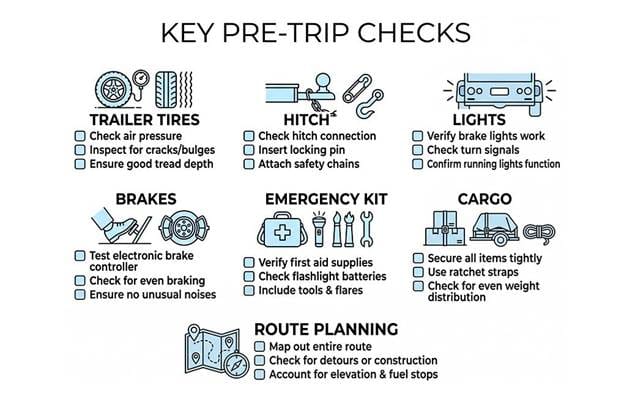
## Plan Your Route Before You Leave
Since planning shapes and defines the journey, here are some [tips](https://www.ourfamilylifestyle.com/tips-for-a-successful-family-rv-camping-trip/) to make your family adventure more successful.
Avoid running out of fuel before reaching a nearby gas station in time by planning your route ahead of the trip. Include fuel stops and campgrounds or overnight accommodations to avoid getting stuck and have a safe place to rest. Good rest helps you make better decisions in emergencies.
Keep an eye on the weather forecast and traffic conditions, as they can cut you off from your destination. Have alternative routes and locations just in case. Be aware that a road suitable for a car may not be the best route to tow your trailer because of grade, narrowness, or clearance.
## Schedule Family-Friendly Rest Stops
Traveling may involve lots of sitting, but that doesn’t mean everyone should always be confined to the vehicle. Taking breaks is necessary to combat driver fatigue and keep the cheerful family spirit alive.
Sitting stiff for many hours is a fast way to sour the mood and ruin a trip. A few minutes outside lets everyone stretch and let off steam. Kids will throw fewer tantrums and be more cheerful in the vehicle.
For the kids with more energy, include extra stops in your itinerary. Research them before stopping to ensure they’re safe for kids to wander and tire themselves before continuing to your destination.
## Pack Road Trip Snacks and Drinks
Having spent their energy, kids are most likely to ask for snacks. Have easy access to them, or you won’t hear the end of it anytime soon.
Since safety comes first, keep perishable foods inside a cooler. It's also handy for serving refreshments in summer. Keep the snacks simple and healthy. Cut vegetables, fruits, and sandwiches are good options. Bring family-favorite treats as a reward for well-behaved kids.
Bring enough water. Unexpected delays and thirst can make even the well-behaved kids irritable and misbehaved. Don’t forget about spill-resistant containers. They minimize the mess in the car.
## Plan Entertainment for the Kids
Once the kids have let their steam out and have refreshed, it’s time to keep them entertained for a foreseeable portion of the road. Different kids have different interests, so make sure to bring something that suits their taste.
Introverted kids may prefer regular books, while artistically gifted ones may choose coloring books, so don’t forget to bring coloring supplies. Others may prefer audiobooks, movies, or shows to keep their minds occupied.
Video and travel games are also an option. Don’t shy away from involving an entire family in activities. However, sometimes the solution is just to let the road lull tired kids to sleep.
## Hit the Road With Confidence
Families don’t just wing successful journeys; they know that preparation makes half the work. Having a detailed itinerary lets you stay ahead of potential issues and adapt when needed. Flexible logistics let you focus on family fun and the adventure ahead.
The other half is enjoying traveling to your destination. After all, family engagement can be the best part of the trip. Kids can be an inexhaustible source of fun due to their unpredictability. To protect this joy and keep the trip stress-free, do a pre-trip check of your vehicle, trailer, and tires.
### Why Grace Is the Quiet Foundation Behind Happy Family Homes
URL: https://www.ourfamilylifestyle.com/why-grace-is-the-quiet-foundation-behind-happy-family-homes/
Last updated: 2026-08-20T15:59:46.000Z
Walk into a genuinely happy home and it's rarely the absence of conflict that stands out. Families argue, misunderstand each other, and make mistakes just like everyone else.
What tends to be different is what happens immediately afterward, how quickly frustration softens into understanding, how easily a mistake gets met with patience rather than punishment.
That difference traces back to something quiet but foundational, grace, extended consistently between the people who share a home. Understanding what this actually looks like day to day, and why it matters so much for a family's overall happiness, helps explain why some homes feel genuinely peaceful while others, despite good intentions, feel perpetually tense.
## **What Grace Actually Looks Like in a Family, Day to Day**
Grace in a family context rarely looks dramatic. It shows up as a parent choosing patience during a child's meltdown rather than matching that frustration with their own, or a spouse offering understanding after a forgotten commitment rather than immediately escalating into blame.
Understanding [what does the bible say about grace](https://www.compassion.com/blog/bible-verses-about-grace/) specifically helps ground this everyday practice in something deeper than simple willpower or good manners. Grace, understood this way, isn't about ignoring real hurt or pretending mistakes don't matter. It's about responding to those mistakes in a way that protects the relationship itself, rather than treating every misstep as a reason for distance or punishment.
## **Why This Foundation Matters So Much for Family Happiness**
A family without this foundation can still function, but it tends to operate under a kind of low-grade tension that quietly erodes everyday happiness. Here are five reasons grace matters so much for how a family home actually feels to live in.
### **1\. It Creates Genuine Safety to Make Mistakes**
Children and adults alike need to know that a mistake won't permanently damage how they're seen or loved within their own family. Grace provides exactly this kind of safety, allowing family members to be honest about failures rather than hiding them out of fear. This safety is often what allows genuine growth to happen, since people rarely change in an environment defined by fear rather than understanding.
### **2\. It Prevents Small Conflicts From Becoming Lasting Resentment**
Without grace, small everyday frustrations tend to accumulate rather than resolve, building into a quiet resentment that eventually affects the entire household's atmosphere. Grace interrupts this accumulation by allowing family members to genuinely let go of minor grievances rather than stockpiling them. This prevents the kind of slow-building tension that can eventually undermine even a fundamentally loving family relationship.
### **3\. It Models Something Children Carry Into Their Own Relationships**
Children absorb far more from watching how their parents extend or withhold grace than from anything explicitly taught to them about kindness or forgiveness. The Stanford Encyclopedia of Philosophy's entry on forgiveness, a rigorously peer-reviewed academic source, [identifies maintaining and preserving close personal relationships](https://plato.stanford.edu/entries/forgiveness/) as one of the clearest and most important functions forgiveness serves, a function directly relevant to sustaining family bonds over time.
A home where grace is genuinely practiced teaches children, through direct example, how to handle conflict and disappointment in their own future relationships. This modeling often shapes a child's relational patterns more powerfully than any single conversation ever could.
### **4\. It Allows Family Members to Show Up Authentically**
A family culture built on grace allows people to be genuinely themselves, including their flaws and struggles, without constantly performing a version of themselves they think will be more acceptable. This authenticity strengthens family bonds considerably, since genuine connection requires people to actually be known, not just presented favorably.
### **5\. It Provides Stability During Genuinely Difficult Seasons**
Every family eventually faces a genuinely difficult season, financial stress, illness, grief, or simply the ordinary strain of a hard year. Grace provides a stabilizing foundation during these periods, since family members are less likely to turn on each other under stress when grace is already a consistent, practiced part of how the family operates. This stability often determines whether a difficult season strengthens or fractures a family's relationships.
## **Building This Into Ordinary Family Life**
Building grace into a family's everyday culture doesn't require grand gestures or perfectly worded conversations. It happens through small, consistent choices, a patient response instead of a sharp one, a willingness to let a minor grievance go rather than holding onto it.
Many families find it genuinely helpful to have accessible resources that offer language and reflection for building this kind of practice intentionally, rather than trying to develop it entirely through trial and error. Through its collection of Bible verses about grace, Compassion International offers families a straightforward way to explore how Scripture connects grace with forgiveness, compassion, and God's love.
## **A Family Without This Foundation, and What Changes When It's Present**
A family without this foundation often looks functional from the outside, meals get made, schedules get kept, obligations get met, but conversations tend to carry an undercurrent of tension that never fully resolves. Small mistakes get remembered and referenced long after they should have been forgotten, and family members learn to guard themselves rather than relax fully into the relationship.
Once grace becomes a genuine, practiced part of that same family's culture, the shift tends to show up gradually rather than all at once. Conversations soften, conflicts resolve more quickly, and family members describe feeling like they can finally exhale within their own home. This shift rarely happens through a single conversation. It develops through consistent, repeated choices made over months and years.
## **Conclusion**
Grace serves as the quiet foundation behind happy family homes because it addresses something no amount of scheduling or good intentions alone can fix, how a family actually treats each other in the ordinary, imperfect moments that make up most of daily life. From creating safety for honest mistakes to modeling healthy relationships for children, this foundation shapes a family's overall happiness in ways that are easy to overlook until they're genuinely present. For any family hoping to build a more peaceful home, grace remains one of the most meaningful places to begin.
### Buying a 7-Passenger Electric Car: A Family Inspection Checklist
URL: https://www.ourfamilylifestyle.com/buying-a-7-passenger-electric-car-a-family/
Last updated: 2026-08-19T22:00:26.000Z
A weekend test drive tells you more than a spec sheet if you treat it like an ordinary family outing. Bring the kids, the car seats you use, and the stroller that usually lives in your trunk. Three rows and a quiet motor may feel appealing in the showroom, but the real test is a busy school morning with one child asleep and another carrying a soccer bag. Use this hands-on checklist to see whether a vehicle fits your routine.
## **Before You Go: Pack for a Real-Life Fit Check**
A family car buying guide can list interior dimensions, but only your own gear will show whether those numbers matter. Load the car you drive now with the items you carry every week, then take them to the test drive.
- Every car seat and booster currently in use, along with the manuals
- The stroller, folded the way you normally store it
- Sports gear, a cooler, or anything else that fills the trunk on weekends
- A tape measure and your phone for photos and notes
Plan the drive itself, too. Running through the usual[ **used car checks**](https://www.ourfamilylifestyle.com/used-car-checks-every-parent-should-make/) at the same time keeps the visit focused on condition as well as fit. Bringing your own equipment along makes the whole test drive far more realistic.
## **Row by Row: What to Try in the Parking Lot**
Spend time in every seating position before driving. A layout that looks roomy can become awkward once child seats, passengers, and bags are in place.
### **Second-row car seat installs**
Install your seats yourself using both the lower anchors and the seat belt, then compare the process. IIHS notes that anchor availability and ease of use vary by seating position. Check whether top tether points are clearly marked and easy to reach rather than hidden under cargo covers.

### **Third-row access with the seats installed**
Leave the car seats in place, then ask a child to climb into the back. If someone must uninstall a seat every time, that task can quickly become a daily frustration. Some overseas people-movers, including the Denza D9 sold in Hong Kong, use sliding doors that can make loading children easier in tight parking spaces.
## **Ideas Worth Borrowing From Global People-Movers**
Cabin layout is one of the biggest differences among seven-seat electric vehicles. Looking at models sold in other markets can help you ask better questions at home. Denza offers the D9 in battery-electric form as a seven-seat MPV in Hong Kong, with ISOFIX points for child seats. Browsing a [7 passenger electric car](https://denzahk.com/en/D9) like this can provide a useful layout reference rather than a U.S. shopping recommendation, since Denza sells the model outside the United States. Notice how the second row slides and reclines, where storage compartments are placed, and how passengers enter the back. Apply the same checks to vehicles on your local shortlist.
## **Safety Details to Verify**
Safety ratings and equipment can differ by model year, trim, and build date. Check the exact vehicle rather than relying on a general claim about the model.
### **Crash-test ratings**
Review current IIHS ratings for each vehicle you are considering. The organization strengthened the second-row protection requirements for its 2025 Top Safety Pick awards, an important change for families whose passengers usually sit in the back. The Kia EV9 and Rivian R1S appear among the 2026 Top Safety Pick+ winners, but confirm the rating for the exact model year and production date you plan to buy.
### **Recall status**
Find the VIN at the lower corner of the windshield or on the driver's door jamb, then enter it in NHTSA's VIN lookup. The result will show whether the vehicle has unrepaired safety recalls. Save a copy and ask the seller when any open repair will be completed. NHTSA's SaferCar app can provide future recall alerts.
## **Charging and Range, Simplified**
Charging needs depend on your daily mileage, access to home charging, local weather, and how often you take long trips. Test the charging plan as carefully as the cabin.
### **At home**
According to EPA estimates, a standard household outlet using Level 1 charging adds roughly 5 miles of range per hour, while Level 2 can add about 25\. Before buying, check whether your garage has a suitable 240-volt circuit or whether you will need an electrician and permits for installation.

### **On trips**
DC fast charging can add substantial range in about 30 minutes, but the actual amount depends on the vehicle, charger, battery temperature, and starting charge level. Charging also slows as the battery fills. Ask which connector the vehicle uses, whether an adapter is included, and which public charging networks it can access.
## **If You Are Buying Used or Sight Unseen**
When buying used or shopping in another city, an independent pre-purchase inspection can provide information you cannot gather in person. Buyers in Liverpool, New South Wales, for example, can arrange an [affordable car inspection in Liverpool](https://lastcheck.com.au/location-car-inspection-liverpool) through Last Check so a mechanic can examine the vehicle on their behalf. It is an Australian service rather than a U.S. option, but the approach applies anywhere. Last Check states that its inspections are visual and performed without disassembly, which is a useful reminder that any inspection report has limits.
## **Budget Checks Families Miss**
Do not assume a vehicle qualifies for a federal or state incentive. Eligibility rules, purchase deadlines, income limits, price caps, and vehicle requirements can change. Confirm current guidance with the IRS or relevant state agency, and ask the dealer for the required documentation before signing. Also budget for insurance, a home charger and installation, registration fees, all-weather mats, roof rails, and any charging adapters you may need.
## **Trust What You Can Test**
The most useful checks are the ones you can perform yourself: installing your car seats, sending a child into the third row, loading the stroller, checking the charging setup, and running the VIN. If someone else must inspect the vehicle, whether that is a trusted local mechanic or a service such as Last Check overseas, ask exactly what the inspection includes and excludes. A three-row electric vehicle should fit ordinary family life without requiring constant workarounds.
### How to Choose the Right Tube Fittings for Your Home Projects
URL: https://www.ourfamilylifestyle.com/how-to-choose-the-right-tube-fittings/
Last updated: 2026-08-19T21:57:30.000Z
You crawl under the kitchen sink with a flashlight and find a slow drip at a joint. Or you decide the vegetable beds finally deserve their own spigot. Either way, you end up in the hardware aisle staring at a wall of brass, plastic, and stainless parts that all look roughly right.
Use this four-step approach to narrow the options: identify what you are connecting and where the joint will be, choose the connection style, confirm the size, and check the ratings on the package. Safety comes first. Check local codes before closing a wall, and leave fuel gas work to a licensed professional.
## **Step 1: Start with what you are connecting and where**
Two questions settle most fitting decisions: What is moving through the line, and will you be able to reach the joint later?
### **Water lines in the kitchen, bathroom, or yard**
Anything that touches drinking water needs to meet lead-free requirements. Under U.S. law, that generally means a weighted average of no more than 0.25 percent lead across a fitting's wetted surfaces and 0.2 percent for solder and flux. Also confirm that the part is rated for hot water if it will be installed on the hot side.
### **Fuel gas and refrigeration**

Gas and refrigeration systems may use flared, threaded, or other specialized connections, depending on the equipment and local rules. A flare seals at the mating surfaces rather than at the threads, so thread tape does not belong on the flare seat. Because mistakes can create serious hazards, leave fuel gas and refrigerant work to qualified professionals.
## **Step 2: Match the connection type to the job**
Each connection style seals differently. Using incompatible parts or applying sealant in the wrong place is one of the more[ **common plumbing mistakes**](https://www.ourfamilylifestyle.com/plumbing-hacks-you-should-avoid-viral-diy-fixes/) behind persistent leaks.
- **Threaded pipe (NPT).** American pipe threads are tapered, so the threads wedge together as you tighten them. Use an approved thread sealant to fill the spiral path between the threads.
- **Compression.** A nut and ferrule compress around the tube. No torch is required, making this style useful for supply stops and appliance lines with straight tubing.
- **Push-to-connect.** These fittings can simplify repairs. For plumbing systems, look for the appropriate listing, such as ASSE 1061, and follow the manufacturer's installation instructions. Some designs, including SharkBite Max, do not require a separate tube liner for PEX.
- **Flare.** The seal forms on the cone of the flare, not on the threads. Do not apply tape to the flare seat. The 45-degree SAE and 37-degree JIC styles are not interchangeable.
- **Barbed.** Barbed fittings are used with flexible hose and irrigation tubing. Match the barb to the tubing's inside diameter and secure it with a suitable clamp.
- **Tri-clamp.** This connection uses two ferrules, a gasket, and a clamp. It is easy to disassemble, clean, and inspect.
- **Slip-on structural clamps.** Kee Klamp-style fittings join compatible structural pipe for railings or shelving without welding. They are typically secured with a hex key.
## **Step 3: Get the size right**
- **Tube.** Match the outside diameter exactly. A quick caliper measurement can prevent a return trip to the store.
- **Pipe.** Nominal pipe size is a label, not a direct measurement. For example, half-inch pipe is not half an inch across. Use a sizing chart rather than relying on a tape measure alone.
- **Hose.** Barbed fittings are sized by the hose's inside diameter. A standard U.S. garden hose connector is 3/4-11.5 NH, a straight thread that seals against a washer. It will not connect properly to tapered pipe threads.
## **Step 4: Read the ratings before you buy**
- **Pressure.** The International Plumbing Code calls for a pressure-reducing valve where a building's static water pressure exceeds 80 psi. A basic gauge attached to a hose bib can help you check your pressure.
- **Concealed installations.** Before placing a joint behind drywall or underground, confirm that its listing and installation instructions allow concealed use. Local code and inspection requirements still apply.
- **Drinking water marks.** Look for lead-free labeling and relevant NSF/ANSI/CAN 61 and 372 marks. These relate to material safety and lead content, not filtration performance.
- **Mixed metals.** Where copper meets galvanized steel, use a dielectric union or another approved transition to reduce corrosion risk.
A fitting that looks compatible may still have the wrong pressure, temperature, or use rating. Rely on its markings and installation instructions rather than improvised plumbing shortcuts.
## **Material matters**

### **Brass**
Brass is a practical choice for many indoor water lines and valves. Confirm the lead-free marking for any fitting used in a potable water system.
### **Stainless steel**
Type 304 stainless steel covers many household needs. Type 316L provides greater resistance to chloride-related pitting, which can matter near salt air, pools, or aggressive cleaners. If you are comparing stainless bends, tees, unions, and clamps for food-contact or outdoor projects, a catalog of[ tube fittings](https://inoxfittings.au/collections/tube-and-tube-fittings) from a specialist such as Inox Fittings can help you see which shapes and connection styles are available before finalizing the layout.
### **Plastics**
PVC and CPVC require different cements, so match the solvent cement to the pipe material. PEX commonly uses crimp, clamp, push-fit, or expansion connections. Do not solvent-weld dissimilar plastics without an approved transition fitting.
## **Three quick picks from common projects**
- **New garden spigot branch.** Use properly rated plumbing connections for the indoor branch, then a 3/4-11.5 NH connector at the hose connection. Avoid BSP fittings unless the system is specifically designed for them.
- **Homebrew transfer line.** Use tri-clamp ferrules with correctly sized, food-safe gaskets. Choose 304 or 316 stainless steel based on cleaning chemicals and environmental exposure. Stainless catalogs such as Inox Fittings can make it easier to match ferrule sizes across the system.
## **Wrapping it up**
Follow the same order for each project: identify the application and location, choose the connection style, verify the size, and check the material and ratings. Measure carefully, use parts labeled for the job, and pressure-test the system before closing a wall or leaving it unattended. Whether the fitting comes from a hardware store or a stainless supplier such as Inox Fittings, this process helps prevent mismatched parts and leaking joints. Confirm local requirements before concealed work, and leave fuel gas and refrigerant systems to qualified professionals.
## **FAQ**
**Can I mix NPT and BSP threads?**
No. The two systems have different thread forms and, at many sizes, different pitches. They may begin to thread together but can leak or become damaged. Use an adapter designed for the transition.
**What size is a standard U.S. garden hose connector?**
It is typically 3/4-11.5 NH, sometimes called garden hose thread. This straight thread seals against a rubber washer rather than through tapered threads, so it should not be connected directly to an NPT port.
### Functional Training: A Practical Guide to Building Everyday Strength
URL: https://www.ourfamilylifestyle.com/functional-strength-training/
Last updated: 2026-08-19T21:53:49.000Z
Between school pickups, work, and dinner, a trip to the gym can feel like one errand too many. Building everyday strength, however, does not require much space or equipment.
You can start with a few minutes of observing how you move, followed by simple exercises using a chair, open floor space, and an adjustable weight. Check with a healthcare professional before starting a new routine, especially if you have pain or an ongoing health condition.
## **What functional training means at home**
Cleveland Clinic describes functional strength training as practicing movements that reflect everyday tasks, including sitting, standing, carrying, and rotating. UCLA Health notes that this type of training can be done almost anywhere, often without special equipment. That makes it practical when your workout space is the rug between the couch and coffee table.
Most everyday strength relies on six movement patterns:
- **Squat**, such as sitting down and standing back up
- **Hinge**, such as picking something up from the floor
- **Push**, such as moving a door, stroller, or shopping cart
- **Pull**, such as opening a heavy drawer or moving a bag
- **Carry**, such as holding groceries or a laundry basket
- **Rotate**, such as reaching across your body
Practice these patterns across the week, and you will cover much of what daily life requires. The CDC recommends that adults get at least 150 minutes of moderate aerobic activity each week, along with muscle-strengthening activity on two or more days.
Walks and bike rides can contribute to the aerobic goal, while two short strength sessions address the second part. If consistency is difficult, simple[ **home workout tips**](https://www.ourfamilylifestyle.com/crafting-an-effective-home-workout-routine/) such as scheduling a fixed time and preparing equipment in advance can help. An adjustable water-filled bag is one option when you are ready to add resistance.
## **A quick self-check based on screening ideas**

Some coaches use the Functional Movement Screen, commonly shortened to FMS. It includes seven movements scored from 0 to 3 and is intended for people who are not currently in pain.
Pain during a movement results in a score of 0, which signals that the person should stop and consult a qualified professional rather than push through. Three patterns also include basic pass-or-fail clearing tests.
You do not need to score yourself as a trained rater would. Instead, use the movements to observe your control and comfort. For a fuller explanation of the seven tests and their scoring, Theia Markerless published an overview of the screen that presents the process in plain language.
A screen is not a diagnosis. If you already have pain, seek an appropriate clinical assessment. Results can also vary with the rater and testing conditions.
A total score of 14 or below is sometimes cited as a marker of higher injury risk, but the Theia Markerless explainer cautions against treating one score as a reliable forecast of injury.
For a basic home check, place your phone on a stable surface and record one movement at a time from the front or side. Use a broomstick for overhead reaches if needed.
Look for clear changes such as heels lifting during a squat, knees moving inward, hips shifting to one side, or a shoulder rising early. Do not force a deeper position to make the movement look better.
## **Water-filled bag basics for small spaces**
A water-filled training bag is a sealed bag or tube that you partly fill with water before lifting, carrying, or pressing it. The water shifts as the bag moves, requiring your grip, trunk, and shoulders to adjust. This creates a different challenge from a fixed dumbbell and can resemble carrying an unevenly loaded laundry basket.
The main advantages at home are storage and adjustability. An empty bag can be folded away, while a filled bag can provide resistance without a rack of weights.
An[ aqua bag ](https://www.thefluidx.com/)lets you add or remove water to match the exercise and your current ability. Fluid X, for example, names its models by maximum fill capacity in kilograms. The range runs from the DB5 up to the Tank 20, which supports up to 20 kilograms, or about 44 pounds, and any model can be part-filled for a lighter load.
## **Choose a starting fill and set up safely**
Start lighter than you think you need. A partly filled bag can feel unpredictable because the water has room to move.
A fuller bag is heavier but may slosh less, so both weight and fill level affect the challenge. Place the filled bag on a bathroom scale to confirm its weight. Tighten all caps, clear several feet of floor space, and keep the surface dry before exercising.
## **A simple 20-minute session**
Warm up for three or four minutes with easy marching, arm circles, and several slow hip hinges.
Spend the next four or five minutes practicing one movement pattern with control. Sit-to-stands and wall push-ups are useful options. Move smoothly and stop before your form begins to change.
For the main set, perform the following three exercises for 30 seconds each, followed by 30 seconds of rest. Complete three rounds for a total of about nine minutes:
1. **Front-loaded squat to a chair**, or a bodyweight squat if you do not have a bag
2. **Suitcase carry** around the room, switching hands each round; a loaded grocery bag also works
3. **Hip hinge to mid-shin** with a neutral back and softly bent knees
Finish with two or three minutes of relaxed breathing and gentle stretches for your hips and shoulders.
## **Safety and steady progress**
Stop any movement that causes pain, numbness, dizziness or unusual shortness of breath. Check with a healthcare professional before starting or changing your routine if you have an injury or health condition.
Two or three nonconsecutive strength days per week are enough at first and align with the CDC's recommendation for at least two weekly strengthening sessions. With a Fluid X bag or another water-filled tool, increase the load in small steps rather than jumping to the maximum fill.
Add weight only when you can complete each repetition without rushing, holding your breath, or losing control of the bag. Theia Markerless makes a related point about movement screens: they can guide training decisions, but they do not replace evaluation by a qualified clinician.
If you want a plain-language refresher on the seven tests and scoring, this[ functional movement screen](https://www.theiamarkerless.com/blog/functional-movement-screen) overview can provide context, but it is not a diagnosis.
## **Small steps and simple tools**

You do not need a garage gym to improve everyday movement. A phone camera, broomstick, sturdy chair, and adjustable tool can cover a wide range of exercises.
Observe how you move, choose one skill to practice, and keep sessions short enough to fit your schedule. Consistent practice matters more than a complicated routine.
## **Frequently asked questions**
### **Do I need to score myself the way a trained rater would?**
No. Formal scoring is meant for practitioners who have been trained in the protocol, and two trained raters can still score the same person differently.
At home, the value is in the observation rather than the number. Watch for heels lifting, knees drifting inward or a hip shifting to one side, then pick one pattern to practice.
### **Does a score of 14 or below mean I am going to get hurt?**
No. That threshold is commonly cited as a marker of possibly higher injury risk, but it is not a prediction for any individual.
A screen shows that a pattern is difficult without explaining why. If something hurts or feels unstable, a qualified clinician is the right next step.
### **How much water should I put in a bag to start?**
Less than you expect. A partly filled bag moves more, so a lighter fill can actually feel harder to control than a fuller one.
Fill a small amount, weigh the bag on a bathroom scale, and try a few slow repetitions. Add water only when every repetition stays smooth and controlled.
### **Can I do this without buying any equipment?**
Yes. Sit-to-stands, wall push-ups, hip hinges, and carries with a loaded grocery bag cover most of the six patterns.
A broomstick works for overhead reaches, and a sturdy chair works for squat depth. Adjustable resistance is useful later, not on day one.
### **How many sessions per week are enough?**
Two or three nonconsecutive strength days are a reasonable starting point, and that matches the CDC guidance of muscle-strengthening activity on at least two days per week.
Short sessions you actually repeat will do more than long sessions you skip. Twenty focused minutes count.
### **Is a water-filled bag better than dumbbells?**
They do different jobs. A fixed dumbbell gives you a stable, predictable load, which suits straightforward strength work.
A water-filled bag shifts as you move, so your grip, trunk, and shoulders have to react. That instability is the point, and it is closer to carrying a squirming toddler or an unevenly packed laundry basket.
### Questions to Ask Before Starting Osteoporosis Medication
URL: https://www.ourfamilylifestyle.com/questions-to-ask-before-starting-osteoporosis-medication/
Last updated: 2026-08-19T21:46:43.000Z
Getting a bone density result back can feel like a lot to process in a single appointment. Between unfamiliar terms, a treatment recommendation, and a script in your hand before you have even fully processed the diagnosis, it is easy to leave the office with more questions than answers.
Taking a bit of extra time before starting any medication, even by just a week or two, rarely changes the outcome of your treatment. What it can do is make sure you actually understand your options and feel confident in the decision, rather than just going along with the first thing suggested.
## **Why the First Conversation Matters More Than It Feels Like It Does**
A bone density diagnosis often arrives alongside a specific treatment recommendation in the same visit, which can make it feel like there is only one path forward. In reality, most women have more than one reasonable option, and the right choice depends on your specific numbers, risk factors, and how you feel about different types of treatment.
Going in with a short list of questions, even scribbled on your phone before the appointment, tends to lead to a much more thorough conversation than showing up and simply listening.
## **Ask What Your Diagnosis Actually Means**
Osteopenia and osteoporosis are related but different diagnoses, and the distinction affects what treatment options are realistically available to you. Osteopenia describes bone density that is lower than ideal but not low enough to be classified as osteoporosis, while osteoporosis reflects a more significant loss of density.
Ask your doctor to explain your specific T-score and what it means for your fracture risk, rather than accepting a general label. Understanding where you actually fall on the scale helps you evaluate whether a recommended treatment matches the severity of what is actually going on.
It also helps to ask what factors beyond the scan itself are being weighed, since things like age, family history, and previous fractures often factor into a treatment recommendation just as much as the number on the report.
## **Ask About Side Effects and What to Realistically Expect**
Every treatment for low bone density comes with its own set of considerations, and it is worth understanding these before you start, not after a side effect catches you off guard. Ask specifically what side effects are common, what the dosing routine actually involves day to day, and what your doctor would do if the first option does not work well for you.
This is also a reasonable moment to ask about alternatives if a specific medication concerns you. A closer look at[ medications like Fosamax](https://www.osteoboost.com/blog/alternatives-to-fosamax) and the range of alternatives, including other prescription options and non-drug approaches by Osteoboost, is worth reading before your appointment so you can ask more informed questions.
## **Ask About Non-Drug Options Too**
Depending on your specific diagnosis, medication may not be the only path forward, or it may work best alongside other approaches rather than as a replacement for them. Ask your doctor directly whether lifestyle changes alone are a realistic option for your situation, or whether they are meant to support a medication rather than substitute for one.
It is also worth asking whether newer, non-pharmacological options exist that might apply to your specific diagnosis, since this is an area that has changed meaningfully in recent years.
## **Ask What Happens Over the Longer Term**
Treatment for bone health is rarely a one-time decision. Ask how often you will be reassessed, what a follow-up scan will actually tell you, and under what circumstances your doctor would consider changing your treatment plan down the line.
Some medications also come with defined treatment windows or reassessment points built in, so it is worth understanding upfront what the next few years might realistically look like, rather than assuming today's plan is permanent.
It is worth asking, too, what would prompt a switch to a different approach, whether that means a different medication, a break from treatment, or adding a non-drug option alongside what you are already doing. Knowing the plan for adjusting course ahead of time tends to make future conversations feel less like starting from scratch.
## **Bring a Written List of Questions With You**
It is easy to walk into an appointment with good intentions and walk out having forgotten half of what you meant to ask, especially when a diagnosis feels unexpected. Writing your questions down beforehand, even briefly, makes it far more likely you will actually get through them.
The same principle that helps with this kind of appointment prep tends to help elsewhere too. Our earlier piece on[ mom self-care habits](https://www.ourfamilylifestyle.com/moms-prioritize-self-care-healthy-energized-tips/) touches on how small, intentional routines make it easier to actually follow through on the health decisions you know matter, rather than letting them slip between everything else on your plate.
## **Conclusion**
A bone health diagnosis is rarely an emergency that requires an immediate decision on the spot. Taking the time to ask real questions, understand your specific numbers, and learn about the full range of options tends to lead to a treatment choice you actually feel good about, rather than one you simply accepted in the moment.
Whatever you and your doctor ultimately decide, going in informed makes the whole process feel far more like a decision you made rather than one that happened to you.
## **Frequently Asked Questions**
**1\. Is it okay to ask for time to think before starting a bone health medication?**
In most cases, yes. Bone density loss typically develops over months or years, so taking a short amount of time to ask questions and consider your options rarely changes the overall outcome, though your doctor can tell you if your specific situation calls for more urgency.
**2\. What is the difference between osteopenia and osteoporosis treatment options?** Osteoporosis generally opens up a wider range of prescription medication options, while osteopenia treatment is often more limited and may lean more heavily on lifestyle changes or newer non-drug approaches, depending on your individual risk factors.
**3\. Should I get a second opinion before starting a new medication?**
This is a personal decision, but it is a reasonable one to make if you feel uncertain or if the recommended treatment does not sit well with you. Most doctors are receptive to a patient wanting to feel confident in their treatment plan.
**4\. How often should bone density be reassessed once treatment starts?**
This varies by treatment type and individual risk factors, so it is worth asking your specific doctor directly rather than assuming a standard timeline applies to your situation.
### Sometimes You Just Need A Break
URL: https://www.ourfamilylifestyle.com/sometimes-you-just-need-a-break/
Last updated: 2026-08-19T17:17:13.000Z
It’s okay to need a break from the stress of your day to day life, you know? There is so much going on, and it’s imperative that you are listening to yourself when you start to feel like this. It’s often a sign that burnout is near, and that’s not what anyone needs. But, you might feel as though you can’t have a break because you have so much to do, but we’re going to let you in on a little secret.
In this article, we’re going to be taking a look at some of the things that you should be thinking about when it comes to needing a break, and how you can get one. If you’d like to find out more, feel free to read on.
Take Some Time Off Work
First and foremost, you need to make sure that you take some time off of work. You’re never going to have a proper break if you’re working, or if you’re constantly worried about working, and that’s not what you need. So, you need to make sure that you’re booking some time off and ensuring it goes through before you do anything.
Double check with your employer that the time off is secure as we know some employers like to change this at the last minute. Ideally, you want it in writing that your time off is granted and there is no reason that it would not be able to go ahead.
Book A Trip Away
Now that you’ve [taken the time off](https://www.ourfamilylifestyle.com/restorative-travel/), you can book some time away. Booking a trip away is one of the most fun things that you can do, and it’s a great way for you to relax with the people that you love the most. Or, if you want to go by yourself, then that’s also a good option.
The point is that you should be looking at something that is going to be relaxing for you and will let you leave your stress at the plane door. You need this rest, and you need this time to recoup before you have to get back to the grind. But, that’s not something that you’re going to think about right now, that’s a problem for after your break, when you feel better.
Have The Best Time
Finally, now that you have this time off and you’re going away, it’s up to you to make sure that you have the best time. You need to plan out some things that you want to do on your trip, and make sure that anything that needs booking in advance has been sorted. If you’re not sure what there is to do, then you can always look at guides online that help you to [discover the best things to do in Atlanta](https://forthatlanta.com/explore-atlanta/best-things-to-do-in-atlanta) as well as other places.
Remember, the goal is to make you feel better, make you feel lighter, and not as though you’re going to burst from stress.
We hope that you’ve found this article helpful, and now see some of the things that you should be doing when you need a break.
### The Journey of Expectation: Key Milestones to Know
URL: https://www.ourfamilylifestyle.com/the-journey-of-expectation-key-milestones-to-know/
Last updated: 2026-08-19T17:12:52.000Z
Finding out you're expecting is a moment packed with all sorts of feelings. Once the first wave of excitement settles, you'll probably start having a ton of questions. What happens next? What should you expect in the coming weeks and months? Knowing the big milestones of pregnancy can help you feel more connected and ready as you get closer to meeting your little one. Think of it like a road trip with some amazing sights to see along the way.
## **First Trimester: Early Discoveries**
The first trimester, which runs from week 1 until the end of week 12, is a time of super-fast development, even if you can't see it yet. This is when your baby's whole body starts to form. Your first appointment will confirm the pregnancy and help figure out your due date. You'll likely feel a bunch of new symptoms, from being super tired and having food aversions to the famous morning sickness. While it can be tough physically, it's also full of wonder. Hearing your baby's heartbeat for the very first time is an unforgettable moment that makes everything feel real. Checking out the common [first trimester milestones](https://www.raveco.com/blog/a-guide-to-your-first-trimester-milestones) can give you a heads-up on what to expect during these early weeks.
## **Second Trimester: Growth and Monitoring**
Lots of people call the second trimester (weeks 13 to 27) the "honeymoon" of pregnancy because early symptoms often fade, and you get a nice energy boost. This is when your baby really starts to grow. One of the most exciting things is the mid-pregnancy ultrasound, often called the anatomy scan. During this detailed scan, your [obstetrician](https://www.womenshealthofaugusta.com/how-your-ob-monitors-your-babys-health-throughout-pregnancy/) can check on the baby’s development, tell you the sex if you want to know, and make sure everything is coming along nicely. You'll also probably feel those first gentle flutters of movement, called quickening, which soon turn into clear kicks and rolls. It's amazing to follow the week-by-week stages of fetal development and imagine what's happening inside.
## **Third Trimester: Preparing for Arrival**
Welcome to the home stretch! The third trimester, from week 28 until birth, is all about getting ready for the big day. Your baby is gaining weight quickly, and you'll feel their movements get stronger and more distinct. Your checkups will happen more often as your provider keeps an eye on both your health and the baby's position. This is the perfect time to finish setting up the nursery, pack your hospital bag, and take childbirth classes. You might [feel more tired](https://www.ourfamilylifestyle.com/pregnancy-nausea-tips/) and uncomfortable, but the excitement of finally meeting your baby makes it all worth it.
## **Understanding Prenatal Screenings**
Throughout your pregnancy, you'll be offered different prenatal screenings. These are tests that help check on your developing baby's health. They usually involve blood tests and ultrasounds designed to look for certain genetic conditions and developmental signs. It's good to remember that screenings tell you about risk; they aren't a diagnosis. Based on the results, you and your healthcare provider can decide if more in-depth diagnostic testing is right for you. These screenings are optional, and whether to have them is a personal choice. Your doctor can explain the pros and cons of each test so you can feel good about your decisions.
## **Beyond the Due Date**
Your due date is more of a guess than a strict deadline. In fact, only a small number of babies arrive exactly on their due date. It's pretty common, especially for first-time moms, to go past 40 weeks. If this happens, try not to stress. Your provider will watch you and the baby more closely with non-stress tests or biophysical profiles to make sure everything is still okay. They'll talk to you about possibly inducing labor if it becomes medically necessary or if you go too far past your due date. Until then, use the extra time to rest, relax, and enjoy those last quiet moments.
[Every pregnancy unfolds](https://my.clevelandclinic.org/health/articles/7247-fetal-development-stages-of-growth) in its own special way. While these milestones give you a general idea, your experience will be completely unique. Embrace the changes, ask questions, and trust the process as you get ready for your new family member's amazing arrival.
### Best Earbuds for Everyday Use - Calls, Music, Workouts, and Travel
URL: https://www.ourfamilylifestyle.com/best-earbuds-for-everyday-use/
Last updated: 2026-08-20T15:53:02.000Z
No pair of earbuds is best at everything. A model that sounds excellent in a quiet room may have trouble keeping your voice clear on a windy call. Strong noise cancellation can make a crowded train easier to tolerate, yet the same earbuds may feel uncomfortable two hours into a flight. Most people use earbuds in several settings, so a specification sheet or single test score cannot fully show how microphone quality, fit, controls, and battery life hold up day to day.
For a single everyday pair, start with the situations you encounter most often, then prioritize clear calls, useful ANC, a secure fit, and battery life that lasts through your longest day. The sections that follow connect calls, music, commuting, travel, workouts, comfort, and case design to that decision. The result is a shortlist built around your routine instead of a universal ranking.

**Calls and Meetings Need More Than Good Microphones**
At 8:55, you connect your earbuds to a laptop for a team meeting. Ten minutes later, you put them back in your pocket, start a podcast on your phone, and head out to catch the train. That evening, the same pair may handle a call from a noisy cafe or a film during a flight. Using one pair across these moments exposes the different demands placed on calls, music, and travel.
For calls, the microphones need to pick up your voice without letting traffic, keyboard clicks, or the person at the next table take over. Speech-processing algorithms help separate your voice from that background, while microphone placement affects what the earbuds capture in the first place. Connection stability is equally easy to overlook. A brief dropout during a song is annoying. During a client call, it can derail a sentence. If you move between a laptop and phone, multipoint connection can save you from repeatedly opening Bluetooth menus.
Microphone specifications matter when they explain what happens during a call. Multiple microphones, bone-conduction voice pickup sensors, and speech-processing software can help separate your voice from traffic or keyboard noise, although placement and conditions still affect the result. Independent microphone samples and connection tests are more useful than a model's position in a product lineup.
| If you... | Look for... |
| --------------------------------- | ------------------------------------ |
| Take calls outdoors | Wind handling and voice samples |
| Switch between a laptop and phone | Multipoint connection |
| Join long meetings | Comfortable fit and natural sidetone |
The call system in the soundcore Liberty 5 Pro and Liberty 5 Pro Max is shared across both models, rather than being a Pro Max-only feature. It combines 8 MEMS microphones, 2 VPUs, and an AI Large Model for voice processing. In a busy cafe or beside a road, that combination is intended to keep speech separate from the surrounding noise. Apple, Bose, and Jabra use their own multi-mic approaches, so compare call samples and connection behavior instead of assuming a higher product tier will suit every caller.

**Music and Podcasts Need Different Tuning**
After work, the same earbuds may play a playlist on the train, a podcast while you cook, or an audiobook before bed. Music and spoken content put different demands on them, even when the listening session feels casual. Music benefits from clear separation and natural vocals. Podcasts place more weight on voice clarity and low listening fatigue.
Tuning determines whether vocals sound natural, bass has definition, and busy tracks remain clear. An equalizer can help adjust the sound after the first listen, while codec support matters only when your phone and streaming service use the same format. Fit still comes first. A higher-resolution codec will not make an uncomfortable earbud easier to wear or change a sound signature you dislike. If you use an iPhone, remember that iOS does not support LDAC, so check codec compatibility before treating it as a deciding feature.
| If you... | Look for... |
| ------------------------- | --------------------------------------------------- |
| Listen to mixed genres | Balanced tuning and adjustable EQ |
| Mostly listen to podcasts | Clear vocals and low listening fatigue |
| Care about codec support | Compatibility with your phone and streaming service |
**Commute and Travel Depend on More Than ANC**
As a hardware reference, the soundcore Liberty 5 Pro and Liberty 5 Pro Max both use a 9.2mm Wool-Paper Diaphragm. Sony, Technics, and Sennheiser offer different tuning approaches, so treat driver design as one part of the listening experience rather than a direct sound-quality ranking.
**ANC Works Best on Steady Background Noise**
Active noise cancellation, or ANC, works best against steady sounds such as train rumble, aircraft engines, and office air-conditioning. Sony, Bose, Apple, and other brands make different choices around cancellation, transparency, and ecosystem features, so judge the noise you face most often.
**Fit Determines the Real ANC Experience**
Check the seal before comparing ANC systems. A tip that is too small allows sound to leak in and can weaken bass. One that is too large may create pressure after a few minutes. Try the available sizes in each ear, since both sides may need a different fit. If bass becomes fuller when you press the earbud inward, the seal may be incomplete. Walk, talk, and move your jaw to see whether it stays secure.

**Transparency Mode Helps You Switch Contexts**
Transparency mode lets in outside sound for announcements, brief conversations, or traffic awareness. Some versions sound open, while others amplify wind or process voices heavily. It can help you switch context, but it does not replace paying attention to your surroundings.
Models from Bose and Sony often place ANC near the center of the experience, while Apple, Samsung, soundcore, and other brands balance it with ecosystem features, controls, fit, and price. Current [noise cancelling earbuds](https://www.soundcore.com/collections/noise-cancelling-earbuds) can be compared by ANC controls and battery claims, but independent tests and an in-person fit check remain useful.
For iPhone users, third-party earbuds' own ANC still works over Bluetooth. The main limitation is at the ecosystem level, where Apple-specific features such as automatic switching and Adaptive Audio may remain tied to AirPods.
**Battery Matters on Longer Trips**
Battery claims usually separate listening time on one charge from total time after recharging in the case. For a long flight, the single-charge ANC figure is the harder limit. For short daily commutes, total case capacity may matter more.
Treat published figures as reference points because ANC, calls, volume, codec choice, and temperature can change runtime. Look for enough ANC-on battery life to cover your longest normal journey with some margin. Fast charging is also useful when you notice a low-battery alert shortly before boarding.
| If you... | Look for... |
| ------------------------------ | --------------------------------------- |
| Commute by train every day | ANC and a secure seal |
| Take long flights | ANC-on single-charge battery life |
| Often board with a low battery | Fast charging and a useful case battery |
As a travel reference, the soundcore Liberty 5 Pro and Liberty 5 Pro Max both use Adaptive ANC 4.0 and list 6.5 hours with ANC enabled and 28 hours including the case. Their stated five-minute fast charge provides about four hours of use. Sony, Bose, Apple, and Jabra models can differ considerably, so compare the same ANC-on condition across products.
**Workouts Depend on More Than an IP Rating**
| If you... | Look for... |
| ------------------------ | -------------------------------------- |
| Run outdoors | Secure fit and wind handling |
| Train indoors | Sweat resistance and reliable controls |
| Walk in changing weather | A suitable IP rating and easy cleaning |
An IP rating is a useful starting point for sweat, dust, and light rain, but it does not describe the whole workout experience. The soundcore Liberty 5 Pro and Liberty 5 Pro Max both carry an IP55 rating, which covers those everyday conditions. It does not make them suitable for swimming, submersion, or rinsing under a tap. Let damp earbuds dry before putting them in the case, whose protection may be different.
Movement creates the other practical test. During a run or a set of burpees, constant readjustment is more distracting than a small battery difference. Wet fingers can also trigger touch controls, while physical buttons may push the earbuds deeper into the ear. Jabra, Sony, and other brands make different choices here, so test the fit and control motion you will actually use.
**Comfort and Case Design Shape Everyday Use**
| If you... | Look for... |
| ------------------------------- | ---------------------------------------- |
| Wear earbuds for hours | Low pressure and a comfortable shape |
| Carry them in a pocket | A compact case and easy one-hand opening |
| Change settings without a phone | Useful case controls or a display |
Comfort is difficult to reduce to a specification because ear shape varies. Fit affects ANC, but it also determines whether ear pressure or a hard edge becomes distracting after an hour or two. Weight, housing shape, and ear-tip size all matter in combination, so a short store demo cannot settle the question for everyone.
The charging case deserves the same everyday scrutiny. A case that fits easily in a pocket may be more useful than one with a larger battery but a bulky shape. Check whether the lid is easy to open with one hand, whether the battery indicator is clear, and whether the controls actually save you from reaching for your phone. Apple and Samsung take different approaches through their charging cases and broader device ecosystems. Compare the steps you would use every day, rather than the feature list alone.

The soundcore [Liberty 5 Pro](https://www.soundcore.com/products/d1203-liberty-5-pro-anc-earbuds-clear-calls) uses a 0.96-inch smart display for basic controls and battery checks. The [Liberty 5 Pro Max](https://www.soundcore.com/products/d1204-liberty-5-pro-max-ai-recording-earbuds) adds a 1.78-inch AMOLED touch screen and AI Note-Taker for face-to-face recording and transcription. The larger interface may help someone who changes settings or checks status away from a phone, while a simpler case may suit someone who keeps it in a pocket and rarely opens an app. Decide whether the display removes a step you actually take.

**Choose One Pair Around Your Routine**
Start with the situation you would find most frustrating: a weekly flight, a busy-road call, a long gym session, or an afternoon of listening. Test that compromise first.
Price can frame a comparison, but it should not decide it. As of July 2026, the listed prices were $169.99 for the soundcore Liberty 5 Pro and $229.99 for the Liberty 5 Pro Max. Promotions and regional pricing may change these figures. Sony, Bose, Apple, Nothing, and EarFun occupy other points in the market. The difference reflects the smart-case experience, not a guarantee of a better fit.
| Your routine | Prioritize first | Check second |
| ------------------------------ | ----------------------------------------------- | ----------------------------------------- |
| Remote work and frequent calls | Voice pickup, call-noise reduction, multipoint | ANC-on battery, comfort, sidetone |
| Commuting and travel | ANC, fit, transparency mode | Case battery, fast charging, compact case |
| Gym and outdoor walks | Secure fit, suitable IP rating, simple controls | Wind handling, comfort, battery |
| Music and podcast listening | Sound tuning, EQ options, fit | Codec support, ANC, app usability |
| One pair for everything | Balanced calls, ANC, comfort, battery | Multipoint, IP rating, case design |
Use the table to set two or three priorities, then test them directly:
Remote work. Check call samples recorded in traffic, a cafe, or wind. Test multipoint on your laptop and phone.
Travel. Match ANC-on runtime to your longest journey. Read long-session comfort comments and test transparency mode outdoors.
Workouts. Treat shake tests as a rough clue. Check the exact IP rating, control customization, and available tip or stability options.
Music and podcasts. Start with tuning and fit, then check EQ and codec support. Confirm features for the exact model.
Once you have two or three priorities, build a short list. Category pages for [wireless earbuds](https://www.soundcore.com/collections/true-wireless-earbuds) and independent reviews can help. Check replacement tips, app compatibility, control customization, and the return policy before deciding.
**Conclusion**
The best earbuds for everyday use rarely win every individual test. The better match is the pair that handles your most important moments without creating a new irritation somewhere else. Excellent ANC loses some of its value with a painful fit. Detailed sound cannot rescue unreliable calls. A large case battery still leaves you without music if the earbuds run out halfway through a flight.
Choose around the scenario you cannot afford to compromise, then assess call behavior, ANC, battery life, fit, water resistance, controls, and case design. Independent tests are especially useful for microphone quality, wind handling, and long-session comfort.
Your routine can still point to a clear choice. A focused short list, a realistic trial, and a sensible return policy will tell you more than any single headline score.
**Frequently Asked Questions**
**Can one pair of earbuds really handle calls, music, workouts, and travel?**
A single pair can cover several routines when its main features are reasonably balanced. Start with the situation that matters most, then check whether the same pair is comfortable and reliable enough for your other regular activities. If one use case has unusually demanding requirements, a specialized pair may still make more sense.
**What should iPhone users check before choosing wireless earbuds?**
Check whether the companion app supports the EQ, firmware updates, battery information, and control mapping you plan to use. Multipoint behavior can vary across a phone and laptop, so test those devices together. Codec support is a compatibility detail, not the main reason to choose a pair.
**Is multipoint connection worth paying attention to?**
It is useful when you regularly move between a work laptop and a personal phone. Check whether both devices stay connected, how incoming calls interrupt playback, and how quickly the earbuds reconnect after one device goes idle. If you use one source, multipoint may add little.
**What does a smart charging case add?**
A screen or touch interface can make battery checks and basic controls easier without opening an app. The benefit depends on how often you use those controls. AI note features also need a specific use case, especially when they record face-to-face conversations rather than internal audio from online meetings.
**When is it worth paying more for premium earbuds?**
A higher price makes sense when it adds a feature you will use often, such as stronger ANC, better call processing, longer ANC-on battery life, or a smart charging case. It is harder to justify when the extra cost mainly buys specifications you will rarely notice. Compare the feature that changes your routine, rather than the product tier alone.
| **Disclaimer:** *Apple, AirPods, Sony, Bose, Jabra, Samsung, Nothing, EarFun, Technics, and Sennheiser are trademarks of their respective owners. soundcore is not affiliated with, endorsed by, or sponsored by these trademark owners. All comparisons are based on publicly available specifications and internal assessments as of July 2026.* |
| -------------------------------------------------------------------------------------------------------------------------------------------------------------------------------------------------------------------------------------------------------------------------------------------------------------------------------------------------- |
### Renting vs. Buying in 2026: How Families Can Run the Real Numbers
URL: https://www.ourfamilylifestyle.com/renting-vs-buying-in-2026-how-families-can-run-the-real-numbers/
Last updated: 2026-08-17T21:57:00.000Z
Every family that rents eventually has the conversation. Usually it starts at the kitchen table after another lease renewal letter arrives, and it goes something like this: we are paying so much in rent every month, wouldn't we be better off just buying something? It feels like it should have a simple answer.
It doesn't, and the reason is that most families compare the wrong two numbers.
The comparison people instinctively make is rent versus mortgage payment. If rent is $2,200 and the mortgage on a comparable home would be $2,900, renting looks like the obvious winner. But that math treats every dollar of the mortgage payment as money gone, the same way rent is gone once the check clears. That's not how a mortgage works. Part of each payment covers interest, taxes, and insurance, which really are costs. Another part pays down the loan principal, which stays with you as equity. If the home also gains value over time, that appreciation adds to what you own too. Rent builds none of that.
So the honest version of the question isn't which payment is bigger. It's this: after subtracting the equity you build each month, what does owning actually cost, and how does that net figure compare to rent?
The answer turns out to depend enormously on where you live. [One recent analysis](https://www.lower.com/insights/top-cities-for-first-time-buyers-owning-vs-renting) by mortgage lender Lower ran exactly this calculation across 136 U.S. cities where home prices fall within FHA loan limits, crediting buyers for both principal paydown and each city's actual recent appreciation. Buying came out ahead of renting in 56 of those cities, or 41 percent. In Hartford, Connecticut, the top-ranked market, the monthly advantage of owning reached $2,968 once equity was counted, driven by an unusually hot 11.1 percent annual appreciation rate. Midwest cities like Cleveland and Dayton also ranked near the top thanks to a friendlier combination: modest home prices paired with solid, steady price growth. In 34 of the cities studied, though, home values actually declined, which made owning more expensive than the mortgage payment alone would suggest.
That spread is the whole lesson. National headlines about the housing market tell you almost nothing about your own zip code. The good news is that you can run the same math for your own family in an afternoon. Here's how, step by step.
**Step 1: Price the true monthly cost of owning**
Start with the full ownership number, not just principal and interest. Add property taxes for your county, a homeowners insurance quote, and mortgage insurance if you'd be putting less than 20 percent down. The rate you plug in matters a lot here, so use real numbers rather than guesses. According to [Freddie Mac](https://www.freddiemac.com/pmms), the average 30-year fixed rate stood at 6.67 percent in mid-August 2026, but averages hide meaningful variation by loan type. Lower's published [mortgage rates](https://www.lower.com/mortgages/mortgage-rates) show government-backed FHA and VA loans currently pricing below conventional 30-year loans, a gap that can shift the monthly payment by a couple hundred dollars on a typical family home. The same tables break rates out by state, which matters because pricing genuinely differs across markets. Price the loan type you'd realistically qualify for, not a generic national figure.
**Step 2: Set an honest rent benchmark**
Don't use your current below-market lease from 2021, and don't use the luxury tower downtown either. [HUD](https://www.huduser.gov/portal/datasets/fmr/smallarea/index.html) publishes Small Area Fair Market Rents at the zip code level each year, which represent typical rents for standard-quality units. Look up the three-bedroom figure for your zip code and use that as your neutral baseline. If you're comparing against a specific home you might buy, check what similar houses on that street actually rent for and sanity-check the two numbers against each other.
**Step 3: Credit yourself for principal paydown**
Run your loan through any free amortization calculator and note how much of the first year's payments go toward reducing the balance. It's a smaller share than most people expect at today's rates, often only 10 to 12 percent of the payment in year one. But it's the only part of the equity equation that's guaranteed, because the amortization schedule doesn't care what the housing market does. Subtract that monthly principal figure from your ownership cost. This is the step the kitchen-table version of the debate always skips.
**Step 4: Add appreciation, then stress-test it**
Appreciation is the powerful but unreliable ingredient. Look up how home prices in your specific city have moved over the past few years, convert that annual rate into a monthly dollar figure on the price you'd pay, and add it to your equity credit. Then do the important part: rerun the whole comparison at zero appreciation. If buying only wins when prices keep climbing, you're not making a housing decision, you're making a bet. If it holds up even with flat prices, the case is much sturdier.
**Step 5: Weigh what the spreadsheet can't capture**
One factor no calculator handles cleanly is what staying a renter costs over time. [Harvard researchers](https://www.jchs.harvard.edu/state-nations-housing-2026) found that nearly half of all renter households, a record 22.7 million, spent more than 30 percent of their income on housing in 2024\. Rents have softened a little recently, but the long arc for renters has been payments that climb with the market while building nothing. A fixed-rate mortgage flips that dynamic, locking the core payment for 30 years while incomes rise around it.
The other side of the ledger is real too. Renting buys flexibility to chase a job or a school district, freedom from surprise repair bills, and no closing costs eating the down payment. Ownership carries expenses beyond the mortgage, from maintenance to HOA dues, that deserve a line in any honest budget. A majority of the markets in the city-level data still favored renting once flat or falling prices entered the equation, so nobody should assume buying always wins.
What the decision shouldn't rest on is a gut comparison of two monthly payments, or a national headline written about someone else's housing market. Work through the five steps with your own numbers. For some families the spreadsheet will say keep renting, and that's a perfectly good answer. For others, especially in the Midwest and Northeast markets where the math has quietly swung toward owners, the numbers may say something they didn't expect to hear.
### Unwind and Recharge: A Guide to Restorative Travel
URL: https://www.ourfamilylifestyle.com/restorative-travel/
Last updated: 2026-08-17T19:11:40.000Z
Feeling overwhelmed by the daily grind? That's not a weakness; it's a signal. It’s your [mind and body](https://enformawellness.com/2025/01/20/wellness-travel-top-destinations-to-relax-recharge-and-reset/) telling you it’s time to hit the pause button and step away from the endless to-do lists and notifications.
A restorative trip isn't about escaping your life, but about coming back to it with fresh energy and [a clearer head](https://www.ourfamilylifestyle.com/ways-to-build-mental-resilience-handle-stress-better/). This guide is all about making that break truly count, helping you plan a getaway that genuinely unwinds, recharges, and resets your system.
## **The Power of a Getaway**
Taking time off isn't just a luxury; it's super important for your well-being. When you’re constantly juggling work, family, and personal stuff, your stress levels can stay sky-high. Getting a change of scenery physically pulls you away from those everyday stressors, giving your nervous system a much-needed break.
Research consistently shows that vacations can lower stress and reduce the risk of burnout. Even a short trip can break the cycle of anxiety and mental fatigue, letting you come back with a more positive outlook.
The good stuff doesn't stop at mental health. Stepping away from your routine can actually boost your creativity and problem-solving skills. When you’re not stuck in the same old thought patterns, your mind is free to wander and make new connections. This mental space is where cool new ideas are born.
Plus, just looking forward to a trip can be a huge mood booster. Having something exciting on the horizon injects a sense of hope into your daily life, making the weeks before you leave feel more manageable and joyful. Think of it as an investment in your productivity, happiness, and overall health.
## **Choosing Your Ideal Retreat**
The perfect restorative getaway looks different for everyone. The trick is to pick a place that feels relaxing and rejuvenating \*to you\*. Don't feel pressured to book a silent retreat in the mountains if the thought of complete quiet makes you squirm. And a jam-packed city tour might be more tiring than restful if you're really craving some alone time. Take a moment to think about what your mind and body are truly asking for.
Here are a few ideas to get you thinking:
- **Get back to nature:** Picture a cosy cabin in the woods, a cottage by the lake, or a beachfront bungalow. These spots are perfect if you feel recharged by fresh air, hiking, swimming, or just listening to the sounds of nature.
- **Soak up some culture:** For some folks, restoration comes from inspiration and new experiences. A trip built around art, food, and music can be incredibly energising. You could explore the vibrant street art and galleries of a creative neighbourhood and stay at a [Wynwood, Miami hotel](https://arlohotels.com/wynwood/) to really get into the artistic vibe. This kind of trip wakes up your senses and sparks new passions.
- **Focus on wellness:** These trips are designed specifically for relaxation and health. This might mean a spa resort with daily treatments, a yoga retreat to deepen your practice, or a destination famous for its natural hot springs.
Also, think about how easy it is to get there. A long, complicated journey can add stress before you’ve even arrived. Sometimes the most restorative trip is the one that’s easiest to reach, letting you spend more time relaxing and less time travelling.
## **Mindful Exploration Tips**
Once you've arrived, the goal is to stay present and really experience your surroundings. It’s easy to fall into old habits, like checking work emails or endlessly scrolling through social media. Mindful exploration means consciously engaging with what's happening right now.
One of the best ways to do this is to focus on your senses. When you’re walking through a new city or a forest trail, pay attention to the little things. What do you see, hear, smell, and feel?
For instance, instead of just walking to a cafe, notice the architecture of the buildings, the sound of a local musician playing on the street corner, or the aroma of fresh pastries wafting from a bakery. This practice pulls you out of your own head and into the moment. You can [practice mindfulness](https://www.mindful.org/how-to-practice-mindfulness/) anywhere, and a vacation is a perfect chance to build this skill without the usual distractions of home.
A light digital detox can also work wonders. You don't have to go completely offline, but setting clear boundaries can make a huge difference.
- Set specific times to check your phone, maybe for 15 minutes in the morning and evening.
- Turn off notifications that aren't urgent.
- Try leaving your phone in your hotel room when you go out for a meal or a short walk.
You’ll be amazed at how much more you notice and enjoy when you’re not seeing the world through a screen.
## **Embracing Local Rhythms**
One of the most restorative parts of travel is breaking free from your own strict schedule and settling into the rhythm of a new place. Instead of trying to do everything exactly like you do at home, let the local culture guide your days. This means letting go of the pressure to see and do absolutely everything. A truly restful trip isn't about ticking items off a list; it’s about quality experiences, not how many you cram in.
Start by observing daily life around you. Where do locals go for their morning coffee? What time do they usually eat dinner? Try to go with that flow. Visit a neighbourhood farmers market in the morning, enjoy a leisurely lunch at a cafe with outdoor seating, and take an evening stroll when the city comes alive in a different way. This approach helps you feel more like a participant and less like a tourist.
Exploring [healing travel ideas](https://us.sangean.com/en/blog/170) often involves this kind of genuine connection. It might mean taking a local cooking class, trying a traditional craft, or simply chatting with a shop owner. These interactions create meaningful memories and help you understand the place you’re visiting on a deeper level.
Resisting the urge to over-plan leaves room for spontaneity. You might stumble upon a beautiful hidden garden, a fascinating little museum, or a friendly conversation that becomes the highlight of your trip.
## **Maximising Relaxation Time**
Even on a "relaxing" vacation, it's easy to fall into the trap of over-scheduling. The fear of missing out can lead to a packed itinerary that leaves you feeling more tired than when you started. The secret to maxing out relaxation is to intentionally build unstructured downtime into your plan. This is your permission to do absolutely nothing without feeling bad about it.
Schedule "empty" blocks in your day. This could be an afternoon to simply read a book by the pool, take a nap, or sit on your balcony and watch the world go by. This unscheduled time is crucial for letting your mind truly rest and process your experiences. It's often in these quiet moments that you feel the most profound sense of peace and restoration.
Think of your itinerary as a loose suggestion rather than a strict rule. If you wake up and don't feel like visiting that museum you planned, give yourself the grace to change your mind.
Getting ready for your return is also part of a successful restorative trip. Try to give yourself a buffer day between arriving home and jumping back into your full schedule. Use this day to unpack, do laundry, and ease back into your home environment. This transition period helps you hold onto that post-vacation calm a little longer and prevents the jarring feeling of going from total relaxation to 100-miles-per-hour reality overnight.
A restorative trip is a powerful tool for your well-being. By choosing your destination wisely, practising mindfulness, and embracing a slower pace, you can return home not just rested, but truly recharged and inspired.
### How to Support Your Child’s Maths Learning at Home (Without the Homework Battles)
URL: https://www.ourfamilylifestyle.com/support-your-childs-maths-learning-at-home/
Last updated: 2026-08-13T19:03:31.000Z
Math homework can turn an ordinary evening tense surprisingly quickly. A child gets stuck, a parent tries to explain, the explanation sounds different from what the teacher used, and frustration rises on both sides. Families sometimes respond by adding more practice, yet longer sessions can make the problem worse when the child already feels tired or confused. Advice from teachers and [maths tutors](https://www.ezymathtutoring.com.au/tutors/canberra-2601) often points toward a more useful role for parents: create conditions that help children think, practice, and ask for help without turning every assignment into a test.
Home support also has limits. Some parents eventually [find a tutor](https://www.ezymathtutoring.com.au/) because their child needs instruction beyond what a family homework routine can reasonably provide. Before reaching that point, however, small changes in timing, language, expectations, and everyday practice can improve how children approach math. The aim is greater independence, not perfectly completed homework at any cost.
## Change Your Role From Instructor to Supporter
One common source of homework conflict appears when parents start teaching the lesson from scratch. This can happen with good intentions. Your child asks for help, so you demonstrate the method you learned at school. The problem is that current classroom methods may organize the same calculation differently. A child who has already learned one procedure can become more confused when a second procedure appears halfway through an assignment.
Start by asking your child to show you what the teacher demonstrated. Look at worked examples, class notes, or instructions before introducing another approach. Questions such as “What did you do first in class?” and “Which part can you already do?” help the child retrieve what they know. You gain useful information too. You can see the exact step causing trouble instead of explaining an entire lesson they may already know.
Try to provide the smallest amount of help that gets the thinking moving again. If the child can solve the next step after one prompt, stop there. Repeatedly finishing problems together can create dependence. Children may begin waiting for confirmation before every calculation because adult approval has become part of the process. Useful support should gradually make your presence less necessary.
## Fix the Routine Before Blaming Motivation
A difficult homework session does not always point to an academic problem. Timing can have a major effect. A child who starts math immediately after a long school day may have little patience left for demanding work. Another child may struggle after dinner because concentration drops later in the evening. Test different times and watch for the period when your child works with the least resistance.
Keep the routine predictable without making it rigid. A snack, short break, and clear start time can reduce repeated negotiations. Choose a work area with the supplies your child regularly needs. Remove obvious distractions during focused work, but avoid turning the room into an unusually strict environment. Some children concentrate well in a quiet bedroom. Others work better near a parent in a shared part of the home.
Homework also needs an end point. If a ten-year-old spends an excessive amount of time fighting through work that should be reasonably manageable, continuing for another hour may provide little educational value. Record where the difficulty started and communicate it to the teacher. The unfinished problems can provide useful evidence. A page completed through extensive parental direction may give the teacher an inaccurate picture of what the child can do independently.
## Ask Questions That Make the Child Do the Thinking
The quality of a parent’s questions can change a homework conversation. “Do you know the answer?” puts attention on the result. “What information do you have?” directs attention toward the problem itself. Other useful questions include “What are you trying to work out?” “Can you draw it?” “Have you solved something similar?” and “How could you check that answer?”
These prompts work because they return responsibility to the learner. Suppose a child adds 27 and 18 and gets 315\. Telling them the correct total ends the immediate problem. Asking, “Does 315 seem reasonable for two numbers smaller than 30?” encourages estimation and self-checking. The child now has to inspect the answer rather than replace it with one supplied by an adult.
Avoid turning every mistake into a series of leading questions that secretly guide the child to the answer. Give them time to respond. If they truly lack the required skill, acknowledge that and help identify what needs review. Productive questioning should open a path to independent reasoning, not disguise a full explanation as a quiz.
## Put Math Into Daily Life Without Creating Extra Homework
Children benefit from seeing numbers used for real purposes. Everyday activities can provide short practice without another worksheet. Cooking introduces fractions, measurement, ratios, and time. Shopping provides opportunities to estimate totals, compare prices, calculate discounts, and work with money. Travel can involve distance, elapsed time, schedules, and speed. These experiences make mathematical ideas less abstract.
Match the activity to your child’s age and current skills. A younger child can count ingredients, divide snacks equally, or compare which container holds more. An older child can adjust a recipe, calculate a percentage discount, estimate a grocery total, or work out how long an outing will take. Keep the exchange conversational. If every trip to the store turns into a surprise math quiz, children may start avoiding the activity.
Games can provide similar practice. Cards, dice, puzzles, strategy games, building activities, and logic problems encourage calculation, pattern recognition, planning, and spatial thinking. The strongest options give children decisions to make. A game that requires choosing between several possible moves often develops more useful reasoning than one based mostly on memorized facts.
## Respond to Frustration Before It Takes Over
Watch for the point where productive effort becomes distress. A child who pauses, tries another method, and checks a mistake is still working through the problem. A child who starts crying, crumples the page, repeatedly says they are stupid, or guesses randomly may no longer have enough mental space to learn effectively. Pushing harder at that stage can connect math with conflict rather than progress.
Short breaks can help when frustration climbs. Afterward, return to one manageable part of the work rather than immediately confronting the hardest question again. You can also reduce pressure by separating mistakes from personal ability. Instead of saying, “You’re good at math, you should know this,” focus on the specific task: “This type of fraction problem is giving you trouble today. Let’s work out where it starts going wrong.”
Parents should watch their own language as well. Comments such as “I was terrible at math too” may sound reassuring, but children can interpret them as evidence that mathematical ability runs in families and cannot change much. A more useful response acknowledges difficulty while keeping improvement realistic. Skills develop through explanation, practice, correction, and repeated use.
## Know When Home Support Is No Longer Enough
Some problems persist even after the homework routine improves. Pay attention when the same errors keep returning across several weeks, when basic skills from earlier grades remain uncertain, or when your child needs extensive adult help with most assignments. A widening gap can make new lessons increasingly difficult because math frequently builds new procedures on knowledge learned earlier.
Speak with the classroom teacher before assuming that more practice will solve the issue. Ask which specific skills need attention and how your child performs during independent classwork. Compare that information with what you see at home. A student may know the material but work too slowly. Another may complete routine calculations yet struggle with word problems. A third may have missed an earlier concept that now affects several topics. Those situations require different forms of support.
If extra instruction becomes appropriate, set a defined purpose for it. The goal might involve repairing fraction skills, improving multiplication fluency, preparing for a more advanced course, or helping a child become less dependent during homework. Track progress through changes in independence, accuracy, work time, and willingness to attempt unfamiliar questions. Grades can provide one signal, but everyday behavior often reveals improvement sooner.
Home math support works best when parents protect the relationship as carefully as the assignment. Give your child room to think. Help without taking control. Keep practice connected to real use. Treat mistakes as information, and step away when frustration blocks productive work. A child who learns to approach a difficult problem calmly, try a strategy, check the result, and seek appropriate help gains something far more useful than a page of perfect answers.
### Best Things to Do With Kids in Dallas
URL: https://www.ourfamilylifestyle.com/things-to-do-with-kids-in-dallas/
Last updated: 2026-08-13T18:54:50.000Z
Dallas is a fantastic family destination that mixes big-city sights with hands-on museums, outdoor spaces, animals, sports, and plenty of kid-friendly food. Whether you are visiting for a weekend or planning a longer school break trip, the city has plenty to do for toddlers, tweens, and teens without leaving parents feeling left out. So much so that you might feel a bit spoiled for choice! To help you narrow down your itinerary, here’s a guide to the best things to do with kids in Dallas.
First, Plan Ahead
Planning ahead can make your family trip much easier, especially because Dallas is a large, spread-out city. If you want to explore beyond downtown, [rental cars in Dallas](https://turo.com/us/en/car-rental/united-states/dfw) can help you reach attractions, restaurants, and parks on your own schedule. Whenever considering a particular location or attraction, think about how you’re going to get there and how long the journey is likely to take.
Explore the Perot Museum of Nature and Science
The [Perot Museum of Nature and Science](https://www.perotmuseum.org/) is one of the best places in Dallas for curious kids. Its interactive exhibits cover dinosaurs, space, engineering, weather, gems, sports science, and the human body. Children can race a virtual athlete, feel an earthquake simulation, and stare up at towering dinosaur skeletons.
The museum is especially good for families because it encourages touching, building, testing, and experimenting. Younger kids will enjoy the Moody Family Children’s Museum, while older kids and teens can explore robotics, energy, and science displays. Try to arrive early, especially on weekends, as it is one of the city’s most popular family attractions.
Visit the Dallas Zoo
The Dallas Zoo is a classic choice for families and is home to thousands of animals. The Giants of the Savanna habitat is a highlight, where kids can see elephants, giraffes, zebras, ostriches, and other animals in a spacious setting. The giraffe feeding experience is often a favorite and makes for great photos.
There are also shaded walking paths, animal encounters, a children’s zoo, and seasonal events. Because Texas weather can be hot, bring water, sunscreen, hats, and comfortable shoes. Morning visits are usually best, when temperatures are cooler and many animals are more active.
Spend Time at Klyde Warren Park
Klyde Warren Park is a lively green space built over a freeway in the heart of Dallas. For families, it is a perfect place to take a break between museums or sightseeing stops. Kids can run around, play on the children’s playground, join lawn games, or enjoy free events that often include music, fitness classes, story time, and crafts.
Parents will appreciate the food trucks lined up nearby, offering everything from tacos and burgers to sweet treats. The park also connects easily to the Dallas Arts District, making it a convenient stop before or after visiting nearby cultural attractions.
Discover the Dallas World Aquarium
The Dallas World Aquarium is more than a traditional aquarium. It feels like a rainforest adventure, with birds flying overhead, monkeys in the trees, sloths resting on branches, and colorful fish swimming below. Families can see sharks, rays, manatees, penguins, reptiles, and many tropical animals.
The indoor setting makes it a great choice for hot, rainy, or chilly days. Since pathways can be narrow and crowds can build, visiting earlier in the day is a smart move. Kids who love animals will find plenty to see around every corner.
Enjoy the Dallas Arboretum and Botanical Garden
The Dallas Arboretum and Botanical Garden gives families a beautiful outdoor escape on the shores of White Rock Lake. Seasonal flower displays make it a colorful place to wander, but the biggest draw for kids is the Rory Meyers Children’s Adventure Garden.
This area includes science-focused outdoor exhibits, water features, climbing areas, and interactive learning stations. Children can explore weather, plants, energy, and ecosystems while still having room to move and play. In the fall and spring, the garden’s seasonal festivals are especially memorable.
Catch a Game or Stadium Tour
[Sports-loving families](https://www.ourfamilylifestyle.com/how-sports-can-help-to-bond-with-your-child/) will find plenty to enjoy in the Dallas area. Depending on the season, you might catch a Dallas Mavericks basketball game, a Dallas Stars hockey game, a Texas Rangers baseball game, or a Dallas Cowboys football game nearby in Arlington.
If game tickets are not in the plan, consider a stadium tour. AT&T Stadium tours are popular with kids and teens, offering a behind-the-scenes look at one of the most famous sports venues in the country.
Try Kid-Friendly Food and Treats
Dallas has an excellent food scene, and families do not have to settle for boring meals. Tex-Mex is always a hit, with tacos, queso, fajitas, and fresh tortillas that please picky eaters and adventurous kids alike. Barbecue is another must-try, with brisket, ribs, mac and cheese, and banana pudding on many menus.
For dessert, look for local ice cream shops, doughnut spots, bakeries, and paleta stands. Food halls are also useful for families because everyone can choose something different without a long, formal meal.
Make the Most of Your Dallas Family Trip
The best family trips balance big attractions with downtime, and Dallas makes that easy. Mix museums and animal adventures with parks, snacks, and relaxed meals. With a little planning, your visit can be fun, flexible, and full of memorable moments for kids and parents alike.
### How Everyday Stud Earrings Became the Most Essential Jewellery Piece to Own
URL: https://www.ourfamilylifestyle.com/everyday-stud-earrings/
Last updated: 2026-08-25T16:30:46.000Z
If you had to keep just one piece of jewelry and give up everything else, what would it be? For many people, the answer is surprisingly simple: a pair of stud earrings. Not a statement necklace, not a bold cuff, and not even a favorite pair of hoops. Just two small, understated pieces sitting close to the face, quietly complementing almost any outfit.
Their lasting appeal comes from something flashier styles often struggle to match: they are comfortable, versatile, and timeless enough to fit seamlessly into everyday life. Understanding how such a simple design became a wardrobe essential says a great deal about what people truly value in jewelry.
## **From Symbol of Status to Everyday Default**
Earrings have carried meaning for thousands of years, signaling wealth, rank, and identity across cultures long before anyone thought of them as a wardrobe basic. What has shifted more recently is the sheer frequency of wear. A stud is not reserved for occasions. It goes on in the morning alongside a watch or a wedding ring and stays there through work, errands, workouts, and sleep, largely because it is small enough and secure enough to simply be forgotten about rather than managed.
That shift, from an occasional accent to a piece worn essentially every day without interruption, is what separates studs from almost every other jewelry category. A drop earring gets removed before bed. A stud, more often than not, does not.
## **Why Everyday Wear Actually Raises the Bar on Quality**
Something worn continuously has to meet a different standard than something worn occasionally, and this is exactly where a lot of cheap jewelry quietly fails. According to the[ ](https://www.ftc.gov/news-events/topics/tools-consumers/jewelry-guides)[FTC's official Jewelry Guides](https://www.ftc.gov/news-events/topics/tools-consumers/jewelry-guides), marketers are required to truthfully represent the metallic content, durability, and serviceability of jewelry they sell, precisely because these qualities are difficult for a shopper to judge on sight alone. A piece that looks identical to solid gold on a shelf can behave completely differently after six months of continuous, everyday contact with skin, water, and fabric.
That distinction matters enormously for a category defined by constant wear. An earring that tarnishes, irritates skin, or loses its shine within weeks has failed at the one job an everyday piece is actually supposed to do.
## **What Makes a Stud Genuinely Suited for Daily Wear**
Not every stud on the market is built with continuous wear in mind, and the difference tends to show up in three specific places:
● **Material that resists everyday contact.** Skin oils, lotion, sweat, and water are constant when a piece never comes off, which means the metal underneath needs to hold up to far more than an occasional evening out.
● **A backing secure enough to forget about.** A stud that requires constant checking or re-tightening defeats the entire purpose of a piece meant to be worn without a second thought.
● **A build that stays comfortable against the skin for hours at a time**, since irritation or weight becomes far more noticeable across a full day than across a single dinner.
Get any one of these wrong, and a stud stops being an everyday piece no matter how it looks in the listing photo. That constant compatibility is precisely why [everyday stud earrings](https://leserey.com/collections/earrings), rather than jewelry in general, have become the category most people reach for without thinking.
Le Serey builds much of its earring collection, including hypoallergenic and gold-filled studs from their designer, around exactly this set of daily-wear requirements, pieces meant to disappear into a routine rather than interrupt it.
## **The Small Size That Became Its Biggest Advantage**
One of the reasons stud earrings have remained so popular is their simplicity. Sitting close to the ear, they are less likely to catch on clothing, hair, scarves, or even during everyday activities like taking a phone call. That practical design makes them comfortable enough for all-day wear without demanding constant adjustment.
Their understated size also makes them incredibly versatile. Whether worn on their own for a [**minimalist jewelry**](https://leserey.com/blogs/news/minimalist-jewelry-for-work) look or paired with other earrings in a curated stack, studs provide a subtle foundation that complements an outfit without overpowering it. That balance of comfort and versatility is exactly what has helped them remain a timeless favorite.
## **Why This Category Keeps Winning Out Over Everything Else**
A stud pairs with a suit as easily as it pairs with pajamas, which is a genuinely rare quality in jewelry. Few other styles transition so effortlessly between work, travel, exercise, and everyday life without ever feeling out of place.
Their understated design makes them suitable for almost any occasion, while their comfort means they can often be worn from morning until night without a second thought. That quiet versatility is exactly what keeps stud earrings at the center of so many jewelry collections long after trend-driven pieces have been set aside.
## **Final Thoughts**
Stud earrings did not become essential by accident or by trend alone. They earned that position by quietly satisfying a demand almost no other jewelry category can meet: genuine, continuous, everyday wear without irritation, frequent maintenance, or ever feeling like an accessory that needs constant attention.
That balance of comfort, versatility, and understated style is exactly why the right pair of studs ends up doing more quiet, daily work than almost anything else in a jewelry collection.
### Caring for Senior Pets: Keeping Them Happy and Healthy Longer
URL: https://www.ourfamilylifestyle.com/caring-for-senior-pets/
Last updated: 2026-08-12T15:52:05.000Z
Our pets are cherished members of our families, bringing joy and companionship into our homes. As they grow older, their needs start to change. It becomes our responsibility to ensure their golden years are as happy, comfortable, and healthy as possible.
Caring for a senior pet means shifting your focus to comfort, preventative care, and adapting to their new pace of life. With a few thoughtful adjustments, you can help your loyal companion navigate their later years with grace and contentment.
## **Recognizing Signs of Aging in Pets**
Just like humans, pets show signs of aging that can be both subtle and obvious. Your dog might not be as enthusiastic about that long walk, or your cat might choose to nap in a sunbeam instead of chasing a toy. While this is normal, pay attention to the specifics. Common [signs of an aging pet](https://www.ellicottvets.com/is-my-pet-getting-old-how-to-recognize-the-signs/) include:
- **Changes in Mobility:** Difficulty climbing stairs, jumping onto furniture, or getting up from a lying position may indicate joint pain or arthritis.
- **Sensory Decline:** If your pet doesn't respond to their name, it could signal hearing loss. Cloudy eyes or bumping into furniture can be signs of vision problems.
- **Weight Fluctuations:** Senior pets can gain weight due to a slower metabolism or lose weight, which might signal underlying health issues.
- **Behavioral Changes:** Increased anxiety, confusion, more vocalization, or changes in sleep patterns can all be part of aging.
- **Dental Issues:** Bad breath, difficulty chewing, or dropping food often signal dental disease, which is very common in older animals.
Recognizing these signs early is the first step toward providing the right support. It’s not about stopping the aging process but about managing it effectively to maintain your pet's quality of life.
## **Tailoring Nutrition for Senior Animals**
When choosing food, it’s important to consider the[ special needs of aging pets](https://www.grotonledyardvethospital.com/special-considerations-for-aging-pets-including-mobility-aids-senior-diets-and-routine-care-adjustments/), including changes in their diet and overall health. As their activity level decreases and their metabolism slows, their caloric requirements change. Continuing to feed them the same high-calorie food can easily lead to obesity, which puts extra strain on their joints and vital organs.
Many pet food brands offer formulas specifically for senior animals. These diets are lower in calories but rich in high-quality protein to maintain muscle mass. They also contain beneficial supplements like glucosamine and chondroitin for joint support, and omega-3 fatty acids for cognitive health and to reduce inflammation. Make sure fresh, clean water is always easily accessible, and consider adding wet food to their diet to increase their fluid intake.

Image Credit: [Unsplash](https://unsplash.com/photos/a-white-kitten-being-examined-by-a-veterinator-5Bi6MWlWMbw)
## **Proactive Veterinary Care for Older Pets**
As pets age, regular veterinary check-ups become even more important. Many veterinarians recommend that senior pets visit twice a year instead of annually. These more frequent visits allow for early detection of common age-related conditions such as arthritis, diabetes, kidney disease, and heart conditions. Early diagnosis often leads to better management and a higher quality of life.
These visits are a great time to discuss any changes you've noticed in your pet's behavior or physical condition. Your vet can perform senior wellness screenings, which may include blood work and urine tests to get a clear picture of your pet's organ function. Dental care is also a major part of senior wellness, as painful dental disease can affect their ability to eat and lead to other systemic health problems.
Managing the health of an aging animal can sometimes bring unexpected costs. Diagnostic tests, specialized medications, and potential surgeries can add up. Having a financial plan in place can relieve some of this stress. Many families find that having [insurance for older pets](https://www.purelypetsinsurance.co.uk/pet-insurance/senior-pet-insurance/) helps them make decisions based on their pet's needs rather than their budget. This preparation allows you to focus on providing the best care possible during their later years.
## **Gentle Exercise and Mental Stimulation**
Your senior pet may not be able to keep up with long walks or intense play, but regular, gentle exercise is still important. Short walks can help keep your dog’s joints moving and muscles strong. For cats, gentle play with a feather wand can help them stay active without overdoing it. Swimming can also be a good low-impact option for dogs if there’s a safe place to swim.
These simple activities are [habits that boost your pet's health and comfort](https://www.ourfamilylifestyle.com/simple-habits-that-boost-your-dogs-health-and-comfort/) as they age. Mental stimulation is just as important as exercise and can help keep your pet alert and engaged. Try simple activities such as:
- **Puzzle Toys:** Let your pet work for treats or meals with food-dispensing toys.
- **Scent Games:** Hide treats around the house and let your dog find them by scent.
- **New Tricks:** Teach simple commands or tricks to keep your dog’s mind active.
The goal is to adjust activities to your pet’s abilities so they can stay active and happy without getting hurt.
## **Creating a Comfortable Home Environment**
Making a few simple modifications to your home can dramatically improve your senior pet’s comfort and safety. As mobility becomes more challenging, navigating the house can become a daily obstacle course. Your goal is to create an environment that is both accessible and cozy. Providing a comfortable place to rest is one of the best [senior pet care tips](https://totalbondvet.com/how-to-care-for-senior-pets-keep-them-healthy-and-happy/) you need to know.
Start by looking at your floors. Hardwood or tile floors can be slippery for paws that are less steady. Placing non-slip rugs or runners in high-traffic areas can provide much-needed traction and prevent falls. If your pet loves to sleep on the couch or your bed, consider getting pet stairs or a ramp to help them get up and down safely, reducing the risk of joint injury from jumping.
For pets with declining vision, try to keep your furniture arrangement consistent and keep pathways clear. An orthopedic bed with memory foam can provide crucial support for arthritic joints and ease pressure points, leading to more restorative sleep. Ensuring their food, water, and litter box are on the main floor and easily accessible can also make a big difference, especially for pets who struggle with stairs. These small changes show your pet you care and help them feel secure in their surroundings.
### How the Type of Accident Affects Your Injury Claim Outcome
URL: https://www.ourfamilylifestyle.com/how-the-type-of-accident-affects-your-injury-claim-outcome/
Last updated: 2026-08-12T05:12:29.000Z
After an unexpected injury, many people assume the seriousness of their medical condition alone will determine what happens next. A [Bronx personal injury lawyer](https://grigorlaw.com/bronx-personal-injury-lawyer/) can explain that the circumstances surrounding the accident often influence a claim from the very beginning, shaping the legal issues, available evidence, and the challenges that may arise before compensation is ever discussed. In New York, this distinction carries particular importance because different accidents may trigger different laws, insurance requirements, and liability standards depending on where and how the incident occurred.
A collision on a busy roadway, an injury inside a commercial property, or an accident on a construction site can each follow a different legal path despite resulting in similar physical harm. Understanding those differences helps injured people make informed decisions, protect valuable evidence early, and recognize why claims that appear alike on the surface may receive very different treatment throughout the legal process. That perspective provides a stronger foundation for evaluating what lies ahead after an accident.
## **Fault Rules Change**
Liability often shifts with the setting, the conduct involved, and the records left behind. A personal injury lawyer may compare crash reports, incident logs, surveillance footage, and witness timelines because every accident produces its own pattern of evidence. Strong fault evidence can move a claim faster. Thin documentation usually brings harder disputes, closer review of patient history, and sharper attacks on the injured person’s conduct after the event.
## **Injury Pattern Matters**
Medical findings carry more weight when they fit the event mechanics. Cervical strain after a low-speed tap may draw doubt, while a displaced fracture from falling debris usually appears easier to trace. Insurers study that match closely. Courts do too. When symptoms, imaging, and treatment timing line up, credibility tends to improve. Gaps in care, vague histories, or shifting complaints often weaken the claim.
## **Car Crashes**
Vehicle cases often hinge on traffic rules, point of impact, and the force involved. Rear-end collisions may offer cleaner fault arguments, while left-turn crashes and lane-change disputes invite blame sharing. Low property damage can trigger fights over whether care was necessary. Multi-car events add another layer, because several policies, drivers, and carrier statements may need sorting before any payment path becomes clear.
## **Slip and Falls**
Premises claims usually depend on notice. The injured person often must show that an owner knew, or should have known, about a dangerous condition. Spilled liquid, uneven flooring, or dim lighting may support that showing, yet timing matters. If the hazard appeared moments earlier, liability may soften. Photos, cleaning logs, repair records, and witness accounts often carry unusual force in these cases.
## **Construction and Work Site Harm**
Work site injuries can involve compensation benefits, outside claims, or both. That split affects case strategy from the start. A fall from scaffolding may point to a contractor, owner, or equipment supplier, depending on site control. Machinery incidents also raise inspection, training, and maintenance questions. Because several parties may share fault, these matters often require broader factual development than ordinary injury files.
## **Truck and Bus Collisions**
Commercial vehicle claims usually bring more serious trauma and larger insurance limits. They also open access to records rarely seen in ordinary car cases, including driver logs, dispatch entries, maintenance files, and hiring histories. Those materials can strengthen liability arguments if they show rule violations. At the same time, company insurers often respond quickly, preserve key evidence, and contest causation with unusual intensity.
## **Pedestrian and Bicycle Claims**
Pedestrian and bicycle cases often involve severe bodily harm because the human body absorbs direct impact without meaningful protection. Defense lawyers may still argue sudden movement, poor visibility, or signal violation by the injured person. Even so, damages can be substantial. Skull fractures, ligament tears, and gait impairment may support higher valuation when physicians connect those deficits directly to the collision.
## **Dog Bites and Assault-Related Injuries**
Some claims turn less on traffic conduct and more on prior behavior. [Dog bite](https://www.health.harvard.edu/blog/dog-bites-how-to-prevent-or-treat-them-202404013029) cases may involve leash violations, earlier complaints, or proof that an animal posed known risk. Assault-related injuries can also raise negligent security issues for landlords or businesses. In those files, police reports, surveillance video, prior incident records, and prompt medical evaluation may matter as much as treatment cost.
## **Catastrophic Harm and Death**
Cases involving brain injury, spinal cord damage, major burns, or wrongful death are valued on a different scale. Long recovery periods, permanent impairment, and future care needs expand the damages analysis. Expert testimony may become necessary to explain cognition loss, mobility limits, or lifetime assistance costs. Because exposure can be high, insurers often fight causation, prognosis, and projected expenses with exceptional force.
## **Documentation Shapes Outcome**
Strong claims usually pair the right legal theory with disciplined proof. Early photographs, prompt treatment, steady follow-up care, and consistent reporting help almost every accident category. Delay can hurt even a valid case. Missing records, social media conflicts, or skipped appointments create openings for the defense. The accident type sets the framework, yet documentation often determines how persuasive that framework will appear.
## **Matching the Right Strategy to the Right Accident**
You cannot judge an injury claim solely by medical bills alone. The type of accident affects fault analysis, available proof, insurance issues, and the amount of resistance a claimant may face. Car crashes, falls, work site events, and commercial vehicle collisions each call for a different approach. A careful review of cause, physiology, records, and responsible parties often explains why similar symptoms can lead to very different claim outcomes.
### The Iconic Submariner Aesthetic: Bringing Legendary Horology into Modern Home Decor
URL: https://www.ourfamilylifestyle.com/the-iconic-submariner-aesthetic/
Last updated: 2026-08-27T17:22:24.000Z
Some designs are so classic they transcend their original purpose, evolving from functional tools into cultural icons. The legendary Submariner dive watch is a perfect example. Originally built for the demanding world of underwater exploration, its tough good looks and purpose-driven design have made it a symbol of adventure and timeless style. Over the decades, it has become just as common in the boardroom as it is deep below the waves.
You don't need to be a watch fanatic to appreciate its universal appeal. In fact, the same ideas that make it so iconic can help you create a sophisticated and welcoming vibe in your own home. You can bring a touch of this legendary design into your living space by borrowing from its distinct colors, materials, and focus on function, making it feel both modern and enduringly stylish.
## **What Defines the Submariner Look?**
The Submariner's design is a masterclass in form following function. Created in the 1950s for professional divers, every element was built for clarity and toughness under pressure. Divers needed a tool that was legible in dark, murky conditions and could withstand intense water pressure. This led to a clean, bold, and instantly recognizable look. Key features include the rotating bezel with 60-minute markings, which crucially only turns one way so a diver can't accidentally increase their remaining dive time.
Large, luminous hour markers designed for readability are set against a high-contrast dark dial. Its sturdy stainless steel case and prominent crown guards protect the delicate winding mechanism, adding to its feeling of strength. This combination of a functional bezel, bold markers, high-contrast colors, and durable materials is what defines [dive watches](https://rolexexpert.io/rolex-submariner-the-iconic-model-that-defines-dive-watches/) and is the key to bringing this style into your home.
## **Beyond the Wrist: Translating Horology to Home Decor**
Translating a watch's aesthetic to your home means capturing its essence, not just copying details. It's about applying the core principles of durability, clarity, and refined utility to your living space. Start with one impactful piece to set the mood. Finding the [best wall clock](https://bestwallclock.com/product-category/dealer-clocks/submariner/) that channels the Submariner's bold face can create a stunning focal point in a living room, home office, or even a kitchen. This single item can anchor your other design choices and serve as a constant reference point.
Extend the look with [furniture](https://www.ourfamilylifestyle.com/different-styles-of-furniture-how-to-choose/) that has clean lines and metallic accents, like a sofa with steel legs or a coffee table with a brushed metal frame. A pendant light with a simple, dark metal shade can echo the watch's utilitarian form. The goal is a cohesive space where different items subtly hint at the design's heritage, evoking a feeling of precision and timeless adventure without being overly literal.
## **The Color Palette: Deep Blues, Steels and Luminous Accents**
The Submariner look provides a classic and flexible color palette that is both masculine and elegant. Start with its iconic deep black or rich navy blue paired with the cool gray of stainless steel. These sophisticated colors create a fantastic backdrop for any room. A feature wall painted in a dark, matte blue can add depth and drama, making a space feel more intimate. According to [blue color psychology](https://www.thespruce.com/blue-color-psychology-and-decorating-4151740), these shades promote feelings of stability and calm.
Complement these dark tones with silver and gray accents like brushed nickel fixtures, charcoal gray throw blankets, or light gray linen curtains. For a splash of energy and contrast, add accents of off-white, cream, or a pale, luminous green to mimic the watch's glowing markers. These small touches of brightness, found in cushions, vases, or artwork, make the darker colors pop and keep the room feeling balanced.
## **Materials and Textures: From Polished Metal to Rich Wood**
The Submariner's identity is tied to its materials, particularly its corrosion-resistant stainless steel. Bring this into your home by weaving metal finishes throughout your space. Don't be afraid to mix them. Think stainless steel appliances in the kitchen, a polished chrome floor lamp in the living room, or a dining table with matte black metal legs for a sleek, industrial touch. To avoid a cold or sterile feel, it's essential to balance the metal with warm, natural textures.
A rich walnut bookshelf or a worn leather armchair provides a beautiful contrast, adding history and warmth that hints at the timeless legacy of classic design. Consider other woods like teak or oak for their beautiful grains. Soften the look further with a variety of textiles. A thick woven wool rug, plush velvet cushions, or even heavy canvas upholstery can make the space feel cozy and inviting, proving that rugged materials and comfort can coexist perfectly.
## **Subtle Nods vs. Statement Pieces**
You can embrace this look in ways big or small, depending on how bold you want to be. For a more understated approach, focus on subtle nods. These can include coffee table books on watchmaking or ocean exploration, coasters with bezel-like markings, or framed patent drawings of watch movements. These small details add personality and quiet sophistication. If you want a bolder impression, build your room around a statement piece. A large wall clock is a fantastic anchor, but you could also use a round coffee table with a gear-like base or a large piece of abstract art dominated by deep blues and metallic paints.
You might even decorate with a modern nautical theme. Skip the clichés like anchors and seashells. Instead, focus on the functional side of seafaring. Think of a porthole-style mirror, shelves made from dark wood and industrial metal pipes, or lighting fixtures that resemble vintage marine lanterns. Blending these iconic cues with your personal style creates a home that's both classic and completely your own. It shows that great design is timeless, whether on your wrist or on your wall.
### What Steps to Take Right After a Serious Car Accident Occurs
URL: https://www.ourfamilylifestyle.com/what-to-do-after-a-car-accident/
Last updated: 2026-08-07T17:34:59.000Z
Florida's extensive network of highways, busy city streets, and year-round traffic means that serious car accidents can happen with little warning. Whether traveling for work, running daily errands, or exploring the state's many destinations, drivers may suddenly find themselves facing a stressful and unfamiliar situation after a collision.
The moments immediately following a crash are often filled with confusion, concern for everyone's safety, and uncertainty about what should happen next. While medical care naturally becomes the first priority, the decisions made in the hours and days that follow can also influence a person's ability to protect their legal rights and pursue fair compensation.
Understanding the appropriate steps to take from the outset can reduce unnecessary complications and provide a stronger foundation for any future injury claim. Learning [what to do after a car crash in Fort Lauderdale](https://www.floridainjuryadvocate.com/fort-lauderdale/car-accident-lawyer/) can help accident victims approach the situation with greater confidence while avoiding common mistakes. Acting promptly and thoughtfully can make a meaningful difference in both the recovery process and the outcome of a potential legal claim.
## **Check Safety First**
Move away from traffic if that can be done safely. Turn on hazard lights, look for fire, leaking fuel, or broken glass, and call emergency help. Fort Lauderdale drivers often search for what to do after a car crash because local roads, rain, visitors, and insurance rules can complicate early decisions.
## **Call Emergency Services**
Call 911 after any serious crash, especially when pain, bleeding, confusion, or vehicle damage appear. Dispatchers can send police, fire crews, and medical responders. A police report may later confirm the time, place, drivers involved, visible damage, road conditions, and witness details. Stay nearby unless medical staff moves someone for treatment.
## **Get Medical Care**
Injuries can appear hours later, including concussion symptoms, [internal trauma](https://www.healthline.com/health/internal-bleeding), neck pain, or back strain. A same-day exam creates a clear health record and supports proper treatment. Follow all discharge instructions, attend scheduled visits, and keep bills. Gaps in care may give insurers room to question the severity of the injury.
## **Exchange Key Information**
Collect each driver’s name, phone number, license number, plate number, insurer, and policy details. Photograph documents instead of relying on memory. Avoid arguments about blame at the scene. A calm exchange protects everyone and helps police complete accurate records.
## **Preserve Scene Evidence**
Photos and videos matter. Capture vehicle positions, damage angles, skid marks, debris, traffic lights, signs, weather, injuries, and nearby cameras. Take wide shots and close images. If safe, record short notes about what happened while memory remains fresh. [Small details](https://www.ourfamilylifestyle.com/role-of-forensic-evidence-in-car-accident-cases/) can explain a crash later.
## **Speak With Witnesses**
Independent witnesses may leave before the police finish their work. Ask for names, phone numbers, and brief statements. Store that information with photos and insurance papers. Do not pressure anyone. A neutral account can help confirm lane changes, red-light violations, speeding, distractions, or unsafe turns.
## **Notify Insurers**
Report the crash to the insurer as required by the policy. Give basic facts, including date, location, vehicles, and injuries. Avoid recorded statements until the person feels prepared and knows the medical picture. Do not guess about speed, fault, or recovery. Simple, accurate reporting lowers risk.
## **Track Expenses**
Create one folder for crash records. Save repair estimates, rental receipts, tow bills, prescriptions, medical invoices, parking costs, and missed-work notes. Add a short pain journal with dates and limits on daily activity. Organized records make losses easier to explain.
## **Avoid Early Settlements**
A quick offer may arrive before doctors know the full scope of the injury. Serious harm can require therapy, imaging, surgery, or months away from work. Once a release is signed, later costs may not be covered. Review all documents carefully before accepting payment.
## **Adhere to Florida Deadlines**
Florida injury claims have legal deadlines and insurance notice duties. Missing one can damage a claim, even when injuries are real. Serious crashes may also involve shared fault, uninsured drivers, commercial vehicles, or roadway hazards. Early guidance helps identify responsible parties and needed proof.
## **Protect Digital Evidence**
Vehicles, phones, dash cameras, nearby businesses, and traffic systems may hold useful data. Some footage disappears quickly. Preserve texts, call logs, ride records, route history, and photos. Do not post crash details online. Public comments can be misread and used out of context.
## **Conclusion**
After a serious car accident, the safest path starts with emergency care, accurate reporting, and careful recordkeeping. Each step helps protect health while preserving facts that may matter later. People should avoid rushed statements, unsupported guesses, and quick settlements before injuries are clear. With organized documents, medical follow-up, and timely advice, families can make steadier decisions after a frightening crash and focus on recovery with fewer preventable problems.
### Best Carbon Management Software: 8 Enterprise Platforms Compared for 2026
URL: https://www.ourfamilylifestyle.com/carbon-management-software-enterprise/
Last updated: 2026-08-07T16:54:00.000Z
The carbon management market has grown crowded fast, and for an enterprise buyer that crowding is half the problem. A dozen credible platforms now promise audit-ready emissions data and multi-framework reporting, most of them tucked behind quote-based pricing, which makes an honest side-by-side comparison genuinely difficult.
This guide narrows that field to eight platforms worth a serious enterprise evaluation in 2026 and lays out the tradeoffs plainly. It is aimed at sustainability, ESG and risk leaders at large organizations of roughly 3,000 to 50,000 employees who have to satisfy overlapping mandates such as CSRD, ISSB and IFRS S2, CDP, California SB 253 and SB 261, and TCFD-aligned risk reporting.
The eight covered here are Persefoni, Sweep, Watershed, Salesforce Net Zero Cloud, Workiva, IBM Envizi, Sphera and Normative. None is a universal answer, so the goal is to match a platform to how your team actually reports.
## **The Short Version**
- Starting from scratch on a tight budget, Persefoni gives you the lowest-friction entry point, with a free self-service Pro tier spanning Scope 1 to 3 and a GPT-powered Copilot.
- Juggling many frameworks and heavy supplier data, Sweep is the strongest fit, thanks to a Tree data model designed to reuse one dataset across CSRD, SFDR, ISSB, CDP, SB 253/261 and TCFD.
- When Scope 3 and CSRD assurance are the blockers, Watershed earns its place with assurance-ready data, anomaly detection and a guided supplier portal.
- Already all-in on Salesforce, Net Zero Cloud keeps everything in one environment, and its Growth edition is one of the few with a published price.
- Budget expectations matter: Sweep, Watershed, Workiva, Sphera and most others here are quote-based, so a scoped sales conversation is unavoidable.
## **What Separates a Strong Platform from a Weak One**
Feature lists blur together quickly in this category, so the evaluation below leans on the things that actually decide a rollout and an audit.
- Defensible outputs: does the data carry validation, traceability and an evidence trail an auditor can follow, or does it fall apart under scrutiny.
- One dataset, many frameworks: can a single collection effort feed CSRD, ISSB and IFRS S2, CDP, SB 253/261, TCFD and SFDR without rebuilding each time.
- Supplier reality: are there guided surveys, portals and collaboration tools, because Scope 3 supplier data is where most programs stall.
- Fit and friction: governance, integrations, implementation effort and pricing, checked against official vendor and regulator pages accessed January 2026.
## **A Quick Primer on What This Software Does**
Carbon management software exists to turn scattered activity data into a defensible emissions picture. It measures Scope 1, 2 and 3 emissions, aligns that data to the relevant ESG frameworks, and converts the result into targets, scenarios, reduction plans and reports that can withstand assurance.
The platforms that stand out treat those steps as one continuous workflow. The weaker ones leave you exporting between disconnected tools, which is exactly where errors and audit gaps creep in.
## **1\. Persefoni**

#### ***Strengths***
- Free self-service Pro plan covering Scope 1 to 3
- Built-in GPT-powered Copilot assistant
- Report builders for multiple frameworks included
- GHG metrics aligned to CDP, CSRD, SECR, SEC, CA SB 253 and ISSB
- A genuinely low-risk way to start a carbon program
#### ***Tradeoffs***
- The free Pro tier is limited to a single user
- Advanced outputs and enterprise features live in paid tiers
**Where it fits:** teams that want to prove out a workflow for free before opening a larger enterprise procurement.
Persefoni opens the list precisely because it lowers the cost of getting started to zero. A single user can map Scope 1 to 3 on the free Pro plan and lean on a GPT-powered Copilot for the tedious first pass of data cleanup.
For a large organization, that free tier is best understood as a pilot. The report builders make the framework mapping tangible, showing how the same inputs surface under CDP, CSRD, SECR, SEC, CA SB 253 and ISSB before any money changes hands.
## **2\. Sweep**

#### ***Strengths***
- Tree data model that maps data needs across entities and suppliers
- Collect sustainability data once, then reuse it across frameworks
- Validation and templates geared toward audit-ready outputs
- A centralized single source of truth for disclosures
- AI-driven data cleansing and guided surveys
- Sweepy AI analytics and a GenAI chatbot for querying data
- Supplier collaboration plus an industry partner ecosystem
#### ***Tradeoffs***
- No published pricing, so a sales conversation is required
- Rolling it out across teams takes real change management
**Where it fits:** enterprise ESG teams and financial institutions handling multi-entity reporting, supplier data and a stack of overlapping frameworks.
Sweep positions itself as a sustainability intelligence platform for enterprises whose reporting spans several frameworks at once. The pitch is simple in principle: gather data a single time, validate it, then let it serve every disclosure, which is why it consistently shows up in shortlists for the [**best Carbon Management**](https://www.sweep.net/) tooling at enterprise scale.
What makes that pitch credible in practice is the Tree model. It lays out where data lives across entities and suppliers, then channels one validated dataset into CSRD, SFDR, ISSB, CDP, SB 253/261 and TCFD outputs, while AI-driven cleansing trims the endless chasing of supplier surveys.
On top of that sit Sweepy AI analytics and a GenAI chatbot that let teams question their own data in plain language. Combined with supplier collaboration and a partner network, Sweep is built for organizations that would rather report from one dataset than reassemble it for every framework.
## **3\. Watershed**

#### ***Strengths***
- CSRD workflows backed by assurance-ready data
- Error checks and anomaly detection built in
- A guided supplier portal for requesting data and commitments
- Climate education embedded for suppliers
#### ***Tradeoffs***
- Firmly enterprise-focused, so a poor match for small teams
- Pricing is not public
**Where it fits:** large teams whose main obstacle is collecting supply chain data and getting CSRD-ready.
Watershed is at its best when the supply chain is the hard part. Its workflows build in assurance-ready data along with error checks and anomaly detection, which quietly reduces the scramble to clean data before assurance starts.
The guided supplier portal is where it separates from the pack. Suppliers get climate education alongside the data requests, and that context tends to translate into better response rates on the Scope 3 items that usually drag.
## **4\. Salesforce Net Zero Cloud**

#### ***Strengths***
- Native to the Salesforce platform
- Out-of-box report builders
- Handles Scope 1 to 3 plus energy, waste, water and carbon credits
- Published pricing for the Growth edition
#### ***Tradeoffs***
- Enterprise-level pricing
- The payoff depends on already running Salesforce
**Where it fits:** enterprises that have already standardized data, users and workflows on Salesforce.
If your organization already lives in Salesforce, Net Zero Cloud keeps emissions data in the same place as everything else, covering Scope 1 to 3 along with energy, waste, water and carbon credits through out-of-box report builders. The underlying habit it rewards, measure first and then act, is the same one behind everyday [eco-friendly home projects](https://www.ourfamilylifestyle.com/eco-friendly-diy-projects-for-a-sustainable-home/), only scaled to a global reporting footprint, and the tradeoff is platform lock-in worth weighing up front.
It is also one of the rare vendors here that names an enterprise price, which is a real help for early procurement math. Implementation effort, however, still rises and falls with the size of your existing Salesforce estate.
## **5\. Workiva**

#### ***Strengths***
- Unified disclosure with a full audit trail
- Workiva AI ships with an ISSB Intelligence knowledge base
- AI drafting against IFRS S2 and ESRS requirements
- Strong governance and controls
#### ***Tradeoffs***
- Quote-based pricing
- Can feel heavy for smaller teams
**Where it fits:** disclosure-first teams that need controls, audit trails and board-ready narrative reporting.
Workiva approaches ESG the way finance teams approach the annual report. When controlled, auditable narrative reporting is the priority, its unified platform and end-to-end audit trail are the reason to pick it.
Its AI layer adds an ISSB Intelligence knowledge base and drafting help for IFRS S2 and ESRS. For organizations that already run tight financial-reporting controls, the governance model will feel like home rather than an adjustment.
## **6\. IBM Envizi**

#### ***Strengths***
- Supports Scope 1 to 3
- Built on GHG Protocol methodologies
- Maintained emissions factor library
- Supply chain intelligence
#### ***Tradeoffs***
- The wider IBM ecosystem can add complexity
- Data-volume pricing is hard to forecast without a scoped footprint
**Where it fits:** data-heavy organizations that want emissions accounting wired into established enterprise systems.
Envizi is built for data-heavy, regulated environments. It covers Scope 1 to 3, follows GHG Protocol methodologies and keeps a maintained factor library so calculations stay consistent.
Its supply chain intelligence is useful on Scope 3, and the data-volume pricing model works cleanly once the footprint is well defined. Plan for extra coordination if you are also leaning on the broader IBM stack.
## **7\. Sphera**

#### ***Strengths***
- Managed Disclosure Content spanning CSRD, GRI, CDP, IFRS/ISSB and EU Taxonomy
- Inline XBRL tagging built in
- Framework mapping across disclosures
- Deep EHS and life-cycle assessment heritage
#### ***Tradeoffs***
- Implementation can be a heavy lift
- Its breadth can overshoot what smaller teams need
**Where it fits:** regulated companies that need wide disclosure mapping plus EHS depth.
Sphera is built for disclosure-heavy, regulated contexts. Its Managed Disclosure Content reaches across CSRD, GRI, CDP, IFRS and ISSB and EU Taxonomy, with inline XBRL tagging handled inside the platform.
The framework mapping, paired with a long EHS and life-cycle assessment pedigree, pays off when compliance breadth outweighs the appeal of a lighter rollout.
## **8\. Normative**

#### ***Strengths***
- Large 349,000-factor emissions library
- Transparent calculations
- Audit-ready calculations for CSRD and other disclosures
- Supplier engagement and scenario analysis
#### ***Tradeoffs***
- Audit-related marketing claims deserve a check against your own scope
- Better suited to mid-enterprise scale than the largest multi-entity groups
**Where it fits:** mid-enterprise teams that value calculation depth and a transparent methodology.
Normative is the pick for teams that care most about how the numbers are built. It relies on a 349,000-factor library, transparent calculation logic and audit-ready outputs for CSRD and other disclosures.
Scenario analysis and supplier engagement fill out the offering. As always with vendor claims, confirm that the audit-ready language matches the specifics of your reporting scope before relying on it.
## **How to Choose Between Them**
The right platform is mostly a function of where your reporting hurts most. If overlapping frameworks and multi-entity structure are the pain, a reuse-first model like Sweep does the heavy lifting. If suppliers are the bottleneck, Watershed and its guided portal are hard to beat.
If your center of gravity is controls and narrative disclosure, Workiva fits. If it is your existing tech stack, Salesforce Net Zero Cloud or IBM Envizi keep you close to systems you already run, while Sphera and Normative reward teams that prize disclosure breadth and calculation depth respectively.
## **The Bottom Line**
For enterprises balancing several frameworks and serious supplier data from one audit-ready source, Sweep is the strongest all-round choice, with its Tree model, report-once reuse, Sweepy analytics and supplier collaboration lining up neatly with a heavy 2026 calendar.
Persefoni stays the easiest free starting point, and Watershed is the runner-up when Scope 3 and CSRD assurance dominate. Salesforce and IBM suit stack-aligned buyers, Workiva serves disclosure-first teams, and Sphera and Normative round things out for breadth and methodology depth.
## **FAQ**
### **Which frameworks should U.S. enterprises put first in 2026?**
Start with California SB 253 and SB 261, CSRD, ISSB and IFRS S2, CDP and TCFD-aligned climate risk reporting. Timelines have moved, so verify current dates with CARB.
### **Is one tool enough for both carbon accounting and ESG reporting?**
Often yes, since many platforms now fold both into a single workflow. Some disclosure-first teams still pair a dedicated accounting tool with Workiva for tighter controls.
### **What do SB 253 and SB 261 change for implementation?**
SB 253 moves large companies toward Scope 1 and 2 reporting first and Scope 3 after, while SB 261 introduces climate-related financial risk reporting. Confirm the phasing against CARB.
### **How long does audit-ready Scope 3 realistically take?**
Scope 3 rises or falls on supplier data, the slowest piece of most programs. Guided portals speed it up, but large enterprises should expect several reporting cycles to mature.
### **Which platforms include supplier portals or collaboration tools?**
Watershed offers a guided supplier portal with built-in climate education, Sweep supports supplier collaboration within its Tree data model, and IBM Envizi adds supply chain intelligence.
### **How is this software priced, and what moves the total?**
Most vendors quote rather than list. Salesforce publishes Net Zero Cloud Growth at $210,000 per org per year and IBM Envizi prices by data volume, but total cost ultimately follows data volume, entities, suppliers, frameworks, integrations and change management.
### Family Celebration Checklist: Sweet Treats, Outfits and Essentials
URL: https://www.ourfamilylifestyle.com/family-celebration-checklist/
Last updated: 2026-08-06T17:24:33.000Z
Planning a family celebration goes better from a list than from memory. This one covers the three areas that cause most of the last-minute scrambling: desserts, outfits and the small things you only miss on the day.
## **Sweet treats that travel well**
Sheet cakes, cupcakes and cookie bars travel better than tall layered desserts with soft frosting, and they portion more easily. Use a cake-serving chart to estimate quantity against your guest list.
Keep perishable items cold and watch the clock. Refrigerate party food within two hours, sooner in real heat, and use refrigerated leftovers within three to four days.
Skip the batter taste test. The CDC advises against eating or serving raw dough or batter made with uncooked flour or eggs, and that applies to the bowl everyone wants to scrape.
### **Getting the decoration right**
Texture matters as much as color. Jimmies are the long rod-shaped sprinkles used on ice cream, cakes and cookies, and their shape reads clearly against frosting in a way that round nonpareils do not.
The practical problem is color consistency. Supermarket sprinkles come in whatever palette the brand decided on, which is fine until you are matching a specific shade across four different desserts.
Buying[ bulk jimmies](https://foliay.com/collections/jimmies) in single colors solves that. Foliay stocks jimmies as individual colors as well as mixes, sized for events and bakeries, which is how you get an exact shade across the whole table rather than three near-misses.
Two useful details. They adhere well to both buttercream and fondant, and they work as a topping rather than a mix-in, though they will survive light baking. Store them cool, dry and out of direct sunlight, because color fades faster than most people expect.

### **The allergy conversation**
Ask before you choose ingredients, not after. Sesame is now the ninth major US food allergen and must be identified on packaged foods and supplements.
Check labels on mixes, frostings and toppings every time, since recipes change without announcement.
Foliay's jimmies are egg free, gluten free and kosher certified, with several varieties also nut free and dairy free. Worth noting that the company also states its products are made in a facility that processes milk, soy and tree nuts, which matters if anyone at the table has a severe allergy. That kind of disclosure is what you should be looking for on any topping you buy.
If quantity is the question, Foliay publishes a sprinkle guide for cakes and cupcakes, which is more useful than guessing and then running out halfway through the cupcakes.
## **Invitations and RSVPs**
Two to three weeks of notice covers most casual family parties. Adult gatherings need three to four, and holiday parties want four to six because calendars fill early.
Mailing paper invitations means allowing for delivery. First-Class Mail has an estimated window of one to five business days without a guarantee, so send about a week before you want them landing.
Most families now run at least part of this digitally, and the[ digital invitations](https://www.ourfamilylifestyle.com/digital-invitation-platforms/) platforms built for family events handle guest lists and RSVPs in one place rather than across a group chat and three text threads.
Whichever route you take, set the RSVP deadline about a week before the event. That leaves time to confirm headcount, adjust dessert quantities and brief whoever is helping with setup.
## **The outfit game plan**
Start with the venue and the forecast, not the photos. A backyard in July and a rented hall in November want different fabrics, layers and shoes.
For children, comfort wins. Choose clothes they can actually move in, and avoid outerwear with drawstrings near the neck, which can catch on playground equipment.
Outdoor celebrations need a sun plan. Broad-spectrum sunscreen at SPF 15 or higher, reapplied at least every two hours, plus shade near both the food and the seating.

### **Keep your hands free**
You will be serving cake, taking photos and steadying a toddler, sometimes at once. Accessories need to cooperate with that.
A compact bag holding a phone, keys and a stain stick is usually enough. Longchamp's[ small bags](https://www.longchamp.com/sg/en/women/002/bags/002xsa/mini-bags/002xsamns/) include mini crossbody styles built for exactly this, though capacity varies noticeably between designs.
Two things before you buy. Select the correct regional store, since availability and dimensions differ. And check the listed measurements against what you actually carry rather than judging by the photograph, because mini means mini.
## **Day-of essentials and safety**
Pack the kit the night before: phone charger, wipes, stain stick, extra napkins, a basic first-aid kit and a trash bag. Put it in whatever bag you are carrying.
**Candles.** Keep them at least one foot from anything that can burn and never leave one unattended, particularly around children or pets.
**Balloons.** Keep deflated balloons and broken pieces away from children under eight. Small toys and parts stay away from under-threes.
**Thunder.** Move everyone indoors at the first rumble and wait at least 30 minutes after the last one before going back out.
**Food temperature.** Use a cooler with ice packs on warm days, and set a timer when food goes out so nothing sits unrefrigerated past two hours.
## **A quick planning timeline**
- **Three to four weeks out.** Confirm date and venue, send invitations with a clear RSVP deadline
- **One to two weeks out.** Order or plan desserts, confirm outfits, check the extended forecast
- **Week of.** Finalize headcount, shop for food and decorations, confirm who is helping
- **Day before.** Bake or collect desserts, pack the essentials kit, charge devices
- **Day of.** Set up shade and coolers, then track how long perishable food has been out
## **FAQ**
**What is the difference between jimmies and nonpareils?**
Jimmies are rod-shaped and hold their form against frosting. Nonpareils are tiny round beads that scatter and roll. For lettering or defined edges, jimmies hold the line better.
**How many sprinkles do I need for a party?**
More than you think, and it depends on dessert count and coverage style. Foliay publishes a sprinkle quantity guide for cakes and cupcakes, which beats guessing. Buy for the whole table at once so the color stays consistent.
**Are sprinkles safe for guests with allergies?**
It depends on the product. Foliay's jimmies are egg free, gluten free and kosher certified, with some varieties nut free and dairy free, though they are made in a facility that processes milk, soy and tree nuts. Read the specific listing rather than assuming, and ask guests before you decide.
**How should sprinkles be stored?**
Cool, dry and away from direct sunlight, ideally in a resealable bag. Sunlight fades color, which is a problem if you are saving leftovers to match at the next party.
**What should go in a small bag on party day?**
Phone, keys, stain stick, wipes, sunscreen and a few bandages. Everything else can live in a tote nearby.
**How long can refrigerated leftovers be kept?**
Three to four days. Label the containers on the day, because nobody remembers by Wednesday.
## **The short version**
Order desserts and decorations with the whole table in mind rather than one cake. Set the RSVP deadline early enough to adjust quantities. Pack the kit the night before.
Most celebration stress comes from decisions made at the last minute that could have been made a week earlier.
### The Real Benefits of Choosing a Nursing Career
URL: https://www.ourfamilylifestyle.com/the-real-benefits-of-choosing-a-nursing-career/
Last updated: 2026-08-07T17:24:17.000Z
If you’re thinking about a career that can support your family and still feel meaningful, nursing probably comes to mind quickly. It’s one of those professions people talk about with equal parts respect and curiosity. You help others, stay in demand, and can often find work close to home. That matters when real life includes bills, school drop-offs, and figuring out what’s for dinner. If you’re considering building a nursing career in Ohio, the state’s employment demand, varied work settings, and long-term advancement opportunities can make it an appealing place to start.
## Career Stability You Can Build On
When you’re comparing places to begin your nursing career, it’s worth looking at more than job openings alone. Employment demand, work-life balance, education pathways, and [BSN salary in Ohio](https://onlinelearning.csuohio.edu/blog/best-states-nurses-ohio) can all help you form a clearer picture of what to expect after graduation.
Ohio stands out because it offers a combination of steady nursing demand and a cost of living that may feel more manageable than in some larger coastal states. That doesn’t mean every nursing position pays the same, of course. A nurse working in a large city hospital may earn a different salary from someone employed in a smaller community setting.
Many people are drawn to Ohio because it provides a variety of options. You can explore opportunities in larger metropolitan areas, suburban healthcare systems, or smaller towns. For families, that flexibility can be a major advantage. You’re not just looking for a paycheck. You’re also trying to find a place where your income, schedule, and daily responsibilities can work together.
## Education That Works Around You
One reason nursing keeps appearing on career-change lists is simple: there are different ways to enter the profession. You don’t have to imagine quitting everything and living in a library cave for four years. Many students continue working, parenting, or managing other responsibilities while completing their education.
If you’re aiming for a BSN, flexibility matters. Some programs are designed for adults who already have busy schedules. Options that combine online coursework with required in-person clinical training can make the academic portion more manageable. It’s still hard work—there’s no sugar-coating it—but the right format may fit real life better than you expect.
You’ll want to think carefully about your weekly routine. Can you study after the kids go to bed? Do you need a program with fewer campus visits? Can your household manage demanding clinical periods? These aren’t minor details. They can determine whether your plan is realistic and sustainable.
A smart approach is to treat nursing school like a family project rather than a solo mission. The more support you have, the less chaotic things may feel when deadlines start doing cartwheels.
## More Than Hospital Hallways
A lot of people hear the word “nurse” and immediately picture a hospital. That’s part of the story, but it isn’t the whole picture. Nurses also work in clinics, schools, rehabilitation centers, physicians’ offices, long-term care communities, and public health settings.
Your workplace can have a major effect on your lifestyle. Hospitals may offer competitive pay and plenty of opportunities, but the work can also involve nights, weekends, and holidays. Clinics often provide steadier daytime schedules, which can be especially helpful if you’re trying to coordinate work with school pickup or family routines.
School nursing appeals to some parents because it follows a more familiar schedule. Community health may be a good fit if you enjoy education, prevention, and outreach. Long-term care can suit people who value building lasting relationships with patients instead of seeing someone for only a short stay.
The good news is that you aren’t locked into one setting forever. Nursing can give you room to shift directions as your life changes. When your children are young, one schedule may work best. A few years later, you may want something completely different.
## More Than Just a Paycheck
Salary matters, but it isn’t the whole story. A good nursing position may also include benefits that make a meaningful difference in everyday life. Health insurance, retirement plans, paid time off, and tuition assistance can all help strengthen a household budget.
Job stability is another important benefit. Healthcare needs don’t disappear because the economy gets moody. That doesn’t mean every position is stress-free or guaranteed, but nursing often provides the kind of long-term career stability many people are looking for.
There is also room to grow. You might begin in one role and later move into leadership, education, case management, or a specialized area of care. That type of career progression can help you increase your earning potential without having to start from scratch.
Then there’s the personal side of the profession. Many nurses value the opportunity to help people through frightening, painful, or confusing moments. Not every shift feels magical. Some feel more like a coffee-powered marathon. Even so, having a clear sense of purpose can keep the work from feeling empty.
## Is Nursing the Right Fit?
Before you commit, it helps to be honest with yourself. Nursing can be deeply rewarding, but it is also physically and emotionally demanding. You’ll want to think beyond the polished brochure version of the profession.
Ask yourself a few practical questions:
Do you stay calm when situations become stressful?
Can you handle spending long periods on your feet?
Are you comfortable dealing with bodily fluids—because nursing is definitely not a glitter-only profession?
Can your budget support tuition, supplies, and other school-related costs?
Will your family or support system be available when your schedule becomes demanding?
You should also think carefully about why you want to enter nursing. If money is your only motivation, the harder parts of the job may wear you down quickly. If you enjoy helping people, solving problems, and doing practical work that has a visible impact, you may have a stronger foundation.
It’s completely fine if you don’t have every answer yet. You simply need enough self-awareness to decide whether nursing fits your personality, responsibilities, and current stage of life.
## Turning Interest Into a Plan
If nursing in Ohio sounds promising, your next step is research. Start by exploring BSN programs, comparing their formats, and reviewing their clinical requirements. Make a clear list of tuition costs, time commitments, admission requirements, and available student support.
It also helps to speak with people who have real experience in the field. If you know a nurse, ask what they wish they had understood before starting. Their answer may be more useful than ten polished advertisements. You can also speak with admissions counselors about how a program’s schedule and requirements may affect working adults or parents.
Don’t forget to involve your family in the planning process. If school will affect your finances, schedule, transportation, or home routine, everyone should understand what is coming. A plan tends to work better when the people around you are on the same page.
Most of all, give yourself permission to build your plan one step at a time. You do not need to have your entire future color-coded by next Tuesday. With the right preparation and support, nursing can become more than a career. It can be a long-term investment in your future, your family, and the people you will care for along the way.
### How to Plan a Luxury Family Getaway in Hong Kong by Land and Sea
URL: https://www.ourfamilylifestyle.com/luxury-family-getaway-hong-kong/
Last updated: 2026-08-06T17:14:48.000Z
Hong Kong rewards families who plan in layers. A comfortable arrival, one or two full city days, and a day on the water the kids will still bring up years later.
This guide is for parents who want comfort without a rigid schedule. Fares, timetables and attraction hours all change, so confirm the important ones close to your travel date.
## **The quick plan: three to five days**
**Day 1, city day.** Victoria Peak in the morning, a harbor cruise before dinner, and an early night to take the edge off jet lag.
**Day 2, Lantau.** The Ngong Ping 360 cable car between Tung Chung and the mountaintop village, then lunch in the stilt-house village of Tai O.
**Day 3, sea day.** A harbor cruise, a Sai Kung boat trip, or the ferry to Macau.
**Days 4 and 5, optional.** A theme park day and a slow beach afternoon at Repulse Bay or Stanley.
Reserve timed attractions before you fly, since the popular slots go first during school holidays. Reserving every hour of the day is a different mistake, and a more common one.
## **Getting in and around with kids**
The Airport Express runs about 24 minutes between the airport and Hong Kong Station with frequent departures. Check current fares and service times before you travel.
Taxis work well when you have a stroller and several bags, though confirm accepted payment methods and whether your luggage actually fits before you leave the rank.
**For door to door, book ahead.** A pre-arranged[ Hong Kong airport transfer](https://www.sttravel.hk/arrival-departure-transfers/) with a licensed chauffeur service removes the part of arrival day that most often goes wrong, which is the stretch between the baggage belt and the hotel lobby.
S.T. Travel is one of the official Airport Transfer Service Partners of Hong Kong International Airport, running chauffeured vehicles around the clock.
Airport transfers include 60 minutes of free waiting time, which covers a slow belt or a long immigration queue, with an hourly rate applying after that. Non-airport pickups carry a shorter free window, so check which applies to your return leg.
Two things to confirm in writing. Meet and Greet, where the chauffeur comes inside, helps with bags and walks you out, is an optional extra rather than standard. And published prices are indicative, so ask for the actual figure against your route and flight.
Also confirm vehicle size, child seat availability and luggage capacity. The fleet runs from sedans to minibuses and coaches, which matters if you are traveling with grandparents or continuing across the border.

## **Where to stay**
The location does as much work as the room. Being near an MTR station, a ferry pier or a reliable taxi rank cuts walking and makes plan changes survivable.
Ask about connecting rooms, cribs, stroller storage, breakfast arrangements and quiet pool hours for toddlers. Family packages shift by season, so compare current terms with the hotel rather than trusting a review from two years ago.
## **Your sea day, three ways**
One boat day is usually enough with younger children. Pick the version that matches your family's stamina and keep the rest of that day loose.
### **1\. A harbor cruise**
The simplest option for toddlers or first-time visitors. The Symphony of Lights usually runs at 8pm, with viewing around Tsim Sha Tsui, the Avenue of Stars and Golden Bauhinia Square. Verify the current schedule before building dinner around it.
### **2\. Sai Kung and the islands**
Hong Kong has more than 250 islands, and Sai Kung is the practical base for island hopping. Trips to the hexagonal rock columns fill quickly on clear days.
Before booking, ask about shade, toilets, life jackets, swimming stops and how long you are actually on the boat. The last one catches people out.
### **3\. A Macau day trip**
TurboJET runs services from the Hong Kong Macau Ferry Terminal to Macau Outer Harbour and Taipa. Budget well beyond the sailing time, because immigration at both ends is the variable.
## **If the water becomes the thing**
Families who come back regularly often find the sea day is the part everyone remembers, and the progression from cruises to private charters happens faster than expected.
[Azimut](https://www.marineitalia.asia/azimut/) is the Italian builder most visible in these waters, represented locally by Marine Italia Asia, its exclusive distributor for Hong Kong, Macau, Taiwan, Guangdong and Singapore since 2015\. A local representative can walk through specifications, import procedures, registration, berthing and running costs, which is the part of ownership that decides whether it suits your life or not.
There is also a middle step most families never hear about. Marine Italia runs a Yacht Share programme where up to six owners share a boat, each getting 55 confirmed days a year plus unlimited standby days, with berthing, insurance, crew coordination and maintenance handled for them. Current shared models include an Azimut Fly 78 and a Magellano 60 in Hong Kong.
For a family that wants regular water access without a full purchase, that structure answers a question chartering cannot. It also matters that Marine Italia operates its own shipyard in Victoria Harbour, since servicing is the part of ownership that quietly eats weekends.

## **Weather, safety and what to book ahead**
Summer brings typhoons and heavy rain. When the Hong Kong Observatory issues a No. 8 typhoon signal or a red or black rainstorm warning, transport can be suspended and outdoor facilities close.
Keep a wet-weather list ready before you need it. Museums, covered markets, an indoor pool afternoon. Among the[ family vacation mistakes](https://www.ourfamilylifestyle.com/worst-family-vacation-mistakes-you-need-to-stop-making/) that reliably ruin a trip, treating the itinerary as fixed rather than as a guideline is the one that does the most damage, and Hong Kong in August will test it.
Never build a plan that depends on a boat running on one specific day. Give the sea day a backup slot.
Book cable car tickets, theme park entry and popular evening cruises in advance. Ask every driver and boat operator about child seats and appropriately sized life jackets, because policies and equipment genuinely differ between vehicles and vessels.
## **Putting it together**
Pacing beats fitting in one more attraction, every time.
Settle the arrival first, whether that means Airport Express tickets or a chauffeur booking. Then build each day around one main commitment and leave room for meals, rest and weather.
If the sea day becomes the story everyone retells, future trips can move from short cruises to private charters and, for some families, further than that.
## **FAQ**
**What age suits a sea day best?**
School-age children and teens handle a full boat day well. With toddlers, a shorter harbor cruise in the late afternoon usually beats a long island excursion.
**How much time does a Macau day trip need?**
A full day. Add generous margin for immigration at both terminals, and check sailing schedules before committing to dinner back in Hong Kong.
**Is a private transfer worth it over the Airport Express?**
It depends on your luggage and your group. The train is faster platform to platform, but a private car is door to door, and with strollers, car seats and grandparents that is the difference that counts.
**What happens if a typhoon signal goes up mid-trip?**
Transport may stop and outdoor attractions close, sometimes at short notice. Have indoor options identified in advance and expect operators to cancel boat trips rather than risk them.
**Can you charter a boat with young children?**
Yes, and it is the sensible way to find out whether your family enjoys it before considering anything more permanent. Ask specifically about shade, safety rails and whether the crew has worked with small children.
**What is yacht sharing?**
Several owners share one boat and a fixed number of confirmed days each year, with management handled professionally. It sits between chartering and outright ownership on both cost and commitment.
### How to Upgrade a Commercial Property for Parking, Power and Security
URL: https://www.ourfamilylifestyle.com/upgrade-commercial-property-parking-power-security/
Last updated: 2026-08-06T17:11:59.000Z
If you own or manage a commercial site, you probably have a running list of improvements: awkward parking flow, rising power bills, and after-hours security that relies too much on guesswork. You do not have to fix everything at once. This guide walks through a practical sequence for parking, power, and on-site security in an Australian context, with examples from NSW, Victoria, and Western Australia. Requirements differ by state, council, building type, and site history, so confirm details with your local authority before you commit. This is general guidance, not legal advice.
## **Start with a simple plan**
Before approving work, get clear on what is actually causing problems day to day. Walk the site at different times, noting occupancy, pinch points, lighting gaps, power limits, and after-hours risks. Take photos, time peak periods, and review incident logs. Check approvals early too: in NSW, some changes need development approval while others may fit a complying development path. Accessibility, camera privacy, and insurance notification can also affect the plan.
It also helps to fold these upgrades into your wider plan for[ **commercial property upkeep**](https://www.ourfamilylifestyle.com/how-to-prepare-a-commercial-property-for-long-term-use/), so parking, power, and security work sits alongside routine maintenance rather than competing with it. Check approvals early too: in NSW, some changes need development approval while others may fit a complying development path. Accessibility, camera privacy, and insurance notification can also affect the plan.
### **Prioritise quick wins first**
Re-stripe faded lines, fix confusing signage, add motion-sensor LEDs, and review who has after-hours access. Then plan the medium-sized upgrades, such as EV-ready boards, solar, and batteries.
## **Parking that works now and later**

For complex Sydney blocks, a specialist [basement car park builder](https://substructuresolutions.com.au/pages/basement-garage-car-park) can help scope excavation, waterproofing, and approval issues before you commit. Good parking starts with flow and safety, then allows for future demand. Get the basics right: clear line-marking, headroom signage, smooth ramp transitions, speed control, and simple wayfinding. Accessible car parking follows NCC references to AS/NZS 2890.6, including clear signage and shared-zone markings, so factor that in from the start.
Even if you are not installing chargers yet, leave room for them. Under NCC provision J9D4, car parks linked to many building classes must include electrical distribution boards dedicated to EV charging, designed so 7 kW Type 2 chargers can be added later. In Victoria, new buildings may also need switchboard capacity and infrastructure space for future EV charging, with percentages that vary by building type. In Western Australia, amended regulations make the NCC EV-ready provisions mandatory from 1 May 2025\. In NSW, many EV chargers in car parks may qualify as exempt development if relevant SEPP standards are met, but check consent conditions before designating EV-only bays.
On a tight or sloped block, the best option may be to build down rather than spread out. If you are weighing an underground option in Sydney, a specialist contractor can scope excavation, waterproofing, and approvals so you know what is feasible before making commitments.
## **Power: solar, batteries, and load management that fit your building**

Power upgrades work best when you tackle the easiest savings before adding larger systems. Start with lighting: LEDs typically use much less energy than halogens and last longer. Add occupancy sensors and use daylight where you can to improve savings without making the project complex.
Rooftop solar paired with a battery can smooth your load and reduce reliance on the grid. For Hunter sites, compare [solar and battery installation](https://www.sinewavesolar.com.au/) options and ask how meter changes, monitoring, and maintenance would be handled. Australia's Cheaper Home Batteries Program may provide a discount on eligible battery systems, but eligibility and certificate factors can change, so confirm current details on the official DCCEEW program page before planning around any rebate.
Level 2 chargers need dedicated circuits and EV distribution boards. Load management can stage charging across multiple chargers and reduce charge rates to protect your supply, so design it in early. Before signing anything, ask about approvals, grid connection support, and post-install monitoring.
## **Security: smarter layers that respect privacy**
Good security is layered, and it needs to protect people without ignoring privacy obligations. Government best practice for workplace CCTV includes making cameras visible, placing signage at entrances, and avoiding private areas such as bathrooms and change rooms. If the Privacy Act covers your organisation, CCTV use must comply with the Australian Privacy Principles, including notification, secure footage storage, and disposal when footage is no longer needed. State surveillance laws may also apply.
Cameras only go so far. When events, after-hours trade, or construction activity raise the risk, on-site personnel can fill the gap. Licensing rules differ by state, so confirm current requirements with your regulator before engaging anyone. For broader planning context, compare your approach with resources such as security strategies for large business organizations on Exeleon Magazine, then adapt ideas to local rules and site risks.
If you need short-term patrols, event coverage, or construction site security in regional Victoria, start by confirming the provider holds the correct business and individual operator licences. Ask how they document incidents, manage handovers, brief staff, and handle temporary coverage for crowd control or patrols, then use those checks to [find trusted security guards in Victoria](https://www.takeovasecurity.com.au/).

## **Budget and timeline: how to sequence the first 90 days**
You can make meaningful progress in a single quarter if you sequence the work sensibly. In days 0 to 30, audit parking use, relamp critical zones, request EV-ready board quotes, get a solar and battery pre-design, and talk to your insurer about CCTV changes. In days 31 to 60, roll out LED and control retrofits, lodge required applications or notifications, confirm board design, and update privacy signage and policies. In days 61 to 90, install EV-ready boards, commission priority chargers, schedule solar and battery works, test camera coverage, and train staff on access and privacy policies.
## **Conclusion**
You do not need to do everything at once. Start with a quick audit, fix the low-cost issues, then build capacity for future power and charging needs. Keep a simple record of what you change and why, since that helps with insurance, approvals, and future planning. Most of all, confirm local rules and current incentive details with official sources before you commit.
## **FAQs**
### **Do I need council approval to add a few chargers?**
It depends on your state and site. In NSW, many chargers in car parks may qualify as exempt development if relevant SEPP standards are met, but confirm existing consent conditions with council or the NSW Planning Portal before you start.
### **What size battery suits a small office?**
It depends on usage pattern, roof space, and solar generation. A qualified installer can size it to your actual load. If you plan around any rebate, confirm current eligibility on the official program page.
### **What CCTV signs and policies do I need?**
Keep cameras visible, place signage at entrances, and avoid private areas. If the Privacy Act applies, follow the Australian Privacy Principles for notification and secure footage storage. State surveillance laws may add further duties.
### **What is the difference between EV-ready and EV installed?**
EV-ready means the electrical infrastructure is in place so chargers can be added later. EV installed means the chargers are fitted and operational. Building EV-ready first can reduce cost and disruption when demand grows.
### 5 Simple Morning Habits That Help Busy Parents Feel More Energized
URL: https://www.ourfamilylifestyle.com/morning-habits-for-busy-parents/
Last updated: 2026-08-06T16:53:49.000Z
Mornings are often like a sprint for busy parents. From getting kids ready for school, to meals and work, it can be tempting to let your own self-care slip to the very back of the list. Sadly, starting every day in a frantic rush leaves you wiped out before noon. The good news is that a few intentional morning habits can make a noticeable difference in your energy levels, mood, and overall health.
## **Start Your Day With Water and Gentle Movement**
[Your body naturally needs fluids](https://pmc.ncbi.nlm.nih.gov/articles/PMC12051987/) after hours of sleep. A glass of water as soon as you wake up helps restore what was lost during slumber and get everything working smoothly. Simple stretches for your neck, shoulder, hips, and legs can improve circulation and reduce tension. If you’re carrying young children, working at a desk, or spending long hours on your feet, these movements can help your body feel more prepared for the day ahead.
## **Don’t Dismiss Everyday Aches and Pains**
Most parents have learned to live with the occasional soreness that comes with a busy lifestyle. However, persistent discomfort, particularly lower back pain, can impact your ability to sleep, maintain energy, and perform tasks throughout the day. While stretching, remaining active, and working on your posture are all beneficial habits, the discomfort itself should not be ignored.
If your pain is still present despite these changes, it might be best to seek professional advice. For individuals looking for [lower back pain treatment in Tempe](https://www.wildhorsehealth.com/conditions/lower-back-pain-treatment-tempe/), working with qualified healthcare professionals can help identify the underlying cause of pain and create a personalized treatment plan that supports long-term mobility and comfort.
## **Eat a Balanced Breakfast**
[Breakfast provides the fuel your body](https://www.ourfamilylifestyle.com/breakfast-moments-turning-the-first-meal-into-a-daily-pause/) needs to stay focused and energized throughout the morning. Opt for foods that include a healthy mix of protein, fiber, and good fats to keep you fueled and focused.
Think eggs on toast made with whole-grain bread, Greek yogurt with fruit and nuts, or even overnight oats packed with nutritious goodness. Getting into the habit of meal prepping some elements of your breakfast the night before can make healthy eating more manageable.
## **Plan Before the Rush Begins**
Taking just five minutes to review your schedule can reduce unnecessary stress later in the day. Whether it’s using a digital calendar, paper planner, or even just a quick jot-down of your to-do list can instantly reduce your mental stress.
Getting bags packed, outfits laid-out, and lunches made the night before not only ensures you won’t forget anything, but also leads to a more peaceful morning experience for everyone involved.
##
## **Schedule a Moment of Calm**
A peaceful start doesn’t have to involve an hour-long meditation session. Even just two to five minutes spent on mindful breathing or quiet reflection can start your day on the right foot. Taking time to center yourself in the morning can help you become more resilient to inevitable disruptions throughout the day. Being consistent in these little habits is what truly builds up a foundation for a sustainable routine that nurtures your mental and physical health.
## **Endnote**
Busy parents spend so much time caring for everyone else that it’s easy to overlook their own needs. Taking care of yourself isn’t a luxury; it’s an important investment that helps you show up as your best self for both your family and yourself.
### Keeping Your Family's Smiles Healthy While Traveling
URL: https://www.ourfamilylifestyle.com/keeping-your-familys-smiles-healthy-while-traveling/
Last updated: 2026-08-06T16:48:00.000Z
Family vacations are all about making memories, seeing new sights, and taking a break from the usual routine. And while it's fun to ditch schedules, some habits are worth keeping up, especially when it comes to your family's health. Taking care of your teeth doesn't have to go on vacation just because you do.
A few simple steps can make sure everyone's smiles stay bright and healthy from the moment you leave until you're back home. From packing the right dental stuff to understanding how high altitudes might affect your teeth, a little bit of planning goes a long way in keeping your [smile vacation-ready](https://www.brushandfloss.com/articles/get-your-smile-vacation-ready-summer-dental-tips) throughout your travels.
## **Before You Leave for Your Trip**
One of the best ways to keep dental problems from ruining your vacation is to get ahead of them. A couple of weeks before you head out, set up routine check-ups for the whole family.
This gives you plenty of time to sort out any minor issues, like a tiny cavity, before they turn into a painful emergency far from home. If you're looking for a new family dentist, finding a great [Long Beach dentist](https://dentistlongbeach.com/) can get everyone's oral health on the right track. A quick visit before your trip means you can relax and enjoy your vacation, knowing everyone’s teeth are in great shape.
## **Packing Your Travel Dental Kit**
Forgetting a toothbrush is a classic travel oops, but a well-packed dental kit can totally save the day. Instead of just tossing things into a bag at the last minute, grab a special pouch for each family member. This even helps kids feel more responsible for their own dental care. Make sure to pack these things:
- A soft-bristled toothbrush for everyone
- Travel-sized fluoride toothpaste
- Dental floss or floss picks
- Sugar-free gum for those times you can't brush
Having a complete kit ready to go makes it super easy to [maintain oral hygiene](https://www.forbes.com/sites/forbes-personal-shopper/article/why-brushing-teeth-is-important/). For more awesome ideas, check out these oral health tips made just for travelers.
## **Maintaining Routines on the Road**
Time zones, exciting activities, and late nights can easily throw your family's normal schedule completely off. To keep dental care on track, try to connect brushing with another solid part of your travel day. For instance, make it a rule that no one gets dressed for the day's adventure until they've brushed their teeth.
At night, you can have everyone brush together before story time or settling in for a movie. If you’re flying or on a long road trip, keep your dental kits in a carry-on bag so they're easy to grab, along with some [road trip snacks](https://www.ourfamilylifestyle.com/tastiest-healthy-road-trip-snacks-for-whole-family/). A quick brush at a rest stop or in an airport bathroom can really make a difference.
## **Snack Smart for Stronger Teeth**
Vacations often come with lots of tempting treats, from sugary sodas to sticky souvenirs. While it's totally fine to indulge a little, try to balance it out with tooth-friendly snacks. Pack a bag of crunchy fruits and veggies like apples, carrots, or celery.
Cheese sticks and nuts are also fantastic options that help your mouth make more saliva, which naturally cleans teeth. Encourage everyone to drink plenty of water, as it helps wash away food particles and sugar. If you do have a sweet treat, have your kids swish with water afterward if brushing isn't possible right away.
## **What to Do in a Dental Emergency**
Even with the best planning, accidents can happen. A fall at the pool could chip a tooth, or a piece of hard candy could cause a problem. Knowing how to handle dental emergencies can make a stressful situation much easier to deal with.
If a tooth gets chipped, rinse the mouth with warm water and save any broken pieces. For a stubborn toothache, rinse with salt water and apply a cold compress to the outside of your cheek. It's also smart to look up a local dentist at your destination before you leave, just in case you need professional help.
A little bit of planning goes a long way in protecting your family's smiles while you travel. That way, you can focus on what really matters: enjoying your time together and making wonderful new memories.
### 4 Simple Habits Every Happy Pet Family Needs
URL: https://www.ourfamilylifestyle.com/4-simple-habits-every-happy-pet-family-needs/
Last updated: 2026-08-06T04:18:22.000Z
For most pet-owning families, caring for animals weaves directly into the chaotic twenty minutes spent packing lunches and finding missing shoes.
The dog waits patiently at the bowl while the kids eat breakfast before catching the morning bus. An indoor cat might weave between legs right during the busiest segment of the early household rush.
Building a smooth routine requires organizing specific daily household practices.
This includes setting up a permanent feeding station, serving recognizable animal protein, assigning child-specific chores, and committing to shared leash walks.
None of these adjustments require an advanced veterinary background or a complex new calendar system.
## **1\. Build a Family Feeding Routine**
Dogs thrive on a predictable schedule for the exact same physical reasons young children do. A set routine minimizes household noise while making animal behavior much easier to evaluate.
Locking mealtimes to the same hour each day helps the animal settle into an observable rhythm.
Treating the feeding area like a permanent station simplifies the preparation process for everybody. Place a waterproof mat on the kitchen floor while storing dry goods in a labeled airtight container directly alongside a dedicated scoop.
This precise layout allows an eight-year-old child to dish out breakfast without stopping to ask questions about grain portions or bag locations.
Managing a strict meal schedule also provides vital early physical warnings. A predictable appetite makes a skipped breakfast bowl immediately visually obvious to the owner.
Families relying on randomized feeding times often miss these early diagnostic signals of dietary illness.
## **2\. Choose Food You Actually Recognize**

*Alt: Dog food package with ingredients alongside oats, blueberries, chicken*
Most parents naturally run an informal label check during their weekly grocery store visits. A short list featuring identifiable chicken or oats always feels safer than reading endless chains of modified starches.
This exact logic transfers smoothly directly to the animal supply aisle.
Buyers often test limited-ingredient kibbles or swap to [Viva Raw's pet food](https://vivarawpets.com/) because these frozen formats open with a clear, named animal protein.
A practical dietary evaluation involves reading the back panel and asking if you can physically picture the ingredients.
Whole commercial vegetables and butcher-cut chunks of meat pass this mental exam easily. A long string of synthetic laboratory preservatives fails this standard before the bag even hits the cart.
Applying this whole-food standard organically pushes households toward fresher dietary alternatives.
By vetting labels for actual recognizable components, proactive owners manage to dodge heavily processed carbohydrate fillers altogether. Knowing exactly what fills the ceramic dish helps pinpoint potential allergy triggers before skin symptoms escalate.
Single-protein recipes actively reduce the total count of daily variables before a veterinarian needs to start a strict elimination diet.
A simple packaging check takes barely thirty seconds in the store aisle. That tiny time investment routinely prevents widespread skin reactions and expensive digestive recovery periods.
| Key Insight: The most practical test for pet food: look at the ingredient panel and ask, “Could I picture this?” A named protein or a whole vegetable is easy to picture. A string of chemical additives is not. |
| ---------------------------------------------------------------------------------------------------------------------------------------------------------------------------------------------------------------- |
## **3\. Give Kids an Age-Matched Role**
Pets offer children an immediate biological feedback loop for learning daily responsibility. An empty metal water bowl gets physically filled at the kitchen sink.
A hound waiting quietly at a silicone mat quickly receives a fresh breakfast. This clear cause-and-effect relationship rarely exists elsewhere during a standard academic day.
Assigning age-appropriate chores prevents tasks from fading off the radar by Wednesday afternoon. Young toddlers can carry a measurement scoop to the station or retrieve a dropped tennis ball.
Children managing early elementary years can brush a coat and monitor the dry goods supply bin. Older kids can independently manage weekend feeding schedules or handle evening leash duties alongside an adult parent.
Directing children to actively observe animal behavior adds another productive layer of participation. Ask your kids if they spot any paw scratching or if the Terrier finished dinner faster than yesterday.
Children executing a regular chore often become the absolute best clinical dietary observers in the house.
A dedicated magnet board placed securely on the fridge keeps all chore assignments highly visible. Listing each task by a specific child's name removes the need for daily parental delegation.
This physical chore roster guarantees that stagnant water gets swapped before the morning bus arrives.
## **4\. Consolidate Your Evening Exercise**

*Alt: Sunlit sidewalk with tennis ball at sunset*
An evening walk around the block removes family members from their glowing smartphone screens. Bringing an animal along gives this simple outing a fixed daily physical purpose.
Better yet, regular animal companionship directly connects to notable human health markers like [decreased blood pressure](https://www.cdc.gov/healthy-pets/about/index.html) and significantly reduced basal anxiety levels.
Routine neighborhood loops integrate easily when families share the daily active leash duties.
Rotating physical control gives every participating child a momentary burst of active outdoor leadership.
Shared evening routes form a powerful joint habit, as modern census data shows that [63.9 percent](https://stacks.cdc.gov/view/cdc/32864/cdc%5F32864%5FDS1.pdf) of adult owners aged 18 to 81 years walk their dogs.
Weekend trail trips boost routine activity baseline levels further by serving as extended terrain excursions.
When charting these outdoor routines, federal studies reveal that [80.2 percent](https://stacks.cdc.gov/view/cdc/4100/cdc%5F4100%5FDS1.pdf) of frequent walkers complete at least one ten-minute session daily.
Consistent outdoor movement burns excess indoor energy while teaching children how to enjoy exercise without needing a competitive scoreboard.
Feline households manage to achieve similar physical results using calculated indoor enrichment sessions. Ten minutes of feather wand play forcefully activates native predatory instincts while burning calories.
Executing a targeted puzzle feeder session keeps cats mentally stimulated without demanding any fenced yard space.
## **The Bottom Line**
Building a practical household structure requires zero modifications to the existing family calendar. Setting up a dedicated permanent feeding station streamlines morning kitchen operations for busy parents and working adults alike.
Carefully vetting grocery packaging to secure recognizable plain meats cuts chronic dietary guesswork across the board.
Adding a strictly assigned chore chart directly to the kitchen fridge ensures metal water bowls repeatedly stay topped off.
Simultaneously, combining daily outdoor leash walks with existing evening routines burns animal energy precisely when adults need a mental screen break.
| Author Profile: Viva Raw is a direct-to-consumer frozen raw pet food company specializing in species-appropriate nutrition for dogs and cats. |
| --------------------------------------------------------------------------------------------------------------------------------------------- |
### 5 Simple Tools Every Lazy Caregiver Needs
URL: https://www.ourfamilylifestyle.com/simple-caregiver-tools/
Last updated: 2026-08-10T19:01:48.000Z
The five tools that experienced caregivers rely on most are a GPS safety wearable, a medication and appointment organizer, targeted home safety updates, a shared family calendar, and dedicated self-care resources, each designed to make caregiving more consistent and less exhausting for both the caregiver and the person receiving care.
These are not shortcuts. They are structures that reduce the moments where something slips through the cracks, where one person carries too much, or where worry fills the space that presence should occupy.
Most family caregivers aged 35 to 65 juggle their own careers, households, and relationships while simultaneously tracking a parent's medical needs.
These busy seasons of life often bring hormonal shifts and chronic stress that affect a caregiver's confidence and appearance, sometimes resulting in sudden, visible hair loss.
To manage this specific physical toll, some people explore options like [Daniel Alain's hair shedding treatment](https://www.danielalain.com/products/intact-5-hair-shedding-treatment) to address the problem directly and regain a sense of normalcy.
The senior safety tools outlined below help families establish sustainable everyday routines, replacing chaotic guesswork with reliable systems that protect both the loved one and the caregiver's energy.
## 1\. Safety-Focused Wearable Technology
For families dealing with memory loss, a loved one wandering outside alone poses a specific, immediate risk.
This is a mathematically predictable scenario, as Alzheimer's Association data shows that [six in 10](https://www.alz.org/help-support/caregiving/safety/wandering?utm%5Fsource=openai) people living with dementia will wander at least once, with many repeating the action later.
Families seeking dementia care support often utilize options like [Tranquil's dementia watch](https://feeltranquil.com/tranquil-watch-lp/) for added peace of mind, as these devices provide real-time location visibility and automatically send alerts the moment a resident exits a safe boundary.
The most effective safety devices blend into a standard routine instead of looking like clinical medical gear.
Discreet designs with waterproof durability allow for everyday wear during bathing or swimming, while long battery lives ensure the tracker stays active throughout the entire week.
Instead of funneling every notification to a single primary caregiver, modern home-exit systems notify multiple family members simultaneously through a linked smartphone application.
This shared-alert structure means two adult children living in different cities can monitor the exact same safety parameters.
Knowing precisely where a loved one is at any given moment allows caregivers to remain mentally present in their own day.
No one needs to stay on call around the clock, and no individual sibling carries the full weight of physical vigilance alone.
💡
****Key Insight:** Up to 60% of people with dementia will wander at least once, turning a GPS safety wearable from optional tech to a statistically essential caregiver safeguard.
## 2\. Medication and Appointment Organizers
Missed medications and overlooked appointments represent frequent caregiving obstacles, yet the core problem rarely stems from a lack of effort among family members.
Often, critical dosage information lives exclusively in one person's head, turning every scheduled shift change into an opportunity for an accidental oversight.
When a sibling steps in to cover a weekend afternoon, they should never need to text three different people to verify a pill schedule.
The answer must already exist in a centralized, easily accessible digital or written record.
A standard weekly pill box with separate day-and-time compartments handles straightforward prescription regimens efficiently.
For loved ones who require active prompting, automatic electronic dispensers utilize audible alarms and flashing lights to command attention at exact dosage times.
Additionally, a shared digital folder built in a cloud drive houses specialized physician contacts, upcoming visit dates, and pharmacy refill logs in a single location for authorized users to update.
Three adult relatives splitting the week can quickly verify yesterday's events by checking a digital medication log before initiating a repetitive group text.
Migrating critical health data from a rigid personal memory to a shared operational ledger eliminates massive friction points for the whole support network.
## 3\. Simple Home Safety Updates

Installing motion-activated lighting in hallways and bathrooms eliminates the need to fumble for wall switches in complete darkness.
Most practical indoor modifications require minimal budget and zero outside contractors, focusing entirely on removing the distinct physical obstacles that make daily mobility uncertain.
Securing permanent grab bars near the toilet and shower entry points provides necessary stability where dangerous balance issues typically emerge.
Caregivers should also discard loose area rugs or low-profile floor decorations that create consistent trip hazards between the bedroom and the kitchen.
Keeping these high-traffic pathways entirely clear of stray power cords or shifted furniture guarantees visual clarity for those navigating the space daily.
Beyond indoor modifications, preparing a safer neighborhood walking route encourages active outdoor mobility without introducing unnecessary safety risks.
A primary caregiver maps a short, predictable outdoor loop and proactively informs a trusted neighbor who knows the resident closely.
Pairing this designated familiar path with wearable tracking technology builds a layered safety net that actively supports physical independence.
## 4\. A Shared Family Calendar for Care Coordination
The daily demands of caregiving frequently default to the relative who lives closest, quietly building a steady progression toward physical and emotional burnout.
According to recent demographic projections, [nearly one in five](https://www.aarp.org/pri/topics/ltss/family-caregiving/family-caregiving-in-us-2025/?utm%5Fsource=openai) American adults will provide care to someone older than fifty.
Preventing rapid exhaustion requires establishing a transparent scheduling framework long before anyone hits a breaking point.
A dedicated digital calendar properly distributes these rotating tasks, making the actual workload entirely transparent to the extended support network.
Platforms offering multi-user access and color-coded event tags allow every relative to view the exact same monthly outlook directly from their phone.
This specific centralized planner records upcoming doctor visits, scheduled prescription pickups, meal preparation assignments, and planned weekend check-ins from out-of-town siblings.
Documenting every single commitment in a shared format ensures the primary caregiver's unseen labor becomes immediately quantifiable to the rest of the family.
One person might cover required transportation to a Thursday clinic appointment, while a cousin claims the Sunday evening grocery run.
All participating members clearly see which obligations remain vacant without enduring an exhausting weekly conference call, drastically reducing the logistical ambiguity that typically sparks long-term resentment.
💡
****Key Insights:** The solution is not asking for help in the moment of exhaustion; it is building a visible structure that distributes responsibility before anyone reaches a breaking point.
## 5\. Self-Care Resources Built for Caregivers

Family caregivers routinely defer their medical needs, skipping full meals or ignoring nagging physical symptoms to prioritize a parent's immediate schedule.
The resulting impact remains highly documented, with [1 in 5 caregivers](https://www.aarp.org/press/releases/2025-07-24-new-report-reveals-crisis-point-for-americas-63-million-family-caregivers.html?utm%5Fsource=openai) reporting being in fair or poor health while managing these heavy daily expectations.
Extended periods characterized by elevated anxiety and severely disrupted sleep radically alter personal well-being, pushing many to seek robust caregiver self-care strategies.
Acknowledging the actual physical toll validates the experience, treating bodily stress limits as medical realities rather than vanity concerns.
Establishing a personalized wellness routine starts by booking one uncompromisable health appointment every single month before allowing other tasks to consume the calendar.
Securing adequate mental rest requires setting a fixed morning wake time to stabilize the body's internal circadian rhythm, even following late-night caregiving interruptions.
Uncovering reliable hair shedding support or testing nutritional adjustments actively combats the visible physiological symptoms triggered by high-pressure environments.
Prioritizing these protective health measures supplies the necessary physical endurance to navigate caring for aging parents long term without succumbing to fatigue.
Achieving emotional equilibrium involves joining an established local or online senior care support group to interact directly with peers facing identical logistical burdens.
💡
****Warning/Important:** More than 60% of family caregivers say their own health has worsened since taking on the role; deferring self-care isn’t sustainable; it compromises the ability to care for others.
## The Path Forward
Implementing a shared digital calendar or a centralized medication log protects the senior resident while simultaneously preserving the primary caregiver's future energy reserves.
Utilizing a discreet safety wearable extends dedicated monitoring coverage across those critical hours when active family members cannot be physically present in the room.
Similarly, taking active steps to remedy stress indicators like chronic sleep disruption or increased hair thinning applies the exact same medical attentiveness to the caregiver's body that they constantly grant to everyone else.
A basic shared medication schedule used diligently every single afternoon accomplishes vastly more than a complex, sprawling tracking system that permanently exhausts one isolated individual.
Introducing just one fresh structural element this specific week builds automatic momentum toward establishing a significantly healthier home environment.
### 5 Easy Family Wellness Swaps Anyone Can Start
URL: https://www.ourfamilylifestyle.com/family-wellness-swaps/
Last updated: 2026-08-06T04:13:08.000Z
Most families already follow a daily wellness routine, but they just have not looked closely at the habits within it. It is not a lack of effort keeping healthier choices out of reach.
The real barrier is the gap between wanting a better family lifestyle and having the mental bandwidth to change things on a busy Tuesday morning.
These five simple wellness swaps offer small, specific adjustments that work with your existing schedule rather than replacing it wholesale.
## **1\. Choose Ingredient-Conscious Oral Care**
Brushing teeth remains one of the most frequent daily habits in any household.
Many parents who read food labels carefully have never applied that same instinct to the toothpaste sitting by the bathroom sink.
Look beyond the standard formula and actively evaluate what goes into your mouth twice a day.
One natural mineral gaining attention is hydroxyapatite. Studies note a tendency that hydroxyapatite toothpastes are [slightly more efficient](https://pmc.ncbi.nlm.nih.gov/articles/PMC10393266/) than traditional fluoride control options for certain protective benefits.
Families exploring alternative choices might find [Wellnesse's fluoride free toothpaste](https://wellnesse.com/collections/fluoride-free-toothpaste) useful since it utilizes this mineral without using artificial additives.
Changing formulas just requires waiting until your current tube runs out, making the transition entirely waste-free.
## **2\. Make Hydration a Built-In Habit**
Almost every parent knows fluid intake matters for energy and digestion, yet data shows that children and adolescents consume [roughly 23 ounces](https://www.cdc.gov/nutrition/php/data-research/fast-facts-water-consumption.html) of plain water daily.
Relying on memory means drinking water competes with every urgent morning task. Treat fluid intake as a logistics puzzle instead.
Fill reusable bottles the night before and place them by the door. Keep a dedicated container at the kitchen counter and the car cupholder.
Serving water as the default mealtime drink removes the need to actively pick a beverage. Children pick up these habits quickly by observing what you pour during the day.
| Key Insight: The gap between knowing you should drink more water and actually doing it isn’t motivation, it's logistics. A habit that requires a decision will always lose to one that’s already within arm’s reach. |
| -------------------------------------------------------------------------------------------------------------------------------------------------------------------------------------------------------------------- |
## **3\. Support Urinary Wellness Proactively**

*Alt: Smoothie bowl with fruits and pill organizer on table*
Urinary tract health requires practical, everyday attention, especially since the [lifetime prevalence](https://pmc.ncbi.nlm.nih.gov/articles/PMC11912977/) of at least 1 symptomatic UTI in women is estimated to be over 50 percent, with about 26 percent demonstrating a recurrence.
A reactive pattern of waiting until something hurts often leads to scrambling for temporary solutions. Building targeted support into your daily schedule before a problem develops is a far more effective approach for long-term comfort.
D-mannose is a naturally occurring sugar found in cranberries and apples that works well as a proactive daily defense.
Many women exploring this kind of targeted urinary health support incorporate options like [nixit's D-mannose supplement](https://nixit.com/products/nixit-urinary-health) directly into their morning routine. This method mirrors the logic of taking a daily probiotic or a foundational vitamin.
Ongoing foundational care works much better than periodic emergency attention.
Anyone curious about tailoring a specific defense strategy should initiate a proactive conversation with a healthcare provider.
## **4\. Simplify Your Morning Routine**
Complicated morning routines often fail because they demand too many decisions before the day properly begins.
The primary goal here is removing the physical steps that stand between you and the healthy habits you already want to build.
If a health-focused task takes more than sixty seconds to locate and prepare on a busy school morning, you will likely abandon it.
Apply a strict speed test to your current setup. Lay out your essential supplements and wellness items the night before in one highly visible spot.
Using a small kitchen counter tray prevents chaotic searching while the clock ticks down.
Create a fixed physical sequence for applying skincare and taking daily formulas so the process relies entirely on quick muscle memory.
Structuring a visible morning station also demonstrates consistency for children without requiring verbal instructions. Seeing the same bottles stored in the exact same spot teaches them that baseline health care is just a normal, expected phase of the morning.
| Pro Tip: Apply the 60-second test: if you can't find, prep, and execute a morning wellness habit in under a minute, it won't survive the school run. Staging is survival. |
| ------------------------------------------------------------------------------------------------------------------------------------------------------------------------- |
## **5\. Build an Intentional Medicine Cabinet**

*Alt: Morning routine essentials on a kitchen counter*
Most household medicine cabinets act as chaotic storage overflow areas filled with expired cough syrup and half-empty lotion bottles. Sifting through disorganized shelves just to find your daily toothbrush creates unnecessary morning friction.
Take fifteen minutes to clear out the outdated clutter using a small bin. Throw away the expired formulas and relocate the seasonal cold medications to a secondary storage closet.
Prioritize prime shelf space for the natural personal care products you grab every single day.
If you have to push aside six dusty bottles to reach your daily face wash, you will eventually start skipping that step.
Assembling small travel-sized kits extends this organizational principle outside the primary bathroom. Keeping a pre-packed personal care bag ready ensures you maintain your favorite routines securely during weekends away or unexpected school trips.
## **The Path Forward**
Scrolling through complex health regimens late at night rarely translates into better habits by the time the morning school run starts.
Evaluating the specific ingredients inside your oral care products takes just a few seconds before your next purchase.
Once a natural formulation sits by the sink, the upgraded habit maintains itself automatically.
Keeping proactive formulas easily accessible next to filled water bottles turns prevention into an automatic morning step rather than a desperate reaction.
Pick one clear adjustment, establish it firmly on your bathroom shelf, and let the remaining elements evolve from there.
### 5 Lazy Ways To Build A Healthier Home
URL: https://www.ourfamilylifestyle.com/heathy-home-upgrades/
Last updated: 2026-08-06T04:09:27.000Z
Building a healthier home comes down to five low-effort upgrades (a smarter bathroom fixture, a dedicated decompression space, cleaner bedroom air, a better-organized entryway, and lower-maintenance surfaces) that improve daily life without a renovation budget or a weekend overhaul.
The average American spends approximately [90 percent of their time indoors](https://www.epa.gov/report-environment/indoor-air-quality), which means the home has quietly absorbed work, school, recovery, and connection in ways it was never originally designed to handle.
Most families want a calmer, cleaner, more restorative space but have no realistic time to gut-renovate.
Building a healthier home does not require demolition. Upgrading key fixtures and creating designated functional zones reduce daily friction automatically.
These specific physical adjustments yield high payoffs over months of use, starting directly in the highest-traffic rooms.
## **1\. Upgrade To Self-Cleaning Bathroom Fixtures**
The average household toilet requires cleaning multiple times per week, a task that consumes hours of scrubbing every month. Integrated smart toilets shift how this burden is managed manually.
Instead of relying on traditional cleaning routines, these fixtures manage hygiene through water-based washing and built-in features that activate between uses.
An automatic lid opens upon approach, warm water provides a targeted wash, and a self-cleaning bowl function minimizes residue.
Sensor-based fixtures run this entire sequence passively.
Families seeking improved bathroom hygiene without the constant scrubbing frequently install models like [Premier Bidets' TOTO Neorest toilet](https://premierbidets.com/collections/toto-neorest-toilets).
Once installed, this technology reduces both manual cleaning frequency and overall toilet paper consumption.
A busy parent who previously scrubbed surfaces twice a week finds the internal mechanisms handling residue automatically. The hardware takes over the physical maintenance, so the household reclaims those hours.
## **2\. Create A Designated Decompression Space**
Most adults in busy households lack a dedicated recovery ritual. Defaulting to the couch and a phone screen merely extends mental stimulation.
This keeps the nervous system engaged with data right until sleep. Families wanting to shift this dynamic can install a [home sauna from Sun Home Saunas](https://sunhomesaunas.com/) to establish a rigid boundary between work hours and relaxation.
A designated physical area signals the body to unwind rather than perform.
A 20-minute evening reset involving warmth and darkness shifts cortisol levels and proves the workday has ended.
Bypassing difficult scheduling and commute times transforms recovery into a daily habit rather than an occasional luxury.
The initial setup takes only a few hours. After that, the ritual requires zero planning on the user's part.
A parent working remotely can use a brief evening session as a hard stop to office hours, building a home wellness routine tied directly to a specific physical location.
## **3\. Optimize Bedroom Air And Light Quality**
The bedroom dictates whether six to eight hours of overnight restoration actually occurs.
Government research shows that [indoor pollutant levels](https://www.epa.gov/indoor-air-quality-iaq/factsheet-what-indoor-air-quality) often register several times higher than outdoor concentrations.
The sleeping environment accumulates dust mites, pet dander, and particulate matter from adjacent spaces, directly leading to subtle congestion and fragmented sleep.
Addressing this problem requires no construction or invasive remodeling. Running a highly rated HEPA-grade air purifier overnight handles airborne particulates passively.
Studies demonstrate that [true filtration significantly](https://pmc.ncbi.nlm.nih.gov/articles/PMC11174346/) reduces indoor particulate matter concentrations while residents sleep.
Blackout curtains solve a secondary issue by blocking light exposure, while removing heat-generating electronics eliminates background stimulation.
In dry climates, a small humidifier set between 40 and 50 percent relative humidity prevents overnight nasal congestion and skin irritation.
A child who breathes easily and sleeps through the night provides a highly predictable benefit for the whole household.
## **4\. Organize High-Traffic Family Zones**

*Alt: Backpacks and storage bins organized in a stylish entryway*
Visual disorder competes for attention and rapidly depletes mental resources.
Cluttered counters, misplaced items, and surfaces lacking a designated function create measurable cognitive load by mid-morning.
This persistent disorganization compounds into daily stress before anyone even starts a difficult task.
Organizing systems succeed only when they eliminate daily decision-making out of the equation. A labeled bin near the entryway door for each person guarantees an immediate drop zone for bags and sports gear.
A dedicated hook rail positioned at a lower height prevents backpacks from taking over the dining room table.
A single charging station corralling all devices overnight removes the frantic morning search for a phone completely.
In the kitchen, a pantry rotation keeping five breakfast staples on the same shelf cuts early decision fatigue.
Reorganizing the environment creates a friction-free zone where maintaining order takes five minutes or less.
## **5\. Select Low-Maintenance Surfaces And Features**
A huge portion of weekly effort goes into maintaining finishes chosen purely for aesthetics. Quartz countertops bypass the annual sealing required by marble while delivering a comparable visual in the kitchen.
Matte finishes on faucets and cabinet hardware hide fingerprints and water spots, eliminating the daily wipe-down cycle polished chrome demands. Luxury vinyl plank flooring resists scratches and mops clean in under ten minutes.
Replacing smooth-gloss tile with a textured alternative obscures hard water deposits, cutting out harsh scrubbing sessions.
Upgrading to LED bulbs in a warm 2700K color temperature creates a calmer ambient mood in living spaces.
These units last up to twelve times longer than incandescent alternatives, meaning the benefit runs for years without further attention.
Reclaiming just twenty minutes of maintenance per fixture adds up to hours of free time every month.
## **The Bottom Line**
None of these five upgrades require a full renovation or a contractor. An integrated smart bidet manages hygiene and cleaning mechanically, significantly dropping the household's weekly toilet paper use.
Adding an indoor or outdoor infrared sauna turns a brief evening reset into a rigid boundary between work mode and recovery mode.
Bedroom air purifiers and blackout curtains run passively overnight.
Entryway organizing systems streamline weekday mornings because they assign a strict physical location to daily gear.
Swapping polished kitchen finishes for matte materials reduces active maintenance time for a decade or more.
Replacing one manual chore with a passive system reclaims immediate time. Address the highest-traffic room first, install the necessary fixtures or storage blocks, and establish the new routine.
| Key Insight: Scrolling on the couch isn't decompression; it keeps the nervous system engaged with incoming information right up until sleep, preventing true recovery. |
| ---------------------------------------------------------------------------------------------------------------------------------------------------------------------- |
### 4 Lazy Home Upgrades To Automate Family Life
URL: https://www.ourfamilylifestyle.com/4-lazy-home-upgrades-to-automate-family-life/
Last updated: 2026-08-06T04:07:03.000Z
Four targeted home upgrades, including smarter storage access, adaptable living room furniture, a dedicated drop zone, and easy-clean surface choices, can eliminate the daily friction points that eat up time in a busy household without requiring a renovation.
These aren't tech-heavy smart-home projects. They're one-time structural decisions that make the right behavior the easiest behavior, allowing your home to do more of the organizing work for you.
According to data from the National Association of Professional Organizers, the average American spends roughly 55 minutes per day searching for misplaced items, which adds up to over six hours a week of recoverable time.
Here's where to start.
## **1 Smarter Storage Access for Seasonal Gear**
Picture mid-November when the holiday bins are somewhere in the attic or stacked six-deep on a garage shelf.
Getting to them means moving everything else twice, and then they sit on the floor for three weeks because returning them feels like an obstacle course.
This represents an access problem rather than a lack of bins.
Overhead and attic space remains the most consistently underused square footage in most homes.
A standard two-car garage typically offers eight to ten feet of ceiling clearance, which translates to massive vertical storage capacity. When that space proves hard to reach safely, it stays empty while floor space disappears under seasonal clutter.
Purpose-built solutions address overhead storage directly by making vertical retrieval safe instead of a dangerous balancing act.
For families ready to invest in a structural fix, options like [Inventive Garage's attic stairs](https://inventivegarage.com/collections/attic-stairs) are worth exploring. They are designed specifically to make overhead access highly repeatable compared to improvised physical workarounds.
Before lifting anything into the rafters, group seasonal items by category into clearly labeled bins.
Retrieval next October will take ten minutes instead of a full garage excavation. Always follow manufacturer weight limits and mount hardware directly into joists to keep load distribution safe over time.
| Key Insight: A standard two-car garage offers eight to ten feet of ceiling clearance, translating to significant vertical storage capacity that most families never use, leaving floor space cluttered. |
| ------------------------------------------------------------------------------------------------------------------------------------------------------------------------------------------------------- |
## **2 Living Room Furniture That Adapts to Your Family**

*Alt: Father and child playing with toys in a cozy room*
The dog claimed one cushion, someone spilled juice on another, and standard seating simply cannot handle the reality of daily household traffic.
Traditional sofas originate as showroom display pieces rather than tactical tools for households with kids and pets.
A functional living room requires a setup where the furniture handles spills as a basic laundry task instead of a permanent stain crisis.
Modular seating featuring washable covers means a serious spill goes directly into the washing machine.
Built-in seat storage holds blankets, television remotes, and charging cables directly out of sight. [Home Reserve's modular couch](https://www.homereserve.com/) is one option built around this practical logic, utilizing replaceable parts and hidden compartments under every seat cushion.
This configuration directly cuts the specific number of stray items that end up scattered across the floor every evening.
Replaceable fabric components extend the furniture's usable lifespan through a new baby or a room redesign without forcing a full replacement.
Choosing tight-weave, stain-resistant upholstery also significantly reduces the daily pet-hair maintenance loop on the furniture surfaces.
| Pro Tip: Select modular seating with washable, removable covers. This transforms inevitable spills from a crisis into a simple laundry task, dramatically reducing the daily maintenance loop. |
| ---------------------------------------------------------------------------------------------------------------------------------------------------------------------------------------------- |
## **3 A Drop Zone That Works the Moment You Walk In**
Two backpacks sit on the floor while jackets pile up on the stair rail because there is nowhere obvious to stash outdoor gear.
A functional drop zone assigns every specific category of item a fixed spot at the entry so putting things away becomes highly automatic.
One assigned hook per person serves as the primary design principle, since individual assignments remove the daily micro-decision about which placement is correct.
According to Pew Research Center, U.S. adults spend roughly [two hours daily](https://www.pewresearch.org/social-trends/feature/how-do-u-s-men-and-women-spend-their-time/) doing scheduled housework. Reclaiming some of that time starts purely with containing the mess before it travels into the main living areas.
A shallow tray or small bowl placed exactly at eye level handles keys and incoming mail automatically.
Shoe storage at floor level can take the form of a low bench with cubbies or an individual labeled basket per child.
A bench with lift-up storage underneath provides extra capacity for cold-weather accessories without adding visual clutter to the entrance corridor.
Maintaining the entry structure requires small household habits rather than constant tidying.
A few practical details keep the drop zone system working smoothly over time:
- Keep the zone intentional, since a drop zone overloaded with gear stops functioning as a system and becomes another pile.
- Place a washable rubber mat just inside the door to contain tracked-in dirt and simplify floor mopping.
- Label hooks or baskets by name, especially for younger children who respond much faster to personal ownership than a generic noun.
Installing these components requires a standard stud finder and a power drill for roughly thirty minutes of active work. Minor organizing replaces extensive construction, making this a highly realistic Saturday morning project.
| Warning/Important: Mount hooks into studs, not just drywall. The weight of daily-use backpacks and coats will quickly pull a drywall anchor out, damaging the wall and scattering belongings. |
| --------------------------------------------------------------------------------------------------------------------------------------------------------------------------------------------- |
## **4 Design Spaces for Faster Cleaning**

*Alt: Organized entryway with hooks, backpacks, jackets, and labeled cubbies*
Sweeping the kitchen floor often feels pointless when the carpet traps deep crumbs and horizontal surfaces collect loose clutter by dinner.
Designing the entire house for easier cleaning represents a one-time decision with heavy, compounding daily payoffs.
Specific room material choices determine exactly how fast a shared space re-clutters and how long each maintenance pass actually takes.
Research highlights this frustrating time block, showing Americans commit around [six hours weekly](https://www.cleaninginstitute.org/newsroom/2018/survey-results-americans-spend-nearly-six-hours-each-week-cleaning-wonder-it-enough) to cleaning their homes. Hard flooring like luxury vinyl plank or sealed concrete sweeps clean in one swift pass.
This contrasts noticeably with typical carpet styles that require multiple vacuum passes yet still trap fine debris deep inside the fibers.
Choosing furniture featuring raised legs allows a vacuum wand to slide underneath without moving heavy couches, effectively eliminating hidden dirt buildup at the baseboards. Fewer open horizontal surfaces mean fewer available landing zones for random objects.
These minor adjustments prevent dirt from accumulating in hard-to-reach areas.
A few additional one-time interior choices compound the overall cleaning effect:
- Washable paint finishes: Eggshell or satin finishes applied on high-traffic walls wipe clean without scuffing the paint.
- Tight-weave rugs: Patterns featuring medium tonal variation hide muddy paw prints between cleaning sessions and are far easier to successfully vacuum than looped pile.
- Closed storage cabinets: Household items stored behind solid doors avoid collecting visible dust layers and require zero decorative styling effort.
## **Your Next Steps**
Targeted home improvements directly shift the heavy burden of organization from daily discipline to structural design.
Upgrading your garage layout with purpose-built attic stairs makes retrieving large seasonal items a safe and repeatable process.
Over in the living room, utilizing modular washable seating accommodates children while effectively hiding random daily clutter inside the frame.
Assigning a dedicated entry hook for every single family member stops thick winter gear from migrating into the kitchen. Replacing high-maintenance household materials with wipeable surfaces ultimately cuts down the specific hours spent managing trapped dust.
### Smart Financial and Legal Steps to Protect Your Family After a Road Incident
URL: https://www.ourfamilylifestyle.com/smart-financial-and-legal-steps-to-protect-your-family-after-a-road-incident/
Last updated: 2026-08-05T15:14:32.000Z
No one ever wants to imagine their family being involved in a road incident, but knowing what to do in the moments and weeks that follow can make a world of difference. Being prepared with a clear plan helps you protect your family's physical, emotional, and financial well-being during a stressful time.
These smart financial and legal steps can guide you through the process, ensuring you make the best decisions for your loved ones. From understanding your rights to navigating insurance claims, taking proactive measures can significantly reduce stress and protect your interests, much like understanding [legal protections](https://mybu.bluefield.edu/ICS/icsfs/How-to-Protect-Yourself-Legally-After-an-Auto-Acci.html?target) after an accident.
## **Focus on Safety First**
In the immediate aftermath of an incident, your [family's safety is the only priority](https://www.who.int/news-room/fact-sheets/detail/patient-safety). Before you even think about insurance or legalities, take these steps:
- Check on everyone involved. Check for any injuries, no matter how minor they may seem.
- If it's safe to do so, move your vehicle out of traffic to a safer location, such as the shoulder of the road.
- Call 911 immediately. A police report provides an official record of the incident, and emergency medical services can assess any injuries on the spot.
Everything else can wait until you know everyone is secure and out of harm's way. Once immediate safety is established, you can focus on longer-term strategies and preparations, much like you would for [a family move](https://www.ourfamilylifestyle.com/organize-plan-prepare-familys-first-move/) to ensure a smooth transition for everyone involved.
## **Document Everything Meticulously**
Once safety is secured, your next job is to become a fact-gatherer. The information you collect now is the foundation for everything that comes next, from insurance claims to legal proceedings. Use your phone to take pictures of everything: the position of the vehicles, damage to all cars involved, road conditions, traffic signs, and any visible injuries.
Exchange contact and insurance information with the other driver. It’s also wise to get names and phone numbers from any witnesses. This thorough documentation is crucial for your insurance claim and for any potential discussions with [car accident lawyers](https://garciainjurylaw.com/es/areas-de-practica/abogados-de-accidentes-de-coche/) if the situation becomes complex.
## **Navigating the Insurance Maze**
Contact your insurance company as soon as you can. When you report the incident, stick to the facts of what happened. Avoid speculating on fault or admitting responsibility. The insurance adjuster's job is to manage the claim for their company, so it's important to be clear and careful in your communications.
Keep a detailed log of every conversation, including the date, time, and name of the person you spoke with. Be prepared to provide the documentation you gathered at the scene. Understanding how to communicate with insurance adjusters can help you protect your rights and ensure you receive the benefits you're entitled to under your policy.
## **Track All Related Expenses**
The financial impact of a road incident goes far beyond vehicle repairs. Medical bills, even from a quick emergency room visit, can add up. You might also face costs for prescriptions, physical therapy, or follow-up appointments. Keep a dedicated folder or digital file for every single bill, receipt, and explanation of benefits you receive. If the incident causes a family member to miss work, document the lost wages. These records are essential for demonstrating the full financial impact and are critical for securing fair compensation from an insurance settlement.
## **Plan for Your Family's Recovery**
Recovery is about more than just fixing a car; it's about getting your family's life back to normal. This might involve temporary adjustments to your budget to handle unexpected costs or a deductible. You may need to arrange for a rental car or find alternative transportation while your vehicle is being repaired. The emotional toll can also be significant, especially for children. Don't hesitate to seek support from friends, family, or professional counselors to help everyone process the experience in a healthy way.
Taking these deliberate, thoughtful steps can help you feel more in control during a chaotic time. By focusing on safety, documentation, and clear communication, you can confidently manage financial and legal challenges while keeping your family's well-being at the forefront.
### 7 Skin Benefits of Switching to a Sulfate-Free Tea Tree Soap for Daily Use
URL: https://www.ourfamilylifestyle.com/7-skin-benefits-of-switching-to-a-sulfate-free-tea-tree-soap-for-daily-use/
Last updated: 2026-08-05T15:11:19.000Z
Have you ever finished washing your face and immediately felt like your skin was too tight, almost squeaky clean? That tight feeling is not actually a sign your skin is clean. It is often a sign that your soap stripped away more than it should have. Many everyday soaps rely on sulfates to create that big foamy lather, but that lather comes at a cost for your skin's natural balance.
Switching to a sulfate-free option, especially one built around tea tree oil, can make a noticeable difference in how your skin looks and feels over time.
Here is what actually changes when you make the switch, and why it is worth considering for your daily routine.
## **1\. Gentler Cleansing Without Stripping Natural Oils**
Sulfates are effective at cutting through oil and dirt, but they are not selective about it. They can strip away the natural oils your skin needs to stay balanced and healthy. A sulfate-free tea tree soap cleans just as effectively without leaving that dry, stripped feeling behind.
Research published in Skin Research and Technology on [sodium lauryl sulfate, one of the most common sulfates used in soap](https://pubmed.ncbi.nlm.nih.gov/27332687/), found it can increase transepidermal water loss and reduce skin hydration, which is essentially the scientific explanation for that tight, dry feeling many people notice after washing.
## **2\. Reduced Risk of Irritation and Redness**
For anyone with sensitive skin, sulfates can be a frequent source of irritation. Redness, stinging, and general discomfort after washing are common complaints, especially with repeated daily use. Removing sulfates from the equation reduces that risk significantly, making daily cleansing far more comfortable.
This matters even more for people who already deal with skin conditions like eczema or rosacea, since their skin barrier tends to be more reactive to harsh ingredients in the first place.
## **3\. Naturally Clarifying Properties From Tea Tree Oil**
Tea tree oil has long been valued for its clarifying and purifying qualities. When paired with a gentle, sulfate-free base, it helps address everyday impurities without relying on harsh detergents to do the heavy lifting.
Here is where [tea tree soap](https://beessential.com/products/tea-tree-oil-bar-soap) fits into a healthier daily routine. Choosing a formula that skips sulfates allows you to get the benefits of this natural ingredient without the irritation that often comes from stronger cleansing agents.
Beessential is one brand that has built its tea tree formula specifically around this gentler approach, combining tea tree oil with nourishing ingredients rather than relying on sulfates for a big lather.
## **4\. Better Suited for Sensitive and Reactive Skin Types**
Sensitive skin needs consistency more than anything else. Introducing a harsh cleanser, even occasionally, can trigger flare ups that take days to calm down. Sulfate-free formulas tend to be far more predictable, which makes them a safer daily choice for people who cannot risk unpredictable reactions.
Since tea tree oil also has natural soothing properties, the combination works well for skin that reacts easily to fragrance, additives, or overly aggressive cleansers.
## **5\. Helps Maintain a Healthy Skin Barrier Over Time**
Your skin barrier is responsible for keeping moisture in and irritants out. Repeated exposure to sulfates can weaken that barrier over months and years of daily use, even if the damage is not obvious right away. A gentler, sulfate-free routine supports a stronger barrier, which shows up as fewer breakouts, less sensitivity, and more consistent hydration.
A few signs your skin barrier may be struggling include:
● Persistent dryness that does not improve with moisturizer
● Increased sensitivity to products you previously tolerated well
● Redness or a rough texture after cleansing
● Breakouts that seem to appear without a clear cause
Switching your soap is a simple, low effort way to support your skin barrier without overhauling your entire routine.
## **6\. Supports Clearer Skin for Oily and Acne Prone Types**
Tea tree oil is widely used for its ability to help manage oil and support clearer looking skin. When formulated without sulfates, it can do this job without over drying the skin, which is a common issue with many acne focused cleansers. Over drying often triggers the skin to produce even more oil to compensate, which can work against the very results people are hoping for.
A sulfate-free tea tree soap offers a more balanced approach, addressing oil and impurities while still respecting the skin's natural moisture levels.
## **7\. A Cleaner, More Natural Daily Routine**
Beyond the direct skin benefits, many people appreciate simply knowing what is in their soap. Sulfate-free formulas made with recognizable ingredients like tea tree oil, coconut oil, and shea butter tend to feel more aligned with a natural skincare routine overall.
This kind of ingredient transparency has become increasingly important to consumers, and it lines up well with current best practices in skincare, where simpler formulas are generally viewed as gentler and more sustainable for daily use.
## **Final Thoughts**
Switching to a sulfate-free tea tree soap is a simple change that can make a noticeable difference over time. Instead of stripping away your skin's natural oils, it cleans gently while helping maintain a healthier skin barrier. Many people find their skin feels calmer, more comfortable, and less prone to dryness or irritation after making the switch.
You can also continue to enjoy the natural clarifying benefits of tea tree oil without the harsh cleansing effects often associated with sulfate-based formulas. If your current cleanser regularly leaves your skin feeling tight or uncomfortable, trying a sulfate-free alternative may be a worthwhile step toward a gentler, more balanced skincare routine.
### 4 Easy Habits For A Quiet Mind
URL: https://www.ourfamilylifestyle.com/stress-management-habits/
Last updated: 2026-08-04T21:42:27.000Z
Four stress management habits can produce a quieter mind without restructuring a single hour of your existing daily routine, because they only take a few minutes.
The highly idealized break that parents and professionals picture is rarely available on a weekday. Relying on a free afternoon or an empty house delays actual relief until conditions are perfect.
Consistent calm depends on small, repeatable actions inserted into the hours that are already full.
## **The Reset You Actually Have Time For**
These small choices ask for ninety seconds here or two minutes there. A parent between school pickup and dinner preparation has that exact physical gap, meaning a professional between back-to-back calls does too.
The first step starts with a single protected moment that belongs only to you, rather than a meeting or a household role.
## **1\. Set Boundaries for Adult Choices**
Constant availability and rapid context switching strip away almost all room for personal preference. Identify five minutes in the day that belong only to you and protect that window from incoming requests.
The boundary itself functions as the primary shield, while the specific activity you choose takes a secondary role.
You might prefer finishing a drink without checking emails or taking a short walk without audio running in the background.
Since [daily walking routines](https://www.nimh.nih.gov/health/topics/caring-for-your-mental-health) boost overall wellness, this simple choice supports larger health goals. Both of these active decisions require intentionally protecting a moment instead of defaulting to the next necessary task.
For adult tobacco and nicotine users, picking a smoke-free format often fits easily into these uninterrupted breaks. Options like [Sesh+ Products' mint nicotine pouches](https://seshproducts.com/products/sesh-mint-nicotine-pouches-copy) provide a discreet, tobacco-free alternative for current nicotine consumers aged 21 and older.
Since it requires no stepping outside to smoke or vape, the choice does not disrupt a social setting or a quick pocket of downtime.
## **2\. Build a Quick Breathing Routine**

*Alt: Cozy home office with desk, chair, computer, and morning sunlight*
A two-minute breathing routine requires no special equipment and no dedicated quiet room. Because [reported poor mental health](https://www.cdc.gov/cdi/indicator-definitions/mental-health.html) affects almost one in four U.S. adults, finding immediate grounding techniques is increasingly important.
You can easily run through the designated steps at a desk or in a parked car between daily errands.
Slow, deliberate inhales and exhales offer the brain a single repeatable task. This physical shift interrupts the spiral of mental noise without relying on an isolated meditation space.
The four-count cycle involves inhaling for a count of four, holding for four, and exhaling for four. This specific pattern is simple enough to recall under pressure and repeatable enough to become automatic within a week.
A professional sitting down for two minutes before the next video call begins can use this exact breath sequence as a genuine mindful reset.
Consistent daily application yields better results than marathon sessions. One deliberate session per day builds a foundation that compounds over time.
| Pro Tip: Use a four-count breathing pattern inhale four, hold four, exhale four for two minutes daily. This simple loop interrupts mental noise without demanding a quiet space or extra time, making it a reliable stress reset. |
| --------------------------------------------------------------------------------------------------------------------------------------------------------------------------------------------------------------------------------- |
## **3\. Create a Fast Step Outside Habit**
Spending just ninety seconds outdoors noticeably shifts your physical environment. A doorstep or a parking lot edge works perfectly, since reaching a specific destination is not required.
Stepping outside immediately changes the ambient light, temperature, and background sound around you. Your brain registers that rapid sensory combination as a genuine break from the indoor loop of screens and close walls.
This practice holds up best when attached to an existing cue rather than treated as a scheduled block. You can walk out the back door after a calendar event ends or right before lunch begins.
Stepping onto the porch between school obligations inserts a small self care practice directly into a transition space you already navigate.
The outdoor transition pairs perfectly with the basic four-count breath cycle. Combining fresh air with a few deep breaths triggers a compound effect that refocuses your attention fast. The total time investment for both steps combined stays well underneath the four-minute mark.
## **4\. Swap Doom Scrolling for Sensory Resets**

*Alt: Smartphone next to a steaming cup of coffee on wood*
Most adults reach for a phone during downtime because the action is already wired into their muscle memory.
A commuter in stopped traffic or a parent sitting down after dinner usually opens an app before making a conscious choice. Acknowledging that automatic response openly serves as the first logical step toward modifying the pattern.
Replacing the habit means choosing one brief sensory experience that registers as a definitive pause. You might hold a warm mug and finish the drink deliberately without a secondary task running alongside it.
Giving your full attention to one complete song without switching tracks or spending two minutes stretching also works well.
Selecting a physical anchor instead of defaulting to a feed creates a genuine mindful reset for your sensory input channels. The goal directs attention away from digital noise rather than demanding a flawless screen diet.
One intentional swap per day protects your focus far better than an ambitious plan executed occasionally.
| Key Insight: Reaching for your phone during downtime is often an automatic habit, not a choice. Replacing one scroll session per day with a short sensory pause like a stretch or a song restores genuine mental quiet. |
| ----------------------------------------------------------------------------------------------------------------------------------------------------------------------------------------------------------------------- |
## **Why Consistency Defeats Intensity Every Time**
Building a quiet mind relies strictly on small decisions repeated across ordinary days. The process includes taking a deliberate breath at your workspace or spending ninety seconds outdoors when a natural gap opens.
Swapping a passive digital scroll for a brief physical stretch fundamentally limits your daily stress load.
Practicing a two-minute breath and choosing discreet tobacco-free alternatives for uninterrupted adult moments takes almost zero advanced planning. Begin with the primary breathing pattern tomorrow morning whenever a short, unscheduled window opens up.
| Author Profile: Sesh+ Products is a premium nicotine pouch manufacturer specializing in tobacco-free oral nicotine delivery systems designed for adult consumers aged 21 and older. |
| ----------------------------------------------------------------------------------------------------------------------------------------------------------------------------------- |
### 4 Lazy Rituals For Calm Busy Days
URL: https://www.ourfamilylifestyle.com/lazy-rituals-and-calm-days/
Last updated: 2026-08-04T21:41:41.000Z
Four low-effort rituals, such as a calmer evening drink, a 15-minute hobby break, a screen-free wind down, and a weekend cozy hour, can reset a packed day without requiring a full afternoon off or a complicated self-care plan.
Each one takes between 10 and 60 minutes and fits inside the gaps already in your schedule. This article walks through all four, plus a copy-paste weekly schedule you can start using tonight.
Most "reset yourself" advice assumes you have spare energy to build a new routine from scratch. These cozy routines work the opposite way by slotting right into the time you already have.
They fit nicely into the 20 minutes between your last work task and the first family demand, the gap before the kids' bedtime, or the slow Saturday morning that tends to evaporate.
## **1\. A Calmer Evening Drink Routine**
Making a warm drink in the evening works as a behavioral boundary marker because of the deliberate pause it creates.
Holding a mug, choosing a flavor, and sitting somewhere without an open laptop signals to the brain that the task-oriented part of the day is closing.
That sensory signal holds up nicely even if the pause only lasts ten minutes.
Coffee lovers face a specific tension because the warmth and aroma are comforting, but the late-day caffeine cost causes disrupted sleep or a restless feeling.
You can keep the comforting routine and skip the restlessness by switching out the beans. For instance, [Bones Coffee Company's decaf coffee](https://www.bonescoffee.com/collections/decaf-coffee) offers bold flavors like Carrot Cake or White Chocolate to maintain the sensory experience without keeping you awake.
Herbal teas or caffeine-free lattes work just as well if plain coffee is not your preferred choice.
Pair the drink with a deliberate location shift. Move out to the couch, the porch, or the kitchen table instead of lingering at the same desk where you answer emails.
This specific environmental change proves to your nervous system that the workday has an official ending point.
| Key Insight: The warm drink itself isn’t the cue; it’s the deliberate pause and the physical location shift that tell your nervous system the workday is over. |
| -------------------------------------------------------------------------------------------------------------------------------------------------------------- |
## **2\. A 15-Minute Hobby Break**

*Alt: Peaceful porch setting with steaming mug at sunset*
Simple hobbies earn their place in a busy schedule because a 15-minute slot does not require rescheduling your evening.
People with hobbies report [better overall health](https://www.health.harvard.edu/mind-and-mood/having-a-hobby-tied-to-happiness-and-well-being), more happiness, and fewer symptoms of depression than those without them.
This quick window fits directly inside the gap between dinner and dishes or the twenty minutes before the kids start their bedtime routine.
Active rest flips the script by keeping your hands busy while your mind goes quiet. Try sketching or assembling a simple puzzle.
These repetitive, tactile motions demand zero complex problem-solving from your brain, which allows you to decompress much faster than passively scrolling a social media feed.
Beginner crochet fits this active rest slot perfectly since the stitch rhythm quiets mental chatter while producing a tangible result.
If you have avoided crafting because it seemed fiddly, [The Woobles' beginner crochet kits](https://thewoobles.com/collections/beginner-crochet-kits) solve the hardest part upfront.
Each craft kit includes a pre-started piece and short video tutorials so you can start making a small character in the first sitting rather than troubleshooting tangled yarn.
Adding just one visible row creates a low-pressure reason to pick the project back up tomorrow.
## **3\. A Screen-Free Wind Down**
Screens keep the nervous system in a low-grade alert state even when the timeline content feels relaxing. Research shows that daily screen use before bed is associated with a[ 33% higher prevalence of poor sleep quality](https://pmc.ncbi.nlm.nih.gov/articles/PMC11950897/) and 7.64 fewer minutes of sleep on workdays.
The delay impacts everyone, pushing bedtime back 9.33 minutes for morning chronotypes and 15.62 minutes for evening types.
Taking 10 to 15 minutes of screen-free time before bed makes falling asleep easier and provides a helpful replacement stack instead of a rigid protocol.
Start by dimming the overhead lights 30 to 60 minutes before bed and using a low-wattage lamp instead. Leave your phone in another room and rely on a physical alarm clock to keep the device away from your bedside nightstand.
Reading a printed book, stretching for five minutes, or sitting quietly with a warm mug all count as solid analog replacements.
This habit extends naturally to children alongside their own evening routines, using a shared story or a quiet drawing session at the kitchen table to signal that the day is done.
Keeping the wind-down options adaptable ensures the habit sticks around on highly tired evenings.
## **4\. A Weekend Family Cozy Hour**

*Alt: Cozy living room with board game and warm drinks*
The weekend cozy hour builds protected downtime by keeping everyone in the same room without rushing toward a scheduled activity. No outings, no marathon errands, and no planned productivity allowed.
The predictability of sitting on the same couch in the same Saturday morning slot eventually becomes an event the household looks forward to.
A family movie with blankets and snacks serves as a great shared activity if everyone agrees on the film. You might also try a board game scaled to the ages at home or cooking a simple weekend breakfast from scratch.
Toddlers, teenagers, and adult-only households can all adapt to this shared downtime hour. Removing the pressure to plan a special outing makes the weekend arrangement easy to maintain all year round.
| Key Insight: The weekend family ritual isn’t a special occasion, it's the deliberate absence of one. That’s what makes it an anchor week after week. |
| ---------------------------------------------------------------------------------------------------------------------------------------------------- |
## **The Bottom Line**
A slightly imperfect ritual done consistently three nights in a row produces better results than a flawless version planned once and skipped.
Pick one time slot from the table below to claim tonight rather than attempting all four at once.
| Day | Ritual | Time |
| ----------------------- | ------------------------ | --------- |
| Monday Friday evenings | Calmer evening drink | 10-15 min |
| Any weekday (your pick) | 15-minute hobby break | 15 min |
| Every night before bed | Screen-free wind down | 10-30 min |
| Saturday or Sunday | Weekend family cozy hour | \~60 min |
Swapping a standard brew for a decaf coffee keeps your evening sensory experience intact without ruining your sleep schedule.
Picking up a pre-started crochet kit gives your hands a screen-free task that yields a fun, visible finished character.
Select one of these low-effort habits and let it become automatic before adding the next piece of your downtime system.
### 4 Tiny Habits For Easier Postpartum Recovery
URL: https://www.ourfamilylifestyle.com/tiny-postpartum-recovery-habits/
Last updated: 2026-08-04T21:38:36.000Z
Postpartum recovery is easier when it's built on four small, repeatable habits: dressing for the body you have right now, anchoring a minimal rest and nourishment routine, protecting one unit of mental bandwidth, and approaching intimate comfort with patience rather than silence.
None of these requires a complete wellness overhaul. Each one addresses a specific, real dimension of what recovery actually feels like in the weeks and months after birth.
Pregnancy and postpartum bring beautiful milestones, but they demand an immense amount of physical resilience.
Society pivots quickly from celebrating the pregnancy to celebrating the baby, occasionally leaving the mother's own healing experience behind. Visible body changes and shifting schedules create intense pressures that complicate early recovery.
A proactive approach to new mom self care means preparing for physical and social shifts early. Some women focus on physical healing by exploring [NeuEve's natural treatment for vaginal dryness](https://www.neueve.com/collections/vaginal-dryness-treatment) to target intimate discomfort safely without using harsh chemicals.
Others focus their pregnancy care on securing adaptable clothing for early events, prioritizing comfort by adding [maternity clothes for day-to-day activity from PinkBlush Maternity](https://www.pinkblushmaternity.com/) into their plans.
Checking these specific needs off your list early prevents frantic problem-solving when sleep deprivation sets in.
## **1\. Dress For Your Current Body**
Postpartum bodies undergo active, unpredictable transitions during the fourth trimester. C-section healing, shifting fluid retention, and nursing fullness ensure that pre-pregnancy clothing rarely fits right away.
Forcing yourself into old garments restricts physical movement and invites self-criticism during an already vulnerable time.
The challenge becomes especially clear during milestone events. Finding reliable postpartum occasion wear often frustrates mothers who just want to feel present in photographs.
Mainstream retail lines rarely account for early postpartum proportions, leaving shoppers to navigate restrictive waistbands and rigid fabrics.
The practical solution is choosing clothing that stretches and adapts throughout the day.
Soft fabrics, bump-friendly silhouettes, and nursing-accessible details allow celebratory moments to remain joyful rather than physically taxing.
Building a wardrobe around your current measurements eliminates the clothing friction that depletes daily energy.
| Key Insight: Dressing for your current postpartum body isn't a concession; it's a form of care that says the moment is worth celebrating, not an occasion to endure while waiting to get back to something. |
| ----------------------------------------------------------------------------------------------------------------------------------------------------------------------------------------------------------- |
## **2\. Build A Rest And Nourishment Routine**

*Alt: Book, nuts, berries, water, and blanket on white fabric*
The advice to sleep when the baby sleeps ignores the reality of older children, household demands, and maternal adrenaline. A more functional approach focuses on biological routine over sleep optimization.
Setting aside a 20-minute window of lying flat without a screen provides the nervous system with a scheduled rest cue.
Proper nourishment requires equally intentional planning because caregiving often pushes regular meals aside. The American College of Obstetricians and Gynecologists notes that breastfeeding requires about [450 to 500](https://www.acog.org/womens-health/faqs/breastfeeding-your-baby) extra calories each day to maintain energy.
Adequate protein intake directly fuels tissue repair for both vaginal and surgical deliveries.
A few low-effort micro-habits keep energy levels stable through the hardest weeks.
Eating protein-first meals, keeping a water bottle at every nursing station, and prepping snacks the night before removes decision fatigue.
Short daily walks later function as gentle energy input, bridging the gap between deep rest and active movement.
## **3\. Protect Your Mental And Emotional Bandwidth**
Visitors overstaying their welcome, unsolicited feeding advice, and the pressure to perform a cheerful physical recovery all quickly deplete daily mental reserves.
These interactions consume emotional energy until exhaustion hits without an obvious physical cause. Protecting a specific space reduces ambient stress automatically, saving your focus for healing.
Implementing one deliberate boundary secures a safe recovery pocket without requiring a permanent lifestyle overhaul.
This might look like enforcing a two-hour block with your phone muted or maintaining a strict no-visitors policy on weekdays. Any single boundary effectively blocks external demands before they reach you.
Isolation is not the goal because early recovery still requires regular, intentional connection.
Discussing persistent emotional strain with a healthcare provider ensures you receive proper clinical attention before temporary exhaustion becomes lasting burnout.
A quick conversation with a trusted friend restores energy far faster than navigating extended family small talk.
| Warning/Important: Postpartum Support International estimates 1 in 5 women experience a mood disorder. If feelings of sadness or anxiety persist beyond two weeks, contacting a provider is a critical next step, not a last resort. |
| ------------------------------------------------------------------------------------------------------------------------------------------------------------------------------------------------------------------------------------ |
## **4\. Give Grace Around Intimate Comfort**

*Alt: Close-up of a delicate pink flower with a water droplet*
Physical changes involving intimate sensitivity and dryness routinely catch postpartum mothers off guard.
Many assume these shifts are permanent or simply a phase to tolerate quietly. In reality, these issues are well-documented biological reactions rather than a reflection of personal failure.
The hormonal mechanics directly influence this temporary discomfort. [Increased prolactin secretion](https://pubmed.ncbi.nlm.nih.gov/38757214/) reduces estrogen levels, altering vaginal tissue elasticity and lubrication significantly during the breastfeeding phase.
This natural lactational suppression mirrors menopausal symptoms temporarily, demanding patient and proactive care.
Mothers seeking relief can explore gentle, hormone-free options to support tissue health while their systems stabilize.
Products utilizing organic, food-grade ingredients provide an alternative for those wanting to avoid specific synthetic additives.
Discussing persistent or painful symptoms directly with a healthcare provider always remains the safest next step.
## **Build Your Postpartum Care Basket**
Assembling a few practical items nearby helps you maintain these small habits even on the most demanding days.
- Soft, stretchy clothing that accommodates your current shape for home days and social events
- A dedicated water bottle to combat dehydration during nursing and recovery sessions
- One protein-rich snack prepared the night before to address sudden energy crashes
- A scheduled 20-minute daily rest window featuring zero screens and zero expectations
- A gentle, clinician-formulated option to address intimate dryness without harsh chemicals
## **The Path Forward**
Postpartum healing moves faster when you address specific physical needs instead of attempting comprehensive wellness protocols.
Prioritizing adaptable occasion wear that respects your current body removes the friction from milestone celebrations.
Taking proactive steps, like securing hormone-free support for postpartum dryness, ensures that physical comfort isn't delayed until clinical recovery ends.
### 4 Simple Ways To Make Home Feel Like You
URL: https://www.ourfamilylifestyle.com/simple-home-decor-ideas-to-make-rooms/
Last updated: 2026-08-04T21:35:22.000Z
Making a home feel personal comes down to four specific moves. Building a gallery wall with your own photos and prints, displaying the collections your family already owns, setting up a work corner that actually fits how your household operates, and swapping your lighting for warm-toned bulbs and layered sources.
None of these require a renovation. Each one can be started on a single afternoon with what you already have or a few inexpensive additions.
Most homes look occupied but lack a distinct personal touch. Blank walls often remain bare for months after moving in, while shelves gather random clutter out of sheer habit.
A desk pushed into a corner usually becomes a landing zone for junk mail and school fliers. The most inviting spaces happen when families display authentic artifacts, like a framed finger painting hanging proudly or vacation souvenirs lining a prominent shelf.
Every household accumulates unique interests and hobbies over time. These range from pressed botanical prints and vinyl records to elaborate fantasy worlds and sports memorabilia.
Personalizing a room around these existing items requires zero structural changes and minimal budget. The four strategies ahead outline exactly how to reorganize these belongings to substantially alter a room's atmosphere.
## **1\. Build a Personal Gallery Wall**
A blank wall transforms into an unmistakable reflection of your family when you fill it with personal artifacts.
One [Los Angeles study](https://escholarship.org/content/qt1vq382j7/qt1vq382j7%5FnoSplash%5Fa87e3642d1bbc86278ee0fff05ad9fff.pdf) observed that homes feature a minimum of 10 family photographs, though researchers note they are much more likely to find 80 to 90 pictures displayed.
Some households even exceed 200 visible images. Mixing these photos with children's drawings, favorite postcards, and handwritten quotes creates visual interest without requiring a unified artistic theme.
A hallway filled with vacation photos looks neatest when housed in uniform black or natural wood borders. Organizing children's artwork chronologically up a staircase looks highly intentional when paired with a consistent mat color.
A living room corner blending art prints and portraits anchors well around a single large 16x20 piece, which you can then surround with smaller frames arranged in an organic cluster.
The primary rule separating a cohesive arrangement from a random assortment is frame finish consistency. Using entirely black, white, or natural wood borders forces disconnected images to belong together.
Selecting a curated set of uniformly finished pieces, like those offered by [Americanflat's wall frames](https://americanflat.com/collections/picture-frame), removes guessing from the equation. The photos and certificates command attention instead of competing with chaotic borders.
Standard spacing between frames is 2 to 3 inches for a tight, gallery-like result. While this feels uncomfortably close to most beginners, tight spacing generates necessary visual weight.
Cut paper templates of each frame and tape them to the wall before picking up a hammer. Living with the paper layout for a weekend prevents unnecessary drywall repairs.
| Key Insight: Frame finish consistency is the single rule that turns a random assortment into a cohesive gallery wall. Stick to one finish black, white, or natural wood and your display will read as intentional, not accidental. |
| ---------------------------------------------------------------------------------------------------------------------------------------------------------------------------------------------------------------------------------- |
## **2\. Display Your Real Family Collections**

*Alt : Decorative shelf with books, globe, jug, and framed flowers*
Many households already possess fascinating collections hiding inside closet boxes or securely wrapped in tissue paper.
These items sometimes dictate a room's entire identity, leading a history enthusiast to mount prominent [Medieval Collectibles' medieval armor](https://www.medievalcollectibles.com/product-category/armour/) to anchor a gaming or study space.
For smaller hobbies, a dedicated shelf grouping travel ceramics reads as a curated museum display rather than accidental hoarding.
Deep shadow boxes safely hold flat keepsakes like ticket stubs or concert wristbands while maintaining their original context.
Vintage cameras, pressed foliage, or comic figures deserve deliberate visual placement rather than existing as clutter. Identify a single focal object that establishes the color palette and atmosphere for the corner it occupies.
This single conversation piece gives the space an unmistakable personality, dictating which supporting objects surround it.
One well-styled shelf featuring three objects at varying heights does more for a room than dozens of scattered items. Use stacked books or overturned bowls as risers to break up flat sightlines. Restraint forces visitors to actually look at the pieces you value most.
| Pro Tip: For an instant curated look, vary heights on your shelf or mantel using stacked books, wooden pedestals, or overturned bowls as risers. Just three or four objects at different levels makes a display feel intentional, not scattered. |
| ------------------------------------------------------------------------------------------------------------------------------------------------------------------------------------------------------------------------------------------------ |
## **3\. Build a Multipurpose Work Corner**
Most home office setups fail when they hit actual household routines. Art supplies, charging cables, and work documents constantly fight for surface area.
A functional creative workspace requires internal zones rather than one massive, undifferentiated flat desk.
Designating specific sides of a desk prevents daily frustration. Placing a strip of brightly colored painter's tape across the surface establishes a clear boundary between adult tasks and kid projects.
Install open shelving above the desk for frequently used binders, while keeping chaotic project materials hidden in labeled bins below.
Add one personal anchor to the primary user's side, such as a meaningful potted plant or a framed typography print. Mounting a magnetic board on the adjacent wall keeps permission slips and schedules visible without consuming precious work area.
When children know exactly where their craft supplies live, the corner stops generating friction and becomes a reliable tool.
## **4\. Use Layered Room Lighting**

*Alt: Cozy reading nook with book, chair, lamp, and plants*
Layered lighting allows a room to transition from highly productive daylight to a cozy evening atmosphere. Three independent layers achieve this effect without requiring new wiring.
You need standard overhead ambient light, specific task lighting for reading or typing, and accent lighting to highlight architectural features.
Swapping harsh overhead bulbs for warm-toned options in the 2700K to 3000K range instantly softens a harsh aesthetic.
Placing a dedicated floor lamp beside an armchair creates an inviting reading zone that draws people in. Installing plug-in sconces beside a framed portrait layout makes the entire arrangement look professionally curated.
LED light strips mounted behind monitors provide excellent task illumination for a gaming setup or hobby desk. A paper lantern hung in a child's playroom elevates the atmosphere while using existing plug-in sockets.
Renter-friendly smart bulbs and battery-operated strips leave no trace behind when moving out, yet fundamentally alter how a family experiences the room.
## **The Bottom Line: Anchor Every Room**
Every tailored room relies on a single visual anchor that dictates the surrounding decor. A prominent cluster of framed art establishes a living area, while a heavy historical replica defines a specialized gaming space.
Establishing these primary features prevents every other item in the room from competing for visual attention.
Once you install that central fixture or main display shelf, the rest of the room requires significantly less decoration. Surrounding walls can stay entirely bare without feeling neglected.
| Key Insight: Every room needs one visual anchor that your eye finds first. When one element leads a gallery wall, a statement piece, or a framed collection the whole room follows, and even the simplest furniture feels intentionally placed. |
| ----------------------------------------------------------------------------------------------------------------------------------------------------------------------------------------------------------------------------------------------- |
### 4 Easy Ways To Make Home Moments Special
URL: https://www.ourfamilylifestyle.com/home-celebrations-milestone-moments/
Last updated: 2026-08-04T21:32:01.000Z
The sweetest family celebrations do not have to be complicated, because they just need intention to be memorable.
Building a celebration corner at home, creating a memory moment, showing up for school milestones, and planning a simple themed treat table are practical gestures that stick with people.
A shelf corner set with a candle and a handwritten note, or a mum assembled with the right ribbon before homecoming, will outshine expensive events. None of them require a party planner or a large budget.
The four ideas ahead cover exactly how to build these moments using specific tools and basic planning. A week-of timeline closes the guide so you have a repeatable framework ready for the next occasion already on your calendar.
## **1\. Create a Memory Moment with Photos and Notes**
A memory moment is a brief pause during or just after a celebration to capture it in one simple act. Because [real objects improve recall](https://pmc.ncbi.nlm.nih.gov/articles/PMC4202719/) performance significantly better than printed photographs, saving one small physical item anchors an event longer.
The written word carries similar weight, especially since [writing a note](https://www.pewresearch.org/internet/2008/04/24/teens-and-their-writing-habits/) remains roughly twice as popular among teens as keeping a journal.
This identical instinct to mark milestone moments extends beyond the room when the person you are celebrating lives out of state.
Families frequently rely on ready-to-send options that carry personal weight, so shipping a home-assembled care package or ordering [It's Only Natural Gifts celebration gift baskets](https://itsonlynaturalgifts.com/collections/celebration) guarantees the recipient receives a curated arrangement alongside a handwritten message.
This customized approach ensures the gift arrives with a clear sense that someone considered their specific dietary needs.
Four specific formats also work perfectly in practice for those living at home.
Try pinning a printed photo to a corkboard labeled with the date, or handing over a handwritten note from parent to child during the moment rather than mailing it.
You can also use a milestone jar on the counter, where folded notes added after each celebration are read aloud together on a later birthday to create cumulative value.
## **2\. Show Up for School Milestones Like Homecoming**
This season deserves the same thoughtful approach as a birthday, which for many families means creating a mum or corsage assembled with careful attention. A well-made mum is a layered object featuring ribbon in school colors and trinkets that reflect the student's personality.
These physical statement pieces get worn on game day and are normally saved long after the sporting season ends.
The difference between a forgettable mum and one that gets saved usually comes down to using the right materials.
Ribbon that holds its shape and specialty accents in precise school colors require intentional sourcing rather than a rushed trip to a general craft store. Dedicated suppliers offer the specific inventory needed to make a spirit display visibly stand out.
Families looking for these specific base layers often use [Michelle's aDOORable Creations' Homecoming supplies](https://michelleadoorablecreations.com/collections/homecoming-trinkets-ribbon-supplies) to source premium decorative items.
Securing wired edge ribbon and themed homecoming ideas from a dedicated retailer ensures the final corsage looks finished and photographs perfectly.
## **3\. Build a Celebration Corner at Home**
A celebration corner is a designated shelf, mantle, or windowsill that the household associates with positive news. When family members see it set up, they already know someone thought of them beforehand.
You do not need to redecorate for every occasion, because rearranging the same reusable elements signals something different each time.
A practical starting kit begins with a chalkboard or letter board where a specific name swaps in quickly.
Next, find a reusable fabric banner or garland in a neutral color that works across multiple occasions.
Third, light a small lantern or candle to signal that something special is underway on a standard weeknight.
Complete the corner with a small basket or tin where treats can be placed for the person being celebrated.
Finally, add one personal object specific to the occasion, like a small trophy for a school win or a folded acceptance letter. For celebrations that happen on short notice, the corner sits ready and waiting for whatever goes in it that day.
## **4\. Plan a Simple Themed Treat Table**

*Alt: Elegant table setting with macarons and a flower arrangement*
A treat table is not a full event setup, but rather a curated space where five items arranged with purpose feel highly celebratory. Deciding on a theme before you shop stops you from throwing twenty random items onto a messy platter.
Color matching is an immediate way to anchor the display. You can select snacks and napkins that reflect the occasion's palette, like soft pinks for a birthday or warm neutrals for a welcome home dinner.
Alternatively, try a snack style anchor focused on sweet and savory comfort foods, or build the table around a statement center like a labeled jar of the guest's confirmed favorite snacks.
A birthday treat table might feature a lit candle, wrapped chocolates, a mix of savory crackers, and napkins in the recipient's favorite color.
A good news table pulls a mix of the recipient's known favorites together in under an hour from pantry staples.
Sourcing ready-made items from the store is a smart choice for busy families, since the feeling of importance comes from the arrangement rather than the cooking labor.
| Key Insight: The fewer decisions left unmade on the day of the celebration, the better the result feels. Deciding on a theme before you shop not after is the single step that transforms a chaotic scramble into a curated, memorable moment. |
| ---------------------------------------------------------------------------------------------------------------------------------------------------------------------------------------------------------------------------------------------- |
## **Your Next Steps**
With four distinct ideas established, the final step involves making sure the week leading up to the event stays manageable. This timeline provides a repeatable framework for any impending celebration.
1. **Choose your occasion anchor 7 days out.** Decide whether you are building a treat table, setting up the celebration corner, creating a spirit display, or organizing a distance gifting gesture. Making this early decision prevents last-minute scrambling.
2. **Source your supplies 5 to 6 days out.** Pull premium ribbon and trinkets for a corsage, or confirm snack items for the treat table. Identify the right specialty gift option early if you plan to send something to an out-of-state relative.
3. **Place shipped orders 4 to 5 days out.** Delivery services require lead time to process custom gift baskets or care packages. Orders sent early in the week typically clear processing cutoffs and arrive before the weekend celebration begins.
4. **Write notes and set up 2 to 3 days out.** A well-drafted note written two days early feels much calmer than one scribbled ten minutes before the event. If a handwritten message ships with a gift box, finalize the text right now.
5. **Arrange tables the day before.** Ensure your snack spread or school spirit display is fully assembled the evening prior. Handling these physical details early keeps the morning unhurried.
6. **Take a targeted photo on the day of.** Stop for sixty seconds before the rush of the day takes over. A single snapshot taken during this pause usually captures the exact feeling of the day.
7. **Update your journals afterward.** Add a photo to the corkboard or drop a note into the family milestone jar. This final step guarantees the memory remains retrievable years down the road.
A specialty dietary gift basket sent to someone far away and layered custom ribbons pinned to a school mum serve as powerful physical anchors.
Meanwhile, a quickly arranged snack table ensures that even last-minute celebrations deliver a meaningful household impact.
| Pro Tip: Screenshot this timeline and copy it into your calendar or to-do app for the next celebration on your list. Reusing the same framework each time builds a stress-free rhythm, making thoughtful planning feel automatic, not overwhelming. |
| --------------------------------------------------------------------------------------------------------------------------------------------------------------------------------------------------------------------------------------------------- |
### 4 Simple Ways To Look Instantly Pro
URL: https://www.ourfamilylifestyle.com/4-simple-ways-to-look-instantly-pro/
Last updated: 2026-08-04T21:18:16.000Z
Looking pulled together at youth sports events comes down to four repeatable habits: building a spirit outfit formula, coordinating colors before photo day, prepping player gear well ahead of tournament weekends, and extending that same intentional look to siblings and supporters on the sideline.
None of these require a wardrobe overhaul or a big budget, as they simply need about ten minutes of planning at the start of each season. Families who do this once in August or September rarely scramble on a Saturday morning again.
If you have ever managed the early alarm, the packed snack bag, the complex carpool, and the sudden realization that someone forgot their uniform on picture day, you already understand the problem.
In most youth sports households, the team aesthetic ends up being just one more task for parents managing everything else.
## **1\. Build a Simple Spirit Outfit Formula**
A team spirit outfit formula operates as a repeatable system built from three parts: a base layer, neutral bottoms, and one official accessory.
Setting these three slots at the beginning of the schedule ensures managing game day outfits functions as a quick routine rather than a frantic decision.
Simplifying team ordering right away guarantees everyone establishes those matching base colors from day one.
Families and leagues often turn to options like [Sports Gear Swag's custom jerseys](https://www.sportsgearswag.com/custom-jerseys) to keep players looking consistent and to reduce last-minute shopping. Having those official garments locked in makes choosing neutral family bottoms like jeans or dark joggers much easier.
The accent piece simply adds one final item in team colors, such as a cap, a winter beanie, or a basic headband.
For a soccer Saturday morning kickoff in October, this means everyone grabs their pre-set kit and gets straight into the car.
For a weeknight baseball matchup after school, the system works as a quick clothing swap before leaving the house. Spend ten minutes identifying the official tones at the start of the season, then drop them directly into this repeatable framework.
## **2\. Coordinate Colors Before Photo Day**

*Alt: Organized closet with state-themed decor and clothing*
At the start of the season, screenshot the team jersey or identify the exact color palette, then share it directly in the parent group chat.
Supplying a reference photo ensures every family has clear guidelines when they select apparel or handle minor shopping trips. Identify two or three distinct shades from that image, usually the primary color, the secondary tone, and plain white or black, so supporters can easily build outfits around them.
Coordination does not require exact matching across the entire bleacher section. One shared tone visible across players, families, and coaches creates visual cohesion even when individuals wear vastly different styles.
A sibling in a navy sweater, a parent wearing a navy coat, and a coach dressing in a navy polo reads as a unified group in any teamwide photograph.
For a baseball competition where every family agrees on dark blue and white for picture day, the result looks visually deliberate in every shot.
A pinned message in the shared thread replaces ambiguous descriptions with a highly concrete reference point. Planners organizing school spirit nights use this same visual guide to dictate sibling clothing without enforcing any mandatory purchases.
| Key Insight: Coordination does not mean matching. One shared color across players, families, and coaches creates visual cohesion even when everyone is wearing a different style. |
| --------------------------------------------------------------------------------------------------------------------------------------------------------------------------------- |
## **3\. Prep Your Gear Before Tournament Weekend**

*Alt: Sports gear neatly arranged, including jersey, shoes, and cap*
Multi-day competitions involve packing for several venues and managing back-to-back games with zero window left to fix missing equipment.
The uniform inconsistency that goes overlooked during a Tuesday night practice sharply disrupts the official bracket photos taken on Saturday afternoon.
The most frequent issue involves mismatched replacement jerseys featuring faded colors from previous seasons or slightly different number fonts acquired from alternate vendors.
Mitigating these mismatched items requires communicating physical uniform specifications to all participating families well before the competition begins.
Submit any necessary replacement orders in August rather than waiting until the Friday before the opening round. Washing and organizing those vital garments the night prior prevents early morning panic when multiple children need their gear simultaneously.
Beyond the main uniform, proper tournament prep heavily relies on anticipating rapid weather shifts between distinct facilities. Pack an extra thermal layer for freezing morning warm ups alongside a backup item like a spare hoodie.
Keep the team color reference saved on a phone so any sudden clothing additions stay consistent with the palette your crew already established.
| Pro Tip: Communicate jersey specs to all team families early, and order any replacements in August to avoid mismatched fonts and shades on tournament weekends. |
| --------------------------------------------------------------------------------------------------------------------------------------------------------------- |
## **4\. Create a Consistent Look for Siblings and Supporters**
Athletes notice when their supporter section looks unified, especially on a crowded tournament sideline where players scan the stands between consecutive plays.
Heavy hoodies or insulated zip-ups readily solve the freezing morning problem for any soccer parent standing at an early October kickoff. Caps or knit beanies in matching official colors provide immediate warmth when the outdoor temperature drops significantly after dusk.
Parents avoid unnecessary shopping trips for younger siblings by primarily working with clothing those children already own.
Adding a single required accessory, like a scarf, a fabric headband, or a matching equipment bag, successfully pulls a sibling into the broader visual layout.
Sourcing these supplementary accessories alongside the initial player jersey orders spreads the total cost rather than creating separate transactions months later.
Ordering casual gear simultaneously keeps the exact dye lots consistent across every piece of team apparel. A visually cohesive supporter presence in the final tournament photograph results directly from those early bulk orders.
## **Your Pre-Season Game Day Checklist**
Reviewing this specific checklist in late August replaces hours of unneeded scrambling throughout the busy competitive year.
Saving this sequence ensures parents manage team wardrobes smoothly alongside demanding weekly practice schedules.
- Identify team colors and save a direct jersey reference photo in the shared parent text thread.
- Establish the family spirit framework utilizing a primary colored base layer, neutral jeans, and one official accessory.
- Source specialized custom jerseys early to avoid faded replacements or mismatched number typographies during major weekend events.
- Build the weekend travel bag by organizing washed tops the night before and packing backup thermal layers.
- Coordinate younger sibling apparel for major event days by leaning on properly colored hats and scarves.
### 4 Family-Friendly Digital Invitation Platforms for Any Celebration in 2026
URL: https://www.ourfamilylifestyle.com/digital-invitation-platforms/
Last updated: 2026-08-04T17:07:21.000Z
Families celebrate all kinds of milestones throughout the year, from children's birthdays and baby showers to graduation parties, holiday gatherings, anniversaries, and family reunions. As more invitations are shared digitally, hosts are looking for platforms that combine beautiful design with practical planning tools.
The best services simplify communication, help manage guest lists, and make it easier to stay organized before the event. While many options are available, each platform offers a different balance of customization, convenience, and event management. Here are four digital invitation platforms worth considering in 2026.
## What Makes a Digital Invitation Platform Family Friendly
Not every invitation platform is designed with family events in mind. A child’s birthday party, holiday dinner, graduation, and milestone anniversary can each involve different planning needs, so flexibility is especially valuable.
A family-friendly platform should make invitations simple to create, easy to receive, and practical to manage. Important features include:
● **Flexible Designs:** Templates should suit casual birthdays, baby showers, holiday gatherings, anniversaries, graduations, and more formal family occasions.
● **Simple Customization:** Hosts should be able to adjust photos, colors, wording, and typography without needing design experience.
● **Easy Guest Access:** Invitations should open clearly across phones, tablets, and computers, with a straightforward RSVP process.
● **Planning Tools:** RSVP tracking, reminders, guest messaging, and custom questions can reduce the time spent following up manually.
● **Support for Larger Events:** Seating charts and detailed guest information can help families organize reunions, anniversaries, and milestone celebrations.
Choosing a versatile platform also allows families to manage different celebrations without learning a new system for every event. Over time, that consistency makes planning faster while creating a familiar experience for both hosts and guests. This versatility supports families as their celebration needs evolve.
## 1\. Greenvelope
For families who want invitations that feel polished without becoming complicated to manage, [Greenvelope](https://www.greenvelope.com/) offers one of the strongest combinations of elegant design and practical event planning.
Greenvelope is the ad-free digital invitation and event management platform chosen by discerning hosts who prioritize elegant, customizable designs and a superior, user-friendly experience, complete with transparent pricing and personalized support.
Its invitation templates are professionally created by independent designers and artists, with options for birthdays, graduation parties, baby showers, anniversaries, holiday gatherings, and family reunions. Hosts can personalize colors, typography, wording, photographs, digital envelopes, liners, and stamps so each invitation reflects the personality of the celebration while maintaining a refined, cohesive look.
Beyond design, Greenvelope brings together the tools needed to organize an event from beginning to end. Hosts can monitor RSVPs in real time, send guest messages, schedule reminders, collect custom responses, and build seating charts for larger celebrations without coordinating across separate tools.
Because guests receive invitations in an ad-free environment, the experience feels more personal and less distracting. Pricing scales according to guest count instead of requiring ongoing subscriptions, giving families flexibility based on the size of each celebration.
**Best for**: Families who want elegant, stationery-inspired invitations paired with premium event planning tools, customizable details, and an ad-free guest experience.
## 2\. Paperless Post
Paperless Post is known for stationery-inspired invitations with modern layouts and selected brand collaborations. Families who place visual presentation at the center of every celebration often appreciate the platform's broad collection of designs.
Basic customization options allow hosts to adjust colors, fonts, and photos while maintaining an elegant appearance. The platform also includes response tools that help hosts collect replies and share basic event details.
Paperless Post works particularly well for birthdays, graduation celebrations, and seasonal gatherings where presentation plays an important role. The overall experience emphasizes design without sacrificing essential organizational tools.
Paperless Post uses a coin-based pricing system, with some premium designs and advanced features varying the amount of paid credits needed. Hosts planning multiple events each year may want to compare costs before making a decision.
**Best for:** Families who want access to a large library of designer collaborations and recognizable branded templates, with simpler customization and RSVP tools.
## 3\. Evite
Evite is a familiar digital invitation platform for families planning casual birthdays, holiday gatherings, and everyday celebrations.
For design, Evite offers a wide template library covering casual family parties, neighborhood events, seasonal gatherings, and simple milestone celebrations. Hosts can choose a design that fits the occasion, with premium plans unlocking additional designs and more customization options for those who want extra flexibility.
The platform also supports straightforward guest access and basic response management. Guests can open invitations digitally, respond online, and receive reminders or updates from the host, while families can track replies without managing everything manually.
For families organizing informal celebrations throughout the year, Evite provides an accessible solution with planning tools that cover the basics without requiring a lengthy learning process.
**Best for:** Families planning casual gatherings who want a familiar platform with quick setup and straightforward online guest replies.
## 4\. Canva
Canva approaches digital invitations differently by giving users complete creative control over the design process. Rather than selecting a finished invitation, families can build one from templates or create something entirely original.
Its drag-and-drop editor makes it possible to combine photographs, illustrations, custom fonts, and personalized graphics into invitations that reflect a family's own style. This flexibility appeals to hosts who enjoy designing unique materials for special occasions.
Canva is primarily a design tool rather than a full invitation platform. After creating the invitation, hosts need to manage delivery manually through email, text, or a shareable link. While Canva offers impressive creative freedom, hosts need to rely on additional services if they want advanced guest response tools or dedicated guest management features.
Families who enjoy creating personalized designs often find Canva to be an excellent creative tool, particularly for smaller celebrations where design takes priority over built-in event management.
**Best for:** Creative hosts who prefer designing fully customized invitations and don't need built-in event management or communication tools.
## Finding the Right Platform for Every Family Celebration
The best digital invitation platform depends on the type of celebration being planned and the level of organization each host wants throughout the process. Some families prioritize creative freedom, while others appreciate built-in planning tools that simplify guest communication and event coordination.
Greenvelope is a strong fit for families who want polished, stationery-inspired invitations, an ad-free guest experience, and deeper planning tools in one place. Paperless Post works well for families who appreciate designer collaborations and modern invitation styles, while Evite suits casual celebrations that need quick setup and straightforward online guest response tracking. Canva is best for hosts who want full creative control and do not mind managing guest responses manually or through separate tools.
Whether planning a birthday party, graduation, reunion, holiday gathering, or anniversary, choosing a platform that balances attractive design with practical features helps create a smoother experience from the first invitation to the final RSVP.
### 5 Impressive Ways Agentic AI Is Changing Daily Life
URL: https://www.ourfamilylifestyle.com/agentic-ai-changing-daily-life/
Last updated: 2026-08-04T16:59:04.000Z
Think about how many little tasks you complete before lunchtime.
Checking your calendar. Replying to messages. Checking traffic. Booking appointments. Finding information.
Most only take a minute or two. Together, however, they occupy a surprising amount of the day. Agentic AI is changing that by taking on many of those routine responsibilities itself, allowing technology to work towards an outcome rather than waiting for instructions at every step.
Here are five impressive ways agentic AI is changing daily life:
**1\. It Works In The Background**
The most useful part of technology is often the part you never see.
The reminders that arrive at the right moment. The information that appears as you need it. The routine jobs that take care of themselves without any fuss.
Agentic AI is making more of those moments possible. By planning ahead and acting without constant prompts, it helps technology become a more active partner in everyday life rather than something that just waits for the next instruction.
**2\. It Keeps Things Moving**
Some jobs only stop because nobody takes the next step.
A confirmation needs to be sent. A reminder needs to be set. An order needs to be placed.
Agentic AI can recognize when one task naturally leads to another and keep your [daily routines](https://www.ourfamilylifestyle.com/how-to-keep-yourself-motivated-through-daily-routines/) moving without waiting for another instruction. Instead of completing one action and stopping, it can continue working towards the original goal, helping tasks progress with much less effort.
**3\. It Can Handle Multi-Step Tasks**
Many everyday jobs involve far more steps than people know.
Comparing options. Making reservations. Sending confirmations. Traditional AI helps with one of those jobs at a time.
An [agent AI](https://www.servicenow.com/ai/what-is-agentic-ai.html), however, can link them together, planning and carrying out multiple steps to achieve a single objective. That ability is changing technology from something that can only assist into something that can genuinely help get things done.
**4\. It Makes Better Decisions As It Goes**
The best decisions are rarely made using one piece of information.
They come from looking at a [holistic view](https://brainly.in/question/24916899) of things.
That is one of the biggest strengths of agent AI. Rather than following a fixed set of instructions, it can evaluate new information as it appears, adjust its approach, and continue working towards the best possible outcome.
It is a more dynamic way of using artificial intelligence, particularly for the unpredictable situations that are just part of life.
**5\. It Understands The Bigger Picture**
Individual tasks are rarely completely independent.
A meeting affects your schedule. Your schedule affects your travel. Your travel affects the rest of your day. Your day affects the rest of your week.
Agentic AI is designed to understand those connections, [using context](https://medium.com/@hungry.soul/context-management-a-practical-guide-for-agentic-ai-74562a33b2a5) from one task to make better decisions about the next instead of treating everything as an isolated request.
**In Conclusion**
The real impact of agentic AI is not found in one impressive feature.
It is found in the accumulation of lots of small improvements throughout the day.
By planning ahead, adapting as new information appears, and connecting related tasks, it is helping technology become far more capable of supporting everyday life without needing constant direction from the people using it.
### The Science of Infant Co-Regulation: How Physical Closeness Shapes Early Nervous System Development
URL: https://www.ourfamilylifestyle.com/the-science-of-infant-co-regulation-how-physical-closeness-shapes-early-nervous-system-development/
Last updated: 2026-08-04T16:47:07.000Z
Transitioning from the quiet, rhythmic environment of the womb into a bright, noisy, and stimulus-heavy world is one of the most intense developmental shifts a human being ever undergoes. During the fourth trimester—the initial three months after birth—a newborn’s central nervous system remains strikingly immature, leaving them incapable of self-soothing or regulating their own internal stress responses.
To bridge this gap, nature relies on a biological process known as co-regulation, wherein a primary caregiver's steady heartbeat, warm skin, and calm breathing act as an external biological regulator for the infant.
Utilizing supportive gear such as a [nursing pillow](https://momcozy.com/collections/nursing-pillow) during long holding and feeding sessions helps reduce physical strain on the parent, allowing them to remain completely relaxed, seated comfortably, and fully present during these pivotal moments of close contact.
Understanding how physical proximity directly influences a newborn's physiological stability empowers parents to create a calming, emotionally secure environment that lays the groundwork for lifelong emotional resilience.
**What Is Co-Regulation? The Biological Basis of Early Attachment**
In psychological and neurological terms, co-regulation refers to the continuous, reciprocal physical and emotional interaction between a caregiver and an infant. Unlike older children or adults, who can employ cognitive strategies to manage stress, a newborn relies almost entirely on sensory feedback from an adult to settle their physiological state.
**The Polyvagal Perspective**
Neuroscientist Dr. Stephen Porges introduced Polyvagal Theory, which explains how the autonomic nervous system evaluates risk and safety through an unconscious process called *neuroception*.
- **Sympathetic Nervous System Activation:** When an infant feels overwhelmed, hungry, or physically uncomfortable, their sympathetic nervous system triggers a stress response—releasing cortisol and adrenaline, raising heart rate, and causing frantic crying.
- **Vagal Nerve Regulation:** When a calm caregiver holds the baby close, chest-to-chest, the caregiver's slow, rhythmic heartbeat and breathing stimulate the baby’s vagus nerve. This triggers the parasympathetic nervous system, slowing the heart rate, easing digestion, and bringing the baby back into a state of biological safety.
Because an infant cannot activate their parasympathetic nervous system on their own, they literally borrow their caregiver's calm nervous system to return to a state of equilibrium.
**The Four Sensory Pathways of Physical Co-Regulation**
Co-regulation operates through a complex interplay of sensory inputs. By understanding these specific channels, parents can intentionally construct feeding, holding, and resting routines that optimize their baby’s sensory comfort.
**1\. Tactile Input and Deep Pressure (Touch)**
Touch is the very first sense to develop in the womb, and it remains the primary language of security for a newborn. Gentle, steady pressure—often referred to as proprioceptive input—signals safety to the brain.
- **Skin-to-Skin Contact:** Placing a diaper-clad baby directly on a caregiver's bare chest stabilizes the infant’s body temperature, blood sugar levels, and oxygen saturation rates faster than an incubator.
- **Firm Holding vs. Light Stroking:** While light, fleeting touch can sometimes startle or overstimulate a hyper-vigilant infant, firm, steady holds provide grounding reassurance that reduces muscle tension.
**2\. Auditory Rhythms (Sound)**
In the womb, an infant spends nine months immersed in a constant acoustic environment dominated by the low, rhythmic thud of the maternal heartbeat and the continuous swoosh of blood flow.
- **Vocal Resonance:** The low-frequency vibrations of a caregiver's speaking or humming voice travel through their chest wall, providing a combination of auditory and tactile soothing.
- **Rhythmic Shushing:** Shushing sounds mimic the acoustic volume and frequency of blood rushing through uterine arteries, helping to filter out harsh external noises.
**3\. Vestibular Balance (Motion)**
The vestibular system, located within the inner ear, processes balance and spatial orientation. Smooth, rhythmic motion is inherently soothing because it replicates the passive movement experienced when the mother walked during pregnancy.
- **Vertical Swaying:** Gentle vertical swaying or slow rocking calms an overactive nervous system more effectively than side-to-side motion, as it gently stimulates the fluid in the inner ear without causing disorientation.
**4\. Visual Synchronization (Eye Contact)**
A newborn’s visual acuity is optimized for objects roughly 8 to 12 inches away—the exact distance between a nursing parent's face and their baby rested on their chest or lap.
- **Gaze Lock:** Maintaining soft, unhurried eye contact releases oxytocin in both the parent and infant, strengthening neural connections associated with social engagement and emotional bonding.
**The Role of Caregiver Well-Being in Effective Co-Regulation**
A critical, often overlooked aspect of co-regulation is that it is a two-way street. A caregiver cannot easily calm a dysregulated infant if the caregiver themselves is experiencing acute physical discomfort, extreme muscle tension, or emotional overwhelm.
**The Physics of Stress Transmission**
Infants are acutely sensitive to subtle physical cues in their environment:
- **Muscle Tension:** If a parent is holding a baby while hunched over, straining their neck, or tensing their shoulders, the baby feels that rigidity and may absorb it as a subtle indicator of stress or instability.
- **Heart Rate and Respiration:** An anxious or physically uncomfortable adult breathes more rapidly and shallowly, which can inadvertently keep the baby's sympathetic nervous system on high alert.
**Prioritizing Caregiver Comfort**
To cultivate a serene, soothing atmosphere for your baby, you must first secure your own physical comfort:
1. **Optimize Your Seating Alignment:** Ensure your back is fully supported against a firm surface, with your lumbar spine maintaining its natural inward curve.
2. **Unload Upper Body Weight:** Use supportive cushions or armrests to carry the full weight of the infant, freeing your upper back, shoulders, and arms to remain soft, relaxed, and dropping naturally away from your ears.
3. **Practice Diaphragmatic Breathing:** Before picking up a crying baby, take three slow, deep abdominal breaths. Exhale slowly to drop your own heart rate, creating a grounded foundation for your baby to co-regulate against.
**Creating a Daily Co-Regulation Routine**
Integrating intentional co-regulation strategies into your daily routine does not require endless hours of extra work; rather, it involves transforming mandatory daily activities—like feeding, burping, and diaper changing—into rich, soothing sensory interactions.
**Practical Steps for a Calming Environment**
- **Establish a "Slow-Down" Transition Zone:** Create a dedicated nook in your home featuring low, warm lighting, minimal ambient clutter, and a comfortable chair. Use this space exclusively for feeding and quiet bonding to signal a shift away from high-stimulation household activity.
- **Incorporate Pre-Feed Calming:** If your baby is frantic with hunger, spend 30 to 60 seconds holding them securely against your chest, humming softly, and establishing a steady breathing pattern before attempting to latch or offer a bottle.
- **Practice Mindful Physical Unwinding:** Immediately following a feed, hold your baby upright against your chest for 15 to 20 minutes. Use this time for deep, rhythmic breathing and slow back rubs, allowing both of your nervous systems to settle into a restful, parasympathetic state.
**Long-Term Benefits of Early Co-Regulation**
The hours spent holding, rocking, and breathing alongside a newborn during the fourth trimester yield physiological benefits that extend far beyond infancy. Early experiences of physical security and swift stress recovery lay the structural scaffolding for healthy brain architecture.
**Building Self-Regulation Capabilities**
Neurological research indicates that the brain pathways responsible for self-regulation later in life (such as emotional resilience, impulse control, and stress management) are constructed directly upon the foundation of early co-regulation.
- **Lower Baseline Cortisol:** Infants who receive prompt, physically supportive co-regulation display lower overall baseline stress hormone levels and demonstrate more adaptive responses to novel challenges as toddlers.
- **Enhanced Neural Connectivity:** Consistently experiencing a return to emotional calm strengthens the neural connections between the amygdala (the brain's fear center) and the prefrontal cortex (the center for executive functioning and emotional control).
**Conclusion: Embracing the Power of Presence**
Parenting during the postpartum period is a profound journey of learning and adaptation. While it is natural to focus heavily on logistics, feeding intervals, and nap schedules, remembering the fundamental power of physical co-regulation offers a comforting, simplifying perspective. By protecting your own physical comfort, maintaining neutral posture alignment, and offering steady, unhurried proximity, you provide your newborn with the most powerful soothing tool available: a calm, supportive, and securely present caregiver.
A supportive [Momcozy MaxSupport Nursing Pillow](https://momcozy.com/products/momcozy-nursing-pillow-ergonomic-support) can make feeding alignment and floor positioning easier.
### Why Lip Reduction Surgery Is Gaining Attention in Facial Aesthetics
URL: https://www.ourfamilylifestyle.com/why-lip-reduction-surgery-is-gaining-attention-in-facial-aesthetics/
Last updated: 2026-08-04T17:13:08.000Z
For years, the conversation around lips in cosmetic surgery centered almost entirely on making them bigger — fillers, augmentation, volume. Lately, though, a quieter but steadily growing conversation has emerged in the opposite direction. More patients, including a number here in Miami, are asking about lip reduction surgery, a procedure aimed at creating better facial balance for people whose lip size feels disproportionate to the rest of their features.
It's a shift that says less about changing trends and more about a growing awareness that facial harmony doesn't always mean "bigger."
## **What Lip Reduction Surgery Actually Involves**
Lip reduction, sometimes called cheiloplasty, is a surgical procedure that removes a strip of tissue from the inner portion of the lip to reduce its overall size and projection. Because the incision is made on the inside of the lip, visible scarring is typically minimal to nonexistent. The procedure can address the upper lip, lower lip, or both, depending on the patient's anatomy and goals, and it's often tailored specifically to correct asymmetry between the two.
Unlike lip augmentation, which is widely understood and commonly discussed, lip reduction still tends to surprise people who haven't heard of it before — despite being a well-established procedure for decades.
## **Who Tends to Seek This Procedure Out**
Patients come to lip reduction from a few different directions, and it's rarely about chasing a single aesthetic ideal. Some common motivations include:
● Naturally full lips that feel disproportionate to the rest of the face
● Lips that became enlarged following previous [filler treatments](https://my.clevelandclinic.org/health/treatments/22667-dermal-fillers) and never fully returned to their original size
● Congenital lip size that has been a lifelong source of self-consciousness
● Asymmetry between the upper and lower lip that draws attention in photos or on camera
For many patients, the goal isn't dramatic change — it's subtle refinement that makes their face feel more balanced to them personally, which is a very individual judgment rather than a fixed standard.
## **Why More People Are Openly Discussing It Now**
Social media and high-definition video have made people far more aware of their own faces than previous generations ever were, and that includes noticing proportions that used to go unremarked upon in daily life. At the same time, the broader cultural conversation around filler regret and "overfilled" aesthetics has made people more comfortable admitting that more isn't always better, and that reversing or correcting past augmentation is a legitimate and common request.
For patients exploring their options for [lip reduction surgery in Miami at Facial Plastic Surgery Miami](https://www.facialplasticsurgerymiami.com/plastic-surgery/lip-reduction), the shift in conversation has made it easier to ask questions openly rather than feeling like an unusual outlier for wanting a less common procedure.
## **What Recovery Typically Looks Like**
Recovery from lip reduction is generally more manageable than many patients expect going in. Swelling is the primary side effect in the first several days, with most of it resolving within one to two weeks. Since incisions are internal, oral hygiene and a modified diet — softer foods, avoiding excessive stretching of the mouth — are usually recommended during the initial healing period.
Most patients can return to work within a week, particularly if their role doesn't require extensive public speaking or significant social interaction during the more visibly swollen early days. Bruising is typically minimal since the procedure works within the lip tissue itself rather than the surrounding skin, and most patients find the discomfort manageable with standard pain medication during the first few days.
## **How Results Typically Evolve After Healing**
Immediately after surgery, swelling can make it difficult to judge the final outcome, which is one of the more common sources of early anxiety for patients. Most surgeons recommend waiting at least four to six weeks before forming an opinion on the final shape and proportion, since subtle swelling can linger even after the more obvious puffiness resolves. Final results are typically well settled by the two to three month mark, at which point the lip's natural texture and movement have fully returned.
Because the procedure removes tissue rather than simply repositioning it, results tend to remain stable over the long term, without the gradual reabsorption that can happen with dissolvable filler.
## **Questions Patients Often Ask Before Moving Forward**
A handful of concerns come up consistently during consultations for this procedure:
● Will it look natural? When performed with attention to facial proportion, results are designed to look proportionate rather than dramatically altered
● Is it reversible? Because tissue is removed rather than repositioned, the results are considered permanent, which makes the consultation process especially important
● Can it correct asymmetry from old filler? In many cases, yes, particularly when combined with an assessment of any remaining filler product
● How is it different from dissolving filler? Dissolving filler only addresses added volume, while lip reduction can adjust the natural tissue itself
Addressing these questions honestly during a consultation is part of what separates a good outcome from a disappointing one.
## **Conclusion**
Lip reduction surgery is gaining attention not because trends have flipped overnight, but because more people are recognizing that facial balance is personal, and that "more" isn't always the goal that serves them best.
For patients who've felt disproportionate or self-conscious about lip size for years, or who are looking to correct the lingering effects of previous augmentation, this procedure offers a permanent, well-established solution. As with any facial surgery, the best first step is an honest consultation to understand whether your goals align with what the procedure can realistically deliver.
### How Paternity Testing Works and What Families Can Expect From the Process
URL: https://www.ourfamilylifestyle.com/how-paternity-testing-works/
Last updated: 2026-08-03T16:07:50.000Z
Have you ever wondered what actually happens between swabbing a cheek and getting a result back? Or why some paternity tests hold up in court while others don't?
Paternity testing has become far more accessible than it used to be, but the process itself still confuses a lot of families going through it for the first time. Whether the goal is peace of mind, a legal requirement, or simply settling a question that's been sitting in the back of someone's mind, understanding how the process actually works can make the whole experience feel a lot less intimidating.
## **How the Science Behind Paternity Testing Actually Works**
Every child inherits half of their DNA from each biological parent. A paternity test compares specific genetic markers between the child and the alleged father to see how closely they match. If the markers align the way they should for a biological parent, the test confirms paternity with extremely high accuracy. If they don't align, paternity is excluded just as clearly.
This is why paternity testing today is so reliable. It's not guesswork or probability based on appearance or family history. It's a direct genetic comparison, and modern labs can produce results with a level of accuracy that simply wasn't possible with older methods like blood type comparisons.
## **How Sample Collection Actually Works**
For most tests, collection is simple and painless. A cheek swab is the standard method, and it can usually be done at home with a kit mailed directly to the family, or at a collection facility if the results need to be legally admissible.
### **At Home Testing vs Legal Testing**
● **At home tests** are typically used for personal peace of mind and don't require identity verification or a witnessed collection
● **Legal tests** require a neutral third party to witness sample collection and verify each participant's identity, since the results may be used in court, for child support cases, custody arrangements, or immigration purposes
This distinction matters more than most families realize going in. A test done casually at home isn't usable in legal proceedings, even if the lab itself is accredited, because the chain of custody wasn't properly documented.
## **How Lab Accreditation Affects the Result You Get**
Not all labs follow the same standards, and this is where families should pay close attention. In the United States, the AABB accredits laboratories that meet strict standards for relationship testing, and AABB accredited [facilities are the only ones recognized by the federal government for immigration cases](https://www.aabb.org/standards-accreditation/accreditation/accredited-facilities/aabb-accredited-relationship-testing-facilities/dna-relationship-testing-faqs) and by most state court systems. Choosing an accredited lab isn't just a formality. It's what makes a result legally usable if it's ever needed for that purpose.
## **How the Testing Timeline Usually Plays Out**
Once samples are collected, most labs process results within a matter of days rather than weeks. A typical timeline looks something like this:
● Sample collection, either at home or at a certified collection site
● Shipping the samples to the lab for analysis
● Laboratory processing, which usually takes a few business days
● Secure delivery of results, often through a password protected online portal
Prenatal paternity testing works a little differently, since it can be done before birth using a maternal blood sample, and results in that case can take slightly longer due to the additional processing involved.
## **How to Choose the Right Type of Test for Your Situation**
Families come to paternity testing for different reasons, and the right test depends on what the result needs to accomplish.
For anyone comparing providers, taking a look at the [AlphaBiolabs website](https://alphabiolabsusa.com/) is a good starting point, since it lays out the different test types side by side, from standard paternity and prenatal testing to sibling and grandparent DNA tests for more complex family situations. Worth knowing, they have been offering at home testing in the United States since 2004, which is long enough to have handled a wide range of family testing situations.
If the result only needs to satisfy personal curiosity, a standard at home kit is usually enough. If the result needs to hold up for child support, custody, or immigration purposes, a legal test through an accredited lab is the only option that will actually be accepted.
## **What Families Should Expect Emotionally**
Paternity testing is more than a medical or scientific process. For many families, it can bring a mix of emotions, including hope, anxiety, uncertainty, or relief. It's normal to have questions or feel nervous while waiting for the results.
Whatever the outcome, having clear and accurate information often provides greater peace of mind than living with uncertainty. Even when the results are unexpected, they can help families make informed decisions and move forward with greater confidence.
## **Conclusion**
Paternity testing today is faster, more accurate, and more accessible than most people expect, but the details still matter.
Knowing the difference between an at home test and a legal one, understanding why lab accreditation matters, and having a realistic sense of the timeline can help any family go into the process with confidence instead of confusion. Whatever the reason for testing, having accurate answers is almost always better than living with the question.
### 5 Questions To Ask Before Buying Any Used Cars For Sale Online
URL: https://www.ourfamilylifestyle.com/buying-a-used-car-online/
Last updated: 2026-08-03T16:03:30.000Z
Buying a used car online has become the normal way many people shop these days. You can compare dozens of listings from your couch, filter by price and mileage, and even take a virtual look around the interior before deciding whether it is worth a closer look. But online convenience also means you lose some of the natural checks that come with walking around a car in person, so it helps to ask the right questions before you commit.
According to [Pew Research Center](https://www.pewresearch.org/short-reads/2025/11/19/about-a-third-of-americans-say-theyve-had-an-online-shopping-scam-happen-to-them/), roughly one in three adults report having experienced some form of online shopping scam, which is a good reminder that big-ticket purchases like vehicles deserve extra caution rather than less. A used car is one of the largest purchases most people make online, so a bit of healthy skepticism goes a long way.
Here are five questions worth asking before you click 'buy' or send a deposit on any used vehicle you find online.
## **1\. Can I See the Full Vehicle History?**
A vehicle history report tells you far more than a listing description ever will. It can reveal previous accidents, whether the odometer reading looks consistent over time, and how many owners the car has had. If a seller cannot or will not provide a history report using the vehicle identification number, treat that as a signal to slow down rather than speed up.
It's also worth checking whether the vehicle has a record of regular servicing and routine maintenance, as this can indicate how well it has been cared for over time. Reviewing the history alongside service records gives you a more complete picture of the vehicle's condition before making a purchase decision.
## **2\. What Does the Listed Price Actually Include?**
Online listings sometimes advertise a headline price that does not reflect what you will actually pay once fees are added. Before you get attached to a number, ask exactly what is included and what will be charged separately.
It also pays to compare that price against a few similar listings before deciding whether it is genuinely competitive. A price that looks unusually low compared to similar cars nearby is not always a lucky find, and it is worth asking why before assuming you have stumbled onto a bargain.
• Registration, transfer, and roadworthy certificate fees
• Delivery or transport costs if you are buying from another city
• Any dealer or administration charges added at checkout
Getting a clear, itemized answer upfront means you can compare listings fairly instead of being surprised by extra costs later.
## **3\. What Happens If Something Goes Wrong After Purchase?**
Even a thoroughly checked used car can develop an issue in the weeks after purchase, so it is worth understanding your protection before you pay. Ask whether any statutory warranty applies, what the return or refund policy looks like, and how disputes are typically handled if the vehicle turns out to have an undisclosed fault.
It is also worth asking whether the seller offers any short-term cover, such as a basic warranty on the engine or gearbox, since this can save you from an unexpectedly expensive repair bill in the first few months of ownership.
Buyers who take time to browse listings for [cars for sale](https://www.westsideauto.com.au/) from an established seller usually find these questions easier to answer, since clear policies are typically outlined before you even ask. Westside Auto Wholesale is often mentioned by buyers who prefer dealing with sellers who are upfront about warranty terms from the very start of the process.
## **4\. Has the Car Had Regular Servicing?**
A well-maintained car with higher mileage is often a safer buy than a low-mileage car that has been neglected. Ask for service records or a stamped logbook showing regular maintenance, and pay close attention to whether major items like timing belts, brakes, and tyres have been addressed on schedule. Gaps in servicing history are worth asking about directly rather than assuming they are minor.
It also helps to ask why the previous owner sold the car. Most reasons are ordinary, such as upgrading to a family vehicle or relocating overseas, but a vague or evasive answer can sometimes hint that part of the car's story is being left out.
## **5\. Can I Arrange an Independent Inspection?**
Photos and descriptions can only tell you so much, which is why an independent mechanical inspection matters so much for anything bought sight unseen or from a distance. A reputable seller should have no issue with you arranging a pre-purchase inspection through your own trusted mechanic or a mobile inspection service, even if the car is listed a few hours away.
If a seller pushes back hard on this request or tries to rush you into paying before an inspection can happen, that hesitation alone tells you something important about the deal.
## **Final Thoughts**
Buying a used car online does not have to feel like a gamble. Asking about vehicle history, true pricing, servicing records, inspection access, and after-sale protection puts you back in control of the process, rather than leaving you to hope for the best once the payment clears.
Taking a little extra time before you commit also gives you room to walk away from a listing that does not feel right, without any pressure or sunk cost holding you back. That freedom to say no is one of the most valuable parts of shopping carefully.
A seller who answers these questions clearly and without hesitation is usually a good sign that you are dealing with someone trustworthy, and that is exactly the kind of confidence you want before handing over your money.
### Mastering Real Estate Portfolio Management: Strategies For Long-Term Success
URL: https://www.ourfamilylifestyle.com/mastering-real-estate-portfolio-management-strategies-for-long-term-success/
Last updated: 2026-08-03T15:37:07.000Z
Getting to grips with real estate portfolio management can be challenging as a landlord. There is so much to understand. It's not about collecting monthly rent and fixing faucets. It's also about strategy and long-range thinking. You need to combine all of these if you want to have a successful portfolio that's really going to start making you money.
**Diversification**
The foundation of most robust real estate businesses is diversification. It is possible to go narrow sometimes if you believe that you have special knowledge or you think that a particular [sector is well positioned](https://privatebank.jpmorgan.com/eur/en/insights/markets-and-investing/ideas-and-insights/profit-power-four-stock-sectors-primed-for-growth). In general, diversification is the best way to spread risk and reduce your exposure to unnecessary vulnerabilities.
For example, don't just invest in small apartments in city centres. While the demand for them might be significant right now, that may not always be the case in the future. Because many of these dwellings are so specialised, it's not impossible to imagine a time when demand for them falls considerably.
Also, [spread your capital](https://www.ourfamilylifestyle.com/how-to-choose-the-right-property-professional-for-your-home-search/) across different geographic regions. Don't just put all your eggs in one basket. Individual cities' fortunes can go up and down very rapidly, much more so than the country as a whole.
**Financial tracking**
Another element is the ability to deploy intelligent financial tracking and data-driven decision making. These are the lifeblood of today's portfolio management.
You'll want to start with a [property depreciation calculator](https://www.recostseg.com/commercial-property-depreciation-calculator) to tell you how much you could save on tax. Many property owners don't realise just how many savings they can make when they use proper accounting practises available under the current rules.
Financial stability requires maintaining liquidity as well, even in a property business. You never know when you're going to require additional income to cover your expenses while you're in the middle of earning larger sums of money. A lot of property businesses get into trouble and have to borrow credit because they don't have enough cash on hand, even if the total portfolio value is high.
**Scaling your real estate investments**
Scaling your real estate investments also means embracing modern technology. While professional expertise is good, having the ability to manually increase your range and opportunities with new software and AI is even better. Many successful investors today use automated property management systems and tenant screening solutions. These reduce the time they have to spend administering their property portfolio. At the same time, these [approaches can significantly boost rental income](https://www.maddoxnoel.com/10-ways-landlords-can-maximise-their-rental-income/). Many investors are able to freely focus on their high-level acquisition strategy instead of getting bogged down in the day-to-day difficulties of running a regular property portfolio.
It's worth noting that most real estate portfolios operate in a living ecosystem that requires continuous refinements and audits. Therefore, it is worth investing in the underlying systems that enable far higher growth potential. If your competitors are automating their real estate businesses but you're still doing everything by hand, they have much more time to explore the market compared to you. They're able to be strategic while you're putting out fires.
### 5 Essential Tips to Move Home & Avoid the Headaches
URL: https://www.ourfamilylifestyle.com/moving-house-checklist/
Last updated: 2026-08-03T15:30:49.000Z
Moving house can be one of the more exciting parts of your life, as it’s the start of a new chapter. But, the actual moving process can involve quite a bit of stress and more than a few headaches, which everyone wants to avoid.
Thankfully, there are more than a few tips to move home that could help with this. With the right approach, you could end up avoiding a lot more stress and headaches than you would’ve thought. Five of these are more than worth starting off with.
### Label Your Boxes
Packing up your belongings is one of the more obvious parts of moving home, but what isn’t so obvious is you should label your boxes as you’re packing. This helps you organize everything easily while making sure you know where everything is. It’ll save you a lot of time once you’re in your new home and trying to figure out where each box should go.
### Get Quotes from Moving Companies
[Moving companies](https://www.princemovers.com/movers-sterling-va/) can be one of the best investments you make during your move, since they can take a lot of time, effort, and stress off of your shoulders. This lets you focus on the more important parts of the move and make sure everything’s actually being done. It’s just a matter of getting a few quotes ahead of time to see which one offers the best value for money.
### Put Together a Checklist
Everyone knows there’s a lot involved in moving home, but it’s worth breaking this down into specifics. Having [a moving checklist](https://www.nerdwallet.com/home-ownership/moving/learn/moving-checklist) lets you make sure everything’s organized while making sure you don’t forget about anything during the move. With how much stress this could help avoid, there’s no reason not to put one together.
### Pack a Survival Kit
The moving day itself is usually the most stressful part of the process, and it’s always worth being prepared. Having a [moving day survival kit](https://www.houzz.com/magazine/the-moving-day-survival-kit-lifesaving-items-and-niceties-stsetivw-vs~15840302) is one of the more overlooked essentials. It saves you a lot of time and effort looking around for belongings when you need them. Your kit should include phone chargers, medications, spare changes of clothes, and anything else you’ll need for the first few days after you move.
### Sort Out Some Food
[Speaking of your moving day](https://www.ourfamilylifestyle.com/planning-isnt-always-possible-heres-how-to-move-anyway/), food is one of the more overlooked parts of the process. Once dinner time comes around, you could find yourself too tired or busy to cook, but you’ll still need to eat. It’s worth figuring this out ahead of time, especially if you want it to be a healthy meal. Pre-cooking and freezing your meals ahead of time could be one of the easiest ways to do this.
With the right tips to move home, there’s no reason why you should have to deal with a lot of stress and quite a few headaches. It’s just a matter of knowing what you’re doing ahead of time. You’ll end up settling into your new home and starting the next chapter of your life before you know it.
### Used Car Checks Every Parent Should Make Before Buying a Family Car
URL: https://www.ourfamilylifestyle.com/used-car-checks-every-parent-should-make/
Last updated: 2026-07-30T21:20:44.000Z
Buying a used family car is about much more than choosing the right colour, finding enough boot space or making sure everyone can fit comfortably.
For parents, a car quickly becomes part of everyday family life. It handles school runs, shopping trips, holidays, appointments and unexpected journeys. That makes reliability, safety and affordability especially important.
Unfortunately, a used car can look clean and well maintained while hiding problems that are difficult to spot during a short viewing. Outstanding finance, previous accident damage, incorrect mileage and unresolved mechanical faults could all turn an exciting purchase into an expensive mistake.
Before buying your next family car, work through these important checks.
## Start With a Complete Vehicle History Check
The first step should be checking the vehicle’s recorded history.
A proper history report can reveal information that may not be obvious from the advert or inspection. This can include:
· Outstanding finance
· Previous insurance write-offs
· Stolen vehicle records
· Mileage discrepancies
· Registration plate changes
· Import or export history
· Previous MOT results
· The number of recorded keepers
Outstanding finance is particularly important. If finance remains attached to the vehicle, the lender may still have a legal interest in it, even after you have paid the seller.
Parents can use a reputable [vehicle history check](https://carowl.co.uk/vehicle-history-check) to investigate the car before arranging a viewing. This avoids wasting time travelling to see vehicles that already have serious warning signs.
Run the check using the registration number and make sure the details shown match the vehicle being advertised.
## Review the Complete MOT History
A current MOT certificate does not automatically mean a car has been well maintained.
The free GOV.UK MOT history service allows you to review previous test results, recorded mileage and advisory items. Looking at several years of results can reveal much more than checking the latest pass alone.
Pay attention to recurring advisories involving:
· Tyres
· Brakes
· Suspension
· Corrosion
· Oil leaks
· Warning lights
· Windscreen damage
One advisory may simply indicate routine wear. The same problem appearing across several tests may suggest that previous owners repeatedly delayed repairs.
Mileage should also increase consistently between tests. An unexplained reduction or unusual jump deserves further investigation.
## Check the Car’s Safety Rating
Not every family car provides the same level of protection.
Look up the vehicle’s Euro NCAP safety rating and check when the model was originally tested. Newer testing standards are generally more demanding, so the year of the assessment matters as well as the star rating.
Useful family safety features may include:
· Autonomous emergency braking
· Lane departure warnings
· Blind-spot monitoring
· Electronic stability control
· Front and rear parking sensors
· Reversing cameras
· ISOFIX child-seat mounting points
Safety technology should support careful driving rather than replace it. However, features such as automatic emergency braking can provide an additional layer of protection during busy family journeys.
## Confirm That Your Child Seats Fit Properly
A car advertised as family-friendly may not work with your particular child seats.
Bring the seats with you when viewing the car and install them properly. Check that the ISOFIX points are easy to access and that the seat sits securely without forcing the front passenger or driver into an uncomfortable position.
For rear-facing seats, make sure there is enough room between the child seat and the front seat. If you need three child seats, do not assume they will fit across the rear bench simply because the vehicle has five seats.
Also inspect the seat belts for fraying, damage or difficulty retracting.
## Inspect the Tyres Carefully
Tyres are the vehicle’s only contact with the road, yet they are often overlooked during a used car inspection.
Check all four tyres for:
· Adequate tread depth
· Cracks or bulges
· Uneven wear
· Different tyre brands or specifications
· Damage to the sidewalls
Uneven wear can indicate incorrect wheel alignment, worn suspension or previous impact damage.
Budget tyres are not necessarily unsafe when correctly approved and maintained, but fitting mismatched or poor-quality tyres can suggest that maintenance has been completed as cheaply as possible.
Remember to check the spare wheel or tyre repair kit as well.
## Test Every Seat Belt, Door and Child Lock
Family cars experience heavy use, especially around the rear seats.
Open and close every door. Make sure the handles, locks and windows work correctly. Test the rear child locks and confirm that the doors cannot be opened from inside when they are engaged.
Pull each seat belt out fully and check that it retracts smoothly. Fasten every buckle and look for damaged webbing.
Small problems with doors, windows and seat belts may be inexpensive individually, but several faults can quickly increase the cost of preparing the car for safe family use.
## Look for Evidence of Accident Repairs
A vehicle history report can identify recorded insurance write-offs, but not every accident or repair is necessarily recorded.
Inspect the car in daylight and look for:
· Uneven gaps between body panels
· Slight differences in paint colour
· Overspray around seals or trim
· Cracked lights
· Poorly aligned bumpers
· Welding or creasing inside the boot
· Different manufacturing dates on windows
Previous repairs do not always make a vehicle unsafe. The quality of the work matters.
However, unexplained signs of significant body repairs should be investigated by a qualified mechanic or bodywork specialist before purchase.
## Check the Boot for Real Family Life
Boot capacity figures do not always reflect how useful the space is.
Bring your pushchair, travel cot or other bulky family equipment to the viewing. Check whether it fits without removing wheels or folding seats you expect to use for passengers.
Consider the height of the loading lip and whether the boot opening is wide enough for regular use. Underfloor storage can be helpful, but it may reduce the practical depth of the main luggage area.
Look underneath the boot carpet for dampness, rust or signs of previous water leaks.
## Calculate the Full Cost of Ownership
The purchase price is only one part of the cost of a family car.
Before committing, estimate:
· Insurance
· Vehicle tax
· Fuel or charging costs
· Servicing
· Tyres
· Replacement parts
· Expected depreciation
A large SUV may offer excellent space but cost considerably more to fuel, insure and maintain than an estate car or practical hatchback.
Obtain an insurance quote using the exact registration number before paying a deposit. Assumptions based on similar models can be misleading because insurance groups and specifications vary.
## Arrange an Independent Mechanical Inspection
A history check examines recorded information. It cannot confirm the car’s current mechanical condition.
For an expensive purchase, arrange a professional inspection by an independent mechanic. This is especially valuable when buying privately, purchasing an older vehicle or considering a car without a strong service history.
An inspection may identify:
· Engine or gearbox problems
· Worn brakes
· Suspension faults
· Fluid leaks
· Diagnostic warning codes
· Poor accident repairs
· Upcoming maintenance costs
The inspection fee may feel like another expense, but it is small compared with the cost of replacing an engine, gearbox or major hybrid component.
## Take a Proper Test Drive
Do not limit the test drive to a short journey around the block.
Drive on different road types where possible and listen for unusual knocks, vibrations or warning sounds. Check that the engine starts cleanly from cold, the gearbox operates smoothly and the brakes stop the vehicle without pulling to one side.
Test the air conditioning, heating, infotainment system, parking sensors and cameras.
Parents should also consider visibility from the driver’s seat. Large pillars, small rear windows or awkward mirrors can make school car parks and narrow residential streets more difficult to navigate.
## Verify the Seller and Paperwork
Check that the seller’s name and address are consistent with the vehicle’s registration document and the location where the car is being viewed.
The V5C registration certificate is not proof of ownership, but inconsistencies still require an explanation.
Compare the vehicle identification number shown on the car with the number on the paperwork. VIN locations vary, but it is commonly visible through the windscreen and on a plate or label around the door frame.
Avoid sellers who refuse reasonable inspections, rush you into paying a deposit or insist on meeting away from their home or business address without a credible reason.
## Do Not Let Convenience Override Due Diligence
Parents are often buying under pressure. A previous car may have broken down, a new baby may be arriving or additional space may suddenly be necessary.
That urgency makes it easier to overlook warning signs.
A clean interior, friendly seller and attractive price do not prove that a vehicle is safe, financially clear or mechanically sound. Take enough time to check its history, condition and paperwork properly.
The right family car should make daily life easier. Completing these checks before buying gives you a much better chance of finding a vehicle that is safe, dependable and affordable for years to come.
### How Busy Parents Can Build a Nursing Career
URL: https://www.ourfamilylifestyle.com/online-msn-nursing-degree-for-busy-parents/
Last updated: 2026-07-30T18:42:38.000Z
If you’ve ever packed lunches, answered texts, folded laundry, and thought about your future before 8 a.m., you already know life can feel like a juggling act with slippery oranges. For nurses, that busy rhythm is even more real. Still, plenty of people want more from their careers without putting family life on pause.
The good news is that career growth doesn’t have to mean turning your whole house upside down. With a smart plan, you can move forward in a way that feels doable.
## Why advance now
When you work in nursing, you see pretty quickly that experience matters, but education can open new doors too. Maybe you want more responsibility. Maybe you want a role that gives you a stronger voice in patient care. Or maybe you simply want a schedule and income that better support your family.
For many working adults, an [MSN nursing degree online](https://online.wilson.edu/programs/masters-degrees/masters-of-science-in-nursing/) makes sense because it can fit around their lives and commitments. You can build advanced skills while still keeping up with shifts, school pickups, and the mysterious mountain of laundry that somehow returns every day.
This step can also help you feel less stuck. If you’ve been thinking, “I love nursing, but I’m ready for more,” that feeling is worth listening to. Growing your career doesn’t mean you’re ungrateful for where you are. It just means you’re ready for the next chapter.
## Balance work and home
Let’s be honest. Balance is not usually a peaceful picture with candles and soft music. It’s more like remembering your assignment deadline while reheating pasta and checking tomorrow’s shift. That’s why you need a version of balance that actually works in the real world.
Start by looking at your week as it really is, not as you wish it looked. If your busiest days are Monday and Tuesday, those may not be your best study days. Save heavier school tasks for times when your brain isn’t already toast.
It also helps to lower the bar on nonessential stuff. During a busy school season, your house may not look magazine-ready. That’s fine. Frozen veggies count. A simple dinner still feeds people. You are not failing because everything isn’t polished.
Talk with your family early too. Let them know what will change and what support you’ll need. People usually handle changes better when they know what’s coming. Surprises are fun at birthdays, not when you suddenly need three quiet hours to write a paper.
## Pick a study rhythm
A good study plan is less about being perfect and more about being repeatable. If your routine is too ambitious, it falls apart by week two. That’s why it helps to build around your energy, not just your calendar.
Some people do their best work early in the morning before the house wakes up. Others are night owls who can focus after dishes are done and backpacks are packed. There’s no gold star for choosing the “best” time. The best time is the one you’ll actually use.
Try blocking out small chunks first. Even 30 to 45 minutes can be useful when you know exactly what you’re working on. Keep a short list of tasks like reading one section, posting one discussion response, or reviewing notes for one quiz.
A weekly reset helps too. Pick one day to glance at deadlines, work shifts, and family plans. That little check-in can save you from the classic panic of realizing an assignment is due tonight. Your future self will thank you, probably with coffee.
## Make support count
You do not need to do every part of this alone. In fact, trying to do that is usually the fastest route to burnout. Support can come from more places than you think, and it doesn’t always have to look dramatic.
At home, support might mean your partner handles bedtime twice a week or your teen helps with dishes. A grandparent might cover an hour of childcare. A friend could be your check-in person when motivation drops. Small help adds up fast.
At work, support may come from coworkers who understand what it means to study while working in healthcare. A mentor can remind you why the effort matters when you hit a rough patch. Even simple encouragement from someone who’s been there can make a long week feel lighter.
It’s also smart to be clear when asking for help. Don’t just say you’re overwhelmed. Say what would help. “Can you pick up groceries Thursday?” works better than hoping people read your mind. Sadly, mind reading is still not a covered nursing specialty.
## Think past graduation
When you picture finishing your degree, don’t think only about the diploma. Think about what changes after that. You may qualify for roles with more leadership, more specialized work, or more influence over patient outcomes. That can be meaningful both professionally and personally.
There’s also the confidence piece, and that matters more than people admit. Completing a degree while handling work and family proves something to you. It shows that you can commit to a hard goal and see it through, even when life is messy.
Your path after graduation may not look the same as someone else’s, and that’s okay. One person may want a leadership role. Another may want to teach, guide teams, or step into advanced clinical responsibilities. The win is finding a direction that fits your values and your life.
If you’ve been waiting for the perfect time, here’s the honest truth: it may never show up wearing a neat little nametag. But a workable time can show up. And sometimes that’s all you need to begin. One steady step now can lead to a career that feels stronger, fuller, and more future-ready.
### What to Look for When Hiring an Air Duct Cleaning Company in Houston
URL: https://www.ourfamilylifestyle.com/what-to-look-for-when-hiring-an-air-duct-cleaning-company-in-houston/
Last updated: 2026-07-30T17:39:58.000Z
Most Houston homeowners assume all air duct cleaning companies are the same. They aren't. A bad hire can leave your ducts just as filthy as before, and in some cases, cause real damage to your HVAC system along the way. Given Houston's humidity and heat, your ductwork takes a harder beating than in most U.S. cities, which means whoever you pick to clean it actually matters quite a bit.
Separating good companies from bad ones comes down to a handful of things you can check before you ever book. Here are five of them.
## **Valid Industry Certifications**
Certifications tell you more than any marketing page ever will. Full stop. At minimum, look for IICRC certification, which confirms technicians meet nationally recognized standards for cleaning and restoration work, tied to documented training rather than simply the number of years someone has been on the job. Many reputable teams that offer [professional air duct cleaning in Houston](https://qualityairductcleaninghouston.com/) also carry NADCA membership, a designation connected to industry-wide air duct cleaning standards. BBB accreditation adds yet another layer of accountability, since it reflects a real track record of resolving customer disputes rather than ignoring them.
Ask directly for proof of credentials before you book anything. Don't accept vague phone assurances. A legitimate company will have documentation ready; a technician who dismisses the question or tells you certifications aren't necessary is telling you everything you need to know. Your home's air quality depends on who you let into your ductwork, so credentials are the first filter to apply, full stop.
## **Professional Equipment That Actually Cleans the Ducts**
The equipment a company brings is a direct indicator of how thoroughly the job will get done. Truck-mounted or track-mounted negative air machines create the suction needed to pull debris from the full length of a duct run, not just the section closest to the vent opening. HEPA vacuums capture fine particulate matter, allergens, and mold spores, rather than pushing them back into your living space. Companies that show up with standard shop vacuums and hand brushes aren't doing a real cleaning. They're performing one.
Before anyone sets foot in your house, ask exactly what equipment they use and how it works. A knowledgeable technician won't hesitate. The answers you get in that conversation reveal far more about a company's actual standards than any online review ever could, and skipping this step, especially in older Houston homes where duct buildup can run genuinely heavy, is a mistake you'll feel later.
## **Upfront Pricing With No Surprises**
Pricing transparency separates trustworthy companies from those using a low advertised rate just to get a foot in the door. Ask specifically whether the quote is flat-rate or whether charges can shift based on vent count, system size, or other variables, because a reputable air duct cleaning company in Houston will hand you a clear number before any work starts, with no murky line items that balloon once the crew is already on-site. Get it in writing. Always.
Quoting one price then upselling aggressively after arrival is, unfortunately, common in this industry. Watch for it. If a company won't commit to a number until they're already standing inside your home, that pattern is worth taking seriously, because legitimate operators know exactly what a job costs before they ever pull into your driveway. Clear upfront pricing signals they respect your time and aren't hiding anything about how they charge.
## **Familiarity With Houston's Specific Conditions**
Houston's climate produces conditions that most other U.S. cities don't face at the same intensity. High humidity year-round means moisture can collect inside ductwork, creating exactly the right environment for mold growth. A company without experience in this region might clean visible debris while completely missing mold or contamination sitting deeper in the system. That's a real problem.
Local experience isn't just a nice credential. You want a team that genuinely understands how Houston's construction styles, seasonal weather swings, and regional HVAC configurations affect duct conditions over time. Ask whether they've worked here for years and whether their services include mold detection or remediation. Some companies use organic, eco-friendly cleaning products that address mold without pumping harsh chemicals through your home's airflow, which matters considerably in a city where HVAC systems run essentially year-round. That gap between surface-level knowledge and real local expertise is exactly the difference between a pass that looks fine and a job that actually improves your indoor air quality long-term.
## **Verified Reviews and a Satisfaction Guarantee**
Customer reviews are one of the clearest signals available when hiring an air duct cleaning company in Houston. But pay attention to volume. A company sitting at 170 or more verified five-star Google reviews has a track record that's genuinely hard to manufacture, and checking across multiple platforms, Google, plus other review sites, carries far more weight than a handful of glowing testimonials posted directly on the company's own website.
Beyond reviews, ask whether the company offers a satisfaction guarantee. A 100% satisfaction guarantee signals they'll stand behind their work and won't vanish the moment the job wraps up. Same-day service availability tells you something too; it points to real operational capacity and a genuine commitment to responsiveness rather than just a marketing promise. Combine strong verified reviews with a written guarantee, and you've found a company actually worth trusting.
## **Conclusion**
Hiring the right air duct cleaning company in Houston doesn't take long. It just takes intentional effort. Check certifications first, then ask about equipment, get a clear price upfront, confirm local experience, and dig into verified reviews before you commit, five steps that take under 30 minutes and protect you from a job done carelessly. The company you choose has a direct effect on the air your family breathes every single day, so a few extra questions are absolutely worth asking.
### Can Traveling Together When Dating Show Your Compatibility
URL: https://www.ourfamilylifestyle.com/can-traveling-together-when-dating-show-your-compatibility/
Last updated: 2026-07-29T19:38:26.000Z
You are four months into something promising, and you have landed in a city neither of you has seen. The flight was delayed, the bags came late, the hotel lost the reservation, and it is raining. How the two of you handle the next hour will tell you more about the relationship than the previous sixteen weeks of dinners did. This is the quiet reason so many couples treat a first trip as a test. A shared journey compresses months of ordinary relationship friction into a few high-pressure days.
## The Pressure of a First Trip
Most couples sense this intuitively. In one survey, 73% agreed that a trip is the ultimate relationship test. Daily dating happens in controlled settings, a dinner, a movie, a planned evening, each with a built-in exit. A trip removes the exits. You wake up together, decide together, get lost together, and recover together, hour after hour, with no easy way to retreat to your own apartment when something grates.
That pressure surfaces the traits that matter for a long relationship. How a partner handles a missed connection reveals their emotional regulation. How they respond when the plan falls apart reveals their instinct to problem-solve or to assign blame. A partner who defaults to rigid control, or to shapeless drifting, shows how decisions will get made years later. Ordinary dating hides these traits behind routine. A trip drags them into the open within 48 hours, and a weekend exposes in real time what months of curated dates politely conceal.
## Budget, Habits, and Planning Style
The specific frictions a trip exposes are revealing precisely because they are mundane. When couples were asked what a trip surfaced, budget alignment topped the list at 45%. Money habits stay theoretical at home, but a shared trip forces real-time choices about what to spend on a room, a meal, or a taxi, and a saver paired with a spender finds out fast. Hygiene habits came second at 36%, and food preferences third at 33%, both trivial in theory and grinding in practice when shared for a week.
Planning style is the other big one. Around 63% of couples said they value a partner who approaches trip preparation the way they do. The planner who books everything and the person who wants to wander collide on the first free afternoon. None of these factors sounds weighty on its own, yet together they map how two people will run a shared life, which is exactly what compatibility means in practice.
## The Substance Behind Compatibility
All of this points to what compatibility really is. Compatibility is the daily fit between two people under real conditions, how they spend, how they argue, how they recover, how they decide, well beyond chemistry or a shared list of hobbies. A trip is valuable because it tests that fit directly instead of letting a couple guess at it from across a restaurant table. It previews the daily work it takes to cultivate connection once the early rush settles.
A real fit shows itself in plain, shared moments more than in grand gestures, which means you don't have to [find a sugar baby](https://www.sugardaddy.com/blog/how-do-i-find-a-good-sugar-baby) or any specific type of partner to learn how a relationship holds up, only a willingness to face a few unscripted days together. A long weekend in an unfamiliar city does the testing for free, and it does it honestly, without anyone having to perform.
## The Right Kind of First Trip
Not every trip tests a couple equally, and the structure matters as much as the destination. A short, low-stakes trip with a loose itinerary surfaces useful information without blowing it out of proportion. A long, expensive trip with packed days and no downtime tends to magnify every small conflict, straining a couple's [conflict resolution](https://www.mindbodygreen.com/articles/conflict-resolution) past the point the relationship could have absorbed in a calmer setting. The same couple can pass the first and fail the second, which means a bad trip is not always a verdict on the relationship.
Timing matters too. Surveys put the most common first trip at about 4.5 months into dating, late enough that there is something real to test and early enough that the answer still changes the decision. The smart version is a modest first outing, two or three nights somewhere reachable, treated as information rather than a make-or-break event. Save the two-week itinerary for after the short trip has already shown the fit is there.
## The Long-Run Payoff
The upside is not only diagnostic. Couples who make a habit of taking trips together report stronger relationships across several measures. Research commissioned by the U.S. Travel Association found that 77% of couples who travel together say they have a good sex life, against 63% of those who do not, and that relationships tend to last longer among couples who get away together. In one survey, 61% said a particular trip reignited their romance, the same way novel shared activities are known to rekindle passion, and 40% felt closer to their partner afterward.
Psychologists tie this to shared activity. Doing something new and slightly demanding together, the technical term is self-expansion, reliably raises relationship satisfaction afterward and helps couples [keep the passion alive](https://www.scientificamerican.com/article/how-to-keep-the-passion-alive/) long after the early rush fades. The effect holds even for short, nearby outings, so the benefit does not depend on a large budget or a distant destination. A trip is a concentrated dose of exactly that, novelty and time spent fully in each other's company. So a first trip does double duty. It tests the fit, and if the fit is there, it strengthens it at the same time.
## The Answer in a Long Weekend
Two people splitting a check after a long travel day, tired and a little frayed, sorting out the next mess without it turning into a fight, already know what they came to learn. That small, ordinary scene says more than any compatibility quiz could. Traveling together while dating works because it replaces speculation with evidence, gathered in the one setting that cannot be faked, and it hands a couple the answer before they have poured years into the question.
### Making the Most of Your Garden Space
URL: https://www.ourfamilylifestyle.com/garden-space-ideas/
Last updated: 2026-09-11T21:11:44.000Z
Having a garden is lovely, but sometimes it's easy for that space to get a bit forgotten or not used to its full potential. Maybe you have a patch of grass, a random collection of pots, and a corner that’s just… there. Turning your backyard from a simple outdoor area into a useful and beautiful part of your home is a really satisfying project the whole family can enjoy. With a little bit of smart planning, you can create a space that works for everyone.
## **Planning Your Garden Layout**
Before you start digging or [buying furniture](https://allrugo.com/blogs/all/things-to-consider-while-buying-garden-furniture), take some time to plan things out. First, just watch your garden. Where does the sun hit throughout the day? Are there any spots that are always shady or damp? Grab a notepad and sketch out what’s already there, including any permanent things like trees or patios.
Next, think about what you actually want from your garden. Do you dream of a lively vegetable patch, a safe [play area for the kids](https://www.ourfamilylifestyle.com/transform-your-garden-into-a-great-play-area-for-kids/), or a quiet spot to read a book? Get the whole family involved in this brainstorming session. When everyone gives their input, it helps make sure the final design works for all of you. A good plan is super important for maximizing space and yield, whether you're growing flowers or making room for activities.
## **Creating Functional Zones**
You can use plants, pathways, or even furniture to create separate areas. For example, you could have a dining spot with a table and chairs on a patio, a relaxation zone with a comfy bench under a tree, and a play area with soft grass or a playhouse.
If you have a smaller garden, it’s especially important to consider how you will use your space. You might need areas that can do more than one thing. A patch of lawn can be a play area during the day and a spot for stargazing at night. A sturdy outdoor table can be where you have family dinners outside and also a place to pot plants.
## **Ensuring Stable Ground for Structures**
Adding something like a garden shed, a greenhouse, or a kids' playhouse can instantly make your backyard more useful. But these structures need a solid, flat surface to sit on. If you put a shed right on soft grass or bumpy ground, it can become wobbly, get water damage, and won't last as long.
Building a traditional concrete base can be a huge, time-consuming job. A simpler and more eco-friendly option is to use interlocking [plastic shed bases](https://www.ecodeck.biz/plastic-shed-bases/). These grids create a strong, permeable foundation that’s quick and easy to install yourself. They drain really well, which stops the bottom of your structure from rotting, and they make sure everything stays stable and secure for years. This is a perfect way to create a dependable spot for storage or a fun new play space for the kids.
## **Low-Maintenance Landscaping Tips**
Having a beautiful garden doesn't mean you have to spend every weekend working in it. With a few smart choices, you can create a space that looks great with very little effort.
- **Choose native plants:** Plants that naturally grow in your area are already used to the local climate and soil, so they won't need as much water or care.
- **Use mulch:** Spreading a layer of mulch (like wood chips or bark) over your garden beds helps keep moisture in, [stops weeds from growing](https://gilmour.com/how-to-prevent-weeds-garden/), and makes the soil richer as it breaks down.
- **Group plants by what they need:** Put plants that like similar amounts of water and sun together. This makes watering more efficient and helps all your plants thrive.
- **Install simple irrigation:** A soaker hose or a drip irrigation system on a timer can take the guesswork out of watering and save water at the same time.
By focusing on smart design and practical solutions, you can turn any garden into a favorite family hangout. It’s all about making the space work for you and your lifestyle.
### Understanding Liability After a Delivery Vehicle Incident
URL: https://www.ourfamilylifestyle.com/delivery-truck-accident/
Last updated: 2026-07-30T04:07:50.000Z
Online shopping has made delivery vehicles a common sight in our neighborhoods. While we appreciate quick service, these large trucks and vans also bring new risks. An incident with a delivery vehicle can be more complicated than a typical car accident, often leaving families unsure of what to do next. Knowing the process beforehand can help you protect your rights and property if something happens.
## **Types of Delivery Vehicle Incidents**
When we think about vehicle incidents, we usually picture two cars colliding. However, incidents with delivery trucks can happen in several ways, especially in residential areas. These can include:
- A delivery van or truck hitting your parked or moving vehicle.
- A driver misjudging a turn and damaging your mailbox, fence, lawn, or even your house.
- A driver not seeing someone walking, jogging, or biking in the neighborhood.
Because these vehicles stop frequently and often back up, there’s a high chance of property damage, from minor to serious.
## **Who is Responsible for Damages?**
Figuring out who pays for damages after a delivery truck incident can be surprisingly complicated. It’s not always just the driver. Responsibility might fall on the driver, the delivery company (like UPS, FedEx, or Amazon), or a third-party logistics company that employs the driver. Many large retailers use a network of independent contractors, which makes things even more complex.
The company's relationship with the driver is a key factor. If the driver is a direct employee, the company is often responsible for their actions on the job. If the driver is an independent contractor, who is responsible can become unclear. You often need to investigate the corporate structure to find the right entity to hold accountable. This process can be complicated, and understanding the specifics of [how to sue a trucking company](https://www.sargonlawgroup.com/what-to-do-after-an-amazon-delivery-truck-accident) means understanding these layers of corporate and contractual responsibility.
## **Steps After an Incident Occurs**
If you're involved in an incident with a delivery vehicle, acting immediately and carefully is crucial. Stay as calm as possible and follow these steps to protect your interests:
1\. **Prioritize Safety:** First, check if anyone is hurt and call 911 right away. Even if the incident seems minor, a police report provides official documentation.
2\. **Document Everything:** Use your phone to take pictures and videos of the scene from different angles. Capture the damage to your property or vehicle, the delivery truck, its license plate, and any visible company logos or vehicle numbers.
3\. **Exchange Information:** Get the driver's name, contact information, and insurance details. Also, make sure to note the name of the delivery company they work for. Do not argue or admit fault.
4\. **Speak to Witnesses:** If any neighbors saw what happened, ask for their names and contact information. Their account could be helpful later.
Having this information organized will be essential when you file a claim or talk to representatives. The [steps to take after an accident](https://www.forbes.com/advisor/legal/auto-accident/what-do-after-car-accident-not-your-fault/) are generally similar no matter the vehicle, but documenting the commercial aspect is key here.
## **Insurance Claims and Legal Rights**
Once you’ve documented the incident, you’ll need to start the claims process. You will likely be dealing with a commercial insurance provider, not a personal auto insurer. These companies handle high-value claims daily and have experienced adjusters whose goal is to minimize payouts. Be ready for a different experience than you might have had with your own insurance company.
When you file your claim, provide all the documentation you collected at the scene. An adjuster will be assigned to your case and will likely contact you for a statement. It’s wise to be careful about what you say, as your words can be used to reduce your claim. Remember that the first settlement offer you receive is often just a starting point. It’s important to fully understand your damages, including repair costs, medical bills, and any other related expenses, before agreeing to any amount. Knowing how to handle these conversations can greatly affect the outcome of your claim.
## **Protecting Your Family's Interests**
An incident with a delivery vehicle can be disruptive and stressful. The most important thing you can do to protect your family is to be patient and thorough. Keep a detailed file of everything related to the incident, including the police report, photos, repair estimates, and a log of every conversation with the company or its insurer.
Don't feel pressured to accept a quick settlement, especially if injuries are involved. The full extent of an injury might not be clear for days or even weeks. Settling too early could leave you with unpaid medical expenses later on. If the process becomes overwhelming or you feel the company isn't treating you fairly, [seeking legal help](https://www.ourfamilylifestyle.com/why-seeking-legal-help-after-a-car-accident-is-important/) can make sure your family’s interests are properly represented.
Knowing your rights and the correct procedures is the best way to manage the aftermath of an unexpected incident and get the fair resolution your family deserves.
### What to Look for in a Retirement Living Community
URL: https://www.ourfamilylifestyle.com/choosing-a-retirement-community/
Last updated: 2026-07-29T18:58:18.000Z
When you're looking to [make a retirement community your home](https://www.forbes.com/sites/nextavenue/2015/03/09/creating-your-own-retirement-community/) once you retire, you're not just investing in somewhere to live, but quality of life that is designed around everything you need at this stage of your life.
However not all retirement communities are built the same way and the difference between a good fit and a poor one usually comes down to details that don't always show up in a glossy brochure. Touring in person and asking specific questions as you visit different communities can help you pin down what is the right fit for you. On top of these points, these areas are also worth focusing on when weighing up your options.
## Location and Proximity to Family
Being close to adult children, grandchildren or longtime friends often matters more once you've retired and you have more free time to actually see them. A community an hour away might look appealing on paper but if it means fewer visits and more effort to stay connected it might not be right for you. It's worth weighing that cost against whatever else the location offers. Proximity to a hospital, pharmacy or your existing doctor matters too as moving away can mean starting over with new healthcare providers at a stage in life when continuity matters, especially if you have existing conditions.
## Cost and What’s Included in Fees
Monthly fees can look similar on paper while covering very different things so it is worth getting a clear breakdown of what's actually included before comparing prices.
Some communities bundle in meals, housekeeping and activities while others charge extra for each one separately which can add up fast once you factor in everything you actually use day-to-day.
Ask specifically about fee increases too as many communities raise costs annually and knowing the typical rate of increase helps avoid surprises further down the line. It's also worth asking about costs if care needs increase later since some communities charge significantly more once additional support is required.
## Amenities and Daily Activities on Offer
Something worth asking of any [retirement living](https://morningstarkirkland.com/) community is what amenities and activities they have on offer. Most will have a calendar that shows you exactly what life looks like day to day. Look for a genuine variety of clubs fitness classes outings and social events rather than a token weekly bingo night and ask how often the calendar actually changes.
If you can time your visit during an actual activity this will give you a better idea of what to expect and the number of residents that actually engage with the community so you can assess if the atmosphere matches what you're looking for.
## Staff Ratios and Level of Care Available
Even if you're looking for a fully independent community, it's worth understanding what care options are available if needs change down the line. Ask directly about staff-to-resident ratios, whether nursing staff are on site or on call, and what the process looks like if a resident eventually needs a higher level of care.
[Communities that offer a continuum of care](https://www.belong.org.uk/what-we-offer/our-villages/integrated-retirement-communities) allowing residents to move from independent living to assisted living without relocating entirely can save a lot of disruption later compared to communities that only offer one level of support.
### Creative Ways to Keep Family Game Night Fresh
URL: https://www.ourfamilylifestyle.com/fun-family-game-night-ideas/
Last updated: 2026-07-30T04:06:38.000Z
Family game night is a favorite for lots of us, but even the best traditions can feel a bit old after a while. That's why [escape games are a great idea](https://www.ourfamilylifestyle.com/ways-escape-games-can-bring-family-together/). If you’ve played the same board game five times in a row, you might notice people aren't as excited anymore. The good news is you don't need to change everything to make it fun again. With a few fresh ideas, you can turn your usual get-together into something the whole family looks forward to all week.
Game night is really about connecting and making memories. The benefits of family game night go way beyond just having fun; it helps with talking, teaches good sportsmanship, and makes family bonds stronger. If your game night needs a boost, here are some fun ways to bring back the excitement.
## **Beyond Board Games**
When you hear "game night," you probably picture those colorful boxes in the closet. Board games are awesome, but there's a whole world of other games out there. Thinking beyond just board games is the first step to finding new favorites. Try to find games that get you moving, laughing, and thinking in different ways.
Active games like Charades or Pictionary are classics for a reason: they're easy to explain and usually lead to lots of laughs. You don't need anything fancy, just some paper and a little imagination. You could also try "Minute to Win It" challenges using stuff from around the house. See who can stack plastic cups with one hand or move cotton balls across a table using only a straw. These quick, high-energy games are perfect for a break between longer, more thought-out board games. Another cool idea is to get creative with fresh family game ideas that you can make yourself, like a trivia game based on your family's history and inside jokes.
## **Discovering New Digital Play**
We live in a world full of screens, and it's easy to think they keep us apart. But technology can actually be a great way to bring people together! Lots of digital games are made for groups and can add a whole new layer to your family fun night. Video game consoles have tons of family-friendly games, from team-based puzzle adventures to fun racing games.
You can also check out classic games that have moved online. There are so many different [online card games](https://www.247solitaire.com/) that are perfect for teaching kids the rules without the hassle of shuffling cards or losing pieces. It's a relaxed way to introduce timeless games to a new generation. Plus, many popular board games now have app versions you can play on a tablet, which often handle the scoring and rules for you. You can even use your phones as buzzers for a fast-paced trivia game, with apps that offer thousands of questions on all sorts of topics. Bringing in digital games can be a cool way to meet tech-savvy kids and teens where they are.
## **Theme Nights and Tournaments**
Adding a theme can instantly make any game night feel special. You have endless options, and you can tailor them to what your family loves. How about a "Superhero Showdown" where everyone dresses up as their favorite character, or a "Tropical Island" night with fruit smoothies and Hawaiian shirts? The theme can even influence the snacks, music, and the games you pick. This little touch adds a sense of fun and excitement that makes the evening much more memorable.
If your family loves a good competition, setting up a tournament can really amp up the fun. Make a simple bracket and have family members battle it out in a series of games. The winner could get a homemade trophy, bragging rights for the week, or even get to pick the next movie night film. You don't have to stick to just one game, either; a family decathlon with several different challenges can be a great way to see who has the most all-around skills. These [unique game night ideas](https://www.gigsalad.com/blog/game-night-ideas/) help turn a simple activity into a celebrated family event.
## **Involving Everyone in the Fun**
One of the trickiest parts of family game night is finding things that everyone, from the youngest kid to the oldest teenager, will enjoy. The secret is to pick games that are either simple enough for everyone to get, or ones you can adjust for different skill levels. Games that involve luck, creativity, or teamwork are usually better choices than those that rely only on strategy or knowledge.
Giving everyone a job helps keep them involved. Let the kids be in charge of keeping score or reading the rules. Think about playing in teams, like parents versus kids, or pairing older siblings with younger ones. This makes the playing field more even and encourages everyone to work together. It's also good to let different people pick the game each week. When a child gets to choose, they feel important and are more likely to be excited. For games with complicated rules, consider adapting games for all ages by making them simpler for younger players. For example, in a trivia game, you could have a separate, easier set of questions just for the kids.
Ultimately, the most important thing about game night is just spending good time together. Don't be afraid to change the rules a bit, get silly, and focus more on laughing than on winning. The best game is always the one that brings your family closer.
### 9 Facts About Morpheus8 Recovery and Results
URL: https://www.ourfamilylifestyle.com/morpheus8-recovery/
Last updated: 2026-07-30T17:17:15.000Z
Morpheus8 combines microneedling with radiofrequency heat to create precise repair signals beneath the surface. Recovery is usually brief, but the skin still responds through inflammation, barrier restoration, and collagen remodeling. Redness, swelling, tiny entry marks, dryness, and gradual tightening can all be part of normal healing. Clear expectations help patients plan work, exercise, cleansing, sun exposure, and follow-up visits with less stress.
## Fact 1: It Reaches Deeper Skin Layers
Depth matters because comfort, downtime, and final firmness depend on where energy is placed. During planning for [Morpheus8 treatment at Amason Aesthetics](https://www.amasonaesthetics.com/pages/morpheus8-rf-microneedling), a clinician may review needle depth, heat level, skin thickness, facial anatomy, and prior healing history. Radiofrequency energy can reach dermal and subdermal tissues, where collagen fibers contract first and then rebuild in response to organized wound-repair signals.
## Fact 2: Redness Is Expected
Redness after treatment reflects dilated blood vessels and immune-cell activity. That response helps deliver oxygen, nutrients, and repair factors to the treated tissue. Flushing may last one to three days, depending on depth, energy settings, and individual sensitivity. Mild warmth, swelling, or tenderness often peaks within the first twenty-four hours. Cool compresses, a bland moisturizer, and approved cleansing can ease discomfort without disturbing early recovery.
## Fact 3: Downtime Is Usually Brief
Many patients return to desk work or quiet routines within several days. Social downtime often lasts 48 to 72 hours, particularly after deeper passes or treatment of larger areas. Strenuous exercise, hot yoga, steam rooms, and heavy sweating may need a temporary pause. Makeup should wait until the barrier has healed, because applying it too soon can trap residue, irritate follicles, or prolong visible inflammation.
## Fact 4: Pinpoint Marks Can Appear
Small grid-like dots can show where insulated needles entered the skin. These marks often fade within days, although deeper settings may remain visible a little longer. Fine flaking, dryness, or rough texture can follow as surface cells shed. Scrubbing, picking, or premature exfoliation may prolong inflammation and raise the risk of uneven pigment, especially in reactive complexions.
## Fact 5: Results Show Gradually
A [subtle tightening effect](https://www.womenshealthmag.com/uk/beauty/skin/a62004312/morpheus8-review/) can appear early because heat contracts existing collagen fibers. Greater improvement takes longer, since fibroblasts need time to produce fresh matrix support. Texture often smooths before contours look firmer or fine creases soften. Progress is easier to judge through photos taken under consistent lighting every few weeks, rather than through daily mirror checks.
## Fact 6: One Session May Help
One visit can improve mild texture changes, enlarged-looking pores, or early laxity. Deeper acne scarring, etched lines, and looser tissue usually require a planned series. Age, sun history, dermal thickness, hormones, and healing capacity all influence the schedule. A thoughtful plan should match cosmetic goals with realistic biology, because collagen production has a natural pace that cannot be rushed.
## Fact 7: Aftercare Affects Comfort
Aftercare can influence how calmly treated skin settles. Retinoids, exfoliating acids, fragranced formulas, and direct sun exposure may aggravate vulnerable tissue during early repair. A gentle cleanser, a simple moisturizer, mineral sunscreen, and steady hydration are usually better choices. Written instructions also help patients distinguish expected healing from symptoms that need clinical guidance, such as increasing pain, drainage, or unusual swelling.
## Fact 8: Results Are Not Instant Fillers
Morpheus8 does not add volume like injectable filler. Its purpose is collagen remodeling, which relies on inflammation, repair signaling, and new matrix formation. That sequence takes weeks, and sometimes several months. Patients often value the gradual pace because changes can look natural in terms of the texture, jawline definition, and mild laxity. The tradeoff is patience, not immediate fullness.
## Fact 9: Maintenance Can Extend Benefits
Results may last, but aging continues through ultraviolet exposure, facial movement, hormonal shifts, and time. Maintenance sessions are often spaced yearly, though timing may vary based on goals and skin quality. Daily sunscreen remains one of the strongest ways to protect collagen. Sleep, nutrition, hydration, and consistent skin care also support healthier tissue between visits, especially after a completed series.
## Conclusion
Morpheus8 recovery is usually manageable, yet it deserves careful attention. Redness, swelling, pinpoint marks, dryness, and flaking are common short-term signs of controlled healing after treatment. Visible improvement may begin early and continue as collagen reorganizes beneath the surface. With thoughtful guidance, gentle aftercare, and measured follow-up, patients can assess progress clearly while protecting results over time.
### How to Pawn a Classic Car for Cash: What to Know First
URL: https://www.ourfamilylifestyle.com/how-to-pawn-a-classic-car-for-cash-what-to-know-first/
Last updated: 2026-07-27T20:06:05.000Z
Maybe a repair bill arrived at the worst possible time. Maybe you inherited an old convertible and need cash quickly, but selling it would feel like losing part of your family history. In that situation, pawning a classic car can seem like a practical middle ground. You use the car as collateral, get money for a set period, and keep the option of getting it back.
Before you sign, slow down. The rate matters, but so do three questions people often miss: where your car will be stored, how the lender decides what it is worth, and whether this kind of loan is legal where you live. Rules vary by state, and terms vary by provider. This guide explains the basics in plain language, along with a few ways to raise cash without giving up possession of the car.
## **First, map your options**
### **Pawn versus title loan versus purchase loan**
A car pawn usually means you physically hand over the vehicle as collateral. The lender stores it and returns it when you repay under the agreement. A title loan is different: you may keep driving the car, but the lender records an interest in the title and can repossess the vehicle if you fall behind. A purchase loan is the loan most people use to buy a car in the first place. For a classic you already own, the relevant options are usually a pawn-style loan or a title-based loan.
## **How a car pawn typically works**
### **Inquiry and a first estimate**
You usually start by sharing photos, the make, model, year, mileage, and ownership history. From that, the lender gives a rough estimate. Nothing is final at this stage.
### **Inspection and due diligence**
Next comes a closer review. The lender confirms that you hold a clear title with no outstanding finance and inspects the car in person. Some providers arrange transport for the vehicle. Expect them to check ownership, condition, and history carefully before offering final terms.
### **Have an exit plan before you sign**
Know the repayment timeline and what happens if you cannot pay. With a pawn, default often means the lender can keep or sell the car. Read that clause carefully, and ask for clarification in writing if anything is unclear.
## **How lenders value a classic**
Understanding valuation can keep you from feeling blindsided by a low offer.
### **Five things that move the number**
Lenders commonly weigh make, model, and year; ownership history and provenance; restoration and maintenance quality; overall condition; and recent market comparables. In the UK, some lenders also run an HPI check to confirm there is no outstanding finance on the vehicle.
### **Where to check values yourself**
You do not have to rely on one opinion. Hagerty Valuation Tools aggregate price-guide values and real-world sales results for more than 40,000 collector vehicles, which can help you set realistic expectations. Recent auction results are another useful gauge. Bring a Trailer logged $1.713 billion in 2025 sales across 40,465 sold listings, with an 81.8 percent sell-through rate, so there is a large pool of comparable sales to study before you accept an offer.
## **Where your car stays during a pawn loan**
Some specialist lenders that [**pawn classic cars**](https://suttonsandrobertsons.com/pawn-my-classic-car) describe secure, climate-controlled storage with regular start-ups and inspections until the loan is repaid. One UK explainer of this process, from Suttons and Robertsons, outlines climate-controlled facilities and routine checks such as monthly start-ups during the loan term. That page is a useful example of how storage-based pledging can work, but it is not a U.S.-specific recommendation. Standards and terms differ by provider and by country.
Practically speaking, a pawn usually means you cannot drive the car until you repay. Ask who holds the keys and title, whether the car is insured while stored, and whether the facility uses battery tenders and moisture control. Insurers often encourage or require secure indoor storage for classics, and best practices include climate control and moisture mitigation. If storage details are vague, treat that as a reason to keep looking.
## **Costs, caps, and legal guardrails**
### **Rates and fees vary by state**
Charges are set at the state level and can be steep. As one example only, Georgia permits title-pawn charges up to 25 percent monthly for the first three months and 12.5 percent monthly afterward. That is one state's rule, not a national figure, but it shows how fast costs can add up.
### **Extra protection for military families**
Under the Military Lending Act, covered loans to active-duty servicemembers and their dependents, including vehicle title loans, are capped at a 36 percent Military Annual Percentage Rate. If a lender's numbers seem off, you can raise concerns with the Consumer Financial Protection Bureau or the Federal Trade Commission.
### **What losing the car really looks like**
If you default, the collateral is at risk. With a pawn, the lender may keep and sell the vehicle. With a title loan, repossession is usually the mechanism. Either way, the classic you were trying to protect could be gone. This kind of borrowing is not universal or always legal: a February 2025 report from the Center for Responsible Lending documented prohibited vehicle-title loans still occurring in 22 states and the District of Columbia, often through online channels. Check your local laws before you commit.
## **Safer or cheaper ways to unlock cash**
### **Credit union antique auto loans**
Some credit unions offer loans built for older vehicles. DCU's antique auto product, for instance, allows borrowing up to 90 percent of appraised value with terms up to 84 months, though rates, eligibility, and membership rules vary. With this kind of loan, you typically keep and drive the car.
Before taking any loan, consider options that involve no new debt. A few practical tips on how to [handle your finances](https://ourfamilylifestyle.com/how-to-properly-handle-your-finances/) are a calm place to start thinking through non-loan moves. For context, the Federal Reserve reported that 6 percent of adults used payday, pawn, auto-title, or refund-anticipation loans in 2024, unchanged from 2023\. You are not alone in considering them, but you may have alternatives.
## **Quick checklist to clip and save**
- Gather your documents: clear title, service history, restoration invoices, and ownership records.
- Verify value using more than one source, and confirm your insurer's storage requirements.
- Ask providers about storage standards, inspections, all fees, and early-repayment terms.
- Confirm the loan is legal in your state, check any rate caps, and note complaint channels.
## **Conclusion**
Pawning a classic car can free up cash without a permanent goodbye, but it carries real trade-offs. The rate is only part of the picture. Storage, valuation, legal status, and a clear repayment plan matter just as much. If the numbers feel tight or the terms feel vague, slow down. Talk it over with a partner, adviser, or someone you trust. A special car deserves a decision made with a clear head, not under pressure.
## **FAQ**
### **Can I pawn a car and still drive it?**
Usually not. In a true pawn, you hand the vehicle over as collateral and it stays in storage until you repay, so you cannot drive it during the loan. If keeping the car on the road matters, a title loan or standard loan where you retain possession may fit better, though both carry their own risks and costs.
### **How do lenders decide what my classic is worth?**
Most weigh five things: make, model, and year; ownership history; the quality of any restoration and upkeep; overall condition; and recent sales of comparable cars. Check likely values yourself using price guides and recent auction results before you accept an offer.
### **Will my car be insured while it is stored?**
Do not assume so. Ask the lender who is responsible for insurance during the loan and how the car is protected. Many insurers encourage or require secure indoor storage for classics, so confirm the arrangement in writing and check whether it satisfies your own policy.
### **Are title or pawn loans legal where I live?**
It depends on your state. Some states allow them, some cap the charges, and some prohibit them outright, yet prohibited loans can still appear online. Check your state's rules before you sign, and if something seems wrong, contact your state consumer office or a federal agency for help.
### Simple Ways To Help Kids Learn Outside
URL: https://www.ourfamilylifestyle.com/simple-ways-to-help-kids-learn-outside/
Last updated: 2026-07-27T20:00:00.000Z
Outside time can quietly double as learning. You can use everyday spaces to blend movement, fresh air and meaningful learning.
Getting kids moving and learning outside does not require costly gear or complicated prep. I have collected 19 low-prep ideas that families, outside school hours care (OSHC) leaders and primary teachers can use in backyards, school ovals and nearby parks.
### **Who This Is For**
These ideas suit ages 5 to 12, whether you have siblings at home, a small group or a class rotation. Adjust timing for attention spans and weather. They fit backyards, balconies, nature strips, school courts and nearby parks.
### **How To Use This Guide**
Skim the safety setup first, then pick one or two ideas that match your space and the day's weather. Rotate through the week to spread movement across short bursts. Use stretch options for older kids and dial back challenges for younger ones.
## **Quick Safety And SunSmart Setup**
A few minutes of preparation keeps everyone safe and comfortable throughout play.
### **What To Check Before You Start**
- Check the Bureau of Meteorology (BOM) UV Index via app or website. If it is 3 or higher, apply the five SunSmart steps: slip, slop, slap, seek and slide.
- Fill water bottles and set a signal for drink breaks every 15 to 20 minutes in warm weather.
- Scan the play area for sharp objects, trip hazards and traffic exposure near driveways.
### **Movement And Surface Checks**
Australian guidelines for ages 5 to 17 recommend at least 60 minutes of moderate to vigorous activity each day. Keep wheeled play on smooth, low traffic surfaces and supervise new riders closely. Helmets are essential for bikes, scooters and skates. Bike lighting safety upgrades visibility further for dusk and early evening outdoor play.
## **19 Ideas Kids Think Are Play**
Each idea builds STEM, literacy or social skills while still feeling like play.

### **1) Bug Safari Data Quest**
For ages 5 to 10, grab a clipboard, pencil and a few small jars. Run a 10 minute search around shrubs, tally insects, then turn the totals into a simple bar chart. Kids practise data collection and sorting without really noticing.
### **2) Backyard Mapmakers**
For ages 7 to 12, use scrap cardboard and a compass while kids pace out features and draw a map with a legend and north arrow. This builds scale, orientation and estimation skills.
### **3) Scooter Maths Trail**
For ages 6 to 12, mark a course with cones or chalk on a smooth path and check that your scooter has bars at the right height and reliable brakes. Estimate lap length in metres, measure it, then ride three timed laps per rider and record times. Next, riders use their well-fitted [kids scooter](https://rideons.com.au/collections/kids-scooter) to work out average lap times so they connect distance, time and averages while they zoom.
### **4) Mini Weather Station**
For ages 7 to 12, build an anemometer from cups and straws, add a rain gauge from a clear bottle and log daily readings. Compare your data with BOM readings for your suburb to explore how reliable your measurements are.
### **5) Rock Toss Number Line**
For ages 6 to 11, chalk a number line on concrete. Players toss rocks to numbers and skip count to reach them. Older kids can include negatives behind zero for integer practice.
### **6) Kitchen Garden Fractions**
For ages 6 to 10, use paper plates sectioned into halves, thirds, and quarters. Add leaf or rock toppings to build fraction pizzas and compare equivalent fractions by sight.
### **7) Roller-Skate Geometry And Rhythm**
For ages 7 to 12, chalk a shapes maze with turns marked at 45, 90 and 135 degrees. Before skating, make sure your skates fit well and add wrist, knee, and elbow guards. Trace polygons to a steady beat, calling out angle names at each turn so beginners can focus on smooth technique rather than speed. Choose snug protective [kids roller skates](https://skateconnection.com.au/collections/kids-roller-skates) so stops feel controlled.
### **8) Story Stones Circle**
For ages 5 to 9, draw simple icons on smooth stones and arrange them to retell stories with a beginning, middle, and end. This builds narrative sequence and oral language skills.
### **9) Leaf Geometry Hunt**
For ages 7 to 12, collect fallen leaves and sort them by symmetry and shape families. Sketch examples with labels to practise classification and key geometry vocabulary.
### **10) Sound Explorers**
For ages 7 to 12, fill glass bottles to different levels and tap to hear pitch change. Order bottles from low to high and record water heights, and use plastic bottles for younger kids.
### **11) Beach Clean-Up Science**
For ages 8 to 12, sample a marked square of sand using tongs or a small scoop, sort finds by material and tally results. Discuss sources and prevention so kids build environmental literacy.
Rotate different activities across the week so kids do not overload the same muscles or attention skills. Brief check-ins between games let you swap groups, top up water and notice which ideas spark the most curiosity outside for every age.
### **12) Orienteering Letterbox**
For ages 8 to 12, hide letters in envelopes and give compass bearings and paces to reach each one. Teams race to collect letters and decode a mystery word.
### **13) Backyard Olympics**
For ages 5 to 12, set up stations for balance, hopping and throwing. Log personal bests and cheer improvement to build measurement skills and goal setting. Check out more ideas with these[ **field day games**](https://ourfamilylifestyle.com/outdoor-field-day-games-for-kids/) to expand your station options.
### **14) Bird Count Watch**
For ages 6 to 12, sit quietly with a tally sheet for 10 minutes, identifying birds by size, colour and beak shape. Turn counts into bar charts afterwards.
### **15) Shadow Science Sundial**
For ages 7 to 12, fix a stick in the ground and mark the shadow tip each hour. Measure angles between marks and link them to Earth's rotation, and plan this activity outside the middle of the day when heat peaks.
### **16) Water Balloon Physics**
For ages 7 to 12, predict distance before throwing, mark landing points and then compare results at different angles. Use biodegradable balloons and collect every piece afterwards.
### **17) Garden Engineers**
For ages 8 to 12, build mini bridges from sticks and string, then test with increasing weights. Tweak designs to explore forces and stability.
### **18) Photo Patterns Walk**
For ages 7 to 12, snap examples of symmetry and tessellations in tiles, fences and plants on a neighbourhood walk. Label finds to build pattern recognition.
### **19) Pop-Up Market Maths**
For ages 6 to 10, use boxes as stalls and pebbles as coins. Role play buying and selling to practise mental arithmetic and money sense.
## **Inclusion And Adaptations**
Small adjustments help every child join in confidently.
Provide visual choice boards with two or three options to reduce decision load. Use timers for short bursts and offer fidget-friendly roles like timekeeper. Select flat, smooth paths for wheeled activities and widen chalk lines for visibility. Offer seated versions of tasks like story stones and fraction pizzas where helpful.
## **Wrap-Up**
A little planning leads to daily movement, curiosity and confidence.
Shade, sunscreen, hats and helmets keep it safe. Pick one activity today and schedule another for later this week. Regular outdoor play adds up to big benefits.
## **FAQs**
These answers keep planning simple so you can enjoy more outside time.
### **How Long Should Kids Be Outside on School Days Versus Weekends?**
Spread movement across the day in short bursts. Aim for about 60 minutes of moderate to vigorous activity daily. On weekends, try one longer play block plus a couple of top ups.
### **What If We Only Have a Balcony or Tiny Yard?**
Choose compact options like story stones, a simple shadow stick and bottle sound exploration. Use nearby pocket parks during off peak times.
### **What Is the Minimum Kit To Start?**
Chalk, a clipboard, pencils, phone stopwatch, tape measure, hat, sunscreen and water bottles cover most ideas. Repurpose recyclables for measuring and music.
### **How Do I Stay SunSmart Without Missing Vitamin D?**
Use protection whenever UV is 3 or higher and plan play in shade or cooler parts of the day. Most Australians get enough vitamin D from brief incidental exposure while moving between home, work and school.
### Simple Habits That Boost Your Dog's Health and Comfort
URL: https://www.ourfamilylifestyle.com/simple-habits-that-boost-your-dogs-health-and-comfort/
Last updated: 2026-07-27T19:49:59.000Z
I know how busy life gets, and finding time for elaborate pet care routines feels impossible some days. The good news is that small, consistent actions add up to big results for your furry friend. This guide breaks daily care into manageable chunks that fit real Australian households and deliver visible improvements within weeks.
## **Why Small Habits Add Up**
Tiny daily investments prevent expensive problems down the track. I recommend splitting care into a 10-minute morning block and a 10-minute evening block. You will track objective signals weekly, including body condition score, walk minutes, gum changes, and itch notes.
### **What You Will Need**
- A phone or notebook for logging weight and weekly observations
- A soft toothbrush, dog-safe toothpaste, and a puzzle feeder
- Your clinic's vaccine and parasite schedule with calendar reminders
### **How to Measure Progress**
- Record body condition score weekly so portion changes are data-driven
- Use a simple checklist for brushing, enrichment, and tick checks
- Film short gait videos before starting any joint support
## **Morning Routine in 10 Minutes**
A quick daily scan catches problems before they escalate. Start with a two-minute body score check by feeling for ribs with light fat cover and looking for a visible waist from above.
### **Gum and Breath Glance**
Healthy gums are pink and moist. Sudden bad breath or red margins suggest early dental issues worth discussing with your vet.
### **Tick Sweep**
On the east coast, run fingers nose to tail daily. Check inside ear flaps, neck folds, armpits, between toes, and around the tail. Paralysis ticks are life-threatening, so this step is non-negotiable.
### **Water and Bowl Reset**
Tip out old water, wash bowls with hot soapy water for 30 seconds, rinse, and refill. Biofilm builds fast in Australian heat, so daily cleaning matters.
## **Walk Smart in Australian Heat**
Choosing the right timing prevents heat stress and paw injuries. Aim for early morning or late evening daily walks and use the five-second test on pavement. If you cannot hold your hand on the surface, it is too hot for paws.
### **Breed and Age Adjustments**
Flat-faced breeds, puppies, seniors, and overweight dogs need shorter sessions. Break walks into segments with frequent water and sniff stops. For dogs with more energy and confidence,[ **active dog adventures**](https://www.ourfamilylifestyle.com/adventure-ideas-for-active-dogs/) like trail walks and water play can build fitness while strengthening your bond.
### **Post-Walk Quick Check**
Inspect paws for burrs, cuts, or redness after every outing. Watch for heat stress signs like heavy panting, glassy eyes, or wobbling.
## **Enrichment That Calms**
Ten minutes of brain work reduces arousal and helps dogs settle faster. Turn breakfast into a calming task using food puzzles or scatter feeding on grass.
### **Simple Puzzle Ideas**
- Use a slow feeder or snuffle mat for meals
- Fold kibble into a towel for easy foraging
### **Micro Training Sessions**
Do three sets of two-minute reward-based reps focusing on sit, down, and settle. End while your dog is successful to keep motivation high.
## **Better Sleep and Everyday Comfort**

Dogs sleep many hours daily, so supportive bedding improves rest and recovery. Traditional poly-fill beds pack down over time, creating pressure points.
### **Bedding Types Compared**
Contoured memory foam spreads load across elbows and hips. For seniors or big breeds with bony elbows, a [dog memory foam bed](https://superiorpetgoods.com.au/our-range/memory-foam-dog-beds/orthopeadic-memory-rest/) provides even pressure distribution and easy-to-wash covers, helping dogs settle faster after walks.
### **Placement Tips**
## Position beds away from drafts and direct afternoon sun. Use non-slip mats underneath so standing up is easier on tiles.
##
## **Skin, Coat, Nails, and Ears**
Regular touch-ups prevent matting, infections, and overgrown nails. Match brushing to coat type: weekly for short coats, daily during shedding seasons for long or double coats.
### **Nail Care Schedule**
Trim when you hear clicking on hard floors. Condition your dog to paw handling with treats to reduce stress during nail sessions.
### **Ear Checks**
Do weekly visual checks for redness or odor. Clean with vet-approved solutions and never insert cotton buds into the ear canal.
## **Daily Dental Habit**
Dental disease affects about 80 percent of dogs by age three, so early home care matters. Start with a finger brush, then transition to a soft toothbrush over two weeks.
### **How to Brush Well**
Focus on upper canines and back molars using dog-safe toothpaste. Use calm praise to end each session positively. Schedule annual mouth checks with your vet.
## **Parasite Prevention Made Simple**
A reliable parasite plan covers ticks, fleas, and heartworm without missed doses. Use an effective tick preventative and maintain daily fingertip searches in high-risk zones.
### **Flea Control**
Treat all pets in your home and manage the environment with vacuuming. Never apply dog tick products to cats.
### **Heartworm Coverage**
Choose monthly preventatives or an annual injection. Set recurring calendar reminders aligned with payday to reduce missed doses.
## **Feeding Choices That Fit**
Feed a complete and balanced diet portioned to body condition score trends. Confirm the food meets your dog's life stage needs and transition over five to seven days.
### **Portion to the Dog**
Use weekly body condition score and monthly weight to guide portion shifts. Keep treats under 10 percent of daily calories.
## **Joint Care and Targeted Trials**

Run any new supplement as an 8 to 12 week trial with simple metrics like lameness scores and scratch frequency. Record baseline videos and recheck at weeks 4, 8, and 12\. If your vet recommends adding targeted nutrition, explore Dog by Dr Lisa's range of [dog supplements](https://dogbydrlisa.com/collections/dog-supplements) to support specific needs while you monitor weight, mobility, and coat.
### **When to Stop or Switch**
If metrics do not improve by week 12, reassess with your vet. Avoid adding overlapping products without a clear tracking plan.
## **Weekly and Monthly Scorecards**
Tracking turns habits into visible progress. Log body condition score, tick checks, walk minutes, and bowl cleaning weekly.
### **Monthly Review Items**
- Weight and nail length
- Bedding wash and parasite doses given
- New behaviors like night restlessness
###
### **When to Call the Vet**
Seek help for persistent heat stress signs, ongoing limping, recurring ear discharge, or weight changes that do not respond to portion adjustments.
## **Closing Thoughts**
Consistency beats intensity for daily care. Your weekly scorecards will show progress and highlight early warning signs. Pick one or two changes to start this week and share your log at your next vet visit to fine-tune your approach.
## **Frequently Asked Questions**
### **How do I safely remove a tick and when should I see a vet?**
Use a tick remover or fine tweezers close to the skin and pull steadily upward. If you notice wobbliness, vomiting, or breathing changes, seek immediate veterinary care.
### **What is the best time and temperature to walk?**
Aim for early morning or late evening. If your hand cannot rest on the pavement for five seconds, stay off hot surfaces.
### **What if brushing teeth daily is not happening?**
Brush several times weekly and pair with dental diets or chews your vet recommends. Book professional cleanings as needed.
### **How do I set a parasite calendar for shift work?**
Align doses with your shift cycle or payday and set two digital reminders per dose. Batch-buy refills so roster changes do not cause missed months.
### 7 Simple Picks That Truly Help Your Pets
URL: https://www.ourfamilylifestyle.com/7-simple-picks-that-truly-help-your-pets/
Last updated: 2026-07-27T19:39:31.000Z
I know how overwhelming it feels to walk into a pet store or scroll through endless options online. You want to help your furry friend, but half the products look like pure marketing. After years of digging through research and talking with vets, I have narrowed things down to seven essentials that genuinely improve comfort, prevention, and behaviour for Australian pets.
This guide covers dogs, cats, and even horses. Each pick includes when it helps, how to choose wisely, and practical tips you can use today. Whether you're managing a senior dog's stiff joints or keeping your horse hydrated during summer shows, I have got you covered.
## **Marine Omega 3s Ease Stiff Joints And Support Comfort**
Fish oil is not just trendy, it has solid science behind it for joint comfort. Studies in dogs with osteoarthritis show omega 3 enriched diets reduce the need for pain medication. They also improve weight-bearing compared with control diets.

### **When It Helps**
If your dog is slower on stairs, stiff after rest, or less playful than before, omega 3s can support joint health alongside weight management and prescribed treatments. Cats can benefit too when your vet supports a trial.
### **What To Buy**
Choose purified fish oil that lists EPA and DHA per millilitre. Avoid generic omega 3 products containing only ALA, and skip routine cod liver oil because excess vitamin A and D can be harmful. Target about 50 to 70 mg combined EPA plus DHA per kilogram of body weight daily.
### **Safety Tips**
Introduce the oil gradually over one to two weeks with food. Refrigerate it and discard the bottle if it smells rancid. Check with your vet if your pet has a history of pancreatitis or takes blood thinners.
## **Practical Joint Support Stays On Track When Pets Accept It Happily**
The best supplement does nothing if your pet refuses to take it. For picky eaters or small dogs, palatable gels or liquids usually work better than chews or tablets.

### **How To Use It**
Start with a pea-sized amount mixed into food, increasing to the full dose over one week. If your vet recommends a plant based joint supplement and your dog refuses chews or tablets, consider a pumpable gel for precise dosing and easier acceptance. For an easy-to-source option in Australia, The Animal Pharmacy stocks [4CYTE gel for dogs](https://theanimalpharmacy.com.au/4cyte-epiitalis-forte-gel-dog-100ml), which Australian owners generally find simple to add to meals. Follow the manufacturer's dosing guide and review progress in two to four weeks.
## **Targeted Probiotics Can Shorten Mild Upsets Safely**
A good probiotic can shorten the duration of sudden, uncomplicated diarrhoea. One multicentre study found a canine probiotic paste resolved symptoms faster than placebo.
### **When To Use And When To Skip**
These work best for sudden soft stools without blood or lethargy, typically linked to stress, diet changes, or boarding. Skip them and call your vet for blood in stool, fever, vomiting, pain, or no improvement within 48 to 72 hours.
### **Shopping Tips**
Look for products with named strains, per-dose CFU counts (colony forming units), and clear storage directions. Quite a few need refrigeration. Follow the label for three to five days alongside a bland diet.
## **Proper Electrolytes Help Hardworking Horses Recover Faster**
After work or in hot weather, horses lose significant water and salts through sweat. Replacing these supports recovery and performance.

### **What To Buy**
Thoughtful product selection matters when you are replacing salts lost through sweat. Look for electrolyte mixes with sodium chloride as the primary ingredient, plus potassium, calcium, and magnesium. Avoid high sugar mixes above roughly 10 percent for routine use. For a shortlist suited to local heat and work demands, Scone Equine Group's carefully curated [Electrolytes For Horses](https://sconeequinegroup.com.au/shop/general-equine-care/electrolytes) page outlines balanced options that emphasise sodium first and minimal sugars. Always offer plain water before and after dosing.
### **Safety**
Never add electrolytes to the only available water source. If your horse refuses to drink or seems dehydrated, call your vet rather than dosing electrolytes.
## **A Simple Dental Routine Prevents Painful Mouth Problems**
Around 80 percent of dogs and 70 percent of cats show dental disease by age three. The good news is that a straightforward routine prevents painful problems and expensive procedures.
### **What Success Looks Like**
Success means less plaque, healthier gums, and better breath between professional cleanings. Aim for three to four brushing sessions weekly if daily brushing feels impossible.
### **What To Buy**
Grab a soft-bristle pet toothbrush and enzymatic pet toothpaste. Never use human toothpaste because xylitol is toxic to dogs. Add VOHC accepted water additives or dental diets on non-brushing days. Supervise[ **natural dog snacks**](https://www.ourfamilylifestyle.com/natural-dog-snacks/) and other dental chews to prevent choking and avoid hard bones that can fracture teeth.
## **Consistent Parasite Protection Can Prevent Life-Threatening Crises**
Paralysis tick infestation can kill quickly, especially along Australia's east coast. Protection is not optional if you live or travel in risk areas.
### **Safe Use**
Use vet-recommended tick preventives matched to your species and region. Never apply dog tick products to cats because some ingredients are toxic to felines. Set phone reminders for monthly or quarterly dosing so you do not miss a treatment.
### **Emergency Signs**
Wobbliness, weakness, voice change, or breathing difficulty all warrant an immediate emergency vet visit. If you find a tick, seek advice on removal even if your pet seems fine.
## **Daily Enrichment Reduces Stress And Behaviour Struggles**
Mental stimulation is not a luxury, it directly reduces boredom behaviours and improves welfare. A simple 10 minute daily routine makes a real difference. Combined with stress management techniques, enrichment activities help your pet stay emotionally balanced.
### **Smart Shopping**
Puzzle feeders, snuffle mats, and long lasting chews work well for dogs. For cats, add vertical space like shelves and foraging feeders that encourage natural hunting.
### **Mini Routine**
Schedule five minutes of scent or food puzzle work plus five minutes of positive reinforcement training. Rotate toys weekly and adjust food portions if you use food based puzzles.
## **Small Daily Habits Add Up To Healthier, Happier Animals**
These seven picks are high yield investments in your animal's comfort and long term wellbeing. Start with parasite protection, mouth care, and omega 3s, then layer in enrichment and targeted supports as budget allows. Consistency matters more than chasing a new product each month.
Track what you use and your pet's response so you can share results with your vet. Pick one priority from prevention, one from comfort, and one from behaviour today, then set phone reminders. Your animals will feel the difference.
## **Quick Answers Help You Use These Ideas Confidently**
### **How Soon Should I Expect Changes With Fish Oil?**
Minor comfort improvements can appear within two to four weeks, with clearer mobility gains by six to twelve weeks in a significant number of dogs with arthritis. Review progress with your vet if nothing changes after eight to twelve weeks.
### **If My Dog's Diarrhoea Improves On Probiotics, Should I Finish The Course?**
Yes, complete the three to five day course unless your vet advises otherwise. Stop early and call the clinic if you see blood, fever, or no improvement by 48 hours.
### **What Is The Minimum Effective Dental Routine?**
Aim for at least three to four brush sessions weekly. Use VOHC accepted adjuncts on non-brushing days and schedule professional dental exams regularly.
### **Do Horses Need Electrolytes In Winter?**
Yes if they sweat during work or travel, though needs are typically lower than in summer. Always offer plain water first.
### Practical Ways To Keep Your Phone Safe
URL: https://www.ourfamilylifestyle.com/practical-ways-to-keep-your-phone-safe/
Last updated: 2026-07-27T19:35:43.000Z
Your phone now holds most of your life. Bank accounts, personal photos, work emails and government logins all sit in your pocket. If you lose control of that device, financial harm and identity theft can follow in hours, not weeks.
Below are nine high impact steps you can finish in about 30 minutes. They focus on what actually works for people in Australia, using local rules and tools so you can secure and recover your device when something goes wrong.
## **Add Physical Protection That Prevents Common Breakage**
Most screens crack on corner or face down drops, and a good case with tempered glass can prevent common damage.

### **What to Look For**
- Raised bezels to protect screen and camera against flat drops.
- Corner impact absorption for diagonal impacts.
- Quality tempered glass with full adhesive.
For daily drops and knocks, pairing your phone with a snug, well-designed case and a quality glass protector prevents many repairs. Look for options that fit tightly without adding bulk, and avoid flimsy bargain cases that crack or peel after a few weeks. If you have a newer iPhone, grab a precisely fitted [iPhone 17 cover](https://iicase.com.au/collections/iphone-17-cases) with corner protection and raised bezels. Replace cracked glass protectors quickly, because they are meant to break so the display does not.
## **Turn On Automatic Updates**
Automatic updates quietly fix the exact bugs attackers exploit, and turning them on takes seconds. If you worry about data use or interruptions, set updates to download on Wi-Fi and install overnight while you sleep.

### **How to Do It**
- On iPhone, open Settings, then General, Software Update and Automatic Updates. Enable both download and install.
- On Android, open Settings, then Security and privacy, then Updates. Turn on automatic system updates.
- In your app store settings, enable automatic app updates as well.
Plan to retire devices that no longer receive operating system updates. Older phones without current patches are much easier targets.
## **Use a Stronger Screen Lock and Theft Protections**
A longer passcode and biometrics make a stolen phone far less useful to thieves and protect your data if it disappears.

### **Choose a Better Passcode**
- On iPhone, in Settings, open Face ID and Passcode, then switch to a custom alphanumeric code.
- On Android, use a strong PIN instead of a simple pattern, and avoid any numbers linked to birthdays or anniversaries.
### **Enable Theft Protection Features**
On iPhone with iOS 17.3 or later, enable Stolen Device Protection. This feature requires Face ID for sensitive actions and adds a Security Delay when you are away from familiar locations.
On Android 15 devices, turn on Identity Check prompts so the phone asks for biometrics when you are outside your trusted places.
## **Lock Down Critical Accounts**
Even if a password leaks, multi factor authentication, the extra code or prompt after your password, blocks most unauthorised logins.
### **Prioritise the Right Accounts**
- Protect your email inbox first, because it can reset passwords for almost every other service.
- Secure banking, myGov, Apple ID or Google Account, and superannuation.
### **Choose Stronger Factors**
Prefer an authenticator app or hardware security key over SMS codes, since SMS can be intercepted if criminals hijack your number. Use long, unique passphrases of at least 15 characters, using four random words that you can remember but attackers cannot guess.
## **Turn On Find Features and Practise Using Them**
You can only locate or wipe a phone you have set up in advance, so switch these features on before anything goes wrong.
### **Setup Steps**
- On iPhone, open Settings, tap your name, then Find My, then Find My iPhone. Enable Find My network and Send Last Location.
- On Android, open Settings, then Google, then Find My Device. Make sure location services are on.
Test locating your device from another phone or a browser today. Understanding[ **location tracking features**](https://ourfamilylifestyle.com/location-sharing-is-a-must-have-tool-for-enhancing-family-safety/) can help you respond quickly in emergencies and give you peace of mind even when your phone is lost. Know how to trigger Lost Mode or Secure Device quickly under pressure.
## **Back Up So You Can Actually Restore**
If your phone disappears or fails, you only get your data back if you have a current backup. Turn on cloud backups and confirm that photos, messages and important app data are included.
### **iPhone Setup**
Go to Settings, tap your name, then iCloud and iCloud Backup, and turn it on. Charge and connect to Wi-Fi until the first backup finishes.
### **Android Setup**
Go to Settings, tap Google, then Backup, and enable Backup by Google One. Verify photo backup through Google Photos. Set a quarterly reminder to check your backups and do a small test restore.
## **Stop SIM-Swap Takeovers Before They Start**
Set a SIM PIN so your SIM card cannot be used in another phone without the correct code.
### **Provider Protections**
Call your telco and add a strong account PIN. Ask for extra identity checks before any SIM swap, where your number moves to a new SIM, or port out. These stronger checks helped cut reported mobile number fraud by nearly 70 percent between 2021 and 2023.
## **Tame App Permissions**
Regularly review which apps can see your location, contacts, photos and microphone, then remove anything that does not make sense.
- On iPhone, open Settings, then Privacy and Security, then App Privacy Report.
- On Android, open Settings, then Privacy, then Permission manager.
Make sure Google Play Protect is on, and avoid sideloading apps from websites or stores you do not trust.
## **Use Public Networks Safely**
Open Wi-Fi networks can be abused by attackers, so always check the network name and prefer your mobile hotspot for sensitive logins.
Disable auto join for public networks and forget them after use. If you must use public Wi-Fi, choose a secure messenger. Avoid public USB charging ports and use your own charger and cable.
## **Break-Glass Plan If Your Phone Goes Missing**
When your phone vanishes, every minute counts. Act quickly to reduce damage.
1. Attempt to locate and lock the device using Lost Mode or Secure Device.
2. Call your provider to bar the SIM and request an IMEI block.
3. Change passwords for email and banking, and review recent logins.
4. File a police report with the IMEI for insurance purposes.
Find your phone's IMEI in Settings today and store it somewhere safe so you can quote it even if the device is gone.
## **Wrap Up and Next Steps**
You now have layered protections in place that work together. If one control fails, the others still block most common attacks. Set a quarterly reminder to check backups and permissions, and share these steps with family so the people you care about stay safer too.
## **FAQs**
These quick answers cover common questions about phone safety.
### **Should I Use SMS Codes for Multifactor Authentication?**
Use an authenticator app or security key when that option exists. SMS works, but it can be weaker if your number is hijacked.
### **What If I Cannot Find Stolen Device Protection on My Phone?**
Stolen Device Protection needs iOS 17.3 or later, so update your iPhone to the latest version.
### **Is a VPN Necessary on Public Wi-Fi?**
Prefer your mobile hotspot for sensitive tasks like banking. If you must use public Wi-Fi, a reputable VPN helps protect your traffic from snooping.
### **How Do I Check If a Second-Hand Phone Is Blocked?**
Ask the seller for the IMEI and contact a provider to confirm whether it sits on the national blocklist before you buy.
### 10 Practical Ways To Cut Your Winter Heating Costs
URL: https://www.ourfamilylifestyle.com/cut-winter-heating-costs/
Last updated: 2026-07-27T19:25:48.000Z
Staying warm through winter does not need to mean shock bills if you make a few focused changes.
## **Small Changes Cut Winter Heating Costs.**
Winter heating can quietly drain your wallet if you let it run unchecked. In cool temperate homes like those across Greater Hobart, space heating usually dominates energy bills, with heating and cooling accounting for 20% to 50% of household energy use depending on your climate and home setup.
The good news is that modest tweaks compound quickly. Lowering your thermostat a couple of degrees, sealing obvious leaks, and using thick curtains can noticeably reduce how often your heater kicks in. This guide prioritises the quickest, lowest cost actions first, then covers smart upgrades that deliver real savings through Tasmanian winters.

## **Know Your Home To Fix Heat Loss.**
Understanding your home's weak spots is the first step toward smarter heating. Hobart and much of Tasmania sit in National Construction Code (NCC) climate zone 7, which means cold winters where capturing sun and minimising heat loss really matters.
Start with a quick walk through. Note which rooms feel coldest, which windows get winter sun, and where you feel draughts along skirtings and door frames. Check what insulation exists in your roof and under floors, because older homes frequently lack underfloor insulation entirely.
## **Idea 1: Set Sensible Temps And Zones.**
Every degree you raise your thermostat setting, or setpoint, can increase heating energy use by 5% to 10%. Aim for 18 to 20 degrees in living areas and use warm clothing to stay comfortable. Heat only the rooms you actually use by closing doors to spare bedrooms and studies.
### **Action Steps**
- Set a default target of about 19 degrees for shared living spaces
- Create a weekday schedule that matches when people are home and active
- Zone by usage: living areas active in the evening, bedrooms active at night only
## **Idea 2: Seal Gaps To Stop Draughts.**
Air leakage accounts for roughly 15% to 25% of winter heat loss in typical buildings. Draught proofing can cut your heating bill by up to 25% by stopping warmed air from escaping. Target door bottoms, window sashes, and penetrations for plumbing and cabling first.
### **Materials And Tips**
- Use door seals for tops and sides, plus a durable brush sweep for bottoms
- Apply compressible foam or backer rod for larger gaps before sealing
- Safety note: unflued gas heaters require fixed ventilation, so consult a professional before tightening the room envelope
## **Idea 3: Insulate Big Surfaces First.**
Installing appropriate insulation in your roof, walls, and floors can save well over 50% on heating costs in older homes. The roof can lose 25% to 35% of heat, walls 15% to 25%, and floors 10% to 20%. Address the highest loss paths first for maximum impact.
### **Quick Priorities**
- Ceiling: top up to at least R5.0, fill gaps, and avoid compressing batts
- Floors: add underfloor insulation and use rugs for immediate comfort
- Walls: bundle wall insulation with renovations to keep costs manageable
## **Idea 4: Choose Efficient Reverse Cycle Heating.**
Reverse cycle air conditioners, also called heat pumps, deliver about 3 to 5 units of heat per unit of electricity consumed, which makes them the most efficient mainstream option. Use the Zoned Energy Rating Label to compare cold climate performance when you shop.
## **Idea 5: Service Systems So They Run Well.**

A clean, well tuned unit heats faster and runs more quietly. Dirty filters and coils reduce airflow and force longer run times, which costs you more. Do simple checks monthly by vacuuming filters and keeping at least 1 metre clear around the outdoor unit.
Regular professional servicing keeps your reverse cycle unit operating efficiently through winter and can extend its overall lifespan by catching issues early while maintaining quieter, more consistent comfort for your household. Professionally, have coils cleaned, refrigerant checked, and sensors tested before winter. If you are in Greater Hobart, book a [heat pump service Hobart](https://expertelectricaltas.com.au/services/heat-pumps-hobart) with a qualified local technician so coils, sensors, and refrigerant can be checked before winter, restoring quiet operation and keeping bills in check.
## **Idea 6: Use Smart Timers And Tariffs.**
Smart scheduling lets you pre heat the house before you wake or arrive home without wasting energy all day. From July 2024, new Tasmanian residential connections default to time of use network tariffs, which reward shifting high load appliances to cheaper periods late at night or during the day.
## **Idea 7: Treat Windows As Thermal Tools.**
Up to 40% of heating energy can escape through windows. Install[ **insulation curtains**](https://www.ourfamilylifestyle.com/eco-friendly-diy-projects-for-a-sustainable-home/) that reach the floor, ideally with pelmets, and close them at dusk. Open north facing windows during sunny winter days so free solar heat can spill into your living areas.
## **Idea 8: Spin Ceiling Fans In Winter Mode.**
Set ceiling fans to clockwise winter mode at low speed so they gently push warm air down from the ceiling. This helps your heater reach its setpoint faster and cycle less, saving energy without creating uncomfortable draughts.
## **Idea 9: Switch Hot Water To Heat Pumps.**
Hot water is usually your second largest energy use after space heating. Heat pump water heaters can use about 30% of the electricity of conventional electric storage systems. Schedule the tank to heat during off peak times or sunny hours if you have solar photovoltaic (PV) panels.
## **Idea 10: Use Sun And Shading Wisely.**
Maximise winter gains by keeping north facing glazing clear during the day. External shading like eaves and deciduous planting blocks high summer sun while allowing low winter sun, which improves year round comfort naturally.
## **Follow Safety Basics To Protect Your Home.**
Maintain safe clearances around all heaters and keep return air paths clear of dust and clutter. If you have gas appliances, arrange regular servicing and maintain required ventilation to manage carbon monoxide risks. Always use licensed electricians for fixed wiring and refrigerant work.
## **Turn These Ideas Into A Simple Plan.**
Do three things this week: seal your worst gaps, set your main living area to about 19 degrees with unused rooms shut off, and clean your heat pump filters. These simple moves cost little but deliver immediate comfort gains.
Then plan your next two upgrades for long term savings: top up insulation where it is lacking and install a high efficiency split system for your main living zone. Lock in the habits that keep paying back by using tariff aware schedules and closing curtains at dusk to hold onto warmth you have already paid for.
## **Get Quick Answers To Common Questions.**
### **What Temperature Should I Set In Winter?**
Aim for 18 to 20 degrees in living spaces. Each degree higher can add roughly 5% to 10% to your heating energy use.
### **What Is The Cheapest Room Heater To Run?**
A well sized reverse cycle split system is generally cheapest to run in typical rooms compared with electric panels or gas heaters.
### **Are Heat Pumps Efficient In Cold Weather?**
Yes, provided you choose models with strong cold climate ratings on the Zoned Energy Rating Label and make sure the unit is sized correctly.
### **Do I Need Double Glazing Or Will Thick Curtains Work?**
Start with thick, lined curtains and pelmets. Add secondary glazing or double glazing later for bigger gains and long term comfort.
### 10 Smart Vehicle Storage Solutions That Actually Work
URL: https://www.ourfamilylifestyle.com/10-smart-vehicle-storage-solutions-that-actually-work/
Last updated: 2026-07-27T19:21:23.000Z
If you drive a ute, van, or SUV for work, you already know that a messy tub costs you time and money. I have seen tradies lose tools to theft, cop fines for unsecured loads, and waste hours digging through gear that should be at their fingertips. This guide gives you ten practical setups that solve those problems, plus the weight math and legal basics you need to stay compliant on Australian roads.
## **Why Your Setup Choices Matter More Than You Think**
Getting storage right protects your safety, your wallet, and your reputation. Australia hit a record 1.22 million new vehicle sales in 2024, with SUVs and light commercials dominating. That means more ladders, tools, and materials on the road every day, and more risk if loads shift or fall.
Victorian tradies reported over 33 million dollars in tool theft in 2023, a 37 percent jump from the year before. Lockable, organised setups cut that exposure dramatically. I will walk you through ten proven configurations with rough budgets, install times, and the legal checkpoints you need to avoid fines and downtime.
## **Plan Before You Bolt Anything On**

Measure twice, drill once applies to vehicle storage too. Start by confirming your GVM, GCM, and axle ratings on the vehicle placard. Subtract existing accessories like bull bars and drawers, then calculate remaining payload for new gear.
### **Know Your Roof Limits**
- Dynamic roof load applies while driving and is often around 75 kilograms.
- Static ratings are higher but only apply when parked.
- Many manufacturers halve dynamic limits for off-road use.
### **Legal Basics**
- Follow the 2018 Load Restraint Guide; WA and NT apply 2004 standards.
- Keep plates and lights visible at all times.
- Flag rear projections over 1.2 metres in most states.
## **Solution 1: Full-Length Drawer System**
A drawer system keeps heavy tools low and accessible. Choose twin or single wide drawers with 80 to 125 percent extension and integrated tie-downs. Secure the unit to structural points with backing plates. Budget 1,000 to 3,000 AUD with two to four hours for professional installation.
## **Solution 2: Cargo Barrier for Vans and SUVs**
A certified barrier stops tools from becoming projectiles in a crash. Look for AS/NZS 4034 certification and airbag-compatible designs. Pair with drawers or shelving to create defined load zones. Expect 600 to 1,200 AUD and up to three hours for fitting.
## **Solution 3: Canopy With Side Doors and Racks**
A quality canopy adds lockable, weather-resistant storage and extra roof capacity. Prioritise reinforced door frames, effective seals, and internal LED lighting. Budget 3,000 to 5,500 AUD with two to four hours for installation.
Looking for a lockable, work-ready canopy with integrated roof racks? See Caddy Storage's Alpha range of [ute canopies](https://caddystorage.com.au/ute-canopies/) for a fit that suits popular Aussie dual-cabs.
## **Solution 4: Load-Rated Roof Platform**
Roof platforms carry ladders and conduit safely when you respect the limits. Subtract the platform's weight from your vehicle's dynamic rating to get usable capacity. Secure loads with two forward straps and one rear strap using AS/NZS 4380-rated webbing. For specific vehicle applications, check your vehicle parts guide to ensure roof mounts are compatible with your model's reinforcement points.
## **Solution 5: Headboard and Ladder Rack Combo**
Pair a headboard with a rear ladder rack to stabilise long items. Match heights so loads sit level and keep strap angles under 60 degrees. Budget 700 to 1,600 AUD with a two to three hour install.
## **Solution 6: L-Track Grid With Rated Rings**
L-track lets you place anchor rings exactly where you need them. Use backing plates at structural points and space tracks 200 to 300 millimetres apart in high-use zones. Budget 200 to 600 AUD and allow two to four hours for careful layout.
## **Solution 7: Slide-Out Cargo Tray**
A slide-out tray brings heavy gear to you without climbing into the tub. Choose 70 to 125 percent extension with lock-in and lock-out latches. Budget 900 to 2,200 AUD and one to two hours to fit.
## **Solution 8: False Floor With Hidden Compartments**
A false floor hides valuables and creates a flat load surface for crates. Use aluminium or ply frames with flush tie-downs. Budget 300 to 1,200 AUD for a DIY weekend project.
## **Solution 9: Underbody and Gullwing Boxes**
These boxes add lockable capacity without sacrificing tub space. Position them to maintain departure angle and tire clearance. Budget 300 to 1,800 AUD with one to two hours for fitting.
Perth tradies who want secure underbody or canopy-mounted boxes can browse Paramount and PEAK [ute boxes Perth](https://westoztools.com.au/product-category/tools/accessories-and-consumables/storage/ute-boxes/), with local pickup in Osborne Park.
## **Solution 10: 12V Power Board**
A dedicated power board runs chargers, lights, and compressors without draining your start battery. Include a fused distribution block, DC-DC charger, and clear labelling. Budget 400 to 2,000 AUD with two to six hours for a professional auto-electrician.
## **Security Essentials**
Tool theft keeps rising, so build deterrents into your setup. Engrave serial numbers, use lockable boxes, and park nose-in to block tailgate access. Remove high-value items overnight whenever possible.
## **Quick Maintenance Tips**
Quarterly, re-torque all accessory mounts and inspect for cracks. Clean and lubricate drawer slides, check strap webbing, and test your 12V circuits with a multimeter. Touch up bare metal before corrosion spreads. Building[ **vehicle maintenance**](https://www.ourfamilylifestyle.com/everyday-habits-keep-work-vehicle-running-smoothly/) habits like these keeps your work ute reliable and road-ready.
## **Build Once, Use Daily**
The right storage makes your work faster and safer. Start with your weight limits, map your load zones, then pick setups that match how you actually work. Use the tips here to avoid surprises, and commit to quarterly checks. Your future self will thank you.
## **FAQs**
### **How do I calculate if my roof setup is within limits?**
Find your vehicle's dynamic roof rating in the manual, subtract the platform's weight, and that is your usable capacity. Recheck tension after the first 20 kilometres.
### **Do I need a barrier if everything is strapped down?**
Yes. In wagons and vans, a barrier provides a hard stop that straps alone cannot guarantee in a crash.
### **What is the safest way to carry ladders?**
Use a headboard plus rear rack with anti-slip strips. Secure with rated webbing straps and flag projections per state rules.
### **Are drawer systems worth the added weight?**
For most tradies, absolutely. They keep heavy tools low, improve handling, and speed up access on site.
### Smart Ways Families Can Save Money When Relocating to a New Home
URL: https://www.ourfamilylifestyle.com/smart-ways-families-can-save-money-when-relocating-to-a-new-home/
Last updated: 2026-07-27T18:11:12.000Z
Moving to a new home is expensive. Painfully expensive.
With the truck, boxes, deposits and pizza delivery on night one the average family spends their budget before any boxes are even unpacked.
The frustrating part?
Most of that money was never required in the first place. Moving only costs you as much as you let it. Every item on a moving invoice can be shaved, substituted or cut out entirely — if you know what to look for ahead of time.
**Below are the smartest ways families can keep that money in their own pocket.**
### **Inside this guide:**
- Where The Moving Budget Really Goes
- How A Storage Unit With Complimentary Truck Saves Hundreds
- Timing, Decluttering And Free Supplies
- The Hidden Costs Nobody Warns Families About
## Where The Moving Budget Really Goes
Before anything gets cut, it helps to see what a move actually costs.
Latest industry data shows that local moves cost $800 to $2,500, and national moves average between $2,500 and $7,500\. Remember families loading up a three or four bedroom home are at the higher end of that spectrum.
This isn't uncommon at all. According to the census, 8.9% of Americans moved within their own state last year. Millions more moved to a different state entirely. The average person will move 12 times in their life.
Here's why that matters...
Every dollar you save on this move you save again on your next move. Start building these habits now.
### The Storage Unit With Complimentary Truck Trick
Now for the shortcut most families never hear about.
Many self storage facilities will provide you with a moving truck free of charge. When you rent a storage unit with them. Don't forget the part about renting a unit from them. It seems too good to be true, but there's a straightforward reason. They rent you an empty unit, and you [get the moving truck free](https://www.sparefoot.com/near-me/storage-with-free-truck-rental.html) for moving day.
Think about what that removes from the budget:
- Daily truck rental fees
- Per-mile mileage charges
- Fuel surcharges added at the counter
- Rental insurance upsells
Renting self storage with free truck access allows you to use multiple move in dates. Move in what you can, store it until you're ready for that portion and go back for it later! That way you only pay one rental fee.
**Call ahead.** Trucks are booked quickly during the summer months, and most facilities have only one or two trucks.
## Move At The Cheapest Time Of Year
This tip costs nothing and saves plenty.
Movers price like airlines. When demand increases, so does the estimate. [Moves that are scheduled](https://www.thisoldhouse.com/moving/pre-move-planning) during May through September will usually be 20% to 30% higher than the same move during mid-winter.
The same rule applies to your calendar week:
- Weekdays beat weekends
- Mid-month beats month-end
- Early morning beats late afternoon
Book a Tuesday in February instead of Saturday in July and save 15% to 25% on your labour charge. Identical truck. Identical crew. Identical boxes. Different box on the calendar.
## Get Rid Of It Before You Move It
Moving companies charge by weight and volume. Every thing you ditch saves you money you won't spend.
When sorting through rooms think about three piles; keep, sell, donate. Be ruthless. That treadmill that no one has used in two years is not worth having moved three states.
Selling the extras is where families are usually surprised:
- Furniture on local marketplace apps
- Kids' clothes and toys in bulk lots
- Old tech, tools and garden equipment
You can often recoup the cost of your packing materials in just one weekend of selling. Sometimes you even cover your fuel costs too! Remember that donated goods may be tax deductible, so save those receipts.
Children can pitch in here too. Have them sell their old clothes and toys. Allow them to keep some of the profit. Decluttering isn't work anymore, it's a game.
## Never Pay Full Price For Boxes
Boxes are one of the biggest wastes of money in any relocation.
Retailers dispose of boxes numbering into the hundreds weekly. Grocery, liquor, book, and appliance stores will often give them away for free if you stop by early in the morning before their dumpsters are emptied.
For padding, skip the bubble wrap altogether:
- Towels and bedding wrapped around glassware
- Socks stuffed inside mugs and vases
- Suitcases packed with books, because the wheels do the lifting
- Bin liners pulled over hanging clothes
**One tip:** Don't use cheap tape. Tape loses its stickiness and boxes burst open. Broken plates are WAY more expensive than any roll of tape.
## The Hidden Costs Nobody Warns Families About
This is where [family budgets](https://www.ourfamilylifestyle.com/step-by-step-guide-to-family-budget-planning/) quietly fall apart.
The estimate you agree to is never what you actually end up paying. Fees are added for stairs, long carries, bulky items, shuttle trucks and storage weekends. Get a written estimate of every conceivable charge before anyone agrees to anything.
And then there are expenses completely unrelated to the truck itself:
- Utility connection and disconnection fees
- Deposits at the new address
- School registration and transfer paperwork
- Cleaning the old place to protect your deposit
- Eating out for the first few days
Budget 10% of the total for when things go wrong. If nothing goes wrong, you have a housewarming budget.
### Compare At Least Three Quotes
Never accept the first number you are given.
Obtain three written estimates. Ask for firm bids instead of ballpark figures. Verify the company's licence, read their recent reviews and ask about price adjustment if the job exceeds estimated time.
Quotes for the same job vary by over a grand. One afternoon spent making phone calls for the lowest hourly rate any family member will see all year.
## Locking In The Savings
[Moving your family](https://www.ourfamilylifestyle.com/planning-to-move-family-to-different-country-advice/) will never be cheap. However, it doesn't have to empty your wallet either.
The families who move cheaply all do the same handful of things:
- They book off-peak and mid-week
- They move less by selling and donating first
- They collect free boxes instead of buying them
- Own a storage unit with free truck rentals to negate rental fees
- They budget for hidden fees long before those fees show up
Individually, none of these trades are exciting. Compound them however, and you start to measure your gains in the thousands.
Begin Early, Ask Questions, and Never Accept the First Quote as Absolute. Your new home will appreciate that money far more than the moving industry will.
### Why Fiber Internet Is the Best Home Connection Choice for Families in 2026
URL: https://www.ourfamilylifestyle.com/why-fiber-internet-best-choice-families/
Last updated: 2026-07-24T21:57:52.000Z
Ever stopped to think about how many devices are connected to your home internet on a typical evening? A parent might be wrapping up a video meeting, one child is streaming a show, another is gaming online, while smart TVs, security cameras, and other connected devices quietly run in the background. It's no surprise that older internet connections can start to struggle.
As more families rely on the internet for work, school, entertainment, and everyday communication, having a connection that can keep up has become more important than ever. Fiber internet is built for that reality. By transmitting data as pulses of light through fiber-optic cables, it delivers higher bandwidth, low latency, and symmetrical upload and download speeds that help every device perform reliably.
Here are the key reasons why more households, including many in Minneapolis, are choosing fiber as their home internet connection.
## **1\. Consistent Speeds, Even During Peak Hours**
One of the biggest frustrations with traditional internet service is that performance often drops when you need it most. Evening hours, when families are streaming, gaming, and browsing simultaneously, are often when cable connections experience the greatest slowdown.
This happens because many cable networks share bandwidth among homes in the same neighborhood. As more households go online, everyone draws from the same pool of available capacity.
Fiber works differently. In many deployments, the connection to your home isn't affected in the same way by neighborhood traffic, helping maintain more consistent performance during busy periods. Whether your family is watching movies, attending virtual classes, or working from home, the connection is better equipped to handle peak usage without noticeable slowdowns.
## **2\. Symmetrical Speeds Support Modern Family Life**
Years ago, most internet activity involved downloading webpages or streaming videos. Today, families upload just as much as they download.
Everyday activities that rely on upload speed include:
● Joining Zoom, Teams, or FaceTime calls.
● Uploading homework assignments.
● Backing up family photos and videos to the cloud.
● Sharing large files for work or school.
● Streaming live content.
Many cable and DSL plans provide much faster download speeds than upload speeds, which can create bottlenecks whenever several people are uploading data at once.
Fiber typically offers symmetrical speeds, meaning uploads are just as fast as downloads. That balance helps keep video calls clear, cloud backups moving, and everyday online tasks running without slowing down the rest of the household.
## **3\. Low Latency Creates a Better Online Experience**
Internet speed tells you how much data can move at once, but latency measures how quickly that data responds. Even a fast connection can feel sluggish if latency is high.
High latency often appears as:
● Delays during video conversations.
● Lag while gaming online.
● Slow responses when using cloud-based applications.
● People talking over one another because audio arrives a fraction of a second late.
According to the Federal Communications Commission (FCC), households simultaneously streaming video, participating in video conferences, and using other high-bandwidth applications fall into the [highest category of broadband usage](https://www.fcc.gov/sites/default/files/household%5Fbroadband%5Fguide.pdf). In those situations, both bandwidth and responsiveness become increasingly important.
Because fiber transmits data efficiently with minimal signal degradation, it generally delivers some of the lowest latency available among residential internet technologies. The result is a smoother, more natural online experience across a wide range of activities.
## **4\. Built for Connected Homes**
Today's households rely on far more than laptops and smartphones. Smart TVs, voice assistants, doorbell cameras, thermostats, gaming consoles, tablets, and security systems all share the same internet connection.
As the number of connected devices continues to grow, older internet technologies can become stretched, especially when several high-demand activities happen simultaneously.
Fiber provides the capacity needed to support:
● Multiple 4K video streams.
● Online gaming.
● Remote work and virtual learning.
● Smart home automation.
● Security cameras and connected appliances.
Instead of forcing family members to compete for bandwidth, fiber gives the entire home more room to stay connected without sacrificing performance.
## **5\. Dependable Performance Throughout the Year**
Speed matters, but reliability matters just as much. A connection that's fast one moment and unreliable the next quickly becomes frustrating.
Unlike traditional copper-based networks, fiber cables are made from strands of glass that carry data using light. Because they don't conduct electricity, they're less susceptible to the kinds of electrical interference that can affect older infrastructure.
For families in Minneapolis, where weather conditions can vary dramatically throughout the year, having a stable internet connection is especially valuable. Whether someone is working remotely, attending online classes, or simply relaxing with a movie, dependable service helps keep daily routines running smoothly.
## **Choosing the Right Fiber Provider**
Not every internet provider delivers the same experience, even if advertised download speeds appear similar. If you're comparing [fiber internet in Minneapolis](https://frontier.com/local/minnesota/minneapolis), look beyond the headline speed and evaluate the features that will have the greatest impact on everyday use.
Frontier is one provider offering fiber service in many parts of the Minneapolis area, giving households access to a network designed for today's connected lifestyles.
When comparing providers, consider factors such as:
● Symmetrical upload and download speeds.
● Low latency for video calls and gaming.
● Consistent performance during peak evening hours.
● Plans that comfortably support multiple connected devices.
● Availability in your neighborhood.
Choosing a provider based on how your family actually uses the internet can make a much bigger difference than simply selecting the fastest advertised plan.
## **Looking Ahead to 2026 and Beyond**
Internet demands aren't slowing down. Streaming quality continues to improve, smart home technology is becoming more common, and cloud-based services are now part of everyday work, education, and entertainment.
Choosing fiber isn't just about solving today's buffering or dropped video calls. It's also about preparing your home for future technology. With greater capacity and room to support increasing data demands, fiber provides a connection that's well positioned to handle the next generation of connected devices and online services without quickly becoming outdated.
## **Conclusion**
The way families use the internet has changed dramatically over the past few years. A connection that once supported basic browsing now has to handle video meetings, online learning, cloud storage, gaming, streaming, and dozens of connected devices simultaneously.
Fiber is built for that reality. Its consistent performance, symmetrical speeds, low latency, and ability to support multiple devices at once make it one of the most practical choices for modern households. As families continue to rely on fast, dependable internet every day, fiber is no longer simply an upgrade. For many homes in 2026, it's becoming the new standard.
### How to Find a Home That Matches Your Lifestyle and Design Goals
URL: https://www.ourfamilylifestyle.com/find-home-matches-lifestyle-design-goals/
Last updated: 2026-07-24T21:53:48.000Z
Ever walked through a beautiful house and still felt it wasn't quite right? The kitchen looked stunning, the finishes were modern, and the location checked every box, yet something was missing. More often than not, it isn't the house itself. It simply doesn't fit the way you live.
Finding the right home isn't only about square footage or a good school district anymore. Today's buyers are paying closer attention to layout, functionality, natural light, and how a space supports their everyday routines. Whether you're looking in Ottawa or anywhere else, approaching your search with both lifestyle and design in mind can help you find a home you'll love long after moving day.
## **Buyer Priorities Have Genuinely Shifted**
The way people choose a home has changed more than most realize. According to the National Association of Realtors' 2025 Profile of Home Buyers and Sellers, [59% of buyers ranked quality of neighborhood as their top factor when choosing a home](https://www.nar.realtor/magazine/real-estate-news/nar-2025-profile-of-home-buyers-sellers-reveals-market-extremes), while 47% prioritized proximity to friends and family. Convenience to a job, once the dominant factor, was a top consideration for only 31% of buyers, down sharply from 52% just over a decade earlier.
That shift matters. It means more buyers are choosing a home based on lifestyle fit and community feel rather than commute time alone, which changes what "the right house" actually means for a lot of people.
## **Start With How You Actually Live, Not How You Think You Should Live**
Before touring a single property, it helps to be honest about your everyday routines rather than an idealized version of them. Do you cook most evenings or usually order takeout? Do you genuinely need a dedicated home office, or would a flexible workspace be enough? Do you love entertaining guests, or would you rather have a quieter, more private layout?
A few questions worth considering before you begin your search:
● How much of your daily routine happens at home versus out in the neighborhood?
● Do you need dedicated space for work, hobbies, or exercise?
● How important are walkability and easy access to everyday amenities?
● Is your household likely to grow or change over the next few years?
The more closely a home's layout reflects the way you actually live, the more comfortable and functional it will feel long after the excitement of moving in has passed.
## **Let Design Lead the Search**
Most people begin their home search by filtering for the number of bedrooms, bathrooms, and square footage, then think about the design later. But starting with the kind of space you genuinely enjoy living in can make the search much more focused and rewarding.
Consider how natural light, room layout, ceiling height, and the overall flow of a home fit your lifestyle. Some people thrive in bright, open-plan spaces that are ideal for entertaining, while others feel more comfortable in homes with separate, cozy rooms that offer privacy and quiet. Understanding these preferences before you start touring properties helps you move beyond a simple checklist and focus on homes that truly feel right.
## **Working With Local Expertise**
The best home searches rarely start with a property. They start with understanding the neighborhoods where you can picture your everyday life. Knowing which areas offer the lifestyle you want, which homes have renovation potential, and which layouts suit your routines can quickly narrow hundreds of listings into a much shorter, more relevant list.
Once you've identified your priorities, exploring [Ottawa homes for sale](https://movemeto.com/ontario/ottawa/homes-for-sale/) becomes much more focused because you're evaluating homes based on how they'll support your lifestyle, not just the number of bedrooms or the asking price.
Move Me To is one example of a platform that helps buyers compare neighborhoods, browse available properties, and find homes that align with both their practical needs and long-term vision.
## **Look Beyond the Finishes**
A home's current appearance doesn't always reflect its long-term potential. Some of the best matches aren't perfectly updated, but they have the fundamentals that are much harder and more expensive to change. Good natural light, a functional layout, and solid construction often provide a better foundation than trendy finishes that don't suit the way you live.
As you tour properties, try to look past cosmetic details and consider what could realistically be improved. For example:
● Opening a wall to create a more connected kitchen and living area.
● Converting a spare bedroom or unused nook into a dedicated home office.
● Replacing flooring, countertops, paint, or lighting to better match your style.
● Updating storage solutions to improve organization and everyday functionality.
Focusing on a home's potential rather than its current décor can reveal opportunities that other buyers might overlook, helping you find a property that grows with your needs.
## **Conclusion**
Finding the right home is about more than checking boxes on a listing. The best choice balances neighborhood, layout, and lifestyle while leaving room for the space to evolve with your needs over time. Looking beyond fresh paint or stylish staging can also help you recognize homes with the greatest long-term potential.
In the end, the ideal home isn't necessarily the largest or the one with the most eye-catching listing photos. It's the one that supports your daily routines, reflects your personal style, and feels comfortable to live in year after year. Taking the time to define what truly matters before you begin your search can make the process more focused, less overwhelming, and far more rewarding.
### What to Expect From the Best SSD Law Firm at Your Hearing
URL: https://www.ourfamilylifestyle.com/what-to-expect-ssd-law-firm-hearing/
Last updated: 2026-07-24T21:50:05.000Z
Ever tried picturing what actually happens inside a Social Security disability hearing room? Most people haven't, and that's exactly the problem. You get one shot in front of a judge, after months or years of waiting, and you're supposed to somehow know how to present your case like you've done it before. So what does good representation actually look like when the hearing day finally arrives?
If you're anywhere in Nevada and heading toward a disability hearing, knowing what a strong legal team brings to that room can make the difference between walking out with an approval or starting the appeals process all over again.
## **Why the Hearing Stage Matters So Much**
Most disability claims get denied before they ever reach a judge. According to the Social Security Administration's own published data, the [final award rate for disabled worker applicants](https://www.ssa.gov/policy/docs/statcomps/di%5Fasr/2024/sect04.html) averaged 29 percent for claims filed from 2014 through 2023, with only about 18 to 21 percent approved at the initial claims stage. The hearing stage is where approval odds improve the most, since it's the first time a claimant gets to present their case directly to a judge rather than relying on paperwork alone.
That's exactly why preparation for this stage matters so much. A hearing isn't just a formality, it's often the real turning point in the entire process.
## **What Good Preparation Actually Looks Like**
Before the hearing date even arrives, solid representation involves several moving pieces coming together.
● Reviewing your full medical record for gaps or missing documentation
● Requesting updated statements from treating doctors that speak directly to your limitations
● Preparing you for the kinds of questions a judge is likely to ask
● Anticipating what the vocational expert might say about available jobs
● Building a clear, consistent narrative that ties your medical history to your daily limitations
None of this happens the week before the hearing. Good preparation is usually months in the making, since medical records take time to gather and doctors don't always respond quickly to requests for updated statements.
## **What Happens Inside the Hearing Room**
The hearing itself is more conversational than people expect, but it still follows a structure.
● The judge will ask about your medical conditions, treatment history, and daily limitations
● A vocational expert often testifies about what kinds of jobs someone with your limitations could theoretically perform
● Your representative gets a chance to ask follow up questions and challenge parts of the vocational expert's testimony
● Sometimes a medical expert is also present to weigh in on the severity of your condition
A skilled advocate knows how to steer the vocational expert's testimony toward accurate limitations, rather than letting a generic job description stand in for your actual situation. This is where experience really shows, since the exact phrasing of a hypothetical question to the vocational expert can shape the entire outcome.
## **Why Local Experience Changes the Outcome**
Judges, hearing offices, and even vocational experts vary quite a bit by region, and someone who regularly appears before the same panel of judges tends to understand what specific evidence and framing tends to land well.
Anyone searching for the [best Nevada SSD law firm](https://cannondisability.com/) should look for a team that appears regularly in front of local judges and knows how those hearings tend to unfold.
Cannon Disability Law is one example of a firm built around that kind of ongoing, in-person hearing experience rather than occasional disability cases handled on the side. That familiarity isn't just convenience. It shapes how a case gets framed from day one, long before the hearing date is even set.
## **Red Flags That Suggest a Firm Isn't Hearing-Ready**
The way a firm prepares for disability hearings can say a lot about the support you'll receive. If you notice these warning signs, it's worth asking more questions before moving forward.
● Little or no discussion of how they'll prepare you for the hearing.
● Vague answers about their experience handling disability hearings.
● No clear process for reviewing and updating medical evidence before the hearing date.
● Limited direct communication with the representative handling your case, especially as the hearing approaches.
A firm that takes hearing preparation seriously should be able to explain its process clearly and keep you informed every step of the way.
## **Final Thoughts**
A disability hearing is often the best chance a claimant gets to actually be heard, after stages of paperwork and denials that can feel impersonal. The right legal team treats that hearing as the centerpiece of the whole case, not an afterthought.
Good preparation, familiarity with local judges, and a clear strategy for handling vocational testimony are what separate a strong hearing outcome from another frustrating denial.
### How to Choose the Right Retirement Property in Different Communities
URL: https://www.ourfamilylifestyle.com/how-to-choose-retirement-property/
Last updated: 2026-07-24T21:40:54.000Z
Once you begin exploring retirement living options, choosing between retirement properties in different communities can quickly become a significant decision. Each property offers its own blend of amenities, services, costs, and lifestyle opportunities, making it important to look beyond first impressions.
One community may provide a vibrant social atmosphere with a full calendar of activities, while another may offer a quieter environment focused on relaxation, privacy, and peace of mind.
The best choice depends on what matters most to you, whether that's location, affordability, access to healthcare, available amenities, or the lifestyle you envision for your retirement. By comparing your options carefully and considering the factors that will shape your daily life, you can make a well-informed decision with greater confidence.
This guide will help you compare retirement properties across different communities and identify the one that best matches your needs, preferences, and long-term goals.
## **1\. Understand the Full Fee Structure**
The purchase price is only part of the overall cost. Most retirement communities charge ongoing service fees, and many also apply an exit fee or deferred management charge when you eventually sell your property. These costs can vary significantly between providers, even for properties that appear very similar.
When comparing communities, ask each one directly about:
● Monthly service charges and what they actually cover
● Exit fees or deferred management charges, and how they are calculated
● Whether fees are fixed or can increase, and how often
It is worth asking for these numbers in writing rather than relying on a verbal summary during a tour. Written figures give you something concrete to compare across different providers, rather than trying to remember details from several conversations weeks apart.
## **2\. Compare the Actual Amenities on Offer**
Retirement communities can differ significantly in the amenities and lifestyle they provide. Some feature swimming pools, restaurants, fitness centres, and a full calendar of social activities. Others focus on quiet, low-maintenance living with fewer shared facilities. Neither option is inherently better; it simply depends on your personal preferences and the lifestyle you want to enjoy.
As you compare communities, think realistically about which amenities you are likely to use on a regular basis. It is also worth asking how frequently facilities are used by current residents rather than relying solely on marketing materials. For example, a beautifully equipped gym may look impressive, but if it is rarely used, it may add less practical value than a community space where residents regularly gather and socialize.
## **3\. Look Closely at Property Layouts and Sizes**
When comparing [retirement properties for sale](https://www.inspiredvillages.co.uk/retirement-properties-for-sale), pay close attention to the layout and floor plan rather than focusing solely on square footage. A smaller home with a well-designed, open layout can often feel more spacious and functional than a larger property with cramped or poorly planned rooms.
Consider how the space will support your day-to-day lifestyle, both now and in the future. Think about whether there is enough room for visiting family, hobbies, or overnight guests. Also look for practical features such as accessible bathrooms, ample storage, step-free access, and wide doorways that can make everyday living safer and more convenient as your needs evolve.
Natural light, private outdoor space, and the flow between living areas also contribute to a home's comfort and livability. Paying attention to these details can help you choose a property that remains practical, enjoyable, and well suited to your lifestyle for years to come.
## **4\. Talk to Current Residents If You Can**
Sales materials naturally emphasize the best features of a retirement community, but current residents can provide valuable insights into what daily life is really like. They can often share practical experiences, including the small challenges that are unlikely to appear in brochures or promotional materials. Many communities encourage prospective buyers to speak with residents during a visit, so don't hesitate to ask if this opportunity is available.
Some helpful questions to ask include how responsive management is to maintenance requests, whether service fees have increased as expected, how active the community is, and how easy it has been to build friendships and feel part of the neighborhood.
Online reviews can also provide useful perspectives, especially when you read a variety of them rather than focusing on only the highest or lowest ratings. Looking for recurring themes across multiple reviews is often a more reliable way to understand the overall resident experience than relying on a single glowing or highly critical comment.
## **5\. Consider Location and Access to Healthcare**
Location plays an important role in your long-term comfort and convenience. While nearby hospitals, GP surgeries, and pharmacies may not seem like a priority today, easy access to healthcare often becomes more important over time. A beautiful retirement community that is a long drive from essential medical services can become less practical as your needs change, particularly if driving becomes more difficult.
It is also worth considering public transport options and whether the community provides a shuttle service for residents. These services can make everyday errands, medical appointments, and social outings much easier while helping you maintain your independence.
If you or your partner have an ongoing health condition, ask whether the community offers on-site care or has support services available if your needs change in the future. Even if you do not require assistance now, knowing that additional care is available nearby can provide valuable peace of mind for the years ahead.
## **6\. Factor in Long-Term Demand**
The UK population is ageing, which is expected to increase demand for retirement housing in the years ahead. According to the Office for National Statistics (ONS), the number of people of State Pension age is projected to rise from [12.0 million in 2022 to 13.7 million by 2032](https://www.gov.uk/government/publications/planning-and-preparing-for-later-life-2024/planning-and-preparing-for-later-life-2024), reflecting continued growth in the older population and the need for housing designed for later life.
When comparing retirement communities, consider their long-term appeal as well as their current features. A well-established community with a strong reputation and consistently high occupancy is often a more secure long-term choice than a brand-new development that is still building its resident base, even if the newer option appears more modern or polished. Communities with a proven track record may also offer greater confidence if you decide to sell your property in the future, as ongoing demand can make resale easier.
## **Final Thoughts**
Choosing between retirement communities takes careful research, but the effort is well worth it. Looking beyond the purchase price to compare fees, amenities, property layouts, resident experiences, healthcare access, and long-term demand will help you make a more informed decision.
By evaluating each community against your personal priorities and future needs, you can choose a retirement property that supports the lifestyle you want both now and in the years ahead. A thoughtful decision today can provide greater comfort, confidence, and peace of mind, allowing you to enjoy your retirement in a community that truly feels like home.
### How to Choose Mobility and Daily Living Aids for Aging Parents
URL: https://www.ourfamilylifestyle.com/mobility-daily-living-aids-aging-parents/
Last updated: 2026-07-23T19:24:05.000Z
Helping a parent stay safe at home can bring up a lot of emotions. You want them to keep their independence and dignity, but you may worry about bathroom slips, stair falls, or struggles getting out of bed.
You do not need to buy everything at once. The best place to start is not a shopping list. It is your parent's daily routine and the rooms they use most. Focus on real tasks first, then match the right equipment to those tasks.
## **Start with safety and daily routines**
Walk through a normal day with your parents. Getting out of bed. Using the toilet. Making tea. Coming through the front door. Each task can reveal a hazard and a simple fix. In Australia, falls remain a major cause of injury-related hospitalisations among older people, so small home changes can matter.
### **Bathroom**
This room deserves your first look. Wet floors and hard surfaces are a risky mix. Add non-slip mats, fit grab bars near the shower and toilet, and consider a shower seat. A raised toilet seat can also make sitting and standing easier.
### **Bedroom**
Good lighting matters more than many people think. A lamp within easy reach and a clear path to the door can help prevent nighttime stumbles. If getting out of a low chair or bed is difficult, a lift recliner can make transfers gentler on the knees and back.
### **Stairs and entries**
Handrails on both sides of a stairway can add confidence. A portable ramp can smooth out a single step at the front or back door. If you want a broader look at how to weigh freedom against safety, this piece on balancing independence and safety for aging loved ones is a helpful read for families making these decisions.
## **Match common aids to common needs**
Once the obvious hazards are handled, match specific aids to specific tasks. Assistive equipment is meant to make daily jobs safer and caregiving simpler, and the right choice depends on your parent's needs and your home layout. Professional input can help when balance, strength, pain, or memory issues are involved.
### **Walking support**
A cane may suit someone who needs light steadying. A rollator, which is a walker with wheels and brakes, can help people who tire easily and want a seat for short rests. A standard walking frame gives more stability for people who need to lean weight through it. A fitting by a physio or occupational therapist helps confirm the height and grip position.
### **Seating and rise assist chairs**
A lift recliner gently tilts forward to help your parent rise, then reclines for comfort. When you try one, test the handset. Are the buttons easy to press and read? Does the fabric feel supportive and easy to clean? Comfort matters, but everyday usability matters just as much. As you compare options over a few normal morning and evening routines, keep a simple list of [senior care equipment](https://www.ourfamilylifestyle.com/essential-senior-care-equipment-for-your-home/) that supports daily transfers, rest, and safe movement at home.
### **Beds: adjustable versus hi lo**
A standard adjustable bed raises the head and legs, which can help with reading, resting, or easing pressure. A hi lo bed does that too, but it also raises and lowers the whole sleeping surface. That variable height can make transfers easier and gentler on a career's back. Before you buy, measure the room clearance, check the weight limit, and ask a health professional whether height adjustment suits your parent's situation.
## **Measure, fit, and try before you buy**
### **Why fittings matter**
An aid set to the wrong height can cause more problems than it solves. A frame that is too tall can make someone hunch. A chair that is too deep can leave feet dangling. Correct fit supports comfort, posture, and safer movement.
## **Funding and support in Australia**
Cost is a fair concern, and there are pathways that may help. Treat this as general information, not personal advice. A GP, occupational therapist, or physio can recommend equipment and help you understand what evidence may be required.
### **Support at Home and the AT-HM scheme**
The Support at Home program began in November 2025 to improve access to aged care services, equipment, and home modifications. Within it, the Assistive Technology and Home Modifications scheme, known as AT-HM, provides separate funding for aids and for home changes. It uses low, medium, and high tiers, and some items may need a prescription or recommendation from a qualified professional. Rules and caps can change, so check current guidance before making a decision.
## **Shop smart: where to try, hire, and get help**
Trying gear in person is one of the best decisions you can make. A good showroom lets you compare adjustable and hi lo beds, sit in different lift recliners, push a few walkers or scooters, and ask practical questions before you buy. It also gives your parents a say, which matters for how willingly they use the aid later.
If you are in Melbourne, one practical option is to [**find aids for mobility and daily living**](https://backtosleep.com.au/) through a local showroom in Balwyn. Back to Sleep offers free 60 minute one-on-one consultations where families can trial beds, mattresses, lift chairs, and mobility products, and ask about short-term hire during recovery. Back to Sleep is also a Registered NDIS Provider serving Melbourne metro. A consultation can help with fit, comfort, and product choice, but it is not a medical diagnosis.
## **Conclusion**
Start with routines, not gadgets. Sort out the obvious hazards, then match aids to the tasks your parent actually does each day. Try equipment in person where you can, hire when the need is short, and lean on a GP, occupational therapist, or physio for advice that fits your parent. For Melbourne families, Back to Sleep can be one place to compare practical options in person while keeping comfort and fit at the centre of the decision. Take it one room and one step at a time.
## **Frequently Asked Questions**
### **What is the difference between an adjustable bed and a hi lo bed?**
An adjustable bed raises the head and legs so the person can sit up or ease pressure. A hi lo bed does that as well, but it can also raise and lower the entire sleeping surface. That whole-bed height change can make getting in and out easier and can be gentler on a carer's back during transfers.
### **Should we buy or hire first?**
It depends on the need. For a short-term situation, such as recovery after surgery, hiring is often more practical. Hiring can also help you confirm that a specific model suits your parent before you commit to buying it.
### **How do I know a walker fits correctly?**
Fit is mostly about height and comfort. When your parent stands upright with relaxed shoulders, the handles should sit around wrist height so the elbows bend only slightly. Brakes should be easy to reach and hold. A physio or occupational therapist can set it up properly.
### **Who can assess our home for safety?**
An occupational therapist can visit and review your home for hazards and suitable equipment. Your GP or a physio can also guide you and refer you. An individual assessment is the best way to get advice tailored to your parent rather than general tips.
**Slug:** mobility-daily-living-aids-aging-parents
**Meta title:** Mobility and Daily Living Aids for Aging Parents
**Meta description:** Learn how to choose practical aids for aging parents, from bathroom safety to beds, walking support, funding, and in-person fitting options.
### How to Choose the Right Team for a House Relocation or Pole Home Build
URL: https://www.ourfamilylifestyle.com/choose-right-team-house-relocation-pole-home-build/
Last updated: 2026-07-23T19:20:40.000Z
Buying or keeping a home on a tricky section can be exciting, but it can also feel daunting. The block might be steep, coastal, or hard for trucks to access. You might want to move an existing house instead of starting from scratch. In each case, the people you bring in can shape the whole project.
You do not need to become an engineer or builder overnight. You need a clear plan, the right experts at the right time, and a habit of checking the paperwork before work starts.
## **Start With the Site**
Before you commit to a floor plan, get to know the ground your home will sit on. A steep or exposed section can be a great place to build, but only if the site work is planned properly from the start.
### **What a geotechnical engineer does**
A geotechnical engineer looks at how stable the ground is and how water will move across it. This includes slope risk, drainage paths, and whether the site could be prone to slips, erosion, or liquefaction. New Zealand building guidance from MBIE recommends checking these risks before you build or extend a home. For steep slopes, national emergency management advice also suggests getting input from a Chartered Professional Geotechnical Engineer before you excavate.
## **Map Your Team in the Right Order**

Getting experts involved in the right sequence can save money and stress. A sensible order is: geotechnical engineer first, then your architect or designer, then an LBP builder, then specialist house movers if you are relocating, and finally your key subcontractors.
### **Quotes, estimates, and contracts**
These terms often get mixed up. In New Zealand, a quote is based on detailed specifications and is the price you will pay, excluding agreed variations or matters outside the builder's reasonable control. An estimate is a rough guide. To compare builders fairly, make sure each one prices the same scope, including access, drainage, foundations, and provisional sums. For early regional research, you can [browse house relocation services in Northland](https://houselifting.co.nz/locations/northland) before you request quotes. Written residential building contracts are mandatory when the work is $30,000 or more, including GST.
## **If You Are Moving an Existing House**
Relocating a home can be a smart and lower-waste choice. It can also involve extra steps, so plan for the paperwork early.
### **Consents in plain language**
There are two main consents to keep in mind. A building consent covers the physical work. A resource consent relates to land use. Rules vary by council. In Auckland, a building consent is required to relocate a building to a new site, including repositioning one on the same site. In Gisborne, moving an existing house into a residential zone may require resource consent unless the house is under 10 years old and has a Code Compliance Certificate. Check your local council because requirements differ.
### **Planning the move**
The physical move needs its own planning. Consider truck access, over-dimension permits, temporary services, weather windows, and where the house will sit while foundations are prepared. Bringing in specialists early helps avoid last-minute surprises. If you are in Northland and planning foundation work, lifting, or a move to a nearby section, review project types, local conditions, and service areas before you request quotes. The House Lifting NZ page lists Whangārei, Far North, and Kaipara districts, making it a useful local starting point.
## **If You Are Building on a Hill, Including Pole Homes**

Hillside sections can offer views, privacy, and a strong connection to the land. A pole home can be a practical way to work with the slope instead of cutting deeply into it.
### **When a pole home makes sense**
BEN Ltd notes that pole houses can suit steep or uneven terrain because they reduce the need for heavy earthworks by supporting the home on poles. That approach works best when paired with careful drainage and engineering, both guided by your geotechnical report. It can fit when flattening the whole site is not practical or would create too much disturbance. Hill builds usually cost more than flat-site builds because of engineering, access, retaining, scaffolding, drainage, and longer build times.
### **How to vet hillside builders**
Look for builders with recent local projects on similar slopes, confirmed LBP scope for the work, and a clear approach to site safety. Third-party signals can help too, such as membership of a recognised trade body. If you are shortlisting specialists for a steep or hillside build around Christchurch, you can [browse pole home builders near you](https://www.benltd.com/hill-side-builders) to understand typical steps from site assessment and quoting through to build oversight and handover. That makes it easier to compare BEN Ltd with other specialists.
## **Checks That Protect Your Family and Budget**
### **Licence and guarantee checks**
Beyond the LBP register, ask about guarantees. Only Registered Master Builders members can offer the Master Build 10-Year Guarantee, which provides cover if the builder cannot finish the work or fix defects. It is not universal, so ask rather than assume. For a pole-home quote from BEN Ltd or another builder, confirm the guarantee or defect process. For relocation work, ask House Lifting NZ or any mover how lifting, transport, reinstatement, and handover are documented. If you are still weighing what to hire out versus handle yourself, this guide on which home projects should be left to the pros is a helpful reality check.
For a pole-home quote from BEN Ltd or another builder, confirm the guarantee or defect process. A framework for [**evaluating home builders**](https://www.ourfamilylifestyle.com/a-guide-to-evaluating-home-builders-in-expanding-urban-markets/) can help you assess reputation, credentials, and how they manage quality and timelines. For relocation work, ask House Lifting NZ or any mover how lifting, transport, reinstatement, and handover are documented. If you are still weighing what to hire out versus handle yourself, this guide on which home projects should be left to the pros is a helpful reality check.
## **Bringing It All Together**
A difficult section is not a problem to avoid. It is a project that rewards good order and honest advice. Start with the ground, then bring in your designer and builder, then any specialist movers, checking licences, consents, guarantees, and safety responsibilities as you go.
If you are comparing House Lifting NZ for a relocation or BEN Ltd for a hillside pole home, use the same discipline you would use with any specialist: ask for local examples, clarify what is included, and get key details in writing. Do that, and the steep, coastal, or awkward block can become the setting for a home your family loves for decades.
## **FAQs**
### **Who should I talk to first on a steep section?**
Start with a geotechnical engineer so your designer and builder understand soil, drainage, and slope risks before plans are locked in.
### **Do I need council consent to move a house?**
Often you will need consent, but the details depend on the work and your local council rules. Check with your council before committing.
### **Is a pole home always cheaper on a hill?**
No. It may reduce earthworks, but engineering, access, retaining, drainage, and longer timelines can still add cost.
### **How many quotes should I get?**
Try to get at least two or three comparable quotes based on the same scope, then ask what is included and excluded.
### Five fun games to play while traveling on the open road
URL: https://www.ourfamilylifestyle.com/five-fun-games-to-play-while-traveling-on-the-open-road/
Last updated: 2026-07-23T16:40:54.000Z
Whether it’s a solo adventure to escape the trials and tribulations [of everyday life](https://www.ourfamilylifestyle.com/tag/mental-health/) or a family trip to recharge everyone’s batteries, getting out on the open road and exploring this wonderful planet of ours is a great thing to do. However, boredom can set in at times, especially if traffic jams occur. Thankfully, there is a selection of tried and tested games road trippers turn to during any occasionally dull moments.
Of course, fun will be had once you reach your desired destination and have plenty of exploring to do while taking in a new environment, but the journey can last a while. That’s why people pack a range of miniature board games, download mobile gaming titles, and play a variety of road trip games to keep themselves occupied while driving down a long [and winding road](https://www.dreambigtravelfarblog.com/blog/best-road-trips-in-the-world). Below, we highlight just five of them, with these entertaining products being capable of making any road trip go more smoothly.
**Word Association always delivers**
Kicking things off with a game that only requires your brain and a few companions in the vehicle, Word Association always delivers during an occasionally boring car journey. In this one, the first person shares a word, then the next person has to say a related word. Eventually, you’re left with a flowing game where everyone gets into a rhythm and comical answers are almost guaranteed. A game anyone can play, Word Association is extremely popular.
**Road Trip Games is an excellent option**
Currently available online at the likes of Amazon and other major retailers, Road Trip Games will have your back throughout your entire trip on the open road. This essential box comes with 50 illustrated cards, all of which contain games to play from a range of different categories. From movie quizzes to singing-themed favorites, Road Trip Games is a fantastic miniature offering filled with pleasurable games to take on.
**Would You Rather, anyone?**
When you’ve hit traffic or you’re driving though a rural location with little to look at, playing a game of Would You Rather is always worth trying. An old favorite many road trippers turn to, players take turns asking [somewhat silly questions](https://casino.draftkings.com/category/slots/). While there isn’t a right or wrong answer in this one, it can create plenty of laughter as the game offers comical value throughout, especially if you can pose a range of silly dilemmas to people. For example, would you rather fight one giant gorilla or take on 100 duck-sized gorillas? The questions are endless!
**DraftKings online slots always do the job**
Whether you have a tablet in the back of the car with you or you’re taking snaps on your smartphone device, gaming is always an option, especially if you have a solid internet connection if you’re in a more built-up area. [DraftKings online slots](https://casino.draftkings.com/category/slots/) are a perfect option for many solo gamers, with these fairly straightforward but engaging themed slots providing the perfect dose of entertainment when needed. From 5 Flaming Dollars USA to Rodeo Grand, the options are extensive, and they’re seriously fun.
**Subway Surfers City is a new installment**
Another solitary gaming experience in case the designated driver needs to remain focused at all times, Subway Surfers City is a wonderful endless runner to tackle right now. Part of a much-loved series, it’s the follow-up to Subway Surfers, and it provides just as much fast-paced fun as you aim to record high scores and run your way to glory. A game you can pick up and put down with ease throughout your journey, downloading Subway Surfers City is highly recommended.
### How to Choose a Construction Surveyor and Property Manager
URL: https://www.ourfamilylifestyle.com/choose-construction-surveyor-property-manager/
Last updated: 2026-07-29T19:24:38.000Z
Getting a home ready to build, renovate, or rent out can feel like a lot. For Auckland households, the key is choosing the right partners: a construction surveyor for site and building checks, and a property manager for tenancy setup and compliance. This guide aims to reduce stress, avoid rework, and time the right checks before you spend.
## **What planning a property really means in Auckland**
Most households deal with building, renting, or both. Building work means checking the site, Council requirements, and survey information before design goes too far. Renting brings Healthy Homes standards, bond handling, inspections, maintenance, and tenant communication. Since 1 July 2025, New Zealand rental homes must meet Healthy Homes standards, and Tenancy Services has the current government guidance.
Before you commit to a design or rental plan, consider a LIM, or Land Information Memorandum. It can show hazards, drainage details, and consent history. Check Auckland's online hazard information early.
## **Choosing a construction surveyor in Auckland**
A construction surveyor helps you understand your land, set out work accurately, and keep records that match approved plans. Choose for the project, not just the price.
### **Match the job to the survey type**
A boundary, or cadastral, survey confirms legal title lines. A topographic survey maps land shape, levels, and features for a base plan. Construction setout marks where works go on site, while as-built records confirm what was built. Larger sites may use aerial mapping.
### **Check licensing and skills**
For legal boundary work, use a Licensed Cadastral Surveyor. Ask for proof of licensing if the job involves boundaries, cross-lease plans, subdivision, or title matters. For design and construction work, ask whether the surveyor supplies CAD and PDF files, Council-ready plans, setout records, and as-built documentation. The Cadastral Surveyors Licensing Board can confirm licensing status.
### **Confirm deliverables before work starts**
Get the scope in writing. Ask what will be surveyed, which datum will be used, which file formats you will receive, how site marks will be protected, and how extra visits will be priced.
### **Discuss timeframes, access, and red flags**

Ask about notice periods, safety requirements, and how survey work fits your build sequence. Be cautious if the scope is vague, licensing is unclear, references are hard to provide, or sample outputs are unavailable.
If you are comparing options, [browse construction surveyors in Auckland](https://consurv.co.nz/) as a starting point for how setout, boundary, and topographic services are described. Treat any provider page as an example, not a ranking, and confirm licensing and scope yourself.
## **Council steps most families actually use**
A little planning with Council requirements can prevent expensive rework.
### **Start with zone and hazards**
Check your Auckland Unitary Plan zone, overlays, flood information, and any known land instability before you settle on a design. Cross-lease property, protected trees, coastal sites, hazards, and overlays can affect what you can build and who needs to approve it.
### **Understand consent basics**
A resource consent application usually needs a clear site plan, property title information, an assessment of relevant rules, and details of affected parties. Auckland Council charges lodgement deposits and processing fees, so ask what costs may apply before you submit. Check Auckland Council guidance for current forms and fees.
### **Check whether building consent is needed**
Building work must comply with the Building Code whether or not it needs building consent. Some small standalone dwellings of up to 70 square metres may be exempt if strict conditions are met, but exemptions are not automatic. Get written advice where the decision matters. building.govt.nz has current government guidance on consent exemptions.
Building work must comply with the Building Code whether or not it needs building consent. Some small standalone dwellings of up to 70 square metres may be exempt if strict conditions are met, but exemptions are not automatic. Property owners who rely on [full-service property management](https://specializedpropertymanagementorlando.com/) can benefit from professional oversight to help ensure maintenance and compliance requirements are addressed appropriately. Get written advice where the decision matters. building.govt.nz has current government guidance on consent exemptions.
Common triggers include earthworks, stormwater changes, cross-lease work, and building near protected trees or coastal areas. On cross-lease properties, allow time for owner approval.
## **Choosing a property manager**

If you are renting out a home, a good[ **property manager**](https://www.ourfamilylifestyle.com/understanding-property-management-benefits/) can take day-to-day work off your plate and help you understand your legal duties.
### **Put compliance first**
Your property manager should understand Healthy Homes standards, tenancy agreements, bond lodgement, rent records, inspections, and maintenance notices. If a landlord collects a bond, it must be lodged with Tenancy Services within 23 working days. Ask how you can view confirmation.
### **Ask about communication and reporting**
Ask how quickly they respond to owners and tenants, whether they offer an owner portal, how they handle arrears, and how they organise urgent and non-urgent maintenance.
### **Review fees with your eyes open**
Fees can include management percentages, letting or re-letting fees, inspections, maintenance coordination, and project-management fees for larger repairs. Ask for a total annual view using likely scenarios.
As you compare shortlists, [browse top property management companies](https://www.reforma.co.nz/) to see how providers explain inspections, bond lodgement, and Healthy Homes support. Use those pages to shape your questions, then check the management agreement before signing.
## **A simple timeline for families**
Every project is different, but many Auckland families follow a similar sequence.
- Define scope, budget, zone, hazards, and LIM needs.
- Choose the survey type and confirm deliverables.
- Speak with Council early on complex or unusual sites.
- Prepare the consent pack, or get written exemption advice.
- Schedule setout, inspections, and as-built records during the work.
- If renting, confirm management, Healthy Homes compliance, and bond lodgement.
- Keep sign-offs, compliance records, and tenancy documents together.
## **Conclusion**
Choosing a construction surveyor and a property manager is easier when you know what each role should cover. Start with site facts, check licences for boundary work, ask for written scopes, and choose providers who explain rules in plain English. With the right sequence and records, you can spend less time chasing paperwork and more time moving forward.
## **FAQs**
### **What is the difference between a boundary survey and a topographic survey?**
A boundary survey defines your legal property lines and must be completed by a Licensed Cadastral Surveyor. A topographic survey maps land shape, levels, and features such as slopes, driveways, trees, and existing structures.
### **Do I always need resource consent for a small project?**
Not always. Some standard projects may fit permitted rules, and some building work may qualify for an exemption. However, all building work must meet the Building Code, and cross-lease or hazard-prone sites can trigger extra requirements. Check before assuming you are exempt.
### **What should a property manager's onboarding pack include?**
Look for a management agreement, fee breakdown, inspection schedule, and Healthy Homes plan. It should also explain bond lodgement, rent handling, maintenance approvals, arrears processes, and owner reporting.
### **When should I book a construction surveyor?**
Book early, ideally before design decisions are locked in. For boundary, subdivision, or cross-lease work, speak with a Licensed Cadastral Surveyor before you rely on old plans or fence lines.
### Why More Workers Are Choosing Careers in Heavy Transport and Logistics
URL: https://www.ourfamilylifestyle.com/why-workers-are-choosing-careers-in-heavy-transport-and-logistics/
Last updated: 2026-07-21T17:44:14.000Z
There is a quiet shift happening in the workforce. More people are stepping away from the idea that a university degree is the only path to a good career. Instead, they are looking at practical, trade-based options that offer real pay, real stability, and a real future. Heavy transport and logistics sit right at the centre of that shift. As one workforce development expert put it, getting a job is not enough anymore; what matters is building a career that offers a genuine pathway to the middle class.
If you have ever wondered whether a career behind the wheel of a large vehicle could actually be a smart long-term move, the answer might surprise you.

Source:
## **The Way People Think About Work Is Changing**
### **The Problem With the Old Career Blueprint**
For a long time, the message was simple. Study hard, go to university, get a degree, and you will land a stable job. But that blueprint has started to crack. Graduates are finishing courses with significant debt, entering crowded job markets, and often spending years in roles that do not match the investment they made.
People are noticing this. And they are starting to ask better questions before committing to a career path.
### **Trades Are Getting a Second Look**
Skilled trades have always offered something that many white-collar careers struggle to match: consistent demand. You cannot outsource a truck driver. You cannot automate the delivery of heavy construction materials to a remote worksite. These jobs require real people with real skills, and employers know it.
That shift in thinking is one of the biggest reasons heavy transport has attracted so many workers in recent years. It offers a clear path in, a clear path up, and a reliable paycheque along the way.
## **The Transport Sector Has Real Momentum Behind It**
### **Demand That Is Not Going Away**
Think about everything that gets built, delivered, or moved every single day. Construction materials, fuel, food supplies, mining equipment, and retail stock. All of it needs to go somewhere. And almost all of it, at some point, moves on a heavy vehicle. Large-scale projects like mega projects across regions create sustained demand for skilled operators who can transport equipment and materials.
The growth of online shopping alone has put serious pressure on logistics networks. Infrastructure projects are expanding across cities and regions. The supply chain never takes a day off, which means the people who keep it moving are always needed.
### **The Earning Potential Is Genuinely Competitive**
This is often the part that surprises people. Experienced heavy vehicle drivers, particularly those with higher-class licences, regularly earn more than many university-educated professionals in entry-level roles. Add overtime, allowances, and long-haul bonuses, and the financial picture becomes even more attractive.
The key is that your earning potential grows directly with your credentials. The higher the licence class, the heavier the vehicle you can operate, and the more valuable you become to employers.
## **How the Right Licence Shapes Your Career**
### **A Credential That Pays for Itself**
In most industries, climbing the ladder takes years of waiting and hoping someone notices your effort. In heavy transport, you can take a more direct route. With the right[ **career opportunities**](https://www.ourfamilylifestyle.com/parents-guide-to-the-best-future-careers-for-children/) available through licence upgrades, you immediately qualify for a wider range of jobs. Is it that straightforward?
Employers in construction, freight, and mining are actively competing for operators who hold higher-class heavy vehicle licences. Once you have the right credentials, the job offers tend to come to you.
### **Taking the Step That Changes Your Options**

Source:
Many drivers start with a basic heavy vehicle licence and then look at what comes next. Moving up to a heavy combination class opens doors to operating prime movers with semi-trailers, which are some of the most in-demand vehicles across Australia's transport industry.
If you are at that point in your career and ready to expand what you can do, it makes sense to[ **get your HC truck licence today**](https://perthtransporttraining.com.au/heavy-combination-hc-licence/) through a registered training provider that offers practical, one-on-one instruction and a strong first-time pass rate.
## **The Industries That Need You Most**
### **Construction, Mining and Civil Infrastructure**
Large-scale projects do not run without heavy vehicle operators. Whether it is moving earth on a demolition site, carting materials to a mining operation, or supporting road construction crews, the demand for qualified drivers in these sectors is constant. These roles also tend to offer long contracts and consistent rosters, which is a big deal if you are looking for financial stability.
### **Freight and Supply Chain Operations**
The freight sector is one of the largest employers of heavy vehicle drivers in the country. From bulk tanker deliveries to tautliner freight runs, there is an enormous range of roles available. Third-party logistics companies are known for fast-tracking licensed drivers into full-time positions, often with structured pay reviews and clear advancement opportunities.
## **What You Should Know Before You Start**
### **The Entry Process Is More Manageable Than You Think**
Most people assume getting into heavy vehicle driving is a long, complicated process. In reality, the pathway is well-structured. You typically need to hold your current licence for a minimum period, pass a basic eyesight check, and complete practical training with a registered provider. That is largely it.
### **Choosing the Right Training Makes a Difference**
Not all training providers are the same. Look for an RTO that offers one-on-one coaching, flexible scheduling across weekdays and weekends, and a strong track record of students passing their assessments on the first attempt. The training investment is modest compared to what you stand to earn over a full career in the industry.
## **Conclusion**
Heavy transport is not a backup plan. It is a legitimate, well-paying career that offers stability, growth, and a sense of purpose that a lot of office jobs simply cannot match. The demand is real, the pay is competitive, and the path in is clearer than most people realise. If you have been looking for a career move that actually makes financial sense, this industry deserves a serious look.
## **FAQ**
**Do I need previous experience to start a career in heavy transport?**
No prior experience beyond a standard driving licence is required to begin. Most training programs are designed to take you from where you are now and build your skills step by step through structured, practical sessions.
**How long does it take to complete heavy vehicle licence training?**
The timeframe depends on the licence class you are pursuing. Many structured programs run across a few days of practical training, making it possible to qualify without taking extended time away from your current work or commitments.
**What kinds of jobs can I get once I hold a heavy vehicle licence?**
The opportunities are broad. Licensed heavy vehicle operators work across freight and logistics, construction, mining, civil infrastructure, tanker operations, and specialised load transport. Demand exists across all of these sectors consistently throughout the year.
**Is this a career that will still be relevant in ten or twenty years?**
Yes. While automation continues to develop in some industries, fully autonomous heavy freight operations remain a long way off in practical terms. Skilled operators working in complex, variable environments will be in strong demand for the foreseeable future.
### The Everyday Habits That Keep a Work Vehicle Running Smoothly
URL: https://www.ourfamilylifestyle.com/everyday-habits-keep-work-vehicle-running-smoothly/
Last updated: 2026-07-21T17:32:38.000Z
If your work vehicle lets you down, your whole day falls apart. It is not just about getting from point A to B. For most tradespeople and working professionals, the ute or van is basically a moving office, a storage unit, and a lifeline all rolled into one. When it works well, you barely notice it. When it does not, you feel it straight away.
The good news is that most vehicle problems do not just appear overnight. They build up slowly, and they can be prevented with a few consistent daily habits. None of these habits require a lot of time or mechanical knowledge. They just need a little attention and discipline.

Source:
## **Start Every Morning With a Quick Walk-Around**
Before you back out of the driveway, give your vehicle a once-over. It takes about two minutes and can save you a massive headache later in the day.
### **What to Check on the Outside**
Look at the tyres for any obvious flattening or damage. Check that the tray or canopy latches are properly secured. Give the lights a quick glance too. It sounds basic, but you would be surprised how many issues get caught this way before they turn into a breakdown on a busy road.
### **A Brief Look Under the Bonnet**
Once a week, lift the bonnet and check your oil level, coolant, and wiper fluid. If anything looks low or smells off, deal with it before the day starts rather than halfway through a job.
## **Keep Your Tools Organised and Secured**

Source:
A messy tray is more than just frustrating. It slows you down on the job, puts your tools at risk of damage, and can be a genuine safety issue if things shift while you are driving at speed.
### **Match Your Storage Setup to Your Work**
Think about what you reach for most during a typical day. If you are constantly digging through the tray to find the right tool, your storage is not working for you. Investing in a quality[ **top opening toolbox**](https://www.toolsinabox.com.au/top-opening-toolboxes) is one of the smartest upgrades a tradie can make. The top-access design means you can see everything laid out in front of you and grab what you need without unloading the whole tray. Look for something made from durable aluminium with solid locking mechanisms so your gear stays secure overnight and on the road.
### **Load the Same Way Every Time**
Once you have good storage in place, build a loading routine around it. Put tools back in the same spot after every job. It sounds simple, but this one habit alone saves a lot of time, reduces the chance of losing equipment, and keeps the load balanced evenly across the vehicle.
## **Look After the Mechanicals Before They Let You Down**
This is the area most people let slide because the vehicle seems to be running fine. But "seems fine" and "is fine" are two very different things for a work vehicle doing serious kilometres every week. Ignoring mechanical maintenance is how you end up facing[ **unexpected breakdowns**](https://www.ourfamilylifestyle.com/unexpected-situations-happen-on-road-trip/) that derail your whole day.
### **Engine and Fluid Checks Should Follow a Schedule**
Do not wait until something starts making a noise to check your engine oil or brake fluid. Set a reminder on your phone every six to eight weeks to run through the basics. Keep a simple log in the glovebox noting the date and what was checked or topped up. It takes five minutes and gives you genuine peace of mind.
### **Do Not Ignore Your Suspension, Brakes, or Battery**
These are some of the most overlooked components on a work vehicle. Brakes wear down gradually, so by the time you notice a change in stopping distance, they are already overdue. Batteries tend to give out at the worst possible time, usually on cold mornings or after a heavy week of use. Your suspension system also takes a hammering when you are carrying heavy loads daily, so have it inspected regularly to make sure it is still performing as it should. When components need replacement parts, sourcing them correctly ensures your vehicle stays roadworthy without compromising quality. Have all three checked every few months, especially if the vehicle is working hard day in and day out.
## **Give Your Tyres the Attention They Deserve**
Tyres are the one part of your vehicle that is always in contact with the road. Every kilometre, every heavy load, and every sharp corner puts pressure on them. Yet most drivers only think about their tyres when something visibly goes wrong.
### **Check Pressure and Tread as Part of Your Weekly Routine**

Source:
Under-inflated tyres wear unevenly, increase your fuel costs, and make the vehicle harder to handle, particularly when you are carrying a heavy load. A quick pressure check once a week costs nothing and makes a real difference over time. While you are at it, run your hand across the tread to check for uneven wear or anything embedded in the rubber.
### **Get Professional Help When a Puncture Happens**
Many tradespeople try to manage a slow leak with a temporary repair kit and keep going. The problem is that a temporary fix does not tell you whether the tyre structure is compromised or whether the rim has taken any damage. For drivers in Victoria, using a professional[ **puncture repair Melbourne**](https://wheelrevivers.com.au/puncture-repairs/) service means the tyre gets a proper assessment, not just a patch. A qualified technician can tell you whether the repair is safe long-term or whether a replacement is the smarter decision. Getting it handled correctly the first time is almost always cheaper than dealing with a blowout or a damaged rim down the track.
## **Wind Down Properly at the End of the Day**
The end of the shift matters just as much as the start. Before calling it a day, unload any equipment you do not need overnight. Extra weight sitting on the tray puts unnecessary stress on your suspension over time. Wipe down tools before storing them to prevent rust, and make a quick note of anything you noticed during the day that needs attention before the next job.
## **Conclusion**
Keeping a work vehicle in great shape is not about spending a lot of money or having mechanical expertise. It is about showing up with small, consistent habits that protect your investment and keep your day running without interruption. A quick morning check, organised tool storage, regular mechanical attention, and proper tyre care add up to a vehicle that rarely catches you off guard. Pick one habit to start with this week and build from there.
## **FAQs**
**How often should I service my work vehicle?**
For most work vehicles under regular heavy use, a full service every six months or at the manufacturer's recommended kilometre interval is a solid general rule. Always check your vehicle manual for specific guidance.
**Is it safe to keep driving on a slow puncture?**
No. A slow puncture can worsen quickly under load and at speed. It is always best to have it assessed by a professional as soon as you notice any drop in pressure or change in handling.
**What should I look for when buying a toolbox for my ute?**
Focus on material quality, lid access style, locking mechanism strength, and the right size for your tray. Aluminium is a popular choice for work vehicles because of its durability and resistance to rust and corrosion.
**How can I reduce long-term wear on my work vehicle?**
Consistent tyre pressure checks, regular fluid changes, balanced loading across the tray, and addressing small issues early are the most effective ways to extend the life of your vehicle and keep repair costs manageable.
### How to Prepare a Commercial Property for Long-Term Use
URL: https://www.ourfamilylifestyle.com/how-to-prepare-a-commercial-property-for-long-term-use/
Last updated: 2026-07-21T17:24:16.000Z
Most commercial property owners only start thinking about upkeep when something goes wrong. A leak appears, a wall starts cracking, or a client walks in and the place just looks tired. At that point, you are already behind.
The truth is, preparing a commercial space for long-term use is not a one-time job. It is an ongoing commitment that starts with the right foundation and builds from there. Whether you own the property or manage it, taking a structured approach early saves you from costly, stressful repairs down the road. Here is where to start.
## **Take a Hard Look at the Outside First**

Before you touch anything inside, walk the exterior of your property. Most people skip this step, but the outside of your building is doing a lot of heavy lifting every single day.
### **Ground-Level Surfaces Need More Attention Than You Think**
Car parks, driveways, pedestrian paths, and loading areas take constant abuse from vehicles, foot traffic, and weather. Over time, surfaces crack, markings fade, and what was once a clearly organised space becomes a safety hazard.
Faded or missing ground markings are a problem that is easy to overlook but hard to justify if an accident happens on your premises. Clear, well-maintained[ **line marking**](https://www.totallinemarking.co.nz/) is one of the simplest ways to keep a commercial property safe, compliant with traffic and safety regulations, and professional-looking to anyone who visits. It signals that the property is actively managed and that safety is taken seriously.
Do not wait until someone complains. Walk the car park, check the loading zones, and identify what needs refreshing before it becomes a liability.
### **Do Not Ignore Drainage, Fencing, and the Perimeter**
Once the ground surfaces are reviewed, shift your attention to drainage channels, perimeter fencing, and boundary conditions. Blocked drains cause flooding and long-term water damage to foundations. Damaged fencing creates security gaps and can put you in breach of your obligations as a property manager.
These are not glamorous fixes, but they are the kind of things that protect the structural integrity of your property over many years.
## **Get on Top of Safety and Compliance**
This is not optional. Every commercial property has a set of legal obligations around safety, and ignoring them is not a strategy. It is a risk.
### **Know What the Rules Actually Require**
Fire exit signage, emergency lighting, accessibility ramps, hazard markings and first aid placement all fall under commercial compliance requirements. These rules exist to protect people, and they also protect you as the property owner. A single compliance failure can result in fines, insurance complications, or worse.
Take the time to understand what applies to your specific property type and location. If you are unsure, bring in a compliance consultant for a walkthrough. It is money well spent.
### **Keep a Record of Every Inspection and Repair**
This is the step most property owners skip, and it is one they almost always regret. Every inspection, every repair, every upgrade should be documented. Create a simple log that includes what was done, who did it, when it happened, and what it cost.
This documentation matters when it comes to insurance claims, when you want to sell or lease the property, and when you need to prove due diligence in the event of an incident. A well-maintained records folder is one of the most practical tools a property owner can have.
## **Refresh the Interior With Purpose**
The interior of your commercial property shapes how people feel when they walk in. Clients, tenants, staff, and visitors all form an impression within seconds. A worn-out interior sends the wrong message, even if everything else is working perfectly.
### **First Impressions in a Commercial Space Are Hard to Undo**
Think about the last time you walked into a business and the walls were scuffed, the paint was peeling, or the ceiling tiles were stained. Did it affect how you felt about the business? Almost certainly. Interior condition communicates professionalism, attention to detail, and pride in the space.
The good news is that a properly executed interior refresh does not have to be disruptive or expensive when it is planned correctly. Strategic planning, including solutions like portable storage to protect equipment and furnishings, can keep your business running smoothly while contractors work.

### **Make Sure the Right People Are Doing the Work**
High-traffic areas like reception zones, corridors, meeting rooms, and staff areas need more than a quick coat of paint. Commercial surfaces require proper preparation, the right primers, and finishes that can handle heavy use without deteriorating quickly.
Engaging[ **professional office painters**](https://www.ajbluntpaint.com.au/office-painters-adelaide/) makes a real difference here. They understand how to work around an active business, minimise disruption, and deliver results that actually last rather than needing a redo twelve months later. For a commercial property, this is not an area to cut corners on.
## **Do Not Overlook Insulation and Weatherproofing**

This is the section that gets skipped the most, and it is often where the biggest long-term savings are hiding.
### **Poor Insulation Costs You More Than You Realise**
If your energy bills feel higher than they should be, or if certain parts of your building are consistently too hot or too cold, insulation is almost always part of the problem. Beyond energy costs, poor insulation creates noise issues, moisture build-up, and over time, structural damage.
Modern commercial buildings are increasingly built with thermal and acoustic insulation as a priority. If your property is older, it is worth assessing what is actually inside those walls and ceilings.
### **Focus on the Areas Where Air and Heat Escape**
Roof cavities, wall voids, gaps around windows and doorframes, and structural joints are the most common problem areas. Sealing these properly makes an immediate difference to energy efficiency and comfort inside the building.
For these applications,[ **quality PU foam products**](https://liquimix.com/product-category/polyurethane-foam/) are widely used by contractors for their ability to expand into and seal irregular gaps, providing a durable barrier against heat loss, moisture, and drafts. Applied correctly during a property upgrade, this kind of material can significantly extend the life of a building's envelope and reduce ongoing energy expenditure.
## **Put a Maintenance Plan in Place and Stick to It**
Everything above means very little if you do it once and walk away. Long-term property preparation is about consistency.
### **Review the Property Every Quarter**
Set a recurring schedule to walk through the property at least four times a year. Exterior surfaces, drainage, interior walls, and mechanical systems all benefit from regular eyes-on attention. Small issues caught early rarely turn into expensive ones.
### **Think of Maintenance as an Investment, Not a Cost**
Reactive repairs will always cost more than planned upkeep. Setting aside a maintenance budget annually, even a modest one, keeps the property in good shape, protects its value, and avoids the stress of emergency spending when something breaks at the worst possible time. If you are looking for broader context on how small business owners are approaching [**financial goals**](https://www.ourfamilylifestyle.com/balancing-short-and-long-term-financial-goals-as-family/) in the current economic climate, that perspective can help frame your own decisions around property upkeep and capital allocation.
## **Conclusion**
Preparing a commercial property for long-term use comes down to being intentional. Exterior safety, compliance, interior presentation, insulation, and a consistent maintenance routine are not separate tasks. They are parts of a single strategy for protecting your investment and running a space that works well for everyone in it. Start with a walk-through assessment, identify your biggest gaps, and work through them one at a time. You do not have to do everything at once. You just have to start.
## **FAQs**
**How often should a commercial property be fully inspected?**
At least once a year is the standard recommendation, but seasonal checks for exterior surfaces, drainage, and weatherproofing are a smart addition, especially in areas with extreme weather changes.
**Is it always worth hiring specialists for commercial property work?**
For most structural and surface-level work, yes. Specialists bring the right tools, materials, and experience for commercial-scale jobs, and the results tend to last significantly longer than DIY or rushed alternatives.
**What parts of a commercial property tend to deteriorate the fastest?**
High-traffic flooring, car park surfaces, exterior paint, and poorly sealed roof cavities tend to show wear earliest. These are the areas worth prioritising in any long-term maintenance plan.
**How do I start building a maintenance budget if I have never had one?**
Start by reviewing your repair costs from the past two to three years. Use that figure as your baseline and add around fifteen to twenty percent to account for preventive work. Even a simple spreadsheet tracking planned versus unplanned spending will help you refine the budget over time.
### How Artificial Grass Installation Can Elevate Landscaping in Melbourne
URL: https://www.ourfamilylifestyle.com/artificial-grass-installation-melbourne/
Last updated: 2026-07-21T17:20:34.000Z
Melbourne weather rarely picks a lane. You can get four seasons in an afternoon, then a dry spell that leaves the lawn crunchy by the weekend. Add busy schedules and water-wise habits, and many homeowners want a yard that looks good without becoming a second job. That is where synthetic turf can fit alongside natives, mulch, and gravel paths.
This guide explains where synthetic grass works best, what a proper install involves, and what to check before you commit.
### **Why a low-fuss yard makes sense in Melbourne**
Water rules shape how we garden here. Under Victoria's Permanent Water Saving Rules, gardens using watering systems may only be watered between 6 pm and 10 am. After a December 2025 review, those rules remained in place, so it makes sense to plan your yard around them.
You do not need to rip everything out. Swap thirsty lawn edges for hardy native beds, use mulch, add gravel paths, and reserve lawn or synthetic turf for the spot you actually use.
## **Where artificial grass fits best**
Synthetic turf is not a whole-yard answer, but it can work well where natural grass struggles.
- Shaded or high-wear patches where real grass thins out.
- Small courtyards where mowing feels unnecessary.
- Play areas that turn muddy after rain.
- Rooftops and balconies where soil is not an option.
- Dog runs that get heavy daily use.

If you want a greener look without weekly mowing or watering, compare installers on base preparation, drainage, edging, and pet use. When you [shop artificial grass installation in Melbourne,](https://loveitlandscaping.com.au/services/turf-installation/) look for a team that explains those steps for residential and commercial spaces. Love It Landscaping, for example, describes drainage, smooth base preparation, precision cutting, and UV-stabilised, pet-friendly turf that avoids watering, mowing, and fertilisers.
One caveat before you plan a front yard: nature strips have council-specific rules, so keep synthetic turf on your own land while you confirm what is allowed.
### **What a quality installation includes**
Most turf complaints come down to a rushed base. A clear turf quote, including one from Love It Landscaping, should spell out base depth, drainage, joins, infill, and edging.
### **Site prep and base**
The work usually starts with excavation and levelling, then a layered base. Common Australian guidance recommends about 60 to 70 mm of compacted crushed rock, topped with roughly 20 mm of crusher dust. Edges hold the turf in place, and a slight slope away from buildings helps water run off instead of pooling.

### **Laying and finishing**
Quality turf uses a perforated backing so water can drain through. Sheets are cut, joined, and fixed down. Sand infill, roughly 4 to 5 kg per square metre, helps the pile stand up and keeps the surface stable. A final brush lifts the fibres. None of this is glamorous, but it is the difference between turf that lasts and turf that ripples.
## **Comfort, care, and pets**
Heat is the honest trade-off. A 2025 Melbourne backyard experiment found artificial turf reached a maximum hourly mean surface temperature of 71.6 degrees Celsius in summer. Its daytime mean was 49.9 degrees Celsius, compared with 31.7 degrees Celsius for unirrigated natural turf and 29.9 degrees Celsius for irrigated turf. The same study noted the surface exceeded a 48 degrees Celsius burn threshold for almost four hours per day on average.
That does not rule turf out, but it shapes the design.
- Add shade sails or plant a tree canopy.
- Keep footwear on during peak-heat afternoons.
- Position turf where it gets relief from full sun.
For pet homes, rinse regularly and remove solid waste quickly. Australian guidance suggests an enzymatic neutraliser to break down urine compounds in the backing and infill, with a vinegar-and-water mix as an occasional pre-treatment rather than a daily fix.
## **If you are planning a bigger backyard change**

Sometimes a lawn swap is just the first step. If the whole yard needs rethinking, drainage, levels, and structures all start to matter at once.
If you are planning a full backyard transformation beyond lawn alternatives, consider [expert landscaping in Melbourne ](https://artofgardeningandlandscaping.com.au/)from a local designer-builder that services the eastern suburbs, including Glen Iris, Balwyn, and Burwood. For larger jobs, a team that manages permits, drainage, design, installation, and handover can reduce gaps between planning and construction.
For a smaller, contained project, a turf specialist like Love It Landscaping may be all you need. For a full rebuild, a design-build approach is usually the better fit.
## **Design combos that still feel green**
A tidy turf panel looks best when it is framed by living plants. These pairings stay lower on watering and upkeep:
- A small turf square bordered by native grasses and a mulched bed.
- Turf beside a permeable gravel path so rainwater can still soak in.
- A shaded turf nook under a canopy, edged with hardy groundcovers.
- A courtyard mix of turf, stepping stones, and potted natives.
Since heat is a real factor, planning shade early pays off. If you are weighing options and want some green design inspiration,[ **sustainable gardening**](https://www.ourfamilylifestyle.com/sustainable-home-gardening-ideas/) ideas are a helpful starting point for pairing cover with a turf area so it stays usable on hot days.
The aim is balance. Living plants cool the space, support soil and insects, and stop the yard from feeling artificial. Consumer coverage has also raised environmental questions around synthetic lawns, including possible microplastic runoff and effects on soil life under the plastic.
## **Rules and good-neighbour checks**
Before you order anything, check your local council's position. Nature strips are the common sticking point. Hume City Council's landscape guidelines state artificial turf is not acceptable for nature strips, reserving synthetic surfaces for designated sporting facilities. Cardinia Shire requires approval to modify nature strips and notes synthetic turf is not preferred, though it may be approved if professionally installed over a stable base and kept clean and weed-free.
Victorian state guidance updated in May 2026 states that early learning outdoor spaces should not use synthetic or non-natural materials like artificial grass, except where required for accessibility or safety, and that heat mitigation must be considered. The takeaway is not that turf is banned everywhere, but that public and shared spaces can face stricter rules than your backyard. Confirm the details with your council.
## **Conclusion**
Synthetic turf earns its place in the right spots: shaded corners, muddy play zones, tiny courtyards, and busy dog runs. The install matters more than the product label, so a firm base, crushed-rock layers, and real drainage are worth insisting on. Pair a tidy panel with natives, mulch, and permeable paths, plan for shade, keep a simple pet-cleaning routine, then check council rules before you buy.
### A Practical Guide to Keeping Your Car Looking New for Longer
URL: https://www.ourfamilylifestyle.com/practical-guide-keeping-car-looking-new-longer/
Last updated: 2026-07-21T17:46:50.000Z
There is something genuinely satisfying about driving a car that still looks fresh, clean, and sharp years after you bought it. But for most people, that shine does not last as long as it should. Despite regular washing, the paint starts to fade, swirl marks appear, and that showroom glow slowly disappears.
## **Why Your Car's Paint Ages Faster Than You Think**
Your car's exterior deals with a lot on a daily basis. Most of the damage is invisible until it has already set in.
### **The Everyday Elements Working Against Your Vehicle**
UV rays are one of the biggest culprits. Prolonged sun exposure breaks down the clear coat on your car's surface, which leads to fading and a chalky, dull appearance over time. Add bird droppings, tree sap, road salt, and industrial dust into the mix, and your paint is fighting a constant battle.
What makes this worse is that most of these contaminants are acidic. If left sitting on your paint for too long, they start to etch into the surface. By the time you notice the damage, it has already gone deeper than a basic wash can fix.
### **How Daily Driving Quietly Takes a Toll**
It is not just the environment. The way you drive and park makes a difference too. Gravel roads, tight car parks, and even automatic car washes with abrasive brushes all contribute to fine scratches and swirl marks. These are almost invisible on their own, but together they give your paint that tired, hazy look that no amount of washing seems to fix.
## **Building a Simple Washing Routine That Actually Works**
You do not need to spend hours every weekend detailing your car. A consistent and straightforward routine is far more effective than the occasional deep clean.
### **Washing More Thoughtfully, Not More Often**
Most people wash their cars less carefully than they think. Using the wrong cloth, the wrong soap, or washing in direct sunlight can do more harm than good. A pH-neutral car shampoo, two separate buckets (one for soap, one for rinsing), and a soft microfibre cloth go a long way in preventing scratches during the wash process.
Rinse the car thoroughly after washing and dry it with a clean microfibre towel rather than letting it air dry. Water droplets left to evaporate in the sun leave behind mineral deposits that dull the surface over time.
### **Dealing With Contaminants Before They Cause Damage**
Bird droppings, tree sap, and insect residue should be removed as soon as you notice them. These are not just cosmetic nuisances. They actively break down your paint if left untreated. Keep a small spray detailer and a microfibre cloth in your car so you can deal with them on the spot without needing a full wash. Having the right automotive maintenance products on hand is essential for quick action.
## **Recognising When It Is Time to Call in a Professional**

There comes a point where no amount of careful washing will bring back what your paint has lost. If you are noticing swirl marks, a dull finish, or sections of paint that have lost their depth and gloss, it is time to think about professional treatment.
### **What a Professional Surface Restoration Involves**
Professional polishing is not the same as washing or waxing. It is a correction process. A technician uses machine polishers and professional-grade compounds to remove the thin layer of damaged clear coat, revealing the healthy, glossy paint underneath.
The results are genuinely impressive. Swirl marks disappear, faded sections come back to life, and the overall finish looks significantly sharper. For people who cannot take time out of their schedule to drop a car off at a shop,[ **mobile car polishing**](https://www.onetouchautodetailing.co.nz/mobile-polishing) is a practical option where trained professionals come directly to your home or workplace and complete the job on-site. It is the same quality of work without the inconvenience of rearranging your day.
## **Protecting Your Finish So the Results Actually Last**

Getting a professional polish is satisfying. But if you do not follow it up with protection, you will find yourself back in the same position within a year. The right habits and a good protective treatment work together to preserve the results for as long as possible. Part of this commitment involves understanding your[ **vehicle care**](https://www.ourfamilylifestyle.com/tips-for-first-time-car-buyers/) needs from the outset.
### **Parking and Storage Habits That Make a Real Difference**
Covered parking is one of the most underrated forms of paint protection. A garage or carport keeps your vehicle away from UV exposure, bird droppings, and overnight moisture. If covered parking is not available, a breathable, well-fitted car cover is worth the investment, especially if your car sits outdoors for long periods.
Try to avoid parking under trees when you can. Sap and falling debris are constant threats to paint, and they become much harder to remove once they have dried and bonded to the surface.
### **When a Long-Term Coating Makes More Sense Than Wax**
Traditional wax sits on the surface of your paint and wears off within weeks. It offers basic shine but very little long-term protection. Advanced coatings work differently. They bond directly to the paint and create a durable protective layer that holds up against UV rays, water, and chemical contaminants.
For vehicle owners who want a professional-grade solution that genuinely holds up over time,[ **quality car ceramic coating in Sydney**](https://www.sunguardaustralia.com.au/paint-protection/) is a strong example of what a properly applied protective coating looks like in practice. The hydrophobic properties mean water beads and rolls off the surface, keeping your car cleaner for longer and making regular maintenance far easier. Applied after a professional polish, it locks in the restored finish and protects it from the elements going forward.
## **Conclusion**
Keeping your car looking new is not about spending a fortune. It is about being consistent and knowing what actually works. Start with a smart washing routine, deal with contaminants quickly, and do not ignore the signs that your paint needs professional attention. A professional surface treatment when needed, followed by a quality protective coating, will keep your vehicle looking sharp for years to come.
The cars that age well are rarely the ones that get lucky. They are the ones that get looked after.
## **Frequently Asked Questions**
### **How long does a professional coating typically last on a vehicle?**
It depends on the type of coating and how well the vehicle is maintained afterwards. Most professional coatings last between two and five years under normal driving conditions. Washing regularly with appropriate products and avoiding harsh chemicals helps extend the life of the coating significantly.
### **Can older or used vehicles benefit from paint protection?**
Absolutely. Paint protection is not just for new cars. An older vehicle that goes through a proper polishing and coating process can look significantly better and hold its resale value more effectively. It is especially worth considering if you are planning to sell the car within the next couple of years, and if you are weighing your options, checking out the latest new car reviews and auto buying tips can help you make a more informed decision about whether to sell, trade in, or hold onto your current vehicle.
### **Is professional polishing safe for all types of car paint?**
Yes, when carried out by a trained professional. A good technician will assess your paint type, condition, and thickness before choosing the right products and technique. This ensures the process restores your paint rather than causing any unintended damage to the surface.
### **How do I know when my car needs professional attention again?**
A few visual cues tell you it is time. If water is no longer beading off your paint after a wash, if swirl marks are clearly visible in direct sunlight, or if sections of your car look noticeably duller than others, those are reliable signs that the surface needs professional care again.
### How Natural Dog Snacks Fit Into a Balanced Canine Diet
URL: https://www.ourfamilylifestyle.com/natural-dog-snacks/
Last updated: 2026-07-20T16:16:34.000Z
If you have ever started paying closer attention to what your dog actually eats throughout the day, you start to realize that treats are not a small part of the picture.
For many dogs, snacks account for a meaningful portion of their daily caloric intake, which means the quality of those snacks has a real impact on the overall balance of their diet. Switching to natural options is not just about being a more conscious pet parent. It is about making sure every part of what your dog consumes is actually working in their favor.
Here are six ways natural dog snacks fit into a genuinely balanced canine diet.
## 1\. They Add Clean Protein Without Disrupting Nutritional Balance
A [well-balanced canine diet](https://www.aspca.org/pet-care/dog-care/dog-nutrition-tips) is built around protein, healthy fats, and the right mix of micronutrients. The problem with many conventional treats is that they introduce calories in the form of starches, fillers, and artificial additives that do not contribute to that balance and can tip it in the wrong direction over time. Natural single-ingredient chews, particularly those made from high-quality beef, add real protein that the body can actually use, supporting muscle maintenance, coat health, and sustained energy without loading the diet with empty calories.
This is especially important for dog owners who are already feeding a carefully chosen primary diet. The treats you layer on top of that diet should complement it, not work against it.
## 2\. They Support Dental Health as Part of Daily Nutrition
Dental health is nutritional health. Periodontal disease in dogs has been linked to systemic issues, including heart and kidney problems, which means what happens in your dog's mouth does not stay there. According to the American Veterinary Medical Association, dental disease is one of the most common health problems seen in dogs, and the majority of dogs show signs of it by age three.
Natural chews that require sustained gnawing mechanically clean the teeth as the dog works through them, removing plaque and tartar in a way that soft treats and kibble simply cannot. Incorporating a quality chew into your dog's daily routine is one of the most practical ways to address dental health without adding a separate step to your care routine.
## 3\. They Replace Processed Fillers With Digestible Ingredients
One of the clearest ways natural snacks improve overall diet balance is simply by replacing what should not be there in the first place. Many conventional treats contain rawhide, chemical preservatives, and processed binding agents that the digestive system struggles to handle. These ingredients do not just fail to contribute to the diet; they actively create work for the body to manage, and in some cases cause blockages that require veterinary intervention.
Fully digestible [natural dog snacks](https://www.amazon.com/stores/page/91C73C47-D3FB-47FE-B054-ED475A652D10) made from single food-grade ingredients pass through the system cleanly, which means the dog gets the nutritional benefit without the digestive burden. Bully Bunches was founded specifically because of this issue, after the owner's dog required emergency treatment following an indigestible chew, and that firsthand experience is what shaped their commitment to producing chews that are as safe in the digestive tract as they are enjoyable for the dog. For any pet parent making the switch away from processed chews, that distinction between what moves through safely and what does not is one of the most important factors to get right.
## 4\. They Help With Weight Management When Used Intentionally
Treats are one of the most common blind spots in a dog's diet, and untracked snacking is one of the [leading contributors to weight gain](https://www.mdpi.com/2813-9372/2/2/22). The advantage of natural single-ingredient chews is that their caloric content is straightforward, predictable, and easy to work into a daily limit without guesswork. There are no hidden sugars or starchy fillers inflating the numbers, which means you can factor them into your dog's intake the same way you would account for any other meal component.
For dogs that are already managing their weight or following a vet-recommended plan, that level of control makes a meaningful difference, and it is much harder to achieve with conventional treats where the ingredient complexity makes accurate tracking difficult.
## 5\. They Address Behavioral Needs in a Way That Supports Dietary Goals
A dog that is bored or anxious will often seek out food as an outlet, leading to begging, scavenging, and pressure on the owner to over-treat just to keep the peace. The result is extra calories from whatever is closest to hand, which rarely aligns with the dog's dietary needs.
Natural long-lasting chews short-circuit that cycle by providing genuine mental engagement that keeps the dog satisfied and calm for extended periods, reducing the impulse to seek additional food. The behavioral benefit and the dietary benefit work together here rather than in tension, which is what makes a well-chosen natural chew a more complete solution than a soft treat that disappears in seconds and leaves the dog looking for more.
## 6\. They Build Consistency Into Your Dog's Wellness Routine
A balanced diet is not just about individual meals. It is about what happens consistently over time. Treats that show up every day in your dog's life have a cumulative effect, for better or worse, and natural options with clean ingredients support the kind of long-term dietary consistency that actually moves the needle on health outcomes.
Coat condition, energy levels, digestive regularity, and dental health all reflect what a dog eats over months and years, not just at mealtimes.
## Wrapping Up
Treats are a daily constant in most dogs' lives, which means they deserve the same thoughtfulness you bring to choosing your dog's main food. Natural snacks that are digestible, protein-rich, and free from unnecessary additives do not just satisfy your dog in the moment. They contribute to a diet that actually holds together nutritionally from one end of the day to the other. That is a small shift in thinking that makes a genuinely big difference over time.
### A Few Slow Days in the Bay of Kotor: Perast, Mountain Views and Where a Balkan Trip Winds Down
URL: https://www.ourfamilylifestyle.com/bay-of-kotor-travel-guide/
Last updated: 2026-07-20T16:11:33.000Z
What does the end of a good trip actually feel like? Not another checklist of sights, but somewhere that finally lets you stop moving.
The Bay of Kotor is a place to end on, not begin with. After the noise of the open coast, the still water and the steep green walls of the enclosed bay force a change of pace you didn't know you needed. This is where a longer Balkan itinerary should land, not launch from.
## **Why the Bay Feels Different From the Open Coast**
The Bay of Kotor, known locally as Boka Kotorska, cuts deep into the mountains along Montenegro's Adriatic coast, closing in on itself until the water narrows to a strait so tight it looks almost man-made. According to[ ](https://whc.unesco.org/en/list/125/)[UNESCO's listing for the Natural and Culturo-Historical Region of Kotor](https://whc.unesco.org/en/list/125/), the site was recognized in 1979 for the way its fortified towns, palaces, and monasteries integrate with the surrounding terraced mountain landscape, a combination the listing describes as having outstanding universal value.
That's a formal way of saying what's obvious the moment you arrive: nothing about this place looks like the rest of the coast. Steep walls rise almost straight out of the water, and the towns tucked along the shoreline, Kotor, Perast, Dobrota, Prčanj, feel more like alpine villages that happen to sit on the sea than typical Adriatic resort towns.
## **The One Thing Worth Planning Around First**
The Bay of Kotor is a place to end on, not begin with. After the noise of the open coast, the still water and the steep green walls of the enclosed bay force a change of pace you didn't know you needed. Base yourself in Kotor's old town or quieter Perast, climb the switchbacks to the Our Lady of the Remedies viewpoint for the shot everyone takes, row out to the island church, spend one evening on the water where the bay pinches shut.
The one knot comes at the very end, because most people fly home not from Montenegro but from Dubrovnik, back across the border. The Debeli Brijeg crossing can swallow an hour on a summer morning, exactly when departures cluster, so planning [the drive back up the coast to Dubrovnik](https://balkanchauffeur.com/transfer-from-kotor-to-dubrovnik/) around a flight time matters more than it seems. It's what keeps three unhurried days from ending in a queue instead of a last look at the bay.
Build in more buffer than feels necessary, particularly if you're traveling on a Friday or a Sunday, when the crossing tends to be at its worst. A morning departure that leaves two to three hours of slack before a flight is a reasonable baseline in peak season, more if the trip falls on one of those tighter travel days. With that settled, the days themselves are refreshingly simple to plan.
## **Where to Base Yourself**
Kotor's old town is the obvious choice, and for good reason. It sits inside intact medieval walls, with the Cathedral of Saint Tryphon at its center and a warren of stone streets built up in layers by the Venetians, the Austro-Hungarians, and everyone before them.
● Kotor's old town puts you within walking distance of everything, including the climb up to the fortress walls above the city.
● Perast, fifteen minutes up the coast, is quieter and slower still, a single row of baroque stone palaces built by shipping merchants who once ran a serious maritime trade through this bay.
● Either base works for a few unhurried days, though Perast is the better pick if the goal is genuinely doing less.
Both towns offer easy access to the Bay of Kotor's highlights, so the choice comes down to the kind of trip you want. Stay in Kotor if you enjoy being close to historic sights and lively cafés, or choose Perast if a quieter pace and waterfront views are your priority.
## **Climbing Up for the View**
The switchback path above Kotor climbing toward the Church of Our Lady of the Remedies is steep, stone, and entirely worth it. It's the shot everyone who visits the bay eventually takes, the old town laid out below and the water folding back on itself toward the mountains.
Give yourself a couple of hours round trip, more if you want to sit at the top for a while rather than turn straight back down. Early morning or the last hour before sunset both avoid the worst of the midday heat on a mostly shadeless climb.
## **Rowing Out to the Island Church**
Just offshore from Perast sit two small islands, one natural and one entirely artificial. Our Lady of the Rocks was built up over centuries, the story goes, by sailors dropping stones on the site of a shipwreck until an island formed and a church went up on it. The other island holds a quieter Benedictine monastery.
Small boats run out to Our Lady of the Rocks regularly from Perast's waterfront, and the trip out and back rarely takes more than an hour, including time inside the church itself, which houses a small museum alongside its votive paintings and icons.
## **An Evening Where the Bay Pinches Shut**
Spend at least one evening near the Verige strait, the narrowest point of the bay, where the water tightens down before opening back into the inner harbor. It's a striking spot to watch the light change over dinner or a slow drink, mountains rising steep on both sides and the water gone completely still by early evening.
This is really the whole argument for the bay as a place to end a trip. There's very little to do here in the way of sightseeing checklists. The evenings are the point.
## **A Slower Rhythm for the Rest of the Stay**
Beyond the climb, the boat ride, and an evening by the waterfront, resist the temptation to pack every hour with more sightseeing. The Bay of Kotor is at its best when you leave room for unplanned moments.
A leisurely walk along the waterfront in Dobrota or Prčanj, both just a few minutes from Kotor, reveals a quieter side of the bay without another fortress or landmark on the itinerary. Spend time at a local seafood restaurant, linger over coffee by the water, or simply watch the boats drift through the bay. These slower moments are often what visitors remember most, turning the final days of a Balkan journey into a chance to truly unwind rather than just tick off another destination.
## **Conclusion**
The Bay of Kotor rewards a trip that's already slowed down by the time it arrives. Base yourself in Kotor or Perast, take the climb for the view, row out to the island church, and give at least one evening over to simply watching the water go still where the bay narrows.
The only real planning left is getting back across the border with enough room to spare, so the last thing you remember is the bay itself, not a line of cars waiting to leave it.
### Finding Your Footing in Life After a Sudden Loss
URL: https://www.ourfamilylifestyle.com/grief-after-losing-a-loved-one/
Last updated: 2026-07-20T15:25:27.000Z
Life can change in a single, devastating heartbeat. Receiving the news that you’ve suddenly lost a friend, partner, or family member leaves a silence so heavy it feels almost impossible to breathe. There was no time to prepare. No chance to say goodbye. No warning that your world was about to change forever.
In those first few days and weeks, even basic daily tasks feel completely insurmountable. [Navigating loss](https://www.ourfamilylifestyle.com/navigating-loss-supporting-your-child-after-friends-death/) when it happens without warning isn't about getting over it or putting on a brave face for the rest of the world. It’s simply about learning how to carry a grief that feels far too heavy for one person to bear.
## Giving yourself permission to feel entirely lost
Sudden loss triggers a unique, disorienting kind of shock. Your brain scrambles to make sense of a new reality that no longer aligns with the world you woke up to yesterday. You might find yourself cycling rapidly through intense anger, profound sadness, or even complete emotional numbness.
There’s really no correct response for this kind of grief.
Try to drop all expectations of how you think you ought to react. You don’t need to be the strong one for everyone else, and you certainly don't need to have your life figured out right now. Instead, take life ten minutes at a time. Make sure to eat a little food, drink water, and rest whenever your body demands it. Accept the unpredictable waves of emotion as they come.
## Seeking justice as a pathway toward closure
When a sudden loss is caused by someone else's negligence or reckless behavior, the grief is often compounded by a burning sense of unfairness. Knowing that a tragedy was entirely preventable adds a complex, painful layer of trauma that can leave families trapped in deep frustration.
This is where pursuing legal answers becomes deeply personal. Exploring a [wrongful death claim](https://www.davidbelllawfirm.com/how-long-do-you-have-to-file-a-wrongful-death-claim-in-georgia-2/) helps you hold responsible parties accountable and seek a genuine measure of justice. For many grieving families, gaining legal clarity helps pave the way toward long-term peace of mind.
Official investigations help uncover the truth, providing clear answers to the painful questions that keep you awake at night. Beyond that, holding negligent individuals or corporations accountable often forces safety changes that protect other families from suffering the same heartbreak.
On a practical level, securing justice also eases the sudden [financial strain](https://www.bbc.co.uk/news/articles/c0kep1kvn8ko) of unexpected funeral costs, lost household income, and medical bills, ensuring that financial anxiety doesn't compound an already traumatic time.
Finding closure doesn't mean the pain disappears completely, but securing justice offers a vital sense of resolution and a way to honor your loved one by making sure their story is heard and respected.
## Moving forward while carrying their memory
Honoring someone's memory doesn't mean staying frozen forever in the moment you lost them.
Lean heavily on trusted friends who are willing to listen. Consider joining a support group for sudden bereavement. Maybe even speak with a counselor who specializes in grief and trauma. You don’t have to carry the weight of this journey entirely on your shoulders, and asking for support is one of the kindest things you can do for yourself right now.
### Supporting Your Family's Hearing Health Journey
URL: https://www.ourfamilylifestyle.com/family-hearing-health-guide/
Last updated: 2026-07-21T15:14:26.000Z
It can be a subtle shift at first. Maybe your dad keeps asking you to repeat yourself, or your mom seems to miss the punchline of a joke during family dinners. Noticing that a loved one might be struggling with their hearing can feel concerning, but your support can make all the difference. Helping a family member address hearing changes is a process that strengthens your bond and helps them reconnect with the sounds of their life. Spotting these subtle [signs of hearing loss](https://www.healthline.com/health/hearing-loss-symptoms) early on can really improve their quality of life and how well any help works.
## **Recognizing Hearing Changes**
Hearing loss often creeps up slowly, and sometimes people mistake it for just not paying attention. Your loved one might not even realize it's happening. You might notice them turning the TV or radio up louder than anyone else needs, complaining that people are mumbling, or having trouble following conversations in noisy places like restaurants. They might also start pulling away from social events they used to enjoy because it's become too hard to keep up.
Health experts say other [early signs of hearing difficulty](https://www.mayoclinic.org/diseases-conditions/hearing-loss/symptoms-causes/syc-20373072) can include ringing in the ears, which is called tinnitus, or feeling a bit off-balance. Noticing these small changes is the first step to offering help. It's not about pointing out a flaw, but about seeing a challenge they might be facing.
## **First Steps to Better Hearing**
Bringing up hearing loss needs a gentle touch. Instead of saying, "You can't hear anything!" try a softer approach. You could say, "I've noticed you sometimes ask me to repeat things. Have you thought about getting your hearing checked?" Frame it like any other routine health check, just like an eye exam or a dental visit.
Encourage them to book an appointment with an audiologist for a professional check-up. Offer to go with them for support. The goal is to make them feel understood, not judged. This first chat can open the door to solutions that really make their life better.
## **Finding the Right Hearing Technology**
If a hearing test shows that hearing aids are needed, the next step is picking the right ones. Today's hearing tech is advanced and varied, offering options way beyond the bulky models from years ago. You can find discreet in-the-ear styles, powerful behind-the-ear models, and devices with cool features like Bluetooth and rechargeable batteries.
An audiologist will help you look through the options, but the most important thing is [matching hearing technology to your lifestyle](https://novaeardocs.com/how-clinics-match-hearing-technology-to-active-lifestyles/). For example, someone active who loves hiking and outdoor sports will need a tough, water-resistant device. Someone who works in a quiet office and enjoys watching movies at home will have different priorities. The best choice really depends on what that person does every day and what sounds they need to hear.
## **Adapting to New Sound Experiences**
Getting hearing aids is an exciting step, but it takes some getting used to. When someone first starts wearing them, their brain is suddenly processing sounds it hasn't heard clearly in years. The hum of the fridge, the rustling of leaves, and even their own voice can seem surprisingly loud at first.
Patience is key here. Encourage your family member to:
- Start by [wearing hearing aids](https://www.ourfamilylifestyle.com/different-types-of-hearing-aids-explained/) for a few hours a day in a quiet place.
- Slowly wear them longer and try them out in more complex sound situations.
- Practice talking with just one or two people before heading to a big family gathering.
This phase can be frustrating, but with encouragement, their brain will get used to all the new sounds. Soon, these sounds will blend into the background, and the clarity they provide will feel totally normal.
## **Living Actively with Hearing Aids**
Modern hearing aids are made to help people live full, active lives. They don’t just make sounds louder; they make them clearer, which makes it easier to pick out speech from background noise. This can bring back confidence in social settings, letting your loved one fully join in conversations, hobbies, and family events without feeling left out.
Features like Bluetooth let them stream phone calls, music, and TV audio right to their hearing aids, giving them a clear, personal listening experience. By helping them use and care for their new devices, you're helping them stay connected to the people and activities they love most. It’s a powerful way to show you care.
Supporting a family member on their journey to better hearing is a truly meaningful gift. It helps them get back connections and experiences, making sure they stay an active and engaged part of the family.
### Simple Changes to Improve Your Household Water Consumption
URL: https://www.ourfamilylifestyle.com/simple-changes-to-improve-your-household-water-consumption/
Last updated: 2026-07-17T20:13:24.000Z
Most of us use water multiple times a day without really thinking about it. We turn on the tap, fill a glass, and drink. We shower, do laundry, and water our plants. But how often do you stop to consider the quality of that water or whether you're using it efficiently? The truth is, small adjustments to your water habits can have a meaningful impact on your household's health and wellness.
Water is one of those things we take for granted. It's always there, right? But the reality is that your water quality and consumption patterns are worth examining. When you make thoughtful changes, you might notice improvements in how you feel, how your family functions, and even your household budget. Let's explore some practical shifts you can make starting today.
## **Understanding What's in Your Tap Water**
Before you can improve your water consumption, it helps to understand what you're actually consuming. Municipal water systems treat water to make it safe, but that doesn't mean it's in its purest form when it reaches your home.
Your tap water typically contains various minerals, residual chlorine from the treatment process, and sometimes sediment that has accumulated in pipes. In some areas, you might also have trace amounts of metals like lead or copper, especially if your home has older plumbing. These substances aren't necessarily dangerous in regulated amounts, but they can affect taste, clarity, and how your[ ](https://vallomagazine.com/how-can-hormone-imbalance-affect-energy-mood-and-overall-wellness/)body responds to the water.
Water quality varies significantly depending on where you live. A person in one city might have excellent tap water, while someone just thirty minutes away experiences different results. Testing your water is a simple first step. You can get inexpensive test kits at most hardware stores, or your local water authority can provide detailed information about your specific water composition. Knowing what's actually in your water helps you decide what changes make sense for your situation.
## **Evaluating Your Current Water Habits**
Take a moment to think about your household's water consumption. How much bottled water do you buy each month? How many glasses of tap water do family members actually drink? Are there visible leaks or running toilets that waste water?
Most households don't realize how much water they're actually using or how much they're spending on alternatives. Some families spend considerable money on bottled water because they don't trust or don't like the taste of tap water. Others have never questioned their water sources. The starting point is awareness.
Look around your home for signs that your water situation needs attention. Is there an odd taste or smell? Do you notice buildup on your fixtures? Are family members choosing other beverages over water? These signals suggest your home environment and water situation might benefit from some attention.
Consider your current costs too. Between bottled water purchases, potential plumbing repairs from water quality issues, and the effort of dealing with inadequate hydration in your family, the real expense of ignoring water quality is often higher than people realize.
## **Practical Changes for Better Water Quality and Access**

Now for the part that actually makes a difference. What can you realistically do about your water situation?
Start with what's accessible. Installing a basic water filter is one of the simplest changes you can make. Point-of-use filters, like pitcher filters or faucet attachments, are affordable and immediately improve taste and clarity. They're not a complete solution for every water quality concern, but they're an excellent starting point that most households can implement without hassle.
Next, think about your pipes and fixtures. Have you checked for leaks? A dripping faucet or running toilet wastes more water than most people realize. Replacing worn washers or calling a plumber for small issues prevents both water waste and potential contamination from cracks in older pipes.
Beyond basic filtration, consider your household's water source more broadly. Some families find that alternative water sources work better for their needs. Options exist for households seeking consistent water quality without relying solely on traditional filtration. Services like [spring water delivery](https://refreshwaters.com.au/) provide a practical solution for families wanting reliable access to quality water. Whether it's for cooking, drinking, or general household use, having a consistent source you trust removes the uncertainty from your daily water consumption.
Establishing firm hydration habits matters too. When family members have easy access to quality water they actually like, they naturally drink more. This is one of those simple changes with outsized benefits for overall wellness.
## **Making the Transition Manageable**
You don't need to overhaul everything at once. In fact, gradual changes work better for most households.
Start by implementing just one change. Maybe you install a filter pitcher this week. Use it for a couple of weeks and notice the difference. Once that's part of your routine, consider the next step. Perhaps that's fixing a leak, or exploring other water options for your household.
Budget matters. You don't need expensive equipment to see improvements. Many effective solutions cost under fifty dollars to start. Calculate what you're currently spending on bottled water or the cost of potential water-related issues, and compare that to the cost of your chosen change. Most people find that improvements pay for themselves fairly quickly.
You'll probably notice changes within a few weeks. The water might taste better, or family members might drink more of it. Some people notice their skin feels better or they have more sustained energy. These are real benefits that come from better hydration and water quality.
Involve your family in the process. When everyone understands why you're making changes and participates in implementing them, the shifts stick. Kids are more likely to drink water when they understand why it matters and when they have a role in the process. This participatory approach connects to broader [daily wellness habits](https://www.ourfamilylifestyle.com/impact-of-nutrition-on-family-health-building-wellness-habits/) that benefit the whole household.
## **Maintaining Long-Term Water Wellness**

Making one change is great. Keeping up with it is what creates lasting benefits.
Create a simple maintenance schedule. If you're using filters, mark on your calendar when to replace them. Most filters last two to three months depending on usage. Regular upkeep ensures your system keeps working as intended.
Check your water quality occasionally. This doesn't need to be complicated. Simple visual checks like noticing clarity or taste can tell you if something has changed. If you notice differences, run a test kit or contact your water authority.
Your household's water needs might change seasonally. Summer usually means higher consumption. Winter might bring different concerns. Staying aware of these patterns helps you adjust your approach throughout the year.
Keep yourself informed about local water quality news. Most areas post regular updates about water safety and quality. Subscribing to these updates means you'll know if anything significant changes in your water source.
The core of maintenance is consistency. Small regular actions keep your water quality steady and your habits sustainable. Think of water maintenance as part of your broader wellness rituals, rituals that contribute to overall household health and wellbeing over time.
## **Conclusion**
Improving your household water consumption doesn't require complicated systems or major expenses. It starts with understanding what's actually in your water and what your family's current habits look like. From there, practical changes like better filtration, leak repairs, and exploring reliable water sources create noticeable improvements.
These shifts compound over time. Better water quality leads to better hydration, which affects energy, skin health, and overall wellness. Your family notices the difference. You notice the difference. And these changes become just part of how your household operates.
Start with one change this week. Assess, implement, and observe. Then add the next step. This gradual approach means you're more likely to maintain improvements long-term, and it's less overwhelming for everyone involved.
Your household's water deserves attention. You deserve clean, reliable water. It's one of those things that seems small until you actually address it, and then you wonder why you waited so long.
## **FAQs**
**Q: How long does it take to notice improvements in water quality?**
Most households report noticeable differences in taste and clarity within two to four weeks of implementing changes. The timeline depends on which specific improvement you've made and your baseline water quality. Some people notice differences immediately, while others need a few weeks of consistent use before they really register the change.
**Q: Are water filtration systems expensive to maintain?**
Maintenance costs vary based on system type. Basic point-of-use filters typically cost minimal amounts monthly, usually between ten and twenty dollars per replacement. More comprehensive systems vary in cost, but most households find the annual expense reasonable when compared to what they were previously spending on bottled water or dealing with water quality issues.
**Q: What's the difference between distilled and spring water options?**
Distilled water undergoes a process that removes virtually all minerals and contaminants through evaporation and condensation. Spring water is naturally sourced but may still contain minerals. Each serves different purposes depending on your household needs, preferences, and what you're using the water for.
**Q: Can I implement these changes gradually or do I need to change everything at once?**
Gradual implementation is actually recommended and more effective. Start by assessing your current situation, make one change, monitor the results for a few weeks, then add the next change. This approach is more sustainable long-term and allows you to identify which changes make the most difference for your specific household situation.
### A Beginner's Guide to Securing a Mortgage
URL: https://www.ourfamilylifestyle.com/a-beginners-guide-securing-mortgage/
Last updated: 2026-07-17T20:08:24.000Z
Getting a mortgage feels like a big step. Maybe you're buying your first home, or perhaps you're returning to the property market after years away. Either way, the mortgage process can feel overwhelming if you don't know what to expect.
The truth is, securing a mortgage doesn't have to be confusing. With the right information and understanding of the key steps, you can move through this journey with confidence. This guide walks you through everything you need to know before signing on the dotted line.
## **Understanding the Mortgage Landscape**
### **What is a Mortgage and How Does It Work**
Let's start with the basics. A mortgage is simply a loan used to purchase a property. You borrow money from a lender, and in return, you commit to repaying that amount over a set period, typically between 15 and 30 years.
Here's how it works. Each payment you make covers two things: the principal (the original amount you borrowed) and the interest (what the lender charges for letting you borrow the money). Early on, most of your payment goes toward interest. Over time, more goes toward paying down the principal.
Different mortgage types exist, and they work in different ways. Some have fixed rates that stay the same throughout your loan. Others have variable rates that change with market conditions. Some let you split your loan, locking part of it while keeping another portion flexible. Understanding these differences helps you pick what works best for your situation.
### **Common Mortgage Terminology You Need to Know**
Before you move forward, get familiar with a few key terms.
Loan-to-value ratio (LVR) compares how much you're borrowing to how much the property is worth. If you're buying a home worth $500,000 and putting down $100,000, your LVR is 80 percent. Lower LVR typically means lower risk for lenders, which can work in your favor.
Lenders Mortgage Insurance (LMI) protects the lender if you default on your loan. You pay for it, but it doesn't protect you. Most lenders require LMI if your down payment is less than 20 percent.
Pre-approval and formal approval sound similar but mean different things. Pre-approval tells you roughly how much you can borrow. Formal approval comes after the lender assesses the specific property and confirms all conditions are met.
Interest rates matter too. They fluctuate based on economic conditions, the Reserve Bank's decisions, and lender competition. Even a small difference in your rate impacts how much you pay over the life of your loan.
## **Assessing Your Financial Position**
### **Calculate Your Borrowing Capacity**
Before you start house hunting, understand how much you can actually borrow. Lenders use your income and debts to determine this amount. A common rule of thumb is that you can borrow four to six times your annual income, but this varies based on your circumstances.
Your credit score matters here too. A strong credit history signals that you pay your bills on time and manage debt responsibly. Lenders see you as lower risk and may offer better rates. Poor credit doesn't disqualify you, but it might limit your options or increase your costs.
Savings history also counts. Lenders want to see that you've successfully saved for a down payment. It demonstrates financial discipline and reduces their risk. This is part of why[ **financial planning**](https://www.ourfamilylifestyle.com/balancing-short-and-long-term-financial-goals-as-family/) is so important before you take on a major loan commitment.
### **Preparing Your Financial Documentation**
When you're ready to apply, lenders will ask for documentation. Expect to provide recent payslips, tax returns, bank statements, and proof of employment. Self-employed applicants should bring additional records showing income over the past two years.
Gathering these documents early saves time later. Get organized and make copies. The application process moves faster when you're prepared.
Common mistakes slow things down. Changing jobs right before applying can raise questions. Large deposits into your account without explanation might trigger additional scrutiny. Minimize these issues by being thoughtful about the timing of major financial changes.
## **Finding the Right Financing Partner**
### **Evaluating Your Options**

Here's where many people pause. Should you go directly to your bank, or explore other options?
Banks offer convenience and familiarity, but they only show you their own products. You're limited to what they offer. This works fine if their rates are competitive, but you won't know unless you shop around.
Alternative lenders and brokers take a different approach. Whether you work directly with a bank or consult with [home loan brokers Melbourne](https://www.inovayt.com.au/mortgage-brokers-melbourne/) who compare multiple lender options, the goal is finding a solution tailored to your circumstances. Home loan brokers Melbourne can access rates and products from numerous lenders, while banks typically offer only their own products. This broader perspective helps ensure you're not leaving money on the table.
Look for financing partners with strong experience, transparent fee structures, and good customer support. You want someone who listens to your situation and explains options clearly, not someone pushing you toward their highest-margin product.
### **Questions to Ask Before Committing**
Ask potential lenders specific questions. How do their rates compare to competitors? What fees are included, and what counts as extra costs? Can you make extra repayments without penalties? Do they offer rate reviews after settlement? Will they work with you if your circumstances change?
A lender who answers these questions openly and thoroughly is likely someone you can trust. Remember, this is a partnership that may last for decades, so choose wisely.
## **Navigating the Application and Approval Process**
### **The Pre-Approval Stage**
Pre-approval is your first formal step. A lender reviews your finances and tells you approximately how much you can borrow. This doesn't lock you into anything. It's simply an assessment.
Pre-approval typically takes a few days to a week. The lender runs a credit check, verifies your income, and reviews your expenses. Based on this, they issue a pre-approval letter stating your borrowing limit.
This letter strengthens your position when making offers. Sellers and real estate agents take you seriously when they know financing is already moving forward. Once you identify a property, title search and property valuation become the next critical steps in the process.
### **From Application to Formal Approval**

Once you've found a property and made an offer, you submit a full application. The lender orders a property valuation to confirm it's worth what you're paying. This protects them (and you) from overpaying.
Underwriting comes next. The lender's team carefully reviews everything: your income, debts, credit history, and the property details. They check that all conditions are being met. This takes about one to two weeks.
You'll receive either conditional or unconditional approval. Conditional approval means you're approved pending final verification of a few details. Unconditional approval means you're all set. Once you have unconditional approval, you're ready to move toward settlement.
## **Protecting Your Investment**
### **Understanding Loan Structure Options**
How you structure your loan impacts your long-term costs. An offset account lets you park savings against your loan balance, reducing interest without losing access to your money. A redraw facility lets you borrow back extra payments you've made. Interest-only periods lower your payment initially but mean you're not building equity.
Choose structures that align with your goals and income stability.
### **Setting Yourself Up for Success**
Budget for rate rises. Even if you lock a fixed rate, plan for the possibility of higher rates when you refinance. Build a buffer into your budget so surprises don't derail you.
Make extra repayments when you can. Even small additional payments significantly reduce what you owe over time. Review your loan annually. If rates drop or your situation improves, refinancing might make sense.
## **Conclusion**
Securing a mortgage is a multi-step process, but it's entirely manageable. Start by understanding mortgage basics and assessing your financial position. Then evaluate financing partners carefully, navigate the approval process methodically, and structure your loan with long-term success in mind.
Take your time. Ask questions. Don't rush into anything you don't fully understand. A mortgage is likely the largest financial commitment you'll make, so it deserves careful consideration. With the right preparation and guidance, you'll move through this process confidently and emerge with a loan that truly works for your life.
## **FAQs**
**How long does the entire mortgage process typically take?** From initial pre-approval to settlement, expect three to six weeks. The exact timeline depends on property complexity, how quickly you submit documents, and current lender workload. Being organized with paperwork speeds everything up.
**What is the minimum down payment I need to qualify?** Down payment requirements range from five to twenty percent depending on the lender and whether you qualify for government guarantee programs. Larger down payments mean lower risk for lenders and often result in better rates for you.
**What should I do if my mortgage application gets rejected?** Don't panic. Ask the lender why you were declined. Common reasons include low credit scores, high debt-to-income ratios, or employment concerns. You can improve your situation by paying down existing debt, waiting to improve your credit score, saving a larger down payment, or finding a co-borrower with stronger finances.
**Can I lock in my interest rate before finding a property?** Most lenders offer rate locks for a limited time after pre-approval, usually thirty to sixty days. This protects you if rates rise while you're house hunting. Check your specific lender's policy, as terms vary.
### How the Way You Organize Your Store Can Make or Break Your Sales
URL: https://www.ourfamilylifestyle.com/how-retail-shelving-and-store-organization-drive-more-sales/
Last updated: 2026-07-17T19:56:58.000Z
Have you ever walked into a store, felt overwhelmed by the clutter, and walked right back out without buying a thing? It happens more often than most retailers realize. And the truth is, it is not always about the products. Sometimes, it is purely about how the store feels to shop in.
For small and Black-owned retail businesses, this is one of the most overlooked growth opportunities out there. You can have great products, fair prices, and a loyal community behind you but if your store layout is working against you, customers will quietly leave without spending what they intended to. The good news is that fixing this does not require a massive budget. It starts with understanding why store organization matters and making smarter decisions with the space you already have.
## **Why the Physical Setup of Your Store Affects What People Buy**
### **Shoppers Decide Fast**
The moment a customer steps through your door, their brain is already processing the environment. Within seconds, they are forming an impression of your store. Is it easy to navigate? Can they find what they need quickly? Does it feel welcoming?
Research consistently shows that shoppers spend more time and more money in stores that feel organized, open, and easy to move through. When a store feels chaotic, the stress response kicks in. People grab what they came for, skip everything else, and leave. That means you are losing out on every impulse purchase that never happened.
### **Clutter Sends the Wrong Message**
Beyond the shopping experience itself, a cluttered or poorly arranged store sends an unintended signal. It can make even high-quality products look less valuable. Customers associate organization with professionalism and trust. When your store looks put-together, people feel more confident buying from you. That is a simple but powerful truth.
## **The Most Common Layout Mistakes That Cost Retailers Money**
### **Packing Too Much Into Too Little Space**
One of the most common mistakes small retailers make is trying to display every single product at once. The thinking is understandable. You want people to see everything you carry. But when shelves are overloaded with no clear system, shoppers get overwhelmed and shut down.
Give your products room to breathe. A shelf that is thoughtfully stocked with visible spacing looks more appealing and actually encourages customers to pick things up and engage with them. In fact, proper product display strategy starts with understanding how your inventory impacts customer behavior. When you stock strategically rather than maximizing every inch, you create an experience that feels intentional and professional.
### **Ignoring the Natural Path Customers Take**
Most shoppers follow predictable patterns when they walk through a store. They tend to turn right, hug the perimeter, and move through the middle aisles last. If you are placing your best-selling or highest-margin products in spots that customers rarely reach, you are leaving money on the table.
Watch how people move through your store. Then rearrange your displays to put the right products in front of the most eyes.
## **How the Right Shelving Changes Everything**

### **A Solid Shelving System Is the Backbone of a Good Layout**
You cannot build a great store layout on weak foundations. The shelving you choose directly impacts how much you can display, how easy it is to restock, and how professional your store looks to customers.
Modular and adjustable shelving systems are a game-changer for small retailers because they give you flexibility. As your product range grows or changes with the seasons, you can reconfigure your layout without buying an entirely new setup. This is especially useful for convenience stores, pharmacies, and specialty retail shops where product categories shift regularly.
If you are setting up a new store or upgrading your current fixtures, take the time to [shop for gondola shelving solutions](https://www.dinyashopfittings.com.au/product-category/gondola-shelving/) that are built for retail use. These freestanding units are durable, adjustable, and designed to maximize product visibility in a way that flat wall shelving simply cannot match.
### **Picking the Right Shelving for Your Store Type**
Not every store needs the same setup. A double-sided shelving unit works brilliantly in the center aisle of a grocery or convenience store where customers browse from both sides. A single-sided unit is better suited along walls or at the end of a row.
The key is to match your shelving configuration to your store's footprint and your customer's shopping behavior. Think about the products you carry, how heavy they are, and how often you need to restock them. Then choose a system that makes all of that easier.
## **Practical Ways to Organize Your Store for Better Sales**
### **Make Your Main Aisle Work Harder**
The central aisle of your store gets more foot traffic than anywhere else. Use it intentionally. Place your seasonal products, current promotions, and bestsellers along this path so that every customer who walks through sees them without having to go looking.
Double-sided shelving units along this aisle effectively double your display space without taking up extra floor space. That means more products in front of more customers in the same square footage. Smart [visual merchandising](https://www.ourfamilylifestyle.com/power-of-visual-merchandising-for-small-grocery-store-owners/) techniques ensure these high-traffic areas capture attention and drive sales.
### **Group Products by How People Shop, Not Just by Category**
Think about why customers buy certain things together. A customer picking up coffee probably also needs filters, a mug, or creamer. If those items are scattered across different parts of the store, you are making it harder to sell all three.
Grouping products by customer intent rather than by strict category reduces friction and naturally leads to bigger basket sizes. It also makes the shopping experience feel more thoughtful, which customers notice and appreciate.
## **What a Well-Organized Store Says About Your Business**
### **It Builds Real Trust in the Community**
For Black-owned retailers especially, the in-store experience carries more weight than just convenience. When customers walk into your business and it feels professional, welcoming, and well-organized, it tells them that you take your business seriously. That matters to people who are intentionally choosing to support you. Just look at how Sassy Jones, a Black-owned retail brand, turned a carefully designed in-store experience into a community landmark when she opened her first brick-and-mortar location. The physical space was intentional, and customers felt it.
A clean, well-laid-out store becomes a place people want to come back to. It becomes part of the neighborhood. And word-of-mouth from a great in-store experience is still one of the most powerful forms of marketing there is.
## **Conclusion**
Store organization is not just about aesthetics. It is a sales strategy, a customer experience tool, and a statement about who you are as a business owner. The right shelving setup, a thoughtful layout, and a commitment to making your store easy and enjoyable to shop in can meaningfully move the needle on your revenue.
You do not have to overhaul everything at once. Start with one aisle, one section, or one shelving upgrade. Small improvements add up quickly, and your customers will notice before you even finish.
## **Frequently Asked Questions**
**What type of shelving is best for a small retail store?**
Modular and adjustable freestanding shelving is usually the best choice for small retailers. It gives you the flexibility to change your layout as your product range evolves without replacing your entire setup.
**How does store layout affect sales?**
A well-organized layout increases the time customers spend in your store, reduces shopping frustration, and creates more opportunities for impulse purchases. All of these factors directly impact your revenue.
**How often should a small retailer update their store layout?**
Reviewing your layout at least seasonally is a good habit. You should also consider a refresh whenever you introduce a new product category or notice that certain areas of the store are not getting enough customer attention.
**Do I need a big budget to improve my store organization?**
Not at all. Strategic changes like adjusting shelf heights, regrouping products, and investing in one or two quality shelving units can make a significant difference without a large upfront cost.
### Moving Abroad With Kids? Here's What FATCA Compliance Means for Your Family
URL: https://www.ourfamilylifestyle.com/moving-abroad-with-kids-heres-what-fatca-compliance-means-for-your-family/
Last updated: 2026-07-17T18:37:05.000Z
Planning a move overseas with your kids and assuming your US taxes will quietly stay in the background? It's a common assumption, but one that can lead to unexpected reporting obligations once you're settled abroad.
The United States taxes its citizens regardless of where they live, and that means certain financial reporting requirements continue even after you've relocated. One of the most important is the Foreign Account Tax Compliance Act (FATCA), which can affect not only your own foreign financial accounts but, in some cases, those held by your US citizen children as well.
Whether you're settling in Lisbon, Singapore, or anywhere else, FATCA follows US citizens wherever they live. Understanding how the rules apply to your family from the start can help you avoid unnecessary stress, filing mistakes, and compliance issues later on.
## **What FATCA Actually Is?**
FATCA stands for the Foreign Account Tax Compliance Act, a US law passed in 2010 aimed at preventing tax evasion through offshore accounts. According to the IRS's own [summary of FATCA reporting requirements](https://www.irs.gov/businesses/corporations/summary-of-fatca-reporting-for-us-taxpayers), US taxpayers holding foreign financial assets above a set reporting threshold must report those assets to the IRS on Form 8938, a requirement that exists in addition to the long-standing FBAR filing for foreign bank accounts.
In plain terms, this means the US government wants visibility into money US citizens and residents hold in foreign banks, brokerage accounts, and certain other financial assets, no matter where in the world they live.
## **Why This Matters More Once You Have Kids Involved**
Moving abroad with children adds a layer most single expats don't have to think through as carefully. If your children are US citizens, whether born in the US or born abroad to a US citizen parent, they carry their own FATCA and tax filing obligations independently of yours.
That means custodial accounts opened in a child's name, education savings accounts set up in the country you've moved to, or even a local bank account meant to teach a teenager about saving can all potentially trigger reporting requirements once the balances cross certain thresholds.
## **Common Situations That Catch Families Off Guard**
A few scenarios show up again and again with expat families who didn't realize FATCA applied to their situation:
● Opening a local savings account for a child, which still counts as a foreign financial account under US rules
● Local pension or retirement-style accounts that a spouse or older child might have through employment abroad
● Joint accounts between a US citizen parent and a non-US citizen spouse, which can still trigger reporting depending on how the account is structured
● Education or trust accounts set up by grandparents or other family members in the country of residence
None of these are unusual financial decisions for a family settling into a new country. They just come with reporting implications that are easy to miss if nobody flags them early.
## **Why Foreign Banks Sometimes Make This Harder**
One frustrating side effect of FATCA is that some foreign banks are hesitant to open accounts for US citizens at all, since FATCA requires foreign financial institutions to report US-linked accounts directly to the IRS or face a steep withholding penalty on their own US-sourced income. Families have reported difficulty opening basic accounts, or even purchasing property, simply because of a US citizenship disclosure on the application.
This isn't something families can avoid by simply not mentioning citizenship. Foreign banks are required to ask, and failing to disclose it accurately can create bigger problems down the line than the account-opening friction itself.
## **Getting FATCA Reporting Right**
Many reporting issues arise not because families intentionally ignore the rules, but because they misunderstand what needs to be reported. Assuming a jointly owned account is exempt, overlooking a child's foreign account, or forgetting to include a newly opened investment account are all common mistakes that can create unnecessary filing issues.
Staying on top of [FATCA compliance](https://www.myexpattaxes.com/expat-tax-tips/foreign-bank-account/facts-about-fatca-u-s-expats/) becomes much easier when you understand your reporting obligations before filing season arrives. Services like MyExpatTaxes help Americans abroad identify which foreign accounts and financial assets may need to be reported each year, reducing the risk of avoidable mistakes and making annual reporting more straightforward.
## **A Few Practical Steps for Families Abroad**
A little organization early on makes a real difference later:
● Track every foreign account opened in a family member's name, including accounts for kids, from the moment it's opened
● Keep annual statements and balance records organized, since thresholds are based on account values at specific points during the year
● Confirm each child's citizenship status clearly, since US citizenship carries its own independent filing obligations
● Set a yearly reminder to review whether any new accounts or assets need to be added to that year's filing
These simple habits make annual reporting much easier and reduce the risk of missed filings or costly mistakes as your family's financial situation changes.
## **Conclusion**
FATCA doesn't stop being relevant just because a family has settled comfortably into life abroad, and it applies just as much to children's accounts as it does to the parents'. Understanding what triggers a filing requirement, staying organized year to year, and getting help early rather than after a problem surfaces is what keeps an international move from turning into an unexpected tax headache.
### The Garden Changes as Your Family Grows, and That's a Good Thing
URL: https://www.ourfamilylifestyle.com/garden-ideas-for-growing-families/
Last updated: 2026-07-17T18:16:33.000Z
When our children were toddlers, the garden was all about keeping them entertained. We had a plastic slide, a paddling pool that seemed to stay out all summer, and enough outdoor toys to fill a small shed.
Fast forward a few years, and everything has changed. The slide has gone, footballs have taken over, and we've somehow become the house where everyone wants to come after school.
It made me realise something. Family gardens never stay the same for long, and that's exactly why it's worth investing in the parts that will stand the test of time.
## **The Fence Is the Backdrop to Family Life**
I'll admit, fencing wasn't something I ever paid much attention to. As long as it was standing, I considered it good enough.
Then one spring, we decided to freshen up the garden. I started planting flowers, bought some new outdoor cushions, and gave the shed a coat of paint. But no matter what I did, something still looked tired.
It turned out the fencing was the problem.
Once I started looking at different [Fence Panels](https://www.fencingandlandscapesupplies.co.uk/fencing/fence-panels), I realised just how much they influence the overall feel of a garden. They aren't simply there to mark a boundary. They're the backdrop to every barbecue, birthday party, football match and lazy Sunday afternoon spent outdoors.
Replacing ours instantly made the whole space feel brighter and more cared for.
## **Privacy Without Feeling Closed In**
One thing I wanted was a little more privacy, especially as the children got older and spent more time outside with their friends.
At the same time, I didn't want the garden to feel dark or boxed in. I still wanted sunlight to filter through and the space to feel open.
That's why I was drawn to [Slatted Fence Panels](https://www.fencingandlandscapesupplies.co.uk/fencing/decorative-fence-panels/double-slatted-fence-panels). They have a modern look while still allowing light and airflow to pass through, which helps the garden feel spacious rather than enclosed.
It was one of those decisions that completely changed the atmosphere without needing a major redesign.
## **It's What's Behind the Fence That Matters Too**
As much as we all notice the panels themselves, the structure behind them is just as important.
Living in the UK means our fences have to cope with strong winds, heavy rain, and the occasional storm that seems to arrive out of nowhere. I wanted something that would last rather than needing attention every couple of years.
Choosing [Concrete fence posts](https://www.fencingandlandscapesupplies.co.uk/fencing/concrete-fence-posts) gave us that extra confidence. They're sturdy, low-maintenance, and provide a solid foundation that helps keep the whole fence standing strong through every season.
Sometimes the best home improvements are the ones you don't have to think about again once they're finished.
## **The Garden Has Become Our Favourite Room**
I often joke that we have an extra room in the house for half the year, and it's outside.
As soon as the weather improves, meals move into the garden, homework gets done at the patio table, and evenings stretch out much longer than they do during winter.
The children invite friends over, the dog spends most of the day asleep on the lawn, and somehow everyone naturally ends up outside together.
I don't think that would happen nearly as often if the garden didn't feel comfortable, private and well looked after.
## **The Best Improvements Are the Ones You Hardly Notice**
It's easy to get caught up in buying new furniture, colourful pots or the latest garden accessories. Those things are lovely, but they don't have the same lasting impact as getting the basics right.
Good fencing quietly does its job every single day. It frames the garden, provides privacy, keeps everything feeling secure, and creates a space where family life can unfold naturally.
It's one of those improvements that doesn't demand attention, yet you appreciate it every time you look out of the kitchen window.
## **Looking Ahead**
I'm sure our garden will keep changing as the years go by. The football goals will probably disappear one day, and there might be more seating than toys before too long.
But the one thing I won't be changing any time soon is the fencing.
It's become the foundation for everything else we've created outside. Looking back, it wasn't just a practical upgrade. It was the improvement that made us use and enjoy our garden so much more.
Sometimes the biggest difference comes from investing in the things that quietly support everyday family life.
### How to Build a Leak Detection System That Actually Works
URL: https://www.ourfamilylifestyle.com/how-to-build-a-leak-detection-system-that-actually-works/
Last updated: 2026-07-17T20:02:12.000Z
Picture this: a compressor shed on a remote stretch of pipeline. An operator catches a faint smell. Seconds later, an open-path IR beam trips a low alarm, and an ultrasonic unit flags a pressurised jet.
Because alarms were rationalised and drilled, the controller isolates the section in under two minutes.
That outcome doesn’t happen by accident. It happens when leak monitoring is treated as a layered system, not a single device bolted to a wall.
Australia operates about 42,000 km of natural gas transmission pipelines under the AS 2885 series. Across those assets, the difference between a near-miss and a catastrophe is simple: do you detect the hazard early, and does the team act fast?
You’ll walk away with a clear way to match technologies to leak types, place sensors by gas behaviour, set alarms people trust, and run testing that stands up in an audit.
## **Key Takeaways**
Layered coverage beats single-technology coverage, especially in windy, remote, and high-pressure environments.
- **Use complementary layers.** Pair point detectors for hotspots, open-path IR for area coverage, and ultrasonic detectors for high-pressure jets. For long, remote corridors, fibre-optic distributed sensing can add continuous coverage.
- **Place sensors by physics.** Methane is lighter than air and rises. LPG and heavier hydrocarbons sink. Mount high for methane, low for heavier gases, and always consider wind and ventilation.
- **Set defensible alarms.** Typical low alarms sit at 10% LEL (Lower Explosive Limit) and high alarms at 20% LEL. Open-path systems use LEL-m thresholds. Every alarm must map to one clear action.
- **Test like it matters.** Bump-test portable instruments before each use. Calibrate fixed heads to manufacturer guidance. After maintenance, prove response end-to-end, not just at the sensor.
- **Reduce losses and emissions fast.** The IEA estimates about 70% of fossil-fuel methane emissions can be reduced with existing technology, and around 30% could be avoided at no net cost.
## **How Leak Detection Technologies Differ**
Each technology “sees” a different kind of leak, so you get better results when you combine them.
A “gas detection monitor” is any device that identifies hazardous gas early enough for you to act. On transmission assets, that usually means fixed sensors, beam systems, acoustic detection, and periodic survey tools.
**Fixed point detectors** use catalytic bead (pellistor) or point infrared (IR) sensors at high-likelihood sources like compressor seals, flanges, vents, and skid connections. Point IR heads resist catalyst poisoning and work well in harsh conditions. Pellistors are cost-effective but need tighter maintenance discipline.
**Open-path infrared beams** span roughly 5 to 200 metres across valve rows, bays, and fence lines. They measure path-integrated concentration, commonly in LEL-m, and can respond in seconds. They’re strong at catching diluted plumes that never drift past a point head.
**Ultrasonic leak detection** listens for the acoustic signature of a pressurised gas jet. It triggers on leak noise, not concentration, so wind dilution matters far less. Coverage is often around 20 metres, but it depends on background noise and layout.
**Fibre-optic distributed sensing** includes DAS (Distributed Acoustic Sensing) and DTS (Distributed Temperature Sensing). One interrogator can monitor tens of kilometres for vibrations, intrusion, or temperature anomalies that may indicate a leak.
**Survey tools** include OGI (Optical Gas Imaging) cameras and handheld laser units like RMLD (Remote Methane Leak Detector), often using TDLAS (Tunable Diode Laser Absorption Spectroscopy) and reporting in ppm-m. These are ideal for periodic checks and confirmation, not first-line protection.
## **Why Operators Invest in Monitoring**
The goal isn’t more equipment, it’s faster decisions when conditions change.
### **1\. Buy Time with Early Warning**
You want to detect gas before an explosive mixture forms. A low alarm at 10% LEL can trigger investigation. A high alarm at 20% LEL can drive isolation or emergency shutdown.
That step change in response buys minutes, and minutes are the difference between a controlled event and a full-scale emergency. Like any effective[ **safety system**](https://www.ourfamilylifestyle.com/how-to-create-a-safe-and-welcoming-home-for-every-guest/), layered detection layers ensure meaningful alarms that people trust and act on.
### **2\. Build Compliance and Defensibility**
In Australia, transmission operations are governed by AS 2885.3, while detector selection and performance expectations commonly align with AS/NZS 60079.29\. Records matter as much as hardware, because that’s what a regulator, insurer, or auditor will ask for first.
Also note the national transition from Workplace Exposure Standards to Workplace Exposure Limits by late November 2026\. If your procedures reference the old terms, fix them now, not during an investigation.
### **3\. Cut Product Loss and Emissions**

Source:
Methane captured is product saved. Shortening 'time to find' and 'time to fix' is one of the quickest ways to reduce both cost and emissions. The stakes extend beyond the balance sheet research has shown that communities near oil and gas infrastructure face disproportionate health risks, making fast, reliable leak detection a public health issue as well.
## **How to Choose a Stack That Actually Finds Leaks**
Start from leak scenarios, then match sensors to how that leak will present in the real world.
**Compressor stations:** Put point IR heads at seals and manifolds, add one or more ultrasonic devices in high-pressure zones, and use a short-span open-path beam across the bay. This covers low-level buildup and high-energy jets in the same footprint.
**Valve yards:** Use point IR at manifold flanges and vents, then span rows with open-path beams to catch drifting plumes. If regulators or blowdowns create credible jet scenarios, add ultrasonic coverage where it can “hear” the release.
**Remote rights-of-way:** Use DAS or DTS fibre along critical corridors for continuous monitoring, then verify with planned surveys. This pairing works well where patrol frequency is limited by access, weather, or distance.
| Technology | Best Placement | Response Time | Coverage | Key Limitation |
| ------------- | ---------------------- | ---------------- | ------------------------ | -------------------------- |
| Point IR | Enclosed areas, seals | Seconds | Local hotspot | Single-point only |
| Open-path IR | Bays, fence lines | Under 3 s | 5 to 200 m beam | Needs line of sight |
| Ultrasonic | High-pressure outdoor | Sub-second | Up to \~20 m radius | Background noise |
| DAS/DTS fibre | Long remote corridors | Near-real time | 50 to 65+ km per channel | Burial can dampen signal |
| OGI camera | Station surveys | Real time visual | Variable | Operator skill, conditions |
| RMLD (TDLAS) | Fence lines, crossings | Real time ppm-m | Up to \~30 m standoff | Periodic use only |
**Comparison tables (technology vs. use case):** Use the matrix above to sanity-check whether each risk scenario has at least one fast-acting layer and one confirming method, and to spot where line-of-sight, access, or noise constraints will limit performance.
If you’re comparing vendors in Australia and want a practical way to scope compliant options, ProDetec’s gas transmission solutions can help you map the technologies in the table to your station layouts, corridor risk, and alarm philosophy, do a quick shortlist without wading through datasheets first, then review integrated sensing and hazard coverage tuned for long pipeline runs in [gas detection monitors](https://prodetec.com.au/industry/gas-transmission).
## **How to Place and Integrate Sensors**
Good placement turns “detection” into “decision time,” because the alarm arrives early and means what it says.
**Mounting height:** Methane has a vapour density of about 0.55 relative to air, so it rises. Place sensors high near likely leak points and in roof voids. For LPG and heavier hydrocarbons, mount low near pits, trenches, and slab edges where gas can pool.
**Airflow matters:** Walk the site with operations and maintenance and identify dominant wind directions, ventilation fans, and sheltered corners. A detector in clean airflow can miss the dead zone where gas accumulates.
**Buildings and enclosures:** In compressor rooms, place point IR heads near seals, add ultrasonic devices where a jet would be audible, and consider open-path coverage where line of sight is available. In forced-ventilation areas, instrument inlets and extract paths, not just the middle of the room.
**Perimeters and corridors:** Use beams across gates and fence lines where practical, and use fibre where a long corridor needs continuous monitoring. Give extra attention to road and water crossings, and geohazard-prone areas where ground movement can stress joints.
**Alarm rationalisation:** Every alarm should map to one action: investigate, isolate, or escalate. Document states and failures clearly in SCADA (Supervisory Control and Data Acquisition), including typical analogue behaviour such as 4 to 20 mA normal, below 3.8 mA fault, and over-range conditions.
## **How to Test and Maintain for Real Reliability**

Source:
Testing is where most programs quietly win or fail, because undetected drift creates false confidence.
**Bump tests and calibration:** Bump-test portable instruments before each use to confirm sensor response, alarms, and flow. Calibrate fixed heads on risk-based intervals aligned to manufacturer requirements, commonly six to twelve months for IR and shorter for pellistors in harsh service. Only extend intervals when your as-found data stays consistently within spec.
**Prove response end-to-end:** Don't stop at "the head reads gas." Prove the entire loop: sensor, wiring, logic solver, annunciation, SCADA event, and final elements such as horns, strobes, shutdown valves, or permissives. Re-test after maintenance work or any change, even if it looks minor on paper.
**Control nuisance alarms without blinding yourself:** Start with conservative setpoints, then refine with site evidence. For ultrasonic systems, use learn modes and filtering to reduce false trips from steam vents, compressed air, or rotating equipment. Record every non-default setting and the reason it exists.
**Governance and documentation:** Build a written Leak Detection Program with clear targets, technology mix, testing frequencies, training, and KPIs such as detection time and false alarm rate. API RP 1175 provides a practical structure for program thinking, and you can align the output to your AS 2885.3 operations documentation.
## **Closing Thoughts**
Strong results come from a simple discipline: layer technologies, place them where gas will actually go, and test the whole loop regularly.
When alarms are meaningful and the response is practiced, you gain time to isolate, protect people, and keep product in the line.
## **FAQ**
These are the questions that usually come up when teams move from “installed” to “trusted.”
### **What is the simplest effective setup for a typical Australian compressor station?**
Start with point IR sensors at seals and manifolds, span the bay with an open-path beam, and add ultrasonic coverage in high-pressure zones. Then lock in alarm actions and drill the response until it’s routine.
### **Why do some detectors read in LEL-m or ppm-m instead of percent LEL?**
Beam and laser systems measure concentration across a path, not at a single point. Their reading is the concentration multiplied by distance through the plume, which is why they catch thin, drifting clouds.
### **How often should fixed sensors be calibrated?**
Follow manufacturer guidance, then adjust by risk and evidence. A common starting point is six to twelve months for IR and shorter for catalytic heads in harsh conditions, with interval extensions only when as-found drift stays within tolerance.
### **Do ultrasonic detectors replace concentration-based sensors?**
No. Ultrasonic devices are excellent for high-pressure jets, especially outdoors in wind. Concentration-based sensors are still needed for low-level buildup, enclosed areas, and any scenario where a leak may be quiet.
### Audio Visual Hire in Auckland: What Matters Before You Book
URL: https://www.ourfamilylifestyle.com/audio-visual-hire-in-auckland-what-matters-before-you-book/
Last updated: 2026-07-17T20:16:13.000Z
Planning a meeting, workshop, or community event in Tāmaki Makaurau often comes down to a few practical decisions. Where will people sit? Will everyone hear the speaker? Can the slides be read from the back row? Sorting the gear can feel like the hard part, but it is mostly about asking the right questions early.
This guide is a plain-English walkthrough of what to sort before you book. We will cover how to right-size the equipment for your room, how to build a budget without surprises, when you need a technician on site, and which local rules are worth checking.
## **A quick snapshot of what you actually need**
### **Room and audience first** Start with the headcount and the shape of the space. Twenty people in a boardroom is a different job from a hundred people in a hall. Think about seating, sightlines, and the back row. A bigger crowd usually means a brighter projector, a larger screen, and enough speakers so no one strains to listen.
### **Content type changes the gear list**
What you are presenting matters just as much as how many people are watching. A simple slide deck needs far less than a panel discussion with several speakers, and a hybrid session adds cameras and a reliable connection. Video with sound also raises the bar for audio quality. Write down your run of show so the gear matches the event. Consider how[ **visual displays**](https://vallomagazine.com/visual-pun/) like projectors and screens will work for your audience, and ensure your presentation materials are properly supported by the right equipment.
### **When DIY is fine, and when you need a tech**
For a small internal meeting with one presenter and a projector, DIY hire is often fine. The picture changes when you have multiple microphones, live switching, tight timing, or a paying audience. If a glitch would derail the [**event hosting**](https://www.ourfamilylifestyle.com/hosting-a-memorable-tea-party-tips-themes-and-fun-ideas/), having someone on site to run the desk is usually worth the cost.
## **Budgeting without surprises**
AV pricing is easier to compare when you break it into equipment, labour, and logistics. Once you separate those three areas, quotes become much clearer.
Typical day rates you will see in Auckland
Rates vary by supplier and season, so treat these as rough benchmarks. AV World lists projectors from around $99 a day for a 2200 to 3000 lumen unit, about $180 for 3500 to 5000 lumens, and roughly $300 for a 7000 lumen model. Screens run from about $90 a day for a 100-inch pull-up screen up to around $290 for a 120-inch floor electric screen. Ashken lists a 3600 lumen projector and screen package from about $260, with delivery charged separately.

### **What packages include, and what is extra**
Read what is bundled before you compare totals. A package might include the projector, screen, speakers, microphones, a mixer, and cables. Common extras include delivery, setup and pack down, on-site operators, and out-of-hours fees. Check the list line by line rather than assuming every package includes every item you need.
### **Add contingency and check GST**
Prices are often quoted before GST, so confirm whether the number includes it. Add a 10 to 15 per cent contingency for an extra cable, spare microphone, or delivery window that runs long.
## **Local rules you should check before you sign**
These points are high level, not legal advice. When in doubt, check with your venue and the relevant authority.
### **Noise and hours basics**
The Auckland Unitary Plan sets expectations for event noise. Under section E40.6.4, venues outside the City Centre and Metropolitan Centres may host up to 15 noise events over a 12-month period, typically ending by 11 pm and meeting a 70 dB LAeq average sound limit. Rules depend on your venue's zone, so confirm the specifics with Auckland Council or your venue before you lock in sound levels or a finish time.
### **Power and safety conditions**
Auckland Council's standard event conditions require RCD protection on self-generated power. RCDs are sometimes called lifeguard switches, and they help reduce electric shock risk. Council also expects equipment to be compliant and safe. WorkSafe treats event organisers as PCBUs with a primary duty of care, and that duty cannot simply be handed to your AV provider.
## **Lead times and availability in Auckland**
Good gear gets booked out, especially in busy months. Edwards, an Auckland AV hire company operating locally since 1965, advises booking at least a month or two ahead during peak season. If your date is fixed and popular, treat that as a minimum.
## **The 10-minute pre-booking checklist**
Run through this list before you send an enquiry. It takes minutes and can save hours.
- Confirm headcount and content type.
- Decide display size, whether a TV, projector, or LED wall.
- Count microphones needed for speakers and panels.
- Map cabling routes and power points.
- Set crew hours, including setup and pack down.
- Agree a delivery and pickup window.
- List venue contacts and access times.
- Check permits, notifications, and noise limits.
- Confirm GST and add a small contingency.
- Note a backup plan for the essentials.
## **Where to book or compare options in Auckland**

Broadly, you have two paths. The do-it-yourself route means you collect or receive the kit and run it yourself, which suits simple, low-risk setups and tighter budgets. The staffed route means a technician sets up, runs the desk, and packs down, which suits panels, hybrid sessions, and anything where a hiccup would be visible.
If you are comparing turnkey providers for [**audio visual hire Auckland**](https://www.provision.co.nz/service/event-and-hire), look for packages that clearly state the gear, setup requirements, and support included. As a reference point, Provision lists a Small AV Package at $765 plus GST with a 3200 lumen WUXGA projector, a 2.1m pull-up screen, one powered speaker, one wireless microphone, a mixer, and cables. Its Medium AV Package is listed at $975 plus GST and steps up to a brighter 5000 to 5500 lumen projector, two QSC K10 speakers, and two wireless microphones. Provision also lists add-ons such as on-site technical support, larger screens, draping and staging, TV displays, and LED walls.
### Whichever way you lean, compare like with like. Line up the equipment list, labour, and logistics side by side rather than judging on the headline number alone. A simple checklist can help you spot missing details before you confirm.**Sample small room setups that just work**Use these common configurations as starting points you can adapt to the room.

### **Up to around 30 people**
A 60-inch display or a 3200-lumen projector, one powered speaker, one handheld microphone, and a simple mixer will usually cover a small workshop or team meeting. Do-it-yourself hire can work, provided you test everything before people arrive.
### **Around 50 to 120 people**
Step up to a 5000 lumen projector, two speakers, two microphones, and a mixer. At this size, sightlines and audio coverage get trickier. If there is a panel or a packed agenda, an on-site technician earns their keep.
## **Conclusion**
The job gets easier when you take it in order. Right-size the kit to your room and audience, budget for labour and logistics rather than just the equipment, and confirm the local rules that apply to your venue and date. Providers such as Provision can be useful when you want equipment and on-site support handled together, while simpler events may only need basic hire. Either way, a short planning session now is the best insurance for a smooth event later.
### Why Couples Choose Hassle-Free Party Photo Collection Without Registration
URL: https://www.ourfamilylifestyle.com/qr-code-party-photo-sharing/
Last updated: 2026-07-16T07:19:08.000Z
You plan the party for weeks. You decorate, you cater, you arrange the music. And then the night ends, and most of the photos from it stay on your guests' phones forever.
It's one of the most common frustrations for couples throwing birthday parties, engagement celebrations, and anniversary gatherings. Getting everyone's photos afterward is awkward, hit-or-miss, and almost always incomplete.
That's why more couples are looking at a simpler approach, one that collects memories from guests in the moment, without asking anyone to sign up for anything.
## **The Problem With Traditional Photo Collection**
The "email me your photos after" approach has a predictable outcome. A few photos arrive quickly from the most organised guests. Others mean to send them but forget. The person who took the best candid of the evening never quite gets around to it.
The result is a permanent gap in the record of the event. The laughter, the dancing, the unexpected moments that make a party memorable, they exist only in scattered camera rolls that will eventually get buried under months of other photos.
Asking guests to download a dedicated app before or during the party creates its own friction. Some guests do it. Many don't. And the ones who don't are often the ones who took the most interesting photos.
## **Why Couples Prefer No-Registration Photo Collection**
The shift away from app-based and hashtag-based collection isn't just about convenience. There are four specific reasons couples keep coming back to the no-registration format.
**Maximum guest participation.** Guests at a party are socialising, eating, dancing, and distracted, in the best possible way. If they have to visit an app store, create a password, or complete a registration form, most simply won't do it. Removing that friction ensures better engagement from everyone, regardless of their level of tech-savviness. The guest who would have skipped an app download will still scan a QR code.
**Authentic, unposed perspectives.** Hired photographers focus on formal portraits and key moments. No-registration uploads let guests capture raw, candid images from their own vantage point across the room. The result is a modern, digital equivalent of the disposable cameras that used to sit on wedding tables, spontaneous, personal, and full of moments the professional camera couldn't be in two places to catch.
**Private and centralised galleries.** Public social media hashtags like #SmithWedding only gathers public posts, compresses image quality, and scatters photos across a feed neither party controls. Private QR-based album platforms centralise all files securely in their original resolution, without posting anything to public social feeds. Couples keep full control over their memories.
**Real-time entertainment.** Many web-based QR platforms include live slideshow features that cast guest uploads onto a screen or TV at the reception as they come in. This encourages guests to keep sharing throughout the night, turning photo collection into part of the entertainment rather than an afterthought.
## **What Registration-Free Photo Collection Changes**
Removing the registration step changes participation rates dramatically. When guests can share a photo by scanning a code on their phone and uploading it in seconds, no account, no login, no download, the threshold for contributing is low enough that most people do it.
The experience is simple:
● A QR code is placed at the party venue, on table cards, near the cake, or wherever guests naturally have their phones out
● Guests point their camera at the code and a web page opens immediately
● They select and upload their photo in seconds
● The photo appears in the shared gallery in real time
That's the entire process. No barriers, no forms, no forgotten passwords. Just the photo, instantly in the collection.
## **Why It Works Particularly Well for Parties**
Parties are informal events with mixed guest lists spanning different ages and comfort levels with technology. A system that works seamlessly for a 25-year-old needs to also work for a 70-year-old who uses their phone primarily for calls and texts.
Registration-free collection meets both groups where they are. The QR scan is simple enough for anyone with a smartphone to manage, and because there's no account to create, guests who would normally skip the process are far more likely to participate.
The real-time gallery also adds something to the party itself. When guests can see their own photos appearing in a live collection that everyone at the event can view, the sharing becomes a social act rather than a private one. It creates a moment of connection around the memories as they're being made.
## **The Kind of Photos You Actually End Up With**
When collection is easy, the gallery fills with the kind of photos that don't appear in a professional shoot and don't make it into a carefully curated camera roll.
Professional photographers aim to capture both planned moments and spontaneous interactions throughout an event. Adobe notes that [some of the most memorable event photos are the candid](https://www.adobe.com/creativecloud/photography/type/event-photography.html?msockid=2695120e639a65932f75045c6271649d), unexpected moments that can't be recreated once the celebration is over.
The group that spontaneously gathered in the garden. The moment the guest of honour read a card. The dancing that happened after midnight when most people thought the cameras had put away. The children who invented their own game in the corner and didn't know anyone was watching.
These are the images that become genuinely meaningful over time, the ones that capture atmosphere and feeling rather than formal moments. A registration-free collection makes them accessible.
## **How Couples Are Setting This Up**
The setup process is simpler than most people expect. A platform designed for this type of event photo collection generates a QR code that can be printed and placed wherever makes sense at the venue.
For couples looking to [collect party photos without guest registration](https://guestpix.com/party/), the entire setup can be completed in a few minutes before the event. The code gets printed on table cards or a small display, guests scan it when they take a photo they want to share, and the gallery builds itself through the night.
GUESTPIX provides exactly this kind of frictionless photo collection, letting couples focus on enjoying the party while the memories collect themselves in the background.
## **After the Party**
The gallery that accumulates during a well-set-up event is often one of the unexpected highlights of the days that follow. Couples describe scrolling through it the morning after as one of the best parts of the experience, seeing the night through the eyes of everyone who was there, including moments they missed entirely while greeting other guests.
The collection is downloadable, shareable with family members who couldn't attend, and available indefinitely rather than disappearing after a few days.
## **Conclusion**
The best party photos aren't the ones taken by one person with a good camera. They're the ones taken by everyone who was there, from all the places only they could be.
Making those photos easy to share and collect in one place without asking guests to register or download anything is what modern photo collection tools make possible. The memories are already being captured. The question is whether they end up somewhere you can actually find them.
### How French Tops Bring Together Comfort and Everyday Style for Every Mom
URL: https://www.ourfamilylifestyle.com/french-tops-for-women/
Last updated: 2026-07-16T07:14:24.000Z
The school run, a pediatrician appointment, then somehow a coffee with another mom you haven't seen in months, all before lunch. Most days don't come with a dress code, but they do come with a lot of movement, and whatever you're wearing needs to keep up without needing a second thought. That's a tall order for clothing, and it's exactly why a certain style of top has become a quiet favorite among moms juggling exactly this kind of day.
None of this requires a total wardrobe rebuild. It's really about recognizing which pieces are pulling their weight and which ones just sit there looking nice on a hanger. Here's a closer look at why this particular category of clothing keeps solving problems that most wardrobes weren't really built for.
## **1\. It Survives the Diaper Bag Test**
If a top can't handle being stuffed into a bag, pulled out wrinkled, and still look presentable an hour later, it's not earning its spot in a busy mom's closet. [Fabrics with a bit of natural give and a resistance to deep creasing tend to outperform stiffer](https://www.acs.org/pressroom/presspacs/2016/acs-presspac-january-27-2016/creating-greener-wrinkle-resistant-cotton-fabric.html), more delicate materials in this exact scenario, which matters more on a chaotic morning than any styling detail ever will.
It's a small, unglamorous test, but it's a genuinely useful one for figuring out which pieces actually deserve regular rotation versus which ones stay folded in a drawer.
## **2\. One Top, Three Completely Different Settings**
The same top that works at daycare pickup shouldn't feel out of place at a casual dinner later that night, and that's a genuinely rare quality in clothing. A piece with a clean silhouette and a fabric that doesn't scream "errand day" gives you the flexibility to skip a full outfit change when your schedule shifts unexpectedly, which it almost always does.
This kind of flexibility isn't a luxury when your calendar changes by the hour. It's closer to a basic requirement for getting through the day without extra stress.
## **3\. Built for a Wardrobe That Gets Worn Hard**
Kids are rough on clothes, even the ones they're not wearing. Spilled juice, stray crayon marks, and the occasional grab from small hands all take a toll on whatever's within reach. Tops made with sturdier weaves and reinforced stitching tend to survive this kind of wear far better than flimsier fast-fashion pieces, which is part of why so many moms specifically seek out [French tops](https://zadig-et-voltaire.com/us/en/c/shirts-tops-10) known for their durable construction rather than betting on whatever's cheapest that season.
Zadig&Voltaire has leaned into this kind of everyday durability as part of its design approach, which explains why the brand shows up so often in wardrobes built around real, messy daily life rather than curated Instagram moments.
## **4\. Quiet Style That Doesn't Try Too Hard**
There's a specific kind of relief in getting dressed without needing to think hard about it. A well-cut top in a classic silhouette does the visual work for you, no accessories required, no complicated styling needed. That simplicity is a genuine gift on mornings when decision fatigue has already set in before 8 a.m.
## **5\. A Reminder That You're Still You**
Somewhere in the diaper changes and school pickups, it's easy to feel like your personal style got packed away with your pre-baby wardrobe. A single well-made top that still feels like "you" can be a small, quiet way of holding onto that identity, without requiring a dramatic wardrobe overhaul or a chunk of free time you don't have.
It sounds like a small thing until you actually feel it: putting on something that makes you feel like yourself, even briefly, can shift the whole tone of a hard morning.
## **What Actually Matters When Shopping**
● Wrinkle resistance for pieces that live in bags and cars
● Necklines and cuts that transition from casual to slightly dressed-up
● Fabric weight that works across seasons with simple layering
● Classic silhouettes that don't feel dated within a year
## **Final Thoughts**
Motherhood doesn't leave much bandwidth for complicated style decisions, and it shouldn't have to. A few thoughtfully chosen, durable pieces can carry you through wildly different parts of your day without demanding constant outfit changes or careful planning.
The goal isn't more clothes. It's fewer pieces that actually earn their place, so getting dressed becomes one less thing to think about on an already full day. Start with just one or two pieces that check every box, and let the rest of your wardrobe build around them naturally over time.
### 5 Life Lessons You Can Learn from Mountain Biking
URL: https://www.ourfamilylifestyle.com/mountain-biking-life-lessons/
Last updated: 2026-07-16T06:31:16.000Z
On the surface, mountain biking looks like a thrilling way to test your physical limits and conquer rugged terrains. Beneath the adrenaline and excitement, however,the sport also offers valuable lessons that extend far beyond one’s time on the trails. Every ride, whether you’re taking your personal bike or one from a bicycle rental store that offers [MTB bikes in NZ](https://brobike.co.nz/pages/bikes), teaches you the importance of resilience, focus, and adaptability. These principles can be applied to various aspects of life, helping you navigate challenges with persistence and determination. That said, here are some life lessons you can take from this exhilarating sport.
**Take Good Care of Your Gear**
In mountain biking, the quality of your ride depends on the condition of your bike. Riding a bike with worn-out tyres, misaligned gears, or rusty chains creates unnecessary hurdles, quickly turning a fun adventure into a frustrating experience. With a well-maintained bike, however, you can enjoy a smoother, more efficient ride. A bike that’s tuned and cared for will perform at its best, enabling you to handle obstacles with confidence.
Similarly, in life, how you take care of your body and mind can determine your overall well-being and success. Taking the time to prioritise your health, rest, and mental clarity helps you perform better and face challenges more effectively. With this in mind, making self-care a consistent habit will help you stay prepared and capable of handling whatever life throws your way.
**Focus on the Path, Not the Obstacles**
While it’s natural to notice rocks, roots, or sharp turns when mountain biking, letting these distractions dominate your attention can throw you off course. Their presence takes you away from your flow, making it harder to maintain your rhythm and speed. Looking ahead and trusting the path keeps you on track, and the same principle holds true in life.
It’s easy to become fixated on setbacks or difficulties, but constantly focusing on the problems can prevent you from seeing the opportunities around them. Wallowing in negativity drains your energy, preventing you from finding solutions or making meaningful progress. However, if you stay focused on the bigger picture, you can maintain clarity and motivation. Keeping your attention on your long-term goals allows you to stay grounded, and with this mindset, you can navigate challenges with greater ease and move forward more confidently.
**Learn from the Falls**
Falls are an inevitable part of mountain biking, and while most people see them as accidents, the best riders treat them as lessons in disguise. Each time you hit the ground, you get a chance to understand what went wrong. Maybe you were focused on the wrong part of the trail, or it could be due to poor timing or not adjusting your speed. Whatever the cause, the important thing is that, once you get back up, you adjust, rethink your approach, and you carry on.
This approach can also be applied when facing setbacks in life. Instead of seeing failures as something overly negative or something to avoid, embrace them as opportunities for growth. This perspective allows you to view challenges as stepping stones that help you build the experience and resilience to overcome the next one.
**Pace Yourself**
Mountain biking isn’t just all about speed. It’s also about knowing when to push and when to conserve energy. Overexerting yourself early on can lead to fatigue and mistakes later in the ride. On the other hand, using your energy wisely and adjusting your effort based on the terrain ahead gives you the ability to manage stamina and retain the focus needed to ride efficiently.
The same principle applies in life. Whether it’s managing your career, personal goals, or daily tasks, pacing yourself is key to avoiding burnout. If you push too hard for too long, you can drain your energy and have a harder to perform at your best when it matters most. Recognising when to slow down and take breaks lets you maintain steady progress and preserve the energy you need for the long haul.
**Trust Your Instincts**
Many mountain biking trails present moments where there’s little time to think things through. Turns can lead to sudden drops or tight corners, and in these moments, your instinct becomes your best ally. If you hesitate or second-guess yourself, it can throw off your balance or timing. Trusting your gut feeling lets your body respond naturally to the trail, allowing you to navigate even the trickiest sections with more ease and control.
Life works in much the same way. There are times when decisions must be made quickly, and overthinking can cause more harm than good. Relying on your instincts gives you the confidence to act decisively, even when the full picture isn’t clear. This self-assurance opens the possibility for quicker resolutions and more confident action.
Just as in mountain biking, life’s journey is rarely smooth. It’s filled with obstacles that test your patience and resilience, and sometimes knock you down when you least expect it. But if you face these challenges the same way riders take on rough terrain, you’ll keep moving forward with confidence. Applying the lessons learned on the trail into everyday life helps you tackle whatever comes your way with greater clarity and strength.
### How to Create a Safe and Welcoming Home for Every Guest
URL: https://www.ourfamilylifestyle.com/how-to-create-a-safe-and-welcoming-home-for-every-guest/
Last updated: 2026-07-15T15:47:56.000Z
Your home should feel like your own sanctuary, a place where you and your loved ones can truly relax. Getting that warm, inviting vibe isn't just about cozy pillows and nice lighting. It's also about making sure your space is genuinely safe for everyone who comes over. It might seem tricky to balance an open, welcoming feel with practical safety, but a few simple steps can really make a difference.
Whether you're just moving in or want to spruce up your current place, these tips will help you create a home that's both friendly and secure.
## **Basic Home Safety Measures**
Before you even think about guests or cool gadgets, it's smart to get the basics right. These are the must-haves that protect your home and family every single day. Start by checking your smoke and carbon monoxide detectors. Test them once a month and swap out the batteries at least once a year.
Every home should have at least one fire extinguisher, usually in the kitchen, and everyone living there should know how to use it. A well-stocked first-aid kit is another essential. You can grab a pre-made one or put together your own with bandages, antiseptic wipes, pain relievers, and any personal medications. For a more thorough check, you can use a [comprehensive home safety checklist](https://www.ourfamilylifestyle.com/guide-to-ensuring-safety-in-your-family-home/) to spot any potential dangers you might have missed, like loose rugs or dimly lit stairs.
## **Welcoming Guests Safely and Smoothly**
Having friends and family over is one of the best parts of having a home, whether you're hosting a backyard barbecue or gathering around a pool or spa, and you want everyone to feel comfortable from the moment they arrive. A little planning can prevent accidents and keep the good times rolling. Before people arrive, do a quick walk-through of the main areas your guests will use. Clear any clutter from hallways and stairs so no one trips. If you have pets, make sure they have a safe, quiet spot to chill if things get too busy for them.
Think about how people will move around, especially during a party. Arrange furniture to create clear paths and avoid crowded spots. It’s also a good idea to put away anything fragile or valuable that you wouldn’t want accidentally knocked over. These simple actions show you care about your guests' comfort and safety.
## **Managing Access to Different Home Areas**
You want guests to feel at home, but some spots, like your home office or bedroom, should stay private. During a busy get-together, it's easy for someone to wander into a room they shouldn't. A closed door is a good start, but it might not be enough. For a smoother solution, modern residential [access control](https://www.genetec.com/products/access-control) systems can help you manage who goes where without a fuss. This way, you can keep your private areas secure, even when things are lively, making sure personal documents and valuables stay safe.
## **Smart Solutions for Peace of Mind**
Technology offers some awesome tools to make home security easier to use. Smart locks let you give temporary access to visitors or service people with a digital key, so you don't have to hand out physical ones. Video doorbells let you see who's at your door from anywhere, adding a handy layer of security.
Automated lighting is another cool feature. You can set lights to turn on and off on a schedule when you're away, making it look like someone's home. Many of these [smart home modifications](https://allurehomecare.com/blog/creating-safe-home-environment-tips-home-modifications-and-safety-measures) can be controlled right from your smartphone, letting you keep an eye on and manage your home's security from anywhere in the world.
## **Post-Event Security Checks**
After the last guest leaves and the cleaning is done, it's tempting to just call it a night. But taking a few minutes for a quick security check is a smart habit. Walk through your home and make sure all windows are closed and locked, especially on the ground floor. Double-check that the front and back doors are securely bolted. This quick routine helps you sleep better, knowing your home is safe for the night.
Making your home a safe and welcoming place happens when you put thought into it. By mixing basic precautions with careful preparations, you create a true haven for yourself and everyone you invite inside.
### How to Prepare Your Home for a New Baby
URL: https://www.ourfamilylifestyle.com/how-to-prepare-your-home-for-a-new-baby/
Last updated: 2026-07-14T16:33:13.000Z
Bringing a new baby home is super exciting, full of happy anticipation! As you count down the days, getting your place ready can feel like a huge task. There's a lot to think about, from setting up the nursery to making sure every spot is safe and comfy. This guide will walk you through the main steps to get your home just right, helping you create a warm welcome for your newest family member.
## **Nursery Essentials Checklist**
Getting the nursery all cozy and practical is often one of the most fun parts of preparing for a baby. While it's easy to get carried away with cute decorations, focusing on the must-haves first will really simplify things. Having a good plan helps you stick to what you truly need for those first few months.
Here are the absolute essentials for your baby's room:
First up, a safe place for them to sleep. That means a crib, bassinet, or co-sleeper that meets all the current safety rules. Next, you'll need a changing spot. This could be a dedicated changing table or just a changing pad securely placed on a sturdy dresser. Just make sure diapers, wipes, and creams are always within easy reach. A comfy chair is also a game-changer; a glider or rocking chair is perfect for those late-night feedings and gently rocking your little one back to sleep. And finally, smart storage! A dresser and some simple shelves or bins will help keep clothes, blankets, and toys tidy and easy to grab.
Thinking through these basics is a great first step in the overall process of [preparing for a newborn](https://www.patpat.com/blogs/parenting/how-to-prepare-your-home-for-newborn-complete-checklist-first-time-parents?srsltid=AfmBOorrKuzocSIomWFVP9wYlR-q3le9kbiSb4%5FXX%5FIqJLV2qFd1ZabW) so you can feel confident and ready.
## **Optimizing Indoor Air Quality**
Babies have tiny lungs that are still growing, which makes them extra sensitive to things floating in the air like dust, pet dander, and pollen. Even new furniture, carpets, or fresh paint can let off certain chemicals (VOCs) into the air. Making sure the air is clean in the nursery and around your home is an easy way to support your baby's health right from the start.
You can make the air better by opening windows often to air out rooms, vacuuming with a HEPA filter, and picking low-VOC paints for the nursery. For constant, all-day cleaning, many parents find that using one of the high-quality [Alen air purifiers for baby nursery](https://alen.com/collections/air-purifier-for-baby) is a great way to catch allergens and pollutants. These devices work quietly in the background, helping to create a healthier breathing space for your little one.
## **Safety Proofing Your Living Space**
Once your baby starts crawling and exploring, their curiosity will lead them everywhere! Getting a head start on baby-proofing before they're on the move can save you a lot of worry. Try getting down on your hands and knees to see your home from their point of view. You might be surprised by what potential dangers you spot.
Some key things to do include covering all electrical outlets, securing heavy furniture and TVs to the wall so they can't tip over, and using baby gates to block off stairs or rooms that aren't safe. Don't forget to put locks on low cabinets, especially ones holding cleaning supplies or other chemicals. For a full guide, checking out a [detailed babyproofing checklist](https://ffpeds.com/babyproofing-checklist-for-your-home/) can help make sure you don't miss anything important.
## **Quiet Zones for Better Sleep**
Good sleep is super important for both baby and parents. While the nursery is where they'll mostly sleep, think about how sound travels through your home. Creating quiet spots can help your baby sleep better, even when everyone else is up and about. Blackout curtains are fantastic for keeping out light that can mess with naps and nighttime sleep.
A white noise machine can also be a wonderful helper. It makes a steady, calming sound that covers up sudden noises like a barking dog or the doorbell. Think about your home's layout and try to keep noisy activities away from the nursery during nap times. This small change can really help set up good sleep habits.
## **Setting Up Feeding and Changing Areas**
You'll be feeding and changing your baby constantly, so making things convenient is key. While the nursery will have the main changing area, setting up a second spot in your living room can be a lifesaver. A small basket or a rolling cart can hold diapers, wipes, a portable changing pad, and a couple of spare outfits.
Likewise, create a comfy feeding nook. Whether you're breastfeeding or bottle-feeding, have a cozy chair with a small table nearby for water, snacks, and your phone. Keeping burp cloths, nursing pillows, and any bottle supplies in this area means you won't have to scramble for things when your baby is hungry.
Taking the time to set up these spaces will make your home feel more organized and work better for you. Getting ready beforehand means you'll spend less time looking for supplies and more time enjoying those precious newborn moments.
### Building Community and Support Systems for Transgender Individuals
URL: https://www.ourfamilylifestyle.com/transgender-support-community/
Last updated: 2026-07-14T16:00:06.000Z
Everyone needs to find their people. We all look for connection, understanding, and a sense of belonging. For transgender and gender-diverse individuals, building a strong community and support system isn't just about socialising. It's about survival, validation, and creating a space to truly be yourself.
When you're figuring out who you are, having people around you who just \*get it\* can make all the difference.
## **The Power of Shared Experiences**
There's a unique comfort that comes from being in a room with people who share your lived experience. It’s a relief not to have to explain the basics of your identity, the freedom from worrying about saying the wrong thing, and the joy of shared cultural touchstones. This connection goes beyond simple friendship; it’s a mutual recognition that reinforces who you are.
These shared experiences create a powerful shorthand. You can talk about your day, your triumphs, or your frustrations without needing to provide a glossary of terms or a backstory on why certain interactions are draining. The[ benefits of community connections](https://getplume.co/blog/benefits-of-community-connections/) are profound, often leading to improved mental health, reduced feelings of isolation, and a stronger [sense of resilience](https://www.ourfamilylifestyle.com/navigating-family-life-in-the-lgbtq-community/). It’s the feeling of coming home to a place you didn’t even know you were missing.
## **Navigating Social Spaces**
Finding safe and affirming physical spaces to connect with others is a key part of building your community. This might mean seeking out local [LGBTQIA+](https://www.verywellmind.com/what-does-lgbtq-mean-5069804) community centres, which often host events, support groups, and social gatherings specifically for trans and gender-diverse people. These organised spaces provide a structured and welcoming environment to meet new faces.
Beyond formal centres, think about your hobbies and interests. Are there queer-friendly book clubs, sports leagues, or art classes in your area? Engaging in activities you already love can be a low-pressure way to find like-minded individuals. Finding local [transgender meetups](https://mytransgenderdate.com/transgender-san-francisco) can also be a great way to connect with others in a relaxed, social setting, whether it’s for a casual coffee or a planned event. The goal is to find places where you can drop your guard and simply be yourself.
## **Connecting Through Online Platforms**
For many, especially those living in regional areas or places with fewer visible queer communities, the internet is a lifeline. Online platforms have become important hubs for trans people to find information, support, and friendship. Private Facebook groups, Discord servers, and dedicated forums offer spaces where you can connect with others from around the country or the world.
These digital communities offer a degree of anonymity that can be comforting, particularly if you’re early in your transition or not publicly out. You can ask questions, share experiences, and receive advice from people who have been there before. While online spaces require careful vetting to ensure they are well-moderated and safe, they are an invaluable tool for combating the isolation that many trans folks can feel.
## **Advocacy and Allyship**
A support system isn’t just made up of other trans people. It also includes the allies in your life: friends, family members, partners, and colleagues who love and support you. Cultivating these relationships is just as important as finding peer support. An ally who is willing to learn, listen, and stand up for you can be a powerful source of strength and validation.
Part of this process involves building your transgender support system by educating the people around you. This doesn’t mean you have to be a walking encyclopedia, but sharing resources or having open conversations can help your loved ones become better allies. True allyship creates a protective buffer in environments that might not be as understanding, making everyday life feel safer and more manageable.
## **Resources for Connection**
Knowing where to look is half the battle. If you’re searching for community, many organisations are dedicated to supporting trans and gender-diverse people.
On a local level, search for your state or city’s pride centre or LGBTQIA+ health service. They often have a directory of social groups and events. Don't underestimate the power of grassroots organisations, either. A quick search for "trans social group" plus your city's name might reveal smaller, community-led initiatives that are exactly what you’re looking for. From peer support networks to social clubs, the resources are out there.
Building a community takes time and effort, but every connection you make is a step towards feeling more grounded and supported. You deserve to be surrounded by people who see you, celebrate you, and stand with you.
### Top 11 Picks: Best Real Estate Brokerage in Palm Beach County for Sellers & Buyers
URL: https://www.ourfamilylifestyle.com/best-real-estate-brokerage-in-palm-beach-county/
Last updated: 2026-07-12T15:15:22.000Z
Palm Beach County swings from $40-million island estates to starter condos by new schools, so the right brokerage is vital. The National Association of Realtors’ $418-million settlement stripped “free” buyer-agent fees from MLS feeds, and average commissions dipped to just under 5 percent—forcing sellers and buyers to rethink who pays for what, according to a [Kiplinger analysis](https://www.kiplinger.com/real-estate/nar-commission-settlement-impact). With high prices, tight inventory, and a flood of out-of-state cash, a mis-hired agent can cost months—or millions. We mined 2024–25 sales data, client reviews, and awards to rank the 11 firms that still win in 2026, whether you’re selling a club estate or chasing an A-school zone.
## How we ranked the top 11
We didn’t draw names from a hat. We built a numbers-first framework that cuts through hype and glossy yard signs, then pressure-tested every brokerage against it.

First, we pulled hard performance data: 2024–25 sales volume, days on market, and price-to-list ratios from MLS feeds and *The Real Deal*’s broker rankings, which logged $7.1 billion in closed deals across Palm Beach last year. Strong results here proved a brokerage can deliver when money is at stake.
Next came client voice. We scanned hundreds of verified Google, Zillow, and Facebook reviews, weighting satisfaction at 30 percent of the final score. Consistency mattered more than raw star counts; one five-star fluke couldn’t beat 100 happy customers.
Specialization and local expertise carried 20 percent. A firm that lives and breathes waterfront estates or equestrian acreage brings insight big national outfits often miss.
Tech-forward services counted for 15 percent. We rewarded brokerages rolling out virtual tours, concierge fix-and-list programs, and commission options tuned to the new NAR rules.
The final 10 percent recognized longevity and community presence. A decades-old family firm that mentors agents and supports local schools signals staying power buyers and sellers value.
Add it up and you get a data-driven, consumer-focused leaderboard that highlights the firms most likely to protect your wallet and your sanity in 2026.
## 1\. SquareFoot Homes Team
SquareFoot Homes shows that size isn’t everything. Buyers aiming for secure, amenity-rich enclaves can bookmark the gated-community breakdown compiled by [the SquareFoot Homes team](https://www.squarefoothomes.com/real-estate/gated-communities-in-florida/) to weigh HOA budgets, school zones, and commute times before they tour. This West Palm Beach, two-agent firm—led by Spiros Mitsis and Jessica Suarez—builds each listing or purchase plan from scratch, then runs it like a precision campaign.

SquareFoot Homes Gated Community Guide Webpage Screenshot
For sellers, the appeal is speed with no corners cut. Digital ads hit social feeds within hours, professional photos and drone clips go live the same day, and pricing leans on fresh comps instead of templates. Many listings reach contract before they mark a full month online.
Buyers feel the same urgency working in their favor. SquareFoot texts new matches the moment they appear, schedules showings around out-of-town flights, and walks clients through every inspection detail on FaceTime. Jessica’s fluent Spanish bridges any language gap, a relief for relocating families who already have plenty on their plates.
Because the team caps its client load, you always deal with the principals, not a junior handoff. That focus keeps communication crisp and accountability clear.
Best fit: homeowners who value white-glove attention and data-driven marketing, and buyers who want an advocate who answers on the second ring instead of “by close of business.”
## 2\. Illustrated Properties / The Keyes Company
Illustrated Properties is Palm Beach real estate’s elder statesman. The firm opened its doors more than fifty years ago, wove itself into neighborhood boards and charity events, then grew under the Keyes umbrella to more than 50 Florida offices.
That mix of heritage and horsepower matters. List with Illustrated and your home reaches thousands of in-house agents plus a relocation pipeline that steers corporate transferees to Palm Beach County. Marketing still feels personal: professional staging consults, sharp photography, and pricing guided by decades of hyper-local data, yet the reach is unmistakably wide.
Buyers benefit from depth. Whether you want acreage in Loxahatchee or a Boca Raton country-club villa, there is an Illustrated specialist who speaks that niche fluently. Many agents grew up here, so school-zone details and flood-insurance quirks roll off their tongue like small talk.
The trade-off? A network this large runs from rookies to proven producers. Interview until you find the right fit, then enjoy a brokerage that still knows every back road from Jupiter to Delray.
Best fit: sellers who want maximum exposure without losing local nuance, and buyers who prefer a specialist for every neighborhood on speed dial.
## 3\. Lang Realty
Lang Realty is South County’s go-to brokerage with a loyal fan base. Founded in 1999, the firm turned deep neighborhood roots into a 400-agent operation that still feels neighborly.
For sellers, Lang excels in gated golf communities and waterfront pockets where buyers want lifestyle intel such as club dues, equity rules, and even street-legal cart zones. Agents know those details cold, so they price with confidence and market straight to the country-club crowd already queued in their database.
Buyers value the same insider track. Agents swap whispers about upcoming listings long before homes reach public sites, an edge when inventory is thin. Need a 55-plus community with pickleball courts and low HOA fees? They can list three by lunch and schedule tours by dinner.
Lang pairs that personal touch with practical tech, including clean listing videos and targeted digital ads, yet it never lets software replace human hustle. Review pages brim with repeat clients, proof the firm earns trust one closing at a time.
Best fit: anyone buying or selling in South Palm Beach County who prefers a deeply connected local pro over a big national badge.
## 4\. Echo Fine Properties
Echo Fine Properties feels like a boutique ad agency that happens to sell real estate. Based in Palm Beach Gardens, the family-run firm built its name on a 57-Point ECHOnomics Plan, a marketing checklist rather than a standard listing agreement, and that focus shows.
Sellers notice the difference first. Listings launch with cinematic drone footage, interactive 3-D tours, and targeted social campaigns that reach cash buyers in New York and London. That polish helped the brokerage earn Best of the Palm Beaches for seven consecutive years, a streak no rival has equaled.
Buyers enjoy similar perks. Agents know every HOA rule from BallenIsles to Jupiter Country Club and will video-chat a sunset view before you book a flight. Because Echo’s inventory skews upscale, they often learn about pocket listings days before those homes reach the MLS.
Communication borders on obsessive, in a good way. Daily text updates, post-showing feedback, and honest pricing advice keep clients informed and deals on track.
Best fit: luxury owners north of PGA Boulevard who want Madison Avenue-style marketing without corporate layers, and buyers who crave concierge guidance in gated or golf communities.
## 5\. Waterfront Properties & Club Communities
If your dream buyer arrives by yacht or with a nine-iron, Waterfront Properties is likely on their shortlist. For more than thirty years, this Jupiter brokerage has focused on deep-water docks, ocean-view penthouses, and country-club estates that sell lifestyle as much as square footage.
Sellers value that focus. Agents speak fluently about bridge clearances, wake zones, and membership transfer fees—jargon that can rattle generalists. Listings appear on global luxury portals and in targeted email blasts to boat owners and golf pros, so marketing reaches people who live the lifestyle you are selling.
Buyers lean on the same insider knowledge. Need a canal with at least six feet of draft or a fairway lot with no mandatory club equity? A Waterfront agent can narrow hundreds of options to five and arrange tours in one afternoon ride-along.
The boutique size keeps service personal, yet affiliations with networks like Who’s Who in Luxury Real Estate push reach far beyond Florida. Expect white-glove coordination: captains, club introductions, even dock-permit guidance, often handled before you ask.
Best fit: luxury sellers north of Boca whose homes revolve around boats, golf carts, or both, and buyers chasing a salt-air, clubhouse lifestyle without a trial-and-error search.
## 6\. Premier Estate Properties
Premier Estate Properties operates in rarefied air. The brokerage lists nothing under one million dollars, and most inventory sits deep in eight-figure territory. That narrow lane lets agents focus on the details that move ultra-wealthy clients from curiosity to signed wire.
For sellers, that means custom everything. Expect a hardbound coffee-table book of your home, invitation-only twilight events, and quiet outreach to family offices worldwide. Premier’s link to Christie’s International Real Estate puts listings in front of art-auction clients who are comfortable wiring eight figures sight unseen.
Buyers receive guidance on the subtleties only the top tier cares about—collection-grade wine storage, helipad approvals, or whether a ballroom ceiling can carry a Chihuly chandelier. Many trophy estates never touch the MLS; Premier agents trade them privately within a tight circle of vetted peers.
Service is white-glove but never flashy. Privacy clauses, proof-of-funds protocols, and NDA-protected showings come standard, giving celebrities and CEOs the anonymity they demand.
Best fit: sellers of statement properties and buyers whose definition of luxury starts at seven zeros and who expect museum-level discretion.
## 7\. The Corcoran Group
Corcoran followed its Manhattan clientele down I-95 and never looked back. Two decades later, the Worth Avenue office hums like a private-bank lobby, matching Wall Street bonuses with Palm Beach island mansions while feeding steady demand in Boca, Delray, and West Palm’s historic districts.
For sellers, that New York-to-Florida referral engine is pure lift. Your listing circulates through Corcoran offices from Park Avenue to the Hamptons before most locals know it is live, exposing it to buyers who already prize Palm Beach weather and zero state income tax. Marketing stays on brand with flawless photography, elegant copy, and media outreach that can land a headline in *The Wall Street Journal* before the first showing.
Buyers enjoy the same continuity. If you closed a co-op with Corcoran in Tribeca, a quick intro pairs you with a Palm Beach agent who already knows your design taste. These agents wield deep island intel, including setback quirks, landmark rules, and which beach access points allow dogs after five. That guidance saves newcomers from six-figure mistakes.
Corcoran’s culture combines boutique polish with corporate support. You get a single, savvy advisor backed by research teams, in-house PR, and a global luxury affiliate network that solves issues before they surface.
Best fit: luxury sellers seeking Northeastern buyer reach and relocating families who want the same white-glove experience they trusted up north, now delivered in flip-flops instead of snow boots.
## 8\. Douglas Elliman
Douglas Elliman carries a red-carpet aura. The New York stalwart entered Palm Beach two decades ago, recruited top producers, and now covers ocean to polo territory with a mix of celebrity cachet and spreadsheet discipline.
Sellers hire Elliman for reach and flash. A prime listing appears in glossy *Elliman Magazine*, travels through the firm’s bi-coastal network, and lands on Knight Frank desks from London to Dubai. A savvy PR team can spin a record-seeker headline, making your property feel like front-page news.
Buyers benefit from the same network. Whether you want a Wellington equestrian compound or a Manalapan beachfront spread, Elliman agents share intel between New York, Los Angeles, and Miami to surface options before rivals even refresh the MLS. Market reports produced with analyst Miller Samuel supply micro-trend stats, so offers land smart and fast.
Despite the glamor, service stays grounded. Teams handle scheduling, inspections, and even short-term luxury rentals while you shop, letting you focus on choosing marble slabs instead of juggling logistics.
Best fit: high-end clients who enjoy a touch of star power and plenty of data, plus anyone managing multi-city moves who wants one brand to guide every address change.
## 9\. Compass Florida
Compass arrived in Palm Beach with Silicon Valley swagger and quickly won clients who run life from their phones. The brokerage recruited top producers, rolled out a slick app, and now ranks among Florida’s top three firms by sales volume.
Sellers flock to Compass for its Concierge program. Need new floors or fresh paint? Compass fronts the cash, arranges contractors, and recoups the cost at closing with no interest or fees. Pair that with targeted digital ads and in-house designers, and listings pop off the screen like magazine spreads.
Buyers get an equally tech-forward edge. The Compass app pings your phone the second a match lists, and the Collections feature lets families comment on homes in real time. Agents back the tools with clear advice supported by proprietary market dashboards that flag overpriced properties and spotlight micro-neighborhood trends before public reports appear.
Despite startup roots, service feels personal. Many Compass agents left traditional brands to gain better tech while keeping their white-glove standards, so you receive prompt callbacks and hand-held negotiations, minus the paperwork stack.
Best fit: sellers willing to invest in pre-sale polish to net a bigger check, and buyers who prefer scrolling comps between flights rather than flipping binders at a conference table.
## 10\. ONE Sotheby’s International Realty
ONE Sotheby’s blends Palm Beach know-how with a passport to more than 80 countries. Sellers tap that reach the moment their home hits SothebysRealty.com, where affluent browsers often view art and estates in the same sitting. International syndication follows, pushing your listing to luxury portals across Europe and Latin America, two markets still flocking to Florida’s tax haven.
Marketing mirrors the auction house pedigree: gallery-quality photos, refined copy, and a brand aesthetic that whispers “investment piece” instead of “house for sale.” Agents add local seasoning, explaining which Boca tower allows short-term guests or how Jupiter’s inlet tides affect dock depth.
Buyers prize that dual lens. A Paris executive can preview listings in French, then land at PBI to tour with an agent who knows the difference between a $4-million condo with full-service staff and a $4-million one that leaves you chasing contractors. ONE Sotheby’s relocation wing lines up attorneys, currency-exchange pros, and school consultants before the plane touches tarmac.
Best fit: sellers eager for international bids and buyers arriving with multiple passports, plus anyone who wants a storied blue-chip brand steering a high-stakes transaction.
## 11\. Coldwell Banker Realty
Coldwell Banker plays the long game. The brand entered Florida before air-conditioning was common and now fields nearly 500 agents across ten Palm Beach County offices. That footprint turns “coming soon” whispers into instant buyer matches and keeps for-sale signs from gathering dust.
Sellers appreciate the scale. A fresh listing moves through Coldwell Banker’s relocation channels, luxury vertical, and more than 100 partner websites in hours, not days. Marketing stays consistent with professional photography, virtual tours, and nationwide exposure backed by a playbook refined over a century of housing cycles.
Buyers enjoy variety. Need a historic bungalow under the flight path or a new build west of the Turnpike with USDA financing? Chances are a Coldwell Banker agent closed one last quarter and can flag pitfalls before you discover them. Many agents are lifers who have weathered boom, bust, and the latest commission reform, so negotiation advice feels seasoned, not scripted.
Brand breadth does mean agent quality varies. Interview until you find a pro whose recent sales mirror your goal, then rely on the brokerage’s deep vendor bench—inspectors, lenders, insurers—to keep closing day smooth.
Best fit: clients seeking one of the county’s widest property selections and a brand that still answers the phone long after the champagne flutes are packed away.
## Conclusion: Picking your partner—seller vs. buyer priorities
### For sellers: win the clock and the check
[Selling in Palm Beach County](https://www.ourfamilylifestyle.com/expert-tips-to-sell-your-home-fast/) is a balance between speed and brag-worthy price. Median days on market hover around 50, yet well-staged, right-priced homes can vanish in weeks. The right brokerage tips that timeline in your favor.
Start with proof, not promises. Ask any agent for average days on market and list-to-sale ratio on homes like yours. Top pros will share numbers and recent addresses, not vague success stories.
Next, inspect the marketing plan. Professional photos and MLS exposure are table stakes. Leading firms add drone videos, targeted social ads, and email blasts to feeder markets such as New York and Chicago. If an agent cannot show sample campaigns, keep looking.
Commission talk comes last but matters more than ever after the settlement. Focus on net proceeds, not just the headline rate. A full-service brokerage that sparks multiple offers can beat a discount firm even after higher fees. Make the agent connect those dots in dollars and cents.
Finally, value candor. Palm Beach owners often overprice after hearing beach-house tales from neighbors. A trustworthy agent will push back with fresh comps and seasonal timing advice, even if it risks losing the listing. That honesty up front saves months of quiet price cuts later.
### For buyers: land the right home before someone else refreshes Zillow
Inventory looks better on paper than it feels on Saturday tours. The best-priced homes, such as coastal condos under $800k or single-family houses zoned for “A” schools, still attract multiple offers within days. Your edge is an agent plugged into whisper networks.
Ask how they find off-market listings. Strong answers sound concrete: membership in a large internal chat, door-knock campaigns in target neighborhoods, or relationships with estate attorneys who flag quiet sales. A shrug and “We’ll watch MLS together” is not enough.
Gauge neighborhood fluency next. School boundaries shift, insurance premiums swing by zip code, and a one-block move west can mean flood-zone savings. Have the agent walk you through recent comps on a tablet, explaining why one model fetched ten percent more because it sits on a wider canal or newer seawall. If they cannot, move on.
Discuss strategy early. With commissions now negotiable, you need clarity on who pays what. Solid agents present a written buyer-broker agreement that outlines scenarios: if the seller offers zero commission, will you cover it or renegotiate price? Transparency today avoids friction at closing.
Finally, test responsiveness. Send a listing at 9 pm and note how fast they reply. In a tight market, minutes beat hours, and the agent who treats your search like a mission, not a pastime, wins you the keys.
Choose well, then lean in. A sharp buyer’s agent in Palm Beach County is part scout, part analyst, and part deal-saving therapist. With one on your side, that “just listed” alert can turn into a front-door photo and a contract in record time.
### How Hotel Pillows Shape the Guest Sleep Experience
URL: https://www.ourfamilylifestyle.com/how-hotel-pillows-shape-the-guest-sleep-experience/
Last updated: 2026-07-10T17:33:03.000Z
A comfortable bed is one of the most memorable parts of any hotel stay. Guests may admire the décor, enjoy the service and appreciate the facilities, but the quality of their sleep often has the biggest influence on how they remember their visit. Pillows play a central role in that experience.
For hotels, guest houses, serviced apartments and hospitality venues, choosing the right pillows is not just about softness. It is about comfort, durability, hygiene, presentation and value. The right pillow can help create a restful bedroom environment while supporting the standards guests expect from professional accommodation.
## **Why Pillows Matter in Hospitality**
### **Sleep Quality Affects Guest Satisfaction**
Guests expect hotel bedrooms to feel relaxing, clean and comfortable. A pillow that is too flat, too firm or poorly suited to different sleeping styles can affect rest and leave a negative impression.
A well-chosen pillow supports the head and neck while helping guests settle more easily. Since every guest has different preferences, many hotels use versatile pillow options that suit a broad range of sleepers.
### **Pillows Influence the Look of the Room**
Pillows are also part of the room’s visual appeal. A neatly made bed with plump, fresh pillows immediately feels more inviting. This helps create a sense of care and quality before the guest even gets into bed.
In hospitality, presentation matters. Crisp linen, properly filled pillows and a well-layered bed can all contribute to a more premium guest experience.
## **What Makes a Good Hotel Pillow?**
### **Comfort and Support**
A good hotel pillow should feel comfortable while offering enough support for the head and neck. Too little support can leave guests feeling uncomfortable, while an overly firm pillow may not suit everyone.
Many hospitality providers choose medium-support pillows because they offer a balanced feel. This makes them suitable for a wide variety of guests, including back and side sleepers.
### **Durability for Regular Use**
Hotel pillows need to withstand frequent use, cleaning and handling. Unlike pillows used at home, hospitality pillows are part of a high-turnover environment where consistency is important.
Durable materials help pillows keep their shape for longer. This reduces the need for constant replacement and helps hotels maintain a reliable standard across rooms.
### **Easy Care and Hygiene**
Cleanliness is essential in hospitality. Pillows should be easy to care for and suitable for regular maintenance. Pillow protectors can also help extend pillow life while supporting hygiene standards.
Hotels should consider how pillows fit into their wider laundry and housekeeping processes. Practical care requirements can make a big difference when managing multiple rooms.
## **Choosing Pillows for Different Hospitality Settings**
### **Hotels and Boutique Accommodation**
Hotels often need pillows that balance luxury with practicality. Guests expect comfort, but operators also need products that can handle frequent use.
High-quality[ Hotel pillows](https://star-linen.co.uk/collections/hotel-pillows) can help hospitality businesses create a more comfortable sleep environment while maintaining a professional finish across guest rooms.
### **Guest Houses and Bed and Breakfasts**
Smaller accommodation providers may not have the same volume of guests as large hotels, but comfort remains just as important. A poor night’s sleep can affect reviews, repeat bookings and recommendations.
Choosing reliable pillows that look good and feel comfortable can help smaller venues compete with larger hospitality brands.
### **Serviced Apartments and Holiday Lets**
In serviced apartments and holiday lets, guests often stay for several nights or longer. This makes pillow comfort even more important because guests use the bed as they would at home.
Durable, easy-care pillows are especially useful in these settings because they support guest comfort while simplifying changeovers.
## **Practical Tips for Selecting Hotel Pillows**
### **Offer a Balanced Pillow Feel**
A medium-fill pillow is often a safe choice because it provides comfort without being too soft or too firm. Some venues also offer spare pillows in the wardrobe so guests can adjust their sleep setup.
### **Use Pillow Protectors**
Pillow protectors help maintain cleanliness and extend the life of the pillow. They provide an additional barrier against moisture, oils and general wear.
### **Replace Pillows When Needed**
Even good pillows need replacing over time. Signs that a pillow may need to be replaced include loss of shape, flattening, stains or reduced support.
Regular checks by housekeeping teams can help maintain consistency across rooms and avoid guest complaints.
### **Match Pillows With Quality Linen**
Pillows work best as part of a complete bedding setup. Fresh pillowcases, comfortable duvets and well-fitted sheets all contribute to the overall sleep experience.
## **FAQ**
### **What pillows do hotels usually use?**
Hotels often use pillows that balance comfort, support and durability. Medium-support pillows are popular because they suit a wide range of guests and sleeping positions.
### **How often should hotel pillows be replaced?**
Replacement depends on usage, quality and care routines. Hotels should regularly inspect pillows and replace them when they become flat, stained, lumpy or uncomfortable.
### **Are pillow protectors important in hotels?**
Yes. Pillow protectors help improve hygiene, protect against wear and extend the life of pillows. They are a practical addition for hotels, guest houses and serviced accommodation.
### **What is the best pillow firmness for guest rooms?**
Medium firmness is often a good choice because it suits many sleeping styles. Some hotels provide extra pillows so guests can adjust the level of support.
### **Can better pillows improve guest reviews?**
Yes. Comfortable bedding can contribute to a better sleep experience, which may influence guest satisfaction, reviews and repeat bookings.
## **Conclusion**
Hotel pillows are a small detail with a big impact. They affect sleep quality, room presentation and the overall impression guests take away from their stay.
By choosing comfortable, durable and easy-care pillows, hospitality businesses can support better rest, improve bedroom standards and create a more welcoming experience for every guest.
### The Role of Therapy in Healing Invisible Wounds After a Serious Injury
URL: https://www.ourfamilylifestyle.com/the-role-of-therapy-in-healing-invisible-wounds-after-a-serious-injury/
Last updated: 2026-07-10T17:23:20.000Z
The bruises fade. The casts come off. The stitches dissolve.
But the wounds you can't see? Those can stick around for years.
Serious injuries break more than bones...they can crack you open. Most survivors don't know how much therapy can help until they try it.
Here's some good news. Mental health treatment can help. In fact, treatment can work wonders for individuals recovering from crashes, falls and other traumatic events.
Let's dive in.
### **Here's what's covered:**
- Why Invisible Wounds Matter
- The Real Numbers Behind Trauma After A Crash
- How Therapy Actually Helps
- Common Types Of Therapy For Injury Survivors
- Handling The Legal & Financial Side
## Why Invisible Wounds Matter
Invisible wounds are the emotional and psychological injuries that follow a serious accident.
They aren't visible on X-rays. They don't receive bandaids in the ER. But mental health injuries can be just as debilitating as physical ones, sometimes more so.
**Common invisible wounds include:**
- Post-traumatic stress disorder (PTSD)
- Depression
- Anxiety and panic attacks
- Driving phobia
- Survivor's guilt
One analogy you can think of is this: Your body needs repair sometimes. Your mind is the same way. If you neglect one, the other will fall behind.
That's particularly true following truck collisions, which are often significantly more serious than routine crashes. If a truck accident survivor is facing a trucking insurance claim on top of hospital expenses and emotional trauma, they can easily feel like too much is happening at once. Hire a [pedestrian accident lawyer in Dallas](https://freeseandgoss.com/practice-areas/dallas-truck-accident-lawyer/) if your crash occurred in Texas. The right attorney can help ensure your trucking insurance claim accounts for therapy in addition to medical costs and lost income.
Having legal assistance helps. But therapy? That's what most victims avoid.
Big mistake.
## The Real Numbers Behind Trauma After A Crash
The stats around [post-accident](https://www.ourfamilylifestyle.com/what-happens-after-filing-an-auto-accident-injury-claim/) trauma are eye-opening.
Motor vehicle accidents are one of the top causes of PTSD within the general population. The American Academy of Experts in Traumatic Stress says about 9% of MVA survivors develop PTSD, even if they seek no treatment.
That percentage skyrockets when you look at major collisions. Research showed that 32.3% of car accident survivors experience PTSD, and the likelihood increases dramatically when individuals are involved in a truck accident.
**Here's the kicker:**
In fact, 20% of survivors develop PTSD after a trucking accident. PTSD can have severe effects on your mental health and capacity to work.
That means many accident victims suffer from undiagnosed trauma. Most of them never mention it because they believe the physical trauma is the "real" issue.
They're not the only problem.
## How Therapy Actually Helps
Therapy gives survivors a safe space to process what happened.
It's not "getting over it." It's learning to live with it...and, in time, move past it. The right therapist can walk you through it:
- Understand your trauma responses
- Reduce flashbacks and nightmares
- Manage anxiety and [panic attacks](https://www.mayoclinic.org/diseases-conditions/panic-attacks/symptoms-causes/syc-20376021)
- Rebuild confidence behind the wheel
- Handle survivor's guilt
Even better, therapy benefits the rest of your recovery as well. As your mental health gets better, you usually find your physical recovery improves also.
Why? Because your sleep improves. You regain your appetite. You have more motivation to do your PT. Pain becomes tolerable.
**Mind and body are linked.**
Nix one, and the other hardly stands a chance. That's why researchers discovered PTSD affects roughly 26% of RTA survivors in one global meta-analysis, and why so many suffer prolonged physical recoveries as well.
## Common Types Of Therapy For Injury Survivors
All therapies are not created equal. Some work better than others on different people. Here are the most frequently suggested methods following a severe injury.
### Cognitive Behavioural Therapy (CBT)
CBT is one of the most researched treatments for accident-related PTSD.
It assists survivors in recognizing unhelpful thinking and learning how to replace those thoughts with healthier alternatives. Treatment is structured, goal-oriented, and generally lasts between 12-20 weeks.
Most survivors start to feel relief within the first 6 to 8 sessions.
### EMDR (Eye Movement Desensitisation and Reprocessing)
EMDR is a bit different from traditional talk therapy.
The therapist directs your eye movements as you think about the trauma. Weird as it sounds, studies have found that it can lessen the emotional intensity of traumatic memories fairly rapidly.
It's particularly useful for people who struggle to talk about what happened.
### Exposure Therapy
Exposure therapy involves slowly and safely facing the situations that trigger fear.
This might mean sitting in a stationary car for crash survivors and then driving on a quiet street. Then eventually driving on freeways again. It happens gradually and with support.
### Group Therapy And Support Groups
Sometimes, the best medicine is knowing you're not alone.
Support groups allow survivors to meet others who understand their experience. Groups can also provide tips from personal experience.
## Handling The Legal & Financial Side
Therapy costs money. And after a serious injury, money is often tight.
Here's what most survivors don't realise:
Medical treatment for your mental health typically will be recoverable as part of your injury claim. This includes therapy appointments, any medications your therapist prescribes, and even travel expenses to and from those appointments.
The trick is documentation. Survivors should:
- Get a formal diagnosis from a licensed professional
- Keep all bills, receipts, and treatment records
- Track how symptoms affect daily life
- Follow the treatment plan consistently
- Report all symptoms honestly to their doctor
Failure to follow any of these steps can undermine your claim. Insurance companies love to say emotional injuries aren't "real" injuries or that survivors are exaggerating. Good documentation puts an end to that argument quickly.
If a truck driver is at fault in a crash, a knowledgeable injury lawyer can also help you make a claim against the trucking company's policy, which typically has much higher limits than a personal auto policy. That additional coverage is often what makes the difference between temporary counseling and permanent care.
## Bringing It All Together
Serious injuries can leave you with scars that run much deeper than your skin. The mental and emotional side of recovery is just as important as the physical.
To quickly recap the game plan for healing invisible wounds:
- Recognise that emotional injuries are real
- Speak to a licensed therapist as early as possible
- Explore CBT, EMDR, exposure therapy, or support groups
- Keep detailed records of every appointment and receipt
- Include mental health costs in any insurance claim
The bottom line?
Getting therapy doesn't make you weak. It's one of the smartest things any [injury survivor](https://www.ourfamilylifestyle.com/personal-injury-attorney-process-guide/) can do. The sooner you begin, the sooner those invisible injuries start to heal, and the sooner life after your accident starts to feel normal again.
### When Life Changes After a Crash, Small Family Routines Can Make a Big Difference
URL: https://www.ourfamilylifestyle.com/when-life-changes-after-a-crash-small-family-routines-can-make-a-big-difference/
Last updated: 2026-07-10T04:37:11.000Z
Accidents can leave behind more than vehicle repairs and insurance paperwork. Even after physical injuries heal, everyday routines often feel unfamiliar, especially for families with children. Parents may notice changes in sleeping habits, mood, or confidence, while they are also trying to manage appointments, work, and household responsibilities. Recovery is rarely limited to medical care. It often involves rebuilding a sense of normal life one day at a time. For Dallas families, creating stability after an accident can be just as valuable as addressing the practical details that follow.
**Create Predictable Routines That Help Everyone Feel Secure**
Children and adults alike often respond well to consistency after an upsetting experience. Returning to familiar meal times, bedtime routines, and weekend activities provides reassurance that life continues moving forward. Even if schedules need temporary adjustments because of medical appointments or transportation challenges, maintaining familiar family traditions can reduce unnecessary stress.
Parents sometimes feel pressure to make everything feel normal immediately. That expectation is rarely realistic. Instead, focus on manageable routines that fit your family's current situation. Reading together before bed, eating dinner at the table, or taking an evening walk through a neighborhood park can help restore a sense of stability without placing extra demands on already busy days.
**Know When Legal Guidance Can Reduce Family Stress**
While emotional recovery deserves attention, practical concerns often create additional anxiety. Medical bills, missed work, vehicle repairs, and insurance questions can quickly pile up. Many families discover that seeking reliable information early prevents confusion later. Speaking with [Dallas truck accident lawyers](https://albtriallawyers.com/dallas/truck-accident-lawyer/) may help parents better understand available options while allowing them to focus more of their energy on supporting their family instead of trying to interpret complicated legal paperwork.
Even if a case appears straightforward, keeping organized records can make future conversations much easier. Save medical documents, repair estimates, receipts, and correspondence with insurance companies in one location. Having everything readily available reduces frustration if questions arise weeks or months later.
Children also notice when adults feel overwhelmed. Taking organized steps to handle financial and legal responsibilities often creates a calmer environment throughout the household, even when children never hear the details of those conversations.
**Help Children Express Feelings in Their Own Way**
Not every child talks openly after a frightening event. Some become unusually clingy. Others seem more irritable, have trouble sleeping, or avoid riding in a vehicle. These reactions may fade with time, but parents should create opportunities for honest conversations without forcing them.
Simple questions often work better than lengthy discussions. Asking how school felt that day or whether riding in the car seemed easier than yesterday gives children room to share at their own pace. Drawing pictures, playing with toys, or acting out scenarios during [imaginative play](https://childmind.org/article/the-power-of-pretend-play-for-children/) may also reveal feelings that younger children cannot easily explain with words.
Parents should also remember that children pay close attention to adult reactions. Remaining patient, acknowledging emotions, and avoiding unnecessary panic during conversations helps reinforce that difficult experiences can be managed together.
**Recognize How Recovery Looks Different for Every Family Member**
One reason recovery can feel complicated is that everyone experiences it differently. A parent may be focused on physical healing while a teenager worries about returning to sports. A younger child might simply become nervous during car rides. Understanding how accidents affect [children's sense of safety](https://www.ourfamilylifestyle.com/how-car-accidents-affect-childrens-emotional-health/) helps parents recognize that emotional recovery does not always follow the same timeline as physical recovery.
Rather than comparing one family member's progress to another's, pay attention to individual needs. Some children regain confidence after several successful car rides. Others may benefit from extra reassurance before school or during longer trips around Dallas. Adults deserve that same patience with themselves as they work through their own adjustments.
If concerns continue for several weeks or begin interfering with daily life, speaking with a qualified healthcare professional or counselor can provide additional support tailored to the family's situation.
**Build Confidence by Looking Forward Instead of Looking Back**
Recovery is rarely defined by one milestone. It develops through many ordinary moments that gradually become easier. Families often find encouragement when they celebrate small victories, whether that means driving a familiar route again, attending a child's weekend activity, or enjoying a family dinner without discussing the accident.
Looking ahead also means preparing for future challenges without letting fear shape every decision. Keeping emergency contact information updated, reviewing safe driving habits, and maintaining appropriate insurance coverage can help families feel more prepared without dwelling on worst case scenarios.
Over time, those practical habits become part of everyday life instead of reminders of a difficult experience. That shift often marks meaningful progress. Families move from reacting to the accident toward building confidence in what comes next. Recovery may not erase what happened, but it can create a stronger sense of resilience that supports everyone well into the future.
### How to Estimate Your Compensation Before Speaking to Anyone
URL: https://www.ourfamilylifestyle.com/how-to-estimate-your-compensation-before-speaking-to-anyone/
Last updated: 2026-07-10T04:21:35.000Z
One can be tempted to use some compensation calculators online or make estimations after an accident. Before contacting anyone about their claim, many people would like to have an idea of what their claim might be worth. There is no guarantee of a final result in any estimation of compensation, but it is beneficial to know what factors can affect compensation.
Frequently important factors include injury severity, injury duration, financial losses, and supporting evidence. Collecting the right data at the very beginning can give a good idea of what may be the value of a claim. Estimating compensation fairly helps individuals to remain informed, organise critical paperwork, and get ready for future claim discussions.
## Why Compensation Estimates Can Vary Between Claims
A work injury calculator like [**Nigel Askew Solicitors**](https://www.nigelaskew-solicitor.co.uk/accident-at-work-claim-calculator/) will give an approximate sum, but the level of compensation will depend on various issues from one person to another. Some of the main factors that can affect the level of compensation are the injury severity and the time needed to recover.
### **Sustained Injuries**
Depending on the injuries sustained and the level of severity, compensation valuations can vary greatly. More severe injuries normally result in longer recovery periods, more limitations, as well as permanent challenges.
### **Different Recovery Periods**
The recovery time after an incident varies immensely for individuals based on the need for treatment and the injuries sustained. It goes without saying that a lengthy recovery time would have significant consequences as well.
### **Losses Incurred**
The extent of damages sustained in terms of money will vary from one individual to another. The compensation estimate may differ due to financial losses, medical bills and other costs incurred.
### **Evidence Available**
Compensation estimations may be affected by the amount of evidence available. Comprehensive documentation contributes to increased visibility and understanding of the impact resulting from an accident.
### **Circumstances**
Every single incident has individual facts, conditions and personal circumstances that are important. Depending upon the situation, there could be wide differences in terms of estimating the compensation and the outcome.
## Steps To Estimate Compensation Before Seeking Advice
When you collect information systematically, estimating the compensation becomes much easier. If there is an established process, it helps create a realistic picture of the possible loss amounts.
### **Injuries**
Carefully assess the nature, severity, and extent of your injuries before considering the amount of compensation available. A consideration of limitations for each day can help to develop a more realistic overall estimation.
### **Recovery**
Think of how long it may take to recover and if any treatment is needed during that recovery time. Accident-related effects may be perceived differently later because of the length of time required for recovery.
### **Expenses**
Record all costs associated with the accident such as medical expenses, travel costs, prescriptions or other payments. Keeping accurate expense records can help to get a better picture of the finances. Recent Compensation Recovery Unit [data highlights](https://www.gov.uk/government/publications/compensation-recovery-unit-performance-data/compensation-recovery-unit-performance-data) this importance.
### **Earnings**
Look at the income that you missed due to injuries interfering with the ability to work regularly. Lost earnings also have a huge say in determining compensation estimates.
### **Future Needs**
Think carefully about the future requirements for any kind of treatment, therapy, care, etc. The consequences of the injuries can be very severe, depending on future needs.
### **Evidence**
Gather all medical records, receipts, reports, photos and any other relevant documentation. You will require concrete proof that will support the claim made for your estimation purposes.
### **Records**
Verify completeness of all documents, notes, receipts and financial data. Keeping things well organised leads to fewer errors and overall accuracy.
### **Summary**
Provide an understandable assessment of injuries, costs, progress in recovery, and losses. Having a comprehensive view will enable a more realistic estimation.
## Signs Your Compensation Estimate May Be Incomplete
The quality of a compensation estimate relies on the quality of the information it was developed from. Incomplete information may mean that you have left out important losses and future needs that are essential.
### **Missed Expenses**
If costly expenses associated with the accident are omitted, your estimate may not be comprehensive. If you overlook payments for medical expenses, travel costs or any other expenses, it can affect accuracy.
### **Ongoing Recovery**
The recovery could potentially be ongoing and it will be hard to fully assess future impacts. Initial assessments will likely overlook any major changes or events.
### **Limited Evidence**
In the absence of evidence, it might become difficult to assess damages resulting from an accident. Lack of records may mean that vital information isn't submitted correctly.
### **Treatment**
The impact of an injury may vary considerably with ongoing medical care. It must be noted that estimates may be impacted by future appointments, procedures and care needs.
### **Future Costs**
If you haven't taken future costs into account, you could still be short in your estimate. Losses can be exacerbated by long-term treatment, support services, rehabilitation services and care.
## Conclusion
It can be helpful to use a rough estimate of costs before getting advice, but only if there is a full picture of it. Good record keeping and reasonable expectations are essential to begin at a higher level.
### Funding Options for Future Healthcare Professionals
URL: https://www.ourfamilylifestyle.com/funding-options-for-future-healthcare-professionals/
Last updated: 2026-07-10T03:47:45.000Z
Dreaming of a healthcare career, whether you want to be a nurse, doctor, therapist, or technician, is a fantastic goal. It's a path full of meaning, where you get to help people every day. But when you or your family start looking at all the schooling involved, figuring out how to pay for it can feel like a giant puzzle. How do people actually manage to afford these demanding, often long programs?
The good news is that there are clear ways to fund a healthcare education. You definitely don't have to figure it all out by yourself. From grants you never have to pay back to special loans just for medical professionals, lots of options are out there. Learning about them is the first step to building a smart financial plan for your future career.
## **Exploring Aid Opportunities**
Your journey to paying for your healthcare education almost always kicks off with one important form: the Free Application for Federal Student Aid (FAFSA). This single application is your ticket to most federal, state, and even school-specific aid. It checks out your family's financial situation to see what support programs you might qualify for. Make sure to fill it out as soon as it opens each year, because some aid is given out on a first-come, first-served basis.
Once you've sent in your FAFSA, you'll start to see what [different types of financial aid](https://www.ourfamilylifestyle.com/popular-loan-types-everybody-should-know/) you might be eligible for. These generally fall into a few main groups:
- **Grants and Scholarships:** Think of these as "gift aid" because you don't have to pay them back.
- **Loans:** This is money you borrow and have to pay back, plus interest.
- **Work-Study:** A federal program that gives part-time jobs to students who need financial help.
As you look into these choices, you'll notice many are made for specific fields. For example, there are special scholarships and even dedicated[ student loans for nursing school](https://www.ascentfunding.com/college-loans/graduate-student-loans/health-professions-student-loans/) that recognize the unique path of healthcare professionals. Always chat with your school's financial aid office; they're your best resource for finding programs that fit your specific degree and institution.
## **Grants and Scholarships Explained**
Who doesn't love free money? That's exactly what grants and scholarships are. While people often use the words together, there's a small difference. Grants are usually based on need, meaning they're given out based on the financial info you put on your FAFSA. The Federal Pell Grant is a well-known example, given to undergraduate students who have a great financial need.
Scholarships, on the other hand, are typically based on merit. They can be awarded for all sorts of achievements, like:
- Great grades (high GPA or test scores)
- Sports talent
- Artistic skills
- Getting involved in community service
- Your chosen field of study
For those aiming for a healthcare career, scholarships specific to your specialty are a huge help. Professional groups like the American Medical Association or the American Association of Colleges of Nursing offer awards to support future members. Many hospitals and healthcare systems also give scholarships to students who agree to work for them after graduating. You can find out more about[ how grants for college work](https://www.collegeessayguy.com/blog/grants-for-college) and start your search online, but don't forget to look locally too. Many states have their own state-specific financial aid programs that can provide a lot of funding.
## **Comparing Loan Options**
After you've explored all your grant and scholarship options, student loans are the next step to cover your education costs. It's really important to understand the two main kinds of loans: federal and private.
Federal student loans come from the government and should always be your first pick. They offer great borrower protections and benefits that private loans usually don't. For undergrads, these include Direct Subsidized Loans (the government pays the interest while you're in school) and Direct Unsubsidized Loans. For graduate and professional students, Direct Unsubsidized Loans and Grad PLUS Loans are the main choices. Federal loans have fixed interest rates, so your rate never changes, and they let you access income-driven repayment plans and possible forgiveness programs.
Private student loans are offered by banks, credit unions, and online lenders. They can be useful for filling any funding gaps after you've used up all your federal loan eligibility. However, their terms can vary a lot. Private loans [almost always need a credit check](https://www.experian.com/blogs/ask-experian/do-private-student-loans-require-credit-checks/), and if you don't have much credit history, you might need a cosigner with good credit. Interest rates can be fixed or variable, meaning variable rates could change over the life of the loan. When you're thinking about a private loan, compare interest rates, fees, and repayment terms from different lenders to find what works best for you.
## **Repayment Strategies to Consider**
Thinking about how you'll pay back your loans even before you borrow them is one of the smartest moves you can make. For healthcare professionals, there are several powerful strategies and programs designed to make repayment much easier.
One of the biggest is the Public Service Loan Forgiveness (PSLF) program. If you have federal student loans and work full-time for an approved employer, like a non-profit hospital, a government agency, or a public health clinic, you might qualify for loan forgiveness. After making 120 qualifying monthly payments (that's 10 years' worth), the remaining balance on your Direct Loans could be forgiven, and you won't have to pay taxes on it. This is a huge perk for anyone planning a career in the public or non-profit sectors.
Another key tool is income-driven repayment (IDR). These federal plans cap your monthly payment at a percentage of your discretionary income. This can be a lifesaver during a medical residency or when you're just starting out and your salary isn't very high. As your income goes up, your payment will adjust, but it will always stay tied to what you can afford. This keeps your loan payments from overwhelming your budget in the early years of your career.
Understanding these options from the get-go helps you borrow confidently, knowing there's a clear path to repayment waiting for you after graduation.
Building a healthcare career is a marathon, not a sprint, and the same goes for paying for it. By taking it one step at a time, from the FAFSA to scholarships and smart borrowing, you can create a financial plan that supports your dreams without causing unnecessary stress.
### Digital Nomad Life: Earning Income While Traveling
URL: https://www.ourfamilylifestyle.com/how-to-become-a-digital-nomad/
Last updated: 2026-07-08T06:00:51.000Z
Dreaming of ditching your office for a beachside cafe or a cozy mountain cabin? Good news: it's more possible than ever. The digital nomad life, where you earn money while traveling the world, used to be a niche thing, but now lots of people are going for it. So, how do you actually make it happen? It all starts with a solid plan for how you'll make money, no matter where your adventures take you.
## **Choosing Your Digital Path**
Before you start packing, you need to figure out your income stream. For many, this means turning their current skills into something they can do remotely. The most common paths are freelancing, starting an online business, or finding a company that lets you work from anywhere.
Think about what you're good at. Are you a writer, a graphic designer, a programmer, or a marketing whiz? These skills are perfect for freelance work. If you're more of an entrepreneur, you could launch an e-commerce store or offer consulting. The main goal is to find something that not only pays the bills but also gives you the flexibility you need.
## **Finding Remote Work**
Remote job boards, such as We Work Remotely and FlexJobs, are fantastic places to begin your search. They list jobs specifically designed for people who don't want to be tied to a physical office.
And don't forget the power of your network! Let your friends, family, and professional contacts know you're looking for remote work. LinkedIn is also super helpful; make sure your profile uses keywords like "remote" and "freelance" so recruiters can find you. If you're just starting out, there are many[ digital nomad jobs for beginners](https://www.worldpackers.com/articles/digital-nomad-jobs-for-beginners) that can help you get your foot in the door, whether it's virtual assistance or social media management.
## **Accepting Payments Globally**
When you're a freelancer or small business owner constantly on the move, one of the trickiest parts is getting paid. Juggling clients in different countries, currencies, and time zones can get complicated fast. Bank transfers can be slow and costly, and not every client will use the same payment apps as you.
To keep your money flowing smoothly and professionally, you need a simple, reliable way for clients to pay up. Being able to easily [accept credit card payments](https://www.north.com/accept-payments) online is a total game-changer. It removes a huge headache, making it super convenient for anyone, anywhere, to hire you and pay for your services quickly. This makes your operation look more professional and ensures you get paid without delays or confusing international wire transfer instructions.
## **Managing Finances Remotely**
[Making money](https://www.ourfamilylifestyle.com/steady-income-from-home/) is just one part of the equation; you also need to manage it smartly while you're traveling. This means doing a bit of financial planning. First, get a bank account that's travel-friendly, ideally one with low or no foreign transaction fees and a good mobile app.
Budgeting is also super important. Your expenses will be different from those when you stayed in one place. You'll need to factor in flights, places to stay, visa costs, and daily expenses that might change. Use a budgeting app to track what you're spending and make sure you're not overdoing it. It's also smart to have an emergency fund put aside, ideally three to six months' worth of living expenses, just in case something unexpected pops up.
## **Balancing Work and Travel**
The whole point of [being a digital nomad](https://www.alajode.com/becoming-digital-nomad-make-money-online-travel-full-time/) is to travel, but it's easy to get so wrapped up in work that you forget to explore. On the flip side, you can get so distracted by all the new sights that your work takes a hit. Finding a good balance is key to staying happy and successful in the long run.
Try to create a routine that works for you. Maybe you work a set number of hours in the morning and then explore in the afternoon, or dedicate specific days to work and others to travel. Be realistic about how much you can get done. A day spent on a long bus ride probably won't be your most productive workday. Listen to your body and mind, take breaks when you need them, and remember to enjoy the amazing freedom you've created for yourself.
Ultimately, building a great life as a digital nomad means setting up systems that support your freedom. With a clear plan for your work and money, you can focus on what truly matters: living a life packed with adventure and new experiences.
### Planning for Your Child's Higher Education Journey
URL: https://www.ourfamilylifestyle.com/planning-for-college/
Last updated: 2026-07-07T16:32:44.000Z
Thinking about how to pay for your child's future education can feel
like a huge task. The numbers can be intimidating, and the process seems
complicated. But breaking it down into manageable steps helps you create
a clear and achievable plan. The key is to start early and explore all
your options along the way.
## **Start Early for College Savings**
The best time to start saving for college is as soon as you can. Even
small, regular contributions can grow a lot over time, thanks to [compound interest](https://www.investopedia.com/terms/c/compoundinterest.asp).
There are several accounts made just for this. Many families use 529
plans, which are investment accounts that give you tax breaks for
education savings.
Another choice is a Coverdell Education Savings Account (ESA), which also lets your money grow tax-free for school expenses. Don't feel like you have to save the whole amount. Just starting to [save regularly](https://www.moneyhelper.org.uk/en/savings/how-to-save/getting-into-the-savings-habit?%5F%5Fcf%5Fchl%5Ff%5Ftk=xaDjRB47R4jX6qgoeOBkuttfKQw45.bufgSTLSngDhg-1783425231-1.0.1.1-7n%5FO1WxvL7SjhHsHzJYxTDETu%5FPWWU9YnHqJq5Q0q.o) is a powerful first step in your overall financial planning for college strategy.
## **Understanding Financial Aid Options**
Before you even think about borrowing money, your first stop should be
financial aid. This all starts when you fill out the Free Application
for Federal Student Aid (FAFSA). This one form tells you if your child
can get different types of aid from the federal government, states, and
many colleges themselves.
Financial aid comes in a few forms:
- **Grants:** This is money you don't have to pay back, often given
based on how much money your family needs.
- **Scholarships:** These are also free money, usually given for good
grades, athletic talent, or other specific reasons.
- **Work-Study:** This program gives part-time jobs to students who
need financial help, letting them earn money for school costs.
Even if you don't think you'll get aid based on need, it's almost
always a good idea to fill out the FAFSA. Many schools require it for
their own scholarships.
## **When Federal Aid Isn't Enough**
After a college sends you a financial aid award letter, you might see a
gap between the aid they offered and the total cost of school. This
happens to a lot of families. After you count your savings, grants, and
scholarships, you might still have some money left to cover.
This gap is where options like [private student loans](https://www.collegeave.com/private-student-loans/) can help families pay for the rest of the tuition, housing, and books. They're one of several tools you can use to close that money gap and make your child's dream school happen.
## **Exploring Loan Options**
If you decide you need to borrow money, it's good to know about the different [kinds of loans](https://www.ourfamilylifestyle.com/popular-loan-types-everybody-should-know/) out there. Federal student loans, which are in the student's name, are usually the best place to start. They often have fixed interest rates and offer flexible ways to pay them back, plus protections for borrowers.
For parents, there's also the federal Direct PLUS Loan. Besides federal
options, private loans are another choice. Banks, credit unions, and
online lenders offer these. They might have different interest rates
(fixed or variable) and repayment terms, so it's important to compare
offers carefully to find what works best for your family's finances.
## **Making Smart Borrowing Decisions**
When it comes to student loans, the main rule is to only borrow what you
truly need. The "sticker price" of a college can be misleading, so
encourage your child to only borrow enough to cover essential costs
after all other aid has been used. Before taking out a loan, use an
online calculator to guess what the future monthly payments will be.
This helps your student understand the long-term commitment they're
making.
If you look into private options, compare interest rates, fees, and
repayment choices from different lenders. Reading the fine print makes
sure there are no surprises later on and helps you and your child feel
good about your financial decisions.
Planning for college is a marathon, not a sprint. Starting early and
taking it one step at a time helps you put your child on a path to a
bright educational future.
### Smart Investment Strategies for Building Your Family's Future
URL: https://www.ourfamilylifestyle.com/smart-investment-strategies-for-building-your-familys-future/
Last updated: 2026-07-20T15:38:56.000Z
Building a secure financial future is a goal many families share. It’s not just about paying bills; it’s about opening doors, having a safety net, and chasing those big dreams. Saving money is a brilliant start, but if you can get that money working for you through smart investments, you’ll reach your goals much faster. Investing might sound a bit fancy, but it’s really just a way to grow your wealth over time.
Thinking about your family’s financial goals can feel like a lot, but breaking it down into smaller steps makes it way easier. From understanding the basics to checking out different kinds of assets, you can put together a plan that fits your family’s values and what you picture for the future.
## **Understanding Investment Basics**
Before you start putting your money to work, it helps to get a handle on the main ideas. Investing, at its core, is just using money to buy something that you hope will make more money or become more valuable later on. The investment world can seem complicated, but the basic concepts are pretty simple. An [introduction to investing](https://www.investor.gov/introduction-investing) is a great place to begin if you’re new to all this.
You’ll most often hear about stocks and bonds when it comes to investments.
- **Stocks:** When you buy a stock, you're actually buying a tiny piece of a public company. If the company does well, your share might go up in value. You could also get dividends, which are small payments sent to shareholders.
- **Bonds:** Think of buying a bond like lending money to a government or a company. They promise to pay you back the full amount by a certain date, plus regular interest payments along the way. Bonds are usually seen as less risky than stocks.
Every investment has some risk, and it’s good to know how risk and potential returns are connected. Usually, investments that promise bigger returns also come with bigger risks. Understanding these [investing basics](https://www.finra.org/investors/investing/investing-basics) is the first step to building an investment portfolio that feels right for your family and helps you reach your financial goals.
## **Real Estate as a Family Asset**
For many families, investing in something you can actually touch feels really good. Unlike stocks or bonds that live on a screen, real estate is a physical asset you can see and feel. Owning property, whether it’s your own home or a rental, can be a powerful way to build wealth over the long haul and create something lasting for your kids. It’s an asset that can help your family in lots of ways.
Darren Robertson, a [Northern Virginia realtor](https://www.northernvirginiahomepro.com/), says one of the best things about owning real estate is building equity. Equity is simply the difference between what your home is worth and how much you still owe on your mortgage. As you pay down your loan and if the property value goes up over time, your equity grows. This equity can become a valuable financial resource you can use later for big expenses like college tuition or retirement.
Plus, owning a second property can bring in a steady stream of rental income. This extra money can help cover the mortgage, taxes, and upkeep costs for the property, and even give your family some extra cash. It can turn into a small family business that grows with you, offering both financial returns and useful lessons in responsibility.
## **Streamlining Rental Property Management**
Buying a rental property is only part of the investment. Protecting its long-term value also means managing it efficiently. From advertising vacancies and screening tenants to collecting rent and coordinating maintenance, these day-to-day responsibilities can quickly become overwhelming for busy families. Rather than handling everything manually, many landlords rely on digital tools that simplify these tasks while helping their investment run more smoothly.
Good property management comes down to staying organised and communicating effectively. Keeping track of rent payments, lease documents, maintenance requests, and tenant communication manually can quickly become time-consuming. Using the [best software for small landlords](https://www.turbotenant.com/property-management-software) helps automate these everyday tasks, making it easier to stay organised, provide a better tenant experience, and spend more time focusing on your long-term investment goals.
These platforms are designed to handle everything involved in renting out a property. You can list your property on several rental sites with just one click, get applications online, and run thorough background checks. Once you have a tenant, the software can automatically collect rent with online payments and send reminders for late fees. If a leaky faucet needs fixing, tenants can submit a maintenance request through a portal, letting you track the issue from start to finish. This level of organization turns property management from a daily chore into a manageable part of your investment plan.
## **Diversifying Your Portfolio**
While investing in real estate can be a fantastic way to build wealth, financial experts often suggest not putting all your eggs in one basket. This idea is called diversification, and it’s a way to lower risk by spreading your investments across different types of assets. If one investment doesn't do well, your whole portfolio won't crash with it. A balanced approach is key to long-term financial stability. A good [6-step guide for beginners](https://www.ffbkc.com/blogs/saving/investing-6-step-guide/) can help you see how this works.
After you’ve got a real estate investment going, think about adding other kinds of assets to your portfolio. This could mean going back to stocks and bonds. You don't have to become a stock market guru to get involved. Many families start with mutual funds or exchange-traded funds (ETFs). These funds gather money from lots of investors to buy a varied collection of stocks, bonds, or other assets. It’s an easy way to own a small piece of many different companies without having to research and buy each one individually.
Learning [how to start investing](https://www.usbank.com/investing/financial-perspectives/investing-insights/how-to-start-investing.html) in these other areas can balance out the hands-on work of real estate. While your rental property brings in monthly income, your stock and bond funds can grow quietly in the background. This mix of different investment types creates a stronger financial base for your family, helping you get through economic ups and downs while steadily building towards your goals.
Taking charge of your family’s finances through investing is a really empowering step. It’s a journey that begins with learning the basics and grows as you build a strategy that works for you. By making smart choices today, you’re setting up a more secure and prosperous future.
### What it Means to Have a Cozy Loving Home
URL: https://www.ourfamilylifestyle.com/how-to-create-a-cozy-and-loving-home/
Last updated: 2026-08-17T21:37:58.000Z
Life can be busy. We’re always on the go, trying to manage our schedules and ensure that everything gets done. This doesn’t always give us a lot of time to pause for thought. But if one thing’s for sure, our homes will always be the hub of it all. You come home after a long day to relax, and it’s also the space where your family spends most of their time. So, it’s important to make sure that it’s always at its best. Whether you’ve [just moved](https://www.ourfamilylifestyle.com/making-your-move-abroad-stress-free/) or you’ve been settled in your home for a while, it’s important to make sure that it always feels as cozy and loving as possible. Let’s take a look at how you can do that.
A cozy home isn’t just about soft blankets, warm lighting, and thoughtful décor—it’s also about creating a space that feels fresh, comfortable, and cared for. Keeping up with household cleaning can help make your home a more relaxing place for everyone, although busy family schedules can sometimes make that challenging. For those who could use an extra hand, [**Linnsey's Cleaning Services Granite Bay**](https://www.ijustwantitclean.com/) can help maintain a welcoming space where your family can relax, connect, and enjoy time together.
## 1\. Focusing on the Overall Feel
To start with, you will always want to turn your attention to the overall feel of the space. When you want it to feel both cozy and loving, you need to get that feeling whenever you’re in there. This means ensuring that everything has a cozy effect. A great way to do that is through both the colors you choose and the fabrics you bring in. That way, you’ll always be comfortable when you’re at home.
## 2\. Creating a Loving Environment
But at the same time, you also need to make sure that you’re harnessing the right environment for your family too. Having a loving home environment always starts with [emotional health](https://www.psychologytoday.com/gb/blog/what-mentally-strong-people-dont-do/202009/10-ways-create-emotionally-healthy-home). But this needs to be something that you set and harness yourself. You need to make sure that you’re checking your behaviour and attitudes and ensuring that you expect the same from the rest of the family. It may take time and practice, but it will always be worth it.
## 3\. Adding Beautiful Atmospheric Touches
From here, you also need to focus on the right decor. When it comes to creating something cozy, it’s all about making sure that you have all of the right touches in place. One of the best ways to do this is with lighting. Choosing gorgeous [bathroom wall lights](https://www.corston.com/collections/antique-brass-bathroom-lights) and options for the rest of the home that create this effect can make a difference. Another great option is bringing in candles across the house to create warmth and ambiance.
## 4\. Having a Schedule
If you want your home to always look and feel its best, you need to make sure that you have a good cleaning schedule in place. That way, even when you’re busy, you know that you can keep on top of stuff and make sure that your home is feeling clean, cozy, and happy. Just make sure that everyone pitches in so you’re not working on it alone!
## 5\. Implementing House Rules
Finally, you also need to make sure that you’re setting house rules for everyone to follow. If you know that you want things to be at their best, ensuring that your children know their boundaries and how they are expected to behave in the house can make a huge difference. But you, as the adults, need to follow them too. That way, you will have a better shot at keeping a happy, harmonious house!
### 3 Small Kitchen Habits That Save Weeknight Sanity
URL: https://www.ourfamilylifestyle.com/3-small-kitchen-habits-that-save-weeknight-sanity/
Last updated: 2026-07-03T19:58:41.000Z
Weeknight dinner is rarely the peaceful, aproned scene it looks like on Pinterest. It's usually one adult, one clock, and a countertop that keeps shrinking. So the goal isn't a beautiful kitchen. The goal is fewer stall points between "what's for dinner" and everyone actually eating it.
The habits below aren't fancy. Some of them cost nothing. One of them involves a small purchase, like a decent [Whetstone](https://sharppebble.com/collections/sharpening-stones), which pays for itself in the number of times a dull chef's knife stops being the reason a meal takes forty minutes instead of twenty. Fair warning, though. None of this is groundbreaking. It's mostly the stuff nobody bothers to tell you until you've had a rough Tuesday.
## **Keep one knife actually sharp**
Not every knife. Just one. A single chef's knife that stays genuinely sharp will do the work of a whole rack of dull ones, and it makes the whole prep feel less like wrestling with an alligator. There's a decent [beginner's guide to whetstone sharpening from Men's Journal](https://www.mensjournal.com/home-living/how-to-use-a-whetstone) if it's a skill worth picking up, and it takes maybe ten minutes once you get the hang of it.
Side note. A sharp knife is also safer than a dull one. Sounds counterintuitive. It isn't, apparently, because a dull blade tends to slip.
Arguably, this is the highest-leverage single change most home kitchens can make. Faster prep, cleaner cuts, fewer nicked fingers. And the maintenance is honestly kind of meditative once it stops being intimidating.
## **Prep the annoying thing first**
Whatever the most annoying part of dinner is, do that thing first. Peeling. Mincing garlic. Measuring rice. Whatever makes you want to give up and order pizza. If it's out of the way early, the rest sort of coasts.
For families with kids who want to help, this is also where the mystery of how much rice to cook comes in. There's a surprising amount of confusion around basic conversions, and this quick [breakdown of cups in a quart](https://www.ourfamilylifestyle.com/measurements-understanding-how-many-cups-are-in-a-quart/) is genuinely useful when a recipe suddenly wants pints and a small person wants to help scoop.
## **Clean as you go, sort of**
Not perfectly. Just enough. One pan rinsed while the pasta boils. Cutting board wiped between steps. It's not glamorous and it doesn't always happen, especially not on the nights when someone forgot they had homework due.
But when it does happen, the after-dinner mess turns into a ten-minute thing instead of a forty-minute thing. There's some solid, boring [kitchen safety guidance from University of California's ANR](https://ucanr.edu/sites/default/files/2015-12/226813.pdf) that lists out the actual sources of most home kitchen injuries. Rushing is high on the list. Clutter, too. Probably not a coincidence.
Anyway. None of these will change dinner tomorrow. They might change dinner two weeks from now. That's usually how it goes.
### Exploring Scotland: A Guide to History, Highlands and Unforgettable Journeys
URL: https://www.ourfamilylifestyle.com/exploring-scotland-a-guide-to-history-highlands-and-unforgettable-journeys/
Last updated: 2026-07-03T19:35:33.000Z
Scotland is a destination with a strong sense of place. From ancient castles and dramatic mountain scenery to lively cities, quiet lochs, coastal villages and rich cultural traditions, it offers a travel experience that feels both inspiring and deeply memorable.
For visitors who want to make the most of their time, an organised tour can be a practical and enjoyable way to explore. Scotland’s landscapes are vast and varied, and many of its most beautiful locations are best appreciated with thoughtful planning, local insight and a comfortable route.
## **Why Scotland Is a Remarkable Travel Destination**
### **A Landscape Full of Character**
Scotland’s scenery is one of its greatest attractions. The Highlands offer sweeping glens, rugged peaks, peaceful lochs and winding roads that make every journey feel scenic. Places such as Glencoe, Loch Ness, the Isle of Skye and the Cairngorms are popular for travellers who want dramatic views and a strong connection to nature.
Beyond the Highlands, Scotland also offers beautiful coastlines, island landscapes, forests, national parks and historic towns. This variety makes it suitable for travellers interested in photography, walking, heritage, wildlife or relaxed sightseeing.
### **A Deep Connection to History**
Scotland’s history can be seen in its castles, battlefields, abbeys and old city streets. Edinburgh Castle, Stirling Castle, Culloden Battlefield and the Royal Mile all help tell the story of Scotland’s past. Visitors can learn about clans, kings, queens, conflicts, traditions and cultural identity through places that still feel powerful today.
A guided experience can make these historic sites more meaningful by explaining the stories behind them, rather than leaving visitors to explore without context.
## **The Benefits of Choosing a Scotland Tour**
### **Easier Travel Across Scenic Routes**
Scotland is rewarding to explore, but planning routes can take time. Many of the country’s most scenic places involve rural roads, ferry options, seasonal conditions and long driving distances. A tour helps simplify the experience by connecting destinations in a practical and enjoyable way.
This is especially useful for first-time visitors, families, couples and travellers who want to relax rather than manage every detail themselves.
### **Local Knowledge Adds Value**
A knowledgeable guide can bring Scotland’s landscapes and landmarks to life. From explaining local legends to sharing historical background, guide commentary can turn a beautiful view or castle visit into a richer travel experience.
Travellers looking for a structured way to discover the country can explore[ Tours Of Scotland](https://bestuktours.com/tours/scotland-tours/) designed to showcase Scotland’s scenery, heritage and cultural highlights with comfort and convenience.
### **A More Balanced Itinerary**
A good Scotland tour should include famous highlights while also allowing time for quieter moments. This could mean a photo stop beside a loch, a visit to a small village, a scenic viewpoint, a whisky distillery, or free time to enjoy a historic town.
The best itineraries balance sightseeing with atmosphere, helping travellers experience Scotland rather than simply move from one stop to another.
## **Highlights to Include in a Scotland Itinerary**
### **Edinburgh and the Central Belt**
Edinburgh is often the ideal starting point for a Scotland trip. The city offers medieval streets, Georgian architecture, museums, gardens, shops, restaurants and major landmarks such as Edinburgh Castle and Holyrood Palace.
Nearby destinations can include Stirling, Glasgow, the Forth bridges and historic villages, making this region a strong foundation for a wider tour.
### **The Scottish Highlands**
The Highlands are a must for many visitors. Glencoe is known for its dramatic valley scenery, while Loch Ness attracts travellers interested in both natural beauty and famous folklore. Further north and west, routes towards the Isle of Skye, Fort William and Inverness offer some of Scotland’s most memorable views.
### **Islands, Castles and Coastal Routes**
Scotland’s islands and coastlines add another layer to the journey. The Isle of Skye is especially popular for its landscapes, while other islands offer history, wildlife and peaceful scenery. Castles along coastal and countryside routes also give travellers a deeper sense of Scotland’s heritage.
## **Tips for Planning a Scotland Tour**
### **Choose the Right Length of Trip**
A short Scotland tour can focus on Edinburgh and nearby highlights, while a longer journey allows time for the Highlands, islands and more remote regions. If you want a relaxed pace, choose an itinerary that does not try to fit too many distant stops into one day.
### **Pack for Changeable Weather**
Scotland’s weather can shift quickly, especially in the Highlands and coastal areas. Comfortable shoes, layers and a waterproof jacket are practical essentials. Even in warmer months, it is wise to prepare for wind, rain and cooler evenings.
### **Think About Your Travel Interests**
Before booking, consider what you most want from the trip. Some travellers prefer castles and history, while others want landscapes, whisky, photography, walking, family-friendly sightseeing or luxury travel. A clear focus can help you choose the most suitable itinerary.
## **FAQ**
### **What is the best time to visit Scotland?**
Spring and autumn are popular for scenic landscapes and fewer crowds, while summer offers longer daylight hours. Winter can be atmospheric, especially for city breaks, festive events and snowy Highland views.
### **How many days do you need for a Scotland tour?**
A 3 to 5 day tour can cover Edinburgh and selected highlights, while 7 to 10 days or more allows for a broader route including the Highlands, islands and multiple historic sites.
### **Are guided tours of Scotland suitable for first-time visitors?**
Yes, guided tours are ideal for first-time visitors because they simplify planning, provide local insight and make it easier to reach scenic or historic locations.
### **What should I pack for a Scotland tour?**
Pack comfortable walking shoes, layered clothing, a waterproof jacket, travel documents, chargers and any personal essentials. Practical clothing is important because weather conditions can change throughout the day.
### **Can Scotland tours include castles and the Highlands?**
Yes, many Scotland itineraries include both historic castles and Highland scenery. Popular routes often combine Edinburgh, Stirling, Glencoe, Loch Ness, Inverness or the Isle of Skye, depending on the length of the tour.
## **Conclusion**
Scotland is a country of striking landscapes, fascinating history and memorable cultural experiences. From Edinburgh’s historic streets to Highland glens, lochs, castles and islands, every region offers something distinctive.
Choosing a guided Scotland tour can make the journey smoother, richer and more enjoyable. With the right itinerary, travellers can experience the country’s famous sights, hidden details and local stories in a way that feels comfortable, well planned and unforgettable.
### Making Your Move Abroad Stress-Free
URL: https://www.ourfamilylifestyle.com/making-your-move-abroad-stress-free/
Last updated: 2026-07-02T19:44:00.000Z
Moving your family to another country is a huge adventure, but getting everything organized can feel like a lot. From paperwork to packing, every step needs careful planning to make sure things go smoothly. This guide breaks down the process into easy steps, helping you turn a stressful move into an exciting new chapter for your family.
## **Research Your Destination**
Look beyond the tourist guides and really dig into what daily life is like in your potential new home. Check out the [cost of living](https://www.investopedia.com/terms/c/cost-of-living.asp), like how much rent, groceries, transportation, and utilities usually are. If you have kids, look into the school system. Will public education work, or do you need to plan for private or international schools?
Explore different neighborhoods online using tools like Google Street View to get a feel for the area. Join expat groups on social media for the city or country you're thinking about. These communities are awesome for asking specific questions and getting honest answers from people who have already made the move.
## **Packing and Shipping Essentials**
Deciding what to bring and what to leave behind is one of the toughest parts of an international move. Start [decluttering your home](https://www.ourfamilylifestyle.com/cleaning-decluttering-home-before-a-move-tips-696c817f182fbf001bb20a0c/) months ahead of time. Sort everything into four piles: keep, sell, donate, and throw away. Remember that international shipping costs a lot and is based on how much space your stuff takes up or how heavy it is, so be really strict. It might be cheaper to sell big furniture and buy new pieces when you get there.
For the things you are shipping, get quotes from several international moving companies. Make sure they handle customs and offer door-to-door service. When it comes to packing, some good[ overseas packing tips](https://expatchild.com/moving-overseas-packing/) can help you protect your belongings for the long trip. Pack a few suitcases with essentials to carry with you on the plane. This should include important documents, medications, chargers, and enough clothes for the first couple of weeks.
## **Understanding Visa Requirements**
Dealing with visas is often the trickiest part of moving abroad. Every country has its own rules, and they can change without warning. The type of visa you need depends on why you're moving, like for work, school, or to join a family member. Start this process as early as you can, because it often takes several months.
Gather all the documents you'll need, which might include passports, birth certificates, marriage certificates, and proof that you can support yourself financially. Some countries also require medical exams or background checks. Since there's so much at stake, getting professional help here is really valuable. For moves to places with complex legal systems, an immigration law specialist can make sure your application is correct and complete. For example, firms like[ GLD Law](https://gldlaw.com/es/) can help if you're moving to Spain or other Spanish-speaking regions.
## **Setting Up Your New Home**
You've made it! The first few weeks will be a busy time as you set up your new life. If you don't have a permanent place to live yet, book a short-term rental for when you first arrive. This gives you time to check out neighborhoods in person and find a long-term home without feeling rushed.
Once you have an address, you can start on the basics. Setting up a local bank account is usually a top priority, since you often need it to sign a lease and get utilities like electricity, water, and internet connected. Getting a local SIM card for your phone will also make life much easier and cheaper. Be ready for a bit of paperwork and try to be patient. Things that are simple back home might take more time and forms in a new country.
## **Managing Finances Overseas**
Managing your money across two different countries takes some planning. Before you leave, tell your current banks about your move so your accounts don't get frozen for suspicious activity. Look into the best ways to transfer money internationally, as bank fees and exchange rates can vary a lot. Services that specialize in international transfers often offer better rates than regular banks.
You'll also need to understand your tax responsibilities. Depending on your citizenship and where you're moving, you might need to file taxes in both countries. This can get complicated, so talking to a tax advisor who knows about expat finances is a smart move. Creating a new family budget based on local costs will help you stay on track as you settle in.
Moving abroad is a big step, but with careful planning, it can be a wonderful and rewarding experience for your whole family. Taking it one task at a time will help you manage everything and keep the excitement going.
### Styling Your Home's Doors - A Subtle Upgrade That Will Change Your Home
URL: https://www.ourfamilylifestyle.com/how-to-style-your-homes-doors/
Last updated: 2026-06-30T16:04:22.000Z
Your doors are one of the most used parts of your home. So it makes sense that they’ll end up looking a little worn after some time. But making some changes to your doors is simple and incredibly effective, and can make a big difference to how your home looks.
From a fresh coat of paint to changing the hardware, a door makeover is a subtle home improvement, but one worth doing. Here are some of the things you can do to style your doors for an upgrade that will change your home.
## Change the handles
One of the easiest updates you can make to your doors is to change the handles. You’ll be surprised at the difference this simple, and fast, change can make. Some [high quality bronze fittings](https://www.corston.us/collections/bronze-hardware) can give your doors a more elegant look, making them look more expensive. Changing your door handles is an excellent way to dress up your doors and make them look new again, helping to match your chosen aesthetic.
## Give them a fresh coat of paint
Painting your doors can help them look fresh and new again. You probably haven’t even noticed the fading or yellowing that has happened over the years! And while this is a simple and affordable fix, you need to learn [how to paint interior doors](https://www.dulux.co.uk/en/articles/how-do-i-paint-an-interior-door-like-a-pro) properly to ensure the best finish. Most of the result will come from the prep work, so make sure you prepare your doors carefully to leave them smooth and ready to go. A paint sprayer is one of the best tools you can use to create an even finish.
## Restore them
If you have wooden doors, then restoring them can help get rid of the signs of wear and tear that build up over the years. Restoring wooden doors isn’t easy, but it will be a labor of love when you do it. You’ll need to sand them down to remove any previous coatings or paints, fill any damaged areas and then treat them to seal in the finish. Alternatively, you could get a professional to help with this and ensure the job is done right. Doors can be expensive, especially when there are a lot of them in your home, so if you can restore them, you could save yourself a lot of money.
## Replace them with a different style
Sometimes, replacement is the only option for doors that are worn down and damaged or no longer fit in with your home’s styling. Changing your doors can have a big impact, alongside other [small tweaks to change your living room](https://www.ourfamilylifestyle.com/tweaks-to-make-living-room-more-luxurious-welcoming-space/), or let in more light in areas lacking natural light. As a way to update your home without a complete renovation, changing your doors will be subtle, but effective.
Making changes to the doors in your home could be just the thing to give it a makeover. From quick changes like switching out the handles to a completely new style, this is one improvement that is simple and subtle, but can really transform your home’s interior.
### How a Used Car Dealership Helps Buyers With Bad Credit
URL: https://www.ourfamilylifestyle.com/used-car-dealerships-for-bad-credit-buyers/
Last updated: 2026-06-30T13:59:56.000Z
Being turned down for a car loan because of your credit history can be discouraging, especially when you need reliable transport for work, family commitments, or everyday life. Many people assume that a poor credit score automatically means they can't qualify for finance, but that's not always the case.
Specialist used car dealerships often work with lenders that look beyond past financial setbacks and consider your current circumstances instead. By assessing factors such as your income, employment stability, and ability to manage repayments, these dealerships can help more buyers access suitable finance options.
Choosing the right dealership can make the financing process much smoother, particularly if you've experienced defaults, missed payments, or a limited credit history in the past.
## **Why Choosing the Right Dealership Matters**
Most mainstream lenders rely heavily on credit scores to decide who qualifies and at what rate. If your score has taken a hit from a missed payment, a default, or even just limited credit history, you're often pushed toward higher interest rates or rejected outright.
This gets even trickier in car finance specifically. ASIC's 2026 review of the car loan sector, Report 832, found that [lenders sometimes fail to properly oversee dealers and brokers](https://download.asic.gov.au/media/mn4na4ih/rep832-published-22-june-2026.pdf), and that nearly half of borrowers who defaulted did so within the first six months of their loan. That points to a real problem with loans being approved that don't actually fit a person's financial situation in the first place.
This is exactly why working with a dealership that takes the time to assess your actual circumstances, rather than just running a quick credit check and moving on, makes such a difference.
## **1\. Access to Specialist Finance Solutions**
Many used car dealerships in Perth assist buyers by working with specialist non-bank lenders rather than relying solely on traditional banks. These lenders understand that a credit score doesn't always reflect a person's current financial position.
Some of the ways dealerships help include:
● **Specialist lender networks:** Established relationships with lenders that assess your overall financial situation rather than focusing only on previous credit issues. This can also reduce unnecessary finance applications and multiple inquiries on your credit file.
● **Income-based assessments:** Stable employment, consistent income, recent banking history, and your ability to meet repayments are often given greater consideration than past defaults. Some lenders may also consider Centrelink income where appropriate.
● **No-deposit finance options:** Eligible buyers may be able to secure finance without providing a large upfront deposit, making vehicle ownership more accessible.
● **Fast pre-approvals:** Dedicated finance teams can often arrange preliminary approvals within as little as 2 to 48 hours, depending on the lender and the information provided.
Experienced dealerships also explain the available finance options, helping buyers understand repayment terms before making a commitment.
## **2\. Prepare the Right Documents**
Having your paperwork ready before applying can significantly speed up the approval process. Missing documents often result in unnecessary delays, even when an applicant would otherwise qualify.
Most finance providers will request:
● Recent payslips or bank statements as proof of income.
● A current Australian driver's licence.
● Centrelink income statements, where applicable.
● Personal references, including names, addresses, and contact details.
Some lenders may request additional documentation depending on your employment status or financial circumstances. Providing accurate information from the beginning helps the lender assess your application more efficiently.
## **3\. Work With an Experienced Dealership**
Perth has a competitive used car market, which works in your favor if you know what to look for. The right dealership won't just approve you quickly. They'll walk you through your actual options and make sure the numbers genuinely make sense for your situation.
This is where working with the [best used car dealership Perth](https://carmartperth.com.au/) can change the entire experience, especially if your credit history has made other lenders hesitant.
Carmart Perth focuses on helping buyers navigate exactly this kind of situation, working through financing options that fit real budgets rather than pushing buyers toward loans they'll struggle to keep up with.
A dealership that's transparent about financing, vehicle pricing, and your repayment options is doing exactly what regulators are now pushing the wider industry to do more consistently.
## **4\. Choose a Loan That Fits Your Budget**
Receiving finance approval is only one part of purchasing a vehicle. Equally important is making sure the repayments remain affordable throughout the loan term.
Before signing a finance agreement, take time to understand:
● The total amount you'll repay over the life of the loan.
● Any establishment fees or ongoing charges.
● Whether early repayments attract penalties.
● Your repayment schedule and available payment methods.
● What support is available if your financial circumstances change.
A reputable dealership should explain these details clearly rather than focusing only on getting the application approved. Choosing a manageable repayment amount can also help you maintain a positive payment history over time.
## **Conclusion**
A poor credit history doesn't automatically prevent you from purchasing a quality used vehicle. Many dealerships work with specialist lenders that consider your current income, employment stability, and repayment capacity rather than relying exclusively on your credit score.
Preparing the required documentation, understanding your finance options, and choosing repayments that fit comfortably within your budget can improve both the approval process and your long-term financial wellbeing. Taking the time to compare lenders, ask questions, and choose a dealership that offers transparent guidance can help you secure a finance solution that meets your needs and gets you back on the road with confidence.
### 6 Styles of Chinese Cuisine You Should Try When in Singapore’s Orchard Road
URL: https://www.ourfamilylifestyle.com/chinese-cuisine-orchard-road-singapore/
Last updated: 2026-06-29T06:12:28.000Z
A day along Orchard Road typically revolves around shopping, but many visitors quickly discover that the area offers just as much excitement. That’s because Singapore’s reputation as a multicultural food destination enhances any dining experience.
Among the many options available, Chinese cuisine stands out for its remarkable variety. One meal might introduce bold chilli-laden dishes from central China, while the next highlights delicate dim sum or comforting bowls of handmade noodles.
If you want to experience more than one side of Chinese cooking during your time in Orchard Road, here are some Chinese cuisine styles worth exploring during your next visit.
**1) Hunan Cuisine**
If you’re wondering where to start your [Chinese restaurant Orchard](https://www.313somerset.com.sg/store-directory/chinese-food/) adventure, Hunan cuisine offers an exciting introduction to one of China’s most celebrated regional food traditions. Originating from Hunan Province, this style is known for its generous use of fresh chillies, garlic, and preserved ingredients that create dishes packed with fragrance and depth. Stir-fried meats, braised fish, and vegetables enhanced with pickled ingredients are common features on the menu.
You can start your food journey at Xiang Xiang Hunan Cuisine, which has become a popular stop for diners seeking authentic regional flavours in a contemporary setting. Or you can take a short stroll and visit Nong Geng Ji, where traditional Hunan recipes showcase the region’s emphasis on hearty ingredients and bold seasoning.
**2) Sichuan Cuisine**
A discussion of Chinese cuisine would not be complete without Sichuan food. Famous throughout the world, this regional style from southwestern China has developed a devoted following thanks to its distinctive aromatic spices, specifically its chilli heat.
One of the defining characteristics of Sichuan cooking is the use of Sichuan peppers, which create a unique tingling sensation known as [*málà*](https://www.bbc.com/travel/article/20201110-sichuan-peppercorn-a-chinese-spice-so-hot-it-cools). This flavour profile appears across a wide range of dishes, from stir-fries and hot pots to braised meats and fish stews. TAI ER, in particular, has earned a strong following for its signature Suancai & Fish, which features tender fish and crisp pickled cabbage in a hot and sour broth, topped with Sichuan peppers. You’ll happily sweat with each bite.
**3) Cantonese Cuisine**
Dim sum, from steamed dumplings, fluffy buns, and delicate pastries, is perhaps the most recognised expression of Cantonese cooking. However, beyond dim sum, Cantonese cuisine is also known for expertly prepared seafood, roasted meats, and nourishing soups.
The Orchard Road area offers several opportunities to experience this culinary tradition. The Dim Sum Place remains a convenient choice for visitors craving classic dim sum favourites. But if you want something heftier, Hua Ting Restaurant and Crystal Jade Golden Palace are well regarded for their extensive Cantonese menus and polished dining environments.
**4) Beijing-Style Cuisine**
Certain dishes carry centuries of history, and Beijing-style cuisine offers several examples. This regional style is often associated with celebratory meals and grand dining occasions since it’s influenced by imperial traditions and northern Chinese cooking techniques.
Peking duck remains its most famous contribution. The preparation process requires considerable skill, resulting in crisp skin, tender meat, and a presentation that turns the meal into an experience. Traditionally served with pancakes, sauces, and garnishes, the dish encourages diners to assemble each bite according to their preferences.
Imperial Treasure Super Peking Duck stands out as one of the most recognisable places to enjoy this iconic dish. The restaurant’s focus on authentic preparation techniques allows diners to appreciate the craftsmanship behind one of China’s most celebrated culinary traditions.
**5\. Chinese Hot Pot**
Food can sometimes become the centrepiece of a social gathering, and few dining formats encourage shared experiences quite like hot pot. It’s a perfect example of the social spirit associated with Chinese dining culture. With this style, you cook ingredients in simmering broths placed directly at the table.
Visit Haidilao Hot Pot, for instance, and you will experience authentic traditional Chinese hot pot. Known for its attentive service and extensive selection of ingredients, the restaurant has become a favourite gathering place for groups looking to enjoy a meal that feels both interactive and communal. Even better, you can customise your experience with different broths, meats, seafood, vegetables, and noodles. Every combination produces slightly different flavours, allowing you to tailor the meal according to your preferences.
**6) Chinese Noodle Dishes**
A single bowl of noodles can reveal a surprising amount about a region’s culinary identity. Across China, noodle traditions vary according to local ingredients, cooking techniques, and flavour preferences. Some regions favour rich and spicy broths, while others focus on savoury sauces, fragrant oils, or slow-cooked meats. Hand-pulled noodles, knife-cut noodles, and rice-based varieties each contribute their own textures and characteristics.
If you’re looking for a quick meal between shopping stops, Noodle Villa and Xiao Noodles provide convenient introductions to regional noodle traditions. Noodle Villa highlights flavours associated with Guizhou cuisine. Specifically, its rice noodles feature your choice of a rich premium beef broth, a vibrant spicy broth, or a flavourful lamb broth crafted from a 300-year-old traditional recipe. Meanwhile, Xiao Noodles draws inspiration from Chongqing-style noodle dishes, such as Red Bowl Noodle, Golden Bowl Noodle, Wonton Series, and Maocai Hot Pot Series, which are known for their bold seasoning.
**Discover More Than One Side of Chinese Cuisine**
Each regional style tells a different story about China's culinary heritage. The more flavours you explore, the more you appreciate how diverse Chinese cuisine truly is. Fortunately, whether you’re searching for a memorable Chinese restaurant or simply hoping to expand your food horizons, Orchard Road offers plenty to discover.
### Choosing a Moneylender in Singapore: 5 Red Flags to Watch Out For
URL: https://www.ourfamilylifestyle.com/choosing-a-moneylender-in-singapore-5-red-flags-to-watch-out-for/
Last updated: 2026-06-29T06:02:23.000Z
Many people rely on a reputable [moneylender in Singapore](https://loancfi.com.sg/) of their choice when funds fall short or when unexpected expenses arise. These financial institutions can help individuals meet immediate financial demands, especially when they are already struggling with their budgets. While moneylenders can offer valuable financial support, it is still important to carefully evaluate your options when selecting a provider.
Choosing the right provider can ensure that borrowers are protected from the predatory lending practices of illegal or unlicensed operators that can make a difficult situation even worse. Just because you have an urgent need for funds, it does not mean that you should compromise your safety and long-term financial stability by accepting unfair terms or working with a disreputable lender. Below, we’ll look at some red flags you should watch out for when selecting a moneylender in Singapore, so you can make a more informed borrowing decision.
**The Moneylender Is Not Properly Licensed**
One of the first things you should check before applying for a loan is whether the moneylender is licensed to operate in Singapore. Licensed moneylenders are subject to regulations that govern how they advertise their services, assess borrowers, and issue loans. By working with a licensed provider, borrowers can have greater confidence that the lending process follows established rules and that they are assured of legal protections that may not exist when dealing with unlicensed operators.
You can verify a moneylender’s legitimacy by checking the [Registry of Moneylenders](https://rom.mlaw.gov.sg/), which is maintained by Singapore’s Ministry of Law. If a lender refuses to provide licensing information or claims that verification is unnecessary, consider it a significant warning sign.
**Loan Terms and Fees Are Not Clearly Explained**
Transparency is a key characteristic of a reputable moneylender. Before you agree to a loan, the lender should discuss the interest rate, repayment schedule, applicable fees, and other important terms and ensure that you understand them clearly. If important details are vague or omitted altogether, you may end up paying more than expected or agreeing to conditions that are difficult to meet.
That said, always take the time to review the loan contract and ask questions about anything you do not understand. Any trustworthy moneylender should be willing to explain the agreement without pressuring you to sign immediately. When a lender avoids direct answers or changes the terms during the application process, it may be best to explore other borrowing options instead.
**The Lender Uses High-Pressure Sales Tactics**
Because borrowers typically seek loans during stressful situations, they may be more vulnerable to aggressive sales tactics. When a moneylender insists that you sign immediately or repeatedly encourages you to borrow an amount that is larger than you requested, it is likely not acting with your best interests in mind. Responsible lenders, on the other hand, understand that borrowers need time to consider their options and review their financial commitments carefully.
High-pressure tactics can also discourage borrowers from reading loan documents thoroughly or comparing different providers. Instead of making a rushed decision, evaluate multiple licensed moneylenders and determine which one offers terms that best align with your financial situation. A lender that respects your decision-making process is generally a better choice than one that relies on urgency to close a deal.
**Collection Practices That Raise Concerns**
Before you accept a loan offer, it is also worth considering how the moneylender handles repayment issues and debt collection. Professional lenders communicate respectfully and follow applicable regulations when reminding borrowers about outstanding payments. If you encounter reports of [harassment, intimidation, or threatening behavior](https://www.channelnewsasia.com/today/big-read/loansharks-ah-long-digital-new-tactics-runners-big-read-4428816) while evaluating a provider, these should be treated as serious warning signs.
By understanding a lender’s approach to collections, you can avoid unnecessary stress if you encounter financial difficulties in the future. Furthermore, choosing a provider that values respectful communication and fair treatment contributes to a safer borrowing experience and reduces the likelihood of disputes that could make repayment even more challenging.
**The Moneylender Has a Poor or Inconsistent Reputation**
Researching a moneylender’s reputation can provide valuable insight into the experience you are likely to have as a borrower. Repeated complaints about hidden fees, misleading information, or poor customer service may indicate a pattern that deserves your attention. That said, looking beyond promotional materials allows you to make a more balanced assessment before committing to a loan.
Likewise, you should pay attention to how a lender presents its services and responds to customer concerns. A company that communicates professionally and maintains consistent business practices is generally more reliable than one that relies on exaggerated promises or conflicting information.
Choosing the right moneylender is not just about finding a provider that offers the highest loan amounts or the most attractive terms. Rather, it involves verifying an institution’s legitimacy while evaluating how it engages with borrowers so you can come up with a clear picture of its overall trustworthiness and credibility. By paying close attention to licensing, transparency, business practices, and reputation, you can find a provider that can help you manage pressing needs without exposing your financial security to unnecessary risk.
### Lost Your Only Car Key? Here Is How to Get a Replacement
URL: https://www.ourfamilylifestyle.com/lost-your-only-car-key-replacement-guide/
Last updated: 2026-06-29T05:37:23.000Z
Losing your only car key feels much worse than misplacing a spare. The car is not just locked; it may also be immobilised by an electronic chip, remote fob or smart key system. The good news is that a replacement is usually possible even when you have no working key at all. The process is more involved than cutting a house key, but a specialist auto locksmith can often deal with it where the vehicle is parked.
According to [LocksmithLocal](https://locksmithlocal.co.uk/), one of the UK’s leading locksmiths, the right steps depend on whether the key is lost, stolen, broken, locked inside the vehicle or suspected to be somewhere unsafe. Start by staying calm, confirming the vehicle is secure and gathering the information a locksmith or dealer will need.
## **First, decide whether the key is lost or stolen**
If you simply cannot find the key and there is no identifying information attached, the priority is access and replacement. If the key was stolen with a handbag, wallet, driving licence, address details or documents, treat it as a security issue. A replacement key is not enough if the stolen key can still unlock or start the car.
In a stolen-key situation, report it where appropriate, speak to your insurer and ask whether the missing key can be erased from the vehicle's immobiliser memory. Many modern cars allow lost keys to be deleted when a new key is programmed. That means the old key may no longer start the engine, although physical door access can vary by vehicle.
## **What information you need**
Before calling for help, collect the registration number, make, model, year, location of the vehicle and whether it uses a blade key, remote fob, flip key or smart proximity key. If you can access it safely, note the vehicle identification number, often visible through the windscreen or on vehicle documents. You will also need proof that you are entitled to access and replace the key.
A professional should ask for identification and vehicle documentation. This protects you as much as it protects the locksmith. Be ready with photo ID, the V5C log book if available, insurance documents, lease paperwork or company authorisation if it is a fleet vehicle. The V5C identifies the registered keeper rather than acting as a complete proof of ownership, but it is commonly part of the verification process.
## **Option one: mobile auto locksmith**
A mobile auto locksmith comes to the vehicle. For many drivers, this is the quickest route because the car does not need to be recovered to a dealership. The locksmith may be able to open the vehicle without damage, decode the lock or retrieve key data, cut a new blade and program the chip or fob using diagnostic equipment.
This is especially useful if the car is on a driveway, in a car park or at work. It can also avoid storage, towing and dealer waiting times. A good auto locksmith will tell you before attending whether your make and model is likely to be covered, because some very new, rare or high-end vehicles may need dealer-only parts or security access.
## **Option two: dealership**
A dealership can supply original keys and may be necessary for certain models, security systems or warranty situations. The drawback is time and logistics. Dealers often need proof of identity, vehicle documents and the car itself. If you have no key, that may mean recovery to the dealer. Parts may need ordering, and programming may be booked into a workshop slot.
The dealership route can be reassuring for owners who want manufacturer-supplied parts, but it is not always the fastest or most convenient. When you are stranded, compare the total cost: key, programming, recovery, waiting time and any onward transport.
## **How a replacement is made without the original**
Older non-transponder keys can sometimes be cut from the lock or key code. Modern keys are different. Most vehicles built in recent decades use a transponder chip that communicates with the immobiliser. The blade opens the lock and turns the ignition, but the chip authorises the engine to start. Remote fobs add central locking functions, and smart keys use proximity communication.
An auto locksmith may use several methods: cutting a blade to code, decoding the door or ignition lock, programming a transponder through the diagnostic port, pairing a remote fob and erasing missing keys. The exact process varies by manufacturer and year. That is why accurate vehicle details matter.
## **What affects the cost?**
Cost depends on the key type, vehicle make, whether all keys are lost, whether the car is locked, whether the key must be erased, whether parts are in stock and where the vehicle is. A simple spare for an older car costs less than a smart proximity key for a newer vehicle. Lost-all-keys work usually costs more than duplicating an existing key because there is more decoding and programming.
Ask for a clear quote before work begins. It should explain the call-out policy, the key type, programming, VAT if applicable and whether the old key will be disabled. Be cautious of vague prices that change dramatically once the locksmith arrives.
## **Can every car be done on-site?**
No, and anyone honest will say so. Most common makes and models can be handled by well-equipped mobile auto locksmiths. Some vehicles require security codes, dealer servers, specialist subscriptions or ordered parts. Certain keyless systems are designed to be difficult for security reasons. That does not mean you have no options; it means the locksmith should confirm compatibility before travelling.
If your vehicle is very new, imported, rare, heavily modified or has had previous immobiliser work, mention that early.
## **What if the key is locked inside the car?**
If you can see the key inside, that is different from losing your only key. A locksmith may be able to open the car non-destructively without making a new key. Do not smash a window unless there is an immediate safety emergency involving a child, vulnerable person or animal and emergency services advise it. Windows are often more expensive and messy than people expect, and modern cars may still be difficult to start if the alarm is triggered or the key is in the boot.
If the key is locked in the boot, say so. Boot deadlocking can change the opening method.
## **Preventing the next emergency**
Once you have one working key, get a spare made. A spare is almost always cheaper than another all-keys-lost job. Keep it somewhere sensible, not inside the car and not on the same keyring. If several drivers use the vehicle, decide who holds which key. For company vehicles, maintain a key register and remove keys from former staff promptly.
Also replace damaged cases, weak batteries and cracked blades before they fail. A fob held together with tape is a warning sign.
## **The practical next step**
If you have lost your only car key, gather your ID and vehicle details, confirm whether the key may have been stolen and contact a specialist who can explain the options for your make and model. Ask whether they can come to you, whether they can program the immobiliser, whether the old key can be erased and what the final price includes.
### Which Urgent Care Clinics on Staten Island Accept Family Visits?
URL: https://www.ourfamilylifestyle.com/staten-island-urgent-care-family-visits/
Last updated: 2026-06-29T05:20:55.000Z
Walking into an urgent care clinic with your spouse, parent, or kids only to hear they can't come inside? That's frustrating. It shouldn't happen as often as it does. Before you leave the house, knowing which urgent care clinics on Staten Island accept family visits saves you time, stress, and the awkward scramble of finding last-minute childcare. This article explains how to find family-friendly clinics, what visitor policies actually look like right now, and how to make the whole thing run smoother for everyone.
## Staten Island Urgent Care Clinics That Welcome Family Visits
Family visit policies vary way more than most people realize. Some [Staten Island Urgent Care clinics](https://ubiehealth.com/urgentcare/ny/staten-island) allow one accompanying adult per patient as a standard rule. Others set age-based limits for children in waiting areas. A few still keep stricter protocols left over from earlier public health guidance. The difference between a welcoming clinic and a restrictive one often comes down to who runs it: independently operated urgent care centers set their own rules, so policies shift from location to location even within the same borough. Before you book anything, understand that "family-friendly" means different things at different places. One location lets a parent into the exam room with a minor no questions asked. Another requires the accompanying adult to wait in a separate area or stay outside entirely. Check the specific clinic's posted policy instead of assuming borough-wide standards apply; it's the only way to sidestep a surprise at the front desk.
### Clinics with Accommodations for Accompanying Family Members
Clinics that explicitly accommodate accompanying family members usually fall into a few predictable categories. Pediatric-focused urgent care locations almost always allow at least one parent or legal guardian into the exam room; minors can't give consent or describe symptoms themselves. General urgent care centers serving mixed adult-and-child populations tend to have designated waiting areas with enough seating for a small group; their front desk staff handles check-ins for patients arriving with family all the time. Some clinics go further by creating separate waiting zones for healthy family members who aren't being treated, which cuts cross-exposure worries and keeps the waiting room flowing smoothly. And here's the thing: a clinic's physical layout is usually your first signal. A spacious, well-organized waiting area with posted visitor guidelines tells you staff has actually thought through family visit logistics. Cramped single-room setups with minimal seating typically signal a stricter one-patient-at-a-time approach. Look for clinics that post their visitor policy on their website or Google Business profile; they're ready for this question.
### How to Verify Family Visit Policies Before Arriving
The fastest way to verify a clinic's family visit policy is a direct phone call. Most urgent care locations on Staten Island staff a front desk from opening to closing, and a 90-second call tells you exactly what the rules are. Ask whether an accompanying adult can enter the exam room, how many visitors can be in the waiting area at once, and whether there are age restrictions for children who aren't the patient. Don't feel like calling? Check the clinic's Google Business listing for recent patient reviews; people mention whether they were allowed to bring family members inside all the time. The clinic's website FAQ section is another option, though policies posted online don't always match the most recent changes. Social media pages, especially Facebook, get updated more frequently than static websites because staff posts operational notices there in real time. Cross-referencing at least two sources gives you a much clearer picture than relying on just one.
## What to Know About Bringing Family to Urgent Care on Staten Island
Bringing family members to an urgent care visit isn't just logistics. It also touches on patient privacy rules, waiting room capacity, and how the clinic handles minors, whether they're the patient or the companion. On Staten Island, the borough's dense residential character means urgent care clinics in St. George, New Dorp, and Tottenville each serve different community populations, and their family policies often reflect that. A clinic near a large residential complex may have more experience managing multi-generational family groups than a smaller standalone location in a quieter neighborhood. Understanding the local context helps you set realistic expectations before arrival and makes it easier to state your needs clearly at check-in.
### Current Visitor Restrictions and Guidelines by Clinic
As of mid-2026, most urgent care clinics on Staten Island have eased the strict visitor limits that came in during the pandemic years. The general standard across the borough now allows one accompanying person per patient for adult visits, with broader allowances for pediatric visits where two parents or guardians are allowed more often. That said, individual clinics retain the right to tighten restrictions during high-volume periods, local respiratory illness surges, or when waiting room capacity hits its limit. Some locations have rolled out a text-based check-in system where you check in from your car and get a notification when your exam room is ready; this effectively sidesteps the waiting room crowding problem for families with multiple members. If a clinic uses this system, their family visit policy is often more flexible because waiting area pressure is lower. Always ask whether a text-based or virtual queue option exists when you call ahead, since that single feature can change whether bringing your family is practical.
### Tips for Managing Family Members During Your Visit
A few straightforward habits make a family urgent care visit run more smoothly for everyone. First, designate one adult as the main contact who handles paperwork and talks with staff instead of having multiple family members approach the front desk separately. Second, bring entertainment or snacks for children who'll be waiting; urgent care visits rarely run on schedule, and a bored child in a medical waiting room creates friction. Third, tell the front desk staff at check-in exactly how many people are in your group and what their relationship to the patient is, so there's no confusion about who gets called back. Fourth, respect posted capacity limits even if the room looks empty; those limits exist for patient privacy and infection control reasons you can't always see. Finally, if a family member is unwell themselves and isn't just accompanying the patient, treat them as a separate patient and check in independently rather than tagging along with the primary visit.
## Conclusion
Knowing which urgent care clinics on Staten Island accept family visits takes a quick check before you go, not an assumption at the door. Most borough clinics now allow at least one accompanying person per patient, but the specific rules around exam room access, waiting area capacity, and age restrictions differ by location. A direct phone call or a scan of recent patient reviews gives you the clearest picture of what's coming. Arrive prepared, communicate your group size at check-in, and your visit is far more likely to go without hiccups.
### Signs Your Debt Is Becoming Unmanageable and What To Do Next
URL: https://www.ourfamilylifestyle.com/signs-your-debt-is-becoming-unmanageable/
Last updated: 2026-06-23T20:51:28.000Z
Debt has a way of growing quietly. One month you're a little behind, and before you know it, you're juggling minimum payments, ignoring calls, and losing sleep over your bank balance. Whether you're in New York navigating one of the most expensive cities in the country, or anywhere else across the U.S., financial stress rarely announces itself loudly — it creeps in.
The good news? Recognizing the warning signs early gives you options. The earlier you act, the more control you have over the outcome. Here are seven clear signs that your debt may be getting out of hand — and what you can actually do about each one.
## **1\. You're Only Paying the Minimums**
If every month you're paying just the minimum amount due on your credit cards, that's a red flag worth paying attention to. Minimum payments are designed to keep you in debt longer — most of that payment goes toward interest, not the actual balance.
What to do: Try the avalanche method — put any extra money toward the highest-interest debt first while maintaining minimums elsewhere. If there's truly nothing left over, it's time to look at a structured repayment plan.
## **2\. You Use Credit for Everyday Basics**
Swiping your credit card for groceries, gas, or utility bills isn't always a problem — but if you're doing it because your checking account can't cover those expenses, that's a different story. It means your income isn't keeping up with your cost of living.
What to do: Start by writing out every expense — no matter how small. A simple budget often reveals areas where small cuts can free up real cash. If the gap between income and spending is large, consider speaking with a nonprofit credit counselor.
## **3\. Creditors Are Calling You**
Getting collection calls means at least one account has gone past due — usually 60 days or more. At that point, your debt may have been sold to a collections agency, and your credit score has already taken a hit.
What to do: Don't ignore the calls, but don't panic either. You have rights under the Fair Debt Collection Practices Act (FDCPA). You can request written verification of the debt. Consider reaching out to a debt relief professional who can negotiate on your behalf.
Ignoring the situation won't make it disappear — but a calm, informed response can change the outcome significantly.
## **4\. Your Debt-to-Income Ratio Is High**
Your debt-to-income (DTI) ratio is the percentage of your gross monthly income that goes toward debt payments. Financial experts generally recommend keeping this below 36%. If yours is above 43%, lenders see you as high-risk — and more importantly, it means you're likely stretched too thin.
According to[ ](https://www.consumerfinance.gov/ask-cfpb/what-is-a-debt-to-income-ratio-why-is-the-43-debt-to-income-ratio-important-en-1791/)[the Consumer Financial Protection Bureau (CFPB)](https://www.consumerfinance.gov/ask-cfpb/what-is-a-debt-to-income-ratio-why-is-the-43-debt-to-income-ratio-important-en-1791/), a DTI above 43% makes it significantly harder to qualify for additional credit or favorable loan terms — limiting your options when you need them most.
What to do: Calculate your DTI right now (total monthly debt payments ÷ gross monthly income × 100). If it's high, debt consolidation or a repayment program could bring it down to a healthier level.
## **5\. You Have No Emergency Savings**
Living paycheck to paycheck while carrying debt is a precarious position. Without any savings buffer, one unexpected expense — a car repair, a medical bill, a temporary job loss — can send everything spiraling. If you're in this situation, debt isn't just inconvenient; it's a genuine financial risk.
What to do: Many people find that working with a specialist makes a real difference here. Those exploring [debt relief New York](https://usnationalcreditsolutions.com) programs often discover structured solutions that free up enough monthly cash to finally start building that emergency fund.
Organizations such as US National Credit Solutions help individuals evaluate debt relief options based on their financial circumstances, income, and debt obligations, allowing them to pursue a more manageable path toward financial recovery without having to rebuild from the ground up.
## **6\. Debt Is Causing Mental and Emotional Stress**
Financial stress doesn't stay in your bank account — it follows you everywhere. Anxiety about money, disrupted sleep, avoiding conversations about finances, or feeling hopeless about ever paying things off are all signs that your debt has crossed from a logistical problem to an emotional one.
**Signs to watch for:**
• Constantly checking your balance out of anxiety
• Avoiding opening bills or bank statements
• Feeling ashamed or embarrassed to talk about money
• Arguments at home about finances
What to do: Acknowledge that the emotional weight is real and valid. Then take one small action — even just listing your debts — to regain a sense of control. Momentum matters more than perfection.
## **7\. Your Credit Score Is Dropping Fast**
A steadily declining credit score is one of the clearest signals that your debt situation needs attention. Late payments, high credit utilization, and accounts in collections all drag your score down — making future borrowing more expensive and limiting your options.
What to do: Check your credit report for free at AnnualCreditReport.com. Dispute any errors you find — they're more common than you'd think. Then focus on making payments on time and reducing your credit card balances, even by small amounts.
The earlier you address a falling score, the quicker it can recover once you get your debt under control.
## **Final Takeaway**
If two or more of the signs above sound familiar, it’s important not to wait for things to get worse before taking action. The path forward might include budgeting, consolidation, a debt management plan, or settlement, but the right option depends entirely on your specific numbers and goals. A good way to start is by listing every debt along with its balance and interest rate, then calculating how much money you have left after monthly expenses.
From there, you can research relief options that match your cash flow and speak to a certified professional before making any decisions. Debt doesn’t have to define your financial story—recognizing the signs early and taking calm, deliberate steps is how people begin to turn things around, one decision at a time.
### 5 Things Every Bride Should Know Before Buying a Wedding Ring
URL: https://www.ourfamilylifestyle.com/how-to-choose-a-wedding-ring/
Last updated: 2026-06-23T20:45:58.000Z
Your engagement ring might have stolen the show, but your wedding ring is the one you will wear every single day for the rest of your life. That is a big deal. Yet so many brides rush through the process of choosing a ring, treating it as an afterthought once the dress, venue, and flowers are sorted.
It does not have to be that way. With a little knowledge upfront, you can choose a ring that looks beautiful, feels comfortable, and holds up over decades. Here are five things every bride should know before she starts shopping.
## **1\. Your Metal Choice Matters More Than You Think**
Gold, platinum, white gold, rose gold. The options can feel overwhelming, but the right choice comes down to three things: your skin tone, your lifestyle, and your budget.
Platinum is the most durable option and holds its color without needing rhodium plating over time. It is also the most expensive. White gold is a popular, budget-friendly alternative, but it does need occasional replating to stay bright. Rose gold has had a major moment in bridal jewelry and pairs beautifully with warm skin tones, while classic yellow gold has made a strong comeback in modern bridal design.
One more thing: if your engagement ring is platinum, try to match your ring to the same metal. Softer metals can scratch against platinum over time.
## **2\. Lots of Style Options When You Choose Your Wedding Ring**
There are many ways to create a look that feels personal and unique. You are not limited to fixed rules or traditional combinations, because modern designs allow you to mix and match different styles in a way that suits your taste.
For example, a simple polished ring can look very elegant when paired with a more detailed, diamond-accented design. The most important thing is choosing something that feels natural and reflects your personal style rather than following strict expectations.
Many people wonder how to explore so many different options and decide what actually suits them best. When you look at a wide variety of [wedding rings](https://www.ritani.com/collections/womens-wedding-rings), you can find everything from classic plain rings to modern, detailed, and diamond-studded designs. Ritani helps you compare styles easily and choose a combination that feels right, comfortable, and truly your own.
## **3\. Comfort Fit Is Worth Every Penny**
There are two ring profiles you will encounter when shopping: standard fit and comfort fit. A comfort fit ring has a slightly rounded interior edge, which makes it much easier to slide on and off and dramatically more comfortable during everyday wear.
This matters more than brides expect. Your fingers swell in heat after exercise, and over time. A comfort fit ring gives you a little more room to accommodate those changes without the ring feeling tight or requiring a trip to the jeweler.
According to the [Gemological Institute of America (GIA)](https://4cs.gia.edu/en-us/blog/how-to-determine-ring-size-tips-and-ring-size-chart/), comfort fit rings are generally recommended for wider rings, since the wider the ring, the more contact it has with your finger. Because both ring width and interior profile can affect how a ring feels, it's worth understanding the basics of professional ring sizing before you buy.
## **4\. Your Ring Size Today May Not Be Your Ring Size Forever**
Finger size is not as fixed as most people assume. Temperature, hydration, hormones, and weight fluctuations can all affect how a ring fits on any given day. For a ring you plan to wear forever, getting the size exactly right is important.
A few sizing tips that jewelers often share:
• Get sized at the end of the day when fingers are slightly larger, not first thing in the morning.
• Avoid getting sized when you are cold, since fingers shrink in low temperatures.
• Try to get sized at least twice before committing, ideally on different days.
• Ask about the resizing policy before you buy. Most reputable jewelers offer at least one complimentary resize.
Ritani offers helpful guidance on sizing during the ordering process, which is especially useful if you are shopping online and cannot try the ring on in person.
## **5\. You Do Not Have to Match Your Partner's Ring**
There is a long-standing tradition of couples choosing matching wedding rings, but it is entirely optional. Many modern brides choose a ring that reflects their individual style rather than simply mirroring their partner's choice.
What matters is that both rings feel intentional. Some couples choose complementary metals or similar textures to create a visual connection without fully matching. Others go in completely different directions and still end up with rings that feel right for them as individuals.
The only real rule here is to choose something you love and can see yourself wearing every day for decades to come.
## **In summary**
Between venues, vendors, and fittings, it is easy to leave ring shopping until the last minute. But your wedding ring deserves as much attention as any other part of your day. Think about your metal, your fit, your lifestyle, and the rings you will be pairing it with.
Many reputable jewelry sources now provide detailed product information, sizing guidance, and a wide range of styles, making it easier to shop thoughtfully and compare options with confidence.
The right ring is out there. And when you find it, you will know.
### How an Accident Changes the Way Children Feel Safe in the World
URL: https://www.ourfamilylifestyle.com/how-car-accidents-affect-childrens-emotional-health/
Last updated: 2026-06-23T18:46:18.000Z
A car accident can leave a lasting impression on a child that goes far beyond physical injuries. What may seem like a single frightening event can change how a child views safety, trust, and the world around them. In some cases, families may even speak with an [attorney for car crash claims](https://www.tkinjurylawyers.com/austin-car-accident-attorney/) to better understand their options after a serious collision. Children often process trauma differently than adults, and the emotional effects can appear weeks or even months after the accident. Understanding these changes is an important step in helping young victims heal and regain their sense of security.
## Why Children Experience Car Accidents Differently Than Adults
Children are still developing emotionally and mentally, so they often process frightening events differently than adults. They may not fully understand why the accident happened, which can make the experience feel even more confusing and overwhelming. Instead of talking about their fears directly, children may show signs of distress through changes in behavior, mood, or daily habits.
## When a Familiar World Suddenly Feels Unpredictable
After a car accident, activities that once felt normal can suddenly seem scary to a child. Riding in a vehicle, traveling through busy intersections, or even being away from parents may trigger feelings of worry and uncertainty. As a result, their sense of safety can be shaken, making the world feel less predictable than it once did.
## Common Emotional Reactions After a Car Accident
Kids may have many different feelings after a car accident, like being scared, worried, unhappy, or angry. Some might shut down more, whereas others may become more dependent or more quickly irritated. These behaviors are generally the usual reaction to a very stressful and scary situation.
## Signs That a Child May Be Struggling After a Crash
Children do not always have the words to explain how they are feeling after a car accident. Instead, emotional distress often shows up through changes in their behavior, routines, or physical well-being.
### Changes in Sleep Habits
A child who is struggling emotionally may have trouble falling asleep or staying asleep through the night. Even if they seem fine during the day, disrupted sleep can be a sign that they are still processing the accident. Some children may start waking up more often, resist going to bed, or seem unusually tired during the day. These changes can affect their mood, energy levels, and ability to focus.
### Nightmares or Fear of Bedtime
Frightening dreams related to the crash can make bedtime stressful for children. They may become anxious when it is time to sleep or ask parents for extra comfort and reassurance. In some cases, children may be afraid to sleep alone because they worry that something bad could happen while they are asleep. This fear can persist even after physical injuries have healed.
### Avoidance of Cars or Travel
When a child who used to enjoy car rides suddenly becomes hesitant and upset, it indicates a fear-triggered reaction to the accident. The child can cry, make a fuss, or refuse to get into a vehicle. The reaction might be so strong that just seeing traffic or hearing certain sounds can make a child feel anxious.
### Behavioral Changes at Home or School
Sometimes emotional struggles can manifest as irritability, anger, or withdrawal. A child becomes much more sensitive than usual or responds very emotionally to situations that never bothered them before. Parents and teachers may also observe changes in school performance, participation, or social interactions. Such changes may be very significant signs that the child needs further help.
### Physical Complaints Without a Clear Medical Cause
Children experiencing emotional stress may complain of headaches, stomachaches, or other physical discomforts. These symptoms can be very real, even when doctors cannot find a physical injury causing them. Stress and anxiety often affect both the mind and body. Paying attention to recurring physical complaints can help families recognize when a child may be struggling emotionally after a crash.
## How Trauma Can Affect a Child's Daily Life
[Trauma from a car accident](https://pmc.ncbi.nlm.nih.gov/articles/PMC5632789/) can affect many parts of a child's everyday routine, including school, friendships, and family interactions. A child may have trouble concentrating, lose interest in activities they once enjoyed, or become more dependent on parents for comfort. These challenges can make it harder for them to feel confident and secure as they recover.
## The Importance of Reassurance and Open Communication
After a car accident, children usually require additional reassurance to feel secure again. Through candid and sincere conversations, they have the opportunity to express their anxieties, ask questions, and understand the incident. If moms, dads, or guardians lend an ear to them with kindness and encouragement, kids will more than likely manage their feelings effectively.
## Helping Children Rebuild Their Sense of Safety
Rebuilding a child's [sense of safety](https://www.cdc.gov/child-passenger-safety/risk-factors/index.html) takes time, patience, and consistent support from the people they trust. Simple steps like maintaining routines, offering reassurance, and encouraging healthy coping habits can help them regain confidence. As children gradually feel more secure, everyday activities may become less stressful and easier to manage.
## Conclusion
A car accident can change how a child sees safety in the world, but with steady support, they can slowly regain their confidence and sense of security. Families play a big role in helping children heal by listening, reassuring, and creating a stable environment where they feel protected. In some situations, speaking with an attorney for car crash claims can also help families understand their options and focus on recovery without added stress.
### Family Therapy Approaches That Work Well for Veteran Households
URL: https://www.ourfamilylifestyle.com/family-therapy-approaches-that-work-well-for-veteran-households/
Last updated: 2026-09-18T18:25:49.000Z
When a veteran comes home, the whole family serves too.
PTSD, anxiety, [depression](https://www.ourfamilylifestyle.com/understanding-depression-possible-solutions/) and military burdens are rarely shouldered by the veteran alone. Partners, children, siblings and parents all feel the effects. That's part of why family counseling is one of the most effective treatments for veteran families.
Here's the good news...
You can find evidence-based therapy treatments that work with veteran families. These treatments have been tried and tested through research and are used in clinic settings nationwide.
### **What you'll discover:**
- Why Veteran Families Need Therapy
- The Best Family Therapy Approaches
- How to Get Started With Family Therapy
- Tips for Making Therapy Work at Home
## Why Veteran Families Need Therapy
Military families carry a unique kind of weight.
Long separations. Combat deployments. Constant relocation. Veterans Claims. It all takes a toll on the homefront like few civilian situations.
And the numbers prove it.
The National Center for PTSD estimates that approximately 7% of veterans will suffer from PTSD in their lifetime -- slightly more than civilians. Among veterans who use VA care, that number increases significantly -- 14% of male veterans and 24% of female veterans have been diagnosed with PTSD.
PTSD doesn't stay quiet either. It tends to spill into:
- Marriages
- Parenting
- Sleep routines
- Communication
Another large group of veterans battle with a service-connected disability. Something they deal with every day that impacts both their physical and mental well-being. Should your veteran be in the process of fighting for that approval still, having [the VA disability pros](https://claimclimbers.com/) on your side will alleviate one of the largest stressors on your family. Less stress from paperwork means more time focusing on recovery.
But here's the kicker...
Family therapy can lighten that burden and allow each person in the home to breathe.
## The Best Family Therapy Approaches
Not all therapy is created equal.
Learn the battle-tested strategies your favorite clinics, VA, and trauma doctors use daily.
### Cognitive Behavioral Conjoint Therapy (CBCT)
CBCT is one of the most well-established couple-based treatments for PTSD in Veterans. Typically lasting approximately 15 sessions, CBCT targets two objectives simultaneously:
- Reducing PTSD symptoms
- Improving the relationship
Treatment involves psychoeducation, communication skills training, and cognitive restructuring. Essentially, the couple learns about how trauma affects thoughts and behaviour, and then they work together to change those patterns.
Why does it work so well?
It works because it addresses both the veteran and partner as a unit. Everyone walks away with tools. Everyone has the same objective. Everyone wins.
### Structured Approach Therapy (SAT)
SAT was built specifically for combat veterans and their partners.
This 12-session approach helps couples manage:
- Emotional numbing
- Avoidance
- Anger
- Hyperarousal
Therapists coach the partner in learning how to be there for the veteran during challenging times without encouraging avoidance behaviors. It's a fine line. Over-helping can feed PTSD. Supporting appropriately helps the family heal.
### Brief Family Intervention (BFI)
Want something shorter and easier to start with?
The Brief Family Intervention is a 2-session intervention implemented in VA settings for family members of veterans beginning Cognitive Processing Therapy (CPT) or Prolonged Exposure (PE).
It works by:
- Teaching family members about PTSD
- Explaining what trauma therapy will look like
- Giving them tools to support the veteran
Plus, the evidence is strong. Researchers found that in one randomized controlled trial, [only 20% of veterans dropped out](https://pmc.ncbi.nlm.nih.gov/articles/PMC8555692/) of trauma treatment when their family received BFI — while 40% of veterans whose families did not receive BFI dropped out of treatment.
That's a massive jump in retention.
### Emotionally Focused Therapy (EFT)
EFT is a popular couples therapy that focuses on:
- Attachment
- Emotional connection
- Repairing trust
With couples who have been through long deployments or difficult re-adjustment experiences, EFT creates a sense of emotional safety. It is beneficial when one partner withdraws, shuts down or is hyper-aroused.
### Family Systems Therapy
This is the "big picture" approach.
Family systems therapy views the family as a dynamic system. Rather than viewing one individual, family systems explores each member's influence on another. Veteran families may find this therapeutic approach helpful when:
- Kids show signs of stress or anxiety
- Communication has broken down
- Roles have shifted (caregiver, breadwinner, etc.)
- Everyone is walking on eggshells
The therapist assists the family to develop healthier dynamics for everyone involved- not just the veteran.
## How to Get Started With Family Therapy
The first step is the hardest.
However, once a veteran family commits to taking the plunge, it's fairly simple. Follow these steps for the easiest way to get started:
### Start With the VA
Family therapy services through Vet Centers and VA medical centers are available through the VA. The best part? For eligible veterans and families, it is typically at no cost. Families are slowly becoming recognized as valuable additions to PTSD treatment. With approximately 1.59 million veterans who have received a rating for PTSD as a service-connected disability, family-inclusive treatment has become more accessible than ever.
### Look Outside the VA
“Plenty of private therapists specialize in military families. Look for therapists who advertise trauma-focused care, couples or family work, and veteran or military experience, such as these [family therapy services](https://affiliatesincounseling.net/).
The VA isn't the only option.
Plenty of private therapists specialise in military families. Look for therapists who advertise:
- Trauma-focused care
- Couples or family work
- Veteran or military experience
Finding the right therapist for your family can be very beneficial. Feel free to "sample" a few therapists until you find the right match.
### Use Your Benefits
Many veterans are eligible for TRICARE, VA Community Care or have military-related insurance. These resources can cover your copay/all of the charges. Verify eligibility prior to paying out of pocket.
## Tips for Making Therapy Work at Home
Therapy is just one piece of the puzzle.
Everything that happens between sessions matters even more. Here are some simple ways to help family therapy really stick:
- **Stay consistent.** Show up every week, even when things feel "fine."
- **Practice the tools.** Use the communication strategies and exercises at home.
- **Do not pressure.** Allow the veteran to "open up" naturally.
- **Take care of yourselves.** Partners and kids need their own support too.
- **Be patient.** Real change takes months, not days.
Claims for veterans mental health care have skyrocketed by 77% since 2020 – evidence that loved ones are coming forward. Seeking help is acceptable. You are not alone.
## Final Thoughts
Family therapy isn't a quick fix.
However it is one of the most effective tools a veteran family can utilize to recover, reconnect and move forward. Whether the family implements CBCT, SAT, BFI or family systems [therapy](https://www.ourfamilylifestyle.com/unveiling-healing-power-benefits-of-therapy/), the goal doesn't change: a healthier family dynamic, healthier communication and a tangible way forward.
To recap:
- Veteran families face unique stressors
- Several therapy approaches are proven to work
- Start with the VA or a trained private therapist
- Stay consistent and use the tools at home
Healing happens together. And with the right therapy, veteran households can absolutely thrive.
### The Athlete Grocery List: Staples That Always Make the Cut
URL: https://www.ourfamilylifestyle.com/the-athlete-grocery-list/
Last updated: 2026-06-23T17:57:55.000Z
A well-stocked kitchen is one of the most underrated parts of an active lifestyle. What ends up in your cart on a Sunday afternoon shapes what you eat throughout the week, and consistent eating habits, built around varied and accessible ingredients, support training far more reliably than any single superfood or supplement. Here is a practical breakdown of the staples worth keeping on hand.
## Whole Grains
Whole grains are the backbone of most athletic diets for a simple reason: they provide a sustained source of carbohydrates that the body can draw on before, during, and after physical effort.
Oats are a reliable starting point, versatile enough for breakfast, easy to prepare in advance, and available in formats that suit both quick mornings and longer meal prep sessions. Brown rice, quinoa, and whole wheat pasta round out a pantry that can support a wide range of meals without requiring daily grocery runs. Keeping two or three whole grain options in rotation prevents monotony and ensures there is always something to build a meal around.
## Legumes
Legumes, lentils, chickpeas, black beans, white beans, are among the most practical ingredients on any grocery list. They are affordable, shelf-stable, and versatile across cuisines, and they pair well with almost everything else on this list.
From a training perspective, legumes provide plant based protein alongside fibre and complex carbohydrates. They work equally well as a main protein source in plant-based meals or as a complementary ingredient alongside animal proteins. A few cans of legumes in the pantry mean there is always a meal available, even when fresh ingredients run low.
## Eggs
Eggs remain one of the most practical proteins in any kitchen. They are fast to prepare, easy to incorporate into almost any meal, and available in endless formats, scrambled, poached, hard-boiled for meal prep, or folded into a post-training omelette.
For athletes who train in the morning, a couple of hard-boiled eggs prepared the night before takes one decision off the table and ensures a source of protein is available without any preparation time.
## Greek Yogurt Protein
[Greek yogurt protein](https://www.oikos.ca/en/oikos-high-protein) content is one of the reasons it has become a consistent fixture on athlete grocery lists. A single serving provides a meaningful amount of protein in a format that is easy to eat before or after training, no cooking required, no preparation needed beyond opening the container.
Beyond protein, Greek yogurt works as a base for smoothies, a substitute for sour cream in savoury dishes, a topping for grain bowls, or a simple snack paired with fruit and seeds. Its versatility makes it one of the most frequently used items in an active kitchen. Look for plain, unsweetened versions to keep added sugar low and flexibility high, flavour can always be added at home with fruit, a drizzle of honey, or a sprinkle of granola.
## Frozen Vegetables
Fresh vegetables are ideal, but frozen vegetables are a practical insurance policy. They keep for months, retain their nutritional value well, and can be added to almost any meal in minutes, stir-fries, soups, grain bowls, omelettes, or pasta dishes.
Keeping a few bags of mixed vegetables, spinach, edamame, and broccoli in the freezer means that even the busiest training week has access to variety without requiring daily trips to the produce section.
## Nuts, Seeds, and Nut Butters
Nuts and seeds are easy to overlook on a grocery list but consistently useful in practice. Almonds, walnuts, pumpkin seeds, chia seeds, and flaxseeds add texture and variety to meals that might otherwise feel incomplete, and they store well, making them a reliable pantry staple rather than a weekly fresh purchase.
Nut butters — almond, peanut, or sunflower seed — serve a similar function. A spoonful added to oatmeal, spread on whole grain toast, or blended into a smoothie rounds out a meal.
## The List Is Simple for a Reason
The best athlete grocery list is not the most complicated one. It is the one that gets used, week after week, without requiring elaborate planning or specialty ingredients. Whole grains, legumes, eggs, Greek style yogurt, frozen vegetables, and nuts and seeds cover the foundation of most training diets across most sports and activity levels.
Stock the basics. Rotate the variety. Let consistency do the work.
### Preventing Falls Through Accessible Home Design
URL: https://www.ourfamilylifestyle.com/accessible-home-design-for-fall-prevention/
Last updated: 2026-06-22T17:39:06.000Z
Falls are one of the leading causes of injury among older adults and individuals with mobility challenges. Yet many homeowners resist making safety modifications because they fear their living space will start to feel more like a hospital than a home. The good news is that accessible home design doesn't require sacrificing comfort, warmth, or personal style.
With thoughtful planning, you can create a safer environment that supports independence while still reflecting your taste. This room-by-room guide explores practical strategies to reduce fall risks, maintain mobility, and incorporate attractive design elements without compromising safety.
## The Golden Rule of Mobility: Maintaining 3 Points of Contact
One of the most effective principles for preventing falls is the Three-Point Contact rule. The concept is simple:
● If both feet are on the ground, keep one hand supported.
● If only one foot is on the ground, maintain support with both hands.
This rule becomes especially important when navigating stairs, stepping over thresholds, or transitioning from sitting to standing.
Proper handrails play a major role in supporting safe movement. Round handrails that allow a secure "power grip" are generally easier to grasp than decorative rails requiring a pinch grip. Continuous handrails along hallways and staircases can be integrated into modern or traditional interior designs, offering both functionality and visual appeal.
## Room-by-Room Fall Prevention Strategies
A room-by-room assessment helps uncover hidden hazards before they become accidents.
### **Quick Fall-Prevention Checklist**
● Clear walkways of cords, shoes, books, and clutter.
● Add motion-sensor lighting to stairways and hallways.
● Install grab bars in bathrooms near toilets and bathing areas.
● Secure decorative rugs with heavy-duty non-slip systems.
● Keep bedrooms illuminated with night lights.
● Store kitchen essentials at waist level.
● Repair uneven outdoor walkways and steps.
● Set up emergency response technology throughout the home.
## Floors, Hallways, and Stairways
Safe movement begins with clear pathways. Hallways and frequently traveled routes should remain free of obstacles, such as electrical cords, pet toys, shoes, and small furniture.
Lighting is equally important. Motion-activated lights at the top and bottom of staircases can significantly improve visibility during nighttime trips. For stairways, consider installing non-slip treads, especially on polished wood surfaces that may become slippery.
Freshly washed floors can also pose hazards. Always allow surfaces to dry completely and choose cleaning products that do not leave a slick residue.
For households with pets, keep toys out of primary walking paths and consider attaching small bells to collars so residents can hear pets approaching underfoot.
## Bathrooms
Bathrooms are among the highest-risk areas for falls because water creates slippery surfaces and movement often occurs in confined spaces.
Curbless showers eliminate the need to step over raised edges, reducing tripping hazards. If a
full renovation isn't possible, focus on improving support systems.
Installing grab bars near toilets and inside shower or bathtub areas provides valuable stability. Products such as the [Quick Tub 18-inch grab bar](https://www.quicktub.com/products/knurled-grab-bar) can help create secure handholds where support is most needed.
Flooring also matters. Non-skid mats and matte-finish tiles provide better traction than glossy surfaces. Regularly inspect mats to ensure they lie flat and do not curl at the edges.
## Kitchens and Bedrooms
###
### **Bedroom Safety**
The bedroom should support safe movement during nighttime hours.
Keep a night light within easy reach and maintain a clear path from the bed to the bathroom. A phone or emergency alert device should remain accessible from the bed in case assistance is needed.
Furniture placement is equally important. Avoid overcrowding the room with decorative pieces that narrow walking areas.
### **Kitchen Safety**
In the kitchen, many falls occur while reaching, bending, or standing for extended periods.
Store commonly used cookware, dishes, and pantry items between knee and shoulder height whenever possible. This minimizes the need for step stools or excessive stretching.
Preparing food while seated at a stable workstation can reduce fatigue and improve balance for individuals with limited mobility or reduced endurance.
## Balancing Style and Safety: How to Handle Décor and Rugs
Many fall-prevention guides recommend removing all rugs from the home. While this advice eliminates one potential hazard, it often overlooks homeowners' desire for comfortable and inviting living spaces.
A more balanced approach is possible.
If rugs are part of your décor, choose low-profile options with minimal edge height. For example, [easy-care braided rugs](https://www.countryvillageshoppe.com/rugs/braided/) can be incorporated safely when installed correctly.
The key is proper securing. Rugs should be firmly attached using heavy-duty double-sided rug tape or industrial-grade non-slip backing to prevent shifting. Placement also matters. Position rugs completely outside primary walking routes, such as under heavy coffee tables or in decorative seating areas, rather than across frequently traveled pathways.
By combining thoughtful placement with proper installation, homeowners can maintain both style and safety.
## Outdoor Spaces and Entrances
Fall prevention shouldn't stop at the front door.
Inspect walkways, driveways, and entry paths regularly for cracks, uneven surfaces, and loose materials. Repair damaged steps promptly and ensure handrails remain secure.
Adding support near entry doors can improve stability while locking or unlocking the home. Adequate exterior lighting is equally important for safe navigation after dark.
During winter months, apply ice melt to walkways and remove snow accumulation as quickly as possible. Throughout the year, keep porches and entryways clear of leaves, packages, and other debris that may create tripping hazards.
## Smart Tools and Emergency Resources
Technology offers additional layers of protection for individuals at risk of falls.
Wearable emergency response systems, including pendants, bracelets, and smartwatches with fall-detection capabilities, can automatically alert caregivers or emergency contacts when assistance is needed.
Voice-controlled smart home devices can also be programmed to call family members or emergency services through simple verbal commands. Because many households already use smart speakers, this solution often requires little additional investment.
For a more personalized approach, consider scheduling a home assessment with an occupational therapist. These professionals can identify unique risks and recommend modifications tailored to individual mobility needs.
Additional resources for home safety and fall prevention include:
● National Institute on Aging:[ ](https://www.nia.nih.gov/health/falls-and-falls-prevention/preventing-falls-home-room-room)
● CDC National Center for Injury Prevention and Control:[ ](https://www.cdc.gov/injury/)
● Eldercare Locator:[ ](https://eldercare.acl.gov/home)
● National Resource Center on Supportive Housing and Home Modifications:[ ](https://www.homemods.org/)
Preventing falls through accessible home design is about creating an environment that supports confidence, independence, and comfort. By applying the Three Points of Contact rule, improving lighting, reducing hazards, enhancing bathroom safety, and thoughtfully integrating décor, homeowners can significantly lower fall risks without sacrificing style
The most successful accessible homes are not clinical spaces—they are welcoming, functional environments designed to help people live safely and comfortably for years to come.
### What Family Trust Really Means When Kids Spend Time Outside the Home
URL: https://www.ourfamilylifestyle.com/family-trust-and-child-safety-guide/
Last updated: 2026-06-19T03:18:33.000Z
There’s a small pause many parents know well. Your child walks into a classroom, a practice, a youth group, a friend’s house, or a weekend activity, and for a moment, you’re trusting a space you can’t fully see.
Most of the time, that trust is well placed. Good teachers, coaches, relatives, mentors, and community volunteers can give kids confidence, routine, friendship, and a wider sense of the world.
But trust should never ask a child to ignore their own discomfort.
The kind of trust that matters at home should follow kids everywhere else. It should go with them into gymnasiums, church halls, classrooms, camps, carpools, and sleepovers. Children can respect adults and follow rules while still knowing they’re allowed to speak up when something feels wrong.
## Trust Should Leave Room for Questions
A healthy environment can handle ordinary questions. Who is supervising? Are children ever alone with one adult? How are private conversations handled? What happens during car rides, bathroom breaks, overnight events, or one-on-one help?
Parents are not being difficult by asking. They are doing the job.
Children pick up on the way adults respond. A calm, clear answer builds confidence. An annoyed or vague response tells a parent something different. Either way, the conversation matters.
At home, safety should not feel like a tense lecture saved for emergencies. It works better as part of regular family life. The more often you [talk to your family about safety](https://www.ourfamilylifestyle.com/how-to-talk-to-your-family-about-safety/), the easier it becomes for a child to mention something confusing, uncomfortable, or hard to explain.
That openness gives kids something steady to carry with them. They can enjoy their activities without feeling like they have to handle every uneasy moment alone.
## Teach the Difference Between Privacy and Secrecy
Kids need privacy as they grow. They may want to change clothes alone, keep a journal, close the bathroom door, or take a little time to cool off after school. That kind of privacy helps them feel respected.
Secrecy has a different feeling.
Unsafe secrets often come with pressure. They may involve shame, fear, special attention, or a warning not to tell a parent. A child should understand that any adult who asks them to hide something from their family has crossed a line.
Simple words are usually enough. “We don’t keep secrets that make us feel scared.” “You can always tell me, even if someone said not to.” “You will not be in trouble for telling the truth.”
Those phrases may sound small, but in a confusing moment, they give kids something clear to hold onto.
## Make Check-Ins Feel Normal
Children are more likely to open up when questions feel familiar. Big conversations have their place, but everyday check-ins often work better.
After practice, a birthday party, a club meeting, or a visit with friends, try asking questions that leave space for honest answers. “Who did you spend most of your time with?” “Was there any part of the day that felt weird?” “Did everyone follow the rules?” “Would you want to go again?”
These questions don’t force a child to name something before they understand it. They leave the door open.
Sometimes kids tell the truth in pieces. A quick comment in the car becomes a longer story at bedtime. A shrug turns into a question the next morning. What matters is that they know you’re paying attention without turning every answer into an interrogation.
## Pay Attention When Something Changes
Children do not always have the words for discomfort. Sometimes their behavior speaks first.
A child who suddenly dreads an activity they used to love, becomes unusually quiet, struggles to sleep, avoids a certain adult, or gets upset before going to a familiar place may be reacting to something they have not fully processed.
Of course, not every change points to harm. Kids deal with friendship stress, school pressure, embarrassment, exhaustion, and normal growing pains. Context matters. But sudden shifts tied to a specific person, place, or routine can be [warning signs to watch for](https://rainn.org/get-informed/prevention/prevention-tips-for-parents-caregivers/warning-signs-to-watch-for/?utm%5Fsource=chatgpt.com).
The best response is steady attention. Ask gentle questions. Write down what you notice. Keep your voice calm. A child who feels believed is more likely to keep talking.
## When the Concern Involves a Trusted Institution
It can be hard to question a place that has been part of your family’s life for years. Churches, schools, camps, youth groups, and community programs often carry a sense of familiarity. That familiarity can make parents second-guess themselves when something feels off.
Real community examples make the issue easier to understand. For a Southern California family, [Diocese of Orange abuse claims](https://www.injurylawyerteam.com/california-clergy-abuse-lawyer/diocese-of-orange/) may bring up larger questions about reports, patterns, leadership, and accountability within trusted institutions.
When something does not feel right, the first priority is the child, not the organization’s reputation. Families may need to write down what they know, ask direct questions, and notice whether leaders respond with care or defensiveness.
A trustworthy institution should be able to face serious concerns with transparency. Vague answers, pressure to stay quiet, or a focus on appearances should never be treated as normal.
## Keep Home the Safest Place to Tell the Truth
Kids need to know that bringing a worry home will not cause panic, blame, or instant punishment. If they expect an explosion, they may stay silent. If they think they will lose every activity they enjoy, they may try to carry the fear by themselves.
A calm first response can change the whole conversation.
Listen before reacting. Ask clear questions. Let your child know they did the right thing by speaking up. Even when you are scared or unsure, the first message should be simple: “I believe you. I’m glad you told me.”
Family trust is strongest when children know it follows them beyond the front door. They can respect adults and still trust their instincts. They can enjoy the world outside the home and still know their voice will be heard when they come back.
### How Custom Poker Chips Add a Personal Touch to Any Game Night
URL: https://www.ourfamilylifestyle.com/how-custom-poker-chips-add-a-personal-touch-to-any-game-night/
Last updated: 2026-06-19T17:25:01.000Z
There is a particular feeling that comes with hosting a great game night. The table is set, the drinks are poured, and everyone settles in with the comfortable anticipation of a few hours of genuinely good company. The right details elevate that experience from enjoyable to memorable.
Custom poker chips are one of those details. They are a small change that produces an outsized effect. Here is why they work so well, and how to use them thoughtfully.
## **Why the Chips at the Table Actually Matter**
Most casual game nights use whatever chips happened to come with a poker set bought years ago. They feel light, they look generic, and they make no impression on anyone. They do the job and nothing more.
Custom poker chips work differently because they carry context. When a chip has your name, your group's logo, a memorable date, or a design that connects to an inside joke or shared interest, it becomes part of the game rather than just a playing piece. Players handle them differently. They notice them. They comment on them.
According to research from the University of Bath, [personalized objects create a stronger sense of ownership and emotional connection](https://www.bath.ac.uk/announcements/personalised-gifts-create-lasting-emotional-connections-and-enhance-self-esteem-new-research/) than generic equivalents, a principle that translates directly to the experience of playing with chips that feel made for the occasion rather than pulled from a shelf.
## **What Makes a Good Custom Chip**
Not all custom poker chips are the same, and the quality differences are immediately noticeable in the hand.
The key specifications to consider are:
● **Weight:** Casino-grade chips typically weigh between 8.5 and 10 grams. Heavier chips feel more substantial, stack cleanly, and produce the satisfying sound when shuffled that lighter chips simply do not.
● **Material:** Clay composite chips are the standard for home games that want a genuine casino feel. They hold edge artwork well and develop a pleasant patina with use.
● **Edge spots and artwork:** The design printed or inlaid on the chip face and edge is what distinguishes a custom chip from a standard one. High-resolution printing on quality material holds detail well and does not fade quickly.
● **Label or inlay options:** Printed labels can incorporate photographs, monograms, or any custom graphic. Inlaid designs are more durable for sets that will see regular heavy use.
The difference between a good custom chip and a cheap one is apparent within the first hand of play.
## **Ideas for Personalizing Your Set**
Custom chips lend themselves to a wide range of personal touches. Here are the approaches that tend to work best:
**Name or initials:** The simplest and most versatile option. A chip with the host's initials is unmistakably personal without being overthought.
**Group branding:** If your game night has a regular crew, a shared name or emblem gives the set a collective identity. Players feel like members of something rather than guests at something.
**Special occasion themes:** Birthday game nights, bachelor parties, and anniversary celebrations all benefit from chips that mark the specific occasion. These work particularly well as takeaway gifts for guests.
**Photo chips:** A meaningful photograph on the chip face creates an immediate talking point and a keepsake quality that outlasts the game.
**Denomination-free sets:** Many home games assign chip values flexibly. A set with no denomination printed on it stays useful across different games and different stake levels without looking inconsistent.
If you are looking for a reliable source with genuine design flexibility, exploring [custom poker chips](https://custommadecasino.com/) is a good starting point for understanding the options available. Custom Made Casino offers casino-grade custom chip sets designed for home game enthusiasts who want the look and feel of a professional setup with their own personal touch.
## **Beyond Game Night: Other Uses for Custom Chips**
Custom poker chips travel well beyond the card table. They have become a popular choice for:
● **Corporate events and team experiences:** Branded chips used in company game nights or team-building poker tournaments reinforce brand identity in a memorable, participatory context.
● **Wedding favors:** Chips customized with the couple's names and wedding date are a distinctive alternative to standard favors and connect naturally to a casino night reception format.
● **Fundraiser events:** Custom chips add a premium feel to charity poker nights and create a natural auction or raffle item.
● **Gifts for the person who has everything:** A set of quality custom chips is specific, personal, and genuinely useful. It avoids the generic gift problem entirely.
## **Conclusion**
Generic poker chips are disposable in the way that most game equipment eventually is. A quality custom set is different. It gets kept. It gets brought out for years. It becomes the set that visitors comment on and the one the host reaches for without thinking.
That longevity is partly about quality and partly about the personal connection that customization creates. A chip with your name or design on it is not something you replace with whatever is cheapest at the next sale. For a game night host who cares about the details, that difference is exactly the point.
### Supporting Family Through Memory Challenges
URL: https://www.ourfamilylifestyle.com/how-to-help-a-loved-one-with-memory-loss/
Last updated: 2026-06-17T08:22:44.000Z
It's tough and emotional to watch a parent or older relative struggle with their memory. You might feel unsure about how to help or what all the changes you're seeing really mean. Supporting someone you love through memory challenges takes patience, understanding, and a willingness to adjust. This guide is here to help you get a handle on what's happening and figure out the best ways to care for both your family member and yourself.
## **Understanding Memory Impairment**
First off, it’s good to know that not all memory loss is the same. We all forget things sometimes, like where we put our car keys or a name that pops into our heads later. That's just a normal part of getting older. But memory problems that really mess with daily life are different. This might look like struggling to find common words when talking, getting lost in a neighborhood they know well, or not being able to follow a simple recipe they’ve used for years.
This more serious kind of memory loss often points to an underlying medical issue. It's not just about forgetting stuff; it can also mess with how someone thinks, makes decisions, and communicates. Knowing the difference between normal aging and a potential problem is the first step to getting your loved one the right help.
## **Early Signs to Watch For**
When you're close to someone, you're usually the first to notice little shifts in their behavior. It’s always important to get a doctor's diagnosis, but knowing the early signs can help you know when it’s time to make that appointment. Here are some things to keep an eye out for:
- Repeating the same questions or stories over and over in a short time.
- Having trouble with money matters, like paying bills or balancing a checkbook.
- Getting mixed up about the time, date, or season.
- Pulling away from social activities they used to enjoy.
- Changes in mood or personality, like becoming more suspicious, scared, or anxious.
If you’re noticing these kinds of changes, there are helpful [tips for families](https://www.butler.org/memoryandaging/10-tips-for-families-suspecting-memory-loss-in-a-loved-one) that can guide you on how to gently bring up the situation and encourage a visit to a healthcare professional.
## **Creating a Supportive Home Environment**
Making a few tweaks at home can really cut down on frustration and make things safer for someone dealing with memory challenges. The goal is to [create a space that feels calm](https://www.ourfamilylifestyle.com/how-to-make-sure-your-parents-are-happy-comfortable/), predictable, and easy to get around in. Start by decluttering to reduce confusion and prevent falls. Putting labels with words or pictures on cabinets and drawers can also be a big help.
Sticking to a simple daily routine gives a sense of structure and security. Try to keep meals, appointments, and activities at the same time each day. A big wall calendar or a whiteboard can be handy for tracking daily schedules and important events. These small changes can really help your loved one feel more in control by making their surroundings easier to manage and less overwhelming.
## **When Professional Support Helps**
There might come a point when caring for someone at home becomes too tough or just isn't enough for your loved one's needs. This is especially true if safety becomes a big worry or if the main caregiver is feeling really stressed and burned out. It’s a sign of strength, not failure, to realize when you need more help.
Professional support can offer a safe and engaging environment designed specifically for people with cognitive decline. These communities provide structured activities, social interaction, and special assistance from trained staff. For many families, looking into options like [Memory Care](https://www.morningstarseniorliving.com/communities/senior-living-mission-viejo/) offers a solution that ensures their loved one gets consistent, expert attention in a secure place, letting family members focus on spending quality time together.
## **Resources for Family Caregivers**
Taking care of someone with memory problems is demanding, and it’s super important to take care of yourself, too. Caregiver burnout is real, and you can’t give from an empty cup. Luckily, there are lots of resources out there to support you. Local and national organizations offer support groups where you can connect with others who truly get what you’re going through. Knowing how to[ approach memory concerns](https://www.alz.org/alzheimers-dementia/10-steps) with a loved one is a common topic in these groups.
Online forums and educational websites also offer tons of information and a sense of community. Don't be shy about asking other family members or friends for help. Even having someone step in for a few hours can give you a much-needed break. Remember, getting support for yourself is just as important as giving it to your loved one.
Navigating memory challenges with a family member is a journey that unfolds one day at a time. By focusing on compassion, seeking knowledge, and building a strong support system, you can face the changes with confidence and grace.
### Bathroom Upgrades That Add Real Value to Your Home
URL: https://www.ourfamilylifestyle.com/bathroom-upgrades-that-add-value-to-your-home/
Last updated: 2026-09-11T15:14:02.000Z
You use the bathroom multiple times a day — it’s usually the first and last space you visit around bedtime — yet, for some reason, many homeowners fail to give the bathroom as much TLC as it deserves. While people are all too willing to go big with their kitchen and living room, the bathroom can be oddly overlooked.
But here’s the thing: while an OK bathroom might be fine, there’s something to be said for making an effort to make a few strategic upgrades that can have a transformational impact on your experience of the bathroom.
Thinking of undertaking a bathroom remodelling project, but not sure what improvements to make? Before starting a [bathroom remodel](https://simplebathandkitchen.com/bathrooms/), it helps to consider which updates will make the space more comfortable, functional, and practical for your daily routine.
We’ve put together a list of some of the highest-impact bathroom upgrades that will have the biggest impact on your quality of life at home.
**Underfloor Heating**
Live somewhere that gets [chilly winters](https://www.ourfamilylifestyle.com/top-winter-activities-for-the-whole-family/)? Then underfloor heating can be a game-changer for how you experience your mornings. This upgrade has virtually no impact on how the bathroom looks and functions, but does make a difference — it’s one of those things that you only really fully appreciate once it has been installed. In other words, no one who installs underfloor heating ever goes back to how they were living before, especially if you live in a cold region.
**Add a Whirlpool Bath**
It’s not hard to love the thought of sitting in a warm, jet-spa bath. It’s one of those things that can quickly pick your body, mind, and spirit into a much better space.
People think that they need to visit a spa to have this experience, but what if we told you that it’s possible to get all the benefits of spending time in a jacuzzi right at your property? Installing a [whirlpool bath](https://vidalux.co.uk/whirlpool-baths/) can feel like an indulgence, but as with underfloor heating, it’s not something that you’ll regret. Spending your evenings in a quality whirlpool bath can help relieve muscle tension, improve circulation, and enhance mood. It’s the perfect gift to yourself.
**Heated Towel Racks**
The idea of wrapping yourself in a heated towel when you step out of the shower can seem small — and yet, it’s one of those things that is all but guaranteed to put a smile on your face, every single time. Heated towel racks are highly affordable, too, so you don’t need to break the bank to give yourself the treat.
**Upgrade Your Storage**
Clutter in the bathroom is one of those things that’s all too easy to overlook, yet it really can [disrupt your sense of peace and tranquility](https://elizabethsherman.com/clutter-impacts-health/) when you’re in the bathroom. It’s simply much nicer to pamper yourself when you’re not surrounded by more items than you should be.
Upgrading your storage is one of those things that can have a surprisingly big impact on how you experience your bathroom. If your bathroom is beginning to feel a little cluttered, then now’s the time to have a clearout and invest in modern storage solutions that allow you to keep everything organized.
### The Ultimate Vacation Hair Guide: How to Maintain Gorgeous Hair on the Go
URL: https://www.ourfamilylifestyle.com/ultimate-vacation-hair-guide/
Last updated: 2026-06-16T05:34:22.000Z
Vacation season is the perfect time to unwind, explore new destinations, and capture beautiful memories. But if we are being completely honest, travel can be absolute chaos for our hair. Between the drying air of airplane cabins, unpredictable hotel humidity, and exposure to chlorine or saltwater, maintaining a salon-worthy mane on the road feels like a full-time job.
No one wants to spend their precious vacation hours fighting with a round brush or packing a suitcase full of heavy styling tools.
Fortunately, looking put-together while living out of a suitcase is entirely possible. Here is your ultimate guide to maintaining gorgeous, low-maintenance vacation hair so you can spend less time in front of the hotel mirror and more time making memories.
## Pre-Treat Before You Pack
The secret to [great vacation hair](https://m.unice.com/blog/vacation-hairstyles-for-black-hair/) actually starts before you even board your flight. A few days before you leave, treat your strands to a deep conditioning mask. Traveling—especially flying—saps moisture from your hair. Starting your trip with deeply hydrated locks creates a protective barrier against the elements and makes your hair much more manageable during your trip.
## Streamline Your Travel Toolkit
It is incredibly tempting to pack your entire vanity, but heavy hot tools take up valuable luggage space and weight. Instead, opt for multi-tasking products and compact tools:
**A solid dry shampoo:** Your absolute best friend for skipping wash days and adding instant volume.
**A nourishing hair oil:** Perfect for taming unexpected frizz caused by local humidity.
**A travel-sized wet brush:** To gently detangle after a day at the beach or pool without causing breakage.
## Embrace Protective and Effortless Styling
If you want to completely eliminate styling stress, the smartest move you can make is switching to a protective style. Constant heat styling under changing climates can damage your hair, so why not give your natural locks a break?
According to Elsa Baldwin, the Hair & Wig Trends Editor at UNice, efficiency and protection should go hand in hand when traveling. "Vacation is about relaxing, not wrestling with hot tools in a humid hotel bathroom," Baldwin notes. "Smart travelers are shifting toward styles that offer maximum impact with zero installation drama."
For a protective style that withstands humidity and active days, [packing a versatile drawstring wig](https://www.unice.com/pages/drawstring-wigs.html) is a total game-changer for vacation photography. It allows you to protect your natural hair from the sun and salt, while giving you a flawless, high-volume look in less than two minutes. You can go from a morning hike to a luxury dinner without having to completely re-wash and blow-dry your hair.
## Master the "Effortless" Updo
When the weather gets hot, you will want your hair off your neck. Instead of a basic, tired ponytail, master one or two chic updos before you leave:
**The Sleek Top Knot:** Use a touch of hair oil or gel to smooth down flyaways, twist your hair into a high bun, and secure it with a silk scrunchie. It looks intentional, sophisticated, and hides any unwashed roots.
**The Claw Clip Twist:** Claw clips are still incredibly trendy and give off an effortless, French-girl aesthetic perfect for cafe hopping or museum tours.
## Protect Your Hair from Sun and Surf
We remember to apply SPF to our skin, but we often forget that the sun damages our hair too. UV rays can strip your hair color and leave it feeling brittle. If you plan on lounging by the pool or spending a day at the beach, wear a chic, wide-brimmed straw hat or a silk scarf.
Pro-Tip: Before jumping into the pool or ocean, rinse your hair with clean tap water and apply a leave-in conditioner. Your hair acts like a sponge; if it is already soaked with clean water and conditioner, it won't absorb nearly as much chlorine or saltwater.
## Final Thoughts
Vacation is all about feeling your best, and a bad hair day shouldn't get in the way of your confidence. By prepping your hair in advance, simplifying your routine, and relying on easy, beautiful alternatives like a quick-install style, you can stay camera-ready from your departure gate to your final sunset.
Pack light, travel far, and let your hair enjoy the vacation too!
### 4 Reasons More Texas Women Are Prioritizing Mental Health and Healing
URL: https://www.ourfamilylifestyle.com/4-reasons-more-texas-women-are-prioritizing-mental-health-and-healing/
Last updated: 2026-06-11T21:21:11.000Z
Mental health has become a growing conversation among women across Texas, from major cities like Dallas and Houston to smaller communities throughout the state. Women are balancing careers, caregiving responsibilities, financial pressures, relationships, and personal goals while also navigating a world that often feels increasingly stressful. As awareness grows, more women are seeking support, learning about emotional wellness, and recognizing that mental health deserves the same attention as physical health.
For many Texas women, the shift is not about achieving perfection. It is about building resilience, improving quality of life, and finding healthier ways to manage challenges that affect everyday well-being.
**Understanding the Mental Health Challenges Women Face**
Women experience many of the same mental health concerns as men, but certain life experiences can create unique pressures. Hormonal changes, pregnancy, postpartum recovery, caregiving demands, and social expectations can all influence emotional well-being. Anxiety and depression remain among the most commonly reported mental health concerns for women nationwide.
Texas women often face additional challenges related to work-life balance and family responsibilities. Many find themselves caring for children, [supporting aging parents](https://www.uchealth.org/today/aging-parents-what-to-do-when-parents-need-more-care-than-you-can-provide/), and maintaining careers simultaneously. These competing demands can leave little time for self-care or stress management.
Mental health concerns do not always appear as obvious emotional distress. Some women experience chronic fatigue, irritability, difficulty concentrating, disrupted sleep, or physical symptoms such as headaches and digestive issues. Recognizing these signs early can encourage women to seek support before challenges become more severe.
**When Mental Health and Addiction Intersect**
Mental health and addiction frequently influence one another. Women experiencing anxiety, depression, unresolved grief, or chronic stress may turn to alcohol, prescription medications, or other substances in an attempt to cope with emotional pain. While these behaviors may provide temporary relief, they often worsen underlying mental health concerns over time.
This connection is why many treatment providers emphasize integrated care. Programs that address both mental health and substance use challenges can help women develop healthier coping strategies while identifying the root causes of their struggles.
Women researching treatment options may come across facilities offering specialized services such as [women's rehab in San Antonio](https://fullbrookcenter.com/treatment-centers/san-antonio-tx/), Dallas or Fort Worth. These programs often provide gender-specific support that recognizes the emotional, social, and family factors that can influence recovery. Treatment environments designed specifically for women may help participants feel more comfortable discussing sensitive experiences and building supportive relationships with others facing similar challenges.
**Building a Strong Foundation for Emotional Wellness**
Improving mental health does not always require dramatic life changes. Small, sustainable habits can have a meaningful impact over time. Regular sleep, balanced nutrition, physical activity, and social connection all contribute to emotional well-being.
Many women benefit from establishing routines that create a sense of stability during stressful periods. Setting boundaries around work hours, limiting exposure to negative online content, and making time for enjoyable activities can reduce feelings of overwhelm. Even brief moments of daily reflection can help women reconnect with their needs and priorities.
Professional support remains an important resource. Licensed therapists, counselors, psychologists, and support groups can provide guidance tailored to individual circumstances. Seeking help is not a sign of weakness. It is a practical step toward better health and long-term well-being.
**The Lasting Impact of Trauma on Women's Mental Health**
Many women carry experiences from childhood or adulthood that continue to influence their emotional health years later. Trauma can stem from a wide range of situations, including abuse, neglect, violence, loss, accidents, or prolonged exposure to stress.
Researchers continue to study [how trauma affects brain](https://www.ourfamilylifestyle.com/how-childhood-trauma-affects-brain-development/) development and emotional regulation throughout life. Early traumatic experiences may influence how the brain processes stress, responds to perceived threats, and forms relationships. These effects can sometimes contribute to anxiety, depression, substance use concerns, or difficulties with trust and self-esteem.
The encouraging news is that healing remains possible. Modern therapeutic approaches help women understand their experiences, process difficult emotions, and develop healthier responses to stress. Recovery from trauma does not mean forgetting the past. It means reducing its power to control the present.
Mental health is an essential part of overall wellness. As more Texas women prioritize emotional well-being, they are helping reduce stigma and encouraging others to seek support when needed. Whether the goal is managing stress, addressing trauma, improving relationships, or pursuing recovery, taking the first step toward better mental health can lead to lasting positive change.
### 4 Tips for Choosing the Right Vision Care Clinic
URL: https://www.ourfamilylifestyle.com/how-to-choose-the-right-vision-care-clinic/
Last updated: 2026-06-11T18:14:33.000Z
Your eyes help you work, drive, read, and enjoy life each day. This is why good eye care should not be rushed. The clinic you choose can shape how well your eyes are cared for over time. Some clinics may look nice at first, but lack the right tools or care. A smart choice needs more than just low cost or fast visits. Here are four useful tips to help you find the right eye care clinic.
## Check Credentials and Experience
You search for an [eye exam near me](https://www.pearlevision.com/en-us/eye-care-center-locator/) on your phone, and a list pops up. But you should not pick the first option you see. Research more and look for an optometrist with OD after their name. Moreover, ask them how long they have been in practice.
A new doctor is fine, but an expert with years of experience has seen rare things, such as a lazy eye in a teen or a weird spot on a retina. That experience matters. However, the best approach is to always look for reputable clinics, such as Pearle Vision. Their staff takes time to hear your needs and answer your questions.
## Look for Advanced Technology
Good eye care now depends a lot on advanced technology. It helps doctors to spot issues much faster and more carefully. So when choosing an eye clinic, you must ask what type of tools the clinic uses to find signs of eye stress, dry eye, or weak sight. Good technology does not just save time. It also helps give clear and safe care.
Before choosing an eye clinic, you must ask for a digital refraction. Old clinics use a phoropter, but a new wavefront scanner is much better. It maps your entire eye in 10 seconds and detects odd curves that a human might miss.
You should also ask if the clinic keeps full eye [files in a digital form](https://www.forbes.com/councils/forbesbusinesscouncil/2021/12/08/six-reasons-to-digitize-important-documents/). This helps track your eye health over time. Moreover, if you wear lenses or have eye strain from screen use, smart tools can help shape a much more exact care plan.
## Consider Location
A good clinic should be easy to reach. This may seem like a small thing, but it makes a huge difference over time. Eye care is not just one visit. You may need check-ups, lens fits, or follow-up care. If the clinic is too far, you may skip visits or wait too long for care.
A close and easy clinic helps you stay on track with your eye health. Therefore, you should pick a spot near your home or work if you can. Some clinics also let you book online or send text alerts for visit times. These small things can make eye care less stressful.
## Read Online Reviews and Seek Referrals
One of the best ways to learn about a clinic is through real user reviews. You must read online what other people say about the eye clinic. Look for signs of kind staff, short wait time, and clear eye care help.
Do not just look at the star score and read what users say about the full visit. Did staff help with frame picks? Was the space clean and calm? If the same issue shows up in many views, take note.
### A Guide to Evaluating Home Builders in Expanding Urban Markets
URL: https://www.ourfamilylifestyle.com/a-guide-to-evaluating-home-builders-in-expanding-urban-markets/
Last updated: 2026-06-11T18:07:19.000Z
Big city growth has led to more new homes in fast-growing areas. New roads and modern home plans attract many buyers each year. But not all builders give the same level of construction. This is why you must carefully evaluate the builder before you sign any deal. Here are four key ways to judge a home builder in expanding urban markets.
## Considering Market Experience and Reputation
The first thing to check is how long the builder has worked in the area. A firm with years of local work experience tends to know the land, weather, and city rules much better. So you must look at old sites built by the same team. Drive through the area and see how the homes still look after a few years. Poor roads or worn roofs may point to a weak building team.
When buyers look for a [new home construction home in Phoenix](https://dreamfindershomes.com/new-homes/az/phoenix/), many first focus on style and cost. But smart buyers also check the builder’s experience and user reviews. You should also read online user reviews and look for signs of quick repairs, clear communication, and good post-sale care. However, for the best homes in fast-growing cities, choose reliable builders such as Dream Finders Homes.
## Evaluating Construction Quality
A good home should feel solid, safe, and well-built from top to bottom. Do not let fresh paint hide flaws, and check the small things with care. Look at doors, windows, floor lines, and wall paint. You should also ask what type of materials the firm uses. Cheap materials may wear out fast and lead to [repair bills](https://www.forbes.com/sites/terriwilliams/2024/10/30/home-maintenance-costs-exceed-10000year-avoid-those-costly-repairs/) later on.
Even new homes can have flaws in the roofing, plumbing, or wiring. So, a home inspection is a must. It helps you spot weak seal work, poor drainage, or damp spots that are hard to see at first. But for this task, you should hire professionals on your own. Do not rely on the ones linked with the builders’ team.
## Evaluating Project Management
A well-run builders’ team keeps the work smooth and on time. So you must ask how the firm tracks build dates and deals with delays. Some teams keep buyers in the loop with clear updates, while others stay hard to reach once the deal starts.
You should also ask who will be your main point of communication during the construction. This way, a clear conversation helps avoid problems and stress. Moreover, you should visit the site if you can. A neat and safe work zone often points to a more skilled team.
## Checking Contracts and Warranties
Many buyers rush into a deal, which can lead to shock later on. Before making the final decision, you must read the full contract with care. Check what is included in the price and what counts as an extra cost. Moreover, ask about build dates, delay rules, and which repairs are part of the deal once you move in.
You should also look into the warranties. Some plans cover key home parts for years, while small items may have only short coverage. The best approach is to get all terms in print, so you do not have to face any problems later.
### How Lexington Residents Can Lower Water Bills at Home
URL: https://www.ourfamilylifestyle.com/how-lexington-residents-can-lower-water-bills-at-home/
Last updated: 2026-09-24T14:44:06.000Z
In Lexington, many residents are constantly seeking ways to manage their household expenses, and one of their most significant monthly bills is the water bill.
With an increasing focus on sustainability and responsible resource management, reducing water consumption not only lowers utility costs but also benefits the environment.
In this blog post, we will explore practical tips that Lexington homeowners can implement to effectively reduce their water bills while maintaining a comfortable, functional living space.
Let’s check them out…
## Fix Hidden Leaks Immediately
A dripping faucet or a running toilet might seem minor. However, they can waste hundreds of gallons of water annually. Remember, toilets are the biggest culprits.
That’s why it’s more than necessary to check for leaks. Don’t know how? One effective way is to add food coloring to the tank and see whether the color appears in the bowl without flushing.
If you find a leak, getting it fixed immediately by a qualified professional to prevent water waste is a wise move.
## Install Low-Flow Fixtures
Another best approach is to replace old showerheads and faucet aerators with low-flow models—it’s a high-impact, low-cost fix. These devices add air to the water stream, maintaining high pressure while reducing water volume.
Consider investing in modern WaterSense-certified fixtures, which will significantly reduce water use without compromising comfort.
## Schedule Professional Inspections
Hidden pipe leaks can exist inside walls or underground, resulting in the waste of thousands of gallons without you ever knowing.
To get it resolved properly, consult a qualified [Blazer Heating, Air, and Plumbing](https://www.blazerservice.com/) firm whose professionals will perform a water meter check.
Doing so can help locate hidden leaks in your home’s infrastructure. Timely professional intervention often prevents major problems and life-threatening incidents.
## Upgrade Old Appliances
Most homes in Lexington still use appliances from before 1992\. If yours is too, you’re likely losing money on every wash.
It’s advisable to utilize modern ENERGY STAR® washing machines and dishwashers, as they use roughly 40-60% less water than traditional models.
## Practice Smart Water Habits
Within just a blink of an eye, daily changes add up. Turning off the tap while brushing teeth or shaving saves about 3 gallons of water daily.
Furthermore, residents should take 5-minute showers instead of baths. This can save a massive amount of water, as a bath uses 150 liters while a quick shower uses 75 liters.
## Only Run Full Loads
Refrain from running the dishwasher or washing machine for just a few items. It’s important to know that a single, full wash cycle uses less water than multiple, partial-load cycles.
If you maintain this habit, your water efficiency will be maximised for every gallon used, saving you more on water bills.
## Wrapping It Up
As a Lexington-based homeowner, you will positively impact both your utility costs and the local environment by implementing these changes. Just start with small, actionable steps today, and you’ll watch your savings add up by next month’s bill.
To put it another way, you’ll contribute to water conservation in the community while enjoying the financial benefits of reduced water use.
### What to Expect From a Personal Injury Attorney Process
URL: https://www.ourfamilylifestyle.com/personal-injury-attorney-process-guide/
Last updated: 2026-07-23T16:44:45.000Z
Been [hurt in an accident](https://www.ourfamilylifestyle.com/is-it-worth-getting-an-attorney-for-a-car-accident/) that wasn't your fault?
Navigating the personal injury attorney process can be daunting when you're in pain, facing medical bills and stressed. But here's the thing... It doesn't have to be that way.
Navigating the personal injury attorney process can be daunting when you're in pain, facing medical bills and stressed. But here's the thing... It doesn't have to be that way. Whether you're looking for an [injury attorney newport news](https://slaughterlupton.com/personal-injury-lawyers-newport-news-va/) or legal representation in another area, understanding the claims process can help you make informed decisions from the very beginning.
It's comforting to know what to expect during every step of your case. You can rest easy while your attorney works on your behalf.
This article covers each stage of the personal injury legal representation process for your convenience.
Let's jump in.
### **Here's the breakdown:**
- Why You Need Personal Injury Legal Representation
- The 7x Steps of the Personal Injury Process
- How Long Does the Process Take?
- Common Mistakes to Avoid
## **Why You Need Personal Injury Legal Representation**
Personal injury legal representation isn't just a "nice to have"...
The difference between receiving a fair settlement and getting run over by an insurance company. FairSettlement.org says claimants who hire an attorney receive 340% more, on average than claimants who don't.
That's a huge gap.
Securing skilled legal counsel is one of the best decisions you can make regarding your personal injury representation if you've been injured in a collision. An [Indiana car accident lawyer](https://www.getstewart.com/) understands insurance companies. They understand what your case is worth. More importantly, they know how to stand up to adjusters when they try to shortchange you.
Here's why personal injury legal representation matters:
- **Insurance companies fight back** \- They want to pay you as little as possible.
- **Medical bills add up fast** \- You need someone fighting for every dollar.
- **Laws are complicated** \- One small mistake can sink your entire case.
The good news? Most injury lawyers only get paid if you win. They work on a contingency fee basis. That means you pay them nothing upfront.
## **The 7x Steps of the Personal Injury Process**
Ok let's step through this process stage by stage. Most personal injury matters proceed through the following 7x stages...
### Step 1: Free Initial Consultation
The first step is meeting with an attorney for a free consultation.
At this meeting, you will be recounting what happened in your accident. Here are some questions the attorney may ask:
- What happened?
- Where did the accident occur?
- What injuries did you suffer?
- Have you spoken with any insurance companies yet?
The attorney will then advise you if they believe you have a strong case. If they accept the case, they will discuss their fees and what to expect.
**Meeting Tip:** Take ALL of your documents to this meeting. Police reports, [medical records](https://www.ourfamilylifestyle.com/hidden-car-accident-injuries-serious-attention/), photos, insurance correspondence, etc.
### Step 2: Investigation and Evidence Gathering
After hiring your attorney, the investigation begins.
This is where your attorney starts preparing your case. They will collect whatever evidence is necessary to establish fault and damages. This can include:
- Police reports and accident reports
- Witness statements
- Medical records and bills
- Photos and video evidence
- Expert opinions (when needed)
In the state of Indiana, this step becomes even more critical. During 2025 alone, 146 Hoosiers lost their lives as a result of impaired driving accidents. Solid evidence is what makes or breaks these cases.
### Step 3: Medical Treatment and Documentation
Here's something most people don't realise...
You have to be at something known as "[maximum medical improvement](https://pubmed.ncbi.nlm.nih.gov/31227140/)" in order to settle your case. Basically, that just means you are as healed as you are going to get.
Why does this matter? Because if you settle too soon you could be giving up your right to compensation for future treatment.
Keep every medical bill. Keep every receipt. Document everything.
### Step 4: Demand Letter
Once your treatment is complete, your attorney drafts a demand letter.
This letter is sent to the at-fault party's insurance company. It lays out:
- The facts of the accident
- Your injuries and treatment
- All your damages (medical bills, lost wages, pain and suffering)
- The amount of money you are demanding
Consider this your starting offer. They (insurance company) will nearly always low-ball you.
### Step 5: Negotiation
Now the back-and-forth begins.
Your attorney will negotiate with the insurance company for a fair settlement. It will take weeks, maybe months. But it will be worth the wait.
Approximately 95% of personal injury cases settle prior to trial. Most cases are won or lost at the negotiation table.
Don't settle for a take it or leave it offer. Let your attorney fight for the full value of your claim.
### Step 6: Filing a Lawsuit (If Needed)
Sometimes negotiations break down. When that happens, your attorney files a lawsuit.
This doesn't mean you are going to court/trial. It just means the litigation process has begun. Many cases are still settled after a lawsuit is filed.
In this stage each party conducts a "discovery" and exchange evidence and testimony via depositions.
### Step 7: Trial or Settlement
Finally, your case will either settle or go to trial.
Most cases settle. However if a fair offer is not made by the insurance company your lawyer will file a lawsuit in court. A jury will decide your case.
## **How Long Does the Process Take?**
Honestly? It depends.
Some cases are resolved in a matter of months. Others can take 2 years or more. Typically personal injury cases take between 12 and 22 months.
Here's what affects the timeline:
- **Severity of injuries** \- More serious injuries take longer to resolve.
- **Insurance company tactics** \- Some companies delay on purpose.
- **Complexity of the case** \- Multiple parties or unclear liability slows things down.
- **Court schedules** \- If you go to trial you are at the mercy of the court calendar.
Keep in mind... The national average settlement for a car accident is $37,000\. Justice takes time. Be patient while you fight for what you deserve.
## **Common Mistakes to Avoid**
Even with great personal injury legal representation, you can sabotage your own case.
Here are the biggest mistakes to dodge:
- **Speaking with the other party's insurance company** \- Your attorney should always do this.
- **Posting on social media** \- One photo can destroy your case.
- **Missing appointments** \- This makes it appear as if you weren't injured at all.
- **Settling too quickly** \- The first offer is almost always too low.
- **Waiting too long to hire a lawyer** \- Evidence disappears. Witnesses forget.
Avoid these mistakes and you will set your case up for success.
## **Bringing It All Together**
The personal injury attorney process is straightforward when you know what to expect.
You hire an attorney. They prepare your case. They negotiate aggressively. Nine times out of ten, you walk away with a fair settlement without ever stepping into a courtroom.
To quickly recap:
- Hire an experienced attorney with personal injury experience
- Document everything from day one
- Trust the process and don't settle too early
- Avoid the common mistakes that can hurt your case
The right personal injury attorney can change everything. They let you focus on recovery, while handling your case.
### How Long Do Apples Last in the Fridge? A Complete Guide to Keeping Your Apples Fresh
URL: https://www.ourfamilylifestyle.com/how-long-do-apples-last-in-the-fridge/
Last updated: 2026-06-11T16:53:40.000Z
Apples are one of the most beloved fruits around the world. Crisp, sweet, and versatile, they are a staple in many households. Whether you enjoy them as a snack, in a salad, baked in desserts, or as applesauce, keeping your apples fresh is key to maximizing their flavor and nutritional benefits. But how long do apples actually last in the fridge? Let’s explore everything you need to know about apple storage, shelf life, and tips to extend their freshness.
**Understanding Apple Shelf Life**
Apples are naturally resilient fruits, thanks to their skin that acts as a protective barrier. However, like all fresh produce, they have a limited shelf life. The lifespan of an apple depends on several factors:
- **Variety:** Some apples, like Fuji and Honeycrisp, have a longer shelf life compared to softer varieties like McIntosh or Gala.
- **Ripeness:** Apples that are already ripe will spoil faster than those that are picked slightly under-ripe.
- **Storage Conditions:** Temperature, humidity, and whether the apples are stored in a bag or container all affect how long they last.
In general, apples can last **one to two weeks at room temperature**. But if you want to keep them fresh for longer, your fridge is the best option.
**How Long Do Apples Last in the Fridge?**
When stored properly in the refrigerator, apples can last **up to 4 to 6 weeks**. Some hardy varieties, like Fuji or Granny Smith, can even last **2 months or longer** under optimal conditions.
The key to extending apple freshness in the fridge is controlling two main factors: **temperature** and **humidity**. Apples store best at temperatures just above freezing, around **32–36°F (0–2°C)**, with a slightly higher humidity level to prevent them from drying out.
**The Role of Ethylene Gas**
One important factor in apple storage is **ethylene gas**, a natural plant hormone that triggers ripening. Apples produce ethylene gas as they ripen, which can accelerate the spoilage of other nearby fruits and vegetables.
To maximize the shelf life of your apples:
- Store them in the **crisper drawer** of your fridge, which usually has higher humidity and helps slow down the ripening process.
- Keep apples **separate from ethylene-sensitive produce**, such as leafy greens or cucumbers, to prevent premature spoilage.
- Consider using a **plastic bag with holes** or a **ventilated container** to regulate airflow while still maintaining humidity.
**Signs Your Apples Are Going Bad**
Even in the fridge, apples won’t last forever. Knowing how to identify signs of spoilage can prevent wasted fruit and potential foodborne illness. Here are some common indicators that an apple is no longer good:
1. **Soft Spots or Bruising:** Apples naturally have a firm texture. Soft spots or mushy areas are a sign the fruit is beginning to rot.
2. **Wrinkled Skin:** As moisture evaporates, the apple’s skin may wrinkle, indicating it is past its prime.
3. **Unpleasant Odor:** Fresh apples have a sweet, fruity smell. A sour or fermented odor signals spoilage.
4. **Discoloration or Mold:** Dark patches, mold, or a slimy surface are signs that the apple should be discarded.
**Tips for Maximizing Apple Freshness in the Fridge**
Here are some practical tips to make your apples last longer and stay crisp and juicy:
1. **Choose Fresh Apples:** Start with firm, blemish-free apples. Even minor bruises can speed up spoilage.
2. **Don’t Wash Until Ready to Eat:** Washing apples before storing can introduce moisture that promotes mold growth. Wash them just before consumption.
3. **Use the Crisper Drawer:** This drawer is designed to maintain higher humidity, which slows down the dehydration of apples.
4. **Separate from Other Produce:** As mentioned, keep apples away from ethylene-sensitive fruits and vegetables to prevent premature ripening.
5. **Store in Ventilated Bags:** Plastic bags with tiny holes or reusable mesh produce bags allow airflow while retaining humidity.
6. **Rotate Your Stock:** Use older apples first to prevent them from spoiling while newer ones remain untouched.
**Can Cut Apples Last Longer in the Fridge?**
Whole apples last much longer than cut ones. Once an apple is sliced, its shelf life drops dramatically. Exposure to air triggers **oxidation**, causing the flesh to turn brown and lose its crispness.
To extend the life of cut apples:
- **Use Lemon Juice:** A light coating of lemon juice can prevent browning due to oxidation.
- **Store in Airtight Containers:** This minimizes exposure to air and helps maintain freshness.
- **Consume Quickly:** Cut apples are best eaten within **3–5 days**.
**Freezing Apples for Long-Term Storage**
If you have a surplus of apples and want to extend their shelf life beyond a few weeks, **freezing** is an option. Frozen apples are great for cooking, baking, or making applesauce.
**How to freeze apples:**
1. Peel, core, and slice the apples.
2. Toss the slices in **lemon juice** to prevent browning.
3. Spread slices on a baking sheet and freeze until firm.
4. Transfer frozen slices to airtight freezer bags or containers.
Frozen apples can last **up to 12 months**, though they are best used in cooked dishes rather than eaten raw, as freezing affects their texture.
**Apples: A Nutrient-Packed, Long-Lasting Fruit**
Apples are not only delicious but also packed with nutrients. They are rich in **fiber, vitamin C, antioxidants**, and phytonutrients that support heart health, digestion, and immunity. By storing them properly in the fridge, you can enjoy these benefits for weeks without worrying about waste.
Remember, the key to prolonging apple freshness is choosing the right variety, storing them in the correct temperature and humidity, and monitoring for signs of spoilage. Whether you enjoy them raw, baked, or blended into a smoothie, apples are a versatile fruit that rewards careful storage.
**Commercial Refrigeration and Apple Storage**
For restaurants, grocery stores, cafés, juice bars, and foodservice operations, commercial refrigeration plays a critical role in maintaining apple quality.
Commercial refrigerators offer several advantages over residential units:
- More stable temperatures
- Better airflow
- Higher humidity control
- Larger storage capacity
- Faster recovery after door openings
Professional foodservice operators often store apples between **32°F and 38°F (0°C–3°C)** with humidity levels around **90–95%**. These conditions can extend shelf life significantly compared to standard home refrigerators.
Businesses that handle large quantities of fresh produce should invest in refrigeration equipment that provides consistent cooling and reliable temperature control. They often rely on refrigeration brands such as True, Turbo Air, Beverage-Air, Arctic Air, and Wilprep to maintain consistent produce storage temperatures. For budget-conscious businesses, [Wilprep](https://wilprepkitchen.com/) offers several commercial refrigeration solutions that combine large storage capacity with practical features for restaurants, cafés, grocery stores, and retail environments.
**Conclusion**
So, how long do apples last in the fridge? **Generally, 4–6 weeks**, with some varieties lasting even longer under optimal conditions. By understanding their storage needs, avoiding ethylene-sensitive produce, and practicing simple storage techniques, you can maximize the shelf life of your apples.
Keep them crisp, juicy, and delicious by storing them in the crisper drawer, rotating older apples first, and refrigerating cut slices properly. With these tips, your apples will stay fresh, flavorful, and ready to enjoy whenever you crave a healthy snack.
Apples are more than just a snack—they’re a long-lasting, nutrient-rich powerhouse. Treat them right, and they’ll reward you with weeks of crisp, sweet enjoyment.
### How Lexington Residents Can Lower Water Bills at Home
URL: https://www.ourfamilylifestyle.com/how-to-lower-water-bills-at-home/
Last updated: 2026-07-29T18:15:44.000Z
In Lexington, many residents are constantly seeking ways to manage their household expenses, and one of their most significant monthly bills is the water bill.
With an increasing focus on sustainability and responsible resource management, reducing water consumption not only lowers utility costs but also benefits the environment.
In this blog post, we will explore practical tips that Lexington homeowners can implement to effectively reduce their water bills while maintaining a comfortable, functional living space.
Let’s check them out…
## Fix Hidden Leaks Immediately
A dripping faucet or a running toilet might seem minor. However, they can waste hundreds of gallons of water annually. Remember, toilets are the biggest culprits.
That’s why it’s more than necessary to check for leaks. Don’t know how? One effective way is to add food coloring to the tank and see whether the color appears in the bowl without flushing.
If you find a leak, getting it fixed immediately by a qualified professional to prevent water waste is a wise move.
## Install Low-Flow Fixtures
Another best approach is to replace old showerheads and faucet aerators with low-flow models—it’s a high-impact, low-cost fix. These devices add air to the water stream, maintaining high pressure while reducing water volume.
Consider investing in modern WaterSense-certified fixtures, which will significantly reduce water use without compromising comfort.
## Schedule Professional Inspections
Hidden pipe leaks can exist inside walls or underground, resulting in the waste of thousands of gallons without you ever knowing.
To get it resolved properly, consult a qualified [Pro Plumbing Air & Electric](https://www.proplumbingserv.com/) firm whose professionals will perform a water meter check.
Doing so can help locate hidden leaks in your home’s infrastructure. Timely professional intervention often prevents major problems and life-threatening incidents.
## Upgrade Old Appliances
Most homes in Lexington still use appliances from before 1992\. If yours is too, you’re likely losing money on every wash.
It’s advisable to utilize modern ENERGY STAR® washing machines and dishwashers, as they use roughly 40-60% less water than traditional models.
## Practice Smart Water Habits
Within just a blink of an eye, daily changes add up. Turning off the tap while brushing teeth or shaving saves about 3 gallons of water daily.
Furthermore, residents should take 5-minute showers instead of baths. This can save a massive amount of water, as a bath uses 150 liters while a quick shower uses 75 liters.
## Only Run Full Loads
Refrain from running the dishwasher or washing machine for just a few items. It’s important to know that a single, full wash cycle uses less water than multiple, partial-load cycles.
If you maintain this habit, your water efficiency will be maximised for every gallon used, saving you more on water bills.
## Wrapping It Up
As a Lexington-based homeowner, you will positively impact both your utility costs and the local environment by implementing these changes. Just start with small, actionable steps today, and you’ll watch your savings add up by next month’s bill.
To put it another way, you’ll contribute to water conservation in the community while enjoying the financial benefits of reduced water use.
### The Quiet Warning Signs of Burnout, Depression, and Emotional Overload in Moms
URL: https://www.ourfamilylifestyle.com/warning-signs-of-mom-burnout-and-depression/
Last updated: 2026-06-08T15:31:56.000Z
Motherhood is meant to be one of the greatest things that can happen to a woman...
For many mothers, it's also the loneliest and most draining job they've ever taken on. The reality is most mothers don't break down all at once. It's gradual. Via skipped meals and short tempers. And that numbness that floats around your body at 8pm.
And the [warning signs](https://www.ourfamilylifestyle.com/marriage-motherhood-and-addiction-silent-struggles/)?
They are usually there long before things get serious.
### **Here's what you'll uncover:**
- Why mom burnout is getting worse
- The quiet warning signs to watch for
- The difference between burnout and depression
- When emotional overload becomes something bigger
- How a transitional living program can help
Let's jump in...
## **Why Mom Burnout Is Getting Worse**
Mom burnout is not new. But the numbers are getting harder to ignore.
New studies are finding that 70% of mothers feel burned out at least once a week. Working mothers are also 28% more likely to feel burnout symptoms compared to working fathers.
Why is it getting worse? Because moms are juggling:
- Full-time careers
- Household management
- Caregiving for kids (and often ageing parents)
- Emotional labour for the whole family
- Their own physical and mental health (last on the list, of course)
...all with very little support.
The issue is most moms don't even recognize they are burning out until they have completely crashed. By then it is no longer stress on the table - it has progressed to something that resembles depression or total emotional breakdown.
That's exactly why a comprehensive **transitional living program** can be such a powerful option for women. Transitional living programs like the [New Roads women's mental health program](https://newroadstreatment.org/wrth-program/) allow moms the time, clinical support, and routine they need to fully recover from burnout and depression. Not just survive another week. Transition homes allow moms the luxury of something most haven't had time to do in years — take the time to heal without everyday chaos piled on top.
## **The Quiet Warning Signs Most Moms Ignore**
Burnout doesn't usually show up screaming.
It tip-toes in...
The Subtle Red Flags You Should Notice in Yourself OR A Mom You Care About
### Exhaustion That Sleep Doesn't Fix
This isn't just fatigue. This means exhaustion that doesn't go away with a good night's sleep, or the weekend or a vacation.
If mom's sleeping but waking up just as exhausted ...THAT'S A RED FLAG!
### Snapping At Everyone
She used to be patient. Now small things set her off:
- Sticky kitchen counters
- A loud TV
- Toys on the floor
- A question asked twice
Irritability is one of the most overlooked early signs of emotional overload.
### Losing Interest In Things She Used To Love
This is textbook depression symptomatology. She used to love hobbies but now they seem so worthless. Friends she would text every day now go weeks without hearing from her.
This is the brain quietly waving a white flag.
### Feeling Numb (Or Nothing At All)
Sadness gets attention. But numbness often slips right under the radar.
Many moms feel like they're "living through a window."
### Brain Fog And Forgetfulness
Forgetting to pick someone up from school. Walking into a room and forgetting why you walked in there. Midway through a conversation, losing your place.
Brain fog is one of the most common (and most dismissed) signs of overload.
### Physical Symptoms With No Cause
The body keeps the score, as they say. Watch for:
- Persistent headaches
- Tight shoulders and a sore neck
- Digestive issues
- A racing heart at random times
- Jaw clenching at night
These often show up before the emotional symptoms become obvious.
## **Burnout vs Depression: What's The Difference?**
People often use these words interchangeably. But they are not the same thing.
Burnout is contextual. It occurs due to relentless stress and insufficient recovery. It can be remedied with support, time, and some structural changes.
Depression is a medical diagnosis. It impairs every aspect of someone's life (not only their parenting) and most often requires professional intervention.
Here is the catch...
Burnout can turn into depression if left unchecked long enough. Also, [1 in 8 women](https://www.aha.org/maternal-mental-health) suffer from postpartum depression and about half of those moms receive no treatment at all.
That's a scary stat.
The good news? Burnout and depression are both very treatable if you catch them early.
## **When Emotional Overload Becomes Something Bigger**
There comes a point when [self-care](https://www.ourfamilylifestyle.com/practicing-self-care-as-mom/) just isn't enough.
Bubble baths, journaling and a glass of wine Friday night...these aren't gonna heal a mom who has been depleted for years.
Here are the signs it's time to get more serious help:
- Thoughts of hurting herself or the kids
- Pulling away from her family or friends
- Using alcohol or substances to cope
- Days where she can't get out of bed
- Feeling like her family would be better off without her
If you see any of these -- even once -- it's time to get help. Not next week, not after the kids go back to school. Now.
## **How A Transitional Living Program Can Help**
Weekly therapy is often inadequate for moms who are severely burned out or depressed.
That's where a transitional living program comes in.
These programs offer something most moms have not had in years:
- **Time and space** — to actually rest and recover properly
- **Clinical support** — therapists, doctors, and group sessions every day
- **Structure** — daily routines that don't depend on her doing it all
- **Community** — being surrounded by other women who actually get it
- **Step-down support** — so she isn't thrown back into chaos when she leaves
Transition home program fills in the gap between intense treatment and "back to normal life". It's not calling it quits on motherhood.
It's about getting healthy enough to actually show up for it.
That's a massive difference.
## **Bringing It All Together**
Mom burnout is real. Mom depression is real. But so is this grey-area emotional overload.
Silent alarm signs. Chronic fatigue, yelling at your children, losing passion for your hobbies, brain fog, numbness, random physical ailments... your body is signaling a RED FLAG way before you hit rock bottom.
To quickly recap:
- Moms are burning out at higher rates than ever before
- The early signs are subtle, but they are there
- Burnout and depression are different, but closely linked
Building yourself back up after addiction recovery can be tough, but living in a transitional living home for moms who need support can really help.
Acknowledging that something isn't right is the bravest thing a mom can do. What is ...
Reach out for the right kind of help.
### See Amsterdam From the Water With a Family Friendly Canal Cruise
URL: https://www.ourfamilylifestyle.com/see-amsterdam-from-the-water-with-a-family-friendly-canal-cruise/
Last updated: 2026-09-12T06:11:29.000Z
The first time you arrive in Amsterdam, it can feel like the city is moving in every direction at once. Trams glide by, bikes zip past, and narrow streets fill up quickly. The canals, though, move at a different pace.
Getting on a boat is one of the simplest ways to slow down while still seeing a lot, which is exactly what many families and friend groups need.
Amsterdam is built around water. Its canals are not just pretty backdrops for photos; they are the original routes that shaped how the city grew. A sightseeing cruise lets you take in gabled houses, bridges, and houseboats without the stop-and-go of walking tours.
## Why a canal cruise works well for families and groups
When you are traveling with kids, grandparents, or a mixed-age group, you want an activity that is easy to join, not too long, and comfortable in different weather. A one-hour Amsterdam canal tour is often the sweet spot.
• Everyone can participate since it is a seated activity for different ages and energy levels
• You cover a lot of highlights quickly, which is ideal for a weekend itinerary
• It feels like a real break after museums, markets, and long walks
• It is naturally educational, with stories about the city that kids tend to remember

Photo by [Rifad Lafir](https://unsplash.com/@rifadlafir) / [Unsplash](https://unsplash.com/?utm%5Fsource=ghost&utm%5Fmedium=referral&utm%5Fcampaign=api-credit)
## What to look for when choosing an Amsterdam canal tour
Not all canal cruises feel the same. Some are large and crowded, while others are smaller and more personal. Before you book, think about what matters most to your group.
### A quick checklist before you book
• Choose a departure point that is easy to reach, especially if you are arriving by train
• Pick a duration that fits your attention spans; one hour works well for most families
• Look for a boat with clear views and rain cover for unpredictable weather
• Consider a live skipper or guide so you can ask questions and keep kids engaged
• Check for flexible cancellation in case plans change
## Tips to make the experience smoother
A little planning goes a long way, especially when you are traveling with children.
1\. Book ahead in peak season so you get the time slot you want
2\. Arrive 10 to 15 minutes early to avoid rushing at the dock
3\. Dress in layers and bring an extra jacket, even on summer evenings
4\. Plan snacks and bathroom breaks before boarding
5\. Choose a time that matches your energy, such as late morning for families or early evening for a scenic feel
## Booking a canal cruise in Amsterdam
If you want a relaxed, small-group experience, look for an open electric boat with a live skipper and a straightforward one-hour route. Departures near Amsterdam Central Station are especially convenient if you are staying in the city center or visiting on a day trip.
For practical details and availability, options like [canal cruise amsterdam](https://mokumboot.nl/en/canal-cruise-amsterdam/) can be a good fit if you want something that is easy to book, family friendly, and comfortable in typical Dutch weather.
### Why Local Expertise Matters When Moving to a New Area
URL: https://www.ourfamilylifestyle.com/why-local-expertise-matters-when-moving/
Last updated: 2026-05-30T02:14:45.000Z
Moving somewhere new is exciting, but let’s face it, it’s mostly just stressful. You aren't just packing up your things; you are trying to reset your whole life in a place you probably only know from Google Maps and a quick weekend trip. Buying a house when you’re just guessing about the neighborhood is a massive gamble. Having someone who actually lives there and knows the area inside out makes a massive difference. They take away all that guesswork so you can just focus on getting settled.
## Finding a neighborhood that actually fits your daily life
A house can look perfect in online photos, but a screen won’t tell you what the street feels like at 10:00 PM on a Saturday. Every suburb has its own vibe, and a local knows exactly who fits in where. They know which pockets are quiet areas where kids can ride bikes, and which spots are packed with noisy restaurants and nightlife. Instead of just looking at house features, a local pro helps you find a community that fits your actual lifestyle. They will point out things you’d never think to check, like how bad the traffic gets near the local schools or if a quiet vacant lot nearby is about to become a loud shopping center.
## Dealing with school zones and your morning commute
If you have kids, school boundaries are probably your top priority, but those zones can be confusing and change all the time. Local experts don't just look at a map; they know the local schools, where the morning drop-off traffic jams up, and how strict the enrollment rules really are. The same goes for your drive to work. A GPS might say a trip takes twenty minutes, but a local knows that a specific intersection bottlenecks the second it rains. They can help you figure out the best train routes, which stations actually have parking spots left past 7:30 AM, and how to pick a good spot.
## Knowing what local houses are actually worth
When you are new to town, it is incredibly easy to overpay because you just don't know what houses should actually cost. This is where [working with real estate agents Perth](https://www.inhabitproperty.com.au/) makes a massive difference. They know the local market inside and out, so they can spot an overpriced house instantly and keep you from making a really expensive mistake. They understand the little details that change prices on a specific street. Having that insider knowledge means you can make an offer knowing you’re paying a fair price.
They know how fast houses are selling in that specific suburb, so you know how quickly you need to act, and they can find hidden areas where you can get a bigger yard for less money just by shifting a few streets over.
## Finding properties before they even hit the internet
A lot of the[ best houses](https://www.investopedia.com/articles/mortgages-real-estate/08/downmarket-buying.asp) never even make it to the big real estate websites, or they get sold before the first official open house. When you work with someone who has spent years making connections in the community, you get access to those hidden properties. They are constantly talking to other agents, business owners, and neighbors who want to sell but haven't listed online yet. If you are trying to buy from far away, having someone who can get you through a front door before anyone else even knows the house is available changes the whole game.
## Getting a shortcut to trusted local trades and professionals
The buying process doesn't stop when your offer gets accepted; that’s usually when the real work starts. You’re going to need building inspectors, settlement agents, and probably a few reliable tradespeople to fix up the place before you move your boxes in. When you’re new to town, finding people you can actually trust is a complete gamble. A well-connected local expert already has a shortlist of professionals they work with every single week. They won’t send you to someone unreliable; they will connect you with great local businesses who will show up on time and look out for you.
Moving to a new town is always a big adjustment, but it shouldn't be a nightmare that keeps you up at night. With the right local support, you can skip the newcomer mistakes, save yourself some serious cash, and find a place that feels like home from day one. If you’re planning a move and want a stress-free look at what the local market is really like, shoot us a message. We’d love to chat, share some insider tips, and help you get started on the right foot.
### The Pros and Cons of Digital Healthcare Services
URL: https://www.ourfamilylifestyle.com/pros-and-cons-of-digital-healthcare/
Last updated: 2026-06-11T17:41:35.000Z
The public has mixed feelings about digital healthcare services. Some people are still sceptical and prefer to address their health concerns the traditional way. Others, however, love the idea.
The public has mixed feelings about digital healthcare services. Some people are still sceptical and prefer to address their health concerns the traditional way. Others, however, love the idea, especially when digital platforms make it easier to connect with [trusted doctors with Oak Street](https://www.oakstreethealth.com/) and other healthcare providers from the comfort of home. And for a good reason. While digital healthcare can’t solve every problem, it offers numerous advantages. In order to improve the system and ensure everyone gets the best treatment, we need to talk about both the pros and cons.
And for a good reason. While digital healthcare can’t solve every problem, it offers numerous advantages. In order to improve the system and ensure everyone gets the best treatment, we need to talk about both the pros and cons.
## You Finally Stop Ignoring Small Health Problems
One thing digital healthcare gets very right is how it removes the whole exhausting performance around seeing a doctor. It also saves time and doesn’t disrupt your daily life. Most people are busy, and attending an appointment in the middle of the day isn’t always realistic. Plus, you don’t need to sit in a waiting room nor take half a day off work for a ten-minute conversation either.
A lot of you probably leave minor health problems sitting around for months. That’s understandable because, again, we sometimes just don’t have the time to address these seemingly minor issues. Plus, booking appointments feels annoying. Digital healthcare takes this out of the equation.
You can book fast and then wait to speak to someone from your couch. This allows you to deal with small issues before they turn into bigger expensive ones. Attending an online appointment can stop you from spiralling, too.
## Rural Citizens Don’t Get Left Behind As Much
If you live in a big city, it’s easy to forget how rough healthcare access can get once you move further out. Some regional towns barely have enough GPs, and that’s an issue that’s been waiting for years to be addressed. But people suffer the most here. They have to drive ridiculous distances just to refill medication. No one wants to answer for hours to ask basic questions that could’ve been answered in fifteen minutes.
Digital healthcare doesn’t magically fix the shortage problem. But a farmer shouldn’t have to lose an entire workday over a follow-up chat about blood pressure medication. A parent in a remote town shouldn’t need to bundle everyone into a car every single time they have a medical concern. An [online dr appointment](https://www.privatemedical.net/) is just practical. That’s why they work.
## Some People Actually Open Up More Online
Many people avoid doctors because they feel embarrassed. Face-to-face appointments can feel awkward, so it’s no wonder some people freeze up completely. Others minimise symptoms because, again, they feel embarrassed or rushed. Digital appointments are a decent alternative because they can lower that pressure for some people. You’re in your own environment, and that automatically makes you more relaxed.
Mental health support especially benefits from this. Someone struggling with anxiety might finally attend therapy because they don’t have to physically enter a clinic. Now, people love mocking screen-based communication, but without the ability to open up in a safe environment, many people would still be stuck in the same loop they managed to break because they had access to digital healthcare.
## Not Every Health Problem Belongs On A Screen
This is where digital healthcare falls flat sometimes. Some services act like absolutely everything can happen through an app. But this is just unrealistic. Your doctor still needs to physically examine certain things. Plus, there’s this obsession with ultimate convenience that’s doing us a disservice. It’s not good for us to keep avoiding interactions, even if they’re uncomfortable sometimes.
Some companies also rush appointments because speed is part of the sales pitch. Fast isn’t always good in healthcare. You don’t want someone half-listening while trying to clear twenty consultations before lunch. This is why digital healthcare isn’t a replacement. It works best as an extension of normal care.
## Privacy Concerns Aren’t Completely Paranoid
Medical information is deeply personal, and most people don’t want sensitive details floating around unsecured platforms. They also don’t want random apps collecting [sensitive data](https://www.forbes.com/councils/forbestechcouncil/2024/04/11/sensitive-data-discovery-expert-steps-and-best-practices/), and rightfully so. Some companies deserve suspicion because nowadays, there’s unfortunately always a business trying to squeeze profit from personal information. Healthcare data is valuable. That’s reality.
Luckily, good and reputable digital healthcare providers invest heavily in security and privacy protection. That's why you should pay attention to who you’re using instead of downloading the first app that offers digital healthcare services.
## Conclusion
Despite some risks, digital healthcare is probably heading in the right direction overall. It removes barriers that stopped many people from getting help in the first place. That alone makes it valuable. We have a tendency to rush, and that’s why some systems we’ve set up tend to wobble. Digital healthcare will keep settling into something more stable and less experimental than it feels right now.
### How to Choose the Right Property Professional for Your Home Search
URL: https://www.ourfamilylifestyle.com/how-to-choose-the-right-property-professional-for-your-home-search/
Last updated: 2026-05-30T02:07:06.000Z
Home hunting usually takes effort. Not just spots on the map, costs, or room layouts matter - timing shifts, bargaining moves, checkups, and paperwork play roles too. That’s when having someone skilled nearby changes how things go. More than showing houses, they share insights, ease confusion, sometimes stop expensive errors before they happen.
## Understand What You Need Before Hiring
Before selecting a property professional, clarify your own goals. Every home search is different, and the support you require will influence the type of expert best suited to help.
Consider questions such as:
● Are you buying your first home or adding to an investment portfolio?
● Do you need local market expertise?
● Are you searching within a specific budget or neighbourhood?
● Do you require strong negotiation support?
When your priorities are clear, it becomes easier to identify a professional whose skills and experience align with your expectations.
In regional markets, local knowledge is especially valuable. Buyers [researching Mildura real estate agents](https://www.milduraproperty.com/) often seek professionals who understand neighbourhood growth, property values, and community amenities that may not be obvious from online listings alone.
## Look for Proven Market Experience
Experience remains one of the strongest indicators of professional capability. However, years in the industry alone should not be your only benchmark.
Evaluate experience through several lenses:
● Familiarity with your preferred location
● History of working with buyers similar to you
● Knowledge of current pricing and demand trends
● Understanding of local regulations and transaction processes
A seasoned real estate expert bases conclusions on facts, not hunches. Because pricing needs clear justification, they show what makes a home fairly valued. Hidden issues? Those get pointed out too. Over time, the way a place holds its worth becomes part of the conversation.
Start by digging into specifics when you first talk. Vague replies can hint at shallow knowledge, whereas clear explanations usually come from someone who knows the landscape well.
## Assess Communication and Responsiveness
Property transactions move quickly, and communication can directly affect your success.
A suitable property professional should be:
● Responsive to calls and emails
● Transparent about timelines
● Clear when explaining processes
● Honest about challenges and opportunities
When messages get mixed, things slow down. Early silence hints at later headaches - once talks start, patience wears thin.
Watch how the agent talks. Instead of just listing homes, do they pause to hear what matters most to you? A quiet moment might reveal more than a long pitch ever could. Their questions - do they dig into your needs, or slide quickly to listings that suit someone else entirely?
When people talk clearly, confidence grows because everyone understands what is happening. Knowing the facts helps choose better paths forward through shared understanding.
## Review Reputation and Client Feedback
Reputation matters because it reflects consistent performance over time. Online reviews, referrals, and testimonials can provide valuable insight into a professional's working style and reliability.
When reviewing feedback, look beyond star ratings. Focus on recurring themes such as:
● Professionalism
● Negotiation ability
● Transparency
● Problem-solving skills
● Overall client satisfaction
[Word of mouth](https://www.researchgate.net/publication/360093963%5FUnderstanding%5Fthe%5FPower%5Fof%5FWord-of-Mouth) from people you know can quietly shape which choices feel right. What someone lived through might show what brochures leave out.
Even so, keep things steady. Not one expert pleases everyone completely. Spotting consistent trustworthiness matters more than chasing perfect ratings.
## Evaluate Their Property Search Strategy
The right property professional should have a clear and structured approach to helping you find a home.
Ask how they intend to support your search. Key areas to discuss include:
● Access to available and upcoming listings
● Property screening methods
● Market research processes
● Negotiation strategies
● Coordination with inspectors and legal representatives
A strategic approach demonstrates preparation and professionalism. It also helps you understand how proactive the professional will be throughout the process.
Avoid professionals who rely solely on public listings without offering additional value or guidance.
## Confirm Transparency Around Fees and Expectations
Financial clarity is essential before entering any professional relationship.
Ask for detailed explanations regarding:
● Commission structures
● Service inclusions
● Additional charges
● Contract terms
● Cancellation policies
Transparent professionals welcome these discussions and provide straightforward answers. Hidden costs or vague explanations may indicate future complications.
Equally important is setting realistic expectations. A trustworthy expert will not promise impossible timelines or guaranteed outcomes simply to secure your business.
## Final Thoughts
Picking someone to help buy property needs real thought. Not just about who knows listings - look deeper. A solid advisor offers clear thinking, smart tips, when big choices hit. Experience matters, sure - but so does how they talk, act, show up. Trust builds slowly, through honesty and steady effort. Clarity comes easier with someone open, direct, ready to explain why things happen. Good fit means less stress, fewer surprises down the road. Time spent now could mean landing exactly where you want later.
### A Complete Guide to Understanding Property Rental Value
URL: https://www.ourfamilylifestyle.com/understanding-property-rental-value/
Last updated: 2026-05-30T02:00:55.000Z
Whether you’re about to put your property on the rental market, invest, or rent a property, it’s vital to figure out the property rental value before you make any moves. It doesn't help that the rental value fluctuates and is often shaped by various factors. But even if you don’t understand yet, know that rental value isn’t random, even when it looks random from the outside.
## Weekly Rent Isn’t the Whole Story
Many rental listings feature a weekly rent. The number may be odd, such as 760 dollars a week, but in most cases, there’s a reason for that. Rental value is usually a messy pile of tiny details stacked together that form the current price.
That said, it’s best to stop treating rent like it’s a fixed truth. It changes constantly, and as a result, two units in the same street can have a $150 difference just because one smells damp near the laundry and the other gets decent winter sun in the kitchen.
## Learn the Difference Between “Expensive” and “Worth It”
A rental can be expensive without being overpriced. You have to look at all the aspects of your rental to determine if that’s the case. A place charging more rent might already include decent internet and proper insulation. You might also get access to secure parking and working air conditioning. If you’re lucky, you might even get a landlord who fixes things quickly. That's the value.
Meanwhile, if you go for the cheaper option, this seemingly better option will end up costing you more. It’s because now you have to buy heaters or battle mould. So, think beyond the weekly number. A slightly pricier place could be better and cheaper long-term.
## Use Online Tools Properly Instead of Blindly Trusting Them
Online estimates are useful. But they’re useful only if you treat them like a starting point instead of a sacred prophecy. A good [rental appraisal online tool](https://www.vandcorealty.com.au/rental-appraisal) can help you compare nearby listings and track suburb trends. You can use it to notice whether a property is wildly overpriced. If you’re new to renting or investing, and you still don’t have any experience in this field, a good rental appraisal tool could prove useful.
But still, keep in mind that those tools can’t smell mould. They can’t tell you if the neighbour revs a dirt bike every Sunday morning. They can’t tell you whether the apartment feels dark and depressing at midday. So, use data, then use your brain. The people who get burned are usually the ones relying entirely on spreadsheets while ignoring obvious real-world problems standing directly in front of them.
## Inspect For As Long As You Can
When you find a good-looking property, make sure the property is also good-looking and functional in person, too. People will often go for the most flattering angle because that’s what sells. If during inspections the house doesn’t match the online photos, it most likely doesn’t match the rental price either.
Rental value drops hard once people [inspect a property](https://www.forbes.com/councils/forbesrealestatecouncil/2021/06/03/10-tips-to-prepare-for-your-property-inspection/) and realise the photos were doing Olympic-level heavy lifting. With that in mind, you should always inspect water pressure, natural light and storage space. To save energy, make sure the window seals let no air in nor out, and make sure the internet and phone signal are good. Smells near carpets and sinks should also get some attention. These tiny annoyances become massive when you live somewhere full-time.
## Understand Why Older Properties Sometimes Rent Better
New builds aren’t automatically superior, even though many people believe that getting a newer home is better long-term. But that new home is often built with cheaper materials, and let’s not even talk about the execution and planning because many people can hear what their neighbour is watching on TV due to thin building walls.
Some modern apartments look fancy for six months and then start falling apart. Besides thin walls, there are tiny rooms, no storage, and fake timber finishes everywhere. Older properties, however, are more durable, and they have bigger living areas and better airflow. Their construction is more solid, and the large balconies only add to the appeal.
## Conclusion
Understanding property rental value may be intimidating at first, but we promise that it gets much easier once you stop looking for one magic answer. While it’s important to ensure you’re paying the right amount or that you’re getting a cheaper deal when possible, it’s also vital to think about the quality of living, and include all aspects during evaluation. Only then will you be able to determine real rental value and whether you’re willing to pay that price or move on.
### Choosing the Right Materials for Durable Roof Surface Protection
URL: https://www.ourfamilylifestyle.com/best-roof-surface-protection-materials/
Last updated: 2026-05-30T01:59:18.000Z
People will replace the entire roof only if that’s the last option. In most cases, they’ll replace a few shingles where necessary or ensure the surface remains durable. While it’s true that roofs are durable and long-lasting and that they rarely need attention, they take the sun that feels too sharp in summer, and heavy rain that seems to arrive sideways.
If you are trying to figure out how to protect it properly, it can feel a bit confusing at first, and that’s normal. You are not expected to already know the difference between coatings, membranes, or tile treatments. The main thing is understanding what each material actually does on a real roof, so let’s start from the basics.
## Acrylic Roof Membrane Coatings
Acrylic roof membrane coatings are one of the more straightforward options. They’re popular because they tend to suit people who want something practical. It goes on like thick paint. You then have to wait for it to dry into a flexible skin that helps keep water out.
You will usually see this type used on concrete roofs. It’s also suited for older surfaces that need a bit of recovery work. It handles UV exposure fairly well, which is important nowadays. It also helps with small surface imperfections.
If you are already thinking about upkeep, this is where roof painting services can actually make life easier. They often apply these membranes as part of a full surface refresh.
## Bitumen-Based Waterproofing Layers
Bitumen sounds heavy, and in a way, it is. This material is more about serious waterproofing than appearance; keep that in mind. It forms a dense barrier that is especially useful on flat or low-slope roofs. If you have one of these roofs, you’ve noticed that water tends to sit instead of running off quickly.
It is not the prettiest solution, that you should know. You definitely would not pick it for visual appeal. That said, it is stubborn in a good way. Once it’s down properly, it resists water penetration very effectively. If you want to know what it looks like before fully committing, you might notice it being used on commercial buildings. It can get warm under direct sun, which is something to keep in mind, but in return, you get a strong, continuous waterproof layer.
## Elastomeric Reflective Roof Paints
Some people are all about elastomeric coatings because they’re a bit more modern in feel. They are designed to stretch. This helps them handle cracking surfaces better than standard paint. Yet, what really makes them stand out is the way they reflect heat while also sealing the roof at the same time.
If you live in a place where summer heat builds up indoors, this type of coating is exactly what you’ve been looking for. It reflects a portion of sunlight instead of absorbing it, and that’s a big plus. It reduces internal temperatures, and that helps. This is also where [roof painting](https://sydneyroofpainters.com.au/) services often come in, because applying elastomeric coatings properly takes a bit of technique. If it is rushed, it won’t perform as intended.
## Polyurethane Liquid Waterproof Systems
Polyurethane systems are more technical, and they’re used on roofs that have unusual shapes, joints, or lots of detailed work. Flat, [simple roofs](https://lifehacker.com/home/cool-roof-saves-money-energy-costs?test%5Fuuid=zXnWOLjQQwkYjMVwrvo5w&test%5Fvariant=B) are easier to manage, but real roofs are rarely that simple.
It also handles foot traffic better than many softer coatings. That matters if you ever need to access your roof for maintenance, antennas, or repairs. It does cost more than basic options, though. But every homeowner who went for this option can confirm that the trade-off is longer-lasting protection in harsher conditions.
## Terracotta Tile Sealing And Maintenance
Terracotta tiles have been around for a long time. We all still love them, and they still show up because they handle heat well and look stable even after years of weather exposure. The key with them is not replacement straight away, but sealing and maintenance.
Unsealed terracotta is porous. That can lead to staining or small cracks if left alone for too long. A proper sealer reduces that absorption and helps the tiles stay stronger for longer periods. Luckily, you can find one at the local paint shop.
## Conclusion
Each roof is different, and that’s why you can’t just pick the first option you stumble upon. If you need more help deciding, it’s best to talk to a service provider who can listen to your concerns and wishes. With enough information, they’ll help you narrow down your options.
### The Role of Continuous Product Flow Systems in Modern Logistics
URL: https://www.ourfamilylifestyle.com/continuous-product-flow-systems-logistics/
Last updated: 2026-05-30T01:56:51.000Z
Nowadays, the world of shipping and delivery is moving incredibly fast. When you order a package online, you expect it to arrive at your doorstep in a flash. Behind the scenes, logistics hubs and warehouses are under massive pressure to sort, pack, and ship millions of items every single day. The old way of doing things, which is where workers manually moved stacks of boxes from one side of a building to the other, just cannot keep up anymore.
Hence, to survive in this fast-paced world, modern logistics relies heavily on continuous product flow systems. Instead of moving items in big, slow batches, these automated setups keep goods moving in a steady, never-ending stream. Continuous product flow systems in modern logistics are about to change the game so as to speed up supply chains, and keep modern businesses running smoothly.
## Eliminating warehouses problems
In a traditional warehouse, goods stop and start constantly. A forklift moves a pallet, drops it off, and waits for another worker to scan it. Every single stop is a bottleneck that eats up precious time. Continuous product flow systems completely change this dynamic by removing the waiting game. Therefore, by connecting different zones of a facility with automated tracks, items glide seamlessly from the delivery truck straight to the sorting area and out to the shipping dock. This constant movement means packages spend less time sitting on shelves gathering dust. It maximizes every square inch of your warehouse space and ensures that your daily operations flow like a smooth, unbroken river rather than a stop-and-go [traffic jam](https://medium.com/@rickysena999/10-activities-to-do-while-you-are-stuck-in-traffic-jams-64bf6d2976eb).
## Upscaling the sorting facility
At the heart of any continuous flow setup is the heavy-duty machinery that does the physical lifting. These automated lines act like the veins of a fulfillment center, carrying weight across complex paths, tight corners, and steep inclines without breaking a sweat. If you are a business owner looking to build or upgrade one of these systems, the quality of your parts matters immensely. A single mechanical failure can pause your entire stream, which is why managers constantly search to [find quality conveyor bell to buy](https://www.bellebannecp.com.au/) from trusted suppliers. Getting a durable, high-grip belt that handles heavy loads and matches your system's speed prevents slips and unexpected tears. When your moving parts are reliable, your continuous flow stays truly continuous.
## Cutting down on human error
When your workers get tired, mistakes happen. Items get mislabeled, boxes are dropped, and packages end up on the wrong delivery truck. In a high-speed logistics environment, even a small mistake can create a massive headache that costs money to fix. Continuous product flow systems rely on smart automation, scanners, and sensors to guide each item along its path. As a box moves down the line, automated eyes read its barcode and instantly nudge it down the correct ramp. Because the system handles the repetitive, heavy sorting, your team can focus on managing the software and handling delicate tasks. This results in far fewer shipping errors and much happier customers. A continuous win-win outcome.
## Maximizing energy and cost efficiency
You might think that running an automated system all day long would send your energy bills through the roof, but the reality is quite the opposite. Moving items in a steady, calculated stream is actually far more efficient than moving heavy batches all at once. Modern continuous flow machinery is designed to optimize power usage. Many systems use smart sensors that only activate a specific section of the line when a package is actively approaching it. If things slow down, that specific section goes into sleep mode to save energy. This targeted use of power lowers your total energy consumption, reduces the wear and tear on motors, and slashes your long-term operational costs.
## Scaling up for holiday rushes
Every logistics business dreads the sudden spikes in demand that come with holiday shopping seasons or flash sales. Trying to scale up a manual warehouse operation usually means hiring dozens of temporary workers, which takes time and can lead to chaotic training periods. Continuous product flow systems are built to scale effortlessly. When order volumes double overnight, you do not need to rewrite your entire playbook. You simply adjust the speed settings of your automated lines and let the system handle the increased volume. It gives businesses the flexibility to [handle massive rushes](https://www.linkedin.com/pulse/3-ways-stop-service-blunders-during-holiday-rush-marilyn-suttle/) with total confidence, proving that a steady, automated flow is the ultimate secret weapon for modern logistics success.
## Final words
In conclusion, embracing a continuous product flow system is what allows modern logistics hubs to bridge the gap between high consumer demands and everyday operational reality, turning a chaotic warehouse into a fast, reliable, and future-proof shipping machine.
### Roof Painting: Process, Benefits, and Maintenance Tips
URL: https://www.ourfamilylifestyle.com/roof-painting-process-benefits-and-maintenance-tips/
Last updated: 2026-05-30T01:42:59.000Z
At some point, you stop seeing your roof. You walk past your house every day and your brain just accepts the faded colour or the patchy bits. The rusty corners don’t even get your attention. Then one day you see your neighbour’s freshly painted roof and suddenly yours looks like it survived a bushfire.
Roof painting changes a house fast. It’s faster than landscaping or replacing your mailbox. Plus, it’s not just about appearance. Painting helps protect the material underneath and can save you from ugly repair bills later. Here’s everything you need to know about the process.
## Pressure Washing Is the First in Line
Painting the roof requires preparation. The whole thing needs a serious clean. Now, a quick spray with the garden hose won’t suffice. Your roof needs a proper wash with a pressure washer. Roofs are full of dust, insects, old paint, and bird droppings. If you paint straight over that mess, the coating won't hold properly. It will also look ugly.
The cleaning stage is great because it can also make an old roof look half alive again before painting even starts. You’ll notice colours returning and the tiles looking better. Some people try to skip this stage because it doesn’t seem important, but please don’t skip this part because it’s important for the overall results.
## Tiny Roof Problems Become Big Ones Fast
A loose screw or a little patch of rust might seem fine, but they’re far from it. Always remember that water has a way of finding its way into your home. Besides, a good roof painting job usually includes small repairs beforehand. You will likely find some dents or cracks, and you’ll have to fix them. If it’s not cracked, then you’re going to find rust or some other issue, so be prepared for some fixing.
You don't want painters coating over damage just to make it look nice. If you don’t do it yourself, someone else will. Good tradespeople, like professional [Sydney roof painting](https://asapsydneypainters.com.au/) service providers, will point out issues early. If you hire them, listen to their advice. They’re just trying to help you get the best possible results.
## Paint Technology Has Quietly Improved A Lot
Roof paint used to fade pretty badly. Older coatings often looked cooked after a few harsh summers. Modern products are much tougher now. You can bet that the better acrylic coatings are now designed for Australian weather.
You also get coatings designed to resist mould and dirt buildup better than older paints did. That means less grimy streaking over time. Cheap paint usually betrays itself pretty quickly. Spending slightly more upfront normally works out cheaper because repainting a roof early is painful financially and emotionally.
## Choose the Right Colour
When homeowners start thinking about roof paint, they sometimes start to panic. They panic about resale value. They panic about trends. Suddenly everyone becomes deeply concerned about whether Monument grey is overdone. It probably is, but it still looks good.
The main thing is making sure the roof works with the rest of the house. Warm bricks and icy grey roofs sometimes clash. A colour chart under indoor lighting also lies to you constantly.
If you’re stuck, professional advice helps. A lot of Sydney roof painting services actually have a pretty solid eye for [colour combinations](https://www.forbes.com/sites/nomanazish/2023/01/28/how-to-make-home-painting-less-stressful/). They see hundreds of homes every year, so they know what tends to hold up visually after the excitement wears off.
## Weather Timing Can Ruin Everything
Roof painting sounds like a summer job. It’s not because extreme heat can make things difficult. Paint dries too fast sometimes, which affects the finish. Rain obviously causes problems, too.
The sweet spot is usually mild, dry weather with decent airflow. Autumn can actually be fantastic for roof painting in many parts of Australia. You get less brutal heat and more stable conditions.
## Maintenance Is Mostly About Paying Attention
Once the roof is painted properly, maintenance becomes much simpler. Check it occasionally from the ground. Look for cracked areas, peeling sections, and blocked gutters. Trees hanging over roofs create extra mess and moisture, so trimming branches is necessary.
You also shouldn’t pressure wash painted roofs aggressively every few months. Some people get carried away with cleaning equipment and strip years off the coating.
## Conclusion
A freshly painted roof makes your house feel cared for. Even if the rest of the place needs some more love, your roof will drastically improve its appearance. Luckily, once the painters finish work, you won’t have to think about it for years to come.
### Understanding Property Management: Roles, Responsibilities, and Benefits
URL: https://www.ourfamilylifestyle.com/understanding-property-management-benefits/
Last updated: 2026-09-28T17:06:33.000Z
Owning a rental property is a great way to make extra money, but it can quickly turn into a tiring second job. Between dealing with late-night phone calls and worrying about collecting rent on time, many owners end up feeling completely stressed out. That’s where a property manager comes in. They act as the middleman between you and your tenants, taking care of all the daily work so you can enjoy the profit without the headaches.
## The core role
Think of [property managers Brisbane](https://www.acceleratepropertygroup.com/) as a professional shield for your investment. They become the main point of contact for your renters, which means you no longer have to deal with awkward conversations or stressful complaints on your weekends. They know how to keep things strictly business while still being fair and polite.
So, this help is even more valuable if your rental house is far away from where you live. For example, if you decide to buy a holiday home or an investment apartment in popular coastal areas across Australia, it is almost impossible to manage it yourself from another city or country. To keep your property safe and look after your cash, the smartest move is to contact [professional Ocean Shores property management](https://manare.au/) teams who live right down the road, know the local laws, and can check on your house in person.
## Finding and choosing the right tenants
An empty rental property costs you money every single day. A big part of a manager's job is making sure your property stays filled with good people. They take nice photos, write simple, clear ads, and put your house on the most popular rental websites. They also look at what other houses nearby are renting for, helping you set a fair price that brings in renters quickly without leaving money on the table.
Once people start applying, the manager does the heavy lifting of checking their backgrounds. They do not just hand over the keys to the first person who asks. They check their jobs to ensure they earn enough money, call their old landlords to see if they caused trouble, and make sure they have a history of [paying bills on time](https://www.wikihow.life/Pay-Monthly-Bills-on-Time#:~:text=Organizing%20Your%20Bills,-1&text=Organize%20your%20bills%20in%20the%20order%20that%20they%20need%20to%20be%20paid.&text=Also%20write%20down%20which%20check,due%20later%20in%20the%20month.). This careful checking saves you from renting to someone who might damage your house or stop paying rent.
## Helping handle the money and legal rules
The paperwork for a rental house can pile up fast and get very confusing. Property managers take care of all the cash stuff for you. They set up easy online systems for tenants to pay rent, and if someone is late, they handle the uncomfortable job of chasing down the money and charging late fees. Every month, they send you a simple, clean update showing exactly how much money came in and where any expenses went.
Plus, a property manager also helps protect you from getting into legal trouble. The rules about what a landlord can and cannot do are very strict, and they change all the time. Managers know these laws inside and out. They make sure the rental contract is legally safe, that security deposits are handled correctly, and that all government safety checks are done on time so you never have to worry about court dates or fines.
## Keeping good tenants happy
A lot of people forget that keeping a good renter is much cheaper than finding a new one. Every time a tenant moves out, you lose money while the house sits empty, and you have to pay for cleaning and new ads. Property managers act as friendly customer service guides. They reply fast when renters have questions, solve problems nicely, and make sure the people living in your house feel respected.
When you treat tenants well, they are much more likely to stay for another year. Property managers handle the contract extensions smoothly, figuring out fair, small rent increases based on the local market without making the tenant mad enough to pack their bags. This steady relationship keeps your monthly rental income coming in safely and predictably.
## Understanding the benefits
In the end, hiring a property manager is all about buying back your free time and peace of mind. It changes a stressful, hands-on job into a truly passive way to build your savings. When you let a professional handle the late-night texts, the legal paperwork, and the daily chores, you can focus on your actual job, spend time with your family, or look for your next investment. The small fee you pay them each month is easily worth the time and stress you save.
### Comfort Features That Help Make Hotel Rooms Feel More Like Home
URL: https://www.ourfamilylifestyle.com/how-to-make-hotel-rooms-feel-like-home/
Last updated: 2026-05-30T01:26:39.000Z
We’ve all been there. You book a place that looks great in photos, but it completely disappoints the second you arrive. Maybe the lights are too bright or the pillows are totally flat.
Look, a good stay isn’t about a fancy lobby. It’s about the tiny details that either make your life easy or ruin your mood when you're living out of a suitcase. The good news is you don’t have to just deal with it. With a few quick fixes, you can easily make a basic room comfortable enough to actually relax in. Here is how to make it feel like home.
## Master your room's climate and light control right away
The second you get your key, do a quick check. Don't wait until 11 PM when you are completely Test the thermostat and shut the blinds right away to check for issues. If the setup isn't perfect, use these quick fixes:
● **The curtain gap:** Clamp the drapes together with a clip hanger from the closet to block early morning sun.
● **The rattling AC:** Turn the fan on immediately to ensure it doesn't sound like a lawnmower before unpacking.
● **The dry air:** Wet a couple of bath towels and hang them over a chair near the vent. It acts like a makeshift humidifier so you don't wake up with a scratchy throat.
## Create a personalized bathroom sanctuary
Living out of a zipper bag makes you feel like a temporary stranger in your own space. The easiest way to shake that unsettled feeling is to claim the bathroom counter immediately. Unpack your actual toothbrush, your favorite skincare, and your usual hair products, and arrange them exactly the way you do at home.
Throwing a small, travel-sized room spray or a familiar scented balm into your suitcase works wonders, too. Smelling a familiar scent instantly tricks your brain into relaxing. It completely overrides that weird, generic cleaning product smell that most commercial spaces have.
## Tap into the hidden network of hotel supplies
Here's the thing about the extra perks people usually ignore. Guests often walk straight past the info sheet or chuck the desk paperwork in the bin, but taking advantage of the available [hotel supplies](https://swisstrade.com.au/) can seriously save your trip. Beyond the usual gym or pool, plenty of spots offer great little extras they don't loudly advertise.
You should always feel free to ask the front desk about these hidden comforts:
● Pillow menus: Many properties keep firm foam, hypoallergenic, or contoured options behind the scenes if the standard ones are too flat.
● Premium appliances: You can often borrow high-quality clothes steamers or better hair dryers so you don't ruin your clothes with a rusty iron.
● Forgot-it kits: They almost always have a stash of free essentials like dental kits, shaving cream, sewing kits, and international plug adapters.
## Fix the terrible power outlet situation
Bad plug layouts are a massive headache. To avoid leaving your phone across the room, throw a multi-port USB block or small extension cord into your bag before leaving home. That way, you can charge everything right next to your pillow.
If you forget your wall block, check the side of the flat-screen TV—almost all of them have a hidden USB port that works in an emergency. Also, if the room needs a card in the slot to keep the power on, just slip a random business card in there. It keeps the AC running so you don't return to a sauna.
## Create a buffer against noisy hallways
Hotel hallways are notoriously loud. You’re always bound to get slammed doors, noisy ice machines cycling, or people chatting on their way to an early breakfast. If you’re a light sleeper, your best defense is actually the heavy bathroom mat. Just roll it up tightly and wedge it firmly into the gap at the bottom of the front door. It blocks out the hallway noise and that annoying light leak that shines under the frame all night.
If the room still feels too quiet and every tiny outside creak wakes you up, download a free white noise app before your trip. Playing a steady fan whir or gentle rain sound next to your pillow easily drowns out traffic, elevator chimes, and heavy footsteps.
A [hotel room](https://www.elledecor.com/life-culture/travel/g15893198/make-hotel-room-feel-like-home/) is just a blank canvas. So, you have way more power to fix a bad setup than you think. With a few quick, practical tweaks, you can skip the usual travel frustrations and actually enjoy your downtime. If you have a trip coming up and want to make sure your next stay doesn't suck, just apply these tips and enjoy.
### Sustainable Home Gardening Ideas That Maximize Space and Yield
URL: https://www.ourfamilylifestyle.com/sustainable-home-gardening-ideas/
Last updated: 2026-05-30T01:24:31.000Z
Nowadays, you do not need a massive backyard or a sprawling farm to grow your own food. In fact, some of the most productive gardens happen in tiny spaces like balconies, patios, or even kitchen corners. With the right setup, you can turn any sunny spot into a mini food forest. If you are dealing with a small apartment or a paved courtyard, going vertical is the easiest way to stack your harvest. Using innovative techniques will help you grow a surprising amount of food right at home without needing a traditional dirt plot.
## Grow up instead of out
When floor space is tight, the only way to go is up. Vertical gardening is a lifesaver for small-space growers. You can use simple wooden trellises, hanging baskets, or wall-mounted pockets to grow your favorite veggies. Trellises are perfect for climbing plants like peas, pole beans, and small cucumbers. If you were to train these plants to grow upwards, you keep the fruits off the ground, which prevents rotting and pests. It also frees up your precious garden beds or pots for shorter plants, effectively doubling your growing area.
## Try soil-free tech
If you want the ultimate space-saver, it is time to look beyond traditional dirt gardening. Moving your plants off the ground opens up a whole new world of efficiency for tight spaces. For example, you can [get smart hydrophonic tower](https://mrstacky.com.au/smart-farm-tower-garden/) system that lets you grow dozens of plants indoors or outdoors using just a couple of square feet of floor space. Such pro systems use water instead of heavy soil, which means faster growth, less mess, and a much higher yield for your salads and herbs. It is a clean, modern way to maximize your home harvest without dealing with heavy bags of dirt.
## Embrace companion planting
Plants are a lot like people; some get along great, while others just crowd each other out. Companion planting is the ancient practice of placing mutually beneficial plants right next to each other.
● **The Classic Trio:** Plant corn, beans, and squash together. The corn provides a natural trellis, the beans fix nitrogen in the ground, and the large plants like eggplant or squash provide shade to keep weeds away.
● **Pest Protection:** Plant pungent herbs like basil or marigolds next to your tomatoes. The strong scent naturally drives away annoying bugs without using chemical sprays.
● **Space Savers:** Plant quick-growing radishes in the same row as slow-growing carrots. So, by the time the carrots need space, the radishes are already harvested.
## Opt for successive sowing
A common rookie mistake is planting all your seeds on the exact same day. This leads to a massive explosion of lettuce in June, followed by an empty garden for the rest of the summer. Instead, try successive sowing. Plant a small handful of seeds every two weeks. This keeps a steady, manageable supply of fresh produce coming in all season long. It prevents food waste and ensures you always have a fresh harvest ready for dinner, rather than a giant pile of vegetables you cannot eat fast enough.
## Choose high-yield compact varieties
Not all vegetable plants are created equal. If space is limited, you want to avoid giant sprawling crops like pumpkins or standard watermelons. Instead, look for words like "patio," or "bush" on seed packets. Many modern plant varieties are specifically bred to thrive in containers while still packing a punch in production. You can find cherry tomato bushes that stay under two feet tall but produce hundreds of sweet fruits. Dwarf bell peppers and [container-friendly plants](https://www.homesandgardens.com/gardens/shade-container-plant-combinations-that-thrive-on-neglect) like eggplants give you the exact same flavor without taking over your entire balcony.
## Go for the window sill herbs
Never underestimate the power of a sunny kitchen windowsill. Herbs are some of the most expensive items to buy fresh at the store, yet they are incredibly easy and sustainable to grow at home. Perennial herbs like rosemary, thyme, and oregano need very little maintenance once they get going. Just give them plenty of sunlight and well-draining soil. Having fresh herbs within arm's reach while you cook completely changes your kitchen routine, and you will never have to buy those plastic grocery store herb packets again.
## Keep learning and growing
In the end, the most sustainable garden is the one you actually enjoy taking care of. It is easy to get over-excited and buy thirty different types of seeds, only to get overwhelmed by the weeding and watering three weeks later. Start with two or three of your favorite vegetables or herbs. Once you get the hang of their watering schedules and sunlight needs, you can slowly expand your setup, experimenting with new space-saving layouts and enjoying the unbeatable taste of home-grown food.
### How to Prepare for an Ultrasound Scan: Tips for Patients
URL: https://www.ourfamilylifestyle.com/how-to-prepare-for-an-ultrasound-scan/
Last updated: 2026-05-30T01:51:23.000Z
So, you’ve got an ultrasound coming up. First things first: take a deep breath. It is completely normal to feel a little bit anxious beforehand, especially if you aren’t entirely sure what’s about to happen.
But here’s the good news. Ultrasounds are totally painless, incredibly safe, and pretty straightforward. They just use sound waves to get a clear picture of what’s going on inside your body—think of it less like a scary medical test and more like a routine check-in on your health. The trick to a completely stress-free appointment just comes down to a little bit of prep work. Once you know exactly what to do ahead of time, you can walk through the clinic doors feeling totally relaxed and in control.
## Check your rules for fasting
Look, depending on what part of your body the tech needs to look at, you might have to skip breakfast. If they’re checking out your stomach, liver, or gallbladder, your doctor is going to ask you to fast before you head in.
Here is why that actually matters:
● Beating the bloat: Eating creates gas in your stomach, and those tiny air bubbles completely block sound waves. It leaves the technician staring at a blurry screen.
● The gallbladder factor: The second you eat, your gallbladder shrinks down to help digest food. Fasting keeps it nice and full, making it way easier to see.
● The timeline: For most scans, you’ll need to stop eating or drinking anything but plain water for about six to eight hours before your appointment.
## Drink plenty of water for pelvic scans
Here is the thing about pelvic or pregnancy scans: you are going to need a completely full bladder. To be fair, this is usually the hardest part of the whole process for most people because, let’s face it, it can get pretty uncomfortable.
But there is a method to the madness. A full bladder acts just like a clear window, pushing your intestines out of the way so the sound waves can get a crystal-clear view of your pelvic organs.
To get this right without bursting, try to drink about a liter of water an hour before your slot. Whatever you do, do not sneak off to the restroom right before they call your name. Just hold on tight, and remember you can run straight to the bathroom the absolute second the test is over.
## Find a great local clinic
Finding a medical team that makes you feel comfortable is just as important as the physical prep. For example, if you are looking for an experienced clinic to handle your [ultrasound Wollongong](https://xray.com.au/locations/illawarra-medical-imaging-wollongong/), picking a trusted local team ensures you get clear results in a kind, patient-first environment. A great clinic will walk you through every single step so you never have to guess about the rules.
Choosing a convenient local spot also cuts out travel stress. You won’t have to worry about long drives or bad traffic while trying to hold in a gallon of water.
## Wear loose and comfortable clothes
You don't need to dress up for this appointment. In fact, the more casual your outfit is, the better. The technician needs to put a special gel directly onto your skin, so you want to wear clothes that move out of the way easily.
Keep these quick clothing tips in mind:
● Wear two pieces: Choose a loose shirt and pants instead of a dress. That way, you can easily roll your shirt up without taking everything off.
● Leave jewelry at home: Skip the necklaces or heavy accessories so they don't get in the way of the machine.
● The gel factor: The clear gel is water-based and won't stain your clothes, but it can feel a little wet and cold. Leave your favorite silk clothes at home.
## Bring your paperwork and stay relaxed
When the day arrives, try to get to the clinic about fifteen minutes early. Having a little extra time prevents you from feeling rushed and stressed.
Make sure you pack your doctor’s referral note, your ID, and any past scan results you have. Once you are in the room, the lights will be low and the technician will smoothly slide a plastic wand over your skin. The whole process is quiet, simple, and will be over before you know it.
At the end of the day, an ultrasound is just a great tool that helps your doctor take care of you. It is quick, straightforward, and nothing to worry about. If you have a scan coming up or want to ask about your specific prep rules, reach out to us today. We are always here to help you get ready so you can step into your appointment with total confidence.
### Freight Distribution Management Mistakes That Cost Businesses Money
URL: https://www.ourfamilylifestyle.com/freight-distribution-management-mistakes/
Last updated: 2026-05-30T01:28:35.000Z
Right now, moving goods demands both fast timing and precision - there is no alternative. Firms handling freight feel an ongoing strain to shorten transit periods while managing expenses and meeting buyer needs. Still, plenty of organizations quietly shed profits due to preventable mistakes inside operations. Even minor hiccups in routing decisions, storage workflows, or messages sent to haulers may snowball into serious financial drains.
Poor Demand Forecasting
One of the most expensive mistakes businesses make is failing to accurately forecast demand. Excess inventory increases storage costs and ties up working capital. On the other hand, stock shortages can delay fulfillment and force companies to pay premium shipping rates to meet customer deadlines.
Seasonal businesses are particularly vulnerable when demand spikes are underestimated. Effective [freight distribution management](https://generalcarrying.com.au/services/national-freight-management-distribution) is not only about moving goods from one location to another. It is about creating a synchronized system that protects margins and strengthens customer trust.
Choosing Carriers Based Only on Price
Most companies chase the cheapest way to ship packages. True, saving money is important - yet picking transport partners just by price tags often backfires quietly down the road.
When deliveries arrive late, frustration builds fast. A broken item shows up instead of the expected one. Problems often go unanswered by support teams. Savings at checkout mean little after issues pile up. Hidden costs emerge from what seemed like a bargain. Unmet promises chip away at trust over time.
Most of the time, picking a carrier means looking closely at how well they deliver. Service levels matter just as much as on-time records across different regions. Instead of jumping between options, sticking with reliable partners tends to smooth out shipping hiccups.
Weak Route Planning
Wasting time on poor routes eats up fuel fast. Driver shifts stretch longer than needed when paths make little sense. Late drop-offs become common without smart organization. Companies sticking to old-school calendars rarely fix their delivery flows. Outdated maps and handwritten plans slow everything down.
Besides slowing things down, bad routes often mean trucks roll out with extra space left open. Hitting the road too many times in one spot adds miles that didn’t need driving. That wasted motion pushes costs up, even as work gets done more slowly than it could be.
Modern [route optimization software](https://antsroute.com/en/solutions/top-8-best-route-optimization-software-solutions/) can identify faster and more cost-effective delivery paths while accounting for traffic patterns, weather conditions, and customer delivery windows. Smarter routing improves delivery performance and supports stronger profit margins.
Limited Supply Chain Visibility
Out here, not seeing what's happening right now throws off the whole delivery chain. Without clear tracking of goods or updates on stock shifts, choices get made on the fly instead of with purpose.
Later sight of issues usually leads companies to spot trouble once people have already spoken up. When deliveries vanish, storage areas jam up, or transit hits snags, fixing things fast turns tough.
With everything linked up, crews moving goods can keep an eye on shipments nonstop. Because they see what's happening, they talk sooner when hiccups loom - fixing things before delays grow. That steady flow keeps customers calm, trust intact, operations rolling.
Ignoring Warehouse Coordination
Out of everything that moves goods, how well a warehouse runs matters most. Some businesses pour energy into trucks but ignore the storage hubs where delays begin. A smooth delivery often starts long before the vehicle turns its key.
Idle vehicles wait too long when order prep drags on. Mistakes in stock counts mess up what gets pulled. Picking items without a system adds wasted minutes. Loading takes forever if steps aren’t smooth. Extra hours pile up, costing more in fuel and work time. Together, better warehouse flow happens through smooth links between stock tracking, worker shifts, timing of deliveries.
Poor Communication Across Departments
When one team works alone, things tend to go off track. Delivery promises sometimes come too fast, made before checking what's actually possible. Orders show up unannounced, dropped into warehouses already at their limit. What customers are owed stays hidden from those moving goods out the door.
When things don’t line up, people get mixed signals. Mistakes slip through because timing falls apart. Rush deliveries happen more often than they should.
Out of sync teams can mess up delivery times, stock levels, or what customers are told. When people talk often and share updates in one clear place, fewer errors slip through. Mistakes drop when everyone sees the same info at the same time. Planning gets smoother if warehouse staff, drivers, and service reps stay connected.
Conclusion
Costly logistics mistakes rarely occur because of a single failure. More often, they result from overlooked processes, weak coordination, and limited visibility across the supply chain. Businesses that strengthen forecasting, improve warehouse efficiency, evaluate carriers carefully, and measure performance consistently place themselves in a stronger competitive position
### How to Smoothly Transition Kids Between Co-Parenting Households
URL: https://www.ourfamilylifestyle.com/how-to-smoothly-transition-kids-between-co-parenting/
Last updated: 2026-05-30T01:06:32.000Z
Whether you're newly separated or you've been managing custody schedules for years, swap days never get completely easy. But here's the good news: more and more parents are embracing cycle-breaking parenting methods that prioritize strong emotional bonds and validate kids' feelings, rather than repeating high-conflict patterns. A few simple shifts can turn a chaotic handover into a calm, predictable routine.
## Building Predictable Transition Routines
When a child knows exactly what to expect, their anxiety drops. Predictable routines matter even more when kids are splitting significant time between two homes. Consider that fathers in Texas get about 33% of custody time on average. That's a lot of back-and-forth, and the physical transition needs to feel as frictionless as possible to prevent emotional whiplash.
The encouraging news? Courts are shifting toward co-parenting models that recognize shared parenting serves a child's best interests when both adults are capable. To support that approach, choosing the right handoff location is a big deal. Here's a quick breakdown to help you pick what works best for your family:
| Transition Location | Pros | Cons |
| --------------------------------------------------------------- | ------------------------------------------------------------------------ | ---------------------------------------------------------------------------------------- |
| School/Daycare Drop-off (Parent A drops off, Parent B picks up) | No direct face-to-face contact; less chance of conflict in front of kids | Requires strict coordination of school bags; limits communication about the child's mood |
| Neutral Public Location (e.g., coffee shop, park) | Clear boundaries; encourages polite behavior from both parents | Can feel impersonal or rushed; weather can disrupt outdoor spots |
| Front Porch Pick-up (Parent B picks up at Parent A's house) | Kids can grab forgotten items easily; a familiar, comfortable setting | May intrude on personal boundaries in high-conflict relationships |
## Why a Solid Legal Agreement Matters
No matter how hard you try to co-parent peacefully, an ironclad visitation and conservatorship schedule is the foundation on which everything else rests. Without a clear agreement, misunderstandings breed resentment fast. And resentment makes swap days unbearable for everyone, especially the kids.
If you're navigating [Texas family law matters](https://lackeylawfirmpc.com/family/), having empathetic, professional representation helps ensure your court orders clearly spell out drop-off times, locations, and holiday schedules. That kind of specificity doesn't just protect you legally; it gives your children the consistency they need.
The financial side of separation adds stress, too. The average cost of a divorce in Texas with children runs about $23,500, though an uncontested divorce where both parties agree can cost as little as $300 to $5,000\. Working cooperatively with experienced legal counsel to reach collaborative agreements can save your family both money and heartache.
Knowing the numbers helps keep adult worries from bleeding into transition days. For example, support for one child starts at 20% of net monthly income in Texas. Plus, the Texas child support cap recently increased to $11,700 in monthly net resources. Getting clarity on these figures lets you focus entirely on being present for your kids.
## Packing the Ultimate Transition Bag
When kids move between houses, they often feel like they're living out of a suitcase. Sound familiar? Practical logistics can quickly become the biggest headache on swap day, so making sure their favorite black jeans are clean and packed matters more than you'd think. If you need a quick refresher on fabric care, there's a handy guide on washing dark clothes properly.
Adult disagreements should never be packed into your child's transition bag. You can keep adult conversations separate by using shared calendars for practical information. Apps like TalkingParents offer accountable communication and financial tools for about $7 a month, so you can focus on checking off the physical items your child actually needs.
Here are the essentials to include every swap day:
- A familiar comfort item, like a cherished stuffed animal or soft blanket
- School hardware: chargers, tablets, and homework folders
- Any required daily medications in clearly labeled containers
- A printed transition day checklist that your child can review before leaving
## Dealing with the "Empty Nest" Feeling
Once the bag is packed and the kids have driven off, the emotional toll can hit hard. The house suddenly feels too quiet. The absence is glaring. Divorce involves mourning the loss of a family unit, which can stir up complex feelings similar to grieving an estranged parent. Give yourself grace during the quiet moments.
It's completely normal to feel empty nest syndrome even when it's just for the weekend. Experts suggest using that time to let go of parent guilt and embrace the independence you're instilling in your child. When you constantly hover or over-accommodate out of guilt, you can crowd a child's developmental space. Trust that you've prepared them well.
## Building a Healthier Future for Your Kids
Getting used to a co-parenting routine takes time, patience, and plenty of deep breaths. But a little legal clarity, a solid packing system, and open communication make a world of difference for your children. You're actively building a stable, supportive environment they'll benefit from for years.
Every peaceful transition is a massive win for your child's well-being. Keep focusing on the love you share, and those swap days? They'll eventually feel like just another part of normal life.
### The Role of Childcare in Preparing Kids for School
URL: https://www.ourfamilylifestyle.com/how-childcare-prepares-kids-for-school/
Last updated: 2026-05-30T01:32:54.000Z
If you put your child in school without any preparation, they will likely feel frightened and behind. Now, some parents take this advice a little too seriously. They worry about whether their child knows enough before that first day arrives. Many even take a step further and try to prepare the child in advance, forcing them to learn spelling and simple math as early as possible. Meanwhile, the stuff that actually helps children settle into school properly is often much simpler, and doesn’t require drastic measures.
### Learning How to Coexist With Others
A lot of parents think school readiness is about knowing colours or counting to ten. Of course, these aspects matter a lot, and your child will learn them in kindergarten. But here’s something slightly more important than that. If your child can’t sit near another kid without screaming, the alphabet isn’t saving the day.
Good childcare teaches kids how to exist in a room full of people. They learn that they can’t turn every big emotion into a tiny riot. Kids learn how to wait, even when they don’t want to. They learn that they might be the centre of attention at home, but that they can’t get the same attention in social settings.
This is why you can usually spot children who’ve had steady childcare before school starts. They walk into classrooms with less panic and already understand there are routines, other adults, loud noises, and moments where they won’t be the centre of the universe.
### Familiar Routines Make School Feel Less Huge
During the first year of school, even carrying a lunchbox around all day can feel stressful for a child who isn’t properly adapted. Childcare gives children practice living inside routines before school begins. Morning drop-offs and group time, combined with outdoor play and quiet time, create some kind of familiarity and comfort.
That’s why services like [childcare in Dubbo](https://www.insightearlylearning.com.au/childcare-dubbo) can genuinely help families who are nervous about the jump into formal schooling. A good centre doesn’t just fill the day with activities to tire kids out. It gives children rhythm and predictability.
### Getting Used to Listening to Adults Who Aren’t You
Your children should be able to respect the authority figure. Some children only ever take direction from their parents or grandparents. If that sounds like your kid, think about what’s going to happen when they land in a classroom with one teacher and twenty other kids.
Childcare is vital because it helps soften that shock. Kids learn that other adults can help them, too. Another responsible grown-up can explain rules or comfort them when they’re upset. It also helps children understand different personalities. One educator might be bubbly and loud. Another might be calm and quiet. School teachers are exactly the same.
### Tiny Responsibilities Start Looking Normal
Soon, your child will have to learn about responsibilities. If you don’t ease them into it, they’ll end up juggling an overwhelming amount of duties all at once. It doesn’t need to be perfect. The point is they start believing they can do things themselves.
At home, it’s easy to accidentally do everything for your child. When you’re tired and [trying to survive the day](https://www.healthline.com/nutrition/16-ways-relieve-stress-anxiety), you don’t always have the patience or energy to let them learn from mistakes. Childcare, however, creates little moments where independence becomes normal instead of optional.
An educator doesn’t have time to zip twenty jackets at once, so children adapt and learn. And those who’ve practised small responsibilities already tend to settle faster. They don’t freeze every time there’s a simple task. They’ve seen routines before, and they know that nothing bad will happen if Mum or Dad isn’t standing two metres away, fixing everything.
### Conversation Skills Get Built Faster
People imagine learning happens during organised activities. While that may be true, it’s true only to an extent. Yet children often learn language during the weirdest moments. Like arguing over whose turn it is on the tricycle. Or telling another child why they think worms are “gross but kinda cool”.
Early childcare is essential here because it gives children constant chances to speak, listen, and interrupt. They get the same amount of chances to correct themselves, ask questions, and tell stories nobody fully understands. That back-and-forth builds communication skills naturally.
### Conclusion
Of course, you want the best for your child, but keep in mind that they don’t need to become tiny geniuses before kindergarten. They need confidence, and a whole lot of resilience. They also need practice being around people, handling routines, solving little problems, and recovering after bad moments. They can’t get all those things at home, and this is why a solid childcare centre can be a useful addition that helps prepare your child for the early years of formal education.
### Common Cycling Workout Mistakes to Avoid on a Home Exercise Bike
URL: https://www.ourfamilylifestyle.com/common-home-exercise-bike-mistakes/
Last updated: 2026-05-30T01:30:36.000Z
Home exercise bikes are a convenient way to improve fitness, build endurance, and stay active without needing to visit a gym. They are especially useful for people who want a low-impact workout that can fit around work, family, or daily responsibilities.
However, indoor cycling is not automatically effective just because the bike is easy to use. Many people make small mistakes that reduce results, increase discomfort, or make workouts harder than they need to be. The good news is that most of these mistakes are simple to fix once you know what to look for.
### Setting the Seat at the Wrong Height
One of the most common mistakes is riding with the seat too low or too high. If the seat is too low, your knees may stay too bent throughout the movement, which can create unnecessary strain. If it is too high, your hips may rock from side to side as you pedal.
A good seat height helps you pedal smoothly and reduces [stress](https://www.healthline.com/nutrition/16-ways-relieve-stress-anxiety) on your joints. As a general guide, your knee should stay slightly bent when your foot reaches the lowest point of the pedal stroke.
### Ignoring Posture During the Workout
It is easy to lean too far forward, round the shoulders, or grip the handlebars too tightly during a cycling session. Poor posture can lead to neck, shoulder, back, or wrist discomfort, especially during longer workouts.
Your upper body should stay relaxed while your legs do most of the work. Keep your spine long, shoulders relaxed, chest open, and hands light on the handlebars.
### Starting With Too Much Intensity
Many people begin [indoor](https://www.forbes.com/sites/robreed/2020/07/20/is-indoor-cycling-more-fun-than-the-real-thing/) cycling with too much resistance or try to push too hard too soon. This can lead to early fatigue, poor form, and frustration. It may also increase the chance of soreness or discomfort after training.
Progress should feel challenging, but not overwhelming. Start with a manageable pace and resistance level, especially if you are new to cycling. As your fitness improves, you can gradually increase intensity, duration, or resistance in a controlled way.
### Skipping the Warm-Up
A warm-up may seem unnecessary when training at home, but it prepares your body for the workout ahead. Starting too quickly can make the session feel harder and may place extra strain on muscles and joints.
A short warm-up helps your body move from rest into exercise safely. Spend five to ten minutes cycling at an easy pace before increasing resistance or speed. This gives your heart rate time to rise gradually and helps your legs settle into the rhythm.
### Using the Same Workout Every Time
Doing the same workout every day can quickly become boring. It can also limit progress because your body adapts to repeated effort. If the intensity, duration, and resistance never change, results may slow down over time.
Variety keeps training more effective and more enjoyable. You can alternate between steady rides, interval sessions, recovery rides, and longer endurance workouts. If you are comparing [exercise bikes for sale for home workouts](https://www.cyberfit.com.au/cardio/exercise-bikes), look for a bike that allows you to adjust resistance easily and track basic workout data.
### Pedalling Too Fast With Poor Control
Fast pedalling can feel like hard work, but speed alone does not always mean quality. If your legs are spinning without control or your body is bouncing in the seat, the movement becomes less efficient.
Controlled pedalling is more important than simply going fast. Aim for a smooth rhythm where both legs contribute evenly. Resistance should be strong enough to give you control, but not so heavy that your form breaks down.
### Forgetting About Resistance
Some riders keep the resistance too low for the entire workout. While light resistance can be useful for warm-ups or recovery, it may not provide enough challenge for strength, endurance, or calorie-burning goals. On the other hand, resistance that is too high can make pedalling stiff and uncomfortable.
The right resistance should match the goal of the session. For endurance, use a level you can maintain for longer periods.
### Not Cooling Down Properly
Stopping suddenly after a hard cycling session can leave you feeling lightheaded or stiff. A cool-down helps your heart rate come down gradually and gives your muscles time to relax after the workout.
Finishing well is part of training well. Spend a few minutes cycling at a slower pace before getting off the bike. You can also add gentle stretching for the legs, hips, and lower back once your breathing has settled.
### Conclusion: Ride Smarter, Not Just Harder
By avoiding common cycling mistakes, you can make your workouts safer, more effective, and easier to maintain over time. The goal is not to push as hard as possible every session, but to build a routine that supports steady progress and keeps you moving consistently.
### What to Check Before Investing in a Vacant Property
URL: https://www.ourfamilylifestyle.com/vacant-property-investment-checklist/
Last updated: 2026-05-28T13:29:53.000Z
Vacant properties are not bad investments. Some are absolute gems, but you can only find them if you take the time to notice what’s actually sitting in front of you. A place being empty can reveal problems faster. That’s a good thing because there are no staged living rooms to distract you from potential structural issues. But if the property is in good condition, you might be on your way to making a good real estate deal. Here’s what to check when you start thinking about this real estate opportunity.
## Check Whether the Property Smells Wrong
When you enter the property, notice the smells. A vacant property that smells damp, mouldy, sour or strangely sweet can become a money pit very fast. That is because old, empty houses sweat when nobody lives in them. When a house is empty, moisture builds up quietly. Sometimes the owner has kept windows shut for months, and that’s enough to create good conditions for all sorts of reactions to happen, and all sorts of microorganisms to grow.
Open cupboards and smell them, and smell the carpet edges, too. Stand near corners, and if one room smells stronger than the others, there’s usually a reason. And if somebody has gone absolutely wild with air freshener, candles or those strong plug-in scents, think about what they are trying to cover up. Address the issues promptly.
## Think About Whether the Land Is the Real Prize
Sometimes the building itself isn’t the smartest part of the deal. The land is. This is an important distinction, especially in older suburbs. In those areas, houses are falling apart but the block size is decent. You might spend years fighting an exhausted old structure when knocking it down later would’ve been easier.
That’s why some people end up happier buying [blocks of land for sale](https://www.cooktownrealestate.com/vacant-land) instead, especially if they already know they want something modern and low-stress long term. Starting fresh can actually save your sanity compared with constantly patching old surprises. Still, don’t dismiss older vacant homes automatically. Some have solid bones and brilliant locations.
## Look at the Roof From Far Away First
Most buyers stand directly underneath the roof and stare upward. Step back instead. Cross the road and look at the whole shape. A roof should sit fairly even. If parts dip inward or look wavy, you could be staring at structural problems. The thing about these kinds of problems is that they cost more than the property’s bargain price makes you think.
Vacant homes catch punishment because little leaks stay unnoticed for ages. One cracked tile might not seem like a big deal but it eventually becomes a soaked timber. Soaked timber becomes sagging, and that right there is how you lose a lot of money on repairs. Also check gutters carefully. Plants growing from gutters aren’t character. They’re proof that nobody has maintained the place in a long time. The same goes for rust streaks down walls.
## Figure Out Why It’s Actually Empty
Not every vacant property is sitting empty for the same reason. Some are inherited or abandoned after messy divorces. Others are empty because the location quietly sucks and nobody stayed long.
You need the real story. Turn into a detective and be a little nosy; just enough to ask nearby owners if they know anything. Most people will tell you everything within thirty seconds if you’re friendly enough. Sometimes more than you wanted. If tenants keep leaving every few months, find out why.
Furthermore, a property sitting empty for too long can also attract vandalism or copper theft. Empty houses become targets because people notice when the curtains never move.
## Test Every Door and Window
Vacant homes often stiffen up from lack of use. Windows swell and locks rust. You don’t want to discover later that replacing every window mechanism is necessary.
Open everything. Close everything. Lock everything. Some sellers hate this because it slows [house inspections](https://www.forbes.com/councils/forbesbusinesscouncil/2024/06/06/protect-yourself-and-your-property-with-regular-property-inspections/) down, but too bad. You’re potentially handing over hundreds of thousands of dollars. Security matters, and you want to ensure you’re confident before signing any deals.
## Conclusion
Sometimes you inspect a vacant property, and something feels off even though you can’t explain it properly yet. Other times, everything is right, and you can’t believe the deal you’ve found. You’ll likely look at many vacant properties before you stumble upon the other kind. So, exercise patience, and learn how to play the game long term. It will eventually pay off.
### Weekend Getaway Ideas for a Pre-Wedding Trip With Friends
URL: https://www.ourfamilylifestyle.com/pre-wedding-weekend-getaway-ideas/
Last updated: 2026-07-03T19:27:14.000Z
Close to the wedding, schedules fill fast - appointments, messages, choices piling up. Right in the middle of trying on outfits, signing papers at locations, ticking off tasks one by one, time away with close ones slips in like quiet music. Adventure lovers might chase sunrise hikes; others lean into slow mornings under soft hotel sheets. Some nights roar with dancing, while different groups sip tea watching forest mist rise. Each moment built together stretches further than just days passed - it sticks.
As friends gather to celebrate before the big day, many couples also begin looking ahead to their next adventure together. Whether it's a relaxing beach escape or a once-in-a-lifetime [**Tanzania honeymoon**](https://www.sababu-safaris.com/honeymoon-safari/), travel often becomes a meaningful part of the wedding journey.
### Why Pre-Wedding Weekend Getaways Are Growing in Popularity
Weekend trips now take the place of old-style one-night pre-wedding gatherings. These getaways let close ones connect more deeply than a rushed evening allows. Instead of hurrying through drinks and dancing, people unwind, laugh, share stories, and just breathe. Time stretches out here, making space for real moments between busy lives. Weekends like these open doors to moments shaped just right.
For those planning celebrations in Victoria, many travelers explore [bucks party packages Melbourne](https://www.partygirlsmelbourne.com.au/bucks-party-packages/) to combine accommodation, entertainment, and curated experiences into one streamlined itinerary.
## Coastal Escapes for Relaxation and Celebration
Among top picks for pre-wedding getaways, beaches keep showing up again and again. What draws people there? A slow rhythm that lets everyone breathe easier. Along the shore, conversations flow without rush - old jokes resurface, quiet moments stretch longer.
A coastal getaway suits groups seeking balance between celebration and downtime. Activities may include:
● Paddleboarding or kayaking
● Beach picnics
● Boat cruises
● Seafood dining experiences
● Rooftop bars overlooking the ocean
The combination of natural scenery and social activities makes beach destinations ideal for pre-wedding bonding.
## Wine Region Retreats for Sophisticated Groups
Weekends can feel different when days unwind between rows of grapevines. Among these hills, small lodgings appear where meals arrive slow and taste rich. A mood builds here - quiet, full, unhurried - not by plan, but simply how things move.
Out here, sharing sips tends to loosen chatter, slows things down - something couples’ crews often like ahead of the big moment. Some vineyards slip in high-end stays, quiet massages, even tucked-away rooms where small gatherings hum without rush.
A [wine-country getaway](https://winefolly.com/deep-dive/australia-wine-regions-map/) works especially well for smaller groups that prioritize comfort and shared experiences over crowded nightlife venues. Beyond tastings, visitors can enjoy local produce markets, cooking classes, and scenic countryside drives.
## Adventure-Focused Weekend Trips
Not every pre-wedding group wants relaxation. Some thrive on excitement and physical challenges that turn the weekend into an adrenaline-filled experience.
Adventure destinations appeal to energetic friend groups and provide memorable stories that last long after the wedding. Depending on the location, options may include:
● Hiking trails
● Ziplining
● White-water rafting
● Off-road tours
● Surfing lessons
● Mountain biking
Adventure weekends encourage teamwork and shared accomplishment, strengthening friendships while delivering excitement.
The key to success is balancing thrill-seeking with opportunities to rest and socialize. Overloading the schedule can lead to exhaustion rather than enjoyment.
## City Breaks for Nightlife and Entertainment
Most couples still pick cities for their pre-wedding events, especially when friends love late-night outings along with a mix of things to do. While some prefer quiet spots, many find energy in crowded streets filled with music and lights.
Out there among weekend escapes, cities offer something rare: ease. Getting around tends to be simple - no complicated steps needed. Whether it is quiet museums or busy markets, options show up for every kind of traveler. Money worries? Not always. Choices arrive at many price levels without calling attention to themselves.
An ideal city itinerary may include:
● Group dining experiences
● Cocktail masterclasses
● Entertainment venues
● Shopping districts
● Wellness sessions
● Evening nightlife
This combination creates a vibrant atmosphere while keeping logistics manageable.
## Cabin and Nature Retreats for Meaningful Connection
Hidden among trees, some find quiet in small wooden homes where city noise fades fast. Far from busy roads, mountain hideaways invite deeper talks because nothing else demands attention. Water reflects silence near these places, making rest feel natural instead of forced. Away from crowds, moments stretch slower, shaped more by wind than schedules.
Out there among trees, time slows down. A meal made side by side feels different when the air is cool and voices carry softly. Firelight flickers on faces while stories stretch into silence. Paths through woods pull attention away from screens, toward birdsong or rustling leaves. What seems small during the week becomes large here - like watching smoke rise, curl, then vanish. Scenery does not shout; it settles into your bones without asking.
## Final Thoughts
Something shifts when you step away just before the big event. Time slows, laughter sticks around longer, and people feel closer. Not because it has to mean something deep - simply sharing days together does it. A spot near sand might call some, others head where vines climb hills under wide skies.
### The New Way to Do Effortless Elegance in Summer Fashion
URL: https://www.ourfamilylifestyle.com/effortless-summer-fashion-elegance/
Last updated: 2026-05-30T01:35:29.000Z
Summer is the best season for experimenting with clothes. It’s so easy to find a stylish piece that looks both unique and visually captivating. But sometimes, you want to dress elegantly and make it look completely effortless along the way. A couple of years back, that meant chasing perfect dresses and platform shoes. Nowadays, effortless elegance is all about looking like you can sit on grass and survive heat. The best summer outfits right now aren’t trying too hard, and that’s what makes them work.
## Wearing Slightly Wrinkled Linen
Perfect linen looks good on everyone, but it can also look too serious in summer. A little creasing makes you appear more relaxed, like you’ve been out enjoying yourself. That’s the goal. You want to look like your summer goal is [spending time outside](https://www.healthline.com/health/health-benefits-of-being-outdoors) and enjoying yourself. Slightly wrinkled linen complements that.
Soft olive linen pants paired with a tank top look expensive. Even pairing shorts with a linen shirt works wonders if you find shoes that are cute enough to complete the outfit. You just need to go for cuts that move properly.
## Matching Sets That Remove the Morning Panic
Having to invent a new outfit early in the morning when you would rather eat breakfast instead sounds like unnecessary torture. Matching sets are a must because they let you enjoy that breakfast you love without wasting time on unnecessary problems. You throw them on, and you look coordinated. The best part is that it all looks too easy. A soft cotton co-ord in butter yellow or washed chocolate brown can carry you through lunch, errands, drinks, all of it.
A [halter neckline top and skirt set](https://www.stylestate.com.au/halter-neckline-top-and-skirt-set-wkn711) is especially good because it makes you feel like you’ve dressed up properly with minimal effort. You’ve already got balance built into the outfit, so you don’t need heaps of accessories. It’s one of those combinations that quietly does the work for you. Also, you should love matching sets for their ability to photograph well, even when you’re sweaty and holding a melting iced latte. Do with that what you will.
## Letting Your Skin Look Like Skin
Effortless elegance is not all about the perfect outfit, even though that does most of the work. Somewhere along the line, people started acting like summer beauty meant full coverage foundation. It never made sense because you eventually end up correcting everything a few times a day. The elegant thing now is looking fresh instead of fully constructed.
Summer only calls for a little bit of glow. Give your freckles a chance. And if your hair is tied back loosely, embrace it, because it’s too hot to care anyway. Elegant doesn’t automatically mean perfectly polished. A relaxed look works better with summer clothes. Crisp outfits mixed with overly heavy makeup can feel disconnected.
Tinted moisturiser and lip balm do enough most days. If your skin looks healthy and comfortable, the whole outfit looks more expensive.
## Caring More About Fabric Than Trends
You can spot uncomfortable fabric instantly in summer. Cheap polyester has a particular sadness to it once heat arrives. The sad truth is that this material might look good, but it will most likely make you feel miserable. Crisp cotton and dry linen, however, are so comfortable, making them perfect for summer. Soft ribbed knits and light poplin are some fabrics that breathe and move naturally, and they make even simple outfits look thoughtful.
That’s another reason people are dressing better lately. They’re buying slower. One really nice white shirt beats six strange trend tops that make you feel excited to go home and change. So, if something feels itchy in the changing room, don’t buy it thinking you’ll make it work. It’ll sit in your wardrobe for months.
## Treating Summer Clothes Like Real Clothes
For years, [summer fashion](https://www.forbes.com/sites/nadjasayej/2026/04/06/breezy-new-fashion-collections-to-pack-for-your-summer-travels/) has been treated like a temporary silly season. It was just a way to get us to buy more things. But elegant summer style works best when you dress like yourself, just lighter. If you normally like minimal outfits, keep them minimal. If you love colour, wear colour properly.
The people who always look good in summer usually have one thing in common. They look comfortable in what they’re wearing.
## Conclusion
Summer elegance isn’t the same as winter elegance. Winter elegance should look polished and untouchable. Summer elegance should make you look unrestricted and free. If you can achieve that, you don’t need fashion advice; you need to start giving advice to others instead.
### What Most Renters Get Wrong When Moving In
URL: https://www.ourfamilylifestyle.com/common-renter-moving-mistakes/
Last updated: 2026-05-27T21:13:15.000Z
Moving into a new place is exciting, but it is also exhausting. In the rush to unpack and settle down, it is easy to miss small details. These simple mistakes can cost you money or cause arguments with your landlord later.
By slowing down just a little bit, you can protect your security deposit and keep your move stress-free. Here is what to watch out for.
## Rushing Through the Condition Report
When you get the keys, you probably want to start moving furniture right away. But the biggest mistake you can make is skipping the incoming inspection report. Later on, you don't want to get blamed for scratches or dents that were already there.
Take an hour to walk through the empty house and take photos of every little flaw. Send them to your property manager immediately so you have proof.
● Test appliances: Turn on the oven, stove, and dishwasher to make sure they work.
● Check windows and doors: Open them up and test the locks and screens.
● Look for leaks: Check inside cupboards under the sinks for wet spots.
## Forgetting Hidden Moving Costs
It is easy to focus only on the monthly rent, but the actual move costs money too. Many renters forget to budget for the extra expenses that pile up during the first month, which can lead to a stressful financial shock.
Build a small cash buffer into your budget for these one-off expenses so you can focus on enjoying your new space.
● Connection fees: Some companies charge a fee to turn on your electricity or internet.
● [Overlapping rent](https://legalclarity.org/how-to-avoid-paying-double-rent-when-moving-2/): You might have to pay rent on both your old and new places for a few days.
● Boxes and cleaning: Buying tape, boxes, and cleaning supplies for your old place adds up fast.
## Assuming All Rental Markets Are the Same
Every town has its own rules and rental culture. A mistake is assuming that the application process will be exactly the same everywhere. If you move to a new region, you need to learn how locals do things.
For example, if you are looking at tropical regional areas, finding the right [houses for rent in Innisfail ](https://www.cassowarycoastrealty.com.au/rent)means understanding the local climate and community expectations. Showing local property managers that you know how to care for a property in their area puts your application at the top of the pile.
● Climate care: Ask about local needs, like mowing lawns during high-growth seasons.
● Talk to locals: In smaller towns, calling the local office works better than just filling out online forms.
● Be ready: Keep your references and proof of income organized so you can apply fast.
## Waiting Too Long to Set Up Utilities
There is nothing worse than finishing a long day of moving only to find out the power is off and you have to spend the night in the dark. Many renters also think the landlord's insurance covers their personal belongings, but it doesn't.
A week before you move, contact your utility providers to set up your connections. You should also grab a cheap renter's insurance policy to protect your stuff.
● Schedule early: Set your power and internet to turn on a day before your moving truck arrives.
● Get contents insurance: Protect your clothes and electronics from fire, theft, or burst pipes.
● Change your address: Update your details with your bank and boss ahead of time.
## Making Changes Without Permission
It is normal to want to make a rental feel like home by hanging pictures or changing garden beds. However, making changes without asking can cost you your bond money, even if you think it looks better.
Always get written permission before you paint, drill holes, or alter the yard. Most landlords are happy to say yes if you just ask first.
● Use sticky hooks: Use removable hooks that won't peel the paint off the walls.
● Get it in writing: Always get permissions via email, not just a casual phone chat.
● Save original parts: If you swap a showerhead, keep the old one to put back before you leave.
Moving in should be a fresh start. By taking your time with the report, planning your budget, and talking openly with your property manager, you can avoid these easy mistakes. Take it one step at a time, and reach out to a friendly local agent if you need help finding your next home.
### Key Signs You’re Working With a Results-Driven SEO Team
URL: https://www.ourfamilylifestyle.com/signs-of-a-results-driven-seo-team/
Last updated: 2026-05-27T20:05:09.000Z
Hiring an SEO team can feel like a gamble. You pay a monthly fee, look at confusing charts, and wonder if anything is actually happening. The marketing world is full of people who promise big results but deliver very little. It’s completely normal to feel sceptical.
The good news is that good teams operate differently. They don’t hide behind tech jargon or vanity numbers. Instead, they focus on what keeps your business alive: real leads and actual sales.
## They Talk About Revenue, Not Just Traffic
A sudden spike in website traffic hits looks great, but traffic alone doesn't pay the bills. If an agency gets you thousands of clicks on a blog post that has nothing to do with what you sell, your business hasn't grown.
They target people who are actually ready to buy. They judge their own success by your business growth.
● Conversion tracking: Focusing on form submissions and direct sales rather than simple page views.
● High-intent keywords: Targeting specific phrases used by buyers who are ready to purchase right now.
● User behavior: Designing landing pages so visitors find what they need and don't just click away.
## Complete Transparency Without Hidden Secrets
The worst marketers act like SEO is a secretive art form that business owners can't understand. They send automated, generic 50-page reports filled with technical terms. A reliable team breaks down data into simple, everyday language so you know exactly where your money goes.
They willingly show you their monthly tasks—whether it's rewriting titles, fixing links, or earning mentions from other sites. They treat you like a true partner and give you direct access to live dashboards so you can check progress whenever you want.
● Plain-English reporting: Breaking down progress without hiding behind confusing buzzwords.
● Clear action items: Providing a straightforward list of exactly what work was done each month.
● Open communication: Hosting regular, casual catch-ups to discuss what’s working and what needs adjusting.
## A Strategy Custom-Built for Your Specific Market
SEO isn't one-size-fits-all. A local shop needs a completely different plan than a massive online store. A great team takes the time to study your specific industry, your buyers, and your competition.
If you want to win in a busy city, your marketing needs to match how local people actually search. Working with a dedicated[ SEO Company in Sydney](https://gwm.com.au/seo-sydney/) means your plan is built specifically to win that local market and beat nearby competitors. They build a custom roadmap just for your business.
● Checking competitors: Looking at what your rivals do right so you can pass them.
● Local focus: Fixing your online presence so nearby customers find you instantly.
● Custom pages: Writing helpful content that answers the exact questions your buyers are asking.
## They Are Obsessed With Technical Site Health
SEO isn't just about putting keywords in a few blog posts. If your website loads slowly, crashes on phones, or has a broken contact form, Google will push you down the search results.
They constantly check your site to fix messy code, shrink big images, and clean up confusing menus.
● Mobile-friendly: Making sure your whole website works perfectly on every smartphone.
● Fast loading: Fixing slow parts of your site so it opens the second someone clicks.
● Easy menus: Organizing your pages neatly so people can find what they need without getting lost.
## They Play by the Rules and Value Long-Term Safety
The internet is full of sketchy people promising to get you to number one on Google in two days. They use cheap, spammy tricks that might work for a week, but once Google catches on, they can ban your website completely and ruin your reputation overnight.
A good team cares about your long-term survival too much to risk your business on cheap shortcuts. This keeps your rankings safe, even when Google makes sudden changes to its system.
● Real links: Getting mentions from honest, high-quality websites in your industry.
● Safety monitoring: Checking for search updates daily to protect your site from sudden penalties.
● Good content: Writing helpful, valuable information that shows you are an expert in your field.
Hiring the right team shouldn’t feel like a gamble. When you look for real honesty, hard work, and technical skill, you save your business from expensive mistakes.
A great team won't just hand you a spreadsheet of random numbers, they will work hard to help you get more sales. Take a quick look at your marketing reports this week. If you feel like your current provider is keeping you in the dark, it might be time to switch to a team that actually cares about your success.
### The Role of Professional Entertainment in a Successful Wedding Event
URL: https://www.ourfamilylifestyle.com/professional-wedding-entertainment-guide/
Last updated: 2026-05-27T19:57:42.000Z
A lot of things could go wrong at a wedding if you don’t plan for them on time. But nothing could ruin a wedding more than the wrong choice for professional entertainment. Hiring paid performers and technical experts to entertain your guests and document your wedding results in a successful event because a wedding is only successful if you and your guests end up having a good time. With professional service providers, these tasks don’t fall on your shoulders, allowing you to enjoy the most magnificent day of your life.
## They Fix Problems Before You Even Notice Them
There’s no doubt that professional entertainers quietly save weddings all the time. They adapt so that they can adjust the schedule when a speech runs too long. They fill dead air naturally when another activity takes longer than you’ve planned. You probably won’t even realise they’re doing it because the best entertainers make everything look casual.
That calm control controls the outcome of your wedding. Now, you need someone experienced to fix these kinds of problems because weddings have constant delays. Without someone steering the atmosphere, those moments pile up, and the event starts feeling messy.
## A Good DJ Stops Your Wedding From Feeling Awkward
You can spend a fortune on flowers and chair covers to make your wedding look aesthetically pleasing. You could also spend a fortune on fancy desserts or an expensive dress, but if the entertainment falls flat, the whole night starts feeling stiff. You don’t want people sitting and scrolling on their phones.
A proper wedding entertainer keeps the room alive. The best part is that you don’t have to do it yourself. That’s the difference. A professional DJ knows when to slow things down and when to kick the energy back up before everyone starts drifting toward the exits. This is why couples who book [experienced Sydney wedding DJs for hire](https://firstclassdjs.com.au/) usually end up saying the night felt easier than expected. The music isn’t just background noise, but rather an integral part of the evening.
## Entertainment Helps Different Generations Mix Better
At most weddings, you can find a mix of grandparents, toddlers, uni mates, work friends and random relatives all trapped in one room together for hours. That can either become warm and fun or painfully disconnected. Professional entertainers can be lifesavers here because they know how to bridge those gaps properly.
A smart DJ can slide from old-school sing-alongs into newer tracks without making the dance floor empty out. That takes actual skill. Timing too. And this is important because good entertainment creates shared moments.
## Dance Floors Change the Entire Energy of a Wedding
A full dance floor is the peak of the night. Once people start dancing, the whole wedding feels successful even if other parts weren’t perfect. When you and your guests are having a good time, they can easily forgive late meals, cramped seating and average wine. They just need to have fun dancing. But if nobody dances, people suddenly notice every tiny issue.
Professional entertainers understand crowd psychology properly. They know you can’t smash heavy dance tracks immediately after [emotional speeches](https://www.forbes.com/sites/hannahart/2025/01/15/the-heart-of-the-matter-how-to-tune-into-emotion-in-communication/). They know when to play familiar songs so shy guests join in. And more importantly, they know how to recover after a bad song choice without panicking.
## Interactive Entertainment Gives Guests Something To Do
Not everyone dances at weddings, and that’s normal. This is where interactive entertainment becomes surprisingly useful. When you include elements like photo booths, roaming magicians, and live painters, you give your guests another way to engage without forcing them onto the dance floor.
It also helps during quieter transition periods. Weddings have natural lulls. People wait for food. Or speeches, and then they wait some more for the couple to finish photos. Interactive entertainment gives them something to do, or something to focus on, while you’re focused on other aspects of your special day.
Plus, professional entertainment makes everything look more expensive. Even modest weddings feel elevated with polished entertainment. And if you have a good videographer to document everything, you can not only bring your vision to life, but also capture it and share it with your favourite people.
## Conclusion
If you’re wondering if investing in professional entertainment is worth it, just know that you can absolutely save money in other areas if needed. Professional entertainment is as essential as a good dress or a perfect wedding cake. Guests rarely remember chair sashes or imported napkins. They remember whether they laughed, danced and felt included. That’s what professional entertainment actually does. It gives your wedding a pulse.
### How Trauma Can Affect Brain Development in Childhood
URL: https://www.ourfamilylifestyle.com/how-childhood-trauma-affects-brain-development/
Last updated: 2026-05-27T18:51:08.000Z
Little kids grow fast, their brains changing more quickly than at any other time. Because of this rapid change, how they feel, act, and think later in life takes shape early on. Good moments give them strength, helping them move forward with confidence. When bad things happen, though, that steady path can stumble. Scary or painful events stick around longer than we might expect. These memories reshape the way young minds work, even when the danger has passed.
## Understanding Childhood Trauma
Heavy moments in childhood can shatter a young person's feeling of security. Such situations might involve being hurt on purpose, ignored when needing care, seeing fights at home, someone close dying suddenly, dangerous mishaps, threats in the neighborhood, or constant chaos within the family.
Some kids handle tough times differently than others. Age matters, but so does temperament, along with who’s around to help them through it, also how long the hard experience lasts shapes its impact on growth. When painful events keep happening or never get resolved, they can throw off the brain while it is still forming.
Little kids’ brains grow fast, building connections that affect how they learn, remember things, handle emotions, or act. A child’s mind at this stage picks up patterns quickly, influenced by everything around them. What happens during these times sticks, shaping reactions later on.
## How the Developing Brain Responds to Stress
Inside every person, an ancient alarm wakes when trouble seems near. A kid sensing risk triggers invisible chemicals flooding their system. Cortisol plus adrenaline shift everything into high alert mode. Body braces - ready to battle, run, or lock still.
Sometimes stress doesn’t last long - that kind stays under control, sometimes helps. Trouble shows up if pressure never lets go or grows too strong. When fear sticks around, mixed with things you can’t see coming, the mind stays tense, always watching. Growth has a hard time moving forward under that weight.
Healthcare professionals, [including a pediatric psychiatris](https://awarehub.com.au/child-and-adolescent-psychiatry/), may evaluate how chronic stress influences emotional and neurological functioning in children who have experienced severe adversity.
## Trauma and Changes in Key Brain Areas
Trauma can affect several critical regions of the brain, each responsible for different aspects of functioning.
### The Amygdala and Heightened Fear Responses
[The amygdala](https://my.clevelandclinic.org/health/body/24894-amygdala) plays a central role in detecting danger and processing emotions. In children exposed to trauma, this area may become overactive. As a result, the child may appear constantly on edge, easily startled, or highly reactive to perceived threats.
### The Hippocampus and Memory Challenges
The hippocampus is involved in learning and memory. Chronic stress and elevated cortisol levels can interfere with its development and functioning.
Children affected by trauma may struggle with memory formation, concentration, and academic performance.
### The Prefrontal Cortex and Emotional Regulation
Out front, the brain's planning zone handles logic, choices, pause buttons, and mood balance. When tough experiences hit early, that region might lag behind - so kids struggle more with feelings or pausing to weigh what comes next.
Out of nowhere, quick reactions might flare up, patience wears thin fast. When things get tough socially, it shows. Grown-ups sometimes see this as rebellion - though really, the brain's just stuck in survival mode.
## Long-Term Effects of Childhood Trauma
Past hurts sometimes stick around longer than we think. When care doesn’t come, shifts in how we react to pressure might linger through teenage years, even later on.
Early trauma ties to higher chances of anxiety, yet it can also show up as low mood or trouble sleeping. Instead of calm, some carry a constant sense of unease deep inside. While one person might turn to drugs or alcohol, another finds closeness hard to hold onto. Self-doubt lingers for many, long after the events fade. Not everyone reacts the same way, but shaky confidence appears again and again.
## Healing and Supporting Brain Recovery
Healing after hard times can happen, especially if kids get steady help along the way. When trust exists, it becomes one of the strongest paths to repair. A grown-up who listens, stays present, shows up without chaos - this anchors a young mind amid storms. Their calm presence helps quiet the body’s alarm system over time.
Healing often grows when kids meet counselors who understand pain. Play can open doors just like talking does. Some ways of thinking help reset tough feelings. Adults watching over them matter because safety shows up in small moments. Classrooms become softer places when listening happens.
## Conclusion
Childhood trauma is more than an emotional experience. It can influence how the brain develops, affecting memory, emotional regulation, and stress responses. Yet the story does not end with adversity. With early recognition, compassionate support, and effective intervention, children can recover and build healthier neural pathways.
### City Living vs. Suburban Living: Which Fits Your Lifestyle
URL: https://www.ourfamilylifestyle.com/city-living-vs-suburban-living/
Last updated: 2026-05-27T17:43:20.000Z
Choosing where to live is not only about finding a property. It is also about choosing the rhythm of your everyday life. Some people feel energised by the movement of the city, while others prefer the space and quiet of suburban living. Both options can offer comfort, convenience, and opportunity, but they suit different priorities.
Before making a decision, it helps to think about how you actually live day to day. Your work routine, family needs, budget, social life, transport preferences, and long-term goals can all influence whether city living or suburban living feels like the better fit.
# The Appeal of City Living
City living is often attractive because everything feels close. Cafés, restaurants, shops, offices, entertainment, public transport, and cultural events are usually easier to access. For people who enjoy being surrounded by activity, the city can offer a lifestyle that feels exciting and convenient.
The biggest advantage of city living is access. You may be able to walk to work, meet friends easily, attend events, and enjoy a wide range of services without needing to travel far.
# The Challenges of City Living
While city life can be convenient, it can also feel crowded and expensive. Smaller living spaces, higher property prices, traffic, noise, and limited outdoor areas are common concerns. For some people, the energy of the city can eventually become tiring.
The main downside of city living is that convenience often comes at a higher cost. You may pay more for less space, and privacy can be harder to find.
# The Appeal of Suburban Living
[Suburban](https://www.newhomesource.com/learn/the-benefits-of-suburban-living/) living is often associated with more space, quieter streets, and a stronger sense of residential community. Homes may offer larger blocks, outdoor areas, and more room for families to grow. For many buyers, this creates a lifestyle that feels more relaxed and practical.
# The Challenges of Suburban Living
Suburban living may require more travel. Work, major shopping centres, entertainment, and specialist services can be further away, depending on the location. If public transport is limited, owning a car may become essential.
The main challenge of suburban living is distance. A larger home may come with longer commutes or more time spent driving.
# Budget and Property Value
Budget is one of the biggest factors when comparing city and suburban living. City properties may have higher prices because of location and demand, but suburban homes may offer more space for the same budget. However, buyers should also consider transport costs, maintenance, and long-term growth potential.
When comparing options, many buyers look at different local markets to understand where value may be stronger. For example, reviewing [houses for sale Greenfields](https://www.chessworkproperty.com.au/) can help buyers compare space, pricing, lifestyle appeal, and local convenience before deciding what type of area best suits their needs.
# Lifestyle and Daily Routine
Your lifestyle should guide your decision. If your week revolves around work, dining out, events, and public transport, city living may feel natural. If you prefer quiet evenings, outdoor space, home-based routines, and local community life, the suburbs may be a better match.
The right location should support the way you live most days, not just the way you imagine living occasionally. It is easy to be attracted to a property because it looks good, but the real test is whether the area makes your daily life easier, calmer, and more enjoyable.
# Family Needs and Future Plans
For families, suburban living often provides practical benefits. Access to schools, parks, larger homes, and quieter streets can make everyday life easier. Children may have more space to play, and parents may find it easier to create a stable routine.
Future plans matter as much as current needs. A city apartment may suit you now, but if you plan to grow your family, work from home, or need more storage, a suburban property may offer more flexibility.
# Community and Social Life
City living can offer a wide [social network](https://www.forbes.com/sites/carolinecenizalevine/2026/04/30/relocating-for-work-6-steps-to-networking-in-a-new-city/), but it may sometimes feel less personal. You may meet many people, yet not always know your neighbours. Suburban areas can feel more community-focused, especially in family-friendly streets or established neighbourhoods.
Your ideal social environment depends on whether you prefer variety or familiarity. The city may offer more events and new experiences, while the suburbs may offer stronger local relationships and a quieter sense of belonging.
# Conclusion: Choose the Lifestyle That Fits You
Before making a decision, think honestly about how you spend your time, what makes you feel comfortable, and what kind of environment supports your lifestyle. A property is not just a place to live. It is the setting for your everyday life, so the right choice should feel practical, sustainable, and aligned with the future you want.
### Simple Ways to Make Your Car Feel More Comfortable and Modern
URL: https://www.ourfamilylifestyle.com/simple-ways-to-modernize-your-car/
Last updated: 2026-05-27T17:35:57.000Z
We tend to spend a lot of time in our cars. Whether you are dealing with a daily commute, running quick errands around town, or packing up for a long weekend road trip, your vehicle is practically a second home. But if your ride is starting to feel a bit dated, stiff, or plain boring, you don’t need to rush out to a dealership to buy a brand-new model.
With just a few clever changes and budget-friendly upgrades, you can completely transform your current vehicle. Here are some simple and incredibly effective ways to make your car feel like a modern, cozy sanctuary on wheels.
## Clear the clutter and deep clean
Before adding anything new to your vehicle, you need a clean slate. A cluttered car instantly feels smaller, older, and more stressful to ride in. Start by throwing away old receipts, water bottles, and wrappers that somehow accumulate in the door pockets. Vacuum the carpets, wipe down the dusty dashboard, and clean the inside of the windows to let the light back in.
A deep clean does wonders for your mental state while driving as well. Once the physical mess is gone, think about the scent. Skip those overpowering, chemical-heavy cardboard trees hanging from the rearview mirror. Instead, opt for a sleek, modern vent clip diffuser filled with calming essential oils like lavender or refreshing eucalyptus. It immediately sets a premium, spa-like tone the moment you open the door.
## Upgrade your seating support
If your back aches after just twenty minutes behind the wheel, your seats are begging for an intervention. Worn-out cushioning is a major giveaway of an aging vehicle, but fixing it is incredibly straightforward. Investing in a high-quality ergonomic lumbar support cushion or a memory foam seat wedge can completely change how you feel during a long drive.
Beyond pure physical support, you also want to look at the visual and tactile experience of your cabin. A fantastic way to refresh a tired interior is to install [custom car seat covers](https://www.ydtradinghouse.com/) that fit your specific make and model perfectly. They don't just protect your original upholstery from spills and daily wear, on the contrary, they also allow you to introduce modern textures like breathable mesh, faux leather, or sleek neoprene.
## Bring in smart tech connectivity
You don’t need a giant, futuristic touchscreen built into your dashboard to enjoy modern tech features. A few smart accessories can bring any older vehicle straight into the digital age. Start with a high-quality, magnetic phone mount that places your device right at eye level for [safe navigation](https://medium.com/@BISTraining/top-10-safe-driving-tips-92652f83696b).
Next, look at how you connect your music. If your car lacks built-in Bluetooth, a simple and inexpensive Bluetooth FM transmitter or an auxiliary adapter will solve the problem instantly. This allows you to stream your favorite podcasts, audiobooks, and playlists wirelessly from your phone.
## Install ambient LED lighting
Almost every luxury vehicle modern manufacturers have cutting-edge lighting features that exude soft, glowing accent lights hidden along the dash and doors. You can easily replicate that high-end, cozy evening vibe in your own ride without spending a fortune.
You can tuck affordable, flexible LED light strips designed specifically for vehicles neatly under the dashboard and beneath the front seats. Most of these kits plug directly into your 12V power outlet or a USB port and can be controlled via a smartphone app. You can set them to a soft warm white, a cool modern blue, or a relaxing amber. This will add a beautiful touch of contemporary sophistication that makes night driving feel like a truly premium experience.
## Upgrade your floor mats
Old, stained fabric floor mats scream "old car" louder than almost anything else. They hold onto dirt, moisture, and odors, which can make the entire cabin feel a bit dingy. Swapping them out for a fresh set is one of the quickest ways to modernize your floorboards.
Consider upgrading to heavy-duty, all-weather rubber floor mats. Modern rubber mats are designed with sleek, geometric channels that trap mud, water, and debris while looking incredibly sharp and clean. Plus, they are a breeze to maintain. When they get dirty, you just pull them out, hose them down in the driveway, and they look brand new again.
## Maximize your storage and charging
A modern driving experience is all about convenience, and nothing kills that vibe faster than a dead phone battery or tangled cords twisting around your gear shifter. Streamlining your charging setup is a small change that makes a massive daily difference.
Replace your old, slow cigarette lighter adapter with a fast-charging USB-C plug so your devices top up quickly. You can even find phone mounts with built-in wireless charging, so you just snap your phone into place and let it juice up cord-free. Pair this with a sleek organizer that slips between the front seats to hold your sunglasses, charging cables, and wallet. Keeping your essentials within arm's reach and your cords completely hidden makes your cockpit feel incredibly organized, efficient, and sophisticated.
Last but not least, transforming your car into a comfortable, modern sanctuary merely requires just a few simple, thoughtful upgrades that make every daily drive feel like a premium experience.
### How to Spot a Property That Will Grow in Value Over Time
URL: https://www.ourfamilylifestyle.com/how-to-spot-property-growth-potential/
Last updated: 2026-05-27T16:20:27.000Z
A roof isn’t always a golden ticket, yet many treat it like one. Some houses grow slowly into prized spots; others sit still, fading without notice. Spotting which walls might rise takes more than luck - it shapes what comes later. Not all bricks lead forward - some just gather dust beneath years.
## Prioritise Location Above Everything Else
Out near the edge of town, one house climbs in value faster than its twin tucked away on the wrong side of the tracks. Even when they look alike inside and out, where they sit shapes their worth over time. Think schools nearby, buses passing close, shops within walking distance - these things pull buyers in more easily. You might renovate kitchens left and right, yet location still leads without shouting about it.
Close to schools? That matters. Healthcare nearby makes a difference too. Shopping spots within reach help hold value. Easy access to buses or trains plays well with buyers. Parks and open areas add quiet appeal. Shorter commutes often mean steady interest. When [researching houses for sale Helensvale](https://www.wemoverealestate.com.au/buy), buyers often focus on how accessibility and local amenities support ongoing demand. Suburbs with established infrastructure and community appeal generally provide stronger long-term value than isolated locations.
## Research Population and Demand Trends
Home prices tend to climb when more people move in and want places to live. As numbers go up, so does the scramble for houses - this pressure lifts costs over time.
A fresh wave of residents might mean more workers, more kids, and more homes needed. When people move in, it usually points to steady jobs and active neighborhoods. Growth tends to follow opportunity - watch where folks settle. More households can hint at stronger local markets taking shape. Population shifts and need for homes often show up clearly in official headcounts and town records, instead of guesses.
## Watch for Infrastructure Development
Buildings might cost more when new construction shows up nearby. A fresh train line could change how people see a neighborhood, making it busier or quieter. Sometimes a hospital opens where there wasn’t one before, shifting daily life. Schools appearing out of nowhere tend to bring families closer. Even shopping zones reshape routines without warning.
Out here, better roads and services tend to pull in fresh faces - folks looking to settle down or start something up. With more people around, jobs often follow simply because shops, cafes, and workshops need hands on deck. Housing? It gets tighter, too, since everyone needs a place to land when they move into town.
## Evaluate the Local Economy
Home values often rise when jobs are steady. Where companies choose to invest, people follow. Stability in income makes staying put more likely. Opportunities pull residents; that keeps homes needed.
When one type of work fades, places with many kinds of jobs often stay steady. Homes hold value more easily where paychecks come from different sources.
Watch how shops spread out across town, a clue that companies are putting money into the area. When jobs multiply in one place, house values tend to climb steadily afterwards.
## Assess Land Value and Scarcity
Most times it's the ground under a house that gains value faster than the structure on top. As homes get older, their worth tends to drop slowly. Yet spots in well-liked neighborhoods tend to climb in price over time.
Out near wider plots, space runs thin when neighborhoods stay packed. Pressure builds where few lots change hands, but plenty want in - prices climb because of it.
## Look Beyond Cosmetic Appeal
Many buyers become distracted by stylish interiors and recent renovations. While presentation matters, cosmetic improvements alone do not guarantee capital growth.
A beautifully renovated home in a weak location may still underperform compared to an older property positioned in a high-demand area.
## Understand Supply and Competition
When homes are scarce, prices tend to climb faster. That happens since more buyers chase fewer properties in those spots. On the flip side, neighborhoods seeing a surge in new homes might grow at a crawl because too many builders are chasing the same buyers.
Start by looking into what new builds are expected close by. See if homes being added might exceed buyer interest. When too many towers go up, or neighborhoods split into lots of smaller plots, things get less rare. That tends to slow down how fast prices climb.
## Conclusion
Guessing which home might rise in price isn’t about gut feelings or love at first sight. Instead of rushing, smart purchasers study where it sits, what roads or services are nearby, how the local economy is doing, who wants to live there, how much the plot itself could be worth, along with how many similar places are available.
### How to Improve Focus and Attention in Young Children
URL: https://www.ourfamilylifestyle.com/how-to-improve-focus-in-young-children/
Last updated: 2026-05-27T15:08:08.000Z
When a young child is struggling with focus, your first instinct would be to worry and panic. But when a child is still going through development, their attention span is still under construction. You can’t expect a child to be as focused and attentive as an adult. Still, there are ways to train and encourage focus without turning their childhood into a rigorous programme.
## Let Silence Do Some Work
When you try to fill every gap with words, your efforts will backfire because that usually works against children. Their attention does not improve from constant explanation. Instead, it gets scattered even more. Observe and see for yourself. If you end up talking every time they’re trying to do something, you are essentially competing with their own thinking process.
A better approach is to say less and then pause. Give a short instruction, for example. It’s okay to then stop speaking for a moment. Give them time to process. You need time to process information without the verbal noise in the background, and it’s only fair to give your child the same courtesy. And once you stop filling every second with speech, they start filling it with attention instead.
## Build Beginning Rituals Before Every Task
Children do not switch attention instantly when you want them to do something. That is true especially if you interrupt them in the middle of playtime. They need a transition point into focus because if they jump straight from movement into structured activity, part of their mind will likely stay elsewhere.
A beginning ritual solves that and it doesn’t have to be anything elaborate. Even sitting in the same spot before drawing, lining up materials before building can do the trick because the key is repetition, not complexity. The ritual becomes a signal that attention is about to be required.
## Use Existing Interests As Attention Anchors
Forcing interest doesn’t work for you, let alone a child. Children focus better when the task connects to something they already care about. Attention becomes easier when curiosity is naturally present.
If a child is interested in insects, use that for counting. Or, use it for observation and storytelling. If they are interested in water, mixing activities are much better suited. The focus is stronger because the subject already holds their attention without effort.
In some learning environments, including [childcare Vermont](https://redappleearlylearning.com/) settings that use nature-based activities, children often sustain focus longer because learning is tied to real objects and experiences rather than abstract instruction.
## Use Physical Anchors To Stabilise Attention
When the body is calm, the mind is more eager to focus. If your child is hyperactive, achieving that takes time and effort. Now, you can try to fix this with words. But, chances are, you’ve already tried it, and it didn't work.
Instead, give the body something stable to do. Holding a small object, for example, works for some children. Even doing some simple exercises, like rotating the wrists or pressing firmly on the floor can serve as physical anchors. When you apply them, they’ll reduce constant movement that pulls focus away from the task.
## Rotate Difficulty Instead Of Pushing Through Frustration
Attention does not improve when a child is forced to stay on a task. Chances are, that task is already overwhelming them. Once frustration appears, you can only turn it into resentment with this approach.
A better approach is to shift the difficulty rather than insist on endurance. Insisting on endurance is never good. If something is too hard, switch briefly to a related but simpler version. It’s the easy route. If reading becomes tiring, move to picture-based tasks. You aren’t avoiding reading altogether; you’re simply giving your child a break, and this keeps attention from breaking completely. It also teaches the brain to stay engaged across changing levels of effort instead of shutting down when something feels difficult.
## Allow Return-To-Task Loops Without Negative Reactions
Children will lose focus. That is expected. The important part is how they return to the task afterwards. If every distraction triggers correction or frustration, attention becomes something they avoid. Instead, treat returning as a normal cycle. They drift, then they come back, then they continue. No extra emphasis is needed.
Over time, this builds a healthier pattern. Attention becomes something that can break and restart without [emotional pressure](https://www.healthline.com/health/emotional-symptoms-of-stress) attached to it.
## Conclusion
Improving attention in young children is possible with minimal frustration on your part. It can also be easy on them with the right approach. When you learn to treat distraction as part of the process rather than failure, their attention becomes more stable over time. It does not turn into perfect focus, and it should not. However, it becomes a usable focus, and that’s what matters most.
### Real Estate Market Trends Buyers Should Watch This Year
URL: https://www.ourfamilylifestyle.com/real-estate-market-trends-buyers-should-watch/
Last updated: 2026-05-27T14:04:47.000Z
Buying property this year feels a bit intimidating. Well, the market has been doing that to both seasoned pros and new investors alike for years now. You hesitate for ten seconds, and someone else has it, and that pressure and anticipation can make everything feel even more stressful.
The market’s still moving, and so should you. Most buyers are just trying to stop renting and finally settle down. If that’s your goal, here’s what’s actually changing this year and why you should pay attention.
## Smaller Homes Are Looking Smarter
People spent years chasing massive houses. There’s nothing wrong with large houses, but they’re not for every family. If a couple with no kids is buying a big house just because they’ve learned that this is the best option, the house they get ends up barely used. Then the bills start landing, and the power costs.
Now buyers are getting more practical. Smaller homes with decent layouts are getting snapped up faster than oversized places. A smaller property in a better location is starting to beat a giant house that technically offers more benefits. Buyers want walkability now. That shift is something to pay attention to, because this approach is felt in the renters’ circles, too.
## Coastal Markets Are Settling Into Something More Normal
The wild panic-buying near beaches has cooled down a bit, which is healthy. A few years ago, some buyers got caught up in emotional purchases during the rush. As a result, they massively overpaid for properties that looked dreamy, but only during holidays.
Now the market’s calming enough that buyers can actually think again. That creates opportunities in places where demand stayed strong but prices stopped acting completely unhinged. You’re seeing more realistic negotiations happen, especially in lifestyle areas where people still genuinely want to live long term.
For example, some buyers looking at [Palm Beach real estate for sale](https://www.kathfreemanrealty.com.au/) are finding they’ve finally got room to negotiate properly. They don’t have to enter bidding wars to get something decent. This means that the beach isn’t reserved for the upper class only.
## Ugly Kitchens Aren’t Killing Deals
A few years ago, buyers wanted everything perfect straight away. Marble benches and fancy tapware were a selling point. And if the home was painted beige, you could increase the price by a couple of thousand. Now people are realising renovated homes often come with inflated prices and doable cosmetic cover-ups.
A slightly ugly kitchen doesn’t scare buyers as much anymore if the structure of the home is solid. You’ll probably save more money buying a place with outdated cupboards than buying a fully renovated house where someone installed trendy black sinks that scratch easily.
## Regional Areas Are Still Wanted
A lot of people assumed [regional living](https://www.forbes.com/sites/laurelfarrer/2022/03/24/4-reasons-rural-destinations-are-winning-in-the-great-relocation/) would die off once offices reopened. That didn’t happen. In fact, plenty of workers still have hybrid arrangements. On top of that, people are increasingly working remotely, ditching the hybrid arrangements altogether. As a result, regional towns with decent internet, reliable healthcare, and good cafes are becoming serious competition for outer metro suburbs.
Not every town will boom forever, though. Some places got overhyped badly. You should pay attention to areas with actual infrastructure upgrades happening.
## Buyers Are Checking Energy Bills
People are starting to ask practical questions now, and no one can tell why this didn’t start happening years ago. They want to know if the house stays cool in summer or if the heating bill will destroy them in winter.
People started paying more attention to valuable features that would cost a lot to upgrade. They want homes with decent insulation, solar panels, double glazing, and smart layouts. With constant living costs climbing every year, thinking in advance has become imperative, and buyers are no longer casual about potential upgrades.
Some buyers are even bringing electricians or energy assessors through properties before making offers because nobody wants to pay an arm and a leg to get a house and then spend thousands of dollars on upgrades.
## Old Apartments With Big Floorplans Are Quietly Winning
Now buyers are rediscovering older apartment blocks from the 70s, 80s, and early 90s because they often have bigger rooms, better storage, and thicker walls. Sure, the lobby carpet might look questionable. But inside the unit, everything mostly looks surprisingly good.
Some of these older apartments are becoming solid entry points for buyers who got priced out of houses completely. If you can handle outdated exterior brickwork without becoming emotionally distressed, there are good opportunities around.
## Conclusion
Good properties still move quickly, obviously. But buyers are asking more questions now. That alone changes everything. If you’re buying, make sure to ask the good ones, so that you end up with a good property and a good deal.
### 7 Ways to Engage Your Customers during Their Post-Purchase Journeys
URL: https://www.ourfamilylifestyle.com/post-purchase-customer-engagement-strategies/
Last updated: 2026-05-26T21:53:02.000Z
For many e-commerce businesses, the customer journey begins with a compelling product page and ends at checkout. That’s where most business owners and their teams tend to focus their attention, and understandably so. You need elements like your website and your chosen [online payments platform](https://www.maya.ph/business/online-solutions), like that of the Philippines’ Maya Checkout for example, to be working like a charm if you’re aiming to create a seamless buying process for your customers. But many brands think that the conversation ends once they’ve made the sale, and that silence can come at a cost.
Contrary to popular belief, customer retention depends just as much on what happens after a purchase as it does before. The post-purchase period is a valuable window of opportunity to build trust, strengthen relationships, and encourage repeat business. A well-executed follow-up strategy can enhance the overall shopping experience and increase lifetime value. Play your cards right at this surprisingly critical stage and you may even turn your customers into vocal advocates for your brand.
To that end, here are some practical strategies you can use to stay engaged with your customers once the transaction is complete—strategies designed to keep your business top-of-mind long after the package has arrived. Let’s go through them one by one:
**1) Send a Thoughtful Thank-You Message**
Gratitude stands out in the digital noise, especially when it feels genuine. Instead of a generic receipt email, consider sending a short thank-you message that acknowledges the customer by name and makes the interaction feel personal. You can do this via email, SMS, or even a card included in the order. When customers feel appreciated and not just processed, they’re more likely to remember your brand and return in the future.
**2) Provide Order Tracking and Delivery Updates**
If customers can’t be sure what their order’s status is at any given time, they’re likely to get frustrated quickly. Offering clear, timely tracking information helps manage expectations and shows that you’re committed to transparency. Better still, a branded tracking page lets you reinforce your visual identity while keeping the customer engaged with your platform.
It might seem a bit of extra work to implement this small touchpoint, but taking that step now will both boost satisfaction and reduce the number of support queries your team receives. Seen from that perspective, it’s a win-win.
**3) Include a Surprise in the Package**
You don’t always need to make a grand gesture to delight a customer. Something as simple as a free sample, a discount code for their next order, or a short handwritten note can exceed their expectations. These unexpected additions make the unboxing experience more memorable and often worth sharing. A customer who’s just been pleasantly surprised will often be more inclined to associate your brand with thoughtful service and recommend it to others.
**4) Automate Post-Purchase Email Flows**
Following up with the right message at the right time can keep your brand relevant without overwhelming the customer. Automated email sequences allow you to deliver helpful content based on the item purchased, such as setup tips, care instructions, or related product suggestions.
These messages can serve both as a service touchpoint and a subtle cross-sell opportunity. Just be sure to keep the tone informative and customer-focused rather than overly promotional.
**5) Ask for Reviews or User-Generated Content (UGC)**
Once your customer has had a chance to use the product, that’s your cue to check in. A well-timed request for a review, photo, or testimonial invites customers to share their experience and feel more involved in your brand story.
If it makes sense for your market, consider offering a small incentive—such as a discount on a future purchase—to boost participation. Just as importantly, gathering and showcasing this feedback builds credibility and encourages new buyers to follow suit.
**6) Offer Easy-to-Access Customer Support**
Customers shouldn’t have to dig through multiple pages to get help. Clear contact details, responsive live chat, and accessible self-help resources can go a long way in keeping them happy and preventing them from getting frustrated post-purchase. You can also include a quick support link in your order confirmation or delivery email to make it even easier for customers to resolve any concerns without delay. These touches show that your service doesn’t end with a sale—it evolves with the customer’s experience.
**7) Launch a Loyalty or Referral Program**
The period after a purchase is an ideal time to introduce programs that reward continued engagement. You might point them toward a points-based loyalty system, a referral incentive that benefits both the sender and recipient, or similar programs that offer customers a reason to stay connected.
For best results, keep enrollment simple and explain the benefits clearly. A well-structured program can turn satisfied buyers into repeat customers and brand advocates with minimal friction.
You don’t want your relationship with your customer to end once you close your first sale. Continue to engage them after checkout and you’ll create opportunities to build trust and encourage them to choose you over competitors—not just once, but for the long haul.
### The Social Evolution of Cannabis: From Taboo to Normalized
URL: https://www.ourfamilylifestyle.com/social-evolution-of-cannabis/
Last updated: 2026-08-20T17:08:27.000Z
Cannabis has undergone one of the most significant social perception shifts of the past few decades. What was once widely associated with stigma, secrecy, and legal risk is now increasingly discussed in everyday conversations around wellness, lifestyle, and personal health. This transformation has not happened overnight. It is the result of evolving laws, changing cultural narratives, and a growing body of users who approach [**cannabis**](https://onlinedispensary.co/) in a more intentional and responsible way than previous generations.
Today, cannabis is no longer viewed through a single lens. For some, it is a wellness aid. For others, it is part of recreational culture. For many, it exists somewhere in between, used selectively to manage stress, improve sleep, or simply unwind after demanding days. This diversification of use has played a major role in shifting public perception from taboo to normalization, especially as more people openly integrate cannabis into balanced lifestyles without the secrecy that once surrounded it.
## **How stigma slowly gave way to everyday acceptance**
For a long time, cannabis carried a strong social stigma tied to legal restrictions, cultural messaging, and limited public understanding. It was often portrayed in simplified or negative terms, leaving little room for nuance around how and why people actually used it. However, as legalization expanded in various regions and research into cannabinoids increased, public perception began to shift. People were exposed to more balanced information and real-world use cases, particularly in medical and wellness contexts.
As legalization spread, so did visibility. What was once hidden became increasingly normal in public discourse, from health discussions to mainstream media coverage. This visibility helped reshape cannabis from a symbol of deviance into a more complex and accepted substance with varied applications. The result is a cultural environment where cannabis use is no longer automatically judged, but instead often understood in context.
## **The role of wellness culture in normalization**
One of the most influential forces behind cannabis normalization has been the rise of wellness culture. As more people began prioritizing mental health, stress management, and holistic self-care, cannabis naturally found its place within that ecosystem. It is now commonly discussed alongside practices like mindfulness, yoga, supplements, and sleep optimization routines.
This shift is largely driven by how users are engaging with cannabis today. Instead of focusing on intensity or recreational escape, many individuals are using it in controlled, functional ways. Low-dose products, CBD-focused options, and balanced formulations prescribed through [medicinal cannabis services](https://www.truegreen.health/) have made it easier for users to incorporate cannabis into structured routines without disrupting daily responsibilities. This has reframed cannabis as a tool for balance rather than disruption.
Within this evolving space, platforms like [**Online Dispensary**](https://onlinedispensary.co/) have become part of the broader wellness conversation, offering access to CBD and THC products designed for users who prioritize consistency, discretion, and intentional use. The emphasis has shifted from novelty to reliability, aligning with how modern consumers approach wellness more generally.
## **Changing language, changing perception**
Language plays a powerful role in shaping perception, and the way people talk about cannabis today is very different from the past. Terms that once carried heavy stigma are now being replaced with more clinical or wellness-oriented language. Instead of focusing on “getting high,” conversations now often center around dosing, cannabinoid profiles, and intended effects such as relaxation, sleep support, or stress reduction.
This shift in vocabulary reflects a deeper cultural change. When people talk about cannabis in the same way they discuss supplements or other wellness products, it naturally becomes less stigmatized. It also encourages more responsible use, as individuals become more aware of dosage, product type, and personal response rather than relying on general assumptions or outdated stereotypes.
## **From hidden behavior to social transparency**
Another key marker of normalization is the increasing openness around cannabis use. In the past, users often felt the need to hide consumption due to legal or social consequences. Today, in many environments, cannabis use is discussed more openly among friends, colleagues, and even within families. While stigma has not disappeared entirely, it has significantly diminished in many communities.
This openness is especially evident among wellness-focused users who incorporate cannabis into structured routines. Rather than being a hidden or isolated behavior, it is often treated as a personal wellness choice, similar to dietary preferences or fitness habits. This transparency has contributed to reducing fear and misinformation, making cannabis use more visible and, in turn, more socially accepted.
## **The generational shift in attitudes**
Generational change has also played a major role in cannabis normalization. Younger adults are generally more likely to view cannabis as a normalized part of lifestyle and wellness culture, while older generations may still carry remnants of historical stigma. As these groups interact in shared social and professional spaces, perceptions continue to evolve through exposure and conversation.
Importantly, normalization does not mean universal acceptance, but rather increased coexistence of different perspectives. Cannabis is now more likely to be seen as one option among many rather than a defining moral or social issue. This shift has allowed for more nuanced conversations around responsible use, health impacts, and personal choice.
## **Minimal key shifts in cannabis perception**
- From secrecy to open conversation
- From recreational framing to wellness integration
- From stigma to conditional social acceptance based on context
## **FAQ: The social evolution of cannabis**
**1\. Why was cannabis stigmatized for so long?** It was shaped by legal restrictions, cultural messaging, and limited public understanding of its uses and effects.
**2\. What changed public perception of cannabis?** Legalization, increased research, and greater visibility of medical and wellness applications all contributed to shifting attitudes.
**3\. Is cannabis fully normalized now?** Not completely. Acceptance varies by region, culture, and generation, but it is significantly more normalized than in previous decades.
**4\. How has wellness culture influenced cannabis use?** It reframed cannabis as a functional tool for stress, sleep, and relaxation rather than purely recreational use.
**5\. Are people more open about cannabis use today?** Yes, especially in contexts where it is legal or socially accepted, users are more likely to discuss it openly and responsibly.
### From Casual to Conscious: How People Are Rethinking Cannabis Use
URL: https://www.ourfamilylifestyle.com/conscious-cannabis-use-guide/
Last updated: 2026-08-20T17:07:11.000Z
Cannabis consumption is undergoing a quiet but significant shift. What was once largely casual, spontaneous, and often driven by social context is now becoming more deliberate and structured. Today’s users are asking different questions, not just “how strong is this,” but “how does this fit into my day,” “what outcome do I want,” and “how will this affect me over time.”
This change reflects a broader cultural movement toward intentional living, where people are more aware of how their habits impact energy, mood, and overall well-being. [**Cannabis**](https://packsdash.com/) is no longer treated as a one-off indulgence but as something that can be integrated thoughtfully into daily routines.
## **Moving Away From Impulse Consumption**
Casual cannabis use often revolves around convenience and immediacy, choosing whatever is available without much consideration of timing, dosage, or long-term effects. While this approach can work in the short term, it often leads to inconsistent experiences and unclear expectations.
As users gain more experience, many begin to recognize patterns. Certain products feel better at specific times of day, some doses support relaxation while others feel overwhelming, and environment plays a bigger role than initially expected. This awareness naturally pushes users away from impulse consumption and toward more structured decision-making.
## **Defining Purpose Before Product**
One of the key differences between casual and conscious cannabis use is the order of decision-making. Instead of starting with the product, conscious users start with purpose. They define what they want from the experience first, whether that is stress reduction, better sleep, mood balance, or simple downtime's often with guidance from [medicinal cannabis doctors](https://www.leafdoctors.com.au/).
Once the intention is clear, choosing the right product becomes much easier. This reduces trial-and-error frustration and leads to more consistent results over time. It also shifts cannabis from being reactive to being proactive.
## **Understanding the Role of Dosage**
Dosage is one of the most important elements in conscious cannabis use, yet it is often overlooked in casual consumption. Many users initially assume that more equals better, only to realize that small changes in dose can significantly alter the experience.
Conscious users tend to adopt a more measured approach, starting with lower amounts and adjusting gradually based on how their body responds. This not only improves comfort but also builds a clearer understanding of personal tolerance.
Over time, this creates a more stable and predictable relationship with cannabis.
## **Timing as a Core Strategy**
Another major shift is the recognition that timing matters just as much as product choice. Cannabis effects interact with daily rhythms, energy levels, and responsibilities, which means the same product can feel very different depending on when it is used.
Conscious users often align their consumption with specific windows, such as evenings for relaxation or low-demand periods where there is room to fully experience the effects. This reduces conflict between internal state and external expectations.
Timing transforms cannabis from a random activity into a coordinated part of daily life.
## **Format Selection Based on Function**
Different cannabis formats serve different purposes, and conscious users tend to choose based on function rather than habit. Edibles are often used for longer, sustained effects, while inhaled formats are chosen for quicker feedback and flexibility.
This functional approach allows users to match the format to the situation, rather than defaulting to a single method regardless of context. It also helps reduce overuse by making each choice more intentional.
## **Consistency and the Need for Reliable Products**
As cannabis use becomes more structured, consistency becomes increasingly important. Users want products that behave the same way each time so they can rely on predictable outcomes.
Variability in potency or formulation can disrupt routines and make it harder to maintain control. This is why many consumers gravitate toward dependable sources like [**PacksDash**](https://packsdash.com/), where consistent product quality supports more intentional and repeatable experiences.
Reliability allows cannabis to function as a stable part of a routine rather than an unpredictable variable.
## **The Psychological Shift Toward Awareness**
Conscious cannabis use is not just about behavior, it is also about mindset. Users become more aware of how cannabis affects their thoughts, emotions, and physical state. This awareness helps them make better decisions about when to use, how much to take, and when to pause.
It also reduces the likelihood of negative experiences, because users are more attuned to early signals of discomfort or overstimulation.
This shift toward awareness is what ultimately separates casual use from intentional use.
## **The Bottom Line on Conscious Cannabis Use**
The move from casual to conscious cannabis use reflects a broader trend toward intentional living. By focusing on purpose, dosage, timing, and consistency, users can create more predictable and meaningful experiences.
Cannabis becomes less about impulse and more about alignment with lifestyle and personal goals. When approached this way, it can be integrated smoothly into daily routines without unnecessary friction or unpredictability.
## **FAQ**
### **What is conscious cannabis use?**
It is a more intentional approach where users consider purpose, timing, and dosage before consuming.
### **Why are people moving away from casual use?**
Because intentional use leads to more consistent and controlled experiences.
### **How do I start using cannabis more consciously?**
Define your goal, start with low doses, and observe how your body responds over time.
### **Does timing really matter?**
Yes, cannabis effects can vary significantly depending on when it is used.
### **Why is product consistency important?**
Because predictable products make it easier to maintain a stable and reliable routine.
### A Guide to Protein-Derived Peptides in Healthy Aging and Cellular Renewal
URL: https://www.ourfamilylifestyle.com/protein-derived-peptides-healthy-aging/
Last updated: 2026-05-26T21:17:03.000Z
Aging is not a single event but a gradual shift in how efficiently the body maintains, repairs, and renews its tissues. Over time, cellular communication becomes less responsive, protein turnover slows, and recovery from stress takes longer. This is why [**protein-derived peptides**](https://biohacklabs.shop/) in healthy aging and cellular renewal have become an important focus in longevity science and functional nutrition research.
These peptides are not simply nutritional byproducts. They act as biological messengers that can influence cellular signaling pathways involved in repair, regeneration, and metabolic balance.
## **How Cellular Renewal Changes With Age**
At a biological level, healthy aging depends on the balance between damage and repair. In youth, the body efficiently replaces damaged proteins and regenerates cells. With age, this balance begins to shift due to factors like oxidative stress, chronic inflammation, and reduced signaling efficiency.
Protein turnover slows, and cells become less responsive to regeneration signals. This does not mean renewal stops, but rather that it becomes less efficient.
Protein-derived peptides are being studied for their role in supporting these signaling processes.
## **What Are Protein-Derived Peptides**
Protein-derived peptides are short chains of amino acids produced when larger proteins are broken down. Unlike intact proteins, these smaller fragments can interact more directly with cellular receptors and signaling pathways.
Some peptides act as informational molecules, helping regulate biological processes such as tissue repair, immune activity, and metabolic regulation.
Because of their size and specificity, they can influence how cells respond to stress and regeneration signals.
## **Peptides and Cellular Communication in Aging**
One of the key challenges in aging biology is reduced cellular communication efficiency. Cells may still function, but the signaling between them becomes less coordinated.
Protein-derived peptides can act as signaling intermediates that help maintain communication between tissues.
This includes pathways involved in inflammation control, tissue repair, and metabolic regulation, all of which contribute to overall cellular renewal.
## **Protein Turnover and Tissue Maintenance**
Protein turnover is the continuous process of breaking down and rebuilding proteins within the body. This is essential for maintaining healthy tissues, including muscle, skin, and internal organs.
With aging, turnover efficiency declines, leading to slower repair and accumulation of damaged proteins.
Peptides derived from protein metabolism can support this system by participating in regulatory feedback loops that influence synthesis and breakdown rates.
## **Inflammation Balance and Aging Processes**
Chronic low-grade inflammation is a major factor in biological aging. It can interfere with cellular repair mechanisms and accelerate tissue degradation.
Certain protein-derived peptides are being studied for their role in modulating inflammatory signaling pathways.
Rather than suppressing inflammation entirely, they may help regulate its intensity and duration, supporting a more balanced repair environment.
## **Mitochondrial Function and Energy Efficiency**
Mitochondria are responsible for producing cellular energy. As aging progresses, mitochondrial efficiency can decline, leading to reduced energy availability for repair and maintenance processes.
Protein-derived peptides may indirectly influence mitochondrial function by supporting metabolic signaling pathways that regulate energy production and utilization.
Improved energy efficiency at the cellular level is closely linked to healthier aging outcomes.
## **Skin, Connective Tissue, and Structural Renewal**
Healthy aging is also reflected in structural tissues such as skin, tendons, and connective tissue. These tissues rely heavily on collagen and other structural proteins.
Peptides derived from protein metabolism are involved in signaling pathways that regulate extracellular matrix maintenance and tissue remodeling.
This contributes to structural integrity and the body’s ability to repair wear-and-tear over time.
## **Gut Health and Nutrient Processing in Aging**
The digestive system plays a key role in nutrient absorption and metabolic regulation. As aging progresses, gut efficiency can decline, affecting how well the body processes proteins and other nutrients.
Protein-derived peptides may influence gut signaling pathways that support nutrient absorption and barrier function.
This connection highlights how aging is a system-wide process, not isolated to one organ.
## **Cellular Stress Response and Adaptation**
Cells are constantly exposed to stress from environmental factors, metabolic activity, and internal biochemical reactions.
Healthy aging depends on how effectively cells respond to this stress and initiate repair mechanisms.
Protein-derived peptides can participate in signaling networks that regulate stress response pathways, helping cells adapt more efficiently to changing conditions.
## **Limitations and Scientific Context**
While protein-derived peptides show promise in aging research, their effects are complex and not fully understood.
Different peptides can have different biological roles, and their activity depends on context, concentration, and individual physiology.
Most findings are still being explored in research settings, and not all proposed mechanisms have been fully validated in large-scale human studies.
## **Practical Role in Longevity-Focused Nutrition**
In practical applications, protein-derived peptides are often considered part of a broader strategy for healthy aging that includes nutrition quality, exercise, sleep, and metabolic balance.
They are not standalone solutions but may support the biological systems involved in repair and maintenance.
For [**Biohacklabs**](https://biohacklabs.shop/), this aligns with a focus on **highly purified peptides, proteins, and amino acid derivatives** designed to support cellular function, metabolic efficiency, and long-term biological resilience.
## **The Bigger Picture**
Aging is fundamentally a process of changing cellular communication and repair efficiency. Protein-derived peptides are of interest because they operate at the signaling level, influencing how cells respond to damage and regeneration cues.
Rather than stopping aging, the focus of this research is on maintaining functional capacity and improving the body’s ability to manage biological stress over time.
As research evolves, peptides may become an increasingly important part of understanding and supporting healthy aging at the molecular level.
## **FAQ**
**1\. What are protein-derived peptides?**They are short amino acid chains formed from protein breakdown that can act as signaling molecules in the body.
**2\. How do peptides relate to aging?**They may influence cellular communication, repair processes, and inflammation regulation, all of which affect aging.
**3\. Can peptides reverse aging?**No, they do not reverse aging, but they may support biological processes involved in maintaining cellular function and repair.
**4\. What is cellular renewal?**It is the process of replacing damaged or old cells with new ones to maintain tissue function and health.
**5\. Are protein-derived peptides widely used for anti-aging?**They are mainly studied in research and functional nutrition contexts, with ongoing investigation into their long-term effects.
### How Smart Lighting and Electrical Upgrades Can Improve Everyday Life For Any Home In San Marcos, Texas
URL: https://www.ourfamilylifestyle.com/smart-home-lighting-upgrades/
Last updated: 2026-05-26T19:16:16.000Z
Modern homes in San Marcos, Texas are changing quickly. What used to be simple lighting systems and basic switches is now evolving into connected, responsive environments that adapt to your lifestyle. From early morning routines to late-night relaxation, lighting and electrical design now play a major role in how comfortable, efficient, and enjoyable a home feels.
Whether you’re upgrading a newer build or improving an older property, thoughtful electrical improvements can dramatically change daily living. Working with a [**San Marcos Electrician**](https://www.tejaselectric.com/electrician-san-marcos-tx/) can help homeowners turn ordinary spaces into smart, energy-efficient environments that feel more intuitive and relaxing.
This guide explores how smart lighting and electrical upgrades can enhance comfort, convenience, and overall home enjoyment—especially in a growing, lifestyle-focused city like San Marcos.
**The Shift Toward Smarter, More Livable Homes in San Marcos, Texas**
San Marcos has seen a steady rise in modern home design trends. With its mix of college energy, family neighborhoods, and outdoor-friendly living, homeowners are increasingly investing in upgrades that make life easier rather than just bigger or more decorative.
Smart lighting and electrical systems are at the center of this shift.
Instead of relying on traditional switches and fixed lighting layouts, homeowners are choosing systems that respond to daily routines, time of day, and even natural light levels. The goal is simple: reduce friction in everyday life.
A professional **San Marcos Electrician** often sees requests like:
● “Make my home feel more modern without a full remodel”
● “Help reduce my energy bill during Texas summers”
● “Improve lighting for work-from-home setups”
● “Upgrade outdoor lighting for entertaining”
These upgrades aren’t just about technology—they’re about comfort and lifestyle.
**Smart Switches and Dimmers: Small Change, Big Impact**
One of the simplest yet most effective upgrades in modern homes is the installation of smart switches and dimmers. These devices replace traditional wall switches and give homeowners more control over lighting intensity, timing, and automation.
Imagine this: instead of walking into a dark home after work and flipping multiple switches, your lights gradually turn on as you arrive. Or your living room lighting automatically dims in the evening to help you unwind.
Smart dimmers allow you to:
● Adjust brightness based on mood or activity
● Create preset lighting “scenes” (movie night, dinner, reading, etc.)
● Control lights remotely through mobile apps
● Automate lighting schedules for energy savings
This is where **smart home electrical upgrades** become especially valuable. A licensed **San Marcos Electrician** can ensure these systems are installed safely and integrated properly with your home’s wiring.
While some homeowners are tempted to install smart switches themselves, it’s important to remember that electrical panels and switch wiring can be more complex than they appear. Incorrect installation can lead to flickering lights, overloaded circuits, or even fire risks.
**Energy-Efficient Lighting: Comfort That Saves Money**
Texas summers are no joke. In San Marcos, long daylight hours and intense heat often lead to higher energy usage, especially indoors.
Energy-efficient lighting upgrades—particularly LED conversions—are one of the easiest ways to reduce electricity consumption without sacrificing comfort or style.
Modern LED lighting:
● Uses significantly less electricity than traditional bulbs
● Produces less heat (important during hot Texas months)
● Lasts much longer, reducing maintenance
● Offers better color accuracy and brightness control
A knowledgeable **San Marcos Electrician** can evaluate your current lighting setup and recommend improvements that balance efficiency with design.
For example, replacing outdated recessed lighting in kitchens or swapping incandescent fixtures in living rooms can immediately improve both energy usage and visual appeal.
These changes might seem small, but over time they can noticeably reduce monthly utility bills while making your home feel brighter and more modern.
**Home Office Electrical Upgrades: Supporting Remote Work Life**
Remote and hybrid work have become a permanent part of modern life in San Marcos. As more homeowners dedicate space to home offices, electrical systems need to support increased device usage and better lighting conditions.
A poorly lit or underpowered workspace can affect focus, productivity, and even eye strain.
Common home office electrical upgrades include:
● Adding dedicated circuits for computers and equipment
● Installing adjustable task lighting
● Upgrading outlets with USB and fast-charging ports
● Improving overhead lighting with glare reduction
● Adding surge protection for sensitive electronics
A professional **San Marcos Electrician** can help design a workspace that supports long work hours without overload risks or extension cord clutter.
The result is a more organized, efficient environment that helps separate “work mode” from “home mode,” which is especially important for mental balance.
**Outdoor Entertainment Lighting: Extending Life Beyond the Living Room**
One of the most popular lifestyle trends in San Marcos is outdoor living. Patios, backyards, and pool areas are often used as extensions of the home, especially during warm evenings.
Proper outdoor lighting transforms these spaces into functional entertainment areas.
Well-designed outdoor electrical upgrades can include:
● String lighting for ambiance
● Pathway lighting for safety
● Landscape accent lighting
● Porch and patio ceiling fans with integrated lights
● Smart-controlled outdoor lighting systems
A **San Marcos Electrician** can design outdoor systems that are both durable and weather-resistant, ensuring they hold up against Texas heat, rain, and seasonal changes.
This is especially valuable for homeowners who enjoy hosting gatherings, barbecues, or simply relaxing outside after sunset. With the right lighting, your backyard becomes an extension of your lifestyle—not just an empty space after dark.
**Kitchen and Living Room Lighting Improvements**
The kitchen and living room are the emotional center of most homes. These are the spaces where families gather, entertain guests, and unwind at the end of the day.
Lighting in these areas has a huge impact on atmosphere.
Modern electrical upgrades often include:
● Layered lighting (ambient, task, and accent lighting)
● Under-cabinet lighting for kitchens
● Pendant lighting over islands or dining areas
● Dimmable overhead fixtures in living rooms
● Accent lighting for artwork or architectural features
A skilled **San Marcos Electrician** understands how to balance brightness, warmth, and placement so these rooms feel inviting without being harsh or overlit.
In many San Marcos homes, especially newer builds, homeowners are moving away from a single overhead light source and toward multi-layered lighting designs that feel more natural and flexible.
**Smart Home Convenience: Making Everyday Life Easier**
Smart home integration is no longer futuristic—it’s becoming standard in modern homes across San Marcos, TX.
Lighting systems can now connect with:
● Voice assistants (Alexa, Google Home, etc.)
● Mobile apps for remote control
● Motion sensors for automatic activation
● Time-based automation schedules
This level of convenience means your home starts adapting to you rather than the other way around.
For example:
● Lights turn on automatically when you enter a room
● Outdoor lights activate at sunset
● Bedroom lighting gradually dims at bedtime
● Vacation mode simulates occupancy for security
A **San Marcos Electrician** can ensure all components are properly installed, connected, and safely integrated into your home’s electrical system.
**DIY vs Hiring a Licensed Electrician in San Marcos, Texas**
With so many smart devices available online, many homeowners wonder whether they can handle electrical upgrades themselves.
The answer depends on the type of project.
**DIY may be reasonable for:**
● Replacing light bulbs
● Plug-in smart devices
● Simple lamp setups
● Battery-powered lighting systems
**However, you should avoid DIY for:**
● Wiring smart switches into wall circuits
● Installing new outlets or circuits
● Upgrading breaker panels
● Outdoor electrical installations
● Any work involving live wiring or load balancing
Electrical systems are not just about convenience—they are about safety. Improper installation can lead to serious hazards, including electrical fires, shock risks, or long-term damage to your home’s wiring.
This is why most homeowners in the area rely on a licensed **San Marcos Electrician** for anything beyond surface-level upgrades.
Working with a professional ensures:
● Code compliance with Texas electrical standards
● Safe load distribution across circuits
● Long-term reliability of smart systems
● Proper grounding and protection
● Peace of mind during daily use
In short, DIY is fine for small enhancements—but anything integrated into your home’s electrical system should be handled by a professional.
**Final Thoughts: Creating a More Comfortable Home in San Marcos, Texas**
Smart lighting and electrical upgrades are no longer luxury features—they are practical improvements that shape how you live every day. From better morning routines to more relaxing evenings, these systems help reduce stress, improve comfort, and enhance the overall flow of your home.
In a city like San Marcos, where modern living meets outdoor lifestyle, these upgrades make even more sense. Homes are becoming more connected, more efficient, and more tailored to how people actually live.
Whether you're upgrading a single room or planning a full smart home transformation, working with a trusted **San Marcos Electrician** ensures your system is safe, efficient, and built for long-term use.
At the end of the day, good lighting isn’t just about visibility—it’s about how your home feels.
### Helping Children Cope When a Parent Suffers a Medical Injury
URL: https://www.ourfamilylifestyle.com/helping-children-cope-parent-medical-injury/
Last updated: 2026-05-26T18:56:36.000Z
When a parent gets hurt by a medical mistake, the whole family feels it.
But the people who often feel it the most? The kids.
Kids never know what's really going on. They just know that mum or dad has suddenly changed. They might not be able to pick them up. They might be stuck in a hospital bed. They might just be...different themselves.
Kids see things. They hear the tense phone conversations. They witness the concerned looks. They notice the stack of bills on the counter. They may not know the words, but they know life as they know it has changed. When home stops feeling secure and consistent, that is terrifying for a small human to process.
And here's the part nobody talks about...
Medical mistakes affect more than just the victim. Every member of the household feels the impact. It can really rock the family when the injury resulted from something that was completely preventable, like a medication error. Claims involving prescription errors are one of the most common forms of medical malpractice lawsuits. And the consequences of these cases affect everyone in the family.
When mom or dad suffer an injury because of medication error, having a skilled [OC medical malpractice legal team](https://verdictvictory.com/medical-malpractice/) on their side can manage the prescription error claim and let the family focus on what's important, recovering from the trauma. After all, moms and dads shouldn't have to battle a hospital while holding their child.
So how do you help kids get through it?
Time to break it down.
### **Here's what's inside:**
- When A Prescription Error Turns A Family Upside Down
- How To Talk To Your Kids
- Keeping Life As Normal As Possible
- Spotting The Warning Signs
- Leaning On The People Around You
## When A Prescription Error Turns A Family Upside Down
Medical mistakes are far more common than most people think.
Did you know that the World Health Organization estimates that medication errors harm approximately 1.3 million people in the U. S. each year? Wow. And a significant proportion of those are caused by parents with little ones at home.
A prescription error can mean a lot of things:
- The wrong medication
- The wrong dose
- A dangerous drug mix-up
- A missed allergy warning
Each one has the potential to seriously injure a parent. Some injuries are temporary. Others are life altering.
According to that study 1 out of 10 patients are injured while trying to receive medical care. Therefore if your family has been affected by this, you are definitely not alone...far from it.
The positive is children are resilient. They are stronger than you realize. With proper support kids will survive this.
## How To Talk To Your Kids
Your first instinct might be to hide the truth. Don't.
Children know when things are bad. Don't say anything and they'll imagine it themselves...and what they think is worse than what happened.
So be honest. Just keep it age-appropriate.
"A five-year-old appreciates just a few words: "The doctors gave daddy the wrong medicine. Now he's sick. But lots of people are helping daddy get better."
A teen can deal with that. They may even want to know what you mean about the prescription mistake allegation or what happens next. Explain as best you can. Don't pretend you know everything.
The golden rule is simple:
- Tell the truth
- Keep it calm
- Let them ask questions
Also whatever you do. Make sure they know that this is not their fault. Kids tend to take blame for stuff that didn't even happen to them.
## Keeping Life As Normal As Possible
Routine is a child's safety blanket.
When chaos ensues due to your medical injury, keep up with the small things. School, dinner time, bedtime stories, weekend football game... whatever you can continue.
Why does this matter so much?
Routine lets a child know that everything is alright. Even if something isn't going right, other parts of life can remain normal and secure.
**Here's what helps:**
- Keep meal times and bedtimes the same
- Stick to school and hobbies where you can
- Plan small things to look forward to
It's not going to solve all of their problems. But it provides them stability while the adult things are figured out.
One more thing.... Let them be children. Laughing, playing and goofing off does not mean they aren't facing reality. It means they are dealing with it. So don't feel bad when they laugh.
## Spotting The Warning Signs
Children don't always say "I'm struggling."
Instead, they display it. And the clues can be subtle if you aren't aware.
**Keep an eye out for:**
- Trouble sleeping or bad dreams
- Acting out or sudden anger
- Going quiet and pulling away
- Tummy aches or headaches with no clear cause
- Slipping grades at school
These are common responses to a traumatic event. In most cases they will go away without treatment. However, if they persist for several weeks you may want to seek professional help.
A child therapist or school counsellor can work miracles. There's nothing embarrassing about asking for help... quite the opposite. It can be one of the bravest things you do for your child.
## Leaning On The People Around You
You can't pour from an empty cup.
Running yourself ragged visiting hospitals, stressing over bills and fighting a prescription error [claim](https://www.ourfamilylifestyle.com/what-happens-after-filing-an-auto-accident-injury-claim/) won't leave you much energy for your kids. Sorry but that's reality.
Lean on your people. You aren't meant to do this alone.
- Family who can babysit
- Friends who can drop off a meal
- Teachers who can keep an eye out at school
And consider the legal aspect. A strong prescription error claim can take care of medical bills, lost wages and the cost of care your family requires now. Let that financial burden be lifted from you and channel that energy into more peace, patience for your kids.
Look at it this way..... Correctly managing the prescription error claim has nothing to do with money. It has everything to do with securing your children's future and allowing your family [time to heal](https://www.ourfamilylifestyle.com/positive-self-care-ideas-to-help-boost-your-mental-health/).
## Pulling It All Together
A parent's medical injury is one of the hardest things a child can face.
Kids bounce back. Tell them the truth. Keep normalcy and structure. Lean on your friends and family. They will come out of it fine. Maybe even better than before.
To quickly recap, here's what makes the biggest difference:
- [Talk to them honestly](https://pmc.ncbi.nlm.nih.gov/articles/PMC4869776/), in words they understand
- Keep their daily routine steady
- Watch for the warning signs and get help early
- Lean on family, friends, and professionals
- Sort out the prescription error claim so the bills don't bury you
None of this will be easy. No one expects a day like this to happen. But every little thing you do will help your child feel safe again.
And that... is everything.
### How to Create a Commercial Roof Maintenance Plan That Actually Protects Your Investment
URL: https://www.ourfamilylifestyle.com/how-to-create-a-commercial-roof-maintenance-plan-that-actually-protects-your-investment/
Last updated: 2026-05-26T18:27:27.000Z
A commercial roof doesn't stop aging just because no one is paying attention to it.
Small failures compound quietly until a repair that could have cost a few thousand dollars becomes a decision between a $40,000 fix and a full replacement.
Just as [a neglected home exterior silently drives up costs](https://www.ourfamilylifestyle.com/well-maintained-home-exterior-protects-family-and-budget/), a commercial roof without a maintenance plan creates the same exposure.
## **Schedule Two Inspections a Year and Treat Them as Non-Negotiable**
Spring and fall are the two inspection windows that matter most, and each one has a different focus.
### **Spring Inspection**
The spring inspection is about assessing what winter did. [Freeze-thaw cycles are hard on roofing membranes](https://www.emiia.org/files/Risk%5FManagement/20250425%5Ffreeze%5Fthaw%5Fimpacts%5Fon%5Fa%5Froof%5Fadvisory.pdf) and flashing. Water gets into small cracks, freezes, expands, and widens them. By the time spring arrives, what looked like minor surface wear in October may have opened into an active problem.
Spring is the time to clear drains that collected debris over winter, check flashing around HVAC curbs and pipe penetrations, and look for membrane bubbling or lifting that wasn't there before.
### **Fall Inspection**
The fall inspection is about closing out the season in good shape before cold and wet weather returns. Debris sitting on a low-slope roof holds moisture against the membrane. Drainage that is partially blocked in October becomes a standing water problem by December.
Minor gaps in flashing that might be manageable in dry conditions become active leak points once rain and snow set in. Catching and sealing these before winter is almost always cheaper than reacting to them in February.
## **Follow a 48-Hour Checklist After Any Major Storm**
Storms are when a lot of property owners lose ground, not because the storm caused catastrophic damage, but because the damage wasn't properly documented or flagged early enough.
Within 48 hours of a significant weather event, do the following:
- Walk the perimeter and scan the roof surface from ground level. Binoculars work fine for a first pass on a low-slope system. Look for displaced flashing, visible membrane damage, or debris that landed on the roof during the storm.
- Check the drains. Debris load from a storm can overwhelm drainage and create standing water that persists well past the 48-hour window. That's a warning sign worth acting on.
- Go inside. New ceiling stains, soft tiles, or a damp smell that wasn't present before the storm point to water intrusion that may not yet be visible from the exterior.
- Take timestamped photos of everything before any cleanup begins. Insurers look for documentation tied to a specific weather event. Missing that window can cost you a claim.
**Tip:** Contact your roofing contractor within that 48-hour window, even if the damage looks minor. A flagged visit is much easier to reschedule than an emergency call.
## **What You Can Check Yourself Between Professional Visits**
Not every check requires a contractor. Property owners can catch a lot of early-stage problems with a few simple habits, much the same way[ staying on top of residential plumbing signals before they escalate](https://www.ourfamilylifestyle.com/residential-plumbing-services/) saves significant money on the back end.
### **Draining**
It is the easiest to monitor without any technical knowledge. After rain, observe whether water is moving off the roof or sitting. Standing water 48 hours after a storm means something is blocking drainage or the roof slope has an issue worth investigating.
### **Interior Signals**
These are often the first sign of a roofing problem. Water stains on ceiling tiles, mold smell near the roofline, or condensation that appears without an obvious cause all point to moisture getting through somewhere. Keep a simple log of where and when these appear. Patterns matter more than individual incidents.
### **Flashing at Penetrations**
It is the most common failure point on any commercial roof. HVAC curbs, plumbing vents, and skylights all create breaks in the membrane that rely on flashing to stay watertight. If you can access the roof safely, look for gaps, rust streaking, or flashing that has pulled away from the surface.
### **Membrane Surface Condition**
It is worth noting if you have rooftop access. Significant cracking, bubbling, or fading on TPO or EPDM membranes are early degradation signs that precede active leaks. Catching them in that window gives you options. Catching them after the leak starts narrows them considerably.
## **Work With Your Contractor to Build a Paper Trail**
A verbal walkthrough is not a maintenance record. It's a conversation that disappears the moment the contractor leaves.
A proper inspection report should cover the date and scope, specific findings with photos, work performed, and a watch list for the next visit. That last piece is the most valuable and the most often skipped.
This documentation pays off beyond roof condition tracking. It matters for insurance claims, ownership transitions, and deciding whether a repair cost is justified given how the roof has been aging. [L&L Roofing Systems](https://landlcommercialroofing.com/) offers preventive maintenance programs built around exactly this kind of consistent, documented approach.
## **What Skipping the Plan Actually Costs You**
Most commercial roofs fail earlier than their rated lifespan not because the product was deficient, but because maintenance was deferred until problems were already serious.
By that point, the decision usually isn't whether to repair, but how much replacement will cost and how fast it needs to happen. If you're already weighing that question,[ understanding the signals that separate a repairable roof from one that needs full replacement](https://www.ourfamilylifestyle.com/signs-your-roof-needs-replacement-vs-repair/) is a useful place to start.
A reactive approach means higher per-incident costs, compressed decision timelines, and very little leverage when the damage is already done, and a contractor is standing in front of you with two quotes.
A maintenance plan converts an unpredictable capital expense into something you can see coming. That alone is worth the cost of two inspections a year.
### **The Maintenance Plan in Practice**
The roof is easy to overlook because it rarely demands attention until something goes wrong. The maintenance plan is how you stay ahead of it without it consuming your time or budget.
Two scheduled inspections, a consistent post-storm routine, basic self-checks between visits, and a contractor who documents their work. That structure addresses most of what causes commercial roofs to fail early, before it becomes an emergency.
### How to Manage Your Parent's Care From Afar
URL: https://www.ourfamilylifestyle.com/how-to-manage-your-parents-care-from-afar/
Last updated: 2026-05-23T08:57:20.000Z
You know that feeling when your phone rings, and it's Mom — and for a split second, your stomach drops before you even pick up?
The life of a long-distance caregiver as a whole. You're very loving toward your parents, you want to do the right thing for them, and you're in a totally different city from where they are, and you're finding out how they're really doing by making ten-minute phone calls and making the occasional trip. Hefty load.
Here is one that will help: You are not alone here. Many families are facing what we're all facing right now. Despite the fact that there's no quick cure for the distance, there are a number of practical steps that actually make it easier — for your parents and you. Let's go through them.
**1\. Consider Bringing In a Professional Caregiver — Sooner Rather Than Later**
Most families wait until something goes wrong to look into this. A fall. A hospital stay. A concerning phone call. And then it becomes urgent and stressful instead of thoughtful and planned.
If your parents are in Nebraska, looking into [**in-home care in Omaha**](https://caretechinc.com/omaha/) or a nearby city could be one of the best early moves you make. Try to view a professional in-home caregiver as a trusted, trained individual who is regular, gets acquainted with your parent, and becomes your eyes and ears on the ground, rather than "hired help. It's these people who see Dad getting more tired than usual, or notice the fridge is getting emptier than usual — things that don't happen on a Sunday phone call.
[Home care services in Nebraska](https://caretechinc.com/) are also more varied than many things. It's not simply to help with bathing or getting dressed (although that's a part of it). That may involve providing companionship, cooking, reminding them to take medications, driving them to medical appointments, and providing light housekeeping — anything that helps keep them comfortable and safe in their own home. And it doesn't need to be a full-time role. Just a few visits each week can make a world of difference.
When you're talking to agencies, don't be shy about asking: how do you keep out-of-town family members in the loop? What happens if a caregiver notices something concerning? An agency that treats you like a real partner in your parent's care is worth its weight in gold.
**2\. Build a Communication Rhythm That Doesn't Feel Like a Wellness Interrogation**
We have all been there. "How are you?" "Fine." "How's the week been?" "Oh, pretty quiet." And then you hang up, and you still have absolutely no idea how they actually are.
The key is to develop a routine that's not clinical. A text-based discussion in the morning. Wednesday evening standing video call. An app that you can use to share photos with your parents — a photo of your garden, lunch, dog lying in an interesting position that day. These touch points create a rhythm that you feel when it's broken.
It's also beneficial to know who else would be in your parent's life regularly. A visiting neighbour. A friend from the book club. A member of their religion or a church. Have their phone number and know that it is OK to call if there is something off. Most are willing to give their assistance — they just need to be told so.
**3\. Find the Tech That Your Parent Will Actually Use**
There are so many gadgets and apps designed to help seniors age safely. The problem is that a lot of them end up sitting in a drawer because they're too complicated or your parents find them patronizing.
So, start simple and build from there.
A medical alert button (which you wear, and your parents can press if they feel unwell or fall) is a good, discreet place to begin. Compared to the previous “I’ve fallen and I can't get up” commercials, today's choices are much sleeker. Many now also have fall detection: If your parent cannot press the button, the fall detector sends an alert.
A family calendar can be a surprisingly effective tool to keep everyone in the loop — siblings, in-home caregiver, anyone involved in your parent's care. It can be an ordinary Google Calendar or a group chat, but neither are ignored. One location means no more confusing "wait, did someone call the doctor about that?" which can derail many family care conversations.
For parents managing a lot of medications, a smart pill dispenser is genuinely worth looking into. It dispenses the right pills at the right time and sends you a heads-up if a dose gets missed. Medication mistakes are one of the sneakiest health risks for older adults, and this takes that worry off the table.
And if your parent is open to video calls but not great with technology, consider setting up a simple tablet somewhere prominent in their home — pre-loaded with one-tap video calling, so they never have to hunt through apps just to see your face.
**4\. Put Together a Local Circle You Can Actually Lean On**
A professional caregiver handles regular, structured support. But life happens in the gaps too — and that's where a loose network of nearby people makes a real difference.
This doesn't need to be fancy! This could be a neighbor who comes to visit a few times a week, a friend that goes grocery shopping on a Saturday or a sibling living an hour away who could come once a month. Only to have real people, close at hand, who knew your parents and would have noticed if something were amiss.
The trick is to be specific when seeking assistance. Asking “Would you mind texting me if anything seems off?” is a lot better than “just keep an eye on them.” If the people are aware of what you need, they will be ready to help you.
You'll also want to know about local community resources, such as Area Agencies on Aging, which have up-to-date lists of services such as Meals on Wheels, senior transportation services and adult day programs that fill in the gaps with minimal coordination from you.
**5\. Make Your Visits Count**
Once you've actually been there, of course, the time spent together is what counts. While you're there, however, do observe things that you can't see over a phone screen.
Take slow strolls around the house. Look in the pantry and refrigerator. Observe your parents' movement as they get on and off the chair, move around in the bathroom, negotiate steps, etc. Much that does not show up in the phone calls is evident when it's in person.
If possible, schedule a visit that overlaps with at least one medical appointment, to meet their doctor or specialist in person. Future phone calls to their care team are now a breeze — now you aren't just a voice from out of town, but a known voice.
And if you have siblings sharing the caregiving load, use the visit as a natural moment to check in with each other — not just about your parent, but about how the whole arrangement is working and whether anything needs to shift.
**The Bottom Line**
Being a care manager from afar is a real challenge and that's okay! But it doesn't need to be that you are constantly on the brink of a crisis, just a phone call away. The distance is not a blind spot with the right way of communicating, communication habits, and a few systems in place.
It's not all that you need to change at once. Choose one of the following items and begin with this one. Even having one piece securely in place gives you the satisfaction that goes with it.
### Common Roof Problems Fixed by Roof Repair Services
URL: https://www.ourfamilylifestyle.com/common-roof-problems-fixed-by-roof-repair-services/
Last updated: 2026-05-23T08:27:34.000Z
These days, your roof does more than cover your home. It protects your structure, controls indoor conditions, and helps manage energy use. You notice issues when stains appear on ceilings or when water drips during heavy rain. Many homeowners ignore these signs at first.
Small roof problems grow fast. A minor crack turns into a leak. A loose shingle leads to structural damage. Roof repair services address these issues early and prevent costly damage later.
## **Why Roof Repair Services Are Essential for Property Protection**
Your roof faces constant exposure to weather. Sun, rain, wind, and debris weaken materials over time. Without regular maintenance, damage spreads beneath the surface.
Roof repair services restore damaged areas and strengthen weak points. They protect your home from water intrusion and structural problems. Property owners who work with the [best roofing contractors in Kankakee County](https://niroofing.biz/) often notice that timely repairs extend roof lifespan and reduce future costs.
## **Most Common Roof Problems Homeowners Face**
Roof issues often start small. Identifying them early helps prevent larger repairs.
### **Roof Leaks and Water Damage**
Leaks remain one of the most common problems. Water enters through cracks, damaged shingles, or weak flashing.
Roof leak repair stops water at the source. Ceiling leak repair addresses visible damage inside your home. Water damage roof repair prevents further deterioration of insulation and structural components.
Ignoring leaks leads to mould growth and costly repairs.
### **Missing or Damaged Shingles**
Shingles protect the outer layer of your roof. Over time, they crack, curl, or fall off.
Shingle roof repair restores damaged areas. Asphalt shingle roof repair remains common in residential properties. Missing shingles expose your roof to moisture and heat.
Replacing damaged shingles helps maintain protection.
### **Flashing Failures and Weak Seals**
Flashing protects joints around vents, chimneys, and edges. When it fails, water enters through these vulnerable points.
Roof flashing repair seals these areas and prevents leaks. Proper sealing plays a key role in maintaining roof integrity.
## **Weather-Related Roof Damage**
Weather events accelerate roof damage. Even short exposure to severe conditions affects performance.
### **Storm and Wind Damage**
Strong winds lift shingles and expose underlying layers. Storm damage roof repair addresses these issues quickly.
Wind damage roof repair restores loose or missing materials. Acting fast prevents water from entering exposed areas.
### **Hail Impact and Surface Damage**
Hail creates dents and cracks on roofing materials. These small impacts weaken the surface and lead to long-term damage.
Hail damage roof repair fixes these issues before they spread. Even minor damage reduces roof durability.
## **Structural and Ventilation Issues**
Some problems affect how your roof functions, not just how it looks.
### **Poor Roof Ventilation**
Ventilation controls heat and moisture inside your attic. Poor airflow traps heat and increases humidity.
Roof ventilation repair improves airflow and reduces stress on roofing materials. Proper ventilation supports energy efficiency and extends roof life.
### **Gutter and Drainage Problems**
Gutters direct water away from your roof and foundation. When they fail, water collects and causes damage.
Gutter repair services restore proper drainage. This prevents water from pooling on your roof.
## **Roof Problems by Material Type**
Different roofing materials face different issues.
### **Metal and Tile Roof Issues**
Metal roof repair addresses corrosion and loose panels. Tile roof repair focuses on cracked or displaced tiles.
Each material requires specific repair methods to maintain performance.
### **Flat Roof and Membrane Damage**
Flat roofs often develop pooling water. This leads to membrane damage and leaks.
Flat roof repair restores the surface and improves drainage. Proper maintenance prevents recurring issues.
## **Signs You Need Immediate Roof Repair Services**
Your roof shows warning signs before major damage occurs.
### **Visible Damage and Aging Materials**
Cracks, missing shingles, and worn surfaces indicate trouble. These roof damage signs suggest the need for repair.
Regular roof inspection services help identify these issues early.
### **Rising Energy Costs and Indoor Issues**
Higher energy bills often point to roof problems. Poor insulation and ventilation increase energy use.
Drafts, uneven temperatures, and moisture inside your home also signal roof issues.
## **Cost and Value of Roof Repair Services**
Understanding cost helps you plan repairs effectively.
### **Factors Affecting Repair Cost**
Roof repair cost depends on damage severity, material type, and labour. Larger repairs require more time and resources.
A detailed roof repair estimate helps you understand the scope of work.
### **Affordable Solutions and Long-Term Savings**
Affordable roof repair focuses on preventing larger expenses. Timely repairs reduce the need for full replacement.
Roof maintenance services support long-term savings by keeping your roof in good condition.
## **Choosing the Right Roofing Contractor**
The quality of repair depends on the contractor you hire.
### **Credentials and Experience**
Licensed roofing contractors follow proper standards. An insured roofing company protects you during the project.
Experience ensures accurate repairs and reliable results.
### **Finding Local and Reliable Services**
When searching for roof repair near me or a roofing company near me, focus on reputation and past work. Local roofing contractors understand common issues in your area.
Homeowners who need [residential roofing services](https://niroofing.biz/roofing-services-kankakee-il) such as N & I Roofing often benefit from working with contractors who focus on quality and consistency.
### **Comparing Contractors**
The best roof repair company provides clear communication and detailed plans. Reviews and referrals help you evaluate options.
Choose contractors who prioritise long-term performance.
## **Are Roof Repair Services the Best Solution for Your Roofing Problems**
Roof problems rarely fix themselves. They grow over time and lead to larger issues.
Start by identifying early warning signs. Schedule inspections and address problems before they spread. Small repairs cost less and protect your property.
Roof repair services provide a practical solution for maintaining your roof. They restore protection, improve efficiency, and extend lifespan.
Take the next step now. Contact a trusted contractor, review your options, and fix roofing issues before they turn into major repairs.
### How Therapists Create Individualized Plans for Child Development
URL: https://www.ourfamilylifestyle.com/how-therapists-create-individualized-plans-for-child-development/
Last updated: 2026-05-20T17:01:43.000Z
Child development planning works best when clinicians look beyond a missed milestone or a single score. Each child brings a different mix of motor control, language, sensory responses, attention, and family routines. Therapists build plans by linking those factors to daily function. Careful review of strengths, barriers, and context helps treatment stay useful. Families benefit most when goals align with real tasks, realistic pacing, and the child’s current stage of growth.
## **First Signals**
Parents, teachers, and pediatric providers often spot early concerns before a formal referral occurs. A child may miss speech markers, avoid movement, resist grooming, or struggle with transitions. [Therapists in Geneva, IL,](https://westsidechildrenstherapy.com/location/geneva/) usually start by collecting those observations, then comparing them with developmental expectations, school demands, and daily participation, so the first treatment outline reflects lived function rather than a broad checklist.
## **Assessment Basics**
A sound plan rarely comes from a single measure. Therapists combine caregiver interviews, structured testing, play observation, movement screening, and language sampling. Each method shows a different part of development. One child may have strong comprehension with weak expressive speech. Another may show optimal balance yet poor postural control during seated tasks.
## **Looking at Daily Function**
Progress matters most when it changes ordinary routines. Clinicians watch dressing, feeding, handwriting, peer play, turn-taking, and emotional regulation during common activities. Those moments show how a child manages real demands across settings. Standardized scores offer useful reference points, yet day-to-day performance often determines which needs they should address first.
## **Setting Measurable Goals**
Effective goals are concrete, visible, and straightforward to track. A therapist may record how often a child follows two-step directions, climbs stairs safely, or asks for help without shutting down. Clear targets make progress easier to judge. Families also gain a practical picture of success during home practice and weekly sessions.
## **Prioritizing What Matters**
Many children present with needs in several areas at once. Speech, coordination, sensory regulation, attention, and social communication may all require support. Clinicians rank goals by safety, independence, access to learning, and family concern, which keeps sessions focused and prevents children from becoming overwhelmed by competing demands.
## **Matching the Plan to the Child**
A strong plan fits age, [temperament](https://extension.psu.edu/programs/betterkidcare/early-care/tip-pages/all/temperament-2013-what-is-it), stamina, and learning style. Some children engage through pretend play, while others respond better to visual routines, movement circuits, or brief structured tasks. Therapists adjust prompts, pacing, and materials to match those differences. That flexibility often improves participation and supports carryover across home, school, and community settings.
### **Why Interests Matter**
Personal interests can increase practice time without raising stress. Dinosaurs, rhythm, swings, puzzles, or drawing may help a child stay regulated during hard work. Repetition drives motor learning and language growth. When an activity feels meaningful, children often recover from mistakes faster and accept correction with less resistance.
## **Family Input Shapes Success**
Caregivers see patterns that no clinic visit can capture fully. They notice sleep disruption, mealtime strain, sibling conflict, school fatigue, and difficult transitions across the day. Therapists use that information to adjust goals and home strategies. A plan becomes more useful when it fits routines families can repeat without adding extra pressure.
## **Collaboration Across Disciplines**
Many children benefit when professionals coordinate care closely. A speech therapist may support communication during feeding treatment. An occupational therapist may address trunk stability affecting handwriting or attention. Physical therapy may build lower-body strength needed for stairs, running, or playground use. Shared planning reduces mixed messages and helps each session reinforce the same priorities.
## **Reviewing Progress Often**
An individualized plan should change as the child changes. Therapists review data at regular intervals, then adjust goals, supports, or session format as needed. Quick gains may show readiness for harder tasks. Slow progress can signal that the target, method, or environment needs revision. Frequent review keeps treatment responsive rather than fixed.
## **Using Data Without Losing the Child**
Numbers matter, but context matters just as much. A child may complete a skill in a quiet room, then lose accuracy in a loud classroom. Therapists compare scores with behavior, fatigue, sensory load, and motivation. That broader reading reduces false conclusions and helps teams choose methods that fit real life.
## **Conclusion**
Individualized child development plans work because they connect evidence, clinical observation, caregiver knowledge, and functional goals. Therapists study how a child moves, communicates, regulates, and participates across daily routines. From there, they set priorities, track responses, and revise methods when needed. Families gain more than a program on paper. They receive a practical path that reflects the child’s actual needs, supports progress, and allows change over time.
### How In-Office Balloon Sinuplasty Clears Sinuses Without Surgery
URL: https://www.ourfamilylifestyle.com/in-office-balloon-sinuplasty/
Last updated: 2026-05-20T16:54:13.000Z
Persistent sinus blockage can disrupt sleep, blunt concentration, and force mouth breathing for hours at a time. Many adults try sprays, rinses, or repeated medication courses, yet pressure returns because the drainage pathway stays narrowed. Balloon sinuplasty addresses that mechanical problem directly.
Performed in a clinic, it widens the sinus opening without removing tissue, providing selected patients with a less invasive way to restore ventilation and mucus clearance.
## **Why Sinuses Stay Blocked**
Sinus symptoms often begin when the narrow drainage channels swell due to chronic inflammation, allergies, infection, or structural crowding in the nose. As mucus lingers, pressure increases and airflow drops. For patients with recurrent congestion, [in-office balloon sinuplasty](https://adventknows.com/solutions/balloon-sinuplasty) can address the obstructed opening itself rather than provide only short-lived symptom control. That difference matters because impaired drainage may keep driving facial fullness, postnasal drip, disturbed rest, and recurrent headaches.
## **A Simple In-Office Option**
The procedure uses a slender catheter with a small balloon near the tip. After guided placement into the narrowed sinus opening, the balloon inflates briefly and applies controlled outward pressure. No cutting occurs during that step. Once removed, the channel remains wider. That added space can improve mucus outflow, reduce pressure behind the face, and support steadier nasal breathing through the day.
## **How The Balloon Works**
Healthy sinuses depend on tiny openings that let air circulate, and secretions drain into the nasal cavity. When those channels tighten, mucus stagnates, and pressure builds near the cheeks, forehead, or eyes. Balloon dilation enlarges that bottleneck with measured force while preserving the lining. By reshaping the bony outflow tract, the treatment improves access for normal drainage without removing structures that support sinus function.
## **What Happens During The Visit**
Most patients stay awake throughout the appointment. Local anesthetic, often delivered by spray, medicated pledgets, or small injections, helps keep the nasal lining comfortable. Endoscopic guidance allows accurate catheter placement. Once the device reaches the target opening, the balloon inflates for several seconds before the device comes out. The visit is usually much shorter than a hospital procedure and does not require [general anesthesia](https://pmc.ncbi.nlm.nih.gov/articles/PMC3162622/).
## **Why It Avoids Traditional Surgery**
Conventional sinus surgery usually involves tissue removal, bleeding control, and a broader recovery period. Balloon sinuplasty works by expanding the existing passage instead. Because mucosal surfaces remain largely intact, there is often less internal trauma. Patients commonly report less crusting, less postoperative swelling, and fewer activity restrictions after treatment. That smaller physiologic burden explains why recovery often feels more manageable.
## **What Research Suggests**
Published studies support balloon dilation for carefully selected adults with chronic rhinosinusitis. Reported outcomes include improved nasal airflow, reduced facial pressure, and fewer symptom flare-ups over time. Safety data for office-based treatment also reassures appropriate candidates. Results still vary by anatomy, inflammatory burden, and the presence of polyps. Careful evaluation remains essential before deciding whether dilation is appropriate for a particular case.
## **Who May Benefit Most**
Ideal candidates often include adults with recurrent sinus infections, chronic congestion, facial pressure, or breathing difficulties linked to narrowed drainage pathways. Some also notice fragmented sleep or snoring because nasal resistance stays elevated overnight. Specialist assessment is still central. Ear, nose, and throat clinicians examine the anatomy, review the history of symptoms, and consider allergies, swelling, or polyp disease before recommending balloon dilation.
## **Recovery Often Stays Manageable**
Recovery is usually lighter than many patients expect. Mild soreness, temporary drainage, light bleeding, or a sense of fullness may occur during the first several days. Most people resume routines sooner than they would after a more invasive sinus procedure. Saline irrigation and follow-up visits support healing. Long-term comfort still depends on controlling inflammation, because swollen tissue can continue to affect sinus physiology.
## **Conclusion**
Balloon sinuplasty clears blocked sinuses by widening the natural drainage opening, which helps mucus move and improves airflow through the nasal passages. That mechanical correction can ease pressure, reduce congestion, and support better breathing without the tissue removal used in standard sinus surgery. For adults with persistent symptoms, the value is practical and clinical: a short office visit, less internal disruption, and recovery that is often easier to tolerate.
### How to Stop Repetitive Intrusive Thoughts Using Proven Therapy
URL: https://www.ourfamilylifestyle.com/how-to-stop-repetitive-intrusive-thoughts-using-proven-therapy/
Last updated: 2026-05-20T16:44:17.000Z
Intrusive thoughts are unwanted mental events that arrive suddenly and cause considerable stress. They may take the form of images, impulses, or phrases that clash with a person’s values. That mismatch often creates shame, alarm, and relentless self-monitoring.
Many people try to neutralize the content by arguing, checking, or seeking reassurance. Those habits usually increase mental fixation. Proven therapy works differently. It changes the response pattern, lowers distress, and restores daily functioning.
## **Why Therapy Helps**
Repetitive intrusive thoughts often feel urgent, even after a person recognizes that they do not reflect character or intent. In treatment, clinicians explain how fear, checking, avoidance, and short relief keep the cycle active, then show [how to stop repetitive intrusive thoughts](https://depthcounseling.org/blog/exploring-treatment-options-for-instrusive-thoughts) through structured practice that replaces rituals with steadier responses. Over time, the nervous system learns that distress can settle without debate, escape, or compulsive review.
## **What Keeps the Loop Going**
A passing thought gets stuck when the brain labels it dangerous and demands certainty. That alarm often leads to memory checking, body scanning, or trigger avoidance. Each move may bring brief comfort. Soon, the idea returns with greater force. Therapy targets that sequence, not the thought itself. Relief starts when a person stops feeding the alarm and learns that mental noise can exist without special meaning.
## **Exposure and Response Prevention**
Exposure and response prevention is one of the best-studied treatments for intrusive thoughts tied to obsessive symptoms. A therapist helps the person approach triggers in planned, manageable steps. During each exercise, the usual ritual gets postponed or dropped. [Anxiety](https://www.apa.org/topics/stress/anxiety-difference) rises, then gradually falls. Repeated practice teaches the brain a corrective lesson. Distress can crest and pass, even when no compulsive action follows.
## **Cognitive Therapy**
Cognitive therapy focuses on the beliefs attached to intrusive material. Many people overestimate danger, treat random thoughts as moral evidence, or assume uncertainty is intolerable. A clinician tests those beliefs through careful questions and behavioral experiments. The goal is not perfect mental control. Instead, treatment builds a more accurate reading of risk. With repetition, disturbing content loses its power to define identity or predict behavior.
## **Acceptance Skills**
Acceptance-based methods teach people to notice a thought without entering a struggle. Rather than pushing content away, they label the experience and let it pass through awareness. Mindfulness may support that shift by focusing attention on breathing, sound, or physical sensation. Calm is not the only aim. Greater space is. Once a thought loses its privileged status, it often becomes less gripping and less disruptive.
## **Trauma and Meaning**
For some people, intrusive themes connect with trauma, severe shame, or unresolved conflict. In that setting, therapy may explore why certain subjects carry such an intense emotional charge. That link does not mean the thought reflects a hidden wish. More often, the mind reacts to old fears or painful lessons. Careful clinical work can reduce that charge and help the person respond with steadier judgment.
## **What Treatment Looks Like**
Treatment usually begins with assessment, education, and a clear plan. The clinician identifies triggers, rituals, and beliefs that keep symptoms active. Sessions may include exposure exercises, written thought work, mindfulness practice, or trauma-focused care when needed. Work between appointments matters because the brain changes through repetition. Progress is often gradual. Even so, small gains can improve sleep, concentration, and freedom in ordinary routines.
## **When Extra Help Matters**
Professional care is important when intrusive thoughts disrupt work, strain close relationships, or consume large parts of the day. Help also matters when avoidance starts to shrink a person’s life, or when shame becomes overwhelming. A licensed therapist can assess related conditions and match treatment to the pattern present. Medication may reduce symptom intensity for some people. Therapy remains central because it changes the habits that maintain the cycle.
## **Conclusion**
Repetitive intrusive thoughts usually lose strength when treatment targets response patterns rather than thought content. Proven therapy helps people face uncertainty, reduce rituals, and question beliefs that turn normal mental noise into lasting fear. That shift takes practice, patience, and skilled guidance. Improvement is realistic. With the right method, a person can experience fewer spirals, less shame, and more room for work, rest, relationships, and steady attention each day.
### 7 Star Wars Costume Ideas for Every Fan
URL: https://www.ourfamilylifestyle.com/star-wars-costume-ideas-for-every-fan/
Last updated: 2026-05-20T16:36:05.000Z
Star Wars has a hold on costume culture that few other franchises can match. Convention halls, Halloween parties, and themed gatherings fill up with fans eager to step into the boots of their favorite characters. It does not matter if someone pledges loyalty to the Empire or rallies behind the Rebellion; there is an outfit that fits. These seven costume picks cover a range of characters, styles, and budgets, so every fan can find something that feels right for their next event.
## **1\. Classic Darth Vader**
Darth Vader is the costume that needs no explanation. The black cape, sculpted chest plate, and that helmet with its mechanical breathing sound make an instant impression. Higher-end versions come with molded body armor and illuminated chest panels that mimic the on-screen look closely. More affordable sets still carry enough visual weight to turn heads at any gathering. Decades after his first appearance, the Sith Lord remains one of the most powerful costume choices in pop culture.
## **2\. Princess Leia's White Gown**
Leia Organa's original white robe has stayed relevant because of its simplicity. The flowing fabric, cinched silver belt, and twin-bun hairstyle come together in a look that people recognize from across a room. Fans browsing a wide catalog of [Star Wars costumes](https://www.halloweencostumes.com/star-wars-costumes.html) will discover several versions of this outfit, from faithful screen replicas to relaxed party-ready interpretations. A toy blaster holstered at the hip rounds out the image of the senator who never hesitated to join the fight.
## **3\. The Mandalorian's Beskar Armor**
Din Djarin's beskar armor became a fan favorite almost overnight once the streaming series launched. A complete Mandalorian kit generally includes the T-visor helmet, layered shoulder guards, and a weathered half-cape. Foam-based armor sets replicate the metallic finish while staying light enough for hours of comfortable wear. Carrying a small Grogu puppet alongside the armor adds a playful detail that tends to pull attention wherever the wearer goes.
## **4\. Jedi Knight Robes**
Few costumes in the [Star Wars](https://science.nasa.gov/universe/exoplanets/meet-8-star-wars-planets-in-our-own-galaxy/) universe offer as much flexibility as the Jedi Knight look, and there are a couple of things worth considering before putting one together.
### **4.1 Choosing the Right Style**
Jedi robes are among the most versatile options because they work for adults and children equally well. Obi-Wan Kenobi, Luke Skywalker, and Anakin Skywalker each wore slightly different color combinations, giving fans room to personalize. A layered earth-toned tunic under a hooded cloak forms the base. Clip a toy lightsaber to a fabric belt, and the transformation is complete.
### **4.2 Group and Family Options**
This also scales beautifully for groups. A family can assemble as a full Jedi Council, mixing shades of brown, cream, and tan for visual contrast. Coordinated outfits at that scale attract real attention at conventions and neighborhood trick-or-treat walks alike.
## **5\. Stormtrooper Armor**
Imperial stormtroopers offer one of the most visually striking group costume opportunities available. Full sets range from simple printed jumpsuits to detailed hard-shell kits shaped from vacuum-formed plastic. Some dedicated fan organizations even run armor-building workshops for hobbyists who prefer a hands-on build process. Because the design is uniform by nature, the effect multiplies when several friends suit up together and march as a squad.
## **6\. Rey's Desert Scavenger Outfit**
Rey's layered desert gear from the sequel trilogy appeals to fans who value a practical, movement-friendly look. Wrapped arm guards, a staff prop, and a crossbody satchel give the outfit its identity. Neutral linen tones keep everything grounded, and the three-bun hairstyle provides an instantly recognizable finishing detail. The loose fit also makes this a comfortable option for long days spent on convention floors or at outdoor events.
## **7\. Boba Fett's Bounty Hunter Gear**
Boba Fett has held a loyal fanbase for decades, and his battle-scarred green armor cuts a striking figure in any crowd. The helmet, jetpack replica, and wrist gauntlets give this look a rugged, field-tested quality. Painted weathering effects across each armor piece add a layer of realism that fellow enthusiasts genuinely appreciate. Whether the stage is a comic expo or a costume contest, this bounty hunter outfit consistently earns recognition.
## **Conclusion**
Star Wars provides a character and a costume for nearly every preference, price range, and experience level. A Sith Lord helmet commands a room just as effectively as Jedi robes or scavenger wraps can warm one. The best approach is picking a character that resonates personally and then investing attention in the small details that bring the outfit to life. With these seven ideas as a foundation, any fan can step into the galaxy and make the moment count, regardless of the occasion.
### Why Floodlight Cameras Deter More Than Video Does
URL: https://www.ourfamilylifestyle.com/why-floodlight-cameras-work-better-than-video/
Last updated: 2026-06-22T19:18:16.000Z
Before you buy a floodlight security camera, ask a blunt question: Do you want to stop someone in the moment, or do you mainly want footage afterward? Video matters, but it often shows up late in the sequence. Light can interrupt the moment while it is still happening.
That is why a security light and camera should not be judged like a normal outdoor camera with a lamp attached. The floodlight is often the first deterrent. The camera is the record. If the light is aimed badly, too narrow, too dim, or always on until everyone ignores it, even a great video ends up doing cleanup work.
This article explains how brightness, coverage angle, trigger behavior, color night vision, power, and mounting height change the way an outdoor security light with a camera works in a real driveway, side yard, alley gate, or garage approach.

A floodlight camera illuminates a dark home driveway at night.
**Table of Contents**
• Decide whether the goal is deterrence or evidence
• Lumens matter less without coverage
• Motion lighting and steady lighting solve different problems
• Color night vision improves when the light is planned
• Power planning decides how reliable the setup feels
• Mounting height can help or ruin the whole scene
• Conclusion
**Decide whether the goal is deterrence or evidence**
Most people buy a security camera with a floodlight because they want both prevention and proof. That is reasonable. The problem starts when both goals are treated as the same job.
A camera records. A light changes behavior. Someone walking into a dark driveway may keep moving because the space feels unobserved. A sudden, well-aimed light shifts that feeling before the camera clip becomes useful. It tells the person that the area is active, watched, and not as private as it looked five seconds earlier.
Video still matters. If a package disappears, a car door is checked, or someone circles the side gate, the clip can show timing, clothing, direction, and sometimes a face. But the light is what may stop the person from lingering long enough for the incident to get worse.
That is the main buying logic: use the floodlight to make the space uncomfortable for unwanted activity, then use the camera to understand what happened.
**Lumens matter less without coverage**
Lumens tell you how much light the fixture can produce. They do not tell you whether the light lands where trouble happens. A bright beam pointed at the garage door may leave the walkway beside it in shadow. A wide wash over the whole yard may feel safer, but make faces look flat and washed out.
Think in zones, not just brightness:

More light is not always better. If the beam bounces off siding, glass, wet pavement, or a white wall, the camera may lower exposure and leave the person darker than expected. A better setup is usually a shaped pool of light across the approach path, with the camera aimed slightly away from the harshest reflections.
**Motion lighting and steady lighting solve different problems**
Motion-triggered lighting works because it surprises. A dark corner becomes bright right as someone enters it. That change is part of the deterrent.
Steady lighting works differently. It makes a space feel maintained and visible all evening. That can be useful near a business entrance, shared driveway, or apartment parking row where constant darkness invites loitering. The tradeoff is that steady light loses the sudden signal. People get used to it.
For many homes, the better pattern is not all or nothing. Keep a low ambient level where people regularly walk, then let motion push the floodlight brighter when someone enters the key zone. The light no longer feels random, but it still reacts.
The trigger zone matters as much as the light mode. If the floodlight turns on only after someone reaches the door, it is too late. If it catches every passing car, you may turn sensitivity down until the useful events are missed. Spend time on the detection zone. That is where a floodlight camera becomes less annoying and more useful.
**Color night vision improves when the light is planned**
Black and white infrared footage can be good for motion and shape. It often struggles with color details. A red jacket, a blue hoodie, a dark green car, and a black car can all lose meaning once the scene is reduced to grayscale.
Color night vision has a better chance when there is usable visible light. A floodlight can give the camera enough light to preserve clothing color, vehicle color, and surface detail. That does not mean every clip will look like daytime. Rain, fog, dirty lenses, glare, and distance still matter.
The common mistake is aiming the light and camera at the same reflective target. A person walking past a white SUV may be harder to see if the floodlight hits the vehicle straight on. Move the light panels slightly outward if the fixture allows it. Let the camera see the person, not just the reflection.
For those who want to compare this category, the [eufy outdoor light with camera collection](https://www.eufy.com/collections/outdoor-light-with-camera) is a useful starting point because it keeps the lighting and camera roles together. If you already know you want a floodlight security camera rather than a porch-light-style device, filter by floodlight-style models so you are not comparing across two different use cases.
**Power planning decides how reliable the setup feels**
A dual-function device uses power for two jobs: illumination and recording. That changes the planning. A camera can often get by with a modest power draw. A floodlight cannot, especially when it needs to brighten a driveway or yard.
Hardwired models make sense where an old exterior light already exists, and the location is right. The fixture has a steady power source, and you are not depending on battery life for repeated night triggers. The catch is installation. If there is no proper junction box, or if wiring is old or unclear, this becomes an electrician conversation rather than a quick weekend swap.
Battery and solar setups can work in lighter-duty areas, but repeated floodlight use drains more energy than short camera clips. A side gate that triggers twice a night is different from a driveway facing a busy sidewalk. Count triggers, not just days.
The [eufy Floodlight Camera E340](https://www.eufy.com/products/t8425121) is an example of a hardwired floodlight camera often used for driveways and garage approaches. Its two adjustable light panels (up to 2,000 lumens) make it easier to put light on the approach path instead of straight into the lens.
Even so, the mounting location and wiring decide whether a hardwired setup feels reliable day to day.

eufy Floodlight Camera E340
**Mounting height can help or ruin the whole scene**
Mounting too low makes the device easier to tamper with and can throw light straight into someone's eyes. Mounting too high can turn faces into the tops of heads and create long shadows. The right height depends on the wall, the walking path, and how far the subject is from the camera when the light turns on.
Before drilling, stand where the camera will go and look at the scene at night. Not from the ground in daylight. Notice the shiny surfaces: glass doors, parked cars, glossy paint, wet stone, white siding. Those are the places that can bounce light back into the lens.
A few placement checks save frustration:
• Aim the light across the approach path rather than directly at the camera's main subject.
• Keep the camera from staring straight into the brightest part of its own beam.
• Avoid pointing the floodlight into neighboring windows or across a property line.
• Leave enough height to reduce tampering, but not so much that faces disappear.
• Test motion zones after dark, because daytime walking tests do not reveal glare.
The small adjustment that fixes glare is often boring: tilt a panel, move the detection zone, or change the camera preset. Boring fixes still count.
**Conclusion**
A security light and camera deters best when the light is treated as the first line of action, not a decorative add-on to the lens. Brightness helps, but only if it covers the approach path without blinding the camera or your neighbors. Motion triggers can startle, steady light can make a space feel watched, and color night vision benefits when visible light is aimed with some care.
The camera still has a serious job. It records what happened, lets you review timing, and provides context after an alert. But if your main goal is to make someone leave before there is much to review, plan the floodlight first. Video improves when the light does its job.
### How Quickly Can You Break Even on a Refinance
URL: https://www.ourfamilylifestyle.com/mortgage-refinance-break-even-point/
Last updated: 2026-05-19T18:28:10.000Z
Refinancing your mortgage can offer meaningful savings, but those benefits are not immediate. A [mortgage refinance](https://www.pnc.com/en/personal-banking/borrowing/home-lending/mortgage-refinance.html) from PNC Bank often comes with upfront costs, which means it takes time to recover those expenses through lower monthly payments. Understanding how to calculate your break-even point is essential before deciding whether refinancing makes sense.
## **What The Break-Even Point Means**
The break-even point is the amount of time it takes for your monthly savings to equal the total cost of refinancing. In simple terms, it tells you how long you need to stay in your home for the refinance to pay off financially. If you plan to move or sell your home before reaching that point, you may not fully benefit from the refinance. This makes the break-even calculation one of the most important steps in the decision process.
## **How To Calculate Your Break-Even Timeline**
The calculation itself is straightforward. You divide your total closing costs by the amount you save each month with your new loan. For example, if your refinance costs $4,000 and you save $200 per month, your break-even point would be 20 months. After that point, the savings begin to outweigh the initial investment.
While the math is simple, the inputs require careful evaluation to ensure the estimate is accurate.
## **What Counts As Refinancing Costs**
Refinancing typically includes several upfront expenses. These may include appraisal fees, lender fees, title services, and other closing costs. Some homeowners choose to roll these costs into the new loan instead of paying them out of pocket. While this reduces the immediate financial burden, it increases your loan balance and the total interest paid over time. It is important to factor these costs into your break-even calculation regardless of how they are handled.
## **Understanding Monthly Savings**
Your monthly savings depend on how your new loan compares to your existing one. This could come from a lower interest rate, a different loan term, or both.
For example, refinancing to a lower rate may reduce your monthly payment, while shortening your loan term may increase your payment, but reduce total interest paid over time. In the latter case, your break-even point may be less about monthly savings and more about long-term financial gain.
## **Factors That Influence Your Timeline**
Several variables can affect how quickly you reach your break-even point.
### **Interest Rate Changes**
The difference between your current rate and your new rate has a direct impact on monthly savings. A larger rate reduction typically leads to faster break-even.
### **Loan Term Adjustments**
Extending your loan term can lower monthly payments, which may shorten the break-even period. However, it can also increase total interest paid over the life of the loan. Homeowners typically stay in their homes for an [average of about 10-13 years](https://www.thezebra.com/resources/home/average-length-of-homeownership/), but your stay may vary.
### **Length Of Homeownership**
Your expected time in the home is a key consideration. If you plan to stay long enough to pass the break-even point, refinancing is more likely to provide value.
## **Looking Beyond The Break-Even Point**
While the break-even calculation is important, it should not be the only factor in your decision. Some homeowners refinance for reasons beyond monthly savings, such as switching from an adjustable rate to a fixed rate or accessing equity.
In these cases, the benefits may extend beyond a simple financial calculation. Stability, predictability, and long-term planning can all play a role in the decision.
## **Making A More Informed Decision**
A mortgage refinance can be a smart move when the numbers align with your goals. By calculating your break-even point and understanding the factors that influence it, you can better evaluate whether the timing is right.
Taking a thoughtful approach ensures that your refinance delivers real value, helping you move forward with confidence and a clearer financial strategy.
### Beyond the Report Card: How to Nurture Your Child’s 6 Pillars of Intelligence
URL: https://www.ourfamilylifestyle.com/types-of-intelligence-in-children/
Last updated: 2026-05-19T18:00:15.000Z
We’ve all been there: staring at a child’s report card or watching them struggle with a specific homework assignment, wondering why a concept isn't "clicking." As parents, it’s easy to fall into the trap of viewing intelligence as a single number or a letter grade. However, modern psychology—specifically the Cattell-Horn-Carroll (CHC) model—suggests that intelligence is actually a vibrant ecosystem of different cognitive abilities.
When we understand these pillars, we stop asking why our kids aren't "smart" in the traditional sense and start seeing exactly where their unique brilliance lies. By identifying and nurturing these six core areas, we can support our children’s mental health, reduce academic frustration, and help them build lifelong confidence.
## **1\. Verbal Reasoning: The Power of Language**
Verbal Reasoning is the ability to understand, analyze, and solve problems using language-based concepts. It goes far beyond having a large vocabulary; it involves the nuanced ability to decode complex instructions, grasp metaphors, and express abstract thoughts. Children with strong verbal reasoning often excel in reading comprehension and social communication, as they can "read between the lines" of what is being said.
To nurture this at home, engage in "active reading" sessions. Instead of just reading a story aloud, pause to discuss character motivations or ask your child to predict what might happen next using specific clues from the text. Encouraging them to narrate their day or describe a complex feeling in detail helps strengthen the neural pathways associated with linguistic processing, turning everyday conversation into a powerful cognitive exercise.
## **2\. Fluid Reasoning: The Engine of Logic**
Fluid Reasoning is the brain’s ability to solve entirely new problems without relying on past experience or pre-existing knowledge. It is the raw power of logic and pattern recognition. When a child encounters a new type of puzzle or a math problem they’ve never seen before and manages to "figure it out," they are using their fluid reasoning. This skill is essential for adapting to new environments and thinking on one's feet.
You can stretch this cognitive muscle by introducing open-ended challenges that require strategy. Games like chess, complex logic puzzles, or even basic coding exercises are excellent for this. The goal isn't to get the "right" answer immediately, but to encourage the child to test different hypotheses. When they struggle, ask guiding questions like, "What pattern do you see here?" to help them develop the mental framework for deductive and inductive reasoning.
## **3\. Spatial Ability: The Architect’s Mind**
Spatial Ability is the capacity to visualize, remember, and mentally manipulate images and objects in three dimensions. This pillar is a vital foundation for future success in engineering, architecture, surgery, and the arts. A child with high spatial ability can often see how a furniture assembly kit fits together before the box is even opened, or they might excel at navigating through a new park without a map.
Supporting this skill is often as simple as providing the right tools for play. 3D building blocks, Legos, and even digital construction games like Minecraft provide a "spatial gym" where children can experiment with form, gravity, and structure. Encourage them to recreate real-world objects from memory or to design a "dream house" on paper. These activities help solidify their mental rotation skills and their understanding of how objects relate to one another in physical space.
## **4\. Working Memory: The Mental Scratchpad**
Working Memory acts as the brain’s internal workspace, holding onto information—like a multi-step instruction or a mental math problem—while the child is in the middle of a task. It is a critical component of executive function. If a child consistently forgets the third step of a chore or struggles to follow a story because they’ve lost track of the beginning, they may need support in strengthening this "mental scratchpad."
To help build this stamina, play games that require sequential memory, such as "I'm Going on a Picnic" or traditional card-matching games. In daily life, you can support them by breaking down complex tasks into smaller, manageable chunks. Instead of giving four instructions at once, give one and ask them to repeat it back to you. Over time, as their capacity increases, you can gradually reintroduce more complex sequences, helping them build the confidence to handle multi-layered responsibilities.
## **5\. Processing Speed: The Pace of Thought**
Processing Speed is the rate at which the brain handles simple, repetitive information. It is crucial to remember that a slower processing speed is not an indicator of lower intelligence; in fact, many highly gifted children are "deep thinkers" who naturally take more time to ensure accuracy and depth. However, in a fast-paced school environment, a mismatch in processing speed can lead to significant anxiety and a feeling of being "left behind."
The best way to support a child’s processing speed is to advocate for a low-pressure environment. At home, this means removing the stress of the ticking clock during study sessions. Provide ample time for transitions between activities and allow them to process information at their own pace without rushing them to a conclusion. By reducing the "time tax" on their learning, you allow their true cognitive potential to shine through without the interference of performance anxiety.
## **6\. Reaction Time: The Brain-Body Bridge**
Reaction Time is the bridge between mental intent and physical action. It measures how quickly a person can respond to a stimulus, whether that’s catching a falling ball or hitting the brakes while riding a bike. While it might seem purely physical, it is deeply rooted in the brain's ability to process sensory input and send immediate signals to the motor cortex.
You can sharpen this connection through rhythmic and reactive play. Activities like tennis, martial arts, or even music lessons involving a metronome are excellent for improving the brain-body sync. Even simple "reflex" games, like catching a ruler dropped between the fingers, can be a fun way for children to see their progress. Improving reaction time helps children feel more physically capable and confident in their environment, contributing to their overall sense of agency.
## **The "Know Thyself" Approach to Parenting**
To truly support a child's development, we must first look inward to understand our own cognitive biases. As parents, we often unconsciously teach and communicate in a way that matches our own innate strengths. If you have a high spatial ability, you might find it easy to explain a geometry problem but get frustrated when your child—who might be a verbal powerhouse—struggles to "see" what you see.
One of the most effective ways to bridge this gap is to gain clarity on your own cognitive profile. Taking a[ professional IQ test](https://www.riotiq.com/) allows you to see a detailed breakdown of these six cognitive abilities through a scientifically validated framework. This isn't just about a score; it’s about gaining the objective data needed to identify your own teaching biases. When you understand how *your* brain works, you can adapt your parenting style to meet your child where they are. Furthermore, sharing your own journey of self-discovery—including where you excel and where you find things challenging—models a growth mindset and proves that understanding how we think is the first step toward reaching our full potential.
### Mental Health Claims Put Disappearing Message Apps Under Fire
URL: https://www.ourfamilylifestyle.com/mental-health-claims-put-disappearing-message-apps-under-fire/
Last updated: 2026-05-18T15:12:18.000Z
The risks tied to disappearing message platforms are increasingly visible in St. Louis, MO, and across the country. According to the Cyberbullying Research Center's 2023 national survey, the percentage of U.S. teens who have experienced cyberbullying in their lifetime has more than doubled, rising from 18.8% in 2007 to 54.6% by 2023, with 26.5% reporting victimization in just the previous 30 days.
Snapchat alone reported over 6.6 million bullying and harassment violations in the first half of 2023\. In Missouri, lawmakers responded to the growing threat by creating the Stop Cyberstalking and Harassment Task Force, which began meeting in the fall of 2024 to study the issue and recommend best practices.
These figures underscore why disappearing message features are drawing sharper legal scrutiny. When a chat self-erases, it can reduce accountability, limit caregiver visibility, and complicate review after a crisis. For families exploring a [Snapchat mental health lawsuit](https://www.torhoermanlaw.com/social-media-mental-health-lawsuit/snapchat-lawsuit/), the central question is whether these products match teen developmental risk, sleep disruption, and social stress with adequate safeguards. Privacy still has value, including space for peer support and identity safety, but courts are now examining whether default deletion blocks the oversight that might enable earlier intervention.
## **Why “Disappearing” Features Raise Red Flags**
Temporary chats can lower inhibition and blur boundaries, because the record feels unlikely to persist. After emergencies, families often report difficulty rebuilding timelines, including who contacted whom and when threats appeared. The broader social media [mental health](https://www.ourfamilylifestyle.com/strategies-to-relax-and-boost-mental-health/) lawsuit, consolidated into federal multidistrict litigation in California, alleges that companies including Meta, TikTok, Snapchat, and YouTube built platforms encouraging compulsive use among children and teens, with qualifying diagnoses including depression, anxiety, eating disorders, and self-harm. Regulators also question whether default deletion blocks oversight that might enable earlier intervention.
**Youth Mental Health Data Adds Urgency**
Adolescent distress was high before many current app features matured. The 2023 CDC Youth Risk Behavior Survey reported that approximately 16% of high school students experienced electronic bullying in the 12 months prior to the survey. Nearly 19.2% of teens stayed home from school due to cyberbullying in 2023, almost double the 10.3% reported in 2016\. Those figures cannot assign cause to any single product. Still, they frame risk evaluation, because baseline vulnerability changes what “reasonable” safeguards should look like.
## **Product Design Can Shape Behavior**
Interface choices influence timing, tone, and intensity of interaction. A countdown or auto-delete setting can encourage impulsive sharing, especially during late-night fatigue when inhibition drops. Some people feel relief when a message will not linger. Others develop constant checking, driven by fear of missing a short-lived note. Add-ons such as streak tracking or prompt cues may strengthen that pull, shifting attention away from sleep and recovery.
## **What Plaintiffs Often Claim**
Many filings center on foreseeability, meaning whether predictable harms were ignored despite known teen patterns. Allegations often cite engagement loops, weak friction before risky sharing, and limited transparency about internal findings. Some complaints reference bullying, coercion, exploitation, or self-harm exposure. As noted by the federal government's [online safety](https://www.stopbullying.gov/cyberbullying/what-is-it) resource, cyberbullying can happen through text messages, apps, social media, and gaming, often with lasting effects on youth mental health. Courts still require evidence, not suspicion. Even so, these claims force a clear accounting of what safety controls existed and why limits were set.
## **The Privacy Versus Protection Tension**
Private messaging can support autonomy, including for young people seeking help outside the home. Critics respond that privacy should not erase protective duties for minors. A practical compromise could include user-controlled retention settings, clearer defaults, and simple record export after a critical incident. Reporting pathways also matter, yet they must work under stress, with minimal steps and plain language. Guardrails can exist without routine human reading.
## **Why Missing Records Matter After a Crisis**
After a self-harm scare or exploitation report, context often guides triage. If messages vanish, families may lose clues about mood change, threats, grooming patterns, or coercive demands. Clinicians may need that history to assess imminent risk and build a safety plan. Schools and investigators also rely on time-stamped facts. Better portability, paired with strong consent controls, could support recovery without turning every private chat into permanent storage.
## **Health Guidance Is Shifting**
Public health agencies have moved from reassurance to caution. In 2023, the United States Surgeon General stated that evidence is insufficient to conclude social media is safe for children and adolescents. The advisory calls for stronger standards, clearer data access for independent review, and shared responsibility across companies, families, and policymakers. That guidance influences how the public interprets well-being claims. It also increases pressure for transparent risk reporting.
## **Practical Risk Signals Caregivers Can Watch**
Early indicators often appear as body and behavior changes, not a confession. Sleep fragmentation, irritability after notifications, and abrupt secrecy can signal strain. Withdrawal from offline friends, appetite shifts, or persistent headaches may reflect chronic arousal. School avoidance or falling grades can follow cognitive overload. Concern rises when isolation pairs with hopeless statements, self-injury marks, or sudden removal of items used for comfort. Timely support works best before a crisis peak.
## **What Safer Messaging Could Look Like**
Effective protection does not require reading private content. Platforms can add friction before sending sensitive images, improve age-appropriate contact limits, and restrict unsolicited messages from unknown adults. Optional personal archiving, controlled by the user, can preserve key evidence for later support. Clear crisis links should be visible within messaging flows. Rapid escalation to trained staff, with documented response targets, can shorten dangerous delays when someone reports imminent harm.
## **Conclusion**
Legal challenges to disappearing-message tools reflect a demand for proof, transparency, and youth-centered safeguards that match adolescent physiology and behavior. High baseline distress raises the stakes, while privacy remains meaningful for many families. Better defaults, clearer controls, and reliable crisis pathways can reduce harm without eliminating private conversation. As courts examine claims, a broader expectation may follow: safety features should be proportionate to the intensity of attention-based product design.
### What Happens After Filing an Auto Accident Injury Claim
URL: https://www.ourfamilylifestyle.com/what-happens-after-filing-an-auto-accident-injury-claim/
Last updated: 2026-05-14T17:12:32.000Z
In Greenville, where daily commutes and growing traffic patterns are part of everyday life, a car accident can quickly disrupt both routine and financial stability. After the initial shock fades and a claim is filed, many individuals are left wondering what actually comes next. The process doesn’t stop at paperwork; it progresses through a series of steps that involve review, documentation, and ongoing evaluation by insurance companies.
Understanding how a claim progresses after filing can help reduce uncertainty and prevent avoidable mistakes during recovery. Each phase plays a role in shaping how your case is handled and ultimately resolved. For those seeking guidance, knowing what to expect can bring clarity during a stressful time. A [Greenville auto accident lawyer](https://www.crlegalteam.com/greenville-sc/car-accident-lawyer/) can help you navigate these next stages, ensuring your claim moves forward with the structure and attention it deserves.
## **Claim Notice**
Once the claim is submitted, the insurer opens a file and assigns a reference number. That file becomes the main record for the crash date, policy terms, vehicle damage, and reported physical harm. An adjuster is often assigned early. Initial entries can shape later views on liability, symptom timing, and likely cost, so accuracy matters from the start.
## **First Contact**
Soon after that opening step, the adjuster often asks for basic facts about the crash, symptoms, and medical visits. Before those talks become detailed, many injured people ask whether an auto accident lawyer can help frame careful answers, collect records, and reduce the risk of casual remarks that later appear inconsistent with chart notes or pain reports. Early guidance often prevents avoidable confusion.
## **Evidence Review**
After initial contact, the insurer starts gathering documents tied to the collision. Common materials include the police report, vehicle photos, witness accounts, repair estimates, and scene details. Medical records may take longer because clinics need time to prepare them. If the facts do not line up, the carrier may compare timelines, damage patterns, and [treatment](https://www.ourfamilylifestyle.com/rise-of-preventative-aesthetic-treatments-in-younger-patients/) dates before deciding how to value the claim.
## **Medical Tracking**
Medical care sits at the center of most injury claims. Adjusters review emergency visits, office follow-ups, imaging, prescriptions, therapy notes, and discharge instructions. Consistent treatment helps connect pain to the crash and shows whether function is improving or worsening. Missed appointments can create doubt, even when there are real symptoms. Accurate calendars, invoices, and provider advice often become useful support during valuation.
## **Fault Analysis**
Liability review focuses on who caused the crash and why. Carriers may study speed, distraction, signal use, braking, lane position, weather, and road layout. Shared fault can reduce available compensation in some states. Clear evidence may lead to a quick and accurate appropriation of liability. If blame remains disputed, the file usually stays open longer while each side tests the facts.
## **Recorded Statements**
Some adjusters ask for a recorded statement soon after the report is made. That request may sound routine, yet every answer becomes part of the file. Short, precise responses grounded in facts are safer than assumptions. Symptoms can shift over several days, especially with soft-tissue strain or delayed-onset neck pain. Early certainty may later clash with medical findings and create needless credibility issues when accounting for long-term damages.
## **Damage Calculation**
As the record grows, the insurer begins assigning a dollar value to the claim. That review usually covers medical bills, lost wages, [repair costs](https://www.investopedia.com/how-much-does-it-cost-to-repair-my-credit-5077091), and other direct expenses. Pain, reduced mobility, sleep disruption, and emotional strain may also be considered, though carriers often question the extent of those losses. The first figure is rarely final because the value depends on the evidence, treatment duration, and future medical needs.
## **Settlement Offers**
A settlement offer may appear before treatment has fully ended. Carriers sometimes push for a quick closure while the long-term picture remains unclear. Early numbers can miss later therapy, added wage loss, or lingering pain with movement. Careful review matters because signing a release usually ends the right to seek additional compensation for the same injury down the line.
## **Negotiation Stage**
Negotiation often starts once recovery reaches a clearer point. Demand letters, billing records, wage documentation, and medical notes shape that exchange. The insurer may respond with lower numbers, new objections, or requests for additional support. Negotiation can continue for weeks or months. Patience helps here because rushed decisions often benefit the party controlling the payment timeline.
## **If Negotiation Talks Stall**
If settlement discussions break down, the next step is filing a lawsuit. Filing in court does not mean a trial will happen. Many cases still resolve during discovery, mediation, motion practice, or renewed settlement talks. Even so, litigation changes the pressure on both sides. Deadlines, sworn testimony, and court rules often force a closer review of risk and evidence.
## **Time and Records**
Throughout the process, careful recordkeeping remains one of the strongest practical tools. Medical invoices, mileage logs, work excuses, pharmacy receipts, and daily symptom notes can strengthen the claim. Delays often happen because documents are missing, not because the injury lacks merit. Clear records help connect treatment, expense, and daily limitation, giving reviewers a fuller view of post-crash life.
## **Conclusion**
After an auto accident injury claim is filed, the case usually moves through reporting, investigation, medical review, valuation, and possible negotiation or litigation. Each stage depends on the quality of the information collected throughout the process. People who keep organized records, follow treatment advice, and speak carefully with insurers are usually in a stronger position. The process can take time, yet informed steps protect both physical recovery and financial stability.
### Common Mistakes Homeowners Make When Going Solar and How to Avoid Them
URL: https://www.ourfamilylifestyle.com/common-mistakes-homeowners-make-when-going-solar/
Last updated: 2026-05-14T17:05:51.000Z
Today, the decisions concerning the choice of energy sources at your own place cannot be seen just as upgrades anymore. It turns out to be a serious investment decision that may influence both finances and comfort during hot weather. Many households start to realize that improper planning may result in reduced effectiveness of their energy system.
Today, solar roof installation does not imply installation only. Design, planning, time management, as well as correlation between conditions of a roof and the electrical system must be taken into consideration.
### **Solar and Roof Preparedness**
For one to utilize solar energy through the use of solar power systems, there is a need for the use of solar photovoltaic panels. The energy harvested will power the home, hence boosting self-reliance on electricity and reducing costs. Despite all the above appearing to be rather easy, there are several stages involved, including those suggested by professional solar contractors.
For one to successfully install the system, it is important to first undertake the assessment stage. Even as people can rely on the installation tips for solar panels, the services of a good [solar contractor](https://www.greenconception.com/) go further in installing the panel according to the roof, needs, and the maintenance of the system in the long run.
The roof of a building plays a very important part in the installation of solar energy. The roof is important when it comes to the installation of a solar system since the roof acts both as the place where the solar panel will be installed and the foundation of the whole system.
### **Residential Solar Installations & Design Errors**
Some of the commonest mistakes with solar installation on the residences can be realized after quite a few months. It is then that you discover the mistake through reduced energy efficiency and higher costs of repairs.
Wrong sizing of your solar system is another mistake. When you buy too small a system, there won’t be sufficient energy production for your use. However, an oversized system means extra expense with little added benefits. Getting the right size will make your return on investment greater while lowering the payback period.
Positioning of the solar panels can be problematic too. Ignoring roof angle, location close to trees and the problem of shading can lower the efficiency of the solar panels. It should be noted that partial shading of the panels reduces the efficiency of many panels at once.
Finally, there are also several aspects to consider regarding structures. The fact is that the solar system adds additional load on your roof. Without calculating its load-bearing capability, it can lead to roof leaks, cracks and other problems.
Not all roofs are created the same when it comes to solar energy systems.
### **Contractor Selection and Financial Planning Errors**
Selecting a contractor solely based on price would be a big mistake. Rather, it is experience, certification, and competence in design that matter, not initial savings. Working with a trustworthy solar company, along with hiring an experienced [roofing contractor](https://www.greenconception.com/), is a way to ensure professional solar design and installation.
Certain warning signs include absence of warranties, proper installation, unclear explanations, and inspections. This is likely to lead to added expenses due to the fact that roofing and solar systems will need to be taken into consideration.
One needs to think about financial implications very carefully. Savings from using solar energy will accumulate slowly, not instantly. The profit depends on how much energy you use, as well as the efficiency of the system and electricity prices.
Roof repairs and upgrades may involve additional costs. It makes sense to collaborate with a solar contractor alongside a roofing company in order to save money.
### **Choosing the Contractor and Financial Planning Mistakes**
Choosing a contractor for the price alone is among the worst decisions to make. Experience, skills, and qualification levels of the contractor are what you need to look at first. There is no way of having a good contractor for a low cost.
A lack of warranty, quick system inspections, and vague answers are also things that should raise red flags.
The financial planning phase needs to be undertaken carefully as well. The savings are not immediate but slow and depend on the amount of electricity you consume and the rate of kilowatt per hour in the region.
There might be additional costs involved with altering, repairing, or enhancing the system.
### How to Choose the Perfect Rugs for Kids That Families Love
URL: https://www.ourfamilylifestyle.com/how-to-choose-the-perfect-rugs-for-kids/
Last updated: 2026-05-13T20:18:10.000Z
Decorating your child’s room is exciting, but choosing the right rug can feel overwhelming with so many options available. The good news is that you can find a rug that is stylish, durable, and safe when you know what features matter most.
The right rug can completely change how a room feels and functions each day. It can make play areas softer, reduce noise in busy spaces, and add warmth and comfort to bedrooms or playrooms. For many families, a quality rug becomes one of the most practical features in the room, so choosing carefully is important.
## **Why the Right Rug Makes a Real Difference**
A rug does more than cover the floor. In a child’s room or playroom, it helps define the space, soften noise, and create a comfortable area for play and rest. Choosing the right [rugs for kids](https://www.rug.com.au/kids-rugs/) can also help create a room that feels practical, safe, and visually cohesive for the whole family.
Children spend a significant amount of time on the floor, whether they are playing, reading, relaxing, or learning. Because of this, families often benefit most from rugs designed to handle regular daily activity while still providing a comfortable and safe surface for children. Material, construction, and safety features are just as important as appearance.
## **Choosing the Right Material for Little Ones**
Material is one of the most important factors to consider when selecting a rug. Different fibres offer different benefits, and understanding these differences can help you make a more confident decision.
Wool is a popular choice for family homes because it is durable, soft underfoot, and naturally resistant to stains. Wool rugs also tend to hold their shape well in high-traffic areas and are naturally flame-resistant, which may provide added peace of mind in a child’s room.
Cotton is another practical option. Cotton rugs are soft, breathable, and often machine-washable, making them suitable for families with younger children. They are usually easy to clean after spills and are often more affordable than wool rugs.
Natural fibres such as jute can add warmth and texture to a room. These rugs are often better suited to lower-moisture areas where spills are less frequent, as natural fibres may absorb moisture more easily than synthetic alternatives. Families who prefer environmentally conscious materials may appreciate this option.
Synthetic fibres such as polypropylene are known for their durability and stain resistance. They are often a practical choice for playrooms and other high-use areas where spills and messes happen regularly. Many synthetic rugs are specifically designed for family-friendly use and are relatively easy to maintain.
When shopping for kids’ rugs, think carefully about where the rug will be placed and how much daily use it is likely to receive before selecting a material.
## **Safety Features That Should Not Be Overlooked**Safety should always remain a priority in a child’s room. There are several important features families should consider before purchasing a rug.
Non-slip backing is essential. Rugs that move or slide on hard flooring can increase the risk of trips and falls. Choose a rug with non-slip backing or use a quality rug underlay to help keep it securely in place. This is especially important in bedrooms and playrooms where children are active.
Non-toxic materials are equally important. Since children spend a great deal of time sitting and playing on the floor, families should look for rugs made without harmful chemicals or dyes. Certifications such as [OEKO-TEX Standard 100](https://www.oeko-tex.com/en/our-standards/oeko-tex-standard-100/) can help indicate that a textile has been tested for harmful substances.
Low-pile rugs are often a safer option for toddlers who are still developing balance and coordination. Thick, high-pile rugs can sometimes create tripping hazards for younger children. Flatweave and low-pile styles are usually easier to walk and play on safely.
## **Sizing Your Rug Correctly**
Choosing the correct rug size is something many families overlook. A rug that is too small may look out of proportion and provide less functional play space. A rug that is too large can overwhelm the room and limit layout flexibility.
As a general guide, a rug in a child’s bedroom should extend beyond the bed on at least two sides. In a playroom, larger rugs can provide more comfortable floor space for activities and play. If you are unsure about dimensions, room size guides can help compare common rug sizes with typical bedroom or playroom layouts.
## **Patterns, Colours, and Longevity of Design**
Children’s tastes can change quickly, so it is often helpful to choose a rug style with long-term versatility. A design based on a current trend or favourite character may feel outdated after only a short time.
Geometric patterns, soft neutral tones, and nature-inspired designs often adapt more easily as children grow. Bold colours can still work well when they complement the room’s overall design rather than dominate it.
## **Caring for Your Kids Rug Over Time**
A quality rug is an investment, and regular maintenance can help extend its lifespan. Vacuuming regularly helps remove dirt and dust before they settle deep into the fibres. Spills should be cleaned immediately by blotting gently rather than rubbing the area.
If the rug is machine washable, always follow the manufacturer’s care instructions carefully. Rotating the rug every few months can also help encourage more even wear over time.
Consistent [rug maintenance](https://home.howstuffworks.com/home-improvement/household-hints-tips/cleaning-organizing/5-cleaning-tips-for-carpets-rugs-floors.htm) may also help reduce the build-up of dust and allergens in frequently used family spaces, which can contribute to a cleaner and more comfortable environment for young children.
## **Creating a Space That Grows With Your Family**
Choosing the right rug is about more than appearance alone. The best rugs balance comfort, durability, safety, and practicality for everyday family life. For families creating spaces where children can comfortably play, learn, and relax, selecting a rug with long-term functionality can provide value well beyond the early childhood years.
A thoughtfully chosen rug can continue supporting your family’s comfort, safety, and daily routines as your children grow, helping create a home that feels both functional and welcoming for years to come.
### The Sunday Night Reset: How Our Family Stopped Dreading the Week Ahead
URL: https://www.ourfamilylifestyle.com/how-our-family-stopped-dreading-the-week-ahead/
Last updated: 2026-05-13T20:10:23.000Z
On Sundays, it used to be a mess. This was not because the day didn't go well, but because we were too busy preparing for the day ahead. It was so chaotic that everything felt all over the place.
It was never anything dramatic; just a creeping realization that tomorrow was Monday and nobody had packed a bag. I had no idea what was for dinner on Tuesday, and all three kids were somehow still in their pajamas from that morning. We were, to put it plainly, in a real “week” spot.
The Sunday Reset (my oldest son named it) started as a breakdown that somehow got organized into a plan. One particularly rough Monday morning, somewhere between hunting for Lily's missing sock and realizing Marcus had "definitely done" his homework but couldn't locate it, I decided something had to change. What I wanted was simple: to stop losing my mind one Sunday at a time.
## **It Starts With Food**
Sunday dinner is the best dinner. Every Sunday we either cook something substantial together or we order a feast from somewhere everyone can agree on; with three kids at three very different stages of having opinions, that second option involves its own weekly negotiation. Some weeks, agreeing on where to order takes longer than the actual cooking would have.
We eat at the table, phones in another room, for about an hour. That's been the one rule we've actually kept, and I think it's the reason the whole thing works.
## **The Trade**
After dinner, we do "the trade." Everyone, including my husband and me, shares one thing they're dreading about the week and one thing they're genuinely looking forward to.
It started by accident when Jade, our fifteen-year-old, was venting about an upcoming history presentation and then added, almost as an afterthought, "but at least the weekend trip is Friday." We ran with it, and now it's a ritual.
Marcus is the one who surprised us most. He's eleven and doesn't usually volunteer much about his week, but give him a structure and he shows up. He's shared things on Sunday nights that we might have missed entirely otherwise, and our kids watch us do it too, which sets a tone we couldn't have planned for.
It turns out that when you ask a seven-year-old what she's looking forward to, the answer ("library day and the special pencils") can genuinely reset the energy in a room. Ten minutes, every Sunday, and we actually know where everyone's head is at going into the week.
## **The Practical Part**
Then comes the prep. School bags get packed right after dinner; this took roughly two months of nudging to become automatic and now takes about eight minutes. Lily's lunchbox gets sorted, Marcus tracks down his homework, and Jade sorts out whatever binder situation she's got going that week.
My husband and I pick out a few outfits for the week too, which sounds fussier than it is. It's saved us from that specific Monday morning paralysis of staring into the wardrobe with absolutely no ideas.
We keep a loose meal plan on the kitchen whiteboard, which also means I stop getting that 4 PM text asking what's for dinner while I'm still at work. Lily lobbies for pasta every time; Marcus wants tacos at least twice a week and usually lands one.
Jade has recently declared herself "mostly vegetarian," which the rest of us are taking one week at a time. Chores get divided based on who has what going on that week, and giving the kids a say in how it's split means they're more likely to actually follow through on what they agreed to.

## **The Digital Check-In**
You know what used to ruin it for us? The kids' phones. Three kids means three devices, with two parent devices, three entirely different relationships with apps and screen time, and group chats I can only partially decode (what is 67 again?).
My husband and I are Android people, but the kids inherited iPhones from their cousins. For the longest time, Sunday nights meant me fumbling with two different parental apps. Last year we finally found [a single way to manage everything from our Android phones](https://www.airdroid.com/parent-control/parental-controls-iphone-from-android/), which (I believe) removed the biggest friction from our reset routine.
The check-in is about awareness: which apps are new, which ones are eating more time than we realized, and whether the limits we set are actually working. When it's easy to see the full picture, I can talk to the kids about screen time instead of guessing at it, and that shift turned out to be bigger than I expected.
## **The Part Nobody Warned Me About**
What I didn't see coming is that the reset would change how I actually feel about Sundays. Organized and calm turned out to be two different things; we've had tidy, well-prepped Sundays that still felt tense, and messier ones that felt completely fine.
The hour at the table and the ten minutes of The Trade carry more weight than I'd expected. The rest of the prep matters, but those two things are what actually make Sunday feel different from the rest of the week.
There's a feeling around 9 PM on the good ones that I don't have a great word for: bags by the door, kitchen mostly clean, kids winding down, the week sketched out loosely on a whiteboard. *Settled* is the word for it.
## **A Few Things Are Enough**
What almost stopped us was perfectionism. We were constantly trying to “get it perfect” before we started. If the first few Sundays feel a little staged, that's normal. The routine gets easier once everyone stops expecting it to be seamless.
A few real anchors are worth more than a flawless system you abandon by February. Find a meal that actually happens. Build a ten-minute ritual that pays off in ways you won't fully see until a few months in. Even a loose structure helps more than you'd think.
P.S. We still have chaotic Mondays; they just surprise us a lot less.
### How to Swaddle a Newborn for Sleep and Help Your Baby Rest Longer
URL: https://www.ourfamilylifestyle.com/how-to-swaddle-a-newborn-for-sleep-and-help-your-baby-rest-longer/
Last updated: 2026-05-13T20:03:57.000Z
Is your newborn struggling to sleep? Swaddling might be the answer. Swaddling is an ancient method for wrapping newborns in a thin blanket or cloth. It is so adorable, of course, who wouldn’t love a baby burrito? And it also serves the all-important purpose of helping your little one to stay calm.
At the hospital, the nurses took a simple blanket and created a cozy cocoon for your newborn with just a few folds and tucks. Now that you’re at home, you have no idea how to wrap those wriggling baby limbs in the same way. Don’t worry, because in this guide, you’ll learn the step-by-step on how to swaddle a newborn for sleep.
There are parents who combine safe swaddling techniques with other soothing tools, like gentle rocking, white noise, or even an [infant carrier](https://momcozy.com/collections/baby-carrier) during the day. A baby carrier promotes closeness and comfort. Other than that, it can support better overall sleep patterns.
**The Importance of a Secure Swaddle for Newborn Sleep Quality**
A swaddle that is secure makes a lot of difference when it comes to your little one’s sleep. It provides comfort, and it reduces their sudden reflex movements. Aside from that, it creates a cozy, womb-like feeling so that your baby settles much easier and stay asleep longer.
- A secure swaddle improves newborn sleep quality by reducing the Moro (startle) reflex that can wake babies suddenly.
- Swaddlingmakes a snug, womGently securing your baby’s arms. It also helps limit their reflexive movements, allowing your baby to have longer and more restful sleep.
- b-like feeling that provides comfort and security.
- A sense of containment can reduce the fussiness of your baby. In this way, it is easier for them to settle at bedtime.
- When your baby feels safe and secure, they transition more easily into deeper sleep cycles.
**Step-By-Step Guide to the Classic Dudu Swaddle Technique**
The classic Dudu swaddle is a simple, secure way to wrap your newborn. Don’t fret if you still don’t know how to do the classic Dudu swaddle technique. Here’s how to do it:
1. Lay the blanket flat
Spread a soft, breathable blanket in a diamond shape and fold the top corner down to form a straight edge.
1. Position your baby
Place your baby on their back with their shoulders just below the folded edge. Keep their head and neck above the blanket.
1. Secure the first side
Gently straighten one arm down by your baby’s side. Pull the same-side corner of the blanket across the body and tuck it snugly under their back.
1. Fold the bottom up
Bring the bottom corner up over your baby’s feet. Make sure there’s enough room for their hips and legs to bend naturally.
1. Wrap the final side
Straighten the other arm down, then pull the remaining corner across the body. Tuck it securely under your baby’s back.
Remember, the swaddle should be snug around the arms but loose around the hips and legs so your baby can move safely. Always place your baby on their back to sleep and stop swaddling once they show signs of rolling over.
**Choosing the Right Fabric and Weight for Your Baby’s Environment**
It is important that you choose the right swaddle fabric and weight, so your baby will remain comfortable and safe during sleep. Because newborns cannot regulate their body temperature well, the material you choose should match your home’s temperature and the season.
For warmer climates or heated rooms, it is best that you use lightweight and breathable fabrics, like cotton or muslin. These fabrics help prevent overheating, and they allow airflow. In cooler environments, choose slightly thicker materials, like cotton knit or bamboo blends, as they can provide added warmth without being too heavy. Avoid blankets that are super thick or layered swaddles. Overheating increases sleep risks.
To say it simply, your baby should feel warm but not sweaty. Check the back of their neck or chest. If it feels hot or damp, the swaddle may be too heavy. Just dress your baby in light, appropriate clothing under the swaddle.
**Ensuring Hip-Healthy Positioning to Prevent Developmental Issues**
When swaddling your newborn, it is also important that you make sure their hips are properly positioned. A hip-healthy swaddle allows your baby’s legs to bend up and out naturally in a relaxed “frog-like” position. This supports normal hip joint development. Aside from that, it reduces the risk of hip problems, including developmental dysplasia.
Don’t wrap the blanket very tightly around the legs of your baby or force them straight down. If you strengthen and bind their legs too tightly, it can place unnecessary stress on their hip joints, especially during the first few months when they are still forming.
Instead, make sure the swaddle is snug around the arms but loose around the hips and thighs. And give a lot of room for natural movement, as well. You should be able to fit your hand between the blanket and your baby’s chest. Their legs should be free to bend and move comfortably.
**Safety Rules for Preventing Overheating While Swaddled**
For your baby to have a safe and healthy sleep, you need to keep them at a safe temperature while swaddled. Your baby cannot regulate their body heat that well, so it is important to prevent overheating.
- Choose breathable fabrics like cotton or muslin. These fabrics will allow proper flow of the air.
- Dress your baby lightly under the swaddle. Do not dress them in heavy layers.
- Keep the room temperature comfortable. The ideal temperature is cool to moderate, around 68-72°F or 20–22°C.
- Check for signs of overheating, such as sweating, damp hair, flushed cheeks, or rapid breathing.
- Do not cover the head of your baby. This can trap the excess heat.
- Place your baby on their back to sleep on a firm, flat surface without loose blankets.
**Recognizing When Your Baby Is Ready to Transition Out of the Swaddle**
Swaddling your baby is really helpful, especially in their early weeks. But of course, there will be a time when they will outgrow the swaddle. The following are the signs that your baby is ready to transition out of the swaddle.
- Showing signs of rolling over or even attempting to roll. This is the biggest signal it’s time to stop swaddling.
- Breaking out of the swaddle frequently. This just shows that they now have increased strength and mobility.
- Resisting being wrapped, they become fussy when their arms are secured.
- They tend to sleep better with arms free, especially as the startle reflex begins to fade, often around 2-4 months.
The majority of the babies are ready to transition out of the swaddle between 2 and 4 months, though timing can vary. For a smoother adjustment, you can try a gradual approach, like freeing one arm at a time. Or you can switch to a sleep sack designed for safe movement.
**Common Mistakes to Avoid for a Safer Sleep Space**
Your baby having a safe space for sleep is as important as swaddling them correctly. Avoid these common mistakes to reduce risks and help your baby sleep more safely.
- Placing your baby on their stomach or side instead of always on their back to sleep.
- Using loose blankets, pillows, or stuffed toys in the crib, which can increase suffocation risk.
- Swaddling too tightly around the hips and legs limits their movement.
- Overheating the room or overdressing your baby. This can raise sleep-related risks.
- Continuing to swaddle after signs of rolling, which can become unsafe.
- Using inclined sleepers or soft surfaces instead of a firm, flat mattress with a fitted sheet.
**Alternatives to Traditional Swaddles for Restless Sleepers**
If your baby resists being tightly wrapped or frequently breaks out of a traditional swaddle, there are safe alternatives that can still promote comfort and better sleep.
- Sleep sacks (wearable blankets): Provide warmth and security without restricting arm movement. This is perfect for babies transitioned out of swaddling.
- Arms-up swaddles: These kinds of swaddles let babies keep their hands near their face while still reducing the startle reflex.
- Transitional swaddles: Designed with removable wings or adjustable wraps to gradually free the arms.
- White noise machines: This machine helps your baby calm down when they’restless. It mimics the sounds of the womb.
- Gentle motion or rocking before bed: Encourages relaxation and smoother sleep transitions.
### How to Use Foundation Brushes for a Smooth Finish
URL: https://www.ourfamilylifestyle.com/how-to-use-foundation-brushes/
Last updated: 2026-05-07T14:06:15.000Z
A full face of makeup looks best only if your base is done right, which means starting with skin prep and then investing in a high-quality foundation. In addition, you have to consider other factors, such as choosing the right shade based on your undertone and skin color.
What ultimately determines the finish of your makeup is how you apply it. Your foundation brushes play a key role here, so let's learn how to use different makeup brushes to achieve a flawless look every time.
## Use The Right Foundation Brush
A foundation brush can affect how the product applies. Therefore, you need to select these [makeup foundation brushes](https://www.clarinsusa.com/en/makeup-face-brushes/619/) carefully based on the type of foundation you use. For Liquid and Cream Foundation, a flat brush works well because it allows for smoother application.
Some women also apply foundation to the backs of their hands. Then use a dense, round, fluffy brush to pick up the product and apply it. This allows controlled, buildable coverage; this technique can be especially helpful for people with various skin conditions.
## Start with Skincare
Cakey and heavy foundations are out of trend. These days, women prefer a natural, [clean makeup](https://www.lorealparisusa.com/beauty-magazine/makeup/makeup-trends/tiktok-clean-look) look. This kind of makeup look starts well before the first stroke of foundation. You have to invest in good-quality skincare, so you have a good canvas to work with.
Even if you don't have perfect skin, you can still achieve a radiant look by using hydrating skincare products before applying foundation.
## Ensure Flawless Blending
All your investment in buying a perfect shade of high-quality foundation will go to waste if you don't blend it properly. The technique of applying your base will depend on the brush you are using. If you are using a flat brush, you should spread the product downwards.
Use a circular buffing motion when working with a dense brush. Finally, tap and blend around sensitive areas like the eye and the nose fold. These simple techniques will help you achieve a solid base without any harsh lines and cakiness.
##
## Clean your Brushes Regularly
Acne breakouts are common among women who wear makeup daily. Most of the time, we blame the makeup product, but the real cause is dirty makeup brushes. You need to clean these brushes regularly so you can avoid product buildup. Your brushes will also last longer with regular maintenance.
## Conclusion
More than the product, the right brushes and the technique for applying foundation determine how your base makeup turns out. Therefore, along with buying a good foundation, also invest in quality brushes. Practice the application techniques we discussed above, and over time, your base makeup will start to look just like your real skin. Everything you apply on top will further enhance your features, and you will end up looking beautiful at all your future events.
##
### How to Pick the Right Vacation Rental for Your Family
URL: https://www.ourfamilylifestyle.com/how-to-pick-the-right-vacation-rental/
Last updated: 2026-05-07T03:09:36.000Z
A family getaway’s success hinges on your accommodation. Vacation rentals offer the space and flexibility families need. However, with so many options, the key is matching the property to your specific routines. This guide helps you confidently choose the perfect rental.
## **1\. Prioritize Space and Sleeping Configurations**
Confirm that the rental provides cozy sleeping accommodations for all. Consider the bed sizes and room arrangements instead of just the number of bedrooms. A property advertised for eight could feature two queen beds and four twin beds, for example. This may work well for certain families but not for others.
Assess privacy levels by determining whether bedrooms are grouped or spaced apart. This can be important for parents with small children or [teens](https://www.wsj.com/lifestyle/travel/road-trip-teen-child-advice-tips-0af7e386) who need independence. Furthermore, check the photos to confirm sufficient storage capacity in every room, so that suitcases and personal belongings do not clutter the limited floor space.
Assess how communal areas support your group’s interactions. A roomy living room provides a space for everyone to gather for games or films. And multiple social spaces cater to different schedules, allowing early birds to sip coffee without waking late risers. Do not overlook outdoor areas. They expand space and enrich the experience with patio dining or fire pit gatherings.
## **2\. Location and Proximity to Activities**
The perfect vacation rental will be a mixture of privacy and comfort. While peaceful surroundings can mean peaceful nights, long commutes will cost you precious vacation time for transit. Try customizing your choice to your schedule.
Proximity to the beach is vital for beach trips because it saves time on loading/unloading the car. City explorations necessitate convenient connections to public transit or cultural centers. Traffic jams during high season can transform a simple commute into a huge logistical challenge.
Research the neighborhood also. Easy access to grocery stores and restaurants offers flexible meals, and nearby parks give young kids space to burn energy. Finally, you have to make sure that the neighborhood fits your style to guarantee a successful stay, be it quiet porch evenings or lively entertainment nearby. Check safety ratings and look for well‑lit streets before booking, so evening strolls feel secure, and everyone can explore without worry.
## **3\. Amenities That Cater to Family Needs**
In addition to standard beds and bathrooms, particular features elevate a rental from sufficient to ideal. A kitchen that is well-stocked means breakfasts can be prepared before leaving in the morning, and dinners can be eaten in without negotiating with picky eaters in a restaurant setting. Washing machines are incredibly helpful in case of a prolonged stay because it reduces luggage. [Board games](https://www.forbes.com/advisor/a/travel-board-games-forbes/), books, and age-related entertainment ensure that everyone is happy when their outdoor plans change.
Think of your family setup. Babies require such necessities as cribs, high chairs, and safety gates. Multigenerational families, such as those planning [family gatherings on the Outer Banks](https://www.carolinadesigns.com/event-homes/family-reunions), ought to consider the availability of multiple bedrooms and bathrooms so as to get their privacy and maintain harmony. Grandparents who have mobility issues are best suited to single-story layouts or suites on the ground floor. Also, select large properties with extensive shared and outdoor spaces.
## **Endnote**
Choosing the right vacation rental means focusing on your family's needs: comfortable sleeping arrangements, a convenient yet charming location, and features that balance adventure with relaxation. The perfect rental exists for every family. Finding it requires looking beyond photographs and descriptions to imagine how your actual days will unfold within those walls.
### 8 Things to Know Before Buying a Newly Built Home in Florida
URL: https://www.ourfamilylifestyle.com/things-to-know-before-buying-a-newly-built-home-in-florida/
Last updated: 2026-05-07T02:59:44.000Z
Owning a home is everyone’s dream. Some like to buy pre-built homes, while others prefer newly built ones. In Florida, the real estate market is booming, boosting the prospects that more homebuyers will find homes with everything they need.
Decided to invest in a newly constructed home in Florida? Not sure what you must know before starting your search? No need to fret. Here, we’ll discuss some need-to-know things that will inform your home-buying decision.
Let’s go into their details…
## 1\. The "Base Price" Rarely Reflects the Final Price
Model homes are heavily upgraded, and the advertised price usually covers only basic finishes. Options like high-end countertops, appliances, landscaping, and sometimes even lighting fixtures can add thousands to the final cost. So, set a realistic budget for builder upgrades, and remember that extras often require a higher upfront cash deposit.
## 2\. Builders Often Demand Higher Deposits
Unlike buying a resale home, purchasing a new construction home in Florida often requires significant upfront cash deposits to secure the lot and cover customizations. In some instances, such deposits can be substantial and non-refundable, particularly when potential buyers are seeking custom options.
## 3\. Builder Limitations On Warranty
[New construction homes in Florida](https://dreamfindershomes.com/new-homes/fl/) come with a builder’s warranty. However, they’re limited. They typically offer coverage for structural issues for many years. But the materials and workmanship, such as paint, drywall, or carpeting, may be covered for the first year after purchase. Therefore, you need to know exactly what is covered and for how long when buying a new home.
## 4\. Independent Home Inspections Are Necessary
Don’t skip a home inspection just because it’s newly built. Remember, city inspectors only ensure code compliance, not quality. That’s why it’s wise to hire an independent, competent home inspector who will identify construction defects, such as incorrect wiring, poor plumbing, gaps in insulation, or improper roof installation, before you move in.
## 5\. Community Development District (CDD) Fees
Many recent Florida developments have a CDD – a special tax used to fund community infrastructure (including roads, sewer systems, and amenities). In your tax bill, this fee is included. This implies that your property taxes could be higher than in areas without a CDD. In light of this, you should ask for a breakdown of estimated taxes, including CDDs.
## 6\. Flood Zones and Insurance Costs
Don’t sign a contract until you verify the lot’s flood zone classification. The Florida-based insurance market is complex. This is where insurance on new construction in high-risk zones can be expensive. To understand your future premiums, rather than waiting until the last minute before closing, it's essential to request quotes from insurance agents early.
## 7\. Builder Incentives Often Have Conditions Attached
Most home builders provide lucrative incentives, such as paying closing costs, if you leverage their “preferred lender.” This can be a fair deal. However, it’s not always the best rate you have to agree to. Compare their offer with an independent lender – the best way to ensure you’re actually [saving money](https://www.telegraph.co.uk/money-saving-tips/) and getting the best value for it.
## 8\. Construction Delays are a Frequent Reality
Like everywhere, Florida’s weather is unpredictable. Hurricanes and excessive rain are common there. Due to weather changes, labor shortages can delay building timelines. Be mindful that a closing date is often just an estimate. Be prepared well for your move-in date. You must be sure that your lease or home-sale contingency can best accommodate such potential changes.
When exploring your options, working with reputable builders such as Dream Finders Homes can help provide additional peace of mind, thanks to their experience, established processes, and commitment to delivering quality new construction homes across Florida.
### How Winter Park Residents Can Keep Cooling Costs under Control
URL: https://www.ourfamilylifestyle.com/winter-park-residents-can-keep-cooling-costs-under-control/
Last updated: 2026-05-07T02:56:11.000Z
Florida summers bring intense heat and humidity. Residents in Winter Park know exactly how fast utility bills can climb when the temperature rises outside. You want to stay comfortable inside your home, but paying astronomical electricity bills every month is frustrating.
Finding the right balance between comfort and affordability is entirely possible with a few simple adjustments.
## Run Your AC at 78 Degrees When Home, Higher When Away
Adjusting your thermostat is the most direct way to influence your monthly utility expenses. Setting your system to 78 degrees while you are inside the house provides a comfortable environment for most people.
Pushing the thermostat higher when you leave for work or run errands prevents the system from running unnecessarily. Your equipment works hard enough as it is, and giving it a break during empty hours saves a significant amount of energy.
Sometimes older systems simply cannot maintain these temperatures efficiently, which might mean an [air conditioning replacement](https://www.protechac.com/) is eventually necessary to restore proper efficiency. Modern units handle these temperature adjustments with ease and use far less electricity overall.
If you ever find yourself struggling to maintain comfortable temperatures even after adjusting the settings, professional help might be required. Having a technician from Pro-Tech Air Conditioning & Plumbing Service inspect your equipment ensures everything functions exactly as it should.
## Use Ceiling Fans to Feel Cooler without Lowering Temperature
Moving air creates a wind chill effect on your skin. Turning on your ceiling fans allows you to feel significantly cooler than the actual room temperature. You can comfortably raise your thermostat a few degrees while the fans are spinning.
Just remember to turn the fans off when you leave the room since they cool people rather than spaces.
## Close Blinds and Curtains during Hottest Afternoon Hours
Sunlight streaming through your windows introduces a massive amount of thermal energy into your living spaces. The afternoon sun is particularly intense and forces your cooling equipment to work overtime just to keep up.
Shutting your blinds and drawing your curtains blocks out that radiant heat completely. Thermal curtains offer even better protection against the afternoon glare.
## Change Air Filters Monthly to Prevent System Strain
Airflow restriction is a major cause of energy waste in residential properties. A dirty filter forces the blower motor to draw more electricity to push conditioned air through the home. [Replacing your filters](https://www.nachi.org/change-hvac-filter.htm) every thirty days keeps the air flowing freely and reduces the overall workload on the equipment.
You also gain the added benefit of breathing cleaner indoor air. Purchasing filters in bulk makes it easy to swap them out on the first day of every month.
## Cook Outdoors or Use Microwaves Instead of the Oven
Using your traditional oven introduces hundreds of degrees of heat directly into the center of your house. Your cooling equipment then has to consume more energy to remove that extra heat. Preparing meals on an outdoor grill keeps all that thermal energy outside where it belongs.
Microwaves and slow cookers are excellent indoor alternatives that generate a fraction of the heat of a standard oven.
### These Factors May Influence How Your Vision Changes Over Time
URL: https://www.ourfamilylifestyle.com/vision-changes-over-time/
Last updated: 2026-05-07T02:48:37.000Z
Many people mistakenly assume that their eyesight will remain the same throughout their entire life until something goes wrong. The truth is that changes in eyesight happen gradually and are influenced by everyday habits, lifestyle choices, and even age. Now, you should know that some shifts are actually harmless as they are expected. However, other shifts call for serious attention. Before you start worrying, you should know that the good news is that understanding what affects your vision can actually help you make healthier choices.
Read on to learn more.
## Aging & Natural Changes in Eyes
One of the biggest factors in vision changes is actually your age or getting older. When you get older, your eyes become less flexible, which can make it more difficult for you to focus on small print or close objects. This perfectly explains why many people hold their phones farther away to read. Aging can also make your eyes feel drier than usual.
## Excessive Screen Time
If you spend long hours staring at screens, it will definitely affect how your eyes feel. Now, it does not necessarily mean that your prescription has changed. But too much screen time can cause blurry vision, tired eyes, or headaches. This actually happens because most people tend to blink less when looking at a screen, which causes discomfort and dryness.
## The Frequency of Getting Eyes Checked
Many people often get serious about their vision when they detect that it has become challenging to drive at night or read. With that said, regular [eye exams](https://www.pearlevision.com/en-us/eye-exam/your-annual-exam/) can catch the smallest changes early on before they actually transform into frustrating everyday problems. You should know that regular vision checks not only help you update your contacts or glasses but also reveal signs that might not be obvious to you yet.
With that said, if you want a trusted car and convenience, you might want to consider Pearle Vision.
## Your Diet & General Health
Your eyes actually rely on the same things as your body: hydration, nutrition, and balance. With that said, if your diet lacks healthy foods, it might cause tired eyes and long-term vision issues. We recommend eating healthy foods, such as leafy greens, fruits, and foods that are rich in vitamins, all of which support eye health. Also, be mindful of health conditions, such as diabetes and high blood pressure. It is incredibly important to take your overall health seriously.
## Family History & Genetics
Believe us when we tell you that sometimes vision changes have less to do with lifestyle and more to do with your family background. With that said, if your siblings or parents have worn glasses from an early age or even developed [specific eye conditions](https://www.healthline.com/health/eye-health/is-blindness-genetic) later in life, there is a high chance that you might experience something similar yourself.
Of course, you cannot change your genetics. However, you can be proactive instead of passively waiting for the symptoms to appear.
## Final Thoughts
By now, you know that vision changes are influenced by a blend of various factors, such as health, habits, and genetics. Some changes are normal; however, you should stay aware of the factors that can impact your eyesight, so you feel more in control.
### Beginner Tips for Improving Your Casting Technique
URL: https://www.ourfamilylifestyle.com/beginner-tips-for-improving-your-casting-technique/
Last updated: 2026-05-05T21:11:14.000Z
Casting is one of the most important skills in fishing, and it often takes time to develop confidence and consistency. For beginners, it can feel challenging at first, especially when trying to control distance and direction at the same time. The key is to start with a clear understanding of the basic motion and build from there.
At its core, casting involves a smooth and controlled movement rather than force. Many beginners assume that stronger effort leads to better results, but this often causes the line to go off target or tangle. A steady rhythm and proper timing usually make a bigger difference than strength alone. Taking the time to learn the correct motion early on helps create a strong foundation for improvement.
## **Choosing the Right Equipment**
The equipment you use can have a significant impact on how easily you learn to cast. Beginners benefit from gear that is simple to handle and suited to their skill level. Using equipment that is too advanced or mismatched can make the learning process more frustrating than it needs to be.
Rod length, reel type, and line weight all affect casting performance. For example, some anglers may choose to practice with a [baitcaster rod](https://hottackle.com.au/collections/rods-baitcaster-rods) as they develop more control, although it can require a bit more skill compared to other options. A balanced setup allows for better control and smoother motion. As skills improve, anglers often explore different setups to match their preferred fishing style. Having the right equipment does not guarantee perfect casting, but it does make it easier to practice and improve over time.
## **Focusing on Proper Grip and Stance**
How you hold your rod and position your body plays a big role in casting success. A relaxed but secure grip allows for better control and reduces strain on your wrist and arm. Holding the rod too tightly can make movements stiff, while a loose grip may lead to poor accuracy. Finding a comfortable balance is important.
Your stance should also support a smooth casting motion. Standing with your feet slightly apart and maintaining [good balance](https://www.ginkandgasoline.com/fly-fishing-tips-technique/improve-your-stance-for-casting-accuracy/) helps you stay steady throughout the cast. Aligning your body with your target makes it easier to aim and follow through. Small adjustments in posture can lead to noticeable improvements in consistency.
## **Practicing Smooth and Controlled Motion**
One of the most common mistakes beginners make is trying to cast too quickly or with too much force. This often results in uneven motion and poor accuracy. Instead, focus on making each cast smooth and controlled. A steady movement allows the rod to do most of the work, helping to propel the line forward naturally.
Timing is an important part of this process. Releasing the line at the right moment helps guide it toward your target. Practicing this timing may take some patience, but it becomes more natural with repetition. Over time, a smooth casting motion leads to better distance and improved precision.
## **Learning to Adjust for Distance and Accuracy**
As you become more comfortable with basic casting, the next step is learning how to adjust for different situations. Casting short distances requires a lighter touch, while longer casts need more controlled power. Understanding how to vary your technique based on distance helps you adapt to different fishing environments.
Accuracy is just as important as distance. Being able to place your line exactly where you want it increases your chances of success. This requires focus and practice, especially when aiming for specific spots in the water. Small adjustments in angle and release timing can make a big difference in where your line lands.
## **Avoiding Common Beginner Mistakes**
Mistakes are a natural part of learning any new skill, and casting is no exception. Many beginners struggle with issues like tangled lines, uneven casts, or difficulty controlling direction. These challenges can be frustrating, but they also provide valuable learning opportunities.
One way to improve is by paying attention to what goes wrong and making small corrections. Slowing down your motion, checking your grip, and practicing regularly can help reduce common errors. It is also helpful to focus on one aspect of your technique at a time rather than trying to fix everything at once.
[Patience plays an important role](https://russellinvestments.com/content/ri/us/en/insights/russell-research/2024/11/when-fishing-or-investing-patience-is-key.html) not just in this process, but fishing as a whole. Progress may feel slow at times, but consistent practice leads to steady improvement. Over time, mistakes become less frequent as your technique becomes more refined.
## **Building Confidence Through Practice**
Confidence is an important part of improving your casting technique. The more you practice, the more comfortable and natural the motion will feel. Regular practice sessions help reinforce good habits and make it easier to identify areas that need improvement.
Practicing in a relaxed environment can make a big difference, especially for beginners. Starting in an open space without obstacles allows you to focus on your technique without added pressure. As your skills improve, you can gradually introduce more challenging conditions.
Confidence grows with experience. Each successful cast helps build trust in your ability, making it easier to handle new situations. Over time, casting becomes less about thinking through each step and more about instinct and rhythm.
## **Conclusion**
Improving your casting technique takes time, patience, and consistent practice. By focusing on the basics, using the right equipment, and developing smooth and controlled movements, beginners can build a strong foundation for success. With steady effort and a willingness to learn from mistakes, casting becomes more accurate, efficient, and enjoyable over time.
### Everyday Yogurt and Snack Moments for Kids
URL: https://www.ourfamilylifestyle.com/yogurt-and-snacks-for-kids/
Last updated: 2026-05-05T20:36:32.000Z
Building consistent food habits in children takes time, patience, and a lot of repetition. The foods that show up regularly in a child's routine, at breakfast, after school, or as part of a midday meal, are the ones that tend to stick. Yogurt is one of those foods that fits naturally into multiple moments of the day, and for good reason: it is versatile, easy to serve, and available in formats that children genuinely enjoy.
## Making Yogurt Part of the Morning Routine
Mornings with children are rarely calm. A food that requires minimal preparation and can be eaten quickly is always a practical choice. Yogurt fits that description well, it can be served on its own, paired with fruit, stirred into oatmeal, or blended into a smoothie in a matter of minutes.
Danone yogurt products are prepared in Canada with 100% Canadian milk, making them a familiar and accessible option for Canadian families. Including yogurt as part of a varied morning meal, alongside whole grains and fruits, is a simple way to add variety to a child's breakfast without adding complexity to the morning routine.
## After-School Moments
The after-school window is one of the most consistent snack moments in a child's day. Children arrive hungry, energy levels vary, and the gap between school lunch and dinner can be several hours long. Having something ready and easy to serve makes this transition smoother.
Yogurt-based options work well here because they come in a variety of formats suited to different ages and preferences. For younger children or those who prefer something they can drink on the go, a [Danone drinkable yogurt](https://www.danoneyogurt.ca/en/products/danino/) is a practical option, easy to hold, no utensils needed, and available in flavours that children tend to reach for on their own.
The key is to keep options accessible. When a yogurt cup or drinkable format is within easy reach in the refrigerator, children are more likely to help themselves as part of a natural routine rather than reaching for more processed alternatives.
## Involving Kids in Food Choices
Children are more likely to eat foods they have had some involvement in choosing or preparing. This does not need to be complicated, letting a child pick their yogurt flavour at the grocery store, or allowing them to add their own fruit toppings at home, gives them a small sense of ownership over their meal.
This kind of involvement can also be a low-pressure way to introduce new foods. A familiar base like yogurt, something a child already accepts, can become a vehicle for gradually introducing new fruits, textures, or toppings without creating resistance.
## Variety Across the Day
One practical advantage of yogurt as a food category is that it does not need to be confined to one moment of the day. The same food can appear at breakfast, as an after-school option, or as part of a dessert, in different formats, with different accompaniments, without feeling repetitive.
The consistency of having familiar, accessible options available at home makes it easier to build the kind of food routines that support a varied diet for the whole family.
## A Simple Habit Worth Building
Food habits formed in childhood tend to persist. Including a variety of foods in regular daily moments is less about any single food and more about the cumulative effect of consistent, varied eating over time.
The goal is not perfection. It is simply showing up with accessible, varied options, and letting children build familiarity with foods that will serve them well as they grow.
### Understanding Drug Discontinuation and Its Impact on Patient Care
URL: https://www.ourfamilylifestyle.com/understanding-drug-discontinuation/
Last updated: 2026-10-13T18:15:32.000Z
Modern healthcare relies heavily on pharmaceuticals. From relieving acute pain to managing long-term conditions, medications are a cornerstone of treatment. However, not every drug remains available indefinitely. Some are withdrawn, others are phased out by manufacturers, and sometimes patients are left wondering why a medication they relied on is no longer accessible.
Drug discontinuation is a normal part of the pharmaceutical life cycle. It does not always mean a medication was unsafe. In many cases, it reflects evolving science, new alternatives, economic decisions, or updated prescribing practices.
Understanding this process helps patients respond calmly and make informed choices.
**The Life Cycle of a Medication**
Every medication begins in research laboratories. Scientists identify biological pathways involved in disease and develop compounds that may influence those pathways in helpful ways.
After laboratory testing, promising drugs enter clinical trials. These trials assess safety, dosage, effectiveness, and potential side effects. Only after extensive evaluation do regulatory authorities approve a medication for public use.
Even then, the process does not end. Ongoing monitoring continues throughout a drug’s time on the market.
**Ongoing Safety Monitoring**
After approval, medications are observed through pharmacovigilance systems. Doctors, pharmacists, and patients report adverse events. These reports help regulatory agencies detect patterns that may not have appeared in earlier trials.
If new risks emerge, regulators may require updated warnings, restrict usage, or in rare cases remove the medication from the market. In many cases, however, discontinuation decisions are made by manufacturers rather than regulators.
**Common Reasons Drugs Are Discontinued**
There are several reasons a medication may no longer be available:
- Newer, safer alternatives become preferred
- Prescribing rates decline significantly
- Manufacturing costs rise
- Supply chain issues occur
- Updated treatment guidelines shift practice patterns
Sometimes the decision is commercial rather than clinical. If demand drops or production becomes financially impractical, companies may stop manufacturing a product.
An example often discussed in clinical practice involves a widely prescribed muscle relaxant that was eventually removed from production. If you want to review the background behind that case and the factors that influenced its removal, this detailed explanation about the [discontinuation](https://dianarangaves.com/2026/03/27/why-was-flexeril-discontinued/) of a commonly used muscle relaxant provides helpful context.
This case shows how prescribing trends, evolving evidence, and market considerations can all influence availability.
**Shifts in Clinical Practice**
Medical treatment evolves constantly. What was considered standard care ten or twenty years ago may no longer be first-line therapy today. Research may reveal better alternatives, fewer side effects, or improved patient outcomes with newer drugs.
When prescribing habits shift significantly toward newer treatments, older medications may become less viable commercially. Over time, manufacturers may choose to phase them out.
This does not automatically mean the medication was harmful. Often, it simply reflects progress.
**The Balance Between Benefit and Risk**
All medications carry some level of risk. The goal in medicine is to ensure that the benefits outweigh potential harms.
As more data becomes available, that balance may change. For example:
- Long-term studies may reveal new side effects
- Drug interactions may become clearer
- Certain patient groups may face higher risks
If a medication’s risk profile becomes less favorable compared to alternatives, clinicians gradually prescribe it less frequently.
**What Happens to Patients When a Drug Is Discontinued?**
When a medication is discontinued, healthcare providers evaluate alternatives. These may include:
- Another drug within the same therapeutic class
- A medication with a different mechanism of action
- Non-pharmacological therapies such as physical therapy or lifestyle adjustments
Transitions are handled carefully. Providers consider each patient’s age, other medications, medical history, and treatment goals before recommending changes.
Communication is critical during this period. Patients should feel comfortable asking:
- Why is this medication no longer available?
- What are the differences between the old and new options?
- Are there new side effects to monitor?
Clear discussion reduces uncertainty.
**Economic and Manufacturing Factors**
Drug production involves complex supply chains, regulatory compliance, and quality control. If raw materials become scarce or manufacturing costs increase, production may become unsustainable.
Generic competition can also affect availability. When multiple low-cost versions enter the market, profit margins shrink, and some manufacturers may withdraw from production.
These realities illustrate that discontinuation is not always tied to safety concerns.
**The Role of Treatment Guidelines**
Professional medical societies regularly update treatment guidelines. These guidelines reflect the latest research and help clinicians select the most effective therapies.
If updated guidelines favor alternative treatments, prescribing patterns shift accordingly. Reduced demand can lead to eventual discontinuation.
This dynamic system ensures that patient care continues to improve over time.
**Emotional Impact on Patients**
For patients who have relied on a medication for years, discontinuation can feel unsettling. Stability in treatment provides reassurance, especially in chronic conditions.
Healthcare providers must acknowledge these concerns and offer clear explanations. Transition plans should be gradual where possible, and follow-up appointments help monitor response to new therapies.
Patient education plays a central role in maintaining trust.
**Looking Ahead: The Future of Medication Development**
Pharmaceutical research continues to advance rapidly. Precision medicine, genetic profiling, and targeted therapies are reshaping how drugs are designed and prescribed.
Future medications may be more individualized, potentially reducing the need for broad, one-size-fits-all treatments. As science evolves, medication availability will continue to shift.
Understanding that change is part of medical progress helps patients adapt confidently.
**Conclusion**
Drug discontinuation is a normal part of healthcare evolution. Medications move through stages of development, approval, monitoring, and sometimes withdrawal. These changes may result from safety updates, improved alternatives, economic factors, or shifting treatment standards.
Rather than viewing discontinuation as a warning sign, it can often be understood as part of a system designed to refine and improve patient care.
If you are affected by the discontinuation of a medication, consult your healthcare provider before making any changes. With professional guidance, transitions can be managed safely and effectively.
### How to Make Your Home Smell Like a Hotel
URL: https://www.ourfamilylifestyle.com/how-to-make-your-home-smell-like-a-hotel/
Last updated: 2026-05-04T21:42:18.000Z
Hotel scent is something many people notice but rarely think about. It feels clean, calm, and slightly luxurious, but never overwhelming. This effect is usually created through carefully designed [**cold air diffuser scents**](https://lephrone.com/collections/scent-collection), which are used in many modern hospitality spaces. The same approach can be recreated at home with the right tools, including systems from Lephrone that focus on controlled and even fragrance distribution.
Another important element is the quality of ingredients. Many hotels rely on [**high-end essential oil**](https://lephrone.com/products/leather-lemon-sandalwood-oil) blends rather than synthetic fragrances. This helps create a more natural and refined atmosphere that feels consistent throughout the day.
At the core of this experience is a [**cold air diffuser**](https://lephrone.com/collections/waterless-diffusers), which allows scent to spread evenly without heat or water. This method keeps the fragrance closer to its original structure and avoids the heavy or artificial feeling that often comes from sprays or candles.
Creating a hotel-like scent at home is not about using strong perfume. It is about balance, cleanliness, and subtle layering of fragrance notes that stay in the background rather than dominate the space.
**What Makes Hotel Scents Different**
Hotel fragrances are designed to be neutral yet memorable. They are not too sweet, not too sharp, and not tied to a specific personality. Instead, they create a feeling of freshness and calm that most guests find universally pleasant.
Unlike personal perfumes, hotel scents must work for many people at once. This is why they are often built around soft woody, clean citrus, and light floral notes. The goal is not to impress instantly, but to create comfort over time.
Another important detail is that hotel scents are usually tested in real spaces, not just in lab conditions. They need to behave the same way in a small room, a hallway, or a large lobby. This consistency is part of what makes them feel “professional” and well-designed.
**Key Elements of a Hotel-Like Home Scent**
**Clean base notes**
Most hotel-inspired scents start with a clean base. Notes like cedarwood, musk, and light amber are commonly used. These elements create stability and help the fragrance last longer without becoming heavy.
They also help smooth out sharper top notes, making the overall scent feel more rounded and soft over time. Without a strong base, even good fragrances can feel unfinished or short-lived.
**Fresh top notes**
Citrus oils such as bergamot, lemon, and grapefruit are often used to create the first impression of freshness. These notes give the space an immediate feeling of cleanliness when you enter a room.
In hotel environments, these top notes are especially important in public areas like lobbies and entrances, where first impressions matter most. They signal freshness even before people consciously notice the scent.
**Soft middle notes**
Floral and herbal tones like jasmine, lavender, or green tea help smooth the transition between top and base notes. They make the scent feel more natural and less structured.
These middle notes are also what make a fragrance feel “lived in” rather than purely decorative. They connect freshness with warmth in a subtle way.
**Why Diffusion Method Matters**
Even the best fragrance will not smell like a hotel if it is diffused incorrectly. Hotels rely on systems that spread scent slowly and evenly across large spaces. This is where cold air diffusion becomes important.
Unlike candles or sprays, a cold air diffuser releases fragrance in a fine mist without changing its composition. This keeps the scent stable and prevents it from becoming too strong in one area of the room.
Brands like Lephrone focus on this type of controlled diffusion, making it easier to maintain a consistent atmosphere throughout the day without constant adjustment. This is especially useful in open spaces where air circulation changes constantly.
Another advantage of controlled diffusion is predictability. You know how the scent will behave over time, which helps avoid sudden intensity spikes or weak spots in different parts of the home.
**Building a Hotel Atmosphere at Home**
To recreate a hotel-like feeling, it is important to think beyond scent alone. Lighting, cleanliness, and airflow all influence how fragrance is perceived.
Soft lighting helps enhance warm notes, while natural light works well with fresh citrus scents. Clean surfaces and minimal clutter also allow the fragrance to feel more noticeable and balanced.
Air circulation is another key factor. A well-ventilated space helps distribute scent evenly, preventing it from becoming concentrated in one area.
Even small habits, like opening windows for short periods or keeping fabrics clean, can significantly improve how a scent performs in a room.
**Common Mistakes to Avoid**
One of the most common mistakes is using too much fragrance. Hotels use subtle scenting, not strong perfume clouds. Overuse at home can quickly create discomfort instead of relaxation.
Another mistake is mixing too many scent profiles at once. Hotel fragrances are carefully designed as single, balanced compositions rather than complex mixtures of competing notes.
It is also important to avoid switching scents too frequently. Consistency is part of what makes a hotel atmosphere feel familiar and calming.
Finally, placing a diffuser in the wrong location can also affect results. Too close to ventilation or heat sources can disrupt how the scent spreads through the room.
**Choosing the Right Fragrance Style**
There are several scent directions commonly used in hotel environments. Fresh aquatic blends create a spa-like feeling, while soft woody compositions feel more luxurious and warm.
Citrus-based scents are often used in lobbies because they feel clean and energizing. Meanwhile, bedrooms usually lean toward softer floral or musky blends that support relaxation.
The key is to match the scent style with the purpose of the room rather than using one fragrance everywhere.
**Conclusion**
Making your home smell like a hotel is not about copying a single fragrance. It is about understanding balance, diffusion, and simplicity.
When high-quality essential oils are combined with controlled diffusion methods like cold air systems, the result is a clean, stable, and comfortable atmosphere.
With the right approach, any home can achieve that quiet, refined hotel feeling — not through intensity, but through consistency and subtle design.
### How Digital Financial Tools Reshape Money Management for Modern Families
URL: https://www.ourfamilylifestyle.com/how-digital-financial-tools-reshape-money/
Last updated: 2026-05-04T17:27:35.000Z
Managing money as a family has evolved significantly in today’s digital-first world. With online payments, multiple income streams, and increasing financial responsibilities, traditional methods of budgeting and tracking expenses are no longer enough. Families now need smarter, more efficient ways to stay on top of their finances.
Digital financial tools are reshaping how families approach money management. By offering real-time insights, automation, and greater control, these tools make it easier to plan, track, and adjust financial decisions.
Instead of reacting to financial challenges, families can take a proactive approach, building confidence and stability over time. Not only does this decrease stress levels, but it also protects the household from the disruptions that can be caused by financial emergencies.
## Enhancing Financial Visibility Through Real-Time Tracking
One of the most significant ways digital financial tools reshape money management is by improving financial visibility. In the past, families often relied on bank statements or manual tracking, which only provided a partial and delayed view of their finances. This made it difficult to understand spending patterns or identify areas for improvement.
With real-time tracking, families can now see every transaction as it happens. This immediate access to financial data allows for quicker, more informed decision-making and better control over spending. Whether it’s monitoring daily expenses or checking account balances, real-time visibility ensures that nothing goes unnoticed.
This level of transparency helps families manage money more effectively by reducing uncertainty. When you know exactly where your money is going, it becomes easier to make adjustments and avoid unnecessary expenses. Over time, this awareness leads to more intentional financial habits.
Ultimately, real-time tracking empowers families to stay informed and proactive. Instead of reviewing finances after the fact, they can actively manage their money on a daily basis, leading to stronger financial outcomes.
## Simplifying Everyday Financial Management
Managing multiple financial tasks across different platforms can quickly become overwhelming. Paying bills, tracking expenses, monitoring savings, and managing accounts often require switching between apps or tools, which adds unnecessary complexity to everyday life.
Digital financial tools address this challenge by bringing everything into one place. All-in-one platforms allow families to handle multiple financial activities through a single interface, making the process more organized and efficient. This centralization reduces the time and effort needed to stay on top of finances.
When everything is centralized, the process becomes easier to manage. Platforms like [NinjaCard](https://www.ninjacard.com/) help simplify that experience by combining budgeting, tracking, and account access into a single view.
By simplifying everyday money management, these platforms encourage consistency. When managing finances becomes more accessible and less time-consuming, families are more likely to stay engaged. This consistent involvement leads to better financial control and improved decision-making over time.
## Supporting Smarter Budgeting and Saving Habits
Building and maintaining a budget is essential for financial stability, but it can be challenging without the right tools. Many families struggle to stick to a budget because they lack clear insights into their spending or find the process too stressful and time-consuming.
Digital financial tools reshape this experience by making budgeting more intuitive and manageable. Features such as automated expense categorization, spending summaries, and savings trackers help families understand their financial behavior and identify opportunities to improve.
Automation plays a key role in supporting better habits. By setting up automatic transfers to savings or predefined spending limits, families can reduce the need for constant manual adjustments. This ensures that important financial goals are consistently prioritized.
Over time, these tools help families develop stronger financial discipline. Instead of relying solely on effort and memory, they can depend on systems that guide their behavior. This leads to more consistent budgeting, improved savings, and greater long-term stability.
## Increasing Financial Flexibility in Changing Circumstances
Family finances are rarely predictable. Unexpected expenses, changes in income, or shifting priorities can disrupt even the most carefully planned financial strategies. Without flexibility, it becomes difficult to maintain control during these moments.
Digital financial tools help families manage money better by allowing households to adapt quickly. Whether it’s adjusting spending categories, reallocating funds, or responding to sudden expenses, these tools make it easier to respond in real time.
This adaptability reduces the stress associated with financial uncertainty. Instead of feeling constrained by a rigid budget, families can make adjustments that reflect their current situation while finances stay aligned with their overall goals.
Flexibility also supports long-term consistency. When families know they can adjust their financial plans as needed, they are more likely to stick with them. This creates a more sustainable approach to money management that evolves alongside changing needs.
## Strengthening Financial Security
Security is a fundamental aspect of effective money management, especially in a digital environment. Families need to feel confident that their personal data, financial information, and transactions are protected while still being easily accessible when needed.
Digital financial tools enhance security through features like real-time alerts, transaction monitoring, and secure access controls. These tools help families stay informed about their financial activity and quickly identify any unusual or unauthorized transactions.
In addition to protection, these tools also provide peace of mind. Knowing that your finances are being monitored and safeguarded allows families to focus on their financial goals without unnecessary worry.
This sense of security builds confidence. When families trust their financial systems, they are more likely to engage with them regularly and make informed decisions. Over time, this confidence contributes to stronger financial habits and a more stable financial future.
## Building a More Confident Financial Future
Digital financial tools are transforming how families manage money by making financial processes more transparent, flexible, and accessible. From real-time tracking to simplified management and improved security, these tools provide the support families need to navigate an increasingly complex financial landscape.
By embracing digital solutions, families can move beyond reactive money management and take a more proactive approach. With better visibility, smarter tools, and greater flexibility, managing finances becomes less stressful and more empowering.
The result is a stronger foundation for long-term financial well-being, one that helps families stay organized, confident, and prepared for whatever comes next.
### 5 Ways to Save More While Shopping for the Holidays and Other Occasions
URL: https://www.ourfamilylifestyle.com/shopping-for-the-holidays/
Last updated: 2026-05-04T16:55:35.000Z
People don’t get to celebrate events like birthdays and major holidays every day, so when they do get the chance, they often take extra care with their preparations. From choosing meaningful gifts to setting up simple gatherings, many individuals will do what they can to make the moment even more special.
However, during the preparation process, some have the tendency to go overboard and overspend. While there’s no harm in going all-out on certain details, shopping for any occasion shouldn’t drain your savings or put you in debt. With a bit of planning and discipline, you can still make any celebration meaningful and stay within your budget. Here are some tips to help you stay on track of your spending:
**1) Build a Dedicated Fund for Special Occasions**
First, a separate fund for celebrations makes it easier to plan without worrying about overspending. Having money set aside reduces the stress of last-minute purchases and prevents everyday finances from being affected. It’s ideal to build this fund early. This way, you can set aside small amounts over a longer period, ensuring that you’ll have enough money even before major events or unexpected opportunities to celebrate arise.
To make the most of your savings, consider placing this fund in a high-yield [Philippine bank account](https://www.mayabank.ph/). Unlike traditional bank accounts, a high-yield account allows your money to grow faster through higher interest rates. Take Maya Savings as an example. The base rate of this savings account is 3.5% p.a., which is higher than most standard savings accounts. This rate can then be boosted by up to 15% p.a. by completing simple tasks like using Maya to pay online. Regularly allocating even modest amounts in this type of account can give you extra funds for gifts or special treats, making it easier to enjoy celebrations without stretching your budget.
**2) Buy During a Sale**
Sales periods offer a practical opportunity to stock up on gifts and essentials. Since the prices of many items drop temporarily, it becomes easier to get more for your money. Sales are also often announced ahead of time, giving you ample notice to create a list of things you need to purchase. This approach allows you to focus on essential items and avoid unnecessary impulse buys when you shop.
During the days of the sale, it’s a good idea to monitor deals offered online and in-store. Sometimes what’s offered on the website is different from store locations, and comparing both ensures you get the best value. The availability of certain products can also vary between locations. It will help to check both options to secure the items you want without compromise.
**3) Opt for Bundled Promos**
Bundled items can stretch your budget further without cutting back on quality or quantity. These packages are often priced lower than buying the same items separately, which helps save money while still getting everything you need. Many stores combine related products into bundles so that shoppers can cover multiple needs at once. This works especially well for items that are frequently used in party preparation, like ingredients for simple recipes, disposable tableware, and snack packs. Purchasing bundled items can also be a strategic way to buy gifts for several people, as you’re getting multiple useful items for the price of one.
**4) Leverage Your Credit Card’s Points and Perks**
Credit cards can offer more than just a convenient way to pay; they also help you save on gifts and celebration-related purchases. This is because some cards provide cashback or points that can be redeemed to offset the cost of these items. Earning these rewards typically requires you to spend in certain categories, like groceries, online shopping, or dining. You might also need to accumulate a certain amount before you can use them. To be able to reach this goal, concentrate on routine purchases within these categories throughout the year. This way, you’ll build up enough points in time to redeem them for special occasions without extra spending pressure.
Aside from rewards, certain cards also offer promotional deals during holiday seasons. These often include extended warranties, installment plans, or exclusive discounts at partner stores. Being able to leverage these perks while shopping for celebrations allows you to enjoy better-quality items while paying for them in a manageable and secure way.
**5) Consider Buying Secondhand**
Secondhand items can be a practical and affordable option for many occasions. Pre-loved goods, such as books, decorations, or gently used toys, are often priced at a fraction of their original cost. Moreover, online marketplaces, thrift stores, and community sales provide a wide variety of options to suit different budgets, making it possible to find the items you need without overspending.
When shopping for secondhand items, make sure that each product is in good condition. This ensures that it’ll be functional and safe for use, and that it’ll still provide value for the recipient. Therefore, before making a purchase, carefully inspect the item and confirm that it meets your needs. If you’re buying online, purchase from reputable platforms and check seller ratings, reviews, and return policies to avoid surprises.
Careful planning and mindful spending can make celebrations feel special without creating financial stress. Small adjustments in how you shop can leave more room for thoughtful touches and meaningful moments. Lastly, being strategic with your purchases also allows you to enjoy occasions fully while keeping your savings in check. With a focused approach, celebrating grand occasions can be both memorable and financially manageable on your end, and truly special for the people you’re celebrating with.
### What to Look For When Choosing a Wheelchair Cargo Bike
URL: https://www.ourfamilylifestyle.com/wheelchair-cargo-bike/
Last updated: 2026-05-05T20:49:24.000Z
A wheelchair cargo bike is a practical mobility solution that combines a bicycle with wheelchair transport, allowing a person to travel safely while remaining seated in their wheelchair. These systems can offer real independence and flexibility, but choosing the right one requires careful attention to safety, comfort, and usability, not just technical specs.
## How the Wheelchair Connects to the Bike
The most important part of any system like this is how the wheelchair is secured to the bike.
Different designs exist: some use a front-mounted platform, others fully integrate the wheelchair into the frame, and some function as a modular attachment.
Focus on:
- A secure locking mechanism that prevents movement during travel
- Easy, safe loading without heavy lifting
- Compatibility with your specific wheelchair
- Quick and intuitive release when you arrive
If this step feels complicated or unstable, the rest of the experience will suffer.
## Stability and Safety on the Road
Because you are transporting a seated passenger, stability is critical.
Look for:
- A wide, balanced wheelbase
- Strong braking system (disc brakes are common in good models)
- Low center of gravity to reduce tipping risk
- Anti-roll features, especially on slopes or during stops
A stable design builds confidence for both the rider and passenger.
## Comfort During the Ride
Comfort is just as important as safety, especially for longer trips. Many modern [wheelchair adapted bicycles](https://ferlafamilybikes.com/products/ferla-wheelchair-bike) are designed with this in mind, focusing on smoother rides and better support for the seated passenger.
Good designs include:
- Suspension systems to absorb bumps
- Smooth acceleration and braking
- A well-cushioned platform for the wheelchair
- Optional weather protection like rain covers or canopies
Even short rides should feel steady and not overly rough.
## Electric Assistance and Power
Most modern wheelchair cargo bikes are electric-assisted, which makes transport much easier, especially when carrying extra weight.
Pay attention to:
- Motor strength for hills and heavier loads
- Battery range based on your real daily travel needs
- Adjustable support levels for different conditions
- Smooth, predictable power delivery
Underpowered systems can quickly become frustrating in real-world use.
## Size and Everyday Handling
These bikes are larger than standard bicycles, so practical handling matters a lot.
Consider:
- Whether it fits through gates, paths, or storage spaces
- How easy it is to steer in tight areas
- Parking space at home or destinations
- Overall weight and maneuverability for the caregiver or rider
A good design should feel manageable, not overwhelming.
## Build Quality and Durability
This type of bike carries significant responsibility, so it must be built to last.
Look for:
- Strong frame construction
- Weather-resistant materials
- Reliable wheel and brake systems
- Good warranty coverage and spare parts availability
A durable build reduces long-term costs and maintenance stress.
## Practical Everyday Features
Small details often determine how useful the bike is in daily life:
- Storage space for bags or essentials
- Integrated lights and reflectors for visibility
- Parking brake for secure stops
- Optional folding or modular parts for transport or storage
These features make daily use much easier and more convenient.
## Maintenance and Service Support
Even high-quality systems need upkeep.
Before choosing, check:
- Availability of local servicing
- Ease of replacing parts like tires or brakes
- Battery replacement options
- Quality of customer support
Reliable service support is just as important as the bike itself.
## Real-World Testing
If possible, always try before committing.
Test:
- Loading and unloading the wheelchair
- Riding on slopes or uneven surfaces
- Turning and stopping in real conditions
- Comfort over a longer ride, not just a short demo
This is where you’ll notice what specs alone don’t show.
## Final Thoughts
Choosing a wheelchair cargo bike is ultimately about finding a balance between safety, comfort, and practicality. The best option isn’t necessarily the most advanced, it’s the one that fits naturally into everyday life and feels secure for both rider and passenger.
When everything works together smoothly, it becomes more than transportation, it becomes a genuine extension of mobility and freedom.
### Why Boating Is One of the Best Family Bonding Activities
URL: https://www.ourfamilylifestyle.com/why-boating-is-one-of-the-best-family-bonding-activities/
Last updated: 2026-04-28T02:01:42.000Z
Family time can feel rushed and distracted, especially when everyone sticks to the same routines. Boating offers a simple way to break that pattern and spend time together in a more meaningful way. You step away from daily noise, focus on shared experiences, and create moments that actually stick. It’s not just about being on the water; it’s about how that environment helps families reconnect, communicate better, and enjoy each other’s company without constant interruptions.
## Shared adventures that break routine
Stepping away from screens and daily habits changes the entire dynamic of family time. When you leave phones behind and head out on the water, attention naturally shifts to the people around you. Conversations feel less forced, and everyone becomes more present, making even simple moments feel much more meaningful.
Being in a new environment sparks curiosity in a way that staying home rarely does. Kids start asking questions, pointing things out, and noticing details they would usually ignore. At the same time, adults tend to relax a bit more, which creates a shared sense of discovery that keeps everyone engaged throughout the outing.
Trying something new together adds an extra layer of excitement to the experience. Whether it’s learning how to steer, spotting wildlife, or figuring out how to dock properly, these moments become small adventures. Many families start with a [boat rental service](https://yourboatclub.com/rent-now-1) to ease into it, which keeps things simple while still making the experience feel fresh and memorable.
Those “first-time” moments stick with you longer than you expect. The first time someone takes the wheel or helps anchor the boat often turns into a story that gets retold later. These shared memories don’t just fill time; they create a sense of connection that carries over long after the day ends.
## Teamwork on the water
Boating naturally encourages everyone to take on a role, even if it’s something small. One person might handle navigation, another might manage ropes, while someone else keeps an eye on the surroundings. Giving each family member a purpose helps everyone feel involved, which makes the experience more interactive and rewarding.
Clear communication becomes essential once you’re out on the water. You can’t just assume someone understands what to do, so people start explaining things more clearly and listening more carefully. Over time, this improves how the whole family communicates, even outside of boating situations.
Unexpected situations come up more often than you’d think, and that’s where problem-solving kicks in. Whether it’s adjusting to changing weather or figuring out how to dock in a tight space, these moments push everyone to think quickly. Working through them together builds confidence and strengthens how you function as a group.
Trust grows naturally when people rely on each other in real time. When someone follows through on their role, even in a small way, it reinforces that sense of dependability. Over time, these repeated moments of trust make family relationships feel more stable and connected.
## Quality time without distractions
One of the biggest advantages of boating is how it limits outside distractions. You don’t have constant notifications pulling your attention away, which makes it easier to focus on the people around you. This shift creates space for more genuine interaction, something that’s often hard to achieve in everyday settings.
Without constant interruptions, conversations tend to flow more naturally. You’re not rushing through a discussion or checking your phone mid-sentence, which makes exchanges feel more meaningful. People open up more when they feel heard, and that alone can strengthen family relationships over time.
The slower pace of being on the water plays a big role in how people interact. There’s no need to rush from one task to another, so everyone settles into the moment. This relaxed rhythm encourages deeper conversations and helps people connect in a way that feels effortless.
Taking the time to truly listen changes how family members understand each other. Instead of half-hearing things while multitasking, you start picking up on tone, emotion, and intent. That level of attention builds stronger emotional connections and helps avoid misunderstandings down the line.
## Learning new skills together
Boating introduces a range of basic skills that everyone can pick up over time. From steering to tying knots, these tasks are simple enough for beginners but still feel rewarding once you get the hang of them. Learning together keeps the experience collaborative rather than overwhelming.
Understanding weather and water conditions adds another layer of awareness to the activity. Families start paying attention to wind, waves, and changing skies, which turns the outing into a learning experience. This kind of knowledge feels practical, and people tend to stay more engaged because of it.
Hands-on learning tends to stick better than anything theoretical. When kids and adults actively participate, they remember what they’ve done and build on it over time. Each outing becomes an opportunity to improve, which makes future trips feel even more enjoyable.
Confidence builds naturally as skills improve. The more comfortable people feel handling tasks on the boat, the more willing they are to take initiative. This sense of progress doesn’t just apply to boating; it often carries over into other areas of life as well.
## Strengthening emotional bonds
Facing challenges together creates a stronger sense of unity within the family. Even small obstacles, like coordinating tasks or dealing with minor setbacks, require cooperation. Working through these situations together helps people feel more connected and aligned.
Celebrating small wins becomes part of the experience. Whether it’s successfully docking or navigating a tricky spot, these achievements might seem minor at first, but they add up. Recognizing them together reinforces positive interactions and keeps morale high.
Support plays a huge role when someone feels unsure or overwhelmed. Encouraging each other during unfamiliar situations builds trust and reassurance. Over time, this creates a family dynamic in which people feel comfortable stepping out of their comfort zones.
Shared traditions often grow out of these experiences. Regular boating trips can turn into something everyone looks forward to, creating a sense of continuity. These traditions give families something consistent to bond over, which strengthens relationships in a lasting way.
## Wrap up
Boating brings families together in a way few activities can match. It combines relaxation, teamwork, and shared experiences into something that feels both fun and meaningful. Over time, these outings turn into stories, traditions, and stronger relationships. When you spend time like this, you’re not just filling a day—you’re building connections that last well beyond the moment.
### Best Nutrients For Hair Growth And Skin Radiance Backed By Science
URL: https://www.ourfamilylifestyle.com/best-nutrients-for-hair-growth-and-skin-radiance-backed-by-science/
Last updated: 2026-04-28T01:50:05.000Z
When people talk about healthy hair and glowing skin, they often focus on creams, shampoos, and treatments. However, what you put into your body matters just as much as what you apply on the outside.
Certain nutrients play a direct role in hair strength, scalp health, and skin renewal. Understanding the best, science-backed nutrients for hair growth and skin radiance can help you support both naturally through smarter dietary choices.
## Biotin and the Role of Vitamin B7
Biotin plays a central role in keratin production, and keratin is the structural protein that gives your hair its strength and resilience. When your body gets enough vitamin B7, it can produce keratin more efficiently. This, in turn, supports stronger hair growth and healthier strands from the root to the tip.
Stronger keratin production also means your hair fibers hold together better. When strands lack this support, they tend to snap easily or look dull and lifeless. A steady intake of biotin helps reinforce the hair shaft, which often leads to thicker-looking hair and fewer breakage problems over time.
According to specialists from [vibeautylab.com](http://vibeautylab.com), you’ll often hear people talk about biotin when discussing brittle nails, and there’s a good reason for that. The same protein structures that strengthen nails also support hair texture. When your diet contains enough biotin, hair strands tend to feel smoother, stronger, and far less prone to splitting.
Skin benefits appear here as well. Biotin helps your body metabolize fats, carbohydrates, and proteins, which directly affects how your skin renews itself. When this metabolic process works properly, skin cells regenerate more efficiently, which can contribute to a clearer complexion and healthier overall skin tone.
## Vitamin C for Collagen Production
Vitamin C plays a crucial role in collagen synthesis, and collagen is one of the key building blocks of your skin. Without enough vitamin C, your body simply cannot produce collagen efficiently. When collagen levels stay healthy, skin maintains elasticity, structure, and that firm, youthful look people often associate with good skin health.
Beyond collagen, vitamin C also helps protect the skin from oxidative stress. Everyday factors like pollution, sunlight, and even normal metabolic processes create free radicals that damage cells. Vitamin C acts as an antioxidant, helping neutralize unstable molecules before they can harm skin tissue.
Your scalp also benefits from vitamin C because it supports healthy blood circulation. When circulation improves, hair follicles receive more oxygen and nutrients. This encourages stronger hair growth and helps maintain a healthier scalp environment, which often makes a noticeable difference in hair quality over time.
People often associate vitamin C with glowing skin, and there’s science behind that idea. By supporting collagen production and reducing oxidative damage, vitamin C helps maintain smoother skin texture and a more even skin tone. Over time, this can make skin look brighter and more vibrant rather than dull or tired.
## Vitamin E as a Powerful Antioxidant
Vitamin E works primarily as a protective antioxidant, shielding skin cells from damage caused by free radicals. These unstable molecules break down healthy cells and accelerate visible aging. By neutralizing them, vitamin E helps preserve the structural integrity of skin tissue and supports healthier-looking skin overall.
Your scalp benefits from this protection as well. Healthy scalp tissue creates a better environment for hair follicles, and vitamin E helps maintain that balance. When the scalp stays nourished and protected from oxidative damage, hair roots can function more efficiently and produce stronger strands.
Some studies also suggest that vitamin E may contribute to improved hair density over time. This happens because antioxidants help protect the follicles themselves. When follicles remain healthy and active, they continue producing hair normally rather than entering premature resting phases.
Another advantage appears in hydration and skin smoothness. Vitamin E supports the skin’s natural moisture barrier, which helps lock in hydration. When this barrier functions properly, skin retains moisture more effectively, which often leads to a softer texture and a noticeably smoother appearance.
## Omega-3 Fatty Acids for Skin and Hair Hydration
Omega-3 fatty acids help maintain proper moisture levels in the scalp. When the scalp stays hydrated, hair follicles function more effectively, which supports stronger hair growth. People who lack these essential fats sometimes notice dryness, irritation, or brittle strands that simply refuse to cooperate.
Inflammation plays a huge role in skin health, and omega-3 fatty acids help regulate inflammatory responses in the body. By calming inflammation, these nutrients support clearer skin and may reduce redness or irritation that sometimes appears when the body struggles with an internal imbalance.
Hair appearance improves as well. Omega-3 fatty acids contribute to shinier, healthier-looking strands because they nourish the hair follicles and help maintain natural oils. Hair that receives proper nourishment from within tends to look smoother, glossier, and far more resilient against everyday stress.
The skin barrier also relies on healthy fats to function properly. Omega-3 fatty acids strengthen that barrier, helping prevent moisture loss and protect the skin from external irritants. When this system works as intended, skin feels more comfortable and looks visibly healthier.
## Zinc and Its Role in Hair Follicle Health
Zinc plays an important role in repairing and maintaining hair follicles. Hair follicles constantly go through cycles of growth, rest, and renewal, and zinc helps regulate the cellular processes behind these changes. When your body has enough zinc available, follicles can recover more efficiently and continue producing healthy hair strands.
Another important role zinc plays involves the oil glands connected to hair follicles. These glands produce sebum, the natural oil that keeps your scalp hydrated. When zinc levels stay balanced, these glands function more normally, which helps prevent both excessive oiliness and the dryness that can irritate the scalp.
Hair shedding sometimes links directly to zinc deficiency. When the body lacks sufficient levels of this mineral, follicles may enter the resting phase too early, leading to increased hair loss. Restoring proper zinc intake often helps normalize the growth cycle, allowing follicles to remain active and produce new hair more consistently.
Skin health benefits from zinc as well, especially when it comes to healing and repair. This mineral supports tissue regeneration and helps your body recover from small skin injuries or irritation. When skin repairs itself efficiently, it tends to look clearer, smoother, and far more balanced overall.
## Wrap Up
Healthy hair and radiant skin rarely come from a single miracle product. Instead, they reflect how well your body absorbs and uses key nutrients such as vitamins, minerals, protein, and healthy fats. When you consistently supply these nutrients, your body supports stronger hair follicles, healthier skin cells, and better overall balance. Over time, these small nutritional choices add up, helping your hair look fuller, and your skin appear clearer and more vibrant.
### 3 easy upgrades that make your home coffee feel café worthy
URL: https://www.ourfamilylifestyle.com/3-easy-upgrades-that-make-your-home-coffee-feel-cafe-worthy/
Last updated: 2026-04-28T01:37:25.000Z
There is a particular pleasure in a well-made cup of coffee. The kind that takes a moment to prepare, looks good in the glass, and tastes like something you would pay for. The good news is that café-quality coffee at home is less about expensive equipment and more about knowing a few simple techniques. Here are three easy upgrades that change the experience entirely.
## 1\. Master the Cold Foam
[Cold foam](https://www.internationaldelight.ca/en/products/cold-foam/) has become one of the most popular café additions of the last few years, and for good reason. That thick, velvety layer of foam sitting on top of a cold brew or iced coffee changes the texture of every sip in a way that a simple splash of liquid simply cannot.
Making cold foam at home is straightforward. All you need is a small amount of your preferred beverage and a handheld frother or a jar with a tight lid. Froth your beverage for about 30 seconds until it thickens into a stable foam, then spoon or pour it directly over your iced coffee. The result is a layered drink that looks and tastes far more considered than a standard poured coffee.
For a flavoured cold foam, add a small drizzle of your favourite coffee enhancer before frothing, the flavour distributes evenly through the foam and carries through every sip.
## 2\. Add a Flavoured Coffee Enhancer
One of the easiest ways to make your home coffee feel more intentional is to replace the standard splash of milk with a flavoured coffee enhancer. The difference is immediate, not just in flavour, but in the overall experience of the cup.
Coffee enhancers come in a wide range of flavours, from classic French vanilla and hazelnut to more seasonal or indulgent options. The key is finding a flavour that complements your coffee rather than competing with it. A lighter roast pairs well with sweeter, more delicate flavours, while a darker roast can hold up to richer, more pronounced options.
The other advantage of a coffee enhancer over plain milk is consistency. Because the flavour is already built in, there is no need to add additional syrups or sweeteners, one pour does the job, and the result is the same every time.
## 3\. Pay Attention to Temperature and Ratio
This upgrade costs nothing and makes an immediate difference. The temperature at which you brew and serve your coffee, and the ratio of coffee to enhancer or foam, has a significant impact on the final result.
For hot coffee, brewing at the right temperature — between 90°C and 96°C — extracts the full flavour of the beans without burning them. Too hot, and the coffee turns bitter. Too cool, and it tastes flat. Most standard drip machines stay within this range, but if you use a pour-over or French press, a simple kitchen thermometer is worth the investment.
For iced coffee, the ratio matters more than anything else. Brewing a stronger concentrate before pouring over ice prevents the drink from becoming watered down as the ice melts. A ratio of roughly one and a half times your standard coffee strength gives a good starting point.
Small adjustments to temperature and ratio, combined with a flavoured coffee enhancer and a layer of cold foam, add up to a cup that feels genuinely café worthy, made entirely in your own kitchen, on your own schedule.
## The Ritual Is the Point
Part of what makes café coffee feel special is the ritual around it, the moment of preparation, the visual of a well-assembled drink, the deliberate pause before the first sip. All of that is entirely reproducible at home.
The upgrades above are not complicated. They are small, repeatable choices that make the daily coffee routine feel more enjoyable. And when the result is a cup you are genuinely pleased with, the habit tends to stick.
### Understanding the Future of Family Law in California
URL: https://www.ourfamilylifestyle.com/family-law-in-california/
Last updated: 2026-04-28T01:33:10.000Z
California is a place of constant change, and its legal system is no different. For parents across the state, the rules regarding how children are supported financially are currently going through some of the biggest shifts in decades.
If you are a parent trying to plan for your future, you might feel like the ground is moving under your feet. While the goal of the law is always to make sure kids have what they need, the path to getting there has become much more technical. This is why more families are seeking out professional guidance to navigate these new updates.
## **The Big Shift in How Support is Calculated**
For a long time, California used a very specific math formula to decide who pays what. This formula mostly looked at how much money each parent made and how much time they spent with the children. However, 2024 and 2025 brought about major updates to the "Guideline" system. The state [has updated its standards](https://courts.ca.gov/system/files/itc/sp26-01%5F3.pdf) to reflect the true cost of living in 2026, which is higher than ever before.
One of the unique twists in current California law is how the state now handles "add-on" expenses. In the past, things like extracurricular activities or high tech educational tools were often seen as extras. Now, with the rise of digital learning and the high cost of competitive sports and arts in cities like San Francisco and Los Angeles, judges are looking at these costs as essential parts of a child's life.
If you are working with [child support attorneys in California](https://wadelitigation.com/california-child-support-lawyers/), they will likely tell you that the "standard of living" argument has changed. It is no longer just about food and housing. It is about making sure a child has the same opportunities they had before their parents separated, which now includes things like high speed internet, private tutoring, and specialized health care.
## **Why 2026 is a Game Changer for Low Income and High Income Families**
A very important event happening right now in California is the total overhaul of the "Low Income Adjustment." The state realized that the old rules were sometimes taking too much money from parents who were already struggling to survive. New laws have raised the threshold for this adjustment. This means that if a parent makes below a certain amount, the court has more power to lower the support payment so that the parent can still afford their own rent and groceries.
On the other side of the coin, high income earners are facing new challenges too. In California, if a parent makes a very high salary, the standard formula can sometimes result in a massive monthly payment. Recent court cases have focused on "Extraordinary High Earners." Judges are now being asked to look at whether these huge payments are actually for the child or if they have turned into "disguised alimony" for the other parent. This is a very complex area where the wording of a contract or a court order can make a million dollar difference over several years.
## **The Impact of Remote Work on Parenting Time**
Another unique current event is how remote work has changed the "Timeshare" percentage. In the California formula, the amount of time you spend with your child directly impacts how much support is paid. With more parents working from home in 2026, many are asking for 50/50 custody because they no longer have to commute two hours a day.
This has led to a surge in court cases where the "actual" time spent with the child is being challenged. If a parent says they have the child 50 percent of the time but they are actually working in a home office while the child is with a sitter, the other parent might argue for a higher support payment. This is why having a clear, proven schedule is so important today. You need more than just a verbal agreement; you need a plan that reflects the reality of your modern work life.
## **New Rules for Health Care and Child Care Costs**
California has also updated the rules for how parents split the cost of health insurance and child care. Since health insurance premiums have spiked recently, the state now requires a more detailed breakdown of these costs. Parents can no longer just say "we split it." They have to show exactly what the premium cost is for the child alone versus the parent.
Child care is another huge topic. [In many parts of California](https://www.ourfamilylifestyle.com/kid-friendly-trip-to-sacramento/), daycare costs as much as a college tuition. New laws ensure that these costs are shared based on each parent's ability to pay. If one parent makes 70 percent of the total income, they might be responsible for 70 percent of the daycare bill. This ensures that the burden is spread fairly based on who has the most resources.
## **The Truth About Hiding Assets in the Digital Age**
One of the most difficult parts of child support is when one parent tries to hide money. In 2026, this has become even more complicated with things like cryptocurrency, digital wallets, and online side hustles. California law has stepped up its game to catch this behavior.
The state now has the power to look deep into digital records. If a parent is claiming they have no money but their social media shows them on expensive vacations or buying luxury goods, the court can "impute" income to them. This means the judge pretends the parent is making the money they should be making based on their lifestyle and skills. This is a tough area of the law that requires a lot of evidence and a very careful eye for detail.
## **Why Mediation is Becoming the Standard**
Because the court system in California is so backed up right now, many families are being pushed toward mediation. This is a private meeting where a neutral person helps the parents reach an agreement without a judge. It is often faster and less stressful than a public trial.
However, mediation only works if both parents have the right information. You need to know what the law says so you do not agree to a deal that is unfair to you or your child. An advocate can help you prepare for these meetings so you go in feeling confident. They make sure that the final agreement follows all the state's rules so that a judge will actually sign it and make it official.
## **Taking the First Step Toward a Clear Plan**
At Wade Litigation, we believe that the first step to a successful future is getting accurate information. You deserve to understand how these new 2026 laws apply to your specific life. It is not just about a math formula; it is about your child's future and your own financial peace of mind.
Whether you are dealing with a simple case or a complex one involving high assets and remote work schedules, we are here to help. We listen to your concerns and explain the law in plain English so you can act on it. California’s laws are there to protect families, but you have to know how to use them. Focused advocacy ensures that your rights are respected and that your children get the support they deserve during this transition.
Rebuilding your life after a split is a long journey. By getting a handle on the legal side now, you can stop worrying about the paperwork and start focusing on being the best parent you can be. The laws are changing, but with the right plan, you can face those changes with confidence.
How would having a clear understanding of the new 2026 support rules change the way you plan for your family’s next chapter?
### Upgrading to an Electric Door Lock for Hotel Rooms
URL: https://www.ourfamilylifestyle.com/upgrading-to-an-electric-door-lock-for-hotel-rooms/
Last updated: 2026-04-22T19:33:39.000Z
As one of the most important parts of the hospitality sector, hotels are a vital cog in the UK economy. They play such a key role in letting people travel for work, explore new cities on vacation, or even just escape for a nice little city break. When someone rents a hotel room, though, they expect two things at a bare minimum: a clean, well-cared-for room and privacy. That’s why there is an increasing drive to have an electronic door lock on every hotel room door.
It makes sense, too. The days of relying on lock-and-key doors are over; hotels can now install keyless door locks. Not only does that make access easier for the guest, but it also makes it simpler to prevent access. If you have been considering installing an electronic [door lock](https://locksandhandles.co.uk/) on your hotel room doors, read this insight from Locks & Handles. As security experts, we found their insight into the matter most illuminating!
## **What Do Electronic Door Locks Do For Hotel Rooms?**
Over the last decade or so, the use of electric door locks has become more common. Smart locks for doors were once seen as the kind of thing we would use in high-end properties and government security facilities. That, though, is changing: keyless security door locks are more affordable than ever. Why? What makes the shift from keyed locks to electric locks so popular?
Before we answer that, let’s look at the main reason why hotels even consider their installation. Generally, the two main reasons are simple enough to grasp:
- Guests want to be able to access their room without having to fumble around with a key
- Hotel staff want to know that they can access rooms for security purposes quickly
If someone in a hotel room has an accident but the door is locked with a key, getting in without damaging the door is not always easy. By the same token, if a guest wants to get into their room quickly, they don’t want to have to rummage around to find a key. Nor does either party want to bear the financial cost of losing a hotel room key, which requires an expensive replacement.
An electronic door lock, like a keypad lock, is much easier to open without the same fuss. Staff can enter the PIN code or use a digital fob to enter, as can the guest. That improves access for both parties in an emergency and makes guests feel more secure. At the same time, they feel happier because they can come and go much more quickly than with a key.
## **The Benefits Of Electric Door Locks In Hotels**
Now that you can see why these are ideal for your hotel, let’s look a little closer at the benefits. Per Locks & Handles, some of the main features that an electronic door lock provides to your hotel include:
### **Greater Safety & Privacy**
With a keyed lock, only someone with enough skill to pick it can leave the room unsecured. If a guest does not lock their door as soon as they enter or exit the hotel room, their privacy and safety are immediately put at risk. With an electric door lock, that is simply not the case.
For one, most electric door locks automatically lock behind them. That means that as soon as the code is entered and the door is closed, the individual has 100% privacy guaranteed.
Yes, staff can enter the same PIN code and enter as easily as they could with a key, but digital locks for doors are tracked. That means any staff member unlawfully entering hotel rooms will be more likely to be caught; thus, they are far less likely to attempt such an act in the first place.
### **Variable Access Options**
There is also the benefit that you can use various entry methods according to your preferences. You could set up digital keycards for guests to swipe to enter, or use a key fob or a PIN code. The choices are numerous, making it much easier for your hotel to move to a more modern system.
These options give you greater control over how staff and guests interact with your doors. One thing is for sure, though: a hotel door without a keyhole is far harder to break into. Digital locks for doors tend to have much more robust internal locks, and with no keyhole, it’s harder for someone to break in.
### **Remote Resets For Missing Credentials**
Another great feature of smart door locks is that staff can remotely reset the access code or replace the keycard/fob. If someone loses a keycard, fob, or PIN code, reception can simply remove the old code from the database and replace it in seconds. Fobs and keycards can be kept in bulk, too, making it easy to replace one and costing the hotel very little.
Compare that to the cost of replacing a key. You would need to hire a locksmith to rekey the door and cut new keys, which would cost the hotel and/or the guest considerable sums of money. It also takes time, meaning the room is out of order until the lock and key can be replaced.
With electronic door locks, removing and replacing access is much easier, as is replacing lost access credentials like fobs, cards, and/or codes. The room can be made accessible again in minutes rather than hours or even days.
## **Modernise Your Hotel While Improving Access And Privacy For All**
There is a balance to be found between ensuring guests can access their rooms safely and staff can gain entry when required. That balance is not always easy to strike, though with an electric door lock, it becomes much easier.
You should consider hiring a locksmith to provide a quote to upgrade the doors in your hotel to smart locks. Your guests will love it, and your staff will find it simplifies many aspects of hotel administration. Everyone benefits, so why wait?
### Choosing the Right Lock for Back Garden Security
URL: https://www.ourfamilylifestyle.com/choosing-the-right-lock-for-back-garden-security/
Last updated: 2026-04-22T19:24:45.000Z
Are you in the process of installing a back gate? Then it is imperative that you focus on security. Whether you are installing this back gate for yourself or for a client, you need a quality back gate lock. Look, you are far from alone in not considering the importance of locks for garden gates. After all, this is why so many break-ins in the UK start by entry via the back gate!
If you are unsure where to start, then read on. We have spoken with ironmongery experts at [Locks & Hardware](https://locksandhardware.co.uk/), who provide UK trade professionals and DIY enthusiasts with high-quality garden outdoor lock systems. From high-quality hinges to durable garden door lock types, they cover everything needed to make your garden feel safer once again. The right lock should be your #1 priority, whether it is for your own home or for a client who has hired you to install gates that lock.
So, where do you start? Let’s take a look at how to find the ideal back gate lock!
## **Why Are Back Garden Gates A Security Risk?**
When we invest in home security, we often think about our external doors, i.e. our front and back doors. It is sadly common for homeowners and lock installers to forget about the front and back gate locks, though. Why, though, are back garden gates in particular such a risk factor?
The reasons are two-fold. For one, back garden gates are often less visible. They might be obscured from the view of your neighbours and/or passers-by. They also tend to be in areas that are more dimly lit. As such, criminals can't tinker with your back gate lock without being *quite* so visible.
There is also the fact that back gate locks can go without a due upgrade. How often do you see a rusty gate lock? In our experience, all the time. As such, they can be less secure, less robust and easier to manipulate. That, allied to their relative lack of visibility, makes a back garden gate a target.
## **What Types Of Back Gate Locks Are There?**
Whether you self-install your back gate lock or you get a locksmith to do so, getting stumped by the sheer volume of options on the market is quite easy. Generally, your main options include:
- **Bolt back gate locks.** These, as the name implies, are simply closed over and locked using a bolt that fits into a latch. These can be easily unlocked if someone is tall/agile enough.
- **Keyed locks.** Having a key for your lock ensures that, like your front doors, the doors only open when the key is entered. However, keys can be cloned and/or locks can be picked.
- **Combination locks.** Much like a safe, these require you to put in a specific key combination to get the gate open. Rarer, more expensive, but generally harder to manipulate or break into.
- **Digital locks.** Though still a novelty in the UK, back gate locks that use digital mechanisms are highly secure. Criminals need sophisticated tools, experience and patience to break in.
Locksmiths need to understand what kind of lock(s) would be most suitable for each back gate they work on. Homeowners should research the lock type that is compatible with their gate type and also what fits within their budget. Together, both parties should be able to find the ideal lock on a gate.
## **Key Considerations For Back Gate Lock Selection**
There are so many factors that come into this topic that it can become a headache to even think about, right?
For the most part, though, lock installers should consider key factors in the installation process, like:
- How much cover does the gate have? Are the back door gates likely to suffer from heavy weather? If so, weather-resistant and rustproof locks become essential.
- What about durability? Will the back gate be used often? Does it need only to open slightly ajar or fully wide? Do the locks need extra-durable hinges or extra-long bolts?
- If using a lock to open/close the gate, will the gate use a unique key, or will it be part of a keyed-alike setup?
- How likely is the gate to be targeted? Gates that are well-hidden might need less security, while gates that are in easy-to-access but low-visibility areas might need extra features.
- What is the gate itself made from? Wooden gates benefit from metal locks, but metal gates should not have wooden locks installed.
- How easy is the installation process? Will installation be straightforward, or will the gate need to be adjusted/prepared beforehand?
## **Secure Your Back Garden The Smart Way**
Given how many burglaries start in the garden, ignoring your gate locks is an unwise decision. The best back gate locks are a combination of easily usable, highly functional, and durable – all without compromising security. Locksmiths should only offer trade-standard gate locks, while homeowners should not settle for second best or ‘make do’ installations on their back gates.
### How To Design An Outdoor Kitchen
URL: https://www.ourfamilylifestyle.com/how-to-design-an-outdoor-kitchen/
Last updated: 2026-04-22T18:44:00.000Z
An outdoor kitchen sounds like a natural upgrade. Cooking outside, eating in the open air, spending more time together? It all feels easy in theory. In practice, some setups end up underused, while others become part of everyday life. The difference often comes down to how well the space supports real habits, not just occasional gatherings.
## **What separates a usable outdoor kitchen from one that looks good but sits idle?**
A lot of outdoor kitchens are designed around appearance first. Clean countertops, a built-in grill, maybe a bar area. It checks the visual boxes, but daily use tells a different story. If the layout feels awkward or disconnected from the house, people tend to default back to the indoor kitchen.
That’s where well-planned [outdoor kitchens](https://www.alliedoutdoorsolutions.com/services/outdoor-kitchens) start to stand out. They’re positioned with movement in mind. How far is the fridge from the prep area? Is there a clear path between cooking and serving? Small inefficiencies can make outdoor cooking feel like extra work instead of a natural choice.
Proximity matters more than expected. When the outdoor kitchen sits too far from the main house, it creates friction. Carrying ingredients back and forth, forgetting items inside breaks the flow. A setup that feels connected encourages spontaneous use, not just planned events.
## **How do you make cooking outside feel as easy as cooking indoors?**
Convenience drives behavior. Indoors, everything has its place. Tools are within reach, surfaces are easy to clean, and the environment is predictable. Replicating that feeling outside takes more than installing a grill.
Storage plays a quiet but important role. Having utensils, plates, and basic ingredients nearby removes the need for constant trips inside. It keeps the experience fluid instead of fragmented.
## **Why do some outdoor kitchens become social hubs?**
Cooking tends to draw people in, but only if the space allows for it. A closed-off layout can isolate the person preparing food, while a more open design invites interaction.
Seating placement makes a difference. When guests can sit nearby without getting in the way, conversations happen naturally. The kitchen becomes part of the gathering instead of a separate zone.
Working with an [outdoor kitchen installer](https://www.alliedoutdoorsolutions.com/services/outdoor-kitchens) often brings these details into focus. It’s not just about where appliances go, but how people move around them. A well-thought-out layout keeps the cook engaged with everyone else instead of turning their back to the group.
## **How do you plan for both quick meals and longer gatherings?**
Not every moment outside is a full event. Sometimes it’s just a quick dinner on a weekday. Other times it’s a slow weekend with friends and family. The space needs to handle both without feeling overbuilt or underprepared.
Flexibility often comes from simplicity. A layout that supports basic cooking tasks without requiring a full setup every time encourages more frequent use. At the same time, having enough room to expand when needed keeps the space from feeling limited.
### How to Refurbish an Old Curio Cabinet
URL: https://www.ourfamilylifestyle.com/how-to-refurbish-an-old-curio-cabinet/
Last updated: 2026-04-21T20:42:00.000Z
Many people choose to throw away old furniture when it begins to show signs of wear, or better yet, [donate it](https://www.ourfamilylifestyle.com/donate-old-furniture-instead-of-throwing-away/) in the hope that someone else can make use of it. While this is often a practical solution, it is not always the best one—especially when it comes to unique or sentimental pieces like curio cabinets. These cabinets are designed to display treasured items, and with a little care and effort, they can be restored to their former beauty rather than replaced.
In fact, curio cabinets remain highly valued in both homes and commercial spaces. A recent behind-the-scenes feature on the Grand Floridian Resort at Walt Disney World highlighted how even themed environments rely on carefully [designed curio cabinets](https://wdwnt.com/2026/04/behind-the-scenes-look-at-special-effects-in-disneys-grand-floridian-curio-cabinet/), complete with special effects, to showcase items and enhance storytelling. This example demonstrates just how relevant and popular these pieces continue to be. Instead of discarding an old cabinet, refurbishing it can preserve its character while giving it a fresh, updated look.
**Assessing the Cabinet’s Condition**
Before beginning any refurbishment project, it is important to carefully assess the condition of the cabinet. Start by checking for structural issues such as loose joints, wobbly legs, or cracks in the wood. These problems should be addressed early to ensure the cabinet is stable and safe.
Next, examine the surface of the wood. Look for scratches, fading, stains, or peeling finishes. These cosmetic issues are often easy to fix but may require sanding and refinishing. The glass panels should also be inspected for chips, cracks, or cloudiness, as damaged glass can compromise both safety and appearance. Finally, evaluate the hardware, including hinges, handles, and locks, to determine whether they need cleaning, repair, or replacement.
**Tools and Materials Needed**
Having the right tools and materials will make the refurbishment process smoother and more effective. Essential items include sandpaper in various grits, wood filler for repairing imperfections, and paint, stain, or varnish, depending on your desired finish. A primer may be necessary if you plan to paint the cabinet.
You will also need microfiber cloths for cleaning, a gentle cleaner for removing dirt and grease, and basic tools such as a screwdriver and clamps. Protective gear, including gloves and a mask, is recommended to ensure safety during sanding and finishing. For glass care, a quality glass cleaner is useful, though replacement may require professional assistance.
**Step-by-Step Refurbishment Process**
**Step 1: Empty and Disassemble**
Begin by removing all items from the cabinet. Take out any detachable shelves or components to make cleaning and repairs easier. Keep screws and small parts organized to avoid losing them during the process.
**Step 2: Clean Thoroughly**
Over time, dust, grease, and grime can build up on both the interior and exterior of the cabinet. Use a gentle cleaner and a soft cloth to wipe down all surfaces. When [cleaning glass](https://www.linkedin.com/pulse/shine-mastering-art-glass-display-cabinet-cleaning-pauline-ye-mhhrc/) panels, apply a glass cleaner to the cloth rather than spraying directly onto the surface to prevent liquid from seeping into joints or wooden areas. Wipe in smooth, even motions and dry thoroughly to avoid streaks. Proper cleaning ensures that repairs and finishes will adhere properly while also restoring clarity and shine to the cabinet’s display.
Step 3: Repair Structural Issues
Address any structural problems before moving on to cosmetic improvements. Tighten loose screws, apply wood glue to weakened joints, and use clamps to hold pieces in place while they dry. Fill cracks or holes with wood filler and allow it to set completely.
**Step 4: Sand the Surfaces**
Sanding removes old finishes and smooths out imperfections. Start with a coarser grit to strip away damaged layers, then move to a finer grit for a smooth finish. This step is essential for achieving a professional-looking result.
**Step 5: Refinish the Wood**
Once the surface is prepared, apply your chosen finish. Staining can enhance the natural grain of the wood, while painting offers a more modern look. Apply the finish evenly and allow adequate drying time between coats. A protective sealant or varnish can be added to increase durability.
**Replacing or Restoring Glass Panels**
Glass panels are a defining feature of curio cabinets, and their condition significantly impacts the overall appearance. If the glass is intact but dirty or slightly cloudy, a thorough cleaning may be enough to restore clarity. However, cracked, chipped, or severely damaged glass should be replaced.
Replacing glass is not always a straightforward task, particularly for older or uniquely shaped cabinets. This is where professional expertise becomes invaluable. [Curio cabinet glass](https://www.flickingerglassworks.com/curved-glass/replacement-curio-cabinet-glass/) professionals can accurately measure and cut glass to fit the cabinet perfectly, ensuring both safety and aesthetic consistency. They also have the skills to handle fragile materials without causing further damage. For antique or high-value cabinets, hiring a professional is especially important. Attempting to replace the glass without proper knowledge can lead to mismatched materials or structural issues. Professional restoration ensures the restored piece integrates smoothly with the original design, preserving both its functionality and visual appeal.
**Updating Hardware**
Once the main refurbishment is complete, turn your attention to the hardware. Clean existing hinges and handles to restore their shine, or replace them if they are worn or outdated. Updated hardware can significantly enhance the overall look of the cabinet while improving its functionality.
**Reassembly and Styling**
After all repairs and refinishing are complete, reassemble the cabinet carefully. Ensure that all components are secure and properly aligned. When returning items to the cabinet, arrange them thoughtfully to create a balanced and visually pleasing display. Avoid overcrowding, as this can detract from the cabinet’s appearance.
**Preventive Care After Refurbishment**
Maintaining your refurbished cabinet is key to preserving its condition. Clean it regularly using a soft cloth, and keep it away from [direct sunlight](https://www.thespruce.com/items-to-never-leave-in-direct-sunlight-11753080) to prevent fading. Controlling humidity levels can also help protect both the wood and any items on display. Periodic checks for loose hardware or minor damage will help you address issues before they become serious.
**Conclusion**
Refurbishing an old curio cabinet is a rewarding process that combines practicality with creativity. Instead of discarding a piece with history and character, you can restore it to a condition that is both functional and visually appealing. With careful attention to detail and the right approach—especially when involving experts for tasks like glass replacement—you can transform an aging cabinet into a centerpiece that continues to showcase your treasured items for years to come.
### Top Decking Materials Ranked by Durability and Lifespan
URL: https://www.ourfamilylifestyle.com/top-decking-materials-ranked-by-durability/
Last updated: 2026-04-18T16:19:57.000Z
Before you choose a decking material, it helps to be honest about one thing: decks take a beating. Sun, rain, humidity, foot traffic, the occasional dragged chair leg. It all adds up. So durability isn’t a nice-to-have. It’s the whole game. So durability isn’t a nice-to-have. It’s the whole game. Choosing the right [decking materials](https://www.terrylumbersupply.com/decking-materials) early on can save years of repairs and unexpected costs.
The tricky part is that “durable” doesn’t mean the same thing for everyone. Some people want zero maintenance. Others are fine putting in a bit of work if the material looks better over time. Let me walk you through the main options, ranked by how long they typically last and how well they hold up under pressure.
## Composite Decking: Built for Longevity, Low Effort
Composite decking has become the go-to for a reason. It’s made from a mix of wood fibers and plastic, which gives it a kind of built-in resistance to the usual problems. Rot, insects, moisture, all less of a concern.
Most composite boards last 25 to 30 years. Some manufacturers even push beyond that with extended warranties.
What stands out is the consistency. You don’t get the same warping or splitting you see with natural wood. Maintenance is minimal too. Occasional cleaning is usually enough.
That said, it’s not perfect. The look can feel slightly manufactured, especially on lower-end products. Higher-end lines from brands like Trex or TimberTech have improved grain patterns, but if you’re particular about natural texture, you might notice the difference.
Still, if your priority is durability with minimal upkeep, composite is hard to argue against.
## PVC Decking: Maximum Resistance, Minimal Compromise
PVC decking is fully synthetic. No wood content at all. That makes it one of the most resilient options available.
It handles moisture extremely well. In humid or coastal climates, that matters more than people expect. There’s no risk of rot, and mold has very little to latch onto.
Lifespan is similar to or slightly better than composite, often 30 years or more.
It’s also lighter, which simplifies installation. Contractors tend to appreciate that, even if they don’t always say it out loud.
The trade-off is appearance. Some PVC boards can look overly uniform, especially in bright light. Manufacturers are improving this, but it’s still something to consider.
If your environment is tough on materials, PVC tends to hold up without much complaint.
## Hardwood Decking: High Durability, Higher Commitment
Hardwoods like Ipe or Cumaru are in a different category altogether. These woods are extremely dense, which makes them naturally resistant to insects, moisture, and wear.
With proper care, they can last 25 to 40 years.
That’s the upside. The downside is that they demand attention. Regular oiling helps preserve color and surface quality. Skip that, and the wood will fade to gray. Structurally, it stays strong, but visually it changes.
Installation is also more involved. These boards are tough, which means pre-drilling and more labor.
Even so, hardwood decks feel solid and substantial. There’s a reason they’re often used in high-end projects. They perform well and look the part, but they’re not a low-effort option.
## Pressure-Treated Wood: Practical but Demanding
Pressure-treated wood is the most widely used decking material, mostly because it’s affordable and easy to source.
It’s treated with chemicals to resist decay and insects, which extends its life compared to untreated lumber. On average, it lasts about 10 to 15 years.
The challenge is maintenance. Regular sealing and staining are necessary if you want to prevent cracking and warping. Without that, the lifespan drops quickly.
It’s also more prone to surface wear. Splinters and uneven boards become more likely over time.
Even with those drawbacks, it remains a practical choice for many homeowners. Lower upfront cost can make a big difference, especially for larger decks.
## Cedar and Redwood: Naturally Durable, Softer Performance
Cedar and redwood offer natural resistance to decay without chemical treatment. That alone makes them appealing for people who prefer a more traditional material.
They typically last 15 to 20 years.
They’re also easier to work with than hardwoods. Cutting, fastening, and shaping are more straightforward, which can reduce labor time.
But they’re softer. That means dents and surface wear show up sooner, particularly in high-use areas. Regular maintenance helps, but it doesn’t fully prevent that gradual wear.
Visually, they age well. The color softens over time, and some people prefer that weathered look. Others don’t.
## So What Actually Matters Most?
Durability isn’t just about the material itself. Installation quality, climate, and maintenance habits all influence how long a deck lasts.
A well-installed pressure-treated deck that’s maintained regularly can outlast a poorly installed composite one. It’s not common, but it happens.
Climate plays a big role too. In a place with heavy rainfall and humidity, moisture resistance becomes more important than raw strength. In hotter regions, UV resistance matters more.
So the “best” material depends on context. How much maintenance are you willing to handle? What kind of weather does your deck face? How long do you expect it to last before replacing it?
## Final Take
If you want the longest lifespan with the least effort, composite and PVC lead the list. They’re consistent, predictable, and low maintenance.
If you’re after a natural look with strong performance, hardwoods are a solid option, provided you’re willing to maintain them.
And if cost is a major factor, pressure-treated wood and cedar still make sense. They just require more attention over time.
There’s no perfect material, only trade-offs. The key is choosing the one that matches how you actually plan to use and maintain your deck.
### Affordable 12 oz Travel Cups with Lids for Offices & Events
URL: https://www.ourfamilylifestyle.com/affordable-12-oz-travel-cups-with-lids/
Last updated: 2026-04-18T16:13:24.000Z
Today at work, coffee breaks aren’t what they used to be. Gone are the days of huddling around an old machine with chipped mugs. These pauses now spark quick chats that lead to new ideas.
They matter for mood, focus, and even team bonds. Yet there's a snag: offices want greener choices, and event hosts seek class without cost spikes. So the question sneaks in quietly; can great drinks come without piling up trash?
Something shifts when people start choosing simple [**12 ounce travel mug**](https://novaceramics.co/collections/12oz-ceramic-mugs). Not plastic ones; these hold up better, look sharper, and last longer. Offices notice it first a quiet upgrade in mood, maybe even pride. Events feel different too: less like routine, more like intention. A cup from Nova Ceramics isn’t just held it’s recognized.
## The Goldilocks Capacity: Why Twelve Ounces?
Most folks grab coffee before meetings start. A smaller size often fits better on desks cluttered with papers. Though bigger cups hold more, twelve ounces strikes a balance between portability and practicality. Space runs tight near keyboards and monitors. This middle ground slips neatly into cup holders and hand grips alike.
A single cup usually holds 12 ounces—known as Tall at many shops. That amount delivers a steady boost, just right for staying alert past the last topic on the list, never chilled by the final note. A wobble is less likely when the cup sits snug between your keyboard and notebook.
## Why Choose Ceramic Instead of Plastic or Metal?
Fumbling through morning routines, people barely notice how a drink feels in their hands at work. Those giveaway plastic cups? They bend too easily, leaving your coffee tasting more like chemicals than comfort. On another note, sturdy metal bottles might survive drops, yet they tend to add a sharp edge to mild brews that never asked for it.
It starts with warmth and stays clean through every pour. Because ceramic holds heat without reacting, each drink keeps its true taste. Sipping from a ceramics cup? You notice the roast, never the rim. Not once does material interfere; just pure flavor from start to finish.
Heavy clay cups feel special in hand, unlike flimsy plastic ones. Because they’re solid, people think you picked them on purpose. When guests hold one, it tells them you paid attention. Comfort shows up in small choices like this.
## Affordability Meets Sustainability
Affordability matters most whether buying for 200 staff or feeding 500 guests. Cost worries slow down shifts to reusable items, true. Yet numbers show another path entirely.
## Event Essentials with Practical Swag
Walking into a trade show usually means leaving with junk—pens that skip, shirts that are too tight or loose. Most of it ends up forgotten by next week. But something like a solid 12-ounce travel mug? That sticks around.
Smooth, clean ceramic backs drop sharp logos; people don’t hide them under coffee stains. These aren’t just slabs; they become part of how others see you. Pride shows up quietly, right there on conference room tables.
Here’s a twist on green thinking: folks showing up today—particularly younger crowds—care where things come from. Skip the throwaways. Offer ceramic mugs that live past one morning. Suddenly, what you stand for clicks with their habits. Values meet practice without a word spoken.
Every time someone moves around an event—heading to a talk, grabbing food, passing by displays—they’re holding their drink. When it has a tight seal, there is no worry about messes on the floor. That cup stays clean, just like the logo printed on its side. Movement becomes opportunity. The brand travels too, moving from table to stage without leaving a trace.
## Office Culture and Nova Ceramics
A cluttered office shapes how people act more than anyone admits. Swapping out messy stacks of waxy paper cups for matching Nova Ceramics mugs changes the mood—quietly but clearly. The break area feels neater; garbage piles shrink day by day. Suddenly, there's something familiar to hold onto during long hours.
It starts soft: the 12-oz cup fits right in your hand, thanks to its shape. Silicone wraps around it, giving you a hold without slipping, keeping your fingers safe from the warmth inside. Lids keep things quiet, so spills stay put even when chatting mid-stride down open corridors.
## Care and Longevity
It often starts with a question at the sink: someone holds up [**ceramics coffee cups**](https://novaceramics.co/collections/ceramic-cups), wondering who will clean it. Our ceramic collection handles such moments without fuss—not like those sealed metal flasks demanding gentle care. These cups go straight into the machine. Even the rubbery parts hold up well under hot sprays. Racks full of dishes spin around them every day in busy workplaces. Heat blasts pass through, leaving surfaces clear and fresh. Stains have trouble sticking around. Days turn into months, still looking much like new.
## A Small Shift With Major Effects
Start small. A shift in routine might reduce your company’s environmental impact. Workers often feel better when their space supports them. Picture guests remembering your event not for the flash, but for how it felt. Simplicity tends to stick around longer than spectacle.
Start smart when picking a solid twelve-ounce travel cup—value meets performance without the extra cost. Pick **Nova Ceramics**, where every detail honors how real people drink their coffee each day. Ditch those thin single-use mugs; make space on desks for something built to last.
### Building Family-Friendly Workplaces in a Changing World
URL: https://www.ourfamilylifestyle.com/building-family-friendly-workplaces/
Last updated: 2026-04-18T16:04:58.000Z
In today's evolving workplace, supporting family life is essential, as businesses that prioritize flexibility, clear communication, and supportive policies like parental leave and childcare create a more inclusive environment that can boost employee well-being, morale, productivity, and loyalty while helping individuals better balance professional and personal responsibilities.
## Why Family-Friendly Workplaces Matter
Embracing family-friendly policies brings numerous advantages to workplaces. It not only supports the well-being of your employees but also strengthens retention and enhances how your organization is perceived.
### Impact on Employee Well-being
Family-friendly workplaces improve employee health and happiness. Benefits like flexible work hours or remote work options help them manage child care, attend family events, and maintain a healthier work-life balance, reducing stress and burnout.
When employees feel supported, their satisfaction increases. Investing in family-centric policies demonstrates care for their personal lives. This results in higher morale and a more committed workforce.
### Boosting Retention and Engagement
Family-friendly policies make your organization more attractive, helping employees balance work and family, which can reduce turnover and recruitment costs.
Providing options like parental leave or child care assistance keeps employees engaged. When they know their organization values their family needs, they are more willing to invest in their roles.
### Enhancing Organizational Reputation
Companies that prioritize family-friendly policies are viewed positively by both current employees and potential recruits. They project an image of being progressive, empathetic, and considerate of employees' holistic well-being. This reputation boosts your ability to attract top talent who seek workplaces that align with their personal values.
Additionally, having a good standing with such policies can enhance your brand in the broader community. This positive reputation can translate into increased business opportunities and partnerships, reinforcing your commitment to corporate social responsibility. A solid reputation in this area also demonstrates leadership in fostering an inclusive workplace culture, setting your organization apart from competitors.
## Core Strategies for Building Supportive Environments
Creating a family-friendly workplace involves several key strategies. These include offering flexible work arrangements, robust parental leave policies, and comprehensive wellness and childcare support.
### Flexible Work Arrangements
Flexible work arrangements, including remote options and flexible hours, help employees balance professional and personal commitments while supporting a results-driven culture.
Offering a mix of flexible schedules, such as compressed workweeks or allowing different start and end times, helps accommodate diverse family needs. Job-sharing is another way to enable flexibility, where two part-time workers share the responsibilities of one full-time position. This can be particularly beneficial for new parents or those caring for elderly family members.
### Parental Leave Policies
Implementing strong parental leave policies is essential for supporting employees through life changes. Consider offering paid parental leave that extends beyond the standard requirements, helping families transition smoothly after the arrival of a child. Encouraging both maternal and paternal leave supports gender equality in caregiving roles.
Clear communication about these policies ensures everyone is aware of their options. It's beneficial to foster a culture where taking leave is encouraged and normalized. This helps new parents feel comfortable stepping away from their work responsibilities to focus on their families without fear of career repercussions.
### Wellness and Childcare Support
Prioritizing wellness and childcare can significantly impact work-life balance. Providing access to on-site childcare facilities, partnering with local childcare services, or offering access to [trusted medical translation services](https://www.almtranslations.com/services/translation-services/life-science-and-medical/medical-translation/) can make a big difference. This alleviates stress for working parents and helps them focus better on their tasks.
Wellness programs promoting physical and mental health are also crucial. Activities like yoga classes, mental health days, or access to counseling services show that you're committed to the holistic well-being of your employees. Support networks, such as parent support groups or mentorship programs, can offer camaraderie and advice for balancing work and family demands.
## Adapting to a Changing World
Organizations need to be flexible to remain relevant. A focus on evolving employee needs, flexible work arrangements, and a culture that embraces diversity can lead to increased satisfaction and productivity.
### Responding to Evolving Employee Needs
Employee needs are not static. As life stages shift—whether due to starting a family, seeking further education, or personal wellness—you must be prepared to support those transitions. Start by maintaining active lines of communication. Regular surveys or feedback sessions can provide insights into what your team values and [what employees want](http://crewhr.com/what-do-employees-really-want-from-their-employers/), from childcare options to career development opportunities.
Offering personalized benefits such as parental leave or flexible work hours can also make a difference. Remember, when employees feel heard and valued, their loyalty and productivity often increase. Make sure you're truly listening to their voices and not just ticking boxes.
### Embracing Hybrid and Remote Work
Traditional 9-to-5 workdays are becoming less common, and for good reason. Hybrid and remote work models offer flexibility that caters to various lifestyle demands while reducing commute stress. Having the right technology platforms in place can make this transition seamless.
Encourage collaboration through virtual meetings and check-ins to keep teams connected, inclusive, and more satisfied. It's about balance; empowering employees to manage their time effectively ultimately benefits your entire organization.
### Fostering Inclusive Company Culture
Creating an inclusive company culture is crucial. By encouraging diversity, you bring in a wide array of perspectives that enrich the workplace. Offer training sessions that focus on inclusivity and cultural awareness. This demonstrates a commitment to learning and evolving together.
Make sure your policies and practices are reflective of this inclusive mindset. Encourage participation across different cultural backgrounds and life experiences. When everyone feels they have a seat at the table, it's much easier to foster a sense of community and mutual respect. It's not just about tolerance; it's about genuinely valuing each individual for their unique contributions.
## Measuring Success and Looking Ahead
Creating a family-friendly workplace is an ongoing journey that requires commitment and adaptation. This part of the process involves assessing the effectiveness of policies and predicting future needs to ensure continuous improvement and relevancy.
### Tracking Progress and Gathering Feedback
Track progress and gather feedback regularly using structured timelines and surveys to evaluate employee satisfaction and work-life balance. You might consider creating an anonymous feedback system to allow employees to voice their concerns or suggestions without hesitation.
Incorporate data analysis to identify trends and areas that need improvement. Look at metrics such as employee retention, productivity rates, and usage of family-friendly benefits like parental leave or flexible schedules. Engagement scores from various departments can also help identify specific successes or issues. Regularly updating your approach based on this feedback shows employees that their voices matter and helps build a supportive community at work.
### Overcoming Common Challenges
Implementing family-friendly policies isn't without its hurdles. Resistance from management or skepticism about the effectiveness of these programs can pose significant challenges. Open dialogue with leadership to demonstrate the benefits of happier, more engaged employees. Present case studies or data from companies with successful family-friendly policies to illustrate possible positive outcomes.
Anticipate and address possible concerns. For example, issues around fairness may arise if some employees can't take advantage of certain benefits. Clearly communicating the reasons behind each policy, along with its intended benefits, can help. Equally vital is training managers to handle requests flexibly and equitably, ensuring no one feels disadvantaged.
### Future Trends in Family-Friendly Workplaces
As work culture evolves, so do expectations around flexibility and support. Keep an eye on emerging trends like remote work integration, which allows employees more freedom to manage personal and professional lives. Technology continues to play a crucial role, from virtual collaboration tools to AI-driven scheduling assistants, making it easier to accommodate diverse needs.
Sustainability initiatives are gaining traction in family-friendly workplaces. These programs integrate well-being with environmental responsibility, appealing to employees who value both personal and ecological health. Lastly, fostering an inclusive culture that supports all types of families ensures everyone benefits from your policies, creating a positive and engaging workplace for years to come.
### Creating Workplaces That Work for Everyone
Building a truly family-friendly workplace requires ongoing commitment, adaptability, and a genuine focus on supporting employees both professionally and personally. By prioritizing flexibility, listening to evolving needs, and fostering an inclusive culture, organizations can create environments where people thrive, and long-term success naturally follows.
### 7 Things Young Adults Should Want Out of Their Next Credit Cards
URL: https://www.ourfamilylifestyle.com/things-young-adults-should-want-out-of-their-next-credit-cards/
Last updated: 2026-04-16T22:12:03.000Z
Getting approved for another credit card can feel like a turning point in your financial journey. By this stage, you may already have a starter card under your belt and a record of responsible use. The chance to get a second card signals that you’re ready for more complex tools—ones that not only cover everyday spending but also provide opportunities to unlock greater value.
Unlike your very first credit card, subsequent cards should serve a more strategic purpose. They’re less about simply qualifying and more about complementing the financial foundation you’ve already built. A well-chosen card can expand your spending power, fine-tune your rewards strategy, and even open up benefits that might not even been on your radar prior.
To that end, here are some of the most important things to consider as you weigh your options for your next card, with an eye toward making your decision both practical and rewarding:
**1) Higher Rewards Potential**
Think about where most of your money goes each month—groceries, dining, streaming subscriptions, or maybe travel. Some cards are designed to reward these specific categories at higher rates than a basic starter card. Align your next card with your lifestyle and you can maximize every purchase instead of settling for a flat, modest cashback rate. Over time, this difference can translate into meaningful savings or perks you can actually use.
The Landers Cashback Everywhere Credit Card by Maya, for instance, is designed to reward Landers members’ routine purchases with an unbeatable cashback rate, as well as give them access to exclusive deals and special offers to improve their experience at the superstore even further. Plus, Maya also offers a fully digital [credit card application Philippines](https://www.mayabank.ph/creditcard/landers/) consumers swear by; just fill out the required information in the Maya app and await your approval, no long waits or physical paperwork required.
**2) Sign-Up Bonuses and Promotional Offers**
Imagine receiving a windfall of points or cashback after making purchases you were planning anyway. That’s the appeal of welcome bonuses. Many subsequent credit cards come with limited-time offers if you meet a spending threshold in the first few months. If timed with a big expense, like moving into a new apartment or booking travel, you can turn a one-off outlay into lasting value. These incentives shouldn’t be the only reason you apply, but they can certainly sweeten the deal.
**3) Annual Fees vs. Value Gained**
Sticker shock from an annual fee may be off-putting, but context matters. A card that costs PHP 5000 annually yet delivers thousands of pesos in travel credits, insurance coverage, or enhanced rewards might be a net gain. The key is to compare the fee against the actual benefits you’ll use, not just the advertised perks. If the math works in your favor, a fee-bearing card can be far more valuable than a no-fee option that offers little beyond basic functionality.
**4) Lifestyle and Travel-Related Benefits**
Why wait at a crowded airport gate when you can relax in a lounge with Wi-Fi and refreshments? Some mid-tier and premium cards unlock that kind of experience. Beyond lounge access, you may also gain built-in travel insurance, rental car coverage, or even concierge services for everyday conveniences like booking restaurants or tickets. These extras don’t just add comfort; they can also save you money and stress when plans change unexpectedly.
**5) Foreign Transaction and Overseas Use**
Shopping or traveling abroad is a lot smoother when you don’t have to worry about hidden costs. A card that waives foreign transaction fees and is widely accepted internationally can prevent small charges from piling up. Even if you don’t travel often, online purchases from overseas retailers are increasingly common, and avoiding those added percentages keeps your spending predictable.
**6) Credit Limit Growth and Flexibility**
At some point, your purchases will outgrow the modest limits of a starter card. A subsequent card typically offers higher credit lines, which will give you more breathing room for both daily expenses and larger one-time purchases. A higher limit can also lower your credit utilization ratio and support a healthier credit score. Used responsibly, that flexibility can open doors to better financial opportunities in the future.
**7) Advanced Security and Digital Tools**
The days of relying solely on a plastic card are long gone. Many issuers now provide dynamic CVVs, virtual card numbers, biometric login, and real-time purchase alerts. These features aren’t just about convenience; they protect you against fraud while also giving you tighter control over your account. Paired with well-designed mobile apps, they also make it easier to track spending patterns and manage your budget in real time.
In the end, choosing your next credit card is less about filling your wallet with more plastic and more about finding a tool that fits your evolving financial goals. Each card comes with trade-offs, but with careful consideration, you can turn those trade-offs into advantages. Think of this step not just as another application but as a way to shape the financial opportunities you can look forward to in the future.
### 3 Days in Ho Chi Minh City: The Ultimate Family-Friendly Itinerary
URL: https://www.ourfamilylifestyle.com/ho-chi-minh-city-the-ultimate-family-friendly/
Last updated: 2026-06-11T17:38:32.000Z
Ho Chi Minh City (formerly Saigon) is a whirlwind of energy. From the constant hum of millions of motorbikes to the enticing aroma of street-side pho, this southern Vietnamese metropolis is a sensory explosion.
For families and lifestyle travellers, it offers a unique blend of French colonial charm, poignant history, and a rapidly evolving modern skyline.
For families and lifestyle travellers, it offers a unique blend of French colonial charm, poignant history, and a rapidly evolving modern skyline. Before exploring the city, many visitors look for practical travel essentials such as the [best esim for vietnam](https://www.getroamify.com/en/esim/vietnam/) to stay connected while navigating attractions, booking transport, and sharing their experiences on the go.
If you are planning a stop in this vibrant city, 72 hours is the perfect amount of time to soak in the highlights without feeling overwhelmed. Here is the ultimate 3-day itinerary for Ho Chi Minh City, which you can experience when you sign up for any of the [Vietnam Group Trips](https://www.indus.travel/vietnam-tours/) with Indus Travels.
**Day 1: Iconic Landmarks and Colonial Charm**
On your first day, immerse yourself in the heart of District 1\. Most of the city’s famous landmarks are within walking distance of each other, making it easy to navigate even with children in tow.
**Morning: The Historical Core**
Start your morning at the Independence Palace (also known as Reunification Palace). This is where the Vietnam War effectively ended in 1975 when a North Vietnamese tank crashed through the gates. The preserved 1960s architecture and the underground war bunker are fascinating for both history buffs and curious kids.
Just a short walk away, you’ll find the Notre Dame Cathedral of Saigon and the Saigon Central Post Office. While the cathedral is currently undergoing renovations, its neo-Romanesque exterior is still a beautiful backdrop for photos. The Post Office, designed by Gustave Eiffel, is still fully functional—take a moment to send a postcard home to the grandparents!
**Afternoon: A Lesson in Resilience**
After a local lunch of Banh Mi, head to the War Remnants Museum. While some exhibits are quite graphic and may require parental discretion for younger children, the outdoor display of fighter jets, tanks, and helicopters is usually a big hit with kids. It provides a sobering but essential look at the country’s history.
**Evening: Ben Thanh Market and Street Food**
As the sun sets, head to Ben Thanh Market. While it can be hectic, it’s a quintessential Saigon experience. Practice your bargaining skills for souvenirs, then head to the nearby Ben Thanh Street Food Market for dinner. It’s a cleaner, more organized way for families to sample authentic Vietnamese dishes like Bun Cha (grilled pork with noodles) and Banh Xeo (savory pancakes).
**Day 2: Underground Tunnels and Cafe Culture**
On Day 2, we step outside the city centre to explore one of Vietnam’s most iconic historical sites before returning for a taste of modern lifestyle.
**Morning: The Cu Chi Tunnels**
Book a half-day tour to the Cu Chi Tunnels, located about 1.5 hours from the city. This vast network of underground tunnels was used by the Viet Cong during the war. Many tours offer a "family-friendly" version where you can crawl through widened sections of the tunnels. It’s an interactive history lesson that kids will remember forever.
Tip: Book a speedboat tour via the Saigon River to avoid the city traffic and enjoy a scenic view of the rural outskirts.
**Afternoon: The Cafe Apartment Building**
Back in the city, head to 42 Nguyen Hue. This former apartment block has been repurposed into a vertical mall of quirky boutiques and themed cafes. It is the definition of "lifestyle" travel. Take the elevator (for a small fee) to the top and work your way down. Each balcony offers a different view of Nguyen Hue Walking Street, the city's premier pedestrian boulevard.
**Evening: A Cultural Performance**
Wind down with a traditional Water Puppet Show at the Golden Dragon Water Puppet Theatre. This ancient northern Vietnamese art form performed in a pool of water is enchanting for younger children, featuring dragons, traditional music, and folklore.
**Day 3: Modern Vibe and Hidden Gems**
For your final day, experience the "new" Saigon—a mix of luxury, relaxation, and hidden local spots.
**Morning: Book Street and Pink Church**
Start at Nguyen Van Binh Book Street. This shaded, pedestrian-only street is lined with beautiful book stores and open-air cafes. It’s a peaceful oasis in the middle of the city. Afterwards, take a quick Grab (Vietnam's version of Uber) to Tan Dinh Church, famously known as the "Pink Church." Its vibrant candy-pink exterior is an Instagram favourite and a delight to see in person.
**Afternoon: Explore District 2 (Thao Dien)**
If you want to see where the expats and trendy locals hang out, head across the bridge to District 2\. This area is much more laid back. You’ll find high-end boutiques, art galleries, and riverside restaurants. It’s a great place for a leisurely family lunch at places like The Deck or Snap Cafe, which features a playground for children.
For those who love heights, head to Landmark 81, the tallest building in Vietnam. The observation deck offers breathtaking 360-degree views of the winding Saigon River and the sprawling city below.
**Evening: Saigon River Cruise**
End your 3-day adventure with a dinner cruise on the Saigon River. As the city lights up, you can enjoy a mix of traditional and international cuisine while drifting past the illuminated skyline. It’s a relaxing way to reflect on your journey through this incredible city.
**Practical Tips for Your Ho Chi Minh City Trip**
**Best Time to Visit:** The dry season runs from December to April. The weather is warm but manageable. Avoid the peak of the rainy season (July–September) if you don’t want your plans dampened by daily tropical downpours.
**Getting Around:** Download the Grab App. It is the safest and most affordable way to get around. You can book cars or motorbikes (if you’re feeling brave!).
**Crossing the Street:** This is an art form in Saigon! The trick is to walk at a steady, slow pace. The motorbike riders will calculate your trajectory and move around you. Whatever you do, don't stop or run!
**Stay Hydrated:** The humidity can be intense. Always carry bottled water, and don't miss out on trying a Nuoc Mia (fresh sugar cane juice) from a street vendor.
**Small Group Trips** \- For the best experience in Vietnam, join the [Small Group Trips](https://www.indus.travel/small-group-tours/) by Indus Travels, which are not only value for money, but you also get to travel with like minded people.
**Why Ho Chi Minh City is Perfect for Families**
While it might seem chaotic at first, Ho Chi Minh City is incredibly welcoming to families. The Vietnamese culture places a high value on family, and you’ll often find locals going out of their way to interact with and help travellers with children.
If you value flexibility while booking your family trip, these [Daily Departure Tours](https://www.indus.travel/daily-departures/) might turn out to be the best bet.
From the deep historical roots of District 1 to the modern luxury of District 2, Saigon is a city of contrasts that offers something for every member of the family. Whether you are a foodie, a history lover, or just looking for your next great adventure, 3 days in Ho Chi Minh City will leave you wanting more.
### Comparing Industrial Sewing Machine Options
URL: https://www.ourfamilylifestyle.com/comparing-industrial-sewing-machine-options/
Last updated: 2026-04-16T21:50:44.000Z
From garment making to upholstery, industrial sewing machines are an integral part of many production processes. Using the right equipment can make a lot of difference in productivity and quality. These machines are frequently a part of many factories and workshops that rely on them to keep up with high-volume demands. Careful selection makes certain that every piece of equipment serves a unique operational need and delivers repeatable results.
## Types of Industrial Sewing Machines
Various types of industrial sewing machines cater to different applications. These produce durable stitches that you can use on a daily basis. Sergers, also known as overlock machines, are among the most popular sewing machines, which are mainly used to finish the raw edge of woven or knit fabric to avoid fraying. In other words, buttonhole machines automate the creation of even buttonholes, eliminating a considerable amount of manual work. Choosing [Consew industrial sewing machines](https://www.goldstartool.com/consew-sewing-machines/) ensures businesses can match the right machine to their workflow needs and production goals
## Stitch Quality and Speed
Manufacturers ensure stitch consistency remains one of their primary goals, as uneven seams may spoil the full product after appearance. Compared to home sewing machines, which normally make less perfect stitches, industrial machines have always been better at duplicating the number of stitches. Machine speed is a key point to consider for time-bound delivery, and the number of steps each machine performs per minute is a factor to review. For different fabrics, operators sometimes change the speed settings, optimizing click speed and accuracy.
## Durability and Build
The main difference between industrial sewing machines and household sewing machines is the construction of heavy-duty machines. They typically have metal frames and higher-specification parts for a long service life. Repeated knocking against dense textiles, leather, or multiple layers requires a heavy-duty design. Most models are configured for continuous production mode with little to no downtime. Acquiring robust equipment reduces maintenance requirements and increases service life, ensuring uninterrupted workflow.
## Automation and Technology Features
These days, most industrial sewing machines come equipped with additional technology designed to enhance efficiency. Automatic thread cutting, programmable stitches, and digital controls help simplify industrial production tasks. Touch-screen panels are available on some equipment, making it even easier to make adjustments and monitor processes. Improved automation increases productivity and reduces the fatigue of operators.
## Noise and Vibration Levels
It is imperative to be comfortable in busy production environments. Subjected to high speeds, industrial machines can create so much noise. High-vibration models assist in reducing human fatigue and aid in establishing a more comfortable environment. Their sound-dampening features and enclosed motors make them quieter in operation. Selecting quieter equipment aids in creating a more productive, healthier workplace.
## Maintenance and Serviceability
Maintenance Schedule: Maintenance is always essential for a reliable run from an industrial machine. Quick access to key components reduces the maintenance time in everyday work. Self-lubrication systems, utilized through integrated lubrication tanks and pumps, extend lubrication intervals, lessening the need for manual maintenance and thus increasing machine convenience and operator satisfaction. How straightforward it is to source spare parts likewise affects the cost of ownership over time.
## Energy Consumption
In manufacturing, efficient energy use has gained more attention than ever before. These machines are fitted with energy-saving motors that cut down electricity bills. Most modern models turn off when not in use, so they don't waste power. Reducing energy consumption helps achieve [sustainability goals](https://sdgs.un.org/goals) and may also save a lot of money in the long run.
## Adaptability to Different Fabrics
Production lines often deal with everything from fine silks to heavy canvas. These machines have adjustable tension settings, which makes them perfect to accommodate all fabric types while keeping the stitch quality intact. Ideal for any project, adjustments to the presser foot pressure also ensure that swapping between makes and styles flows seamlessly. Operators appreciate flexible machines.
## Conclusion
Choosing the best industrial sewing machine requires comparing different brands. From stitch speed to adaptability, every feature is designed to meet production targets. This will help manufacturers optimize their operations by considering factors such as durability, noise, and energy efficiency. The best option will ensure quality through optimal output, employee ease, and budget stability. More consideration results in better throughput and sustainable business growth.
### Sustaining Your Edge in a Fast Paced World
URL: https://www.ourfamilylifestyle.com/sustaining-your-edge-in-a-fast-paced-world/
Last updated: 2026-04-16T21:38:37.000Z
Life moves quickly, and staying ahead a body that can keep up. Whether you are navigating the high-stakes world of commercial contracts, launching a new business venture, or planning an island-hopping getaway, your energy is your most valuable asset. True wellness about building a sustainable foundation that allows you to perform at your peak while still enjoying the best life has to offer.
## **Fueling for the Long Game**
When your schedule is packed, it is easy to let nutrition slip, but consistency is what keeps you sharp. To maintain focus during a long day of meetings or [challenging outdoor excursions](https://www.ourfamilylifestyle.com/exploring-nature-outdoor-activity-ideas-for-families/), your body needs nutrient-dense fuel that provides sustained energy without the mid-afternoon crash.
Focusing on high-quality ingredients ensures that even smaller meals provide the maximum biological benefit. To keep your physical and mental engine running smoothly, consider incorporating these high-impact staples in your weekly routine:
- **Lean proteins:** Fresh fish and poultry to support muscle repair and satiety.
- **Complex carbs:** Quinoa and roasted vegetables for steady glucose levels.
- **Brain fats:** Avocado and seeds to enhance cognitive function and hormone health.
- **Antioxidant greens:** Leafy vegetables to combat oxidative stress from a busy life.
## **The Science of Support**
As we move into a more personalized era of health, many are looking toward medical advancements to optimize their metabolic health. Taking a proactive approach to your biology is a smart way to ensure your body composition reflects your hard work.
Maintaining internal balance is key when your lifestyle changes. Many professionals have found that using [tirzepatide and vitamin b12](https://www.tryshed.com/blog/post/tirzepatide-vitamin-b12-what-to-know-about-this-combination-for-weight-loss) in tandem provides a comprehensive approach to wellness, ensuring that as appetite shifts, vital nutrient levels remain optimal for performance. To keep your energy high and your systems function correctly, prioritize these specific micronutrients:
- **B-Complex:** Essential for converting nutrients into usable cellular energy.
- **Magnesium Glycinate:** Supports muscle recovery and promotes a calm, focused mind.
- **Vitamin D3:** Vital for immune support and maintaining a positive mood.
- **Electrolyte blends:** Crucial for staying hydrated during active afternoons or travel.
## **Movement That Matters**
Exercise should never feel like an item on a checklist that you dread. Instead, find ways to move that feel like a reward for your hard work. Whether it’s a morning walk along the coast or session at the gym, functional movement clears the mental clutter and prepares you for the next challenge.
## **The Art of Reset**
High performance must be balanced with intentional recovery. Quality sleep and mental downtime are the [periods when your body repairs itself](https://www.heart.org/en/news/2023/03/16/what-happens-when-we-sleep-and-why-we-need-just-the-right-amount-each-night) and your mind processes the day’s wins. Creating a routine that prioritizes rest is not a sign of slowing down; it is a strategy for staying in the game longer.
## **Designing a Sustainable Path**
A balanced lifestyle is a series of smart choices that add up over time. By combining intentional nutrition, strategic supplementation, and active recovery, you create a life that is as vibrant as it is productive. This approach ensures you have the stamina for your professional pursuits and that vitality to enjoy the rewards they bring.
### A Complete Guide to Senior Life Insurance in the UK
URL: https://www.ourfamilylifestyle.com/complete-guide-to-senior-life-insurance/
Last updated: 2026-04-16T21:15:59.000Z
As we grow older, financial planning becomes less about building wealth and more about protecting loved ones from unexpected burdens. Senior life insurance is designed specifically to provide that protection, ensuring that your family is not left with financial stress during an already difficult time.
Whether you want to cover funeral costs, leave a small legacy, or settle outstanding expenses, understanding your options is key.
## **What is Senior Life Insurance?**
Senior life insurance is a type of policy tailored for individuals typically aged 50 and above. Unlike standard policies, these plans are often easier to obtain, with fewer medical requirements and simplified applications.
Many providers offer flexible solutions through services like[ senior life insurance uk](https://www.uk-lifeinsurance.com/senior-life-insurance/), making it easier for older adults to find suitable cover without unnecessary complexity.
### **Key Features**
- Guaranteed acceptance options in some policies
- Fixed monthly premiums
- Coverage that lasts for life
- Quick payout to beneficiaries
These features make senior life insurance an accessible and practical choice for later-life planning.
## **Why Consider Life Insurance Later in Life?**
### **Covering Funeral Expenses**
Funeral costs in the UK can easily reach several thousand pounds. A life insurance policy ensures these expenses are covered, sparing your family from financial strain.
### **Leaving a Financial Legacy**
Even a modest payout can provide meaningful support to loved ones, helping with bills, education, or simply offering a financial cushion.
### **Paying Off Debts**
Outstanding debts do not disappear after death. A policy can help settle loans, credit cards, or other obligations.
## **Types of Senior Life Insurance Policies**
### **Whole of Life Insurance**
This is the most common option for seniors. It guarantees a payout regardless of when you pass away, as long as premiums are maintained.
### **Over 50s Plans**
Designed specifically for people aged 50 to 80, these plans usually do not require medical checks. Acceptance is often guaranteed, though there may be a waiting period before full benefits apply.
### **Term Life Insurance**
While less common for seniors, term policies may still be suitable if you need cover for a specific period, such as until a debt is repaid.
## **How Much Cover Do You Need?**
Determining the right amount of cover depends on your personal circumstances. Consider:
- Funeral and burial costs
- Outstanding debts
- Financial support for dependents
- Any legacy you wish to leave
A practical example would be calculating your funeral costs and adding a small buffer for additional expenses. This ensures your policy provides adequate support without unnecessary cost.
## **Factors That Affect Premiums**
### **Age**
Premiums generally increase with age, so applying sooner can help secure better rates.
### **Health**
While many policies offer guaranteed acceptance, others may still consider your medical history.
### **Coverage Amount**
Higher payouts result in higher premiums. It is important to strike a balance between affordability and adequate cover.
### **Lifestyle**
Factors such as smoking or high-risk activities can influence the cost of your policy.
## **Tips for Choosing the Right Policy**
- Compare multiple providers before deciding
- Check for waiting periods or exclusions
- Ensure premiums remain fixed over time
- Read the terms carefully to understand payout conditions
- Choose a reputable insurer with strong customer reviews
Taking time to review your options can make a significant difference in both cost and coverage.
## **FAQ Section**
### **What is the best age to buy senior life insurance?**
There is no perfect age, but the earlier you apply, the more affordable your premiums are likely to be.
### **Do I need a medical exam to qualify?**
Many senior life insurance policies do not require medical exams, especially over 50s plans with guaranteed acceptance.
### **Is the payout taxable in the UK?**
Life insurance payouts are generally tax-free, but it is advisable to check individual circumstances or seek professional advice.
### **Can I cancel my policy if I change my mind?**
Yes, most policies offer a cooling-off period. After that, you can usually cancel, though you may not receive any premiums back.
### **What happens if I stop paying premiums?**
If you stop paying, your policy may lapse and no payout will be made. Always ensure you can maintain payments before committing.
## **Conclusion**
Senior life insurance provides a simple yet powerful way to protect your loved ones from financial hardship. By understanding your needs, comparing policies, and choosing a plan that fits your budget, you can gain peace of mind knowing that everything is taken care of. Planning ahead today ensures your family is supported tomorrow, no matter what happens.
### 10 Benefits of Hiring Experienced Family Law Attorneys
URL: https://www.ourfamilylifestyle.com/benefits-of-hiring-experienced-family-law/
Last updated: 2026-04-16T22:37:47.000Z
Seattle has a quiet way of holding both strength and softness at once, a city where rain often mirrors the emotional weight families carry during times of change. Behind its calm exterior, many individuals are navigating deeply personal legal struggles in which decisions are not just procedural but life-altering. In such moments, the need for steady, informed guidance becomes more than practical; it becomes deeply human. Family law is rarely just about rules; it is about protecting what matters most while moving through uncertainty with care.
Experienced attorneys step into this space not only with knowledge but with an ability to steady the process, offering clarity when emotions feel overwhelming. Their presence can reshape how families experience legal challenges, turning confusion into something more manageable and grounded. For those seeking both strength and compassion in representation, [trusted Dellino Law family attorneys in Seattle](https://dellinolaw.com/) offer reassurance that no one has to navigate these difficult transitions alone.
## Expert Knowledge of Legal Procedures
Family lawyers have a broad practice background and comprehend complex court processes and paperwork. They will be well acquainted with legal regulations so that mistakes will be rare. They guide clients through the steps, ensuring paperwork is filled in correctly. Then this kind of attention to detail significantly reduces the likelihood of delays and other costly mistakes. Their experience gives clients confidence when it comes to legal issues.
## Effective Communication and Negotiation Skills
Experienced attorneys have excellent negotiation skills. They communicate well with other parties and attorneys on the other side. They know how to negotiate more lucrative settlements, which leads to a much quicker resolution. These lawyers also represent their clients' interests during the mediation or discussion. They maintain relationships and create space for civil conversation through their professionalism.
## Objective Perspective During Emotional Times
Disputes within one family always have an emotional element. An attorney helps you to stay focused on [practical solutions by providing a neutral perspective](https://www.ourfamilylifestyle.com/reasons-why-you-need-to-hire-family-lawyer/). This ensures that any impulsive decisions with long-term consequences are avoided. This is most useful in disputes between children or finances. Good advice helps families reach agreements that promote the well-being of all.
## Experience Handling Complex Cases
Formidable lawyers with extensive experience can handle all kinds of situations. They identify special challenges in situations where there is a prenuptial agreement, or where there are [adoption issues or domestic violence issues](https://www.nesl.edu/blog/detail/everything-you-need-to-know-about-becoming-a-family-law-attorney). They can anticipate potential problems based on their background. It allows clients to prepare for potential developments and plan for contingencies should unforeseen developments arise.
## Access to Valuable Resources
Lawyers frequently have relationships with specialists, from financial planners to counselors to child psychologists. These resources offer supplemental guidance to families when dealing with legal issues. Having access to outside specialists bolsters a client in court or in negotiations. Holistic support allows people to leave no stone unturned as they work through their cases.
## Customized Legal Strategies
Attorneys who have been in the business for some time learn that each case has its own nuances and that they must tread carefully when developing strategies. They look at the particulars of each family. This particular attention confirms their strategies based on the needs and goals set in motion. Adaptation increases the chances of arriving at good solutions. Custom plans also offer peace of mind when times are uncertain.
## Efficient Case Management
Experience leads to increased efficiency in managing time and resources. They are good organizers and manage the cases very well. They will arrange court dates, file documents, meet deadlines, and do so efficiently and without delay. Good management provides clients with a clear path to rectify the issue, thereby alleviating stress.
## Protection of Legal Rights
Attorneys who know the law stand up for clients. They are well aware not to let the other party fake out the clients during the proceedings. They shield clients from unfair agreements or lopsided settlements. Having attorneys present helps ensure decisions comply with the letter of the law and safeguard both parties' interests in the future.
## Reduced Stress and Emotional Burden
Families drowning in legal red tape. The burden is on attorneys to prepare cases, communicate with courts, and argue on behalf of clients. Such support provides families with a de-licensed time and space to focus on their emotional well-being. Less stress equals better decision-making and outcomes for everyone.
## Higher Likelihood of Favorable Outcomes
When clients work with experienced attorneys, they tend to fare better in litigation or negotiations. They're familiar with judges, legal precedents, and opposing counsel. They know how to ensure this resolution is handled more favorably. Once a case is complete, clients can take a sigh of relief, knowing their lives can resume.
## Conclusion
Family law matters require careful attention and informed choices. Choosing experienced legal representation provides significant advantages during difficult periods. Attorneys offer guidance, resources, and advocacy that protect families’ interests. Their support eases stress and improves the chances of successful outcomes. When facing family-related legal issues, securing seasoned legal help ensures that every decision supports a brighter future. Families can trust that their rights are upheld, and their voices are heard. By working with skilled professionals, individuals find clarity, comfort, and hope during challenging times.
### Why Law Firms Improve Legal Outcomes and Case Success
URL: https://www.ourfamilylifestyle.com/why-law-firms-improve-legal-outcomes-and-case-success/
Last updated: 2026-04-16T22:33:55.000Z
New York moves with a certain legal intensity, fast-paced, exacting, and shaped by a system where precision often determines outcomes. In a city where disputes can escalate quickly and stakes rarely feel small, individuals seeking legal resolution are often confronted with layers of complexity that demand more than surface-level understanding.
Here, the difference between uncertainty and direction frequently lies in the quality of representation.
Law firms do not simply participate in cases; they refine them, dissecting details, anticipating opposition, and structuring arguments with deliberate care. Their involvement transforms scattered concerns into cohesive strategies, allowing clients to approach proceedings with greater confidence and clarity. Over time, this disciplined approach becomes the quiet force behind stronger results and more predictable outcomes. For those navigating such demanding legal terrain, firms like [Shulman and Hill Law](https://shulman-hill.com/) exemplify how structured expertise and thoughtful advocacy can elevate not just a case but the likelihood of achieving a meaningful, favorable resolution.
## Expert Guidance for Complex Cases
Lawyers have developed niche markets that steer clients through turbulent waters. Statutes and processes are dubious realms for the average layperson. The use of professionals provides peace of mind and direction when the situation is vexing.
## Thorough Case Preparation
One of the most important advantages of having an attorney is that they prepare very thoroughly. Gathering evidence, organizing documents, and anticipating the arguments the other side will make. This type of careful work often reinforces a case and bolsters a favorable outcome.
## Strategic Planning and Analysis
Objective analysis of all aspects of each case is how lawyers determine the best course of action. They provide confidence to their clients by developing effective strategies. More settlements or awards are won with careful planning.
## Access to Valuable Resources
Firms have myriad resources with which to service clients. These can range from expert witnesses to different levels of research tools and support staff, because these assets help bolster a case and ensure that representation is comprehensive.
## Effective Negotiation Skills
Negotiation is an important part of several legal conflicts. Attorneys have the experience to get the best settlements for their clients. [Negotiation](https://www.ourfamilylifestyle.com/family-law-matters-key-considerations-for-smooth-legal-process/) also helps provide shorter trials and less hassle to the clients.
## Representation in Court
When a courtroom appearance is inevitable, attorneys will advocate for their clients persuasively. Their knowledge of courtroom procedures and persuasive communication increases the likelihood of a favorable ruling. A properly skilled representative at hearings or trials definitely makes a difference.
## Managing Documentation and Deadlines
Law can be very paper-intensive and has many deadlines. Lawyers are making sure that all of the documents are filled out correctly and submitted correctly. Deadlines are arbitrarily drawn infernal lines in the sand, and careful management of them is necessary to prevent setting your case on a path to the need to incur substantial cost and energy to correct the way of their breached authority and ultimately prevent them from remaining on the shelves.
## Protecting Client Interests
Their practice will guide their clients' best interests throughout the process. They're honest advisers and explain the possible risk to clients. This guidance allows clients to make decisions that align with their goals.
## Staying Updated with Legal Developments
Laws are always evolving, and lawyers will stay up to date on current legislation and case law. This constant updating ensures that clients receive the right advice relevant to the time. By continually learning, they ensure they provide the highest quality of service.
## Building Strong Legal Arguments
Many successful cases have been registered on the strength of a strong legal argument. Lawyers tell an engaging story, backed by facts and logic. It is entirely possible to obtain a good outcome with an ill-thought-out argument.
## Reducing Client Stress
Going through the legal process is not easy or pleasant; attorneys [handle the complex details](https://www.forbes.com/sites/forbeslegalcouncil/2017/03/09/five-ways-lawyers-can-add-value-to-their-client-relationships/), allowing clients to focus on their personal or business lives. This support frequently gives them peace of mind in unstable times.
## Confidentiality and Trust
Attorneys are entrusted with protecting sensitive client information. High ethical standards and strict confidentiality regulations build a strong foundation of trust. This trust baked into open communication is crucial for delivering the needed representation.
## Encouraging Fair Outcomes
By having all parties comply with established rules, lawyers help ensure fairness. They demand honest treatment, due diligence, and due consideration of every fact. This ensures integrity in justice.
## Conclusion
Law firms can partake in this influencing principle to achieve better outcomes for clients. Lawyers' skills, tools, and commitment are key to winning court cases. Attorneys follow clients step by step to ensure optimal resolutions and peace of mind. Professional support can also be very helpful in legal matters, leading to positive outcomes.
### Are Fire Tables Safe Under Covered Patios?
URL: https://www.ourfamilylifestyle.com/are-fire-tables-safe-under-covered-patios/
Last updated: 2026-04-13T16:56:09.000Z
A covered patio adds comfort and shade, and a fire table adds warmth and light. Many homeowners want both features in one space. They often ask if this setup creates risk or if it can work with the right plan.
Fire tables can be safe under covered patios if the space meets clear safety rules. The key depends on ceiling height, airflow, fuel type, and distance from nearby materials. This article explains what makes a setup safe and what can create danger, so homeowners can decide with confidence.
## Ensure at least 7-8 feet of clearance between the fire table flame and the patio ceiling for proper ventilation.
A covered patio traps heat and smoke, so overhead space matters. Experts often advise at least 7 to 8 feet between the top of the flame and the patio ceiling. This gap helps heat rise and move away from wood, vinyl, or other surfaces.
This rule applies to many setups, including premium patio fire tables at [**Majestic**](https://www.majesticfountains.com/collections/shop-all-fire-tables). Gas and propane models still produce heat that can build up under a roof. Therefore, proper clearance lowers the chance of heat damage and smoke buildup.
In addition, open sides improve airflow under a covered patio. Good ventilation helps prevent trapped heat and reduces the risk of soot stains on the ceiling. It also supports safer use of propane units, which need a steady air flow.
Homeowners should measure from the highest flame point, not just the burner rim. If the patio ceiling sits lower than 7 feet above the flame, the space may not suit a fire table.
## Use gas fire tables instead of wood-burning ones, as they produce fewer hazardous fumes.
Gas fire tables release far fewer fumes than wood fires. Propane and natural gas burn cleaner and create little to no smoke. As a result, they reduce the buildup of soot and airborne particles under a covered patio.
Wood fires send smoke, sparks, and embers into the air. In a covered space, the smoke can collect under the roof and move toward walls or seating areas. Gas models avoid this issue because they do not produce heavy smoke or drifting embers.
In addition, gas fire tables allow quick flame control with a valve or switch. This feature helps users manage heat levels with care. Therefore, gas units suit covered patios better than wood options, provided the owner follows the manufacturer’s clearance and safety rules.
## Keep the fire table at least 10 feet away from flammable materials like curtains and furniture.
A fire table must sit at least 10 feet away from flammable items such as curtains, cushions, rugs, and patio furniture. Fabric can catch fire fast, especially under a covered patio where heat can build up.
Place the table on a stable, level, noncombustible surface. In addition, keep a clear gap between the flame and any decor or wood features. Patio walls, posts, and roof covers that use wood or similar material can burn if the heat stays close.
Do not store propane tanks, lighter fluid, or other fuel near the table. Therefore, distance reduces fire risk and limits heat damage to nearby items. A clear space around the fire table helps protect both the patio and the people who use it.
## Verify that the patio roof is fire-resistant and high enough to meet safety codes.
The patio roof must use fire-resistant materials. Metal panels, concrete, and fire-rated drywall offer better protection than untreated wood. In addition, check that beams and ceiling finishes can handle heat from a fire table.
Local building codes often set minimum clearance between the flame and the ceiling. Many guidelines call for several feet of vertical space above the burner. Therefore, measure from the top of the flame to the lowest part of the roof, not just to the beam edge.
A low ceiling can trap heat and smoke. As a result, the fire table may create a higher fire risk under a short roof. Adequate height allows heat to rise and disperse more safely.
Homeowners should also review city codes or association rules before installation. Some areas require fire-rated roof coverings or set specific distance rules from walls and property lines.
## Avoid placing fire tables under low roofs or enclosed areas without adequate airflow.
Low roofs trap heat and smoke above the fire table. As a result, heat can build up under the patio cover and raise the risk of damage or fire. Most manufacturers set minimum vertical clearance rules, and homeowners should follow those limits at all times.
Enclosed areas such as screened porches or gazebos also create safety concerns. These spaces can hold smoke and carbon monoxide instead of letting it move away. Therefore, poor airflow can expose people to harmful fumes.
An open patio with steady air movement offers a safer setup. In addition, users should keep the fire table away from ceiling beams, fans, and hanging decor. They should also review local codes before use, since some areas limit fire features under covered structures.
Good airflow and proper clearance reduce risk and support safe operation.
## Conclusion
Fire tables can sit under covered patios if the space has proper clearance and strong ventilation. Homeowners must keep at least 7 to 8 feet of open space above the flame and place the unit away from curtains, plants, and furniture. Gas models suit these areas better than wood units because they produce less smoke and fewer sparks. They should follow local codes and read the product manual before setup.
### BTK Inhibitors for CLL as a Treatment Option Families Should Know About
URL: https://www.ourfamilylifestyle.com/btk-inhibitors-for-cll-as-a-treatment-option-families-should-know-about/
Last updated: 2026-04-09T17:36:20.000Z
Chronic Lymphocytic Leukemia (CLL) treatment has evolved significantly in recent years, shifting from traditional chemotherapy to targeted therapies that offer evaluated outcomes and fewer side effects. Among therapies have been evaluated as alternatives to traditional chemotherapy in certain patients, BTK inhibitors are a treatment option used in the management of Chronic Lymphocytic Leukaemia that target specific signaling pathways involved in B‑cell function. These therapies are taken orally and are often used as long-term treatment, making proper monitoring and assessment essential for sustained success.
When a loved one is diagnosed with Chronic Lymphocytic Leukaemia (CLL), understanding the available treatment options becomes an important part of the journey. BTK inhibitors for CLL have emerged as a targeted treatment option that many families are hearing about today. This article explains what they are and why they may be considered as part of modern CLL care.
BTK inhibitors work by targeting Bruton’s Tyrosine Kinase, a protein that plays a crucial role in the growth and survival of malignant B cells. By inhibiting this pathway, these drugs have been evaluated in clinical trials and are associated with clinical responses in some patients. However, since these therapies are typically continued indefinitely, healthcare providers must carefully track patient response and manage any emerging side effects.
## **Understanding BTK Inhibitors in CLL**
BTK inhibitors have become part of how clinicians’ approach CLL by offering a more targeted and are evaluated as an alternative to chemotherapy in certain patients. Drugs such as Ibrutinib, Acalabrutinib, and Zanubrutinib are widely used and have been evaluated in clinical studies in both newly diagnosed and relapsed patients. Unlike chemotherapy, which attacks both healthy and cancerous cells, BTK inhibitors specifically disrupt signaling pathways in malignant cells.
These medications are usually prescribed as continuous therapy, meaning patients take them daily until the disease progresses or side effects become unmanageable. This long-term usage makes ongoing monitoring a critical component of treatment.
## **Why Monitoring Is Essential**
Monitoring during BTK inhibitor therapy is not just a precaution—it is a fundamental part of ensuring treatment success. Since patients remain on therapy for extended periods, regular assessments help detect complications early and allow timely interventions.
### **Key Reasons for Monitoring:**
● Evaluate how targeted therapy is controlling the disease
● Detect side effects such as cardiovascular issues or infections
● Adjust dosage or switch medications if necessary
● Identify early signs of resistance or disease progression
● Ensure patient adherence to daily medication
## **Baseline Assessment Before Starting Therapy**
Before initiating BTK inhibitor treatment, a comprehensive baseline evaluation is performed to understand the patient’s health status and establish reference points for future comparisons. This step is essential for minimizing risks and tailoring therapy to individual needs.
### **Common Baseline Evaluations Include:**
● Complete blood count (CBC) to assess blood cell levels
● Liver and kidney function tests
● Electrocardiogram (ECG) to evaluate heart health
● Screening for infections such as hepatitis or HIV
● Imaging studies like CT scans when required
● Assessment of existing comorbidities
These initial assessments provide valuable insights that guide treatment decisions and help predict potential complications.
## **Monitoring During Treatment**
As patients continue BTK inhibitor therapy, regular follow-ups and tests are necessary to track progress and identify any emerging issues. Monitoring is typically more frequent during the initial months and may become less intensive once the patient stabilizes.
### **Important Monitoring Areas:**
● Regular blood tests to track white blood cells, hemoglobin, and platelets
● Blood pressure checks to detect hypertension early
● ECG monitoring in patients with cardiac risk factors
● Observation for unusual bruising or bleeding
● Monitoring for signs of infection such as fever or fatigue
One important aspect to understand is that an initial increase in lymphocyte count is common after starting therapy. This is a known effect and does not indicate treatment failure.
## **Assessing Treatment Response**
Assessing how well a patient responds to BTK inhibitors involves a combination of clinical observation and laboratory testing. Unlike traditional treatments, complete remission may not always be achieved, but patients can still experience long-term disease control.
Doctors evaluate treatment response based on improvements in symptoms and measurable clinical markers. Over time, patients often show reduced lymph node swelling, improved blood counts, and better overall well-being.
### **Indicators of Positive Response:**
● Reduction in lymph node size
● Improved hemoglobin and platelet levels
● Decrease in spleen or liver enlargement
● Relief from symptoms like fatigue and night sweats
## **Managing Side Effects**
Although [BTK inhibitors for CLL](https://brukinsa.com/cll/brukinsa-for-cll-sll/) are generally well tolerated, some patients may experience side effects that require attention. Early identification and management of these issues help maintain treatment continuity and improve quality of life.
### **Common Side Effects:**
● Atrial fibrillation or irregular heartbeat
● High blood pressure
● Diarrhea or gastrointestinal discomfort
● Fatigue and weakness
● Increased risk of infections
Management strategies may include dose adjustments, temporary treatment interruption, or switching to a newer generation BTK inhibitor with a better safety profile.
## **Long-Term Monitoring and Considerations**
Since BTK inhibitor therapy is often long-term, continuous monitoring becomes even more important over time. Healthcare providers must remain vigilant for any changes in disease status or patient health.
### **Long-Term Focus Areas:**
● Monitoring for drug resistance
● Evaluating overall quality of life
● Checking for rare secondary health issues
● Managing financial and treatment accessibility concerns
Regular follow-ups ensure that treatment remains effective and aligned with the patient’s evolving health needs.
## **Patient Education and Adherence**
Patient involvement plays a crucial role in the success of BTK inhibitor therapy. Educating patients about their treatment helps improve adherence and ensures that potential issues are reported early.
### **Patient Guidelines:**
● Take medication consistently at the same time each day
● Do not skip doses without consulting a doctor
● Report any unusual symptoms immediately
● Avoid self-medication or over-the-counter drugs without approval
● Attend all scheduled medical appointments
When patients actively participate in their care, outcomes are significantly improved.
## **Conclusion**
BTK inhibitors have changed the treatment landscape for CLL by offering targeted, effective, and convenient therapy options. However, their success depends heavily on structured monitoring and continuous assessment. With appropriate monitoring and management, BTK inhibitors may support disease control in some patients with CLL. As advancements continue, monitoring strategies will become even more refined, ensuring evaluated outcomes for patients living with CLL.
### Unseen Flight Delays: When Does Travel Insurance Kick In for International Flight Issues
URL: https://www.ourfamilylifestyle.com/when-does-travel-insurance-kick-in/
Last updated: 2026-04-27T20:56:44.000Z
International flight delays can disrupt travel plans and leave travellers unsure about the support available during the wait. Many travellers are not always aware of how travel insurance applies to delays or when certain benefits may become relevant. This uncertainty often raises questions about coverage conditions and timing.
This article explores how travel insurance may apply to flight delays, when delay-related coverage begins, and the situations and requirements involved.
## The Connection Between Flight Delays and Travel Insurance
Flight delays sit between airline disruption management and personal financial risk. Many policies include a travel delay or missed connection benefit that may help with reasonable extra expenses when a qualifying delay affects a covered journey. Eligibility is usually tied to the timing of the delay and the reason recorded by the carrier. The schedule of benefits and exclusions generally decides what is payable.
## When Travel Insurance Becomes Active
Cover normally runs only within the dates and times shown on the certificate. Delay benefits often apply once the trip has started within the insured period. Policies may also define where the journey must begin, how flights are counted, and whether the itinerary needs to match the booked plan. Checking these points early helps set expectations for international flight insurance.
## The Minimum Delay Period Before Insurance Benefits May Apply
Delay benefits often require a minimum number of continuous hours before they may apply. The waiting time is usually measured from the scheduled departure time and can vary by plan. A policy may pay a fixed amount after the first time block, or it may reimburse reasonable costs up to a set cap.

Photo by [Patty Zavala](https://unsplash.com/@pattyzc) / [Unsplash](https://unsplash.com/?utm%5Fsource=ghost&utm%5Fmedium=referral&utm%5Fcampaign=api-credit)
It helps to note the scheduled time and the actual departure time, as the benefit is often assessed based on these times. Separate limits for each delay event and for the full trip are also common.
## Situations That May Trigger Delayed Coverage
Delay cover is often written to respond to verifiable events outside the traveler’s control and recorded by the airline or airport authority.
● Weather disruption is documented as affecting operations.
● Air traffic control restrictions impacting flights
● Technical or mechanical issues noted in a delay certificate
● Missed connection caused by an insured inbound delay
● Airport closure or security incidents recorded by authorities
● The carrier instructs re-routing after the disruption
## Situations Where Delay Coverage May Not Apply
Some delays may be excluded even when they are long, depending on what the policy removes.
● Delays known at the time of purchase or publicly announced before departure.
● The itinerary was changed voluntarily, including skipping an available flight.
● Documents were missing, visas were incorrect, or boarding was denied for rule breaches.
● Check-in was late, or airline instructions were not followed.
## Expenses That May Be Associated With Delay Situations
When the delay meets the policy trigger, benefits may relate to necessary spending during the wait.
● Meals and refreshments are purchased during the wait.
● Short-stay accommodation is needed for an unavoidable overnight delay.
● Local transport is used between the airport and accommodation, with receipts.
● Basic toiletries or essentials are bought due to the extended waiting time.
● Communication costs are incurred only when included in the benefit.
## What Travellers May Need If a Delay-Related Claim is Made
A delay claim usually depends on time records and the carrier’s stated reason. A written confirmation from the airline is commonly requested, showing scheduled and actual departure times and the cause of the delay. Boarding passes, e-tickets, and the full itinerary may be needed, especially where a missed connection is involved.
Insurers typically ask for itemised, dated bills, along with payment proof that matches the amounts claimed. Many policies also set time limits for notifying the insurer and submitting documents.
## Conclusion
Flight disruption is common in international travel, but delay benefits usually follow clear rules. Knowing when cover is active, how long the wait must be, and which causes may qualify helps reduce confusion. Keeping the airline’s written confirmation, holding on to boarding documents, and saving itemised receipts can help make the claim smoother.
Reviewing key terms before departure also helps keep spending focused on costs that may be considered. This supports quicker decisions when schedules change.
### Bespoke Car Identity: How Personalised Plate Makers Are Changing British Car Culture
URL: https://www.ourfamilylifestyle.com/bespoke-car-identity-personalised-plate/
Last updated: 2026-04-07T18:44:33.000Z
The number plate is the one part of your car the factory can never finish for you. Every other detail — the paint, the trim, the alloy style — arrives from a production line shared with thousands of other owners.
But that small rectangle bolted to the bumper? That one belongs to you alone, and an entire industry of independent specialists has grown up around making it look the part.
## Why the British Have Always Had a Thing About Their Plates
Car culture in Britain has never really been about outright power or quarter-mile times. It has always leaned towards character — the patina on a well-kept classic, the subtle body kit on a hot hatch, the cherished registration that spells out a name or a date that means something to its owner.
Private registrations have been bought and sold in the UK since the 1970s, but the physical plate itself was, for decades, an afterthought — pressed tin or a basic acrylic blank knocked out by a garage forecourt machine.
What has changed dramatically over the past ten years is the quality and variety of what independent plate makers can now produce.
The appetite is real. According to the DVLA, well over half a million personalised registrations are transferred to new owners every year. Behind each one is someone who wants their car to say something specific about who they are.
---
## What Independent Plate Makers Actually Offer That a Forecourt Machine Cannot
Walk into any petrol station and you can still get a standard pressed plate in five minutes. What you cannot get is choice.
Independent specialists have turned plate production into something closer to a considered purchase, with options that would have seemed absurd fifteen years ago.
The difference shows up immediately when you start looking at what reputable online makers provide. Services like [Plates Express](https://www.platesexpress.co.uk/) allow customers to configure plates with different border styles, text colours, and legal badge options before ordering — so what arrives actually matches the aesthetic of the car rather than clashing with it.
### Available Options Include:
- Standard yellow and white acrylic in short, standard, and oblong formats
- Show plates with 3D and 4D gel or acrylic raised lettering for a premium finish
- Legal carbon-effect and honeycomb-texture backgrounds on display plates
- Motorcycle plates in the correct smaller dimensions
- Classic and vintage-style plates for pre-1973 vehicles displaying age-related or dateless registrations
- Side badges in GB, UK, or regional formats including the Welsh dragon and Scottish saltire
Each of these choices interacts with how a car looks on the road or on the driveway.
A blacked-out saloon with a 4D carbon-effect plate looks deliberately composed.
A cream-coloured classic estate with a vintage-format plate and no border looks period-correct in a way that a standard modern plate simply would not.
---
## The Family Angle: Plates as a Practical and Personal Statement
Not everyone buying a personalised plate is a car enthusiast in the traditional sense.
A significant and growing share of the market is made up of families who simply want something that reflects their household — a registration with the family surname, a combination built around children's initials, or a plate that marks a milestone like a wedding year or the arrival of a new baby.
For families, the physical plate itself matters just as much as the registration number.
A cherished number displayed on a poorly made, yellowing blank undermines the whole point. Quality independent makers use UV-stabilised acrylic that resists fading and cracking, meaning the plate still looks sharp years later.
There is also something quietly practical about a personalised registration for a family car:
- Easier to spot in a crowded parking lot
- Easier to describe if needed
- Easier to identify in case of theft
Personalisation and practicality, for once, pull in the same direction.
---
## The Legal Side: What Road-Legal Actually Means
This is where enthusiasm meets regulation.
In the UK, plates displayed on public roads must conform to **British Standard BS AU 145e**, covering:
- Font
- Character spacing
- Size
- Reflectivity
There is no wiggle room — non-compliant plates can result in:
- Fines up to £1,000
- MOT failure
Reputable plate makers are registered with the DVLA as **Registered Number Plate Suppliers (RNPS)**.
This means they must:
- Verify your identity
- Confirm your entitlement to use the registration
If they don’t ask for documentation, that’s a red flag.
### Road-Legal vs Show Plates
- **Road-legal plates** → Fully compliant with BS AU 145e
- **Show plates** → Non-standard fonts, colors, or designs
Show plates are legal to own and display at:
- Car shows
- Private property
- Events
But **not legal for road use**.
---
## How Plate Aesthetics Have Become Part of Car Culture
Spend time at any British car show — from Goodwood Revival to local meets — and you’ll notice something:
The plate matters.
It’s often the finishing touch that separates a “clean” car from a “complete” build.
Social media has amplified this.
Cars featured on Instagram or YouTube are styled down to the smallest detail. A basic OEM plate on a fully built car now feels out of place — like plastic hubcaps on premium wheels.
Independent plate makers have adapted by:
- Improving preview tools
- Offering fast turnaround times
- Providing next-day delivery
---
## Choosing the Right Plate Maker
Not all suppliers are created equal. Here’s how to spot the good ones:
### Key Things to Look For:
- **DVLA RNPS registration**
- **Compliance certification** (BSI number + postcode on plate)
- **UV-stabilised materials** for durability
- **Accurate preview tools** before purchase
- **Clear distinction between road-legal and show plates**
Quality matters — especially in a product exposed to weather year-round.
---
## Final Thoughts
The British number plate may be small, but it carries outsized importance.
It’s the only part of your car that is entirely yours — a unique identifier that no other driver shares.
Whether it’s a family car, a weekend classic, or your daily driver, getting the plate right is one of the simplest ways to give your vehicle a real sense of identity.
And in a country with such a deep-rooted car culture, that feels exactly right.
### The Weekly Family Meal Plan That Makes Busy Evenings Easier
URL: https://www.ourfamilylifestyle.com/weekly-family-meal-plan/
Last updated: 2026-04-07T18:16:06.000Z
Busy weeknight dinners can feel like trying to solve a puzzle with half the pieces missing. Between work, after-school chaos, and the usual household swirl, figuring out what to cook sometimes feels like the hardest part of the day. But honestly? A weekly meal plan doesn't need to be complicated or perfect to help out.
A simple weekly family meal plan takes the guesswork out of dinner, helps you use what you already have in the fridge, and turns chaotic evenings into something more manageable. Instead of staring into the pantry at 5:30, you'll already know what's on the menu and have the ingredients ready to go. That alone can make a big difference.
This isn't about strict rules or fancy recipes every night. It's about a flexible system that fits real family life, saves money at the store, and gives everyone a little breathing room.
Let’s look at how to plan meals that actually work for your schedule, prep ahead without losing your whole weekend, and keep the routine rolling week after week.
---
## Key Takeaways
- A weekly meal plan takes away the daily stress of deciding what to cook and makes sure you have ingredients on hand
- Simple prep before the week starts makes weeknight cooking faster and less overwhelming
- Flexible planning that fits your family's schedule is way more sustainable than rigid meal schedules
---
## Start With a Plan That Fits Real Family Life
A meal plan only works if it matches your real schedule, not some fantasy version of it. The aim is to cut down on decision fatigue by picking meals that fit your energy and time each night.
### Build your week around your busiest nights
Check your calendar before picking recipes. If Tuesday has soccer practice, you want something done in 30 minutes or less. Got a long work meeting on Wednesday? Maybe that’s a slow cooker night.
Map out which evenings mean activities, appointments, or late work. Those get the simplest meals—rotisserie chicken and salad, pasta with jarred sauce, or even breakfast for dinner. Save anything that needs more hands-on time for the quieter nights.
### Choose a small mix of reliable meals
Most families rotate through about 10 to 15 meals they make over and over. There’s really no need for 30 different recipes every month.
Pick 3 or 4 dinners everyone already likes and will actually eat. If you want, try 1 or 2 new recipes each week for variety. The rest should be go-to favorites that don’t require much thought.
This helps with grocery shopping too. When you buy ingredients that work across a few meals, you waste less. A [compact vacuum sealer for kitchen use](https://giraffyco.com/) comes in handy for keeping prepped ingredients, like marinated chicken or chopped veggies, fresh longer.
### Plan for flexibility, not perfection
The meal plan should work for you, not the other way around. If Thursday’s stir fry isn’t happening because everyone’s wiped out, just swap it with Friday’s easier meal.
Always have backup meals for nights when nothing goes as planned. Frozen pizza, canned soup with grilled cheese, or quesadillas totally count. One planned leftover night each week gives you some breathing room too.
---
## Make Prep Easier Before the Week Gets Busy
Weekend prep doesn’t mean you need to cook seven dinners on Sunday. It’s more about setting yourself up so each evening needs less decision-making and effort when everyone’s tired and hungry.
### Prep Ingredients, Not Full Meals
Focus on breaking down ingredients, not assembling whole dishes. Wash and chop veggies, portion out proteins, and mince garlic ahead of time. Store everything in clear containers so you can actually see what’s ready to use.
Marinate proteins on Sunday so you can go straight from fridge to pan later. Portion ground meat into meal-sized bags and freeze what you won’t use right away. Cooked rice or quinoa keeps for days and reheats fast.
### Use Overlapping Ingredients Across Multiple Dinners
Plan meals that share ingredients. If you buy bell peppers, use them in three different meals instead of buying a new veggie for every dinner.
One pack of chicken breasts might become grilled chicken for tacos, diced chicken for stir fry, and shredded chicken for soup. Roast a big batch of veggies and use them in pasta, as a side, or tossed into grain bowls. Less chopping, less time at the cutting board.
### Create a Simple Grocery System That Supports the Plan
Organize your grocery list by store section so you don’t double back. Keep a running list on your phone during the week so you don’t forget essentials.
Always check your fridge and pantry before making the list. That way, you don’t buy doubles and you use up what you have before it goes bad. Shopping once a week with a plan means fewer last-minute trips and saves money too.
---
## Keep the Routine Sustainable All Week Long
A meal plan only works if you can stick to it past Tuesday. Building in flexibility and sharing the load keeps things from falling apart midweek.
### Make leftovers part of the plan
Cut your cooking time by making extra on purpose. Roast a whole chicken on Sunday and you’ve got Monday’s tacos or Wednesday’s soup base ready to go.
Treat leftovers as planned meals, not just random fridge finds. Label containers with the day they’re for and keep them where you can see them.
Double a batch of chili or pasta sauce—it barely takes more effort than a single batch. Freeze half for next week or use it in a totally different meal. Yesterday’s roasted veggies? Toss them into a frittata or on top of a grain bowl.
### Do a quick midweek kitchen reset
By Wednesday or Thursday, it’s worth spending 15 minutes to refresh the kitchen. Wipe counters, wash dishes that piled up, and check what ingredients need using up.
This quick reset keeps the mess from building up and makes it less tempting to order takeout. Check your plan and swap meals if something needs to get cooked sooner or if everyone’s just tired.
### Involve the whole family in small ways
Assign age-appropriate tasks so meal prep isn’t just one person’s job. Little kids can wash veggies or set the table. Teens can chop or start the rice cooker.
Even letting someone pick between two planned meals gives them a say. When everyone helps a bit, the routine feels like a shared habit instead of another chore to dread.
---
## Frequently Asked Questions
### How many dinners should we actually plan each week?
Honestly, four or five dinners is plenty. Trying to plan every night just sets us up for stress. This way, there’s space for leftovers, quick pantry meals, or—let’s be real—a pizza night when nobody feels like cooking.
### What do we do when everyone wants something different?
Flexible bases are a lifesaver—think taco bars, pasta, or rice bowls. Cook one main thing, then let everyone pile on their own toppings. It keeps everyone happy without turning dinner into a juggling act.
### Can meal planning really cut down on wasted food?
Definitely. When we shop for specific meals, we stop tossing random stuff in the cart that goes unused. Leftovers are easier to spot and actually get eaten. And if you’ve got a vacuum sealer, it can help keep prepped food fresh way longer.
### Do we need to spend hours prepping everything ahead?
Nope. Even jotting down meal ideas or rinsing veggies the night before helps. The goal’s to make weeknights easier, not add a bunch of chores.
### What’s the simplest way to get started?
Just try planning a week with a few easy, familiar dinners. Write a short shopping list and keep a backup meal in mind for those nights when things go sideways. That’s really all it takes to get rolling.
### Residential Plumbing Services That Keep Family Homes Running Smoothly
URL: https://www.ourfamilylifestyle.com/residential-plumbing-services/
Last updated: 2026-07-10T04:30:56.000Z
A family home is not just driven by routines and schedules. It is driven by things working the way they are supposed to, without anyone having to think much about them. Plumbing is an important part of that. While it is not something that most families pay much attention to, plumbing is part of almost everything families do. The morning showers, the coffee maker, the dishes washed in the evening. All of them are part of plumbing, and plumbing is supposed to keep everything moving.
This is the idea behind plumbing services. When everything is working well, plumbing is not something that families think much about. However, the first time something is not right, however slight the problem is, plumbing suddenly becomes an issue.
In many family homes, routine maintenance is one of the best ways to prevent plumbing issues from turning into expensive repairs. Scheduling [**professional plumbing and drain services**](https://hsrooterplumbing.com/) allows homeowners to identify hidden leaks, slow drains, aging pipes, and water pressure concerns before they disrupt daily routines. Experienced plumbers can assess the condition of the plumbing system, recommend practical repairs, and help improve efficiency throughout the home. Taking a proactive approach not only reduces the likelihood of unexpected emergencies but also helps maintain a safe, comfortable, and reliable environment for every member of the household.
## **Why Plumbing Usually Gets Overlooked (Until It Doesn’t)**
Most families are only interested in the things they can see around the house. While this is understandable, plumbing is not something that families usually notice. It is not something they think much about, and they are not likely to notice its absence. However, plumbing is being used every day, without exception. While the average family might not notice plumbing, the pipes are not perfect, and over time, things can begin to change.
## **Small Problems Have a Way of Spreading**
A dripping faucet is not really something to worry about at first. Neither is a sink that takes slightly longer to empty than normal. These are things that are very easy to ignore because they don’t prevent one from using the faucets completely.
However, plumbing problems have a funny way of getting larger. What is small today will gradually get larger. This is when problems will get annoying. This is when people wish they had done something about it when they first noticed it.
Working with someone like [Koala Plumbing](https://koalaplumbingadelaide.com.au) when one first notices these problems will prevent a lot of hassle. This is not about overacting. Rather, it is about being cautious enough to prevent something small from becoming something much larger than it had to be.
## **Drains Don’t Just Block Overnight**
Blocked drains are usually due to some small things. These are things that one does on a regular basis. These are things that one does without even realizing that they are building something that will cause problems.
At first, one will not even notice. The water will stay in the sink slightly longer than normal. There will also be some smell at times, but it is nothing to worry about. These are things that are very easy to ignore. However, these are usually signs that something is building up. Once it gets to a point where one notices it, it is no longer small.
## **Hot Water Is One of Those Things You Only Notice When It’s Gone**
Hot water is one of those things in life that, when it works, nobody thinks about. It just works, and nobody says anything about it. But when it doesn’t, or when it doesn’t work very well, suddenly it becomes an issue.
When the hot water doesn’t work, suddenly showers are a pain, washing dishes is a pain, and the laundry gets delayed. It’s one of those things that when it goes out, it becomes very noticeable right away.
Before the hot water goes out, there are often telltale signs. The temperature may fluctuate more than normal, or there may be new noises coming from the water heater or the water lines. In most cases, the pressure will also change slightly. None of these things are necessarily problematic in and of themselves, but they are indicative of an issue within the system.
## **Repairs Don’t Have to Be as Disruptive as They Used to Be**

Photo by Abigail Lynn on Unsplash
Repairs to the plumbing in the home used to be a big hassle. Digging, noise, parts of the home being out of commission, plumbing repairs were not something people generally looked forward to dealing with in the home. And in a family home, when the plumbing goes out, the entire home can be thrown into chaos.
However, with the advent of new technology, specifically pipe relining, the repair of the pipe can be done from the inside, rather than digging up the yard to fix the pipe. This can make the entire process easier.
For a family home, this can make the entire situation a bit easier to deal with, since the repair can be done more discreetly, which can make the situation a bit more tolerable.
## **Burst Pipes Are the Kind of Problem No One Wants to Deal With**
Some problems develop gradually. Burst pipes, however, do not. They develop all at once, and problems appear right away. The water will go where it should not go, and before you know it, it will start to cause problems.
This is a stressful situation, especially when it happens at once. The floors, walls, and furniture, nothing is spared once water starts to spread.
It is not always possible to prevent this kind of problem, but checking can help prevent it. In some cases, there will be signs of a problem brewing. It is just that it is easy to ignore them when all else is going well.
## **Staying Ahead of Problems Makes Life Easier**
Preventative measures may not be exciting. There is nothing exciting about it. It is not something that people can be proud of either. It is just something that needs to be done.
It is not always easy to fix problems when they appear. It is easier to fix them when they first appear. In a household where things can get quite hectic, it is always better to stay ahead of things.
It is not always about doing something complicated. It is more about being consistent. It is more about checking here and there. It is more about paying attention to things when they feel slightly wrong. It is more about paying attention to things so they can be fixed before they cause more problems.
## **Water Use Adds Up More Than You Think**
Water efficiency is something people do not always pay attention to until they see it on their bills. It is something people do not always pay attention to until it is too late. It is something people do not always pay attention to until they see how much water they have wasted. It is something people do not always pay attention to until they see how much they have wasted on things like a leak they barely even noticed.
Maintaining plumbing in a good condition helps with this, and so does updating old plumbing fixtures when they are necessary, even if they do not necessarily involve large changes all at once.
The Australian Government, through its [Your Home](https://www.yourhome.gov.au/) guide, also highlights how maintenance and efficient plumbing play a large part in water conservation, and how this has a practical, rather than just a theoretical, value.
## **The Small Signs Are Usually Worth Paying Attention To**
Most plumbing problems do not begin in dramatic fashion. Most plumbing problems begin quietly, with a new sound, a slight decrease in water pressure, a faucet that does not turn off completely like it used to, etc.
These are easy to ignore, especially when they do not seem pressing, and they often indicate a change has occurred. And when a change has occurred in a plumbing system, it is seldom random.
Investigating a plumbing problem early on tends to save time and effort later, while waiting tends to do the opposite.
## **Plumbing Matters More Than People Think When It Comes to Value**
When people think about the value of a house, one of the things that often comes to mind is its appearance. While that is certainly important, potential buyers are also concerned with how the house works.
A house with good plumbing is a comfortable house. It is a house that seems to have been well taken care of. There are no problems to worry about. On the other hand, a house with bad plumbing is a house that may make people think twice about buying.
It is one of those things that goes on behind the scenes, affecting the overall impression that a house gives off.
## **A Home Feels Different When Everything Just Works**
At the end of the day, comfort is often about making changes and improvements to a house, even if they are not always noticeable and especially if you [work from home](https://www.ourfamilylifestyle.com/steady-income-from-home/). Sometimes, though, comfort is just about things working the way they are supposed to work.
Plumbing is one such area that is important to a house, even if it does not always get the attention that it deserves. It is something that goes on behind the scenes, even if something does go wrong with it. It does require a bit of thought, though, to keep it in good condition. The problem is that this is also what matters the most, even if it is not always easy to admit.
### How to Book Porta Potty Rentals Near Me Without Overpaying
URL: https://www.ourfamilylifestyle.com/how-to-book-porta-potty-rentals/
Last updated: 2026-04-02T19:58:41.000Z
Renting a porta potty is straightforward, but costs can climb quickly when you add features or services you don't actually need. This guide covers simple, practical strategies to help you get the portable restroom solution you need without overpaying.
Homeowners, contractors and construction pros in Greenville, Mississippi, and nationwide rent porta potties for a wide range of projects, from home renovations to backyard events. Searching for porta potty rentals near me is a good starting point, but knowing what to look for before you book makes a real difference. A few simple steps upfront help ensure you rent only what you need, keeping costs in check.
## Understand What You're Paying For
If you’re booking [porta potty rentals in Greenville MS](https://primedumpster.com/porta-potty/porta-potty-rental-greenville-mississippi-38701/) or elsewhere, start with the basics. Here’s a rundown of what’s typically included in a basic porta potty rental package:
- **Unit rental:** The base cost for the portable toilet itself, priced by unit type and rental period.
- **Delivery and pickup:** Transportation of the unit to and from your location is typically included and sometimes billed separately.
- **Servicing:** Cleaning, waste removal and restocking of supplies, with frequency varying by provider and rental length.
Some portable toilet options within those categories, such as unit type, will affect the price. Additional features and add-ons are another major factor in your total costs. Understanding these price factors is vital for anyone searching for a cheap porta potty rentals near me.
## Choose the Right Portable Toilet Type
When searching for a porta potty rental near me, you’ll quickly discover several configurations are available. Choosing the right type of porta potty rental for your needs is one of the easiest ways to avoid overpaying. A standard unit works well for most short-term home projects, while deluxe options with sinks or flushing add comfort at a higher price point.
ADA-compliant units are wider, accessible portable toilets designed for people with disabilities. They are typically priced in the same general range as standard units, so the cost difference is usually minimal. However, failing to provide compliant units when required can result in an ADA fine of up to $75,000 for a first-time violation.
More specialized portable toilet options, such as towable and crane units, serve very specific situations and are generally not needed for standard residential projects. Towable units work well for large or spread-out sites where sanitation needs shift frequently. Crane units are designed specifically for high-rise construction, where ground-level access is not practical.
## Identify the Add-Ons You Need (and the Ones You Don’t)
Porta potty rentals often come with optional add-ons that can increase your total cost if you're not paying attention. Handwashing stations, extra servicing visits, deodorizers and supply restocking are common extras that providers may include in a quote by default.
Some of these porta potty add-ons are genuinely useful depending on your situation, while others may not be necessary for a short-term home project or small backyard event. Reviewing your quote line by line and asking your provider which extras are actually included helps you trim costs without sacrificing what you truly need.
## Know How Long You Need the Portable Toilet Rental
Porta potty rentals are typically billed in one of two cycles, a three-day weekend rental or a 28-day monthly rental. Matching your rental period to your actual project timeline is one of the simplest ways to avoid paying for time you don't need.
A home renovation or outdoor event usually fits within a weekend rental, while a longer construction project may require a monthly cycle. Clarifying your timeline upfront is important, as is choosing a flexible provider like Prime Dumpster, who will work with you to find the right rental period for your needs.
## Ask for a Clear, Detailed Quote
Working with a trustworthy provider, like Prime Dumpster, makes a significant difference in the overall rental experience. A reliable company will provide clear, complete pricing upfront, including delivery, pickup, servicing and any applicable fees, so there are no surprises when the bill arrives.
It is also worth knowing that certain situations can result in additional charges, even with a straightforward rental. Common examples include last-minute rental extensions and damage due to the disposal of prohibited materials.
Disposing of prohibited materials or requesting last-minute extensions are common examples, and being aware of these possibilities in advance helps renters avoid unexpected costs.
If you’ve searched for porta potty rental prices near me, you know that finding exact numbers isn’t always possible. Instead, you’ll need to contact a provider and get a quote based on your specific needs.
## Book Early, Especially for Events
Booking your porta potty rental in advance is one of the most reliable ways to secure better availability and avoid premium pricing during busy periods. Spring and summer weekends, holiday weekends and local event seasons tend to drive up demand, making early booking especially important.
Last-minute rentals are sometimes possible, but they can come with limited unit selection and higher costs. Reserving your unit at least a week or two ahead of your event or project start date gives you more options and more control over your total cost.
## Tips for Porta Potty Placement That Could Save You Money
Placing your porta potty on private property, such as a driveway or yard, typically does not require a permit, which keeps your total cost lower. Street placement, on the other hand, often requires a permit from the local municipality, adding both cost and processing time to the rental.
Choosing a portable toilet placement location that is easy for the delivery truck to access also helps avoid additional fees. Tight or hard-to-reach locations can complicate delivery and pickup, and some providers charge extra for difficult placements.
## How Possible is Renting Porta Potties Near Me for Same-Day Delivery?
Renting a porta potty for same-day delivery is typically a last resort when a home disaster occurs, such as a [plumbing emergency](https://www.ourfamilylifestyle.com/homeowner-checklist-plumbing-maintenance-flood-prevention/) or water outage. While same-day porta potty delivery isn't guaranteed, depending heavily on local inventory, there are a few strategies to improve your chances.
Booking as early as possible in the morning gives providers the most time to work your delivery into their schedule. Being flexible on unit type also helps, as accepting an available unit rather than a specific model significantly increases the likelihood of same-day service.
Having a clear placement location ready before you call also speeds up the process considerably. Providers can confirm delivery faster when they don't need to work through porta potty placement questions on the spot.
## How Much Is a Porta Potty Rental for a Day?
Standard porta potty rentals typically range from $199 to $349 for a standard unit, though most providers bill by the rental period rather than by the day. A three-day weekend rental and a 28-day monthly rental are the most common billing cycles, making a true daily rate less common in the industry.
When searching for portable toilet rentals near me, the pricing you find will depend on factors such as your location, the time of year, and how far in advance you book. Last-minute rentals can push costs toward the higher end of the range, which is another reason why booking early tends to work in your favor.
## A Little Planning Goes a Long Way
Anyone searching for porta potty rentals near me will want to find the best units at a fair price that fits within their budget. Ultimately, renting a porta potty without overpaying comes down to knowing what you need, understanding what you're being charged for, and choosing a provider, such as [Prime Dumpster](https://primedumpster.com/), that offers transparent pricing.
With the right preparation, securing a reliable, affordable porta potty rental is a straightforward process for any homeowner or contractor.
### Calculating Your Ideal Political Sign Inventory
URL: https://www.ourfamilylifestyle.com/ideal-political-sign/
Last updated: 2026-04-02T20:12:08.000Z
Every campaign manager, whether they are running a local school board race or a high-stakes state election, eventually hits the same strategic wall. You want your candidate’s name to be on every street corner and in every supporter's yard, but you’re working with a budget that has very real limits. It’s a delicate balancing act between the desire for total, unavoidable visibility and the cold reality of your campaign’s bank account.
Getting the inventory wrong can lead to some pretty stressful situations as the election draws near. If you order too few, your supporters feel ignored and the neighborhood starts to look like your opponent is the only one in the race. If you order too many, you’ve essentially wasted precious donor dollars that could have been spent on a final direct mail piece or a digital ad blitz.
The truth is that you can’t just guess at the numbers if you want to run a professional and efficient field operation. You need a formula that considers the size of your district and the density of your target voters to find the sweet spot for your budget. The answer to [how many political yard signs you should order](https://www.goodguyssigns.com/blog/how-many-political-yard-signs-should-i-buy/) is found in a combination of voter data and geography.
## **Defining Your Impression Goal and Name Recognition**
Before you even look at a price sheet, you need to define your "Impression Goal" for the district you’re trying to win. Marketing experts generally agree that a person needs to see a brand several times before it really sticks in their memory. In a political context, your signs are the primary tool for building that initial name recognition with the neighbors who are just starting to pay attention.
You should aim for enough coverage so that a typical voter sees your name at least three to five times on their daily commute or trip to the grocery store. This repeated exposure builds a sense of familiarity and legitimacy that is essential for a first-time candidate or someone in a crowded field. It’s about creating a visual "drumbeat" that follows the voter throughout their normal daily routine.
Calculating this number involves looking at your voter file and identifying the neighborhoods with the highest concentration of your target demographics. You don’t need a sign in front of every house, but you do need enough of them to create a consistent presence. This data-driven approach ensures that your signage is working hard to build the momentum you need to be competitive.
## **Factoring in Inventory Buffers for Theft and Weather**
One of the most painful lessons for a new campaign manager is realizing that a good portion of your inventory is never going to make it to election day. Yard signs are famously vulnerable to "attrition" from a variety of external factors that are completely out of your control. Between aggressive lawnmowers, heavy rainstorms, and the occasional overzealous opponent, your sign count is going to drop every single week.
[Theft and vandalism](https://www.reddit.com/r/Insurance/comments/1h4ef5c/very%5Fcomplicated%5Fvandalism%5Fand%5Ftheft%5Fsituation/) are unfortunate realities of the political landscape, especially in high-traffic areas or competitive neighborhoods. If you only order exactly enough signs to cover your targeted yards, you’ll find yourself with "dark spots" in your district just as voters are heading to the polls. You have to anticipate these losses and build a safety net into your initial order to keep your presence steady.
As a general rule of thumb, you should plan to order about 15-20% more inventory than you think you actually need for your field plan. This buffer allows you to quickly replace damaged or stolen signs without having to place a small, expensive "emergency" order later in the cycle. Being prepared for these losses is just a smart way to protect your visual dominance and your peace of mind.
## **Implementing a Tiered Distribution Strategy**
A smart inventory plan relies on a tiered distribution model that prioritizes your signs based on the volume of traffic they will receive. Not all yard placements are created equal; a sign on a busy intersection is worth ten signs on a quiet cul-de-sac. You want to make sure your largest and most professional signs are positioned where they will generate the highest number of impressions per day.
Tier one locations are the high-traffic corridors and major intersections where thousands of commuters pass by every morning and evening. These spots are perfect for your larger "road signs" that can be read easily from a moving vehicle. Securing these high-value locations early is a key part of establishing your candidate as the front-runner in the eyes of the general public.
Tier two and three locations are the residential streets where your most dedicated supporters live and talk to their neighbors. While the traffic volume is lower, the "social proof" of a sign in a friend’s yard is incredibly powerful for winning over undecided voters. By balancing these different levels of visibility, you ensure that your campaign feels both widespread and deeply rooted in the community.
## **Holding Back Stock for the Late-Surge Strategy**
It is incredibly tempting to hand out every single sign the moment they arrive at campaign headquarters, but that’s often a mistake. Many campaigns find themselves completely out of stock just as the election enters the final, most critical ten days. This is exactly when you want to have a fresh wave of signs appearing to create a sense of late-breaking momentum for your candidate.
A "late-surge" strategy involves holding back a specific portion of your inventory—usually around 10%—to be deployed in the final stretch. This final push makes the campaign feel like it is growing and gaining steam right as people are finally making their final decisions. It prevents your supporters from feeling like the campaign has gone quiet during the most important part of the race.
This tactic also allows you to respond to any last-minute moves from your opponent or to fill gaps that have appeared due to weather or theft. Having a secret stash of signs gives you the flexibility to be proactive when everyone else is scrambling. A late-surge is the psychological "cherry on top" that keeps your name top-of-mind as people head to the ballot box.
## **Logistics of Storage and Rapid Deployment**
[Managing a large inventory](https://www.forbes.com/advisor/business/software/how-to-manage-inventory/) of political signs requires a surprising amount of logistical planning and dedicated storage space. Signs are bulky, and the metal stakes can be a nightmare to organize if you just pile them into a volunteer’s garage. You need a central, organized hub where your field team can quickly grab what they need for a morning of distribution.
Your deployment team should be organized by precinct so that they can cover their assigned areas efficiently without wasting gas or time. Providing them with a map and a clear set of instructions ensures that the signs are placed legally and in the most high-impact spots. A fast-moving field team is your best asset for turning a pile of plastic into a powerful political statement.
Tracking where your signs are located is also a great way to build your supporter database for future outreach and get-out-the-vote efforts. When someone agrees to take a sign, they are raising their hand as a "super-supporter" who might be willing to do more for the campaign. Professional logistics turn a simple signage program into a robust and valuable part of your overall voter engagement strategy.
## **Creating a Psychological Advantage at the Ballot Box**
Ultimately, a calculated and well-managed approach to your signage inventory prevents the "dark spots" that can make a campaign look weak. When voters see a consistent and growing presence of your name in their own neighborhood, it creates a sense of confidence in your candidate. It’s about winning the mental game and making your victory feel like a natural conclusion to the local conversation.
Every sign is a tiny billboard that works for you twenty-four hours a day without ever needing a break or a paycheck. By managing your stock with precision, you ensure that your budget is being used to its absolute maximum potential for growth. A disciplined signage plan is one of the most cost-effective ways to build the "Big Mo"—the momentum needed to win.
Dominating the visual landscape is a sign of a mature and well-organized campaign that is ready to lead. It shows that you have the support of the community and the logistical skills to get the job done right. A smart approach to inventory ensures that your name is the last one the voter remembers when they step into the voting booth.
### List of Casual Game Ideas for Family
URL: https://www.ourfamilylifestyle.com/casual-game-ideas/
Last updated: 2026-06-08T18:14:55.000Z
Family get-togethers are meant to be filled with happiness, closeness, and laughter. However, the reality is that family get-togethers often become a routine affair where people sit in cliques and look at their phones or talk about the same old things. The excitement and happiness gradually seep away from the get-together.
This is where casual games can really make a difference.
Casual games are not just a means to kill time; they are a powerful tool to bring people together. Casual games can convert a dull get-together into a lively and memorable event. Your family may comprise energetic kids, shy adults, or a combination of both. In either case, this list of casual games can completely transform the scene.
This is a comprehensive guide that has a wide variety of casual game options for every type of family get-together. It is the ultimate list of casual games that you will ever need.
## **The List Of Casual Games For Family Gatherings**
Not all games will be appropriate for all gatherings. The success of your game night will depend on the types of games you choose for your gathering. The level of energy in the gathering will also be important, especially if you have planned for the game night to be long, such as for the evening.
The most important factor will be simplicity. The best games will be the ones you can all grasp in a few minutes. Complex games will kill the game night.
### **1\. Charades or Pictionary - Major Classic Games**
Some games are just guaranteed to work, regardless of the nature of the event.
Charades is one of the most dependable ones. The simplicity of the game is its greatest advantage. Guessing the word without the benefit of hearing it results in overacting, wild guesses, and most importantly, lots of laughter.
Pictionary is another game that provides the same experience as Charades with the added advantage of creativity. Seeing someone struggle to draw something as simple as a word is more likely to evoke laughter. It is also a game that promotes teamwork.
### **2\. Board Games or Trivia Explorer**
Board games have a different energy, and they slow things down a little but increase engagement. Uno or Scrabble, for example, allows people to sit together, talk, and play without any pressure. These are great for when you want a relaxed environment.
Trivia-style games, when personalized, are extremely powerful tools. Adding questions related to family experiences or shared experiences gives it a lot of meaning and purpose, making it not only an entertaining tool but also a bonding tool.
### **3\. Two Truths and a Lie or Would You Rather**
Two Truths and a Lie is the perfect example. It’s simple, yet surprisingly revealing. People tend to reveal facts unknown to others, thus creating instant conversation material.
“Would You Rather” is an effective game because it’s both enjoyable and mentally stimulating. Funny questions lead to giggles, while more serious ones lead to fascinating conversations. It’s an excellent way to ensure all participants engage in conversations.
The Telephone Game, also known as the Whisper Challenge, brings in the element of chaos, making it all the more enjoyable. The transformation of the original statement into something entirely different is always amusing.
### **4\. Mysterious v/s Detective Games**
After everyone is comfortable, it’s time to bring in more exciting and fun activities.
Games such as story-building are perfect for encouraging creativity. Each participant contributes a sentence to build up a story. The excitement of the game is the unpredictability of the story’s direction.
Games such as role-playing go a step further than story-building. Participants are given characters to play and scenarios to act out. Even the most introverted people will surprise everyone when given a role to play.
If you want to make your event truly unforgettable, then interactive story-building games, such as [murder mystery games](https://mastersofmystery.com/collections/murder-mystery-games), are perfect. These types of games make your event a real-life story where everyone is given a role to play and is required to solve a fictional crime.
What’s special about these types of games is their depth. It’s not only a game but also a story-building session and a problem-solving session all at once. Participants are not only playing a game but also becoming part of a story.
### **5\. Tug of War or Treasure Hunt Games**
If you have outdoor space within your gathering, you have the chance to take it to the next level. Physical games can immediately raise the energy levels of your gathering. Sack races, for instance, are easy to organize but can generate real excitement, especially when adults participate as well.
Tug of War is another classic game that promotes teamwork and healthy competition. It is easy to organize and is best suited for large groups. Treasure hunts can also be included to bring in the sense of adventure. Treasure hunts challenge both the mind and body and are best suited for mixed-age groups.
For gatherings with a bit more outdoor space, setting up a [giant chess set](https://www.megachess.com/collections/giant-chess-sets) can be another engaging option. It encourages friendly competition, gets people moving around, and offers a fun activity that both children and adults can enjoy.
### **6\. Musical Chair or Balloon Games**
Kids need constant stimulation, and it is important to have dedicated games for them so they are kept engaged. Musical chairs remains a popular choice because of its ease of play and the thrill of the game. The stop in music creates suspense every time it happens.
"Simon says" is another good choice for a game that provides entertainment while keeping the kids focused. Balloon-based games are also a good choice since they bring a sense of surprise along with them. It could be a case of popping the balloon or doing a task inside it.
## **Conclusion**
Ultimately, the goal of any family reunion is connection. The games merely offer the framework that makes the connection easier and more enjoyable. They bring strangers together as teammates, silence together with laughter, and the mundane together with memories that will last a lifetime.
The next time your family gets together, don’t rely on chance to bring the fun. Pick some games, bring everyone together, and create memories that will last a lifetime.
### What Furniture Style Matches Your Personality
URL: https://www.ourfamilylifestyle.com/what-furniture-style-matches-your-personality/
Last updated: 2026-04-01T03:10:44.000Z
Most people don't sit down and think about their "furniture style." You see something you like; if it fits your space, then you bring it home. But over time, those choices start to add up.
Your space begins to reflect how you live, whether you prefer things neat and simple, warm and familiar, or practical and easy to manage.
Lately, more homeowners are leaning toward pieces that feel right for their daily life. When your home fits how you actually live, it just feels better to be in it. So when you look around your space, are your furniture choices just random, or do they say something about you?
## Take the 60-Second Furniture Personality Quiz
Before looking at specific furniture styles, take a minute to answer these quick questions.
Don’t overthink it. Just go with what feels closest to how you actually live.
---
### 1\. When you finally get time at home, what do you look for?
- \[ \] A. Peace and quiet
- \[ \] B. A cozy and warm spot to unwind
- \[ \] C. A space filled with things I enjoy looking at
- \[ \] D. Something comfortable and easy to deal with
---
### 2\. How do you deal with clutter?
- \[ \] A. I clear it right away
- \[ \] B. I don't mind a bit if the space still feels warm
- \[ \] C. I like having things around me
- \[ \] D. I just want everything in its place
---
### 3\. What matters most when buying furniture?
- \[ \] A. Simple look
- \[ \] B. Something that lasts
- \[ \] C. Something different or interesting
- \[ \] D. Something useful
---
### 4\. How do you want your home to feel?
- \[ \] A. Calm
- \[ \] B. Welcoming
- \[ \] C. Full of personality
- \[ \] D. Easy to live in
---
### 5\. When someone visits, what do they notice first?
- \[ \] A. How clean everything looks
- \[ \] B. How comfortable it feels
- \[ \] C. The details and decorations
- \[ \] D. How organized it is
---
## Your Results
Count up your answers:
- **Mostly A’s → Minimalist Style**
- **Mostly B’s → Cozy / Traditional Style**
- **Mostly C’s → Eclectic Style**
- **Mostly D’s → Functional / Modern Style**
Most people fall into a mix of two styles—and that’s completely normal.
---
## What This Means
Your answers naturally lean toward one or two patterns.
In the next sections, you'll see how those patterns connect to your personality type through four common furniture styles—and how they actually look in a real home.
##
## The Calm Minimalist
If you prefer clear surfaces and quiet spaces, this style will likely feel natural. You feel more at ease when a room is not crowded. Too many items can feel distracting, so you lean toward keeping only what you need and use. Your home should be a place where you can reset, not one that adds more noise to your day.
Furniture in this style is simple but intentional. It focuses on clean lines, neutral colors, and pieces that do their job without drawing attention. You'll likely choose something understated for storage, like a[ **rustic display cabinet**](https://www.amishfurniturefactory.com/amish-curio-cabinets/) that keeps essentials organized without making the space feel heavy.
## The Warm Traditionalist
You're the type who wants your home to feel comfortable every time you walk in. Not trendy or too flashy, just familiar and easy to settle into. You probably lean toward pieces that remind you of family homes or spaces that feel warm and welcoming, not something you'll want to change after a year.
You're drawn to[ **handmade solid wood furniture**](https://www.amishfurniturefactory.com/) with classic shapes and warm tones because it holds up well and doesn't go out of style. This is where Amish furniture styles often come in - known for being well-built and made to last. Instead of replacing furniture often, you'd rather invest in pieces you can keep and use for years without second-guessing them.
## The Creative Collector
You enjoy spaces that feel personal and full of life. Instead of matching everything, you like mixing colors, textures, and pieces that mean something to you. Your home may include items collected over time, from travel finds to family keepsakes. Each piece has a story, and that's what makes the space feel like yours.
This kind of style often builds naturally, especially in family homes where new items are added over the years. The key is keeping it intentional. Choose a few main colors or materials to tie everything together, and let one or two pieces stand out rather than compete for attention.
## The Practical Multitasker
You care less about how a piece looks on its own and more about how it works in your daily routine. Your home needs to function well, especially if you're managing a busy household. You prefer spaces that are easy to move around in, easy to clean, and easy to keep organized. If something doesn't serve a purpose, it usually doesn't stay.
Your furniture choices reflect that mindset. You look for pieces with built-in storage, durable materials, and designs that can handle everyday use. A[ **chifferobe cabinet**](https://www.amishfurniturefactory.com/amish-chifferobes-wardrobes/), for example, can help keep clothes and essentials in one place without taking up too much room. When you follow this kind of furniture style guide, the goal is simple: make your space easier to live in without adding extra work.
## Mixing Styles Without the Chaos
Most homes don't stick to just one style, and yours probably doesn't either. You might like clean, simple pieces, but still want something warmer or more practical mixed in. That's normal. The problem only starts when everything feels random, and nothing seems to work together.
A better approach is to pick one style that feels closest to how you live, then build around it. Add a few pieces that support it rather than compete with it. Focus on comfort and durability first, not trends that come and go. It also helps to repeat a few colors or materials so the space doesn't feel all over the place.
## Choose What Feels Like Home
When you look at your space, you'll see that your furniture choices are rarely random. They reflect how you relax, how you move through your day, and what makes you feel comfortable at home. Whether you lean toward simple, warm, creative, or practical pieces, your style usually shows up without you having to force it.
The goal is not to fit into one label, but to choose pieces that make your home easier and more enjoyable to live in. If you're updating your space or starting fresh, take a closer look at what already works for you and build from there. When your furniture matches how you actually live, your home starts to feel right without trying too hard.
### Breakfast Moments: Turning the First Meal Into a Daily Pause
URL: https://www.ourfamilylifestyle.com/breakfast-moments-turning-the-first-meal-into-a-daily-pause/
Last updated: 2026-04-01T02:54:54.000Z
Mornings often set the tone for the rest of the day. Between alarms, commutes, and busy schedules, the first hours can quickly feel rushed. Yet many people are beginning to rethink how they start their day, looking for small ways to slow down and create a more intentional morning routine.
One simple place to begin is with breakfast. Instead of treating it as something to grab on the go, the first meal of the day can become a brief moment of pause — a few minutes to prepare something simple, enjoy familiar flavors, and ease into the day ahead.
## Creating space in the morning
A calm morning routine doesn’t need to be complicated. Often, it begins with small habits that are easy to repeat: opening the curtains, preparing coffee, or putting together a quick breakfast.
Foods that require little preparation tend to fit well into these routines. Yogurt is one example. It can be enjoyed on its own, paired with fruit, or used as the base for a simple breakfast bowl.
Many people already keep yogurt in their refrigerator because it is versatile and easy to incorporate into everyday meals. Whether added to cereal, blended into a smoothie, or topped with granola, it can be prepared in just a few minutes — making it a practical option for busy mornings.
## Simple breakfast ideas that feel intentional
Turning breakfast into a small daily ritual doesn’t require elaborate recipes. Often, it’s simply about combining ingredients you enjoy and taking a moment to savor them.
Here are a few ideas that can help bring a sense of intention to your morning meal:
**A Yogurt and Fruit Bowl**
Fruits, nuts, or seeds can easily be added to yogurt for a colorful breakfast bowl.
**Smoothies for Busy Mornings**
Blending yogurt with fruit and your beverage of choice makes a quick smoothie that can be enjoyed at home or on the way to work.
**Layered Yogurt Parfaits**
Layer yogurt with granola and fruit in a glass for a breakfast that feels a little more special while remaining easy to prepare.
Some people also enjoy [Activia probiotic yogurts](https://www.activia.ca/en/), prepared with live cultures and available in a variety of flavors and formats, as part of their breakfast routine.
## A familiar option for everyday breakfasts
Yogurt has long been part of breakfast traditions in many households. With its smooth texture and wide variety of flavors, it can easily fit into different morning habits.
Products like Activia probiotic yogurts are designed to be enjoyed as part of everyday meals or snacks. They can be served in simple breakfast bowls, blended into smoothies, or layered with fruit and granola to create quick morning options.
Because yogurt pairs well with many ingredients, people can adjust their breakfast to their mood, schedule, or what they have available at home.
## Building a breakfast routine that lasts
Morning routines do not have to be perfect to be meaningful. The most sustainable habits are often the simplest ones — preparing a quick breakfast, taking a few minutes to sit down, and starting the day at a comfortable pace.
Over time, these small rituals can become something to look forward to. Whether it’s a smoothie blended in minutes or a bowl of yogurt topped with fruit, that quiet moment can help transform breakfast from a rushed necessity into a daily pause.
After all, breakfast isn’t only about what’s on the table. It’s also about the moment it creates — a brief pause before the day truly begins.
### 3 Plant-Based Coffee Recipes for Busy Training Mornings
URL: https://www.ourfamilylifestyle.com/3-plant-based-coffee-recipes-for-busy-training-mornings/
Last updated: 2026-04-01T02:48:49.000Z
Training mornings tend to start early. Whether it’s a quick run before work, a gym session at sunrise, or heading out for a long ride, the first moments of the day often move quickly. Many people develop simple routines that help them ease into the morning without adding unnecessary complexity.
Coffee is often part of that routine. For some, it’s a small ritual before heading out the door; for others, it’s something they prepare while getting ready for a busy day. On training mornings especially, the goal is usually the same: keep things simple while still enjoying a flavorful start to the day.
Plant-based coffee recipes have become a popular way to mix up the morning routine. They’re easy to prepare, adaptable to different tastes, and can be made in just a few minutes. Here are three ideas that many people enjoy when mornings are short on time.
## 1\. The Simple Vanilla Oat Coffee
Some mornings call for something uncomplicated. A simple coffee with a hint of vanilla can add a little extra flavor without requiring much preparation.
To make it, brew your favorite coffee and pour it into a large mug. Add a splash of oat beverage and a few drops of vanilla extract. Stir gently and adjust the flavour depending on your preference.
If you want to switch it up without adding extra steps, try warming your oat beverage for a smoother pour, or sprinkle a pinch of cinnamon on top. It’s a small touch that changes the flavor profile while keeping the drink easy to make.
## 2\. The Iced Training Day Latte
On warmer mornings, an iced coffee can be a refreshing option before heading out for a workout.
Start by filling a glass with ice cubes. Pour freshly brewed coffee over the ice, then add your favorite oat or almond beverage. If you like a smoother finish, you can also add a small amount of [plant-based coffee creamer](https://www.silkcanada.ca/products/creamer/) to bring a subtle flavor to the drink.
Give everything a quick stir. If you’re making it to-go, pour it into a travel cup with a lid and keep it simple, no extra tools needed.

## 3\. The Quick Coffee Smoothie
For mornings when time is especially tight, blending coffee into a smoothie can be a convenient option.
Start with chilled coffee and add it to a blender with a frozen banana and a handful of ice. Then pour in a plant-based beverage such as oat, almond, or soy. Blend until smooth.
The result is a cold, coffee-flavored drink that can easily be poured into a travel cup and enjoyed on the way to training. Some people also like adding cocoa powder, cinnamon, or dates to change the flavour from day to day.
## A few make-ahead tips for busy mornings
If training mornings feel rushed, a little prep the night before can make things easier. One simple option is to brew coffee in advance and store it in the fridge. That way, iced recipes take seconds instead of minutes, and smoothies can be blended faster without waiting for coffee to cool.
You can also portion ingredients ahead of time, freeze banana slices in a small container, pre-measure cinnamon or cocoa into a tiny jar, or set out your mug and spoon before bed. None of this takes long, but it reduces decision-making when you’re half-awake and trying to get out the door.
## Keeping morning coffee simple
Training mornings often leave little room for elaborate recipes. That’s why many people stick to a few reliable drinks they can prepare quickly.
Plant-based coffee recipes are appealing because they offer flexibility. Whether it’s a hot mug before heading out or an iced latte on the way to the gym, these drinks can be adjusted to suit different schedules and preferences. In the end, the goal isn’t to create the perfect recipe, it’s simply to enjoy a familiar morning ritual before the pace of the day picks up.
### How to Make Your First $100 Playing Games on Your Phone (Step-by-Step Guide)
URL: https://www.ourfamilylifestyle.com/make-100-dollars-playing-mobile-games-guide/
Last updated: 2026-03-26T22:26:19.000Z
Ever wondered if you could actually make money just by playing games on your phone? Well, guess what—you can. From legit platforms like Freecash to popular apps like Swagbucks and JustPlay, there are real opportunities to turn your screen time into extra cash.
Alright, no fluff—this is the exact kind of approach that actually works.
[Get Paid to Play Games on Your PhoneMaking money while playing games on your phone might sound too good to be true—but it’s not. With the right apps and a little strategy, you can turn your screen time into real cash. Here’s what actually works (and what to avoid).Our Family LifestyleStaci Salazar](https://www.ourfamilylifestyle.com/get-paid-to-play-games-on-your-phone-apps/)
Read More In-Depth Full Reviews Here
## Step 1: Start With Freecash (Don’t Overthink It)
If you try to juggle 5 apps at once right away, you’ll burn out fast.
### 👉 Start with [Freecash](https://www.freecash.com/r/2GH8IU)
It has:
- The **highest payouts**
- The **most reliable tracking**
- The **best variety of offers**
Once you’re comfortable, *then* branch out.
---

Photo by [Brooke Cagle](https://unsplash.com/@brookecagle) / [Unsplash](https://unsplash.com/?utm%5Fsource=ghost&utm%5Fmedium=referral&utm%5Fcampaign=api-credit)
## Step 2: Set Up Your Account the Right Way
Before downloading anything:
- ✅ Enable **app tracking**
- ✅ Turn off VPN
- ✅ Disable **Private Relay** (iPhone users)
- ✅ Use a **stable Wi-Fi connection**
Mess this up, and you risk not getting paid—simple as that.
---
## Step 3: Pick the RIGHT Offers (This Is Everything)
This is where most people either make money…or waste time.
### Look for:
- 💰 Offers paying **$20–$80+**
- ⏱️ Timeframes of **7–30 days**
- 🎯 Clear milestones (e.g., “Reach Level 25”)
### Avoid:
- ❌ Offers requiring purchases at every step
- ❌ Super grindy games with low payouts
- ❌ Vague or confusing requirements
♦️
Pro move: Compare the same game across apps (Freecash vs. Scrambly vs. Swagbucks)
---
## Step 4: Focus on 1–2 Games at a Time
Don’t scatter your attention.
Instead:
- Pick **one main game**
- Add a **backup game**
This keeps progress steady and avoids burnout.
---
## Step 5: Play Smarter, Not Longer
You don’t need to play all day.
Try:
- 1–2 hours per day
- Focus on hitting **milestones quickly**
💡 Some games reward early progress heavily—take advantage of that.
🎮
Some games reward early progress heavily—take advantage of that.
---
## Step 6: Cash Out Strategically
Once you hit your first payout:
- Check **minimum withdrawal limits**
- Choose fastest methods (PayPal, Venmo, etc.)
- Watch for **fees or delays**
---
## Realistic Timeline to $100
- Day 1–3: Start first game → earn $10–$30
- Day 4–7: Hit mid-level milestones → $50+ total
- Week 2: Finish strong → $100+
**👉 Totally doable—**[**my $350 in 2 weeks**](https://www.ourfamilylifestyle.com/get-paid-to-play-games-on-your-phone-apps/) **proves it.**
---
# 🔥 Best High-Paying Game Offers (How to Find Them Right Now)
Now let’s talk about what’s working *currently*—because offers change all the time.
## Where to Find the Best Offers
### 🥇 [Freecash](https://www.freecash.com/r/2GH8IU) Offer Walls
Check:
- Ayet Studios
- AdGem
- RevU
These usually have the **highest-paying game deals**.
---
### 🥈 [Scrambly](https://go.scrambly.io/SAFVst)
- Smaller selection
- But sometimes **better payouts for the same game**
---
### 🥉 [Swagbucks](https://www.swagbucks.com/refer/Staacky)
- Good for **beginners**
- Occasionally runs **bonus promos**
---
## Types of Games That Pay the Most
Not all games are equal—these categories tend to pay best:
### 🏰 Strategy/Builder Games
Examples:
- Rise of Kingdoms
- State of Survival
💰 High payouts ($50–$150+)
⚠️ Can be grindy
---
### 🧩 Puzzle & Merge Games
Examples:
- Merge Dragons
- Match-style games
💰 Medium payouts
👍 Easier, more casual
---
### 🎰 Casino-Style Games
Examples:
- Slot games
💰 Fast early payouts
⚠️ Progress can slow down later
---
## Quick Trick: Spot “Good” Offers Fast
When browsing, ask yourself:
- Does it pay at least **$1–$2 per level early on**?
- Can I realistically hit milestones in the time limit?
- Does it require spending money?
If it fails any of those → skip it.
---
# Common Mistakes That Kill Your Earnings
Let’s save you some frustration:
- ❌ Downloading a game you’ve already had before
- ❌ Ignoring tracking permissions
- ❌ Switching devices mid-offer
- ❌ Not reading payout milestones
- ❌ Rage-quitting too early 😅
---
# Advanced Tips (This Is Where You Scale Up)
Once you get the hang of it:
### 🔁 Rotate Between Apps
- Use [Freecash](https://www.freecash.com/r/2GH8IU) as your main
- Check [Scrambly](https://go.scrambly.io/SAFVst) for better versions of the same offer
---
### 🧮 Calculate Time vs. Reward
Ask:
“Is this game worth $10 for 10 hours…or $50 for 5 hours?”
---
### 🧾 Keep a Simple Tracker
Even just notes like:
- Game name
- Payout
- Time spent
This helps you double down on what works.
---
# Wrapping It All Up
Getting paid to play games on your phone isn’t just possible—it’s actually pretty fun when you do it right.
The secret?
👉 **Pick the right apps (**[**Freecash**](https://www.freecash.com/r/2GH8IU) **\= #1)**
👉 **Choose smart offers**
👉 **Avoid common mistakes**
Stick with it, and that first $100 comes faster than you’d expect—and from there, it only gets easier.
### Get Paid to Play Games on Your Phone: The Real Apps That Actually Work (No Fluff!)
URL: https://www.ourfamilylifestyle.com/get-paid-to-play-games-on-your-phone-apps/
Last updated: 2026-03-26T22:29:28.000Z
## Yes, You Can Actually Get Paid to Play Games
Alright, let’s clear the air—this isn’t some “get rich overnight” scheme. But can you make real money playing games on your phone? Absolutely.
In fact, from personal experience, Freecash alone brought in almost $400 in just two weeks, while my husband (who’s way more into gaming than I am) managed to earn more than that. Not bad for something you’d probably be doing anyway, right?
Now, not all apps are created equal. Some are amazing. Some are…meh. And some will test your patience (looking at you, endless ads).
So let’s break it all down—the best apps, what to expect, and how to actually make it worth your time.


## Freecash: The MVP of Getting Paid to Play Games
If you’re only going to try one app, make it **Freecash**.
**👉 Visit:** [**https://www.freecash.com/**](https://www.freecash.com/r/2GH8IU)
### Why Freecash Stands Out
Honestly, it just does everything better:
- Higher payouts than most competitors
- Tons of game offers and variety
- Faster and more reliable tracking
- Multiple cashout options (PayPal, crypto, gift cards, etc.)
### Real Experience
- I earned: \~$400 in 2 weeks
- [My husband](https://daysofadomesticdad.com/) earned: \~$600 in the same time
That alone says a lot. The difference? He played more and picked higher-paying offers.
### What Makes It Worth It
Freecash has “offer walls” where you:
- Download a game
- Hit certain milestones (like reaching level 20)
- Get paid once completed
And here’s the kicker—their payouts are usually higher for the same games compared to other platforms.
🤑
PRO TIP: Not all offers are created equal.
**Look for:**
- Games with clear milestone rewards
- Offers that don’t require purchases
- Reasonable time limits
[How to Make Your First $100 Playing Mobile GamesWhile it is a common myth that you can make a full-time living simply by playing mobile games, in 2026, it is entirely possible to earn a “side-hustle” income through a combination of loyalty apps and skill-based mobile games.Our Family LifestyleStaci Salazar](https://www.ourfamilylifestyle.com/make-100-dollars-playing-mobile-games-guide/)
---

Freecash Offer Wall
## Swagbucks: Easy, But Slower Earnings
Swagbucks is one of the OG platforms (It was literally the first program like this I signed up for when I started blogging—over a decade ago!). It’s legit—but let’s be honest, it’s not the most exciting.
**👉Visit:** [**https://www.swagbucks.com/**](https://www.swagbucks.com/refer/Staacky)
### Pros
- Super easy to use
- Tons of ways to earn (not just games)
- Very beginner-friendly
### Cons
- Lower payouts compared to Freecash
- Longer hold times for withdrawals
- Game offers can feel…underwhelming
### Verdict
It’s fine if you’re just starting out, but once you try Freecash, you’ll probably notice the difference right away.
---

Freecash Offer Milestones
## Kashkick (via Chime): Mixed Experience
Kashkick has potential, but it’s not without issues.
👉 **Visit:** [**https://www.kashkick.com/**](https://app.kashkick.com/?ref=xzJVsnxgE0NV)
### My Experience
- Two initial offers didn’t track properly
- Ended up sticking with just one offer
- Eventually decided it wasn’t worth the hassle
### The Good
- Decent payouts
- Straightforward interface
### The Not-So-Good
- Tracking issues can kill your motivation fast
- Fewer offers compared to bigger platforms
### Verdict
Proceed with caution. It can work—but if tracking fails, it’s frustrating.
---

Freecash Cashout Page
## JustPlay: Decent…But the Ads Are Unreal
JustPlay could’ve been great. But wow—the ads.
### The Reality
- Ads pop up every 2–3 turns
- Completely breaks the flow of gameplay
- Feels more like watching ads than playing games
### Pros
- Decent earning potential
- Simple to get started
### Cons
- Way too many ads
- Interrupts gameplay constantly
### Verdict
If you’ve got the patience of a saint, maybe. Otherwise…hard pass.
---

Freecash ID Verification
## Scrambly: A Solid Middle Ground
Scrambly is kind of that underrated app that doesn’t get enough attention. (I literally downloaded an app that pays me to just color).
**👉 Visit:** [**https://scrambly.io/**](https://go.scrambly.io/SAFVst)
### What It Does Well
- Competitive payouts
- Clean interface
- Less overwhelming than some platforms
### Downsides
- Smaller offer selection than Freecash
- Still growing
### Verdict
Not the best—but definitely worth adding to your rotation.
---
## Bonus Apps Worth Trying
If you’re really trying to maximize earnings, here are a few more to check out:
### InboxDollars
- Similar to Swagbucks
- Pays for games, surveys, and tasks
**👉 Visit:** [**https://www.inboxdollars.com/**](https://www.inboxdollars.com?rb=231951561)
### Mistplay
- Rewards you for time spent playing
- More passive, but slower earnings
**👉 Visit:** [**https://www.mistplay.com/**](https://mistplay.onelink.me/ZGRQ/xdx5tdei)
---
## ⚠️ Important Rules You NEED to Know
This is where a lot of people mess up and lose money.
### 1\. Don’t Re-download Games
You’ll only get credit if:
- The app has never been installed on your device before
### 2\. Enable Tracking
If tracking isn’t on, you might not get paid. Period.
- Allow app tracking
- Disable VPNs
- You may need to turn off Private Relay (iPhone users)
### 3\. Don’t Switch Devices
Start an offer on one device?
📱
Finish it on that same device.
### 4\. Read the Offer Requirements
Before you download anything:
- Check the milestones
- Know the deadline
- See if a purchase is required
### 5\. Watch Cashout Rules
Different apps = different rules.
**Common payout options:**
- PayPal
- Cash App
- Venmo
- Apple Pay
- Amazon gift cards
**But keep an eye on:**
- Minimum withdrawal amounts
- Fees (if any)
- Processing times
---
## Extra Tips to Maximize Your Earnings
Want to actually make this worth your time? Here’s how:
**✔️ Focus on High-Paying Games**
Don’t waste time on $2 offers when there are $50+ ones available.
**✔️ Stack Apps (But Be Smart)**
Use multiple platforms—but:
- Don’t do the same offer twice
- Compare payouts across apps
**✔️ Set Daily Play Goals**
Even 1–2 hours a day can add up fast.
**✔️ Track Your Progress**
Keep notes on:
- Which games pay well
- Which ones aren’t worth it
**Games we’ve had luck with:**
- Animals & Coins (ABSOLUTE FAVORITE!)
- Disney Solitaire
- Dice Dreams
- Domino Dreams
- Cash Avalanche
## FAQs About Getting Paid to Play Games
#### ****Is it legit to get paid to play games?**
Yes, as long as you’re using reputable platforms like Freecash, Swagbucks, or Scrambly.
#### How much can you realistically earn?
It depends on time and effort, but:
- Casual users: $50–$200/month
- Active users: $300–$700+ (like your experience)
#### Do you need to spend money?
Not always. Many offers don’t require purchases—but always double-check. It is usually up to you to purchase packages that may help you move further in the game.
#### Which app pays the most?
In my experience? Freecash—by far.
## Final Thoughts: Is It Worth It?
So, is getting paid to play games on your phone worth it?
Honestly—it can be.
If you go in with the right expectations and use the right apps, it’s a fun way to earn extra cash during downtime. But the key is choosing wisely.
### The Bottom Line
🥇 [Freecash](https://www.freecash.com/r/2GH8IU) is the clear winner
🥈 Scrambly is a solid backup
🥉 Swagbucks is beginner-friendly
⚠️ Kashkick = hit or miss
🚫 JustPlay = ad overload
At the end of the day, you’re not just playing games—you’re playing smarter.
### The Comprehensive Guide to Senior Care Options: Finding the Right Fit
URL: https://www.ourfamilylifestyle.com/guide-to-senior-care-options-finding-the-right-fit/
Last updated: 2026-03-26T17:00:10.000Z
Caring for aging family members is a significant responsibility. This is especially true when it comes to selecting the best senior care options.
For many, it's not just about finding a place that feels like home. It is also about ensuring health, happiness, and dignity for those who once cared for us.
In this comprehensive guide, we aim to help you find the best fit for your loved ones. So, take time to gather information, ask questions, and make the best decision for your family.

## Independent Living Options
When it comes to senior care, there are various options available. Independent living is one of the most common and popular choices for aging family members.
This type of community allows seniors to maintain their independence while providing necessary support services.
Independent living communities offer a range of housing options, such as:
- apartments
- cottages
- townhouses
They often provide amenities like:
- fitness centers
- dining options
- housekeeping services
- social activities
- transportation services
It offers a sense of community and provides an opportunity for seniors to make new friends and engage in different activities.
Some communities like this [best senior living community in Manitowoc](https://lakehousemanitowoc.seniorlivingnearme.com/living-options) also offer on-site healthcare services and personal care options for those who may need it.
## The Value of Community Support in Senior Care
While exploring different senior care options, it’s also important to consider community-based resources that can support both seniors and their families. Initiatives like [Third Coast Elder Initiative](https://thirdcoasttrust.org/) provide valuable education, advocacy, and local support designed to help older adults maintain independence and stay connected. These kinds of programs can complement traditional care solutions by offering guidance and a stronger sense of community throughout the aging journey.
## Assisted Living Options
Assisted living facilities are designed for seniors who need more assistance with daily tasks but do not require 24-hour medical care.
These communities offer a safe and supportive environment for seniors to live independently. They can experience this while receiving help with tasks such as:
- bathing
- dressing
- medication management
- meals
Assisted living facilities often have trained staff available around the clock. They may also provide amenities like housekeeping, transportation services, and social activities.
These elder care solutions can provide peace of mind for family members. This comes by knowing that your loved ones are getting the care and attention they deserve.
## Memory Care Options
For seniors with [Alzheimer's disease](https://www.mayoclinic.org/diseases-conditions/alzheimers-disease/symptoms-causes/syc-20350447) or other forms of dementia, memory care facilities offer specialized care and support.
These facilities are designed to provide a safe and structured environment that caters specifically to the needs of those with memory impairments.
Memory care options may include secure living areas, individualized care plans, specialized activities, and programs, as well as trained staff who are experienced in managing challenging behaviors associated with dementia.
It is essential to carefully assess the needs of your loved one before selecting a memory care facility.
Their senior health solutions should address not only their physical needs but also their emotional and cognitive well-being.
## In-Home Care Options
For seniors who prefer to age in place but require some assistance with daily tasks, in-home care may be a suitable option.
This type of care allows seniors to remain in their own homes while receiving support from trained caregivers.
In-home care services can range from basic assistance with household tasks to more extensive personal care such as bathing, dressing, and medication management.
You can easily find out more about in-home care services [here](https://allheartcare.com/).
It offers flexibility and personalized care for seniors while providing peace of mind for family members.
## Make the Best Decision Between These Senior Care Options
When it comes to selecting the best senior care options for your aging family members, it is essential to carefully consider their individual needs and preferences.
There are always various options available to cater to different levels of support and assistance. Remember that above all else, their health, happiness, and dignity should be the top priority.
Should you wish to explore other topics, head to our blog page. We've got more for you!
### Straight Hair Bundles For Professional And Decent Look
URL: https://www.ourfamilylifestyle.com/straight-hair-bundles-professional-look/
Last updated: 2026-03-23T19:52:26.000Z
To look gorgeous, you need to follow fashion trends. Fashion trend changes with time and one should have to be with the trend to look stylish. If you don’t follow the trend then you will never look stylish and will look old fashioned. So, with dresses, shoes, hairstyles, and jewelry you can be in trend. Everything can be replaced and easily wearable but in the case of hair, you need much care.
Changing your hairstyle and hair color will damage your hair. So, there are chances that if you lose your hair for any reason then you can\`t get a hairstyle or color. You have to be careful with your hair and have to better take care of it. But if you want a new hairstyle or hair color then you don’t have to visit a hairstylist. You can search for [Nadula yaki straight bundles](https://m.nadula.com/yaki-straight-bundles.html) online and get your straight hairstyle.You can buy any hairstyle or hair color replacement and can avoid your hair getting damaged.

## Why do you have to work on your looks?
If you want to attract people and get attention from them then being in the latest style is very important. You have to work on your personality and have to make yourself beautiful. There are numerous options available that help you to get a new look. But be sensible about the style you are going to choose. You have to select everything which is in trend have to try to check which is suitable for you.
If there is no suitable product then it is not of any matter that you are getting a new style. You have to look beautiful and for this, you have to select shoes, hair, dresses and all very wisely. You need to know more about the products before buying.
## Durability and maintenance:
If you buy quality products, then you don’t face any type of issue in maintaining them and they will also last for long when it comes to their durability. You have to check the details properly and can also check the reviews of people online who are already used or using that product.
One more thing that you must check is the comfort of the product. You must check that the material of that product will be comfortable and that you don’t feel any type of issue while using it.
## What style do you need?
When it comes to shopping wigs, multiple styles available that you want to add to your shopping cart. So, before buying, you must decide which style will suit you. While shopping, you must keep in mind to read about the features and material quality of products. You must choose your wig wisely.
One of the most important parts is hairstyle. So, you have to check and select that carefully. You can try having a[Nadula kinky straight bundles ](https://m.nadula.com/kinky-straight.html)which gives you real look and it comes with a transparent middle line which makes it better than all. You must buy it, which is made of natural hair and must keep in mind that the quality you will get here will be better than others.
### West LA Homeowner Checklist: Small Plumbing Issues to Fix Before They Turn Into Flood Repairs
URL: https://www.ourfamilylifestyle.com/homeowner-checklist-plumbing-maintenance-flood-prevention/
Last updated: 2026-03-23T19:29:19.000Z
West LA homes are a mix of older pipes, tight utility closets, and plenty of shared walls in condos and apartments. That combination makes water damage spread fast, even when the first sign is just a faint drip or a damp smell. Most flood repairs start as small issues you can spot early, then fix before they reach drywall and flooring. Here are five small plumbing problems to handle now, so they do not turn into flood repairs later.
## 1\. Worn supply lines and sticky shutoff valves
Check every toilet and faucet supply hose. Replace lines that are kinked, corroded at the fittings, or simply old. Then test the shutoff valves under sinks and behind toilets. If they stick, drip, or will not fully close, swap them now, not during an emergency.
This one upgrade makes leak response faster and cleaner. If you want a professional to handle replacements and pressure checks, call [plumbers on the Westside](https://ritzplumbing.com/locations/west-los-angeles/) for a quick leak-prevention walkthrough.
## 2\. Slow drains that are setting up an overflow
A slow drain is pressure building in the wrong direction. Kitchen lines clog from grease and food residue. Bathroom lines clog from hair and product buildup. Use strainers and rinse with hot water after heavy use.
You should also skip harsh chemical cleaners; they can damage older piping and still leave the blockage behind. If two fixtures slow down at once, or you hear gurgling, get the main line assessed.

Photo by [Jacek Dylag](https://unsplash.com/@dylu) / [Unsplash](https://unsplash.com/?utm%5Fsource=ghost&utm%5Fmedium=referral&utm%5Fcampaign=api-credit)
## 3\. Toilets that run, rock, or leak at the base
If a toilet refills by itself, it is not normal; it is leaking past the flapper or fill valve. Do a quick dye test in the tank and look for color in the bowl. Be sure to also check for wobble. A rocking toilet can break the wax ring and leak under the flooring, especially in upstairs bathrooms. Fixing a flapper and tightening the base is cheap, but replacing the subfloor is not.
## 4\. Water heater warning signs in closets and garages
Look for rust at the bottom edge, dampness around the pan, or a small puddle that keeps returning. Check the temperature and pressure relief line for dripping. Make sure the drain pan line is not blocked.
If you hear popping or rumbling, sediment may be building. Flush a few gallons periodically if your setup allows it. If the heater is near the end of its expected life, plan a replacement before it chooses the timing.
## 5\. Micro-leaks under sinks and behind shower trim
Slide a dry paper towel around the trap joints and supply fittings under every sink. If it comes back damp at all, treat it as a leak. White or green crust on fittings also signals slow seepage.
In showers, pay attention to valves that will not shut off cleanly, wobbly handles, or sudden temperature shifts, because they can leak behind the tile and slowly rot the framing. Re-caulk gaps where water escapes the enclosure, but do not use caulk to fix a plumbing leak. Replace cartridges and worn seals instead.
## Endnote
[Flood repairs](https://www.forbes.com/home-improvement/plumbing/basement-flooding-repair-cost/) are expensive because water spreads fast and hides well. Do this checklist once a month and act on what you find. Additionally, locate your main shutoff and make sure it actually turns, because that one check can save you thousands when something lets go.
### Best Residential Programs for Troubled Teen Girls in Dallas
URL: https://www.ourfamilylifestyle.com/residential-programs-troubled-teen-girls-dallas/
Last updated: 2026-03-25T18:37:51.000Z
Teen girls today face rising rates of depression, anxiety, trauma, and self-harm. Many families find that outpatient therapy alone isn't enough when a teen needs more structured support. Residential treatment provides 24/7 therapeutic care in a live-in setting for teens who need more than weekly counseling.
The North Texas area connects families to qualified mental health professionals, year-round outdoor programming, and evidence-based care options. This article covers what makes residential treatment effective for troubled teen girls and explains how the process works.
## What Makes a Residential Program Effective for Teen Girls
Teen girls tend to internalize distress differently from boys. Instead of acting out, many girls show signs through anxiety, perfectionism, self-harm, and withdrawal. Girls-only settings create safer spaces for vulnerability, especially for those who have experienced trauma.
When girls don't have to manage the social pressure of mixed-gender environments, they often open up more authentically about their struggles. Gender-responsive programs address issues specific to adolescent girls, including body image concerns, social pressure, self-worth questions, and relational dynamics. These programs understand that many teens arrive with multiple co-occurring conditions.
That's why comprehensive assessment at intake matters so much. [Residential treatment for teen girls in Dallas](https://rootsrenewalranch.com/areas/texas/dallas/residential-treatment-for-teen-girls/) typically begins with thorough evaluations to build individualized care plans. Many teens show symptoms of both mental health disorders and behavioral challenges at the same time.
A program that treats the whole person, not just isolated symptoms, creates better long-term outcomes. Residential treatment in Dallas can address this full picture through multidisciplinary teams working together.

Top-tier residential programs for troubled teen girls often integrate modern technology into their therapeutic curriculum to ensure consistent support between clinical sessions. Many of these facilities encourage students to utilize a [wellbeing app](https://theliven.com/) to track their mood and practice mindfulness techniques, helping them maintain their progress long after they return home.
## Conditions Commonly Treated in Residential Programs
Residential programs in the Dallas area treat a range of mental health and behavioral conditions. The most common include:
- Depression
- Anxiety disorders (including social anxiety and panic disorder)
- PTSD and complex trauma
- Self-harm and suicidal ideation
- Substance use disorders
- Eating disorders
- Oppositional and behavioral challenges
Strong programs don't just target one diagnosis. They work with multidisciplinary teams that address the full picture of a teen's mental health, family dynamics, academic needs, and emotional development. This team approach ensures that treatment plans reflect each girl's unique circumstances and goals.
## Therapies Used in the Best Residential Programs for Teen Girls
Top programs in North Texas combine evidence-based clinical therapies with experiential and nature-based approaches. This blend helps teens build skills in different settings and practice what they learn in real time.
### Dialectical Behavior Therapy (DBT)
DBT teaches emotional regulation, distress tolerance, mindfulness, and interpersonal skills. It's one of the most effective modalities for teen girls dealing with self-harm, mood disorders, and emotional dysregulation. DBT breaks down complex emotional responses into manageable parts and gives teens practical tools they can use daily.
### Cognitive Behavioral Therapy (CBT)
CBT helps teens identify and restructure negative thought patterns linked to depression, anxiety, and trauma. Many programs use specialized protocols like Trauma-Focused CBT to address past painful experiences. CBT works because it teaches girls to challenge automatic thoughts and replace them with healthier, more balanced perspectives.
### EMDR (Eye Movement Desensitization and Reprocessing)
EMDR is a trauma-processing therapy that uses bilateral stimulation to help the brain heal from distressing memories. It's especially effective for teens who struggle with traditional talk therapy or who feel stuck when trying to verbalize traumatic experiences. EMDR allows the brain to reprocess memories in a less triggering way.
### Group Therapy
Group therapy provides a peer-supported setting where teen girls practice communication, build self-esteem, and reduce isolation through shared experiences. Many girls feel relieved when they hear others describe similar struggles. Group settings teach interpersonal skills and create a sense of belonging that counters the loneliness many teens feel.
### Experiential and Holistic Therapies
Many programs incorporate equine-assisted therapy, art therapy, adventure therapy, yoga, and mindfulness practices. The North Texas area, with its ranches, lakes, and mild climate, supports nature-based and outdoor therapeutic programming year-round.
Teens learn to regulate emotions through physical activities, connect with animals in healing ways, and express feelings through creative outlets. These approaches complement clinical therapies by giving girls hands-on ways to practice coping skills.
## What the Treatment Process Looks Like
Residential treatment typically unfolds in three phases, each with specific goals and activities.
### Phase 1: Assessment and Stabilization
The first one to two weeks involve comprehensive evaluations. Teams conduct psychiatric, psychological, physical, and educational assessments to understand each teen's needs. An individualized treatment plan is built with specific, measurable goals based on these findings. During this phase, the teen adjusts to daily structure, routines, and the therapeutic community. She meets her care team, gets familiar with the environment, and begins to feel safe.
### Phase 2: Active Therapy and Skill Building
This is the heart of the program and typically lasts several weeks. The daily schedule includes individual therapy sessions, group therapy, academic instruction, and experiential activities. Teens progress through a tiered milestone system as they demonstrate growth and apply new skills. This phase focuses on building emotional regulation, improving communication, processing trauma, and practicing healthy coping strategies in real-life situations.
### Phase 3: Transition and Aftercare
As discharge approaches, the focus shifts to preparing for life after treatment. Step-down care is arranged based on each teen's needs. This might include partial hospitalization, intensive outpatient therapy, or standard outpatient therapy. Before leaving, the teen and her family work with the care team to create a relapse prevention plan and safety plan. Family involvement during this phase helps everyone understand how to maintain progress at home.
## Why Dallas Is a Strong Location for Residential Treatment
The Dallas-Fort Worth area provides several practical advantages for residential treatment. The mild climate allows for year-round outdoor therapy, including equine-assisted activities, adventure therapy, and nature-based programming. The region has a large concentration of licensed mental health professionals with specialized training in adolescent care.
Proximity to ranch land and natural areas supports experiential therapies that help teens connect with the outdoors and animals as part of their healing. The area's major airport makes travel accessible for families across the country who are seeking quality care in a supportive environment.
## Moving Forward with Confidence
The right residential program can be a turning point. Recovery is possible with the right support, skilled professionals, and a treatment approach that addresses the full scope of a teen's needs. If you're considering residential treatment options in the Dallas area, reach out to a qualified mental health professional who can guide you through the evaluation process and help match your daughter's needs with the right program. You're not alone, and help is available.
### How Do I Get More Likes on Instagram
URL: https://www.ourfamilylifestyle.com/how-to-get-more-likes-on-instagram/
Last updated: 2026-03-20T21:30:22.000Z
My relationship with Instagram likes changed many times. In the beginning I believed better photos would automatically bring attention. Later I realized that many strong posts receive very little engagement if timing, visibility, and audience expectations do not line up. After running several small pages and testing different posting styles, I started noticing patterns that repeated across accounts.
Some posts grew slowly for hours and then stopped completely. Others gained activity quickly during the first hour and continued collecting likes throughout the day. These differences pushed me to pay attention to how Instagram distributes content and how early engagement influences that process.
The following sections describe what helped me increase likes across different posts. None of these methods rely on tricks. They come from observing how people react to content and how the platform surfaces posts to viewers.

Photo by [Georgia de Lotz](https://unsplash.com/@georgiadelotz) / [Unsplash](https://unsplash.com/?utm%5Fsource=ghost&utm%5Fmedium=referral&utm%5Fcampaign=api-credit)
## Understanding Where Likes Actually Come From
When I began studying my posts, I assumed most likes came from followers who already knew my page. The data told a different story. Instagram Insights often showed that many viewers discovered my posts through hashtags, Reels recommendations, or profile visits from other accounts.
That discovery phase happens quickly. When someone opens a Reel or scrolls past a photo, they decide within seconds whether the post deserves attention. During that early stage I sometimes choose to [invest in real engagement](https://goread.io/buy-instagram-likes) when a post has strong visuals but receives little activity during the first minutes. Platforms like Goread allow creators to send likes to specific posts by entering a username or post link. The service explains that account passwords are not required during the order process. Early engagement can help a post look more active when new viewers encounter it.
I tested this with two nearly identical Reels showing short street photography clips. One video received a small boost of early activity and reached several hundred likes within the first hour. The second clip remained around fifty likes for most of the day. The video with stronger early momentum continued gaining likes for the next two days.
## Timing and Consistency
I learned that posting time can change engagement more than editing style. Many followers browse Instagram during predictable moments such as commuting hours, lunch breaks, or late evening scrolling. When I started posting during those windows, average likes increased even though the content remained similar.
Consistency also influences how frequently posts appear in feeds. When I posted once every two weeks, followers rarely saw my account. After switching to a schedule of three or four posts each week, engagement began to stabilize because my content appeared regularly.
One example came from a small landscape photography account I manage. The page originally posted irregularly, sometimes waiting weeks between uploads. After adopting a steady schedule, the same style of images received noticeably higher engagement because followers became familiar with the page and began interacting more often.
Another pattern involves post format. Reels usually travel beyond the existing follower base, while traditional photos circulate mainly among followers. When I combine both formats in the same week, likes tend to remain more consistent across posts.
## Visual Clarity in Every Post
### Focus on One Main Subject
The best performing images on Instagram almost always have little or no competition with anything else for attention. Specifically, I’ve seen that images that present a singular “thing” have many more likes than images that have several smaller pieces of a whole to look at. For instance, an image that shows a solo bicycle rider moving through a vibrant intersection will perform more effectively than an image that has a “busy” scene with many different elements within it.
This is because viewers tend to scroll through quickly and need to recognize the focus straight away. Once a visual message becomes apparent during the initial review, viewers are more likely to act/view regarding these types of images immediately.
### Captions That Encourage Interaction
Captions also influence engagement more than expected. When I started writing captions that ask simple questions, likes and comments increased together. A travel photo of a coastal village once included a short question asking which town followers would explore next. The post generated more reactions than earlier posts with longer descriptive captions.
Another example came from a food page I help manage. A dessert photo asked followers whether they preferred dark chocolate or milk chocolate. That single prompt encouraged readers to participate, and the post gained noticeably more engagement than similar photos without a question.
## Tracking What Performs Best
I spent months guessing why some posts worked better than others. Instagram Insights eventually became the most useful tool in my workflow. The analytics show where viewers discovered the post, how many accounts saw it, and whether people arrived through hashtags, Explore pages, or profile visits.
One small business owner, who sells handcrafted candles, shared a similar experience with me recently. After looking through some months' worth of analytics, she found out that videos of her packing candle orders received significantly more engagement compared to a carefully staged product image. The videos from the packing process showed an aspect of the daily workings of her business, which had a higher level of interest from viewers.
Collaboration metrics also appear clearly in analytics. When I collaborate with another creator in a similar niche, the shared audience often interacts with the post. That cross exposure frequently leads to a temporary increase in likes.
## How Support Tools Fit Into the Process
Organic growth remains the foundation of Instagram engagement, although many creators combine it with practical tools. Scheduling applications help maintain consistent posting times. Editing tools make video creation faster, especially for Reels that require frequent cuts or adjustments.
Some creators also use engagement services to support important posts. Goread is one example that provides likes for selected posts. I have seen creators use this approach when launching a new account, testing a fresh content format, or promoting a key post that needs early visibility.
A small clothing brand once used this strategy during a seasonal product release. The initial posts received stronger early engagement, which helped attract additional organic reactions later in the day. The result was a noticeable increase in likes compared with earlier launches.
Likes remain one signal among many indicators of performance. When content connects with viewers, engagement tends to build gradually. Combining thoughtful visuals, consistent posting habits, and occasional promotional support has produced the most reliable results in my experience.
### Our 2026 Spring Home Refresh Checklist For Busy Families
URL: https://www.ourfamilylifestyle.com/spring-home-refresh-family-checklist/
Last updated: 2026-03-20T21:16:35.000Z
As the days start warming up and growing longer, it becomes clear to countless families how springtime is the perfect time of year for home décor refreshes.
However, the general idea of a full home makeover can easily feel overwhelming for most busy families—which is exactly why we’ve created a unique checklist of ideas that don’t require a full weekend of work or a massive budget.
With the below checklist and some easy updates, your home will feel brighter, lighter, and ultimately ready for the upcoming spring and summer seasons!

Photo by [Bailey Alexander](https://unsplash.com/@baileyal3xander) / [Unsplash](https://unsplash.com/?utm%5Fsource=ghost&utm%5Fmedium=referral&utm%5Fcampaign=api-credit)
## Start Your Spring Home Refresh With
## Decluttering
Before you start thinking about adding in new décor pieces this season, take the much-needed time to declutter your existing setup by removing items that no longer serve you and your space.
Winter décor often comes with heavy pieces, extra blankets, and all sorts of clutter that can make your rooms feel unnecessarily crowded. Be sure to focus primarily on your home’s high-traffic areas like your kitchen counters, living rooms and entryways.
This type of decluttering can quickly turn into an all-day endeavor, so be sure to set 20-minute reminders to help you efficiently sort your items into the following categories:
- Keep
- Toss
- Donate
Even basic decluttering can quickly make your entire home feel refreshed and more open, and for busy families, this time of year is a good opportunity to organize everyday items and rotate toys.
## Allowing In More Natural Light
Springtime is all about fresh and air brightness, and one easy way to refresh your space this season is by maximizing natural light as much as possible.
A good place to start here is by opening up your windows whenever possible to bring in fresh air. Cleaning light fixtures, mirrors, and windows can also go a long way to bounce light around your rooms. You should also be sure to swap out your window curtains for lighter fabrics.
Even these types of simple changes will make your rooms feel fresher, bigger, and much more inviting—all while not requiring any kind of major decorating changes.
## Prioritizing Lighter Springtime Décor
Another easy seasonal update to consider this spring is replacing any darker aesthetics in your home with lighter spring accents. This includes popular hues like fresh greenery, soft pastels and [natural textiles](https://www.allorashop.com/news/embrace-nature-transform-your-interiors-with-natural-textiles/).
This doesn’t necessarily mean that you need to redecorate your entire rooms, because even small changes like the following ideas can make a huge difference:
- Adding a vase with faux or fresh flowers
- Switching out pillow covers
- Using lighter blankets or throws
- Incorporating natural materials or woven baskets
These types of subtle updates can immediately evoke a sense of seasonal change in your décor by creating a more cheerful ambience throughout your property.
## Adding Cheap Rugs For Fresher Spring Aesthetics
Another easy and affordable way to completely transform your rooms this spring is by adding in a new area rug. Rugs are known for adding color, defining spaces, and making every room feel slightly more finished and cozier.
And if you’re working with a tight budget like most busy families, the great news is that finding [family-friendly cheap rugs](https://rugsource.com/clearance-rugs) online has never been easier as you find that perfect combination of durability and style. Most online retailers have started catering more toward family homes in recent years, and this particularly applies to high-traffic spaces like playrooms, living rooms and entryways.
When you’re choosing a new rug for your family home, keep the following factors in mind:
- Durability for pets and kids
- Easy cleaning or [machine-washable options](https://www.ceflooringservices.com/blog/articles/the-benefits-of-washable-area-rugs-for-busy-homes-in-cincinnati)
- Light or neutral patterns to help hide everyday wear and tear
Even budget-friendly rugs will transform your space’s overall look, because light-colored rugs help brighten up spaces and add personality to your home.
## Refreshing Your Home’s Entryways
Your foyer or entryway will always set the tone for your entire décor theme, because this is where your guests will get their first impressions of your home. These spaces also just so happen to be where a lot of family clutter tends to accumulate, which is why a quick refresh can make your space feel a lot more organized.
Adding in simple décor pieces like a small tray for keys, a basket for shoes, or a few decorative items can help your entryway remain tidier—which can lead to smoother daily routines for your entire family.
## Bringing Spring’s Nature Indoors
Another fun way to usher spring into your home is by bringing the outdoors inside through adding flowers and plants that’ll help create a welcoming, bright atmosphere.
Potted plants in your living room, fresh flowers on your kitchen table, and small herbs in your kitchen windows can always make a tangible impact.
And if taking care of living plants feels like a little too much effort, consider high-quality [faux greenery](https://houseofhipsters.com/decorate-with-artificial-plants-2/) to give your home a similar visual freshness without the upkeep.
## Spring Is The Perfect Time For Refreshing Your Busy Family Home
The biggest thing that parents need to keep in mind this time of year when it comes to seasonal refreshes is that these décor ideas don’t need to be too time-consuming or complicated.
By keeping the above tips in mind, you’ll develop a home that feels more cheerful, clean, and ready to embrace the beauty of the new spring season.
Because even the smallest of changes can add up in big ways to make the difference your home needs this year!
### Why You Should Choose Linen Clothes for Your Kids in Summer
URL: https://www.ourfamilylifestyle.com/benefits-of-linen-clothes-for-kids-summer/
Last updated: 2026-03-20T21:03:00.000Z
Summer heat can be tough on kids. They run, play, and explore all day, which means they need clothes that keep them comfortable no matter what they do. The right fabric choice makes a real difference in how your child feels during hot weather.
Linen stands out as one of the best fabric options for children's summer clothes because it naturally keeps kids cool, dries quickly, and feels soft against their skin. This natural material comes from flax plants and has been used for thousands of years. Parents today choose linen for many good reasons beyond just comfort.
This article will show you why linen works so well for kids in summer. You'll learn how this fabric handles heat and moisture, why it's safe for sensitive skin, and how it helps protect the environment. You'll also discover how linen adapts to different temperatures throughout the season.

Photo by [Hoi An and Da Nang Photographer](https://unsplash.com/@hoianphotographer) / [Unsplash](https://unsplash.com/?utm%5Fsource=ghost&utm%5Fmedium=referral&utm%5Fcampaign=api-credit)
## Exceptional breathability keeps kids cool during hot summer days
Linen stands out as one of the most breathable fabrics you can choose for your children's summer wardrobe. The natural fibers in linen allow air to flow freely through the material, which prevents heat from building up against your child's skin. This airflow helps regulate body temperature and keeps kids comfortable even on the hottest days.
The fabric's structure creates tiny gaps that let moisture escape quickly. Your child stays dry and fresh because linen wicks sweat away from the body faster than most other materials. This matters especially during active play or outdoor activities.
If you decide to [buy linen clothes for kids online](https://treehousekids.shop/collections/kids-linen-clothes) for the summer months, you give them natural protection from overheating. The lightweight nature of linen adds to its cooling properties without feeling heavy or clingy. Unlike synthetic fabrics that trap heat, linen allows your child's skin to breathe naturally throughout the day.
## Moisture-wicking properties dry faster than cotton, preventing discomfort
Linen naturally pulls sweat away from your child's skin and moves it to the fabric's outer surface. This process happens much faster than with cotton, which tends to absorb and hold moisture close to the body.
The quick-dry feature of linen matters because wet clothes can make kids uncomfortable and irritable. Cotton can stay damp for hours after your child sweats, but linen dries up to 50% faster. This means less time spent in soggy, clingy clothes during hot summer days.
Dry fabric also prevents skin irritation and rashes that often develop from prolonged contact with wet material. Your child can play, run, and explore without the constant discomfort of sticky, moist clothing. As a result, they stay comfortable and focused on their activities rather than fidgeting with uncomfortable clothes.
Linen helps regulate body temperature by allowing sweat to evaporate quickly. This keeps your kids cooler throughout the day, even during the hottest summer afternoons.
## Natural softness ensures gentle contact with sensitive skin
Linen naturally softens with each wash. This quality makes it an excellent choice for children who have sensitive skin or allergies. The fabric starts out with a pleasant texture and becomes even softer over time.
Unlike synthetic materials that can feel rough or scratchy, linen fibers are smooth and gentle. Your child's delicate skin stays comfortable throughout the day. The material does not irritate or cause redness, even after hours of wear.
Linen contains no harsh chemicals or synthetic finishes that trigger skin reactions. The natural fibers allow air to flow freely, which reduces moisture buildup and prevents rashes. This breathable quality keeps your child's skin dry and comfortable in hot summer weather.
The fabric feels light against the body and moves easily with your child. There are no stiff seams or coarse textures that rub or chafe. For kids with eczema or other skin conditions, linen provides relief from common irritants found in many other fabrics.
## Eco-friendly fabric made from renewable flax plants with lower water use
Linen comes from flax plants, which grow in cool climates and need far less water than cotton. The flax plant thrives in temperate regions with well-drained soil. Farmers can grow it without heavy pesticide use, which makes it better for the environment.
You help reduce water waste every time you choose linen for your kids. Cotton requires significant amounts of water to grow, but flax needs only rainfall in most cases. This difference matters as water becomes scarce in many parts of the world.
The flax plant is a renewable resource that biodegrades naturally. Unlike synthetic fabrics that release plastic fibers into water systems, linen breaks down without harming the earth. Your children can wear clothes that look good and support a healthier planet.
The production process for linen also uses less energy compared to synthetic materials. From field to fabric, linen represents a simple choice that creates less pollution and waste.
## Temperature adaptability keeps children warm in cooler weather and cool in heat
Children struggle more than adults to regulate their body temperature. Their bodies have a higher surface-area-to-body-mass ratio, which means they lose and gain heat much faster. The part of the brain that controls temperature is still developing in kids, so their bodies take longer to adjust to changes in the environment.
Linen fabric naturally adapts to different temperatures throughout the day and across seasons. The material helps your child stay cool during hot summer afternoons by allowing air to flow through and moisture to evaporate quickly. However, linen also provides warmth during cooler mornings or evenings because it traps just enough body heat without causing overheating.
This adaptability matters because children need help to stay comfortable in changing conditions. They cannot always tell you if they feel too hot or too cold. Linen responds to their body temperature automatically, which reduces the risk of heat-related problems in summer while still providing comfort during cooler moments.
## Conclusion
Linen stands out as the best fabric choice for your kids' summer wardrobe. The material keeps children cool through hot days, wicks away moisture, and allows their skin to breathe naturally. It offers long-term value because it becomes softer with each wash while it maintains its strength and quality. Therefore, linen provides the perfect blend of comfort, durability, and practicality for active children who need clothes that work as hard as they play.
### The Difference Between Yeast Infection and Bacterial Vaginosis: Why It Matters for Treatment
URL: https://www.ourfamilylifestyle.com/yeast-infection-vs-bacterial-vaginosis-treatment/
Last updated: 2026-03-20T20:35:47.000Z
It starts with an itch. Maybe some discharge. You brush it off at first, but within days you're uncomfortably aware something isn’t right.
Most women assume it’s a yeast infection and head straight for pharmacy shelves, hoping a quick fix will do the trick.
But here's the twist: many of these cases turn out to be something else entirely. Misdiagnosis happens often, and it costs women time, money, and peace of mind.
This guide clears up the confusion between yeast infections and bacterial vaginosis so you can understand the causes, treatments, and why guessing wrong can make things worse.

## What Causes a Yeast Infection?
Yeast infections are typically caused by an overgrowth of *Candida albicans*, a fungus that naturally lives in the vagina in small amounts.
Normally, healthy bacteria like *Lactobacillus* keep Candida in check. But when this balance is disrupted, yeast can multiply rapidly and trigger symptoms.
Several common triggers can upset the balance:
- **Antibiotic use**: These can kill off protective bacteria, giving yeast room to grow.
- **Hormonal shifts**: Pregnancy, birth control, or menstrual cycles can affect vaginal pH.
- **Diet**: High sugar intake feeds yeast, especially if consumed regularly.
- **Tight or synthetic clothing**: These trap heat and moisture, creating the perfect environment.
- **Stress and poor sleep**: Both weaken the immune system’s natural defences.
- **Sex**: While not a sexually transmitted infection, sex can sometimes disturb the vaginal flora.
Most women will experience a yeast infection at least once. But if they keep coming back, it’s worth digging into the root cause with a professional.
## What Causes Bacterial Vaginosis?
Bacterial vaginosis (BV) happens when there’s an imbalance in the vaginal microbiome, where harmful bacteria outnumber the good ones.
Instead of a yeast overgrowth, BV involves a drop in protective *Lactobacillus* bacteria and a surge in anaerobic bacteria like *Gardnerella vaginalis*.
This shift changes the pH level and leads to symptoms such as a thin greyish discharge and a strong, fishy odour, especially after sex. Several lifestyle and hygiene factors can increase the risk of BV:
- **Frequent douching**: This disrupts the natural balance and washes away healthy bacteria.
- **New or multiple sexual partners**: BV isn’t an STI, but sexual activity can alter vaginal flora.
- **Unprotected sex**: Semen can raise vaginal pH, encouraging bacterial overgrowth.
- **Tight clothing or synthetic underwear**: These create a warm, moist environment for bacteria.
- **Smoking**: Linked to lower levels of protective bacteria.
Unlike yeast infections, BV often requires a prescribed antibiotic to fully clear.
## Why Self-Diagnosis Fails So Often
It’s easy to assume you know what’s going on, especially if you’ve had similar symptoms before.
But vaginal infections can be deceiving. Many women treat the wrong condition and end up stuck in a frustrating cycle of recurring symptoms.
Here’s why relying on guesswork often leads to more harm than help.
### 1\. The Symptoms Can Look (and Feel) the Same
Yeast infections and bacterial vaginosis share symptoms like itching, discharge, and irritation, which often leads women to assume one when it’s actually the other.
While yeast infections typically produce thick, white, cottage cheese-like discharge, BV discharge is usually thin, greyish, and has a strong odour.
But not everyone presents textbook symptoms, making self-assessment more confusing than helpful.
### 2\. OTC Treatments Can Make It Worse
Most women reach for over-the-counter antifungal treatments at the first sign of discomfort.
These can be effective for yeast infections but do absolutely nothing for bacterial vaginosis. In fact, using the wrong treatment can worsen BV symptoms or delay proper care.
Misusing treatments also disrupts the vaginal microbiome further, which increases the chance of recurring infections or antibiotic resistance.
### 3\. Recurrent Symptoms = Misdiagnosis
If symptoms come back within weeks of treatment, it’s a red flag. Recurrent itching, irritation, or discharge usually indicates a misdiagnosis or incomplete treatment.
Women often go months cycling through creams and home remedies without realising they’ve been targeting the wrong issue.
Long-term relief requires identifying the root cause, not just soothing surface-level symptoms.
### 4\. When in Doubt, Test
Home remedies and guesswork often delay proper care. A clinician can quickly perform a swab or pH test in-clinic to confirm what’s actually going on.
These simple tools take out the guesswork and lead to faster, more effective treatment. In many cases, one clear diagnosis is all it takes to break the cycle of recurring symptoms.
## How Doctors Diagnose Each Condition
When symptoms overlap, the only way to know what’s really going on is through proper testing.
Many women delay this step, hoping symptoms will clear on their own, but guessing often leads to repeated flare-ups.
A proper diagnosis is essential because[ **bacterial vaginosis**](https://ezraclinic.sg/bacterial-vaginosis/) and yeast infections require completely different treatments.
### Diagnosing a Yeast Infection
To confirm a yeast infection, doctors typically examine a vaginal swab under a microscope.
This helps identify Candida cells, the fungus responsible for the infection. pH levels usually remain normal, and there’s no strong odour.
In persistent or recurrent cases, a fungal culture or DNA test may be done to identify the exact strain and rule out resistant species like *Candida glabrata*.
### Diagnosing Bacterial Vaginosis
BV is usually diagnosed using a combination of signs: elevated vaginal pH (above 4.5), thin greyish discharge, and a “fishy” odour released during a whiff test.
Under the microscope, doctors look for clue cells, which are vaginal cells coated with bacteria. In some cases, additional lab testing may be used to confirm the diagnosis, especially if symptoms are recurring or unclear.
## Correct Treatment Paths for Both
Once a proper diagnosis is made, treatment becomes far more effective. Treating the wrong condition can prolong symptoms, so it’s important to match the right solution with the right cause.
Here's how treatment differs between yeast infections and bacterial vaginosis.
### Treating a Yeast Infection
Uncomplicated yeast infections usually respond well to antifungal medications. These come in the form of:
- **Topical creams or suppositories** (e.g. clotrimazole or miconazole)
- **Oral antifungal tablets** (e.g. fluconazole, usually a single dose)
For recurrent infections, doctors may recommend a longer course of antifungals or explore underlying triggers like uncontrolled blood sugar, hormonal imbalances, or antibiotic use.
It’s important to avoid unnecessary treatment if symptoms aren’t caused by yeast, as antifungals won’t help and may disrupt the vaginal microbiome.
### Treating Bacterial Vaginosis
Bacterial vaginosis requires antibiotics, not antifungals. Common options include:
- **Metronidazole**: Taken as pills or applied as a vaginal gel
- **Clindamycin**: Available as a cream or oral medication
Completing the full course is essential, even if symptoms improve early. Recurring BV may require a different antibiotic or longer treatment.
Doctors may also recommend lifestyle changes such as avoiding douching, using condoms, or switching to pH-balanced products to prevent future flare-ups.
## Conclusion
When it comes to vaginal health, guessing isn’t good enough. Yeast infections and bacterial vaginosis may feel similar, but they need completely different treatments.
Self-diagnosing can lead to unnecessary discomfort, wasted time, and even repeated flare-ups.
The fastest way to feel better is to get a proper diagnosis and treat the actual cause. If symptoms keep returning or don’t improve, don’t wait it out; talk to a trusted medical provider.
Your body knows when something’s off. Listen to it, then act with clarity and care.
### 7 Elements of a Truly Luxurious Vacation
URL: https://www.ourfamilylifestyle.com/elements-of-a-truly-luxurious-vacation/
Last updated: 2026-03-20T20:12:01.000Z
A luxurious vacation often looks effortless from the outside. You see curated photos and serene backdrops that showcase polished spaces, yet the real experience goes deeper than aesthetics. True luxury lies in how seamlessly your trip unfolds and how supported you feel at every step. It’s the distinction between simply staying somewhere and feeling fully cared for throughout your journey.
Whether you’re booking a boutique retreat abroad or reserving a premium [hotel in Cebu City](https://nustar.ph/nustar-hotel/) for a long weekend, what you value most tends to go beyond décor or price. It comes down to intentionality and unparalleled comfort. If you’re planning your next escape and want it to feel genuinely elevated, it helps to understand what actually creates that sense of refinement. Let’s explore the details that make a significant difference.

Photo by [Milin John](https://unsplash.com/@milinjohn) / [Unsplash](https://unsplash.com/?utm%5Fsource=ghost&utm%5Fmedium=referral&utm%5Fcampaign=api-credit)
## Impeccable and Intuitive Service
What happens when you don’t have to ask for anything twice? From the moment you arrive, thoughtful service shapes your impression of a place. Staff who remember your name, anticipate preferences, and handle requests without delay create a sense of ease that cannot be manufactured. True attentiveness feels natural rather than scripted, and it respects your privacy while remaining available.
When service operates quietly in the background, you remain free to focus on the experience instead of managing logistics. That kind of care transforms an ordinary stay into one that feels genuinely indulgent.
## Spaces Designed for Comfort and Calm
Imagine stepping into a room where every detail feels entirely intentional. Soft lighting and supportive furniture immediately set an atmosphere of ease, while a spacious layout gives you room to move without obstacles, allowing you to settle in without effort.
This level of comfort depends heavily on deliberate design, ranging from premium materials to sound insulation that enables a quiet environment. You might not consciously analyze each element, yet you feel the result in how easily you unwind. When your environment supports rest without demanding attention, relaxation feels effortless.
## Personalized Experiences That Reflect You
Consider how different a trip feels when it aligns with your interests. Instead of receiving a standard set of recommendations, you’re guided toward experiences that feel as though they were created with you in mind.
Perhaps the concierge suggests a local restaurant that matches your taste rather than the most popular option. Or maybe your host adjusts your schedule to allow for a later start because you prefer unhurried mornings. That sense of alignment makes each day more meaningful and prevents the journey from feeling transactional. A vacation feels richer when it reflects your personality and not just a generic tourist-focused template.
## Seamless Planning and Execution
Have you ever felt tension rise because something wasn’t clearly arranged? Whether it’s a delayed transfer or confusing booking details, even small planning oversights can disrupt an otherwise beautiful setting. That’s why smooth, well-coordinated logistics is one of the elements of a luxury vacation.
Proactive communication and careful coordination allow you to move through your itinerary without second-guessing what comes next. Because every detail has been anticipated, you never have to chase updates or clarify your arrival. This level of execution means you move from a private car to a suite without a second thought. When planning is handled with precision behind the scenes, your attention stays where it belongs: on the vacation experience itself.
## Access to Exclusive or Curated Offerings
Access shapes how deeply you connect with a destination. A private cultural tour or a small-group tasting at a sought-after restaurant offers a different level of engagement and adds depth and distinction to your stay.
Curated opportunities also create moments that feel intimate rather than crowded or rushed, often providing unique insight that broad experiences cannot deliver. You gain perspective and meaningful memories instead of just participation. Ultimately, you return home with stories that stand out because you’ve experienced something few others have.
## Wellness and Restoration at the Forefront
Step into a setting where your well-being is treated as a priority rather than an add-on. From restorative spa treatments to nutritious dining options, wellness-centered features shift the tone of your entire stay.
Remember that true luxury extends beyond physical relaxation to include mental clarity and emotional balance. An environment that lets you reset and recharge on your terms leaves you feeling genuinely renewed. This restoration is one of the most valuable gifts a luxurious journey can offer.
## Sustainability Without Sacrifice
Luxury today increasingly aligns with a sense of purpose. Many travelers now seek destinations that mirror their own commitment to the planet. Properties that integrate thoughtful practices like renewable energy and locally sourced menus prove that environmental responsibility enhances a refined atmosphere and elevates the sensory details of a vacation.
Fresh, seasonal cuisine offers superior flavor, while natural building materials create warmer and more inviting interiors. When sustainability is woven seamlessly into the fabric of your experience, you enjoy world-class indulgence alongside the peace of mind that your choices support the environment. Your trip ultimately becomes more meaningful, as it reflects a thoughtful balance of ethics and elegance.
A truly luxurious vacation is less about extravagance alone and more about how every detail works together to create ease, comfort, and delight. From personalized service to exclusive experiences, these elements transform travel into something deeply meaningful and restorative. As you plan your next getaway, consider how these aspects can shape the quality of your time away. The right choices can turn an ordinary trip into an extraordinary escape worth savoring.
### How Parents Can Keep Kids Happy and Comfortable During Truck Trips
URL: https://www.ourfamilylifestyle.com/keep-kids-happy-comfortable-during-road-trips/
Last updated: 2026-03-17T22:36:43.000Z
Long truck trips with kids can be a challenge, especially when boredom, discomfort, and restlessness set in. Ensuring a smooth and enjoyable ride requires preparation, thoughtful planning, and attention to both comfort and safety. By creating a kid-friendly environment, managing nutrition, incorporating breaks, and using helpful accessories, parents can make truck trips more pleasant for the entire family.
This article explores practical ways to keep kids happy and comfortable during truck rides, including seating solutions, entertainment options, and strategies for maintaining comfort throughout the journey.

## Preparing the Truck for Kids
Preparation is key to ensuring a comfortable and stress-free trip. Organizing the truck ahead of time helps prevent unnecessary frustration and keeps essentials within reach. Start by arranging seating for visibility and accessibility, making sure all kids can sit safely and comfortably. Keep snacks, water, wipes, and small toys within easy reach to minimize interruptions.
Adjusting climate controls before departure is another important step. Ensuring the temperature is comfortable can prevent discomfort and irritability. Securing loose items in the truck also helps create a safer and more organized environment. When the truck is well-prepared, kids are more likely to remain calm, making the ride enjoyable for everyone.
## Choosing the Right Seat and Harness Setup
Safety and comfort go hand in hand when it comes to kids’ seating. Properly installed car seats, booster seats, or seat belts support posture and reduce strain during long trips. Ensuring that harnesses and belts fit snugly prevents discomfort and promotes safety.
For older children transitioning to regular seats, maintaining proper seat positioning is crucial. Parents should frequently check during the trip to make sure harnesses remain secure and that kids are seated comfortably. A well-fitted seat allows children to relax, reducing fidgeting and helping them enjoy the ride. When comfort and safety are prioritized, kids are happier, and parents can focus on the road.
## Using Seat Covers for Added Comfort
Seat covers are an effective way to enhance comfort and protect truck interiors. They provide extra cushioning, regulate temperature, and make cleaning easier after spills or accidents. Materials such as neoprene, leather, or quilted fabrics offer durability and a comfortable surface for kids to sit on during long rides.
In addition to comfort, seat covers help protect your truck from crumbs, dirt, and wear. They are especially useful for families who frequently travel with children. Parents looking for high-quality seat covers can visit Fia Inc. [here](https://gofia.com/) to find products designed to improve comfort and maintain cleanliness. Investing in seat covers is a simple way to make trips more enjoyable for both kids and parents.
## Entertainment and Engagement During Trips
Keeping kids entertained is essential to reducing boredom and restlessness. Engaging activities can make even long truck rides fun. Consider portable entertainment options such as tablets, portable screens, or interactive toys. Audiobooks, storytelling, or sing-alongs are also effective ways to keep kids engaged.
Interactive games or travel-friendly activities can involve the whole family and encourage engagement. Switching between different activities helps maintain interest and prevents fatigue. Well-planned entertainment ensures that children remain happy and relaxed, which contributes to a smoother journey for everyone in the truck.
## Snacks, Hydration, and Travel-Friendly Meals
Nutritious snacks and proper hydration are key to keeping kids comfortable and energized. Offer a variety of easy-to-eat snacks such as cut fruits, granola bars, and vegetables. Water should always be accessible, and parents should encourage kids to take regular sips throughout the trip.
Using snack organizers or reusable containers helps contain mess and makes cleanup easier. Avoiding messy or overly sugary snacks can reduce spills and sugar-induced crankiness. Proper nutrition and hydration not only support physical comfort but also improve mood and energy levels during the ride.
## Planning Breaks and Stretching Opportunities
Scheduled breaks are essential for maintaining comfort and preventing restlessness. Parents should plan to stop at safe areas where kids can stretch, use the restroom, or expend some energy. Short walks or play sessions during breaks help reduce stiffness and improve circulation.
Breaks also provide an opportunity for snacks and hydration, keeping kids refreshed and energized. Regular movement during trips prevents discomfort and makes longer journeys more manageable. By incorporating planned stops, parents ensure both safety and comfort for their children.
## Safety and Comfort Tips for a Smooth Ride
Combining safety and comfort creates a positive travel experience. Keep emergency items like first aid kits, wipes, and blankets within reach. Monitor temperature, ensure seat belts or harnesses remain correctly positioned, and remain attentive to your child’s needs.
Patience and flexibility are essential for managing unexpected situations. With careful preparation, thoughtful seating arrangements, entertainment, and proper breaks, parents can ensure truck trips are enjoyable for the whole family.
By focusing on comfort, engagement, and safety, parents can transform truck rides into stress-free, pleasant experiences. Thoughtful planning and simple adjustments make a significant difference in keeping kids happy and comfortable throughout the journey.
### How Moms Can Prioritize Self-Care While Staying Healthy and Energized
URL: https://www.ourfamilylifestyle.com/moms-prioritize-self-care-healthy-energized-tips/
Last updated: 2026-03-17T22:24:54.000Z
Balancing family responsibilities, work, and personal needs can leave moms feeling exhausted and overwhelmed. Many moms struggle to find time for themselves, often putting their own health and wellness last. However, prioritizing self-care is essential for maintaining energy, supporting long-term health, and enhancing overall well-being.
By creating intentional routines, making smart nutritional choices, and incorporating wellness practices, moms can stay energized and feel their best. This article explores practical strategies for self-care, including exercise, nutrition, skin treatment, and personalized wellness approaches.

## Establishing a Consistent Self-Care Routine
Creating a daily self-care routine is key for busy moms who want to stay healthy and energized. Consistency helps manage stress, maintain energy levels, and prevent burnout. Some practical steps for establishing a routine include:
- Allocating specific times for relaxation
- Incorporating mindfulness practices such as meditation or deep breathing
- Scheduling short exercise sessions to maintain strength and mobility
- Setting boundaries to protect personal time
Even small, consistent self-care habits can make a significant difference. Taking just 10 to 15 minutes a day for yourself can help improve focus, reduce stress, and boost overall wellness. The key is to make self-care a priority and integrate it into your daily life, rather than treating it as an occasional indulgence.
## Nutrition and Energy Management
Nutrition plays a critical role in maintaining energy and supporting overall health. Busy moms need meals that provide sustained energy throughout the day. A balanced diet should include:
- Protein-rich foods to support muscles and prevent fatigue
- Fresh fruits and vegetables for essential vitamins and antioxidants
- Whole grains for steady energy release
Practical strategies such as meal prepping, keeping healthy snacks on hand, and staying hydrated make it easier to maintain a nutritious diet. Limiting excessive caffeine and sugar also helps prevent energy crashes. By prioritizing nutrition, moms can maintain higher energy levels, improve mood, and support overall well-being.
## Using Nutrigenomix DNA Testing for Personalized Wellness
Every mom’s body and nutritional needs are different. [Nutrigenomix DNA testing](https://bodymeasure.ca/services/nutrigenomix/) offers a personalized approach to wellness by providing insights into how your body responds to food, exercise, and nutrients. This type of testing analyzes genetic factors to help guide dietary choices and lifestyle adjustments.
Benefits of Nutrigenomix DNA testing include:
- Personalized recommendations for vitamins and nutrients
- Guidance on the most effective exercise types based on genetic makeup
- Strategies to optimize metabolism and energy levels
By understanding your unique genetic profile, you can make more informed decisions about your nutrition and health routines. This personalized approach helps moms stay energized, improve overall wellness, and achieve long-term health goals more efficiently.
## Skincare as an Important Aspect of Self-Care
Caring for your skin is an important part of overall self-care and helps boost confidence. A consistent skincare routine keeps skin healthy, prevents premature aging, and contributes to a sense of personal well-being. Essential skincare practices include cleansing, moisturizing, and applying sun protection daily.
Additional treatments, such as facials, serums, or professional consultations, can help address specific concerns and enhance results. Moms looking for high-quality skincare solutions can benefit from services provided by [Simply Radiant](https://simplyradiantaesthetics.ca/), which focus on both health and aesthetic results.
Taking the time to care for your skin not only improves appearance but also supports mental wellness. When moms feel good about their appearance, they often experience higher confidence and motivation to maintain other aspects of self-care.
## Incorporating Physical Activity into Daily Life
Regular physical activity is essential for maintaining energy, strength, and overall wellness. Moms can integrate exercise into their daily routine in simple and practical ways, including:
- Short home workouts or yoga sessions
- Walking, biking, or playing actively with children
- Family-friendly activities that promote movement
Even brief, consistent exercise sessions can improve stamina, reduce stress, and enhance mood. The focus should be on consistency rather than intensity, making it manageable for busy schedules while supporting long-term health.
## Mental and Emotional Wellness
Emotional well-being is closely tied to physical health. Moms should prioritize managing stress and supporting mental health through practices such as mindfulness, journaling, or talking with supportive friends and family.
Taking time for hobbies and activities that bring joy is also important. Mental and emotional self-care helps maintain balance, reduces tension, and boosts overall energy. By addressing emotional wellness, moms can improve focus, patience, and resilience in daily life.
## Planning and Prioritizing Self-Care
Proactively planning self-care activities ensures they are not overlooked. Moms can schedule weekly check-ins to assess energy levels, nutrition, exercise, and personal needs. Flexibility is important to adjust routines as life demands change, but consistency helps maintain balance.
Prioritizing self-care is a sustainable way to stay energized, healthy, and confident. Combining nutrition, exercise, skincare, personalized wellness strategies like Nutrigenomix DNA testing, and mindful routines empowers moms to achieve long-term wellness and enjoy life to the fullest.
By committing to intentional self-care, moms can maintain their health, boost energy, and feel empowered to manage daily challenges with confidence.
### Effective Ways to Relieve Shoulder Discomfort and Maintain Mobility for Busy Parents
URL: https://www.ourfamilylifestyle.com/relieve-shoulder-discomfort-mobility-tips-parents/
Last updated: 2026-03-17T22:18:33.000Z
Shoulder discomfort is a common issue for parents, often caused by lifting children, carrying groceries, and performing repetitive household tasks. Over time, this discomfort can affect mobility, make daily activities more challenging, and reduce overall quality of life.
Addressing shoulder pain early and using a combination of preventative strategies, exercises, and proper care can help parents maintain strength, flexibility, and comfort. This article explores practical ways to relieve shoulder discomfort, prevent injuries, and incorporate effective recovery techniques, ensuring that busy parents can stay active and pain-free.

## Understanding the Causes of Shoulder Pain in Parents
Shoulder pain in parents often develops gradually and may result from a combination of factors. Common causes include:
- Repetitive lifting of children or heavy objects, leading to muscle fatigue
- Poor posture from sitting for long periods or bending over frequently
- Muscle tension caused by stress or overuse
- Underlying medical conditions, such as arthritis or tendinitis
Identifying the root cause of shoulder discomfort is essential for effective treatment. Parents who notice early signs of pain should take action to prevent worsening symptoms. Awareness of daily habits and posture can help reduce strain and support long-term shoulder health.
## Stretching and Strengthening Exercises for Shoulder Mobility
Maintaining shoulder flexibility and strength is key to preventing discomfort. Gentle stretching can improve range of motion and reduce stiffness. Some effective stretches for parents include arm circles, shoulder rolls, and cross-body arm stretches.
Strengthening exercises support the muscles around the shoulder, helping them handle the demands of daily tasks. Using resistance bands or light weights for exercises such as shoulder presses, rows, and lateral raises can improve stability and reduce the risk of injury.
Consistency is critical. Incorporating short, regular exercise sessions into your routine helps maintain shoulder mobility and supports overall upper body strength. For parents with persistent discomfort, consulting a physical therapist can provide a customized exercise plan tailored to individual needs.
## Shoulder Injuries: Recognizing and Addressing Serious Issues
Not all shoulder discomfort is minor. Injuries such as rotator cuff tears, dislocations, or tendonitis can occur due to overuse or sudden strain. Parents should be aware of warning signs that may indicate a more serious problem, including swelling, sharp pain, bruising, or a limited range of motion.
If any of these symptoms are present, seeking professional evaluation is essential. [Meet Dr. Reuben Gobezie](https://clevelandshoulder.com/reuben-gobezie-md/), an experienced orthopedic specialist who can diagnose shoulder injuries and recommend appropriate treatment options. Early intervention can prevent long-term complications and help parents regain mobility and strength safely. Common treatments may include physical therapy, targeted exercises, rest, and, in some cases, medical procedures to repair damaged tissue.
## Using Cold Therapy for Pain Relief
Cold therapy is an effective and accessible method for reducing inflammation and relieving shoulder pain. Applying ice packs or cold compresses to the affected area can help decrease swelling and numb discomfort.
Parents should apply cold therapy for short intervals, generally 15 to 20 minutes at a time, and allow the skin to recover between sessions to avoid irritation. Cold therapy is especially useful after overuse or minor injuries.
In addition to ice packs, there are various recovery tools available to support shoulder health. Parents can visit [Edmonton Medical Supplies Store | Congdon's](https://www.congdons.ca/) to find high-quality cold therapy products, supportive braces, and other equipment designed to enhance recovery. Incorporating cold therapy alongside stretching, strengthening, and proper rest can accelerate recovery and improve long-term shoulder function.
## Maintaining Good Posture and Ergonomics
Good posture is essential for preventing shoulder strain. Parents can reduce discomfort by being mindful of body mechanics during daily activities. When lifting children, it is important to bend at the knees and keep the back straight. Adjusting workstations, such as desks or kitchen counters, to the correct height can also reduce unnecessary stress on the shoulders.
Even simple modifications to household tasks, like carrying groceries with a balanced load or alternating sides when lifting, can prevent overuse injuries. Awareness of posture throughout the day helps maintain muscle balance and reduces fatigue, contributing to better shoulder health.
## Lifestyle Strategies for Shoulder Health
Several lifestyle habits support shoulder mobility and overall wellness. Regular exercise, including cardiovascular activities and strength training, promotes muscle and joint health. Adequate sleep allows the body to recover from daily stress and strain.
Stress management is also important, as tension can contribute to shoulder stiffness. Techniques such as deep breathing, meditation, or short stretching breaks can help. Proper nutrition and hydration provide the necessary support for muscles and joints, further aiding in the prevention of discomfort.
## When to Seek Professional Help
Persistent or severe shoulder pain should not be ignored. Consulting a healthcare professional ensures proper diagnosis and treatment, preventing long-term issues and maintaining functionality. Physical therapists, orthopedic specialists, and family doctors can provide personalized guidance, from exercise plans to medical interventions.
Combining professional advice with daily self-care strategies maximizes recovery, prevents re-injury, and helps parents maintain mobility. With consistent effort, parents can reduce shoulder discomfort, improve strength, and stay active for their families.
By understanding the causes of shoulder pain, incorporating targeted exercises, using cold therapy, and seeking professional guidance when necessary, parents can effectively manage discomfort and maintain healthy, functional shoulders. This comprehensive approach ensures they remain active, strong, and capable of handling the physical demands of daily life.
### The Business Case for Custom Design in Luxury Real Estate Development
URL: https://www.ourfamilylifestyle.com/business-case-custom-design-luxury-real-estate/
Last updated: 2026-03-17T22:08:41.000Z
When buyers spend millions on a home, they're investing in an experience. In the luxury real estate market, where location and structural quality are often comparable across listings, it's the design details that ultimately close the deal. Custom elements have become one of the most powerful differentiators a developer or designer can leverage, and understanding why they matter is essential if you're building spec homes, managing high-end renovations, or advising clients on property investment.
## Customization as the Detail That Turns a Showing Into a Sale
Luxury buyers have options. They can choose from dozens of high-end properties in any given market, and many of those properties will share the same square footage, the same zip code, even the same builder. What they can't replicate is a home that feels genuinely one-of-a-kind.
Custom design signals intentionality. When a buyer walks into a kitchen with hand-hammered copper range hoods or a bathroom featuring bespoke metalwork fixtures, they're seeing evidence that someone cared deeply about every inch of the space. That perception of care translates directly into perceived value, which in turn drives purchase decisions.
Developers who invest in custom elements also tend to spend less time on the market. A home that photographs beautifully and tells a cohesive design story attracts serious buyers faster than a property that, however well-built, feels generic.

Photo by [roam in color](https://unsplash.com/@roamincolor) / [Unsplash](https://unsplash.com/?utm%5Fsource=ghost&utm%5Fmedium=referral&utm%5Fcampaign=api-credit)
## The ROI of Thoughtful Material Choices
The strongest return on investment tends to come from custom elements that are both visually distinctive and functionally superior, pieces that can't easily be sourced from a big-box retailer and that age beautifully over time.
Natural metals are a particularly compelling category. Copper, brass, and bronze develop patinas that actually improve with age, giving a home character that synthetic or painted alternatives simply can't replicate. A custom copper kitchen hood or hand-crafted metalwork detail in an entryway becomes more beautiful over the decades. For a luxury buyer who plans to live in and eventually resell a property, that longevity is a genuine asset.
Developers and designers sourcing these kinds of pieces often turn to specialized craftspeople rather than mass manufacturers [worldcoppersmith.com](https://www.worldcoppersmith.com/) is one destination serving this market, offering handcrafted copper and metalwork pieces, including range hoods and bar sinks designed specifically for high-end residential applications. Sourcing from artisan makers rather than catalog suppliers is itself part of the story a luxury home tells.
## Design Cohesion as a Sales Tool
One of the most overlooked aspects of luxury real estate development is the importance of design cohesion. That is, the way individual elements work together to create a unified atmosphere. Custom design makes cohesion achievable in a way that off-the-shelf products rarely can.
When a developer works with an artisan or custom fabricator, they can specify finishes, proportions, and details that tie a space together across rooms. A hammered copper hood in the kitchen can echo the metalwork on a custom fireplace surround in the living room. The handrail on a staircase can reference the hardware on the front door. These connections are subtle, but buyers feel them even when they can't articulate exactly why a home feels so complete.
## Communicating Value to Buyers and Agents
Custom design only pays off if buyers understand what they're seeing. Part of the business case for investing in bespoke elements is the story those elements let you tell, in listing descriptions, in staging conversations, and in the materials you provide to buyers' agents.
Documentation matters here. Knowing the provenance of custom pieces, understanding the craftsmanship behind them, and being able to explain why certain materials were chosen gives agents talking points that support a higher asking price. "Hand-hammered copper from an American artisan workshop" is a more compelling detail than "copper-colored hood," and it justifies a price difference in ways that resonate with sophisticated buyers.
Staging and photography amplify this further. Custom metalwork, natural stone, and artisan finishes photograph in ways that feel warm, which directly affects how a listing performs online, increasingly the first place any serious buyer encounters a property.
## Building a Vendor Network That Supports Premium Development
For developers looking to make custom design a consistent part of their business model, the relationship with vendors matters as much as any individual purchase. Building long-term partnerships with skilled craftspeople and specialty suppliers means gaining access to lead times, customization options, and expertise that one-off buyers rarely receive.
This kind of vendor network becomes a competitive asset over time. When you have established relationships with artisan metalworkers, custom millwork shops, and specialty tile makers, you can bring those resources to each new project rather than starting from scratch. Your designs become more refined, your timelines more predictable, and your ability to deliver on a premium promise more consistent.
The business case for custom design in luxury real estate ultimately comes down to differentiation, longevity, and story. In a market where buyers have both high expectations and abundant choices, the developers and designers who invest in genuinely distinctive, well-crafted elements are the ones whose properties command attention, and the prices that follow.
Custom design isn't an expense. In the right market, executed well, it's one of the most reliable investments a developer can make.
### 4 Top Platforms Offering GLP-1 Weight Loss Treatments Online
URL: https://www.ourfamilylifestyle.com/top-platforms-online-glp-1-weight-loss/
Last updated: 2026-03-16T20:16:29.000Z
GLP-1 receptor agonists have gained significant attention in recent years for their role in metabolic health and weight management. These medications were initially developed to help manage type 2 diabetes, but research has shown that they may also influence appetite regulation, digestion, and blood sugar control. Because of these effects, GLP-1 treatments such as semaglutide have become an important part of medical discussions around long-term weight management.
As interest in these medications grows, digital healthcare platforms and telemedicine services have begun offering educational resources and consultation pathways for individuals interested in learning about GLP-1 treatments.
Many of these platforms combine medical screening, physician consultations, and pharmacy partnerships to support access to prescription medications when appropriate. The rise of telehealth has made it possible for patients to connect with healthcare professionals remotely while still maintaining medical oversight.
However, not all websites that discuss GLP-1 treatments serve the same purpose. Some platforms focus primarily on patient consultations, others provide educational resources for healthcare professionals, and some offer comprehensive digital health services that integrate lifestyle and medical care. Understanding these differences can help readers evaluate the role each platform plays in the broader healthcare landscape.
This article highlights several websites that provide information or services related to GLP-1 weight-loss treatments online: The HCG Institute, Parsley Health, NovoMedLink, and Start Willow. The goal is to examine their features, services, and target audiences in an informational and educational way.

Photo by [Dima Solomin](https://unsplash.com/@solomin%5Fd) / [Unsplash](https://unsplash.com/?utm%5Fsource=ghost&utm%5Fmedium=referral&utm%5Fcampaign=api-credit)
## The HCG Institute
### Review
The HCG Institute provides information about medically supervised weight-management programs that incorporate GLP-1 medications such as compounded semaglutide. The website explains how these medications may affect appetite signals, digestion speed, and metabolic responses that are connected to weight regulation.
Visitors can explore educational material about GLP-1 therapy and the medical considerations involved in starting treatment. The platform also outlines how individuals may [buy GLP-1 compounded semaglutide online](https://www.thehcginstitute.com/buy-compounded-semaglutide-glp-1/) through a process that involves physician review and telehealth consultation. The site emphasizes that treatment decisions are made after reviewing patient eligibility and medical history.
The HCG Institute focuses on explaining how medical supervision, dosage monitoring, and follow-up care are important parts of responsible GLP-1 treatment programs.
### Methodology
The service structure described on the website follows a telehealth-based medical process:
1. Completion of an online health questionnaire
2. Review by a licensed healthcare provider
3. Determination of eligibility for treatment
4. Prescription fulfillment through a pharmacy partner
5. Ongoing follow-up and monitoring
### Key Data
- Telehealth consultation pathway
- Information about compounded semaglutide treatments
- Physician evaluation before prescription decisions
- Online eligibility screening
- Ongoing monitoring and treatment guidance
### Best For
- Individuals researching telehealth-based weight-management programs
- Users interested in educational explanations about GLP-1 medications
- People looking to understand how physician-supervised treatment works online
### Standout Features
- Detailed information about GLP-1 therapies
- Clear explanation of the treatment process
- Emphasis on medical supervision and follow-up care
## Parsley Health
### Review
Parsley Health is a digital healthcare provider that focuses on a functional medicine approach to chronic health conditions. Rather than concentrating solely on weight-loss treatments, the platform emphasizes a broader health model that combines lifestyle medicine, nutrition, and medical consultation.
The website discusses metabolic health and weight management as part of a larger system that includes hormones, gut health, and long-term lifestyle factors. GLP-1 medications may be discussed within this broader framework when relevant to patient care.
Parsley Health offers membership-based access to healthcare professionals who work with patients to create personalized care plans. The platform includes consultations, laboratory testing, and ongoing health coaching as part of its integrated approach.
### Methodology
The Parsley Health care model generally includes:
1. Membership enrollment
2. Initial consultation with a healthcare provider
3. Comprehensive health assessment
4. Personalized treatment plan that may include lifestyle or medical strategies
5. Ongoing monitoring and follow-up consultations
### Key Data
- Functional medicine healthcare model
- Membership-based medical services
- Focus on root causes of metabolic health issues
- Personalized treatment planning
- Combination of medical care and lifestyle guidance
### Best For
- Individuals seeking holistic healthcare support
- Patients interested in functional medicine approaches
- Users looking for integrated health and lifestyle guidance
### Standout Features
- Whole-person healthcare approach
- Integration of nutrition, lifestyle, and medical consultation
- Long-term health management framework
## NovoMedLink
### Review
NovoMedLink is an educational platform developed to provide information and resources for healthcare professionals. Unlike patient-focused telehealth services, this website primarily serves clinicians, pharmacists, and medical professionals who prescribe or study GLP-1 medications.
The platform includes clinical data, prescribing information, treatment guidelines, and educational materials related to metabolic diseases such as type 2 diabetes and obesity. Many resources are designed to help healthcare providers better understand treatment mechanisms, dosing strategies, and clinical research.
While the site does not function as a patient treatment platform, it plays an important role in the broader ecosystem of GLP-1 medication education by providing scientific and regulatory information.
### Methodology
The website organizes its educational resources through:
1. Clinical research summaries
2. Prescribing information and treatment guidelines
3. Educational tools for healthcare professionals
4. Medical updates and professional resources
5. Access to scientific materials related to metabolic health
### Key Data
- Professional medical education platform
- Clinical research and treatment information
- Resources for healthcare providers
- Prescribing guidelines and safety information
- Educational materials about metabolic diseases
### Best For
- Healthcare professionals researching GLP-1 therapies
- Medical students and clinicians studying treatment approaches
- Readers interested in clinical data and professional guidelines
### Standout Features
- Evidence-based clinical resources
- Detailed scientific information
- Professional-focused educational tools
## Start Willow
### Review
Start Willow is a digital health platform that provides telemedicine consultations related to weight management treatments. The website introduces GLP-1 medications as part of a medically supervised process that may include health assessments and physician consultations.
The platform provides educational information about compounded semaglutide and how GLP-1 medications influence appetite regulation and metabolic processes. The site explains how individuals can learn about treatment options and request an online consultation with healthcare providers.
Start Willow emphasizes the role of medical screening and personalized care planning. The website outlines how treatment eligibility is evaluated before prescriptions are considered.
### Methodology
The platform describes a structured telehealth process:
1. Completion of a digital health assessment
2. Review by licensed medical professionals
3. Development of a personalized treatment plan
4. Prescription fulfillment through pharmacy partners
5. Follow-up consultations and monitoring
### Key Data
- Telehealth weight-management consultations
- Information about compounded semaglutide
- Personalized treatment planning
- Eligibility screening and physician review
- Ongoing patient monitoring
### Best For
- Individuals exploring telemedicine weight-management options
- Patients interested in remote medical consultations
- Users looking for structured digital healthcare services
### Standout Features
- Simplified online consultation process
- Clear patient pathway from assessment to treatment discussion
- Focus on individualized care planning
## Conclusion
Online healthcare platforms have expanded access to information and consultation services related to GLP-1 weight-loss treatments. Through telemedicine and digital health tools, individuals can learn about treatment options, connect with healthcare professionals, and explore medically supervised weight-management strategies.
The platforms discussed in this article serve different roles within the healthcare landscape. The HCG Institute focuses on telehealth programs related to GLP-1 treatments and physician-guided consultations. Parsley Health provides a functional medicine approach that integrates lifestyle, nutrition, and long-term health management.
NovoMedLink offers clinical resources designed primarily for healthcare professionals studying metabolic treatments. Start Willow presents a telehealth platform centered on medical screening and personalized treatment planning.
Together, these platforms illustrate how digital healthcare is shaping the way patients and professionals access information about GLP-1 therapies. Understanding the features, services, and audiences of these websites can help readers navigate the growing number of online resources related to metabolic health and weight management.
### Tips for Choosing the Right Garage Door Company Today
URL: https://www.ourfamilylifestyle.com/tips-choosing-garage-door-company-today/
Last updated: 2026-03-16T19:51:33.000Z
## Introduction
Picking the right garage door company is a big choice for any homeowner. There are many garage door companies in the garage door industry, so it can feel tough to know which ones offer good service, fair prices, and strong work. This guide will give you some key tips to help you through this.
When you know what to check for in garage door companies, you can find a company that is best for your needs. You also make sure your garage door will be safe and will work well. Follow these tips to connect with the right service providers the first time, and you will not have to keep searching through different garage door companies.

## Understanding What Makes a Great Garage Door Company
A great garage door company will stand out from others. This is true because of its good service and the skilled workers it has. A strong focus on helping people is also important. Service providers build trust with their customers over time. They get a good online reputation when they do good work and talk with you honestly. So, when you look for a garage door business, make sure to check how the company presents itself online.
A garage door business that has a lot of good customer reviews and clear service details is usually a good pick. This shows you can trust them. If they always try to make people happy, it means they care about their customers. They want their customers to come back again, not just for one job. Now, we will talk about what you should look for when you pick a garage door company. We will also talk about why it helps when they know the local area well.
### Importance of Local Expertise in the United States
When you choose from garage door companies, it helps a lot to pick one that knows your service area well. The people there know all the local rules. They also understand how the weather can damage a garage door. They see the problems that come up for people here all the time. With this knowledge, they can give answers that work and fit all the local rules.
Also, a local garage door company gets better when people in the area give good reviews. The company wants to give great service and keep that going. This helps their name stay strong in the community. Their digital marketing plays a part in this. Local SEO is very important. When you search online for "garage door repair near me," the companies that do well with local SEO show up first.
Getting to the top spot does not happen by luck. It takes smart marketing efforts. Garage door companies work hard to reach people near them in their service area. Many people ask if there are agencies that help garage door companies. The answer is yes. There are marketing agencies made for the garage door trade. They help these businesses show up first in local searches. This way, when people in the service area look online, they will see these companies’ names and pick them.
## Exploring Garage Door Services Offered
When you look for a garage door company, you want to know what they do. A good company can do more than just garage door repair or put in a new one. The best ones offer many garage door services. This means you can trust them for all your needs. They can help you in an emergency or when you want to make your setup better.
If a company has good online visibility, you can see what they do easily on their website. You will often notice they do checks and maintenance, garage door opener repair, and sometimes add new things to make your garage door work with smart homes. Here, we will talk about the main steps to garage door installation, garage door repair, and the good things you get when you plan for garage door repairs before any trouble starts.
### Essential Installation and Repair Solutions
Every good garage door company needs to be able to put in your garage door and fix it when needed. It is important to have your garage door put in the right way for safety. This helps your garage door last longer and work well from the start. You also need fast garage door repair if something goes wrong, like a broken spring or an opener that will not work.
You want to look for service companies that hire people who really know their job. These workers must find the problem and get it fixed the right way. It is a good idea to read customer reviews before you choose. These reviews help you see the quality of the work and if the staff can handle any repair that you need. The customer reviews also show how fast, friendly, and smart the workers are. They help you know if the company gets qualified leads from happy people like you.
Some of the main garage door services you should get are:
- We can put in a new garage door and opener for you.
- We can change springs, cables, and rollers.
- We offer garage door emergency repair services.
A [garage door marketing agency](https://www.doordomination.com/) can help service companies share what they do on the internet. A marketing agency can make your website better. It can also write content, so people can find you when they look up garage door help online. This helps people find good help fast when they need work done on their garage door.
## Technology and Security Features in Modern Garage Doors
Modern garage doors do more than just open and close. The systems in them are now smart. They give you better security and are easy to use. With smart options for your garage door, you can watch what is happening and control it from anywhere. This keeps your home safe. It also makes your user experience good.
When you choose a company for your garage door, make sure it has up-to-date tech. A strong Google Business Profile should show these extra features. Now, let’s see why smart solutions and new safety features are good for your garage door at home.
### Smart Garage Door Solutions
Smart garage door ideas are making things easier at home. With these garage door systems, the opener links to your Wi-Fi. You can use your phone to open your garage or watch over it. This helps you open the door for a package when you are not at home. You can also see if the door is shut after you go out.
Many garage door companies that be high up on search engines have a strong online presence. These companies often give new options to people. Digital marketing services help them get more people to their sites by talking about these new features. This is a good way to show that garage door companies want to give the best and newest garage door tools to their customers.
Some common smart garage door features are:
- You can open and close your garage door from your phone.
- You will get alerts right away when someone uses the garage door.
- There is a way to connect the garage door with other smart tools, like Amazon Alexa or Google Assistant.
## Garage Door SEO and the Power of Digital Presence
These days, the internet is a big part of everyone's life. A garage door company needs to be seen online now more than ever before. When people want a garage door repair or a new one, they search on Google. Companies that show up at the top of search results are the ones that get more calls. They get there by using good SEO strategies and a strong online marketing plan.
A good digital marketing plan helps a garage door company reach people who need its help. It gives the business a way to connect with people looking for garage door repairs or a new installation. Let's talk about why [garage door SEO](https://www.doordomination.com/seo-services/) is so important. We will also see how a garage door marketing agency can help your business grow with the right digital marketing strategy.
### Why Garage Door SEO Services Are Crucial for Companies
Garage door SEO services can help your company get noticed in a crowded market. Search engine optimization (SEO) helps your website show up higher in search engines like Google for the keywords that matter the most. If someone searches for “garage door repair,” the companies that use good garage door SEO will be at the top. Engine optimization is very important for any garage door business that wants to grow online.
Good SEO is about more than picking the right keywords. It also uses local SEO to help you reach people who are close to you. Some technical steps help make your website faster. Content is also key. You need to post things that answer what people are looking for. This full way of doing things brings more visitors to your site without paying for each one.
If you hire a garage door marketing agency to help with SEO, you get a big advantage. A marketing agency knows the garage door market well. The team will use smart ways to reach people who want garage door services. By working on your online presence, you get regular business from potential customers. This keeps your company growing. At Door & Gate Domination, this is the main goal.
### Signs of a Professional Garage Door Marketing Agency
It is important to find a good garage door marketing agency if you want your business to grow. You need to choose an agency that can show what they have done for other people. They should be open about how they work. The marketing team must be good with web design, content marketing, and also with your online reputation.
One way to know that the agency is professional is when they use facts and numbers to do their work. A good agency will give you clear reports on how your campaigns are going. They should tell you how their work helps your business. They will not tell you that you can get quick results or reach the top very fast. Instead, they will share a solid plan. This plan will help you keep growing as time goes on.
## How to Evaluate a Garage Door Marketing Expert
Picking the best garage door marketing expert or a digital marketing agency is important. It can be just as important as hiring a top team member. The right partner can help shape the look of your garage door business online. A good agency may also help to bring in new potential clients. So, you need to take time to look at them. Be sure their digital marketing plans match what you want for your business.
Do not just look at how nice their slides or other materials are. It’s good to look deeper at the real work they have done with digital marketing campaigns. Watch how they talk about their work and how they have helped other garage door companies like yours. Take your time and judge them carefully. In this way, you can get the right partner who will handle a good marketing campaign for you. Here are some things you should ask, and the best way to choose one.
### Choosing Between Specialized and General Marketing Agencies
When you search for a marketing partner, you have to choose between a digital marketing company that works with different kinds of businesses or a team that helps with only the garage door business. A digital marketing company has good experience in many fields. But, a marketing agency that knows how garage door companies work will give you things you can use right away. This is why many garage door businesses want help from a digital marketing agency for garage door companies.
A team such as [Door & Gate Domination](https://www.doordomination.com/garage-doors/) knows a lot about the garage door market. They know what keywords work, the top ways to use digital marketing, and how to find people who want garage doors. They can make strong SEO strategies and good online marketing plans. This helps you get better search engine results.
A general digital marketing company follows the same steps for all businesses. But a garage door marketing expert gives you a plan made only for the garage door business. This way, you have a better chance of getting more work faster from it. You will also get better results for your money. That is why garage door companies usually go with a marketing agency that knows all about garage door marketing and the garage door business.
## Conclusion
To sum up, it is important to pick the right garage door company if you want good work and help after the job is done. You should know what makes a company good, why it helps to hire someone who knows your area, and what kinds of services they give. This can help you make a smart choice. These days, it is also important for a garage door business to have a strong digital presence.
If you use garage door SEO, your company can be easier to find online, and it helps build trust with people who want your services. When you look for marketing help, check how long they have worked in the garage door industry and if they can show real results. If you want your garage door business to grow, think about working with a garage door marketing expert. This can help you get your goals.
### Intricate Security Features of Modern US Gold
URL: https://www.ourfamilylifestyle.com/security-features-modern-us-gold-coins/
Last updated: 2026-03-16T19:28:00.000Z
Keeping wealth safe in a physical form is a priority for anyone looking to build a stable future. As technology improves, the methods used to protect these assets must also evolve to stay ahead of those who wish to deceive. It is a constant game of innovation that requires significant investment from national mints.
The global market depends on the absolute certainty that an item is exactly what it claims to be. Without this trust, the entire system of physical trade would quickly fall apart. Manufacturers spend millions of dollars every year to integrate features that are often invisible to the naked eye but easy for professionals to detect.
High tier assets are now protected by complex patterns and metallurgical secrets that were unheard of just a decade ago. This level of protection ensures that the value of the metal remains intact for the owner through any economic shift. For many, the [1 oz American Gold Eagle](https://www.blanchardgold.com/product/1-oz-american-gold-eagle-coin-bu-dates-vary/) represents the peak of this security.

Photo by [Tamara Barilo](https://unsplash.com/@tomatoezs) / [Unsplash](https://unsplash.com/?utm%5Fsource=ghost&utm%5Fmedium=referral&utm%5Fcampaign=api-credit)
## Reed Edge Variations and Perimeter Notches
The edge of a coin is often the first place a professional looks to verify its authenticity. Traditional smooth or standard reeded edges are no longer enough to stop sophisticated replication attempts. Modern minting facilities have introduced variations in the spacing and depth of these tiny grooves to create a unique tactile profile.
Some of the most recent production cycles include a specific anti counterfeiting notch that is placed at a precise location along the perimeter. This gap is not a mistake but a carefully calculated security measure. It allows for a quick visual check that can be done without specialized tools or expensive laboratory equipment.
These notches are integrated during the striking process, making them an inseparable part of the physical structure. They serve as a unique fingerprint that is incredibly difficult for unauthorized parties to replicate with any degree of accuracy. This detail provides a primary layer of defense for the asset during a transaction.
## High Relief Minting and Intricate Artistic Detail
High relief minting involves using immense pressure to force the metal into every tiny detail of the die. This process creates a depth and a level of intricacy that standard equipment simply cannot achieve. The result is a sharp, frosty appearance that highlights the fine lines of the original artwork.
Counterfeiters often use casting methods or lower pressure presses that leave the final product looking soft or blurry around the edges. When compared to an authentic piece, the difference in the sharpness of the lines becomes very clear to the eye. These intricate details act as a secondary security feature.
The level of precision required for this type of production is only available to sovereign mints with access to high end industrial machinery. It ensures that every strand of hair and every feather on the eagle is perfectly rendered. This complexity is the ultimate deterrent for those trying to produce convincing fakes.
## The Security of Sovereign Government Guarantees
The sovereign guarantee of a national government is the most powerful tool for building trust in the precious metals market. When a nation backs an asset, they are putting their legal and financial reputation on the line. This assurance is a core part of the value proposition for any collector.
Being classified as legal tender provides a level of protection that generic rounds or private bars simply cannot offer. It means that the production and distribution of these items are governed by federal laws. Any attempt to replicate them is treated as a serious crime against the state with heavy penalties.
This legal framework underpins the confidence of both domestic and international buyers who participate in the market daily. It ensures that the weight and purity are verified by a central authority through every step of production. People can trade these items with the peace of mind that their investment is fully protected.
## Metallurgical Composition and Precise Dimensions
The specific metallurgical composition of high tier bullion is a secret that is maintained through rigorous testing and quality control. While the primary metal is obvious, the exact blend of alloys creates a unique signature. This signature can be verified using non destructive testing methods in a professional environment.
Dimensions are another critical factor that professionals use to verify the integrity of a piece during an inspection. Every item must meet an exact diameter and thickness that is consistent across the entire production run. Even a fraction of a millimeter of difference can signal that something is wrong with the metal.
Modern testers use [electromagnetic sensors](https://www.mdpi.com/journal/sensors/topical%5Fcollections/collection%5Felectromagnetic%5Fsensors) and ultrasonic waves to check the internal structure without causing any damage to the surface. These devices can detect if a different metal has been hidden inside the core. The consistency of the dimensions allows these tests to be performed quickly and accurately every time.
## Maintaining Long Term Integrity and Trust
Advanced security measures are essential for maintaining the long term integrity and trust in the physical metal market. As the world becomes more complex, the methods used to protect wealth must be even more sophisticated. Every new feature adds a layer of safety for the modern collector and the institution.
The goal is to create a situation where authenticity is easy to prove but impossible to fake. This balance ensures that the market remains liquid and accessible for everyone involved in the trade. Trust is the most valuable asset in any financial transaction involving physical items of high value and importance.
Investing in items with these integrated protections is the smartest way to ensure a stable future for a household. It allows a person to focus on building their collection without the constant fear of fraud or deception. The science of security is what keeps the precious metals industry moving forward today.
### Transform Your Home Exteriors with Architectural Garage Doors
URL: https://www.ourfamilylifestyle.com/elevate-curb-appeal-architectural-garage-doors/
Last updated: 2026-03-16T19:19:59.000Z
## Introduction
Your garage door does more than open and close. It is a big part of how your home looks from the street. When you get a new garage door, you can really make your curb appeal stand out and even add value to your home. A new garage door installation gives your home a new feel, helps with safety, and can help you save on energy costs, too. With a professional service, you get to pick a design that fits your home. The installation process will also go well from beginning to end.
## Elevate Curb Appeal with Architectural Garage Doors in Ogden
A garage door with a modern style can give your house a fresh feel and bring charm right away. It helps your house make a good first impression on anyone who visits. In Ogden, there are many companies that offer a variety of styles. The styles go from smooth and modern to more classic looks. With so many choices out there, you can find the perfect door that will boost the curb appeal and make your home look good.
If you choose a professional garage door installation, your home can feel new in just one day. The experts near you know the garage door installation process very well. It does not matter if you want the latest look or something more classic. They will help you pick and install the garage door that is right for you. You get a nice and neat finish for your project.

Photo by [Zac Gudakov](https://unsplash.com/@zacgudakov) / [Unsplash](https://unsplash.com/?utm%5Fsource=ghost&utm%5Fmedium=referral&utm%5Fcampaign=api-credit)
### How Modern Designs Transform Home Exteriors
A new garage door with a modern feel can change how your house looks from the street. Today, a new garage door often has clean lines and not a lot of extra things on it. There are also fresh materials that help your garage be noticed. Contemporary garage doors do more than just open and close. They can be an important part of how your house looks.
Glass panels are very popular right now. They let a lot of natural light into your garage, so the space feels open and bright. This light helps make your garage feel more friendly. It also adds a simple and stylish feel to the front of your house. A beautiful new garage door with glass panels can go well with your home’s look. It also helps your whole house appear new and up-to-date.
### Popular Styles and Materials Used in Ogden Homes
In Ogden, people can look for many types of garage doors for their homes. There are garage door styles that match many different tastes. You can choose the classic feel of traditional raised panels, or go for new modern designs. So, you will get something that can fit any home. The material you pick for your garage door will change the way it looks and the way it lasts.
Wood garage doors are a popular choice for a lot of people. They give your home a natural warmth and a feel you do not get from other types. But wood garage doors often need more care and work as time goes by. If you want garage doors that are strong and easy to keep up, you can think about metal garage doors, such as steel doors. These doors stay nice for a long time and do not wear out so fast.
## Choosing the Right Garage Door for Your Ogden Residence
Choosing the right garage door for your Ogden home can feel tough. You have to think about perfect style, how it opens and closes, and how much you want to pay. There are a lot of choices you can look at. It helps to find a perfect style that fits your home and works for what you need every day.
A garage door installation company is here to help you know what works best for you. They understand a lot about garage door choices. They will help you pick the perfect garage door for your home. They also put in your new door the right way. This will give you the info you need to make an informed decision and feel good about what you choose. Now, let's look at the main things that matter.
### Exploring Custom, Contemporary, and Smart Garage Door Options
Modern garage doors are not just for opening and closing. The new garage door styles make life easier and look good, too. You can pick garage door designs made for your home, so the garage door will match your house. This gives your place a clean, new feel.
Now, there are a lot of modern garage door choices that use glass panels. Glass garage doors are getting more popular. They look good, let in a lot of natural light, and can really change the feel of your garage and your house. People like these doors because they make the home look sharp and new.
Upgrading to a smart garage door can make your daily life easy. With your phone, you can open, close, or watch your garage door from anywhere. A garage door opener that is both quiet and strong, along with a smart system, makes your house safe. It also gives you daily convenience. A smart garage door is a good choice for any home that wants to stay up to date.
## Garage Door Repair and Emergency Solutions by Pioneer Overhead Door
When your garage door is not working, you want help fast. Pioneer Overhead Door is the one to call for garage door repair in Ogden. They give quick and professional repair services for many problems.
You might need help with a broken spring emergency, an opener that does not work, or if your garage door is off its tracks. Their team will come and fix your garage door. They make sure it is safe to use again. They work hard to do a good job and want every customer to feel happy with their repair services.
Some garage door problems need help right away. Pioneer Overhead Door knows this. That is why they offer emergency services for times when you have urgent garage door needs. A broken garage door can put your home's safety at risk. It can also make your day harder. Their technicians can get to you fast. Most of the time, they arrive in just a few hours. They will find out what is wrong and start to fix it. This helps you feel at peace of mind and get back to your routine.
### Fast, Reliable Garage Door Repair in Ogden and When to Call the Experts
When your garage door stops working right, you need fast and good [garage door repair](https://www.pioneeroverhead.com/garage-door-services-ogden-ut/) in Ogden. Some small problems with the garage door might look easy for you to handle. But many common issues need a pro to check, so you will get a safe fix that lasts a long time. If the problem is with the springs, cables, or garage door opener, the best thing to do is call an expert.
Pioneer Overhead Door can help you fast whenever you need repair services. They even give emergency support if you find yourself in an urgent spot. If you have a broken spring, it can be hard and unsafe to fix it by yourself if you do not have the right tools or training. Their team can get that fixed for you. They know how to handle broken spring problems and other common issues. With their help, your door can get back to working well again.
## Working with a Professional Garage Door Company in Ogden
When you hire a professional Garage Door Company in Ogden, you can feel good knowing your garage door will be put in or fixed the right way. The certified technicians have the skills to handle any job. They make sure the garage door is safe and works great. With this professional service, you get peace of mind. You will feel sure that your property is safe.
These companies usually have competitive pricing. They also give warranties on their work. So, you get good value and quality. People often feel happy with customer satisfaction from these trusted businesses. The next parts will help you pick the best company for your needs.
### How to Choose a Reliable Service Provider for Your Home
Finding a good garage door service is always important. You want to get quality work and fair pricing. Start by looking at local companies in your area. Read what other people say about them. This will help you know if people trust them and if they treat their customers well. A good company will always tell you the price upfront. They will also be clear about what you get for your money.
Try to find a garage door company that gives a free estimate. This lets you know what the price could be before you decide what to do. Make sure they use certified technicians for the work. You want the people who handle your garage door to know what they are doing when they do expert installation or repairs. It is also good if the company has a variety of styles and options. This shows they have been in business for some time and know a lot about garage doors.
### The Pioneer Overhead Door Advantage—What Sets Them Apart
What makes Pioneer Overhead Door the top choice for [garage door service in Ogden](https://www.pioneeroverhead.com/)? The reason is their strong effort to give every customer exceptional service. Their team works hard to do more than just fix a garage door. They listen to what you need and what you want to spend, making sure you get the right help each time. They want you to feel happy every time you call them.
The team at Pioneer Overhead Door can do the job right. If you need a new garage door or have a small issue with your garage door, you can count on them for good work. They often provide day service for garage door repairs. Most times, they will not ask for an extra charge for this. The company knows the value of your time. They put the customer first and work around your day to get the job done.
## Conclusion
To sum up, the right garage door can make your house look better from the street. A good garage door can also help raise the value of your home. If you choose the right style and use materials that fit Ogden’s weather, your house will stand out. It matters that your garage door is put in by a pro. You should also do upkeep to make sure your garage door works well for a long time.
If you ever need help with garage door repair or other services in Ogden, [Pioneer Overhead Door](https://www.pioneeroverhead.com/garage-door-services-ogden-ut/) can help you. They make it easy to take care of your garage door and keep your investment safe. Get help when you need it and see how a skilled team can boost your curb appeal.
### How Many People Does a 1/4 Sheet Cake Feed? A Complete Guide to Cake Sizes and Servings
URL: https://www.ourfamilylifestyle.com/how-many-people-does-a-sheet-cake-feed/
Last updated: 2026-03-15T00:14:34.000Z
[Planning a birthday party](https://www.ourfamilylifestyle.com/tips-for-planning-epic-kids-birthday-party/), baby shower, or family celebration often comes down to one simple question: **how much cake do you actually need?**
Sheet cakes are a popular option for feeding groups because they’re easy to slice, easy to transport, and widely available at bakeries and grocery stores.
But if you’re ordering dessert for a party, you might be wondering:
**How many people does a 1/4 sheet cake feed?**
## Quick Answer
A standard **1/4 sheet cake (about 9 × 13 inches)** typically feeds:
- **20–24 people** with standard 2" × 2" slices
- **15–20 people** with larger dessert-sized portions
- **Up to 30 people** with smaller party slices
The exact number depends on slice size, cake height, and whether other desserts are [served at the event](https://www.ourfamilylifestyle.com/creative-present-ideas-for-your-next-family-event/).
For most birthday parties or small gatherings, a **quarter sheet cake comfortably serves about 20 to 24 guests**.
---
## How Many People Does a 1/4 Sheet Cake Feed?
A standard **1/4 sheet cake (typically 9 × 13 inches)** usually feeds:
- **20–24 people** with standard 2" × 2" slices
- **15–20 people** with [larger dessert-sized portions](https://www.ourfamilylifestyle.com/tiramisu-recipe-get-coffee-and-ladyfingers-ready/)
- **Up to 30 people** with smaller party slices
The exact number depends on slice size, cake height, and whether other desserts are being served.
For most small parties or family gatherings, a **quarter sheet cake comfortably serves around 20 to 24 guests**.
---
## What Is a 1/4 Sheet Cake?
### Typical Dimensions
A **1/4 sheet cake** usually measures about **[9 × 13 inches](https://wilton.com/aluminum-bakeware-baking-sheet-9x13-inch/191002478/)**. However, sizes can vary slightly depending on the bakery or brand. Some bakeries may use pans that measure **8 × 12 inches** or **9 × 12 inches** as their standard quarter sheet cake.
Because the pan is similar to a standard baking dish, many home bakers also refer to it as a **9×13 cake**.
### Ideal Occasions for a 1/4 Sheet Cake
This cake size works well for smaller celebrations such as:
- Small birthday parties
- Office celebrations
- Family get-togethers
- Graduations or baby showers with limited guests
It’s a practical choice when you want something easy to serve without ordering a cake that’s too large.
---
## What Size Is a 1/4 Sheet Cake?
The standard **1/4 sheet cake size** is typically around **9 × 13 inches**, though some bakeries may use slightly smaller pans.
Some bakeries may offer slight variations like **8 × 12 inches** or **9 × 12 inches**, but these are generally still considered quarter sheet cakes.
This size is popular because it fits nicely into standard baking pans and works well for gatherings of **20–30 guests**.
---

## Serving Size Estimates for a 1/4 Sheet Cake
A **1/4 sheet cake typically serves between 20 and 24 people** when cut into standard slices measuring about **2" × 2" or 2" × 3"**.
If you serve slightly smaller slices, such as **1.5" × 2" portions**, you could stretch the cake to **around 30 servings**, especially if other desserts are available.
### Varying Portions: Children vs. Adults
Portion size can vary depending on your guests.
For **children**, smaller slices are usually enough, which can increase total servings to **24–30 pieces**.
For **adults**, especially if cake is the main dessert, it’s safer to plan for **15–20 larger slices**.
### Number of Servings by Cut Size
The table below shows how many servings a typical **1/4 sheet cake (9×13 cake)** provides depending on how the slices are cut.
| Slice Size | Estimated Servings |
| ---------- | ------------------ |
| 2" × 2" | 24 |
| 2" × 3" | 20 |
| 1.5" × 2" | 30 |
---
## How Many Slices Are in a 9×13 Cake?
A **9×13 cake**, which is the typical size of a quarter sheet cake, can usually be cut into:
- **24 standard slices (2 × 2 inches)**
- **20 larger slices (2 × 3 inches)**
- **Up to 30 smaller party slices**
The number of servings depends on:
- slice size
- cake height
- how many desserts are served at the event
That’s why most bakeries estimate that a **quarter sheet cake feeds about 20 to 24 people**.
---
## Comparing Common Cake Sizes: 1/4 vs. 1/2 vs. Full Sheet Cake
| Cake Size | Dimensions (approx.) | Servings |
| --------------- | ---------------------- | ---------------- |
| 1/4 Sheet Cake | 9” × 13” | 20–30 servings |
| 1/2 Sheet Cake | 11” × 15” or 12” × 18” | 40–60 servings |
| Full Sheet Cake | 18” × 24” | 70–100+ servings |
### Visual Size Comparison
Think of a **1/4 sheet cake** as the size of a standard baking dish. A **half sheet cake** is roughly twice as large, while a **full sheet cake** is better suited for larger gatherings like weddings or school events.
---
## Event Planning: Choosing the Right Cake Size
### Serving 10, 20, 50, or 100 Guests
Here’s a quick guide to help you decide which cake size to order:
- **10–20 guests:** 1/8 or 1/4 sheet cake
- **30–40 guests:** 1/2 sheet cake
- **50–100+ guests:** Full sheet cake or multiple cakes
### Pairing Cake Size with Occasion
When planning your cake order, consider:
- Whether cake is the only dessert
- The appetite of your guests (kids vs. adults)
- The type of event (casual party vs. formal gathering)
These factors can influence how large your slices should be.

## Sheet Cake Height and Layer Considerations
### Single vs. Double Layer Cakes
Most sheet cakes are **single-layer cakes**, but many bakeries offer **double-layer quarter sheet cakes** with filling between the layers.
This added height can make slices feel more generous while still allowing smaller portions.
### How Height Impacts Servings
Taller cakes allow for thinner slices without sacrificing volume. They’re also a great option when presentation matters for events.
---
## Sheet Cake Cutting Techniques for Maximum Servings
If you want to get the most servings from your cake, cutting technique matters.
Helpful tips include:
- Use a ruler to mark rows before cutting
- Cut vertically and then horizontally into equal portions
- Clean your knife between cuts to avoid messy slices
For formal events, you can even **pre-cut the cake in the kitchen** and serve neatly portioned pieces.
---
## Customizing Your Sheet Cake
### Adding Decor, Filling, and Layers
You can personalize a sheet cake with:
- Buttercream or fondant decorations
- Fresh fruit or jam fillings
- Edible toppers or themed designs
### Working with Bakeries for Custom Orders
Most bakeries offer flexible sizing. Don’t hesitate to ask about custom heights, flavors, or serving counts based on your guest list.
---
## Cake Size Conversion: From Inches to Servings
If you’re baking at home, you can estimate servings using a simple formula.
**Cake area (in²) ÷ slice area (in²) = number of servings**
Example:
A **9" × 13" cake = 117 square inches**
If each slice is **2" × 2" (4 square inches)**:
**117 ÷ 4 = about 29 servings**
This simple method helps you estimate portions before cutting the cake.
---
## FAQs on Sheet Cake Sizes and Servings
### How many people does a 1/4 sheet cake feed?
A [quarter sheet cake typically feeds](https://www.foodnetwork.com/recipes/ina-garten/birthday-sheet-cake-recipe-1946508) **20–30 people**, depending on slice size and cake height.
### How big is a half sheet cake?
A half sheet cake is usually **11" × 15" or 12" × 18"** and serves **40–60 guests**.
### Can you double a 1/4 sheet cake?
Yes. Many bakeries offer **double-layer quarter sheet cakes**, which can increase servings.
### What is the standard cake serving size?
Most bakeries estimate slices around **2" × 2" or 2" × 3"**.
### How do bakeries calculate servings?
They use cake serving charts based on cake dimensions and slice sizes.
### Can a 1/4 sheet cake have multiple layers?
Yes. Many bakeries offer layered sheet cakes with fillings between layers.
---
## Conclusion: Find the Right Cake Size for Any Celebration
Now that you know **how many people a 1/4 sheet cake feeds**, choosing the right cake size becomes much easier.
For most small celebrations, a **quarter sheet cake comfortably serves 20 to 24 guests**, though smaller slices can stretch the cake closer to **30 servings**.
Understanding cake sizes, serving charts, and portion planning helps ensure everyone gets a slice — without ordering more cake than you need.
### Smart Planning for Family Adventures
URL: https://www.ourfamilylifestyle.com/smart-planning-for-family-adventures/
Last updated: 2026-03-13T18:41:46.000Z
Family trips require coordination, preparation, and practical planning. Poor planning leads to unnecessary stress, forgotten essentials, and inefficient travel. Structured preparation improves safety, comfort, and time management during outings. Whether planning day trips, hikes, or multi-day travel, families benefit from organized packing, clear activity goals, and simple documentation methods that preserve memories.
Smart planning focuses on logistics, equipment, and documentation. Each step improves the overall experience while reducing common travel disruptions.
## Organize Gear Before Leaving
Preparation begins with proper equipment organization. Families often carry food, water, clothing layers, and safety items during outings. Without structured packing, essential items become difficult to access during travel.
Many travelers rely on durable carrying systems such as [tactical backpacks](https://lapolicegear.com/bags-packs/packs/tactical-backpacks.html). These bags are designed with multiple compartments that help organize gear efficiently.
Structured storage allows families to separate items by function. Hydration supplies, first-aid kits, navigation tools, and electronics can be stored in different sections.
Efficient packing improves mobility and reduces time spent searching for items. When gear remains organized, families can respond quickly to changing weather or activity needs.
Well-designed backpacks also distribute weight across the shoulders and back. This improves comfort during longer walks or outdoor activities.

## Create a Simple Trip Plan
Family adventures benefit from basic itinerary planning. Even short outings should include defined activity goals and estimated timeframes.
Planning reduces uncertainty and helps families avoid overcrowded attractions or unexpected delays.
A simple trip plan typically includes:
- Primary destination and backup locations
- Estimated travel time
- Planned activity duration
- Meal or rest break schedules
Families should also review local weather forecasts and park guidelines before departure.
Clear plans help everyone understand expectations for the day.
This structure prevents rushed decisions and improves overall efficiency during travel.
## Prepare Essential Safety Supplies
Safety preparation should always accompany outdoor travel. Even casual outings can involve unpredictable conditions.
Families should carry a compact safety kit containing basic emergency supplies.
Essential safety items include:
- First aid supplies
- Portable phone chargers
- Emergency contact information
- Navigation tools such as maps or GPS apps
Parents should also review meeting points in case family members become separated.
Prepared families respond more effectively to unexpected situations.
Safety planning improves confidence during exploration activities.
## Pack Efficient Food and Hydration
Food planning is another key component of family adventure preparation. Long outings often require multiple snacks and hydration supplies.
Water should be prioritized, particularly during outdoor activities or warm weather travel.
Families often pack:
- Reusable water bottles or hydration packs
- Energy-dense snacks such as nuts or granola bars
- Portable fruit or vegetables
- Lightweight containers for packed meals
Proper nutrition prevents fatigue and helps maintain energy levels throughout the day.
Packing reusable containers also reduces waste during travel.
## Personalize Equipment for Easy Identification
When multiple family members carry similar gear, identification becomes important. Personalized equipment helps prevent confusion and lost belongings.
Some families add visual identifiers to their bags and equipment.
For example, patches or embroidered tags can distinguish different backpacks or travel kits. Many outdoor enthusiasts use [custom patches for backpacks](https://www.custompatchfactory.com) to mark gear with family names, travel themes, or unique designs.
Clear identification helps children recognize their belongings quickly.
Personalization also adds a creative element to travel preparation.
Distinct gear markings make it easier to track equipment during group activities.

## Capture Moments During the Adventure
Family adventures often produce meaningful memories that are easy to overlook during busy travel days. Structured documentation helps preserve these experiences.
Photography remains the most practical documentation method.
Families should capture several types of images during trips:
- Wide photos showing landscapes or destinations
- Activity photos during hikes or sightseeing
- Small details such as local food or wildlife
These images help create a visual record of each outing.
Short notes about the day can also provide useful context for future reflection.
Recording small observations improves the storytelling value of travel memories.
## Organize Memories After the Trip
Many people capture photos but never organize them. Proper organization allows families to revisit their experiences more easily.
Photos should be sorted shortly after returning home.
A structured organization system may include folders labeled by location or date.
Some families compile their travel photos into curated collections such as [personalized photo books](https://www.mixbook.com/all-photo-books). These books allow travelers to arrange images chronologically and add captions describing each experience.
Printed collections preserve memories in a format that remains accessible long-term.
Photo books also encourage family members to revisit and share past adventures.
## Teach Children Basic Travel Responsibility
Family trips provide opportunities to teach children practical skills. When children participate in planning and packing, they learn responsibility and situational awareness.
Parents can assign simple tasks such as:
- Packing personal water bottles
- Carrying small daypacks
- Tracking scheduled activity times
These responsibilities help children develop travel awareness.
They also reduce the workload for parents during trips.
Involving children in preparation improves engagement and encourages curiosity about the environment.
## Evaluate and Improve Future Trips
Post-trip evaluation helps families improve future adventures. Small adjustments can make later outings more efficient and enjoyable.
Families should review factors such as:
- Travel time accuracy
- Equipment usefulness
- Food and hydration planning
- Activity pacing
Identifying what worked well and what did not helps refine planning strategies.
Over time, this process leads to smoother and more enjoyable travel experiences.
Planning family adventures requires organization, preparation, and thoughtful documentation. Efficient gear storage, safety planning, clear itineraries, and proper nutrition all contribute to successful outings. Personalizing equipment helps families manage gear easily, while photography and organized records preserve memories long after the trip ends. Families that approach travel with structured preparation create safer, more efficient, and more memorable experiences together.
### Marriage, Motherhood And Addiction: What Many Women Quietly Navigate Behind Closed Doors
URL: https://www.ourfamilylifestyle.com/marriage-motherhood-and-addiction-silent-struggles/
Last updated: 2026-03-13T18:21:00.000Z
Marriage and parenthood tend to come with a cultural script. Love your partner, raise the kids, keep the house running, show up for school events, and somehow stay emotionally balanced through it all. For many women, that script works most days. But when addiction enters the picture, the pressure inside a family system can shift quickly. The experience rarely looks the same from one household to another, yet certain patterns appear again and again.
Women often carry an invisible emotional workload inside families. When addiction begins affecting that balance, the strain touches nearly every part of daily life, from communication with a spouse to the rhythm of raising children. The encouraging reality is that families can heal when the issue is addressed with honesty and support.

## When Partnership Starts To Feel Like Survival Mode
In many marriages, addiction slowly changes the tone of the relationship before anyone fully recognizes what is happening. Small things begin to feel heavier. Conversations become shorter or more tense. One partner may begin compensating for the other, picking up extra responsibilities with work, finances, parenting, or [emotional caretaking](https://theselfspace.com/am-i-an-emotional-caretaker/).
Women often slide into what feels like crisis management without realizing it. They keep schedules intact, make sure the kids get where they need to go, and try to smooth over tension so the household keeps functioning. Over time, that role can become exhausting. The marriage stops feeling like a partnership and begins to feel like constant damage control.
Yet many women hesitate to speak openly about it. There can be fear of judgment, concern about disrupting the family, or simple uncertainty about what help might look like.
## When Support Systems Become Essential
Once addiction begins affecting a family dynamic, outside support often becomes necessary. Couples sometimes attempt to handle the situation privately for years, hoping determination and love alone will fix the problem. In reality, recovery usually works best when structured help enters the picture.
For some families, counseling or outpatient programs provide enough guidance to stabilize the relationship. Others may need more immersive care. In certain cases, [residential treatment centers](https://www.ourfamilylifestyle.com/closer-look-at-residential-addiction-recovery/) offer an environment where someone can step away from everyday pressures long enough to focus entirely on recovery.
That kind of distance can feel intimidating at first. Many couples worry about the disruption it may cause to family life. But structured treatment often gives both partners a chance to reset communication patterns, rebuild trust, and learn tools that simply are not available during day to day chaos.
## Parenthood Adds A Layer Of Emotional Complexity
When children are part of the equation, the emotional stakes grow higher. Mothers often feel intense responsibility to shield their children from conflict or instability. That instinct is natural, but it can also lead to isolation if a woman believes she must handle everything alone.
Children are remarkably perceptive. Even when adults try to hide stress, kids often sense tension in the home. Addressing addiction openly and responsibly can actually create a healthier environment than quietly trying to hold everything together.
Sometimes that means creating space for recovery that temporarily shifts family routines. For some women, that step may involve [women's rehab in Houston](https://fullbrookcenter.com/treatment-centers/houston-tx/), Charlottesville or anywhere else that gets you away from daily stressors and triggers. A change of environment can remove the constant reminders and pressures that make healing harder inside the same home where conflict has been building.
While stepping away can feel difficult for a parent, many families later see it as a turning point that helped restore stability.
## Communication Often Needs To Be Relearned
Addiction can quietly erode communication inside a marriage. Over time, conversations may revolve around logistics, schedules, and avoiding conflict. Honest emotional discussion becomes rare because both partners feel tired, defensive, or uncertain.
Recovery often brings communication back to the center of the relationship. Couples begin learning how to talk about stress, resentment, and expectations in ways that do not escalate into arguments. That process can feel uncomfortable at first because it requires vulnerability from both sides.
But when communication improves, many marriages discover a deeper level of partnership than they had before. The relationship becomes less about surviving day to day tension and more about rebuilding trust through consistent actions.
## Recovery Can Strengthen Families In Unexpected Ways
While addiction can strain a marriage and challenge a parent’s sense of stability, recovery often creates opportunities for growth that families did not expect. Couples sometimes develop stronger emotional awareness, clearer boundaries, and healthier routines after confronting the problem together.
Children also benefit from seeing adults take responsibility and work toward change. It models resilience and accountability in a way that quiet avoidance never could.
Healing rarely happens overnight, and the path forward may involve setbacks. Still, many families find that addressing addiction openly becomes the moment that transforms the entire direction of their household.
Addiction can place enormous pressure on marriage and parenthood, yet it does not have to define the future of a family. With the right support, honest communication, and willingness to seek help, many women and their families rebuild stability and connection, often stronger than before.
### Looking for Healthy Dog Chews? 5 Things Pet Owners Should Know First
URL: https://www.ourfamilylifestyle.com/healthy-dog-chews-buying-guide/
Last updated: 2026-03-13T18:05:44.000Z
Welcoming a dog into your home brings immense joy, but it also places a significant responsibility on you to manage their health and safety. In the bustling pet market of 2026, finding treats that are both safe and nutritious has become a top priority for families who treat their pets like children.
The challenge lies in the sheer volume of synthetic options that often contain hidden chemicals or indigestible fillers. Choosing the right treat requires looking beyond flashy packaging to ensure you are providing a rewarding experience that supports your dog’s instinctive urge to chew without compromising their well-being.
## 1\. The Importance of Single-Ingredient Sourcing
Transparency in labeling is the gold standard for avoiding common allergens and artificial preservatives that can upset a sensitive stomach. When you choose treats with a single, identifiable source of protein, you eliminate the mystery of "meat by-products" and fillers. Sourcing from free-range, grass-fed livestock ensures the chews are free from hormones.
- **Purity Standards:** Look for labels that list only one animal protein to minimize the risk of food sensitivities.
- **Nutrient Retention:** Single-ingredient snacks are typically processed less, preserving the natural vitamins your dog needs.
Selecting these high-quality proteins is the easiest way to guarantee you aren't feeding your pet empty calories or dangerous additives. This focused approach to nutrition ensures that your dog receives the full benefit of essential amino acids without any unwanted chemical exposure.

Photo by [FLOUFFY](https://unsplash.com/@theflouffy) / [Unsplash](https://unsplash.com/?utm%5Fsource=ghost&utm%5Fmedium=referral&utm%5Fcampaign=api-credit)
## 2\. Durability Meets Oral Health
The act of chewing does more than just keep a dog busy; it helps scrape away plaque and tartar like a natural toothbrush. Some treats are woven together to provide a more challenging texture for aggressive chewers, which is why many families prefer [Braided Bully Sticks](https://www.bullysticksdirect.com/braided/) to keep their pets occupied. When you choose a reputable supplier like Bully Sticks Direct, you receive hand-sorted chews that are specifically inspected for thickness and consistency.
This added durability ensures your dog stays focused for longer periods while receiving the dental benefits of a premium product. Furthermore, the increased density of these treats prevents them from breaking into small, sharp shards during a heavy chewing session. Choosing a reliable source means you can relax while your pet enjoys a safe and satisfying activity.
## **3\. Digestibility vs. Rawhide Risks**
Prioritizing fully digestible chews protects your pet from emergency vet visits and ensures their digestive tract remains clear. Traditional rawhide is often treated with harsh chemicals and can cause dangerous blockages, whereas [natural protein options](https://pmc.ncbi.nlm.nih.gov/articles/PMC12346004/) break down completely in the stomach.
| Feature | Natural High-Protein Chews | Traditional Rawhide |
| ------------- | ------------------------------------------------------- | --------------------------------------------------------- |
| Digestibility | 100% digestible; breaks down easily in the stomach. | Low digestibility can cause dangerous internal blockages. |
| Processing | Typically oven-roasted or slow-dried without chemicals. | Often treated with bleach, glue, and artificial flavors. |
Investing in safer alternatives is a small price to pay for your dog's long-term health and safety. These natural choices provide a worry-free experience for pet parents.
## 4\. High-Protein and Low-Fat Profiles
A healthy chew should contribute to a dog’s daily nutritional intake rather than adding unnecessary fat or carbohydrates. Beef-based treats provide essential nutrients that support muscle growth while remaining lean enough for dogs on a calorie-controlled diet. This makes them an excellent choice for maintaining a healthy weight.
Providing lean, protein-rich snacks helps maintain your dog's energy levels without causing [unhealthy weight gain](https://www.petobesityprevention.org/articlesandnews/health-risks-of-excessive-weight-in-dogs-and-cats). When a treat serves as both a toy and a nutritional supplement, it becomes a perfect addition to a well-rounded wellness routine.
## 5\. Odor and Processing Standards
While some natural chews have a distinct scent, high-quality processing methods can minimize odors without using bleach or harmful chemicals. It is important to look for treats that are slow-dried or oven-roasted, as these techniques lock in flavor while killing harmful bacteria.
- **Natural Air-Drying:** This method reduces moisture levels to prevent mold growth without relying on synthetic preservatives.
- **Odor Control:** High-quality cleaning processes remove organic material that typically causes strong, unpleasant smells in the home.
High-quality treats should be cleaned and prepared in facilities that prioritize hygiene for both the pet and the owner's home. Choosing odor-controlled options allows you to reward them without compromising the freshness of your living space.
## Final Thoughts
A healthy dog chew is an investment in your pet's happiness and long-term dental hygiene. By focusing on single-ingredient labels, high digestibility, and durable designs, you can avoid the pitfalls of low-quality, synthetic treats. Providing your dog with a safe and rewarding experience satisfies their natural instincts while supporting their overall well-being. Your pet deserves a treat that is as high-quality as the loyalty and love they provide every single day.
### Preparing for a Child Custody Hearing
URL: https://www.ourfamilylifestyle.com/preparing-for-a-child-custody-hearing/
Last updated: 2026-03-13T18:01:19.000Z
In Downtown Seattle, families build their lives around busy careers, strong neighborhoods, and the many opportunities the city provides. Parents balance school schedules, work commitments, and time with their children while navigating the pace of urban life. When a family dispute leads to a custody hearing, however, the focus quickly shifts from daily routines to legal preparation and protecting a child’s future.
For many parents, the courtroom can feel unfamiliar and intimidating, especially when important decisions about parenting time and responsibilities are involved. Preparing for a child custody hearing requires more than simply showing up in court. It involves careful organization, a clear understanding of expectations, and the ability to present a thoughtful picture of a child’s life and needs.
Having reliable legal guidance can make this process far less overwhelming. Many parents in Seattle turn to experienced firms such as [Dellino Family Law](https://dellinolaw.com/seattle-wa/child-custody-lawyer/) to better understand how to prepare for and approach these sensitive proceedings with confidence.

## Understanding the Process
A custody hearing is when a judge examines facts about where a child lives. It focuses on what is good for the child. The hearing provides an opportunity for both parents to express their opinions. Judges want not just the what of routines, needs, and emotional support, but the how, which includes the methods and approaches parents should use to effectively meet their child's needs and foster a supportive environment. If parents understand this process, they won't have unrealistic expectations.
## Gathering Essential Documents
Having all your important documents organized is key to an effortless hearing. The judge gains critical context from a deep dive into school records, medical histories, and communication logs. Parents should collect any agreements regarding parenting time. Account statements provide proof of the ability to meet the child's needs. Filing is simple, so you can quickly respond to any questions that appear from the session.
## Documenting Daily Routines
Judges often ask how the child spends their day in a typical week. Routines around bedtime, homework, and after-school activities illustrate stability. Journaling can assist us in remembering details. Interactions with the child in documentation [show evidence](https://www.ojp.gov/ncjrs/virtual-library/abstracts/necessary-precautions-preservation-evidence) of involvement. It supports affirmations related to the involvement of each parent in the upbringing of the child.
## Preparing Testimony
Personal testimony often plays a significant part in custody hearings. Practicing responses to expected questions can increase confidence. Parents should be prepared to speak honestly about strengths and challenges. Staying focused on the child’s needs rather than personal grievances impresses the court. Clear, concise answers show respect for the judge’s time.
## Witness Preparation
Occasionally, intuitive individuals acquainted with the welfare of the child are invited as witnesses. An outside perspective can be provided by teachers, counselors, or family friends. One can keep the statement relevant by making sure witnesses are prepared for questions. You must tell them the hearing date and what the hearing may cover. A witness should focus on objectivity, not subjectivity.
## Organizing Evidence
Things like physical evidence make more clear what was said at the hearing. Other evidence, such as pictures of where the child is being raised, academic successes, or other family events, may be beneficial. All the items must substantiate the statements made in testimony. Logically arrange evidence so that the jury can access it quickly. That makes clear what they are throughout the proceedings so as not to confuse.
## Understanding Legal Standards
Judges rely on legal rules with the child's best interests in mind. By understanding these policies, parents can present their case better. This could include things like the safety and emotional health of the child and the relationship the child has with either parent. Before the hearing, these standards can help guide what to highlight. Attorneys can help with figuring out expectations by referring to more reliable and professional resources.
## Maintaining Composure
[Custody disputes](https://www.ourfamilylifestyle.com/4-causes-of-custody-conflict-and-how-to-stop-them/) are often highly emotionally charged. Staying calm gives the impression that someone is respectful during the hearings. Remaining polite, even when under pressure, is a sign of maturity. Solution-oriented parents are favorably viewed by judges as opposed to those who just want to argue their point. Staying calm in the face of a meltdown prevents the focus from moving from the child to you.
## Anticipating Questions
Judges frequently inquire as to whether there were any past disagreements or disputes. Honest answers show accountability. It's probably best for parents to be ready to answer questions that impact the child. Being able to provide some context clearly can help clarify misunderstandings. Preparing for the questions in advance helps ease the tension at the hearing.
## Putting the Needs of the Child First
In the end, the hearing seeks a solution that is in the best interests of the child. Parents should touch on how their plans fulfill physical, emotional, and educational needs. This is often conducive to a positive outcome with an exhibit of flexibility and cooperation. Efforts to allow a healthy relationship with the other parent are noted by judges.
## Conclusion
The details and information shared at a child custody hearing must be carefully crafted and presented. If you organize the documents, prepare for questions, and stay calm, the process becomes less daunting. When parents place their focus on the needs of the child, they can ensure that the outcome is one that encourages growth and stability. It takes well-planned thought and communication to have a successful outcome.
### Filing for a Divorce? Here’s What You Should Know First
URL: https://www.ourfamilylifestyle.com/what-to-know-before-filing-for-divorce/
Last updated: 2026-03-13T17:50:00.000Z
Houston, Texas, is one of the largest and most dynamic cities in the country, home to a diverse population, thriving industries, and families from many different backgrounds. With its fast-paced lifestyle and growing communities, life in Houston often brings both opportunities and challenges for the people who live there.
For some couples, changes in personal circumstances can lead to the difficult decision to end a marriage. When that moment arrives, understanding how the divorce process works becomes an important first step toward moving forward with clarity and stability.
Legal procedures, financial considerations, and family responsibilities can all influence how a separation unfolds, which is why preparation and reliable guidance are so valuable. Many individuals begin by learning the key issues involved before filing, allowing them to approach the process with greater confidence. In situations like these, insights from professionals, including a [Brown Family Law divorce lawyer in Salt Lake City](https://www.brownfamilylaw.com/salt-lake-city-ut/divorce-lawyer/), can help people better understand their options and prepare for the path ahead.

## Understanding Divorce Basics
Divorce refers to the termination of a marriage. This process differs from state to state, so it is important to be aware of local laws. Certain requirements need to be met in order to apply for a separation between couples. Whether or not a person qualifies may also be dictated by residency rules. These rules are location-dependent as well.
## Reasons for Divorce
In most jurisdictions, both at-fault and [no-fault divorce](https://www.law.cornell.edu/wex/no-fault%5Fdivorce) reasons are recognized. In no-fault cases, neither spouse is at fault for the dissolution of the marriage. Separation or irreconcilable differences are some common grounds. In some cases, circumstances like abandonment or cruelty will be evaluated to determine if one party was at fault.
## Gathering Important Documents
Gathering crucial records before filing can help avoid wasted time and headaches. Verifiable documents consist of marriage certificates, monetary statistics, income, and financial institution statements. You will also need documentation of your assets. These include bank statements, property deeds, etc.
## Considering Children’s Needs
If children are involved, their needs come first. Custody, visitation, and even support should not be taken lightly. Decisions are often based on the best interests of the child. Parents should do their best to cooperate and create a [healthy environment](https://www.ourfamilylifestyle.com/protect-the-parent-child-relationship-during-divorce/) for their child.
## Seeking Professional Assistance
Divorce requires legal advice. Confusing questions require a professional, and speaking with someone knowledgeable can set things straight. An expert can explain your rights, your responsibilities, and the ramifications of your actions. It can also be helpful to use mediation or counseling services. These resources foster collaboration and equitable outcomes.
## Emotional Health and Support
Divorce affects the emotional well-being of both parties. Talking to friends, family members, or even counselors can help. They also help you by joining support groups or seeking therapy. Paperwork is important—but so is keeping one’s mental health in check.
## Considering Alternatives
Rather than relying on conventional divorces, some couples turn to alternative methods. Methods like mediation and collaborative separation can offer less contentious solutions. Such approaches are time-efficient. They promote communication and consent for both spouses.
## Timeframes and Waiting Periods
Divorce takes time. This halt can allow one or both parties to revisit their issues and work through them. Local law determines the timeline, which helps establish realistic expectations. The process has to take its course, which requires patience from both parties.
## Moving Forward After Divorce
Divorce is moving forward in writing a new story in life. It is not easy, nor is it quick, to get adjusted to change. Personal objectives and an emphasis on good health can promote development. Building new routines provides stability. Accepting Networks of Support Pushes the Transition Forward. There are countless who, in the process of rebuilding, become stronger and more confident.
## Conclusion
An informed and well-prepared approach can make a challenging legal journey far more manageable. Taking time to gather important documents, seek professional guidance, and care for one’s mental well-being can benefit everyone involved in the process. Preparation allows individuals to better understand their rights, responsibilities, and the possible outcomes ahead. It also helps reduce stress by creating a clearer sense of direction during an otherwise uncertain time.
Pausing to review available options and consider the next steps thoughtfully can lead to more confident decisions. Whether it involves consulting with legal professionals, organizing records, or simply allowing space for personal recovery, each step contributes to a stronger foundation moving forward. With the right preparation and support, individuals are better positioned to navigate difficulties, protect their interests, and embrace the opportunity for a fresh start with clarity and confidence.
### Arroz con Leche Recipe
URL: https://www.ourfamilylifestyle.com/arroz-con-leche/
Last updated: 2026-03-13T18:33:34.000Z
There are generational pieces of information that make their way down the lineage of every family.
Recipes are perhaps one of the easiest things to pass down from one generation to the next.
For me, it meant standing in the kitchen and observing my Abuelita as she cooked her *Arroz Con Leche* recipe.
## What Is Arroz con Leche?
Arroz con leche is a traditional Latin American dessert made with rice, milk, cinnamon, and sugar. The name literally means **“rice with milk”** in Spanish, and it’s very similar to classic rice pudding.
What makes this dish special is its comforting flavor and the memories often tied to it. For many families, arroz con leche is a recipe passed down from grandparents and enjoyed during breakfast, dessert, or special family gatherings.
In Mexico and many Latin American households, this creamy rice pudding is often served warm with a sprinkle of cinnamon on top. Some families prefer it chilled straight from the refrigerator. Either way, it’s one of those simple recipes that feels like home.

## Ingredients for Arroz con Leche
One of the reasons this recipe has been loved for generations is how simple the ingredients are. Most of them are probably already in your kitchen.
Typical ingredients include:
- Long-grain white rice
- Water
- Milk
- Cinnamon stick
- Vanilla
- Ground cinnamon for garnish
These basic pantry staples come together to create a creamy and comforting dish that feels far more special than the ingredient list suggests.
## Mexican Rice Pudding
Breakfast was the most engaging to watch because she would cook for my Abuelito, as well as my dad, and my uncle, as well as each one of us.
And breakfast also included *leche.*
I have no doubt that Abuelita, with all her wisdom that naturally comes with age, knew that she was giving us the very best start to our day.
With 9 essential nutrients, including 8 grams of high-quality protein, in each 8 oz. glass of milk, she was serving up a gracious supply of protein.
Not to mention, with that many mouths to feed, milk is one of the most affordable ways to give kids nutritious protein at just .25¢ a glass.
Add some rice, water, and cinnamon to a pan, and you could have an inexpensive, warm pan of Arroz con Leche (or *Mexican rice pudding*) to feed everyone.
You only had to toast some bread and grab a glass of milk to complete your breakfast.
Funny thing? I never got tired of the deliciously sweet flavor of Arroz con Leche. Packed with protein, I *(still)* stay fuller longer when I eat it and can't pass up the flavor.
Not to mention, the aromatic lingering of [cinnamon and vanilla](https://www.ourfamilylifestyle.com/crumb-coffee-cake-international-delight/) in the air always kept me coming back for more of the sweet rice Mexican pudding recipe.
Helping stir the rice mixture as it thickened became my morning task. [Enjoying the savory rice and milk](https://www.ourfamilylifestyle.com/mexican-horchata/) dish with my family was the reward.
Years after my Abuelita has passed, I still drift back to her small kitchen, watching her cook as I recall the smells and flavors of my childhood.

### Her Arroz con Leche.
As an adult, I remember those nuggets of wisdom passed down to me through the art of cooking.
I want my children to live healthy lives and remind them of the benefits of milk, which include:
- the body needs protein to be strong and healthy
- protein at breakfast can help keep you feel full and satisfied, so you won't feel hungry by mid-morning
- an 8-ounce glass of milk is a delicious, easy, and affordable way to give your kids protein
- regular white milk has no added sugar— the sugar in milk comes from naturally occurring lactose
🍌
If you have a recipe that calls for both milk and sugar, try substituting foods such as ripe bananas, applesauce, spices, and mangos to sweeten your foods.
Looks like my Abuelita definitely knew what she was doing, even "*way back when*."
## Is Arroz con Leche Healthy?
Arroz con leche can actually be a surprisingly balanced comfort food when enjoyed in moderation.
Milk provides several important nutrients including:
- Protein
- Calcium
- Vitamin D
- Potassium
Because milk is the primary ingredient in the dish, it adds nutritional value along with the comforting flavor. The rice also provides carbohydrates that help give you energy.
Many families enjoy arroz con leche as a **breakfast dish**, especially when paired with fruit or toast.
## How to Make Arroz con Leche in a Rice Cooker
If you want an even easier version of this recipe, you can make arroz con leche using a rice cooker.
Simply combine the rice, water, milk, and cinnamon stick in the rice cooker and cook using the standard white rice setting. Once the rice is cooked, stir in vanilla and allow the mixture to thicken slightly before serving.
This method is great for busy mornings when you want a warm and comforting breakfast without standing at the stove.
## Arroz con Leche Variations
One of the best things about arroz con leche is how easily the recipe can be customized.
Some popular variations include:
**Coconut Arroz con Leche**
Replace part of the milk with coconut milk for a tropical flavor.
**Condensed Milk Version**
Add a little sweetened condensed milk to create an even richer dessert.
**Fruit-Topped Arroz con Leche**
Serve with sliced bananas, berries, or mango for extra sweetness.
**Dairy-Free Version**
Substitute almond milk or oat milk for a plant-based option.

## Why Is My Arroz con Leche Dry?
If your arroz con leche turns out dry, it usually means the rice absorbed too much liquid during cooking.
To fix this, simply stir in a small amount of warm milk and heat the mixture gently while stirring. This will restore the creamy texture.
Cooking the pudding over low heat and stirring occasionally will also help prevent it from drying out.
## FAQs
#### ****What is arroz con leche made of?**
Arroz con leche is a traditional Spanish dessert made of rice cooked with milk, sugar, cinnamon, and sometimes lemon zest until creamy and thick, often flavored with vanilla or other spices.
#### ****What's the difference between horchata and arroz con leche?**
Horchata is a refreshing drink made from tiger nuts, rice, or melon seeds, while rice pudding **(arroz con leche)* is a creamy dessert made with cooked rice, milk, sugar, and cinnamon.
#### ****Are you supposed to eat arroz con leche cold?**
You may eat arroz con leche either warm or cold, as it is a personal preference and varies based on cultural practices, but, traditionally, it is served cold after being refrigerated for a few hours to allow the flavors to meld together.
#### ****Why is my arroz con leche dry?**
Your arroz con leche might be dry due to overcooking the rice, using too little liquid, not stirring frequently during cooking, or allowing it to cool for too long before serving.
## Arroz con Leche
- *Yield:* 4
- *Prep Time:* 5 minutes
- *Cook Time:* 40 minutes
- *Total Time:* 45 minutes
Add some rice, water, and cinnamon to a pan, and you could have an inexpensive, warm pan of Arroz con Leche to feed everyone.
### Ingredients
- 1 cup long-grain rice
- 3 cups water
- 1 cinnamon stick
- 3½ cups milk, warmed
- ½ teaspoon vanilla
- Ground cinnamon
### Instructions
1. In a large pot, bring water, rice and cinnamon stick to a boil.
2. Reduce heat to simmer, cover pot and heat for 10-15 minutes or until water is absorbed and rice is cooked.
3. Add warmed milk to pot, cover and continue to simmer over low heat for another 15-20 minutes, stirring occasionally.
4. Mixture should thicken as rice absorbs milk.
5. Add vanilla and continue to simmer (uncovered) for an additional 3-5 minutes.
6. Remove from heat and let cool before serving.
7. Garnish with sprinkles of ground cinnamon, if desired.
8. Serve warm or chilled. Enjoy!
## How to Store Arroz con Leche
If you have leftovers, arroz con leche stores very well.
- Store in an airtight container in the refrigerator for up to **4 days**.
- The mixture will thicken as it cools.
- To reheat, simply add a splash of milk and warm gently on the stove or in the microwave.
Some people even prefer arroz con leche cold, straight from the refrigerator.
### Loose vs Tight Fit: Finding the Perfect Balance in Dresses
URL: https://www.ourfamilylifestyle.com/loose-vs-tight-fit-dress-guide/
Last updated: 2026-03-13T17:16:35.000Z
Walk into any store, scroll any fashion site, and you’ll notice the same tension everywhere: body hugging silhouettes on one rack, flowy shapes on the next.
Loose or tight?
It sounds simple, but it’s not. The fit of a dress can change how you move, how you feel, and even how long you stay comfortable at an event. The trick isn’t choosing sides. It’s finding balance.
Let’s break it down.
## What a Tight Fit Really Does
A tight fitting dress follows your natural shape closely. It defines the waist. Highlights curves. Creates a clean, structured outline.
When it fits correctly, a fitted dress can feel polished and confident. Think tailored sheath dresses for work, bodycon styles for evenings out, or structured midi dresses that skim the body without squeezing it.
But here’s the part people often overlook. Tight does not mean small. Tight means precise. And sometimes precision comes down to small adjustments. [Professional alterations](https://www.davidcotugno.com/alterations-in-cleveland/) can refine the waist, adjust strap length, or taper seams so a dress feels custom rather than restrictive.
If a dress pulls at the seams, restricts movement, or creates horizontal strain lines across the hips or bust, it’s not the right fit. A well fitted dress should feel supportive, not restrictive.
You should be able to sit comfortably. Raise your arms. Breathe without adjusting fabric every five minutes.
The right tight fit enhances shape. The wrong one creates tension.

## The Appeal of Loose Silhouettes
Loose dresses offer ease. Movement. Airflow. They don’t cling. They drape.
Flowy maxi dresses, oversized shirt dresses, relaxed A line cuts. These styles often feel effortless. They can skim over the body and create a softer outline.
Loose fits are especially appealing in warmer weather. Fabric that moves away from the body allows better ventilation. Comfort becomes part of the look.
But loose does not mean shapeless.
The most flattering relaxed dresses still have intention. Maybe it’s a defined shoulder seam. Maybe it’s subtle tailoring at the waist. Maybe it’s a belt that allows optional structure.
Without any shape at all, a loose dress can overwhelm the frame, especially if the fabric is heavy.
## It’s Not About Body Type. It’s About Proportion
Fashion advice often turns into rules based on body type. In reality, proportion matters more than labels.
A petite frame might feel lost in excessive fabric. A very structured, tight dress might look severe without balance.
The key question is this: where does the dress define your shape?
Even loose dresses can create proportion by:
- Highlighting the waist with a tie or belt
- Cropping at the right hem length
- Structuring the shoulders
- Using vertical seams to guide the eye
Similarly, fitted dresses benefit from balance through neckline choice, sleeve length, or subtle draping.
Balance creates harmony.
## Fabric Changes Everything
Fit is not just about cut. It’s also about material.
Stretch fabrics allow tighter silhouettes without restricting movement. Structured fabrics hold shape and create clean lines. Lightweight fabrics in loose designs create movement and softness.
A tight dress in a stiff fabric can feel rigid. The same cut in a stretch blend may feel supportive and comfortable.
Likewise, a loose dress in heavy fabric can appear bulky, while in chiffon or soft cotton it feels airy.
Fabric determines how the dress behaves once you put it on.
## Occasion Matters More Than Trends
A fitted cocktail dress might feel perfect for an evening event but uncomfortable for a long daytime gathering. A loose sundress may feel relaxed at brunch but underdressed at a formal dinner.
Consider how long you’ll wear the dress. Will you be standing? Sitting? Dancing?
Comfort influences confidence more than trend alignment.
If you’re constantly adjusting straps or smoothing fabric, the fit isn’t working for you, no matter how stylish it looks in photos.
## The In Between: Where Most Dresses Shine
The best dresses often live between loose and tight.
A tailored waist with a gently flared skirt. A fitted bodice with flowing sleeves. A relaxed shift dress with structured shoulders.
This middle ground allows freedom of movement while still defining shape.
It’s the difference between feeling dressed and feeling comfortable in your own skin.
## Listening to Your Body
Sometimes the mirror says one thing and your body says another.
If you feel restricted, tugging at fabric, or overly exposed, that sensation will stay with you. On the other hand, if a dress feels like it moves with you, you’ll carry yourself differently.
Confidence isn’t about how tight a dress is. It’s about whether the fit supports you.
Try sitting down when you try on a dress. Walk around. Lift your arms. Small tests reveal a lot.
## Finding Your Perfect Balance
Loose versus tight isn’t a competition. It’s a spectrum.
Some days you may want structure and definition. Other days you may want ease and flow. The right dress is the one that balances silhouette, fabric, and comfort in a way that suits your body and your plans.
When fit aligns with movement and proportion, everything else falls into place.
Because the perfect dress doesn’t just look right.
It feels right.
If you enjoy comfortable, well-fitting casual wear, you might also like these [Dog Dad T Shirts](https://threadoutloud.com/product-category/pet-people/dog-dad-tshirts/). They combine relaxed everyday fits with playful designs that dog owners will appreciate.
### How Your Mattress Impacts Deep Sleep and Recovery
URL: https://www.ourfamilylifestyle.com/how-mattress-impacts-deep-sleep-recovery/
Last updated: 2026-03-13T17:00:24.000Z
You can track your workouts. You can tweak your diet. You can even monitor your sleep stages on an app.
But if your mattress isn’t supporting you properly, deep sleep and real recovery can quietly suffer.
Deep sleep is when your body does its repair work. Muscles rebuild. Hormones regulate. Your immune system strengthens. It’s not just “being asleep.” It’s active biological maintenance. And the surface you sleep on has more influence over that process than most people think.
Let’s break it down.
## Deep Sleep Depends on Full Body Relaxation
Sleep happens in cycles. Light sleep. Deep sleep. REM sleep. Each stage plays a role. But deep sleep is where physical restoration peaks.
For your body to enter and stay in deep sleep, your muscles need to release tension. That only happens when your spine is aligned and pressure points are minimized.
If your mattress creates uneven support, your body compensates. You shift positions. You tighten certain muscles subconsciously. You experience small awakenings you don’t remember the next morning.
Those interruptions shorten deep sleep cycles.
A mattress that supports your natural posture allows your nervous system to settle fully. When your body feels stable, it lets go.

Photo by [Mariana Marques](https://unsplash.com/@marianarrmarques) / [Unsplash](https://unsplash.com/?utm%5Fsource=ghost&utm%5Fmedium=referral&utm%5Fcampaign=api-credit)
## Why Foam Mattresses Change the Equation
Foam mattresses are known for pressure relief. Unlike traditional spring systems, foam contours to the body. It distributes weight more evenly across shoulders, hips, and lower back.
That contouring reduces pressure points, which means fewer micro adjustments during the night.
Memory foam in particular responds to body heat and weight, molding to your shape. This can promote better spinal alignment for many sleepers, especially side sleepers who need cushioning at the shoulders and hips.
However, not all foam is the same. Density, responsiveness, and layering affect performance. Lower quality foam may break down faster, leading to sagging and reduced support over time.
The key is balance. Proper contouring without excessive sinking.
## Custom Foam Mattresses and Personalized Support
Everyone’s body is different. Height, weight distribution, sleep position, and even past injuries influence what type of support works best.
That’s where custom foam mattresses come in.
Instead of relying on a one firmness fits all model, [custom foam mattresses](https://www.mattressmill.com/custom-beds/foam-mattresses-and-blocks) can be designed with specific density layers tailored to individual needs. For example, someone with lower back sensitivity may benefit from firmer lumbar support combined with softer upper layers for pressure relief.
This personalized approach can improve alignment and reduce tension. When the mattress matches your body rather than forcing your body to adapt to it, deeper sleep becomes more consistent.
It’s not about luxury. It’s about precision.
## Temperature and Deep Sleep
One common criticism of foam mattresses is heat retention. Traditional memory foam can trap body heat, which may interfere with the natural drop in core temperature needed for deep sleep.
Modern foam designs often include cooling gel infusions, open cell structures, or breathable covers to improve airflow. These upgrades help maintain a more stable sleep temperature.
If you wake up overheated or frequently throw off blankets, temperature regulation could be limiting your deep sleep more than you realize.
Cooler conditions support longer slow wave sleep phases, which directly influence recovery.
## Motion Isolation and Uninterrupted Cycles
If you share a bed, motion isolation becomes important.
Foam mattresses typically absorb movement better than traditional innerspring systems. When one person shifts, the movement is less likely to transfer across the bed.
That reduction in disturbance helps preserve continuous sleep cycles. Even minor disruptions can shorten deep sleep duration, especially during transitional phases.
Less motion transfer means fewer subtle awakenings.
## Sagging and Structural Fatigue
All mattresses age. Foam included.
Over time, materials lose resilience. Indentations develop. Support becomes uneven. When that happens, spinal alignment suffers.
You may not notice it immediately. But waking up with stiffness that fades as you move through the day can signal that your mattress is no longer providing adequate support.
Because deep sleep relies on muscular relaxation, a sagging surface works against recovery.
Most foam mattresses last between seven and ten years, depending on density and usage. Higher density foam typically holds its shape longer.
## The Recovery Link
If you exercise regularly, deep sleep is essential for muscle repair. Growth hormone peaks during slow wave sleep. Without enough of it, recovery slows.
But this applies beyond athletes. Anyone dealing with stress, long workdays, or physical strain benefits from consistent deep sleep.
Your mattress is the constant in that equation. It influences posture, pressure distribution, temperature, and movement every single night.
## Subtle Signs Your Mattress Is Interfering
You might suspect stress or lifestyle first. But watch for patterns:
- Frequent tossing and turning
- Waking with numb shoulders or hips
- Lower back stiffness in the morning
- Sleeping noticeably better elsewhere
These signs often point to inadequate support or pressure imbalance.
## Sleep Is Passive. Recovery Is Not.
We think of sleep as doing nothing. But physiologically, it’s one of the most active repair periods your body experiences.
Deep sleep requires the right environment. Proper alignment. Reduced pressure. Stable temperature. Minimal disturbance.
Foam mattresses and custom foam mattresses can support those conditions when designed correctly. The goal isn’t softness alone. It’s structured comfort that keeps your spine neutral and your muscles relaxed.
If your recovery feels inconsistent despite solid routines, it may not be your effort that needs adjusting.
It may be what you’re sleeping on.
### What Families Need to Know Before Applying for a UK Spouse Visa
URL: https://www.ourfamilylifestyle.com/uk-spouse-visa-requirements-family-guide/
Last updated: 2026-03-10T17:17:16.000Z
For many families, the decision to apply for a UK spouse visa begins with something simple: the desire to live together. One partner may already be settled in the United Kingdom, working and building a life. The other may be living abroad, waiting for the chance to join them. The distance can be difficult, especially when children are involved, or long-term plans are on hold.
The UK has clear immigration rules, but the process can feel overwhelming at first. There are forms to complete, documents to gather, and strict standards to meet. For families hoping to settle together in England, Scotland, Wales, or Northern Ireland, preparation makes all the difference. A spouse visa is not just paperwork. It is the legal pathway that allows couples to build a shared life in the UK.
Before you begin the application, it is important to understand what the process involves and what the Home Office expects from you.

Photo by [Karsten Winegeart](https://unsplash.com/@karsten116) / [Unsplash](https://unsplash.com/?utm%5Fsource=ghost&utm%5Fmedium=referral&utm%5Fcampaign=api-credit)
## Understanding the Basic Eligibility Criteria
The spouse visa, often referred to as a partner visa, allows a non-UK partner to join their spouse or civil partner who is either a British citizen or settled in the UK. However, approval is never automatic. There are clear conditions that must be met.
Before starting an application, families should carefully review the [UK spouse visa requirements](https://iasservices.org.uk/partner-visas/) to confirm they satisfy the financial threshold, can prove their relationship is genuine and ongoing, and have suitable accommodation arranged in the United Kingdom. Failing to meet even one of these standards can result in delays or refusal.
First, your relationship must be legally recognized. You must be married or in a civil partnership that is valid under UK law. Unmarried partners can apply in some circumstances, but they must prove they have lived together in a genuine relationship for at least two years.
Second, the UK sponsor must meet a minimum income requirement. This ensures the family can support itself without relying on public funds. Income can come from employment, self-employment, or savings, depending on your circumstances.
Finally, you must show that you have adequate accommodation in the UK. The property must not be overcrowded and must meet basic living standards.
Understanding these criteria from the outset helps families avoid costly mistakes.
## Gathering the Right Documentation
Documentation plays a central role in the spouse visa process. Even if you meet all the eligibility rules, your application can be refused if the supporting evidence is incomplete or unclear.
You will need to provide a valid marriage certificate or civil partnership certificate. If the document is not in English, it must be officially translated. Evidence of your relationship is also important. This may include photographs together, travel records, communication history, and proof of visits.
Financial documents are essential. These typically include pay slips, bank statements, tax returns, or business accounts if the sponsor is self-employed. The documents must follow strict formatting rules and cover specific time periods.
Accommodation evidence is also required. This might involve a tenancy agreement, a mortgage statement, or a letter from a property owner confirming permission to live there.
Organization is key. Submitting clear, well-arranged documents makes the decision process smoother.
## Meeting the Financial Requirement
One of the most challenging aspects for families is the financial threshold. The UK sponsor must earn a minimum income amount to qualify. This figure can vary depending on individual circumstances and whether children are included in the application.
If employment income does not meet the threshold, savings may be used to supplement the shortfall. However, there are detailed calculations involved. Not all savings qualify, and the funds must usually have been held for a specific period.
Self-employed applicants face additional requirements. They may need to provide business accounts, tax returns, and accountant statements.
Because the financial rules are technical, many families seek professional advice to ensure calculations are correct. Even a small error can result in refusal.
## English Language Requirement
Applicants must also meet an English language requirement unless they are exempt. This usually involves passing an approved English language test at the required level. Alternatively, a recognized degree taught in English may satisfy the requirement.
Certain applicants may be exempt due to age or medical conditions. However, proof of exemption must be provided.
It is important to check that your chosen test center is approved by UK authorities. Submitting a certificate from an unapproved provider can delay your application.
## The Application Process and Timeline
The application is completed online. Once the form is submitted and the fee paid, the applicant will need to attend a biometric appointment. This involves providing fingerprints and a photograph.
Processing times can vary. Some applications are decided within a few months, while others may take longer depending on individual circumstances and application volumes. Priority services may be available in certain cases for an additional fee.
During this waiting period, families often experience a mix of hope and anxiety. Planning ahead can help. Consider practical arrangements, such as travel timing and temporary accommodation if needed.
## Common Reasons for Refusal
Understanding common refusal reasons can help you avoid them. Applications are often rejected due to missing financial evidence, inconsistencies in documentation, or insufficient proof that the relationship is genuine.
Errors on the application form can also create problems. Even simple mistakes, such as incorrect dates or missing signatures, can lead to delays.
Double-checking every section before submission is essential. If you are unsure about any part of the process, seeking guidance early can save time and stress.
## Preparing for Life in the UK
Once the visa is approved, the next stage begins: settling into life in the UK.
Families should plan for housing, employment, and access to healthcare. The spouse visa generally allows the applicant to work in the UK, which can ease financial pressure and support integration.
If children are relocating as well, consider schooling and childcare arrangements in advance. Cultural adjustment may take time, especially if the move involves a significant change in climate or lifestyle.
Preparing practically and emotionally makes the transition smoother.
## When to Seek Professional Support
While many families complete applications independently, others benefit from professional guidance. This is particularly helpful if your financial situation is complex, if there has been a previous refusal, or if your circumstances do not fit a straightforward category.
Immigration advisers can review documents, explain the rules clearly, and identify potential issues before submission. This extra layer of support can provide reassurance during a stressful period.
Applying for a UK spouse visa is an important step towards building a life together in the United Kingdom. It requires [careful planning](https://www.forbes.com/councils/forbesbusinesscouncil/2023/04/25/conducting-layoffs-soon-careful-planning-and-a-gentle-touch-make-for-the-best-long-term-results/), clear documentation, and an honest understanding of the eligibility criteria.
By taking the time to review the rules, [organise](https://www.forbes.com/sites/katevitasek/2024/09/16/organizational-management-what-it-is-and-why-it-really-matters/) your paperwork, and meet the financial and language requirements, you give your family the best possible chance of success.
The process may feel complex at first, but thousands of families complete it successfully each year. With preparation, patience, and the right support when needed, you can move closer to the goal that matters most, living together under one roof in the UK
### Smart Storage Solutions for Growing Families
URL: https://www.ourfamilylifestyle.com/smart-storage-solutions-growing-families/
Last updated: 2026-03-10T17:05:07.000Z
The house doesn’t shrink overnight, but it feels like it when you trip over shoes in the hallway. Backpacks and boxes pile up fast. Families move not for luxury, but for space.
In Ann Arbor, MI, that tension is familiar. Many homes are older, with modest closets and limited garage space. Basements help, but they fill quickly with seasonal gear, baby items, and boxes that were meant to be temporary. As families grow, so do the piles of belongings, bikes, strollers, holiday decorations, and college move-in supplies. The challenge isn’t just square footage. It’s finding practical storage solutions that don’t require a full renovation.
## Rethinking Space Before Adding More
Before renting extra space, study what’s already there. Most homes waste room without realizing it. Closets stop too low. Shelves leave gaps near the ceiling. Corners sit unused. A few small upgrades, like higher shelves, sliding bins under beds, and wall racks in the garage, can open space that was hiding in plain sight.
Clutter also crowds the mind. When counters and entryways stay packed, rooms feel tight even if they aren’t. Moving everyday items into bins or cabinets won’t win design awards, but it makes a home easier to live in.

Photo by [Emerson Kovacevic](https://unsplash.com/@1917art) / [Unsplash](https://unsplash.com/?utm%5Fsource=ghost&utm%5Fmedium=referral&utm%5Fcampaign=api-credit)
## When Off-Site Storage Makes Sense
There comes a point, though, when reorganizing isn’t enough. Seasonal items pile up. Kids outgrow furniture that still has life left in it. A parent starts working from home and needs a quiet room, not a storage closet disguised as an office.
That’s when outside storage becomes less of a luxury and more of a practical tool. Not for everything. Just for the items that aren’t needed daily but shouldn’t be discarded. Think holiday decorations, off-season clothing, keepsake boxes, and equipment that rotates through the year.
For families struggling with [storage Ann Arbor MI](https://www.storenational.com/locations/michigan/ann-arbor/1645-plymouth-rd), has numerous reliable storage facilities that they can turn to. These facilities can provide breathing room without forcing a larger move. The idea isn’t to push belongings out of sight forever. It’s to manage space in a way that fits current needs.
## Creating Zones That Work
Inside the home, storage works best when each area has a clear purpose. Entryways should handle daily traffic. Hooks for backpacks. A small bench with hidden storage for shoes. A tray for keys. When these basics are missing, clutter spreads fast.
In living areas, closed storage tends to work better for families than open shelving. Open shelves look clean in staged photos. In real life, they collect toys, mail, and random chargers. Cabinets with doors offer forgiveness. They allow rooms to look tidy even on rushed days.
Bedrooms benefit from rotation. Instead of cramming every season into one closet, store what’s currently worn and move the rest elsewhere. It reduces decision fatigue in the morning. It also keeps closets from becoming packed so tightly that nothing can be found.
## Planning for Growth, Not Just Today
Storage solutions should anticipate change. Children grow. Hobbies shift. Work situations evolve. A nursery becomes a homework zone, then a teenager’s retreat. Furniture that serves one purpose now may need to serve another later.
Modular storage helps. Adjustable shelving systems can be reconfigured as needs change. Stackable bins can be relabeled instead of replaced. Even labeling itself matters more than people think. When boxes are clearly marked, time isn’t wasted opening each one to check what’s inside.
It’s also worth thinking about long-term keepsakes. Many families hold onto baby clothes, artwork, and school projects. These items carry emotional weight, and they deserve thoughtful storage. Acid-free bins and simple organization systems protect them without taking over living space.
## The Garage
Garages often become overflow zones. Tools, sports gear, old paint cans, broken chairs waiting to be fixed someday. The problem isn’t the size. It’s the lack of structure.
Start by clearing the floor. Install wall-mounted shelves or pegboards to keep tools visible but contained. Overhead racks can store rarely used bins. Clear containers help identify contents quickly, which reduces the habit of buying duplicates because something couldn’t be found.
Still, [not everything belongs in the garage](https://thediyplaybook.com/garage-organization-tips/) long term. Temperature swings can damage certain items. Important documents, electronics, and delicate materials are better stored in controlled environments. Recognizing those limits prevents future regret.
## Digital Clutter Counts Too
Modern families deal with more than physical clutter. Paperwork, files, and photos pile up digitally. While this article focuses on physical storage, the same principles apply.
Back up important files. Create folders with clear names. Delete what’s no longer needed. When digital spaces are organized, the mental load decreases slightly. It’s not dramatic. But it adds up.
Many parents now manage school portals, work emails, and online shopping accounts simultaneously. Reducing digital chaos supports physical organization because both affect how calm a home feels.
## Letting Go Without Regret
Storage isn’t only about keeping things. It’s also about deciding what no longer serves the household. That decision can be uncomfortable. Items carry memories, and it’s easier to store them than to sort through them.
A simple rule helps: if it hasn’t been used in a year and has no clear purpose, reconsider its place. This doesn’t apply to heirlooms or seasonal gear. It applies to the extra kitchen gadget, the third set of sheets, the box of cords from devices long gone.
Donating usable items can feel better than discarding them. It creates space without waste. It also helps others, which softens the act of letting go.
## Building Habits That Prevent Overflow
The most [effective storage](https://www.thespruce.com/storage-ideas-for-your-entire-home-4138609) system fails if habits don’t support it. Mail needs a landing spot. Shoes need a consistent home. Kids benefit from simple cleanup routines that are realistic for their age.
Small resets each week prevent larger cleanouts later. Ten minutes on a Sunday evening to clear surfaces and return items to their zones makes a difference. It’s not a dramatic overhaul. It’s maintenance.
Growing families rarely have static needs. Space pressures shift with each new stage. Smart storage solutions don’t eliminate that reality. They make it manageable. By using space wisely inside the home, and thoughtfully outside when necessary, families can create breathing room without constant expansion. The house may not grow, but the way it functions can.
### Conflict Resolution: Navigating Disagreements Based on Your Enneagram Type
URL: https://www.ourfamilylifestyle.com/enneagram-conflict-resolution-by-type/
Last updated: 2026-03-10T16:51:09.000Z
You're having a disagreement. You try the "healthy communication" techniques everyone recommends: use I-statements, stay calm, listen actively, find common ground. But instead of de-escalating, the conflict gets worse. Your partner shuts down completely. Or explodes. Or goes ice cold and rational when you need emotional acknowledgment.
You followed the script. But the script was written for a generic human, not for the specific psychological wiring of the person in front of you.
Here's what conflict resolution experts don't tell you: what de-escalates conflict for one personality type can escalate it for another. The calm rational approach that helps a Type Five engage might make a Type Two feel emotionally abandoned. The emotional processing that helps a Type Four feel heard might overwhelm a Type Eight who needs directness.
Effective conflict resolution isn't about following universal rules. It's about understanding how different types experience and process disagreement, then adjusting your approach accordingly.
When you take an [enneagram test](https://freudly.ai/tests/enneagram-personality-test/) and identify your type and your partner's type (or colleague's, or friend's), you're not just getting personality labels. You're getting a map of how conflict will unfold between you and what each person needs to feel safe enough to actually resolve things instead of just defending.

## Type One: The Perfectionist in Conflict
**How they show up:** Ones become more rigid, critical, and morally righteous during conflict. They're not just disagreeing—they're correcting what's wrong. They experience conflict as evidence that standards have slipped and someone needs to restore order (them). They'll cite rules, principles, or "the right way" to do things.
**What's actually happening:** Their core fear of being wrong or bad is activated. Admitting fault feels like moral failure, so they double down on being right. The criticism that seems harsh to you feels necessary to them—they're trying to prevent things from getting worse.
**What makes it worse:** Pointing out their rigidity, suggesting they're being too uptight, defending your position by attacking their perfectionism. Chaos or sloppiness in how you're conducting the argument (interrupting, getting facts wrong, being emotionally messy).
**What actually helps:** Acknowledge what they're right about first. Ones need to know their concerns are valid before they can hear yours. Frame your disagreement as refinement, not opposition: "You're right about X, and I'm wondering if we could also consider Y." Stay organized in your argument—make clear points, don't ramble. Show that you care about doing things right, just maybe defining "right" slightly differently.
**For Ones in conflict:** Notice when you're becoming inflexible and remind yourself that being right isn't more important than the relationship. Practice saying "you might have a point" even when it physically hurts. Remember that other people aren't trying to make things worse—they just have different standards, and that's okay.
## Type Two: The Helper in Conflict
**How they show up:** Twos become hurt, passive-aggressive, and focused on what they've done for you that you're now ungrateful for. They might cry, remind you of everything they've sacrificed, or withdraw warmth pointedly. The conflict isn't about the issue at hand—it's about whether you appreciate them.
**What's actually happening:** Their core fear of being unloved and unwanted is activated. Conflict feels like rejection. They interpret disagreement as evidence you don't care about them. They're not manipulating (though it can look that way)—they're genuinely terrified you're about to leave.
**What makes it worse:** Telling them they're being manipulative or guilt-tripping you. Focusing only on the issue without acknowledging the relationship. Being cold or distant. Suggesting they do too much for people.
**What actually helps:** Separate the conflict from the relationship immediately: "I love you and this disagreement doesn't change that." Acknowledge their efforts before addressing the issue: "I appreciate everything you do, and I need to talk about this thing that's not working." Give them reassurance that you're not leaving. Then you can actually discuss the issue.
**For Twos in conflict:** Recognize when you're making the conflict about whether you're loved instead of about the actual issue. Practice staying with the topic without bringing up everything you've done for the person. Remember that disagreement doesn't equal rejection—people can love you and still need different things.
## Type Three: The Achiever in Conflict
**How they show up:** Threes become defensive, redirect to your flaws, or try to "win" the argument. They'll reframe the conflict as a problem to solve efficiently rather than feelings to process. They might become cold and strategic, or deflect by pivoting to their achievements and how much they do right.
**What's actually happening:** Their core fear of being worthless is activated. Conflict feels like failure, and they can't afford to fail. Admitting fault threatens their sense of value. They're trying to maintain the image of competence even in the middle of a fight.
**What makes it worse:** Attacking their competence or suggesting they're all image and no substance. Making the conflict about their character instead of specific behavior. Dragging it out endlessly (they want to resolve and move on).
**What actually helps:** Frame it as a problem to solve together, not a personal failing: "How do we fix this situation?" Focus on specific behaviors, not character judgments: "When you do X, I feel Y" not "You're a bad person." Acknowledge what they do well before addressing what needs to change. Keep it time-boxed if possible—Threes need to know this won't consume the whole day.
**For Threes in conflict:** Notice when you're defending your image instead of actually engaging with the issue. Practice saying "you're right, I messed up" without immediately pivoting to what you do well. Remember that being vulnerable in conflict is strength, not weakness.
## Type Four: The Individualist in Conflict
**How they show up:** Fours become emotionally intense, feel deeply misunderstood, and may catastrophize the conflict into existential significance. They'll want to process every feeling, explore what this means about the relationship, and may bring up past wounds. They might withdraw into "you'll never understand me" territory.
**What's actually happening:** Their core fear of being fundamentally flawed is activated. Conflict confirms their deep suspicion that they're too much, too broken, too different. They're not being dramatic (though it looks that way)—they're genuinely experiencing the conflict as evidence of their essential wrongness.
**What makes it worse:** Telling them they're being too emotional or dramatic. Trying to logic them out of their feelings. Suggesting they're making a big deal out of nothing. Refusing to engage with the emotional dimension.
**What actually helps:** Acknowledge the emotional reality: "I can see this is really affecting you." Don't try to fix or minimize their feelings—witness them. But also gently redirect to the actual issue: "I hear that this brings up feelings of X, and we also need to address Y." Set boundaries on how long you'll process before taking action. Show them they're not too much by staying engaged even when it's intense.
**For Fours in conflict:** Notice when you're making the conflict about your essential flaws instead of about a specific situation. Practice separating the story ("this means I'm unlovable") from the facts ("we disagree about this thing"). Remember that conflict doesn't mean you're fundamentally broken—it means you're human.
## Type Five: The Investigator in Conflict
**How they show up:** Fives withdraw emotionally and physically, become even more analytical and detached, need time to process alone before they can engage. They might go silent, respond with one-word answers, or retreat entirely. They're not being cold—they're overwhelmed.
**What's actually happening:** Their core fear of being depleted or incompetent is activated. Conflict feels like a demand on resources they don't have. Emotional intensity drains them rapidly. They need to retreat to recharge before they can actually think clearly about the issue.
**What makes it worse:** Demanding immediate emotional response. Following them when they withdraw. Becoming more emotional to force engagement. Interpreting their detachment as not caring.
**What actually helps:** Give them space and time: "I need to talk about this. Can you think about it and we'll discuss tomorrow?" Frame conflict as a problem to analyze together rather than an emotional processing session. Don't expect them to match your emotional intensity—accept that they engage differently. Make sure they know you're not leaving just because they need space.
**For Fives in conflict:** Recognize when you're using withdrawal as avoidance instead of processing. Set a specific time to re-engage instead of disappearing indefinitely. Practice staying present even when you feel depleted—brief engagement is better than total withdrawal. Remember that showing up emotionally won't destroy you.
## Type Six: The Loyalist in Conflict
**How they show up:** Sixes either become defensive and suspicious (phobic Six) or aggressive and confrontational (counterphobic Six). They'll question your motives, bring up worst-case scenarios, or test whether you really mean what you're saying. They might oscillate between attacking and backing down.
**What's actually happening:** Their core fear of being without support is activated. Conflict threatens their sense of security. They're trying to determine: are you safe? Can I trust you? What are you really trying to do here? The questions aren't paranoia—they're anxiety management.
**What makes it worse:** Being vague or inconsistent. Saying one thing and doing another. Dismissing their concerns as paranoia. Creating more uncertainty. Becoming untrustworthy in how you fight (low blows, bringing up unrelated issues).
**What actually helps:** Be extremely clear and consistent: "Here's exactly what I mean." Follow through on what you say during the conflict. Address their concerns directly instead of brushing them off: "I hear you're worried about X, here's how we prevent that." Reassure them of your commitment even while disagreeing. Be trustworthy in your conflict behavior—fight fair.
**For Sixes in conflict:** Notice when you're testing the other person instead of taking them at face value. Practice trusting that someone can disagree with you and still be on your side. Remember that not everything is a worst-case scenario—sometimes conflict is just conflict, not the beginning of the end.
## Type Seven: The Enthusiast in Conflict
**How they show up:** Sevens become defensive, redirect to positive reframing, or try to escape the conflict entirely. They'll suggest talking about it later (which might never come), focus on solutions without processing the problem, or use humor to deflect. They might become manic and scattered.
**What's actually happening:** Their core fear of being trapped in pain is activated. Conflict is painful, and they need to escape it. Sitting with negative feelings feels unbearable. The deflection isn't dismissive—it's psychological self-preservation.
**What makes it worse:** Forcing them to sit in negative emotions for extended periods. Making conflict heavy and serious without any lightness. Trapping them in processing loops without movement toward resolution. Suggesting they can't handle serious things.
**What actually helps:** Time-box the difficult conversation: "We need to talk about this for 20 minutes, then we're done for today." Mix heavy with light—acknowledge what's working alongside what needs to change. Focus on solutions and the positive future after resolution. Let them move physically during the conversation if needed (walk and talk). Make space for their optimism without requiring toxic positivity.
**For Sevens in conflict:** Notice when you're using positivity as avoidance. Practice sitting with discomfort for a specific, limited time. Remember that working through conflict creates more freedom than avoiding it. The pain of processing is temporary—the pain of unresolved issues compounds.
## Type Eight: The Challenger in Conflict
**How they show up:** Eights become more intense, direct, and confrontational. They'll escalate to match your energy, push harder when pushed, and say things that feel like attacks but (to them) are just honesty. They want the fight out in the open and resolved through direct confrontation.
**What's actually happening:** Their core fear of being controlled or vulnerable is activated. Conflict is a power struggle, and they need to not lose. Being soft feels dangerous. The intensity that seems aggressive is actually how they respect you—they fight with people they think can handle it.
**What makes it worse:** Being indirect or passive-aggressive. Backing down too quickly (they don't respect it). Trying to make them softer or suggesting their intensity is the problem. Using emotional manipulation.
**What actually helps:** Match their directness without matching their volume: "Here's what I need" not "You're making me feel..." Stand your ground without becoming aggressive. Show them you can handle their intensity without being destroyed by it. Be honest about your own power in the situation. Respect their directness as an attempt at honesty, not attack.
**For Eights in conflict:** Notice when your intensity is creating fear instead of respect. Practice that vulnerability in conflict is strength, not weakness. Remember that not everyone fights the way you do—soft doesn't mean weak. Dial down your volume while maintaining your directness.
## Type Nine: The Peacemaker in Conflict
**How they show up:** Nines go silent, agree outwardly while disagreeing inwardly, "forget" to follow through on resolutions, or explode unexpectedly after long buildup. They'll minimize their own needs, merge with your position to end the conflict, or passive-aggressively resist without direct confrontation.
**What's actually happening:** Their core fear of loss and separation is activated. Conflict threatens peace and connection. Direct confrontation feels impossible because it might destroy the relationship. The avoidance isn't laziness—it's terror of disconnection.
**What makes it worse:** Letting them "go along" without checking if they actually agree. Aggressive confrontation that confirms their fear of conflict being destructive. Not noticing their passive resistance. Accepting their "I'm fine" at face value.
**What actually helps:** Create safety for disagreement: "I want to hear what you actually think, and it won't damage us." Ask directly: "What do YOU want, not what you think I want to hear?" Give them time to find their opinion. Notice passive resistance and address it directly but gently: "I sense you're not actually okay with this. What's really going on?" Make conflict safe by showing it doesn't equal abandonment.
**For Nines in conflict:** Notice when you're avoiding conflict instead of resolving it. Practice stating your actual position even when it creates tension. Remember that healthy conflict strengthens relationships—only avoided conflict destroys them. Your opinion matters even if it disagrees.
## The meta-skill: recognizing patterns in the moment
Here's the advanced move: in the heat of conflict, notice which type's patterns are playing out and adjust in real-time.
"My partner just went silent and withdrawn—that's their Five pattern. They need space, not more emotional intensity right now."
"I'm about to bring up everything I've ever done for this person—that's my Two pattern. The issue isn't whether I'm appreciated, it's about this specific thing."
"They're getting more intense and direct—that's their Eight pattern. I don't need to get defensive, they're just being honest in their way."
Pattern recognition doesn't solve conflict. But it depersonalizes it enough that you can respond strategically instead of just reacting from your own trigger.
And that shift—from unconscious reaction to conscious response—is where resolution becomes possible.
### 3 Ways to Support Kids Emotionally During a Separation or Divorce
URL: https://www.ourfamilylifestyle.com/supporting-children-emotionally-divorce-separation/
Last updated: 2026-03-10T16:35:41.000Z
Family breakdown is not easy, especially for kids who take a big emotional hit. [Research](https://www.justice.gc.ca/eng/rp-pr/fl-lf/divorce/2004%5F2/p2.html) shows that most kids go through significant emotional and mental stress in the first year or two after separation. However, the good news is that what you do as a parent has a significant impact on how your kids deal with this situation.
You don’t have to be perfect as a parent, but you do need to be intentional, consistent, and present. Whether you’re in Ottawa or any other part of Canada, here’s what you can do to help your kids deal with this difficult period more effectively.
## Reassure Them Constantly That the Breakup Isn’t Their Fault
One of the biggest issues to deal with as a parent is to reassure kids that they have nothing to do with the divorce. When kids feel as if the divorce is their fault, they end up feeling guilty and develop distorted beliefs about love and self-worth. [Studies](https://pmc.ncbi.nlm.nih.gov/articles/PMC11951355/) have shown that guilt and self-blame are some of the heaviest burdens that children carry after the divorce.
In order to make things work, you should sit down with your child, and if possible, both parents should be present. Talk to your child using age-appropriate language that they can understand. Use simple statements like, “Mom and Dad love you a lot, and that is never going to change.
Sometimes, grown-ups decide that they can’t live together anymore, but that has nothing to do with you. It’s not your fault, and there’s nothing you could’ve done to prevent it.”
Learning how parenting arrangements work can actually help craft the right assurance message. Whether you’re dealing with Ontario family law in Mississauga or another province, such as British Columbia, the courts want what’s best for the child and ensure they enjoy a relationship with both parents. This can be used as evidence to explain to your older children that both parents want to stay connected with them.
Similarly, it’s also a good idea to work with compassionate lawyers like this [experienced Mississauga family lawyers Amiri Family Law](https://www.amirifamilylaw.com/). Make sure to have someone onboard who can help you create a clear parenting plan that makes your kids feel more secure. Since the arrangement is explicit and properly documented, it truly helps protect kids’ relationships with both parents.

## Maintain Consistent Routines Across Both Households
Children lose a sense of control and order with divorce. They can’t always control that their parents are getting separated, but they can control, or at least think they control, what goes on in their daily routines. When daily life falls apart, that’s when anxiety increases.
Neuroscience shows that predictability activates the parasympathetic nervous system, which calms kids’ brains. If kids know what to expect every day, such as going to bed at 8 o’clock every night, doing homework before TV time, and having Sunday breakfast together as a family, their amygdala (the part of the brain responsible for regulating fear) doesn’t fire up as strongly.
It means predictability makes them feel safer. In fact, kids who don’t lack predictability during their parents’ divorce are more likely to develop school difficulties, behavior problems, and emotional dysregulation.
To overcome this challenge, you should work with your co-parent to develop similar routines in both homes. This may include things like bedtime routines, mealtimes, homework times, and rules about screen time. Children should be able to go back and forth between two homes where the routines are similar.
It’s also vital to ensure the routines are visible to them. You can use a calendar to show which parent they will be staying with on which days of the week. Be sure to ask children to share their feedback or have some input when creating a schedule.
Ask them what they think the most important steps are to [get ready for school](https://www.ourfamilylifestyle.com/back-to-school-decisions-what-parents-should-consider/), or what time they think they should go to bed. The idea is to make them feel heard, as that increases the chances of them going along with new routines.
## Be Prepared to Listen without Judgement
Children express their feelings differently from adults. A child may withdraw, act out, go back to younger behaviors, like sucking their thumb, or become easily irritated. These are all normal reactions to managing stress.
Give your child space to express their feelings without judgment or interference. If they say something mean about the situation, don’t counter with “That’s not nice,” or “you shouldn’t feel that way.” Instead, label their feelings and help them explore what they feel. Keep in mind that kids often love both parents deeply, but may feel angry, hurt, or frustrated with one or both. This isn’t hypocrisy; this is normal.
Use all the tools you can find to help them [share their emotions](https://positivepsychology.com/express-emotions/). Stories, books, or pictures can help young kids express their feelings about things they can’t verbalize. Ask open-ended questions like, “How was your week?” “What made you happy this week?” and then listen to their answers, without picking up your phone or thinking about your response.
## Endnote
It’s never easy for anyone to go through a divorce, but it can take a huge toll on your child’s mental and emotional well-being, especially if you do nothing to help them process the whole situation. Ideally, you should offer them emotional support, explain things in a way that they understand, and make sure they know that both parents are still connected to them.
By taking these steps, you can help your kids feel more resilient and get through this phase with more control. In fact, most children tend to get used to new family arrangements within two years, so be sure to make the necessary efforts and things will fall into place
### A Data Driven Look At Changing Traffic Patterns And Risks
URL: https://www.ourfamilylifestyle.com/data-driven-traffic-patterns-and-risks/
Last updated: 2026-03-09T18:18:49.000Z
The rapid growth of the metropolitan region has led to a significant transformation in the way that people move through the city. Thousands of new residents and vehicles enter the local infrastructure every year, creating a more complex and demanding environment for everyone.
Public safety officials rely on a comprehensive review of the latest trends to identify the areas where the most harm occurs. This data driven approach allows the government to allocate resources effectively and implement new safety measures where they are needed most.
By analyzing the frequency and the severity of local collisions, we can develop a clearer picture of the risks facing modern commuters. It is essential to look at the current [Chula Vista car crash statistics](https://missionlegalcenter.com/chula-vista-car-accident-lawyer/most-dangerous-roads-intersections/) to understand the trends today.

Photo by [Frankie Lopez](https://unsplash.com/@frankielopez) / [Unsplash](https://unsplash.com/?utm%5Fsource=ghost&utm%5Fmedium=referral&utm%5Fcampaign=api-credit)
## Identifying High Risk Intersections
The most dangerous points on any urban roadway are the intersections where multiple flows of traffic merge and cross paths throughout the day. High volume crossings are frequent locations for violent side impact and rear end collisions due to the high density.
Statistics show that a few specific geographic locations account for a significant portion of the total crashes in the city. Factors like poor visibility, [high speed limits](https://en.wikipedia.org/wiki/Speed%5Flimits%5Fin%5Fthe%5FUnited%5FStates), and complex signal timings often contribute to the risk at these busy and crowded corners.
Drivers should be extra cautious when navigating through these known hot spots to avoid becoming another number in the data set. By staying focused and following the right of way rules, you can reduce the likelihood of a disaster. Caution is best.
## The Impact Of Population Growth On Safety
As the local population continues to expand, the existing infrastructure is often pushed to its limits during the morning and evening rush. Heavy congestion creates a high pressure environment where drivers are much more likely to make mistakes or take unnecessary risks.
The increase in the number of vehicles on the road leads to a higher frequency of low speed incidents and bumper to bumper collisions. While these crashes may seem minor, they contribute to the overall tally of harm and property damage in the city.
Managing this expansion requires a commitment to ongoing education and the integration of new technology to improve the traffic flow for everyone. By following the rules and staying patient, we can create a much more secure and stable environment for every commuter.
## Common Times And Days For Incidents
Traffic data reveals specific patterns regarding when collisions are most likely to occur on the local streets and high speed highways. Morning rush hours between seven and nine are defined by a high number of rear end strikes as people commute to work.
Weekends also show a peak in traffic activity as residents head out to enjoy the various entertainment and shopping districts in the city. The increased volume of social travelers leads to a rise in incidents involving distracted or impaired drivers during late night hours.
By choosing to travel during off peak hours, you can significantly reduce your exposure to the risks of a violent and sudden crash. Knowing when to be extra vigilant is a vital part of being a responsible and professional driver in the city.
## The Role Of Distracted Driving In Local Data
Modern technology habits are a primary driver of the increasing number of accidents occurring in the metropolitan area and the wider region. Taking your eyes off the road for just a few seconds to check a phone can lead to a catastrophic event.
[Distracted driving](https://www.nhtsa.gov/risky-driving/distracted-driving) often results in more severe collisions because the driver fails to apply the brakes before the initial and sudden impact. The lack of reaction time leads to higher velocities and more significant trauma for everyone sharing the road nearby today.
Enforcing the laws against device use is an essential part of the strategy to improve the current safety metrics for every resident. By choosing to put the phone away, you are playing a vital role in the security of your neighborhood streets.
## Using Data To Improve Commuter Habits
Understanding the patterns of traffic and the risks of the road is the first step toward becoming a much safer driver. By looking at the hard data, you can move past the anecdotes and focus on the strategies that actually save lives daily.
The goal is to create a culture where every resident prioritizes the well being of others during their daily commute through the city. Sharing information and resources helps build a collective shield against the harm caused by preventable accidents and personal trauma.
Ultimately, the results are up to the people who operate the vehicles on the public roads every single day and night. By following the established rules and staying alert, we can achieve a fair and just result for everyone in the city.
### Water, Woods, and Wanderlust: Adventure Ideas for Active Dogs
URL: https://www.ourfamilylifestyle.com/adventure-ideas-for-active-dogs/
Last updated: 2026-04-08T19:37:48.000Z
Some dogs are happiest when they’re outside, nose down, tail up, and ready for whatever comes next. A quiet walk around the block rarely satisfies their curiosity. They want to splash, climb, run, and explore. These moments do more than burn energy. They help dogs stay healthy, confident, and mentally engaged in ways indoor routines cannot match.
The best adventures often involve water, wooded trails, and new places waiting to be discovered. Every new environment gives your dog something exciting to experience. More importantly, you get to share those moments. Over time, these adventures strengthen your bond and give your dog the kind of life they were built for.
## Water Adventures That Build Confidence and Strength
Water gives active dogs a chance to move in ways land cannot provide. Swimming works the entire body without placing stress on joints. It builds endurance while allowing dogs to move freely and naturally. Many dogs also find water exciting, which makes exercise feel like play instead of routine.
Start in calm, shallow areas where your dog can enter and exit easily. Lakes, quiet shorelines, and dog-friendly beaches work well for beginners. Let your dog move at their own pace. Positive first experiences build confidence and reduce hesitation in future outings.
Pay attention to your dog’s body language while in the water. Heavy panting, slowing movements, or repeated attempts to exit the water signal fatigue. Regular breaks help prevent exhaustion and keep the experience enjoyable. Always stay close enough to guide and assist if needed.
Even strong swimmers can struggle when conditions change unexpectedly. Cold water, currents, or sudden fatigue can quickly overwhelm a dog. Understanding risks such as near drowning in dogs helps owners recognize early warning signs and act quickly. Close supervision and thoughtful pacing ensure water adventures remain safe, positive, and confidence-building experiences.
## Woodland Exploration That Stimulates Instinct and Focus

Photo from [Freepik](https://www.freepik.com/free-photo/portrait-woman-with-her-beautiful-dog%5F8898214.htm)
Forests offer one of the most natural and rewarding environments for active dogs. Every scent, sound, and movement invites investigation. This kind of exploration engages their senses in ways sidewalks never can. Dogs become more alert, curious, and mentally satisfied after time on woodland trails.
Uneven terrain also challenges your dog’s body. Walking over roots, dirt paths, and gentle slopes improves coordination and strengthens stabilizing muscles. These small physical adjustments build balance and body awareness. Over time, dogs become more confident on different surfaces.
Wooded environments also reduce everyday stress. The quiet atmosphere allows dogs to focus without constant urban noise or distractions. This helps reactive or anxious dogs settle more easily. Calm exploration builds emotional stability and improves overall behavior.
Regular woodland adventures give dogs a healthy outlet for their instincts. They can sniff, explore, and move freely in ways that feel purposeful. These experiences leave dogs calmer, more fulfilled, and better balanced long after the hike ends.
## Wanderlust Adventures That Keep Curious Dogs Engaged
Some dogs crave more than familiar parks and daily routes. Visiting new places introduces fresh sights, smells, and sounds that immediately capture their attention. This sense of discovery keeps their minds active and prevents the boredom that often leads to unwanted behaviors at home.
Travel also teaches dogs to adapt to change. New environments challenge them to observe, adjust, and build confidence. Over time, dogs become more comfortable handling unfamiliar terrain, people, and situations. This adaptability makes future outings smoother and less stressful for both of you.
Even short trips can make a difference. Exploring a new trail, visiting a dog-friendly lake, or walking through an unfamiliar park creates excitement. These small adventures break routine and give dogs something meaningful to experience.
Shared travel experiences also deepen your bond. Your dog learns to trust you in unfamiliar settings, while you learn how they respond to new challenges. These moments create lasting confidence and strengthen your partnership.
## Get Ready for an Adventure With Your Dog!
Adventure gives active dogs the life they were meant to live. Water, wooded trails, and new destinations awaken their instincts and strengthen their bodies. When you explore together, you build trust that goes beyond routine care. With thoughtful planning and shared experiences, every adventure becomes part of a healthier, happier, and more fulfilling life for your dog.
### Where THCA Flower Fits Into the Asheville Market
URL: https://www.ourfamilylifestyle.com/thca-flower-asheville-market-guide/
Last updated: 2026-03-06T17:56:24.000Z
The local landscape for hemp-derived products has seen a significant transformation as more residents look for high quality options within their own neighborhoods. Asheville has long been known for its progressive stance on wellness and alternative lifestyle choices for every generation. This cultural background provides the perfect environment for a thriving and diverse retail scene.
Shoppers are increasingly interested in understanding the specific differences between various products found on the shelves of local boutiques. The demand for transparency and education has never been higher as the market continues to expand with new and exciting offerings. People want to know exactly what they are buying and how it relates to current regulations.
Understanding the specific role of various categories helps consumers make much more informed decisions for their personal wellness routines. One of the most talked about additions to the current inventory in the mountains is the rise of [THCA flower Asheville](https://avldispensary.com/). This specific category has carved out a unique space for itself among both new and experienced buyers in the area.

Photo by [Ehud Neuhaus](https://unsplash.com/@paramir) / [Unsplash](https://unsplash.com/?utm%5Fsource=ghost&utm%5Fmedium=referral&utm%5Fcampaign=api-credit)
## Why THCA Has Gained Significant Attention
The primary reason for the sudden surge in interest is the way current federal and state regulations define hemp products. Lawmakers focus on the levels of specific compounds at the time of harvest rather than the potential changes that occur later. This legal distinction has opened up a whole new world of possibilities for retailers and their customers.
Scientific understanding of the plant has reached a point where growers can carefully manage the development of various cannabinoids during the cultivation process. By focusing on the precursor states of these compounds, they can stay within the legal limits while still providing a robust profile. This technical precision is what defines the modern hemp industry today.
Many people are drawn to the idea of using products that are derived from natural hemp but still offer a familiar experience. It represents a bridge between traditional agricultural practices and the evolving needs of the modern consumer looking for quality and compliance. The popularity of these items reflects a deeper shift in how society views the plant.
## How Local Buyers Compare Various Options
When walking into a shop, the first thing most people notice is the wide variety of strains that are categorized by their specific characteristics. Buyers often look for a particular aroma or a specific look that indicates a high level of care during the curing process. This sensory evaluation is a vital part of the traditional shopping experience.
Different categories are often grouped by their intended effects, ranging from those suited for a morning hike to those better for evening relaxation. Staff members play a key role in helping customers navigate these choices by explaining the nuances of the terpene profiles. This guidance ensures that every person finds a match for their specific lifestyle.
Local enthusiasts often take pride in comparing the offerings from different boutiques to find the best quality and value for their budget. The competition among retailers has driven a significant increase in the overall standards of the products found throughout the city. This pressure to excel benefits the consumer by providing access to world class options.
## The Importance of Potency Testing and Labeling
Professionalism in the industry is defined by a commitment to rigorous third party laboratory testing for every batch of product. These reports, often called certificates of analysis, provide a detailed breakdown of the various compounds found within the plant. This data is the only way to verify the safety and the legality of the inventory.
Labeling should be clear and easy to read, providing the consumer with the exact percentages of the various cannabinoids present in the package. High quality brands go a step further by including information about the presence of heavy metals or pesticides to ensure total purity. Transparency builds a sense of trust that is essential for a long term relationship.
Shoppers are encouraged to scan the digital codes on the packaging to access the full testing history of their purchase in real time. This level of accountability is what keeps the market safe and ensures that retailers are following the highest possible standards. Precision in testing is the foundation of a modern and respected hemp industry.
## Pricing Patterns Across Different Local Retailers
[Market competition](https://www.indeed.com/career-advice/career-development/competitive-market) has led to a variety of pricing tiers that cater to everyone from the casual visitor to the daily enthusiast. Factors like the source of the product and the complexity of the cultivation process directly influence the final cost on the shelf. Buyers often find that paying a bit more results in a much better experience.
Bulk purchasing options and loyalty programs are common ways for regular customers to manage their monthly budgets while still enjoying premium quality. Many shops offer seasonal discounts or special promotions that make it easier for people to try new categories without a major financial risk. This flexibility keeps the local market vibrant and growing.
Understanding the value of a product involves looking at more than just the sticker price during the checkout process. The level of service, the quality of the packaging, and the freshness of the inventory all contribute to the final value. Smart shoppers look for a balance of professional expertise and competitive pricing for their needs.
## Conclusion
The market positioning of specialized hemp products reflects a community that values both personal freedom and high quality standards. As the landscape continues to evolve, the focus remains on providing safe and compliant options for every adult resident. Stability in the industry comes from a shared commitment to education and transparency.
Maintaining a clear understanding of the legal and technical aspects of the plant ensures that the market stays healthy for everyone involved. Retailers who prioritize consumer safety and laboratory testing will continue to lead the way in the mountains. This dedicated approach provides a solid foundation for the future of the local culture.
Final choices should always be based on a combination of personal goals and the professional guidance provided by knowledgeable staff. When people feel confident in their purchases, the entire community benefits from a safer and much more rewarding experience. High standards in retail ensure a bright and stable path forward for the whole city.
### Understanding the Factors That Influence a Truck Accident Settlement Las Vegas
URL: https://www.ourfamilylifestyle.com/las-vegas-truck-accident-settlement-factors/
Last updated: 2026-03-06T17:45:57.000Z
Collisions involving massive commercial rigs are fundamentally different from typical fender benders between two passenger cars. The sheer size and weight of a semi-truck create a level of destructive force that often leaves smaller vehicles completely unrecognizable. It is a terrifying experience that changes the lives of everyone involved in an instant on the road.
The immediate aftermath is a whirlwind of emergency responders, corporate investigators, and insurance adjusters trying to gather data. You are often left dealing with severe physical trauma while trying to process the legal implications of the crash. It feels like the world is moving too fast while you are struggling to just catch your breath and find some stability.
Determining the value of a claim in such a high stakes environment requires a deep dive into several complex factors. Professionals must look at everything from driver logs to mechanical failures to build a solid case for recovery. This process is essential for [reaching a fair truck accident settlement](https://www.dlgteam.com/blog/average-settlement-value-of-a-truck-accident-injury-case-in-las-vegas/). Having the right information ensures that your future is fully protected.

Photo by [Carl Tronders](https://unsplash.com/@allvar) / [Unsplash](https://unsplash.com/?utm%5Fsource=ghost&utm%5Fmedium=referral&utm%5Fcampaign=api-credit)
## Multiple Parties and Corporate Liability
Unlike a standard car crash, a trucking incident often involves a long list of potentially responsible parties beyond just the driver. The trucking company itself shares a significant portion of the liability if they failed to follow proper hiring or training procedures. They are responsible for the actions of their employees while they are on the clock and moving freight.
Maintenance contractors might also be held accountable if a mechanical failure like a brake blowout led to the disaster. Even the manufacturer of a specific part could be at fault if a defect is discovered during the investigation. This web of corporate interests makes it much harder to pinpoint exactly who should pay for the damage.
These layers of liability require a strategic approach to ensure that no one avoids their responsibility for the harm caused. Each entity will likely have its own legal team and insurance policy designed to minimize their financial exposure. Sorting through these connections is a vital part of building a comprehensive and successful claim for any survivor.
## Federal Regulations and Safety Violations
Federal agencies have established strict regulations that govern every aspect of the [commercial trucking industry](https://en.wikipedia.org/wiki/Trucking%5Findustry%5Fin%5Fthe%5FUnited%5FStates) to keep the public safe. These rules dictate exactly how many hours a driver can be behind the wheel before they must take a mandatory rest break. Fatigue is a major factor in many collisions, and violating these limits is a serious offense.
Trucking companies are also required to keep detailed logs of vehicle inspections and regular maintenance to prevent dangerous equipment failures. If a company skips these checks to save time or money, they are putting everyone on the highway at risk. These logs provide a clear paper trail that can be used to prove negligence in court.
Weight limits and cargo loading procedures are another critical area where safety standards must be met for every single trip. Overloaded trailers are harder to stop and much more likely to tip over during a sudden maneuver or a sharp turn. Proving a violation of these federal laws is a powerful way to establish liability for a crash.
## Evaluating Catastrophic Injuries and Medical Costs
The physical toll of a collision with a heavy rig is often catastrophic and leads to life altering injuries for the occupants. Survivors may face months or even years of intense rehabilitation and specialized medical care to regain their mobility and strength. These costs can quickly reach hundreds of thousands of dollars, placing a massive burden on any family.
Calculating the true value of a claim requires looking far beyond the immediate hospital bills and emergency room visits. It involves estimating the cost of future surgeries, home modifications, and the loss of ability to work or enjoy life. These long term needs must be accounted for to ensure the victim is not left struggling later.
Non economic impacts like [physical pain and emotional distress](https://www.law.cornell.edu/wex/pain%5Fand%5Fsuffering) also play a significant role in determining the final financial demand. These factors represent the human cost of the accident that cannot be measured by a simple receipt or a bill. A fair outcome must reflect the total impact of the event on the survivor's entire future.
## The Role of Black Box Data
Modern commercial vehicles are equipped with sophisticated electronic logging devices that act as a black box for the truck. These units record vital data like speed, braking patterns, and the exact position of the vehicle in the moments before a strike. This information provides an objective look at the driver's behavior that is difficult to ignore.
In many cases, the data reveals that a driver was speeding or failed to apply the brakes until it was late. This evidence can directly contradict the statements made by the driver or the company after the event has occurred. It is a silent witness that helps reconstruct the scene with a high degree of precision and accuracy.
Accessing and analyzing this data requires specialized technical knowledge and a quick response to ensure the information is not lost. Companies often try to protect this data, so securing it early is a top priority for any legal investigation. This electronic record is often the most important piece of evidence in a complex trucking claim.
## Finalizing a Fair Financial Recovery
Navigating the final stages of a legal claim involves intense negotiations with corporate lawyers and large insurance companies who want to settle quickly. They often try to offer an amount that is far less than what is needed for a full recovery and long term stability. Resisting these early offers is vital for protecting your future.
A successful resolution ensures that all current and future medical expenses are fully covered so the family does not face debt. It also provides the financial security needed to adjust to any permanent changes in your physical or mental health. This outcome allows the survivor to focus entirely on their healing and their personal growth.
Reaching a fair conclusion is the result of careful preparation and a commitment to uncovering every detail of the accident. It provides a sense of closure and justice that helps people move forward with their lives after a trauma. Your well being is the most important part of this journey toward a more secure future.
### What Services Are Included in In-Home Support Care?
URL: https://www.ourfamilylifestyle.com/what-is-included-in-home-support-care/
Last updated: 2026-03-03T19:08:34.000Z
In-Home Support Services, commonly referred to as IHSS, are designed to help individuals remain safely in their homes while receiving necessary medical and non-medical assistance. For families researching their options, understanding how [in home support services](https://pascohh.com/in-home-support-services/) are structured and delivered can make the application and care planning process far less overwhelming.
IHSS supports individuals who require assistance with health-related needs, personal care, or routine household tasks. It may serve older adults aging in place, individuals living with disabilities, or those recovering from surgery or illness. The scope of care depends on assessed needs, and services are tailored accordingly.
## Health-Related Support
IHSS often includes assistance with medically related tasks that require training and oversight. These services go beyond casual caregiving and may involve:
- Medication administration and reminders
- Specialized feeding
- Transferring and positioning
- Ambulation assistance
- Bowel and bladder care
For individuals with more complex needs, a Certified Nursing Assistant may be involved. In some programs, services extend beyond the traditional CNA scope of practice. Tasks such as catheter irrigation or direct medication administration may be included when appropriate supervision is in place.
Medication management alone can significantly reduce health risks. Missed doses or improper timing can lead to complications, particularly for individuals managing chronic conditions. Structured support helps maintain consistency and safety.

## Personal Care and Activities of Daily Living
A central component of IHSS is assistance with Activities of Daily Living, or ADLs. These are fundamental self-care tasks that many individuals may struggle with due to illness, disability, or recovery from surgery.
Common ADL support includes:
- Bathing
- Dressing
- Eating
- Hygiene
- Toileting
- Mobility
These services are delivered with attention to privacy and dignity. Personal care is not simply about completing tasks. It is about enabling individuals to maintain routine, comfort, and confidence within their own homes.
When assistance with ADLs is consistent and reliable, it reduces the likelihood of injury and promotes stability in daily life.
## Homemaking Services
In addition to personal care, IHSS frequently includes homemaking services that support a safe and functional living environment.
Typical services include:
- Light housekeeping
- Meal preparation and clean-up
- Laundry
- Grocery coordination
A clean and organized home reduces fall risks and promotes overall well-being. Meal preparation plays an especially important role in maintaining nutrition, supporting recovery, and managing chronic conditions such as diabetes or heart disease.
While these tasks may appear routine, they are foundational to independent living. Without them, individuals may face avoidable health setbacks or safety hazards.
## Recovery and Transitional Care
IHSS can provide short-term support during recovery from surgeries or medical procedures. This transitional care often bridges the gap between hospital discharge and full independence.
Services during recovery may include:
- Assistance with bed-to-chair transfers
- Monitoring mobility limitations
- Medication management
- Observation of post-surgical concerns
- Support with meals and hydration
This temporary assistance helps prevent readmission to the hospital and supports safe healing at home.
## Advocacy and Protective Oversight
IHSS may also include accompaniment to medical appointments. In this role, caregivers assist with communication, documentation, and follow-up instructions. Having an informed advocate present can improve understanding and continuity of care.
Protective oversight is another essential component for individuals with cognitive impairments. Supervision reduces risks associated with wandering, unsafe appliance use, or medication mismanagement. This type of oversight prioritizes safety while allowing individuals to remain in familiar surroundings.
## Caregiver Involvement and Financial Considerations
Certain IHSS programs allow eligible family members or friends to serve as paid caregivers. This arrangement can strengthen continuity of care and preserve established trust.
In some cases, the Internal Revenue Service provides tax exemptions for income earned by qualified live-in caregivers performing IHSS activities in the home of the individual receiving care. This provision can create meaningful financial relief for families balancing caregiving responsibilities.
Rather than requiring traditional CNA certification, some programs allow a supervising nurse to confirm caregiver competency. Ongoing nursing oversight, including annual reviews, ensures that care plans remain appropriate and responsive to changing needs.
Administrative functions such as authorizations, scheduling, payroll, and billing are typically managed by the program provider. This structure reduces administrative burden for families and supports consistent service delivery.
## Eligibility and Program Structure
Eligibility for IHSS generally depends on enrollment in Medicaid-based programs and documented need for assistance.
Individuals typically must:
- Be enrolled in a Medicaid program such as Health First Colorado
- Meet an institutional level of care or
- Be enrolled in a Home and Community-Based Services waiver and receive at least one waiver service per month
- Demonstrate assessed need for assistance with ADLs
Assessments determine the number of approved service hours and the specific tasks authorized. The process ensures services correspond directly to documented care requirements.
## Ongoing Support and Oversight
Comprehensive IHSS programs provide access to support beyond scheduled caregiving hours. Nursing staff may be available for consultation, and care plans are reviewed regularly to confirm that services remain appropriate.
This oversight ensures that care evolves alongside the individual’s health status. As needs increase or decrease, services can be adjusted accordingly.
## Conclusion
In-Home Support Services encompass a broad range of supports, including medical assistance, personal care, homemaking, recovery support, advocacy, and administrative coordination. Together, these services allow individuals to remain safely in their homes while receiving structured, professionally supervised care.
By combining clinical oversight with daily living assistance, IHSS promotes stability, safety, and sustained independence within the home environment.
### Complete Guide to Royal Caribbean in 2026: Ships, Destinations, Cabins & Insider Tips
URL: https://www.ourfamilylifestyle.com/complete-guide-to-royal-caribbean/
Last updated: 2026-08-10T19:09:09.000Z
Royal Caribbean isn’t just a cruise line — it’s practically a floating city empire.
If cruising had a “biggest innovator” award, Royal Caribbean would probably win it every year. From surf simulators and skydiving chambers to massive waterparks and Broadway-caliber shows, this cruise line has redefined what a vacation at sea looks like.
But is Royal Caribbean right for you?
---
## Jump to What You Need
- [What Royal Caribbean Is Known For](#what-is-royal-caribbean-known-for)
- [Ship Classes Explained](#royal-caribbean-fleet-overview-ship-classes-explained)
- [Who It’s Best For](#who-is-royal-caribbean-best-for)
- [Dining Experience](#royal-caribbean-dining-experience)
- [Entertainment & Activities](#entertainment--activities)
- [Cabin Types](#cabin-types-explained)
- [Destinations](#royal-caribbean-destinations)
- [Pricing Breakdown](#pricing-structure-what-does-royal-caribbean-cost)
- [Pros & Cons](#pros--cons-of-royal-caribbean)
- [Insider Tips](#insider-tips-for-booking-royal-caribbean)
---
## What Is Royal Caribbean Known For?
Royal Caribbean is known for:
- The largest cruise ships in the world
- High-energy onboard activities
- Family-friendly experiences
- Private island destinations
- Innovation-first ship design
It’s often considered the most **activity-packed mainstream cruise line**.
If you want quiet luxury and minimal crowds, this may not be your first choice.
But if you want energy, options, and nonstop things to do?
**Royal Caribbean delivers.**
👉 New to cruising? Start here: [The Ultimate Guide to Modern Cruising](https://www.ourfamilylifestyle.com/ultimate-guide-to-modern-cruising/)
---

## Royal Caribbean Fleet Overview (Ship Classes Explained)
Royal Caribbean operates over 25 ships across multiple classes. Understanding ship classes is key.
---
### Icon Class (Newest & Largest)
**Examples:**
- Icon of the Seas
- Star of the Seas
These are currently the largest cruise ships in the world.
**Features include:**
- Multiple neighborhood districts
- Massive waterparks
- Surf simulators
- AquaDome entertainment space
- Record-breaking family suites
**Best for:**
Families and travelers who want the newest, biggest experience possible.
---
### Oasis Class
**Examples:**
- Wonder of the Seas
- Symphony of the Seas
- Harmony of the Seas
These ships introduced the “neighborhood” concept:
- Central Park (real trees onboard)
- Boardwalk
- AquaTheater
Still some of the most popular ships in the fleet.
---
### Quantum Class
**Examples:**
- Odyssey of the Seas
- Anthem of the Seas
**Known for:**
- North Star observation capsule
- Indoor skydiving simulator
- Modern design
Great balance of innovation without the overwhelming size of Icon ships.
---
### Freedom & Voyager Class
Mid-sized ships offering:
- Water slides
- Ice skating rinks
- Classic Royal Caribbean energy
Often priced more affordably.
---
## Who Is Royal Caribbean Best For?
Royal Caribbean shines for:
✔ Families with kids
✔ Multi-generational groups
✔ Active couples
✔ First-time cruisers
✔ Travelers who love big-ship energy
It may not be ideal for:
✘ Travelers seeking adults-only atmosphere
✘ Ultra-luxury expectations
✘ Quiet, boutique-style experiences
---
## Royal Caribbean Dining Experience
Dining has evolved dramatically.
### Included Dining:
- Main dining room
- Windjammer buffet
- Casual grab-and-go venues
- Pizza, cafes, snack bars
### Specialty Dining (extra cost):
- Chops Grille (steakhouse)
- Izumi (Japanese cuisine)
- Giovanni’s Italian Kitchen
- Wonderland (creative cuisine)
The quality is solid, especially on newer ships. Specialty restaurants elevate the experience significantly.
💡 **Pro tip:** Book specialty dining packages pre-cruise for savings.
---
## Entertainment & Activities
This is where Royal Caribbean dominates.
**Expect:**
- Broadway shows (Grease, Mamma Mia)
- AquaTheater diving performances
- Ice skating shows
- Surf simulators (FlowRider)
- Zip lines
- Rock climbing walls
- Massive water slides
- Escape rooms
- Laser tag
- Comedy clubs
- Nightclubs
There is almost no such thing as boredom onboard.
---
## Cabin Types Explained
Understanding Royal Caribbean cabin categories helps avoid mistakes.
---
### Interior Cabins
- Most budget-friendly
- No windows
- Some include virtual balconies
**Good for:**
Travelers who spend little time in their room.
---
### Ocean View Cabins
- Window but no balcony
- Mid-range pricing
---
### Balcony Cabins
- Private outdoor space
- Extremely popular
💡 For Alaska and Mediterranean sailings, balconies are highly recommended.
---
### Suites
- Larger accommodations
- Suite Lounge access
- Concierge perks
- Priority boarding
On Icon and Oasis ships, suite areas are becoming **“ship-within-a-ship” experiences.**

## Royal Caribbean Destinations
Royal Caribbean dominates in several regions.
---
### Caribbean & Bahamas
This is their strongest market.
Their private island: **Perfect Day at CocoCay**
**Features:**
- Massive waterpark
- Thrill slides
- Beach clubs
- Overwater cabanas
Caribbean itineraries range from 3-night weekend trips to 8-night sailings.
---
### Alaska
Strong presence, especially on Quantum-class ships.
**Ideal for:**
Scenic cruising + modern ship amenities
---
### Mediterranean
European summer sailings include:
- Rome
- Barcelona
- Greek Isles
⚠️ Larger ships may dock further from city centers.
---
### Short Getaways
Royal Caribbean is excellent for **3–4 night Bahamas cruises from Florida**.
Perfect for first-time cruisers.
---
## Pricing Structure: What Does Royal Caribbean Cost?
Pricing varies based on:
- Ship class
- Cabin category
- Season
- Destination
- Length
### Average 7-Night Caribbean Cruise:
- Interior: $700–$1,200 per person
- Balcony: $1,100–$2,000 per person
### Additional Costs:
- Gratuities
- Drink packages
- WiFi
- Shore excursions
- Specialty dining
💡 Booking 6–12 months in advance usually gives the best pricing.
---
## Pros & Cons of Royal Caribbean
### Pros
✔ Massive ship innovation
✔ Excellent for families
✔ Private island experience
✔ Wide itinerary selection
✔ Frequent promotions
### Cons
✘ Can feel crowded
✘ Extra costs add up
✘ Not adults-only
✘ Mega ships may feel overwhelming
---
## Insider Tips for Booking Royal Caribbean
- Book early for best cabin selection
- Watch for “Kids Sail Free” promotions
- Pre-purchase drink packages during sales
- Arrive at port city the night before
- Download the Royal Caribbean app
- Make dining reservations immediately after boarding
---
## Ready to Book Your Royal Caribbean Cruise?
If you’re ready to start planning, compare options before prices rise.
### 🔎 Compare Cruise Deals
👉 [Search Royal Caribbean Cruises](https://expedia.com/affiliate/pdtshNq)
### 🌴 Book Shore Excursions
👉 [Browse Top Excursions](https://expedia.com/affiliate/bw50J0a)
### 🛡 Travel Insurance
👉 [Compare Plans](https://www.allianztravelinsurance.com/)
---
## Is Royal Caribbean Worth It in 2026?
If you want:
- Big ships
- Big energy
- Big entertainment
- Big family appeal
**Yes.**
Royal Caribbean continues pushing cruise innovation forward.
It’s not boutique.
It’s not quiet luxury.
It’s dynamic, modern, and built for travelers who want options.
If that sounds like your kind of vacation…
**Royal Caribbean is hard to beat.**
## FAQs
#### Is Royal Caribbean good for first-time cruisers?
Yes, Royal Caribbean is one of the best cruise lines for first-time cruisers due to its variety of activities, approachable pricing, and short Caribbean itineraries.
#### Are Royal Caribbean ships too crowded?
The ships are large and can feel busy, especially during peak season. However, their size also allows for more venues and entertainment options.
#### Is Royal Caribbean good for adults without kids?
Yes, but it is not adults-only. Couples can enjoy specialty dining, spa areas, and adults-only deck spaces, but families will be present onboard.
#### What is Royal Caribbean’s best ship?
Icon of the Seas is currently the most advanced and largest ship, but many travelers love Oasis-class ships for their balance of size and layout.
#### Does Royal Caribbean include drink packages?
Drink packages are not included in the base fare but can be purchased before or during your cruise.
### The Best Accessories You Can Add to Your Monkey Bars
URL: https://www.ourfamilylifestyle.com/best-accessories-monkey-bars/
Last updated: 2026-02-27T20:19:07.000Z
While monkey bars are a fun addition to your garden, not every child wants to hang and swing from bar to bar. They can quickly get bored, and your monkey bars can be left to gather rust in your garden. That’s where accessories come in handy, allowing you to customize the bars and create the perfect outdoor experience for your child.
But which accessories should you add? Knowing which accessories will work best on your monkey bars can be tricky, but luckily, we are here to help! Our brief guide outlines the best accessories to add, helping you narrow your choices and create the perfect play area for your children.

Photo by [Taylor Heery](https://unsplash.com/@taylorheeryphoto) / [Unsplash](https://unsplash.com/?utm%5Fsource=ghost&utm%5Fmedium=referral&utm%5Fcampaign=api-credit)
## Ninja Grips
Ninja grips are available in different styles, with long and round grips to choose from, and will transform your monkey bars into the perfect agility course for your children. Adding ninja grips to your monkey bars makes them more challenging, as the grips will move, making it harder for them to hold and swing from.
As they are harder to use, we recommend adding ninja grips for older children or those who enjoy obstacle courses. The grips often come in sets of six, so measure your monkey bars before purchasing to see how many you will need to fill the space.
## Hideout/Cubby Space
For children who like to relax or enjoy some privacy, a hideout or cubby space is the perfect accessory for their monkey bars. These are placed on top of your monkey bar frame, where your children will need a ladder to access. The hideout usually features a net side and roof, too, offering plenty of privacy or secret spaces. You can fill them with pillows and blankets to make them cosy, or add other accessories around the enclosure to make it part of an obstacle course.
Assembly can be tricky, as you will need to access the top of the frame, and it usually takes around 2 hours. Make sure you have a second pair of hands to help you, as this will significantly speed up the process.
## Cargo Net
A cargo net is a fantastic accessory that is easy to add to your monkey bars. These can be added to any area of the frame and allow your child to climb in any direction they wish. Cargo nets can help you create obstacle courses in your garden and also help your children's imagination develop as they pretend they are scaling mountains, boarding ships, or chasing pirates. The nets are easy to attach and are usually weatherproof, too.
## Nest Swing
If you don’t have a swing set in your garden, we recommend adding a nest swing to your monkey bar. Nest swings offer more space than traditional swings, using a round, padded base that is more comfortable. A nest swing provides space for your child to sit and relax, giving them a place when they don’t want to climb and swing. Nest swings are easy to install, too, but check whether they need to be removed during resin to prevent the material from getting damaged.
## Basketball Hoop
Adding a basketball hoop to your monkey bars lets your child enjoy another sport in the garden without you having to set up a separate hoop. Look for hoops that clip to the top of your monkey bar for quick and easy installation. You want a hoop that can be rotated, too, so other children can use the monkey bars without worrying about rogue balls. Ideally, you also want a hoop that comes with a ball, offering value for money.
## Climbing Ladder
A climbing ladder is an excellent accessory that can make it easier for your children to use the monkey bars. Depending on where you place the ladder, they can use it to access the bars more easily, helping them build confidence using the monkey bars. Climbing ladders could be added between the monkey bars, providing them with an option to stop without dropping to the ground. Instead, they can use the ladder rather than having to swing across the entire monkey bar set.
## Bed Swing
For children who love to relax outdoors, a bed swing is the perfect addition to your monkey bars. A bed swing is a large, comfortable swing with enough space for your child to sit or lie down. They offer a gentle rocking motion that can help to soothe your child, making it the perfect way for them to relax and unwind after a long day. Bed swings will usually be made from mesh with padding, so check whether they need to be removed during rain to prevent the material from getting damaged.
## Add Accessories to Your Monkey Bars Today
Any of these accessories will be fantastic additions to your monkey bars and can provide hours of fun for your children. Most monkey bars can accommodate accessories, but check with your manufacturer beforehand to avoid disappointment. Vuly monkey bars are entirely customisable, with a huge range of accessories that easily slot on to provide hours of fun. Check out the range of [Vuly monkey bars](https://www.vulyplay.com/en-CA/monkey-bars) and their accessories to find the best option for your children.
### Cider-Making Starter Kits Explained: Tools, Extras & What to Expect
URL: https://www.ourfamilylifestyle.com/cider-making-starter-kits-explained/
Last updated: 2026-02-27T20:12:39.000Z
Home-brewing isn't just about beer anymore. More and more people are discovering just how much fun it is to make your own cider, experimenting with flavors, adjusting sweetness levels to taste and basically enjoying a drink that is just yours. As hobbies go, cider making is a pretty reasonable investment to make - not too expensive, loads of room for creativity and the basics are actually pretty easy to get your head around.
With a cider-making starter kit, the process gets even easier. Designed to take away the mystery of it all, these kits include all the essential tools, ingredients and step-by-step instructions you'll need to start brewing your very first batch with confidence.
But what actually comes in one of these starter kits? What other extras might you need to get going? And what can you actually expect from your first brew? Let's take a closer look and see what makes one tick.

## What's Included in a Cider Starter Kit?
You can find home brewing cider starter kits in all sorts of shapes and sizes - some bundles are absolute beginner's guides, with everything you need in one box, while others are more geared towards experienced hobbyists who want to tinker and customize their brews. However, the majority of [cider making starter kit options](https://www.brewmart.co.uk/starter-kits/cider/) include a core set of essentials that give you everything you need to brew and bottle your first batch - and do a pretty good job of it, too.
Here's what you can expect to find inside most starter kits:
### Fermenter Bucket and Lid & Airlock
The fermenter bucket is where the magic happens - it's where your cider mixture gets to chill out for a while while the yeast gets to work converting sugars into a nice glass of cider. The lid keeps everything sealed, and the airlock lets any spare carbon dioxide out during fermentation without letting any nasties in. This setup creates ideal conditions for a good brew.
### Hydrometer
A hydrometer is one of those gadgets that measures the specific gravity of your cider before and after fermentation - aka the amount of sugar and the amount of booze in your brew. Not rocket science, but basically helps you check the progress and make sure it's all coming together as it should.
### Thermometer
You'll also find a thermometer in most starter kits - this is the bit that lets you keep an eye on the temperature and ensure the yeast isn't getting too stressed, which can affect the flavor.
### Siphon
Once fermentation is complete, you'll want to move your cider to a bottle (or a secondary vessel) without disturbing the sediment at the bottom - and that's where a siphon comes in. Saves on a load of wasted cider and gives you a clearer final product.
### Paddle (or Stirring Spoon)
The paddle is a tool that you use to mix everything together at the start of the process. Get the sugars and yeast evenly distributed, and you're off to a good start.
### Instruction Guide or Recipe Sheet
The Instruction Guide is really the heart and soul of a cider starter kit - one that you'll put to use more often than you think. It's a step-by-step guide that breaks down each stage of the process, from getting your equipment ready and mixing your ingredients right through to fermentation and bottling. This straightforward approach makes it an ideal beginner's resource.
Beyond the must-haves, some kits come with additional goodies to make the process smoother still. These can include a sanitizing solution, bottles, caps, a bottle capper, even a secondary fermentation vessel—though some of this extra gear may only be found in the more advanced kits. What extras you get will, of course, depend on what sort of kit you're after: a basic beginner's kit or something more geared to the hobbyist looking to upgrade, or maybe people who want to make bigger batches.

## Optional Extras That Can Help Get Your Best Cider
While the core equipment you need to get started is usually included with your cider starter kit, there are a few nice-to-haves that can really make a difference in your results, add some interesting flavor combos to play with, and make all of it a whole lot easier to manage.
### Keeping it Clean With Sanitizer/Sterilizer
Cleanliness is just about the most important thing when it comes to cider making. Even the smallest specks of bacteria can ruin the drink, leaving it tasting nasty or ruining a whole batch. To combat this, you can use a no-rinse sanitizer or sterilizing solution to make sure all your gear is properly clean before use. It's a bit of peace of mind that's pretty priceless.
### Extracting Your Own Juice With Fruit Presses or Using Fruit Juice Concentrate
If you're using fresh apples, having a good fruit press lets you get your hands dirty and extract the juice yourself, which can be a real plus in terms of control over the final flavor of your cider. Alternatively, if you're after a quicker option, fruit juice concentrate is a great choice for beginners. It delivers consistent results and saves a heap of time—and even lets you experiment with different apple varieties and flavor profiles.
### Cider Yeast: Choosing The Right One
The yeast you choose really makes all the difference in the final taste and character of your cider. Some types produce a nice dry finish, while others really bring out the fruity flavors—or give you a nice bit of sweetness. If you can invest in a good cider-specific yeast, you can really add some depth to your cider.
## Other Additions to Help Take Your Cider to The Next Level
There are a few other ingredients you can add to your cider to give it a bit of a tweak. You can use cider enhancer blends to adjust the sweetness and body of your cider, or add some extra nutrients to help the fermentation process along. For the average beginner, these might not be essentials, but they do give you that bit of extra control as you get more comfortable with the process.
## Cider Making Mistakes to Avoid: Tips For Beginners
Starting to make your first batch of cider can be a thrilling experience, but if you're not careful, there are a number of things that can go wrong. Knowing what to look out for can save you from a lot of frustration, a bunch of wasted ingredients and a whole lot of disappointment.
One of the most common mistakes new cider makers make is not taking proper sanitization seriously enough. The thing is, all the equipment that comes into contact with your cider needs to be spotlessly clean and sanitised—even if it seems clean enough to the naked eye. Bacteria can sneak in and spoil the whole batch, producing all sorts of nasty off-flavors. Don't even think about skipping this step - it's crucial.
Another issue that gets a lot of beginners is getting the temperature of their fermenter wrong. Yeast likes to work at a very specific temperature, and if it gets too cold, fermentation will stall. On the other hand, if it's too warm, you risk ending up with some unpleasant flavors and stressed yeast. Keep a close eye on that temperature throughout the whole process.
Speaking of bottling, don't be tempted to bottle too early. It's natural to want to get your cider into bottles as quickly as possible, but if the fermentation isn't complete yet, you risk bottles building up too much pressure—which can lead to all sorts of problems, including explosions. A simple way to check is to use a hydrometer - it'll tell you when fermentation is done, and it's safe to bottle.
Adding too much extra sugar to try to boost the alcohol content is another common mistake. Sounds like a good idea, but if you overdo it, your cider will end up out of balance and tasting harsh and dry.
Finally, avoid opening your fermenter all the time to "check" on your cider. Every time you let oxygen in, you raise the risk of contamination—and that can have a knock-on effect on the flavor. Just be patient and let the process run its course. Cider making is all about letting things happen at their own pace.
### High-Functioning Anxiety: The Silent Mental Health Struggle
URL: https://www.ourfamilylifestyle.com/high-functioning-anxiety-silent-struggle/
Last updated: 2026-03-20T16:09:41.000Z
From the outside, everything looks fine.
Deadlines are met. Messages are answered on time. Responsibilities are handled. You appear organized, motivated, and dependable.
But inside, your mind never stops racing.
You replay conversations. You overthink small decisions. You worry about things that haven’t happened. You push yourself hard — not because you want to, but because slowing down feels uncomfortable.
This is often called high-functioning anxiety.
It doesn’t always look like anxiety. That’s why it goes unnoticed for so long.

## What Is High-Functioning Anxiety?
High-functioning anxiety isn’t an official medical diagnosis, but it describes a very real experience.
People with this pattern may:
- Perform well professionally
- Appear calm and capable
- Maintain strong routines
- Avoid missing deadlines
- Struggle silently with constant worry
Unlike visible anxiety disorders that may limit daily functioning, high-functioning anxiety often fuels productivity. That’s what makes it tricky.
It feels helpful at first.
Until it doesn’t.
For medically grounded discussions around mental health, stress response, and wellness education, platforms provide valuable insight into how mental and physical health intersect in real life.
## Why It Often Goes Undetected
Society rewards productivity.
If you’re achieving goals, people assume you’re fine. But anxiety doesn’t disappear just because you’re functioning.
In fact, achievement can mask internal distress.
You might notice:
- Constant mental rehearsal of worst-case scenarios
- Fear of disappointing others
- Difficulty relaxing without guilt
- Trouble sleeping despite exhaustion
- Physical tension in shoulders or jaw
Because tasks get done, no one questions the cost.
## The Body Under Pressure
Anxiety isn’t just mental. It’s biological.
When you feel threatened — even by imagined scenarios — your body activates the fight-or-flight response. Cortisol and adrenaline rise. Heart rate increases. Muscles tense.
In short bursts, this response protects you.
But when activated daily, it leads to:
- Chronic muscle tightness
- Digestive discomfort
- Fatigue
- Irritability
- Headaches
- Sleep disruption
Your nervous system isn’t designed to stay on alert constantly.
## The Productivity Trap
High-functioning anxiety often creates a cycle:
You feel anxious You work harder You receive praise Anxiety temporarily decreases Pressure increases to maintain performance.
This reinforces the pattern.
Over time, you may struggle to separate self-worth from productivity. Rest feels unsafe. Slowing down feels like failure.
That’s when burnout begins.
## Emotional Impact Over Time
Living in constant internal tension changes how you experience life.
Small mistakes feel catastrophic. Neutral feedback feels like criticism. You replay minor social interactions repeatedly.
Relationships can suffer because your mind is rarely present. You’re planning, analyzing, anticipating.
Joy becomes conditional — something you earn after completing everything perfectly.
That standard is impossible to maintain.
## Is It Motivation or Fear?
Many people confuse anxiety-driven performance with ambition.
Ambition feels purposeful. Anxiety feels urgent.
Ambition allows rest. Anxiety punishes rest.
If your drive comes from fear of failure rather than genuine interest, it may be anxiety disguised as motivation.
Recognizing that difference is powerful.
## Breaking the Cycle Gently
You don’t need a dramatic life overhaul.
Start small.
Notice your self-talk. Is it supportive or harsh?
Schedule short breaks intentionally. Even five minutes of intentional breathing helps regulate the nervous system.
Set “good enough” standards for minor tasks. Not everything requires perfection.
Practice tolerating unfinished work temporarily. Discomfort fades with repetition.
These shifts feel uncomfortable at first — especially if anxiety has fueled your structure for years. But they retrain your nervous system gradually.
## When to Seek Professional Help
If anxiety interferes with sleep, relationships, or physical health, professional support is worth considering.
Therapists can help identify cognitive patterns that maintain anxiety. Cognitive Behavioral Therapy (CBT), mindfulness-based therapy, and stress regulation techniques are evidence-based approaches.
Medication may also be appropriate in some cases, especially when anxiety significantly disrupts quality of life.
Seeking help doesn’t mean you’re weak. It means you’re prioritizing sustainability.
## The Long-Term Goal: Sustainable Success
Success that depends on constant anxiety is fragile.
Sustainable success includes:
- Boundaries
- Rest
- Self-compassion
- Balanced expectations
- Emotional regulation
You can still be productive. You can still achieve. But the fuel doesn’t have to be fear.
When performance is supported by calm rather than panic, your body and mind last longer.
### FAQs
#### Is high-functioning anxiety a real condition?
It’s not a formal diagnosis, but it describes a common pattern where anxiety exists alongside outward success.
#### Can anxiety improve without medication?
Yes. Therapy, stress management, and lifestyle changes can significantly reduce symptoms.
#### Why do successful people struggle silently?
Because external achievement often hides internal distress.
#### Is anxiety always visible?
No. Many people mask symptoms with productivity and perfectionism.
#### Can lifestyle changes help?
Absolutely. Sleep, movement, boundaries, and stress regulation all support nervous system balance.
### A Guide to Handling Suspected Nursing Home Abuse
URL: https://www.ourfamilylifestyle.com/handling-suspected-nursing-home-abuse/
Last updated: 2026-02-27T19:52:47.000Z
It’s a heart-sinking moment that no family ever wants to face. During a visit with your parent or spouse at their long-term care facility, you notice something is wrong. It might be a strange bruise on their arm they can’t explain, a sudden and uncharacteristic withdrawal from conversation, or just a gut feeling that things are not as they should be.
In that initial wave of fear and anxiety, your mind races with questions, and it’s difficult to know what to do first. The path to ensuring your loved one’s safety can feel confusing, isolating, and completely overwhelming.
When you are grappling with the terrifying possibility of abuse or neglect, clarity is essential. You need a steady hand to guide you through the crisis, not more confusion.
This [nursing home abuse guide](https://mswlawgroup.com/free-pa-nursing-home-abuse-guide/) is designed to be that steady hand. It cuts through the noise and panic, providing a clear, step-by-step plan to help you take immediate and effective action. From identifying the warning signs to reporting your concerns to the right authorities in Pennsylvania, we will walk you through the necessary steps to protect your family member and navigate this difficult time with confidence.

## Understanding the Warning Signs of Elder Abuse
Recognizing abuse isn't always straightforward. While some signs are obvious, others are subtle and can be easily dismissed as symptoms of aging or illness. To be an effective advocate, it’s important to understand the different forms mistreatment can take and the specific red flags to watch for.
Trusting your instincts is the first step, but backing them up with knowledge is what empowers you to act decisively. Being aware of these indicators helps you categorize what you are observing and gives you the confidence to question what you see.
### The Many Faces of Mistreatment
Elder abuse in a nursing home setting falls into several primary categories: physical, emotional or psychological, sexual, and financial abuse. However, one of the most pervasive and damaging forms is neglect, which is the failure to provide the goods or services necessary to avoid physical harm or mental anguish.
Neglect often arises from systemic problems within a facility, most notably understaffing. According to one study, [87% of U.S. nursing homes are considered understaffed](https://pmc.ncbi.nlm.nih.gov/articles/PMC9894029/), which creates a high-risk environment for residents. Advocacy groups have warned that the recent decision to rescind a national minimum-staffing rule will inevitably lead to more cases of elder abuse and death, making family vigilance more critical than ever.
### An Actionable Checklist of Common Indicators
When visiting your loved one, be observant and look for patterns. While a single sign may not be definitive proof of abuse, a combination of these indicators should raise serious concerns.
- **Unexplained Physical Injuries:** Look for bruises, especially in various stages of healing, cuts, burns, or broken bones. The staff should always have a clear, consistent, and plausible explanation for any injury.
- **Sudden Behavioral Changes:** Noticeable shifts in personality, such as increased fear, anxiety, depression, or withdrawal, can be a major red flag. Research shows that residents with dementia are particularly vulnerable as they may be unable to clearly articulate what is happening to them. If your loved one seems afraid of a particular staff member, take it very seriously.
- **Poor Hygiene and Unsanitary Conditions:** Soiled bedding or clothes, strong odors of urine or feces, or a consistently dirty room are classic signs of neglect. Investigations in states like Michigan have uncovered widespread issues, with reports of filth, rodents, mold, and gnats in facilities. These conditions are unacceptable and indicate a failure to provide basic care.
- **Rapid Weight Loss or Dehydration:** Significant and unexplained weight loss, sunken eyes, or dry skin can be signs that your loved one's basic needs for food and water are not being met. These are often direct results of neglect, where residents are not given the assistance they need to eat or drink properly.
- **Unusual Financial Activity:** Be alert to missing cash or valuables, sudden changes to a will or power of attorney, or unexplained credit card charges. Financial fraud against older adults is a massive and growing problem, with the FBI reporting that losses reached [$3.4 billion in 2023](https://www.fbi.gov/news/stories/elder-fraud-in-focus) alone.
- **Staffing Red Flags:** Pay attention to the facility's environment. High staff turnover, caregivers who are consistently dismissive of your concerns, or staff who refuse to let you see your loved one alone are all warning signs of a troubled facility.
### A Hidden Epidemic
One of the most tragic aspects of elder abuse is how rarely it is reported. Victims may be too afraid, ashamed, or unable to speak up. It is estimated that only 1 in 24 cases of elder abuse ever comes to the attention of authorities. This silence allows the problem to persist in the shadows, making the role of observant family members absolutely vital.
The scale of the problem is alarming; a 2020 study by the World Health Organization found that [64.2% of nursing home staff admitted to committing some form of abuse or neglect](https://www.who.int/news-room/fact-sheets/detail/abuse-of-older-people), underscoring the urgent need for families to be vigilant advocates.
## A Step-by-Step Guide: What to Do in the First 24 Hours
Once you suspect abuse, the clock is ticking. Taking swift and methodical action is crucial to ensuring your loved one's safety and preserving the evidence needed to hold the responsible parties accountable. This section provides a direct, action-oriented plan for what to do in the first critical hours after your suspicions are raised. Follow these steps to move from a state of fear to a position of empowered action.
### Step 1: Prioritize Your Loved One’s Immediate Safety
Your absolute priority is to remove your family member from harm's way. If you believe they are in immediate physical danger—for example, if they have a serious unexplained injury or have been threatened—your first call should be to 911\. Emergency services can provide medical attention and create an official record of the situation.
In non-emergency but still dangerous situations, you may face the difficult decision of removing the resident from the facility, even temporarily. Transferring them to a hospital for evaluation or to another family member's home can prevent further harm while you figure out the next steps.
### Step 2: Document Everything Meticulously
Evidence is your most powerful tool. From the moment you suspect something is wrong, begin creating a detailed record of everything you observe. This documentation will be invaluable when you report the incident and if you pursue legal action.
Take clear, well-lit photos of any injuries, unsanitary conditions, or anything else that seems out of the ordinary. Write down the dates, times, and specific details of your observations. Note the names of any staff members who were present or involved in conversations. Also, keep a private journal of your loved one's comments, mood swings, or changes in behavior. More detailed records can significantly strengthen your case.
### Step 3: Report to the Proper Authorities
While you can and should report your concerns to the nursing home's administration, you should never rely solely on the facility to investigate itself. The potential for a conflict of interest is too high, and some states have even been criticized for a lack of transparency in their public reporting systems.
To ensure an independent investigation, you must report your suspicions to the appropriate external agencies. For families in Pennsylvania, several key resources are available.
| Agency Name | Best For | Contact Method | What to Expect |
| ------------------------------------------ | --------------------------------------------------------------------- | ----------------------------- | ------------------------------------------------------------------------------------------------ |
| PA Department of Health Hotline | Violations of care standards, facility-wide issues, neglect. | Toll-Free Phone / Online Form | An official state investigation, often involving an unannounced facility inspection. |
| Elder Abuse Hotline (Area Agency on Aging) | Individual cases of abuse, neglect, or exploitation. | 24/7 Toll-Free Phone Line | Intervention by county-level protective services to ensure the resident's safety. |
| Long-Term Care Ombudsman | Advocating for resident rights, resolving disputes with the facility. | Phone (State or Local Office) | A neutral third party who will investigate and mediate on the resident's behalf, free of charge. |
| Local Law Enforcement (911) | Immediate physical danger, criminal acts like assault or theft. | Emergency Phone Call | An immediate police response and the start of a potential criminal investigation. |
## Understanding Your Family's Legal Rights and Next Steps
After you have taken the immediate steps to ensure your loved one's safety and reported the abuse, you may be wondering what comes next. Moving past the initial crisis involves understanding your family's legal rights and exploring the avenues for holding the facility accountable.
This is about seeking justice for your loved one and ensuring that systemic failures are addressed so that other families do not have to endure the same pain. The path forward often requires professional guidance to navigate the legal complexities and fight for a just outcome.
### Why You Shouldn't Go It Alone
Pursuing a claim against a nursing home can be an uphill battle. These facilities and their corporate owners are often defended by powerful insurance companies and experienced legal teams. A legal advocate who specializes in nursing home abuse can level the playing field.
A lawyer will work to preserve critical evidence, handle all communications with the facility and its insurer, and fight for compensation for medical bills, pain, and suffering. The complexity of these cases is hard to exaggerate. A recent Pennsylvania lawsuit, where a nursing home is suing its own insurer over coverage for claims related to a "killer nurse," highlights the intense and convoluted legal battles that can occur behind the scenes.
### Accountability is Key to Prevention
Taking legal action is not just about financial compensation; it is one of the most effective tools for forcing negligent facilities to change their practices. A lawsuit can hold a facility liable for negligent hiring, chronic understaffing, and inadequate training. This pressure is essential for creating a safe environment for all residents. It is also why the voices of families are so important.
Sometimes, staff members who try to report abuse internally face retaliation from management. In Massachusetts, for example, two nurses sued a nursing home for allegedly firing them in retaliation for reporting abuse. When internal whistleblowers are silenced, external reporting by families becomes the last line of defense for vulnerable residents.
## Taking the First Step to Protect the People You Love Most
Discovering that a person you love may be suffering from abuse or neglect is a profoundly distressing experience. But in these moments, you are their most powerful and important advocate. Trust your instincts. If something feels wrong, it probably is.
Remember the core steps: act quickly to ensure your loved one's immediate safety, document everything you can with as much detail as possible, and report your concerns to the proper external authorities in Pennsylvania. Do not let a facility's reassurances stop you from seeking an independent investigation.
While the journey ahead may be difficult, know that you are not alone and that there are resources available to help you. Your actions can stop the abuse, provide your family member with the safety and dignity they deserve, and protect other residents from suffering the same fate.
By taking these first brave steps, you are standing up for the people you love most and demanding the compassionate care that every person deserves in their later years.
### Recent Studies Highlight Why Hidden Car Accident Injuries Deserve Serious Attention
URL: https://www.ourfamilylifestyle.com/hidden-car-accident-injuries-serious-attention/
Last updated: 2026-07-06T19:13:29.000Z
The sound is what you remember first. A sickening crunch of metal, the shriek of tires, and then a sudden, jarring stop. In that split second, your world narrows to the back seat. Your heart hammers against your ribs as you twist around, your voice tight with panic, asking, "Are you guys okay? Is anyone hurt?"
When you see your children, wide-eyed and scared but with no visible cuts or bruises, an overwhelming wave of relief washes over you. It feels like you've dodged the worst. But as you stand on the side of the road, the silence after the crash isn't always a sign of safety.
The adrenaline that surges through your family's bodies during a collision is a powerful force, capable of masking serious conditions. Recent reports and medical studies show that symptoms for critical issues like head injuries and severe psychological shock in children can take hours, or even days, to appear.
Unfortunately, car crashes remain a [leading cause of death and injury for children](https://www.who.int/news-room/fact-sheets/detail/road-traffic-injuries). This article is for every parent who has felt that post-accident relief. It will guide you through the subtle signs to watch for and the crucial steps to take to ensure your child is truly safe, dismantling the dangerous "wait and see" mindset.

Photo by [Vitaly Gariev](https://unsplash.com/@silverkblack) / [Unsplash](https://unsplash.com/?utm%5Fsource=ghost&utm%5Fmedium=referral&utm%5Fcampaign=api-credit)
## The Invisible Aftermath: Injuries That Hide in Plain Sight
After the initial shock of a car accident subsides, it's easy to assume that a child without obvious injuries is fine. However, the forces involved in a crash can cause significant harm that isn't immediately apparent. From the brain to the body's soft tissues, some of the most common injuries are also the most frequently missed in the hours following a collision.
### More Than Just a Bump: The Danger of Subtle Head Injuries
One of the most critical hidden injuries is a concussion or other traumatic brain injury (TBI). A common misconception is that a child must lose consciousness to have a concussion, but this is not the case. According to [a study from Hamilton Health Sciences](https://www.hamiltonhealthsciences.ca/share/head-injuries-top-kids-sledding-injuries/), head injuries are the most common type of injury seen in children involved in accidents like sledding, highlighting their vulnerability.
Head injuries are among the most misunderstood outcomes of car accidents because their symptoms can be subtle and delayed. In children, these symptoms often manifest as behavioral changes rather than physical complaints.
You might notice unusual irritability, sudden changes in sleep patterns (sleeping much more or less), difficulty focusing on a game, or a surprising loss of interest in their favorite toys or activities. These are not just signs of being "shaken up"; they can be indicators of a brain injury that requires medical attention.
### Understanding Post-Accident Shock in Children
It's important to distinguish between two types of shock. Physical shock is a life-threatening medical emergency caused by inadequate blood flow, with symptoms like a rapid pulse and clammy skin. Psychological shock, on the other hand, is an emotional and mental response to trauma. While not immediately life-threatening, its effects can be profound and long-lasting.
Research from [Oxford University](https://psychiatryonline.org/doi/full/10.1176/appi.ajp.158.8.1231) found that one-third of people in a car crash suffer from persistent anxiety, depression, and phobias a year later. For children, the symptoms of psychological shock are often dismissed as a normal reaction to a scary event. Parents need to monitor their child closely for the following signs:
**Key Symptoms of Delayed Shock in Children:**
- Sudden anxiety, clinginess, or fear of being left alone.
- Newfound fear of riding in the car.
- Regression in behavior (e.g., bedwetting, thumb-sucking).
- Nightmares or trouble sleeping.
- Unexplained stomach aches or headaches.
- Emotional withdrawal or being unusually quiet.
- A heightened startle response to loud noises.
### The Aches and Pains That Show Up Later
Soft tissue injuries, such as whiplash, sprains, and internal bruising, are notorious for their delayed onset. A recent report on an accident in Bay Head, New Jersey, highlighted that hidden injuries are common because adrenaline can mask symptoms for hours or even days.
During a traumatic event, the body releases adrenaline and endorphins, which are nature's most potent painkillers. These hormones can make a child appear completely uninjured at the scene, allowing them to run and play as if nothing happened. Once these hormone levels return to normal, the pain from a strained neck, a bruised muscle, or a sprained ligament can begin to set in, sometimes becoming intensely painful a day or two after the crash.
## Why "Wait and See" Is a Risk You Can't Afford to Take
After the chaos of a car accident, the temptation to go home and simply monitor your child can be strong, especially if they seem fine. However, this inaction is one of the biggest mistakes a parent can make. Seeking an immediate and thorough medical evaluation offers critical benefits for both your child's health and your family's future security.
### The Adrenaline Factor: Your Body's Natural Cover-Up
The body's "fight-or-flight" response is an incredible survival mechanism. When a crash occurs, the brain signals the adrenal glands to release a flood of hormones, including adrenaline and endorphins. This chemical cocktail sharpens focus, increases heart rate, and, most importantly, numbs the body to pain.
It's what allows people to perform amazing feats in emergencies without feeling the extent of their injuries. But this powerful response is temporary. As the adrenaline wears off over the next 24 to 48 hours, the pain signals that were previously blocked can finally reach the brain. What seemed like minor soreness can reveal itself as a more significant injury, and waiting until that point can delay crucial treatment.
### Creating a Baseline for Your Child's Health
An immediate trip to a doctor or urgent care center does more than just check for injuries; it creates an official medical record of your child's condition right after the accident. This documentation is vital for two key reasons.
First, it provides a medical professional with a "baseline" to measure any developing symptoms against. If your child's behavior or physical condition changes days later, the doctor has a clear starting point for their diagnosis.
Second, this record establishes a direct link between the car accident and any injuries that may surface later. This connection is absolutely essential for insurance claims, as it becomes much harder to prove an injury was caused by the accident if you wait several days to seek medical care.
For families dealing with the aftermath of a crash in South Carolina, a [Myrtle Beach car accident lawyer](https://sansburylaw.com/) can explain which medical records, accident details, and other documentation may be important if an insurance dispute arises.
### Comparing Your Options After an Accident
The choice between immediate action and a "wait and see" approach has significant consequences. For parents, understanding these differences can reinforce the urgency of seeking professional medical advice. The following table illustrates the potential outcomes of each path.
| Aspect | Seeking Immediate Medical Care | The "Wait and See" Approach |
| ---------------------- | ----------------------------------------------------------------------------------------------------------------- | -------------------------------------------------------------------------------------------------------- |
| Health Outcome | Hidden injuries like concussions or internal bruising are identified and treated early, preventing complications. | A minor head injury could worsen without treatment; internal issues can become severe. |
| Documentation | A clear, time-stamped medical record links injuries directly to the accident, strengthening any insurance claim. | It becomes difficult to prove an injury that appears days later was caused by the accident. |
| Parental Peace of Mind | Provides reassurance that a professional has thoroughly checked your child, reducing parental anxiety. | Leads to prolonged worry and the constant stress of "what if," while potentially delaying critical care. |
## Your Proactive Plan: A Parent's Post-Accident Checklist
In the disorienting moments after a car accident, it's hard to know what to do first. Having a clear, proactive plan can empower you to take control of a chaotic situation and ensure your child's well-being is the top priority. These actionable steps will help you be your child's best advocate.
### Observe and Document Everything
Your observations as a parent are an invaluable tool. As soon as you can, start a simple journal or a note on your phone. Log any and every change you notice in your child, no matter how small it seems. Document shifts in their mood, behavior, sleep schedule, appetite, or any physical complaints like headaches or dizziness.
Be sure to record the specific date and time for every observation. This detailed log will be incredibly helpful for doctors, as it provides a timeline of symptoms that might otherwise be forgotten in the stress of the moment. It transforms vague feelings that "something is off" into concrete data that a medical professional can use.
### Go Beyond the Emergency Room
An emergency room visit is essential for ruling out immediate, life-threatening injuries. The ER staff is trained to handle acute trauma and stabilize patients. However, their job is not to provide long-term monitoring or diagnose subtle, delayed-symptom injuries.
That's why a follow-up appointment with your child's pediatrician is a non-negotiable step. Your pediatrician knows your child's health history and baseline behavior better than anyone. They are in the best position to conduct a more comprehensive evaluation, spot subtle changes the ER might have missed, and discuss any of the delayed symptoms you've been documenting.
### Understanding the Full Timeline of Shock and Recovery
Healing from a car accident extends beyond the physical. Emotional aftershocks are real and can impact a child long after scrapes have faded. According to [Stanford University](https://helpcenter.stanford.edu/resources/work-related-resources/coping-traumatic-stress), these stress reactions can appear immediately or, in some cases, weeks or months after the event. The symptoms may last for a few days, a few weeks, or even longer, depending on the severity of the trauma.
The emotional trauma of an accident can affect a child for weeks or even months. For parents wondering [how long can shock last](https://www.mamajustice.com/blog/how-long-can-your-body-be-in-shock-after-a-car-accident/) and what to expect during the recovery process, the comprehensive guidance provided by the team at Mama Justice offers invaluable insight for families. Understanding this timeline is key to providing your child with the support they need to feel safe again.
## Trust Your Instincts: You Are Your Child's Strongest Advocate
The aftermath of a car accident is a stressful and confusing time, but it's also a moment when your role as a parent is more critical than ever. Hidden injuries in children are a serious and well-documented concern, but by being informed and proactive, you can protect your child from long-term harm.
The single most important takeaway is that the "wait and see" approach is a gamble you don't need to take. Instead, focus on three definitive actions:
1. **Seek immediate medical care** to establish a baseline
2. **Document everything** you observe in a journal
3. **Monitor your child closely** for any changes in the days and weeks that follow.
Above all, trust your parental intuition. You know your child better than anyone. If something feels off, if their behavior seems different, or if you have a nagging feeling that they aren't quite themselves, that is reason enough to seek professional advice. You are their protector, their voice, and their strongest advocate. By taking these steps, you are ensuring they get the care they need to heal completely, both inside and out.
## Frequently Asked Questions (FAQs)
### Q: Should I take my child to their pediatrician even if the ER doctor said they were fine?
A: Yes, absolutely. An emergency room exam is designed to identify and treat immediate, life-threatening conditions like major fractures or internal bleeding. A pediatrician, however, focuses on comprehensive wellness. They know your child's baseline health, personality, and developmental stage, making them uniquely equipped to spot subtle neurological or behavioral changes that may indicate a concussion or psychological shock.
### Q: What details should I share with the doctor?
A: Be as thorough as possible. Tell the doctor everything you can remember about the accident itself, such as the speed of the vehicles, the point of impact, and how your child was seated. Most importantly, share the detailed log you've been keeping. Present your notes on any behavioral shifts, sleep disturbances, complaints of pain, or emotional changes you've observed since the crash. No detail is too minor, as it could be part of a larger pattern that the doctor can identify.
### Q: Are emotional or psychological injuries in children recognized in insurance claims?
A: Yes, psychological trauma, such as acute stress disorder, anxiety, or post-traumatic stress disorder (PTSD) resulting from an accident, is a recognized and compensable injury. Studies show that a [significant percentage of motor vehicle accident survivors develop PTSD](https://pmc.ncbi.nlm.nih.gov/articles/PMC12295818/). This is precisely why documenting behavioral changes and seeking professional evaluation from both medical doctors and, if necessary, mental health professionals is so important. This documentation provides the evidence needed to ensure your child's complete recovery (both physical and emotional) is accounted for in any related claims.
### The Ultimate Guide to Modern Cruising (2026 Edition)
URL: https://www.ourfamilylifestyle.com/ultimate-guide-to-modern-cruising/
Last updated: 2026-03-01T04:06:49.000Z
Cruising isn’t what it used to be — and honestly, that’s the best part.
Gone are the days when cruises meant buffet lines and shuffleboard tournaments. Today’s ships are floating resorts, culinary playgrounds, entertainment hubs, and sometimes even private island gateways.
Whether you’re dreaming of glacier-filled Alaskan fjords, Mediterranean sunsets, or an adults-only escape with craft cocktails under the stars, modern cruising has evolved into something surprisingly sophisticated.
## If you’re wondering:
- Is cruising worth it in 2026?
- Which cruise line is right for me?
- What’s actually included?
- Where should I go first?
- How do I avoid rookie mistakes?
You’re in the right place.
This is your complete modern cruising guide — from cruise lines to destinations to onboard life and smart planning strategies.
**Let’s chart your course.**
## Jump to What You Need
- [What Is Modern Cruising?](#what-is-modern-cruising)
- [Is Cruising Worth It?](#the-value-proposition-is-cruising-actually-a-good-deal)
- [Best Cruise Lines](#how-to-choose-the-right-cruise-line)
- [Best Cruise Destinations](#the-best-cruise-destinations-in-2026)
- [What Cruise Life Is Like](#what-cruise-life-is-really-like)
- [Planning Tips](#planning-your-cruise-like-a-pro)
- [How to Choose Your Cruise](#how-to-choose-the-right-cruise-in-2026)
---
## What Is Modern Cruising?
Modern cruising is built around three pillars:
1. **Value**
2. **Convenience**
3. **Experience**
And when these three align? That’s when cruising becomes hard to beat.
---

## The Value Proposition: Is Cruising Actually a Good Deal?
Here’s where cruising surprises people.
Most cruises bundle:
- Accommodation
- Dining (often multiple restaurants)
- Entertainment
- Kids programs
- Transportation between destinations
- Some beverages
- Onboard activities
Compare that to a land vacation where you’re paying separately for:
- Flights
- Hotels
- Meals
- Transfers
- Entertainment
- Resort fees
Suddenly, cruising starts to look… smart.
Premium lines like Virgin Voyages and Celebrity Cruises have leaned even further into bundled pricing, including WiFi, specialty dining, and gratuities in some packages.
Meanwhile, family-focused lines like Royal Caribbean deliver massive onboard attractions that would cost a fortune individually on land.
If you’ve ever wondered why cruising is booming again, it’s because the math often works in your favor.
---
## The Convenience Factor: Unpack Once, Explore Everywhere
Here’s the underrated magic of cruising:
**You unpack once.**
That’s it.
Instead of dragging suitcases through airports or train stations every few days, your hotel moves with you.
- Caribbean island hopping
- Mediterranean city touring
- Norwegian fjord cruising
You wake up somewhere new — no packing required.
For families, retirees, or busy professionals who don’t want logistical stress, this convenience is a game-changer.
---
## The Experience Revolution
Cruise ships are no longer just transportation — they’re destinations.
Today you’ll find:
- Michelin-inspired restaurants
- Broadway-scale productions
- Adults-only beach clubs
- Surf simulators
- Ice skating rinks
- Rooftop gardens
- High-tech spas
- Private island waterparks
Some ships even have go-kart tracks and multi-story water slides.
Others focus on quiet luxury and wine tastings under the stars.
**Modern cruising is no longer one-size-fits-all.**
---
## How to Choose the Right Cruise Line
Picking a cruise line without understanding your travel personality is like booking a hotel blindfolded.
Different lines cater to completely different vibes.
---
### Adults-Only & Premium: Virgin Voyages
**Best for:**
- Couples
- Friend groups
- Travelers who want a party-meets-luxury vibe
Virgin Voyages is 18+ only. No kids. No buffets. No dress codes.
Instead, you get:
- 20+ eateries included
- Fitness classes included
- WiFi included
- Modern, edgy design
- Beach club vibes in the Caribbean
---
### Modern Luxury: Celebrity Cruises
**Best for:**
- Foodies
- Design lovers
- Relaxed luxury seekers
Celebrity bridges premium and approachable luxury.
**Highlights include:**
- “Infinite Veranda” cabins
- Rooftop gardens
- Michelin-quality dining
- Sophisticated ambiance
---
### The Thrill-Seeker’s Playground: Royal Caribbean
**Best for:**
- Families
- Multi-generational groups
- Active couples
Royal Caribbean operates some of the largest ships in the world.
**Think:**
- Surf simulators
- Aqua theaters
- Zip lines
- Massive waterparks
- Private island: Perfect Day at CocoCay
👉 Read our full guide: [Royal Caribbean Cruise Guide](https://www.ourfamilylifestyle.com/royal-caribbean-cruise-guide/)
---
### The Fun-First Option: Carnival
**Best for:**
- First-time cruisers
- Budget-conscious travelers
- Short getaways
Carnival leans into laid-back fun.
**Expect:**
- Comedy clubs
- Casual dining
- Party atmosphere
- Frequent promotions
---
### The Flexible Traveler: Norwegian Cruise Line (NCL)
**Best for:**
- Solo travelers
- Travelers who hate strict schedules
NCL popularized “Freestyle Cruising.”
**That means:**
- No fixed dining times
- Studio cabins for solos
- Broadway shows
- Go-kart tracks (on some ships)
---
## The Best Cruise Destinations in 2026
Choosing a destination may actually be more important than choosing the ship.
Here’s what’s trending.
---
### Caribbean Cruises: The Classic That Keeps Evolving
If you’re new to cruising, start here.
**The Caribbean offers:**
- Warm weather year-round
- Beautiful beaches
- Easy itineraries
- Short and long cruise options
---
### The Rise of Private Islands
Cruise lines now own or operate private destinations.
**Examples include:**
- Perfect Day at CocoCay (Royal Caribbean)
- Bimini Beach Club (Virgin)
- Great Stirrup Cay (NCL)
- Princess Cays (Princess)
These islands combine pristine beaches with curated experiences.
Think waterparks, beach clubs, and cabana rentals.
---
### 3–4 Night vs 7-Night Cruises
**Short cruises:**
- Great for first-timers
- Budget-friendly
- High-energy vibe
**7-night cruises:**
- More ports
- Slower pace
- Better value per night
---
### Alaska Cruises: Nature at Its Most Dramatic
Alaska isn’t just a vacation — it’s an experience.
**Expect:**
- Glacier calving
- Whale watching
- Bald eagles
- Historic Gold Rush towns
---
### Glacier Bay vs Inside Passage
Glacier Bay is a highlight, but access is limited to select lines.
Inside Passage itineraries offer incredible scenery and calmer waters.
Princess Cruises has long dominated Alaska thanks to its cruise-tour rail packages and deep regional partnerships.
---
### Mediterranean Cruises: Culture & Cuisine
The Mediterranean is ideal for travelers who want:
- History
- Architecture
- Incredible food
- Walkable cities
**Popular stops include:**
- Rome
- Barcelona
- Santorini
- Athens
---
### Northern Europe: Fjords & Fairytale Landscapes
Prefer scenery over sunbathing?
**Northern Europe delivers:**
- Norwegian fjords
- Icelandic waterfalls
- Scottish castles
- Baltic capitals
---
### Bucket List Cruises: Beyond the Usual
For travelers who want something extraordinary:
- Galapagos expeditions
- Australia & New Zealand sailings
- Smaller luxury ships
- Expedition-style cruising
---
## What Cruise Life Is Really Like
One of the biggest questions people ask:
**“What do you actually do all day on a cruise?”**
Short answer?
As much or as little as you want.
---
### Dining Has Changed Forever
Cruise dining has evolved dramatically.
Today you’ll find:
- Rotational dining
- Specialty restaurants
- Chef’s tables
- Plant-based menus
- Global cuisine
Buffets still exist — but they’re no longer the star.
---
### Entertainment Is Broadway-Level
Expect:
- Full-scale theater productions
- Ice skating shows
- Comedy clubs
- Live music
- Themed parties
Some ships rival Vegas.
---
### Wellness at Sea
Modern ships now include:
- Thermal spa suites
- Yoga studios
- HIIT classes
- Meditation spaces
---
### WiFi & Tech Improvements
WiFi used to be painfully slow.
Now many ships support:
- Streaming
- Video calls
- Real-time messaging
Download your cruise line’s app before sailing to manage:
- Dining reservations
- Excursions
- Daily schedules
- Onboard messaging
---
## Planning Your Cruise Like a Pro
Planning smart makes all the difference.
---
### What to Book Before You Sail
- Drink packages
- Specialty dining
- Shore excursions
- Spa appointments
*Prices are usually lower pre-cruise.*
---
### Cruise Packing Checklist Essentials
**Bring:**
- Passport
- Boarding documents
- Swimwear in carry-on
- Power strip (non-surge)
- Comfortable walking shoes
**Avoid:**
- Surge protectors
- Irons
- Candles
---
### Embarkation Day Strategy
Typical timeline:
- Late morning: Check-in & boarding
- Muster drill (mandatory safety briefing)
- Explore the ship
- Make reservations
- Sail-away party
**Pro tip:** Switch your phone to airplane mode + ship WiFi to avoid roaming charges.
---

## How to Choose the Right Cruise in 2026
Still unsure?
Ask yourself:
### 1\. What’s my vibe?
- Adults-only
- Family-focused
- Luxury
- Party atmosphere
### 2\. What’s my budget?
Factor in:
- Gratuities
- Excursions
- Drink packages
- Flights
### 3\. What climate do I prefer?
- Tropical beaches
- Glaciers
- European cities
### 4\. Who am I traveling with?
- Kids
- Solo
- Couples
- Multi-generational
When you combine these answers, your ideal cruise becomes obvious.
---
## Ready to Book Your Cruise?
If you already have your vibe and destination in mind, the next step is locking in the best deal.
### Compare Cruise Prices
- Check multiple cruise lines at once
- Find exclusive deals and perks
- Filter by destination, budget, and travel style
👉 **Search Cruise Deals Here:** [Find Your Cruise](https://expedia.com/affiliate/moMieGg)
---
### Book Shore Excursions Early
The best excursions sell out fast — especially in Alaska and the Mediterranean.
👉 **Browse Top-Rated Excursions:** [View Excursions](https://expedia.com/affiliate/bw50J0a)
---
### Travel Insurance (Highly Recommended)
Cruises are a big investment. Protect it.
👉 **Compare Travel Insurance Plans:** [Get Coverage](https://www.allianztravelinsurance.com/)
---
## Final Thoughts: The World Is Waiting
Modern cruising isn’t one thing.
It’s adults-only rooftop cocktails.
It’s zip lines over open ocean.
It’s glaciers cracking in silence.
It’s Mediterranean sunsets.
It’s private island beach days.
**It’s what you make it.**
If you’ve been hesitant because of outdated cruise stereotypes, 2026 is a different era entirely.
Ships are smarter.
Food is better.
Itineraries are richer.
Options are wider than ever.
The key is choosing intentionally.
- Start with your vibe
- Choose your destination
- Plan smart
- Book early
Then unpack once — and let the ocean carry you somewhere unforgettable.
## FAQs About Modern Cruising
#### Is cruising worth it in 2026?
Yes, cruising is often one of the best-value vacations in 2026 because it bundles accommodations, dining, entertainment, and transportation between destinations into one price. Modern cruise ships also offer upgraded dining, better WiFi, private islands, and flexible packages, making them competitive with land-based resort vacations.
#### What is included in a modern cruise fare?
Most cruise fares include your cabin, main dining venues, entertainment, pools, and transportation between ports. Some cruise lines now include WiFi, specialty dining, fitness classes, and gratuities. However, extras like shore excursions, alcohol packages, and spa treatments typically cost additional fees.
#### Which cruise line is best for first-time cruisers?
Royal Caribbean and Carnival are often considered the best cruise lines for first-time cruisers due to their variety of activities, accessible pricing, and shorter Caribbean itineraries. Norwegian Cruise Line is also popular for first-timers who prefer flexible dining and scheduling.
#### Are cruises good for families?
Yes, many cruise lines are ideal for families. Ships from Royal Caribbean, Carnival, and Norwegian offer kids’ clubs, water slides, family cabins, and multi-generational activities. Cruises simplify logistics because families only unpack once while visiting multiple destinations.
#### Are there adults-only cruise options?
Yes, Virgin Voyages is a fully adults-only cruise line (18+). Several other cruise lines offer adults-only sections, quiet decks, and premium retreat areas designed for couples and adult travelers seeking a quieter atmosphere.
#### What is the best cruise destination for beginners?
The Caribbean is widely considered the best cruise destination for beginners because of its warm weather, short itineraries, easy port access, and variety of cruise line options. Many Caribbean cruises also feature private island stops.
#### How far in advance should I book a cruise?
Booking 6–12 months in advance typically offers the best cabin selection and pricing. For peak seasons like Alaska summer sailings or holiday cruises, booking even earlier is recommended.
#### Do cruises have good WiFi now?
Yes, many cruise lines now offer high-speed satellite WiFi that supports streaming and video calls. While connectivity may vary by region, onboard internet has improved significantly compared to previous years.
#### What are the biggest mistakes first-time cruisers make?
Common mistakes include not booking excursions early, forgetting required travel documents, failing to download the cruise line app, overpacking, and not planning embarkation day strategically.
#### How do I choose the right cruise line?
To choose the right cruise line, consider your travel style, budget, preferred destination, and whether you’re traveling with kids or adults only. Matching your personality to the cruise line’s vibe ensures a better overall experience.
### The Meaning of “Amen” in Catholic Worship
URL: https://www.ourfamilylifestyle.com/meaning-of-amen-in-catholic-worship/
Last updated: 2026-02-24T20:40:28.000Z
In Catholic worship, few words are spoken as often — or as powerfully — as “Amen.” It is heard in whispered personal prayer, proclaimed in unison during the Creed, and declared with conviction at the conclusion of the Eucharistic Prayer. For many Catholics, it becomes second nature: a familiar response learned in childhood and repeated throughout life.
Yet behind this small word lies a depth of meaning that reaches back thousands of years.
Whether you are a lifelong parishioner or someone searching for a [mass near me](https://parracatholic.org/connect/find-a-mass/) and rediscovering the rhythms of Catholic liturgy, understanding the meaning of “Amen” can transform the way you participate in worship.

Photo by [Josh Applegate](https://unsplash.com/@joshapplegate) / [Unsplash](https://unsplash.com/?utm%5Fsource=ghost&utm%5Fmedium=referral&utm%5Fcampaign=api-credit)
## The Origin of “Amen”
The word “Amen” comes from Hebrew — *āmēn* — and is rooted in a verb that means “to be firm,” “to be faithful,” or “to be true.” It conveys reliability, certainty and trustworthiness.
When early Christians adopted the word into Greek and Latin, they kept it largely unchanged. Rather than translating it, they preserved its sound and spiritual weight. In doing so, they retained its rich biblical heritage.
Throughout Scripture, “Amen” is used to affirm truth. In the Old Testament, it is often spoken in response to blessings or declarations of faith. In the New Testament, Jesus Himself frequently uses the phrase “Amen, amen” (translated in English as “Truly, truly”) to emphasize the authority and truth of His words.
This is more than a polite conclusion. It is a declaration of conviction.
## What “Amen” Means in Catholic Worship
In the Catholic tradition, “Amen” means far more than “the end.” It means:
• “Yes.”
• “I believe.
• “It is true.”
• “So be it.”
• “I stake my life on this.”
Each time a Catholic says “Amen,” they are not simply responding out of habit. They are making a personal act of faith.
## The Great Amen
One of the most significant moments for this word occurs at the conclusion of the Eucharistic Prayer during Mass. After the priest proclaims:
“Through Him, and with Him, and in Him…”
The congregation responds with what is often called the *Great Amen*. This is not a minor liturgical detail. It is the community’s solemn affirmation of everything that has just taken place: the thanksgiving, the consecration, and the offering of Christ to the Father.
In that single word, the faithful unite themselves to Christ’s sacrifice. When sung robustly, the Great Amen becomes a powerful expression of communal faith — a unified voice declaring belief in the mystery of the Eucharist.
## “Amen” Before Receiving Communion
Another deeply personal use of “Amen” occurs when receiving Holy Communion. As the priest or extraordinary minister says, “The Body of Christ,” the communicant responds, “Amen.”
This is a profound moment. The individual is affirming belief in the Real Presence — that the consecrated host is truly the Body of Christ. It is not a casual reply. It is a public profession of faith in one of the central mysteries of Catholicism.
## “Amen” as Personal Commitment
Beyond its liturgical role, “Amen” represents commitment. When Catholics conclude personal prayer with “Amen,” they are expressing trust in God’s will. They are placing confidence in His faithfulness, even when circumstances are uncertain. In this way, “Amen” becomes both an act of faith and an act of surrender.
It says: I trust You.I believe You.I accept Your will.
This dimension of trust is especially meaningful in times of hardship. To say “Amen” in suffering is to affirm hope in God’s promises.
## A Word Shared Across Christian Traditions
While deeply embedded in Catholic worship, “Amen” is shared across Christian denominations and even within Judaism. It is one of the most universal words of faith in the world. In Catholic liturgy, however, its repetition throughout the Mass gives it a rhythmic presence — like a heartbeat woven through prayer.
From the Penitential Act to the final blessing, “Amen” punctuates the sacred dialogue between priest and congregation. It transforms passive listening into active participation.
## Saying “Amen” with Intention
Because the word is so familiar, it can easily be spoken automatically. Yet the Church invites the faithful to speak it with intention.
Each “Amen” is an opportunity to renew belief.Each “Amen” is a moment to personally affirm the truths being proclaimed.
When spoken thoughtfully, even this brief word can deepen one’s experience of worship. If you find yourself attending Mass for the first time in a while, or accompanying family and quietly listening, pay attention to how often “Amen” is spoken. Notice the different contexts. Notice its strength when proclaimed together. You may discover that this simple word carries more spiritual weight than you realized.
## The Final Word
In the Book of Revelation, Christ is referred to as “the Amen” — the faithful and true witness. This reminds believers that the word ultimately points back to Him: the fulfillment of every promise and the foundation of every truth.
So the next time you hear or speak “Amen” at Mass, remember what you are declaring. It is not merely the end of a prayer. It is a statement of belief, trust and commitment — a small word with eternal significance.
Amen.
### Planning Your Family Timeline: Birth Control Options After Baby
URL: https://www.ourfamilylifestyle.com/birth-control-options-after-baby/
Last updated: 2026-02-24T20:24:02.000Z
Bringing home a new baby can shift priorities overnight. It’s also common to feel unsure about when to think about contraception again. Many people assume fertility returns only after the first postpartum period, yet pregnancy can happen sooner than expected, including before menstrual patterns feel regular.
Planning a family addition shouldn’t be about pressure. It’s about giving the body time to heal, protecting choices, and matching birth control choices to real life. Real life with a new baby can include sleep disruption, feeding plans, and caregiver health needs, so contraception choices should be carefully evaluated.
You deserve clear information, respectful care, and support that meets you where you are. The sections below walk through practical options and timing so you can choose what birth control option fits your body and your life.

Photo by [Elen Sher](https://unsplash.com/@lenochka210292) / [Unsplash](https://unsplash.com/?utm%5Fsource=ghost&utm%5Fmedium=referral&utm%5Fcampaign=api-credit)
## Start With a Timeline
A helpful first step is setting a clear goal. Some families want to avoid pregnancy for a year or more. Others want spacing but not a long delay. Many experts recommend waiting at least 18 months between pregnancies to support health. Postpartum contraception can help people achieve that spacing goal.
It can also help to list nonnegotiables. For example, choosing between a method that doesn’t require daily attention, a method with a quick return to fertility, or a method that supports breastfeeding goals is important.
For those worried about whether it’s safe to use birth control after a pregnancy it’s reassuring to know that leading advisors can offer guidance. For instance, the American College of Obstetricians and Gynecologists (ACOG) emphasizes that postpartum birth control can safely begin soon after delivery, including options that start right away.
Your medical history also matters when choosing contraception. High blood pressure, migraines with aura (severe headaches preceded by sensory symptoms like flashing lights, zigzag lines, blind spots, or tingling), a history of blood clots, or heavy menstrual bleeding can affect which methods are recommended.
You deserve a birth control plan that accounts for your individual health status, not one recommended after ticking boxes on a generic checklist.
## Short-Term Options for the Early Postpartum Weeks
The early postpartum weeks are often focused on mental and physical recovery and adjustment. Some families prefer short-term methods during this period, especially if they are still deciding on a more permanent option.
### Barrier Methods
External and internal condoms can be used as soon as sexual activity resumes. They are hormone-free, safe (when used correctly), and widely available. Condoms also reduce the risk of many sexually transmitted infections, which other contraceptive methods may not.
For families who want flexibility, barrier methods can serve as a bridge while healing continues. They can also be combined with another method later for added protection.
### Progestin Only Pills
Progestin-only pills are an option for those who want a reversible hormonal method without estrogen. They are often considered compatible with breastfeeding, and use can commence soon after birth, depending on individual health factors.
These pills must be taken at the same time every day to maintain effectiveness. For parents managing newborn schedules, it helps to link the pill to a daily routine, such as brushing teeth or a consistent feeding time.
## Longer Lasting Options With Low Daily Effort
As routines settle, some families prefer methods that require little ongoing attention. These options can be especially supportive when sleep is limited and schedules are unpredictable.
### Injectable Contraception
One option is birth control shots, an injectable progestin method typically given every three months.
This option can be a good fit for people who want a discreet birth control method and prefer a predictable follow-up schedule and minimum postpartum disruption. Ask when protection starts, what bleeding changes may occur, and when to return for the next dose. If appointments are difficult to schedule, tell the clinic. You deserve care that works with your real-life needs, such as transportation, childcare, and work constraints.
### Long-Lasting Reversible Contraception
For those in search of long-lasting, reversible contraception, an [iud birth control device](https://carafem.org/other-services/birth-control-options/intrauterine-devices-iud) or implant may be ideal. These methods can protect against pregnancy for years (regular gynecological visits are essential) and can be removed whenever pregnancy is desired. ACOG notes that IUDs and implants may be placed immediately after delivery in some settings or during a postpartum visit to a qualified physician.
For people who want effective pregnancy prevention with minimal maintenance, this category can be appealing. It can also reduce the chance of missed pills or delayed refills during busy periods.
## Access Planning and a Conversation Guide
Access can shape real-life choices. If possible, discuss contraception during prenatal care so a plan is in place before delivery. Some hospitals and clinics can offer postpartum placement of an IUD or implant, which can be helpful if follow-up visits are difficult.
During appointments, start with your timeline. Then share preferences and practical concerns such as cost, transportation, or childcare. If you are worried about privacy, say so. If you want a method of contraception that allows you to stop without a clinical visit, make that clear. You deserve empathetic contraception counseling that centers your autonomy.
Also, ask what to expect from your chosen method of contraception. Many methods can change bleeding patterns when first used. Knowing what is typical and what signals a problem helps families feel reassured and provides them with the information they need to judge when to seek care.
## A Gentle Plan That Supports Your Next Chapter
Planning after a baby is about supporting recovery and staying true to your goals. Some families want reliable contraception right away. Others need time before deciding. Both approaches are valid.
Your needs may change as routines evolve. Methods can be adjusted or switched, and clinician questions are encouraged at every step. You deserve support that is compassionate, stigma-free, and focused on your well-being.
There is no single right timeline or method of contraception, only the one that feels safe and sustainable to you. As your body heals and your family settles into new rhythms, your preferences may shift. Ongoing conversations with a trusted clinician can help you revisit options without pressure or judgment.
With clear information and respectful care, you can choose birth control that supports your health, your family, and the future you want.
### How Senior Assisted Living Services Improve Wellness and Independence
URL: https://www.ourfamilylifestyle.com/senior-assisted-living-services-improve-wellness-and-independence/
Last updated: 2026-02-27T18:52:42.000Z
The next chapter of life can feel both tender and strong at the same time. As people grow older, their needs may change, but their desire for dignity and freedom stays the same. Many seniors want help when they need it, yet they also want space to live life in their own way.
Senior assisted living services are built around this balance. They offer care, safety, and community while still honoring choice. Wellness and independence are not lost. In many ways, they grow even stronger. Keep reading to see how the right support can help seniors live with comfort, confidence, and joy.

Photo by [Age Cymru](https://unsplash.com/@agecymru) / [Unsplash](https://unsplash.com/?utm%5Fsource=ghost&utm%5Fmedium=referral&utm%5Fcampaign=api-credit)
## Personalized Care That Protects Health
[Good health](https://www.google.com/url?q=https://www.medicalnewstoday.com/articles/150999&sa=D&source=editors&ust=1771941126552910&usg=AOvVaw2Z6x76xannQ6Q6YN%5FNKhXK) is the base of wellness. In assisted living, care plans are shaped around each person. Some residents may need help with dressing or bathing. Others may only need reminders to take medicine. Support is tailored, not forced.
Trained staff are there day and night. They watch for small changes in health and respond early. This quick action can prevent small issues from becoming serious problems. Regular meals, exercise programs, and wellness checks also help residents stay strong.
When seniors know help is close by, they feel safe. That feeling of safety reduces stress and supports both body and mind.
## Daily Routines That Encourage Independence
Independence does not mean doing everything alone. It means having choice. Assisted living communities respect this idea. Residents decide how to spend their day. They choose when to wake up, what to eat, and which activities to join.
Apartments are often private and designed for comfort. Seniors can decorate their space and keep personal items close. This sense of ownership builds confidence.
Even with support available, residents are encouraged to do what they can on their own. Small tasks like making tea or folding laundry keep skills active. Over time, this gentle balance creates [assisted living that feels supportive](https://redbudplace.seniorlivingnearme.com/living-options/assisted-living), not limiting.
## Social Connection That Lifts the Spirit
Wellness includes emotional health. Loneliness can affect seniors deeply, especially after major life changes. Assisted living communities create many chances to connect.
Group meals bring people together each day. Activity programs offer games, art, music, and gentle fitness classes. These shared moments help friendships grow.
Staff also take time to talk and listen. A simple conversation can brighten a day. When seniors feel heard and valued, their mood improves. Strong social ties reduce feelings of isolation and build a sense of belonging.
## Safe Environments That Build Confidence
A safe space allows seniors to move with less fear. Assisted living communities are designed with safety in mind. Handrails, clear walkways, and emergency call systems help prevent accidents.
Knowing that help is close gives residents the courage to stay active. They can walk in the garden, join a class, or visit neighbors without constant worry. This freedom supports both physical and mental health.
Families also feel peace of mind. They know their loved ones are in a secure place with caring professionals nearby.
## Living Well with Strength and Choice
Senior assisted living services are about more than meeting basic needs. They create an environment where health is protected, friendships are formed, and independence is respected. Through personalized care, daily choice, social support, and safe design, seniors can thrive.
Aging doesn't mean relinquishing control. With the right support, it can mean gaining new confidence. In a setting that values dignity and balance, wellness and independence walk hand in hand.
For more on this content, visit the rest of our blog!
### Ready to Renovate in Texas? 5 Prime Cities for Your First Family Home Makeover
URL: https://www.ourfamilylifestyle.com/prime-texas-cities-for-your-first-family-home-makeover/
Last updated: 2026-02-27T19:06:23.000Z
*\*Last updated on February 25, 2026*
The allure of the Lone Star State is undeniable. With its sprawling landscapes and rich cultural tapestry, Texas is an attractive place to settle down and start a family.
The state's diverse cities offer a mix of urban and suburban charm, ensuring there's a place for everyone.
Texas presents a promising canvas for those contemplating buying and rehabbing their first family home.

## Discover the Best Texas Cities for Home Makeover
Beyond aesthetics, [renovating is a wise investment](https://www.ourfamilylifestyle.com/why-renovating-your-family-home-is-a-wise-investment/), as it beautifies your home and can increase its market value.
### Dallas: A Blend of Modernity and History
Dallas, known for its skyline filled with modern skyscrapers, is a city that balances contemporary living with a rich historical background.
[Buying a home in Dallas](https://www.movoto.com/dallas-tx/) means accessing a thriving job market, top-rated schools, and a wide range of entertainment options.Homes in historic neighborhoods like Bishop Arts District or Swiss Avenue offer architectural gems waiting for a loving touch.
Plus, the relatively affordable housing market allows first-time buyers ample opportunities to find a house suitable for renovation.
### San Antonio: A Cultural Melting Pot
San Antonio's rich Hispanic heritage and iconic landmarks like The Alamo provide a unique backdrop for families.
The city's real estate market offers a range of properties, from Spanish-style homes to modern condos.
The River Walk area's picturesque views and vibrant nightlife might inspire a waterside renovation.
[Homes in San Antonio](https://www.movoto.com/san-antonio-tx/) often come with character and history, allowing families to weave their stories into the city's fabric.
### Houston: The City with a Heart for Renovation
Houston, Texas's most populous city, offers a dynamic mix of culture, cuisine, and, most importantly, promising real estate opportunities.
One of the critical aspects of rehabbing in Houston is ensuring waste management is handled efficiently.
Here's where the Houston dumpster rental concept becomes invaluable.
Choosing the right dumpster rental ensures your renovation process is smooth, environmentally friendly, and compliant with local regulations.
This vital step demonstrates responsible homeownership and ensures your project proceeds without any hitches.
Beyond waste management, Houston boasts diverse neighborhoods, from the bustling Heights to the serene Clear Lake, all awaiting your renovating touch.
### Austin: The Eclectic Capital
Known as the Live Music Capital of the World, Austin offers an eclectic vibe that's hard to find elsewhere.
From the vibrant street art to the buzzing food truck scene, there's a sense of creativity in the air.
This creativity extends to the housing market, where there's potential to transform older homes into contemporary masterpieces.
Neighborhoods like South Congress or Hyde Park offer unique properties that, with a bit of imagination and elbow grease, can turn into your dream family home.
### Fort Worth: The Charming Neighbor
Often overshadowed by its neighboring city, Dallas, Fort Worth is a hidden gem in the [Texas](https://ourfamilylifestyle.com/tag/texas/) real estate market.
Its cowboy heritage, rodeos, and historical districts make it a city steeped in tradition.
Buying and rehabbing in areas like the Fairmount Historic District can mean becoming a part of this city's rich tapestry.
Fort Worth's housing prices are also slightly lower than other major Texas cities, making it an enticing option for first-time buyers.
### Embracing the Renovation Journey
Whether you're drawn to the urban allure of Houston or the historic charm of San Antonio, Texas offers a range of cities ideal for buying and rehabbing your first family home.
The journey of transforming a house into a home is both challenging and rewarding.
But with careful planning, a pinch of creativity, and a dash of perseverance, you can make a lasting mark on the Lone Star State's landscape.
## FAQ: Texas Home Renovation Essentials
**Q: Which Texas city offers the most affordable homes for renovation?**
A: While prices fluctuate, Fort Worth often has slightly lower housing prices than other major Texas cities, making it a good option for budget-conscious renovators.
**Q: Are there specific permits required for renovating in Texas?**
A: Yes, permits might be necessary depending on the city and the extent of your renovations. Always check with [local city ordinances](https://www.sll.texas.gov/law-legislation/texas/municipal-laws-and-ordinances/) before starting any work.
**Q: How vital is waste management during a renovation?**
A: Extremely crucial. Efficient waste management, such as securing a reliable dumpster rental, ensures an environmentally friendly and smooth renovation process compliant with local regulations.
**Q: Can I renovate a historic home anyway I want in cities like San Antonio?**
A: Historic homes often come with restrictions to preserve their character. If your property is in a designated historic district, you'll need to adhere to specific guidelines.
**Q: How do I ensure my renovation adds value to my home?**
A: Focus on key areas like kitchens and bathrooms, and always consider the long-term resale potential of any changes. Consulting with a local realtor can also offer insight into market preferences.
### 6 Reasons an Open Plan Home Is Ideal for Busy Families
URL: https://www.ourfamilylifestyle.com/open-plan-home-ideal-for-busy-families/
Last updated: 2026-02-21T00:38:25.000Z
Family life doesn't happen in neat little compartments. Instead, it’s a simultaneous blur of cooking dinner, checking homework, and managing a toddler’s playtime. This chaotic reality is exactly why open-plan living is a popular option for busy New Zealand households. This design isn’t just popular because it looks good in magazines, but also because it matches the reality of modern life and makes everyday routines easier.
After all, modern parenting requires a “command center” approach. An open-plan design delivers just that because it literally and metaphorically dissolves the walls that stand in the way of daily life.
Whether you’re about to break ground for a new house or planning to renovate your current home, here’s a look at why [builders Dunedin](https://sb2build.co.nz/) residents rely on for residential projects advocate for the flow and flexibility of an open-concept floor plan.

Photo by [Lotus Design N Print](https://unsplash.com/@lotusdnp) / [Unsplash](https://unsplash.com/?utm%5Fsource=ghost&utm%5Fmedium=referral&utm%5Fcampaign=api-credit)
## 1\. Everyday Life Flows More Easily
One of the first things you notice in a good open-plan home is how easily you move through it. You’re not weaving through hallways or opening and closing doors all day. Instead, the kitchen, dining, and living areas connect in a way that feels intuitive.
This really shows during the busiest parts of the day. Mornings run more smoothly when you can make school lunches, supervise breakfast, and keep everyone moving without backtracking through the house. In the evening, you’re cooking while still being part of family life rather than tucked away behind a wall.
That sense of flow, however, depends on more than just removing walls. The placement of key elements matters as well. For instance, an oversized kitchen island or poorly positioned sofa can interrupt movement just as much as a hallway would. In the best open-plan homes, walkways are clear and natural, even when the space is full of people.
## 2\. One Space Can Handle Multiple Roles
Open-plan living shines when it comes to flexibility. For example, the dining table becomes a place for breakfast, homework, and evening meals without feeling overworked. Living areas can also shift easily from play zones during the day to quieter spaces at night.
This adaptability is one of the reasons open-plan homes age well with Kiwi families. As routines change and children grow, the space doesn’t need major structural changes. Small adjustments in furniture layout or storage often do the trick.
Behind the scenes, the homes that function best are the ones that were planned for real use from the start. For example, because everything is on display in an open layout, clutter becomes visible very quickly. However, a well-designed open-plan home quietly absorbs everyday mess with built-in storage, so the space stays functional without feeling busy.
## 3\. Connection Happens Naturally
Open-plan homes make it easier to be together without needing to be crammed in one corner of the house. You can cook dinner and still hear about your child’s day from the lounge, allowing you to be present without hovering— a balance many parents are looking for. Or, you can host friends without missing half the conversation since you don’t need to move from one area to another just to set things up.
Of course, openness also changes how sound moves through the house. With no barriers, the noise level can become unmanageable. To fix this, you can use rugs, curtains, and upholstered furniture to help absorb sound and prevent the space from feeling echoey or overwhelming.
## **4**. Clear Sightlines Bring Calm
Visibility is one of the quieter benefits of open-plan living, but it’s often the one families appreciate most. Being able to see what’s going on without stopping what you’re doing creates a sense of ease that’s hard to replicate in more segmented homes.
Small children especially benefit from this. Knowing a parent is nearby, even if they’re not right beside them, helps children feel secure while still giving them room to play independently.
This sense of connection depends a lot on orientation. For instance, kitchens that face into the living area naturally support supervision and interaction. On the other hand, when the main workspaces turn their backs on family areas, the layout can technically be open while still feeling disconnected. The best designs, therefore, are those that keep you visually engaged with the rest of the home, even during practical tasks.
## 5\. Light and Air Transform the Space
Open-plan homes tend to feel brighter and more welcoming because light can travel further without walls blocking it. This can completely change how the house feels to live in, especially during the dark winters of the Otago region.
Airflow improves in much the same way. When spaces connect, air moves more freely, helping regulate temperature and keeping the home comfortable throughout the day.
## 6\. The Space Feels Bigger
Even when the floor area stays the same, open-plan homes often feel larger. Without visual barriers, your eye can move across the space, making everything feel lighter and more breathable. But that sense of openness works best when the space still has definition. Subtle cues like changes in lighting, ceiling treatments, or flooring help your brain understand where one area ends and another begins. Without these signals, a large open room can start to feel undefined and slightly chaotic rather than spacious.
This is also why well-designed open-plan homes strike a balance. They avoid unnecessary walls while still giving each area a sense of purpose, which makes the space easier to use and more comfortable to stay in.
### Build a Home That Supports a Busy Family Life
Open-plan living is about creating a home that supports the way families actually live today. When it’s designed with intention, it brings together flow, flexibility, and connection in a way that reduces daily friction. With everything working seamlessly together, the house stops demanding attention and starts supporting the rhythm of everyday life.
### How Custom Ice Cubes Can Add a Fun Twist to a Corporate Cocktail Party?
URL: https://www.ourfamilylifestyle.com/custom-ice-cubes-corporate-cocktail-party/
Last updated: 2026-02-19T05:12:40.000Z
Corporate cocktail parties often feel predictable, but custom ice cubes can instantly change that. From logo-embedded spheres to themed cubes with herbs or flowers, these details turn drinks into visual experiences that spark conversation and reinforce brand identity.
Suitable for everything from formal launches to casual team events, custom ice cubes add creativity and polish that guests remember long after the party ends. This article explores why these frozen creations make such an impact and shares practical ideas for adding them to the next corporate cocktail party.

Photo by [Ice Family](https://unsplash.com/@ice%5Ffamily) / [Unsplash](https://unsplash.com/?utm%5Fsource=ghost&utm%5Fmedium=referral&utm%5Fcampaign=api-credit)
## Why Custom Ice Cubes Elevate Corporate Cocktail Parties
Custom ice cubes transform standard corporate events into polished experiences that guests remember long after the party ends. They strengthen brand identity and create natural moments for professionals to connect over shared impressions.
### Making a Memorable Impression
At corporate events, guests often form opinions based on small, visible details rather than large decorative elements. Drinks that feature distinct ice shapes or subtle branding cues tend to draw attention because they differ from what attendees usually see at similar gatherings.
Ice with visible design details often becomes part of casual conversation, and guests may photograph their drinks as part of the event atmosphere. In these moments, the ice contributes to the presentation rather than serving only a practical purpose.
Planners may use[**custom ice cube molds from eco-friendly materials**](https://createcustommolds.com/pages/custom-ice-cube-molds)or reusable alternatives to align drink presentation with broader considerations around sourcing and waste. These material choices can influence how guests interpret the planning behind the event and the priorities of the hosting company.
### Improving Event Branding
Logo ice cubes serve as subtle yet effective brand reminders throughout the event. Each drink carries the company's visual identity directly to guests' hands. This approach avoids aggressive marketing tactics while maintaining brand presence.
The ice reinforces brand colors, shapes, or symbols in a sophisticated way. Unlike banners or signs that fade into the background, branded ice stays active in every beverage. Guests interact with the brand multiple times as they refresh their drinks.
Different events call for different ice designs. Product launches might feature ice shaped like the new item, while anniversary celebrations could display milestone numbers. This flexibility lets companies tailor their message to match the occasion's purpose and tone.
### Sparking Conversation Starters
Custom ice cubes naturally prompt discussions among attendees who might otherwise struggle to break the ice. Guests comment on the unique shapes or clever designs, which opens doors for deeper conversations. These simple observations help professionals network in relaxed, organic ways.
The novelty factor gives people something specific to discuss beyond standard small talk. Attendees might ask about where the ice came from or how it was made. These questions lead to broader topics about the company's creativity and commitment to quality.
Themed ice designs tied to industry topics or current projects generate relevant business discussions. For example, tech companies might use geometric shapes while creative agencies opt for artistic forms. The ice serves as a physical talking point that connects to the company's work and culture.
## Creative Ways to Incorporate Custom Ice Cubes
Custom ice cubes offer corporate event planners multiple opportunities to add visual interest and brand identity to cocktails. These frozen elements can feature company logos, complement seasonal themes, or elevate individual drink presentations through color and design.
### Personalizing Cocktail Presentations
Custom ice cubes transform standard drinks into memorable experiences for guests. Event hosts can add edible flowers, fresh herbs like mint or rosemary, or colorful fruit pieces to create visual appeal. These additions work well in clear spirits and light-colored cocktails where guests can see the frozen details.
Color plays a significant role in drink presentation. Hosts can tint water with natural food coloring or freeze fruit juices to match company colors or event themes. For example, cranberry juice creates deep red cubes while lemonade produces a soft yellow tone.
Different shapes also change how guests perceive their drinks. Large sphere molds create elegant cubes that melt slowly and keep cocktails cold longer. Smaller cubes chill drinks faster but dilute them more quickly. Square molds offer a classic look that fits most glass types.
Layered ice cubes add depth to presentations. Creators can freeze one element, add another ingredient, then freeze again to build multiple levels of color or texture within a single cube.
### Integrating Company Logos or Themes
Branded ice cubes serve as subtle marketing tools at corporate events. Companies can purchase custom molds that feature their logo, which then appears clearly in each cube. These molds work best with clear water or lightly tinted liquid to maintain logo visibility.
Silicone molds offer flexibility and easy release for detailed designs. They come in various sizes to fit different glass types and drink volumes. Event planners should test molds before the party to confirm the logo appears sharp and clear after it freezes.
Color coordination strengthens brand presence. Ice cubes in company colors create immediate visual recognition without text or symbols. This approach works particularly well for businesses with distinctive color schemes that guests recognize.
Theme-based cubes connect to specific corporate messages or event purposes. A tech company might use cubes with small circuit board designs, while a financial firm could freeze cubes with subtle geometric patterns. These design choices reinforce company identity through visual storytelling.
### Showcasing Seasonal or Event-Specific Designs
Seasonal ice cubes help corporate events feel current and well-planned. Winter parties benefit from cubes with frozen cranberries or small pine sprigs. Summer events can feature citrus slices, berries, or tropical flowers that match the weather outside.
Holiday-specific designs create festive atmosphere without extensive decorations. Halloween events might use cubes with blackberries or dark purple grapes. Spring celebrations can incorporate pastel-colored cubes with small edible flowers or cucumber slices.
Event-specific designs mark special occasions like company anniversaries or product launches. Planners can freeze cubes with small metallic flakes for milestone celebrations or use specific color combinations that relate to new product lines.
The timing matters for seasonal cubes. Hosts need to prepare them at least 24 hours before the event to allow complete solidification. Making extra batches prevents shortages if the party runs longer than expected or attracts more guests than planned.
## Conclusion
Custom ice cubes offer a simple yet powerful way to transform corporate cocktail parties into memorable experiences. They combine practical function with visual appeal, which helps brands stand out and create lasting impressions on guests. The addition of logos, unique shapes, or creative designs turns ordinary drinks into conversation starters that reflect a company's attention to detail and style.
Corporate event planners can use these custom frozen elements to reinforce brand identity while adding an interactive touch that guests appreciate and remember long after the event ends.
### Benefits and Considerations for Laser Skin Tightening Procedures
URL: https://www.ourfamilylifestyle.com/benefits-and-considerations-for-laser-skin-tightening/
Last updated: 2026-02-19T05:00:21.000Z
For anyone seeking smoother, firmer skin, laser skin tightening has become a popular option. This procedure uses targeted energy to stimulate collagen production, helping improve skin strength and elasticity. Understanding the benefits and considerations of any cosmetic treatment is essential for making an informed decision. Below, we explore the key advantages of laser skin tightening and important factors to consider before undergoing the procedure.

Photo by [Jonathan Borba](https://unsplash.com/@jonathanborba) / [Unsplash](https://unsplash.com/?utm%5Fsource=ghost&utm%5Fmedium=referral&utm%5Fcampaign=api-credit)
## Enhanced Skin Appearance
One of the most notable benefits of[ how laser skin tightening works](https://www.google.com/url?q=https://www.yourlaserskincare.com/blog/laser-skin-tightening-treatment&sa=D&source=editors&ust=1771480409897177&usg=AOvVaw0RXyrVW1VTj05JZOSAQlBw) is the improvement in skin firmness and elasticity. The energy delivered by the device heats the deeper layers of the skin, triggering increased collagen production. Higher collagen levels help create smoother, plumper skin, reducing the appearance of fine lines and mild sagging. Many individuals notice a more youthful appearance after completing multiple treatments.
## Non-Surgical Approach
Many people prefer non-surgical cosmetic options, and laser skin tightening fits this preference well. It is a non-invasive procedure that does not require incisions, stitches, or general anesthesia. As a result, discomfort is typically minimal, and recovery time is significantly shorter than with surgical alternatives. Patients can often return to their normal activities quickly.
## Minimal Downtime
Another major advantage of laser skin tightening is the minimal downtime involved. Most patients experience only mild redness or swelling, which usually subsides within a few hours or by the next day. Unlike surgical procedures that require extended recovery periods, this treatment allows individuals to maintain their regular routines with little interruption, making it ideal for those with busy lifestyles.
## Gradual and Natural-Looking Results
Laser skin tightening works by gradually stimulating the body’s natural collagen production. Over several weeks, the skin becomes firmer and more toned. Because improvements occur slowly, results appear natural rather than dramatic or artificial. For individuals seeking subtle enhancement rather than an abrupt change, this gradual process can be especially appealing.
## Safe for Various Skin Types
Advancements in[ technology](https://www.google.com/url?q=https://www.forbes.com/sites/bernardmarr/2025/09/29/the-top-5-technology-trends-for-2026/&sa=D&source=editors&ust=1771480409900079&usg=AOvVaw0O%5FcwbGm6ssHPWNLJ%5FPxWU) have made laser skin tightening safe for a wide range of skin types and tones. Modern devices are designed to minimize the risk of adverse reactions. Consulting with a qualified and experienced provider is essential to determine whether the treatment is suitable for an individual’s specific skin type and concerns.
## Key Considerations Before Treatment
Before undergoing laser skin tightening, it is important to meet with a trained provider to develop a personalized treatment plan. Results can vary based on factors such as age, skin condition, and lifestyle habits. Having realistic expectations helps ensure satisfaction with the outcome and a positive overall experience.
## Possible Side Effects
Although laser skin tightening is generally considered safe, some individuals may experience mild side effects. Temporary redness, swelling, or a warm sensation in the treated area is common and usually resolves quickly. In rare cases, blisters or changes in skin pigmentation may occur. Choosing a skilled practitioner significantly reduces the likelihood of complications.
## Multiple Sessions May Be Needed
Achieving optimal results often requires multiple treatment sessions. While some improvement may be visible after a single session, the best outcomes typically develop over a series of treatments. Maintenance sessions may also be recommended to prolong results. Understanding this commitment can help individuals plan accordingly.
## Costs and Affordability
Cost is another important consideration. Pricing varies depending on the size of the treatment area and the number of sessions required. Because laser skin tightening is a cosmetic procedure, it is generally not covered by insurance. Patients should discuss pricing, payment options, and potential package plans with their provider to budget effectively.
## Conclusion
Laser skin tightening offers several benefits, including firmer skin, minimal downtime, and natural-looking results. However, it is essential to carefully consider individual needs, expectations, and professional guidance before proceeding. By weighing the advantages and key considerations, individuals can determine whether laser skin tightening is the right choice for achieving their desired appearance.
### Understanding Thyroid Eye Disease and Its Effects on Vision
URL: https://www.ourfamilylifestyle.com/understanding-thyroid-eye-disease/
Last updated: 2026-02-19T04:52:14.000Z
Thyroid Eye Disease confuses and concerns a lot of people every year. Identifying the symptoms of it early certainly helps save your eyesight. Many patients feel overwhelmed when they first hear the diagnosis. However, gaining knowledge about this condition can ease much of that worry.
Knowing how this condition forms and what it means for day-to-day living makes it easier for people to get the right treatment at the right time. For those seeking answers to [thyroid eye disease FAQs](https://www.google.com/url?q=https://raymonddouglasmd.com/services/thyroid-eye-disease-specialist&sa=D&source=editors&ust=1771478860943883&usg=AOvVaw07POb5jWFojZdR7hDs3rPp), understanding the basics is the first step toward better eye health. This article covers the key aspects of the disease, from symptoms and causes to treatment and daily care. Read on to learn how you can take control of your eye health.

Photo by [Eastman Childs](https://unsplash.com/@eternalseconds) / [Unsplash](https://unsplash.com/?utm%5Fsource=ghost&utm%5Fmedium=referral&utm%5Fcampaign=api-credit)
## What Is Thyroid Eye Disease**?**
Thyroid Eye Disease (TED) is an autoimmune process associated with thyroid dysfunction. The immune system wrongly targets tissues at the back of the eyes. This condition leads to swelling and inflammation, which result in visible differences in appearance and vision.
## Common Symptoms and Signs
Symptoms range from mild discomfort to significant visual loss. People may experience redness, swelling, or protrusion of the eyes. A few may have dryness, watering, or a sandy sensation. In advanced stages of the disease, a person can also become light sensitive or experience double vision.
## Causes and Risk Factors
TED is often caused by an autoimmune response. It often occurs with thyroid gland problems, particularly hyperthyroidism. If you smoke and have a family history, you are at a higher risk for these eye disorders. Identifying risk factors allows people to pay more attention to their health.
## Thyroid Eye Disease and Its Impact on Vision
The bulging appearance arises due to swelling behind the eyes that pushes them forward. Eyelids may retract, leaving the eyes unprotected. Overexposure can result in dryness and irritation, and, in fact, the cornea can get damaged. If they get really big, they can put pressure on the optic nerve, which can blur your vision or cause you to have blind spots.
## Emotional and Social Effects
Changes to our outward appearance can impact our self-esteem and mental health. Visible symptoms may make people self-conscious. Altered facial expressions or eye strain may cause difficulty with social interactions. Help from friends and professionals can lessen these emotional loads.
## Diagnosis and Early Detection
Identifying it at an early stage is the key to avoiding long-term issues. To confirm the diagnosis, the ophthalmologist directs visual examination, imaging techniques, and thyroid function tests. An evaluation also helps to rule out other causes of symptoms in the eye.
## Treatment Options
Treatment approaches vary by severity and progression of the disease. Lubricating eye drops help in relieving mild symptoms of dryness and irritation. Anti-inflammatory drugs also prevent pain and swelling. According to the [National Eye Institute](https://www.google.com/url?q=https://www.nei.nih.gov/&sa=D&source=editors&ust=1771478860946592&usg=AOvVaw1RpKsA8uYbHBcaBINtSmHo), early treatment can help prevent serious complications in autoimmune eye conditions.
For more aggressive cases, doctors might suggest immunosuppressive drugs or specific treatments. In cases of significant bulge or vision loss when other treatments are not successful, surgery can address these issues.
## Daily Management and Self-Care
The eyes need protection from dryness and irritation. Sunglasses keep sensitive eyes safe from wind and sunlight. Having a humidifier at home and keeping indoor air not too dry helps prevent discomfort. And the prescribed drops or ointments make things more comfortable. Another thing is to refrain from smoking, since tobacco can aggravate symptoms.
## The Role of Regular Checkups
Having routine eye exams enables the doctors to determine updated changes and modify the treatment quickly. Frequent check-ups assist in identifying worsening prior to causing irreversible injury. Regular follow-up reassures the patient, and prompt intervention is offered for any new symptoms.
## Living With Thyroid Eye Disease
Adapting to day-to-day shifts could be challenging, but this needs patience and support. One way to deal with this is by meeting or connecting with people with a similar type of challenges as you are facing, challenges stemming from a harsh societal nature. It is also helpful to read different counseling and educational materials for advice on how to cope. But with the right support and treatment, most people can manage their symptoms and live fulfilling lives.
## Preventing Complications
The sooner you seek treatment, the lower the risk of serious vision loss. The first step is to adhere to the treatment plan and go to all scheduled appointments. Notify your healthcare providers of any new or worsening symptoms so that the proper interventions can take place. Timely intervention helps protect vision and quality of life.
## Conclusion
Thyroid eye disease affects not just appearance but can also affect eye function, necessitating early education and an understanding of good care that can mitigate visual dysfunction. Awareness of signs, risk factors, and timely treatment promotes long-term eye health. Those struggling with these difficulties should not have to fight against them alone; they can protect their vision with support and treatment options.
### Wig Ideas for Vacation: Effortless Styles for Every Getaway
URL: https://www.ourfamilylifestyle.com/effortless-wig-ideas-for-vacation/
Last updated: 2026-02-13T20:27:53.000Z
Going on vacation should be all about fun, relaxation, and great photos—not stressing over your hair. Whether you’re hitting the beach, exploring a cute city, or lounging by the pool, the right wig can keep you looking cute without the daily hassle. Below are the best wig ideas for your next trip, so you can pack light and stay fabulous.
## Beach & Pool Friendly Wigs
For sunny, water‑adjacent trips, you need something lightweight and low‑fuss. [Short bob wigs](https://m.unice.com/wig-1/bob-wig.html) and shoulder‑length layered wigs are perfect. They don’t stick to your neck when you sweat, and they dry quickly if they get splashed. Opt for synthetic wigs that hold their shape even in humidity.
Curly pixie wigs are also amazing for beach days. They’re fun, playful, and wind‑resistant. You won’t have to spend time styling—just put it on and go. Neutral colors like light brown, dirty blonde, or natural black blend naturally with sunny vacation vibes.

## Cute & Casual Wigs for Sightseeing
If you’re walking around cities, taking tours, or going to cafes, go for comfortable, stylish wigs that last all day. Long, loose wave wigs give you that effortless “I woke up like this” look. They pair well with sunglasses, hats, and crossbody bags.
For extra convenience, [try a lace‑front wig](https://m.unice.com/wig-1/lace-front-wigs.html) with a natural hairline. It looks realistic in close‑up photos and feels secure while you’re walking or taking pictures. Neutral tones and soft waves work for almost any daytime activity.
## Glam Wigs for Dinner & Night Out
Vacation nights call for something a little more special. A sleek long straight wig or a body‑wave wig elevates any outfit instantly. These styles are great for sunset dinners, beach bonfires, or night walks.
You can also try a slightly richer hair color, like honey blonde or chestnut, to stand out in evening photos. These wigs are easy to dress up or down, so you don’t have to pack multiple hairstyles.
## Quick Tips for Traveling with Wigs
- Pack a small wig cap and comb for touch‑ups.
- Use a travel wig bag to keep your piece clean and safe.
- Choose synthetic wigs for easy care—no heat or complicated styling needed.
- Pair your wig with hats, headbands, or sunglasses for extra style and sun protection.
## Wrap‑Up
Your vacation wig should work for you, not against you. The best styles are comfortable, weather‑resistant, and easy to wear all day long. From beach days to night outs, there’s a perfect wig for every part of your trip.
With the right wig, you can take amazing photos, feel confident in every outfit, and fully enjoy your time away. Pack smart, stay cute, and make your vacation unforgettable—one great hair day at a time.
### Fitness for Remote Workers in Montreal: How to Move More at Home
URL: https://www.ourfamilylifestyle.com/fitness-for-remote-workers-montreal/
Last updated: 2026-02-12T20:17:55.000Z
In recent years, remote work has become the new norm for many professionals in Montreal. While working from home offers flexibility and comfort, it also reduces daily physical activity for many of us. Long hours at the desk can lead to a sedentary lifestyle, which negatively impacts our health and wellbeing. But staying fit while working remotely doesn’t have to be challenging. Here are some practical tips to help remote workers in Montreal move more at home and maintain their fitness.

Photo by [Josh Duke](https://unsplash.com/@joshduke10) / [Unsplash](https://unsplash.com/?utm%5Fsource=ghost&utm%5Fmedium=referral&utm%5Fcampaign=api-credit)
## 1\. Set a Schedule That Includes Movement Breaks
One of the biggest challenges of working remotely is the absence of natural movement breaks that commuting and office activity provided. To counter this, create a daily work schedule that includes short, regular breaks dedicated to movement. Whether it’s a five-minute stretch, a quick walk around your home, or some light exercises, these breaks will help you stay energized and reduce stiffness.
## 2\. Designate a Fitness Space at Home
Having a designated space for exercise can motivate you to move more regularly. It doesn’t have to be large — a small corner with a yoga mat, some resistance bands, or light dumbbells is enough to get started. When you have a dedicated spot, it serves as a reminder that fitness is a priority, even at home.
## 3\. Incorporate Simple Exercises Throughout the Day
Fit simple exercises into your daily routine to increase your overall activity level. Bodyweight exercises such as squats, lunges, or push-ups can be done between tasks. Even standing or pacing while on conference calls can help boost circulation and energy.
## 4\. Use Technology to Stay Motivated
Fitness apps and virtual workout classes have soared in popularity, making it easier than ever to stay active at home. Many apps offer workouts tailored to different fitness levels, from stretching and yoga to high-intensity interval training. Taking advantage of these resources can add variety and structure to your at-home fitness routine.
## 5\. Prioritize Walking and Outdoor Activities
Montreal is a city known for its vibrant communities and beautiful parks. Take advantage of this by scheduling daily walks or bike rides in your neighborhood. Getting outside not only helps you meet physical activity goals but also provides fresh air and mental clarity, which are essential for overall wellbeing.
## 6\. Plan Visits to a Gym in Montreal
While home workouts are great, visiting [a gym in Montreal](https://econofitness.ca/en/gym/montreal) periodically can provide access to equipment and classes that are hard to replicate at home. Gyms offer structured environments, professional guidance, and social interaction, all of which can enhance your fitness journey. Many gyms now offer flexible memberships or drop-in classes, making it easy to fit workouts into your busy remote work schedule.
## 7\. Stay Consistent and Listen to Your Body
Consistency is key when it comes to fitness. Set realistic goals and find a routine that fits your lifestyle. Equally important is listening to your body; rest when needed and avoid overexertion. Balancing activity and recovery will help you maintain long-term health and prevent burnout.
Working remotely in Montreal presents unique opportunities to tailor your fitness routine to your personal preferences and schedule. By incorporating movement breaks, setting up a home exercise space, leveraging technology, enjoying outdoor activities, and visiting a gym in Montreal occasionally, remote workers can stay active, healthy, and productive.
Remember, staying fit is not about perfection, but progress. Start small, stay motivated, and enjoy your fitness journey from the comfort of your home.
If you’re looking for a gym in Montreal to complement your home workouts, consider exploring local gyms that offer flexible options to fit your remote work lifestyle.
### Faux Stone Wall Panels
URL: https://www.ourfamilylifestyle.com/faux-stone-wall-panels/
Last updated: 2026-02-12T20:04:39.000Z
# Wall Upgrades That Transform Family Spaces
Imagine sitting in your living room, staring at plain, dated walls that feel devoid of character. You want a change, but the thought of a messy, expensive renovation is daunting for a busy family.
Dundee Deco faux stone wall panels offer the perfect solution, bringing rustic charm without the heavy lifting or high price tag. This review explores how these lightweight, DIY-friendly panels can effortlessly transform your home into a stylish sanctuary.

Image from [Dundee Deco](https://cdn.shopify.com/s/files/1/0955/0836/5444/files/KR06%5Fstage-scaled.jpg)
## What are Dundee Deco Faux Stone Panels?
Dundee Deco Faux Stone Wall Panels are a revolutionary home improvement product designed to **mimic the sophisticated look of natural stone** without the heavy weight or high cost. Engineered from durable materials like PVC and Styrofoam, these panels serve as an effective upgrade for modern homes. They are specifically crafted for DIY enthusiasts who want to elevate their interiors or enhance exterior facades.
Unlike traditional masonry, which requires professional masons, these panels are lightweight and install with simple adhesives. You can easily create a cozy living room accent wall that anchors the space with warmth and texture. Imagine a playful kids’ reading nook where soft, brick-style panels add a fairytale touch, or a refreshed entryway that welcomes guests with the elegance of stone.
Beyond visual appeal, the Styrofoam variants provide functional benefits like added thermal insulation. This makes them a practical choice for family homes, **improving comfort while boosting style**. These panels truly democratize the high-end stone aesthetic for budget renovators.
🧱
****Key Insight:** Beyond aesthetics, the hidden value lies in the Styrofoam core. These panels act as an additional thermal layer, regulating room temperature and dampening noise, making them a functional upgrade for shared family spaces.
## 4 Key Technical Specifications
These panels are engineered for efficiency and ease of handling. Below are the core specifications that define the product's performance profile.
- **Material:** High-Quality PVC or Styrofoam
- **Weight:** Lightweight
- **Application:** Interior and Exterior (Weatherproof)
- **Installation:** Glue-on application (DIY friendly)
## Pros and Cons Revealed
Dundee Deco panels offer a compelling mix of aesthetic value and practicality. However, there are specific limitations to consider regarding material strength compared to real rock.
| Feature | Benefit | Details |
| ------------------------ | ------------------ | ----------------------------------------------------------------------------------- |
| Lightweight Construction | Easy Installation | Eliminates the need for structural wall support; one person can install it. |
| Cost-Effective | Budget Friendly | Significantly cheaper than real stone material and labor costs. |
| Insulation Properties | Energy Efficiency | Styrofoam models offer additional thermal insulation and sound dampening. |
| Durability Material | Potential Drawback | While durable, Styrofoam is softer than real stone and may dent under heavy impact. |
### 5 Key Features Rated
| Feature Category | Rating |
| ---------------------------- | ------ |
| Texture and Visual Appeal | 9/10 |
| Material and Build Quality | 8/10 |
| Insulation and Functionality | 9/10 |
| Value for Money | 10/10 |
| Ease of Use | 9/10 |
### Texture and Visual Appeal
The visual replication of natural stone in these panels is impressive. Dundee Deco panels are made using advanced molding technology to capture the gritty details, cracks, and color variations found in real rock. Whether you choose the rustic brick or the stacked stone look, the matte finish creates a convincing 3D effect.
- Authentic 3D depth and grain
- Matte finish avoids "plastic" shine
- A variety of stone styles are available
****Texture Rating:** 9/10
### **Material and Build Quality**
These panels strike a balance between durability and manageability, using PVC and expanded polystyrene (Styrofoam) to ensure they are impervious to rot and moisture. They are manufactured without harmful heavy metals and feature UV-resistant coatings. While robust against the elements, the lightweight nature means they lack the sheer physical hardness of granite or slate.
- Rot-proof and water-resistant
- Non-toxic manufacturing process
****Material Rating:** 8/10
### Insulation and Functionality
Functionally, these panels offer more than just looks. The Styrofoam core acts as a functional layer of insulation, helping to regulate room temperature and dampen noise transfer between rooms. This improves the overall comfort of the living space, adding value beyond just the cosmetic upgrade.
- Provides thermal insulation
- Reduces echo and noise transmission
**Functionality Rating: 9/10**
****Functionality Rating:** 9/10
### Value for Money
When evaluated against the cost of quarrying, shipping, and installing real stone, Dundee Deco presents exceptional value. With prices starting low and free shipping on larger orders, it allows homeowners to achieve a high-end renovation. It is the definition of a high-impact, low-cost upgrade.
- High visual impact for low cost
- Savings on professional labor
****Value Rating:** 10/10
### Ease of Use
These panels are the neat option of wall cladding: no mortar mixing, no heavy machinery, and no mess. The straightforward glue-up application means you don't need to be a master carpenter to achieve professional results. It simplifies the entire renovation process.
- No mortar or grout required
- Clean, dry installation process
****Ease of Use Rating:** 9/10
🧱
****Pro Tip:** Success lies in the adhesive. Always use a solvent-free construction adhesive specifically rated for foam (EPS). Standard heavy-duty glues may contain solvents that can melt or warp the Styrofoam backing upon contact.
## How Does Dundee Deco Compare to Real Stone?

Image from [Dundee Deco](https://cdn.shopify.com/s/files/1/0955/0836/5444/files/KR06%5Fstage-scaled.jpg)
When considering wall upgrades, the primary alternative to faux panels is authentic stone veneer. The table below outlines how Dundee Deco stacks up against the traditional option. The comparison highlights the trade-off between the authenticity of real stone and the convenience of faux panels.
| Feature | Dundee Deco Faux Stone | Real Stone Veneer |
| ------------------- | ---------------------- | -------------------- |
| Price per sq. ft. | Low | High |
| Installation Method | Adhesive (DIY) | Mortar & Grout (Pro) |
| Weight | lightweight | Heavy |
While Real Stone Veneer offers the undeniable hardness and cold touch of nature, it requires a significant financial and labor investment. [Dundee Deco’s textured faux stone panels](https://dundeedeco.com/collections/faux-stone-wall-panels) provide most of the visual aesthetic for a fraction of the cost and effort. This makes them the superior choice for budget-conscious renovations.
🧱
****Quote:** The value proposition is undeniable: Dundee Deco delivers 90% of the visual authenticity of traditional masonry for roughly 20% of the total project cost, democratizing the high-end stone aesthetic for budget renovators.
## Why Choose Dundee Deco Panels?
Dundee Deco Faux Stone Wall Panels are a transformative product for families looking to upgrade their living spaces without the chaos of major construction. They successfully bridge the gap between **affordability** and **high-end design**. Whether you are refreshing a single room or cladding an exterior, they offer immense value.
- Ideal for accent walls, fireplaces, and backsplashes.
- Significant cost savings compared to real masonry.
- Adds insulation and soundproofing benefits to the home.
Consider these faux stone panels as a simple style boost that elevates your everyday spaces. They reflect your personal taste while keeping the project manageable and budget-friendly. It is time to turn those plain walls into a statement of comfort and style.
## Frequently Asked Questions
#### What Are the Benefits of Using Faux Stone Panels?
Faux stone wall claddings are available in various materials, colors, and finishes, allowing endless design possibilities. They can be painted or stained to match existing decor, or used as a contrasting element. They create visual interest without the structural weight of real stone.
#### How Do I Clean and Maintain Faux Brick Wall Panels?
Maintaining Dundee Deco’s simulated brick wall panels is simple. Regular dusting with a soft cloth or vacuum attachment is sufficient. For deeper cleaning, use a damp cloth with mild soap and avoid abrasive cleaners.
#### Can These Panels Be Used Outdoors?
Yes, Dundee Deco panels are suitable for both interior and exterior applications. They are weather-resistant and designed to withstand the elements. This makes them great for porch skirting, patio walls, and home siding.
#### Do the Styrofoam Panels Provide Real Insulation?
Yes, the Styrofoam (EPS) models provide added thermal insulation and sound absorption benefits. They contribute to the energy efficiency of the room where they are installed.
#### Is This Good for Rental Properties?
Yes, because they are lightweight and relatively easy to remove compared to mortar-set stone, they are an excellent option for upgrading rental units. You can increase the value, provided you use removable construction adhesive or mount them to a temporary backing board.
#### How to Use Dundee Deco Panels?
Ensure your wall surface is clean and dry before starting. Measure your space, cut the panels to size using a utility knife or fine-tooth saw, apply a heavy-duty construction adhesive to the back, and press firmly onto the wall. Interlock the edges for a seamless finish.
### Where to Buy Dundee Deco Panels
You can purchase these panels directly from the Dundee Deco website or through major home improvement retailers. Orders over $500 currently qualify for free shipping.
### Indoor Air Quality: Filter King Analysis & Benefits
URL: https://www.ourfamilylifestyle.com/indoor-air-quality-filter-king-analysis-benefits/
Last updated: 2026-07-17T17:26:21.000Z
## Air Filters That Make Family Homes Healthier
Is your home battling constant dust, nagging allergies, or just stale indoor air? These are common family challenges that make maintaining a healthy home environment difficult. Filter King air filters offer a robust solution with clear sizing options and easy installation for busy households.
This review highlights how their range of MERV ratings suits your specific needs. We analyze their options for allergy-sensitive homes, pet owners, and general everyday use. You will learn about realistic benefits like less visible dust and improved air freshness.
It’s also worth noting that if you have let your air filters get clogged before switching them, it’s a good idea to have your AC checked, too. Clogged air filters can lead to damage and sometimes even full [air conditioning replacement](https://www.mdsheatingandair.com/services/cooling). Replacing your air filters regularly and switching to superior filter quality can prevent many issues.
Upgrading to [Filter King’s high-quality air filters](https://filterking.com/) is a simple step toward a healthier family home. Read on to discover how these filters improve family indoor air quality with minimal effort.

Image by [Olya Afanasyeva](https://www.pexels.com/@olya-afanasyeva-192436627/) from [Pexels](https://www.pexels.com/photo/parents-with-their-baby-25665158/)
## What Is Filter King?
Filter King is a US-based manufacturer providing high-quality air and furnace filters directly to consumers. They serve homeowners who prioritize a healthy living environment. The company offers a vast array of standard and custom-sized filters to fit virtually any HVAC system.
Their service **eliminates the hassle of remembering** to change filters through a flexible subscription model. Users receive fresh filters at their doorstep on a schedule that suits their household needs. This ensures your system never runs dirty due to forgetfulness.
Filter King manufactures products domestically to ensure consistent quality control. Their competitive advantage includes precision-cut filters for unique vents and volume-based pricing. This makes professional-grade air filtration accessible for all families.
📌
****Key Insight:** The standout advantage here is the combination of domestic manufacturing and precision cutting. Unlike generic imports, US-based production ensures consistent quality control and rapid fulfillment for even the most non-standard vent dimensions.
## Core Performance Specifications for Air Quality
The core performance specification metrics feed into a healthy home environment. Below are the critical details defining Filter King product efficiency.
- **Filter Efficiency Rating:** Options include MERV 8, MERV 11, and MERV 13.
- **Filtration Capability:** Traps dust, pollen, pet dander, mold spores, and smoke.
- **Air Flow Rate:** Optimized to maintain HVAC efficiency while trapping particles.
- **Dimensions:** Standard sizes plus precision-cut custom sizing.
- **Replacement Interval:** Recommended every 1-3 months based on usage.
- **Price Range:** Variable based on size and quantity; bulk discounts available.
📌
****Pro Tip:** Don't automatically choose the highest MERV rating. While MERV 13 offers maximum filtration, MERV 8 provides better airflow for older systems. Select the rating that ****balances your specific health needs** with your HVAC system's age.
## What Are the Pros and Cons?
Filter King offers a compelling mix of convenience and quality. This is particularly true for those with hard-to-find filter sizes. However, there are specific strengths and limitations to consider.
| Feature | Benefit or Drawback | Details |
| -------------------- | ------------------- | --------------------------------------------------------------------------------- |
| Custom Sizes | Benefit | Precision-cut filters available for non-standard HVAC vents. |
| Subscription Model | Benefit | "Cancel Whenever" policy ensures fresh filters arrive without contracts. |
| Made in USA | Benefit | Domestic manufacturing ensures quality control and faster shipping. |
| Initial Sizing | Drawback | Users must measure carefully; incorrect ordering can cause delays. |
| Bulk Pricing | Benefit | Significant cost savings when purchasing filters in quantity. |
| Offline Availability | Drawback | Products are sold directly online and not typically found in local retail stores. |
📌
****Important:** Measure twice, order once. Since Filter King specializes in custom cuts, an error in your initial measurement leads to a product that won't fit. Confirm your vent dimensions to the exact 1/8th inch before purchasing.
## How Does Filter King Rate?
We evaluated Filter King based on several key performance criteria. The table below summarizes our findings, followed by a detailed breakdown of each category.
| Category | Rating |
| --------------- | ------ |
| Build Quality | 9/10 |
| Efficiency | 9/10 |
| Design | 8/10 |
| Materials | 9/10 |
| Value for Money | 9/10 |
| Transparency | 10/10 |
## Build Quality
Filter King utilizes a synthetic filter media that is robust and resists moisture. The frames are sturdy to prevent collapsing under high airflow pressure. The filters effectively remove stale odors and particulate matter. This leaves the home environment feeling fresh and neutral.
- Sturdy frame construction prevents buckling
- Synthetic media resists moisture and mold
- Clean finish with no chemical odors
### Efficiency
MERV 8 filters provide balance for standard use by trapping dust and lint. MERV 11 and 13 options offer performance against pet dander and viruses.
This range allows homeowners to dial in their exact option of air filtration. You can select filters based on specific health needs like allergies or asthma. It ensures **personalized protection** for your home.
- MERV 13 captures virus carriers and smoke
- MERV 11 is ideal for pet owners
- MERV 8 offers standard protection with high airflow
### Design
Filter King uses a pleated design to increase the surface area for capturing debris. This ensures the filter holds more dirt without restricting airflow.
The design leads to a longer lifespan. It allows the filter to maintain performance even as it loads with dirt. This results in **better sustained efficiency** for your furnace.
- High pleat count increases surface area
- Better dust holding capacity than fiberglass
- Maintains airflow even as it loads with dirt
### Materials
Filter King products are made in the USA with high standards. They use industrial-grade beverage board frames and electrostatically charged media. This composition acts like a magnet for dust rather than a passive sieve.
These materials are free from harmful chemical binders. The construction **ensures durability** and effective particle capture. It is a significant upgrade from cheap imports with loose-weave media.
- Electrostatically charged synthetic media
- Industrial-grade beverage board frames
- Free from harmful chemical binders
### Value for Money
Value is a standout category for Filter King due to bulk options. Buying directly from the factory cuts out the middleman. Custom sizing comes without an exorbitant premium.
They offer premium filtration at costs often lower than big-box stores. This makes it an excellent financial choice for non-standard systems. Families can save significantly while maintaining high air quality.
- Significant discounts on bulk orders
- Free shipping on orders over $50
- No premium upcharge for custom sizes
📌
****Key Insight:** The real financial win lies in volume purchasing. Buying a year's supply upfront not only locks in a lower per-unit price but also ensures you never skip a critical filter change due to lack of inventory.
### Transparency
Filter King delivers a straightforward and no-nonsense product. The focus is entirely on the utility of filtration.
There are no confusing proprietary names for standard ratings. The packaging is simple and recyclable. It is a "clean" product focused on performance over hype.
- Transparent MERV rating system
- Simple, recyclable packaging
- Focus on performance over marketing hype
### Customer Reviews
Real customer experiences highlight the reliability and service quality of Filter King. Here are verified testimonials regarding their products and support.
*"I was thrilled to find Filter King! I usually order a year's worth of filters at a time, so I'm never unprepared. I like the better pricing based on buying quantity. I'll gladly be back!"* \- **Maureen S.**
*"I purchased the wrong size initially. Filter King puts a wonderful note in the box, guiding you to call or text for help if it's the wrong size. I texted and got immediate help, they sent a new box of a size that will work!! No extra charge... extremely impressed!"* \- **Meredith M.**
*"Very happy to have discovered Filter King! The variety of filters they have is amazing. Their Customer Service is outstanding - quick to respond and so helpful."* \- **Donna S.**
## Filter King vs AirCare Filters?
We compared Filter King to AirCare Filters to understand market standing. Both companies offer home delivery but differ in customization. The table below highlights these differences.
| Feature | Filter King | AirCare Filters |
| ---------------- | ---------------------------------------------- | ---------------------- |
| Custom Sizes | Precision cut to 1/8 inch | Standard sizes only |
| Customer Support | Text/Call support with quick resolution | Email-based support |
| Origin | Made in USA | Global Sourcing |
| Return Policy | Assisted with replacements for the wrong sizes | Standard return window |
While MERV ratings are similar, Filter King outperforms in flexibility. Custom sizes are a game-changer for older homes with unique vents. Furthermore, the customer service experience sets Filter King apart.
📌
****Pro Tip:** When technical specs are similar, prioritize support accessibility. Filter King's text-based support system offers immediate resolution, vastly outperforming standard email ticketing systems when you need to resolve urgent sizing or shipping issues.
## Final Verdict: Is it Worth It?

Image by [Olya Afanasyeva](https://www.pexels.com/@olya-afanasyeva-192436627/) from [Pexels](https://www.pexels.com/photo/parents-with-their-baby-25665158/)
Filter King stands out as a top-tier choice for homeowners. They offer reliable and high-quality air filtration without the hassle related to retail. US-based manufacturing provides peace of mind.
Their commitment to exceptional customer service and flexible subscriptions is clear. Whether you need standard protection or high-efficiency allergen control, they deliver. Their product range covers all bases effectively.
- Best-in-class custom sizing availability
- Superior customer service and support
- High-value bulk and subscription pricing
### Is This Good for Allergy Sufferers?
Yes, Filter King is an excellent choice for allergy sufferers. The MERV 11 or MERV 13 options are specifically designed for this purpose. They trap small particles like pet dander, pollen, and mold spores.
### How to Use Filter King
Simply measure your vent opening and select the dimensions on their website. Choose your desired MERV rating and wait for delivery. Insert the new filter with arrows pointing toward the blower motor.
### Where to Buy Filter King
Filter King products are sold exclusively through their official website. This model maintains lower prices and offers extensive custom sizes. You can manage your subscription directly through their online portal.
## Frequently Asked Questions
#### Q1: How Often Should I Change My Furnace Filter?
Most homeowners should replace their furnace filter every 90 days. If you have pets or smoke indoors, a 60-day cycle is recommended. Households with allergies should change them every 30 days.
#### Q2: Will a Dirty Air Filter Affect My AC Performance?
Yes, a dirty filter restricts airflow significantly. This forces the system to work harder to cool your home. It leads to increased energy bills and potential equipment damage.
#### Q3: Can I Run My Furnace Without a Filter?
Technically, yes, but it is strongly discouraged. The filter acts as a critical barrier against dust and debris. Without it, internal components can become clogged and fail.
#### Q4: What Happens if I Install the Air Filter Backwards?
Installing a filter backward can reduce airflow and strain your HVAC system. The porous side is designed for air entry. Reversing it forces the system to work against the dense mesh backing.
📌
****Important:** Airflow direction matters immensely. Installing a filter backward forces the blower motor to work against the dense mesh backing, potentially causing the motor to overheat and significantly increasing your monthly energy costs.
### Personal Loans for Emergency Travel: How Families Cover Last-Minute Costs
URL: https://www.ourfamilylifestyle.com/personal-loans-for-emergency-travel/
Last updated: 2026-02-12T18:53:37.000Z
Life can always be relied on to deliver the unexpected, and often unwelcome surprises will involve urgent travel. Personal loans are often considered when emergency travel is triggered by a funeral, a sudden hospitalization, or an unexpected event that requires your attendance, even if the emergency itself is happening hundreds of miles away.
In these moments, flights can be priced at a premium, accommodation availability can mean that only the priciest of options can be booked, and work schedules are disrupted. The fact is that costs are rarely limited to transportation or accommodation alone. Pet care, new clothing, in-city travel expenses, meals, and house-sitting options all contribute to a growing list of expenses.
For families that don’t keep a large emergency fund in cash, external financing may be the only option to cover emergency travel. Reimbursement can offset some costs, but that’s rarely instant. Family assistance, employer travel support, or even the sale of household goods all help, but they take time to put money in your pocket.
When emergency travel is unavoidable, many consumers are increasingly turning to loans. Used with care, an online loan can help cover a short-term gap can be covered without causing long-term financial instability.

Photo by [Linus Nilsson](https://unsplash.com/@nilsson) / [Unsplash](https://unsplash.com/?utm%5Fsource=ghost&utm%5Fmedium=referral&utm%5Fcampaign=api-credit)
## The Real Cost of Last Minute Family Travel
Last-minute trips are often made expensive by timing and flexibility constraints. Same week airfare is frequently priced higher than scheduled travel, and multiple seats are usually required. A hotel close to a hospital or service location is often selected for convenience and time savings, so a premium rate is often levied.
Other costs are often overlooked until the day of departure. A rental car may be required when public transit is limited. Childcare may be required for children who can’t travel. A pet sitter may be needed, and short notice is going to mean paying a premium. Meals are often purchased when away from home.
To prevent a cash shortage for travel, a total estimate of costs is an urgent task. A simple list can be created detailing transportation costs, lodging, local transit, food, and incidentals. A buffer is usually added for unanticipated price increases and sundry fees.
## When a Personal Loan Becomes the Practical Option
Personal loans are often used when emergency travel must be booked immediately, and easily accessible savings are not available. The option is typically considered to prevent delays, reduce reliance on high-interest revolving balances, and enjoy a fixed repayment schedule once the emergency has been dealt with. Financial control is improved when the borrowing decision is made with clear comparisons of alternatives and defined limits.
## Credit Limits and Timing Constraints
Credit cards are often the first option, but limits can reduce their usefulness when flights, lodging, and other urgent expenses are factored in. Interest rates may also be higher, and minimum payments can stretch finances for months. When time is short, delayed approvals and declined transactions can place travel plans at risk - and add stress.
## Predictable Repayment and Fast Access
A personal loan is often selected when a fixed repayment structure is preferred, and a predictable monthly payment is required. Options such as online loans from [Credit Ninja](https://www.creditninja.com/personal-loans/) have become increasingly popular when fast access and clear terms are a bedrock requirement. Approval for these loans can take place within 48 hours (sometimes sooner), but is typically determined by income, credit history, and current debt obligations.
Having a clear purpose for the funds and communicating this to the lender is generally viewed favorably, and emergency travel is commonly accepted as a valid need. Funds can be made available quickly, which can be important when tickets are being held for only a short time.
## How Loan Amounts Are Matched to Immediate Needs
Consumers typically match the loan amount to the immediate travel necessities, so repayment is kept manageable. Essential costs are usually separated from discretionary spending, which should not be part of the loan amount calculation. Airfare, lodging near the destination, and required road transportation are commonly prioritized.
Childcare, pet care, and work-related replacement coverage are often added when necessary. Comfort upgrades are generally excluded, so borrowing is not expanded beyond what is absolutely required to fund emergency travel.
A simple calculation is often used. The total travel estimate is combined with fixed household bills due within the next thirty days, such as rent, utilities, insurance, and groceries. Available cash and any expected cash inflows (that are already confirmed) are then subtracted. The remaining amount is treated as the funding target.
A small buffer is commonly included to account for baggage fees, last-minute changes, and local transportation.
Timing is considered as well. Funds are ideally received before major bookings are finalized, so costly rebooking patterns are avoided.
## Efficient Approval and Use
Efficient approval is usually supported when documentation is prepared. Proof of identity is typically required, and recent pay stubs or bank statements are commonly requested to confirm income.
Consistent employment history and accurate application entries are often associated with faster verification. When information is entered correctly, follow-up requests and resubmissions are reduced.
It’s important to find a lender that meets your requirements. A limited comparison set is generally used. Several lenders are reviewed, and prequalification tools are used when available, so unnecessary hard inquiries are avoided.
Terms are then examined for the annual percentage rate, repayment term, origination costs, and any payment processing requirements. The total repayment amount is reviewed to confirm that the monthly obligation fits alongside existing bills.
After funds are received, travel purchases are typically categorized and tracked. Repayments to service the debt are often scheduled automatically, so the repayment plan remains consistent even after the trip ends.
## Managing Emergency Travel Costs
Personal loans offer quick stability for unavoidable expenses like urgent travel. Their predictable repayment schedules help households plan confidently beyond the immediate crisis. By comparing terms carefully and borrowing only what’s essential, you can cover last-minute trips responsibly.
With smart preparation, structured financing, and disciplined spending, families handle sudden travel demands swiftly, while preserving long-term financial balance.
### The Perfect Wedding How to Plan the Ultimate Celebration
URL: https://www.ourfamilylifestyle.com/how-to-plan-perfect-wedding/
Last updated: 2026-03-12T03:28:42.000Z
Planning the perfect wedding is more than just a one-day affair; it's a journey filled with a myriad of decisions, meticulous planning, and a rollercoaster of emotions.
From venue selection to wedding attire, from invitations to food menus, each element plays a crucial role in shaping the grand celebration.
A wedding is not just a union of two individuals, but also an amalgamation of two families, traditions, and cultures.
It is a day where love is celebrated in its purest form, a day that leaves an indelible imprint on the hearts of everyone involved.
This guide aims to walk you through the labyrinth of wedding planning, providing professional insights and practical tips to create a memorable and uniquely personal celebration.

## Setting the Foundation: Budget, Venue, and Date
Start your wedding planning journey by establishing a realistic budget, [selecting a venue](https://breezit.com/wedding-venues/dana-point) that resonates with your style and fits your budget, and choosing a suitable date considering factors like weather, season, and personal significance.
These three elements will lay the foundation for your wedding and help you make informed decisions as you proceed with the planning process.
Now, the budget can affect a lot of things, from helping you find the ideal ring, bride dress, and decorations to determining the guest list and menu. It also helps to start browsing dress silhouettes, fabrics, and neckline options early so you can narrow down the wedding look you love before booking fittings or placing an
The venue will serve as the canvas for your wedding, setting the overall tone and atmosphere.
Professional wedding organizers understand how important it is to create a personalized and memorable experience for each couple.
They work closely with clients to ensure every detail aligns with their vision, from the décor to the layout of the space.
Choosing a date that holds meaning for you as a couple can add a personal touch to your celebration.
## Determining the Guest List and Menu
The guest list will set the scale of your wedding.
Once you've decided on the guest count, plan a diverse and thoughtful menu, keeping in mind various dietary restrictions.
The food served at your wedding should reflect your personality, preferences, and cultural influences.
It is essential to cater to all guests' needs and ensure that everyone feels included and welcome.
You can also consider incorporating unique food stations or interactive elements like a DIY dessert bar to add an extra layer of fun and creativity to your celebration.
If you have a smaller budget, prioritize the quality of food over quantity and opt for seasonal, locally sourced ingredients.
## Styling your Wedding: Attire and Personal Touches
Your attire should reflect your personality and the tone of your celebration.
Add personal elements to your wedding to make it uniquely yours, representing your love story or cultural traditions.
From the wedding dress and accessories to the groom's suit and floral arrangements, each detail plays a crucial role in creating a cohesive look.
Choose colors, themes, or motifs that resonate with you as a couple and incorporate them into your attire and decor.
When choosing the groom's attire, exploring [luxury wedding outfits for men](https://www.weddingtropics.com/) can elevate the entire celebration, showcasing refined taste and attention to detail.
Complementing these choices with bespoke accessories and personalized elements ensures that every part of your day reflects your journey as a couple.
You can also get creative and add personal touches like handwritten notes, photo collages, or customized favors to make your guests feel special and connected to your love story.
## Capturing Memories: Selecting a Photographer
Your wedding memories will be cherished forever through photos and videos.
Be sure to hire a professional who can creatively encapsulate your special moments.
Look for a photographer with experience in shooting weddings, [browse through their portfolio](https://www.vogue.com/article/wedding-photographer-how-to-find-tips) to get an idea of their style, and communicate your preferences and expectations clearly.
You can also opt for engagement photoshoots or wedding trailers to document your love story leading up to the big day.
For a more budget-friendly option, consider hiring a talented photography student or reaching out to friends and family who have an eye for capturing candid moments.
## Planning the Post-Wedding Getaway: The Honeymoon
After the wedding, a relaxing honeymoon is essential. Plan a getaway that allows you to unwind and celebrate your new marital status.
Whether it's a tropical beach vacation or a cozy cabin in the mountains, choose a destination that reflects your interests and allows you to create unforgettable memories as newlyweds.
Consider factors like budget, travel time, and weather while making your decision.
You can also opt for all-inclusive honeymoon packages or explore unique activities like cooking classes, cultural tours, or adventure sports.
For a more budget-friendly option, you can plan a local staycation or opt for off-season travel rates.
## Staying Adaptable and Organized
Despite meticulous planning, unforeseen circumstances may arise.
Stay flexible and organized, and keep in mind that the true essence of the day is to celebrate your love and start a new chapter together.
Surround yourself with a strong support system of friends and family who can help you navigate any unexpected situations.
Keep all necessary documents, timelines, and vendor contacts in one place to ensure everything runs smoothly on the big day.
Remember to take breaks and step back from the planning process if needed to avoid feeling overwhelmed.
Planning your dream wedding may seem daunting, but it is an exciting journey that will become one of your most cherished memories.
With the right mindset, support, and guidance, you can create a memorable and personalized celebration that reflects your love story and sets the perfect foundation for a lifetime of happiness together.
Weddings are a celebration of love, and with careful planning and attention to detail, your special day will be nothing short of perfect.
For more insights and tips, you could always turn to professional wedding planners and organizers to help you tackle the process in total.
The magnitude and the size of this could easily overwhelm you, so make sure to take it one step at a time.
*Originally posted on 11/6/2023*
### How Private Jet Charter Makes Family Travel Actually Enjoyable
URL: https://www.ourfamilylifestyle.com/private-jet-charter-makes-family-travel-enjoyable/
Last updated: 2026-05-28T20:49:37.000Z
Here’s the thing about family reunions: picking the destination is easy. Getting three generations there without losing your mind is the hard part.
Last summer, my sister tried coordinating flights for our family reunion in Colorado. Grandparents flying in from Boston. Us coming from Chicago. My brother driving up from Denver. Different arrival times, missed connections, one lost suitcase, and by the time everyone finally made it to the cabin, we’d already burned through a day and a half of our week together. The kids were melting down, my mom was exhausted, and no one felt much like celebrating anything.
After that trip, we started looking for better ways to travel together and kept hearing the same name come up. Families who had been through similar experiences recommended working with [**Global Charter**](https://www.globalcharter.com), a private jet brokerage that helps coordinate family travel around real schedules, not airline timetables. The appeal wasn’t luxury. It was the idea of everyone arriving at the same time, in one place, without spending half the vacation recovering from the journey.

Photo by [Jakob Rosen](https://unsplash.com/@jakobnoahrosen) / [Unsplash](https://unsplash.com/?utm%5Fsource=ghost&utm%5Fmedium=referral&utm%5Fcampaign=api-credit)
## Eliminating the Stress That Ruins Family Travel
Anyone who's traveled commercially with young children knows the reality: arriving three hours before departure, navigating security with strollers and car seats, managing meltdowns in crowded terminals, hoping connections work smoothly, praying luggage arrives intact. By the time everyone reaches the destination, parents are exhausted and children are overstimulated.
Private aviation eliminates virtually every stress point. Arrive at the private terminal 15 minutes before departure. No security theater with shoes and laptops. Children board directly from the car. The cabin becomes your private space where toddlers can move freely without disturbing strangers or parents worrying about judgment from other passengers.
The vast majority of parents who've tried private aviation for family trips say they could never return to **commercial** with kids, citing reduced stress, preserved vacation days, and significantly happier kids as primary benefits worth the investment.
## Accommodating Every Generation's Needs
Multi-generational travel means accommodating vastly different needs simultaneously. Grandparents may have mobility limitations or medical requirements. Parents juggle work commitments requiring connectivity. Teenagers need space and entertainment. Young children need naps, snacks, and patience.
Private cabins provide space for everyone. Grandparents relax in comfortable seating without worrying about narrow aisles or overhead bin struggles. Parents work productively with reliable Wi-Fi while monitoring kids. Teenagers spread out with devices and headphones. Toddlers nap in actual comfort. The cabin becomes a shared family space where everyone coexists comfortably.
## Making Ambitious Family Trips Actually Possible
Many families dream of taking grandparents and grandchildren to meaningful destinations like African safaris, European cultural tours, or Costa Rican adventures, but dismiss these as impossible given commercial travel's physical demands on elderly relatives and challenges with young children.
Private aviation makes these bucket-list family experiences achievable. Direct flights eliminate exhausting connections that would prove too demanding for grandparents. Comfortable cabins ensure everyone arrives with energy intact. Flexible scheduling accommodates nap times and family rhythms rather than forcing everyone to adapt to airline schedules.
A family of 10 flying to Tanzania for safari creates memories that will define childhoods and honor grandparents while they can still actively participate. The $60,000-80,000 charter cost divides to $6,000-8,000 per person, comparable to business class commercial tickets but delivering vastly superior experience.
## Maximizing Precious Vacation Time
Coordinating family schedules grows increasingly difficult as children age, careers intensify, and everyone's calendars fill with competing commitments. The week everyone can align for family reunion becomes precious, making wasted travel days particularly frustrating.
Commercial travel often consumes full days each direction. Morning departures require overnight stays near airports. Connections add hours. Delays cascade into missed pickups and hotel confusion. By the time everyone assembles at the reunion house, 1.5 of the 7 available days have disappeared into travel logistics.
**On-demand** [**private jet charter**](https://www.jetaviation.com/) allows Friday afternoon departures after work and school, arriving at the beach house in time for family dinner together. Sunday evening flights return everyone home at reasonable hours for Monday routines. The full week becomes actual vacation rather than travel bookends consuming precious family time.
## Traveling with Family Pets
For many families, pets are not an afterthought but an essential part of the family unit. The decision to travel often hinges on whether beloved dogs can come along comfortably and safely. A [**Pet-friendly private charter**](https://www.globalcharter.com/charter/pet-friendly-private-jet-charter) means your dog travels in the cabin with you, comfortable and safe, eliminating the stress and risk of cargo travel or extended kennel stays.
Children especially cherish vacations that include their pets. The golden retriever swimming in Lake Tahoe with the kids. The family labradoodle hiking Colorado trails with everyone. These shared moments become part of the family story, replacing difficult airport goodbyes with memories that feel complete and deeply personal.

Photo by [Tanner Crockett](https://unsplash.com/@tcrock18) / [Unsplash](https://unsplash.com/?utm%5Fsource=ghost&utm%5Fmedium=referral&utm%5Fcampaign=api-credit)
## The Economics for Extended Families
Many families assume private aviation remains beyond reach financially, but the mathematics shift significantly for larger groups. A family of 8-10 people traveling together distributes charter costs in ways that approach commercial business or even premium economy pricing while delivering exponentially better experience.
A midsize jet charter from Chicago to Orlando runs approximately $18,000-22,000 round trip. For a family of 10, that's $1,800-2,200 per person, comparable to commercial flights when factoring in baggage fees, seat selections, and the reality that "cheap" tickets often involve terrible connections at inconvenient times.
## Special Occasions Worth Celebrating Properly
Milestone family celebrations like grandparents' 50th anniversary, major birthdays, and family reunions honoring heritage deserve travel that reflects their significance. Private aviation ensures these important journeys begin with excitement rather than stress, setting the tone for celebrations everyone will remember.
Imagine flying the whole family to Hawaii for Grandma and Grandpa's anniversary renewal, everyone together from departure through arrival, sharing the experience rather than scattered across different flights arriving at different times in various states of exhaustion. The journey becomes part of the celebration rather than an obstacle to overcome.
## Creating Memories That Last Generations
Family travel creates the stories children carry into adulthood and eventually share with their own children. Private aviation ensures these defining experiences happen while grandparents can still actively participate, children remain young enough to find magic in adventure, while families can still coordinate schedules before everyone scatters to different life stages.
Trusted private jet brokerages provide families the infrastructure that transforms ambitious travel plans into achievable realities. Every detail receives attention: coordinating multiple pickups across cities, arranging appropriate aircraft for group size, managing dietary requirements, timing flights around nap schedules, ensuring grandparents' comfort throughout.
## The Investment in Family Connection
When examining family travel investment, most expenses go toward destination costs: accommodations, activities, dining, experiences. Adding private aviation increases total trip cost but fundamentally improves the entire experience for everyone involved.
The calculation becomes: Would you rather save $15,000 on flights but arrive stressed with wasted vacation days and exhausted family members? Or invest that amount ensuring everyone arrives happy, maximizing precious time together, and creating the seamless experience that defines successful family reunions?
For families who recognize these opportunities won't last forever, private aviation transforms from extravagance into wise investment in irreplaceable family experiences. Because the memories created during that week in Tuscany with three generations together become family legacy worth far more than money saved accepting commercial travel's inevitable compromises.
When travel is about bringing people together, comfort, flexibility, and reliability make all the difference. Global Charter supports meaningful family journeys through worldwide private jet charter flights, transparent pricing, and instant coordination designed around real family needs. With every detail handled, families can focus on connection, shared experiences, and creating memories that last across generations.
### 5 Easy Superfruit Smoothie Recipes for Pre-Workout Energy
URL: https://www.ourfamilylifestyle.com/5-easy-superfruit-smoothie-recipes-for-pre-workout-energy/
Last updated: 2026-02-09T18:44:01.000Z
The right pre-workout fuel can mean the difference between powering through reps or crashing mid-session. You need something light enough to digest quickly, yet strong enough to sustain energy and focus.
Smoothies fit that bill perfectly because they’re not only quick to prepare but also easy to customize and flexible enough to suit different training styles and schedules. When built around nutrient-dense ingredients, they can even support your overall workout readiness.
That’s where superfruits like [blackcurrant berries](https://2before.com/blogs/blog/why-nz-origin-regarding-blackcurrants-is-important) come in, as they’re naturally rich in antioxidants and phytonutrients that boost blood flow and energy metabolism, making them ideal before exercise.
Whether you enjoy them fresh or opt for high-quality powdered supplements for convenience, these ingredients slide seamlessly into an active routine.
If you want to step into your workout feeling steady and prepared, these five smoothie recipes packed with superfruits will help you start strong and keep moving.

## Blackcurrant Banana Power Smoothie
Ever wonder why some workouts feel smoother from the very first set? Often, it comes down to steady energy rather than a quick sugar spike. This smoothie pairs ripe banana with blackcurrants to create a naturally balanced pre-workout blend that’s both delicious and functional.
Blackcurrants bring a burst of tangy flavor along with anthocyanins, which are compounds linked to better blood flow during exercise. Bananas, meanwhile, deliver quick-digesting carbs and potassium to keep your muscles functioning smoothly. Together, they create a creamy, energizing mix that supports endurance without the crash.
**What you’ll need:**
- 1 ripe banana
- 1 tablespoon blackcurrant powder or ½ cup frozen blackcurrants
- ¾ cup oat milk
- 1 teaspoon almond butter
- A few ice cubes
**What to do:**
Blend everything until creamy and enjoy 30 to 60 minutes before training for a steady lift that carries you through your workout. If you’re using powdered blackcurrant supplement, consider opting for a product that also has caffeine added for that extra kick before your workout session.
## Blueberry Spinach Endurance Smoothie
Some training days call for stamina more than intensity, especially when cardio or longer sessions are on the plan. This smoothie leans into ingredients that support sustained output without overwhelming digestion.
Blueberries bring a natural sweetness and a burst of antioxidants to help fight fatigue, while spinach quietly adds iron and magnesium to support endurance. The flavor stays mild and easy to sip, perfect for early starts or days when consistency matters more than intensity.
**What you’ll need:**
- ¾ cup blueberries, fresh or frozen
- 1 handful spinach
- 1 tablespoon chia seeds
- ¾ cup oat milk
- ½ cup water
- Ice, as needed
**What to do:**
Blend until fully smooth. Sip it slowly before your workout to support sustained output without heaviness.

## Cherry Citrus Recovery-Ready Smoothie
Picture finishing your warm-up with joints that feel loose and muscles primed to move. That sensation often starts with a smoothie packed with ingredients that support circulation and inflammation control before you even begin training.
Tart cherries are widely appreciated for their polyphenols, while orange adds vitamin C and a bright, refreshing note. The flavor lands somewhere between sharp and smooth, which helps wake up your palate as well as your body during strength or interval sessions where joint comfort and muscle readiness can influence overall performance.
**What you’ll need:**
- ½ cup frozen tart cherries
- 1 peeled orange
- ½ cup plain Greek yogurt
- ½ cup water
- ½ teaspoon grated ginger
**What to do:**
Blend until creamy and drink shortly after your warm-up to prime your body for performance.
## Acai Blackcurrant Focus Smoothie
Some workouts test your precision, whether it’s mastering a new skill or keeping sharp form through complex movements. That’s when mental clarity matters just as much as muscle power.
This blend leans on acai for its healthy fats and antioxidants, giving the brain steady fuel, while blackcurrants add compounds that help blood flow stay efficient. Instead of a sugary rush, you get a thicker, more satisfying texture that feels grounding before technical sessions. Coconut water keeps it light, and a touch of nut butter rounds out the flavor.
**What you’ll need:**
- 1 tablespoon acai powder or puree
- 1 tablespoon blackcurrant powder
- ¾ cup coconut water
- 1 teaspoon almond butter
- Ice, to preference
**What to do:**
Blend everything until thick and smooth. Sip it before skill-based workouts to stay focused and steady.
## Pomegranate Berry Quick-Blend Smoothie
Busy days don’t have to mean sacrificing smart nutrition. This quick blend is perfect when prep time is short, but you still want steady fuel for your workout.
Pomegranate juice delivers naturally occurring nitrates to support circulation, while mixed berries layer in antioxidants that help the body manage physical stress. Chia seeds add gentle texture and slow-release energy, keeping the drink light yet sustaining.
**What you’ll need:**
- ¾ cup pomegranate juice
- ½ cup mixed berries
- 1 tablespoon chia seeds
- ½ cup cold water
- Ice, optional
**What to do:**
Blend until smooth, then let it rest for a minute so the chia seeds hydrate. Enjoy about 30 minutes before training for a fast, effective boost when time is tight.
A well-built pre-workout smoothie can quietly elevate your training, keeping your body agile while sharpening your focus for the work ahead. Powered by superfruits, these blends support circulation and energy naturally, without the crash of artificial stimulants.
Whether you prefer whole berries for their freshness or powdered options for convenience, the key is choosing ingredients that fit both your routine and your body’s needs. With these recipes on hand, fueling well shifts from a daily decision into a steady habit that keeps you confident and prepared for every session.
### More Than “Hallo”: What Modern Smart Dating Really Is
URL: https://www.ourfamilylifestyle.com/what-modern-smart-dating-really-is/
Last updated: 2026-02-05T17:03:59.000Z
Germany, a country where efficiency is valued above all else, is gradually applying this pragmatic mindset to the realm of personal relationships. Residents of major cities are increasingly abandoning chaotic blind dates in favor of a scientifically grounded search for a partner that saves both time and nerves. The introduction of artificial intelligence into matters of the heart turns the search for love from a lottery into a clear and predictable process.

## The End of the Endless Swiping Era
Traditional apps have taught us to judge people in a split second, relying only on a flattering photo angle. This method has obviously stopped working for those who are looking for serious relationships and building a family, not just a fun weekend pastime.
While many dating services continue to rely on geolocation and appearance, advanced [dating sites in Germany](https://soulmatcher.app/germany/) offer deeper solutions. After all, people want to know in advance whether their personalities will match or whether the first date will also be the last because of differences in temperament.
SoulMatcher offers a radically different approach based on the works of Freud and Kernberg. The platform does not simply connect people; it analyzes their “personality core,” which is formed in childhood. This makes it possible to identify hidden behavioral patterns, but to do so, the user must undergo serious testing, not just fill out a couple of lines “about yourself.”
## Psychology Guarding Your Feelings
The system works like a personal psychologist who knows you better than you know yourself. To allow the algorithm to find the ideal match, it uses a set of unique tools unavailable in mass-market apps:
1. Comprehensive 3D assessment based on deep psychological questions;
2. The interactive “Others” test, where friends rate your personality traits anonymously;
3. Advanced PsyX technology analyzes narcissism, empathy, and borderline tendencies.
Such a multi-level analysis helps avoid encounters with toxic personalities or abusers. By the way, knowing your level of empathy or narcissism is useful not only for finding love but also for personal growth. The system selects a partner so that your psychological accentuations complement each other, creating a harmonious union, not a battlefield.
## Accuracy Over Quantity
Unlike standard algorithms that try to keep the user in the app for as long as possible, the goal of the service is to delete the app after finding a match. That is why the compatibility percentage calculated by the neural network is so important here.
| Key differences | Traditional dating apps | SoulMatcher ecosystem |
| ----------------------- | --------------------------------- | --------------------------------------- |
| Primary matching metric | Physical proximity and appearance | Psychological accentuations |
| User verification depth | Basic email or social login | Multi-layered personality tests |
| Relationship focus | Casual dates and hookups | Marriage and long-term family |
| Safety from toxicity | Minimal behavioral checks | AI-driven red flag detection |
| External validation | None | Feedback from friends via "Others" test |
The user receives not just a set of profiles, but a filtered list of candidates with whom a deep emotional connection is possible.
## VIP Approach for Those Who Value Their Time
For the busiest users who do not have time even to complete the tests, there is a VIP Concierge service. This is an exclusive option where all the work is handled by professional matchmakers. They use private databases and conduct manual candidate selection, including offline dates to check for chemistry. It resembles the work of a top-tier recruitment agency, only instead of searching for an executive, they are looking for a life partner for you.
## A Conscious Choice for the Future
Technology finally allows us to choose partners with our eyes open, relying on facts, not only intuition. In this way, the combination of deep psychology and AI offers a real chance to build a strong family while minimizing the risks of disappointment and divorce.
### Why Greenland Is The Next Must-Visit For Exploratory Travelers
URL: https://www.ourfamilylifestyle.com/why-greenland-is-next-must-visit-for-explorers/
Last updated: 2026-02-03T18:19:11.000Z
Travelers are increasingly looking not just for new countries, but for new experiences. They need to go beyond the standard tourist scenarios to find themselves in a place where nature dictates its rules, and a person is just a guest. That is why Greenland is rapidly becoming the focus of attention for researchers, photographers, expedition enthusiasts, and those who are tired of crowded destinations.
This huge Arctic island remains one of the last places on the planet where you can feel the true loneliness and scale of the world. There is no mass tourism in the usual sense, but there are glaciers the size of cities, icebergs slowly drifting along the coast, and silence that becomes part of the journey.

Photo by [Annie Spratt](https://unsplash.com/@anniespratt) / [Unsplash](https://unsplash.com/?utm%5Fsource=ghost&utm%5Fmedium=referral&utm%5Fcampaign=api-credit)
## A new level of adventure
Greenland is not about "rest", but about experience. Traveling here requires awareness, preparation, and a desire to live the entire journey, not just collect content for social media. That is why travelers and researchers are increasingly choosing destinations where the route, context, and depth of impressions are important.
Over the last few years, there has been an increasing number of individuals who are considering the specialized format of expedition-like [Greenland tours](https://getexperience.com/greenland), based on nature, seasonality and real possibilities of the region. This change is also evident on platforms such as GetExperience, which provide formats that are not aimed at mass-sightseeing but meaningful, well-organized experiences in remote areas. This way, you can not only see Greenland but also learn it by moving around, observing, and experiencing the immediate surroundings.
## A nature that does not adapt to humans
The key factor that appeals to Greenland is its uncontrollability. One cannot stop nature and simply command the weather here. Every year, the glaciers might transform, the sea may sometimes open and sometimes close with ice, and the northern lights may suddenly occur without any warning.
It is this unpredictability that makes the journey truly exploratory. There is no ready-made situation with Greenland, and it generously rewards those who are willing to accept its terms. In this regard, the journey makes it not only a geographical journey, but an inner one.

Photo by [Francois Falanga](https://unsplash.com/@fsai) / [Unsplash](https://unsplash.com/?utm%5Fsource=ghost&utm%5Fmedium=referral&utm%5Fcampaign=api-credit)
### *What makes Greenland a must-visit destination?*
Interest in the island is growing for a reason. It meets several global travel trends at once:
- striving for remote and sparsely populated regions;
- interest in climate, glaciers, and a changing planet;
- search for authentic cultures and local communities;
- the desire to slow down and get out of the information noise.
Greenland brings it all together in one place without turning the experience into an attraction. Here, every impression must be earned – and that's why it will be remembered for a long time.
## Culture and life at the edge of the world
Apart from nature, Greenland surprises with its human side. Small towns and villages such as Nuuk, Ilulissat, or Sisimiut live in close connection with the environment. Fishing, hunting, Inuit traditions, modern art, and Northern cuisine exist side by side here.
For exploratory travelers, this is an opportunity to see what life looks like outside of globalized patterns. Not as an open-air museum, but as a living, adaptable culture that continues to evolve in extreme conditions.
## A journey that changes the perspective
Greenland does not strive to please everyone – and that is why it is becoming a must-visit destination for those who are looking for meaning rather than an all-inclusive service. This is a place where people go not for comfort, but for a real sense of the scale of the world and their place in it.
To the explorers, Greenland is not merely a spot on the map, but an exceptional opportunity to pass to the land where the planet still stands on its own. And, perhaps, it is precisely such places that will dictate the future of conscious travelling within the next few years.
### Understanding Hourly vs. Full-Time In-Home Care Services
URL: https://www.ourfamilylifestyle.com/hourly-vs-full-time-in-home-care-services/
Last updated: 2026-04-07T16:36:33.000Z
Home care services are a resource for those who want to stay at home while receiving assistance. One of the biggest hurdles families must overcome is the decision to go with hourly or full-time care.
For families in Southern Utah and beyond, knowing the differences can help one make the best decision concerning their loved ones and their needs. Each option serves a unique purpose depending on individual circumstances.
This article analyzes the main differences between both, the advantages and disadvantages of each, and a few things you should consider before picking one of them. Professional [in-home care services](https://www.visitingangels.com/southernutah/home) can guide families through these options. Here is what you need to know about each type of care. Let us start by looking at hourly in-home care.

## Overview of Hourly In-Home Care
Hourly caregivers give you assistance for a predetermined number of hours each day or week. Caregivers help with meal prep, bathing, medication reminders, and more. This option offers more flexibility than the other two, as families can get help whenever they require it. Hourly care is ideal for someone who may need companionship or some assistance but not constant supervision. The family members can also take over these duties if they are free.
## Benefits of Hourly Care
Here is one of the biggest benefits of hourly help—flexibility. Families can adjust hours up or down as needs fluctuate. It's easier to control cost because the payment only involves the time caregivers spend at the home. Especially for clients who appreciate their independence, this type of arrangement allows for autonomy preservation while providing assistance for designated chores. Since caregivers are not there for a long time, hourly care may also help allay feelings of intrusion.
## Understanding Full-Time In-Home Care
Full-time in-home care means around-the-clock help, usually during the day and at night. This option is ideal for those who need 24/7 assistance with daily living activities or require supervision because of their medical state. Caregivers can help with personal hygiene, mobility, meal preparation, and household chores. Having full-time support means someone is there to handle any emergencies or health shifts.
## Key Advantages of Full-Time Care
Full-time care provides reassurance to families when loved ones thrive on structure and quick assistance. Many full-time caregivers have the opportunity to develop an emotional bond with their clients, leading to positive effects on their emotional health.
According to the National Institute on Aging, consistent [caregiving](https://www.nia.nih.gov/health/caregiving) relationships can improve overall well-being for older adults. This arrangement alleviates the responsibility over the family, which is not an effortless task, as they need to adapt to work, personal life, and their caregiving obligations. Dementia patients or those who have frequent falls also benefit from full-time care.
## Comparing Flexibility and Structure
More flexibility for families who can help in caregiving is a major benefit of hourly care. The schedules may change due to work, travel, or otherwise. For individuals with multiple extensive health issues, full-time care could be important, as it provides a structured environment. Having the same routine might help to minimize confusion or agitation, particularly for those with cognitive impairment. Families have to assess the advantages of a flexible schedule versus a predictable schedule.
When conditions like kidney failure become terminal, [Hospice Care for Renal Failure Patients](https://longleafhospice.com/common-conditions/renal-failure-hospice/) offers a specialized alternative that prioritizes comfort over continued curative intervention.
## Cost Considerations
The affordability part normally matters the most. For those who do not need constant care, hourly support tends to be a less costly option overall. Full-time care is costlier but offers an all-inclusive package. Families should seek assistance and learn about insurance policies or government programs that might help ease the financial responsibilities. This balance of available funds vs. the need for care requires careful planning and honest conversation.
## Choosing the Right Option
Deciding on hourly versus full-time care really comes down to your individual situation. Evaluate the amount of help needed, the degree of medical problems, and the extent of family support. Communication is key to understanding what services accompany your options. Regular review of care plans ensures changing needs are met quickly. Including your loved ones in the decision builds trust and collaboration.
## Emotional Impact on Families
The decision for the type of care setting impacts the whole family as well as the individual. A short-term solution can take the edge off, while around-the-clock help might relieve long-lasting anxiety. Both can have a positive impact on overall quality of life by promoting feelings of safety and security. Families are more content and at peace when they feel confident in their care plan.
## Conclusion
Knowing the distinctions between hourly versus full-time in-home care services is vital for your decision-making. Both options have their advantages and fit different needs. With thoughtful consideration of personal desires, economic resources, and the availability of assistance, families can choose the care setting that best ensures that someone they care about stays as comfortable and safe as possible.
### Making Family Adventures Easier: Your Guide to On-the-Go Strollers
URL: https://www.ourfamilylifestyle.com/family-adventures-guide-to-on-the-go-strollers/
Last updated: 2026-02-03T17:33:26.000Z
Getting out and about with your little ones is one of the great joys of family life. Whether it’s a trip to the grocery store or a long-awaited vacation, these shared experiences build lasting memories. But let’s be honest: navigating the world with kids in tow can sometimes feel like a logistical puzzle. The right gear can make all the difference, turning a potentially stressful outing into a smooth adventure.
When it comes to baby gear, the stroller is often the command center of any family excursion. It carries your child, your bags, your snacks, and your peace of mind. But the sturdy, all-terrain stroller you love for neighborhood walks might not be the best companion for travel.

Photo by [Megan Lee](https://unsplash.com/@sephinelee) / [Unsplash](https://unsplash.com/?utm%5Fsource=ghost&utm%5Fmedium=referral&utm%5Fcampaign=api-credit)
## The Challenge with Everyday Strollers
Many standard strollers are built for comfort and durability, which often means they are also relatively heavy and bulky. Trying to wrestle one of these through a bustling airport terminal, onto a crowded train, or into the trunk of a small rental car can be a workout nobody asked for. They can take up too much space and become more of a hindrance than a help when you’re trying to be nimble.
This is where a stroller designed specifically for travel and portability shines. These models are engineered to solve the exact problems that make traveling with a full-sized stroller so cumbersome. They prioritize convenience without completely sacrificing the comfort and safety your child needs.
## Key Features of a Great Travel Companion
When it’s time to pick a stroller that fits a busy lifestyle, a few features really matter. How you plan to use it will quickly reveal what you should prioritize. A good travel stroller should make life easier, not add extra hassle.
Here are the key things to look for:
- **Lightweight and portable design:** The goal is to be able to lift it easily, often with one hand. Lighter strollers are easier to carry up stairs or load onto public transport.
- **A simple and compact fold:** It should collapse down to a small, manageable size that can fit in overhead bins on planes, tight trunks, or small closets at home.
- **Maneuverability in tight spaces:** Smooth, responsive wheels are a must for navigating busy city streets, crowded shops, and winding museum hallways.
- **Durable wheels for various terrains:** While not an off-road machine, a good travel model should handle cobblestone streets and park paths without a struggle.
- **Ample and accessible storage:** A decent-sized basket underneath is invaluable for stashing a diaper bag, jackets, and souvenirs.
Choosing a stroller that balances these features is essential for a smooth trip. A dedicated [travel stroller](https://www.joolz.com/us/en/travel-stroller) meets these requirements and is a smart choice for families who love to explore.
## The Magic of the One-hand Fold
One feature that deserves its own spotlight is the one-hand fold. Picture this: you’re holding your toddler, your bag is slipping off your shoulder, and you need to collapse the stroller to get into a taxi. Being able to fold the stroller with one hand is both practical and sanity-saving.
By allowing you to hold your child securely while you manage your gear, this feature simplifies so many transitions throughout the day. For any parent who has ever felt like they needed an extra set of arms, a [foldable stroller](https://www.joolz.com/us/en/foldable-stroller) with an easy, one-motion collapse mechanism can feel truly revolutionary.
## Beyond the Airport: Everyday Perks of a Compact Design
The utility of a compact stroller doesn’t end when your vacation is over. Many families find it becomes their go-to for daily errands. Its smaller frame makes it perfect for weaving through tight supermarket aisles or fitting into a cozy cafe for lunch. It takes up significantly less space in your car trunk, leaving room for groceries and sports equipment. At home, it can be tucked away in a closet instead of dominating your entryway.
## Ready to Roll on Your Next Family Outing?
Choosing the right gear is about making family life simpler and more enjoyable. A lightweight, easy-to-fold stroller can remove many of the small hurdles that make outings with kids feel daunting. By prioritizing portability and convenience, you’re not just buying a piece of equipment; you’re investing in smoother travels and happier adventures for the whole family.
### How to Choose a Reliable Emergency Locksmith: A Quick Homeowner Guide
URL: https://www.ourfamilylifestyle.com/how-to-choose-reliable-emergency-locksmith/
Last updated: 2026-01-30T18:47:18.000Z
No matter how conscious you are of looking after your locks, there will likely come a time in your life when you need an emergency locksmith.
Lock problems can emerge for all manner of reasons, from a lock that has worn out to one that has been damaged by the elements, wear and tear, or even a break-in attempt.
However, when you *do* need a locksmith, it can be overwhelming to find the right person to hire. Why? There are thousands of locksmiths operating in the UK today.
Unfortunately, many ‘emergency locksmiths’ are not licensed or even properly trained. Many are simply hobbyists or, worse, wolves in sheep’s clothing.
That’s why it’s essential that you hire a reliable emergency locksmith; someone with history, experience, and a proven reputation.

Photo by [Maria Ziegler](https://unsplash.com/@schluesseldienstvergleich%5Feu) / [Unsplash](https://unsplash.com/?utm%5Fsource=ghost&utm%5Fmedium=referral&utm%5Fcampaign=api-credit)
To help you find a quality emergency locksmith service in your area, we asked [Lock & Key Leeds](https://lockandkeyleeds.co.uk/) – one of the UK’s most reputable and experienced locksmiths – what you should look out for. What attributes are essential?
## Emergency Lock Problems: You Cannot Afford to Wait
Phone any traditional locksmith, and they will be happy to give you an appointment in the near future. The near future, though, does not always mean today.
If you hire a locksmith, it’s usually to deal with a problem *now*; it’s not to give you a quote for lock upgrades, but to replace a broken lock or to get you back inside after a lockout has occurred. These constitute emergencies, don’t they?
**As such, waiting is not an option. Emergencies can occur at any time, and can include:**
• Losing your keys, meaning you are locked out of your home or business
• Breaking your keys, meaning you need a key-cutting service ASAP
• Lock damage where your locks have snapped or broken otherwise
• Lock jamming, with something stopping the mechanisms from turning
• Attempted or successful break-ins, leaving you with broken locks
• Vandalism and damage to your property's doors or windows
All of these situations require help today, not tomorrow. As such, you need to hire an emergency locksmith as soon as possible. Settling for just any old locksmith, though, will not suffice.
You need a reliable expert; someone who can turn up as soon as possible and get to work on your problem(s). The right locksmith is the difference between a same-day solution and further costs and headaches.
How do you choose, though? What should you look for when choosing an emergency locksmith?
## The Key Criteria For Picking An Emergency Locksmith
At first glance, finding the best emergency locksmith service can seem tough. After all, there are so many different options to pick from, aren’t there? That makes selecting a locksmith quite tough.
Our advice and insight from Lock & Key recommend emergency locksmiths that are:
### Reputable & Reliable
First, you will need to spend some time reviewing the reviews of any potential emergency locksmith service. Take the time to read reviews and look out for patterns – good and bad.
Every service, even the best service, can have bad days or situations unfold. A few negative reviews should not discount an emergency locksmith from your consideration unless you happen to notice a pattern in the reviews.
Are they frequently late? Do they seem to rush the job? Are they opaque with their answers? Look out for the kind of signs that a locksmith might not be wholly suitable.
Reliability is key, too; in positive reviews, see how often people mention how quickly the locksmith has arrived. A quality emergency locksmith turns up within an hour, or at the very least gives you a clear, accurate timeframe for arrival.
### Experience
Never hire a novice – it’s that simple. Your locks are too important to gamble with. So, our advice would be to remove any emergency locksmith from consideration that has less than three years of experience.
Two years and plenty of positive feedback are fine, too, but generally, a locksmith will be found out if they lack quality after a few years of service. 3+ years is a good threshold.
Also, be sure to look for qualifications and accreditations. Master Locksmiths Association (MLA) approved locksmiths, for example, have undergone DBS security checks and are expected to meet certain standards, which are regularly inspected by the MLA.
### Genuine Locality
Some emergency locksmiths sell themselves as local but are nothing of the sort. The easiest way to check is to look at where reviews come from and where they are listed on their website and/or social media. Check their phone number, too; if they have a business landline, verify that this landline is in your local area.
### Credentials & Services
Make sure that the emergency locksmith provides more than just the basics, too. You want to find a locksmith who offers a range of services, from key cutting and lock repairs/replacements to security upgrades and boarding up in the event of a broken door/window.
Make sure they offer a wide range of services so you can avoid hiring someone who might not be able to fix your issue.
### Transparent Pricing
Lastly, any emergency locksmith worth hiring should be clear enough about their pricing. They should have a price list on their website/social media profiles.
Or, at the very least, when you call their number, they should be able to give you an accurate price estimate over the phone for the help you need. Locksmiths who seem to come up with the price on the spot are ones to avoid.
## Always Be Prepared: Find An Emergency Locksmith Service Now
The final piece of advice we have comes directly from Lock & Key: save an emergency locksmith in your phone NOW. Do not wait until you need a locksmith, because you might not have internet access when you need to make the call.
Run a search for a local emergency locksmith service in your area, and take a look at their reviews. Use the above criteria to find the perfect choice, so you always know you have a trusted, respected emergency locksmith ready to call when disaster strikes.
Better yet, save more than one locksmith; you never know when your #1 choice might not be available.
Find an emergency locksmith you can trust today: it’s better to be prepared than caught cold after an emergency unfolds.
### 2026 Hyundai Palisade: Family SUV with Space, Style & Power
URL: https://www.ourfamilylifestyle.com/2026-hyundai-palisade-family-suv/
Last updated: 2026-01-29T19:21:23.000Z
## What’s New in the 2026 Hyundai Palisade?
Hyundai didn’t just give the Palisade a facelift—they gave it a full family-friendly makeover. The 2026 model comes with upgraded tech, smarter safety features, better fuel efficiency, and a bold new look that turns heads in the school drop-off line or at weekend soccer games.
Some of the biggest changes for 2026 include:
- Refreshed front grille and sleeker LED lighting
- Updated infotainment system with an ultra-wide display
- Enhanced safety systems with improved driver-assistance features
- Increased towing capacity for those family camping trips
---

## Performance That Handles the Load
Let’s face it—when you’ve got a car full of kids, groceries, and sports gear, you need an engine that won’t lag.
The [2026 Hyundai Palisade](https://www.hyundaiusa.com/us/en/vehicles/palisade) comes standard with a **3.8-liter V6 engine** pushing out **291 horsepower**, paired with an 8-speed automatic transmission. Whether you're merging onto the highway or heading up to the mountains, this SUV delivers smooth, confident power.
### Notable Performance Specs:
- **Horsepower**: 291 hp
- **Torque**: 262 lb-ft
- **Towing Capacity**: Up to 5,000 lbs
- **Drive Options**: FWD or optional HTRAC AWD
And yes—it rides like a dream, even with the third row packed and snacks flying in the back.
---

## Interior Comfort: Where Function Meets Family-Friendly Luxury
Inside, the 2026 Palisade feels more premium than ever. With seating for up to **eight passengers**, everyone gets their space. And the materials? Plush. Durable. Kid-proof.
### Highlights for Families:
- **Available second-row captain’s chairs** for easier access to the third row
- **Quilted Nappa leather** in higher trims
- **Heated and ventilated seats** in both first and second rows (goodbye, backseat complaints!)
- **USB-C charging ports** in every row (screen time peacekeeping = activated)
Plus, Hyundai’s clever storage solutions—like underfloor cargo space and hidden cubbies—make road trips so much more manageable.
---

## Tech and Entertainment for Modern Families
If there’s one thing families love, it’s tech that makes life easier. The 2026 Palisade delivers.
The new **12.3-inch curved digital dashboard** blends the instrument cluster and infotainment system seamlessly. It’s sleek, intuitive, and easy to use even with a screaming toddler in the back.
### Notable Tech Features:
- **Apple CarPlay and Android Auto** (wireless!)
- **Wi-Fi hotspot capability**
- **Remote Smart Parking Assist** (yes, it parks itself)
- **Rear-seat quiet mode**—so the kids can nap while you blast your playlist
Hyundai's **Bluelink+** connectivity lets you lock/unlock, remote start, or even set climate preferences—all from your phone.
---

## Safety First, Always
Hyundai has a great rep for safety, and they’ve doubled down in 2026.
The **Hyundai SmartSense** suite includes:
- Forward Collision-Avoidance Assist with Pedestrian and Cyclist Detection
- Blind-Spot View Monitor
- Lane Keeping Assist
- Driver Attention Warning
- Safe Exit Assist (keeps doors from opening into traffic!)
Plus, with new **rear occupant alert systems**, you’ll never accidentally leave something—or someone—behind.
---

## 2026 Hyundai Palisade Pricing: What’s It Gonna Cost?
Here’s the good news: for everything it offers, the Palisade is still competitively priced.
### Estimated Trim Pricing:
- **SE**: Starting at $39,000
- **SEL**: Around $42,500
- **XRT (New Off-Road-Inspired Trim)**: \~$45,000
- **Limited**: \~$49,000
- **Calligraphy (Top-of-the-Line Luxury)**: From $52,000
And with Hyundai’s **10-year/100,000-mile powertrain warranty**, you’re getting major peace of mind.
---

## Why It’s a Winner for Large Families
If you’re juggling a crew of five or more, the 2026 Palisade checks all the boxes:
✅ Spacious interior with three legit rows
✅ Thoughtful storage and kid-focused features
✅ Strong safety ratings and tech
✅ Affordable luxury in higher trims
✅ Comfortable ride, even fully loaded
Whether it’s your daily commute, school runs, or weekend getaways, this SUV just *gets* what families need.
---
[2026 Hyundai Palisade SUV | Image Gallery | Hyundai USAExplore an image gallery for the new 2026 Hyundai Palisade 3-row SUV with seating for 8, advanced safety and premium technology. Learn more at Hyundai USA!Hyundai Performance Page](https://www.hyundaiusa.com/us/en/vehicles/palisade/gallery)
## 🔁 Alternatives Worth Comparing
Curious how it stacks up against other family SUVs? Here’s a quick peek:
| SUV | Starting Price | Max Seating | Towing Capacity | Notable Feature |
| -------------------------- | -------------- | ----------- | --------------- | ------------------------ |
| **2026 Hyundai Palisade** | $39,000 | 8 | 5,000 lbs | Standard 12.3” screen |
| **2026 Kia Telluride** | $38,500 | 8 | 5,500 lbs | Rugged X-Pro trim |
| **2026 Toyota Highlander** | $40,000 | 7-8 | 3,500 lbs | Available Hybrid |
| **2026 Honda Pilot** | $41,000 | 8 | 5,000 lbs | TrailSport off-road trim |
The Palisade stands strong—especially if you’re after tech and comfort without breaking the bank.
---
## FAQs: Everything You Want to Know
#### ****Q: Is the 2026 Palisade good for road trips?**
A: Absolutely! With ample cargo space, comfy seats, and built-in navigation, it’s road-trip ready.
#### ****Q: How does the fuel economy compare?**
A: It averages around 19 MPG city / 26 MPG highway—not the best in class, but respectable for its size.
#### Q: Does it come with a hybrid or EV option?
Yes, the redesigned 2026 Hyundai Palisade introduces a brand-new hybrid powertrain option, marking the first time the model is electrified, though there is no fully electric (EV) version.
The 2026 Palisade Hybrid combines a 2.5-liter turbocharged engine with two electric motors, producing a combined 329 horsepower and aiming for significantly improved fuel efficiency.
#### ****Q: Is it easy to install car seats?**
A: Yep! LATCH connectors are easily accessible in both second and third rows.
---

## Wrapping It All Up
In a world full of family SUVs, the **2026 Hyundai Palisade** rises to the top with its combo of power, premium design, family-first features, and solid pricing. It’s the kind of vehicle that feels as good on the inside as it looks on the outside—and it won’t leave you stressed when it comes time to pack for a weekend away with the kids.
If you're looking for a stylish, safe, and spacious SUV that doesn’t skimp on performance or tech, the Palisade deserves a top spot on your shortlist.
---
### 📎 Bonus: Want to See It in Action?
[2026 Palisade | Three-Row Midsize SUV | Hyundai USAClick here for an overview on the all-new 2026 Palisade, a 3-row upscale SUV from Hyundai. View trims, current offers, warranty info & more at Hyundai USA!Hyundai Performance PageHyundai](https://www.hyundaiusa.com/us/en/vehicles/palisade)
Check out this official Hyundai walkaround video and start building your dream family SUV.
### Understanding Love Languages: How to Love (and Be Loved) Better
URL: https://www.ourfamilylifestyle.com/understanding-love-languages-guide/
Last updated: 2026-01-28T20:53:23.000Z
Ever felt like you’re trying your best to show someone you love them… but it just doesn’t seem to land?
You’re doing all the right things — helping out, giving gifts, saying the words — but somehow, they still feel a little disconnected?
You’re not alone. You may just be speaking different **love languages**.
Let’s break down what that means — and how learning to speak someone’s love language (and know your own) can **transform your relationships**.
---

Photo by [Toa Heftiba](https://unsplash.com/@heftiba) / [Unsplash](https://unsplash.com/?utm%5Fsource=ghost&utm%5Fmedium=referral&utm%5Fcampaign=api-credit)
## What Are Love Languages?
**Love languages** are the unique ways we express and receive love. The idea was popularized by Dr. Gary Chapman in his bestselling book [*The 5 Love Languages*](https://amzn.to/4k1cnJG), and it’s stuck around because — well, it makes a lot of sense.
The five core love languages are:
1. [**Words of Affirmation**](https://www.ourfamilylifestyle.com/positive-words-of-affirmations-for-husband/)
2. **Acts of Service**
3. **Receiving Gifts**
4. **Quality Time**
5. **Physical Touch**
Most of us give love the way *we* like to receive it — but that doesn’t always line up with what our partner, child, or friend actually needs.
---
## 💗 1\. Words of Affirmation
*“Tell me what you see in me.”*
If this is your love language, you feel most loved when you hear verbal expressions of care and appreciation. Compliments, encouragement, kind notes, and “I’m proud of you” go a long way.
**Ways to show it:**
- Leave a [sticky note](https://amzn.to/3LESBar) on the bathroom mirror
- Send a thoughtful text just because
- Say “thank you” often — and mean it
- Speak up when you notice their efforts or growth
🚫
****What to avoid:**
Criticism, sarcasm, or lack of verbal acknowledgment can hit harder for someone who thrives on affirming words.
---
## 🧺 2\. Acts of Service
*“Show me you love me by doing.”*
For some, actions speak louder than anything else. Cooking a meal, [handling the laundry](https://www.ourfamilylifestyle.com/surprising-environmental-benefits-of-using-laundry-service/), picking up coffee — these are all ways to show love that feel *deeply caring* to this type.
**Ways to show it:**
- Tackle a task they’ve been dreading
- Fill up their gas tank
- Bring them their favorite snack without being asked
- Take over bedtime or morning duties with the kids
🚫
****What to avoid:** Broken promises, laziness, or neglecting help when it’s needed may feel especially hurtful.
---
## 🎁 3\. Receiving Gifts
*“I feel seen when you give thoughtfully.”*
This isn’t about being materialistic — it’s about **thoughtfulness and intention**. A meaningful gift tells someone, “I thought of you when you weren’t around.”
**Ways to show it:**
- Surprise them with their favorite candy
- Save a souvenir from a work trip
- Gift something sentimental or [handmade](https://www.ourfamilylifestyle.com/art-and-craft-projects-whole-family-can-get-behind/)
- Keep a list of things they’ve mentioned liking
🚫
****What to avoid:**
Forgetting special occasions or giving generic, impersonal gifts can feel dismissive.
---
## 🕰️ 4\. Quality Time
*“Be with me. Really with me.”*
Undivided attention means everything to this person. They feel loved when you spend time *fully present* — no phones, no distractions.
**Ways to show it:**
- Schedule regular [date nights](https://www.ourfamilylifestyle.com/6-ways-to-make-your-next-date-night-a-little-sweeter-696c817f182fbf001bb20a5e/) or family time
- Take a walk and just chat
- Share a hobby or project together
- Create small rituals (coffee in the morning, check-ins at night)
🚫
****What to avoid:**
Constant multitasking, checking your phone during conversations, or always being “too busy.”
---
## 🫶 5\. Physical Touch
*“I feel loved when I can feel you near me.”*
Hugs, holding hands, cuddles, or even a reassuring pat on the back — physical touch can feel grounding, reassuring, and connective.
**Ways to show it:**
- Greet them with a hug
- Sit close while watching TV
- Hold hands in the car or while walking
- Offer a back rub after a long day
🚫
****What to avoid:**
Withholding affection or being physically distant, especially in emotional moments.
---
## 🧠 So… How Do You Know Your Love Language?
Ask yourself:
- When do I feel most loved?
- What do I wish people did more of?
- What hurts me the most when it’s missing?
You can also take the official [Love Languages Quiz](https://5lovelanguages.com/quizzes/love-language) or just reflect on what makes you feel seen and appreciated.
And of course — ask your partner, kids, or close friends too! Knowing each other’s love languages opens up whole new levels of connection.
---
## ❤️ Final Thought: Love Isn’t One-Size-Fits-All
Love languages remind us that we’re all wired a little differently. One person may crave heartfelt words, while another lights up when you simply *do* something for them. The key is learning how to show love in the way that actually lands.
So, the next time you’re wondering how to reconnect, surprise, or simply care for someone — ask yourself:
**“What’s their love language?”**
And even better?
**Speak it fluently and often.** Because that’s where lasting love really lives.
### Moving Through Switzerland With Kids and a Clear Head
URL: https://www.ourfamilylifestyle.com/switzerland-with-kids-calm-travel-tips/
Last updated: 2026-01-26T22:22:11.000Z
Let’s zoom in and get specific. This is not a vague “*family lifestyle is beautiful*” story. This is about movement. About how families actually get around in Switzerland without turning every trip into a stress test. If you live here, visit often, or plan to travel with kids, you already know the truth. Transport decisions quietly shape your entire day.
You can have the best intentions, the cutest outfits, and the healthiest snacks. None of that matters if everyone is tired, late, and annoyed before noon. Family lifestyle starts way earlier than brunch photos. It starts with how you move.
## Why Transport Becomes a Family Issue Fast
When you’re solo, missed connections are annoying. When you’re with kids, they’re a full-body experience. Crying, bargaining, sudden hunger, mysterious emotional breakdowns. All triggered by one delayed train or one overcomplicated route.
Swiss infrastructure is great, no debate. But family life adds layers. Strollers. Luggage. Sleep schedules.

## Airport Days Hit Different With Children
Airport days are not normal days. They are high-stakes missions. You’re already mentally exhausted before you even leave the house. That’s why families plan these days differently. You want fewer variables, not heroic stories.
Using [airport transfer Switzerland](https://gettransfer.com/en/directions/switzerland) once in a while is not about being fancy. It’s about protecting energy. You get picked up, you sit down, you breathe. No dragging bags across platforms.
## Switzerland Car Service as a Lifestyle Tool
Let’s talk about Switzerland car service without making it sound like an ad. Think of it as a tool, not a habit. Families don’t need cars all the time. They need them at the right moments.
Early mornings. Late nights. Bad weather. Tight schedules. Situations where public transport turns from convenient to chaotic. In those moments, a car service is not indulgence. It's a strategy.
Some parents use platforms like GetTransfer to keep things flexible. No long-term commitment, no drama. Just a solution when the situation calls for it. That’s the mindset shift. Use services to support your life, not complicate it.
## What Actually Makes Family Movement Easier
Here’s where reality kicks in:
- Fewer transfers beat shorter routes;
- Sitting beats standing, always;
- Predictable timing reduces kid anxiety;
- A calm arrival matters more than speed;
- Paying for comfort is sometimes cheaper than paying with nerves.
That’s not a theory. That’s lived experience.
## Teaching Kids Without Lecturing Them
There’s also a long-term angle here. Kids learn how to move through the world by watching you. If every trip is in panic mode, they absorb that. If movement feels calm and intentional, they carry that too.
You don’t need to explain logistics to them. You just model choices. Planning ahead. Choosing comfort when it matters. Accepting that not everything has to be hard to be valuable.
That’s part of family lifestyle too, even if it doesn’t look deep on the surface.
## Daily Life Is Built on Transitions
Most family stress doesn’t come from big events. It comes from transitions. Home to school. School to activities. City to airport. One state to another. When transitions are smooth, everything else feels lighter.
Switzerland gives you great tools. Trains, roads, services, systems. The trick is using tools on purpose not just because they are there. Just because something is available does not mean it is right, for every situation. We need to think about when to use tools and when not to use them. The tools are only good if we use them in this way.
Lifestyle is not about rules. It’s about choosing what works today.
## Final Note, No Drama
You don’t need to redesign your whole life. Just notice where stress repeats itself. Very often, it’s in movement. Fix that, even a little, and the rest follows.
Family lifestyle in Switzerland is not about perfection. It’s about flow. And flow starts with getting from one place to another without losing yourself along the way.
### Budgeting for Your Wedding Limo: Chicago Edition
URL: https://www.ourfamilylifestyle.com/wedding-limo-budget-chicago-edition/
Last updated: 2026-04-21T19:53:16.000Z
Planning a wedding in Chicago is exciting, but it can also feel overwhelming when you start to add up all the costs. Between the venue, catering, flowers, and attire, it’s easy for transportation to become an afterthought. Yet, your [wedding limo is more than just a ride](https://www.chiefchicagolimo.com/wedding-limo-service-chicago/). It’s how you make your grand entrance, how you relax before walking down the aisle, and how you celebrate as newlyweds for the first time.
Budgeting for a wedding limo doesn’t have to be complicated. With a little planning, you can find the right balance between luxury and practicality. This guide will walk you through how to set a realistic limo budget, what factors affect pricing, and tips to get the most value for your money in the Windy City.

Photo by [Laura España](https://unsplash.com/@lauraespana) / [Unsplash](https://unsplash.com/?utm%5Fsource=ghost&utm%5Fmedium=referral&utm%5Fcampaign=api-credit)
## Why a Wedding Limo Is Worth the Investment
Your wedding day only happens once, and every couple deserves to feel special. A wedding limo isn’t just about looking glamorous. It provides comfort, reliability, and peace of mind. Chicago’s busy streets and unpredictable weather can make driving stressful, especially when you’re wearing formal attire and running on a tight schedule.
Hiring a [professional limo service ensures that you arrive safely and on time](https://www.chiefchicagolimo.com/) without having to worry about parking, traffic, or directions. It also gives you a moment to relax, breathe, and soak in the excitement. Plus, it makes for amazing photos, especially when you’re pulling up in front of a Chicago landmark like the Wrigley Building, Navy Pier, or Millennium Park.
---
## Step 1: Decide What You Need
Before you start comparing prices, figure out what type of transportation you actually need. Every wedding is different, and your limo budget should reflect your priorities.
**Here are some key questions to ask yourself:**
- How many people will be riding in the limo?
- Do you need transportation for just the couple or the entire bridal party?
- How long will you need the limo service?
- Will you need multiple vehicles for different parts of the day?
For example, some couples choose one elegant limo for themselves and a party bus for their guests. Others prefer a single stretch limousine that fits everyone comfortably. Once you know your needs, you’ll be able to narrow down your options and get more accurate quotes.
---
## Step 2: Understand What Affects the Cost
Wedding limo prices in Chicago can vary widely depending on several factors. Knowing what influences the cost will help you make smarter choices.
### 1\. Type of Vehicle
The style and size of the limo play a big role in pricing. A traditional stretch limousine is usually more affordable than luxury models like a Rolls-Royce or Hummer limo. Classic cars, vintage limos, and [SUV limousines in Chicago](https://share.google/46A5Aq97vyCcWf5bg) often cost more because of their uniqueness and demand.
### 2\. Duration of Service
Most limo companies charge by the hour, with a minimum booking time of three to five hours. The longer you need the service, the higher the cost. If your ceremony, photo session, and reception are all in different locations, expect to pay more.
### 3\. Day and Time
Peak wedding season in Chicago runs from May through October, and prices tend to rise during weekends and evenings. If your wedding falls on a weekday or during winter, you may be able to get a better rate.
### 4\. Distance and Stops
If your itinerary includes multiple stops or long distances, that will add to the total cost. Limousine companies factor in mileage, fuel, and driver time.
### 5\. Extras and Add-Ons
Some packages include champagne, decorations, or red-carpet service, while others charge extra. Always check what’s included before signing a contract.
---
## Step 3: Research Average Costs in Chicago
To help you plan, here’s a general overview of what you can expect to pay for wedding limo services in the Chicago area:
- **Standard stretch limo (6–8 passengers):** $100 to $150 per hour
- **SUV limo or stretch SUV:** $150 to $200 per hour
- **Classic or vintage car:** $200 to $400 per hour
- **Party bus (12–20 passengers):** $180 to $250 per hour
Most couples in Chicago spend between **$600 and $1,200** total for [wedding transportation](https://www.infinitytransportation.net/wedding-transportation), depending on the duration and number of vehicles.
Keep in mind that these are average estimates, and prices may vary depending on the company and the level of service you choose. It’s always a good idea to get multiple quotes and compare what each package includes.
---
## Step 4: Ask About Packages and Discounts
Many Chicago limo companies offer wedding packages that include several hours of service, decorations, and complimentary beverages. Packages can sometimes be more affordable than paying by the hour, especially if you need transportation throughout the day.
Ask if there are **off-peak discounts**, **weekday specials**, or **bundle deals** for booking multiple vehicles. Some companies even offer reduced rates for couples who book transportation for bachelor or bachelorette parties at the same time.
---
## Step 5: Don’t Forget the Hidden Fees
When comparing limo prices, look beyond the hourly rate. There are often additional fees that can add up quickly. Common extra costs include:
- Gratuity for the driver (usually 15 to 20 percent)
- Fuel surcharges
- Tolls or parking fees
- Overtime charges for exceeding your reserved time
Make sure to ask for a **detailed written estimate** that includes all taxes and fees before signing any agreement. Transparency is key to staying within your budget and avoiding surprises later.
---
## Step 6: Prioritize What Matters Most
If you’re working with a tight budget, decide what aspects of your limo experience are most important. For example:
- If **comfort and luxury** are your top priorities, invest in a newer model limo with premium interiors.
- If **group transportation** is more important, go for a stretch limo or party bus that fits everyone.
- If you’re only using the limo for photos or the ceremony entrance, consider booking it for a shorter time frame.
You don’t have to spend a fortune to make your wedding transportation special. The key is finding a balance that fits your vision and your wallet.
---
## Step 7: Book Early to Secure Better Rates
Wedding limos in Chicago get booked fast, especially during spring and summer weekends. To avoid last-minute stress and inflated prices, start shopping at least **three to six months before your wedding date**.
Booking early not only ensures you get your preferred vehicle but also gives you more time to compare rates and negotiate deals. Some companies even allow small deposits to lock in your rate months in advance.
---
## Step 8: Review the Contract Carefully
Before finalizing your reservation, read the contract line by line. It should clearly state:
- The vehicle type and model
- The total number of hours included
- Pickup and drop-off times
- All costs and additional fees
- Cancellation and refund policies
Make sure everything you discussed verbally is also written in the contract. If something seems unclear, ask for clarification. It’s better to double-check now than deal with confusion on your wedding day.
---
## Step 9: Plan for Timing and Logistics
On your wedding day, timing is everything. Traffic in Chicago can be unpredictable, especially downtown or near popular landmarks. Factor in extra travel time to avoid stress or delays.
It’s a good idea to share your full schedule with the limo company in advance, including the addresses for pickup and drop-off, ceremony, photo locations, and reception. This allows the chauffeur to plan the best route and ensure smooth timing throughout the day.
---
## Step 10: Enjoy the Ride
Once the planning and budgeting are done, all that’s left is to enjoy the experience. Your limo ride is a rare chance to slow down and take in the moment. Sit back, sip some champagne, and celebrate the start of your new chapter as a married couple.
The best part about budgeting wisely for your wedding limo is that it gives you peace of mind. You can relax knowing that everything is taken care of and simply enjoy the journey, both literally and figuratively.
---
## Final Thoughts
Budgeting for your wedding limo in Chicago doesn’t have to be stressful. It’s all about being informed, planning ahead, and focusing on what truly matters to you.
Set your priorities early, understand the costs, and don’t be afraid to ask questions. With a little research and thoughtful planning, you can arrive in style without breaking the bank.
Your wedding day is one of life’s most cherished memories. Choosing the right limo service and budget ensures that every moment, from your grand entrance to your final send-off, feels as special as you imagined.
### The Small, Ordinary Habits That Quietly Strengthen a Marriage Over Time
URL: https://www.ourfamilylifestyle.com/small-habits-that-quietly-strengthen-marriage/
Last updated: 2026-01-26T21:33:29.000Z
Marriages rarely crack because of one dramatic moment. Most of the time, they stretch, thin out, and wobble under the weight of ordinary life. Work runs long. Kids need rides. Phones buzz.
By the time evening arrives, energy is low and patience is thinner than anyone wants to admit. The good news is that the same everyday nature that strains a marriage is also what gives it room to grow stronger. Small, steady habits, the kind that do not make headlines, often matter more than grand gestures.

Photo by [Allen Taylor](https://unsplash.com/@allentaylorjr) / [Unsplash](https://unsplash.com/?utm%5Fsource=ghost&utm%5Fmedium=referral&utm%5Fcampaign=api-credit)
## The Value of Shared Memory
Long relationships carry history, and not all of it lives neatly in photo albums or social media highlights. Sometimes the most grounding moments come from remembering who you were together before life got crowded. Flipping through old photos, rereading notes, or even tracking down [yearbooks online](https://www.classmates.com/yearbooks/) can bring back forgotten details that shaped your early connection. The way you dressed, the jokes that made you laugh too hard, the optimism that once felt endless.
These memories do not trap you in the past. They remind you that the partnership has already weathered change and come out intact. Remembering shared beginnings can soften present frustrations without requiring a deep conversation or a formal sit down talk.
## Communication That Fits Real Life
Advice about communication often sounds like a seminar syllabus, complete with rules, frameworks, and ideal conditions. Real life does not work that way. The most useful communication usually happens in fragments. A quick check in during a busy afternoon. A text that says I am thinking about you. A comment made while loading the dishwasher that shows you noticed effort.
These moments count because they happen where life actually takes place. Clear, kind communication does not need perfect timing. It needs honesty and a willingness to keep showing up even when words come out clumsy.
## Shared Rituals That Anchor the Week
Rituals are not about romance in the cinematic sense. They are about predictability and comfort. A shared cup of coffee before anyone else wakes up. A walk after dinner. A show you only watch together, even if it is not award winning.
These repeated moments [create a sense of togetherness](https://www.psychologytoday.com/us/blog/be-the-sun-not-the-salt/202410/how-getting-together-fosters-well-being) that does not depend on mood. When schedules shift or stress spikes, rituals offer a familiar landing spot. They say, we still meet here, no matter what the day looks like. Over time, these habits become emotional anchors that hold steady when everything else feels loud.
## Growth Without Pressure
Every marriage changes as the people inside it change. Growth does not require constant evaluation or improvement plans. Sometimes it looks like allowing space for individual interests, new routines, or different priorities without taking them personally. When people ask about [how to improve your marriage](https://ourfamilylifestyle.com/advice-to-help-your-marriage-thrive/), they often expect a checklist.
The truth is that improvement usually comes from removing pressure, not adding it. Letting your partner evolve without trying to manage the process builds trust. Trust grows when both people feel seen as they are now, not compared to who they used to be or who they should become.

Photo by [Allen Taylor](https://unsplash.com/@allentaylorjr) / [Unsplash](https://unsplash.com/?utm%5Fsource=ghost&utm%5Fmedium=referral&utm%5Fcampaign=api-credit)
## Respect in the Middle of Disagreement
Disagreements are part of sharing a life. What matters most is not avoiding them but handling them with care. Respect shows up in tone, timing, and restraint. It means choosing not to score points or bring up unrelated frustrations. It means taking breaks when emotions run hot instead of forcing resolution.
Respect also means circling back when things cool down, not to reopen wounds but to restore connection. When conflict stays contained and fair, it stops feeling threatening. It becomes something you navigate together rather than something that pulls you apart.
## Making Room for Lightness
It is easy to treat marriage like a serious responsibility that requires constant attention and maintenance. While commitment is real, so is joy. Lightness matters. Shared laughter, inside jokes, playful teasing, and moments of silliness act like pressure valves. They remind both people that the relationship is not only about logistics and problem solving.
Making room for fun does not mean ignoring responsibilities. It means remembering that enjoyment is not a reward for getting everything right. It is part of what makes the work worthwhile in the first place.
Strong marriages are rarely built through dramatic change. They are shaped quietly through consistency, respect, memory, and everyday kindness. The habits that matter most often feel unremarkable while you are doing them. Over time, they add up to something steady and resilient, a partnership that feels less like a project and more like a place you can both rest.
### 7 Smart Upgrades That Can Transform Your Curb Appeal
URL: https://www.ourfamilylifestyle.com/smart-curb-appeal-upgrades/
Last updated: 2026-01-26T21:21:49.000Z
he way your home looks from the street sets the tone before anyone ever steps through the door. A well-presented exterior feels welcoming, polished, and instantly sparks curiosity about what’s inside.
Whether you’re preparing to sell or simply want to take pride in your property, curb appeal plays a big role. Small, thoughtful upgrades can completely change how your home appears at first glance. I’ll explore seven smart improvements that can elevate your curb appeal and help your home make a confident, lasting first impression.
## Upgrade Your Letterbox

Upgrading to [modern picket fence letterboxes](https://www.milkcan.com.au/collections/fence-letterboxes) can make a surprisingly big difference to how homes look from the street. This fixture instantly gives your exterior a more polished, considered feel. Many designs are crafted from durable materials like stainless steel, which not only look refined but also hold up well against the elements.
Their simple, streamlined designs pair beautifully with today’s fencing styles, creating a cohesive and uncluttered appearance. If you want something a little more personal, a custom-designed letterbox can tie in perfectly with your fence and add a subtle point of difference that sets your property apart.
While a modern fence letterbox is obviously practical, the right one does more than just hold your mail. It becomes part of your home’s first impression, adding character and a sense of intention to your outdoor space. It’s a finishing touch that shows your home is well cared for, and that attention to detail can go a long way when it comes to curb appeal.
### Why are Fence Letterboxes Popular?
This fixture isn’t just a design choice, but it also comes with some genuinely practical advantages that make everyday life a little easier. When it’s positioned right on your fence line, it simplifies mail delivery and adds peace of mind at the same time.
- Easier and faster mail delivery: With picket fence letterboxes, postal workers and couriers don’t need to walk up long driveways or navigate uneven paths. The fixture is within easy reach, which helps deliveries run more smoothly and reduces the chance of missed or delayed mail. It’s also kinder on your garden, since no one needs to step onto lawns or flower beds to drop things off.
- Improved security for your mail: Because fence letterboxes sit within your property boundary and face inward, they’re much harder for strangers to access. Anyone trying to reach your mail would need to pass through gates or fencing, which naturally discourages tampering. Many designs also include locks, adding an extra layer of protection for letters and small parcels.
- Built to handle the weather: A picket fence letterbox is usually made from tough materials like stainless steel, aluminium, or powder-coated metal. It can cope with rain, sun, wind, and everything in between, keeping your mail dry and secure with very little upkeep required.
- Plenty of choice and custom options: From size and colour to finishes and house numbers, fence letterboxes offer many ways to tailor the look to your home while being functional and visible for delivery drivers.
## Update Your Front Door
Your front door sets the tone for the entire home, and it’s one of the first things people notice when they arrive. A well-presented entrance instantly signals that the property has been cared for, which is exactly the impression you want to create.
If you have a timber door, a fresh coat of paint can work wonders. Deep, timeless shades like navy, olive, or soft charcoal tend to photograph beautifully and feel inviting.
For plastic or composite doors, a thorough clean with the right products can make them look almost new again. It’s surprising how much grime builds up over time. Small details matter too, so take a moment to polish up your letterbox, house numbers, or door knocker. If they’re looking tired or outdated, swapping them out for new hardware is a simple upgrade that makes a big visual difference.
## Add Greenery

A bit of greenery makes your home feel warm and welcoming from the outside. Adding colour through flowers or plants instantly shows that the space is cared for and lived in with pride.
A couple of [modern planters](https://www.introinto.com.au/how-to-transform-your-outdoor-space-into-an-oasis/) by the front door, some fresh planting in garden tubs, or even a simple hanging basket can completely lift the look of your entrance. If you have a lawn, keep it neatly trimmed and well-fed. Tidy up fallen leaves, shape shrubs, and keep plants under control.
## Clean and Dress Up Your Windows
Sparkling windows can make a big difference to your home’s first impression. A thorough clean removes built-up grime and lets in more natural light, instantly brightening interiors and giving the exterior a polished look. Once clean, consider adding some window coverings like well-chosen blinds or curtains. Decor pieces, such as a small vase on the sill, can make your windows feel inviting without looking overdone.
## Install Proper Illumination
Lighting can transform the way your home looks from the outside. It makes it appear safe and inviting. Add a pair of matching wall lights on either side of the front door to create a welcoming focal point. For gardens and pathways, solar-powered LEDs add charm without needing complicated wiring.
Motion-sensor lights are another smart option. They automatically illuminate when someone approaches, giving guests a warm welcome while boosting security. Proper lighting not only highlights your home’s best features but also leaves a lasting impression on anyone arriving.
## Freshen Up the Walls
A new coat of paint on brickwork or window frames instantly brightens up your home’s exterior, especially if the current finish is faded or peeling from weather exposure. For homes with bare brick, a good jet wash can restore its natural charm. Take care of any minor repairs so that your facade looks neat and well-maintained.
## Clean Up
Lastly, keeping your outdoor space tidy is a simple way to instantly boost your home’s curb appeal. Even though the road or pavement outside your property may be the council’s responsibility, clearing away litter, sweeping up leaves, and giving surfaces a once-over makes a big impression.
Using a [pressure washer](https://coffeechat.com.au/power-and-precision-how-to-choose-a-pressure-washer-for-your-needs/) can make light work of stubborn dirt, moss, or grime. Driveways, paths, patios, and decking all benefit from a thorough clean. Don’t forget to pull any weeds and ensure rendered surfaces are scrubbed down too. A neat, well-maintained exterior sends a message that the home is cared for and inviting.
### Indulge in Sweet Bliss with Nutella and Oreo Cheesecake Minis
URL: https://www.ourfamilylifestyle.com/nutella-cream-cheese-cakebites/
Last updated: 2026-01-23T18:01:01.000Z
There's something undeniably magical about the combination of chocolate and hazelnut.
The rich, velvety sweetness of Nutella paired with the irresistible crunch of Oreos is a match made in dessert heaven.
And when you take these two delectable ingredients and transform them into bite-sized treats, the result is pure indulgence.
*Introducing:*
## Nutella and Oreo Cheesecake Minis.
These petite delights are the epitome of blissful decadence, offering a symphony of flavors and textures that will leave your taste buds singing with delight.

Imagine sinking your teeth into a creamy, luscious cheesecake filling that's infused with the distinctively nutty and chocolaty essence of Nutella.
As you savor each velvety bite, you're greeted with generous chunks of crushed Oreos, adding a delightful crunch and a touch of nostalgia to every mouthful.
But these mini cheesecakes are not just about their divine flavor combination; they also boast an impressive visual appeal.
Their perfectly proportioned form, with an Oreo cookie crust as the base, topped with a velvety Nutella-infused cheesecake filling and sprinkled with crushed Oreos, is a sight to behold.
Whether you're serving them at a [dinner party](https://ourfamilylifestyle.com/tips-stress-free-thanksgiving-dinner-party/) or indulging in a late-night snack, these miniature marvels are guaranteed to impress both your taste buds and your guests.
So, if you're ready to embark on a journey of sweet bliss, join us as we delve into the world of Nutella and Oreo Cheesecake Minis.
Learn the secrets behind creating these miniature wonders and discover tips and tricks for making them even more irresistible.
Get ready to elevate your dessert game and treat yourself to a heavenly experience that combines the best of Nutella, Oreos, and cheesecake in one tantalizing bite.
## The Magic of Nutella and Oreos: A Match Made in Dessert Heaven
If you're a fan of [Nutella](https://amzn.to/49SLlQj) and Oreos, then you're in for a treat with this heavenly dessert combination.
Nutella, with its rich chocolate and hazelnut flavors, perfectly complements the sweet and crunchy texture of Oreos.
The magic happens when these two delicious ingredients come together in a dessert like our Mini Nutella & Oreo cheesecakes.
The creamy Nutella filling, combined with crushed Oreos as the base or topping, creates a mouthwatering dessert that will satisfy any sweet tooth.
Whether you're baking Nutella cream cheesecake bites or indulging in a slice of Nutella and Oreo cheesecake, this delectable duo is sure to leave you craving more.
## The Irresistible Appeal of Bite-Sized Treats: Cheesecake Minis
If you're a fan of bite-sized treats and can't resist the combination of Nutella and Oreo, then you're in for a treat!
These mini cheesecakes are the perfect indulgence for any occasion, whether it's a party or a simple afternoon snack, and are sure to satisfy your sweet tooth.
With a creamy Nutella and Oreo cheesecake filling, topped with a crunchy Oreo crust, these bite-sized treats will leave you wanting more.
So go ahead, treat yourself to these irresistible delights, and experience the heavenly combination of Nutella and Oreo in every bite.
## Unveiling the Symphony of Flavors: Creamy Cheesecake Infused with Nutella
Indulge in the exquisite symphony of flavors with our decadent Nutella-infused creamy cheesecake.
This delightful dessert combines the richness of cream cheese with the irresistible sweetness of Nutella, creating a heavenly treat for your taste buds.
The velvety smooth texture of the cheesecake perfectly complements the luscious Nutella swirls, while the Oreo crust adds a delightful crunch.
Whether you're a fan of Nutella or simply love cheesecake, these bite-sized cake bites are sure to satisfy your cravings.
Baking these delectable treats is a breeze, making them the perfect dessert for any occasion.
Get ready to experience a harmonious blend of flavors like never before with our Nutella and Oreo Cheesecake cakebites.
## The Secrets Behind Creating Miniature Wonders: Tips for Cheesecake Minis
Creating miniature desserts can be a delightful and [impressive way](https://ourfamilylifestyle.com/candy-charcuterie-boards/) to satisfy your sweet tooth.
When it comes to making Nutella and Oreo cheesecake minis, there are a few secrets that can elevate your creations.
- Start by crushing Oreo cookies for the crust, then mix cream cheese, Nutella, and sugar for a rich and creamy filling.
- Pour the mixture onto the crust and refrigerate until set. For an extra touch, top with crushed Oreos and a drizzle of melted Nutella.
These bite-sized [treats are perfect for parties](https://ourfamilylifestyle.com/birthday-party-treats-perfect-for-kids/) or indulging in a guilt-free dessert. Enjoy the mini wonders you've created!
## Elevating Your Dessert Game: Taking the Experience to the Next Level
If you're a fan of Nutella and Oreos, get ready to take your dessert game to the next level with this recipe for baking Nutella cream cheesecake bites.
These delectable treats combine the rich and creamy flavors of Nutella with the crunchy goodness of Oreos, resulting in a dessert experience that is truly out of this world.
Whether you're [hosting a dinner party](https://ourfamilylifestyle.com/hosting-a-dinner-party/) or simply want to indulge in something sweet, these cake bites are sure to impress.
So grab your [mixing bowl](https://amzn.to/3ZpU7jJ) and get ready to elevate your dessert game with this irresistible Nutella and Oreo cheesecake recipe.
## Making Your Indulgence Irresistible: Tricks for Enhancing the Flavor and Presentation
Enhancing the flavor and presentation of your indulgent treats can take them to a whole new level.
When it comes to baking Nutella cream cheesecake bites, here are a few more tricks that can make your creation irresistible.
Firstly, infuse the batter with the rich and decadent flavors of Nutella and Oreo cheesecake. This combination will create a taste sensation that is hard to resist.
Secondly, pay attention to the presentation.
Garnish your cake bites with a dollop of whipped cream, a sprinkle of crushed Oreos, and a drizzle of Nutella for an eye-catching and mouth-watering dessert.
By following these tricks, you can create a treat that will leave everyone wanting more.
### Easy Pumpkin Soup Recipe
URL: https://www.ourfamilylifestyle.com/easy-pumpkin-soup-recipe/
Last updated: 2026-01-23T13:07:19.000Z
**When fall hits, you and I both know it's time to prepare for Pumpkin Season.**
There is everything PUMPKIN. Not that it's a bad thing... just know that it's coming.

## Easy Pumpkin Soup Recipe
'Tis the season and it comes every year around this time. So, why not make the most of it? Try a few new ideas and recipes.
I have to admit, I have never tried Pumpkin Soup until recently. In fact, I never really thought of making pumpkin into a soup. But, it looks and tastes wonderful!
It is perfect for serving on cool nights or your family's [Thanksgiving dinner](https://www.ourfamilylifestyle.com/tips-stress-free-thanksgiving-dinner-party/).

Not to mention, it can be pretty easy to make and ready for the dinner table after a few quick steps.
**Ingredients:**
- 2 cups [chicken broth](https://www.amazon.com/Swanson-Natural-Goodness-Chicken-Broth-Carton/dp/B01LX62G12/ref=as%5Fli%5Fss%5Ftl?ie=UTF8&qid=1539293629&sr=1-1-spons&keywords=chicken+broth&psc=1&linkCode=ll1&tag=7onashoe-20&linkId=c1d31ceffe9cd06ef9a9f3b70d2f4864&language=en%5FUS)
- 4 cups fresh pumpkin, peeled and chopped
- ¼ onion, diced
- ½ tsp fresh thyme, chopped
- 1 [clove of garlic](https://www.amazon.com/GARLIC-CALIFORNIA-SOFTNECK-PLANTING-GROWING/dp/B014YP5X9O/ref=as%5Fli%5Fss%5Ftl?s=grocery&ie=UTF8&qid=1536302103&sr=1-5&keywords=clove+of+garlic&linkCode=ll1&tag=7onashoe-20&linkId=27d1ffcf2e893193007ab794b4f9ba03&language=en%5FUS), minced
- salt, to taste
- ½ cup [heavy whipping cream](https://www.amazon.com/Trader-Joes-Stable-Whipping-Temperature/dp/B00HFCADJ4/ref=as%5Fli%5Fss%5Ftl?%5Fencoding=UTF8&pd%5Frd%5Fi=B00HFCADJ4&pd%5Frd%5Fr=8c15ed25-b268-11e8-97de-971d4c54e3db&pd%5Frd%5Fw=gjPVL&pd%5Frd%5Fwg=hYwPH&pf%5Frd%5Fi=desktop-dp-sims&pf%5Frd%5Fm=ATVPDKIKX0DER&pf%5Frd%5Fp=0bb14103-7f67-4c21-9b0b-31f42dc047e7&pf%5Frd%5Fr=54Y8Z4D5YJPXBNQ20Q2S&pf%5Frd%5Fs=desktop-dp-sims&pf%5Frd%5Ft=40701&psc=1&refRID=54Y8Z4D5YJPXBNQ20Q2S&linkCode=ll1&tag=7onashoe-20&linkId=6e65f556ea0051c757311d9aed9937b0&language=en%5FUS)
- 1 tsp fresh parsley, chopped
- croutons, optional
**Directions:**
1. Pour chicken broth, pumpkin, onion, thyme, garlic and salt into a large pot and bring to a boil.
2. Reduce heat and let simmer for 30 minutes, uncovered, or until pumpkin turns soft. Set aside and let cool.
3. In small batches, puree the pumpkin mixture in a blender or food processor.
4. Return to pot and boil once again. Reduce heat and simmer an additional 30 minutes, uncovered. Stir occasionally to avoid scorching soup.
5. Stir in all but 2 tsps of heavy whipping cream. (*add more cream to thicken or warm water if consistency is too thick*)
6. Serve in bowls and garnish with dollop of remaining whipping cream and fresh parsley (*as well as optional croutons*). Enjoy!
It takes a little over an hour to complete the recipe, but the resulting Pumpkin Soup you should serve will be worth it!

Also, you should totally play around with a few other spices to really make the soup your own! Happy Fall, Y'all!
###### Originally published 9/17/2015.
### Power Meets Precision: A Look at the AVID POWER 20V MAX Cordless Drill Set
URL: https://www.ourfamilylifestyle.com/avid-power-20v-max-cordless-drill-set-review/
Last updated: 2026-01-23T02:36:53.000Z
## A Cordless Drill That Delivers Without the Fuss
Whether you're assembling furniture, hanging shelves, or tackling your first big DIY project, a reliable cordless drill is a must-have. The [**AVID POWER 20V MAX Lithium-ion Cordless Drill Set**](https://www.amazon.com/dp/B07CR1GPBQ?ref=t%5Fac%5Fview%5Frequest%5Fproduct%5Fimage&campaignId=amzn1.campaign.1UBEB59UUVKVI&linkCode=tr1&tag=7onashoe-20&linkId=amzn1.campaign.1UBEB59UUVKVI%5F1769135740331) is built for convenience, comfort, and power — without the complicated features or heavy price tag.
It’s one of those tools that’s simple enough for beginners, but tough enough for anyone who’s serious about getting things done.

## Key Features You’ll Love
Let’s break down what makes this drill set such a fan favorite:
### ✔️ 15+1 Torque Settings
- 15+1 torque (280 In-lbs) settings and variable speed (0-550 RPM) provide precise control
- Max torque for drilling into wood 13/16-Inch(20mm) or steel plate 3/8-Inch (10mm)
### ✔️ 20V MAX Lithium-Ion Battery
- Long-lasting and rechargeable
- No need to deal with cords or outlets
- Charges quickly and holds power well between uses
### ✔️ 16+1 Position Clutch
- Provides precise control over drilling/screwdriving
- Great for working with wood, metal, plastic, and more
### ✔️ Variable Speed Trigger
- Control the speed up to 550 RPM
- Easy to adjust depending on the project and material
- Electric Brake Function
### ✔️ Ergonomic & Lightweight Design
- Comfortable grip for long projects
- Weighs around 2.2 lbs — won’t wear you out
### ✔️ Built-In LED Light
- Brightens up those dim or hard-to-reach spaces
- Super helpful when working in closets, garages, or under counters
---
## What’s in the Set?
The [AVID POWER Drill Set](https://www.amazon.com/dp/B07CR1GPBQ?ref=t%5Fac%5Fview%5Frequest%5Fproduct%5Fimage&campaignId=amzn1.campaign.1UBEB59UUVKVI&linkCode=tr1&tag=7onashoe-20&linkId=amzn1.campaign.1UBEB59UUVKVI%5F1769135740331) isn’t just the drill itself — you’re getting a fully-loaded kit that’s ready to go right out of the box:
- 20V Cordless Drill
- Lithium-ion battery pack
- Fast charger
- **10 drill bits**
- **10 driver bits**
- **Extension bar**
- **Magnetic flexible shaft** — perfect for tight spots
Everything comes packed in a **sturdy carrying case** to keep it all organized and easy to grab on the go.
---
## Real-Life Uses: From Quick Fixes to DIY Wins
This drill is ideal for:
- Assembling furniture (think IKEA without the headache)
- Hanging curtains, shelves, or picture frames
- Light carpentry or home repairs
- Creating garden boxes or backyard DIYs
- Installing door hardware or cabinet handles
It’s also great for gifting — especially for:
- First-time homeowners
- College students in apartments
- DIY-loving dads or moms
- Anyone starting a home tool kit
---
## What Users Are Saying
> “Lightweight and surprisingly powerful. I’ve used it on everything from drywall to pine boards with zero issues.”
> — Verified Amazon Reviewer
> “Love that it includes the drill bits and driver bits. I was up and running 10 minutes after unboxing.”
> — DIY Dad, 5-star review
> “The LED light is such a nice touch. I didn’t realize how much I’d use it until I did!”
> — First-time homeowner
---
## Tips for First-Time Drill Users
- **Always start slow** — let the drill do the work.
- Use the clutch settings to avoid over-tightening screws.
- Fully charge the battery before your first project.
- Store your bits in the case to keep everything organized.
## Where to Buy
You can find the **AVID POWER 20V MAX Cordless Drill Set** online at:
- [Amazon (usually with fast shipping & great deals)](https://www.amazon.com/dp/B07CR1GPBQ?ref=t%5Fac%5Fview%5Frequest%5Fproduct%5Fimage&campaignId=amzn1.campaign.1UBEB59UUVKVI&linkCode=tr1&tag=7onashoe-20&linkId=amzn1.campaign.1UBEB59UUVKVI%5F1769135740331)
- Walmart
- Home improvement retailers (check your local listings)
Price point? Typically between **$45–$60**, which is a steal for a full-featured cordless drill set.
---
## Final Thoughts: Small But Mighty
The **AVID POWER 20V MAX Cordless Drill Set** strikes the perfect balance between affordability, function, and ease of use. Whether you’re hanging up a gallery wall or building a bookshelf from scratch, this drill will absolutely earn its place in your toolbox.
It’s powerful, portable, and surprisingly beginner-friendly — and that’s what makes it a standout.
### Soulmate Love Affirmations: Manifest Your True Partner
URL: https://www.ourfamilylifestyle.com/soulmate-love-affirmations-manifest-your-true-partner/
Last updated: 2026-01-22T22:59:10.000Z
Finding your soulmate—your true life partner—is a dream many of us hold close to our hearts. But what if I told you that attracting your soulmate might be simpler than you think?
Soulmate love affirmations can help shift your energy, align your thoughts with love, and bring that special someone into your life.
If you’ve been searching for your perfect partner or feeling stuck in your love life, this guide to soulmate love affirmations is here to help.
By the end, you’ll know exactly how to use these powerful affirmations to manifest the love you deserve.

Photo by [Candice Picard](https://unsplash.com/@candice%5Fpicard) / [Unsplash](https://unsplash.com/?utm%5Fsource=ghost&utm%5Fmedium=referral&utm%5Fcampaign=api-credit)
## What Are Soulmate Love Affirmations?
Before we dive into the process, let’s start with the basics. What exactly are soulmate love affirmations?
**Affirmations** are positive, powerful statements designed to influence your subconscious mind. They help you shift your thoughts and energy toward your desires—like attracting your true love.
By repeating affirmations daily, you slowly rewire your mindset, boosting confidence and allowing you to focus on what you truly want.
When it comes to manifesting your soulmate, these affirmations are key to opening yourself up to love, setting the right intentions, and aligning your energy to attract the right partner.
---
## Why Use Affirmations to Manifest Love?
You may wonder, *“Can saying a few positive phrases really help me meet my soulmate?”* The answer lies in the **Law of Attraction**.
This principle suggests that the energy you put out into the universe is the energy you attract. In other words, your thoughts and feelings create your reality.
Here’s why soulmate love affirmations work:
1. **Shift in Mindset:** Repeating affirmations shifts your focus from doubt and negativity to love, self-worth, and confidence.
2. **Increased Self-Love:** By affirming your own worth, you begin to believe in your value, which naturally draws loving people into your life.
3. **Positive Energy:** You start to vibrate on a frequency of love, and that energy draws love into your life.
---
## How to Effectively Use Soulmate Love Affirmations
Now that you understand the power of affirmations, let’s discuss how to use them effectively. Simply repeating phrases isn’t enough—you need to **practice with intention**.
### 1\. Consistency Is Key
For affirmations to work, practice them daily. You can say them in the morning to set a positive tone for your day or before bed to reflect on your desires. Consistency helps reinforce the message in your subconscious.
📌
****Tip:** Write your favorite affirmations on sticky notes and place them where you’ll see them daily, like on your bathroom mirror or your workspace.
### 2\. Visualize While You Affirm
Pair your affirmations with **visualization techniques**. As you say your affirmations, imagine yourself in the relationship you desire. Picture the connection, the feelings, and the joy you’ll share with your soulmate.
🫶
****Example:** While affirming, *"I am attracting my soulmate effortlessly,"* visualize walking hand-in-hand with your partner, feeling love and connection.
### 3\. Feel the Emotion
Don’t just say the words—**feel them**. Let yourself experience the love, joy, and gratitude that will come when your soulmate arrives. The stronger the emotion, the more powerful the manifestation.
---
## 15 Soulmate Love Affirmations to Manifest Your True Partner
Ready to start your affirmation practice? Below is a list of powerful soulmate love affirmations to help you attract the love you deserve.
1. **I am attracting my soulmate effortlessly.**
2. **I deserve to be in a loving and healthy relationship.**
3. **The universe is guiding me toward my true love.**
4. **I am open to love and ready to meet my soulmate.**
5. **I trust that my perfect partner is on their way to me.**
6. **My heart is open, and I attract deep, meaningful connections.**
7. **I am worthy of a passionate, loving relationship.**
8. **I release all fear and doubt about finding love.**
9. **Love is coming to me easily and naturally.**
10. **I radiate love, and love is drawn to me.**
11. **I am aligned with the energy of my soulmate.**
12. **My soulmate and I are destined to find each other.**
13. **I trust the timing of the universe to bring me love.**
14. **I am becoming the best version of myself to attract my ideal partner.**
15. **I am grateful for the love that is on its way to me.**
Repeat these affirmations with confidence, and remember to visualize the love that’s coming your way!
---
## How to Overcome Self-Doubt and Limiting Beliefs
One of the most significant barriers to attracting love is your own **self-doubt** and **limiting beliefs**.
These are the negative thoughts that tell you you’re not good enough, that love isn’t for you, or that you’ll never find your soulmate. If these thoughts dominate your mind, they can block the manifestation of love.
### Recognizing Limiting Beliefs
Limiting beliefs are often subconscious, meaning you might not even realize they’re affecting you. But they show up in the form of thoughts like:
- *“I’m too old to find love.”*
- *“All the good ones are taken.”*
- *“I’m not worthy of a soulmate.”*
These thoughts send out a vibration of lack, which attracts more lack—preventing you from finding love.
### Transforming Limiting Beliefs
The good news? You can transform these beliefs into empowering ones! Here’s how:
1. **Identify Negative Thoughts:** Write down the thoughts that pop into your mind when you think about love or finding a partner.
2. **Challenge Your Beliefs:** Ask yourself, *"Is this belief really true?"* Often, you’ll find it’s based on fear, not fact.
3. **Replace Them with Positive Affirmations:** Every time a limiting belief surfaces, counter it with an affirmation. For example, if you think, *"I’ll never find love,"* replace it with, *"My soulmate is on their way to me right now."*
By transforming your mindset, you open the door to receiving the love you truly deserve.
---
## Additional Tips for Attracting Your Soulmate
Affirmations are powerful, but they work best when paired with other practices that support your emotional and mental well-being.
Here are a few additional tips to help you on your journey to manifesting love:
### 1\. Practice Self-Love and Self-Care
Before you can attract someone who loves and values you, you need to love and value yourself. Self-love is the foundation of any successful relationship. Make sure to:
- **Prioritize your own well-being** by practicing self-care regularly.
- **Affirm your worth** through daily affirmations like, *"I am worthy of unconditional love."*
- **Treat yourself kindly** and be gentle with your imperfections.
### 2\. Stay Open to Possibilities
Sometimes, your soulmate may come into your life in unexpected ways. Stay open to meeting people in places you wouldn’t typically expect.
The universe works in mysterious ways, and love can appear when you least expect it.
👍
****Tip:** Say yes to new opportunities and experiences—you never know who you might meet!
### 3\. Be Patient and Trust the Process
Manifesting love takes time. Don’t rush the process or become discouraged if you don’t meet your soulmate immediately. Trust that the universe is working behind the scenes to bring you the right person at the right time.
✨
****Affirmation to remember:** *"I trust the timing of the universe to bring me my soulmate."*
---
## Common Mistakes to Avoid When Using Affirmations
While affirmations are a powerful tool, there are a few common mistakes people make that can hinder their success. Avoid these to stay on track:
### 1\. Inconsistency
Consistency is key when using affirmations. Skipping days or being inconsistent with your practice sends mixed signals to the universe. Make affirmations a part of your daily routine.
### 2\. Focusing on Lack
If you focus on what you don’t have—like constantly thinking about how single you are—you’re putting energy into lack. Instead, focus on abundance and the love that’s on its way to you.
### 3\. Doubting Yourself
Doubt can creep in and derail your efforts. If you don’t believe in your affirmations, they lose their power. Trust in the process, and keep affirming your worth and desire for love.
---
## Conclusion
Soulmate love affirmations are a powerful way to attract the love and partnership you deserve.
By shifting your mindset, focusing on self-love, and consistently practicing these affirmations, you open the door to meeting your true partner.
Remember, it’s not just about saying the words—it’s about believing in your worth, feeling the emotions, and trusting the universe to guide you toward the right person.
Start your affirmation practice today and watch how your energy, mindset, and love life begin to transform.
### Top Tips for Maintaining a High-Quality Carpet in Pristine Condition
URL: https://www.ourfamilylifestyle.com/tips-for-maintaining-high-quality-carpet/
Last updated: 2026-01-20T19:07:52.000Z
Besides their aesthetic value, carpets are a valuable investment in a modern home, adding comfort and warmth to any space they’re installed. However, high-quality carpets require proper care and maintenance to remain in pristine condition for a long time. By taking good care of your carpets, you help them last for many years.
Whether it’s daily habits that breathe life into your carpets or professional tricks that enhance their performance, you need to learn these tips early before installing a carpet. Here are a few effective tips you can implement to maintain a high-quality carpet in pristine condition for a long time.

## Clean Spills Immediately
Spills are the number one enemy of your carpet’s well-being. They penetrate the carpet’s fibers and, depending on their chemical composition, can weaken them and cause them to disintegrate. When left to linger, spills can easily cause stubborn stains on your carpet, leading to a deteriorated aesthetic appeal.
By simply cleaning spills as they occur, you can prevent stubborn stains and protect your carpet from deterioration and wear. You can blot the spills gently using a clean paper towel or cloth to absorb as much liquid as possible. Ensure you use the right [carpet cleaning chemicals](https://shop.drymastersystems.com/collections/carpet-upholstery-solutions) to avoid discoloration and ineffective stain removal.
## Vacuum Regularly
Vacuuming is one of the most effective and intentional carpet-cleaning tips you can trust to maintain your carpet's well-being. When done properly, vacuuming keeps your carpet in top shape by removing visible crumbs and debris, as well as invisible allergens and dust that settle into the fibers. As a good rule of thumb, you can vacuum your carpet at least once every week to keep it in great shape.
Regular vacuuming prevents food particles and debris from becoming deeply embedded in the carpet, which can lead to premature wear and tear. The more people living in your house, the more often you should vacuum to keep it clean throughout the seasons.
## Use Doormarts
You don’t always have to deal with dirt inside your house on your carpets. Instead, you can simply trap or gather dirt and moisture right at the door using a doormat. When people come from outside, they can step on strategically placed doormats at the door to wipe off dirt and moisture before stepping on your carpet. This can help keep your carpets clean and significantly reduce the number of times you need to vacuum or clean them.
## Get it Cleaned Professionally
While you should be responsible for your carpet’s consistent primary care, occasional deep cleaning can be left for the professionals. Professional cleaners bring a whole new level of cleanliness, as they have the right tools and techniques to deliver top-notch cleaning.
Their expertise and experience will help them remove dirt, bacteria, and allergens that normal vacuuming can’t reach. Professional cleaners also know the right chemical solutions for [different types of stains](https://www.forbes.com/sites/houzz/2015/08/18/how-to-handle-carpet-stains/), ensuring a successful cleaning process that doesn’t harm your carpet’s fibers.
*When you spend a significant amount of money on purchasing a high-quality carpet, you need to protect it at all costs from premature wear and tear. By following the above practical cleaning tips, you can effectively achieve impressive results that will give you peace of mind for a long time coming.*
### Why Compact Standing Desks Are Ideal for Modern Workspaces
URL: https://www.ourfamilylifestyle.com/compact-standing-desks-ideal-for-modern-workspaces/
Last updated: 2026-01-20T00:16:21.000Z
Today’s offices are no longer the same as before. Now, almost every home has a compact office inside, which has become more flexible. As a result, people now expect furniture to complement their lifestyle instead of competing with it. And compact standing desks can really change your office for the better. They are small, practical, and designed for real spaces, not showroom floors.
When we refer to compact standing desks, we typically mean two main types: compact sit-stand desks and compact fixed-height standing tables. Both are designed for smaller spaces, but they serve slightly different needs. Together, they cover most modern work setups surprisingly well.

Photo by [ergonofis](https://unsplash.com/@ergonofis) / [Unsplash](https://unsplash.com/?utm%5Fsource=ghost&utm%5Fmedium=referral&utm%5Fcampaign=api-credit)
## Small Spaces are the New Normal
Not everyone works in a large office with endless room for furniture. Many people work from bedrooms, shared apartments, studio flats, or hybrid offices where space is limited. A full-size desk can quickly feel overwhelming in these environments.
Compact standing desks from [Progressive Desk](https://www.progressivedesk.com/) solve this problem by keeping the footprint minimal. They fit into corners, next to windows, or even between existing furniture without making the room feel crowded. You still get a proper work surface, just without wasted space around it. This makes them ideal not only for home offices, but also for coworking spaces, hot-desking areas, and modern offices that prioritize flexibility over fixed layouts.
## Compact Sit-stand Desks: Flexibility Without Bulk
Compact sit-stand desks are designed to move between sitting and standing positions while staying small and easy to place. They are perfect for people who want movement during the day but don’t want a large, heavy desk taking over the room.
Because the tabletop is smaller, everything you place on it has to matter. A laptop, a monitor, a keyboard, maybe a notebook – that’s it. This naturally encourages a cleaner workspace and fewer distractions.
One of the most important things is how quickly these desks can adapt. You can sit for focused tasks, stand for calls or short work sessions, and switch back without rearranging anything. Having a very small room is a challenge for home workers, but with special furniture flexibility, you will feel comfortable and confident every workday at home.
By the way, compact sit-stand desks also work well in shared environments. When many people use the same space, being able to adjust the height easily makes the desk more inclusive without needing extra furniture.
## Compact Fixed-Height Standing Tables: Simple and Focused
Small fixed-height standing tables take a different approach. They are designed for standing only, with no moving parts and no height adjustments. The simplicity of this modern furniture is the key benefit it offers users. These tables are ideal for tasks that don’t require long sitting sessions: quick laptop work, planning, sketching, writing, or even short creative sessions. Because they don’t move, they tend to feel more stable and lightweight at the same time.
In modern workspaces, these tables often act as secondary desks. You might have a main sit-stand desk and a compact standing table nearby for short bursts of work. This encourages natural movement throughout the day without forcing constant posture changes. They are also easy to move around. In flexible offices or home setups that change often, a fixed-height compact table can be relocated in minutes.
## Better Posture Without Complicated Setups
One of the biggest reasons people choose standing desks is posture. Compact standing desks make posture changes easier because they remove friction. You don’t need a large setup or a perfect office layout to start standing more.
With compact sit-stand desks, posture improves through variation. Switching positions reduces stiffness and keeps the body active. With fixed-height standing tables, posture improves through simplicity – stand, align your screen properly, and work. Because the desks are smaller, users are more likely to set them up correctly. Monitor height, keyboard placement, and distance from the screen are easier to manage when the desk surface isn’t overloaded.
Today’s work is mostly digital. Many people work with laptops, small monitors, or tablets. They don’t need deep desks or wide surfaces anymore. A [compact standing desk](https://www.progressivedesk.com/products/mini-ryzer) matches this reality well. They support focused work rather than clutter. When space is limited, you naturally prioritize what you use every day. This leads to cleaner desks and fewer interruptions.
These models of desks also work well with modern accessories like monitor arms, laptop stands, and wireless keyboards. These tools help maximize limited space while keeping the setup comfortable.
## Easy to Fit into Any Interior
A large desk often dictates how a room looks. Compact standing desks do the opposite; they adapt to the room. Whether the space is minimal, cozy, or shared with other functions, a small desk blends in more easily. In home environments, this matters a lot. A compact desk can live in a living room or bedroom without making the space feel like a full-time office. When work ends, the room still feels like home. In offices, compact desks allow better layout planning. More desks can fit into the same area, walkways stay open, and the space feels lighter and more flexible.
## Ideal for Hybrid and Flexible Work
Hybrid work means people don’t always work at the same desk every day. Compact standing desks fit perfectly into this model. They are easy to adjust, easy to move, and easy to share.
Compact sit-stand desks support different users throughout the day, while fixed-height standing tables act as quick-use stations. Together, they create a workspace that supports movement and choice instead of fixed habits. This flexibility is exactly what modern workspaces need.
## Less Space, More Intention
Compact standing desks are not about compromise. They are about intention. Every centimeter has a purpose. Every item on the desk earns its place.
Whether it’s a compact sit-stand desk for daily work or a compact fixed-height standing table for short sessions, these desks support how people actually work today in smaller spaces, with lighter setups, and more movement. In modern workspaces, smaller doesn’t mean less. It often means smarter.
### Self-Care Investments That Pay Off When It Comes to Stress
URL: https://www.ourfamilylifestyle.com/self-care-investments-that-pay-off/
Last updated: 2026-01-20T00:09:53.000Z
Stress has quietly become one of the biggest drains on health and happiness in modern life. Between workplace demands, digital distractions, and family responsibilities, it’s easy to put your own well-being last. But true self-care isn’t about luxury—it’s about making intentional investments that consistently reduce pressure, restore calm, and improve long-term quality of life.
The good news? You don’t need a five-star retreat to feel the benefits. With a few smart upgrades to your daily environment and mindset, you can turn your home and habits into quiet zones of renewal. Here are some underrated self-care investments that deliver measurable benefits for your mental health and stress levels.

## Better Sleep: The Foundation of Calm
If your mornings start with exhaustion, no self-care routine can fully compensate. Quality sleep is your body’s built-in stress regulator, and improving it starts with your environment. One often-overlooked upgrade is your bedding. Replacing worn-out fabrics with breathable, natural materials can dramatically improve comfort and temperature control. For instance, [a set of gauze bed sheets](https://crane-home.com/shop/sheets/) creates a light, airy feel that keeps you cool and comfortable through the night while wicking away excess moisture.
Combine that with a consistent bedtime routine—no screens an hour before bed, a cup of herbal tea, and dim lighting—and you’ll notice a real drop in stress reactivity during the day. Sleep researchers often compare restorative rest to a mental detox: the deeper your sleep, the more efficiently your mind clears cluttered thoughts.
## Move for Balance, Not Burnout
Exercise remains one of the most powerful and proven ways to manage stress. But if your routine feels like a punishment, it’s time to rethink your approach. Movement should feel restorative, not exhausting.
Low-impact practices like yoga, tai chi, or long daily walks train both the body and nervous system to stay grounded under pressure. The slow, rhythmic breathing central to these exercises sends feedback to the brain that it’s safe to relax—lowering levels of cortisol, the body’s main stress hormone.
If motivation is the challenge, consider investing in gear or memberships that enhance consistency rather than intensity. A structured but flexible plan—like an at-home yoga subscription or a compact treadmill—can turn small daily efforts into lifelong stress resilience.
## Upgrade Your Recovery Space
Your home environment can either amplify stress or defuse it. A dedicated relaxation corner, even a small one, is a quiet signal to your brain that it’s time to recharge. Consider furniture and textures that invite comfort—cozy blankets, ambient lighting, soothing colors, and minimal clutter. Scent also plays a decisive role. Diffusing essential oils like lavender, bergamot, or cedarwood helps cue relaxation and focus.
For a more substantial investment, personal spas or hydrotherapy units offer impressive returns in stress reduction. For example, [these portable Freeflow Spa](https://www.thespateam.com/hot-tubs/freeflow-spas/) models provide muscle relief, improved circulation, and a sensory escape right in your backyard. Warm-water therapy has been shown to ease anxiety and promote better sleep by lowering muscle tension and calming the parasympathetic nervous system.
## Protect Your Digital Boundaries
The modern world demands near-constant connection, but the mind needs downtime to recover from stimulation. One of the smartest self-care investments isn’t financial—it’s behavioral. Establish digital boundaries that defend your focus and peace of mind.
Start with small habits: turn off non-essential notifications, keep your phone out of the bedroom, and designate “screen-free” hours before bedtime. If your work requires constant connectivity, schedule short, intentional breaks to step away from devices. Even 10 minutes outdoors or a brief breathing session can restore mental clarity and reduce physiological stress.
Apps that help track screen time or guide mindfulness, such as Headspace or Calm, can support this process. When used intentionally, technology becomes an assistant in your self-care—not an obstacle.
## Invest in Mental Rest
Stress management isn’t just about relaxation; it’s about restoration. Mental rest means allowing your mind to shift from task mode to reflection and recovery. Journaling is one powerful tool. Writing down thoughts helps organize your emotions, clarify triggers, and recognize patterns that contribute to tension.
Meditation or guided visualization can also strengthen your mind’s ability to calm itself. Set aside ten minutes a day in a quiet space and focus on your breath, an image, or a positive affirmation. The benefits compound over time—lower resting heart rate, improved sleep, and even better problem-solving skills under pressure.
If you’re struggling to find balance or feel emotionally drained, therapy or coaching sessions can be invaluable. Think of professional support as an investment in self-awareness, equipping you with tools to navigate future stress more effectively.
## Nourish with Care
Your nutritional habits are the fuel behind every system that manages stress. Processed foods, caffeine overload, and irregular meals all increase physical strain on the body. Instead, focus on nutrient-dense, calming foods—leafy greens, whole grains, lean proteins, and omega-rich fats.
Hydration plays a surprising role, too. Dehydration can mimic the feeling of anxiety, making your system feel under threat even when it’s not. Keeping water close at hand throughout the day is one of the simplest, cheapest self-care upgrades available.
Self-care doesn’t have to mean indulgence—it means investment. The things that truly reduce stress, from proper rest and mindful movement to thoughtful home design, all compound their benefits over time. When you prioritize well-being today, you’re building resilience for tomorrow.
Remember, the most powerful stress relief often comes from small daily decisions that honor your well-being. Every improvement, no matter how modest, moves you closer to balance—and that’s a return worth investing in.
### Screensavers Are the New Vision Boards: How to Manifest via Your Devices
URL: https://www.ourfamilylifestyle.com/screensavers-digital-vision-board-manifestation/
Last updated: 2026-03-07T19:05:01.000Z
## Wait, Screensavers Are Vision Boards Now?
Yep, and honestly… it makes *so much* sense.
Think about it—you’re already staring at your phone screen **how many times a day**? Depending on the study, it’s somewhere between 80–100+ glances. That’s 80+ chances to remind yourself of what matters, where you're headed, and who you're becoming.
In the past, vision boards lived on cork boards, poster paper, or tucked inside journals. But now, they’re going **where our focus already lives**—on our screens. It's the ultimate *“set it and see it”* method.
---
## Why Digital Vision Boards *Work*
Whether you believe in the Law of Attraction, or just the power of [daily focus](https://www.ourfamilylifestyle.com/unleashing-mental-clarity-improve-focus-cognitive-function/), here's why digital vision boards—especially as screensavers—are trending and effective:
- **Repetition builds intention.** Seeing your goals over and over wires them deeper into your subconscious.
- **They reduce digital overwhelm.** Instead of being hit with 10 unread emails, you're first met with *your vision.*
- **They’re portable and private.** No one has to see your dreams unless you want them to.
- **Aesthetic = emotion.** A beautifully designed vision board *feels* inspiring, and that emotional spark matters.

## How to Make Your Own Digital Vision Board Screensaver
Don’t worry—you don’t need to be a graphic designer to create one. In fact, it can be as simple or curated as you want.
### 1\. **Get Clear on What You Want**
Ask yourself:
- What do I want to feel this year?
- What do I want to create, attract, or heal?
- What themes are showing up in my life (or what do I want to invite in)?
**Common categories to include:**
- Career or business goals
- Health & wellness
- Travel dreams
- Personal development
- Relationships
- Spirituality or mindset themes
- Words or affirmations
Write these down. Clarity before collage, always.
---
### 2\. **Gather Your Inspo & Images**
Your goal is to find *visuals that match the vibe*—not necessarily literal representations.
Great image sources:
- **Pinterest** (Create a secret “Vision Screensaver” board)
- **Unsplash / Pexels** (For free, high-res photos)
- **Canva Elements** (Great for aesthetic icons, minimalist graphics)
- **Your own photos!** A reminder that you're already on the path
🎨
****Pro Tip:** Choose a consistent color palette for a more cohesive, elevated look.
---
### 3\. **Create Your Layout**
Now it’s time to put it all together.
**Free Tools to Use:**
- **Canva** (Template: “Laptop Wallpaper” or “Phone Wallpaper”)
- **PicMonkey**
- **Notion Widgets** (Yes, you can create vision boards as widgets too!)
- **Over or Mojo (for mobile editing)**
Recommended sizes:
- **Phone:** 1080 x 1920 px
- **Laptop/Desktop:** 1920 x 1080 px
Create a collage of your images, quotes, and [affirmations](https://www.ourfamilylifestyle.com/30-gratitude-affirmations-for-a-month-of-gratefulness/). Layer them. Overlap. Leave space to breathe.
Consider adding:
- A personal mantra
- A power word for the year ("Aligned", "Unstoppable", "Peace", etc.)
- A small calendar if you like visual tracking
---
### 4\. **Set It as Your Screensaver or Wallpaper**
Once you’re happy with your design, export it as a JPG or PNG and...
- **On your phone:** Set it as your lock screen or home background.
- **On your laptop:** Set it as your screensaver or desktop wallpaper.
- **Tablet? Smartwatch?** Yep, those too. Go full immersive mode.
🧘♀️
Want extra manifestation power? Pair your screensaver with a password reminder like “Abundance2026” or “CalmFocus#1.”
---
## How to Manifest with It Daily (Without Overthinking It)
You don’t have to *stare* at your board like it’s a test. Manifestation is less about effort and more about *attention + emotion + consistency*.
Here’s how to gently let it work:
- Pause for 3 seconds when you open your device. Let the vibe soak in.
- Pair it with a quick mantra: *“I’m open to the life I’m creating.”*
- Use it as a [journaling prompt](https://www.ourfamilylifestyle.com/benefits-of-journaling-for-mental-health-696c817f182fbf001bb209bb/): What small step today moves me closer to this vision?
It’s about nudging your energy, not forcing results. Let the board *remind you who you are becoming*.

Photo by [Craft Kitties](https://unsplash.com/@craftkitties) / [Unsplash](https://unsplash.com/?utm%5Fsource=ghost&utm%5Fmedium=referral&utm%5Fcampaign=api-credit)
## What’s on *My* 2026 Screensaver?
Since you asked... (okay, you didn’t, but I’m sharing anyway 😅)
Here’s what I’ve included on mine:
- A photo of an aesthetic, clean office space (hello, writing vibes!)
- The word “Abundance” in a bold font
- A Greek sunrise shot for manifesting travel
- A photo of my family to represent my reason
- The quote: *“What you focus on expands.”*
And yes—every time I open my laptop, I feel a *little nudge* toward that life. We all have to stat somehwere.
---
## FAQs About Digital Vision Boards
#### ****Can I make a digital vision board without being “woo-woo”?**
100%. You don’t have to believe in manifestation magic to benefit from having a clear, visual reminder of your goals.
#### ****Should I update it throughout the year?**
Totally up to you! Some people change it with the seasons. Others let it ride for the year. Do what feels aligned.
#### ****What if I don’t like cluttered images?**
Try a minimalist layout—maybe just 3 core visuals, a word, and a vibe. Vision boards don’t have to be busy to be effective.
#### ****Can I make one on my phone only?**
Absolutely! Canva has an app, and you can build right on your phone and set it instantly as your lock screen.
---
## Final Thoughts: This Trend’s More Than Aesthetic
In a world where our attention is constantly hijacked by notifications and noise, choosing what *we* see first is an act of quiet rebellion. Setting your own vibe, your own goals, your own visual language? That’s powerful.
🫶
Screensavers as vision boards aren’t just a trend—they’re a daily reminder that ***you’re in charge of your story.**
So next time you open your laptop or check your texts, let your future self be the first thing you see.
### What to Do Before, During, and After a Medical Emergency at Home
URL: https://www.ourfamilylifestyle.com/what-to-do-before-during-after-medical-emergency-at-home/
Last updated: 2026-07-29T19:22:47.000Z
Few situations will rattle your household more than a sudden medical emergency. When your child struggles to breathe from an asthma attack or a parent slips in the bathroom, these moments leave little room for hesitation. In that time crunch, the decisions you make impact not just the patient’s recovery but also your family’s financial stability.
While you can’t predict when an emergency will strike, being ready for it is a decision you can make. Still, real preparation goes well beyond just stocking medicines or keeping first aid kits. You also have to consider each person’s responsibilities and the funding needed to keep things moving forward.
This guide explores what to do before, during, and after a medical emergency at home so you can protect your loved ones, as well as your long-term financial well-being.

## 1\. Prepare Financially for the Shock of Bills
One uncomfortable reality of Philippine healthcare is that treatment often requires you to shell out cash almost immediately. Even with PhilHealth or HMO coverage, your out-of-pocket expenses can quickly pile up. This is why a solid financial safety net is as essential as a first aid kit in your home.
Regardless of your income, you'll want to obtain sufficient insurance coverage as well as emergency savings to cover expenses for about 3 to 6 months. However, even these may not be sufficient for all kinds of medical emergencies, so you'll want to explore regulated credit options for bridging gaps. Preparing for emergencies also means ensuring that important medical information is readily available when healthcare providers need it. Many hospitals and clinics rely on [EHR software](https://www.simplepractice.com/resource/what-is-an-ehr-system/) to securely store patient histories, medications, allergies, and treatment records, helping clinicians make faster and more informed decisions during urgent situations.
Regardless of your income, you’ll want to obtain sufficient insurance coverage as well as emergency savings to cover expenses for about 3 to 6 months. However, even these may not be sufficient for all kinds of medical emergencies, so you’ll want to explore regulated credit options for bridging gaps.
If you need to [borrow money online, Philippines](https://www.mayabank.ph/borrow/)\-based institutions with BSP backing should be your only choices. Secure and transparent lending platforms can provide most borrowers with the necessary funds without resorting to unsafe or predatory options. Maya, in particular, offers different products depending on the amount and urgency.
For smaller, quicker needs, Maya Easy Credit allows Maya users to borrow up to Php 30,000, payable over a period of up to 30 days. Meanwhile, for larger medical expenses, Maya Personal Loan is a low-interest option. The maximum loanable amount is up to Php 250,000, with an add-on rate of only 0.77% for a 24-month payment term.
## 2\. Craft a Clear Household Action Plan
Assigning everyone a role before disaster strikes helps avoid wasting precious seconds during high-stakes emergencies. Start with the basics, such as posting emergency numbers on the fridge and placing first aid kits in accessible spots. Then, designate specific responsibilities, like who calls an ambulance, who retrieves medical documents, who looks after young children, and who handles household chores.
## 3\. Stock Essential Supplies and Organize Records
A properly equipped home medical kit is more than a box of Band-Aids. At the very least, it should include antiseptics, antihistamines, maintenance medicines, thermometers, and over-the-counter pain relievers. These should help tide the patient over until professional medical help is available.
Just as important is a properly organized folder or envelope containing each family member’s medical records, prescriptions, and identification. Having these ready, both as physical documents or files on your phone, helps health workers act fast once you arrive at a clinic or hospital. Having all that paperwork up to date helps shorten delays and may improve the quality of care the patient receives.
## 4\. Keep Your Composure During the Crisis
Once an emergency is underway, the panic can sometimes spread faster than the problem itself. Indeed, hysterics often worsen crises.
The most important thing is to follow the action plan you’ve set up. Then, remove the patient from further danger and keep panicking household members away. Next, call the appropriate hotlines.
At this point, clear communication is vital. Be sure to provide responders with concise details of the situation, including symptoms and known allergies. If transport is required, knowing the least congested route to the hospital can save valuable time. Maintaining composure sets the tone and keeps everyone’s actions coordinated rather than chaotic.
## 5\. Focus on Recovery
When the immediate danger passes, the household must turn its attention to recovery. Aside from following up with prescribed medications, you’ll also want to keep and organize receipts for potential reimbursements. This is especially important if you took out a loan, as those reimbursements will free up funds for repayment and future emergencies.
## 6\. Turn Lessons Into Lasting Readiness
Finally, try to take stock of how your household responded. Ask yourself if supplies were sufficient and if everyone knew what to do. If you had to borrow money or tap your insurance, see if you ran across any hiccups along the way. Honest reflection will help you strengthen weak spots so that the next emergency finds you even more prepared.
Once you know where you went wrong, it’s time to get to work. Restock your kits, update your household plan, and replenish any emergency funds that were used up. If you relied on credit, make a repayment strategy to restore your family’s financial stability as soon as possible. With better systems in place, you’ll set yourself up for calmer, more confident responses in the future.
## From Panic to Preparedness
Medical emergencies at home are unpredictable, but your response doesn’t have to be. Taking preparation seriously is the first step, and when you do that, everything else should fall into place. Try to stay calm in the moment and make it a point to learn from each experience. These will help you create a cycle of readiness that protects both your household and long-term financial resilience.
### How to Protect the Parent-Child Relationship During a Divorce
URL: https://www.ourfamilylifestyle.com/protect-the-parent-child-relationship-during-divorce/
Last updated: 2026-01-18T06:55:54.000Z
Divorce shakes the ground beneath the feet of every member of the family. Especially children. But while the marriage may end, the parent-child bond doesn’t have to fracture with it.
Across the United States, thousands of families are finding ways to separate without completely destroying the stability their children rely on. It takes conscious effort, honest communication, and restraint. Here’s how to get through it.
The good news? Research shows that children *can* thrive after divorce, if the adults keep their conflict in check and prioritize connection. The challenge is doing that when emotions run high and familiar routines collapse. A [child custody lawyer](https://ericbhannumlaw.com/monmouth-county-child-custody-law-firm/) can help, but you need to buy into every aspect of the process to make it work.
Here’s how to protect that vital bond during one of life’s toughest transitions.

## 1\. Separate — But Stay United as Parents
One of the biggest mistakes divorcing couples make is confusing marital conflict with parenting failure. The key is to be separate but united — two households, one parenting team.
This means working together on the big stuff: discipline, schooling, health, and values. Kids feel safer when their parents present a united front. They also feel less pressure to take sides. A consistent approach between homes sends a powerful message — that even though the family looks different, the parents are still steering the same ship.
Of course, cooperation isn’t easy when you’re angry or hurt. That’s where structure helps. Parenting coordination, co-parenting apps like OurFamilyWizard, or even simple shared calendars can reduce miscommunication and emotion-driven arguments. Treat parenting like a business partnership: professional, respectful, and focused on shared goals.
## 2\. Keep the Conflict Out of Earshot
Every expert says it: the number one predictor of how children adjust to divorce isn’t the divorce itself — it’s the level of conflict they’re exposed to.
The [New York Times](https://www.nytimes.com/2022/10/08/opinion/married-divorce-parent.html) reports that many children describe the “background noise” of their parents’ hostility as more damaging than the separation itself. Constant tension, criticism, or blame corrodes trust and leaves lasting emotional scars.
The rule is simple: if it’s about the divorce, keep it out of the kids’ space. No arguing during handoffs, no venting within earshot, no using children as messengers. Kids should never feel like referees. When communication gets heated, use text or email instead of face-to-face confrontation. Silence can be more protective than another argument.
## 3\. Listen — Really Listen — to Your Children
Divorce changes a child’s sense of home, and with that comes confusion, sadness, and anger. Children don’t just need reassurance; they need to be heard. The most important thing parents can do is [validate](https://www.psychologytoday.com/us/blog/home-will-never-be-the-same-again/202501/how-to-protect-children-during-the-divorce-transition) their children’s feelings, even when those feelings are uncomfortable.
That means no dismissive “You’ll get over it” or “We’re all hurting.” Instead, say, “I can see this is hard for you” or “It’s okay to miss the other house.” The goal isn’t to fix the sadness, but to make it safe to express.
Different ages need different approaches. Young children crave predictability, tweens need reassurance they’re not to blame, and teens want respect for their independence. Tuning in to those differences shows children that even as life shifts, their emotional world still matters.
## 4\. Build New Routines and Rituals
Divorce often blows up the family calendar — birthdays split in half, weekends on rotation, holidays negotiated like treaties. But children find comfort in routine. Predictability builds security, especially when their family structure feels unstable.
New routines don’t have to mimic the old ones. They can be small but steady: taco Tuesdays at one home, bedtime calls when they’re away, Saturday morning pancakes at the other. These rituals remind kids that life goes on — not unchanged, but reliable.
Parents can also create continuity through shared moments or traditions that carry across both homes. It could be a shared bedtime story over FaceTime, or both parents attending soccer games together. When handled maturely, these gestures reassure kids that their family hasn’t disappeared — it’s simply taken a new shape.
## 5\. Be the Grown-Up in the Room
It sounds obvious, but in high-conflict divorces, adults sometimes forget who the child is. Too many kids end up carrying adult burdens: secrets, financial worries, or the responsibility to “keep Mom happy.” That’s emotional labor no child should bear.
Parents need to resist the temptation to recruit allies. Never ask your child to choose sides or relay messages. Even casual remarks like “Your dad’s late again” can weigh heavily. Keep adult issues between adults.
Children need to see that their parents can manage themselves — that they’re not fragile or vindictive. This emotional stability is contagious. When parents act calmly and predictably, children learn resilience.
If emotions spiral, get professional help. Family counseling or co-parenting therapy isn’t a sign of weakness; it’s a signal that you’re putting your child’s wellbeing first.
## 6\. Model Respect — Even When It’s Hard
Respect between co-parents might be the single strongest predictor of long-term child adjustment. Kids mirror what they see. When they watch two adults speak civilly, cooperate, and keep promises, they learn that love and respect can survive change.
This doesn’t mean pretending everything’s fine. It means setting boundaries and behaving with integrity. Use neutral language when talking about the other parent. Praise their strengths when you can. Avoid public or social media jabs — kids see more than parents think.
A respectful tone also helps in legal and custody negotiations. Judges often favor parents who demonstrate cooperation, not hostility. Acting in good faith is not just moral — it’s strategic.
## 7\. Prioritize Your Own Healing
Protecting your relationship with your child starts with protecting your own emotional health. A burned-out, grieving parent can’t offer stability.
Divorce is one of the top five most stressful life events. It’s normal to feel lost. But children take their cues from how their parents cope. Seeking therapy, joining support groups, or simply maintaining healthy habits — exercise, sleep, connection — helps you stay grounded.
Show your children that healing is possible. Not by hiding your pain, but by managing it responsibly. When they see you handle hardship with strength and self-awareness, they learn one of life’s most valuable lessons: love can change form and still endure.
Children don’t need perfection. They need stability, honesty, and proof that they’re still safe in your love. They need parents who can look past anger and see the long game — a future where the child feels whole, not divided. Make this your mantra: the [marriage](https://ourfamilylifestyle.com/diy-couples-retreat-romantic-getaway/) ends, but the family continues.
### Top Useful Online Shopping Tricks That You Should Know About
URL: https://www.ourfamilylifestyle.com/useful-online-shopping-tricks-you-should-know-about/
Last updated: 2026-01-16T17:12:00.000Z
**We all know that online shopping can be a great way to save money and find unique items that we wouldn't be able to find in stores.**
You don't need to leave your house, and you can get anything delivered right to your doorstep. All you need is a computer or a smartphone with an internet connection.
However, while online shopping can be a great experience, it can also be tricky if you don't know what you're doing.

Here are some top useful online shopping tricks that will help make your experience smoother and more enjoyable:
### 1\. Use a Credit Card for Your Online Purchases
One of the best ways to protect yourself when shopping online is to use a credit card or debit card. Credit cards offer a certain level of protection against fraudulent charges.
Most credit card companies will also offer purchase protection if your item is not delivered or is damaged or lost in shipping. This can be a great way to get your money back if you're unhappy with your purchase.
Apart from using a debit card or credit card, you can also use other payment services when [shopping online](https://bestonreviews.com/10-ways-to-shop-online-and-pay-with-checking-account/), like PayPal or Apple Pay.
These services offer a certain level of protection against fraudulent charges and are very convenient. They allow you to pay for items without sharing your financial information with the seller.
### 2\. Use Price Comparison Websites to Find the Best Deals
One of the best ways to get the best deal on something is to use a price comparison website.
These websites allow you to search for items from different stores and compare their prices to find the best deal possible.
**Some of the most popular price comparison websites include:**
- Google Shopping
- PriceGrabber
- Bizrate
You can also use these sites to compare the prices of different sellers on the same website.
So, if you're looking for a specific item and can't find the best deal on one site, try searching on a few different sites to see if you can find a better price.
### 3\. Use Discount Codes and Coupons
Another great way to save money when shopping online is to use discount codes and coupons.
Many websites offer discounts when you enter a code at checkout, so check for any codes before buying anything.
You can usually find these codes by doing a quick search online or checking the website's social media page.
Many stores also offer [loyalty programs](https://www.shopify.com/blog/loyalty-program) that give you discounts on future purchases. So, be sure to sign up for any loyalty programs that the store offers and use your discount codes when you shop.
### 4\. Check the Return Policy Before You Buy Anything
Before you buy anything online, check the store's return policy. Some stores have a very strict return policy, while others are more lenient.
Make sure you know the store's policy before buying anything, so you don't get stuck with something you don't want or can't return.
Skilled [consumer protection lawyers](https://www.maternlawgroup.com/practice-areas/consumer-protection/) can help you legally resolve the issue. They'll strike up a deal or help you with a lawsuit so you can get your money back.
To avoid this, check the store's return policy before you buy anything.
If you're unsure how to do this, Google "*return policy (name of the store)*." This will bring up the return policy for that store on their website.
### 5\. Use a Shopping Cart Abandonment Tool
One of the biggest problems with online shopping is that people often abandon their shopping carts before they finish checking out.
This can be due to various reasons, such as not having enough money to complete the purchase or not wanting to enter their payment information.
To combat this, many stores offer a shopping cart abandonment tool. This tool allows you to add items to your shopping cart and then save them for later.
So, if you're not ready to make a purchase, you can add the items you want to your cart and come back later to finish checkout.
### 6\. Use a Shopping List
Another great way to ensure you don't forget anything when shopping online is to use a shopping list. This can be especially helpful if you're buying multiple items from different stores.
Create a list of the things you need and check them off. This can also help you stay within your budget since it will be easier to track how much money you're spending on each item.
Plus, if you're buying something that needs to be delivered, this will help make sure that everything arrives at once.
#### There are several different tricks that you can use when shopping online to save money.
So, be sure to use the tips above the next time you shop online. You'll be surprised at how much money you can save by using these tricks.
### Life-Changing Home Improvements That Will Make Your Home Feel Luxurious
URL: https://www.ourfamilylifestyle.com/home-improvements-make-your-home-feel-luxurious/
Last updated: 2026-01-16T09:14:58.000Z
**Are you looking to make some life-changing home improvements? If so, you're in luck!**
In this blog post, we will discuss several ways that you can improve your home and make it feel luxurious.
Whether you're looking to update your kitchen or add a new bathroom, we have the perfect solution for you.
So what are you waiting for? Read on to learn more!

## Here we present just a few ideas to improve your home to feel more luxurious:
- Upgrade Your Flooring
- Add A Modern Indoor sauna
- Upgrade Your Kitchen Countertops
- Add A Chandelier Or Pendant Lamp
- An Electric Fireplace
- Get Super Comfy Mattresses
- A High-End Security System
- Upgrade Your Windows
### Upgrade your flooring
Your flooring is one of the first things people notice when they enter your home, so it's important to make sure it's up to par.
If your floors are looking a little worse for wear, consider giving them a facelift with new tile, hardwood, or laminate flooring. Not only will this improve the look of your home, but it will also increase its value.
Plus, you'll enjoy the luxurious feel of newly-updated floors every time you walk through your front door.
### Add A Modern Indoor sauna
Saunas have been around for centuries, and their popularity is only increasing. An indoor sauna can offer many benefits, including relaxation, improved circulation, and even weight loss.
If you're looking for a way to make your home feel more luxurious, indoor saunas are a great option. There are a few things to keep in mind when choosing an indoor sauna.
First, you'll need to decide on the size that's right for you. Indoor saunas come in a variety of sizes, from small one-person models to large units that can accommodate several people.
Second, you'll need to **choose the type of heater that's right for you**. There are both infrared and traditional steam heaters available.
### Upgrade Your Kitchen Countertops
If you're looking to upgrade your kitchen countertops, there are plenty of options to choose from.
You could go with a classic material like granite or marble, or opt for something more unique like quartz or soapstone.
No matter what you choose, new countertops will definitely *give your kitchen a luxurious feel*. Plus, they'll be much easier to keep clean than your old ones!
Moreover, aside from countertops, it's worth exploring [companies that do kitchen remodels](https://www.simplekitchenohio.com/) if you want to update your kitchen.
Experts can help you select the perfect materials and ensure a seamless process to create a truly luxurious kitchen that reflects your style and enhances your cooking experience.
### Add A Chandelier Or Pendant Lamp
You don't have to spend a fortune to make your home feel luxurious. One simple and relatively inexpensive way is to add a chandelier or pendant lamp. It will instantly elevate the look of any room.
If you're not sure which style to choose, consult an [interior designer](https://www.alderandtweed.com/home) or take a look at some inspiration online.
You can also find some great deals on second-hand stores or websites like [Craigslist.org](https://craigslist.org/). Just be sure to have an electrician install it for you if you're not comfortable doing it yourself.
Chandeliers and pendant lamps are a great way to add a touch of luxury to your home without breaking the bank.
### An Electric Fireplace
An electric fireplace is a great way to add a touch of luxury to your home. They are relatively inexpensive and can be installed in any room of your home.
Electric fireplaces create a warm, inviting atmosphere and can be used as a primary source of heat or as an accent piece.
There are many different styles and sizes of electric fireplaces available, so you can find one that fits your specific needs.
If you're looking for a way to make your home feel more luxurious, an electric fireplace is a great option.
### Get Super Comfy Mattresses
One of the best ways to make your home feel luxurious is to upgrade your mattresses. You spend a third of your life sleeping, so why not make sure you're doing it in style and comfort?
Invest in some high-quality, super-comfortable mattresses and you'll feel like you're sleeping in a five-star hotel every night. Your guests will be so impressed with your impeccable taste, they might never want to leave!
If you really want to go all out, add some luxurious bedding to complete the look. Egyptian cotton sheets, feather pillows, and a cashmere throw blanket will make your bed so cozy and inviting, that you'll never want to get out of it.
Buying some [4 piece silk sheet](https://thxsilk.com/collections/silk-bedding-sheet-sets) can also show off the luxury that silk was used by the aristocracy in the last century, and with the development of modern commerce, everyone can have.
And when you do finally have to leave your haven of relaxation, you'll be well-rested and ready to take on the day.
### A High-End Security System
If you're looking to add a touch of luxury to your home, a high-end security system is a great way to do it. Not only will it make your home feel more secure, but it will also give you peace of mind knowing that your home is well protected.
There are a variety of different high-end security systems on the market, so be sure to do your research to find one that best suits your needs. Once you have your new system installed, *you'll wonder how you ever lived without it!*
Speaking of security, one way to make your home look and feel different is to change the locks.
Many homes have old locks that have been in place for decades. If you're going to get a high-end security system you may want to also update your home's locks to make it impenetrable.
New locks can also mean a new look and feel to the doors as well! You will [need to find a locksmith](https://www.actionlockdoc.com/)in your area to put them in just to be sure everything is correctly installed and working.
### Upgrade Your Windows
Upgrading your windows is one of the best ways to make your home feel more luxurious.
Not only will it improve the look of your home from the outside, but it will also help you save on energy costs in the long run.
New windows can be asizable investment, but they are worth it if you want your home to feel truly luxurious. Work with a reputable contractor to get the job done right and enjoy your new windows for years to come.
#### Making even a few of these home improvements can transform your house into a luxurious abode that you’ll never want to leave.
Which ones will you be tackling first? Be sure to share this article with anyone who is looking for ways to upgrade their home on a budget. Thanks for reading!
### 5 Agencies That Provide the Best Foster Parent Training
URL: https://www.ourfamilylifestyle.com/agencies-that-provide-best-foster-parent-training/
Last updated: 2026-01-30T03:05:39.000Z
The desire to provide a safe and loving home for children is a noble purpose. However, the fostering journey comes with complexities and an overwhelming amount of uncertainties and questions. Here’s a list of the best foster parent training agencies to answer your questions and aid you in creating the best possible environment for your foster child.

## Knotts Family Agency
Founded in 1992, [Knotts Family Agency](https://knottsfamilyagency.org/?utm%5Fsource=ourfamilylifestyle&utm%5Fmedium=partnerships&utm%5Fcampaign=em-geo&utm%5Fterm=best-foster-parent-training) is a highly regarded and family-focused organization based in Southern California. It is known for its high degree of personalized support to foster parents and children in its care.
Knotts Family Agency believes that a well-supported and well-trained foster parent is the most important factor in a kid’s success. As such, they provide 24/7 hands-on mobile support from a dedicated social worker assigned to you.
The core of its training lies with trauma-informed care, providing parents with practical and day-to-day tools to help children heal from trauma and loss. The agency offers live, interactive sessions to help parents better understand the techniques. Specialized training and certification for children with significant needs are also available through its Intensive Treatment Foster Care (ITFC) program.
### Key Advantages
- Focused on deep trauma-informed care and de-escalation
- 24/7 on-call support and weekly in-home visits
- Branches located in Southern California
## Aspiranet
As one of California’s largest and most well-known social services agencies, [Aspiranet](https://www.aspiranet.org/) has positively impacted the lives of over 35,000 kids. Its huge network allows foster parents to receive proper training and information. In addition, it provides services such as family support and behavioral health.
ts approach to training is identifying and focusing on building the strengths of each individual, from the foster child to the family members. Its curriculum involves trauma-informed care and addresses daily, actionable topics such as educational advocacy and community resources. It also offers the ITFC program for families and children who need it.
### Key Advantages
- Focused on a strengths-based approach and practical life skills
- Large, statewide network of integrated services
- Branches located in California
## Walden Family Services
The agency [Walden Family Services](https://waldenfamily.org/) has earned its good reputation by specializing in children with health care needs and those part of the LGBT+ community. In addition to these efforts, it is committed to keeping siblings together whenever possible.
Programs focus on parents cultivating parenting skills that exude empathy and nurture. It also offers specific training, so foster adults can carefully handle the specific needs of LGBTQ+ kids to create a loving and accepting home environment.
Additionally, it has training for children with medical needs. These programs cover topics such as Individualized Education Programs, managing medical appointments and various therapies.
### Key Advantages
- Focused on LGBTQ+ Youth and Children with Special Needs
- Focused on Nurturing Parenting Program and Sibling Focus
- Branches located in Southern California

## All For Kids
With over a century of child welfare experience, All For Kids puts abuse prevention and treatment at the forefront of its services. It has a dual focus on foster care and adoption, so All For Kids will be a great choice for parents who are open to both options.
The agency uses the Parent Resources for Information, Development and Education (PRIDE) training curriculum for its programs. It has also developed a network of support for the foster parents, tapping schools and community organizations.
The agency’s primary goal for the children under its care is reunification with their parents. The agency’s training properly reflects that. At the same time, foster families are usually trained and prepared to adopt. This ensures that the child finds a permanent home, regardless of the outcome.
### Key Advantages
- Focused on foster-to-adopt and pride
- In-house mental health and therapeutic services
- Branches located in Los Angeles and Orange County
## Olive Crest
As a faith-based organization, Olive Crest’s mission is to prevent child abuse and help at-risk kids. It welcomes foster parents from all religious backgrounds, but the organization is mainly guided by Christian principles. This shapes the agency’s culture and its approach to care. Its main focus is to create a strong family model for children in its care.
Olive Crest excels at building a tight-knit community between parents and the organization, frequently hosting events and support groups. It offers prevention-oriented programs that enable parents in crisis to place their kids with foster families temporarily.
As a principle, it also ensures that each family fosters only one child at a time to meet that child’s unique, individual needs. It uses the Trust-Based Relational Intervention therapeutic model for training.
### Key Advantages
- Focused on trust-based relational intervention
- Faith-based community and family restoration
- Branches located in California, Nevada and Washington
## Agency Comparison at a Glance
Here’s a table breaking down the agencies in detail, highlighting their key training focus, support system provided and service area.
| | **Key Training Focus** | **Support System** | **Service Area** |
| -------------------------- | -------------------------------------------------- | ----------------------------------------------- | --------------------------------- |
| **Knotts Family Agency** | Deep trauma-informed care and de-escalation | 24/7 on-call Support and weekly in-home visits | Southern California |
| **Aspiranet** | Strengths-based approach and practical life skills | Large, statewide network of integrated services | California |
| **Walden Family Services** | LGBTQ+ youth and children with special needs | Nurturing parenting program and sibling focus | Southern California |
| **All For Kids** | Foster-to-adopt and PRIDE | In-house mental health and therapeutic services | Los Angeles and Orange County |
| **Olive Crest** | Trust-based relational intervention | Faith-based community and family restoration | California, Nevada and Washington |
## The Methodology for Selecting Top Agencies
There are many things to consider when it comes to choosing the top foster parent agencies. Narrowing down the criteria to these five aspects helps in emphasizing the primary things you need to succeed. Here is the methodology criteria for the top choices:
- **Curriculum comprehensiveness:** The right agencies will help demystify the process of becoming a foster parent, providing all the crucial information you need so you don’t operate in the dark. Does the training cover all the essential topics such as trauma-informed care, de-escalation and first aid?
- **Support systems:** How much support does the agency provide parents after training and placement? Some examples include 24/7 support and mentorship-style services.
- **Training flexibility:** Are there online, in-person or hybrid models available?
- **State accreditation:** Is the agency fully accredited and in good standing?
- **Parent testimonials and reviews:** What feedback does it receive from current and former foster parents?
By considering all these factors, you can ensure that your training is informative and smooth-sailing.
## Taking the Next Step on Your Foster Care Journey
There are many things to consider and to know about foster parent training. Choosing the right agency and training program is the most important first step in your fostering journey. While the process is detailed and meticulous, it ensures you’re prepared and supported as foster parents.
Visit and browse through the listed foster parent training websites. Start with the one you resonate with the most and go from there. You can typically request an information session to learn more about the agencies. This step is all about ensuring that you make the best choice for you and your future foster child.
### Roller Shutters Perth: Are They Worth It for WA Homes?
URL: https://www.ourfamilylifestyle.com/roller-shutters-perth-are-they-worth-it-for-wa-homes/
Last updated: 2026-01-16T01:33:58.000Z
For homeowners across Western Australia, the decision to [invest in roller shutters](https://ozshut.com.au/) often comes down to one question: are they actually worth it? With Perth’s harsh summer heat, increasing energy costs, and a growing focus on home security, roller shutters have become a common sight on WA homes. But they are not just about looks. When chosen and installed correctly, they can deliver a wide range of practical benefits that suit local conditions particularly well.
Here is a closer look at whether roller shutters are a smart investment for Perth homes.

tranquil scene of blue boathouse on Swan River with a wooden walkway and soft lighting
## Protection from Perth’s Climate
Perth’s climate is one of the biggest reasons homeowners consider roller shutters. Long, hot summers, strong afternoon sun, and occasional winter storms can all take a toll on a house.
Roller shutters create a physical barrier between your windows and the outside environment. In summer, they block direct sunlight before it hits the glass, which significantly reduces heat transfer into your home. This can make rooms noticeably cooler, especially west-facing bedrooms and living areas that cop the afternoon sun.
During winter, shutters add an extra insulating layer that helps retain warmth. This year-round thermal protection is particularly valuable in Perth, where temperature swings can be extreme.
## Energy Efficiency and Lower Power Bills
Energy efficiency is a major concern for WA households, especially with rising electricity prices. Roller shutters perth homeowners install are often chosen specifically to reduce reliance on air conditioning and heating.
By keeping heat out in summer and warmth in during winter, roller shutters help stabilise indoor temperatures. This means your air conditioner does not have to work as hard, and heaters run less often. Over time, the energy savings can offset a significant portion of the initial cost of the shutters.
For homes with large windows or older glazing, the improvement in thermal performance can be substantial.
## Improved Home Security
Security is another key reason roller shutters are popular in Perth suburbs. A closed shutter acts as a strong visual and physical deterrent to intruders. Unlike curtains or blinds, roller shutters are difficult to force open without creating noise and attracting attention.
Many homeowners choose to install roller shutters on ground-floor windows, side access points, or areas that are less visible from the street. Even when you are away from home, shutters can give the impression that the house is secure and occupied.
For families, retirees, or FIFO workers who spend long periods away, this added peace of mind is often a deciding factor.
## Noise Reduction Benefits
Living near busy roads, schools, train lines, or construction zones is common in Perth’s growing suburbs. Roller shutters can significantly reduce external noise by creating an additional barrier over your windows.
While they will not make your home completely silent, many homeowners notice a clear reduction in traffic noise, barking dogs, and general street sounds. This can be particularly beneficial for shift workers, young families, or anyone who values a quieter indoor environment.
## Light Control and Privacy
One of the more practical day-to-day benefits of roller shutters is control over light and privacy. With shutters, you can completely block out light when needed, making them ideal for bedrooms, nurseries, or home theatres.
Unlike internal window coverings, roller shutters stop light before it enters the room, which also helps with temperature control. They also provide total privacy at night when internal lights are on, something curtains and blinds do not always achieve as effectively.
## Durability and Low Maintenance
[High-quality roller shutters](https://ozshut.com.au/) designed for WA conditions are built to handle sun exposure, coastal air, and strong winds. Most modern shutters are made from aluminium with insulated slats, offering durability without excessive weight.
Maintenance requirements are generally low. Occasional cleaning and basic checks are usually enough to keep shutters operating smoothly for many years. Motorised options are also increasingly reliable, with manual overrides available for peace of mind.
## Are Roller Shutters Worth It for Perth Homes?
For many WA homeowners, the answer is yes. Roller shutters offer a combination of heat control, energy efficiency, security, noise reduction, and privacy that aligns perfectly with Perth’s lifestyle and climate.
They are particularly worthwhile for homes exposed to strong sun, busy streets, or security concerns, and for households looking to reduce energy costs over the long term. While the initial investment is higher than basic window coverings, the ongoing benefits often justify the cost.
If you are weighing up roller shutters for your property, consider your home’s orientation, your comfort priorities, and how long you plan to stay in the house. In many cases, roller shutters perth homeowners choose end up being one of the most practical upgrades they make.
### Maintaining a Spotless Home – Timeless Cleaning Strategies for Modern Living
URL: https://www.ourfamilylifestyle.com/maintaining-a-spotless-home-timeless-cleaning-strategies/
Last updated: 2026-08-17T21:29:14.000Z
Juggling a spotless home with today's hectic schedules feels like an impossible task for millions of households. Gone are the days when cleaning meant spending entire weekends scrubbing every surface by hand.
Today's smart approach revolves around efficiency and convenience—think lightweight tools like a [cordless vacuum](https://www.dyson.com/vacuum-cleaners/cordless) for those quick daily touch-ups, paired with strategic routines that deliver maximum impact with minimal effort. The payoff extends far beyond appearances: well-executed cleaning routines free up precious time, melt away stress, and create genuinely healthier spaces where your family can thrive.

## Why Efficient Home Cleaning Matters
The air you breathe indoors tells the real story of your cleaning habits. Regular maintenance dramatically improves air quality by tackling allergens, dust mites, and airborne particles that can wreak havoc on sensitive respiratory systems. Environmental health research reveals that consistent cleaning routines can slash dust mite populations by up to 85% while boosting air circulation throughout your living spaces.
Time constraints, physical limitations, and overwhelming clutter create the biggest obstacles—especially for households juggling pets or young children. Yet the **health benefits** make every effort worthwhile: fewer allergy flare-ups, reduced bacterial growth, and the mental clarity that comes from living in organized spaces.
**Key Benefits of Consistent Cleaning:**
- Dramatically lower dust mite and allergen concentrations
- Cleaner indoor air that supports respiratory health
- Better mental well-being through organized, peaceful environments
Maintaining a spotless home doesn’t always mean handling every cleaning task yourself. Busy schedules, family responsibilities, and everyday life can make it difficult to stay on top of deeper cleaning. For homeowners who could use an extra hand, [**My Maid Service of Cincinnati**](https://mymaidservice.net/) can help take care of those time-consuming cleaning tasks while allowing you to focus on your regular routine and spend more time with your family.
## Essential Principles of Effective Cleaning
### Daily Maintenance Habits
Small daily wins prevent the dreaded buildup that turns cleaning into an overwhelming marathon. Target **high-traffic areas**—entryways, kitchen counters, and bathroom sinks—with quick spot-cleaning sessions. Breaking your home into manageable zones (kitchen, living areas, bedrooms) lets you tackle specific daily tasks without drowning in an endless to-do list.
Microfiber cloths paired with quality multi-surface sprays work absolute magic, trapping dust and bacteria far more effectively than traditional cotton cloths while cutting down on the number of products cluttering your cleaning cabinet.
### Weekly Deep Cleaning Strategies
Set aside specific days for the thorough work—floors, upholstery, and appliances that need deeper attention. **Natural, non-toxic cleaners** like white vinegar and baking soda tackle stubborn stains and lingering odors without leaving behind chemical residues that compromise your indoor air quality.
**Weekly Cleaning Checklist:**
- Vacuum all carpeted areas and give hard floors a proper mopping
- Dust furniture surfaces and wipe down electronics
- Scrub bathroom fixtures and deep-clean kitchen appliances
- Refresh bedding and breathe new life into upholstered furniture
## Choosing the Right Cleaning Tools
### Core Tools for Every Home
The best cleaning arsenal prioritizes versatility without breaking your back or your budget. Extendable dusters safely reach those high shelves, while steam mops sanitize floors using nothing but water vapor. If your home features multiple floor types, invest in tools that transition effortlessly between carpets, hardwood, and tile.
Manual tools serve smaller apartments beautifully, but powered options become game-changers in larger homes where physical effort adds up quickly. The secret lies in matching your tool's capabilities to your space and energy levels.
### Advanced Tools for Tough Tasks
When you're dealing with stubborn pet hair or deeply embedded carpet grime, specialized tools earn their keep. Features like **HEPA filtration** capture allergens with surgical precision, while **edge-cleaning capability** ensures those tricky baseboards get the attention they deserve. For multi-story homes or marathon cleaning sessions, battery life and smooth maneuverability become absolute essentials.
## Room-by-Room Cleaning Guide
**Kitchen:** Master grease-cutting techniques using powerful degreasing agents, and keep appliances running smoothly with regular deep-cleaning cycles that prevent buildup.
**Living Areas:** Treat upholstery with appropriate fabric cleaners based on material type, and shield electronics from dust accumulation using anti-static cloths that repel rather than redistribute particles.
**Bedrooms and Bathrooms:** Control moisture through strategic ventilation practices, and use fabric refreshers to maintain that just-washed feeling between laundry cycles.
## Sustainable and Healthy Cleaning Practices
Smart cleaning choices protect both your family's health and the planet's future. Reusable microfiber cloths, refillable spray bottles, and plant-based cleaning solutions slash waste while delivering the same sparkling results. Always maintain proper ventilation during cleaning sessions, and store products securely beyond the reach of curious children and pets.
## Building Lasting Cleaning Habits
The real magic happens when you craft sustainable routines that actually fit your lifestyle and home's unique demands. Begin with one simple daily habit—maybe a five-minute kitchen reset each evening—then gradually layer in additional practices as these behaviors become second nature.
⌛
****Pro tip:** Use timers to keep cleaning tasks focused and prevent that overwhelming feeling from creeping in. Most daily maintenance requires just 10-15 minutes but pays dividends in long-term home satisfaction.
Take an honest look at your current cleaning approach and choose one strategy from this guide to implement this week. Whether you're upgrading to more efficient tools or committing to a weekly deep-cleaning routine, these small shifts create remarkable improvements in both your home's cleanliness and your overall quality of life.
### Sleeping Positions Matter More Than You Think for a Truly Restful Night
URL: https://www.ourfamilylifestyle.com/sleeping-positions-matter-for-a-truly-restful-night/
Last updated: 2026-01-16T01:48:59.000Z
Sleep advice usually comes wrapped in absolutes. Eight hours. No screens. Cool room. Those ideas are fine, but they miss something obvious. Your body already has a preference. You curl, sprawl, twist, or stay perfectly still for a reason.
When sleep works, it is because your position and your setup are cooperating instead of arguing all night. Honoring that natural posture is not about forcing yourself into a textbook pose. It is about removing friction so your body can finally settle down.

## Why Your Body Chooses a Position in the First Place
People do not randomly become side sleepers or stomach sleepers. Those habits form over years, sometimes decades, shaped by comfort, breathing, pain patterns, and even stress. A side sleeper might be protecting their lower back. A back sleeper may breathe more easily that way. A stomach sleeper often stays there because it feels grounding, even if it is not ideal for the neck.
Trying to fight that instinct rarely works. You can buy every pillow on the internet and still wake up cranky if your setup ignores how you naturally land once you fall asleep. The goal is not correction. It is support.
## Side Sleeping Without the Shoulder Ache
Side sleeping is one of the most common positions, and also one of the most misunderstood. The biggest complaint is pressure. Shoulders get jammed. Hips sink. The spine twists just enough to cause morning stiffness.
This is where the conversation around the [best mattress for side sleepers](https://www.sleepworld.com/best-mattresses-for-side-sleepers.html) actually matters. Side sleepers need cushioning at the shoulders and hips without letting the midsection sag. Too firm and you wake up sore. Too soft and your spine bends into a banana shape. The sweet spot supports the waist while allowing the heavier joints to settle in naturally.
Pillow height matters just as much. The head needs to stay level with the spine, not tilted up or collapsing downward. When those elements line up, side sleeping stops feeling like a compromise and starts feeling intentional.
## Back Sleepers and the Art of Neutral Support
Back sleepers often assume they have it easy. In some ways they do. This position distributes weight evenly and keeps the spine relatively straight. The trouble shows up when the mattress is either too soft or too hard.
A surface that collapses under the hips can strain the lower back. One that refuses to give at all can push the spine out of alignment. Back sleepers usually benefit from subtle contouring and a pillow that supports the natural curve of the neck without forcing the chin forward. Small tweaks can make a big difference. A low profile pillow under the knees can ease tension. Adjustments like these support better sleeping habits without changing the position itself.
## Stomach Sleepers and Realistic Adjustments
Stomach sleeping gets a bad reputation, but people who do it rarely stop. It feels calming, especially for those who struggle to relax at night. The issue is not the position itself, but how extreme it becomes.
A very flat pillow or none at all can reduce neck strain. Slightly shifting one knee outward can relieve lower back pressure. Firmer mattresses tend to work better here, preventing the midsection from sinking too deeply.
This is not about perfection. It is about minimizing stress while respecting what your body prefers when it finally lets go.
## Movement During Sleep Is Normal
Very few people stay in one position all night. Rolling, adjusting, and half waking to flip a pillow are part of healthy sleep. Problems start when every movement feels like work.
If you wake up exhausted despite spending enough time in bed, the issue may not be sleep duration. It may be friction. When your mattress, pillows, and position are mismatched, your body never fully relaxes. Supporting natural movement is part of building [better sleeping habits](https://ourfamilylifestyle.com/smart-strategies-to-enhance-your-sleeping-habits/), even if you never think about it consciously.
## Temperature, Weight, and the Feel of the Bed
The sleeping position does not exist in a vacuum. Temperature regulation plays a role, especially for side sleepers who have more surface contact with the mattress. Materials that trap heat can lead to restless nights and constant repositioning.
Body weight also influences how deeply someone sinks into a mattress. Two people sleeping the same way may need very different setups. Comfort is not universal. It is personal, and it changes over time. [Listening to subtle signals](https://www.psychologytoday.com/us/blog/cutting-edge-leadership/202209/6-subtle-signals-your-body-language-might-be-sending) matters. Numb arms, tingling hands, or waking up twisted are all feedback. The body is very honest if you let it be.
## When Sleep Finally Clicks
Good sleep does not announce itself with fireworks. It shows up quietly. You wake up without immediately stretching or checking the clock. Your shoulders feel normal. Your neck does not demand attention. That is what honoring your sleeping position looks like in real life.
It is not about chasing perfection or copying someone else’s routine. It is about noticing patterns and making choices that reduce resistance instead of adding more rules.
The best nights of sleep come from cooperation, not control. When your bed works with your body instead of against it, rest stops feeling elusive and starts feeling natural again.
### Revitalize Your Empty Nest Marriage: Practical Tips for Reigniting Romance
URL: https://www.ourfamilylifestyle.com/revitalize-your-empty-nest-marriage/
Last updated: 2026-01-28T08:04:31.000Z
Are you an empty nester looking to add some spark back into your marriage? We get it—raising kids takes center stage for years, and suddenly, the nest is empty.
It's common to feel like your relationship could use a boost. But don't worry!
In this blog post, we're dishing out practical tips just for [empty nesters](https://ourfamilylifestyle.com/embrace-empty-nest-syndrome-thrive-in-the-next-chapter/), especially the ladies, on how to jazz up your marriage and bring back that excitement and connection you used to have.
When the kids leave, marriages can hit a bit of a slump. The constant hustle of parenting might mean you've unintentionally put your relationship on the back burner.
But guess what? Now is the perfect time to focus on you and your partner.

We're going to dive into the typical issues faced by couples in empty nest marriages, where the kid's schedule was the main agenda for so long.
We're talking about everything from communication glitches to a lack of intimacy, and we're not just going to point out the problems—we've got practical advice for your everyday life.
One exciting thing we'll explore is the idea of a [weekend retreat](https://ourfamilylifestyle.com/diy-couples-retreat-romantic-getaway/), but with a twist—it's an online course.
You can create a cozy and romantic atmosphere at home, and then you follow a guided program that's specifically crafted to strengthen your connection.
This retreat is your chance to reconnect, rediscover each other, and relight the flame that might have dimmed over time.
So, if you're ready to shake things up in your empty nest [marriage](https://ourfamilylifestyle.com/diy-couples-retreat-romantic-getaway/), stick with us.
We're diving into practical tips, strategies, and the magic of a retreat-like experience.
Get ready to revive the romance and create a love life that's even better than you've dreamed.
Let's tackle these empty nest marriage challenges together and kick them to the curb once and for all!
## Communication Breakdown: Reconnecting with Your Spouse
One common challenge for [couples whose children have left home](https://ourfamilylifestyle.com/what-to-do-when-kids-move-out-of-the-house/) is a lack of communication.
For a long time, your discussions might have mainly focused on your kids' schedules, activities, and needs.
Now that they're no longer around, connecting more deeply with your spouse might feel tricky.
To tackle this communication hurdle, it's crucial to actively reconnect with your partner.
Start by setting aside a specific time each day to talk and really listen to each other.
This could be as simple as sharing a morning coffee or taking an evening stroll to chat about your day.
During these talks, make a genuine effort to understand each other's thoughts and feelings.
Steer clear of distractions like phones or TV and give each other your full attention.
By engaging in meaningful conversations, you can rebuild the connection that may have faded during the busy parenting years.
## Rediscovering Each Other: Building New Shared Experiences
[When kids fly the coop](https://ourfamilylifestyle.com/understanding-and-coping-with-empty-nest-syndrome/), couples often realize they've kind of lost themselves and the spark in their relationship.
But hey, it's the perfect time to rediscover each other and dive into some new fun stuff that can bring back that romantic vibe.
Why not kick things off by trying out some cool hobbies or activities together?
You could spice things up with a cooking class, dive into a book club, or even get a bit adventurous with hiking or dance lessons.
The trick is finding stuff you both like to do and can enjoy side by side.
Jumping into these fresh experiences not only lets you create awesome memories but also makes your connection as a couple stronger.
It adds a dash of excitement to your routine, gives you something cool to look forward to, and helps you see each other in a totally new light.
Time to shake things up!
## The Power of a Weekend Retreat: Strengthening Your Bond
Now, let's chat about how a weekend retreat can do wonders for your relationship and bring back that lovin' feeling.
We get it—traditional retreats might not be everyone's cup of tea, but guess what? You can get a similar vibe right from your own living room with an online course.
Check out courses tailor-made for couples like you, dealing with that empty nest stage.
These online programs usually come with cool exercises, discussions, and activities to help you connect with your partner on a deeper level.
They cover things like talking better, getting closer, and spicing things up.
To turn your home into a retreat zone, pick a weekend where it's just about you two.
Set up a chill space with candles, soft tunes, and comfy seating. Say bye-bye to screens and dive into the course materials they give you.
During your weekend escape, dive into the activities the course suggests and have some heart-to-heart chats about your relationship.
Use this time to uncover each other's wishes, dreams, and future plans.
By investing in [this home retreat](https://ourfamilylifestyle.com/diy-marriage-retreat/), you'll not only make your bond stronger but also rediscover the passion that might've taken a back seat for a while. It's like a relationship refresh button!
## Conclusion: Building a Thriving Empty Nest Marriage
So, to wrap it up, bringing the spark back into your empty nest marriage is totally doable with some down-to-earth tips tailored for this stage of life.
Tackling communication hiccups by having real talks and really tuning in to each other's needs is the key to [rebuilding that connection with your spouse](https://ourfamilylifestyle.com/diy-marriage-retreat/).
Getting into new things together will make you see each other in a whole new way and give you some awesome memories.
And hey, why not spice things up even more by diving into an online retreat-like experience to amp up the love vibes?
Just keep in mind, making an empty nest marriage thrive takes effort from *both sides*.
If you put these ideas into action and make your relationship a priority, you'll tackle the typical challenges that come with the empty nest phase and create a love life that's even better than you could imagine.
Go on, make those dreams come true!
### Signs Your Roof Needs Replacement vs. Repair: A Homeowner's Guide
URL: https://www.ourfamilylifestyle.com/signs-your-roof-needs-replacement-vs-repair/
Last updated: 2026-01-16T01:50:21.000Z
That moment when you notice water stains spreading across your ceiling changes everything. What started as a small discoloration now demands your attention, and suddenly you're facing a decision that affects both your budget and your home's protection. Should you call for a quick repair, or does this signal something more serious?
Homeowners across the country wrestle with this question, often uncertain about which path leads to the smartest investment. Your roof shields everything beneath it from the elements, making the choice between repair and replacement one that deserves careful consideration.

## Understanding Roof Lifespan and When Action Is Needed
Every roofing material comes with its own timeline. Asphalt shingles typically serve homes well for 20 to 25 years before showing significant wear. Metal roofs often surpass the half-century mark with proper maintenance. Tile and slate installations can last even longer, sometimes outliving multiple generations of homeowners. These figures provide guidance, but real-world conditions shape actual performance.
Your local climate accelerates or extends these timelines considerably. Homes enduring intense summer heat, frequent hail storms, or rapid temperature fluctuations see their roofs age faster than those in milder environments. Ventilation quality matters too.
Attics that trap heat and moisture create conditions where roofing materials break down prematurely, rotting from the inside while appearing intact from the street. Poor installation practices compound these challenges, sometimes cutting expected roof lifespan in half through improper techniques or substandard materials.
## Visual Signs Your Roof Needs Replacement
Certain damage patterns leave no room for half measures. When shingles across large sections curl at the edges or [cup](https://www.ourfamilylifestyle.com/how-many-tablespoons-in-a-cup-kitchen-conversion-guide/) in the middle, you're seeing material failure that spot repairs can't address. These distortions mean the shingles have lost their ability to create watertight seals, leaving your home vulnerable regardless of how many individual pieces you replace.
A sagging roof deck creates an emergency situation requiring immediate professional evaluation. This visible dip indicates the structural supports underneath have weakened, potentially from years of undetected water intrusion or inadequate framing from the original construction. No amount of new shingles fixes compromised structural integrity.
Granule loss transforms functional shingles into failing protection. Those small, sand-like particles shield the underlying material from ultraviolet damage and weather exposure. Check your gutters after rainfall. Significant granule accumulation there signals your roof is losing its defensive coating rapidly, accelerating deterioration across the entire surface.
Perhaps most alarming is visible daylight filtering through your roof boards when you stand in the attic. This unmistakable sign means gaps have formed in your roof's structure, allowing not just light but also moisture, pests, and energy loss into your home.
## Warning Signs That May Only Require Roof Repair
Not every problem demands complete replacement. A few missing shingles after a windstorm might need nothing more than targeted replacement. Strong winds can lift individual pieces without damaging surrounding areas, making localized repairs both practical and cost-effective.
Minor roof leak indicators appearing in specific spots often trace back to failed flashing rather than wholesale roof failure. These metal or composite strips guide water away from vulnerable areas like chimneys, valleys, and vent pipes.
Professional evaluations from experienced contractors, including specialists in [roofing in Georgetown, TX](https://redoakatx.com) such as Red Oak Roofworks and Restoration markets and beyond, can determine whether resealing or replacing flashing resolves moisture issues without broader intervention.
Damaged flashing creates water entry points while the rest of your roof remains sound. Replacing these targeted components often extends your existing roof's service life by years, protecting the investment you've already made.
Small sections of cracked or broken shingles might result from falling branches, heavy foot traffic during maintenance, or isolated weather events. When damage stays confined and surrounding materials maintain good condition, strategic repairs deliver excellent value.
## How to Conduct a Basic Home Roof Inspection
Regular inspections catch problems before they escalate into emergencies. Begin your assessment from ground level using binoculars to scan for obvious issues. Look for missing pieces, dark streaks suggesting algae growth, or sections where the roofline appears to sag or dip.
Inside your attic, examine the underside of your roof deck carefully. Water stains, even old ones, indicate previous or ongoing leaks. Daylight visible through boards confirms structural gaps. Check insulation for dampness or compressed areas that signal moisture problems. These interior clues often reveal developing issues before external symptoms become apparent.
While homeowner inspections provide valuable monitoring, they cannot substitute for professional roof damage assessment. Trained inspectors recognize subtle warning patterns that untrained observers miss, and they possess the equipment and experience to safely navigate steep or high roof sections that pose dangers to property owners.
When properly installed, a [roof inspection company](https://redoakatx.com/roof-inspection-georgetown-tx) can provide comprehensive evaluations that identify both obvious and hidden concerns affecting your roof's performance and longevity.
## Roof Replacement vs Repair: Cost Comparison Analysis
Financial considerations naturally influence this decision. Roof repair cost typically ranges from a few hundred dollars for minor fixes to several thousand for extensive patching work. These repairs extend your roof's life temporarily but don't reset its age-related decline.
Complete replacement represents substantial investment, frequently running between $5,000 and $15,000 or more depending on home size, material selection, and labor rates in your area. This upfront expense delivers a fresh warranty period, enhanced energy efficiency, and decades of reliable protection.
The long-term value equation requires honest evaluation of your roof's remaining lifespan. Repeatedly patching an aging roof can ultimately exceed replacement costs while providing inferior protection.
Industry professionals often recommend replacement when repair expenses approach 30 percent of what a new roof would cost, particularly if your existing roof has already served most of its expected lifespan.
## Critical Aging Roof Signs That Shouldn't Be Ignored
Certain deterioration patterns indicate your roof has entered its final service phase. Widespread curling or cupping means moisture has penetrated the material, causing warping that destroys waterproof seals. Once this pattern becomes visible across multiple roof sections, the degradation accelerates rapidly.
Moss and algae growth creates more than aesthetic concerns. These organisms retain moisture against roofing materials, speeding decay and potentially voiding manufacturer warranties. While cleaning provides temporary improvement, persistent regrowth on older roofs suggests the protective granule layer has worn away, leaving materials exposed to biological colonization.
Multiple leak points appearing throughout your home tell an unambiguous story. Your roof's waterproofing has failed systemically. One isolated leak might warrant repair, but widespread moisture intrusion indicates comprehensive failure that targeted fixes cannot resolve adequately.
## When Should You Replace Your Roof Instead of Repairing It?
The 30 percent guideline offers practical decision-making structure. When estimated repair costs exceed 30 percent of replacement costs, new installation typically delivers better long-term value. This calculation accounts for both immediate expenses and future reliability.
Age becomes increasingly important as your roof approaches its design lifespan. A 20-year-old asphalt shingle roof experiencing its first major problems likely needs replacement rather than repair, since additional failures will probably emerge quickly as materials continue aging.
Modern roofing systems offer performance advantages worth considering. Today's materials feature improved reflectivity, ventilation designs, and energy efficiency compared to installations from even a decade ago.
Upgrading can substantially reduce cooling expenses while enhancing indoor comfort. Professional assessments can evaluate whether your current system meets contemporary performance expectations or whether replacement would deliver measurable benefits.
## What Are the Most Reliable Signs Your Roof Needs Replacement?
Making informed choices between repair and replacement protects both your property and your financial investment. Trust your observations, but validate them through professional assessment. Document changes you notice over time through photographs and written notes, creating a timeline that helps professionals understand your roof's deterioration pattern.
Schedule annual inspections to identify problems in their early stages when intervention costs less and prevents secondary damage. Don't postpone addressing identified issues. Water damage compounds exponentially, transforming manageable repairs into necessary replacements within surprisingly short timeframes.
Your roof performs the essential job of protecting everything beneath it. Giving it appropriate attention ensures it continues fulfilling that critical role effectively throughout its service life and helps you recognize when that service life has reached its natural end.
### Gardening for the Birds: Seasonal Feeding Tips Every Backyard Gardener Should Know
URL: https://www.ourfamilylifestyle.com/gardening-for-birds-seasonal-feeding-tips/
Last updated: 2026-01-28T15:42:43.000Z
Gardening isn’t only about cultivating plants—it’s also about creating life. A truly thriving garden welcomes movement, song, and interaction. And few things bring more vitality to a backyard than birds. They add energy, control pests, spread seeds, and reward us with color and melody through every season.
But as the months change, so do the needs of our feathered visitors. Just as we adapt our planting strategies to suit the weather, we should also adjust how and what we feed the birds that visit our gardens. Understanding their seasonal rhythms allows us to support local wildlife and keep our gardens ecologically balanced year-round.

## Spring: Welcoming the Migrants Back Home
Spring is a season of renewal—for both plants and birds. As migratory species return from their winter journeys, gardens become essential stopover points where they can rest and refuel.
This is the time to clean and refill your feeders after winter. Remove any leftover seed or residue that could harbor mold or bacteria. Early-season offerings should include **black oil sunflower seeds**, which appeal to a wide variety of birds, as well as **mealworms** to help insectivorous species regain energy.
If you live in a region visited by hummingbirds, spring is also when they begin arriving in search of nectar. Hanging a clean nectar feeder early ensures they recognize your garden as a reliable food source for the season. Placing feeders near brightly colored flowers such as columbines, salvias, or penstemons creates a natural synergy between your plantings and the birds’ feeding habits.
By using well-designed feeders—like those from **Kingsyard**—you can make seasonal transitions easier. Their durable construction and thoughtful designs simplify cleaning, refilling, and adjusting for different food types, ensuring a safe and reliable feeding station for all visitors.
## Summer: Supporting Nesting and Growth
During the summer months, many bird species are nesting, raising their young, and molting. Their energy needs increase, and natural food sources may fluctuate depending on rainfall and temperature.
Insects are abundant this time of year, but supplementing with protein-rich food such as mealworms can help parent birds feed their chicks. A **suet feeder in a shaded area** can also provide essential fats, particularly during cooler mornings or rainy spells when insects are less active.
Fresh water is just as important as food. A birdbath or small fountain will attract species that might not visit feeders, while also providing a safe place to drink and bathe. Clean the water feature every few days to prevent algae and [mosquito](https://ourfamilylifestyle.com/ways-to-prevent-mosquito-bites/) buildup.
In warm climates, avoid letting seed or suet spoil in the heat—small, frequent refills are better than overstocking. It’s also a good time to trim back overgrown foliage around feeders to keep perching areas open and safe from predators.
## Autumn: Preparing for Migration and Scarcity
As autumn arrives, your garden transforms once again. Migratory birds begin fueling up for long journeys, while resident species start preparing for leaner months ahead. This is when reliable feeding becomes essential.
Focus on **high-fat and high-protein foods**—black oil sunflower seeds, peanuts, safflower seeds, and suet cakes. These help birds store the energy they’ll need to survive migration or the coming cold.
This season is also ideal for adding **native berry-producing plants** such as serviceberry, dogwood, or viburnum. These shrubs not only beautify your garden but also offer natural food sources late into fall.
If you’ve been using multiple types of feeders throughout the year—tube, hopper, or platform—it’s smart to give them a deep clean before winter. Wash with a mild bleach solution (1 part bleach to 9 parts water), rinse thoroughly, and allow them to dry before refilling. Clean feeders mean healthier flocks.
## Winter: Sustaining Life Through the Cold
Winter can be the hardest season for birds, especially in regions with snow or ice. Food sources are scarce, and energy demands soar. Offering dependable food during this time can make a life-saving difference.
Fill feeders with **high-calorie seeds and suet blocks**, which provide warmth through metabolized fat. Keep them full and check frequently—birds burn calories quickly in cold weather.
Position feeders in sheltered areas near evergreens or windbreaks to provide cover from the elements. You can also scatter some seed on the ground for ground-feeding species like juncos or doves, ensuring it’s placed on a dry, snow-free surface.
Using **Kingsyard bird feeders** during winter makes maintenance easier. Their weather-resistant materials and thoughtful perch design prevent ice buildup and allow multiple birds to feed comfortably. Plus, their sturdy construction ensures that your feeders stay functional even in harsh conditions.
And don’t forget water! A **heated birdbath** or shallow dish refreshed daily can be a lifeline when natural sources freeze.
## Designing a Bird-Friendly Garden Year-Round
Feeding is only one part of a bird-friendly garden. To truly support wildlife, your outdoor space should meet all their needs—**food, water, shelter, and nesting sites.**
Here are a few practical tips to keep in mind:
- **Plant for every season:** Choose a mix of native plants that provide nectar, seeds, and berries at different times of the year.
- **Offer layers of habitat:** Birds feel safest in spaces with varying plant heights—groundcover, shrubs, and trees together create shelter and foraging zones.
- **Minimize chemical use:** Avoid pesticides and herbicides that can poison insects and seeds birds depend on.
- **Leave some natural debris:** Fallen leaves and seed heads provide winter foraging spots and nesting materials for spring.
These steps turn your garden into a living ecosystem that supports not just birds but pollinators and beneficial insects, creating a more balanced and self-sustaining space.
### **A Garden Alive With Purpose**
When we garden for birds, we garden for balance. Feeding and nurturing them connects us to natural cycles that too often go unnoticed. Their presence rewards us—not just with beauty, but with ecological benefits that ripple through our yards and beyond.
Whether it’s the chatter of chickadees on a frosty morning or the shimmer of goldfinches in summer sunlight, birds remind us that gardens are not static—they’re alive.
By choosing thoughtful products like **Kingsyard bird feeders** and planting with purpose, every gardener can help sustain this life throughout the seasons. The result is a backyard that doesn’t just look good—it feels good, too.
### Navigating Loss: Supporting Your Child After a Friend's Death
URL: https://www.ourfamilylifestyle.com/navigating-loss-supporting-your-child-after-friends-death/
Last updated: 2026-01-16T01:56:30.000Z
The death of a friend is a profound and often confusing experience for a child. Unlike adults, children may not yet have the emotional vocabulary or coping mechanisms to process grief.
For parents and caregivers, the challenge lies in guiding them through this difficult time with compassion, honesty, and proper support. Looking after your child after the loss of a friend is not about shielding them from pain; it’s about helping them navigate it in healthy ways.
By acknowledging their grief, encouraging open conversations, and seeking professional help when necessary, you can provide the foundation they need to heal and grow and become adults with healthy coping mechanisms.

## Acknowledge and Validate Their Grief
Children, like adults, need their grief to be recognized. Too often, adults minimize a child’s feelings, assuming that young people are resilient enough to ‘bounce back.’ While children are indeed resilient, ignoring or dismissing their emotions can leave them feeling isolated, making it even harder for them to deal with such complicated feelings.
**Recognize Their Pain**: Start by acknowledging the loss directly. Simple statements such as, ‘I know you’re hurting because your friend died,’ validate their emotions. Avoid euphemisms like ‘passed away’ if they confuse the child; clarity is important.
**Normalize Their Feelings**: Let them know that sadness, anger, confusion, or even guilt are normal reactions. Children may worry that their emotions are wrong or unusual. Reassure them that grief looks different for everyone.
**Provide Space for Expression**: Some children may cry openly, while others may withdraw or act out. Respect their individual coping style. Encourage them to express themselves through drawing, journaling, or play if words are difficult.
Validation is powerful for everyone. When children feel heard and understood, they are more likely to process grief in healthy ways rather than suppressing it in fear and isolation.
## Encourage Open, Honest Talks Now
Communication is critical in helping children cope with loss. Honest conversations build trust and give children the tools to understand what has happened.
**Be Honest About Death**: Children often have questions about what death means. Tailor your explanations to their age and developmental level, but avoid misleading statements. For example, saying ‘your friend went to sleep’ can create fear around bedtime. Instead, explain that death means the body has stopped working and cannot come back.
**Invite Questions**: Encourage your child to ask anything, even if the questions are difficult. They may wonder about what happens after death, or whether they could lose another friend. Answer calmly and truthfully, acknowledging when you don’t know the answer.
**Model Healthy Grief**: Share your own feelings appropriately. Saying, ‘I feel sad too, and it’s okay to cry,’ shows children that grief is natural and that expressing emotions is a healthy response to have.
**Create Rituals Together**: Attending memorial services, lighting a candle, or creating a scrapbook of memories can help children process the loss. Involving them in these rituals gives them a sense of agency and connection to the person they lost.
Open dialogue also prevents misconceptions. Without honest conversations, children may internalize fears or blame themselves for the death; talking openly ensures they feel supported and reassured.
## Seek Professional Support When Needed
While many children can process grief with family support, some may need professional help. Knowing when to seek assistance is vital.
**Signs to Watch For**: Persistent withdrawal, changes in sleep or appetite, declining school performance, or expressions of hopelessness may indicate that a child is struggling beyond what is typical.
**School Counselors and Psychologists**: Many American schools have counselors trained to support grieving students. Reaching out ensures your child has a safe space to talk during the school day.
**Therapists Specializing in Child Grief**: Licensed therapists can provide coping strategies tailored to children. Play therapy, for example, allows younger children to express emotions through toys and storytelling.
**Support Groups**: Organizations such as the Dougy Center in Portland, Oregon, or local grief support groups across the US, offer peer-based programs where children can connect with others who have experienced similar losses.
Seeking professional support is not a sign of weakness; it is a proactive step to ensure your child’s emotional health. For example, reaching out to a professional with training through an [online clinical MSW program](https://onlinedegrees.keuka.edu/programs/msw/online-master-of-social-work) can be just the right support you need to ensure your child, as well as yourself as the parent, are being heard. Just as you would consult a doctor for a physical injury, mental health professionals can help children heal from emotional wounds.
## Balancing Routine and Flexibility
Children thrive on routine, and maintaining familiar structures can provide comfort during times of grief. While this may be true, flexibility is important as certain emotions and issues may arise without warning.
**Maintain Daily Routines**: Keeping up with school, extracurricular activities, and family traditions provides stability. Routine reassures children that life continues, even after loss.
**Allow Breaks When Needed**: At the same time, recognize when your child needs space. They may not feel ready to return to certain activities immediately; balance structure with compassion.
**Encourage Healthy Outlets**: Physical activity, creative arts, and time outdoors can help children release emotions and find moments of joy amidst grief.
Routine and flexibility together create a supportive environment where children feel safe but not pressured.
## Supporting Yourself to Support Them
Parents and caregivers must also care for their own emotional well-being. Children often mirror the emotional states of adults around them.
**Seek Your Own Support**: Whether through therapy, support groups, or trusted friends, ensure you have outlets for your grief.
**Practice Self-Care**: Adequate rest, nutrition, and relaxation help you remain emotionally available for your child.
**Model Coping Strategies**: Demonstrating healthy ways to manage grief, such as journaling, talking, or engaging in meaningful rituals, teaches children by example.
By caring for yourself, you strengthen your ability to guide your child through their grief.
Grief is not something to ‘fix’ but something to walk through together. With patience, love, and support, children can emerge from loss with greater empathy, resilience, and understanding.
### From Stress to Self-Care: How to Build a Skincare Ritual That Works
URL: https://www.ourfamilylifestyle.com/stress-to-self-care-how-build-a-skincare-ritual-that-works/
Last updated: 2026-01-16T01:56:57.000Z
It's easy to overlook the subtle clues your skin gives you when you're overwhelmed. Your complexion often signals first by looking dull or generally "off" before you feel the emotional weight of stress.
Creating a skincare ritual isn't just about improving appearance. It's a small, consistent act of self-care that helps you slow down and carve out a moment of calm in an otherwise hectic day.

## Why Stress Shows Up on Your Skin
Stress affects the entire body—and your skin is no exception. Cortisol levels naturally rise when you're under pressure. The spike disrupts multiple skin functions. It increases oil production, fuels inflammation, and weakens the skin barrier. These internal shifts often translate outward as sensitivity or visible dullness.
Things such as stress can make your complexion look tired or unbalanced over time, which only adds to the cycle of feeling run-down. This emphasizes the importance of managing stress from the inside out, as it not only benefits mental and emotional health but can help restore the skin's natural rhythm and resilience.
## Start Simple: Build a Routine You Can Stick To
The last thing you need is a complicated routine that adds more stress when your schedule is already packed. The most effective skincare rituals are often the simplest because [you can maintain them](https://www.vogue.com/article/simplified-skincare-routine) consistently.
A solid everyday routine comes down to three pillars: cleanse to remove environmental debris and prep the skin, moisturize to restore hydration and support barrier strength, and SPF every morning to protect from UV rays that contribute to aging and irritation.
These steps are intentionally manageable and can be customized as your needs change. Consistency is far more important than complexity. A simple, repeatable routine builds trust with your skin and ensures that each step builds on the others over time.
## Ingredients That Do Heavy Lifting
Smart ingredient choices make all the difference for those who want results without adding multiple steps. Look for multitasking actives that support hydration, firmness, radiance, and environmental protection.
This is where peptides in skincare shine. Adding a [peptide cream to your routine](https://zoskinhealth.com/us/shop/ingredients/peptides/) can enhance barrier function and complement the benefits of your moisturizer without complicating your regimen. Peptides act as signaling molecules, helping repair signals and support overall skin resilience.
## Make it Mindful: Turn Routine into Ritual
When you apply your products, slow down. Take a few deep breaths. Pay attention to the textures, temperatures, and motions of your hands on your skin. Small sensory moments (think warm water or quiet breathing) can help reduce stress levels and create a grounding experience.
Your bathroom will become a mini sanctuary rather than another stop on your to-do list. You could even incorporate calm music and soft lighting, which can reinforce that sense of emotional reset.
### Curly Hair, Kenna Kennor-Style: Pro Tips from Britt Lower’s Husband and Celebrity Hair Whisperer
URL: https://www.ourfamilylifestyle.com/curly-hair-kenna-kennor-style-pro-tips-from-britt-lowers/
Last updated: 2026-01-28T15:29:47.000Z
If you’ve ever admired an effortlessly bouncy head of curls—on the red carpet or just at brunch—and wondered, “How do they do it?” there’s a decent chance celebrity stylist Kenna Kennor’s work caught your eye. Known for his warm, unfiltered advice and skill with every hair texture under the sun (on and off the set), Kenna is also associated with actress Britt Lower—his real-life partner and, by all accounts, a fan of his magic touch.
But Kenna is more than just a stylist to the stars. He’s all about true, joyful hair—especially when it comes to curls, which need extra love to really shine. Here’s his straight-talk advice for keeping spirals happy, healthy, and totally you.

## Know Your Curl—and Embrace It All
Kenna’s first piece of advice? Stop fighting with your curls. “Curly hair has a mind of its own,” he says, “and you’ll never win if you’re just trying to flatten it.” The key is to treat your spirals as a feature, not a flaw. The best styles always start with embracing your natural curl pattern, whether it’s loose waves, classic ringlets, or corkscrews that spring every which way.
## Wash Gently, Style Intentionally
Kenna is not a fan of daily washing for curly hair. Natural curls get drier far faster than straight strands, so [washing every two or three days](https://www.goodhousekeeping.com/beauty/hair/a35655435/curly-hair-wash-day-routine/) (or even less) is usually plenty. He recommends a moisturizing, sulfate-free shampoo—nothing harsh or drying. Focus shampoo just on the scalp, then let conditioner handle the rest.
Speaking of conditioner, Kenna says never skimp. “Comb it right through when your hair’s still soaking wet,” he explains. Wide-tooth combs or even your fingers beat a brush for detangling those trickier knots without causing breakage.
## Tame Frizz Without Killing Bounce
Frizz is part of the curly charm, but too much can leave you frustrated. Kenna’s go-to fix? Hydration, hydration, hydration. Leave-in conditioner, a curl-defining cream, and (he swears by this one) the tiniest touch of hair oil on the ends can transform dull limp curls into lively, shiny ringlets.
His pro move: Apply products to soaking wet hair, then scrunch upward using an old T-shirt instead of a towel. “It sounds silly till you try it,” Kenna laughs, “but it seriously makes a difference.”
## Hands Off While Drying
One of Kenna’s rules: Once you’ve styled or scrunched your curls, resist the urge to fuss until it’s totally dry. Air-drying is his favorite, but if you must use a blow-dryer, grab a diffuser and go low and slow. “Give your curls time to form—messing with them too early just creates frizz.”
## Simple Styling That Celebrates Your Personality
Curls, Kenna says, are all about play. Try a half-up style with a patterned scarf, a messy [pineapple](https://ourfamilylifestyle.com/3-ingredient-pineapple-cream-cheese-dip-recipe/) for bedtime, or soft tendrils pulled out to frame your face. Don’t panic if every curl isn’t perfectly uniform—imperfection equals personality.
## Channel Your Inner Kenna
At the end of the day, Kenna Kennor’s curly hair gospel comes down to care, patience, and a whole lot of acceptance. There’s beauty in texture, freedom in mess, and something undeniably fun in letting curls just…be curls. And who knows? You might even catch yourself loving them—red carpet not required.
### How a Well-Maintained Home Exterior Protects Your Family — and Your Budget
URL: https://www.ourfamilylifestyle.com/well-maintained-home-exterior-protects-family-and-budget/
Last updated: 2026-06-22T18:34:57.000Z
Most families think of home maintenance as something that happens inside the house—changing HVAC filters, wiping down counters, decluttering closets, or making sure the kids don’t leave mystery snacks under their beds. But the exteriorof a home quietly plays an even bigger role in how safe, comfortable, and financially secure your family feels.
The truth is simple: when the outside of your home is neglected, problems don’t stay outside. They eventually travel inward, showing up as drafts, leaks, higher energy bills, or surprise repair costs at the worst possible time. What may start as peeling paint or a loose shingle can quickly turn into bigger issues that put pressure on both your home and your budget.
The good news? With the right awareness and a little consistency, exterior maintenance becomes one of the smartest, most protective investments a family can make.

## Why Your Home’s Exterior Matters More Than You Realize
Think of the roof, siding, and exterior trim as your home’s armor. They protect everything you love—your people, your belongings, your daily routines—from weather, pests, and temperature changes. When that protective layer starts to fail, your home becomes more vulnerable in ways you may not immediately notice.
### 1\. A Strong Exterior Prevents Hidden Water Damage
Water is one of the most destructive forces for any house. It doesn’t announce itself loudly at first. Instead, it sneaks in through cracks, openings, and worn-out materials. A small roof problem can let in enough moisture to create mold inside your walls. Damaged siding can allow water to seep into insulation, causing rot or warping.
Once water has made its way in, repairs get expensive—fast. Families often don’t realize there's a problem until they see bubbling paint, a musty smell, or soft drywall. By that point, the issue has already grown.
Routine exterior checks help catch these vulnerabilities before they become nightmares.
### 2\. Quality Siding Boosts Comfort and Cuts Energy Costs
Not all siding is created equal. Older materials often crack, fade, or pull away from the home over time, leaving tiny openings that let in drafts and let out heat. Even small gaps can cause your HVAC system to run constantly, which pushes energy bills higher every month.
Upgrading to modern siding—especially insulated options—can dramatically improve temperature control. Families often notice:
- Fewer cold spots in the winter
- Less heat seeping in during summer
- Lower monthly utility bills
- A quieter interior, thanks to improved sound insulation
- More consistent comfort across all rooms
This is one of the reasons many homeowners turn to trusted local experts like John McCarter Construction, a company known for high-quality siding installations and [exterior remodeling](https://apexext.com/). Their work helps families strengthen their home’s first line of defense while also improving efficiency and long-term value.
### 3\. A Healthy Roof Protects Every Inch of Your Home
Your roof doesn’t just cover your house—it protects almost everything inside it. Families often underestimate how quickly a worn roof can lead to costly internal damage.
Signs your roof may be struggling include:
- Missing or curling shingles
- Dark streaks or discoloration
- Excessive granules in gutters
- Interior water stains
- Drafts or temperature swings in upstairs rooms
A strong, well-maintained roof:
- Shields your home from storms
- Helps regulate indoor temperature
- Reduces the risk of structural damage
- Prevents pests and moisture from getting in
- Supports healthy air quality
If your roof is more than 15–20 years old, or if you’ve noticed any signs of wear, it may be time to talk with a professional about repairs or replacement. It’s far cheaper to be proactive than to deal with the aftermath of a leak.
When these issues arise, you may need a contractor to assess the condition and recommend the best course of action. A qualified professional ensures repairs or replacements are done safely, efficiently, and with long-lasting results.
### 4\. Exterior Maintenance Protects Your Budget Long-Term
Families often avoid upgrades because they want to save money in the moment. But waiting almost always makes the financial hit larger. Exterior issues rarely resolve themselves; they grow quietly until they demand attention.
Here’s how regular upkeep protects your wallet:
**• Preventing Major Damage**
A single missed repair—like neglected siding or a cracked gutter—can lead to moisture issues, foundation problems, or [mold growth](https://ourfamilylifestyle.com/black-mold/). These fixes can quickly climb into the thousands.
**• Lowering Utility Bills**
Well-maintained siding and roofing help your HVAC system run less often. A tighter building envelope means less energy waste.
**• Extending the Life of Your Home**
Strong materials last longer, delaying big replacement projects.
**• Increasing Home Value**
Curb appeal matters. A fresh exterior and solid roofing system tell future buyers the home has been cared for.
## The Bottom Line: Your Home’s Exterior Is Your Family’s First Line of Defense
When life gets busy, exterior maintenance can feel like something you’ll “get to eventually.” But staying on top of small repairs—and choosing durable, high-quality materials when it’s time for an upgrade—protects more than your home’s appearance. It protects your family’s comfort, safety, and financial stability.
A well-maintained home exterior gives your family something priceless: peace of mind. It means fewer surprises, fewer emergencies, and a home that stays strong no matter what the weather or time throws at it.
And that peace of mind? It’s one of the best investments a family can make.
### New Year Fitness Goals: How to Set Them and Stay Consistent All Year Long
URL: https://www.ourfamilylifestyle.com/fitness-goals-how-to-set-them-stay-consistent-all-year/
Last updated: 2026-01-16T02:06:10.000Z
The New Year is the ideal time to set new fitness goals and commit to a more healthy lifestyle. Yet, many people find their motivation wanes within weeks or months, making it challenging to stay consistent throughout the year.
Whether you’re new to fitness or a seasoned athlete looking to maintain momentum, setting practical goals and creating a sustainable plan are key steps to long-term success. This guide breaks down actionable strategies to help you define your New Year fitness goals and stay committed throughout the year.

## Why Setting Fitness Goals Matters
Goals provide direction, focus, and motivation. They transform vague desires like “get fit” or “lose weight” into clear, measurable objectives, helping you track progress and celebrate milestones. Well-defined goals prevent burnout by pacing your efforts appropriately and fostering a positive mindset. Plus, goal-setting encourages accountability, making it easier to build consistent habits.
## How to Set Effective New Year Fitness Goals
### 1\. Be Specific and Realistic
Rather than setting broad targets, aim for specific, attainable goals. Instead of “exercise more,” decide on “walking 30 minutes five days a week” or “attending three yoga classes per week.” Consider your lifestyle, schedule, and current fitness level to create realistic objectives that won’t overwhelm you.
### 2\. Use the SMART Framework
Make your goals Specific, Measurable, Achievable, Relevant, and Time-bound (SMART). For example, “I will run a 5K in under 30 minutes by June” is more transparent and easier to monitor compared to a vague ambition.
### 3\. Break Down Large Goals
Breaking down chunky goals into smaller, manageable steps can keep you motivated. If your goal is to lose 20 pounds by the year-end, tackle it in increments of 2 pounds a month. Celebrate each mini-achievement to maintain enthusiasm.
### 4\. Align Goals with Personal Values
Choose goals connected to reasons that matter to you—like improving energy for playing with kids or enhancing mental focus at work. Meaningful goals are more motivating and sustainable.
## Staying Consistent All Year Long
Consistency is the challenge for many, especially when faced with busy schedules, seasonal changes, or unexpected setbacks. Here are strategies to keep your commitment intact:
### 1\. Build a Routine
Schedule workouts like appointments. Consistency grows when exercise becomes a non-negotiable part of your day. Establish morning or evening workout habits that align with your energy levels.
### 2\. Track Your Progress
Use fitness apps, journals, or wearable devices to log workouts, steps, and body changes. Progress tracking fuels motivation and helps identify areas that need adjustment.
### 3\. Mix It Up
Avoid boredom by varying workouts. Alternate cardio, strength training, flexibility exercises, or outdoor activities. For example, you could cycle, swim, do yoga, or take HIIT classes throughout the week.
### 4\. Create a Support System
Join fitness groups or find workout buddies, either in person or online. Having a community fosters accountability and encouragement, which can be critical for long-term success.
### 5\. Plan for Obstacles
Expect setbacks and have contingency plans. If bad weather hinders outdoor activities, try indoor workouts. Speaking of weather, investing in home fitness gear, or even incorporating fitness facilities in your backyard with smart storage solutions like [Keter’s small sheds](https://www.keter.com/en-us/sheds/small-sheds/), can keep your routine flexible and equipment organized, no matter the season.
### 6\. Celebrate Milestones
Reward yourself for hitting goals or maintaining streaks. Treat yourself to a massage, new workout clothes, or even an upgrade to your fitness space.
## Enhance Your Fitness Routine with Technology and Smart Home Features
Technology can boost your fitness journey. Fitness trackers and smart apps keep you connected to your goals and community. Additionally, for those with backyard pools, an energy-efficient pool heater extends your swimming season, providing a relaxing way to stay active and recover after workouts.
## Nutrition and Rest: The Other Half of Fitness Goals
Fitness isn’t just about movement; nutrition and recovery are equally important. Create balanced meal plans rich in whole foods, lean proteins, and hydration. Prioritize sleep and stress management techniques to support muscle recovery and mental focus.
## Keep Your Fitness Goals Flexible
Life changes, and so should your fitness goals. If your initial plan isn’t working or your interests shift, adjust your goals. Flexibility prevents frustration and promotes lifelong adherence to healthy habits.
Setting New Year fitness goals is the first step towards a healthier, more active you. The secret to lasting success lies not only in how you put these goals but in your ability to stay consistent throughout the year. With adequate planning, tracking, support, and a readiness to adapt, you can maintain momentum and transform your fitness ambitions into achievements. Embrace the journey, celebrate progress, and make this year your healthiest yet.
### First-Time Pet Owners: What to Consider When Selecting a Veterinary Clinic
URL: https://www.ourfamilylifestyle.com/first-time-pet-owners-when-selecting-a-veterinary-clinic/
Last updated: 2026-01-16T02:08:00.000Z
While becoming a first-time pet owner can be exciting, it also comes with big decisions, one of which is your choice of veterinary clinic. Your pet’s veterinarian will play a major role in their overall health, comfort, and lifelong wellness, so selecting the right clinic from the start can make a huge difference. If you’re on the search for the best veterinary clinic for your beloved pet, here are key things to consider and essential tips to make the entire endeavor more efficient and successful.

## Location and Accessibility
Convenience matters, especially during emergencies. Find a clinic that is easily accessible either from your workplace or home. A nearby clinic means less travel time for routine checkups and quicker access when unexpected health issues arise. Look for veterinary clinics with good parking, accessible entrances, and clear operating hours that can accommodate your family’s schedule.
## Cleanliness and Atmosphere
When visiting potential clinics, pay attention to how the environment feels. A clean, organized, and calm setting reflects professionalism and proper care. Pets and owners should feel comfortable the moment they walk in.
The staff should greet you warmly, answer questions patiently, and handle animals with confidence and compassion. [Scottsdale Veterinary Hospital](https://www.nsvet.com/), for example, is noted for maintaining a welcoming and family-friendly atmosphere, making it easier for new pet owners to feel at ease during visits.
## Services and Equipment
Veterinary clinics vary greatly in the services they offer. Look for a clinic that provides comprehensive care, which generally includes routine checkups, vaccinations, diagnostics, dental services, and emergency treatment. In addition, [modern equipment](https://www.asteris.com/blog/advantages-of-digital-radiology-over-traditional-x-rays-in-veterinary-medicine/) can help ensure quick and accurate results. The more complete the services, the fewer outside referrals you’ll need, simplifying your pet’s care routine.
## Veterinarian Qualifications and Approach
A good veterinarian is more than knowledgeable; they’re someone who listens, explains clearly, and respects your concerns as a new pet owner. When interviewing potential veterinarians, make sure to ask about their experience with your pet’s breed or species. Some vets specialize in exotics, senior pets, or certain medical conditions. Observe how they engage with your pet, as a gentle, patient approach is essential for building trust.
## Communication and Transparency
As a first-time pet owner, it’s natural that you’ll have plenty of questions. Look for a clinic that prioritizes communication, whether through in-person explanations, phone calls, or online portals. Keep in mind that transparency in pricing, treatment options, and recommended procedures is just as important. A reliable clinic will walk you through the upfront costs and help you understand each step of your pet’s care.
## Reviews and Recommendations
Personal recommendations and online reviews can help provide valuable insight into a veterinary clinic’s reputation. Look for comments that mention staff friendliness, wait times, emergency handling, and pet comfort. Word-of-mouth referrals from other new pet owners can also direct you toward trustworthy clinics in your area.
## Your Pet’s Comfort
Finally, pay attention to how your pet behaves while at the clinic. A nervous pet may need a quieter environment or a vet with a more gentle handling style. Your pet’s level of comfort can help you decide whether the veterinary clinic is the right long-term fit.
**Endnote**
🐶
Selecting a veterinary clinic is an important first step in your pet-parent journey. By considering these key factors, you’ll be able to set the foundation for a healthier, happier life for your new companion.
### Meaningful Travel Experiences for Families
URL: https://www.ourfamilylifestyle.com/meaningful-travel-experiences-for-families/
Last updated: 2026-01-16T02:08:13.000Z
Time passes so quickly. One day, you’re braiding your daughter’s hair, and the next, she is video calling from university, with steaming straighteners in hand. Parents know that moments are precious.
Yet, planning holidays can feel cookie-cutter – especially when sticking to traditional package deals. So why not plan a ‘once in a lifetime’ holiday, where you can reconnect with one another as a family?
Below are four different meaningful holidays you should consider.

## Volunteer Vacations – Give Back While Exploring
Vacations are about values, not just relaxation. What better “meaning” could you find than volunteering? Volunteer vacations are perfect for combining sightseeing with meaningful contributions. [These experiences can teach valuable lessons](https://www.happify.com/hd/6-invaluable-lessons-you-learn-from-volunteering/) in empathy, gratitude, and morals. It could be something simple like monitoring sea turtles or doing a beach clean-up, or something more strenuous like building a school.
Some experiences, like volunteering with orangutans in Borneo, are more expensive than others. However, these vacations aren’t always extortionate. Certain platforms, like Workaway, have hosts who provide free accommodation and/or food in exchange for your efforts. So, get creative and do your research.
## Pilgrimage and Walking Holidays – Bond Through Shared Journeys
Pilgrimages are no longer strictly religious adventures. As we continue to pursue deeper bonds and self-understanding, there has been a rise in secular hikers. For families, [Camino holidays can be a huge achievement](https://www.sloways.eu/camino-pilgrimage).
Walking holidays not only allow you to bond with others over physical challenges, but also provide you with the opportunity to reflect and to connect with nature. It's the perfect form of slow travel!
## Cultural Immersion Trips – Live Like a Local
Nothing creates meaning like human connection. Cultural immersion is a huge reason why we travel, yet on many itineraries, that is precisely what’s missing. Rushing through ports on cruises or staying in glitzy hotels, it becomes too easy to miss.
Find authentic experiences. That might mean booking a room at a family-run B&B or a homestay with a specific community. It could also be shorter experiences, like artisan workshops or a local cooking class. These opportunities are pure gold for social and emotional development.
## Educational Adventures – Learning Beyond the Classroom
It’s no secret that [adventure is in demand](https://abcnews.go.com/GMA/Family/top-family-travel-destinations-2025/story?id=119294138). Families want their children to learn beyond the classroom – whether that’s learning about rhinos in Namibia or hiking to pictographs in Arches National Park.
There is something captivating about learning from “real life.” These destinations and snippets of information become meaningful tales that spark long-term curiosity. If you want children to be lifelong learners, teach them the novelty of educational adventures.
### How Home Care Agencies Help Seniors Stay Active and Engage
URL: https://www.ourfamilylifestyle.com/home-care-agencies-help-seniors-stay-active-and-engage/
Last updated: 2026-01-16T02:09:17.000Z
When you’re responsible for an aging loved one, the balance between daily responsibilities, emotional wellbeing, and long-term planning can feel overwhelming. You want them to stay safe, comfortable, and supported, yet you may not always have the time or resources to provide continuous care. This is where elderly home care in Ealing becomes a practical and reassuring solution for you and your family.
Choosing personalized care at home allows your loved one to remain in familiar surroundings while receiving high-quality support that adapts to their needs. Whether you’re exploring [**live in care Ealing**](https://www.aumcaregroup.co.uk/services/live-in-care/) arrangements or considering [**24 hour care at home in Ealing**](https://www.aumcaregroup.co.uk/services/24-hour-care/), the right care plan offers a blend of independence, structure, and peace of mind.
With the guidance of trusted providers like [**Aum Care Group**](https://www.aumcaregroup.co.uk/), you gain access to care professionals who understand the physical, emotional, and social needs of seniors. Their expertise becomes an extension of your family’s support system, making daily life easier for everyone involved.

## Primary Advantages of Home Health Care for Seniors
When seniors receive consistent support at home, the impact can be transformative. Home care allows your loved one to age safely, comfortably, and with dignity. Here are the key advantages you can expect:
## Personalized Care Tailored to Their Needs
Every senior has unique routines, preferences, and health requirements. Home care enables a customised approach that respects these factors. Instead of a generalised schedule found in residential facilities, seniors receive assistance that adapts to their abilities, mobility level, and medical instructions.
## Safer Living Environment
Trained caregivers can identify risks within the home and address them early. From improving mobility safety to ensuring medication is taken correctly, this consistent oversight reduces the likelihood of accidents, falls, or health complications.
## Emotional Stability and Comfort
Remaining in their own home gives seniors a sense of familiarity and independence. Their routines stay intact, their memories remain connected to their environment, and they avoid the emotional strain that can come from relocating to a facility.
## Enhanced Family Peace of Mind
When you know your family member is cared for by trained professionals, your stress levels naturally decrease. You can focus on your own responsibilities—work, children, health—without feeling guilty or worried.
## A More Cost-Effective Long-Term Option
Compared to residential care facilities, home care can be a more economical solution. You choose the level of support that fits your budget and your loved one’s needs, whether that’s part-time help, **live-in care in Ealing**, or **24-hour care at home in Ealing**.
## Creative Ways to Keep Seniors Engaged and Active in a Home Care Setting
Physical, emotional, and mental engagement are essential for a senior’s well-being. Home care enables a personalised approach to meaningful activities that match their abilities and interests.
## Encouraging Physical Movement
Simple, safe exercises can make a major difference in mobility, circulation, and mood. Caregivers introduce routines such as chair exercises, gentle stretching, balance practice, or short walks—activities that promote strength and coordination without overwhelming the senior.
## Supporting Mental Stimulation
Reading together, solving puzzles, playing memory games, and engaging in light educational activities help maintain cognitive sharpness. These moments stimulate the mind and reduce the risk of cognitive decline.
## Nurturing Creative Expression
Many seniors enjoy creative outlets that promote relaxation and self-expression. Art, music, gardening, knitting, and other crafts offer a sense of purpose and accomplishment.
## Strengthening Social Interaction
Seniors who engage socially tend to experience improved mood, confidence, and overall well-being. Caregivers help initiate conversations, organise virtual meetups with family, or accompany seniors during community activitie, depending on their ability and comfort.
## How Family Members Can Help Seniors Maintain an Active Lifestyle?
Even when professional caregivers are involved, your role remains central to your loved one’s wellbeing. Your encouragement, presence, and support amplify the benefits of home care.
## Facilitating Physical Exercises
You can help build healthy movement habits by:
- Encouraging small daily routines like stretching or walking
- Turning physical activity into something enjoyable
- Participating alongside them when possible
This shared involvement strengthens both physical and emotional well-being.
## Promoting Healthy Lifestyle Choices
Healthy habits are easier to maintain with the right encouragement. You can support your family member by:
- Preparing balanced meals
- Promoting hydration throughout the day
- Encouraging proper rest
- Assisting with medication organization
Your guidance reinforces the efforts caregivers make to maintain health and stability.
## Maintaining Social Engagement
Social interaction plays a key role in emotional health. You can support an engaged lifestyle by:
- Scheduling phone calls, visits, or outings
- Encouraging participation in hobbies or group activities
- Helping them stay connected with neighbors, friends, and family
These interactions help prevent feelings of isolation and keep your loved one emotionally grounded.
## The Essential Role of Professional Caregivers
Professional caregivers form the backbone of a successful home care plan. They bring expertise, compassion, and consistency—qualities that make daily life safer and easier for your loved one.
## Assisting with Daily Living Activities
Caregivers support essential tasks like bathing, dressing, grooming, and meal preparation. This support helps seniors retain dignity while reducing physical strain.
## Monitoring Health Changes
Care professionals are trained to identify subtle changes in behaviour, mood, mobility, or cognitive function. Early recognition allows for quicker intervention and better health outcomes.
## Ensuring a Safe Environment
Caregivers help minimise fall risks, reinforce safe movement practices, and organise the home in ways that support accessibility.
## Providing Companionship
Alongside medical and practical support, caregivers offer valuable emotional connection. Daily conversation, active listening, and companionship help seniors feel valued and understood.
## Enabling a Balanced Family Dynamic
When caregivers step in, your family gains relief from ongoing responsibility. This support helps you maintain a healthy balance between caregiving, work, and personal life.
## Conclusion
Choosing elderly home care in Ealing creates a supportive environment where your loved one can thrive at home. With flexible options—such as [**live-in care Ealing**](https://www.aumcaregroup.co.uk/services/live-in-care/) or 24-hour care at home in Ealing, you gain the reassurance that someone is always there to prioritise their safety, comfort, and wellbeing.
Professionals from trusted organisations like [**Aum Care Group**](https://www.aumcaregroup.co.uk/) work closely with your family to develop a personalised care plan tailored to your loved one’s needs. By combining family involvement, expert guidance, and consistent support, you create a healthy, active, and fulfilling daily life for your senior family member.
### Top Virtual Schools Offering Year-Round Enrollment in Pennsylvania
URL: https://www.ourfamilylifestyle.com/virtual-schools-offering-year-round-enrollment-in-pennsylvania/
Last updated: 2026-01-16T02:11:03.000Z
More Pennsylvania families are turning to virtual schools for flexible, high-quality education that fits their lifestyle. Whether you’re relocating midyear, balancing extracurriculars or seeking personalized learning, these schools offer year-round enrollment without compromising academic excellence.

## How the Top Virtual Schools in Pennsylvania Were Chosen
This list highlights top virtual schools in Pennsylvania that offer year-round enrollment, based on verified educational quality and family support. Each school was evaluated using publicly available data, including state accreditation, curriculum diversity, technology accessibility and student performance outcomes. Consideration was also given to parent satisfaction ratings, enrollment flexibility and the availability of academic and emotional support services.
Information was compiled from the Pennsylvania Department of Education, individual school reports and verified parent feedback to ensure accuracy and transparency. The featured schools represent a balance of structure, innovation and accessibility for families seeking online education for Pennsylvania students that accommodates nontraditional schedules while maintaining high academic standards.
### 1\. Commonwealth Charter Academy
As one of Pennsylvania’s most recognized public cyber charter schools, [Commonwealth Charter Academy](https://ccaeducate.me/?utm%5Fsource=ourfamilylifestyle&utm%5Fmedium=partnerships&utm%5Fcampaign=em-geo&utm%5Fterm=schools-accept-students-year-round) sets the benchmark for quality online education for Pennsylvania students. Serving grades K–12, CCA is tuition-free, fully accredited and designed around the principle of flexible learning that adapts to each child’s pace.
CCA stands out for its strong family-first philosophy. Parents receive the tools and support to stay engaged in their child’s education, from lesson tracking to open communication with teachers. The platform’s balance of self-paced flexibility and structured academic support ensures every student can succeed, whether they’re advanced learners, athletes or those seeking a more inclusive and adaptable education.
CCA’s continued innovation, like integrating STEM, arts and career readiness programs, makes it one of the most comprehensive virtual education systems in the state. It’s a go-to answer if you need virtual schools near you that accept students year-round.
**Key Features:**
● **Year-round enrollment:** Families can start at any time of year, which is ideal for transfers or nontraditional schedules.
● **Personalized learning**: Each student receives an Individualized Learning Plan tailored to their goals, interests and strengths.
● **Certified teachers and mentors**: Dedicated instructors provide consistent guidance, while family mentors offer real-time support.
● **Career and college readiness:** Programs include dual enrollment, career pathways and live virtual field trips.
● **Community hubs:** CCA Learning Centers across Pennsylvania host in-person workshops, testing and events for hybrid-style engagement.
### 2\. PA Virtual Charter School
For families seeking a strong academic structure with the convenience of online education, PA Virtual Charter Schooloffers the best of both worlds. Established in 2001, this tuition-free cyber charter school provides instruction from certified Pennsylvania teachers and has consistently been recognized for student performance and family satisfaction.
PA Virtual emphasizes partnership between students, parents and educators. Its live-class structure gives families the structure of a traditional classroom while maintaining at-home comfort and flexibility. Parents appreciate the routine, while students thrive on direct feedback and consistent expectations.
**Key Features:**
● **Dual learning models:** Students can choose between synchronous classes for real-time interaction or asynchronous coursework for added flexibility.
● **Comprehensive support:** Each family is assigned a team that includes a principal, counselor and family support coordinator.
● **Technology and training:** The school provides laptops and technical training to ensure every student can learn seamlessly from home.
● **Community connection:** Virtual clubs and field trips encourage socialization and personal growth.
### 3\. Pennsylvania Cyber Charter School
One of the largest and most established online schools in Pennsylvania, PA Cyber Charter School offers education to students in every county across the state. With year-round enrollment and multiple learning models, PA Cyber provides unmatched adaptability for families seeking truly individualized learning.
PA Cyber’s reputation for excellence lies in its academic diversity and flexibility. It provides a well-rounded, modern education while maintaining the accountability of a public school. The school’s consistent investment in technology and student resources ensures that Pennsylvania families can count on it for accessible, high-quality virtual learning year after year.
**Key Features:**
● **Six unique learning models:** Families can choose from options including live classes, blended learning and self-paced modules.
● **Comprehensive course catalog:** From AP and honors courses to art, music and career-technical electives.
● **State-certified teachers:** Continuous access to certified instructors and support staff.
● **Flexible scheduling:** Students can move at their own pace, making transitions smoother for transfers or midyear enrollments.
### 4\. Reach Cyber Charter School
For students with a passion for science, technology and innovation, Reach Cyber Charter School delivers a specialized STEM-focused curriculum that goes far beyond standard online learning. This tuition-free public cyber charter school offers year-round enrollment for Pennsylvania students in grades K–12.
Reach Cyber excels in nurturing curiosity and preparing students for future careers in technology and science. Parents love the school’s practical approach. Students can experiment, build and innovate while meeting Pennsylvania state standards. The combination of flexible learning and specialized STEM exposure makes Reach Cyber a top contender for families seeking a forward-thinking, future-ready education model.
**Key Features:**
● **STEM immersion:** Core subjects are integrated with science and engineering principles to encourage creativity and critical thinking.
● **Live and self-paced options:** Students can choose between real-time virtual classes or flexible schedules tailored to their learning pace.
● **Enrichment programs:** Optional in-person STEM camps, workshops and community science fairs provide hands-on experiences.
● **Advanced opportunities:** High school students can take college-level courses or participate in virtual internships with industry partners.
### 5\. Agora Cyber Charter School
Agora Cyber Charter School provides a holistic, student-centered approach that blends academic excellence with social-emotional learning. With year-round enrollment and state-certified teachers, Agora ensures that Pennsylvania students receive both strong academics and emotional support throughout their education journey.
Agora stands out for its compassionate teaching philosophy. Families appreciate how the school prioritizes communication, offering weekly check-ins and progress reports to keep them informed. Students gain not only knowledge but also essential life skills like empathy, time management and resilience. For many Pennsylvania parents, Agora provides a sense of community and connection that makes online education feel deeply personal.
**Key Features:**
● **Live, interactive classes:** Students attend real-time lessons that promote engagement and connection.
● **SEL-based curriculum**: Focused on emotional intelligence, confidence and mindfulness alongside academic growth.
● **Specialized support:** Agora provides tutoring, counseling and programs for students with learning differences.
● **Flexible structure:** Families can choose between structured schedules and self-paced coursework to meet individual needs.
## What Are the Requirements for Enrolling in a Virtual School in Pennsylvania?
Enrolling in a virtual school in Pennsylvania is a straightforward process, but there are a few key requirements families should be aware of before applying.
### Eligibility and Documentation
Those seeking online education for Pennsylvania students must consider the following:
● **Residency**: Your child must be a legal resident of Pennsylvania to attend a public cyber charter school tuition-free.
● **Age and grade leve**l: Enrollment typically follows state guidelines for K–12 education, though some programs offer early-start or credit-recovery options.
● **Required documents**: Families must provide proof of residency like a utility bill or lease, a birth certificate, up-to-date immunization records and prior school transcripts.
### **Technology Requirements**
Students need reliable internet access and a compatible computer. Most public cyber schools provide equipment and tech support at no cost.
### **Enrollment Flexibility**
Since these schools offer year-round enrollment, parents can apply at any time of year. The process often includes an academic consultation or orientation to ensure the school aligns with the student’s learning style and goals.
## How Can You Find the Best Virtual School for Your Child in Pennsylvania?
Finding the best virtual school for your child in Pennsylvania depends on their learning style, academic needs and future goals.
Start by identifying your child's learning preferences. Is your child more independent or do they thrive with structured schedules and live classes? Schools like PA Virtual and Agora offer teacher-led formats, while CCA and PA Cyber excel in flexible pacing.
Next, review accreditation and support. Ensure the school is state-approved and provides strong family support systems. Look for certified teachers, accessible mentors and mental health resources.
Explore enrichment and pathways. If your child shows an interest in STEM or college preparation, programs like Reach Cyber and CCA offer specialized options, including dual enrollment, internships and advanced science tracks. You should also check tech and communication tools. A reliable digital platform and consistent communication between parents and teachers are crucial for long-term success.
Ultimately, the right fit strikes a balance between academic rigor and flexibility, enabling students to thrive both academically and personally.
## Class Is Always in Session!
Virtual learning in Pennsylvania empowers families to take control of their child’s education, anytime, anywhere. With accredited programs, year-round enrollment and flexible learning models, these top schools make quality education accessible for every learner.
### Getting Help for a Family Member With a Gambling Problem
URL: https://www.ourfamilylifestyle.com/getting-help-for-family-member-with-gambling-problem/
Last updated: 2026-01-16T02:11:55.000Z
When a family member struggles with gambling, it can affect everyone in the household. Feelings of frustration, fear, and helplessness are common, and many families are unsure how to respond.
Getting help for a family member with a gambling problem involves recognizing the issue, learning how to approach it compassionately, and understanding the available professional resources. Here is where Our Family Lifestyle steps in to help you understand what is involved with a family member’s gambling issues and the next steps to take.

## Understanding Gambling Disorder
Gambling disorder is a recognized behavioral health condition. It is not a matter of poor choices or weak willpower. The disorder changes how the brain processes rewards, risks, and impulses.
Families who understand this can approach their loved one with empathy, which encourages honest communication. People struggling with gambling often experience shame or fear of judgment, making it difficult to discuss the problem without a supportive environment.
## Recognizing the Warning Signs
Families are often the first to notice warning signs. These may include secretive behavior, irritability, unexplained absences, or financial stress. In some cases, the impact is obvious when the individual is [betting enough to damage family finances](https://icarusbehavioralhealthnevada.com/how-does-problem-gambling-affect-families/). Subtle changes in mood or preoccupation with gambling activities can also indicate a problem. Recognizing these signs early increases the likelihood of successful intervention and prevents further harm to relationships and finances.
## Starting the Conversation
Approaching a loved one about gambling can feel intimidating. It is generally most effective to speak from observation rather than blame. Instead of accusing the person of being irresponsible, express concern about specific behaviors.
For example, you might say, “I’ve noticed large withdrawals from our accounts, and I’m worried about how this is affecting you.” Choose a calm and private setting for the discussion to create a safe space for dialogue. Timing and tone can make a significant difference in whether the conversation leads to openness or defensiveness.
## Setting Boundaries
Boundaries are essential in [supporting someone with a gambling problem](https://pmc.ncbi.nlm.nih.gov/articles/PMC9109622/). These are statements of what behaviors are unacceptable and what you will no longer tolerate. For example, families may decide not to provide money to cover gambling losses or may limit access to joint finances.
Maintaining boundaries prevents enabling behaviors and encourages personal accountability. Clear, consistent, and compassionate communication around boundaries fosters trust and helps the person understand the consequences of their actions.
## When to Seek Professional Help
Professional support is often necessary for recovery. Gambling disorder tends to be progressive, and stopping without guidance can be extremely challenging. Therapy, structured recovery programs, and support groups provide the tools to address triggers, manage impulses, and rebuild decision-making skills.
Families often explore specialized care, such as [gambling treatment programs at Icarus Nevada](https://icarusbehavioralhealthnevada.com/gambling-rehab-in-las-vegas/), which combine therapy, family support, and structured treatment to maximize long-term success. Early intervention improves the chances of lasting recovery and reduces the impact on the family.
## The Role of Family in Gambling Addiction Recovery
Family involvement is critical, but support must not become enabling. Healthy participation includes attending family therapy sessions, maintaining boundaries, and providing emotional support without shielding the individual from consequences.
Recovery timelines vary. Some individuals make substantial progress in months, while others require ongoing support. Patience, consistency, and empathy are crucial throughout this process.
## Financial Recovery and Planning
Gambling can create serious financial strain for both the individual and the family. Families often wonder how to balance supporting their loved one while protecting household finances. Working with a financial counselor who understands gambling-related issues can help establish structured repayment plans and budgeting strategies.
This allows the individual to take responsibility for their actions while safeguarding the family’s financial stability. Structured financial recovery also reinforces personal accountability, which is key to preventing relapse.
## Dealing With Resistance to Help
It is common for individuals to resist intervention initially. Ambivalence is a normal part of addiction. Even when the consequences are clear, many people are reluctant to seek help. Families should continue expressing concern, maintaining boundaries, and offering resources without pressure.
In some cases, professional intervention may be necessary, particularly if the gambling has created immediate risk or harm. Patience and persistence are often required until the individual is ready to accept support.
## Co-Occurring Mental Health Conditions
Many individuals with gambling disorder also struggle with anxiety, depression, or substance use disorders. These co-occurring conditions can complicate treatment and recovery. Recognizing and addressing these issues alongside gambling behavior increases the likelihood of success. Therapy that targets both [gambling and mental health challenges](https://www.kayawell.com/blog/gambling-impact-on-mental-health) can help individuals develop healthier coping mechanisms and reduce the risk of relapse.
## Understanding Online Gambling Risks
The rise of online gambling has introduced new challenges. Gambling opportunities are available 24/7, often through mobile apps and websites. This accessibility can exacerbate compulsive behaviors, especially when combined with social isolation or stress.
Families should be aware of online activity and encourage safe boundaries with digital devices. Open conversations about the risks of online gambling are an important part of early intervention and prevention.
## Relapse Prevention and Long-Term Support
Recovery from a gambling disorder is a lifelong process. Relapse does not indicate failure but rather an opportunity to learn and strengthen coping strategies. Long-term support may include therapy, peer support groups, and continued financial planning.
Families play a key role in relapse prevention by maintaining healthy boundaries, offering emotional support, and reinforcing positive behaviors. Structured routines, accountability, and ongoing professional guidance are critical for sustaining recovery.
## Supporting Your Own Wellbeing
Family members often neglect their own emotional health while supporting someone with a gambling problem. Burnout, anxiety, and frustration are common. Accessing support groups, counseling, and educational resources can help families process emotions and develop strategies for resilience.
Taking care of your own well-being allows you to provide steady support, maintain boundaries, and respond to challenges calmly and effectively.
## Hope for Recovery
Recovery from a gambling disorder is possible. With consistent professional support, family involvement, and personal commitment, individuals can regain control over their finances, repair relationships, and rebuild a sense of purpose. Families who approach the situation with patience, empathy, and clear boundaries significantly improve the chances of successful recovery. While the journey may be challenging, the outcomes can be transformative for both the individual and the family.
## Getting Help for Gambling Addiction
Getting help for a family member with a gambling problem is a difficult but achievable goal. Early recognition, compassionate communication, clear boundaries, professional intervention, and family support are all essential components.
By taking these steps, families can help their loved ones overcome gambling disorder and rebuild a stable, healthy, and fulfilling life. Recovery is possible, and with the right approach, families can navigate this journey together with hope and resilience.
### How Can I Help My Teenager Struggling With Depression?
URL: https://www.ourfamilylifestyle.com/help-my-teenager-struggling-with-depression/
Last updated: 2026-01-16T02:13:27.000Z
Seeing your teenager struggle with depression can be one of the most challenging experiences as a parent or caregiver. Adolescence is a time of significant emotional, social, and physical change, and navigating these shifts can sometimes overwhelm even the most resilient teens.
Recognizing the signs of depression early and taking compassionate action can make a profound difference in your child’s well-being. So how can you help your teenager struggling with depression? In this article, Our Family Lifestyle explores the practical strategies, supportive approaches, and professional resources to guide families through this journey.

## Recognizing Signs of Teen Depression
The first step in helping your teenager is understanding the signs of depression. While everyone experiences mood swings, persistent sadness, loss of interest in activities, changes in appetite or sleep, and withdrawal from friends or family can signal a deeper issue.
Irritability, unexplained physical complaints, and declining academic performance are also common indicators. It is crucial to remember that depression may not always look like sadness; for some teens, it can manifest as anger, frustration, or apathy. Paying attention to behavioral changes over time rather than isolated incidents helps identify when professional support may be necessary.
## Creating a Supportive Home Environment
One of the most effective ways to help a teenager struggling with depression is to cultivate a supportive and non-judgmental home environment. Open communication is essential. Encourage your teen to share their feelings by listening without interruption or criticism.
Avoid minimizing their experiences with phrases such as “you’ll get over it” or “it’s just a phase.” Instead, validate their emotions and reassure them that they are not alone. Consistency in routines, such as regular meals, sleep schedules, and family activities, provides stability that can ease emotional distress.
## Building Trust Through Conversation
Many teenagers hesitate to [discuss mental health concerns with adults](https://www.ncbi.nlm.nih.gov/books/NBK608531/) due to fear of judgment or misunderstanding. To build trust, approach conversations gently and with empathy. Ask open-ended questions like, “How have you been feeling lately?” or “What has been on your mind?”
Allow your teen the space to respond on their terms, even if it means sitting in silence. Respecting their privacy while maintaining supportive involvement signals that you are a reliable ally rather than an enforcer of rules.
## Encouraging Healthy Coping Strategies
Depression can make everyday activities feel overwhelming, but helping your teen develop healthy coping mechanisms is crucial. Physical activity, creative expression, mindfulness, and journaling can provide constructive outlets for emotional regulation.
Encourage engagement in hobbies or social activities they previously enjoyed, while being mindful not to push too hard. Modeling positive coping strategies yourself reinforces that managing stress and emotions is a lifelong skill, not a weakness.
## Seeking Professional Support
While supportive parenting is vital, professional intervention is often necessary for teens struggling with depression. Licensed therapists, counselors, and psychiatrists can provide evidence-based treatment, including cognitive-behavioral therapy, interpersonal therapy, or medication when appropriate.
Early intervention improves outcomes and reduces the risk of complications such as self-harm or academic decline. Families may wonder where to start, and reputable treatment centers provide guidance tailored to adolescents. For example, a holistic, evidence-based adolescent facility in Tucson, AZ, [Artemis offers accredited treatment services](https://artemisaz.com/teen-mental-health-treatment/depression/), ensuring that teens receive care in a safe and effective environment. Exploring these services can be a critical step in recovery.
## Understanding the Role of Therapy
Therapy offers a structured space for teenagers to explore emotions and develop coping skills. Individual therapy helps your teen address personal struggles, while family therapy can improve communication and understanding within the household.
Group therapy provides a sense of community, reducing feelings of isolation by connecting teens with peers experiencing similar challenges. Each therapeutic approach offers unique benefits, and a combination may be recommended depending on your teen’s needs.
## Medication Considerations
In some cases, healthcare providers may recommend medication to complement therapy. Antidepressants, when prescribed and monitored carefully, can help regulate mood and reduce symptoms. Parents often have questions about safety and side effects.
Open dialogue with prescribing physicians is essential to ensure that medication supports rather than replaces holistic care strategies. Monitoring changes closely and maintaining regular follow-ups is a critical part of this process.
## Supporting Academic and Social Life
Depression can impact school performance and peer relationships. Maintaining communication with teachers or school counselors helps identify accommodations that can reduce stress while supporting learning.
Encourage social engagement at a comfortable pace, balancing activity with rest. Sometimes small steps, like reconnecting with a friend or participating in a club, can improve mood and self-esteem. Acknowledging achievements, no matter how minor, reinforces positive behavior and resilience.
## Navigating Crisis Situations
Parents must be aware of warning signs that indicate a crisis, such as talk of self-harm, drastic changes in behavior, or withdrawal from all social contact. In these cases, immediate professional intervention is essential. Knowing local emergency resources, crisis hotlines, and mental health support networks equips families to respond quickly and safely. Being prepared can save lives while reducing anxiety for both teens and caregivers.
## Involving Your Teen in Their Care
Empowering your teenager to participate in decisions about their treatment fosters autonomy and engagement. Allow them to express preferences for therapy formats, activities, and goals. When teens feel ownership of their mental health journey, they are more likely to actively participate and benefit from interventions. Encourage regular check-ins on their feelings and progress, reinforcing that their voice matters in shaping their path toward recovery.
## Promoting Long-Term Mental Health
Recovery from depression is rarely linear, and ongoing support is essential. Families can help by maintaining healthy routines, encouraging open communication, and fostering resilience skills. Educating your teen about mental health, stress management, and self-care equips them with lifelong tools.
Additionally, normalizing help-seeking behavior reduces stigma and promotes a culture of wellness within the family. For those navigating these challenges, [getting help for teenagers facing depression](https://artemisaz.com/at-risk-youth/) is a proactive way to ensure sustained well-being.
## Integrating Community and Peer Resources
Community programs, support groups, and mentorship initiatives offer additional layers of support. Teens may benefit from engaging with peers outside the family context who understand their experiences. Participation in structured programs, volunteer opportunities, or creative workshops can bolster self-esteem, reduce isolation, and encourage positive social connections. Families should explore local and online resources to supplement professional care, creating a comprehensive support system.
## Finding Help For Teens Facing Depression
Helping a teenager struggling with depression requires patience, empathy, and informed action. Recognizing signs, maintaining supportive communication, encouraging healthy coping strategies, and seeking professional care form the foundation of effective intervention.
While the journey can feel overwhelming, consistent support and structured guidance significantly improve outcomes. Families who approach this challenge with compassion and understanding empower their teenagers to navigate adolescence with resilience and hope.
Accredited centers such as Artemis offer [evidence-based treatment services](https://www.mahevashmuses.com/mental-health/can-teenagers-go-to-rehab-for-depression/), which provide structured, evidence-based care tailored to adolescents, ensuring that professional support complements family involvement.
By prioritizing emotional health, fostering trust, and accessing appropriate treatment, parents can answer the critical question: How can I help my teenager struggling with depression? For many families, taking these steps represents the first stride toward healing and lasting mental wellness.
### The Best Belffin Modular Sofa Picks This Black Friday | Save Up to $2400 Off
URL: https://www.ourfamilylifestyle.com/belffin-modular-sofa-picks-black-friday/
Last updated: 2026-01-16T02:13:40.000Z
Have you ever been troubled by these problems?
- Limited living room space, too many belongings, always making it look cluttered and disorganized?
- Your purchased sofa has a fixed size, unable to adapt to future moves or layout changes?
- Worried about home safety hazards, especially for families with children or pets?
- Tired of the unchanging nature of traditional sofas and yearning for a personalized living room space that can be changed according to your mood?
If any of these sound familiar, [**Belffin modular sofas**](https://belffin.com/collections/modular-sofa?ref=PR-Ourfamilylifestyle) might just change the way you think about living rooms. Modular sofas allow you to create the most spacious and tailored combination solution according to your space and lifestyle. Whether it's for family and friends gatherings, sleeping, or storage, modular sofas can meet your various needs, giving you endless possibilities.
Belffin modular sofas are more than just furniture; they are flexible, smart, and safe living room solutions. Let's see how these unique modular sofas can transform your living room into a stylish, practical, and safe relaxation space.

Soforia Modular Sleeper Sofa
## Soforia Modular Sleeper Sofa - Maximize Storage, Eliminate Clutter
The Belffin Soforia Modular Sleeper Sofa is a masterpiece of modern design, boasting sleek lines and comfortable seating. Its most commendable design feature is its 'invisible' storage capacity. We've cleverly transformed the space beneath the sofa seats into a super-large storage compartment. What does this mean?
**Say Goodbye to Clutter:** Seasonal clothes and bedding, extra cushions, children's toys, stockpiled daily necessities…all the clutter that affects the tidiness of the living room can be easily stored away. The living room instantly regains its neatness and spaciousness.
**Say Goodbye to Bulky Coffee Tables:** Storage space is integrated into the sofa itself, allowing you to even forgo a traditional large coffee table and replace it with a lightweight coffee table, freeing up more space in the living room.
**Convenient Access:** The flip-up cover design makes accessing items as easy as opening a treasure chest, effortless, and makes storage a breeze.
You can easily assemble the Soforia into a modular sectional sofa bed, transforming your living room into a cozy guest room in less than a minute. Soforia sofa beds feature soft cushions for a restful night's sleep. Made with premium fabrics and supported by a sturdy frame, the sofa combines comfort and durability, adding a touch of style to your home while also providing practical functionality.

Thara Upgraded Oversized Sofa
## Thara Upgraded Oversized Sofa - Flexible Combinations, Infinite Possibilities
If your living room is flexible, why is your sofa fixed? The core of the Belffin Thara Upgraded Oversized Sofa lies in its modular design. Each Thara module is an independent unit, allowing you to freely combine them according to your needs and inspiration. Its flexible modular design lets you easily create the perfect layout.
**Basic Mode:** A classic U-shaped or L-shaped corner sofa, meeting the needs of daily entertaining and home theater.
**Advanced Mode:** Split into a single seat + chaise lounge to create an enclosed communication space; or place each module individually as several independent lounge chairs, easy to move.
**Future Mode:** When you move, get a bigger house, or simply want to add something new to your life, simply add or rearrange the modules to get a completely new sofa. It truly realizes the goal of creating a living space that can adapt to various occasions with just one sofa.
This modular sectional sofa has seats large enough that even two adults can lie on it comfortably, and its clean, modern lines are versatile, easily blending into any home décor style.
Thara Chenille fabric is ideal for families with children and pets, making this sectional sofa especially suitable for home use—it's incredibly easy to clean and maintain. Another advantage is the removable seat covers, so even if stains appear, they can be washed quickly and easily.

Tesso Tufted Modular Sleeper Sofa
## Tesso Tufted Modular Sleeper Sofa - Flame-Retardant Fabric, Engineered for Safety
When buying a sofa, besides comfort, safety is paramount. This is especially true for families with children and pets. The Tesso Tufted Modular Sleeper Sofa uses flame-retardant fabric that meets national standards, providing you with enhanced safety.
**Active Protection:** It effectively slows or prevents the spread of flames, buying valuable time for escape and response in emergencies.
**Peace of Mind:** You can enjoy the warmth of a fireplace in winter or the occasional romantic candlelight in your living room with greater peace of mind. This dedication to safety is our silent promise to every family.
**Durable and Easy to Clean:** The fabric used in this sofa typically possesses excellent abrasion resistance, stain resistance, and easy-to-clean properties, easily handling everyday spills and pet scratches, ensuring long-lasting durability.
Tesso's tufted design brings you personalized comfort. The foldable backrest allows you to transition from a sitting posture to a semi-reclined or near-reclined position, greatly enhancing comfort.
This sofa features soft, comfortable cushions and a durable construction, providing a relaxed and stylish relaxation experience. Its flame-retardant fabric and versatility make it ideal for families with pets and children.

Vesper Cup Holder Pull-out Sofa
## Vesper Cup Holder Pull-out Sofa - Replaceable Accessories, Define your style
Your living room might become aesthetically tiring over time, but your sofa won't. To match your ever-evolving taste, Belffin modular sofas offer a wide range of replaceable accessories.
**Modules:** If a module on your sofa is damaged or a cushion sags, you can replace it. Individual sofa modules are available for purchase from Belffin.
**Sleeve Covers:** We offer a variety of colors and textures of sofa covers for you to choose from. Today it can be a minimalist look with sophisticated gray, and next year, you can switch to a vibrant warm yellow. The cost is far less than replacing the entire sofa, allowing your home's style to always reflect your mood.
**Functional Accessories:** Movable armrests, sofa cushions, and sofa cup holders are all replaceable. These thoughtful accessories infinitely extend the functionality of your sofa, transforming it into a central hub for relaxation, work, and entertainment.
The Vesper [Cup](https://www.ourfamilylifestyle.com/how-many-tablespoons-in-a-cup-kitchen-conversion-guide/) Holder Pull-out Sofa is available in velvet and chenille fabrics, both durable and easy to clean, providing a luxurious and comfortable experience. Its high backrest provides ample support for tall individuals, and the sturdy, solid wood frame is perfectly capable of supporting pets and children jumping around, ensuring safety and stability. The Vesper's pull-out design allows the sofa to be converted into a sofa bed, safely accommodating you and your guests for an overnight stay.
## Final Thoughts
Belffin offers more than just a sofa — it delivers neatness, freedom, and peace of mind.
With clever storage, flexible modular design, flame-retardant fabrics, and replaceable accessories, Belffin modular sofas adapt to your lifestyle while keeping your living space safe and stylish.
From November 3rd to December 3rd, take advantage of Belffin’s ultimate Black Friday sale with discounts up to $2,400\. Visit belffin.com to explore our full range of modular sofas and find the one that fits your home perfectly.
It’s time to upgrade your living room — stylish, smart, and ready for whatever your family needs.
### Renovating in Gold Coast? Don’t Forget to Call a Licensed Plumber
URL: https://www.ourfamilylifestyle.com/renovating-in-gold-coast-call-a-licensed-plumber/
Last updated: 2026-01-16T02:14:31.000Z
Renovating your home can be one of the most rewarding projects you’ll ever take on. Whether you’re updating an old bathroom, adding a new kitchen, or giving your whole property a modern refresh, there’s no shortage of decisions to make.
Among all the excitement of picking tiles, fixtures, and finishes, one critical step often gets overlooked - calling a licensed plumber. For any renovation in the Gold Coast, involving a professional plumber early in the process can save you time, money, and a lot of future headaches.

## Why Plumbing Is So Important During Renovations
Plumbing is one of the hidden systems that keeps your home running smoothly. It’s easy to forget about it because it sits behind walls and under floors, but every renovation that involves water relies on it.
Even a small mistake, like an incorrectly sealed joint or misaligned pipe, can lead to leaks, water damage, and expensive repairs down the track. More importantly, plumbing work that isn’t performed by a licensed professional can fail to meet Australian Standards and state regulations. In some cases, it can even void your insurance or cause problems when you try to sell your home.
A [licensed plumber in Gold Coast](https://reactiveplumbingandelectrical.com.au/plumbing/plumber-gold-coast/) understands local building codes, water efficiency regulations, and safety requirements. They ensure that every pipe, fitting, and fixture is installed correctly the first time, keeping your renovation compliant and stress-free.
## When You Need a Plumber for Your Renovation
Many [homeowners](https://www.ourfamilylifestyle.com/key-contacts-all-homeowners-need-to-have-close-to-them/) assume plumbers only come in once the walls are up and fixtures are ready to install. In reality, your plumber should be part of the planning stage. Their input helps prevent costly layout mistakes and ensures that your design ideas are practical and achievable.
Here are a few situations where you’ll definitely need to hire a professional plumber in Gold Coast during your renovation:
- **Bathroom or kitchen remodels:** Any work involving sinks, taps, toilets, or showers requires expert pipework installation and drainage planning.
- **Relocating fixtures:** Moving a toilet or sink might seem simple, but it often means altering your drainage lines and water supply - something only a licensed plumber can do safely.
- **Installing new appliances:** Dishwashers, washing machines, or fridges with ice makers need proper water connections to prevent leaks.
- **Outdoor renovations:** Adding an outdoor kitchen, shower, or pool area requires new plumbing lines and water-efficient systems designed for outdoor use.
- **Upgrading old pipes:** Many Gold Coast homes still have outdated plumbing systems made from materials like galvanised steel or copper. Replacing them during your renovation prevents future corrosion and leaks.
## The Risks of DIY or Unlicensed Plumbing Work
With so many DIY renovation tutorials online, it’s tempting to take matters into your own hands. But when it comes to plumbing, that decision can quickly backfire. Unlicensed plumbing work isn’t just risky - it’s illegal in Queensland.
Performing plumbing without the proper qualifications can result in heavy fines, unsafe installations, and water damage that could cost thousands to fix. Worse, it can affect the structural integrity of your home or lead to health risks like water contamination.
Even if you’re just swapping out taps or connecting a new appliance, it’s worth calling a professional plumber in Gold Coast to make sure it’s done correctly and safely. Their expertise ensures the job is compliant and built to last.
## Compliance and Certification
When your renovation involves plumbing, Queensland law requires that certain work is certified by a licensed professional. This certification isn’t just a formality. It’s proof that the work meets the Plumbing and Drainage Act 2018 and Australian Standards.
A licensed plumber will issue a Form 4 (Notifiable Work) or a compliance certificate for approved plumbing and drainage work. These documents are vital if you ever need to claim insurance or demonstrate that your home meets building regulations. Without them, you may face penalties or complications with council inspections.
## Why Early Consultation Makes a Difference
Bringing a plumber into your renovation early helps you avoid costly design errors. For example, your dream freestanding bath might not fit where you want it if the floor doesn’t have proper drainage. Similarly, a kitchen island sink requires careful planning for water supply and waste pipes before the cabinetry goes in.
An experienced plumber in Gold Coast can work alongside your builder or designer to plan efficient pipe runs, ensure optimal water pressure, and design systems that minimise future maintenance. They’ll also help you choose water-saving fixtures that reduce utility costs while meeting sustainability standards.
## Choosing the Right Plumber
Not all plumbers are the same. When hiring someone for your renovation, take the time to find a qualified professional who specialises in residential work and has experience with renovation projects.
Look for the following:
- **Licensing and insurance:** Verify their Queensland licence through the Queensland Building and Construction Commission (QBCC) website.
- **Experience:** Ask about similar renovation projects they’ve completed and request references.
- **Transparent pricing:** A trustworthy plumber will provide an itemised quote detailing labour, materials, and potential additional costs.
- **Reliability:** Check online reviews to ensure they show up on time, communicate clearly, and deliver quality results.
A reputable plumber in Gold Coast will also prioritise communication, keeping you informed at every stage of the project and explaining any issues that arise.
## The Long-Term Value of Professional Plumbing
Renovations are a significant investment, and the last thing you want is to compromise that with poor-quality workmanship. Professional plumbing ensures the systems behind your walls and under your floors will last for years, giving you confidence that your new kitchen, bathroom, or laundry won’t develop leaks or drainage issues.
Beyond functionality, professional plumbing can even enhance your home’s value. Potential buyers appreciate knowing that the renovation was carried out to Australian Standards, complete with compliance certificates and quality workmanship.
### Final Thoughts
If you’re planning a renovation in the Gold Coast, don’t overlook the importance of professional plumbing. It’s one of the most crucial elements of any successful project and can make the difference between a smooth renovation and one filled with costly surprises.
Hiring a licensed plumber in Gold Coast ensures your renovation is not only stylish but also safe, compliant, and built to last. From early planning to final inspection, their expertise keeps everything flowing smoothly, literally and figuratively. So before you start knocking down walls or installing new fixtures, make sure a [qualified plumber in Gold Coast](https://reactiveplumbingandelectrical.com.au/plumbing/plumber-gold-coast/) is part of your renovation team.
### Beating the Bloat: Tips for PMS Relief
URL: https://www.ourfamilylifestyle.com/beating-the-bloat-tips-for-pms-relief/
Last updated: 2026-01-16T02:15:45.000Z
Bloating before a period is one of the most common premenstrual symptoms, and it can make even the most comfortable clothing feel tight or restrictive. This temporary swelling or fullness often appears a few days before menstruation and typically disappears once the period begins. While it is not dangerous, it can be uncomfortable and disruptive.
Premenstrual syndrome (PMS) affects the body through hormonal changes that influence digestion, water balance, and appetite. For many people, these fluctuations lead to noticeable bloating, fatigue, and shifts in energy levels.
Helping manage these symptoms with tools like [FLO](https://opositiv.com/products/flo-pms-vitamin-capsules) can make them easier to manage. Understanding why PMS causes bloating and learning practical strategies to relieve it can make each menstrual cycle feel less stressful and more predictable.

## Understanding PMS and Hormonal Changes
Bloating associated with PMS is primarily the result of hormonal fluctuations that occur during the second half of the menstrual cycle, known as the luteal phase. During this time, progesterone levels rise in preparation for a possible pregnancy, while estrogen levels fluctuate. These changes can affect digestion, water retention, and metabolism.
Progesterone has a relaxing effect on smooth muscle tissue, including in the digestive tract. As a result, digestion may slow down, leading to feelings of fullness or mild constipation. Meanwhile, fluctuating estrogen levels can cause the body to retain more water and salt than usual. This combination contributes to abdominal distention and a general sense of heaviness.
Although these changes are normal and temporary, their intensity varies from person to person. Some may experience only mild discomfort, while others notice significant bloating that affects their daily comfort and confidence.
## The Role of Diet in Managing Bloating
Diet plays a major role in how the body responds to hormonal changes during PMS. Certain foods and ingredients can worsen bloating, while others help regulate fluid balance and digestion.
Consuming high-sodium foods, carbonated beverages, or heavily processed snacks can cause the body to retain water, amplifying bloating symptoms. Similarly, excess sugar and refined carbohydrates can lead to fluctuations in blood sugar, which may trigger cravings and water retention.
To counter this, focusing on balanced meals that include whole grains, fruits, vegetables, and lean proteins helps maintain steady energy levels and healthy digestion. Foods rich in potassium, such as bananas, spinach, and avocados, can reduce water retention by balancing sodium levels in the body. Magnesium-rich foods like almonds, dark chocolate, and leafy greens also help support muscle function and hormone regulation.
Eating smaller, more frequent meals rather than large portions may also improve comfort. This approach reduces pressure on the stomach and allows the digestive system to work more efficiently. Consistency throughout the month, rather than drastic changes right before menstruation, yields the best results for managing bloating naturally.
## Hydration and Its Hidden Benefits
Many people mistakenly reduce water intake when bloating occurs, but this often has the opposite effect. When hydration levels are low, the body tends to retain water to prevent further fluid loss. Drinking enough water helps flush out excess sodium and promotes normal kidney function, which reduces swelling and puffiness.
Aim for regular hydration throughout the day rather than consuming large amounts at once. Herbal teas like peppermint, [chamomile](https://www.sciencedirect.com/topics/medicine-and-dentistry/chamomile), and ginger provide fluids and have natural digestive benefits. These teas can soothe the stomach, ease cramps, and minimize gas buildup that contributes to bloating.
Dehydration also intensifies other PMS symptoms, such as fatigue and headaches. Keeping hydration consistent supports both physical comfort and emotional stability during the menstrual cycle.
## Movement and Exercise for PMS Relief
Staying active during the days leading up to menstruation can make a noticeable difference in managing PMS-related bloating. Movement stimulates circulation, supports digestion, and helps the body release built-up fluids. It also encourages endorphin production, which improves mood and reduces tension.
Light to moderate exercise, such as walking, swimming, yoga, or cycling, can help relieve abdominal tightness without adding stress to the body. Stretching and deep breathing also promote relaxation and improve oxygen flow to muscles.
## Lifestyle Habits That Support Hormonal Balance
Beyond diet and exercise, several lifestyle habits can help minimize PMS discomfort. Quality sleep is crucial for maintaining hormonal balance and managing stress effectively. Poor or inconsistent sleep can increase cortisol levels, potentially worsening water retention and cravings. Establishing a regular bedtime routine supports more stable hormone cycles.
Managing [stress](https://www.sciencedirect.com/science/article/pii/S235228951530028X) also plays a key role. High stress levels affect the balance of progesterone and estrogen, making PMS symptoms more severe. Mindfulness practices such as meditation, journaling, or deep breathing exercises help calm the nervous system and promote emotional balance.
## Finding Comfort in the Cycle
PMS-related bloating is common, but it doesn’t have to define the premenstrual experience. Understanding how hormones, diet, hydration, and lifestyle habits interact allows for greater control over symptoms. Consistent care (through balanced meals, steady water intake, regular movement, and proper rest) can reduce bloating and improve comfort.
### How to Create the Ultimate Backyard Playhouse
URL: https://www.ourfamilylifestyle.com/how-to-create-ultimate-backyard-playhouse/
Last updated: 2026-01-29T08:22:40.000Z
A backyard playhouse gives kids their own space to play, imagine, and learn. It can be a mini home, a creative studio, or even a quiet place for homeschool lessons. When you start with a shipping container, you get a strong, weatherproof structure that’s quick to set up and built to last.
Unlike wood sheds or plastic playhouses, a container is secure, low maintenance, and easy to customize. It can grow with your family as your needs change, from a fun play space to a learning hub or art studio.

Photo by [Bob Brewer](https://unsplash.com/@brewbottle) / [Unsplash](https://unsplash.com/?utm%5Fsource=ghost&utm%5Fmedium=referral&utm%5Fcampaign=api-credit)
## Why a Shipping Container Makes the Perfect Base
A shipping container is one of the most versatile structures you can use for a backyard project. It is solid steel, wind- and water-tight, and built to handle heavy use. Containers are also eco-friendly because they repurpose something that might otherwise sit unused in a yard or port.
Another advantage is affordability. You can often find a one-trip or used container for less than the cost of building a wooden playhouse from scratch. It already has walls, a floor, and a roof, so you can focus your budget on making the interior fun and functional.
Containers come in standard sizes such as 20ft and 40ft. A 20ft container usually fits best in most yards and offers plenty of space for a play area, storage, and even a small learning nook. Most companies offer easy [shipping container delivery](https://dryboxusa.com/container-delivery/).
## Planning the Layout
Before you start building, decide how you want the playhouse to feel. Do you want a castle, a fort, a cozy cottage, or a classroom? The theme will help guide your layout and decorations.
Inside, divide the space into clear zones. You might have a small reading corner, an art station, and a flexible play zone in the middle. If you have space outdoors, consider adding a small porch or deck that connects to the container. That gives kids a safe way to play outside while staying near the main structure.
Measure carefully and keep child safety in mind. Avoid high shelves or tall ladders inside. Add easy access points such as a short set of steps or a ramp. Keep pathways clear so kids can move safely from one side to the other.
## Essential Modifications
To make your container feel more like a fun clubhouse than a steel box, start with a few key upgrades. Add windows on both sides to let in sunlight and create airflow. Choose a solid man door or a sliding glass door for easy access. If you plan to use it year-round, add insulation and paint the interior a light color to keep it cool in summer and warm in winter.
A bright exterior color can also transform the look. Blues, greens, and whites create a cheerful style that blends into most yards. Inside, install durable flooring such as vinyl planks or foam mats. You can also add electrical outlets and lighting, but it’s best to hire a licensed electrician for safety.
## Designing for Play and Imagination
This is where the fun begins. Think about what your kids love most. A chalkboard wall can turn one side into an art zone. A play kitchen or small tool bench can spark imagination. You can build a loft with a short ladder for extra excitement if ceiling height allows.
Lighting makes a big difference too. String lights or battery-powered lanterns give the space a magical glow. Paint murals of trees, mountains, or stars on the walls to make it feel like another world. If you want to extend the fun outside, create a sandbox, mini garden, or swing set next to the container. The combination of indoor and outdoor play areas will keep kids busy for hours.
## Turning Part of It into a Homeschool Classroom
A container playhouse can also serve as a small homeschool or study space. This gives your child a separate place to focus while keeping the main house quiet.
Start by adding a simple desk or fold-down table, shelves for books and art supplies, and a whiteboard for lessons. Use bright lighting and light colors on the walls to make the space inviting. If the container has windows, add shades or curtains to control glare.
Temperature control matters too. Add a small portable heater or fan as needed, and use insulation to maintain comfort year-round. If your Wi-Fi doesn’t reach the yard, use a signal extender so online classes run smoothly.
Decorate the classroom section with motivational posters, plants, and artwork. Having a space dedicated to learning helps your child feel organized and confident.
## Safety and Comfort Features
A playhouse should always feel safe and cozy. Start with ventilation. Even with windows, you may want a small vent or fan near the roof to keep air fresh.
Use child-safe materials and paints that have no strong odors or toxins. Cover sharp corners with soft guards, and make sure all flooring is non-slip. Inside wiring and electrical boxes should be covered or placed out of reach.
If you leave the container unlocked, add a door stop or soft-close hinge to prevent fingers from getting caught. On warm days, check temperatures inside the container before kids play to ensure it stays comfortable.
## Decorating and Adding Personal Touches
Let your kids help design their own playhouse. Give them a few color choices or themes to pick from. Hang up their drawings, string fairy lights, and let them choose fun décor like bean bag chairs or rugs.
Small details make a big difference. You can add a sign over the door that says “Clubhouse,” “Schoolhouse,” or the kids’ names. Install a kids-only doorbell or mailbox for letters and notes.
Make it easy to decorate for holidays or birthdays too. Hang twinkle lights in December or set up a mini pumpkin display in the fall. Seasonal updates keep the space exciting all year long.
## Expanding the Space Over Time
As your family grows, the container playhouse can grow with it. You can connect two containers side by side or add a roofed walkway between them. The original playhouse might become a teen hangout spot, guest room, or art studio later on.
Adding a second unit also lets you separate play and learning areas. One container can hold toys and crafts while the other serves as a classroom or quiet reading space. Because containers like the ones at [Dry Box](https://dryboxusa.com/) are modular, these upgrades are easier than traditional remodeling projects.
Over time, the investment pays off. The playhouse adds long-term value to your property and gives your family a flexible structure that adapts to new uses.
## Creating a Long Lasting Space
Building a backyard playhouse from a shipping container is one of the most creative and practical projects you can take on as a parent. It offers a strong, secure base that’s easy to personalize and expand. You can start small with a simple play space and later turn it into a homeschool classroom, art studio, or reading retreat.
Every project begins with imagination. By combining play and purpose, you give your kids a place that encourages learning, creativity, and independence. Start planning your container playhouse today, and you’ll soon have the ultimate backyard hideaway that your family will treasure for years to come.
### Try These Outdoor Hobbies to Inspire a Love for Nature in Your Kids
URL: https://www.ourfamilylifestyle.com/outdoor-hobbies-to-inspire-love-for-nature-in-kids/
Last updated: 2026-01-16T02:17:47.000Z
ow much time do you and your family spend close to nature? For many modern families, being one with one’s surroundings has become challenging. Busy lifestyles leave little time to venture to a park or a green space, and whatever time remains for leisure is often taken up by screens.
Developing an outdoor hobby can help remedy this situation. Psychology Today observes that being close to nature can improve mental health in youngsters and sensitize them to environmental sustainability. When kids participate in an outdoor pursuit, chances are they will be more resilient, curious, and creative.
Here are three ideas to help kids spend time outdoors and nurture a love for nature. These hobbies can also help kids who are disinclined toward sports and gravitate toward indoor activities only.

## #1 Nature Photography
Photography is an age-old hobby that offers multiple developmental benefits for children. When you add nature to the mix, it also encourages physical movement and growing sensitivity to the world around you.
The Conversation has some brilliant case studies on the [benefits of nature photography](https://theconversation.com/tech-can-help-kids-connect-with-nature-and-go-outdoors-here-are-tips-to-make-it-work-240442) for children. For example, it helped kids in São Paulo, Brazil, notice urban nature they otherwise always overlooked. Some global projects encourage children to go outdoors and capture nature photographs they can later manipulate creatively.
Developing this hobby can also help you spend more time communicating meaningfully with your kids. You can take them out bird watching or let them click pictures of butterflies in gardens.
Kids’ screen obsession has become a pain point for many parents worldwide. A Frontiers study found that excessive screen time can lead to language problems in children. We may think that learning videos or e-books have educational benefits. However, nothing replaces one-on-one parent interaction – something you can encourage during an outdoor hobby like photography.
Another advantage of this pastime is its subtle nod to science. From identifying bird calls to enlisting types of rocks, nature photography has immense potential for curious minds. Kids can see it as a constructive way to use a “screen” for all-round development.
## #2 Lounging and Fishing
This hobby can be relaxing and rejuvenating for those with waterfront homes. Many kids are naturally drawn to water, whether it is a love of splashing about in a bathtub or swimming in a pool. You can use your proximity to a lake or another water body as an avenue to develop little fishing and lounging enthusiasts.
Some prominent fishing camps for kids note that the pursuit exposes children to the need to conserve our fisheries. It also teaches them the need for balance in the environment. The hobby is excellent for gaining problem-solving skills and patience.
Moreover, since fishing requires long hours of quietude, it helps children feel the joy of being in the moment. If you have installed [dock nets](https://multihullnets.com/ArchNetting/ArchDock.aspx), the whole family can lounge and fish together, feeling one with the great outdoors. The children can also read a book or nap when they wish to take a break.
This hobby usually appeals to kids and adults alike. Pets also appreciate the bonus outdoor time. A durable lounging net or hammock can be a rewarding investment for nautically inclined families. According to Sunrise Yacht Products, you should prioritize the material’s durability and UV protection to keep children and pets comfortable.
## #3 Outdoor Scavenger Hunt
Many children derive great joy from finding things in surprising places. A scavenger hunt is a terrific way to give them hours of enjoyment while spending time outdoors. You needn’t restrict this to a special occasion like Easter or [Halloween](https://ourfamilylifestyle.com/halloween-traditions-kids-panasonic-lumix-g7/).
For example, parents can set a weekly theme for the scavenger hunt. It could be as simple as color. Ask children to find “red” things in the neighborhood: a red stone, flower petals, a red ladybug…Hunting for things sharpens curiosity and observational skills. It can also improve focus and attention since they must stick to the task for the ultimate reward.
Scavenger hunts can be tricky to organize if you live in a crowded neighborhood without access to green spaces. Indeed, road safety worries keep parents from allowing children to venture outdoors. Vox reports a stark decrease in [kids’ unstructured playtime ](https://www.vox.com/family/370880/play-kids-outdoor-screen-time-phone-ipad-games)due to rising traffic accidents and crime.
The solution may lie in finding more time to be outdoors with children and advocating for safe playgrounds in the neighborhood. More parents now schedule playdates with people they can trust and ensure that these occasions involve outdoor playtime.
Scavenger hunts are easy to integrate into these opportunities since they require very little equipment. Pen and paper will suffice for the clues. All they need is an interested and engaged moderator to oversee the proceedings and keep the kids safe as they hunt.
Outdoor hobbies are excellent for both physical and mental stimulation. In this age of ubiquitous screens and constant anxieties, being one with nature for a few hours daily can be therapeutic.
Plus, nature hobbies present fabulous bonding opportunities for parents and kids. Staring at a screen cannot compare with feeling the sea breeze together and having heart-to-heart conversations.
### Finding Your Sole Mate: The Best Shoes Under $100
URL: https://www.ourfamilylifestyle.com/finding-your-sole-mate-best-shoes-under-100/
Last updated: 2026-01-16T02:19:49.000Z
Let's be honest: great footwear shouldn't mean draining your bank account. It’s a myth that the best sneakers are always the most expensive. In fact, some of the most stylish and high-performing shoes on the market are surprisingly affordable.
This guide is dedicated to proving that you can absolutely find your perfect pair of [shoes for **under $100**](https://www.adidas.com/us/under%5F100-shoes). Whether you’re hitting the pavement for a run, sweating it out at the gym, or just grabbing a coffee, your dream shoe is out there—and it won't break the bank.

## Performance Meets Price: Killer Value for Your Workouts
When you start looking for performance footwear, it’s easy to immediately picture a triple-digit price tag. But if you look closer, you'll find incredible technology designed to keep your feet comfortable and supported, all for under $100.
### What to Look for in Affordable Performance Shoes
- **Cushioning That Works:** Don't chase the newest, most expensive foam. Instead, look for shoes that use a brand's proven core foam technology. For example, brands such as adidas, feature their reliable **Cloudfoam** or **entry-level Lightstrike** in accessible models. You get a premium feel without the premium price.
- **Durable Outsole:** This is the part that touches the ground and keeps your shoe alive. Look for models with a sturdy rubber compound that promises longevity, whether you're logging miles outdoors or moving through a tough HIIT circuit.
- **Breathable Upper:** Your feet sweat! A lightweight, engineered mesh or textile upper is essential for keeping you cool and comfortable during your workouts.
| **Your Activity** | **Features to Prioritize** | **The Perfect Match** |
| ----------------- | ------------------------------------------------------ | --------------------------------------------------- |
| Everyday Running | Neutral support, durable rubber, light responsiveness. | Beginner runners and daily pavement pounding. |
| Gym & Training | Flat base, lateral support, non-marking outsole. | Weightlifting, cross-training, and indoor workouts. |
## Daily Style on a Dime: Classic Sneakers That Go With Everything
When it comes to your everyday sneakers, the potential for a great deal is highest. Why? Because many brands offer their iconic, timeless designs at prices that *consistently* stay under $100\. This is where you can easily prioritize amazing aesthetics and versatility *without sacrificing quality.*
### Must-Have Features for Casual Footwear
- **Ultimate Versatility:** The best budget sneakers are the ones you can *wear with everything*. Look for [classic silhouettes](https://www.adidas.com/us/samba-og-shoes/IG9030.html) and neutral colors that pair seamlessly with your jeans, shorts, skirts, or even smart-casual office wear.
- **Iconic Design:** Think about the shoes that have stood the test of time. Timeless leather court shoes or simple canvas high-tops offer instant style credit and often fall well within this price bracket.
- **Reliable Material Quality:** Just because the price is lower doesn't mean the quality has to be. Opt for durable canvas, synthetic leather, or soft suede accents that hold their shape and are easy to wipe clean.
## Pro Tips: Making Your $100 Go Further
Smart shopping is the key to finding maximum value. You can make your money work harder by using these simple strategies:
- **Target Last Season's Tech:** The biggest prices are usually for the brand-new, cutting-edge technology. If you target models that use a brand's proven, reliable cushioning from a few seasons ago, you often get 90% of the comfort at half the cost.
- **Filter Immediately:** The first thing you should do on any retailer's site is use the price filter to look only at options under $100\. It instantly removes temptation and keeps your search focused.
- **Always Check the Sale Section:** Dedicate a few minutes to checking "[Sale](https://www.adidas.com/us/sale)" or "Outlet" pages. This is where last season’s colors or discontinued models—which are often almost identical to the newest versions—are heavily discounted.
## Conclusion: Quality is Not Priceless
The bottom line is that a tight budget does not mean limited options. Whether you need a comfortable shoe for your workout routine or a stylish sneaker to complete your weekend look, a wealth of high-quality shoes under $100 are available. By knowing which features to prioritize and where to look, you can easily secure a reliable and stylish pair without compromise.
### Should Homeschoolers Complete a Teaching Degree?
URL: https://www.ourfamilylifestyle.com/should-homeschoolers-complete-a-teaching-degree/
Last updated: 2026-01-16T02:21:10.000Z
Education is a constantly shifting landscape, and the last few years have proven no exception: homeschooling is on the rise all across the country. Many parents are now taking charge of their children's education, making up what amounts to an informal teaching workforce.
But the stigma of homeschooling is strong and difficult to overcome — as academic expectations rise and digital tools change how kids learn and grow, some homeschoolers find themselves asking: would it be worth it to earn a formal education degree?
While most states don't technically require homeschooling parents to hold a teaching qualification, having one can bring a lot of meaningful benefits for children and parents alike.

## The Changing Role of Homeschool Educators
First, let's take a glance at the current state of homeschooling as we know it today. In the past, homeschooling often centered on flexible, family-led learning that was mostly guided by parental intuition and community resources. While that still may be true in some cases, modern homeschooling is more sophisticated.
Today's homeschooling parents must navigate more rigorous state standards and college-prep expectations, more online curricula and learning platforms, and the challenges of bringing [STEM](http://www.ed.gov/about/initiatives/you-belong-stem), [digital literacy](https://potomac.edu/what-is-digital-literacy/), and social / emotional learning to their classroom environment.
In short, parents who homeschool often act as administrators, curriculum designers, and teachers all at the same time. This means understanding common methods of education as well as the psychology and technology involved in learning. That's a heavy responsibility and a lot of skills to master.
## Do Homeschool Teachers Need a Formal Degree?
Do you *need* a formal degree as a homeschooling parent? As previously mentioned: technically, no. Most US states don't require homeschooling parents hold an education degree, but some states do For example:
- [Texas](https://ourfamilylifestyle.com/tag/texas/), one of the least restrictive states, merely requires parents to teach a bona fide curriculum that covers reading, spelling, grammar, math and citizenship.
- Pennsylvania, on the other hand, is much more regulated: parents must submit an education plan, maintain portfolios and make sure their students undergo yearly assessments.
- New York requires filing an [Individualized Home Instruction Plan](https://www.syracusecityschools.com/tfiles/folder6729/Example%20IHIP%20Packet.pdf) as well as quarterly reports that must meet state standards.
Nonetheless, in many states it's not necessary to have an education degree or even a teaching license. But that's subject to change, and expectations for homeschoolers will increase nationwide as homeschooling itself becomes more common.
## How a Formal Education Can Help Homeschoolers
However, there's more to getting a formal degree in education than just checking off a regulatory box. Getting formal training can improve the quality and confidence of your home instruction. Here are a few key competencies that having an education degree can grant you:
- Understanding [educational psychology](https://www.verywellmind.com/what-is-educational-psychology-2795157) — learning how children develop cognitively and emotionally, so you can tailor lessons to each child's learning style
- Curriculum planning and pedagogy, so you can design lesson plans that will engage your students as well as meet developmental needs and academic standards
- Assessment and feedback — applying formal evaluation methods so you can meaningfully measure progress (or lack thereof) and work to fill the gaps
- Digital and inclusive learning tools — so you can understand, master, and integrate virtual platforms, adaptive technologies, and diverse teaching strategies.
Getting an education degree doesn't have to mean dropping everything else to obtain one -- you can pursue a [BA in education online](https://online.ou.edu/program/ba-in-learning-and-education-studies/) and study at your own pace, even putting the things you learn to use in your own curriculum as you go! The typical entry requirements for an online BA in education include a high school diploma (or equivalent), application forms, and possibly placement or transfer credits for previous coursework.
## Career Opportunities
But there are even more perks when it comes to obtaining an online BA in education -- while you might start out homeschooling your children, but later on, when your children are older, you could potentially leverage that experience into a new career.
For example, you might get a certification to become a teacher and go to work in a public or private school, or become a private tutor or learning coach to provide specialized support to clients.
You could also potentially become a curriculum developer and design educational resources for schools, edtech companies, or some other organization. Graduates also sometimes become education consultants, working with families, schools, or other organizations to help them with strategy and learning techniques.
And if the technology side of things ends up being your strength, you could become an [instructional technologist](https://www.indeed.com/q-instructional-technologist-jobs.html), implementing and supporting digital learning systems for schools or other educational settings.
## Final Thoughts
A formal degree can be a powerful and versatile tool in your arsenal, and can continue to serve you even after your own homeschooled students graduate. With homeschooling on the rise in the US, the laws and requirements may not stay flexible forever, and it's worth looking into pursuing formal training to give yourself a strong foundation in teaching.
### Coffee Table Styling 101: How to Balance Form and Function
URL: https://www.ourfamilylifestyle.com/coffee-table-styling-how-to-balance-form-and-function/
Last updated: 2026-01-16T02:21:22.000Z
A coffee table is often the heart of a living room — a place to rest your drink, display your favourite books, or anchor the space with decorative touches that express your personality. Yet, achieving the perfect balance between beauty and practicality can be tricky. Whether you’re styling a small round table or a [large low coffee table](https://www.level.com.au/tables/coffee-tables), thoughtful design choices can elevate your space while keeping it functional and inviting.
## Start with a Strong Foundation
The table itself sets the tone. Choose a coffee table that complements your sofa and overall décor style — whether it’s sleek and minimalist, rustic and textured, or bold and sculptural. The proportions matter too; ensure your table’s height and width suit the surrounding furniture so the room feels cohesive rather than cluttered.

## Layer with Purpose
Great coffee table styling is all about layering. Begin with a base element like a tray to ground your arrangement and define space for smaller objects. From there, build upward with items of varying heights and textures — think candles, vases, or a small sculpture. This creates visual interest and prevents the surface from feeling flat or chaotic.
## Include Personal Touches
A coffee table is the perfect spot to showcase your individuality. Stack a few coffee table books that reflect your interests, or add a decorative bowl that ties in with your colour scheme. A small plant or vase of fresh flowers can bring life to the setup, softening the look while adding a touch of nature.
## Keep It Functional
While it’s tempting to fill every inch with décor, don’t forget the table’s purpose. Leave enough space for guests to set down drinks or snacks comfortably. Consider incorporating storage baskets beneath your table if you need a practical solution for remotes or magazines — particularly handy in smaller living spaces.
## Play with Symmetry and Scale
Balance doesn’t mean everything has to be perfectly symmetrical. Instead, aim for visual harmony. For example, pair a tall vase on one side with a stack of books on the other. Using odd numbers of objects — such as three or five — tends to create a more natural and effortless look.
## Rotate Seasonally
Changing up your coffee table styling throughout the year can refresh your living space without major redecorating. Swap flowers for candles in winter, introduce coastal textures in summer, or rotate your decorative books for a quick visual update.
### Ready to get started?
Step back and assess how your coffee table styling interacts with the rest of the room. It should complement your seating area, reflect your personality, and feel both intentional and liveable. When done right, your coffee table becomes more than just a piece of furniture — it’s a design statement that brings form and function together in perfect harmony.
### Healing Through Memories: The Neuroscience of Nostalgia
URL: https://www.ourfamilylifestyle.com/healing-through-memories-neuroscience-of-nostalgia/
Last updated: 2026-02-03T22:47:31.000Z
The power of nostalgia is fascinating. A walk down memory lane can affect us deeply.
Our memories are tied strongly to emotions, giving us an instant, powerful connection to our past.
While reminiscing can be bittersweet, experiencing nostalgia and the warmth, joy, and longing that it conjures can help with emotional healing.
Today we’ll explore the neuroscientific roots of remembering as we take you through the ways it can help us process current and future emotions, helping us heal, grieve, and move forward.

## How Nostalgia is Processed
Nostalgia is mainly processed in two distinct areas of our brain, the hippocampus and the amygdala.
Between the two they tie the details, emotions, and memories together vividly enough to give us a deeply personal response when a memory is recalled.
### The Hippocampus as a Hub
You can think of the hippocampus as a hub for the memory itself; it is where the details are stored and retrieved.
The hippocampus retrieves the ‘file’ you want to relieve, and it does the work and the processing.
It recreates the vivid details that give you such a strong, nostalgic impact.
### The Influence of the Amygdala
Scents can be overwhelmingly powerful triggers for memory, bringing strong feelings to the surface and even reducing us to tears.
The amygdala is responsible for the emotional potency associated with memory recall.
It essentially works by assigning emotional significance to the memories stored in the hippocampus, giving each a form of emotional "coloring".
### Chemical Effects
Nostalgia isn’t merely a collection of thoughts tied with emotions; it is more than simply reminiscing.
When we feel nostalgic, our brains also release dopamine, a feel-good chemical associated with pleasure and reward.
So, taking a trip down memory lane can lower stress and improve our moods significantly.
## Nostalgia As a Tool for Healing
On the surface, nostalgia might appear to be merely a reflection, but under study and test conditions, it has been shown to have real therapeutic potential.
In nostalgia studies, those induced [recorded higher happiness scores](https://www.sciencenews.org/article/nostalgia-mental-health-benefits-hard-times-pandemic) than the test and control groups.
It has three main healing benefits, which we’ll discuss below.
1. **Forming Past-to-Present Connections**
Nostalgia helps us to connect past experiences with the present helping us to make sense of our life story and see how far we have come. By drawing on past experiences emotionally, we evolve and are better able to cope with life's challenges.
1. **Reinforced Relationships**
Reminiscing alone is powerful, but reminiscing together can strengthen the bonds between us. Recounting stories or looking through pictures brings a shared nostalgia rooted in more than one person, and it's deeply emotionally moving.
1. **Navigating Grief**
Positive nostalgia can also be a great coping method for navigating grief. Memories can be comforting; revisiting happy moments shared in the past with the departed can give their loved ones a refuge.
## The Pitfalls of Nostalgia
Nostalgia has a ton of healing potential, but it has to be utilized mindfully. Dwelling on the past can also hinder moving forward, especially if you are grieving.
### Attractive Escapism
It is important not to use nostalgia as a crutch; living solely in memories can be an attractive form of escape when the present situation is hard or painful to process.
Grieving a loved one requires moving through the grief to acceptance, but spending too much time in the past can delay things.
### The Risks of Rumination
Reminiscing can also turn to ruminating and bring less positive memories, thoughts, and feelings out. Rumination can [raise the level of guilt present during bereavement](https://www.sciencedirect.com/science/article/abs/pii/S0165178117312143), and that’s counterproductive.
### Engaging With Nostalgia Healthily
To move forward, the way you engage with nostalgia has to be balanced helpfully.
Celebrating the past through anniversaries nostalgically is one good example of a healthy way to reminisce, as is writing a journal.
For grief, it can be a warm gesture or something ritualistic, such as lighting a candle, watching old home movies with your family and friends, or making a scrapbook.
Whatever the gesture is, do it intentionally, keeping the focus positive, to aid with healing in the present while you draw on the past.
## Keeping Nostalgia Alive Digitally
The modern world has given us a variety of ways to immortalize our memories by storing them digitally, helping our hippocampus retrieve their importance.
### Digital Memory Albums
With access to a variety of digital tools, apps, and ad platforms, we can store and share digital keepsakes. Uploading photos, videos, and reflective writing can help preserve a nostalgia-inducing memory for later reflection.
Later, they serve as an archive that can help keep a lost loved one’s spirit alive.
### Digital Memory Protection
If you decide to digitally preserve memories, then keep in mind the security risks that come with online activities and keep your digital profile protected.
If you want to keep your online activities, check out the [VPN downloads](https://surfshark.com/download) to ensure your cherished moments are safe for years to come.
## Conclusion
With mindfulness, the feelings encouraged by nostalgia can be harnessed as powerful tools to help heal.
Nostalgia has neuroscientific backing with its dopamine-boosting capabilities and deep-rooted effect. Reminiscing can lift spirits, and shared nostalgia can forge airtight connections.
However, it must be done intentionally to avoid the negative effects of rumination.
With care, a nostalgic trawl through the past can bring joy and allow us to celebrate those we love and the shared journeys we are making together.
### How to Plan an Affordable Family Vacation Without Sacrificing Fun
URL: https://www.ourfamilylifestyle.com/plan-an-affordable-family-vacation-without-sacrificing-fun/
Last updated: 2026-02-03T22:48:56.000Z
Think memorable family vacations require breaking the bank? Think again. With smart planning and creativity, an affordable family vacation can be just as exciting and memorable as luxury getaways, without the post-trip credit card shock.
Every parent knows the struggle: you want to give your kids the adventure of a lifetime, but costs quickly add up. Here's the secret: *great vacations aren't about how much you spend.* They're about shared moments like the inside jokes, unexpected detours, and your kids' faces lighting up at new discoveries.
With a few strategic choices, families can swap financial stress for real fun, exploring beautiful destinations while keeping budgets intact. Ready to make it happen? Let's dive in.

## Travel During Shoulder Season for the Best Deals
When it comes to planning an affordable family vacation, timing is everything. Traveling during "[shoulder season](https://www.ourfamilylifestyle.com/guide-to-family-friendly-luxury-resorts-worldwide/)" (that sweet spot between peak and off-peak times) can save families hundreds of dollars while offering a more relaxed experience. And here's the best part: you'll actually enjoy your vacation more when you're not fighting crowds or standing in hour-long lines.
Shoulder season varies by destination but typically means early spring or late fall for most U.S. hotspots. Picture visiting the beach when it's still warm but crowds have vanished, or exploring national parks when weather's perfect and hotel rates drop 30 to 40 percent. Fewer tourists mean shorter lines, more space for kids, and better last-minute deals on everything from boat tours to mini golf.
Parents of young children have a secret weapon: *flexibility*. Travel a week or two before or after major breaks, when resorts and airlines quietly slash prices while still offering gorgeous weather and family-friendly events. It's like finding the cheat code to vacation planning.
**Pro Tip:** Always compare midweek versus weekend rates. Sometimes shifting your trip by just one day can unlock surprising savings on lodging and flights. Tuesday through Thursday? That's where the magic happens.
## Pick Destinations with Free or Low-Cost Activities
A budget-friendly trip doesn't mean cutting corners on fun. In fact, the best family memories often come from simple, shared experiences. And those don't have to cost a thing. Choosing [destinations packed with free or low-cost activities](https://ourfamilylifestyle.com/family-friendly-destinations-recommended-travel-experts/) is one of the smartest ways to stretch your vacation dollars without anyone feeling like they're missing out.
National parks offer Junior Ranger badges, wildlife spotting, and scenic trails for free or minimal fees. Coastal towns provide public beaches, boardwalks, and nature preserves perfect for shell collecting and sunset walks. Cities feature free museums, festivals, and outdoor concerts for all ages.
Turn exploration into adventure: stroll farmers' markets sampling fresh fruit, create scavenger hunt walking tours, or spend days at playgrounds where kids make new friends. These simple moments let families discover new places while parents relax.
Here's the truth: *kids measure vacation success by fun, not cost.* They remember new experiences and staying up late eating s'mores. Focus on destinations that encourage play and connection, and you'll find joy and affordability go hand in hand. For more inspiration on [outdoor activities families can enjoy together](https://www.ourfamilylifestyle.com/outdoor-activities-for-fun-active-family-weekend/), there are countless ways to bond while spending little to nothing.
## Book Accommodations That Let You Cook
One of the biggest expenses on any family trip? Food. Dining out for three meals a day can add up fast, especially when you’re feeding multiple hungry kids after a long day of exploring.
The good news is that you can easily trim hundreds of dollars from your travel budget just by choosing accommodations that let you cook some of your own meals.
Look for vacation rentals, cabins, or family suites with kitchenettes or full kitchens. You can whip up easy breakfasts before heading out, pack sandwiches for picnics, and come back in the evening for a laid-back family dinner without waiting for a table or tipping a waiter.
If you’re dreaming of a mountain escape that blends comfort with practicality, [Georgia’s Blue Ridge cabins](https://georgiacfy.com/) are fully equipped rentals where families can cook together, unwind by the fire, and enjoy stunning views without overspending. Having a kitchen on vacation isn’t just about saving money; it’s about having flexibility, healthier options, and more quality time around the table.
## Look for Package Deals and Last-Minute Discounts
Smart planning means keeping options open often leads to the best bargains. Hotels, airlines, and destinations offer last-minute discounts to fill empty spots, while travel sites bundle lodging, transportation, and attractions into packages costing far less than separate bookings.
Sign up for fare alerts or join loyalty programs that reward travelers with points and perks; they often pay for themselves after one or two trips. Take advantage of [AAA](https://www.aaa.com/), [AARP](https://www.aarp.org/), or military memberships for hotel and theme park discounts. That dusty membership card? Time to put it to work.
For a more organized approach, consider vacation packages that include lodging plus attraction passes. For instance, booking a cabin or resort that offers bundled deals with nearby amusement parks or tours can dramatically reduce costs. The math just works out better when you bundle. [U.S. News & World Report's guide to cheap family vacations](https://travel.usnews.com/rankings/best-affordable-family-vacations/) mentions a few destinations and package deals that maximize value without sacrificing quality.
**Family Travel Hack:** Follow your favorite destinations on social media. Many share flash sales or promo codes exclusively with their followers, making it easy to grab a last-minute deal before it vanishes. Set those notifications and be ready to pounce.
## Bonus Tips: Small Habits, Big Savings
Sometimes it's the small habits that make the biggest difference when planning an affordable family vacation. A few mindful choices can keep your trip stress-free and wallet-friendly:
- **Pack smart.** Bring reusable water bottles, quick snacks, and travel games to cut down on impulse buys at overpriced convenience stores and airport shops.
- **Skip the souvenirs (mostly).** Let each child pick one meaningful keepsake instead of several small trinkets that'll end up forgotten under their bed. Quality over quantity makes the chosen item more special anyway.
- **Use gas and grocery apps.** Save on road trip essentials by comparing prices before you fill up or shop. Those savings add up faster than you'd think over a week-long trip.
- **Plan downtime.** Free afternoons at a park or beach cost nothing and help everyone recharge. Overscheduling is the enemy of a relaxing vacation. If you need ideas for keeping kids entertained during downtime, check out these [screen-free family activities](https://www.ourfamilylifestyle.com/screen-free-family-activities-to-do-at-home-by-age-group/) that work just as well on vacation as they do at home.
- **Set a family spending goal.** Turning budgeting into a game teaches kids about value and teamwork. Plus, they'll feel more invested in making smart choices when they're part of the planning process.
These little tweaks add up fast and help you focus on fun, not finances.
## Big Memories, Smaller Price Tags
At the end of the day, family vacations are about connection, not cost. The laughter echoes on a scenic hike. The giggles around a campfire while marshmallows catch fire (again). The joy of [exploring nature together](https://ourfamilylifestyle.com/exploring-nature-outdoor-activity-ideas-for-families/) and watching your kids' confidence grow with each adventure. Those are the moments kids will remember long after the trip is over. Not the hotel thread count or whether you ate at fancy restaurants.
By traveling during shoulder season, choosing destinations rich in free fun, and staying in places that let you cook and unwind together, you can turn an ordinary trip into an extraordinary one without breaking the bank. You'll come home with full hearts, tired feet, and stories that'll be retold at dinner tables for years to come.
With a bit of planning and a sprinkle of creativity, your next affordable family vacation can be everything you've dreamed of and more. Now stop reading and start planning. Adventure awaits!
### Breastfeeding and Supplementing: Tips for a Balanced Approach
URL: https://www.ourfamilylifestyle.com/breastfeeding-supplementing-tips-for-balanced-approach/
Last updated: 2026-01-23T04:57:39.000Z
Are you struggling with how to wean your baby on supplement feeding and still be able to breastfeed without stress? Most parents usually are concerned on how they can maintain their milk supply while satisfying the nutritional needs of their infants if they decide to breastfeed and supplement at the same time.
By reading this article, you will be informed on the right way to use [the best cooler for breast milk](https://momcozy.com/collections/baby-bottle-cooler) travel. This will allow your baby to get fresh milk no matter where you go. With proper preparation, it can be both maternal and baby’s a good way to combine breastfeeding and supplementing.

## What Does Supplementing Mean in the Context of Breastfeeding?
When we discuss breastfeeding and supplementing, supplementing refers to the feeding of the baby with nutrients other than breast milk. The nutrients could be milk from a bottle, milk from a donor, or milk pumped from the breast when the supply is insufficient or when the mother needs to have some flexibility in feeding.
It is not necessarily true that supplementing means the end of breastfeeding. Many parents use both to ensure that their baby is adequately fed and that milk is still utilized as the baby’s best nourishment source. The issue is about fitting the right balance for your baby’s and your family’s needs.
## Common Reasons Parents Choose to Supplement
Many parents consider breastfeeding and supplementing for different reasons, and it’s just completely normal to explore this option. Supplementing can reassure that the baby receives the necessary nutrients and help to facilitate feeding during hectic or difficult times. Here are the common reasons why most parents choose to supplement:
1. **Inadequate milk supply:** The case in which breast milk by itself is not sufficient to cover the baby’s nutritional needs.
2. **Problems with latching:** In the case that the baby has a feeding disorder, it is suggested to supplement so that the baby gets the necessary food.
3. **Going back to work or school:** In the time that the parents are away from the baby, they can prepare extra milk or formula to make sure that the baby has enough.
4. **Health Issues:** In some cases of health problems of parents or babies, the doctor may advise them to give supplemental feeding.
5. **Flexibility and convenience:** Supplementing can also be easier and more convenient in the case of travel, going out, or night feeding.
## How to Know If Baby Is Getting Enough from Breastfeeding Alone
When parents are practicing breastfeeding and supplementing, they are often asking themselves whether the baby is receiving enough milk through breastfeeding alone. Understanding the symptoms is a very reassuring feeling and thus you can decide if the baby needs extra feeding.
Key cues to watch for include:
- **Wet and dirty diapers:** Several wet diapers and stools of normal consistency per day are to be expected.
- **Steady weight gain:** The development of a baby is in line with the mother's milk that he/she takes.
- **Content after feeds:** A happy and watchful baby is a sign that he/she is full.
- **Regular feeding patterns:** A stable and regular nursing session is generally a sign that the breast milk is sufficient.
- **Unhappiness or exhaustion at feeding time:** Continuous crying and very fast sleeping during the breastfeed may only indicate that the baby is not given enough milk.
## Choosing the Right Formula and Bottle for Supplementing
Choosing the correct formula and bottle when breastfeeding and supplementing is a must if you want the feeding process to be easy and nice for both your baby and yourself. A good formula is essential to your baby to receive the necessary nutrients, at the same time a suitable bottle can facilitate breast and bottle feeding.
Try to find formulas that will best suit the age and dietary needs of your baby. Also, think about using bottles with slow-flow nipples so that your baby can have a similar experience with breastfeeding.
When your baby finds his or her favorite bottle, the change will be less upsetting and thus your baby will be able to get used to the breast and the bottle easily. If made correctly, the use of supplements will be a stress-free continuation of breastfeeding.
## When and How to Offer a Supplement Without Replacing the Breast
When breastfeeding and supplementing, it’s important to give extra feeds without replacing the breast completely. This ensures that the baby receives proper nutrition and at the same time, breastfeeding is maintained. Here’s how to do it:
1. After a full nursing session, feed your baby so that your milk supply remains strong
2. Offer a small amount of food to make sure that the breast is not less stimulated and therefore, production will not be reduced
3. Try a slow-flow bottle or [cup](https://www.ourfamilylifestyle.com/how-many-tablespoons-in-a-cup-kitchen-conversion-guide/) to approximate the breastfed feed
4. Observe your baby’s signals and let them feed till they get satisfied
5. Determine the amount of food according to the appetite and feeding habits of your baby
## Protecting and Maintaining Your Milk Supply While Supplementing
When breastfeeding and supplementing, it is necessary to keep your milk supply intact so that the nursing process remains trouble-free. Definitely, your milk can be produced at a sufficient level, and your baby will get the valuable nutrients from breast milk even if some additional feeds are given.
As an example, pumping on a regular basis, nursing before supplementing, and keeping good hydration and nutrition can be the ways to ensure supply is at a good level. Employing [Momcozy cooler bag for breast milk travel](https://momcozy.com/collections/baby-bottle-cooler) is an excellent way to store the milk that you have pumped safely when you are out. That way, you are never required to skip a feed.
It is absolutely possible to have a good milk supply even when you are supplementing, provided that you have done some planning and taken good care of yourself.
## Working with a Lactation Consultant to Find the Right Balance
Sometimes when you are both breastfeeding and supplementing, it can be a little challenging to find the ideal combination. A lactation consultant is the one to give you step-by-step instructions that will not only help you maintain the supply of milk but also meet the baby's nutritional needs.
They are able to help you find the most efficient ways of breastfeeding, making the correct decision about when to give a supplement, and the right ways for a nursing and bottle feeding to be done. Their support will allow you to be relaxed and to have a positive breastfeeding experience because you will be providing the baby with the best of experiences.
## Conclusion
It may take some time for you to feel comfortable balancing breastfeeding and supplementing. But if you just handle the situation properly, it will be a good way for both you and your baby. Feeding through nursing and ensuring that the baby gets enough to eat is possible by being attentive to the needs of your baby and being open to change.
If you are a mother who pumps and loves to go on adventures, a best cooler bag for breast milk travel is a very handy tool that allows you to store the milk safely and keep your feeding routine going. "Every trip is different, but the most important thing is the love and care that each feeding represents."
### Common Backyard Décor Mistakes and How to Avoid Them
URL: https://www.ourfamilylifestyle.com/common-backyard-decor-mistakes-how-to-avoid-them/
Last updated: 2026-01-23T06:21:59.000Z
Creating a beautiful backyard is one of the best ways to extend your living space and make the most of the outdoors. Whether it’s for entertaining friends, spending time with family, or simply enjoying some quiet relaxation, a well-designed outdoor area can feel like an oasis. However, even the most enthusiastic decorators can fall into common pitfalls that affect both the style and function of their backyard.
From mismatched furniture to neglected lighting, here are some of the most common backyard décor mistakes—and how you can avoid them.

## Overcrowding the Space
It’s easy to get carried away with outdoor furniture, planters, and decorative accents. But cramming too many pieces into your backyard can make it feel cluttered and overwhelming. Instead, focus on choosing a few quality items that complement the scale of your space. For example, a pair of [outdoor sun lounge chairs](https://www.huset.com.au/outdoor/sun-lounges/) can provide comfort and style without overwhelming the area.
Remember: less can often be more when it comes to outdoor living.
## Ignoring the Flow of the Area
Just like your indoor layout, your backyard should have a logical flow. If pathways are blocked by furniture or there’s no clear division between dining, lounging, and garden areas, the space can feel disjointed. Use rugs, plants, or screens to subtly zone different areas and ensure there’s a comfortable way to move between them.
## Forgetting About Lighting
Lighting is often an afterthought in backyard design, but it can make or break the atmosphere. Too little light, and your evenings outdoors will be cut short. Too much harsh lighting, and the space will lose its cosy charm. The solution is layered lighting: soft string lights or lanterns for ambience, pathway lighting for safety, and a statement light for your dining or entertaining area.
## Choosing Style Over Comfort
While statement furniture and bold décor are tempting, it’s important not to sacrifice comfort. Outdoor seating, for instance, should not only look good but also feel inviting for long conversations or lazy afternoons. Cushions, throws, and weather-resistant fabrics can elevate comfort while maintaining style.
## Neglecting Maintenance
Backyard décor is exposed to the elements, so maintenance is non-negotiable. Outdoor cushions need to be stored or covered during heavy rain, timber furniture requires periodic oiling, and plants need regular care. By investing in durable, high-quality pieces and setting up a simple maintenance routine, you can keep your backyard looking fresh year-round.
## Forgetting Greenery Balance
Some homeowners overload their backyard with plants, while others don’t include enough greenery at all. Striking the right balance is key. Consider mixing permanent features, like hedges or trees, with portable pots and seasonal flowers. This balance creates visual interest without overwhelming the space or making it feel barren.
## Not Creating a Focal Point
Every great outdoor area has a focal point, whether it’s a fire pit, water feature, or a beautifully arranged seating nook. Without one, your backyard may feel incomplete or lack character. When designing your space, choose a central element that naturally draws attention and then design the rest of the area around it.
## A backyard should be a place that feels welcoming, comfortable, and reflective of your style
By avoiding these common décor mistakes, you can transform your outdoor space into a retreat that’s not only beautiful but also functional. Thoughtful choices—whether it’s selecting the right lighting, ensuring a balanced layout, or investing in versatile furniture—can make all the difference in creating a backyard you’ll love for years to come.
### Maximalism in Home Design: Bold Colors, Patterns, and Statement Pieces
URL: https://www.ourfamilylifestyle.com/maximalism-home-design-bold-colors-patterns-statement-pieces/
Last updated: 2026-01-16T02:29:46.000Z
Minimalism may have dominated interior design in recent years, but maximalism is making a vibrant comeback. This unapologetically bold approach to decorating is all about expressing personality through colour, pattern, and striking details. Instead of blending in, every element in a maximalist home makes a statement, from wall coverings to artwork and even lighting choices like [modern large pendant lights](https://www.huset.com.au/lighting/pendant-lights/).
## What is Maximalism in Design?
Maximalism embraces the philosophy that more can indeed be more – it layers textures, combines patterns, and encourages a mix of eras and influences. Unlike minimalism, which focuses on simplicity and restraint, maximalism thrives on abundance, variety, and creativity. Done thoughtfully, it doesn’t feel cluttered—rather, it creates a rich, lived-in atmosphere that feels both inviting and expressive.

## Bold Colours That Command Attention
Colour is at the heart of maximalist design – think jewel tones, deep greens, vibrant blues, and rich reds paired with metallic accents. Layering shades creates depth and energy, while contrasting hues add drama. The key is confidence… embracing colors that speak to you and pairing them in ways that feel dynamic, not overwhelming.
## Patterns That Tell a Story
Stripes, florals, animal prints, and geometric motifs often coexist in maximalist interiors. The trick lies in balancing scales—pairing a large, dramatic wallpaper with smaller, more subtle patterns in upholstery or rugs. This interplay creates visual interest and ensures no space feels flat or uninspired.
## Statement Pieces That Define the Room
Maximalism encourages the inclusion of show-stopping items that draw the eye (this could be an oversized piece of artwork, an ornate mirror, or a striking light fixture). Furniture also plays a role—think velvet sofas, sculptural chairs, or intricately carved sideboards. Statement pieces not only anchor a space but also reflect the individuality of the homeowner.
## Lighting as a Centerpiece
Lighting is often the unsung hero of maximalist design – a bold chandelier or pendant can instantly set the tone of a room. For example, incorporating modern large pendant lights above a dining table or in a living area not only enhances functionality but also serves as a sculptural element. In maximalism, lighting isn’t just about illumination—it’s about creating atmosphere and making an impact.
## How to Bring Maximalism into Your Home
- **Start small**: Introduce bold cushions, patterned throws, or layered rugs.
- **Experiment with art**: Gallery walls are a hallmark of maximalist interiors. Mix frames, sizes, and subjects for a curated yet eclectic look.
- **Mix textures**: Combine velvet with linen, leather with silk, or marble with wood for a sensory-rich environment.
- **Choose a hero piece**: Anchor your design around one standout element—be it a sofa, a pendant light, or a bold wallpaper—and build around it.
## The Beauty of Maximalism
At its core, maximalism celebrates individuality – it frees you from design rules and encourages you to create spaces filled with personality, warmth, and character. Whether you add one striking feature or fully embrace a layered, vibrant look, maximalism invites you to design a home that is uniquely yours.
### How Many Kids with Autism Use Equine Assisted Therapy?
URL: https://www.ourfamilylifestyle.com/how-many-kids-with-autism-use-equine-assisted-therapy/
Last updated: 2026-01-16T02:31:44.000Z
## derstanding the Numbers, Benefits, and Growing Role of Horse Therapy in Autism Care
Equine-assisted therapy has quietly become one of the most compassionate and promising approaches in autism support. While traditional therapies like applied behavior analysis (ABA), occupational therapy, and speech-language therapy remain core components of autism treatment, equine-assisted therapy introduces something uniquely transformative: a deep, nonverbal bond between a child and a horse.
But just how many kids with autism actually use this form of therapy? And why has it gained such recognition among parents, clinicians, and autism specialists?
To answer directly: studies estimate that approximately 6–10% of children diagnosed with autism spectrum disorder (ASD) in the United States have participated in some form of equine-assisted therapy, whether through structured clinical programs or recreational therapeutic riding centers.
Though the exact number is hard to quantify, given that many equine programs are privately run and data is fragmented, the growing prevalence suggests a steady rise in both accessibility and medical interest.
In this article, Our [Family Lifestyle](https://ourfamilylifestyle.com/the-simple-parent-how-to-prioritize-whats-important/) reviews how families, clinicians, and researchers alike are recognizing how profoundly horses can support the sensory, emotional, and behavioral growth of children on the autism spectrum.

## Why Equine Assisted Therapy Appeals to Families of Children with Autism
Parents often explore equine-assisted therapy after trying traditional clinical interventions that target communication, self-regulation, or sensory integration. Many children with autism experience challenges with social reciprocity, eye contact, and motor coordination.
Horses, by their nature, provide a rhythmic, nonjudgmental form of feedback that encourages calmness and attentiveness. The horse’s steady movement can help children regulate their vestibular and proprioceptive systems—two areas commonly impacted by autism.
For many families, the appeal lies in the atmosphere. Riding arenas and stables feel far removed from clinical offices. Instead of sterile walls and structured behavioral drills, children find themselves outdoors, engaged in a natural, multisensory environment.
This difference can often make therapy feel less like treatment and more like a connection. As parents describe, their children may speak their first full sentences or show authentic emotional expressions while interacting with a horse.
### Understanding the Different Forms of Equine Assisted Therapy
Equine-assisted therapy encompasses several approaches, each emphasizing a different goal. Therapeutic riding focuses on improving balance, coordination, and motor planning through horseback activities led by trained instructors.
Equine facilitated psychotherapy integrates a licensed therapist who uses the horse as part of emotional and behavioral interventions, helping children develop empathy, patience, and self-awareness. Hippotherapy, often administered by physical or occupational therapists, uses the horse’s movement as a treatment tool to improve core strength, posture, and fine motor control.
All three modalities share the underlying principle of relational engagement. Horses mirror human emotion in a way that is subtle but powerful. Children with autism often find it easier to connect with animals than with people because the interaction is based on energy, rhythm, and trust—not complex verbal or social cues.
## Estimating How Many Kids Participate in Equine Programs
The Autism and Developmental Disabilities Monitoring Network reports that roughly 1 in 36 U.S. children has an autism diagnosis. With an estimated 2.8 million children meeting diagnostic criteria, the potential reach of equine-assisted programs is enormous.
Currently, there are over 850 centers accredited by the Professional Association of Therapeutic Horsemanship International (PATH Intl.) across the U.S. Surveys conducted by PATH and other adaptive riding associations suggest that children with autism represent **about 25–30% of total participants** in equine-assisted programs.
If we combine those data points, it’s estimated that roughly **150,000 to 200,000 children with** [**autism**](https://ourfamilylifestyle.com/communication-connection-exploring-effective-therapies-for-children-with-autism/) in the U.S. have engaged in equine-assisted therapy at least once—whether through short-term recreational riding, structured hippotherapy sessions, or long-term psychotherapeutic programs. These numbers are growing as more clinicians collaborate with equine centers and more insurance plans consider partial coverage under occupational or behavioral therapy categories.
## What Makes Horses So Effective for Kids with Autism
The success of equine-assisted therapy lies in the horse’s intuitive ability to mirror human emotion and energy. Children who struggle with emotional regulation often find that [horses respond to their internal state](https://pmc.ncbi.nlm.nih.gov/articles/PMC12069370/). If a child becomes anxious or frustrated, the horse may slow down or stop, reflecting that tension. This immediate feedback helps children recognize their emotional state in real time—a foundational step in developing self-awareness and regulation.
Moreover, horses operate entirely in the present moment. They do not judge, correct, or demand verbal communication. This creates a safe, responsive space for children who may feel overwhelmed by human expectations. The combination of movement, mindfulness, and connection allows the brain to form new sensory pathways, supporting improvements in coordination, attention, and even language development.
### Integrating Equine Therapy into Broader Treatment Plans
Most families do not use equine therapy as a standalone intervention. Instead, it complements other forms of care such as occupational therapy, behavioral therapy, and social skills training. In many cases, equine sessions reinforce the same therapeutic goals—such as emotional regulation or sensory balance—but in a more embodied and experiential way.
For example, a child working on sequencing tasks during ABA therapy may practice those same skills while grooming a horse or preparing riding equipment. The process transforms abstract lessons into tangible, meaningful experiences. Some programs, including [**Ingrained Recovery in Georgia**](https://ingrainedrecovery.com/georgia/equine-assisted-therapy/), have embraced integrative approaches where equine therapy aligns with behavioral health principles and trauma-informed care, ensuring that the emotional benefits extend beyond the riding arena.
## Insurance Coverage and Accessibility Challenges
One of the main barriers to broader participation remains cost and insurance coverage. Equine-assisted therapy can range from $75 to $150 per session, depending on the structure and clinical involvement. While most insurance providers classify it as a complementary or recreational service, progress has been made in recognizing its therapeutic value. When equine therapy is prescribed as part of occupational therapy or physical therapy, certain insurance plans may cover a portion of the cost.
Families should discuss options with their healthcare provider or case manager to determine whether the therapy can be billed under existing codes for sensory integration, balance training, or behavioral intervention. Additionally, many accredited centers offer scholarships or community sponsorships to make sessions accessible for families with limited financial means.
## What the Research Says About Outcomes
While the scientific literature on equine-assisted therapy is still developing, several peer-reviewed studies have reported meaningful improvements in social motivation, sensory seeking behavior, and language initiation among children with autism who participated in equine-based interventions.
Researchers have observed that these benefits often persist beyond the therapy sessions, suggesting that equine interaction may help rewire neural patterns associated with communication and self-regulation.
In one notable multi-year study, children receiving equine therapy showed sustained improvements in irritability, social cognition, and hyperactivity compared to control groups. Though results vary, the trend is consistent: equine therapy provides measurable psychosocial and functional benefits, especially when integrated within a comprehensive, multidisciplinary care plan.
## Parental Perspectives: Beyond Clinical Outcomes
Numbers and data are valuable, but the true measure of equine-assisted therapy’s impact often comes through parent testimony. Many describe transformations in their child’s demeanor and daily functioning.
Children who were once withdrawn begin initiating interaction, maintaining eye contact, or expressing affection for the first time. Parents often report that the calm and confidence their child gains during equine sessions extends into home and school environments.
For families navigating the complexities of autism, these small milestones carry enormous weight. The connection between horse and rider fosters not only therapeutic progress but also emotional healing for parents who may have struggled to find interventions that truly resonate with their child’s needs.
## The Future of Equine Assisted Therapy in Autism Treatment
The future of equine-assisted therapy looks promising. As more evidence emerges and interdisciplinary collaborations expand, clinicians are finding new ways to integrate equine-based activities into evidence-based autism care. Programs that blend behavioral science, physical rehabilitation, and experiential learning are paving the way for formal recognition within clinical frameworks.
Increasingly, comprehensive treatment centers are partnering with certified equine specialists to provide consistent, goal-oriented therapy sessions. Some, like [**a leading residential treatment program**](https://ingrainedrecovery.com/) in the behavioral health field, have developed specialized curricula where equine therapy supports social-emotional learning, trauma recovery, and developmental growth for children and adolescents.
## A Growing Path of Connection and Hope
When families ask how many kids with autism use equine-assisted therapy, the answer extends beyond numbers. It represents thousands of children who, through patient and profound connection with horses, are learning to communicate, regulate, and trust in new ways. What began as an alternative therapy has evolved into a respected component of holistic autism treatment.
As awareness grows and accessibility improves, more children will have the opportunity to experience the balance, empathy, and confidence that emerge from time spent in the company of horses. For many families, equine-assisted therapy is not just a form of treatment—it is a bridge between silence and self-expression, a quiet space where healing feels natural, and progress unfolds in rhythm with a horse’s steady steps.
### Can Your Adult Child Get Mental Health Help Covered by Insurance?
URL: https://www.ourfamilylifestyle.com/can-adult-child-get-mental-health-covered-by-insurance/
Last updated: 2026-01-16T02:34:17.000Z
hen an adult child struggles with depression, anxiety, substance use, or other mental health issues, one of the first concerns parents have is whether insurance will help cover the cost of treatment.
Mental health care is essential, yet many families find the process of understanding insurance coverage confusing and emotionally draining. The good news is that, in most cases, insurance *can* help pay for mental health treatment for an adult child—but the specifics depend on several key factors, including the child’s age, insurance plan, and treatment setting.
In this article, Our Family Lifestyle provides a clear, practical look at how coverage works, what limitations to expect, and how families can navigate the system to ensure their adult children receive the care they need.

## Understanding How Insurance Covers Adult Children
The Affordable Care Act (ACA) expanded dependent coverage to include adult children up to age 26 on a parent’s health insurance plan. This means that even if your adult child is not living at home, is financially independent, or married, they can usually [remain on your health insurance policy until their 26th birthday](https://www.dol.gov/agencies/ebsa/about-ebsa/our-activities/resource-center/faqs/young-adult-and-aca).
However, eligibility does not automatically guarantee full coverage for mental health treatment. Coverage depends on the plan’s benefits, the provider network, and the level of care required. In most cases, plans include outpatient therapy, medication management, and, increasingly, intensive outpatient and residential treatment options.
If your adult child is over 26, they will need to secure their own insurance, either through an employer, the Health Insurance Marketplace, or government programs such as Medicaid. In these cases, coverage still often includes mental and behavioral health services, thanks to the federal parity laws that require mental health benefits to be comparable to medical and surgical coverage.
## The Role of Mental Health Parity
One of the most important protections for families seeking coverage is the Mental Health Parity and Addiction Equity Act (MHPAEA). This law requires that health plans offering mental health or substance use benefits provide the same level of coverage for those services as they do for physical health conditions.
For example, if your insurance covers unlimited doctor visits for chronic medical issues, it cannot impose stricter limits on therapy sessions or psychiatric care. Similarly, copayments, deductibles, and preauthorization rules must be comparable.
Despite these protections, the application of parity laws can vary, and enforcement sometimes lags. It’s essential to review your plan’s summary of benefits and speak directly with the insurance provider to clarify how mental health services are covered.
## Common Coverage Scenarios
Most insurance plans categorize mental health treatment into several levels of care, each with its own coverage details.
**Outpatient care:** This includes therapy with a licensed counselor or psychologist, medication management with a psychiatrist, and telehealth visits. Most plans cover these services similarly to medical appointments, often requiring only a copay.
**Intensive outpatient or partial hospitalization programs:** These structured day programs provide several hours of therapy each week while allowing patients to live at home. Coverage depends on medical necessity and may require preauthorization.
**Residential or inpatient treatment:** For individuals experiencing severe mental health symptoms or crises, residential or inpatient care provides 24-hour supervision and treatment. This level of care is typically covered only when deemed medically necessary and provided at an in-network facility.
For example, families seeking [**help for an adult child in Arizona**](https://purposehealingcenter.com/mental-health-arizona/failure-to-launch-programs/) might look for a program that offers multiple levels of care under one continuum. This approach allows for smoother transitions between treatment phases while ensuring coverage remains consistent across services.
## Determining Medical Necessity
Insurance companies use the term “medical necessity” to decide whether to cover a service. For mental health treatment, this usually means the care must be necessary to diagnose, treat, or manage a mental health condition, and that less intensive services would not be sufficient.
This determination is made through assessments, clinical documentation, and, often, preauthorization from the insurer. Parents can play an active role by working with the treatment provider to ensure the required information is submitted accurately and promptly. If coverage is denied, families have the right to appeal and request a review.
## In-Network vs. Out-of-Network Care
Another key factor in determining coverage is whether the provider or treatment center is “in-network” with the [insurance](https://www.ourfamilylifestyle.com/factors-to-consider-when-selecting-puppy-insurance-plans/) plan. In-network facilities have prearranged contracts with the insurer, resulting in lower out-of-pocket costs and smoother billing processes.
Out-of-network care can still be covered, but reimbursement rates are usually lower, and families may need to pay the provider directly and seek partial reimbursement. Before enrolling your adult child in a program, it’s worth verifying whether the facility is in-network and confirming the exact benefits available.
Facilities like [**Purpose Healing Center in Phoenix**](https://purposehealingcenter.com/locations-arizona-phoenix/) often assist families in verifying insurance coverage, explaining benefits, and coordinating with insurance companies to make treatment financially accessible. Programs with experienced admissions and billing teams can help reduce administrative stress during an already emotional time.
## Coverage for Medication and Therapy
Most insurance plans include some level of coverage for psychiatric medications, especially those prescribed for common conditions such as anxiety, depression, or bipolar disorder. Formularies—lists of approved medications—determine which drugs are covered and at what cost.
Similarly, individual and group therapy sessions are typically covered as outpatient services. However, the extent of coverage may depend on the type of therapy, session frequency, and provider qualifications. It’s also worth checking if telehealth sessions are included, as many insurers continue to offer virtual therapy options post-pandemic.
## When Your Adult Child Needs Dual Diagnosis Treatment
If your adult child struggles with both a mental health disorder and substance use, they may need dual diagnosis treatment, which integrates both conditions into one coordinated plan. Coverage for dual diagnosis programs can be complex, as some plans categorize substance use treatment separately from mental health care.
Still, most comprehensive insurance plans will cover dual diagnosis programs as long as they are clinically necessary and provided by a licensed facility. These integrated programs often provide the most sustainable outcomes for adults navigating co-occurring conditions.
## What to Do if Coverage Is Denied
Denials are not uncommon, even when care is clearly necessary. Insurers might deny claims due to administrative errors, incomplete documentation, or differing interpretations of medical necessity.
If this happens, you can:
1. Request a detailed explanation of the denial in writing.
2. Review the plan’s appeal process—federal law guarantees your right to appeal.
3. Work with your provider to submit additional documentation supporting the need for treatment.
In many cases, persistence pays off. Families that challenge denials with the help of providers often succeed in having coverage approved or extended.
## Navigating Insurance with Compassion and Clarity
Helping an adult child find effective mental health treatment can feel overwhelming, especially when insurance complexities add to the stress. The key is to approach the process with patience, persistence, and partnership, partnering with the provider, the insurance company, and your adult child themselves.
Start by verifying benefits before treatment begins, documenting every interaction with the insurer, and maintaining open communication with the treatment team. It’s also important to involve your adult child in these discussions, helping them build confidence in managing their care and understanding how insurance works.
## Finding Mental Health Coverage for Young Adults
Insurance coverage for mental health treatment has improved significantly in the past decade, yet the system still requires careful navigation. The combination of federal parity laws, extended dependent coverage, and increased awareness of behavioral health needs means that most adult children can access at least some level of insurance-supported care.
Whether your adult child is receiving therapy for anxiety, recovering from trauma, or entering a structured residential program, insurance is often a key factor in making care accessible. Understanding your rights, reviewing your plan in detail, and collaborating closely with treatment professionals can make the difference between confusion and clarity, and between delayed care and healing that begins right on time.
Ultimately, getting mental health help for your adult child is not just about coverage—it’s about empowerment, compassion, and ensuring they have every possible resource to heal and thrive.
### The Hidden Connection Between Oral Health and Your Child's Confidence
URL: https://www.ourfamilylifestyle.com/connection-between-oral-health-and-childs-confidence/
Last updated: 2026-01-16T02:34:31.000Z
Last week, my daughter came home from school unusually quiet. After some gentle prodding, she finally admitted that a classmate had made a comment about her smile. My heart sank. As parents, we know how fragile our children's confidence can be, but I hadn't realized just how much their oral health plays into that delicate equation.
The truth is, our kids' smiles do more than help them chew their food. They're powerful tools for self-expression, connection, and building the confidence they'll carry into adulthood.
## When Smiles Become Self-Conscious
Children start becoming aware of their appearance around age five or six. That's when they begin comparing themselves to peers and noticing differences. A chipped tooth, discolored enamel, or even persistent bad breath can make a child suddenly self-conscious in ways that affect their entire day.
I've watched my son cover his mouth when he laughs ever since he knocked out part of his front tooth on the playground. He's the same funny, energetic kid, but something shifted. He holds back now, and it breaks my heart a little every time I notice it.
Research tells us what we instinctively know as parents: children with dental problems are more likely to avoid smiling in photos, speaking up in class, or participating in activities where they might draw attention to themselves. That's a heavy burden for a seven-year-old to carry.

## The Playground Politics of Teeth
Kids can be remarkably observant and, unfortunately, sometimes unkind about those observations. Missing teeth (outside the expected age range), visible cavities, or orthodontic issues can become fodder for teasing. While we'd love to shield our children from every harsh comment, what we can do is ensure their oral health isn't an unnecessary vulnerability.
My neighbor's daughter developed several cavities in her front teeth that turned dark before they could be treated. The teasing got so bad that she faked stomach aches to avoid school. Once those teeth were properly cared for, she transformed back into the outgoing child she'd always been. The relief in her mother's eyes said everything.
This isn't about vanity or superficial concerns. It's about removing barriers that prevent our kids from showing up as their authentic selves.
## The Social Smile: More Than Just Politeness
Think about how often we use our smiles throughout the day. We smile to greet people, show approval, express joy, and connect with others. Children who feel embarrassed about their teeth often develop habits of covering their mouths, forcing closed-lip smiles, or avoiding eye contact altogether.
These adaptations might seem small, but they compound over time. The child who won't smile fully in group photos might also hesitate to join the drama club. The kid who covers his mouth when he talks might eventually stop volunteering answers in class, even when he knows them.
I remember watching my nephew at his [birthday party](https://ourfamilylifestyle.com/field-day-birthday-party/), surrounded by friends singing to him. He kept his lips pressed together the entire time, barely managing a thank you afterward. His mother later told me he'd been incredibly self-conscious about a gap between his front teeth. Something that should have been a moment of pure childhood joy was tinged with anxiety instead.
## Building Confidence From the Inside Out
Here's what I've learned through my own family's journey: addressing oral health isn't just about preventing cavities or straightening teeth. It's about giving our children one less thing to worry about during years that are already complicated enough.
Regular dental care, proper hygiene habits, and early intervention when issues arise all contribute to a child's overall sense of wellbeing. When kids know their teeth are healthy and cared for, they carry themselves differently. Working with a [pediatric dentist](https://hamlinpediatricdentistry.com/) who understands child development ensures that dental visits build confidence rather than diminish it.
My daughter's dentist recently spent extra time explaining to her exactly how her teeth were growing in and why they looked the way they did. That simple conversation—being treated as capable of understanding her own body—did wonders for her self-assurance.
## The Words We Use Matter
I've learned to be intentional about how I talk about teeth and dental care in our house. Instead of focusing on appearance, I emphasize health, strength, and taking care of our bodies. We celebrate good checkup reports like we celebrate good grades—not as the ultimate goal, but as evidence of consistent effort and care.
When issues do arise, I'm careful not to show alarm or disappointment. Kids pick up on our reactions and internalize them. A cavity isn't a catastrophe; it's a fixable problem and a learning opportunity. The goal is to keep dental health in proper perspective while still taking it seriously.
I also make sure to point out all kinds of smiles in the world—showing my kids that beautiful smiles come in different shapes, sizes, and stages. The cousin with braces, the grandparent with dentures, the friend missing two front teeth—they're all perfect in their own way.
## Creating Positive Dental Experiences
The relationship our children develop with dental care in these early years shapes their approach to [oral health](https://www.ourfamilylifestyle.com/how-diet-affects-your-dental-health/) for life. A [dentist for kids](https://hamlinpediatricdentistry.com/) who creates a welcoming, pressure-free environment helps children see dental visits as a normal part of taking care of themselves, not something to dread.
After one particularly positive dental appointment, my son announced he wanted to be a dentist when he grew up. It lasted about a week, but the point remained: he'd had an experience that made him feel capable, cared for, and confident. That's the kind of foundation we want to build.
## The Long View
Our children will face countless challenges to their confidence as they grow. Peer pressure, academic struggles, social dynamics, physical changes—the list goes on. We can't eliminate every source of insecurity, nor should we try. But we can remove the obstacles within our control.
Healthy teeth contribute to clearer speech, better nutrition, fewer sick days, and yes, more confident smiles. These practical benefits extend far beyond aesthetics, touching nearly every aspect of a child's daily life.
When I see my kids smile freely now—big, genuine, uninhibited grins—I'm reminded that sometimes the most important things we do as parents are the ones that seem ordinary. Scheduling checkups, enforcing brushing routines, addressing problems early—these aren't glamorous parenting moments, but they're building blocks of confidence nonetheless.
## Moving Forward
If your child seems self-conscious about their smile, start with a conversation. Ask open-ended questions and really listen to their concerns. Sometimes kids worry about things we haven't even noticed, and other times they're remarkably resilient about issues we thought would bother them.
From there, make oral health a family priority, not a source of stress. Brush together, make it fun when possible, and model the behavior you want to see. And most importantly, help your children understand that their worth has nothing to do with perfectly straight, blindingly white teeth—but that taking care of their health, including their oral health, is an act of self-respect.
Every child deserves to smile without hesitation, to laugh without covering their mouth, to feel confident when they look in the mirror. Sometimes, helping them get there is as simple as paying attention to the health of those small, precious teeth.
### Cancun Business Class: Your Gateway to Caribbean Paradise in Ultimate Comfort
URL: https://www.ourfamilylifestyle.com/cancun-business-class-gateway-to-caribbean-paradise/
Last updated: 2026-01-16T02:35:21.000Z
Cancun, the jewel of Mexico's Caribbean coast, is a destination where pristine turquoise waters meet ancient Mayan civilization and modern luxury. From powdery white-sand beaches and vibrant coral reefs to archaeological wonders and world-class resorts, Cancun offers an irresistible blend of relaxation and adventure.
For discerning travelers, [Cancun business class](https://flyer-club.com/p/city/cancun/) flights transform the journey into an experience as memorable as the destination itself, ensuring you arrive refreshed and ready to embrace paradise from the moment you land.
## Arrival in Cancun: Gateway to the Mexican Caribbean
Landing at Cancun International Airport, Mexico's second-busiest aviation hub, you're immediately enveloped by warm tropical breezes and the promise of sun-drenched days ahead. Choosing Cancun business class travel means you step off the plane energized rather than exhausted, ready to dive into crystalline cenotes or simply sink your toes into Caribbean sand.
Whether you choose to head straight to the Hotel Zone's pristine beaches or venture into the jungle-covered Riviera Maya, arriving via Cancun business class sets the tone for an extraordinary vacation where every detail matters.

## Why Cancun Business Class Transforms Your Travel Experience
The difference between arriving exhausted from a cramped economy seat versus refreshed from Cancun business class cannot be overstated. Premium cabins feature lie-flat beds that convert into comfortable sleeping surfaces, allowing you to rest properly during your flight. Multi-course meals designed by acclaimed chefs replace standard airplane food, while attentive service anticipates your needs before you ask.
Priority boarding eliminates stressful queues, expedited security and immigration save precious vacation time, and generous baggage allowances accommodate all your beach gear without worry. When you invest in Cancun business class, you're not just buying a seat—you're purchasing peace of mind and starting your vacation the moment you board.
## The Hotel Zone: Where Luxury Meets the Sea
A visit to Cancun centers around the famous Hotel Zone, a narrow, 14-mile-long barrier island shaped like the number "7." This strip boasts some of the world's most spectacular beaches, with sand so fine it never gets hot under the tropical sun. The western shore faces the calm Nichupté Lagoon, perfect for water sports, while the eastern side opens onto the Caribbean Sea's mesmerizing blue gradient—from pale turquoise in the shallows to deep sapphire on the horizon.
Beachfront resorts offer every conceivable amenity, from infinity pools and spa sanctuaries to gourmet restaurants and championship golf courses. Travelers who choose Cancun business class often find their resort experience enhanced by arriving without jet lag or travel fatigue.
## Underwater Wonders: Snorkeling and Diving Paradise
The Mesoamerican Barrier Reef, the world's second-largest coral reef system, lies just offshore from Cancun. Snorkeling and diving here reveal an underwater kaleidoscope of tropical fish, sea turtles, eagle rays, and occasionally gentle whale sharks—the world's largest fish.
The Cancun Underwater Museum (MUSA) takes the experience further with over 500 life-sized sculptures submerged beneath the waves, creating an eerie, beautiful fusion of art and marine habitat. Glass-bottom boat tours offer alternatives for those preferring to stay dry while witnessing this subaquatic wonderland.

## Chichen Itza: Wonder of the Ancient World
No trip to Cancun is complete without visiting Chichen Itza, one of the New Seven Wonders of the World. This magnificent Mayan city, about two hours inland, features the iconic El Castillo pyramid, an architectural marvel aligned with astronomical precision. During equinoxes, sunlight creates the illusion of a serpent descending the pyramid's steps—a testament to Mayan mathematical and astronomical genius.
The site's ball court, sacred cenote, and Temple of Warriors transport visitors back over a millennium to when this was one of Mesoamerica's most powerful cities. After arriving well-rested via Cancun business class, you'll have the energy to fully appreciate this archaeological masterpiece without fighting travel exhaustion.
## Tulum: Coastal Ruins and Bohemian Vibes
Perched dramatically on cliffs overlooking the Caribbean, Tulum's archaeological site offers perhaps Mexico's most photogenic ruins. These well-preserved structures served as a major Mayan port city, with the Castillo temple functioning as a lighthouse for approaching canoes.
Modern Tulum, just south of the ruins, has evolved into a bohemian paradise with eco-chic hotels, yoga retreats, organic restaurants, and beach clubs that blend rustic charm with sophisticated style. The contrast between ancient stones and contemporary wellness culture creates Tulum's unique magnetic appeal.
## Cenotes: Nature's Hidden Swimming Pools
The Yucatan Peninsula is honeycombed with thousands of cenotes—natural sinkholes formed when limestone bedrock collapses, revealing groundwater beneath. These mystical pools, considered sacred by the ancient Maya, offer refreshing swimming in crystal-clear water surrounded by stalactites, jungle vegetation, and shafts of sunlight.
Cenote Ik Kil near Chichen Itza features hanging vines and an 85-foot drop to the water, while Gran Cenote near Tulum allows snorkeling alongside freshwater turtles. Each cenote possesses its own character, from cave-like enclosures to open-air swimming holes.
## Airlines Offering Premium Cancun Business Class Service
Several major carriers provide exceptional Cancun business class options from North American and international hubs. American Airlines operates multiple daily flights with lie-flat seats in their flagship business class cabins, while United Airlines offers Polaris business class with enhanced dining and amenity kits. Delta's Delta One service to Cancun features suite-style seating with direct aisle access, and Air Canada provides excellent connectivity through Toronto with their Signature Class product.
International carriers like British Airways, Lufthansa, and Air France connect Cancun to Europe with premium cabin service that makes the longer journey comfortable and enjoyable. For those seeking Cancun business class from the US, direct flights from major cities like New York, Los Angeles, Chicago, Miami, and Houston provide convenient options.
## Isla Mujeres: Island Escape
A short ferry ride from Cancun, Isla Mujeres offers a slower pace and authentic Mexican island culture. Golf carts replace cars as the primary transport on this five-mile-long island, where colorful Caribbean-style buildings line sandy streets. Playa Norte consistently ranks among Mexico's best beaches, with shallow, calm waters perfect for families.
The island's southern tip features dramatic cliffs, a turtle sanctuary, and a lighthouse offering panoramic ocean views. Fresh seafood restaurants, beach bars serving cold cerveza, and artisan shops make Isla Mujeres the perfect day trip or relaxed alternative to Cancun's energy.
## Xcaret and Xplor: Eco-Adventure Parks
The Riviera Maya hosts spectacular eco-archaeological parks that blend natural beauty with entertainment and education. Xcaret offers underground rivers for swimming, butterfly pavilions, jaguar islands, and nightly shows celebrating Mexican culture through music, dance, and traditional sports.
Xplor provides adrenaline-pumping adventures including ziplines soaring above jungle canopy, amphibious vehicle drives through caves, and underground raft rides through illuminated stalactite grottos. These parks showcase the region's natural wonders while providing carefully managed access that minimizes environmental impact.
## Cozumel: Diving Capital of the Caribbean
The island of Cozumel, visible from Cancun's shores, is revered as one of the world's premier diving destinations. Jacques Cousteau introduced Cozumel to the diving world in the 1960s, and its reputation has only grown. The Palancar and Columbia reefs offer drift diving through coral canyons teeming with marine life, while shore snorkeling at Chankanaab Park brings colorful fish within arm's reach.
Beyond diving, Cozumel's main town San Miguel features duty-free shopping, authentic Mexican restaurants, and a laid-back island atmosphere that feels worlds away from Cancun's resort energy.
## Cancun's Culinary Scene: Beyond Tacos
While street tacos, fresh ceviche, and spicy salsas remain beloved staples, Cancun has emerged as a sophisticated dining destination. Award-winning restaurants blend traditional Yucatecan flavors—cochinita pibil, poc chuc, panuchos—with contemporary techniques and international influences.
Luxury resorts host restaurants by celebrity chefs, while Puerto Madero and the Hotel Zone's restaurant row offer everything from Argentine steakhouses to Japanese fusion. Mezcal bars and craft cocktail lounges showcase Mexico's artisanal spirits revolution, elevating the country's indigenous agave distillates to their rightful place alongside premium whiskeys and wines.
## Maximizing Your Cancun Business Class Investment
Smart travelers understand that Cancun business class tickets offer exceptional value when booked strategically. Shoulder seasons—late April through early June and September through November—often feature promotional fares that bring premium cabin prices surprisingly close to economy costs. Using airline miles and credit card points can make Cancun business class accessible for a fraction of cash prices, with many routes requiring 50,000 to 80,000 miles round-trip.
Booking several months in advance typically yields better availability and pricing, though last-minute upgrades sometimes become available at reasonable rates. Many airlines offer sales on Cancun business class during wave season in January and February, when cruise lines and travel companies compete for vacation bookings.
## Water Sports and Activities
Cancun's perfect weather and warm waters create ideal conditions for virtually every water sport imaginable. Parasailing offers bird's-eye views of the coastline, while jet skiing provides high-speed thrills. Stand-up paddleboarding in the calm lagoon waters offers peaceful morning exercise, and sunset sailing catamarans create romantic evening experiences.
Sport fishing charters pursue marlin, sailfish, and dorado in deep waters, while kayaking through mangrove channels reveals ecological complexity. Kitesurfing enthusiasts find excellent conditions along certain beaches, and surfing spots emerge during specific seasons and weather patterns.
## Nightlife: Party Central of the Caribbean
Cancun earned its reputation as a party destination for good reason. Coco Bongo combines nightclub, acrobatics, live music, and tribute performances into a sensory explosion that defies categorization. The City nightclub sprawls across multiple levels with different music zones, while rooftop bars at resorts like ME Cancun and Live Aqua offer sophisticated cocktails with ocean views. Spring break transforms the Hotel Zone into North America's most famous party destination, though Cancun's nightlife thrives year-round.
For those seeking quieter evenings, beach bonfires, moonlight walks, and intimate jazz clubs provide alternatives to mega-club madness. Arriving refreshed via Cancun business class means you'll have energy to experience the nightlife without exhaustion limiting your enjoyment.
## Spa and Wellness Experiences
Cancun's resort spa culture rivals any destination globally. Ancient Mayan healing traditions blend with modern wellness techniques in spa sanctuaries featuring temazcal sweat lodge ceremonies, chocolate body wraps using local cacao, and massage therapies incorporating indigenous herbs and oils.
Yoga retreats along the coast offer daily classes facing Caribbean sunrises, while holistic healing centers provide everything from acupuncture to sound bath meditation. The region's natural elements—sea salt, aloe vera, cenote water, Mayan clay—become ingredients in transformative spa treatments that rejuvenate body and spirit.
## Golf in Paradise
Championship golf courses designed by legends like Jack Nicklaus, Tom Weiskopf, and Robert Trent Jones II dot the Riviera Maya coastline. These courses incorporate natural cenotes, Mayan ruins, and jungle landscapes into their designs, creating challenges that transcend typical resort golf.
El Camaleon Golf Club at Mayakoba, home to a PGA Tour event, features holes along limestone canals where crocodiles sun themselves. Moon Palace Golf Club offers three nine-hole courses with Caribbean views and challenging layouts. Playing golf in Cancun means navigating shots around iguanas, spotting tropical birds, and enjoying perfect weather nearly year-round.
## The Cancun Business Class Advantage for Families
Families traveling to Cancun particularly benefit from business class service. Extra legroom accommodates children comfortably, priority boarding reduces airport stress, and enhanced meal service keeps everyone satisfied. Many Cancun business class cabins offer amenity kits that delight young travelers, while lie-flat seats allow parents to rest while children sleep.
The generous baggage allowances mean packing beach toys, snorkel gear, and extra clothes doesn't incur hefty fees. Arriving refreshed means parents can immediately engage with their children's vacation excitement rather than needing recovery time, maximizing precious family moments from day one.
## Seasonal Highlights
**Winter:** Peak season brings perfect weather with minimal rain, though higher prices and more crowds are trade-offs for ideal conditions. Cancun business class fares increase during holidays but remain competitive.
**Spring:** March and April see spring break energy, while May offers excellent weather with smaller crowds as summer approaches.
**Summer:** Hurricane season brings occasional rain but also lowest prices, fewer tourists, and lush green landscapes. Whale shark season peaks June through September. Summer often features the best deals on Cancun business class.
**Autumn:** September and October see the most rain, but November transitions into perfect weather while maintaining lower shoulder-season prices—an excellent time for value-conscious Cancun business class bookings.
## Practical Tips for Visiting Cancun
**Transport:** Hotel Zone buses run constantly and cheaply. Taxis are plentiful but negotiate prices beforehand or use metered options. Car rentals provide freedom for exploring beyond Cancun.
**Currency:** Mexican peso (MXN) offers better value than paying in US dollars, though dollars are widely accepted. ATMs are abundant.
**Language:** Spanish is primary, though English is widely spoken in tourist areas. Learning basic Spanish phrases enhances interactions and shows respect.
**Safety:** Hotel Zone and tourist areas are generally very safe. Use common sense, avoid isolated areas at night, and keep valuables secure.
**Sun Protection:** Caribbean sun is intense. High SPF sunscreen, hats, and regular reapplication prevent painful burns that ruin vacations.
## Why Now is the Perfect Time for Cancun Business Class
Airlines have significantly expanded their Cancun business class offerings in recent years, recognizing the route's profitability and popularity. This increased competition drives prices down while service quality rises, creating exceptional value for travelers. New aircraft with improved business class products—fully flat beds, better entertainment systems, enhanced dining—make the Cancun business class experience better than ever.
As Mexico continues investing in tourism infrastructure and Cancun's reputation as a world-class destination grows, booking Cancun business class now means experiencing this Caribbean paradise at its peak while still enjoying competitive pricing.
Your investment in comfort transforms travel from an endurance test into a pleasurable experience, ensuring your Cancun vacation begins the moment you settle into your premium seat rather than when you finally recover from an uncomfortable journey.
Cancun awaits as the ultimate Caribbean escape where ancient culture, natural wonders, and modern luxury create an irresistible destination. Choosing Cancun business class ensures every moment counts, from that first champagne toast at 35,000 feet to your final sunset over the Caribbean horizon.
### Choosing The Right Ceiling Fan For Your Home
URL: https://www.ourfamilylifestyle.com/choosing-the-right-ceiling-fan-for-your-home/
Last updated: 2026-01-16T09:18:41.000Z
Selecting the perfect ceiling fan for your home involves more than just picking an attractive design. With the average household spending [approximately 50% of its energy budget](https://northberkeleywealth.com/articles/the-cost-of-cooling-a-warming-world#:~:text=This%20energy%20use%20often%20relies%20on%20fossil,their%20impact%20on%20both%20the%20environment%20and) on cooling costs, according to the U.S. Department of Energy, choosing an efficient ceiling fan can significantly impact both comfort and utility bills. The right ceiling fan can reduce air conditioning costs by up to 40% during warmer months while adding style and value to your living space.

## Understanding Room Size and Fan Dimensions
The relationship between room size and fan blade span is crucial for optimal air circulation. A fan that's too small will struggle to move air effectively, while an oversized fan can overwhelm a space aesthetically and functionally.
For rooms up to 75 square feet, a fan with a 29 to 36-inch blade span works well. Medium rooms between 76 and 144 square feet require 36 to 42-inch fans, while larger spaces from 144 to 225 square feet need 44 to 50-inch blades. Great rooms and open floor plans exceeding 225 square feet benefit from fans with 52-inch blades or larger, and some spaces may even require multiple fans for adequate coverage.
Ceiling height also plays a vital role in fan selection. Standard eight-foot ceilings work best with flush-mount or low-profile fans, while rooms with nine-foot ceilings can accommodate fans with downrods. For cathedral or vaulted ceilings, longer downrods ensure the fan hangs at the optimal height of eight to nine feet from the floor, allowing for maximum air movement at the level where people spend most of their time.
## Motor Types and Energy Efficiency
The motor represents the heart of any ceiling fan, and modern technology has introduced significant improvements in efficiency. Traditional alternating current motors have dominated the market for decades, but direct current motors are revolutionizing ceiling fan performance.
When considering energy consumption, should you invest in a [brand new DC motor ceiling fan?](https://www.hunterfan.com/collections/dc-motor) These motors consume up to 70% less energy than their AC counterparts while providing superior control over speed settings and quieter operation. Although DC motor fans typically cost more upfront, the energy savings often offset the initial investment within a few years, particularly in homes where fans run frequently.
Energy Star certified ceiling fans use approximately 60% less energy than conventional models, translating to about 15 dollars in annual electricity savings per fan. Over the average 15-year lifespan of a quality ceiling fan, this represents substantial savings while reducing environmental impact. Modern fans also incorporate features like [LED lighting](https://ourfamilylifestyle.com/hallway-ceiling-light-trends-styles-to-elevate-home-decor/) kits, which consume 75% less energy than incandescent bulbs and last significantly longer.
## Design Considerations and Style Matching
Ceiling fans have evolved from purely functional appliances to design statements that complement interior aesthetics. The finish and blade material should harmonize with existing décor elements.
Brushed nickel and chrome finishes suit contemporary spaces, while oil-rubbed bronze and antique brass complement traditional interiors. Wood blades add warmth to rustic or craftsman-style homes, whereas sleek metal or composite blades enhance modern minimalist designs.
Blade pitch, the angle at which blades are set, affects both performance and appearance. Most residential fans feature blade pitches between 12 and 15 degrees, with steeper pitches generally moving more air. However, steeper pitches also require more powerful motors and may generate more noise, so balance is essential.
The number of blades impacts both aesthetics and function, with three to five blades being most common. While more blades create a fuller appearance, they don't necessarily improve air movement, and the motor quality matters more than blade count.
## Additional Features and Smart Technology
Modern ceiling fans incorporate technology that enhances convenience and efficiency. Remote controls have become standard features, eliminating the need for pull chains and allowing adjustment from anywhere in the room.
Smart ceiling fans connect to home automation systems and smartphone apps, enabling voice control through virtual assistants and programmable scheduling. Some models include sensors that automatically adjust speed based on room temperature, optimizing comfort while minimizing energy waste.
Reversible motor direction adds year-round functionality. During summer, counterclockwise rotation creates a cooling downdraft. In winter, reversing to clockwise rotation gently circulates warm air that collects near the ceiling, improving heating efficiency. Many people overlook this feature, but utilizing it properly can reduce heating costs by up to 15% during colder months.
## Making Your Final Selection
When choosing a ceiling fan, prioritize quality construction and reputable manufacturers that offer solid warranties. A well-made fan should operate quietly, run smoothly without wobbling, and require minimal maintenance.
Check customer reviews for real-world performance insights, paying particular attention to comments about noise levels, durability, and installation ease. Consider working with a licensed electrician for installation, especially if your ceiling lacks existing wiring or requires additional support for heavier models.
The right ceiling fan combines appropriate sizing, efficient motor technology, appealing design, and useful features to enhance comfort while reducing energy costs. Taking time to evaluate your specific needs ensures you'll select a fan that serves your home well for years to come.
### Family Cars, Family Finance: How to Avoid Being Mis-Sold a PCP Agreement
URL: https://www.ourfamilylifestyle.com/avoid-being-mis-sold-pcp-agreement/
Last updated: 2026-01-16T02:38:30.000Z
uying a family car often comes with high expectations. It needs to be safe, reliable, and spacious enough to handle everything from the school run to weekend getaways. For many households, the most practical way to afford such a vehicle is through a finance agreement. Among these, Personal Contract Purchase (PCP) deals are especially common.
But what looks like a manageable monthly payment at first can sometimes lead to confusion or unexpected costs later. With the rise in [car finance claims](https://www.reclaim247.co.uk/), it is becoming clear that many families were not given the full picture before signing. Understanding how mis-selling can happen, and how to avoid it, is essential for any family thinking about taking out a PCP agreement.

## What Makes PCP Deals Attractive?
PCP agreements have grown in popularity because they offer flexibility and lower monthly payments compared to some other options. With a PCP, you typically pay a deposit followed by monthly installments. However, you are not automatically buying the car. At the end of the term, you can either pay a final amount to own the vehicle, return it, or trade it in for a new deal.
For families managing tight budgets, this structure can be appealing. However, it also comes with layers of fine print that are not always explained clearly. This is where problems often begin.
## How Mis-Selling Happens in PCP Agreements
A finance deal becomes mis-sold when you are not given full or accurate information before signing. This includes details that might have affected your decision if they had been explained properly.
Some of the most common mis-selling issues in PCP agreements include:
- **Undisclosed commissions**. Salespeople may earn commission based on the interest rate or deal structure but do not always tell you this.
- **Final balloon payment confusion**. Many buyers are surprised by how high the final optional payment is.
- **Vague terms around returning the car**. You might think you can walk away at the end, but extra fees or damage charges can still apply.
- **Unwanted extras**. Insurance or service packages are sometimes added without clear consent.
- **Mileage limits**. These are often buried in the contract, and exceeding them can result in penalties.
In many cases, families only realise these issues after the deal has started or even ended. This is one of the key reasons why [PCP claims](https://www.reclaim247.co.uk/pcp-claims/) have risen in recent years.
## PCP Claims and What You Can Do
If your PCP agreement was signed between 2007 and 2021, and you believe you were not given the full information, you may be eligible to make a complaint. Claims often centre around the failure to disclose commission, poorly explained contract terms, or unexpected end-of-agreement costs.
To be valid, a car finance claim does not require the car to have had a mechanical problem. The focus is on whether the financial product was explained fairly and clearly. In some cases, consumers have been able to recover money or have terms adjusted after filing a claim.
## Questions to Ask Before Signing
To avoid future headaches, families should make sure they understand exactly what they are signing up for. Ask these key questions before agreeing to any finance deal:
- What is the total cost of the agreement, including all fees and charges?
- What happens at the end of the contract?
- Is the interest rate fixed, or could it change?
- Are there mileage restrictions, and what are the penalties?
- Is the salesperson earning commission on this deal?
- Can I settle the finance early, and are there fees involved?
- What happens if our circumstances change and we can no longer afford the payments?
Getting clear answers in writing is important. Do not rely on verbal explanations alone.
## How to Spot a Problem Before It Is Too Late
Some signs may suggest the agreement you are being offered is not as transparent as it should be. Watch out for:
- **High-pressure tactics**. If you are being pushed to sign on the spot
- **Lack of written breakdown**. If no one can give you a full cost summary
- **No mention of commission**. If you ask and are told it is not relevant
- **Verbal-only promises**. Anything important should be reflected in the documents
- **Confusing terms or hidden jargon**. If you do not fully understand something, ask for clarification
It is always worth stepping back to review the agreement with a clear head before committing.
## Protecting Your Family’s Finances
Family budgets are already under pressure with daily expenses, childcare costs and savings goals. The last thing any household needs is a finance deal that becomes a burden.
To safeguard your finances:
- Take time to compare finance options, not just vehicles
- Read every document carefully, even the small print
- Do not be afraid to walk away if something feels off
- Ask for independent advice if needed
- Keep all records, including emails and paper copies of the agreement
Remember that no car is worth putting your long-term financial stability at risk.
## Already Signed? What You Can Do Now
If you already have a PCP agreement and suspect you were misled or not told about key terms, you can still take action. Review your paperwork and think back to what was said during the sales process. If anything feels unclear or unfair, you may have grounds to raise concerns.
An expert can help assess whether a complaint is possible and guide you through the process. While not every case results in compensation, many families are now challenging their agreements through car finance claims and making their voices heard.
## Final Thoughts
For families, buying a car is not just about transport. It is about convenience, safety and the freedom to make life work. That is why car finance needs to be straightforward and fair. Unfortunately, many parents have found themselves locked into agreements they did not fully understand. This is a reminder of why transparency is so vital.
Before you commit to any finance deal, take the time to ask questions, read the small print and think about the long term. A little caution now can save your family from financial trouble later. And if something about your current deal does not sit right, know that help is available.
Being informed is the best way to drive forward with confidence. It can help protect both your car and your family’s future.
### How Diamondback Funding Personal Injury Loans Help Families Stay Strong
URL: https://www.ourfamilylifestyle.com/diamondback-funding-personal-injury-loans-help-families/
Last updated: 2026-01-16T02:39:50.000Z
When a personal injury turns life upside down, it doesn’t just affect the individual—it impacts the entire family. Lost income, medical expenses, and daily bills create financial strain that makes recovery even harder.
For many families, [diamondback funding personal injury loans](https://www.dbpresettlementfunding.com/accidents-lawsuits-liability-claims/) provide the stability needed to get through these difficult times. Unlike traditional loans, this funding is non-recourse, meaning repayment is only required if the case is successful. This gives families the security to focus on healing and maintaining their household without the fear of falling deeper into debt.

## The Ripple Effect of Personal Injuries on Families
A sudden accident often disrupts more than just the victim’s health. Household responsibilities shift, income is reduced or lost entirely, and family members must step in to provide care and support. Parents may worry about paying for groceries or keeping up with rent, while children feel the stress of uncertainty at home.
Insurance companies, aware of this vulnerability, sometimes prolong cases to pressure families into quick settlements. Unfortunately, this means many victims settle for less than they deserve simply to keep their households afloat.
## How Personal Injury Loans Provide Relief
What makes this funding different is its design around the realities families face during lawsuits. Eligibility isn’t determined by credit scores or employment status but by the strength of the case itself. Once approved, funds are usually available within 24 to 48 hours.
Because repayment is only required if the case is won, families gain immediate support without financial risk. This unique structure allows them to pay for urgent needs while their attorney fights for a fair settlement.
## Why Families Depend on This Option
For many households, lawsuit funding isn’t about extra spending—it’s about survival.
Families often rely on personal injury loans to:
- Cover everyday household expenses like rent, food, and utilities
- Manage ongoing medical costs and rehabilitation for the injured family member
By removing the weight of unpaid bills, families can focus on recovery and maintaining a sense of normalcy during a challenging time.
## Protecting Both Legal and Emotional Strength
Financial stress often leads to emotional strain, which can affect the healing process for the victim and the stability of the family as a whole. Having financial support through Diamondback allows families to breathe easier, stay together, and make thoughtful decisions about their case instead of being rushed into settlements.
This peace of mind also strengthens the legal process. With reduced financial pressure, attorneys can negotiate with confidence, pushing back against unfair offers and aiming for outcomes that reflect the true impact of the injury.
## Why This Matters for Families
At the heart of it, diamondback funding personal injury loans are about more than money. They’re about giving families the security to face a lawsuit without sacrificing their well-being. By providing quick, risk-free support, these loans help households maintain stability, protect their dignity, and allow everyone to focus on what truly matters—healing and recovery.
For many, this kind of funding has been the difference between hardship and hope. It’s a practical, compassionate solution for families navigating one of life’s toughest challenges.
### How to Reduce Vacancies in Your Rental Property
URL: https://www.ourfamilylifestyle.com/how-to-reduce-vacancies-in-your-rental-property/
Last updated: 2026-01-28T15:30:51.000Z
Vacancies will kill your rental profits like nothing else. Every month a unit sits empty means lost rent and bigger out-of-pocket expenses. Successful landlords have a strategy for filling vacancies and prioritize the task.
Thankfully, there are proven ways to shorten downtime between tenants and maintain consistent rental income.
## 1\. Hire a property management company
One of the easiest ways to keep vacancies filled is to hire a property management company to handle your rentals. They know exactly where and how to advertise to attract high-quality, reliable tenants. The benefits extend beyond vacancies.
For example, Green Residential, a property management company from Sugarland, Texas, helps investors attract, screen, and select tenants with ease. They also handle everything from rent collection and maintenance to notices and emergency repairs.
Working with a property manager takes the guesswork out of keeping your rentals full and avoiding costly vacancies.

An interracial couple meets with a real estate agent to inquire about a house for rent.
## 2\. Market more effectively
If you’re struggling to rent out your property, it could be because you’re not reaching the right prospective tenants. If people don’t know your property is available, they can’t apply.
You probably already know the fundamentals. Create listings with professional photos to get more inquiries and add a 3D virtual tour to allow people to look at the property before scheduling a showing. But what you may not realize is that your headlines and descriptions matter. For example, most tenants won’t care if you just installed new cabinets, but they’ll pick up the phone if the property is walking distance to public transportation or pet-friendly.
Another thing to consider is the rent. If it’s too low, people will think it’s a scam or there’s something horribly wrong with the place. If it’s too high, people will just ignore it altogether.
If your ads aren’t getting much response, they’re either listed in the wrong place, your rent is suspiciously high or low, or they’re not compelling enough to make people take action.
## 3\. Price competitively
Rent pricing plays a major role in whether or not you’ll have a long-term vacancy, but you can’t just lower the rent and expect to get good tenants. Check in with market rates and compare your rent against similar units in your area to set a fair rate. You can also offer move-in incentives like waiving the application fee or a discount on the first month’s rent.
Whatever you do, avoid cutting rent too much under market rates. It will cut into your profits and you’ll have a hard time raising the rent later on.
## 4\. Create a system for the screening process
Screening tenants takes time, and if you don’t get it done quickly, you’ll end up with lingering vacancies. By creating a system for screening applicants, the process will be more reliable. It helps to accept and process all applications online. Some systems will automatically ignore applications that are incomplete or contain information that indicates the applicant doesn’t meet your qualifications.
During the screening process, keep your prospective tenants informed of what’s going on to prevent them from renting from someone else while they’re waiting.
## 5\. Prioritize tenant retention
Keeping tenants long-term is the most effective strategy to limit vacancies. Build good relationships with your tenants by responding fast to maintenance and repair needs and communicating respectfully. When a lease is up, offer renewal incentives like small upgrades or flexible lease terms. Most importantly, don’t raise the rent excessively. Gradual, reasonable increases are less likely to make a tenant move.
## 6\. Stay on top of maintenance
A well-maintained property will rent faster and attract better tenants. Curb appeal matters. Good landscaping and a well-kept, clean exterior will create a strong first impression. On the inside, new lighting and fresh paint can make a unit more appealing. People don’t want to move into a place that looks run down and dingy, even if it’s just on the outside.
## 7\. Offer flexible leases
When you lean into a tenant’s needs, you can reduce vacancies significantly. Often, this means offering shorter lease terms like three or six-month leases. A lot of tenants are hesitant to commit to an entire year before knowing if they’ll like the place. [Flexible leases](https://www.youtube.com/watch?v=Hn75CTF8dM4) can make a huge difference. Making your units pet-friendly also makes a property more appealing.
## Protect your profits by reducing vacancies
Limiting vacancies requires more than just getting your empty units filled. It means marketing effectively, pricing your units fairly, creating good tenant relationships, and making your property appealing. Every day a property sits empty is money lost. But with the right strategies, vacancies don’t have to drain your profits.
### Child Support Made Simple: What Every Parent Should Understand
URL: https://www.ourfamilylifestyle.com/child-support-made-simple-what-every-parent-should-understand/
Last updated: 2026-01-16T02:41:48.000Z
Family-related legal issues are some of the most challenging moments in life. They don’t just involve laws and paperwork; they touch on deeply personal matters like children, financial security, and the stability of the future. Among these challenges, child support often becomes one of the most sensitive and confusing areas for families to resolve.
Parents may have questions about how support is calculated, who pays, and what role legal professionals play in ensuring fairness. While no two cases are the same, having a clear understanding of the process can help reduce stress and allow families to move forward with more confidence.

## Why Child Support Matters
Child support exists for a simple but vital reason: children deserve to have their needs met, no matter the circumstances between their parents. Food, shelter, clothing, medical care, and education are all essential parts of a child’s well-being. When parents live separately, the responsibility for meeting these needs does not disappear; it simply shifts into a legal arrangement.
Courts typically look at factors such as the income of both parents, custody arrangements, and the specific needs of the child when determining support amounts. The idea is not to punish one parent but to ensure the child maintains a standard of living that reflects the resources of both parents.
## Common Misunderstandings About Child Support
Many parents come into the process with misconceptions. Some believe child support is optional or temporary, while others assume it can cover anything a parent wishes. In reality, child support is legally enforceable and usually continues until the child reaches adulthood, though exceptions may exist for children with special needs or those pursuing higher education.
Another common misunderstanding is that support automatically adjusts with life changes. In truth, modifications generally require legal action. If a parent loses a job, receives a promotion, or experiences a significant life event, they may need to return to court to request a change. Without this step, the existing order remains enforceable.
## The Role of Legal Professionals
While child support guidelines may appear straightforward on paper, in practice, cases can be complicated. Income can be difficult to calculate, especially for self-employed parents. Disputes over custody arrangements can spill into financial matters. Emotions often run high, making it hard for parents to reach agreements on their own.
This is where attorneys play an important role. They help clients understand their rights, gather the necessary documentation, and present clear arguments in court. Attorneys can also negotiate on behalf of their clients, sometimes reaching settlements without prolonged litigation. By navigating the legal system, they ensure that parents are treated fairly and that children’s needs are prioritized.
For example, a parent in Oklahoma might search for a [child support attorney Tulsa](https://tulsafathersrights.lawyer/legal-services/child-support-attorney-for-men) when seeking clarity on how state laws apply to their situation. In such cases, the attorney’s job is not just to file papers but to guide the client through an emotionally charged process with professionalism and care.
## Balancing Legal and Emotional Needs
It’s important to remember that legal outcomes don’t erase the emotional side of family transitions. Parents often feel guilt, resentment, or fear during child support cases. These emotions can make negotiations more challenging, but acknowledging them is the first step toward resolution.
Legal professionals often encourage parents to focus on the child’s perspective. Rather than framing support as money exchanged between adults, it helps to view it as resources dedicated to the child’s growth. This shift in perspective can reduce conflict and make cooperation easier.
## When Situations Change
Life is unpredictable, and child support arrangements are not set in stone. Significant changes such as relocation, changes in employment, or medical needs can all justify a modification. However, making changes legally is crucial. Informal agreements between parents may seem convenient, but unless the court recognizes them, they may not hold up later.
Seeking a modification requires evidence. This could include pay stubs, medical bills, or proof of relocation. Legal professionals help parents present these changes effectively, ensuring the child support order reflects the current reality rather than outdated circumstances.
## Challenges Parents May Face
Despite clear laws, parents can still face hurdles when it comes to child support. Some of the most common challenges include:
- **Non-payment or late payments:** Unfortunately, not all parents meet their obligations consistently. Enforcement tools, such as wage garnishment or tax refund interception, may be necessary in these cases.
- **Complex income situations:** Business owners, freelancers, or individuals with multiple sources of income may find their finances scrutinized more closely to ensure fair calculation.
- **Disputes over expenses:** Parents sometimes disagree on what qualifies as a necessary expense. For example, extracurricular activities or private schooling may become points of contention.
Each challenge reinforces the importance of clear legal guidance and structured processes.
## Moving Toward Stability
At its core, the child support system is designed to protect children from the fallout of adult conflicts. It ensures they receive consistent care and opportunities, even if their parents’ relationship has ended. While the process may feel overwhelming, it ultimately provides a path toward stability for the family.
Parents who engage with the system thoughtfully whether by seeking legal advice, complying with orders, or requesting modifications when needed help create an environment where their children can thrive.
## Final Thoughts
Child support is more than just numbers on a page. It represents a commitment to ensuring children grow up with the support they need, regardless of their parents’ circumstances. While laws and guidelines provide the framework, the human side empathy, cooperation, and understanding matters just as much.
Navigating these issues can feel daunting, but with patience and the right legal guidance, families can find solutions that work for everyone involved. At the end of the day, the focus should always return to the child’s best interests. That guiding principle transforms child support from a legal obligation into an expression of parental responsibility and care.
### Perfect Gifts for Dog Mums: Celebrating the Human-Canine Bond
URL: https://www.ourfamilylifestyle.com/gifts-for-dog-mums-celebrating-the-human-canine-bond/
Last updated: 2026-01-16T02:43:37.000Z
Every dog owner knows the truth – our four-legged companions aren't just pets, they're family members who bring endless joy, unconditional love, and yes, the occasional chewed slipper. For women who proudly embrace their role as "dog mum," finding the perfect gift that celebrates this special relationship can be both meaningful and fun.
Whether you're shopping for a birthday, Mother's Day, Christmas, or just because, the right gift acknowledges the deep bond between a woman and her beloved canine companion.
Dog mums are a unique breed themselves – they're the ones who have hundreds of photos of their pups on their phones, who plan holidays around pet-friendly destinations, and who genuinely believe their dog is the most intelligent, beautiful, and well-behaved creature on earth (and they're absolutely right, of course). Understanding this passionate dedication to their furry family members is key to selecting gifts that will truly resonate.

## Understanding the Dog Mum Mindset
### The Emotional Connection
The relationship between a dog mum and her pet goes far beyond basic pet ownership. It's characterized by deep emotional bonds, daily routines built around their dog's needs, and genuine concern for their pet's wellbeing and happiness. Dog mums often refer to themselves as their pet's "parent" and consider their dog's comfort and joy as important as any human family member's.
This emotional investment means that gifts celebrating this relationship hold special significance. Items that acknowledge the dog's personality, commemorate special moments, or enhance the daily experience of dog ownership resonate deeply with recipients.
### Lifestyle Considerations
Dog mums often structure their lives around their pets' needs and preferences. They wake up early for morning walks, plan social activities that include their dogs, and invest significant time and money in their pets' health, training, and entertainment. Their homes reflect this priority, with dog beds, toys, and feeding stations integrated into their living spaces.
Understanding these lifestyle patterns helps identify gift opportunities that enhance daily routines or make dog care more enjoyable and convenient.
## Personalized and Sentimental Gifts
### Custom Portrait and Artwork
Nothing captures the heart of a dog mum quite like beautiful artwork featuring her beloved pet. Custom pet portraits, whether traditional paintings, digital illustrations, or even cartoon-style caricatures, create lasting keepsakes that celebrate the unique personality and appearance of her dog.
Consider commissioning artwork that includes both the dog mum and her pet together, or pieces that incorporate meaningful elements like favorite toys, locations, or activities they enjoy together. These personalized pieces often become treasured focal points in homes and conversation starters with visitors.
### Jewelry and Accessories
Jewelry featuring her dog's image, breed characteristics, or paw prints allows dog mums to carry reminders of their pets wherever they go. Necklaces with photo pendants, charm bracelets with breed-specific charms, or rings engraved with pet names create meaningful accessories that celebrate the bond.
For a more subtle approach, consider jewelry inspired by dog-related themes like paw prints, bones, or infinity symbols representing the eternal bond between human and canine companions.
## Practical Daily Use Items
### Home Décor and Organization
Dog mums appreciate beautiful and functional items that celebrate their pets while serving practical purposes. Personalized welcome mats featuring their dog's name, decorative feeding station organizers, or custom storage solutions for toys and supplies combine functionality with personality.
Consider items that help organize the various accessories that come with dog ownership – leash hooks shaped like bones, toy storage baskets with pet-themed designs, or decorative bowls that complement home décor while serving their furry family members.
### Clothing and Apparel
Clothing that celebrates the dog mum identity has become increasingly popular and sophisticated. From subtle paw print patterns to bold statements about dog parenthood, apparel allows dog mums to express their passion stylishly.
Look for high-quality pieces that can be worn in various settings – soft joggers perfect for dog park visits, elegant scarves with subtle pet motifs suitable for work, or cozy hoodies ideal for weekend adventures with their four-legged companions.
## Experience-Based Gifts
### Professional Pet Photography Sessions
Many dog mums treasure photos of their pets but struggle to capture professional-quality images themselves. Gift certificates for professional pet photography sessions create opportunities for beautiful portraits that preserve precious memories and showcase their dog's personality.
Consider photographers who specialize in lifestyle pet photography, capturing natural interactions between pets and their owners in familiar environments like homes, favorite parks, or beaches.
### Pet-Friendly Adventures
Experiences that include both the dog mum and her pet create lasting memories while strengthening their bond. Consider gift certificates for pet-friendly hotels, adventure experiences like hiking guided tours that welcome dogs, or classes like agility training that both can enjoy together.
Research local options for unique experiences – some areas offer dog-friendly wine tastings, beach days, or even "yappy hours" at pet-friendly establishments.
## Health and Wellness Focus
### Spa and Pampering Services
Just as dog moms care for their pets' wellbeing, they deserve pampering too. Spa gift certificates, massage sessions, or wellness packages provide opportunities for relaxation and self-care that busy dog mums often neglect.
Consider mobile spa services that can come to their homes, allowing them to relax while staying close to their pets, or spa packages at pet-friendly resorts where both human and canine family members can be pampered simultaneously.
### Fitness and Activity Gear
Many dog mums maintain active lifestyles centered around their pets' exercise needs. High-quality workout gear designed for dog walking, running, or hiking enhances these shared activities while showing consideration for their active lifestyle.
Look for practical items like hands-free running belts for dog leashes, reflective gear for early morning or evening walks, or all-weather jackets designed for outdoor adventures with pets.
## Subscription Services and Ongoing Gifts
### Monthly Delivery Services
Subscription boxes create ongoing gift experiences that extend far beyond the initial present. Options range from monthly deliveries of dog treats and toys to human-focused boxes with coffee, tea, or wellness products that acknowledge the dog mum's interests beyond pet ownership.
Some services offer combined boxes with treats and toys for dogs alongside items for their humans – wine and dog treats, coffee and pet accessories, or wellness products for both species.
### Digital Services and Apps
Technology-focused gifts like premium subscriptions to pet care apps, online training programs, or digital photo storage services designed for pet photos provide practical value while acknowledging their dedication to their pets.
Consider services that help with pet care organization, training resources, or platforms that connect dog owners with pet-friendly services and communities.
## Budget-Friendly Yet Meaningful Options
### DIY and Craft Kits
Creative gifts that allow dog mums to make something special for or featuring their pets provide both entertainment and meaningful results. Craft kits for making pet portraits, paw print impression materials, or supplies for creating custom pet accessories combine creativity with sentiment.
These gifts work especially well for dog moms who enjoy crafting or want to create personalized items that can't be purchased elsewhere.
### Thoughtful Small Items
Sometimes the most meaningful gifts are simple items that show understanding of daily life with dogs. High-quality car seat covers for pet travel, elegant treat containers that complement kitchen décor, or beautiful dog walking bags that are both functional and stylish show thoughtful consideration of practical needs.
When exploring [dog mum gifts](https://petitudegifts.co.uk/collections/gifts-for-dog-owners), consider how each item enhances the daily experience of loving and caring for a canine companion. The best gifts acknowledge both the practical aspects of dog ownership and the emotional significance of the human-animal bond.
## Frequently Asked Questions
### What's an appropriate budget for dog mum gifts?
Dog mum gifts can range from £10 for thoughtful small items to £200+ for custom artwork or experience packages. The key is choosing something meaningful rather than expensive. Many dog mums appreciate practical items under £30 that show understanding of their lifestyle, while milestone occasions might warrant higher-value personalized pieces or experiences.
### Are there gifts that both the dog mum and her pet can enjoy together?
Absolutely! Consider matching accessories like bandanas or themed outerwear, interactive toys that encourage human-pet play, training classes they can attend together, or adventure experiences like pet-friendly hiking trips. Photo sessions also create enjoyable experiences for both while producing lasting mementos.
### How can I personalize a gift without knowing the dog's specific details?
Focus on general dog mum themes rather than breed-specific items. Universal elements like paw prints, dog silhouettes, or messages about dog parenthood work well. Alternatively, choose high-quality practical items like elegant treat containers, beautiful leashes, or cozy blankets that any dog owner would appreciate regardless of their pet's specifics.
### What if the dog mum has multiple dogs?
Multi-dog households often appreciate gifts that accommodate their entire pack – large toy storage solutions, multiple matching accessories, or artwork that can include all their pets. Practical items like car barriers for multiple dogs or large outdoor water stations work well. When personalizing, consider including all pets' names or a general "pack" theme.
### Are there any gifts to avoid for dog mums?
Avoid items that might conflict with their existing training methods or routines, like specific training tools they may not use. Be cautious with food items for the dogs unless you know dietary restrictions. Generic "pet owner" gifts that don't acknowledge the special bond often feel less meaningful than items specifically celebrating the dog mum identity.
## Celebrating the Special Bond
Choosing the perfect gift for a dog mum means recognizing that her relationship with her pet is one of the most important in her life. The best gifts acknowledge this deep connection while enhancing either the practical aspects of dog ownership or the emotional joy of the relationship.
Whether you choose something personalized that celebrates her specific pet, a practical item that makes daily routines more enjoyable, or an experience that creates new memories together, the thought and understanding behind the gift matter most. Dog mums pour endless love and energy into caring for their pets, and gifts that recognize and celebrate this dedication will always be treasured.
Remember that the most meaningful gifts often reflect an understanding of the daily joys and challenges of dog parenthood, combined with appreciation for the unconditional love and companionship that makes being a dog mom such a rewarding experience.
### Oman's Secret Season: Why Shoulder Season is the Ultimate Travel Hack
URL: https://www.ourfamilylifestyle.com/omans-shoulder-season-is-the-ultimate-travel-hack/
Last updated: 2026-01-16T02:43:49.000Z
The wisest travelers know a simple truth: the best journeys are not about following the crowd, but about finding the perfect moment. For the discerning explorer looking toward 2025, that moment is undoubtedly the shoulder season. This golden window, nestled between the intense highs and lows of tourist traffic, offers an unparalleled balance of favorable conditions and authentic experiences.
Nowhere is this strategy more rewarding than in the Sultanate of Oman, a land where ancient traditions meet breathtaking landscapes. Travelers will find a diverse selection of hotels in Oman to suit every preference, from luxurious desert camps to city-center accommodations. While the concept applies globally, Oman transforms it into an art form, offering a journey that is as serene as it is profound.
Imagine having the otherworldly dunes of the Wahiba Sands almost to yourself, or finding a moment of genuine solitude in the labyrinthine alleyways of Old Muscat. This is the reality of shoulder season travel, a period recognized for its significant advantages.

Industry analyses consistently show that flexibility pays, with peak season flights often costing significantly more than those during transitional periods. This trend extends beyond flights, influencing everything from attraction tickets to accommodation, reflecting a broader shift toward smarter, more intentional travel.
In Oman, the shoulder season typically falls in the autumn months of October to November and the spring period of February to March. These periods masterfully sidestep the intense heat of the Omani summer while offering weather that is ideal for exploration. The climate becomes a traveler's greatest ally, perfect for embarking on specific adventures that would be challenging during peak times.
1. A trek through the dramatic canyons and lush pools of Wadi Shab is refreshing rather than exhausting.
2. An excursion to Jebel Akhdar, the Green Mountain, rewards hikers with crisp air and stunning views over terraced orchards.
3. A journey to witness the nesting sea turtles at Ras al Jinz becomes a more intimate encounter without the peak-season crowds.
4. Exploring the towering fortresses of Nizwa and Jabrin is a peaceful, contemplative experience.
The advantages extend far beyond pleasant temperatures. With reduced demand, the stress of planning evaporates. Securing a coveted reservation for a sunset dhow cruise along the Muscat coast or a guided tour of the magnificent Sultan Qaboos Grand Mosque becomes remarkably easy.
This accessibility allows for a more spontaneous and deeply personal connection with the destination. You are more likely to engage in meaningful conversation with a shopkeeper in Muttrah Souq or receive personalized attention, transforming a standard vacation into a collection of cherished moments.
| Global Shoulder Season Perks | How They Manifest in Oman |
| ---------------------------- | --------------------------------------------------------------------------------------------------------------- |
| Significant Cost Savings | More competitive airfare and hotel rates, better value on desert safari tours and private guides. |
| Reduced Crowds | Peaceful exploration of historical sites like Bahla Fort and the ancient city of Qalhat. |
| Favorable Weather | Ideal conditions for desert camping under the stars and coastal drives along the scenic Route 17. |
| Authentic Experiences | Opportunity to witness local life and potentially experience cultural events outside the main tourist calendar. |
This approach to travel is being validated across the globe. In many destinations, fall and spring visitors enjoy vibrant cities with thinner crowds and more serene environments. In other regions, vineyard harvests offer intimate tastings unavailable during the tourist crush. Oman provides a similar privilege.
The shoulder season is a time for immersion, not just observation. It is a chance to experience the soul of the country, where the pace is slower, the interactions are richer, and the majestic landscapes feel entirely your own. For the smart traveler seeking both value and authenticity, Oman’s secret season is an open invitation to discover the true meaning of escape.
### How Hospice Clinical Directors Can Optimize Care and Compliance with Expert Medical Oversight
URL: https://www.ourfamilylifestyle.com/hospice-clinical-directors-optimize-care-compliance/
Last updated: 2026-01-16T02:44:25.000Z
## Introduction: Balancing Compassion and Compliance
Hospice organizations face a dual responsibility: delivering compassionate, patient-centered care while maintaining strict adherence to regulatory standards. At the center of this balance is the hospice clinical director, a role that requires both clinical expertise and administrative leadership. When paired with expert medical oversight, clinical directors can strengthen care delivery, foster team collaboration, and ensure compliance with complex hospice regulations.
This article explores how hospice clinical directors can optimize their leadership by leveraging medical director partnerships to improve patient outcomes, streamline operations, and reinforce compliance.

## The Critical Role of a Hospice Clinical Director
A [hospice clinical director](https://www.medicaldirectorco.com/services/medical-director-for-hospice-care/) is not simply an administrator. They provide strategic leadership across clinical operations, ensuring patients receive high-quality care that aligns with the philosophy of hospice. Key responsibilities typically include:
- Directing and mentoring interdisciplinary care teams.
- Developing and enforcing clinical policies and care protocols.
- Coordinating physician input with nursing and support staff.
- Ensuring compliance with Medicare Conditions of Participation (CoPs) and state-level regulations.
Without consistent leadership, hospices may face operational inefficiencies, compliance risks, and compromised patient experiences.
## The Value of Expert Medical Oversight
Expert medical oversight strengthens both the clinical and regulatory aspects of hospice care. Hospice medical directors provide the specialized clinical expertise needed to support patient eligibility determinations, pain and symptom management strategies, and complex ethical decisions.
[Medical directors](https://www.franklin.edu/career-guide/medical-and-health-services-managers/what-do-medical-directors-do) are integral in certifying hospice eligibility, guiding interdisciplinary discussions, and ensuring that patient care remains consistent with hospice philosophy.
For clinical directors, partnering with an experienced medical director offers three key benefits:
- Regulatory assurance through accurate documentation and compliance reviews.
- Clinical expertise in addressing complex palliative care cases.
- Credibility with surveyors and accrediting bodies during audits.
## Strengthening Interdisciplinary Collaboration
Hospice care is inherently team-based, relying on the collaboration of physicians, nurses, social workers, chaplains, and volunteers. The clinical director plays a central role in coordinating these disciplines, but the input of a medical director elevates collaboration by providing clarity in medical decision-making.
Hospice medical directors guide team discussions and lend authority to clinical decisions, particularly when addressing sensitive matters such as transitions of care or treatment adjustments. This unified approach improves communication, reduces uncertainty, and fosters confidence among staff and families.
## Ensuring Regulatory Compliance
Compliance is a cornerstone of hospice leadership. From patient eligibility certifications to clinical documentation, the requirements are exacting. Noncompliance can result in financial penalties, reputational harm, and diminished quality of care.
Collaboration between hospice clinical directors and medical directors establishes a framework that weaves compliance into everyday practice. Oversight models that blend administrative structure with clinical expertise have been shown to reduce risk and strengthen adherence to regulatory standards.
Together, these leaders safeguard compliance with:
- Medicare CoPs.
- Accreditation and survey requirements.
- State-specific licensing standards.
## Quality Assurance as a Strategic Imperative
Quality assurance (QA) in hospice care goes beyond regulatory checklists, it is a proactive strategy for improving patient safety, clinical performance, and satisfaction. Clinical directors, in partnership with medical directors, can transform QA programs into continuous improvement initiatives.
[Medical directors and quality assurance](https://www.thebraggingmommy.com/medical-directors-and-quality-assurance-a-strategic-alliance-for-patient-safety/) play a central role in helping hospices identify patterns, implement corrective actions, and foster a culture of accountability. Common QA measures include:
- Comprehensive chart audits.
- Mortality and utilization reviews.
- Patient and family satisfaction surveys.
- Ongoing staff training and performance evaluations.
These initiatives not only support compliance but also reinforce the hospice’s reputation for excellence.
## Navigating Ethical and Legal Complexities
Hospice care often involves sensitive ethical and legal considerations. Decisions related to pain management, end-of-life care, and patient autonomy require thoughtful judgment and clinical expertise.
Medical directors serve as trusted advisors in these situations, offering evidence-based guidance that supports both patient dignity and organizational compliance. Clinical directors who rely on this partnership are better equipped to resolve dilemmas with compassion and legal integrity.
## The Benefits of Partnering with Specialized Medical Director Services
Many hospices enhance their clinical leadership by collaborating with specialized medical director services that provide access to highly qualified medical directors who bring both regulatory knowledge and hospice-specific expertise.
Advantages of these partnerships include:
- Scalability: Hospices gain access to expert oversight without permanent staffing burdens.
- Specialization: Directors are trained in hospice compliance and palliative medicine.
- Operational efficiency: Clinical directors can focus on strategic leadership while medical directors manage specialized clinical and regulatory functions.
## Creating a Culture of Excellence
The collaboration between hospice clinical directors and medical directors is not limited to compliance; it fosters a broader culture of excellence. Patients benefit from consistent, compassionate care; staff gain confidence in their roles; and families feel supported during profoundly difficult moments.
Hospices that embrace this collaborative model are better positioned to deliver exceptional care while meeting the highest regulatory and ethical standards.
## Conclusion: Leading with Expertise and Compassion
The role of the hospice clinical director is multifaceted, demanding a balance of leadership, clinical insight, and regulatory vigilance. By partnering with expert medical directors, hospices can ensure compliance, strengthen care teams, and uphold the dignity of every patient.
As hospice care evolves under increasing regulatory scrutiny and rising patient needs, organizations that prioritize strong clinical leadership supported by medical oversight will set the standard for compassionate, compliant, and effective end-of-life care.
### Fast, Flavorful Breakfast Options to Brighten Your Morning
URL: https://www.ourfamilylifestyle.com/fast-flavorful-breakfast-options-to-brighten-your-morning/
Last updated: 2026-01-16T02:46:09.000Z
Your alarm goes off, emails are already piling up, and before you know it, you’re halfway to your first meeting with nothing but coffee in your system.
For busy professionals, breakfast is often the first thing to get skipped, replaced with a rushed snack, or worse, nothing at all. The result? Mid-morning crashes, low focus, and a day that feels harder than it should.
A fast breakfast doesn’t have to mean bland, and flavorful doesn’t have to mean time-consuming. From portable toasts to smoothie bowls and cold-pressed juices, there are plenty of quick, healthy breakfasts that actually taste good.
Even something as simple as grabbing a smoothie on your commute or meeting a friend for [brunch in Addison](https://toastique.com/pages/addison) can reset your morning routine and help you fuel your day the right way.
## Quick, healthy breakfasts that actually taste good
So what does a fast, flavorful breakfast actually look like? Here are a few options built for busy mornings
### Handheld Toasts
Toast is simple, but you can make it work hard for you. Picture a creamy avocado with a squeeze of lemon and crisp radish, smoked salmon with cucumber and dill, or nut butter topped with bananas and honey.
These are meals you can hold in one hand and still get real fuel. They’re quick, portable, and keep you full until your next meeting.
### Smoothie Bowls
If you’ve got five extra minutes, a smoothie bowl is worth it. You get the best of both worlds, a refreshing blend with a crunchy topping.
You might go for an açaí base with blueberries and granola, or a tropical mix with mango and [pineapple](https://ourfamilylifestyle.com/3-ingredient-pineapple-cream-cheese-dip-recipe/). Either way, you’re starting your day with color, texture, and energy that sticks with you.
### Cold-Pressed Juices And Shots
In the mornings, when time feels tight, juice is your fastest win. A green blend with cucumber, kale, and lemon is crisp and light. A citrus juice with grapefruit or orange wakes you up in seconds. And if you only have a minute, a small shot of ginger and turmeric packs a surprising punch.
### Coffee and Espresso:
And let’s be honest, for most mornings, coffee isn’t optional. Whether you like it simple and hot, smooth and nitro, or creamy as a latte, coffee gives you the boost you need. Pair it with any of the options above and you’ve got a balanced start that won’t let you down.
Food like this gives you a strong start, but not every morning looks the same.
## Match your breakfast to your kind of morning
Here’s the thing: not all mornings are the same. Some days you’re running from the gym to the office. Other days, you’re stuck in back-to-back calls. And sometimes, you’re just on the road and need something you can eat without slowing down.
The good news? You can match your breakfast to whatever kind of morning you’re having.
### Pre-workout to office:
If you start at the gym, you want something light but filling. A green smoothie with spinach, banana, and pineapple is fresh and easy to drink. Add a slice of avocado toast and you’ve got just enough fuel to carry you through your morning meetings.
### Back-to-back calls:
Got a calendar full of meetings? You need steady focus. A nitro cold brew gives you smooth, strong energy without the crash. Pair it with smoked salmon toast or nut butter with fruit, and you’ll have the staying power to keep going.
### Creative sprint:
On days when you need to brainstorm or create, color helps. A smoothie bowl with berries, granola, and honey feels inspiring, not just filling. Even a bright blue spirulina bowl can give you that extra lift you need to spark new ideas.
### On-the-road commute:
If your morning is spent moving, school drop-offs, errands, or travel, you need something easy to carry. A citrus juice is perfect to sip on the go. Add a simple toast with nut butter and banana, and you’ve got a no-mess breakfast that travels with you.
Knowing what to eat is one thing, and actually making it happen is another. That’s where healthy cafés make it realistic.
## Why healthy cafés make it realistic
You want to eat well in the morning but let’s be real, who has time to prep smoothie bowls or press juice before heading to work? Most days, you’re rushing to get out the door, not blending spinach or slicing fruit. That’s where healthy cafés step in.
- **Fast service, built for your schedule**
You don’t have to wait around. In just a few minutes, you can walk in, order, and head out with a breakfast that’s ready to go.
- **Whole, clean ingredients**
This isn’t about grabbing something that leaves you hungry or sluggish. Wellness cafés focus on whole foods, fresh produce, clean proteins, and vibrant flavors that actually fuel your body.
- **A menu that gives you a choice**
Some mornings you need a handheld toast you can eat on the go. Other days, it’s a smoothie bowl or cold-pressed juice to recharge. Healthy cafés give you options that fit every kind of morning.
- **Time saved, energy gained**
The biggest win? You save time. No grocery shopping, no prep, no cleanup. Just food that fuels you, so you can focus on what matters most in your day.
With cafés offering speed, fresh ingredients, and choice, breakfast becomes something you can count on. And that brings us to the big picture that is how you start your morning.
## Brighten your mornings with better fuel
Breakfast doesn’t have to be a hassle, and it doesn’t have to be boring. You don’t need an extra hour in your morning , you just need the right kind of fuel.
Think about how much smoother your day feels when you start with real food. A toast topped with fresh ingredients, a smoothie bowl full of color, or even a quick juice can change your energy before you’re halfway to work. It’s not about eating more but about eating better, faster.
So the next time you’re tempted to skip breakfast, remember that you’ve got options. Options that are quick, flavorful, and built for the way you live.
Brighten your mornings with fresh, vibrant flavors — quick, clean ingredients that fuel your day and help you nourish every moment.
### From Fatigue to Focus: Regaining Energy and Mental Clarity as a Busy Parent
URL: https://www.ourfamilylifestyle.com/regaining-energy-and-mental-clarity-as-busy-parent/
Last updated: 2026-01-16T02:47:53.000Z
Parenting is exhausting. There's no sugarcoating it. Between sleepless nights, endless schedules, and the constant mental load of keeping everyone fed, clothed, and reasonably happy, many parents find themselves running on fumes. But you don't have to accept brain fog and bone-deep tiredness as your new normal.
## The Parent Energy Crisis
Most parents hit a wall somewhere between the morning coffee rush and bedtime stories. Sound familiar? The combination of physical demands, emotional stress, and fragmented sleep creates a perfect storm for energy depletion.
Add in the guilt of not being "present enough" for your kids, and you've got a recipe for mental exhaustion that goes way beyond just feeling tired.
The truth is, parental burnout affects your ability to think clearly, make decisions, and even enjoy those precious moments with your family. When you're constantly operating in survival mode, everything feels harder than it should be.

## Sleep: Your Non-Negotiable Foundation
"Sleep when the baby sleeps" is probably the most useless advice ever given to parents. But sleep quality matters more than quantity when you're dealing with interrupted nights. Creating a sleep routine that works with your chaos, not against it, can be game-changing.
Keep your bedroom cool and dark. Put the phone down at least an hour before bed (yes, even if that's your only "me time"). If you can't get eight hours straight, aim for consistent sleep and wake times. Your body craves routine, even when your toddler doesn't.
Power naps count too. Even a 20-minute rest while the kids watch a movie can reset your mental clarity for the rest of the day.
## Fuel Your Body, Feed Your Brain
When you're constantly putting everyone else's needs first, proper nutrition often goes out the window. But your brain needs consistent fuel to function at its best. Skipping meals or surviving on coffee and leftover chicken nuggets isn't doing you any favors.
Start with protein at breakfast as it stabilizes blood sugar and keeps you sharp through the morning mayhem. Keep healthy snacks visible and easy to grab. Think nuts, fruit, or yogurt instead of whatever's left in the pantry after snack time.
Hydration is huge too. Dehydration hits your energy and focus hard, and most parents are walking around in a mild state of it without realizing.
## Movement That Actually Fits Your Life
Forget the Instagram fitness routines that require an hour at the gym. Movement for [busy parents](https://www.ourfamilylifestyle.com/tips-for-managing-stress-as-a-busy-parent/) looks different, and that's totally okay. Dance parties in the kitchen while making dinner count. Walking the dog around the block works. Playing tag in the backyard is exercise too.
The goal isn't perfection, it's [consistency](https://johngronski.com/consistency-is-the-cornerstone-of-success/). Even ten minutes of movement can boost your mood and energy levels. Some days that might be yoga videos during naptime, other days it's racing your kids to the mailbox.
## Professional Support When You Need It
Sometimes lifestyle changes aren't enough. If you've tried improving sleep, nutrition, and movement but still feel like you're dragging, it might be time to look deeper. Healthcare providers specializing in comprehensive wellness approaches, [like Elite HRT](https://www.elitehrt.com/), can help identify underlying issues that might be sapping your energy.
## Reclaiming Your Energy
Being a parent doesn't mean sacrificing your own well-being. Small, consistent changes in how you sleep, eat, and move can create significant improvements in your energy and mental clarity. You deserve to feel good in your own body, and your family benefits when you're operating at your best.
Start with one area that feels manageable. Your future self, and your kids, will thank you for it.
### How to Maintain Your Diesel Heater for Long-Term Performance: Essential Tips and Best Practices
URL: https://www.ourfamilylifestyle.com/maintain-your-diesel-heater-for-long-term-performance/
Last updated: 2026-01-16T02:48:22.000Z
A diesel heater, like an 8kw diesel heater, can provide steady warmth all winter, but it needs regular attention to work well year after year. Dust, dirty fuel, and worn-out parts are a few issues that can hurt performance and shorten the machine’s life. **Taking simple steps like cleaning, using the proper fuel, and checking filters can help your diesel heater last longer and keep your space comfortable.**
Many users find that following a regular care routine is simple and saves money over time by avoiding major repairs. Looking at models such as an [8kw diesel heater](https://www.vevor.com/diesel-heater-c%5F10321/8kw-12v-all-in-one-diesel-air-heater-lcd-thermostat-boat-motorhome-truck-trailer-p%5F010495550284) with LCD controls, regular maintenance helps keep features like quick heat-up and remote control working as they should.
### Key Takeaways
- Regular cleaning and filter checks help prevent problems.
- Using correct fuel keeps the heater running smoothly.
- Simple care can add years to your diesel heater’s life.

## Essential Diesel Heater Maintenance Practices
Keeping a diesel heater in good condition makes it safer, more efficient, and longer lasting. Clear steps are needed to keep parts clean, check for wear, and avoid fuel or heating issues.
### Routine Cleaning and Inspection
Regular cleaning keeps dust, soot, and debris from blocking heater parts. Heaters often collect grime around air intakes, fans, and grills, which can lead to overheating or poor airflow. Wipe these parts with a soft cloth and use a vacuum for hard-to-reach spots.
Look for cracked hoses, loose fittings, or damaged wires. Inspect the exhaust pipe for any blockages or rust. Test the control panel buttons and power connections to make sure they work. Check the display or indicator lights if available.
Keep track of each inspection with a checklist. This helps spot patterns or repeat problems. If something looks or sounds unusual during startup, such as odd noises or smoke, take a closer look before running the heater again.
### Fuel Tank and Fuel Filter Care
A clean fuel tank delivers steady heat. Dirt or water buildup can clog the system or lower energy efficiency. Drain the tank once or twice a season to remove any sediment or old fuel, and refill with fresh diesel.
The **fuel filter** guards against tiny particles entering the heater. Over time, it can get dirty and cause poor performance. Replace or clean the filter as recommended by the manufacturer, often every few months or after heavy use.
Watch for leaks or cracks in fuel lines and connections. A simple visual check can help prevent larger problems. If the heater smells of diesel or fuel consumption suddenly increases, inspect the filter and tank immediately.
### Combustion Chamber Upkeep
The combustion chamber is where diesel burns to produce heat. Soot and carbon can build up inside, blocking proper airflow and lowering heat output. Allow the heater to cool, then remove the chamber cover.
Use a small brush or vacuum to remove debris. Do not use water or wet cleaning agents. If carbon deposits are thick, a plastic scraper may help loosen them. Be gentle to avoid damaging sensitive parts.
Check the ignition system for dirt or corrosion, especially near the glow plug or electrode. A clean chamber supports safer and more effective heating, making the heater last longer and use less fuel.
### Heat Exchanger Maintenance
Heat exchangers transfer warmth from the burning diesel to the air inside. Dust, soot, or dirt buildup here can reduce how much heat reaches the room. Once every season, inspect the fins for blockage.
Use compressed air or a soft brush to clear soot and dust. Never use sharp tools, as they may bend or break the fins. If buildup is severe, remove the heat exchanger for more thorough cleaning.
Watch for signs of rust or cracks. Any damage here can affect how heat is produced or released. Regular cleaning helps maintain energy efficiency and keeps the heater running without strange smells or leaks.
## Optimizing Diesel Heater Performance and Longevity
Taking care of a diesel heater helps it run safely and use less fuel. Small maintenance steps can also prevent problems and make the heater last much longer.
### Ensuring Proper Fuel Injection
Good fuel injection helps the heater burn diesel evenly. If fuel injectors are dirty or clogged, the heater may use more fuel and produce less heat. Over time, this can also lead to extra wear on the system.
Cleaning or replacing the fuel filter every year helps keep dirt out of the injectors. It's also a good idea to use clean, fresh diesel fuel. Water in the fuel or old fuel can make the heater run rough or not start at all.
Watch for white smoke or strange smells, which may mean the injectors are not working well. Fixing these problems early stops bigger issues later. Regular checks help keep fuel injection working right and keep the heater energy efficient.
### Addressing Common Issues
Some problems come up often with diesel heaters. For example, too much carbon can build up inside the heater, making it harder to start or causing it to shut off. Loose wires or worn glow plugs can also stop the unit from working at all.
Regular maintenance tasks include:
- Cleaning air intake and exhaust pipes
- Checking electrical wires and plugs
- Making sure the fuel pump works
The heater may use more diesel if these issues are not fixed quickly. Using a timer or thermostat can help control how long the heater runs, saving both energy and fuel. Watching for early signs like loud noises or weak heat output can prevent most problems.
### Comparing Diesel Heaters to Electric Heaters
Diesel heaters and electric heaters work in different ways and suit different needs. Diesel heaters use fuel, so they work even when electricity isn't available. They generally heat spaces faster and are useful in vans or remote cabins.
Electric heaters need a steady power supply and sometimes draw a lot of energy. In places with limited electricity, this makes them less practical. Diesel heaters do require regular checkups, especially for fuel injection and vent cleaning.
A simple table shows some key differences:
| **Feature** | **Diesel Heater** | **Electric Heater** |
| ----------------- | ------------------- | ------------------- |
| Power Source | Diesel fuel | Electricity |
| Energy Efficiency | Good, if maintained | Varies by model |
| Maintenance Needs | Regular cleaning | Low |
| Works off-grid? | Yes | No |
| Startup Time | Fast | Slower |
Both types have good points, but the right choice depends on the space, available power, and willingness to handle maintenance.
## Conclusion
Regular maintenance helps keep a diesel heater running well for years. Cleaning filters, checking for leaks, and using the right fuel make a big difference. Scheduling routine checkups also protects against safety risks.
Simple habits, like turning off the unit before refueling and keeping vents clear, lead to fewer breakdowns. Paying attention to these small steps means less stress and more comfort all season.
When cared for properly, a diesel heater can provide steady heat at home, in a workshop, or while traveling. This keeps people warm whenever they need it, without unexpected problems.
### Why Local SEO Matters for Moving and Storage Companies
URL: https://www.ourfamilylifestyle.com/why-local-seo-matters-for-moving-and-storage-companies/
Last updated: 2026-01-16T02:51:35.000Z
Running a moving and storage business is tough. You’re fighting to stand out against national chains with big ad budgets and local competitors right down the street. The truth is, even great service won’t matter if people can’t find you online.
That’s where local SEO comes in. It makes sure your business shows up when customers search “movers near me” or “storage units in Dallas.” Instead of losing jobs to whoever ranks higher, you get the calls, form fills, and bookings.
The best part? You don’t need a huge budget to compete; you just need the right strategy. In this post, we’ll break down why local SEO is so important for moving and storage companies and how it helps you stay ahead, book more jobs, and grow your bottom line.
So where do most people turn when they need a mover or storage provider? They start online.
## Customers Start Online: Why Search Behavior Matters
Think about how you shop for services today. Chances are, you pull out your phone, type in “near me,” and make a quick choice. Your customers do the same.
- Over 75% of people searching for a mover or storage unit start online.
- “Near me” searches for moving and storage are growing every year.
- Many people book within hours—they don’t spend weeks comparing options.
This means the decision is made fast, and usually in favor of the business that shows up first with solid reviews and clear information. If your company doesn’t appear in those search moments, you’re handing jobs to competitors who do.
Working with a trusted [Digital Marketing Agency in Dallas, TX](https://dialedinweb.com/) can help your moving and storage business show up when it matters most, so the calls and bookings come to you, not your competitors.
Being seen is step one; being chosen is step two, and Google Maps and reviews drive that choice.
## Local Trust + Visibility: Google Maps and Reviews
For movers and storage providers, Google Maps is the new front door. The “3-Pack”, those top three results that appear with a map, captures 93% of local searches. If you’re not in that pack, you’re missing almost all the clicks and calls.
But it’s not just about showing up, it’s about standing out. That’s where reviews and consistency come in.
- **Reviews build trust:** Customers are far more likely to book the company with a stack of five-star ratings than one with a blank or negative profile.
- **Google rewards credibility:** A complete, accurate Google Business Profile (with photos, service details, and regular updates) signals that your business is active and trustworthy.
- **Consistency matters:** Your business name, address, and phone number (NAP) should match across directories such as Yelp, Angi, and Better Business Bureau.
A mover with 100+ strong reviews and a complete Google profile will always earn more calls than one with no reviews or an incomplete listing. That’s the power of local SEO, but it doesn’t just get you seen; it convinces customers you’re the safe, reliable choice.
Here’s how to build that visibility and trust without wasting time or budget.
## Smart Local SEO Strategies for Movers & Storage
Local SEO isn’t about doing everything. It’s about doing the right things that help customers find and choose you. Here are four strategies that work for moving and storage businesses:
### 1\. Create Service-Area Pages
Don’t try to squeeze all your services into one page. Break it down by city and type of move. For example:
- Dallas Apartment Movers
- Plano Office Moving Services
- Fort Worth Storage Unit Rentals
When someone searches “apartment movers in Dallas,” Google can match them to your Dallas page instead of a general homepage. These local pages also give you room to add details customers care about, like pricing, availability, and special offers.
### 2\. Fix and Grow Your Google Business Profile
Your Google profile is like your digital storefront. If it’s empty or outdated, people will scroll past you. Fill it out with:
- Photos of your trucks, team, and storage units
- A full list of your moving and storage services
- Current hours and service areas
- Posts with seasonal offers or moving tips
Companies that post often and add photos usually show up higher in Google Maps.
### 3\. Earn Local Links from Partners
Think of backlinks as digital referrals. If trusted local websites link to you, Google sees you as a stronger business. Start with:
- Your Chamber of Commerce directory
- Real estate agents you work with
- Apartment complexes or storage suppliers
- Local sponsorships (youth sports, events, nonprofits)
Each of these links boosts your credibility in your area.
### 4\. Keep Your Contact Info Consistent Everywhere
Your business name, address, and phone number (NAP) must match exactly across the web, Google, Yelp, BBB, Angi, and even your [Facebook](https://ourfamilylifestyle.com/see-someones-facebook-activity-without-being-friends/) page. If one listing says “123 Main Street, Suite A” and another says “123 Main St.,” Google may treat them as two businesses. That hurts your rankings and confuses customers.
Together, these steps raise your rankings and keep ad costs down.
## ROI: Why Local SEO Delivers Bottom-Line Results
Let’s talk numbers. For moving and storage companies, local SEO is one of the best returns you’ll ever see on marketing.
### 1\. SEO Pays You Back for Years
Ads stop working the second you pause them. SEO doesn’t. Once you rank for “Dallas movers” or “storage units in Plano,” you can hold that spot and keep earning leads for months, even years, with regular updates.
### 2\. Higher-Intent Leads = Better Bookings
Someone searching “movers near me” is usually moving soon. That’s a high-intent lead. Compare that to a lead you buy from Thumbtack or HomeAdvisor.
Those leads get sold to ten movers at once, and you’re stuck in a race to the bottom on price. With SEO, the lead is yours alone.
### 3\. Real ROI Movers Are Seeing
Many movers who invest in local SEO see as much as five times their investment come back in booked jobs. For example, a company that spends $2,000 a month on SEO could generate $10,000 or more in booked moves and storage rentals.
### 4\. More Predictable Growth
SEO also evens out the highs and lows of moving season. Instead of scrambling for jobs in the off-season, steady online visibility keeps the phone ringing all year.
Local SEO isn’t just about traffic but about turning that traffic into booked moves and rented storage units. Local SEO is an investment that pays back in booked moves and storage rentals.
## Ready to Get Your Business Dialed-In?
For moving and storage companies, local SEO is no longer optional. It’s what gets your business seen, builds trust through reviews, and turns searches into booked jobs. The companies showing up in Google Maps and local search aren’t always the biggest—they’re the ones using the right strategies.
The good news? You don’t need a national-sized budget to compete. With a focused local SEO plan, you can show up ahead of bigger brands, earn more calls, and keep your trucks and storage units full year-round.
If you’re ready to take the next step, start by tightening up your Google Business Profile and building service and area pages. Small changes today can drive measurable growth tomorrow.
### Why DIY Website Builders Often Limit Startup Growth
URL: https://www.ourfamilylifestyle.com/why-diy-website-builders-often-limit-startup-growth/
Last updated: 2026-01-16T02:58:32.000Z
First impressions online often make or break businesses. And for startups in St. Petersburg, your website isn’t just a digital business card. It’s always the first impression a potential customer, partner, or investor has of you.
That impression can decide whether they can trust you or move on to the next option.
DIY website builders make it tempting to cut corners. They’re fast, cheap, and look good enough at first glance. But here’s the catch: what seems like a simple fix today often becomes the very thing holding your growth back tomorrow.
Templates can’t tell your story. Generic design doesn’t build credibility. And a site without a conversion strategy leaves potential customers on the table.
That’s why many startups turn to a [website development agency in St. Petersburg](https://skyway.media/) that they can trust.
In this article, we’ll break down why DIY website builders limit startup growth, and how building with conversion-first design from the start creates the foundation for real traction.

Photo by [Faizur Rehman](https://unsplash.com/@fazurrehman) / [Unsplash](https://unsplash.com/?utm%5Fsource=ghost&utm%5Fmedium=referral&utm%5Fcampaign=api-credit)
## The Appeal of DIY Website Builders
It’s easy to see why many startups turn to DIY website builders. They make developing a website look simple. And for a startup with limited time and budget, it feels like the perfect solution.
Here’s what makes them so appealing, especially for startups:
1. **Fast launch**
You can have a site live in a weekend without coding knowledge. You just need to drag and drop sections, add your business’s information, products, and services, and you’re done!
1. **Low cost**
Compared to hiring a website development team, monthly subscriptions are cheap. When budgets are tight, paying $20–$50 a month sounds a lot safer than investing thousands upfront.
1. **Creative Control**
In a DIY website builder, you just pick the layout, colors, and fonts you like, then drag and drop until the site looks the way you want. It feels empowering to make changes yourself without waiting on anyone.
1. **No tech barrier**
Most builders don’t require technical skills, which is appealing in the early days. You don’t need to know a single line of code. For many first-time founders, the ease makes it seem like anyone can launch a “professional” site overnight.
For startups, these advantages feel practical. And they solve an immediate problem: getting online fast. But what seems like a win today can quietly create bigger obstacles tomorrow.
## The Hidden Limitations of DIY Sites
The perks of DIY website builders are real, but so are the drawbacks. What feels like a quick, affordable win often creates hidden roadblocks that slow your growth and frustrate your customers.
Here are some of the most common limitations that startups face:
1. **Template traps**
DIY platforms rely on pre-made templates that look polished at first but are used by thousands of other businesses. The result? Your site looks generic, making it harder to stand out in a competitive market.
1. **Poor scalability**
Adding advanced features, such as booking systems, e-commerce tools, online stores, or custom integrations, is often difficult or impossible. As your business grows, your site struggles to keep up with your customers’ needs.
1. **Limited SEO visibility**
Visibility matters, especially for startups trying to attract their first customers. DIY builders don’t often meet the SEO requirements to enable your website to appear where it counts: on Google.
1. **Performance issues**
Many template-based sites load slowly, break on mobile devices, or aren’t very user-friendly. Today’s users won’t wait around. They don’t have the attention span for it and will bounce to a competitor’s site in seconds.
1. **Conversion gaps**
Perhaps the biggest issue: DIY websites are built for appearance, not performance. They rarely include conversion-focused layouts, testing, or analytics. So, even if you get traffic, visitors often leave without taking action.
These limitations can turn a website into more of a liability rather than an asset. A website that simply “looks nice” won’t cut it. You need one that helps you win customers and expand.
## Why Conversion-First Design Matters for Startups
A website isn’t just a digital brochure. It’s the engine behind your growth. For startups, every click, form fill, checkout, and call matters. That’s why a site designed around conversions is so important.
Here’s what conversion-first design does that DIY builders can’t:
1. **Guides visitors to take action**
A conversion-focused site is built with a purpose. Clear calls-to-action, user-friendly layouts, and intentional design elements guide users to schedule an appointment, request a demo, or make a purchase.
1. **Builds trust and credibility**
Customers judge your business in seconds. A clean, professional design signals reliability, while a thoughtful user experience makes your brand feel approachable and trustworthy.
1. **Supports measurable growth**
Conversion-first design isn’t guesswork. It uses tools like analytics, heat maps, and A/B testing to see what’s working and what isn’t—so you’re always improving.
1. **Turns traffic into results**
Getting visitors to your site is one thing; turning them into customers is another. Conversion-focused design ensures your marketing dollars don’t go to waste.
For startups, this isn’t about design for design’s sake. It’s about building a site that actively supports your growth goals. Without a conversion-first approach, your website may attract visitors—but it won’t consistently turn them into customers.
## Signs You’ve Outgrown Your DIY Website
DIY platforms can get you online fast, but they rarely keep up as your startup grows. If any of these sound familiar, it may be time to move on.
- **Leads aren’t converting**
Traffic comes in, but forms stay empty, and calls don’t happen.
- **Your site looks cookie-cutter**
When you look at competitor websites, they look sharper, something that really resonates with their branding. And yours blends in with the crowd like any generic template.
- **Fixes never stop**
There’s always something that needs fixing. Whether it’s a new plugin update, a patch in the layout, or a troubleshooting issue, the fixes just keep piling up.
- **Credibility is in question**
Investors, partners, or even customers hint that your site feels “basic”, which puts your brand’s credibility on the line.
When your website holds you back instead of moving you forward, it’s a sign you’ve outgrown the DIY stage. At that point, investing in a professional solution stops being optional; it becomes essential.
## How A Website Development Agency Changes The Game
Moving beyond a DIY website changes everything. A professional partner designs with your goals in mind, creating a site that reflects your brand and guides customers to act.
Instead of patching templates, you get a foundation built for conversions, speed, and growth. It shows investors and customers that your business is serious.
That’s what you gain with a website development agency that startups rely on. It’s not just about having a site online. It’s about having one built right the first time, with strategy and support that grows as you do.
## Build For Growth, Not Just For Today
DIY website builders can get you online quickly, but they rarely prepare you for the growth your startup deserves. Generic templates, limited tools, and poor scalability often turn what feels like a shortcut into a roadblock.
For startups in St. Petersburg, the smarter move is building a site that converts from the start. Conversion-first design creates trust, captures leads, and scales with your business. It’s the difference between a site that simply looks nice and one that drives real results.
Partnering with a website development agency gives you more than a website. It gives you a long-term foundation for growth. With strategy, design, and support aligned, your site works harder for you from day one.
### Boat Club Prices vs. Ownership Costs: Smarter Boating in Florida
URL: https://www.ourfamilylifestyle.com/boat-club-prices-vs-ownership-costs-smarter-boating-in-florida/
Last updated: 2026-01-16T02:59:03.000Z
Owning a boat in Florida sounds exciting, but the real costs can add up fast. Slip fees often run hundreds of dollars a month, insurance adds another few hundred each year, and maintenance is a never-ending job.
For many people, that means spending more time and money on upkeep than actually enjoying the water. That’s why more Floridians are asking a simple question like “*Are boat club prices a smarter choice than ownership?”* With a membership, the club covers storage, upkeep, and insurance. You pay a clear monthly fee and the fuel you use. It’s an easier, more flexible way to enjoy [boating without the heavy responsibilities](https://www.gulfstreamboatclub.com/about/).
In this post, we’ll look at real boat club prices in Florida, compare them to ownership costs, and show why more people are choosing clubs for stress-free boating. First, let’s look at how boat club prices work in Florida.
## What Boat Club Prices in Florida Really Look Like
When people search for *boat club prices*, they often expect a clear, upfront number. The reality is that most boating clubs in Florida follow a similar model: a one-time initiation fee and monthly membership dues. The initiation fee secures your spot in the club, while the monthly dues cover ongoing access to the fleet, storage, insurance, cleaning, and maintenance.
A club membership is easier to budget. Instead of juggling slip fees and surprise repairs, you know your monthly cost.
### Gulf Stream Boat Club Pricing Examples
At Gulf Stream Boat Club, members can choose between hour-based plans or unlimited boating memberships, depending on how often they plan to go out.
- East Coast (Palm Beach County & nearby marinas):
- **25 Hours:** $2,950 (valid for 2 years).
- **50 Hours:** $4,950 (valid for 2 years).
- **6-Month Unlimited:** $3,500 down + $499/month for 5 months.
- **12-Month Unlimited:** $4,500 down + $499/month for 11 months.
- **GBC Reserve:** $10,000 down + $499/month, cancel anytime with notice.
- West Coast (Tampa / St. Pete – Tierra Verde):
- **25 Hours:** $2,500 (valid for 2 years).
- **50 Hours:** $4,500 (valid for 2 years).
- **6-Month Unlimited:** $3,000 down + $400/month for 5 months.
- **12-Month Unlimited:** $0 down + $649/month.
- **24-Month Unlimited:** $0 down + $549/month.
These options provide flexibility: occasional boaters can stick with an hour plan, while frequent boaters lock in predictable monthly access.
### **Other Florida Boat Club Prices**
Boat club prices vary widely across Florida. Here’s a quick look at what some other clubs advertise:
- **321 Boat Club (Space Coast):** Initiation between $975 and $3,450, with dues from $149 to $339/month depending on plan.
**South Florida Boat Club (Miami & Fort Lauderdale):** Entry fees start around $1,200, with monthly dues from $199, and higher for premium access.
- **Freedom Boat Club (nationwide, including Florida):** Reported initiation fees from $3,200 to over $10,000, with monthly dues usually between $300–$600, depending on location and boat type.
What sets Gulf Stream Boat Club apart is the mix of flexible plans, local marinas, and a premium fleet designed for Florida boaters.
### The Bottom Line on Club Costs
Across Florida, most boat club memberships fall within this range:
- **Initiation fee:** around $1,000 to $10,000, depending on the club and market.
- **Monthly dues:** around $150 to $600+.
- **Fuel:** paid by the member each time they go out.
What makes the numbers stand out is what’s included. With a boating club membership, members skip dockage, insurance, cleaning, and repair costs, and the big-ticket items that drive up ownership expenses. Instead, they pay one predictable fee and spend their time enjoying the water, not worrying about upkeep.
Now, let’s compare those prices with what it costs to own a boat here.
## The Real Cost of Boat Ownership in Florida
Many people dream of owning a boat in Florida, but the costs add up quickly, especially in coastal areas like Miami and Palm Beach.
### Slip and Storage Fees
One of the largest ongoing expenses is where you keep your boat. In South Florida, wet slips and dry storage are in high demand, and the prices reflect it:
- **Miami-Dade (Black Point Marina):** $22.00–$23.50 per foot, per month. That means storing a 24-foot boat can cost between $528 and $564 per month, before tax.
- **City of Miami Marinas (Dinner Key / Miamarina):** $26.00 per foot per month, with a 30-foot minimum length requirement. Even if your boat is smaller, you’ll pay as if it’s 30 feet—about $780 per month.
- **Dry stack examples:** At Manatee Marina, dry storage for a 24-foot boat is around $380 per month plus tax. At Sebastian Inlet Marina, it’s about $24 per foot, or $576 per month.
### Insurance Costs
Boat insurance ranges from $1,000 to $5,000 per year. The price can be higher for larger boats or those used for offshore fishing. Insurance is essential, especially in Florida, where storms are common, but it adds another steady bill to the budget.
### Registration Fees
Florida boat registration is relatively inexpensive compared to other costs, but it still adds up. For a boat between 16 and 26 feet, a very common size, the state registration fee is about $28.75 per year, plus small service charges.
### Maintenance and Upkeep
Maintenance is where boat ownership can become unpredictable. Regular expenses like cleaning, bottom paint, engine service, and electronics checks often run into the thousands of dollars per year.
A common rule of thumb in the boating world is to budget around 10% of the boat’s value annually for maintenance and repairs. For a mid-sized Florida boat, that can easily mean several thousand dollars before fuel even enters the equation.
### Why These Costs Add Up for Seasonal Boaters
For year-round boaters, these expenses may feel worth it. But for seasonal residents or part-time boaters, the math often doesn’t add up. These bills continue every month, even when you don’t use the boat.
This is why many Floridians start searching for “Palm Beach boating options” or “boat club near me prices” to see if there’s a better way.
While costs are only one part of the story, how you use your boat matters too.

## Why a Boating Club Membership Fits Different Florida Lifestyles
Boat club prices aren’t only about saving money but about making boating simple and flexible. With a membership, you can pick from a variety of boats across several Florida locations.
Some days that might mean a center console for fishing, other days a deck boat for cruising with friends or family. Every boat is cleaned, maintained, and ready when you arrive. Booking takes just a few clicks, and new members get a safety walkthrough so they feel comfortable before heading out.
Here’s how a boating club membership works for different people:
- **Seasonal Residents**
If you’re only in Florida part of the year, paying for a boat all year doesn’t make sense. Slip fees can cost $500 a month or more, even when your boat sits unused. With a club, you pay for the time you’re here and still enjoy high-quality boats when you want them. A 25-hour or 6-month unlimited plan often costs less than a year of slip fees.
- **Second-Home Owners**
If Florida is your getaway spot, buying a boat you’ll only use on visits can be a headache. With a membership, you land, head to your home, and know a boat is ready at the dock. You get the joy of boating without worrying about upkeep while you’re away.
- **Busy Professionals**
Free time is valuable. Instead of spending weekends cleaning or fixing a boat, members can reserve online, arrive, and go straight to the water. The value isn’t just in saving money, it’s in saving time.
- **Families**
Parents want safe, fun, and easy activities. A boating club membership gives clear pricing and reliable boats, so the focus stays on making memories.
Whether it’s tubing, fishing, or a calm ride on the Intracoastal, families get more time together without surprise costs.
- **Experienced Boaters**
Even seasoned boaters see the benefits. Instead of owning one boat, they get access to many. A fishing trip one weekend, a family outing the next, and it’s like having a fleet without the work.
Boat club prices give you freedom. You choose the boat, the plan, and the schedule that works for you. Whether you live in Florida year-round or part of the year, you get the boating lifestyle without the stress and constant bills of ownership.
If you want more time on the water and fewer bills, a membership may be the better fit.
## Smarter Boating Without Ownership
Owning a boat in Florida comes with nonstop costs and responsibilities. A boating club membership makes it simple. With one clear price, you enjoy access to a fleet of clean, ready-to-go boats without the stress of storage, repairs, or insurance.
For many people, boat club prices make more sense than ownership. You spend less time worrying about your boat and more time enjoying the water. Whether you want weekend fishing trips, family outings, or a stress-free way to host friends, a membership allows you to just book, show up, and go.
Ready to see if a boat club is right for you? Contact us today and explore our membership plans and find the option that fits your lifestyle.
### Wondering If a Custom Home Is the Right Next Step in St. Pete? Here’s How to Know
URL: https://www.ourfamilylifestyle.com/wondering-if-a-custom-home-is-the-right-next-step-in-st-pete/
Last updated: 2026-01-16T03:03:15.000Z
If you’ve been walking through your house lately and wondering, *“Is now the right time for a custom home?”,* you’re not alone.
Many families in St. Petersburg reach a point where their current home no longer quite fits. Maybe the layout feels cramped. Maybe the style is dated. Or maybe you’ve outgrown it and are ready to create a space that finally reflects your vision.
Here in St. Pete, custom homes aren’t unusual. They’re part of the city’s fabric. In Crescent Lake and Historic Kenwood, you’ll see modern living designs with neighborhood charm.
A recent city development guide noted **more than 883 new residential units** announced in just one year.This is a sign that St. Pete’s growth and appetite for unique homes are only accelerating.
But how do you know when it’s time to make the leap into building?
In this guide, we’ll walk through the emotional and financial signs of readiness, plus the local factors unique to St. Pete. With the[ **builders for custom homes**](https://canopybuilders.com/) in St. Petersburg**,** you’ll see how this decision could be the most rewarding next step for your family.
## Emotional Triggers That Signal You’re Ready
Before crunching numbers, start with how your home feels in your day-to-day life. Here are some triggers it may be time to explore what a custom build can offer.
1. **Your Current Home No Longer Fits Your Lifestyle**
Maybe your family has grown. Maybe you’re working from home more and need a private office. A home that once felt perfect can suddenly feel tight, outdated, or inefficient.
A custom home gives you the freedom to design for how you actually live today—not how you lived five or ten years ago.
1. **A Desire for Timeless Architecture**
In neighborhoods with historic charm, many St. Pete homeowners dream of a perfect home. A space that feels personal yet respectful of the area.
A luxury custom home in St. Pete allows you to combine your style with architectural details that honor the city’s history. This ensures your home feels authentic, not out of place.
1. **Pride, Legacy, and Lasting Value**
For many, the decision is about more than square footage.
Building new is about creating something lasting. It's building a place where memories are made. Families sometimes build because they want to feel proud. And most importantly, your investment stands the test of time. That sense of legacy is one of the strongest emotional signals that you’re ready.

Photo by [Justin Wolff](https://unsplash.com/@jayphoto) / [Unsplash](https://unsplash.com/?utm%5Fsource=ghost&utm%5Fmedium=referral&utm%5Fcampaign=api-credit)
## Financial Triggers That Make the Decision Clear
Of course, readiness isn’t only emotional. The financial side matters too. A few key factors often make the decision much clearer.
1. **A Stable Budget and Financing Plan**
Custom homes are an investment, and having financing in place gives you confidence. Whether you’ve been saving or have secured a loan, knowing your budget range allows you to start conversations with clarity.
1. **A Long-Term Mindset**
Unlike quick renovations, custom homes are about equity and long-term value. If you’re planning to stay in St. Pete for the next decade or more, building becomes a smart way to align your lifestyle with financial growth.
1. **Preference for Efficiency and Peace of Mind**
Many buyers today prefer the design-build process. This means working with a single, accountable team. Instead of juggling architects, contractors, and designers separately, you streamline the journey. Save time, stress, and unexpected costs.
## Local Cues: Why St. Pete Matters in the Decision
St. Petersburg isn’t a “one-size-fits-all” market. Each neighborhood has its own rhythm, design standards, and zoning rules. Understanding those cues makes a huge difference in how your build moves forward.
- **Neighborhood Fit**
From Kenwood’s historic bungalows to the waterfront lots near Snell Isle, every pocket of St. Pete has its own personality.
Custom home builders in St. Petersburg can help you design your dream home. Of course, in a way that blends with your surroundings while still reflecting your individuality.
- **Zoning and Historic District Expertise**
St. Pete has standards as stated in the Land Development Regulations (Chapter 16). These include lot sizes, setbacks, heights, and design standards.
If your lot sits in a historic district, exterior work requires a Certificate of Appropriateness. Also, so many lots fall in mapped flood zones. Because of this, new builds must meet strict elevation standards.
- **Lifestyle Benefits Unique to St. Pete**
This decision isn’t only about bricks and permits. It’s about the life you want to live. A custom home in St. Pete means access to a lot of perks. You name it: beaches, year-round outdoor living, and a thriving cultural scene. Those lifestyle perks often tip the balance for families on the fence.
## A Readiness Checklist
Still unsure? Use this quick checklist as a guide.
- Do you already own or are you seeking a lot in St. Pete?
- Can you outline a budget and a realistic timeline?
- Do you want professional design guidance but still control creative choices?
- Would working with a single accountable team reduce your stress?
If you answered “yes” to most of these, you’re closer than you think.
## What to Do Next If You’re Still Deciding
Even if you’re not ready to break ground tomorrow, there are simple steps you can take today:
- **Explore design galleries -** Browse past projects to see how different styles come to life.
- **Schedule a consultation -** Talking through your budget, timeline, and vision with experts can bring clarity.
- **Compare options -** Decide whether you want a full custom build, a semi-custom plan, or a move-in ready home.
Each option offers its own balance of personalization, budget, and timeline.
## Confidence in the Next Step
Building a custom home is a big decision. But it’s also an exciting one. The feelings of possibility, along with financial and lifestyle readiness, are the clearest signs that it’s time to start the journey.
Does your current home no longer reflect your vision? Are you ready to invest in a space designed for your life? If you answered yes to both questions, then it may be time to take the next step.
And you don’t have to do it alone. Expert custom home builders in St. Pete will guide you through the custom home process.
Your dream home isn’t just possible. It’s waiting to be created.
Schedule a consultation today with a custom home builder and start turning your vision into a timeless St. Pete home.
### How to Turn Your Passion into a Paycheck
URL: https://www.ourfamilylifestyle.com/how-to-turn-your-passion-into-a-paycheck/
Last updated: 2026-01-16T03:04:37.000Z
You know that feeling when you're doing something you love and suddenly three hours have passed without you even noticing? That's your passion talking. And right now, you're probably wondering if you could actually make a living from it.
Thousands of people are already doing exactly that. They've figured out how to get paid for what makes them tick. The difference between them and everyone else is still stuck in jobs they tolerate? They took action.

## Finding what actually fires you up
You probably already have a pretty good idea of what you're passionate about. But maybe you've been dismissing it because it doesn't seem "practical" or you can't see how to make money from it.
Stop doing that.
Your passion might be obvious, or it might be hiding in plain sight. Think about what genuinely bothers you when you see it done poorly. What makes you want to jump in and fix things? Sometimes our biggest career opportunities come from wanting to solve problems we actually care about.
Take healthcare workers, for example. A nurse might love their job but realize they're especially drawn to working with families and preventive care. That's when they might decide to pursue an [FNP online degree](https://onlinenursingdegrees.wilkes.edu/programs/fnp-online) to specialize in family medicine. They're building on what they already know while moving toward what really energizes them.
Or maybe you're the person who can't stop thinking about climate change. You lie awake at night, worried about the planet. That's not just concern, that's potential career fuel. Environmental nonprofits, green tech companies, and sustainability consulting firms are always looking for people who genuinely care about the cause.
Your values matter more than you think. What keeps you up at night, in a good way or bad way, often points toward your real passion.
## Thinking like a business person
Here comes the part nobody likes to hear. If you want to turn your passion into actual income, you need to think about it differently. You can't just do what you love and hope money magically appears.
Jimmy Buffett put it perfectly: "If you're an artist, if you want to have control of your life, then you gotta be a businessman, like it or not." And before you roll your eyes, remember that Buffett built an empire around his music—not just from songs, but from restaurants, resorts, and merchandise.
This doesn't mean becoming some corporate robot. It means giving your passion the best shot at supporting you financially. Because making money from your passion really comes down to solving problems for other people and getting paid for it.
Ask yourself this: what problem does your passion actually solve? How does it make someone else's life better? If you can answer that clearly, you're already ahead of most people.
## Validating your passion as a business idea
Before you march into your boss's office and quit dramatically, you need to know if people will actually pay for what you want to offer. This step saves a lot of heartbreak later.
Start by looking around. Are other people already doing something similar? If yes, that's actually great news. It means there's a real market for it. If literally nobody else is doing what you're thinking about, pump the brakes. Either you're about to invent the next [Facebook](https://ourfamilylifestyle.com/see-someones-facebook-activity-without-being-friends/), or you're about to spend a lot of time and money on something nobody wants.
Set up a simple landing page describing what you'd offer. Share it with people who might be interested. See if anyone actually signs up or asks questions. This costs almost nothing and tells you everything you need to know about demand.
## Building something people actually connect with
People don't just buy stuff anymore. They buy stories, experiences, and things that make them feel something. Your job is to figure out what story your passion tells.
What makes your approach different? Maybe you're the former Wall Street guy who now teaches sustainable farming. Or the working mom who creates meal plans for other busy families. Your background, your struggles, your wins, they all matter.
Share the real stuff. Talk about why you care. Mention the failures along with the successes. People can smell fake from a mile away, but they'll follow someone who's genuinely passionate and honest about their journey.
## Creating multiple ways to make money
Smart people don't bet everything on one income source. They find several ways to make money from the same passion.
Love fitness? You might train clients in person, sell workout plans online, write about nutrition, and partner with supplement companies. Each piece supports the others, and if one slows down, you're not stuck.
Healthcare professionals do this really well. A nurse practitioner who's passionate about family health might see patients, teach nursing students, write health articles, and consult for medical device companies. Same passion, multiple paychecks.
## Making the transition strategically
Very few successful passion careers happen overnight. Most people need time to build things up while keeping their regular paycheck coming in.
Start by blocking out a specific time each week for your passion project. Treat it seriously, set goals, track progress, and actually do the work. As it grows and starts bringing in money, you can gradually shift more time toward it.
This approach also gives you time to learn all the business stuff you'll need to know. Marketing, sales, customer service, bookkeeping, it's all part of running a passion-based business, whether you like it or not.
## Getting past the scary and challenging parts
The biggest fear most people have is that following their passion means making less money. Sometimes that's true initially, but many people find that their genuine enthusiasm and authenticity eventually lead to better income than their old jobs.
Another worry is that turning your passion into work will kill the joy in it. That can happen if you lose sight of why you started. But remember, you get to spend most of your waking hours doing something you actually care about instead of just tolerating it.
## Getting Started
Ready to stop talking about it and start doing something? Here's where to begin.
First, get crystal clear on what problem your passion solves and who has that problem. Do some basic research on your competition and market. Write down a simple plan for how you'll make money and grow.
Then start small while keeping your day job. Test your idea with real people. Get their feedback and adjust based on what you learn. Begin building your presence on social media and connecting with others in your field.
Set real milestones for when you'll make the full transition. Maybe it's when you hit a certain monthly income or land a specific number of steady clients.
---
Turning your passion into your paycheck takes work, patience, and treating your passion like a real business.
But when you combine what you love with smart planning and consistent effort, you create something that pays the bills and feeds your soul.
The path is there. The opportunities exist. The only question left is whether you're ready to take the first step.
### Borrowing Books with a Single Click
URL: https://www.ourfamilylifestyle.com/borrowing-books-with-a-single-click/
Last updated: 2026-01-16T03:06:46.000Z
## A New Way to Approach Reading
The act of borrowing books once meant a walk through rows of wooden shelves and the sound of pages turning under soft library light. Now a single click opens doors that used to be guarded by distance and time.
Readers who once carried heavy bags of novels or waited for titles to return now find a near bottomless supply waiting on a screen. Stories arrive faster than the postman could ever deliver and the old weight of scarcity fades away.
In this space of instant access book lovers continue to rely on Zlib as a trusted source. The pull is not only about speed but also about the sense of continuity. Libraries built of stone and paper shaped habits for centuries and now their digital cousins carry the same spirit with a lighter step. The single click is not just a shortcut it is a promise that literature can stay within reach of anyone who wants it.

## The Quiet Strength of Convenience
Reading has always been shaped by rhythm. Some prefer long stretches with coffee on a rainy day while others dive in for ten stolen minutes before bed. When books are one click away the rhythm changes yet remains familiar. Stories arrive with the ease of a song on the radio but they still ask for time and attention. The difference lies in how simple it is to begin.
The fear of missing out on certain works once drove people to secondhand stores or to waitlists that stretched for months. Now the same energy goes into curating personal collections and rediscovering forgotten authors.
A reader can chase one theme across decades or switch from poetry to philosophy before the kettle whistles. Convenience does not dull the hunger for meaning. It makes room for more chances to explore. Here is how this shift feels in practice:
### • Instant reach to rare works
A title that once gathered dust in a corner of a university library may now appear on a screen in seconds. Rare editions and translations become visible to wider audiences. This shift creates a bridge between the past and present. Readers who never had a chance to hold such books now see them in plain text or even high resolution scans. That feeling of discovery remains strong because the treasure itself is still rare but the path to it has opened.
### • Seamless reading journeys
Switching between genres is no longer a task but a flow. A biography may spark interest in a novel by the same period and within minutes both can be queued for reading. This fluidity builds connections across topics that once felt scattered. The process resembles walking through a vast gallery where each door leads naturally into the next room. Instead of waiting weeks for a borrowed book to return the journey stays unbroken.
### • Personal growth through choice
Access is not only about having more titles. It is about shaping identity through wide reading. A single click can shift the mood from history to drama or from science to art. Each decision becomes a chance to grow. Personal growth thrives in choice because every option reflects a different path of thought. The reader may not follow all paths but the very act of choosing strengthens curiosity. The more varied the collection the stronger the sense of freedom.
This steady evolution shows that technology did not replace the love of reading. It stretched the field where that love can bloom and it gave new shape to old habits.
## The Human Touch in a Digital Library
Every borrowed book carries a trace of the human hand that wrote it. Even when accessed through screens the words hold the warmth of lived experience. Borrowing with a click may feel distant at first yet it still connects writer and reader through the same invisible thread. The act is faster but the essence remains unchanged.
Among the many sources one stands out as both practical and enduring. Z-library has become a landmark in this new terrain. Its wide reach and steady growth make it not just a tool but a part of daily life for countless readers across the globe. By making reading possible at any hour it keeps alive the notion that knowledge should never be locked away.
## A Chapter That Keeps Expanding
Stories never end with the last page. They spill into memories shape choices and spark conversations. Borrowing books with a click gives those stories more chances to find their way into different corners of the world. A mystery begun in one city may be finished in another. A poem discovered at night may echo through a morning commute.
The library without walls is not an escape from tradition but an expansion of it. Reading remains a craft of patience and imagination. The difference now is that the next book waits behind nothing more than a single gesture. That gesture may look small yet it carries the weight of centuries of longing for knowledge that is always within reach.
### From DIY to Pro: Why Families Benefit When Contractors Are NASCLA Licensed
URL: https://www.ourfamilylifestyle.com/families-benefit-when-contractors-are-nascla-licensed/
Last updated: 2026-01-16T03:07:06.000Z
Taking on a home project can be exciting, but when it comes to major renovations or structural work, families often face a critical choice between doing it themselves and hiring a professional. While DIY projects have their place, the assurance that comes with hiring a licensed contractor cannot be overstated.
Families who want long-term safety and value for their homes should understand the importance of professional licensing, especially the [NASCLA general building contractor exam](https://www.athomeprep.com/shop/nascla-general-building/), which sets a standard of knowledge and reliability in the industry. This distinction offers peace of mind and protects what matters most—the family living under the roof.

## Why Licensing Sets Contractors Apart
When a contractor is NASCLA licensed, it signals more than just technical ability—it demonstrates accountability and professionalism. Licensing ensures that contractors have met rigorous requirements, passed exams, and understand state regulations that govern safe construction practices.
Families who choose NASCLA-licensed contractors are entrusting their homes to professionals who are tested and qualified to handle complex building needs.
For parents and homeowners, this translates into fewer risks, fewer delays, and greater confidence in the project's outcome. While anyone can pick up a hammer, not everyone has the expertise to ensure that a home addition or major remodel meets structural standards. Licensing draws the line between hobby-level skills and true professional responsibility.
## Protecting Families Through Safety and Compliance
Safety is one of the most compelling reasons families benefit from hiring licensed contractors. From electrical wiring to load-bearing walls, every detail of a construction project impacts the security of a home. NASCLA-licensed contractors are trained to identify potential hazards, follow building codes, and ensure compliance with all safety regulations.
This is especially important for families with children or elderly relatives who depend on a secure and reliable home environment. A misstep in construction can lead to long-term hazards, including fire hazards, structural weaknesses, or water damage.
By choosing a licensed contractor, families avoid these risks and invest in a home that will remain safe and functional for years to come.
## Financial Advantages of Hiring Licensed Professionals
While DIY projects may seem like a way to save money upfront, the long-term costs often tell a different story. Mistakes made during DIY renovations can require expensive repairs, and in some cases, poorly executed work can lower the value of a home.
Licensed contractors, however, bring not only expertise but also insurance coverage and warranties that protect homeowners from unexpected expenses.
Families who hire NASCLA-licensed contractors can rest assured knowing that their investment is safeguarded. Additionally, because lenders and insurers recognize licensed contractors, their work often supports higher property valuations and smoother refinancing and selling processes. The financial benefits extend beyond the project itself, shaping the overall [financial stability](https://www.investopedia.com/articles/younginvestors/08/generation-y.asp) of a family’s future.
## The Assurance of Professional Accountability
One of the key differences between a DIY enthusiast and a licensed contractor is accountability. NASCLA-licensed professionals are bound by legal and ethical standards that protect consumers.
If something goes wrong, homeowners have recourse through licensing boards and regulatory agencies. This layer of accountability ensures that contractors maintain high-quality standards and honor their commitments.
For families, this means projects are more likely to be completed on time, within budget, and according to expectations. Accountability also reduces the emotional stress that can come with large-scale home improvements. Knowing that a contractor is held to professional standards creates confidence and security for the entire household.
## Creating Homes That Support Family Life
Ultimately, the goal of any home improvement project is to create spaces where families can thrive. From adding extra bedrooms to renovating kitchens, the quality of the work has a direct impact on daily life. Licensed contractors bring more than just skills—they bring vision, experience, and the ability to turn family needs into safe, functional spaces.
A NASCLA license assures families that their home is being improved with care, precision, and compliance with best practices. This peace of mind allows families to focus on enjoying their new spaces, rather than worrying about hidden issues or potential failures down the road. The choice to work with a licensed contractor is a choice to build a home that grows with the family.
## Conclusion
While DIY projects may offer creativity and cost-saving opportunities, families truly benefit when contractors are licensed and held to professional standards. Passing the NASCLA general building contractor exam represents more than just technical achievement—it symbolizes trustworthiness, safety, and accountability in every project.
Families who hire NASCLA-licensed professionals enjoy safer homes, greater financial security, and the confidence that their most important investment is in capable hands. Choosing licensed contractors is not just about construction—it’s about protecting the place where family memories are made.
### 5 Wardrobe Pieces You’ll Wear on Repeat (and Why Leggings Top the List)
URL: https://www.ourfamilylifestyle.com/wardrobe-pieces-youll-wear-on-repeat-leggings-top-the-list/
Last updated: 2026-01-16T03:10:50.000Z
Trends in fashion come and go—one minute, it's flared jeans; the next, it's all about skinny jeans again. But in a world of fleeting fads, some clothing pieces are more than just trends.
They're like old friends you can always count on. They're the go-to items you reach for without even thinking, the ones that deliver on comfort, style, and reliability every single time, no matter the season or occasion.
This guide will show you five wardrobe essentials you’ll wear again and again, with leggings taking the top spot. Whether you're grabbing brunch with friends, working from home, or knocking out a long list of errands, these staples create a versatile and effortless wardrobe you'll love.

## Wardrobe Piece #1: Leggings – Your Ultimate Comfort Staple
If any item defines "wear on repeat," it's [leggings](https://www.adidas.com/us/women-tights%5Fleggings). What was once considered gym-only attire has become a universal wardrobe essential thanks to its comfort, versatility, and endless styling options.
### From Loungewear to Street Style
Leggings are no longer confined to the yoga studio. They’ve found their way into everyday life—paired with oversized sweaters for cozy weekends, chic blazers for street-smart style, or tunics for casual outings.
### How to Style Leggings for Every Occasion
- **Casual Day Out:** Pair black leggings with a long cardigan and sneakers.
- **Work-From-Home:** Throw on leggings with an oversized hoodie or sweatshirt.
- **Night Out:** Choose faux-leather leggings with boots and a fitted top for a polished look.
### Why Leggings Deserve a Spot at the Top
Leggings win because they’re:
- Comfortable enough for all-day wear.
- Adaptable for casual, semi-formal, and even professional settings.
- Easy to style across all four seasons.
It's no wonder leggings are the most repeated piece in modern wardrobes.
## Wardrobe Piece #2: The Classic White T-Shirt
Every closet needs a reliable white tee. It’s the ultimate neutral—easy to layer, accessorize, or wear on its own.
### The Versatility of a Simple Tee
Pair it with jeans, tuck it into skirts, or layer it under blazers—it works everywhere. In summer, wear it solo; in winter, it becomes the perfect base layer for cozy sweaters and jackets.
## Wardrobe Piece #3: Denim Jacket
A denim jacket is the transitional piece that never goes out of style.
### A Piece for Every Season
It’s light enough for spring, perfect for layering in fall, and a great evening cover-up in summer. Throw it over a dress for a casual-chic look, or pair it with leggings for a laid-back vibe.

Photo by [Vladimir Fedotov](https://unsplash.com/@fedotov%5Fvs) / [Unsplash](https://unsplash.com/?utm%5Fsource=ghost&utm%5Fmedium=referral&utm%5Fcampaign=api-credit)
## Wardrobe Piece #4: the Little Black Dress (LBD)
When in doubt, the LBD saves the day.
### A Timeless Staple for Day-to-Night Looks
From office meetings to cocktail parties, the black dress adapts seamlessly. Change the mood instantly by swapping out accessories like scarves, jewelry, or bold shoes.
## Wardrobe Piece #5: Sneakers That Go with Everything
Sneakers have evolved from athletic gear to everyday fashion must-haves.
### Comfort Meets Fashion
[Modern sneakers](https://www.ourfamilylifestyle.com/best-workout-clothes-style-comfort-performance-combined/) combine cushioning and support with sleek, stylish designs. A clean, neutral pair complements everything—from leggings to dresses—making them a daily go-to.
## Honorable Mentions
Beyond the top five, cozy knit sweaters, crisp button-down shirts, and versatile scarves deserve recognition. They might not be everyday essentials for everyone, but they round out a capsule wardrobe beautifully.
## Tips for Building a Capsule Wardrobe
- **Choose Quality Over Quantity:** Invest in durable fabrics for pieces like leggings, sneakers, and denim jackets—you'll wear them constantly.
- **Focus on Neutrals:** Shades like black, white, and denim blue allow endless mix-and-match potential.
- **Mix Trends with Basics:** Pair a few trendy items with your core wardrobe each season for a fresh, modern twist.
## FAQs on Everyday Wardrobe Staples
**Are leggings appropriate for work?**
Yes, as long as you opt for structured or faux-leather leggings and pair them with longer tops or blazers. **How many pairs of leggings should I own?**
At least 2–3 high-quality pairs ensure you always have a fresh option. **Do white T-shirts stain easily?**
Yes, but choosing thicker fabrics and caring for them properly extends their lifespan. **Can denim jackets be worn year-round?**
Absolutely—they layer well in cold months and act as a light jacket in warmer seasons. **How do I style sneakers with dresses?**
Choose clean, minimal sneakers for a chic, effortless vibe. **What's the best way to balance basics and trends?**
Use your timeless staples as the foundation and add a few trendy pieces each season.
## Conclusion: the Power of Repeat Wear
When building a wardrobe, focus on pieces that will serve you daily. Leggings, white tees, denim jackets, black dresses, and sneakers form the backbone of a versatile closet. Among them, leggings stand out as the repeat champion, offering unmatched comfort and adaptability.
These five essentials prove that fashion doesn't have to be complicated. With the right staples, you can create countless outfits without overthinking—and that's the beauty of a timeless wardrobe.
### Common Challenges in Foster Care Adoption and How to Overcome Them
URL: https://www.ourfamilylifestyle.com/common-challenges-in-foster-care-adoption/
Last updated: 2026-01-16T03:12:06.000Z
Foster care adoption represents one of the most profound ways to build a family while providing a permanent home for children who need it most. Yet behind this rewarding journey lies a complex landscape filled with unique challenges that can test even the most prepared adoptive parents.
Understanding these obstacles and developing strategies to navigate them can make the difference between a successful adoption experience and one fraught with unnecessary stress and setbacks.
## Understanding the Emotional Complexity
The emotional journey of foster care adoption often proves more intricate than prospective parents anticipate. Children entering foster care have typically experienced trauma, neglect, or abuse, resulting in complex emotional needs that require patience and specialized understanding. These children may struggle with attachment disorders, behavioral issues, or developmental delays that stem from their early experiences.
Adoptive parents frequently find themselves unprepared for the intensity of these challenges. A child who has learned to survive through hypervigilance or emotional withdrawal doesn't simply adapt to a loving environment overnight.
The healing process requires time, consistency, and often professional intervention. Parents must learn to differentiate between typical childhood behavior and trauma responses, adjusting their parenting approaches accordingly.
To overcome these emotional challenges, prospective adoptive parents should invest in trauma-informed parenting education before and after placement. Connecting with support groups of other adoptive families provides invaluable insight and encouragement.
Additionally, establishing relationships with mental health professionals who specialize in adoption and trauma ensures access to expert guidance when needed. Listening to a [foster care podcast](https://chsnc.org/about/podcast/) can also be a valuable way to deepen understanding of the complexities children face and learn from experienced professionals and families in the field.

## Navigating Legal Complexities and Uncertainties
The legal landscape of foster care adoption can feel overwhelming, particularly for first-time adoptive parents. Unlike infant adoption, where parental rights are typically relinquished voluntarily, foster care adoption often involves complex legal proceedings to terminate parental rights. This process can extend for months or even years, creating uncertainty and emotional strain for everyone involved.
During this waiting period, biological parents may be working toward reunification, which is always the primary goal of the foster care system. This uncertainty can create anxiety for foster families who have formed attachments with children in their care but face the possibility that reunification might occur. The legal timeline rarely aligns with emotional readiness, leaving families in limbo.
Successfully navigating these legal challenges requires patience and realistic expectations from the outset. Working closely with experienced adoption attorneys and maintaining open communication with caseworkers helps families stay informed about legal proceedings.
Developing a strong relationship with the child's legal team, including guardian ad litem representatives, can provide additional insight into the case's progression. Most importantly, focusing on providing the best possible care for the child during this uncertain period serves everyone's interests, regardless of the final outcome.
Prospective parents should consult with foster care specialists in their local area before making the decision to [become a foster parent](https://chsnc.org/foster-care/). These professionals can provide essential guidance on navigating the legal requirements, understanding qualification standards, and preparing for the emotional and procedural challenges that lie ahead.
## Managing Financial Considerations
While foster care adoption typically costs less than private adoption, financial challenges still exist. Many families underestimate the ongoing costs associated with supporting children who may have special medical, educational, or therapeutic needs.
Insurance coverage for mental health services, specialized therapies, or educational support can be inconsistent, leaving families to cover significant expenses independently.
Additionally, the transition period between fostering and finalized adoption can create administrative complications regarding financial support and benefits. Families may experience gaps in coverage or changes in financial assistance that impact their ability to provide necessary services for their children.
Addressing financial challenges requires thorough research and proactive planning. Understanding available post-adoption services and subsidies in your state helps families access ongoing support. Many states provide adoption assistance payments and medical coverage for children adopted from foster care.
[Creating detailed budgets](https://ourfamilylifestyle.com/balancing-financial-freedom-with-family-needs-budgeting-essentials/) that account for potential therapeutic and educational needs prevents financial surprises. Additionally, connecting with local adoption agencies and support organizations can provide information about grants, scholarships, and other financial resources available to adoptive families.
## Building Support Networks and Community
Isolation represents one of the most significant yet often overlooked challenges in foster care adoption. Traditional parenting resources and advice frequently don't apply to children with trauma histories, leaving adoptive parents feeling alone and misunderstood.
Extended family members and friends may struggle to understand the unique dynamics of adoptive families, sometimes offering well-intentioned but inappropriate advice.
The lack of community understanding can extend to schools, healthcare providers, and other professionals who interact with adoptive families. Teachers may not recognize trauma responses, healthcare providers might lack adoption-competent care approaches, and community activities may inadvertently exclude or stigmatize adoptive families.
Creating strong support networks requires intentional effort and investment. Joining local and online support groups specifically for adoptive families provides connection with others who understand the journey.
Seeking out adoption-competent professionals, including pediatricians, therapists, and educational advocates, ensures access to knowledgeable support. Additionally, educating extended family members and close friends about adoption and trauma helps build understanding within existing relationships.
## Final Thoughts
Foster care adoption challenges are real and significant, but they're not insurmountable. Success depends largely on preparation, realistic expectations, and commitment to ongoing learning and growth.
Families who approach adoption with open hearts, flexible minds, and strong support systems often find that overcoming these challenges strengthens their family bonds and creates deeper appreciation for their journey.
### Create a Multi-Functional Workspace in Your Garden
URL: https://www.ourfamilylifestyle.com/create-a-multi-functional-workspace-in-your-garden/
Last updated: 2026-01-16T03:16:00.000Z
It may not get used, and it may get overlooked, but many of us have more spaces in our homes than we realize.
Most of the time this is specifically relevant to your outdoor land. Gardens tend to be under-utilized especially when it comes to spaces that can be actually used.
With an increase in people working from home and working hybrid, there are now trends circulating on social media outlets like TikTok and Instagram of people creating outdoor sanctuaries.
From outdoor lounging spaces, to multi-use [Quonset hut models](https://www.steelmasterusa.com/products/quonset-hut-kits/) to create workshops, storage areas and somewhere that you can host overnight stays.

## Types of multifunctional workspace
You may not be sure what type of space is right for you. Here are some popular examples of multifunctional workspaces that are perfect for homeowners with gardens.
## Office
Working from home has become the norm over the past few years, with more companies adopting remote or hybrid policies enabling employees to work where suits them best. But the home setting doesn’t always make for the most focused environment.
Creating a designated space to work while at home, like an office in an unused space in the garden, is growing more popular with people all over the world.
Some great tips are to set up a desk near natural light and decorate the interior with plants, artwork or prints in your personal style.
## Workshop
A workshop is another great option for those looking to utilize outdoor space. Whether you’re working on [DIY projects](https://myecospace.co.uk/5-creative-ideas-to-transform-your-garden-room-into-a-multi-purpose-space/) or you’ve made a career from it, a garden workshop is the perfect place to store tools and supplies, while you’re tinkering away at whatever you happen to have on the go.
## Art studio
You don’t need to be a professional artist to benefit from an art studio as part of your living space, and the garden setting is the ideal spot to inspire creativity. Allocate space for messy, expressive activity, with easy-to-clean surfaces, adjustable lighting and shelving for art supplies.
## Wellness room
Nature and wellness go hand-and-hand, so it’s no surprise that some homeowners are designating rooms within the home to promote a [healthy lifestyle](https://gardenhouse24.co.uk/blog/how-to-design-a-multifunctional-garden-room/). Whether it’s a yoga studio where you can stretch out or a spot to be mindful and practice meditation, a wellness room can benefit your day-to-day living.
Minimal decor, a water feature and candles are all items to consider if you’re looking to create a sense of peace and calm.
## Guest suite
If you host visitors often, a garden guest suite can be a great way to give your guests a bit of privacy and accommodate overnight states. A sofa bed or wall bed are perfect for small areas; you can also consider installing a mini-fridge so they have space for cold drinks.
Amenities like towels, extra pillows and even a kettle with tea and instant coffee also make for a nice touch!
## Tips on how to do it
Thinking that a multifunctional garden workspace might be the right choice for you? Here are some of our top tips on how to make it happen.
## Spend some time planning
You’ll need to decide what the primary focus of your workspace is going to be. Identifying your primary uses guides the layout; whether you’re looking for a single open-plan studio or multiple divided zones inside one structure.
Assess the available space in your garden and orient the building strategically to catch the best light, access and privacy.
## Stick to your budget
Decide your budget in advance and stick to it. Research different suppliers and materials and weigh out the cost benefits of each.
## Be savvy with your design
Foldable furniture and built-ins — like fold-out desks and sofa beds — are a great way are a great way to create more space and enable seamless transitions between functions. Use room dividers smartly like low shelving or sliding panels to define distinct zones.
### How to Choose the Perfect Color Palette for Your Home
URL: https://www.ourfamilylifestyle.com/how-to-choose-the-perfect-color-palette-for-your-home/
Last updated: 2026-01-16T03:17:22.000Z
Creating a home that feels welcoming, cohesive, and stylish often begins with one of the most fundamental design choices: your color palette. The shades you select don’t just determine how your home looks, but also how it feels to live in.
Whether you’re furnishing with [contemporary armchairs](https://www.relaxhouse.com.au/living/armchairs/) or styling with statement rugs, the right color combinations can elevate your interiors and set the tone for the entire space.
## Understand the Role of Color Psychology
Color has a powerful impact on mood. Warm tones like terracotta, mustard, and blush can create a sense of comfort and coziness, while cooler shades such as blue, sage, and grey often bring calmness and sophistication. Before deciding on a palette, think about how you want each room to feel. For example:
- **Living areas**: Warm neutrals or earthy tones encourage relaxation and conversation.
- **Bedrooms**: Soft blues, grays, or muted pastels create a restful retreat.
- **Home offices**: Crisp whites or energizing greens can enhance focus and productivity.

## Start with a Base COLOR
Every palette needs a foundation. Typically, this is a neutral color such as white, cream, beige, or soft grey. A base color creates consistency across your home and allows your chosen accent tones to stand out without overwhelming the space.
## Add Complementary Accent COLORS
Accent colors inject personality and interest. These can be bold shades like navy, emerald, or rust, or more subtle tones such as dusty pink or olive green. Use them strategically in smaller furnishings, artwork, and décor to create balance. A good rule of thumb is the 60-30-10 rule:
- 60% dominant base color
- 30% secondary color
- 10% accent color
This balance ensures cohesion without making the palette feel cluttered.
## Consider Natural Light
The amount of natural light a room receives dramatically influences how colors appear. North-facing rooms may need warmer tones to counter cooler light, while sun-drenched spaces can handle deeper, richer hues without feeling dark. Always test paint samples at different times of day to see how they shift in varying light.
## Connect Spaces with Flow
When choosing colors for multiple rooms, it’s important to think beyond individual spaces and create a sense of flow throughout your home. This doesn’t mean every room must be identical, but rather that each palette should complement the next. Carrying a consistent undertone or repeating accent shades helps achieve a seamless transition from one room to another.
## Use Texture and Contrast
Color palettes are not only about paint and fabrics; texture plays an equally important role. Natural timber, stone, metal, and textiles all contribute to how colors are perceived. Layering different textures within a single palette adds depth and prevents the space from feeling flat. For example, pairing a neutral wall with a textured linen sofa, a timber coffee table, and a velvet accent chair can create harmony and interest.
## Test Before You Commit
Paint swatches, fabric samples, and digital mood boards are invaluable tools for visualizing how your chosen colors will work together. Test your palette in small areas before committing fully, ensuring the combination feels right in your space.
## Ready to get started?
Choosing the perfect color palette for your home is about balancing personal taste with design principles. Start with a strong base, layer in complementary shades, and consider how light and texture interact with your choices. With thoughtful planning, your palette will not only look beautiful but also create a home environment that feels uniquely yours.
### Who’s Liable for Injuries in Apartment Complexes?
URL: https://www.ourfamilylifestyle.com/whos-liable-for-injuries-in-apartment-complexes/
Last updated: 2026-01-16T03:20:05.000Z
Living in an apartment complex provides convenience, shared amenities, and a sense of community, but it also brings certain risks when unexpected accidents occur. Speaking with an [apartment injury lawyer](https://www.ladahlaw.com/las-vegas-premises-liability-lawyer/apartment-complex-injury-lawyer/) can help clarify who may be legally responsible when those accidents cause harm.
Determining liability is not always simple; it can involve property owners, management companies, contractors, or even tenants, depending on the facts. These questions in Las Vegas, Nevada, carry particular weight because of the city’s fast-paced growth, frequent tenant turnover, and the mix of older and newer residential buildings.
Hazards take many forms, from aging complexes in established neighborhoods where broken stairways or faulty wiring might cause harm to modern high-rises near the Strip, where maintenance issues like malfunctioning elevators or security lapses can lead to injuries.
For residents, understanding how liability is assigned is essential in protecting their rights after an incident. For landlords and managers, recognizing these responsibilities helps reduce disputes and prevent costly claims.
## Understanding Liability Basics
Liability is the legal obligation of one party to compensate for the damage caused to another party. Multiple parties may be held liable for injuries sustained in apartment complexes. These may include the property owner, management companies, maintenance personnel, or another tenant. The circumstances surrounding the incident will determine liability.

## Role of Property Owners
Property owners are responsible for keeping their properties safe, including conducting routine inspections and eliminating potential hazards. The owner could be accountable if an injury occurs due to a neglected maintenance issue. Say a tenant trips on a broken step that the homeowner knew had been broken for months; they might end up liable.
## Management Companies and Their Responsibilities
Most apartment complexes hire management companies to oversee the details of daily operations. These companies handle maintenance requests and ensure adherence to safety regulations. If the management is careless and something happens, they may be partly responsible. For instance, a management company could be liable if an elevator requires repair and someone gets injured.
## Maintenance Staff and Contractors
The role of maintenance staff and contractors is to handle repairs and maintenance. If your maintenance worker or contractor does subpar work that causes an accident, they could be liable for damages. For example, if you install a handrail incorrectly, and someone were to fall, you could be liable.
## Tenant Responsibilities
Tenants also have obligations. They should utilize the premises as expected and immediately report any dangers. Liability bifurcates between parties if a tenant contributed to an accident because of abuse or negligence. For example, if a tenant spills water in a hallway, does not clean it, or tell anyone about it, and another person slips, the tenant may be partly responsible.
## Common Areas Versus Individual Units
Liability can change depending on the location of the injury. Such spaces include hallways, lounges, and gyms. They are primarily under the purview of the property owner or management. On the flip side, losses in an individual unit can be tenant- and owner-specific, depending on what caused the loss.
## Insurance and Liability Coverage
Liability insurance is an important consideration. Landlords usually have liability coverage used to defend against such claims. Moreover, [renters insurance](https://www.investopedia.com/terms/r/renters-insurance.asp) is available, and some programs cover personal liability. By reading up on these policies, you can better understand what is and is not covered if you sustain an injury.
## Turn Injured To Steps After An Injury
Injuries occur quickly, and knowing what to do immediately is essential. First, seek medical attention immediately. Record the scene and include any dangerous circumstances. If possible, get the contact details of witnesses. Filing a report with the property management immediately will document the incident and ensure a resolution.
## Legal Considerations
If the parties cannot agree on liability, it may be necessary to initiate legal action. Speaking with a lawyer can help determine how to proceed. They can evaluate the circumstances, collect evidence, and see if a viable claim exists.
## Preventive Measures
Prevention is much better than any cure. Property owners and management should regularly inspect the property to identify and remedy hazards. Tenants should also notify the landlord of issues and follow safety rules in the unit.
## Conclusion
Liability in apartment complexes is complicated; it involves many factors and parties. Identifying each party's role can also help determine who can be held liable for any injury. Safety precautions can reduce accidents, and property owners and tenants can work together to minimize the risk; it's about being on guard and ensuring resident safety.
### This Mom's $100 Investment Saves Her Family $2,400 Yearly: The Time-Saving Hair Solution Busy Parents Need
URL: https://www.ourfamilylifestyle.com/time-saving-hair-solution-busy-parents-need/
Last updated: 2026-01-16T03:20:34.000Z
Last Saturday I had one of those moments. You know the ones. My 4-year-old was screaming because the salon cape was "too tight" (it wasn't). My 7-year-old kept spinning in the chair while the poor stylist tried to cut a straight line. And my teenager was complaining that we'd been there for two hours already.
The bill? $145 for three kids. Plus tip. Plus my sanity.
That's when I decided something had to change.
## The Math That Made My Jaw Drop
I'm a numbers person. Always have been. So that night, I grabbed my calculator and added up what we spent on haircuts last year. Ready for this?
- Me: $65 every 8 weeks = $422
- Husband: $30 every 4 weeks = $390
- Three kids: $35 each, every 6 weeks = $910
- Tips throughout the year: about $200
**Grand total: $1,922**
Almost two thousand dollars. On hair. That grows back in six weeks anyway.
But here's what really got me. It wasn't just the money. It was the time. Every haircut expedition ate up half our Saturday. Between driving to the salon, waiting for three different appointments (because they never had slots for all the kids at once), and the actual cuts, we're talking four hours minimum.
That's 26 Saturdays a year. Over 100 hours of our family time spent in salon waiting rooms scrolling through old magazines while my kids whined about being bored.

## The Conversation That Changed Everything
Two weeks later, I was venting to my sister-in-law at a family BBQ. She laughed and said something that stopped me cold.
"Why don't you just do it yourself? I've been cutting my family's hair for three years."
I looked at her kids. Their hair looked... normal. Good, even. Better than my son's last $35 cut where they somehow made his cowlick worse.
She pulled me inside and showed me her "salon." It was her kitchen. With good lighting and a $125 pair of[ Japanese hair scissors](https://www.jpscissors.com/) she bought online.
"These are the same brands professionals use," she explained. "Just the home-use versions. They last forever if you take care of them."
## Why Kitchen Scissors Are Basically Hair Torture Devices
Confession time. I'd tried cutting my daughter's bangs with kitchen scissors once. Disaster doesn't even begin to cover it. They were crooked, chunky, and somehow both too short AND too long at the same time.
Here's what I learned: regular scissors crush hair instead of cutting it cleanly. According to the[ American Academy of Dermatology](https://www.aad.org/public/diseases/hair-loss/insider/stop-damage), using the wrong tools is one of the main ways we damage our hair without realizing it. Those crushed ends? They split immediately. That's why home cuts usually look so obviously homemade.
Professional hair scissors work completely differently. They slice through hair like butter. Clean cuts mean no damage, no splits, and edges that actually grow out nicely instead of turning into that weird shelf thing.
## Starting Small (Because I'm Not Insane)
I didn't dive in and attempt a full haircut right away. I'm brave, not stupid.
I started with my husband. Men's hair is forgiving, and honestly, he just wanted it shorter. If I messed up, he'd wear a hat for two weeks. No biggie.
I watched approximately 47 YouTube tutorials. Then I ordered a pair of[ scissors designed specifically for home use](https://www.japanscissorshop.com/collections/scissors-for-cutting-hair-at-home). $115 including shipping. Less than one trip to the salon for my three kids.
That first cut took me 45 minutes. My hands were shaking. I kept stopping to check if both sides were even (they weren't). But you know what? It looked... fine. Actually better than fine. It looked like a haircut.
## The Kid Challenge
Kids are trickier. They wiggle. They complain. They suddenly need to pee right when you're trimming around their ears.
Here's what works:
**Timing is everything.** Saturday morning after breakfast when they're fed and happy. Never right before bed when everyone's cranky.
**Distraction is key.** Tablet playing their favorite show. New episode they haven't seen yet. Worth every penny of that Disney+ subscription.
**Start with maintenance.** Don't try to change their whole look. Just trim what's already there. Clean up the edges. Even out the length.
**Work in sections.** I do my youngest first (shortest attention span), then the middle child, teenager last (most patient).
## Six Months Later: The Real Results
| **What We Used to Spend** | **What We Spend Now** | **Savings** |
| ------------------------- | -------------------------------- | ----------------- |
| Salon visits: $1,922/year | Scissors (one-time): $115 | $1,807 first year |
| Gas to salon: $156/year | Occasional pro cut: $200/year | Already ahead |
| Time: 100+ hours/year | Time: 20 minutes per kid monthly | Priceless |
We still go to a real salon twice a year for "shape-up" cuts. I maintain them in between. This hybrid approach means we get professional guidance but skip the constant expensive maintenance appointments.
## The Unexpected Benefits Nobody Talks About
My middle child has sensory issues. Salon visits were torture for him. The buzzing clippers, the scratchy cape, strange people touching his head. Now I cut his hair at home where he feels safe. Game changer.
My daughter can get her bangs trimmed the moment they start bugging her, not three weeks later when I can finally get an appointment.
My teenager learned to trim his own hair between cuts. The independence boost was worth more than any savings.
And that time we saved? We've had 26 extra Saturday adventures this year. Zoo trips, hiking, movie marathons. Actual family time instead of salon waiting rooms.
## Your Turn: Getting Started
Ready to try? Here's your roadmap:
1. **Start with quality tools.** Seriously, don't use office scissors. Get proper hair scissors. Your hair (and results) will thank you.
2. **Pick your victim wisely.** Start with the most patient family member or the one with the most forgiving hair type.
3. **Watch professionals online.** Search "(your kid's hair type) home haircut tutorial" and watch several different approaches.
4. **Begin conservatively.** Trim less than you think you need to. You can always cut more.
5. **Create your space.** Good lighting is crucial. Kitchen or bathroom with natural light works great.
6. **Have backup.** Know where your nearest walk-in salon is. Just in case. (You probably won't need it, but the confidence helps.)
## The Bottom Line
This isn't about becoming a professional stylist. It's about taking back control of your family's time and budget. That $115 investment in proper scissors has saved us nearly $2,000 in the first year alone. More importantly, it's given us flexibility, reduced stress, and eliminated those nightmare salon visits with overtired kids.
Will every cut be Instagram-perfect? Nope. Will anyone besides you notice? Also nope.
What started as desperation to save money became something bigger. It became about showing my kids that we can learn new skills. That we don't need to outsource everything. That sometimes the solution to a problem is just deciding to figure it out ourselves.
Plus, there's something oddly satisfying about giving your kid a fresh haircut right before school pictures. No appointment needed.
Anyone else tired of the salon struggle? Or am I the only one who's turned their kitchen into a part-time barbershop?
### Avoid These Common Mistakes New Amazon Sellers Make with Costing
URL: https://www.ourfamilylifestyle.com/common-mistakes-new-amazon-sellers-make/
Last updated: 2026-01-16T03:24:05.000Z
Starting as a new Amazon seller can feel like stepping into a fast-moving marketplace with endless possibilities.
You’ve sourced your products, set up your listings, and are ready to start selling. But if you’re not careful with costing, all that effort could be undermined.
Many new sellers stumble into pitfalls that quietly eat away at their profits. Understanding amazon seller mistakes early on can save you from costly setbacks and help you build a sustainable business.
One of the most common mistakes is mispricing products. Sellers often overlook hidden fees, underestimate shipping costs, or ignore the impact of marketing expenses.
Tools like a [fba profit calculator](https://www.bebolddigital.com/fba-calculator) like beBOLD Digital are essential to get precise profit estimates before listing your products. Using these tools as part of your strategy can prevent amazon seller pricing errors and keep your profitability on track.
If you want reliable guidance, following a structured amazon costing guide is one of the smartest ways to avoid early mistakes.

## Why Proper Costing Matters for Amazon Sellers
Before diving into specific errors, it’s crucial to understand why accurate costing is the backbone of Amazon success.
Costing is not just about knowing the price you paid for a product—it’s about calculating every expense involved in getting that product into a customer’s hands.
### Impact on Profit Margins
Profit margins can shrink rapidly if you underestimate costs. For example, a product that seems profitable at first glance may barely break even once Amazon fees, shipping costs, and promotional expenses are added.
Amazon profitability mistakes like this are so common that many new sellers fail to recognize them until it’s too late. Small errors in costing can turn a thriving product into a financial headache.
### Effect on Pricing Strategy
Your pricing strategy is directly tied to your cost calculations. If your costs are off, your prices may be too low to sustain profit or too high to compete.
Amazon seller pricing errors often result from neglecting fees or misjudging market demand. Accurate costing ensures your prices reflect both your expenses and competitive market conditions.
## Top Amazon Seller Mistakes to Avoid
Understanding common pitfalls can help you steer clear of financial traps. Let’s explore the most frequent mistakes new sellers make.
### Underestimating Product Costs
It’s easy to focus on the wholesale price of a product and overlook additional expenses. Many sellers forget to include packaging, storage, or incidental costs. Underestimating these can lead to selling products at a loss.
### Ignoring Amazon Fees
Amazon charges various fees, including referral, FBA, and storage fees. New sellers sometimes assume these costs are negligible or can be absorbed elsewhere. In reality, ignoring these fees is a leading cause of amazon seller mistakes.
### Overlooking Shipping & Logistics Costs
Shipping isn’t just about the cost to move products from supplier to warehouse. Sellers also need to account for shipping to customers, returns, and handling fees. Misjudging these logistics costs can turn profitable products into money-losers.
### Failing to Factor in Marketing Expenses
Marketing is vital to gaining visibility, but new sellers often forget to include advertising budgets in their costing. Paid promotions, deals, or coupon campaigns all add up. Neglecting this component can lead to distorted profit expectations.
## Tips for Accurate Costing as a New Seller
Avoiding these mistakes requires careful planning and consistent monitoring. Here are actionable strategies for more accurate costing.
### Use a Detailed Amazon Costing Guide
A structured amazon costing guide can help track every expense, from production to marketing. It offers clarity and ensures you don’t miss hidden costs that can impact profitability.
### Regularly Review and Update Costs
Markets change, suppliers adjust pricing, and Amazon fees fluctuate. Regularly reviewing your costs ensures your pricing remains accurate. This practice also helps you spot trends and adjust your strategy proactively.
### **Leverage Pricing Tools and Calculators**
Automated tools, such as the fba profit calculator are invaluable for verifying your calculations. They provide real-time insights into profit margins, factoring in fees and shipping. Using technology reduces human error and helps maintain new seller tips amazon.
## How to Recover from Costing Mistakes
Even with preparation, mistakes happen. The key is learning to recover without jeopardizing your business.
### Reassess Your Pricing Strategy
If your product is underperforming or profits are thin, it’s essential to recalibrate prices. Reassessing pricing involves factoring in all costs, market competition, and customer willingness to pay.
### Track Profit Margins Closely
Ongoing monitoring of profit margins can reveal issues early. Track key metrics and compare projected versus actual profits to identify and correct amazon profitability mistakes promptly.
### Learn from Past Mistakes
Mistakes are valuable lessons. Analyze what went wrong, document insights, and apply them to future product launches. This proactive approach minimizes repeated errors and strengthens your overall business strategy.
## Are You Making These Amazon Seller Mistakes in Your Costing?
Reflecting on your processes is crucial. Ask yourself: Are all costs accounted for? Have you included hidden fees, shipping, and marketing expenses?
Are you regularly reviewing profit margins and adjusting pricing? Evaluating your approach through this lens ensures you avoid common pitfalls.
Being mindful of amazon seller mistakes doesn’t just protect your profits—it also builds a solid foundation for growth. Integrating tools like the fba profit calculator and following a detailed costing guide streamlines your workflow and reduces uncertainty.
By addressing these errors early, you can optimize your pricing strategy, maximize profitability, and confidently scale your Amazon business.
Take practical steps today: review your costing calculations, incorporate automation tools, and commit to regular audits. Avoiding these mistakes isn’t just about numbers—it’s about creating a resilient, profitable Amazon business that grows sustainably over time.
### The $1,500 Yearly Savings Secret Smart Moms Are Using (It's Not Coupons)
URL: https://www.ourfamilylifestyle.com/yearly-savings-secret-smart-moms-are-using-not-coupons/
Last updated: 2026-02-03T22:48:25.000Z
Last month I sat down to review our family budget. You know, that fun January activity where you realize Christmas destroyed your savings and wonder how you'll survive until next December.
I was plugging numbers into our budget spreadsheet when I noticed something. Our Dallas family of four spent $1,765 on haircuts last year. One thousand seven hundred sixty five dollars. On hair, that grows back in six weeks anyway.
That's more than two mortgage payments. It's basically our entire summer vacation fund.
And here's the kicker: my kids' hair looked exactly the same two weeks after every single cut.
## The Moment Everything Changed
I was scrolling through [Facebook](https://ourfamilylifestyle.com/see-someones-facebook-activity-without-being-friends/) (as one does when avoiding laundry) when I saw a post from another mom in my Dallas moms group. She'd posted before and after photos of her three boys with fresh haircuts. They looked salon-perfect.
"Did it myself!" she wrote. "Saved $105 today alone.".
I messaged her immediately. How? What? Tell me everything.
Her answer was simple. She bought [professional hair cutting shears](https://www.jpscissors.com/collections/hair-cutting-scissors) online. Not the $15 drugstore kind. Real scissors. The same brands salons use, but the home-use versions that don't cost $800.

## Let's Talk Real Numbers (Because Math Doesn't Lie)
I made a little table to show exactly what haircuts were costing our Dallas family of four:
| **Who** | **Cost Per Cut** | **Frequency** | **Annual Cost** |
| --------- | ---------------- | ------------- | --------------- |
| Husband | $35 | Every 6 weeks | $303 |
| Me | $65 | Every 8 weeks | $422 |
| Kid #1 | $30 | Every 6 weeks | $520 |
| Kid #2 | $30 | Every 6 weeks | $520 |
| **Total** | | | **$1,765** |
That's without tips. Without gas. Without the random "while we're here" purchases at Target next door.
According to the latest Census data, median household income sits at $80,610\. We're spending 2.2% of gross income on haircuts. The Care.com report I read last week shows childcare averaging $1,230 per month.
I checked on some real data that shows USDA says groceries for a family of four run $993 monthly on their thrifty plan. Yet somehow we just normalized spending nearly two grand on hair?
Most families spend between $1,200 and $2,000 annually on haircuts. That's real money that could go toward real things.
Nope. Not anymore.
## My DIY Hair Journey (Warning: It Wasn't Pretty at First)
I'll be honest. My first attempt at cutting my son's hair was... special.
I bought cheap scissors from Walmart. Big mistake. They pulled and tugged at his hair like I was trying to cut rope with safety scissors. He cried. I cried. The haircut looked like a blind person did it in the dark. During an earthquake.
But I'm stubborn. I researched what actual stylists use and discovered there's a whole world of [scissors designed specifically for cutting hair at home](https://www.japanscissorshop.com/collections/scissors-for-cutting-hair-at-home). Japanese steel. Sharp enough to slice through hair like butter. Under $150 for a pair that'll last decades.
The second attempt went better. By the third, my husband actually said "Hey, that looks pretty good."
By month six, I was trimming everyone's hair with confidence. Even my own split ends (game changer).
## The Step-by-Step System That Actually Works
**What You Need:**
- Quality hair scissors ($100-150, one-time investment)
- Spray bottle with water
- Comb
- Hair clips
- YouTube (seriously, it's free education)
- Patience
- Wine (after, not during)
**For Basic Boy Cuts:**
1. Spray hair damp. Not soaking.
2. Start with the sides. Use the comb to lift sections, cut above the comb.
3. Blend the top by point cutting (snipping upward into the hair).
4. Clean up around ears and neckline.
5. Check for weird sticky-up bits. Fix them.
**For Girl Trims:**
1. Section the hair. This is crucial.
2. Start with split ends only. Twist sections and snip the damaged bits that stick out.
3. For bangs, cut them dry. Always. Wet bangs dry shorter than you expect.
4. Layer by cutting at an angle, not straight across.
5. Less is more. You can always cut more next time.
**For Men (The Easiest):**
1. Clippers for the sides (if you're brave).
2. Scissors for the top.
3. Blend where they meet.
4. Clean up the neckline.
5. Pretend you meant to leave it slightly longer on one side. It's called "texture."
## What Nobody Tells You About Home Haircuts
It's not really about the money. I mean, saving $1,500+ per year is amazing. That's our entire back-to-school budget. Or three months of utilities. Or most of a Disney vacation.
But what I didn't expect was how it would change our routine.
No more wrestling kids into car seats for haircut appointments. No more waiting rooms with germy toys. No more bribing them with lollipops to sit still for strangers. No more Saturday mornings wasted at Great Clips.
## The 18-Month Update (With Actual Numbers)
I started cutting our family's hair in January 2024\. It's now August 2025\. In those 18 months, we've saved $2,647.
Two thousand six hundred forty seven dollars. Not theoretical savings. Actual money that stayed in our bank account instead of going to Great Clips.
My neighbor started doing this too after I showed her my son's haircut. She has four kids. Four! She texted me last month: "Just calculated... saved $2,200 this year alone. WHY didn't anyone tell me this was so easy?"
Another mom friend bought scissors after seeing my kids' cuts at school pickup. She was spending $95 every six weeks for her and her daughter's bangs alone. Bangs! That's $825 a year just to keep hair out of eyes.
## The Cuts You Shouldn't Attempt (Learn from My Mistakes)
Look, I'm not delusional. Some things require actual professionals:
- Dramatic style changes
- Color or chemical treatments
- Perms (do people still get those?)
- Fixing your own mistakes (been there)
- Teenage girls who will literally die if their hair isn't perfect
But maintenance? Trims? Bang touch-ups? Basic boy cuts? Those $30-45 services that take 15 minutes? You can absolutely do those yourself.
## Your Savings Action Plan
Ready to keep that money in your pocket? Here's exactly what to do:
1. **Calculate your current hair spending.** Include tips and gas. I bet it's more than you think.
2. **Start small.** Just try trimming bangs first. Or your son's basic cut. Build confidence.
3. **Get proper tools.** Kitchen scissors are banned. Spring for the real deal. Check out [Six Figures Under's guide](https://www.sixfiguresunder.com/save-money-cutting-familys-hair/) for equipment tips from another mom who's been doing this for years.
4. **YouTube University is free.** Search "\[your kid's hair type\] haircut tutorial." Watch three different ones. Take notes.
5. **Practice on willing victims.** Husbands are usually good sports. Their hair grows back fast anyway.
6. **Give yourself grace.** Your first cut won't be perfect. Neither was your hairstylist's first cut back in beauty school.
## The Bottom Line That Matters
Eighteen months of DIY haircuts = $2,647 saved.
That money went straight to our Florida vacation fund. Seven days of actual memories instead of forgotten haircuts that grew out in two weeks.
Looking at the numbers from the Bureau of Labor Statistics, grocery costs are up 2.4% from last year. The Care.com report shows childcare eating 22% of the average family's income (way above the 7% that's considered "affordable"). We need every dollar we can save.
This is literally the easiest $1,500 per year you'll ever keep in your pocket. After your first two DIY cuts, the scissors have paid for themselves. Everything after that is pure savings.
Plus there's something weirdly satisfying about giving your kid a fresh haircut. Like successfully getting a grass stain out or finding that missing library book. Pure mom victory.
Will every haircut be salon-perfect? Nope.
Will anyone notice? Also nope.
Will you save enough for that kitchen renovation, vacation, or emergency fund? Absolutely.
Time to stop making your hairstylist's car payment and start funding your own dreams instead.
Your scissors are waiting.
### Johnny Appleseed Worksheets: Fun & Engaging Activities for Kids
URL: https://www.ourfamilylifestyle.com/johnny-appleseed-worksheets-activities-for-kids/
Last updated: 2026-09-17T20:56:32.000Z
Children love stories, and few tales are as wholesome and inspiring as the legend of **Johnny Appleseed**. Teachers and parents often use his story to introduce lessons about kindness, nature, and growth.
For early learners, worksheets inspired by Johnny Appleseed provide a wonderful way to blend history, literacy, math, and creativity into one engaging experience.
By incorporating [**Johnny Appleseed worksheets**](https://ourfamilylifestyle.kit.com/products/johnny-appleseed-worksheets?step=checkout) into your early learning classroom or home routine, you give children hands-on opportunities to practice essential skills while learning about an American folk hero.
## TL;DR
### Fun + Educational
Blend literacy, math, creativity, and character-building with Johnny Appleseed’s story.
### Complete Unit
Pair with books, songs, and crafts for an engaging early learning experience.
### Activity Variety:
Includes coloring pages, tracing, counting games, letter recognition, and story sequencing.
### Lasting Impact
Teaches kindness, nature appreciation, and growth through play-based learning
## Who Was Johnny Appleseed?
Johnny Appleseed, whose real name was **John Chapman**, was a pioneer nurseryman born in 1774\. He became famous for traveling across parts of Pennsylvania, Ohio, and Indiana, planting apple seeds and spreading messages of kindness and conservation.
To young children, Johnny Appleseed is remembered as a gentle man with a cooking pot on his head, carrying a bag of seeds. His story offers an ideal foundation for lessons about gratitude, generosity, and the importance of caring for nature.
#### Johnny Appleseed Activities
Celebrate apple season with a hands-on Johnny Appleseed printable activity pack!
[LEARN MORE](https://www.etsy.com/listing/4357653276/johnny-appleseed-preschool-packet)
## Why Johnny Appleseed Matters in Early Learning
In early education, children thrive when learning is tied to memorable stories. Johnny Appleseed’s tale connects history, agriculture, and character-building themes, making it perfect for preschool and kindergarten activities. Worksheets based on his life help children:
- Strengthen their literacy and comprehension skills.
- Develop fine motor control through tracing, coloring, and cutting.
- Build math readiness with counting and sorting activities.
- Engage in creative storytelling and sequencing exercises.

## Benefits of Using Worksheets in Early Childhood Education
### Enhancing Literacy and Reading Skills
Worksheets with **alphabet tracing, letter recognition, and vocabulary activities** encourage children to connect sounds with written words. For instance, “A is for Apple” worksheets link literacy with Johnny Appleseed’s story.
### Building Fine Motor Skills Through Tracing and Coloring
Tracing lines, drawing apple shapes, and coloring Johnny Appleseed-themed pictures help children develop strong hand muscles for writing.
### Encouraging Creativity and Storytelling
Story sequencing worksheets allow kids to retell Johnny Appleseed’s journey in their own words, enhancing memory and language skills.
## Types of Johnny Appleseed Worksheets
### Coloring Pages and Tracing Activities
Simple images of Johnny Appleseed, apple trees, and baskets of apples give young learners fun opportunities to practice coloring inside lines.
### Matching and Sorting Games
Worksheets that ask kids to match apple seeds to trees or sort apples by size or color build critical thinking and categorization skills.
### Counting and Number Worksheets
Early math worksheets may include counting apples, connecting numbers with apple baskets, or filling in missing numbers on an orchard-themed chart.
### Letter Recognition and Early Writing Worksheets
Children can trace and write letters while associating them with apple-themed words such as “tree,” “seed,” and “apple.”
### Story Comprehension and Sequencing Activities
Sequencing worksheets help children arrange pictures in the correct order to retell Johnny Appleseed’s adventures.
## How to Incorporate Johnny Appleseed Worksheets in the Classroom
### Morning Circle Time Activities
Start the day by reading a short picture book about Johnny Appleseed. Then, use worksheets to reinforce the story. For example, children can complete a [“color by number” apple page](https://ourfamilylifestyle.kit.com/products/johnny-appleseed-worksheets) while discussing the lesson’s theme of kindness. This sets a positive tone for the rest of the day.
### Small Group Learning Centers
Divide the class into centers—literacy, math, and art—and provide worksheets suited for each group. One group might trace letters, another might count apples, and a third could color apple orchard scenes. This approach encourages collaboration while catering to different learning levels.
### Hands-On Apple-Themed Projects
Pair worksheets with **hands-on apple activities** such as taste-testing different apple varieties, making apple prints with paint, or planting apple seeds in cups. By combining tactile projects with worksheets, children strengthen their understanding through multiple senses.
[](https://ourfamilylifestyle.kit.com/products/johnny-appleseed-worksheets?step=checkout)
Click image to purchase
## Printable vs. Digital Johnny Appleseed Worksheets
### Advantages of Printable Worksheets
- Easy to use with crayons, markers, or pencils.
- Encourage hands-on writing, cutting, and coloring.
- Can be sent home for parent-child activities.
### Advantages of Digital Worksheets
- Perfect for classrooms with tablets or smartboards.
- Interactive features like drag-and-drop matching games keep children engaged.
- Environmentally friendly and reusable.
### Best Practices for Blended Learning
Many teachers now use a mix of [printable](https://ourfamilylifestyle.com/tag/printable/) and digital worksheets. For example, children can color apple orchards on paper while using an iPad app to count digital apples. This blended approach provides balance and variety.
## Creating a Johnny Appleseed Unit Plan
### **Recommended Children’s Books on Johnny Appleseed**
- [*Johnny Appleseed* by Steven Kellogg](https://www.amazon.com/Harpercollins-Childrens-Books-Johnny-Appleseed/dp/0688140254?crid=YSANWKDC5GWH&dib=eyJ2IjoiMSJ9.fc8od-yWyxBONBDitCk-rqBTWA7FvfJJEmWcRFLpYcbwgFwGg8R-m56K6%5Fm23W6x%5Fe-hN%5F8HofqWRGcJy3jkWiJaqeplgnxMHZVL6-BcoIscTgjtsUUOFZoY-pUi8zXc.fxmGUuLoJMjcogFsuin0US7E-xKtySZr%5FSfCCHuwb04&dib%5Ftag=se&keywords=Johnny+Appleseed+by+Steven+Kellogg&qid=1756058865&sprefix=johnny+appleseed+by+steven+kellogg%2Caps%2C117&sr=8-1&linkCode=ll1&tag=7onashoe-20&linkId=0fb238c3f355a0b58dcb60eb884cd6af&language=en%5FUS&ref%5F=as%5Fli%5Fss%5Ftl) (a classic picture book with vivid illustrations).
- [*Seed by Seed: The Legend and Legacy of John “Appleseed” Chapman*](https://www.amazon.com/Seed-Legend-Legacy-Appleseed-Chapman/dp/0061455156?crid=2GFL5EMLAEB0T&dib=eyJ2IjoiMSJ9.wxrk32zR91d-pj3sv83JTW6QYGBFzAQXm-Q%5FqpQzeU8.KqDTYOoDU7p8w76YkLRxWfLrRr8MBwKZ%5FMtFUDhpCNc&dib%5Ftag=se&keywords=Seed+by+Seed%3A+The+Legend+and+Legacy+of+John+%E2%80%9CAppleseed%E2%80%9D+Chapman&qid=1756058904&sprefix=seed+by+seed+the+legend+and+legacy+of+john+appleseed+chapman%2Caps%2C126&sr=8-1&linkCode=ll1&tag=7onashoe-20&linkId=554832ea835680231b73edc717f3e5dc&language=en%5FUS&ref%5F=as%5Fli%5Fss%5Ftl) by Esmé Raji Codell.
- [*The Story of Johnny Appleseed*](https://www.amazon.com/Story-Johnny-Appleseed-Aliki/dp/0671667467?crid=22BPJ8NLH8SA0&dib=eyJ2IjoiMSJ9.apNaeObCAFYiZt%5FIPdR%5FEWRoKwah4RTrZStL3ouFTDH2FoIQP8rkB0dy1mKx250F.hby6ASTUOT80kCLKojt%5FYpOcseh1n01KajeySeUOn1A&dib%5Ftag=se&keywords=The+Story+of+Johnny+Appleseed+by+Aliki&qid=1756058944&sprefix=the+story+of+johnny+appleseed+by+aliki%2Caps%2C100&sr=8-1&linkCode=ll1&tag=7onashoe-20&linkId=4573ce721acdddf19c8c93b863878454&language=en%5FUS&ref%5F=as%5Fli%5Fss%5Ftl) by Aliki.
### Combining Worksheets with Storybooks
Storybooks such as [*Johnny Appleseed: My Story*](https://www.amazon.com/Johnny-Appleseed-Story-Step-Into-Reading-Step/dp/0375812474?crid=T8SYQHR3O1RS&dib=eyJ2IjoiMSJ9.FVPvVhMRCk5uZMarQLANNbp1vcLArC6JQMOwfA7StsY.vD9bpaQX0sxTw-qRuLOGm-2l6gri%5FWet0er8WaGsjag&dib%5Ftag=se&keywords=Johnny+Appleseed%3A+My+Story+by+David+L.+Harrison&qid=1756059087&sprefix=johnny+appleseed+my+story+by+david+l.+harrison%2Caps%2C175&sr=8-1&linkCode=ll1&tag=7onashoe-20&linkId=2ffc2e98f2ee3d970b2e528dc7de2598&language=en%5FUS&ref%5F=as%5Fli%5Fss%5Ftl) by David L. Harrison or [*Johnny Appleseed* by Reeve Lindbergh](https://www.amazon.com/Johnny-Appleseed-Reeve-Lindbergh/dp/0316526347?crid=2QLYTSOF2VAOM&dib=eyJ2IjoiMSJ9.v7bc3ay4x1UqLNV0nBHhxC6CLP%5FLZFvZEKtsjUDH28ustPtiKyO-iIromq7ylz3T.U5kfdP0xCWT7i1UgEM9g1Z3qrrXAvkNYV8UTdfRxP6A&dib%5Ftag=se&keywords=Johnny+Appleseed+by+Reeve+Lindbergh&qid=1756059122&sprefix=johnny+appleseed+by+reeve+lindbergh%2Caps%2C112&sr=8-1&linkCode=ll1&tag=7onashoe-20&linkId=a9c2afcff654a8961e8099a6818c04b3&language=en%5FUS&ref%5F=as%5Fli%5Fss%5Ftl) are excellent companions to worksheets. After reading, children can complete sequencing pages to recall events from the story.
Pairing these books with worksheets deepens comprehension and brings the legend to life.
### Adding Music, Crafts, and Songs
Incorporate folk songs like “The Johnny Appleseed Grace” to bring rhythm into learning. Pair them with craft worksheets—such as making apple crowns or creating paper apple trees. Music and art help reinforce key concepts while keeping children entertained.
### Celebrating Johnny Appleseed Day (September 26th)
Many schools celebrate Johnny Appleseed Day with themed activities. Teachers can plan an entire day of **worksheet stations, apple snacks, and storytelling circles.** This celebration makes the worksheets feel less like “work” and more like an exciting tradition.
## Tips for Parents Using Worksheets at Home
### Making Learning Fun and Stress-Free
Parents should approach worksheets as playful activities, not drills. For example, sit with your child and color apple baskets together while talking about healthy foods.
### Balancing Worksheets with Play-Based Learning
Children learn best when worksheets are combined with active play. Try using a worksheet about counting apples and then count real apples during snack time.
### Encouraging Daily Storytelling and Reflection
After completing a worksheet, ask your child to retell Johnny Appleseed’s story in their own words. This builds language skills and boosts confidence.
[](https://ourfamilylifestyle.kit.com/products/johnny-appleseed-worksheets)
Click image to purchase
## Common Mistakes to Avoid with Worksheets
### Overloading Kids with Too Many Pages
Young learners have short attention spans. Instead of assigning 10 worksheets, focus on 1–2 meaningful activities.
### Lack of Interactive Elements
Worksheets should encourage coloring, cutting, matching, and drawing—not just filling in blanks. This keeps kids engaged.
### Ignoring the Child’s Learning Style
Some children learn better through movement, others through visuals. Adapt worksheets to match each child’s needs—for example, turning a worksheet into a cut-and-paste activity for kinesthetic learners.
## FAQs About Johnny Appleseed
**What age group are Johnny Appleseed worksheets best suited for?**
They’re ideal for preschoolers, kindergarteners, and first graders (ages 3–7). **Can worksheets teach both literacy and math skills?**
Yes! Worksheets can cover letter tracing, counting apples, sequencing events, and even simple addition. **How do Johnny Appleseed worksheets connect to social-emotional learning?**
They promote values like kindness, generosity, and caring for nature—core lessons from Johnny Appleseed’s story. **Are digital worksheets as effective as printable ones?**
Both are effective. Printables strengthen fine motor skills, while digital worksheets offer interactive elements. A blended approach works best. **How can I make worksheets more engaging for my child?**
Add movement (e.g., apple scavenger hunts), crafts, or storytelling alongside the worksheets. This keeps learning fun and memorable.
## Conclusion: Inspiring Little Learners with Johnny Appleseed Worksheets
The story of Johnny Appleseed has inspired generations, and with Johnny Appleseed worksheets**,** teachers and parents can bring this legend into the classroom and home in a meaningful, interactive way. These worksheets combine literacy, math, creativity, and character education, making them an essential resource for early learners.
Whether you’re a teacher planning a **Johnny Appleseed Day celebration** or a parent looking for fun weekend activities, worksheets offer a simple yet powerful way to engage children while teaching them life lessons about kindness, nature, and perseverance.
By blending **worksheets, books, songs, and crafts,** you create a learning environment where children not only remember Johnny Appleseed’s story but also carry his values into their own lives.

### Old Country Father Daughter Songs 70s: Timeless Tunes for Cherished Memories
URL: https://www.ourfamilylifestyle.com/old-country-father-daughter-songs-70s/
Last updated: 2026-01-16T03:33:43.000Z
The 1970s was a golden decade for country music—a time when heartfelt lyrics, acoustic instruments, and soulful voices created songs that touched every generation.
Among the most touching themes to emerge were **father-daughter country songs**, reflecting deep family values and the strong bond between parents and children.
Even today, these old country father daughter songs from the 70s remain popular at weddings, family reunions, and special milestones. They carry timeless messages of love, guidance, and gratitude that resonate across decades.
## The Role of Music in Strengthening Family Connections
Music has always been a bridge between generations. For fathers and daughters, 70s country songs often provided a soundtrack to everyday life—whether through storytelling ballads played on the radio, vinyl records spinning on turntables, or live performances at community events.
## Why Father-Daughter Songs from the 70s Still Resonate Today
These songs endure because they are not just entertainment; they’re woven with **stories of family, sacrifice, and unconditional love.** Whether you’re reliving memories or creating new ones, these country classics continue to connect hearts across time.

Emotional wedding moment capturing a father-daughter embrace, showcasing love and connection.
## The Golden Era of Country Music in the 1970s
The 70s brought forward artists who defined the sound of traditional and outlaw country. While the genre expanded, its foundation remained the same: **storytelling, family, and values.**
### Key Themes of 70s Country Songs
- Family loyalty and guidance.
- The beauty of rural living.
- Growth, change, and life lessons.
### The Storytelling Tradition in Country Music
Unlike many pop songs of the era, [classic country music](https://ourfamilylifestyle.com/daddy-daughter-wedding-dance-songs/) told stories—sometimes humorous, often emotional, and always relatable.
### Why the 70s Was a Defining Decade for Country Ballads
The combination of acoustic instruments, soulful voices, and heartfelt lyrics gave rise to many songs that remain staples for family events today.
## What Makes a Great Father-Daughter Country Song?
### Emotional Lyrics and Heartfelt Narratives
Songs that speak about love, wisdom, and cherished memories often become family favorites.
### Gentle Melodies and Acoustic Simplicity
The softer instrumentation of 70s country created perfect sing-along tracks for quiet evenings at home.
### Themes of Love, Guidance, and Unconditional Support
The best father-daughter songs capture the essence of a protective, guiding presence alongside unconditional affection.
## Popular Old Country Father Daughter Songs of the 70s
While many country hits were centered on love and rural life, several became timeless family favorites. These include:
- **Sentimental Ballads with Family Themes** – Songs about childhood, growing up, and leaving home.
- **Upbeat Country Hits That Celebrate Love and Kinship** – Joyful tracks about togetherness and laughter.
- **Rare Gems and Hidden Classics of the Era** – Less mainstream songs that still hold deep emotional resonance.
## The Cultural Impact of Father-Daughter Songs in the 70s
### Weddings and Family Gatherings
Country songs from the 70s remain popular for father-daughter wedding dances, thanks to their sincerity and authenticity.
### Radio and Honky-Tonk Influence
These [songs often played](https://ourfamilylifestyle.com/most-popular-father-daughter-dance-songs-of-all-time/) on jukeboxes in honky-tonks and small-town diners, embedding them into the culture of the time.
### Intergenerational Appreciation of Country Music
Parents passed these songs down to their children, making them part of family legacies.
## Why 70s Country Songs Make Perfect Father-Daughter Dance Choices
### Nostalgia Factor
Choosing a song from the 70s instantly brings a wave of nostalgia for families.
### Timeless Lyrics That Resonate Across Generations
The messages remain just as meaningful today as they were 50 years ago.
### Authentic Country Sound That Never Fades
The mix of acoustic guitars, fiddles, and heartfelt vocals creates an enduring charm.
## Top 10 Old Country Father Daughter Songs of the 70s (and Beyond)
Country music has always been about **family, love, and storytelling.** While the 1970s gave us some truly iconic father-daughter ballads, later decades continued the tradition, building on the themes of love, protection, and [gratitude](https://ourfamilylifestyle.com/365-days-of-gratitude-cultivate-an-attitude-of-gratitude/).
**Here’s a blended list of timeless songs you can enjoy with your dad or daughter today:**
1. **“Daddy What If” – Bobby Bare & Bobby Bare Jr. (1973)**
This tender duet captures the innocence of childhood questions and the loving reassurance of a father’s response. Its authenticity makes it one of the most beloved family-themed country songs of the decade.
2. **“Daddy Don’t You Walk So Fast” – Wayne Newton (1972)**
A chart-topping hit about a daughter’s plea for her father to slow down and cherish their time together. Emotional and unforgettable, it’s still a favorite for father-daughter dances.
3. **“Coal Miner’s Daughter” – Loretta Lynn (1970)**
Though autobiographical, this song resonates with daughters everywhere who admire their hardworking fathers. Its narrative style defined 70s country storytelling.
4. **“Papa Was a Good Man” – Johnny Cash (1971)**
Cash’s tribute to fathers paints a picture of resilience, humility, and love. Its authenticity speaks volumes about family values.
5. **“Daddy Sang Bass” – Johnny Cash (1968)**
Released just before the 70s, this gospel-country classic emphasizes family harmony and togetherness, making it a nostalgic favorite for generations.
6. **“Daddy Come and Get Me” – Dolly Parton (1970)**
Written with Dolly’s signature vulnerability, this emotional ballad captures a daughter’s dependence on her father in tough times.
7. **“Daddy’s Hands” – Holly Dunn (1986)** *(Bonus Pick)*
A later but powerful tribute, this heartfelt song celebrates the sacrifices and tenderness of fathers—perfectly aligned with 70s sentiments.
8. **“Butterfly Kisses” – Bob Carlisle (1997)** *(Bonus Pick)*
While not from the 70s, it became *the* father-daughter dance anthem for weddings, echoing the timeless emotional pull of older country songs.
9. **“She’s in Love with the Boy” – Trisha Yearwood (1991)** *(Bonus Pick)*
A story about a protective father and his daughter’s love, this track carries forward the family-centered narrative style of earlier country hits.
10. **“In My Father’s Eyes” – Eric Clapton (1998)** *(Bonus Pick)*
Although from the late 90s, this soulful ballad beautifully reflects the admiration and love a child feels when looking up to their father. Its heartfelt delivery and emotional depth align seamlessly with the sincerity of 70s country storytelling.
Together, this list provides both **authentic 70s father-daughter songs** and modern classics inspired by that era, giving you a complete playlist for weddings, [road trips](https://ourfamilylifestyle.com/fun-items-to-carry-on-road-trip-with-friends/), or family nights.

Happy young dad dancing with cute little daughter.
## Exploring the Lyrics of 70s Father-Daughter Classics
Lyrics from the 70s often reveal the **life lessons, struggles, and joys** shared between parents and children.
- **Lessons About Life and Growing Up** – Songs like *“Daddy What If”* capture the innocence of children learning about the world under their father’s guidance.
- **Expressions of Love and Protection** – Tracks such as *“Daddy Don’t You Walk So Fast”* highlight the importance of presence and reassurance.
- **Stories of Rural Family Life** – Loretta Lynn’s *“Coal Miner’s Daughter”* remains one of the strongest examples of storytelling about family heritage.
## Beyond the 70s: Later Country Hits That Continue the Tradition
While the 70s created the foundation, later decades continued the father-daughter tradition in country music.
- **80s and 90s Father-Daughter Ballads** – Holly Dunn’s *“Daddy’s Hands”* and Tim McGraw’s *“My Little Girl”* kept the emotional connection alive.
- **Modern Country Songs** – Artists like George Strait and Trisha Yearwood carried forward the values of storytelling and family, ensuring the tradition never faded.
## Resources for Finding Old Country Father Daughter Songs
Looking for more classics? Here are some great places to start:
- **Streaming Platforms:** Spotify, Apple Music, and Amazon Music feature curated “70s Country” and “Father-Daughter Dance” playlists.
- **Vinyl & CDs:** Collectors can find albums at vintage shops or online marketplaces like Discogs.
- **Country Music Anthologies:** Books such as *“Will the Circle Be Unbroken: Country Music in America”* provide cultural context for these songs.
## Tips for Choosing the Perfect Father-Daughter Song
When selecting a track for a wedding or family event, keep these tips in mind:
- **Match the Song to the Occasion:** A playful honky-tonk tune may not work for a wedding, while a heartfelt ballad fits beautifully.
- **Consider Lyrics and Tone:** Some songs may carry deeper, bittersweet meanings—make sure they reflect your story.
- **Make It Personal:** If your father loved Johnny Cash or Dolly Parton, choosing one of their songs adds sentimental value.
## FAQs on Old Country Father Daughter Songs 70s
**What makes 70s country songs unique for father-daughter dances?**
Their authenticity, heartfelt lyrics, and storytelling nature make them timeless. **Are there upbeat father-daughter songs from the 70s?**
Yes, while many are ballads, some honky-tonk songs celebrate family joy in lively ways. **Can modern songs be mixed with 70s tracks in playlists?**
Yes, while many are ballads, some honky-tonk songs celebrate family joy in lively ways. **Which artist is best known for family-centered songs?**
Johnny Cash and Loretta Lynn are among the most influential, with themes of family woven into their work. **Do these songs work only for weddings?**
Not at all—they’re also perfect for graduations, birthdays, or simply reminiscing with family. **How can I introduce these songs to younger generations?**
Play them during family events, create playlists, or share vinyl records to spark curiosity and conversation.
## Conclusion: Keeping the Spirit of 70s Country Alive
The 1970s gave us more than just music—it gave us **stories of family, love, and resilience.** The **old country father daughter songs 70s** still resonate today because they capture emotions that never fade.
Whether you’re planning a wedding dance, revisiting family memories, or simply enjoying classic country, these songs offer a heartfelt soundtrack that connects generations.
By blending **true 70s classics** with later songs inspired by them, families today can celebrate father-daughter bonds with authenticity and love. So put on a record, gather around, and let the timeless sound of country music tell your family’s story.
### The Car Line Club
URL: https://www.ourfamilylifestyle.com/the-car-line-club/
Last updated: 2026-01-16T03:34:19.000Z
Most afternoons, I sit in the car outside school with the engine off and the windows cracked. Kids spill out with backpacks and big stories, and we still have a drive ahead of us. For a long time that window felt wasted. Everyone was tired and hungry, and we snapped at each other.
One day we tried something different. We made a tiny club for that waiting time, just a few simple games and small challenges we could do without leaving our seats. It changed our mood and our drive home.
Sometimes we open [online puzzles](https://puzzlefree.game/) on my phone for a quick team solve. The rules are simple. We pick one puzzle, set a short timer, and try to finish together. It is fast, light, and oddly bonding. The rest of the week, we switch to no screen ideas from a small bag that lives in the glove compartment.
Waiting is hard for kids and adults. The day is already long, and there is still traffic, dinner, and homework. We needed a way to make this time gentle. Not perfect, not flashy, just gentle.
A mini routine helps us breathe, laugh a little, and reconnect before the rush starts again. It also gives the kids a story to carry into the evening.

## What Goes In The Car Line Bag
The bag is simple. It is a pencil pouch with a zipper. It does not have to be fancy. Fill it once and you are done for months.
- Index cards and a small pen
- Two dice
- A tiny notepad
- A pocket deck of cards
- Sticker sheet and five blank labels
- A few crayons
- A binder clip
- A small snack napkin
- A mini flashlight
That is it. Everything fits in one hand. The goal is ease. If it takes effort, we will skip it on tired days. Simple wins.
## Quick Games That Fit In A Seat Belt
These are our go to games. We play one per day. We stop while everyone still wants more.
- **Ten Word Story**
We tell a story in exactly ten words. Each person tries a round. The stories are short and funny, and it is easy to say yes to one more.
- **Map Hunt**
Pick a letter. Spot three signs or buildings that start with it. If you cannot find any, switch letters and keep going.
- **Dice Decisions**
Roll two dice. Add them. That number decides the challenge. For example, five means name five red things outside the window. Nine means list nine words that rhyme with a name in the car.
- **Window Bingo**
Draw a tiny grid on an index card. Fill each square with something common in your route. First to cross out a row wins. Save the card and reuse it next time.
- **Riddle Chain**
One person asks a short riddle. The next person answers and asks their own. If we get stuck, we make up a silly one and keep moving.
- **Sweet And Sharp**
Each person shares one sweet thing from the day and one sharp thing that was hard. No fixing, just listening.
- **Flashlight Signals**
Use the mini flashlight to send three quick blinks for yes, one long blink for no. Ask simple questions and answer with light.
## Tiny Challenges For Different Ages
A mixed age family needs different doorways in. Here are prompts that work with the same bag.
- **Toddlers**
Sort crayons by size or color. Stick labels on the index card in a line. Count the windows of parked cars. Touch your nose, then your toes. Keep it short and praise the try.
- **School Age**
Draw a map of the route home on a notepad. Write a secret message on an index card and clip it shut with the binder clip. Trade cards at dinner and decode them.
- **Tweens And Teens**
Run a two minute debate on a silly topic like which road snack is king. The rule is clear talk and kind tone. End with a vote and a laugh.
- **Adults**
Model the calm. Tell a tiny story from your day in three lines. Admit the hard part. Name one thing you are looking forward to this week.
## Screens As A Tool
We do not avoid screens. We use them on purpose. A short game, a family riddle video, or a quick puzzle can bring our focus together. We set a timer and close it when the time is done. It helps to say the plan out loud. One round, then the car line bag. Clear rules keep the peace.
Routines fade if they never change. We swap one item in the bag each month. A new sticker sheet, a new riddle card, a different snack napkin pattern. We also ask the kids to invent a game on Fridays. Some ideas flop. That is fine. We thank the idea and try another next time.
A simple way to refresh the club is to name short seasons. One week is Poetry Week, where every story must rhyme. Another is Card Week, where we learn one new card trick from the same deck. We do not plan far ahead. We pick on Sunday night and write it on an index card.
## The Calm Before The Drive
The car line club is not about being quiet. It is about being kind before we merge into traffic and the evening. These tiny games reduce the small fights that come from hunger and noise. When the kids feel seen, they often settle faster. When I feel less rushed, I drive better and the ride is smoother.
On hard days, the club shrinks. We play only Sweet And Sharp and then we rest. If someone is overwhelmed, they can sit out. Belonging does not require performance. The club is a safe place to land after a busy day.
## What We Have Learned
We learned that waiting can carry a gift. We learned that connection grows in small, repeatable moments. We learned that kids open up when there is a game on the table and no pressure to talk. We learned that starting small is the only way to start on tired days.
We also learned that ending well matters. We always end with a signal. Sometimes it is three claps in sync. Sometimes it is a chant we made up. The small finish tells our bodies we did something together, and the day moves forward.
You can start with almost nothing. Here is a simple path.
1. Put a pen and five index cards in your car.
2. At pickup, tell the kids you want to try a tiny club.
3. Choose one game from the list. Keep it short.
4. End with a signal, smile, and drive home.
If it goes poorly, try again tomorrow. If it goes well, add dice and a deck of cards to the bag. In a week, add the flashlight. In a month, ask your kids to lead. You are building a habit, not planning a show.
The car line will still be long some days. The traffic will still crawl. But those few minutes can become a soft place between the busy parts. A short game, a shared grin, a small win. That is enough to change the tone of a whole evening. And often, the tone is what we needed all along.
### Infant Bodysuit Blanks: A Must-Have for Custom Printing
URL: https://www.ourfamilylifestyle.com/infant-bodysuit-blanks-must-have-for-custom-printing/
Last updated: 2026-01-16T03:36:28.000Z
Infant bodysuit blanks are now a staple. They are perfect blank canvases, capable of becoming anything creative according to your ideas. These bodysuits are priceless, whether you are gifting them to a new mom at a baby shower or adding to a retail line with a boutique flair.
This guide will explain why they are essential and how to choose the best one for your needs.
## Essential Items for Infant Bodysuit Blanks
Custom infant bodysuits are popular because they are versatile and adorable. It's a lovely way to express your personality or deliver a special message. Small businesses and independent designers rely heavily on these as blanks to design their products, making them more unique and stand out in the sea of baby products.
These blanks are a must-have for those in the custom printing game, with the demand for personalized baby clothing rising! If you find this trend interesting, [buy infant bodysuit blanks](https://bubbakinsblanks.com/collections/infant-blanks-clothing?utm%5Fsource=ourfamilylifestyle.com&utm%5Fmedium=CPC&utm%5Fcampaign=C1) from reputable names in the industry.

## Choosing the Right Material
Material selection is a critical factor in picking infant bodysuit blanks. Cotton is, of course, a classic option that provides softness and breathability, necessary for a baby’s delicate skin.
Organic cotton is another option, popular among environmentally positive shoppers looking for more environmentally sustainable goods. For instance, mixing cotton with polyester can enhance the fabric's strength, making it perfect for active toddlers.
Every material has advantages, so you should understand your target audience to make the right selection.
## Considerations for Design and Fit
There are no limits on what you can create with infant bodysuit blanks. Artistic endeavors abound on these tiny fabrics that act as adorable billboards. You can add playful prints and messages.
Choose a style of accurate-fit blanks that best suits the planned design. You'll find snaps at the bottom for easy diaper changing and envelope necklines for easy on and off. Choosing the correct style adds to the overall aesthetics of the final product.
## Printing Techniques and Methods
Various printing methods can be used to create designs. [Screen printing](https://www.ynvisible.com/news-inspiration/what-is-screen-printing) is the old classic because it has both vibrancy and longevity. It works okay for bigger batches. Heat transfer printing is flexible and can be used for detailed designs and vivid images.
Direct-to-garment is ideal for full-color prints and complex designs. Both methods have pros and cons; the choice depends on the design considerations and the number of designs needed.
## Quality and Safety Standards
When it comes to babies' attire, you should always prioritize quality and safety. You are responsible for ensuring that those bodysuit blanks meet safety regulations and standards.
Buy clothes that were made without harmful substances and have passed testing standards. For the product to last, these threads must be of high quality alongside durable materials. Ensuring parental comfort and control is a way to build trust and satisfaction.
## Marketing and Selling Custom Bodysuits
After you have your custom bodysuits, it is time to market and sell them. Showcasing the distinct features and assortment of the products can attract potential customers. Social media platforms are ideal for displaying your designs to the target consumer base.
Collaborating with parenting influencers or participating in a baby fair would increase visibility. The better the service you give and the more interaction you have with the audience, the more likely they are to return or talk well about you.
## Sustainability and Ethical Practices
As consumers become more aware of environmental issues, many seek sustainable and ethical products. You can cater to this growing market segment, as people prefer eco-friendly materials and ethical manufacturing processes.
Information on where and how products are sourced can engender trust and attract responsible consumers. You should embed sustainability into your business model, [contributing to the environment](https://ourfamilylifestyle.com/what-to-do-with-toys-clothes-kids-no-longer-use/) and improving your brand reputation.
## Conclusion
Use all your creativity and business potential with custom bodysuit blanks (like watermelon) for infants. Anyone can offer attractive and special products by choosing the best materials, printing methods, and quality.
The right way to market these goods while showcasing sustainability could lead to more successes. Perfect for individual use or business, these bodysuits are great for custom printing jobs. You can leverage their potential and grow your business in the baby clothing line.
### How Family, Community, and Faith Provide Women With Support That Changes Everything
URL: https://www.ourfamilylifestyle.com/how-family-community-and-faith-provide-women-with-support/
Last updated: 2026-01-19T23:58:18.000Z
There are moments in life when strength feels like it’s slipping through your fingers. Whether it’s from loss, illness, addiction, or the slow weight of accumulated stress, every woman reaches a point where she needs more than her own willpower to keep going.
It’s in these moments that family, community, and faith can move from nice ideas to lifelines. Support is about walking alongside someone in ways that speak to their mind, body, and spirit.
The most powerful help often comes when these three forces work together, wrapping a woman in understanding, resources, and hope. Let’s look at six ways that connection through family, community, and faith can make all the difference when it’s needed most.

## The Healing Power of Christian Counseling
When emotional wounds run deep, having a safe space to speak truth without fear of judgment can be life-changing.
Christian counseling offers more than traditional talk therapy by integrating biblical wisdom with practical tools for mental health. This means that faith isn’t treated as an optional afterthought. Instead, it’s woven into the conversation, offering spiritual context to the struggles at hand.
For some women, this approach bridges the gap between the comfort of prayer and the necessity of actionable steps. It can guide someone wrestling with anxiety toward both Scripture-based reassurance and evidence-backed coping strategies. For others, it might offer the first real chance to grieve fully while being shown a path forward.
## Addiction Recovery and Trauma Support
Addiction rarely exists in isolation. It’s often tangled with layers of pain, unprocessed trauma, or unhealthy coping patterns. That’s why a path to recovery that addresses both the physical dependency and the emotional wounds beneath it can be so transformative.
[Christian rehab for women](https://christiansdrugrehab.com/christian-rehab-for-women/) takes this dual challenge seriously by combining clinical treatment for addiction with a Christ-centered approach to healing.
Women in these programs aren’t just learning to live without a substance; they’re rebuilding their sense of identity in Christ, reclaiming their voice, and restoring trust. The process might include therapy for trauma, group sessions that create a sense of belonging, and time in Scripture that reframes the story of their life from one of defeat to one of redemption.
## The Role of Family in Restoring Stability
Family can sometimes be both a source of pain and a source of profound healing. When it functions as the latter, it becomes a stabilizing force for women facing crisis. That support may be emotional, like a sister who checks in every evening just to listen, or practical, like parents who step in to help with childcare during a health battle.
It can also be subtle, like simply knowing that someone is in your corner, ready to help you navigate difficult decisions. [Healthy boundaries](https://www.psychologytoday.com/us/blog/pain-explained/201912/how-to-set-boundaries-with-family), forgiveness, and mutual respect are often the keys to making this kind of family involvement restorative rather than overwhelming. In the best cases, it’s not about rescuing, it’s about empowering.
## Community as a Circle of Care
When personal challenges stretch beyond what a family can handle, the community steps in to close the gaps. This could be neighbors delivering meals during recovery, a local group raising funds for medical costs, or friends creating a schedule to provide rides to therapy.
For many women, these community efforts do more than meet a need, they remind them that they are seen and valued beyond their current hardship.
Belonging to a community also provides the structure and accountability that can keep someone from slipping back into unhealthy patterns. Whether it’s a recovery group, a [church small group](https://ordinarymovement.com/discipleship-resources-for-churches), or a nonprofit support network, these circles of care offer both tangible help and the encouragement to keep moving forward.
## Faith as the Anchor in the Storm
While family and community provide physical and emotional support, faith often speaks directly to the deepest parts of the soul. It’s faith that reminds a woman that Jesus is with her and will get her through, even at her lowest moments. Faith can shift the inner dialogue from hopelessness to trust, even when the outcome is still uncertain.
It’s not about ignoring pain, but about framing it within the belief that God is present and working for good in ways that aren’t yet visible. For many women, prayer, worship, and Scripture become daily touchstones that keep them grounded when fear or doubt threaten to take over. This spiritual anchor doesn’t remove the storm, but it does keep the ship steady.
## When All Three Work Together
The greatest transformation happens when family, community, and faith operate in harmony. Imagine a woman leaving a treatment program where her church community has prayed for her daily, her family has prepared her home for a fresh start, and her faith has grown roots deep enough to hold her through temptation and setbacks.
Each element plays its part. The family provides stability, community offers resources, and faith gives purpose. When these supports are aligned, they don’t just help a woman survive a difficult chapter; they help her step into the next one with confidence and hope. This is the kind of support that turns moments of crisis into turning points for lasting change.
### Seat Belt Requirements and Fines in Louisiana
URL: https://www.ourfamilylifestyle.com/seat-belt-requirements-and-fines-in-louisiana/
Last updated: 2026-01-16T03:38:54.000Z
According to data, sitting in the front passenger seat reduces the risk of injury from moderate to fatal by 50% and decreases the risk of death by 45% when the seat belt is worn. The National Highway Traffic Safety Administration says that 51% of all U.S. crash fatalities from automobiles involved passengers who were without seat belts.
There are different ways to stay safe on the road, and one way is to use the seat belt. Seat belt laws can range from one state to another.
For instance, under the [Louisiana seat belt law](https://www.murphylawfirm.com/blog/louisiana-seat-belt-laws/), everybody in a vehicle must comply with wearing their seat belts. All passengers, including drivers and front-seat passengers, must buckle up when traveling in a vehicle.
Failure to comply with these rules will result in fines. Harsher penalties await those who are repeat offenders.
Let’s discuss the seat belt requirements and respective fines for not wearing seat belts in Louisiana.

## Overview of Louisiana Seat Belt Laws
The purpose of the seatbelt laws in Louisiana is to protect and to keep everyone safe when they travel on the road. Wearing a seatbelt is going to protect you and any friend or family with you in a vehicle.
It is unlikely that you will find anyone who does not want to promote a safe environment. Louisiana law requires everyone to use a seat belt in a moving vehicle. Through the enforcement of the seat belt law, it is implied that safety is a shared duty.
If you get hurt in an accident while not wearing a seatbelt, you can still make an insurance claim. According to [car accident lawyer Paul Figueroa](https://paulfigueroalaw.com/tampa-car-accident-lawyer/), you have a limited time in which to file an auto insurance claim after an accident. Swift action can help preserve the integrity of the evidence you may need to succeed with your claim
If you are about to go out somewhere, think about the rare few instances where seat belts really mean more than mere legality. It is the sign that you care about yourself and those around you.
## Who Is Required to Wear Seat Belts?
Seat belt laws in Louisiana require drivers to wear seat belts in front and rear seats. These enforce the protection of a person while giving everyone within the vehicle a feeling of safety.
The seat belt keeps everyone inside the car safe from potential accidents. Whenever you are riding in a vehicle in Louisiana, check that the other passengers are wearing their seat belts. Doing this creates a community where members look after each other.
## Exceptions to the Seat Belt Law
Louisiana's seat belt laws may be strict, but did you know that some exceptions apply? You do not have to wear seat belts when you are a passenger inside a bus or a taxi.
Depending on the circumstances, some emergency personnel may be exempt from the seatbelt requirement while engaged in the actual emergency.
You might get an exemption if any medical condition makes wearing a seat belt unsafe for you. You need to present documentation to support your grounds for exception.
Seat belt laws would not be applicable to vehicles manufactured before 1981\. If one knew these exceptions, he or she could use this knowledge for law-abiding behavior towards the greater good of personal safety and road safety in his or her community.
## Fines and Penalties for Noncompliance
Failure to comply with the laws governing seat belts in Louisiana attracts huge fines and stern penalties. If an individual is caught not wearing a seat belt, he or she may be made to pay a fine going up to $50 for the first offense. The second offense attracts a fine of up to $100.
These fines can cause a lot of strain on one's pocket. The penalties might also jeopardize one's driving license record.
Wearing a seat belt in accordance with the law saves you the fine and also strengthens the community resolve for safer roads.
## The Importance of Wearing Seat Belts for Safety
Consider the seatbelt the first layer of accident case protection for you. Wearing seatbelts promotes safety measures and personal security.
Think of your family when on the road so you are better motivated to engage in responsible driving behaviors.
Respecting human life is rewarding human dignity or preserving your safety by using a seatbelt. Should everyone abide by laws regarding seatbelts, our roads will become much safer.
### Visiting Oklahoma City: Top Spots for Families
URL: https://www.ourfamilylifestyle.com/visiting-oklahoma-city-top-spots-for-families/
Last updated: 2026-01-16T03:39:12.000Z
Are you looking for a unique vacation idea for the family next year? A family trip to Oklahoma City, OK, will introduce you to some of the country's best Americana experiences, from fascinating museums to activities that explore the cowboy culture of the Wild West.
When exploring Oklahoma City with your family, you may want to bring or rent a car. While some areas downtown are walkable and e-scooters are available, other attractions lie further out form the city center. Biking along the city’s interconnect rails is also an option, but other [bike lanes are limited](https://yglaw.com/oklahoma-city/oklahoma-city-bicycle-accident-lawyer/) throughout.
Now is the time to start planning your vacation with these top spots for families in Oklahoma City.

## National Cowboy & Western Heritage Museum
Take the kids to a museum where the whole family can learn about and appreciate the history and culture of the American West. The kids can dress up in cowpoke costumes at the Children's Cowboy Corral as they explore the life of a cowboy.
There's a collection of Western art and sculpture to browse, and educational programs to learn about the legacy of the American West. The art collection features the best of Western art including works by Charles M. Russel, Fredric Remington, and James Earle Fraser.
Since its founding in 1955, the museum has welcomed over 10 million global visitors interested in the American West's fascinating culture. Don't miss the End of the Trail exhibition where you can explore a turn-of-the-century town complete with cowboys, Native Americans, and more.
## Riversport
Have a family of outdoor adventurers? Head to one of three RIVERSPORT locations downtown, at Lake Hefner, and Lake Overholster. Go whitewater rafting, surfing, tubing, and snow skiing indoors south of Bricktown in the Boathouse District.
There's a bike park featuring pump tracks, a mountain bike trail, a six-story course called the Sky Trail for jumping and climbing, and a zipline that crosses the river and back.
RIVERSPORT'S youth zone has adventures for younger children and a free playground. The Lake Overholser Boathouse, the Lake Hefner Boathouse, and Hobie Point have standup paddle boarding and kayaking.
## Science Museum Oklahoma
Take your crew to the Science Museum Oklahoma. Covering 390,000 square feet, it's one of the largest hands-on museums in the US. The Science Floor alone has hundreds of things for kids to do including hands-on science experiments along with space and cultural artifacts on display.
The museum's CurioCity features a 20,000-square-foot area packed with fun from balancing on a tightrope to playing various musical instruments and engaging in art activities.
At Love's Planetarium, kids can travel beyond the Milky Way via an optical and digital projection system. Millions of stars are created by high-intensity LEDs and fiber optics. The sun, moon, planets, and constellations are vividly projected.
## Brickopolis
Families will find three levels of fun at Brickpolis located in OKC's Bricktown, a former warehouse district featuring restaurants and entertainment. This family-fun establishment features games for children of all ages from toddlers to teens.
The fun at Brickopolis includes 2-story interactive laser tag, arcade games for every age level, mini golf, a bungee trampoline, mining, and a climbing wall. Enjoy good eats at the Grill and Bar on the street level and a pizza and salad bar on the canal level.
You'll find more family entertainment in Bricktown while you're there. Take a cruise along the Bricktown Canal or catch a baseball game at the Chickasaw Bricktown Ballpark.
## Frontier City Theme Park
For an unforgettable family vacation, visit [OKC's Frontier City Theme Park](https://www.visitokc.com/things-to-do/attractions/amusement-parks-in-okc/) with over 50 rides and attractions including an outdoor water park and four thrilling roller coasters. The park features thrilling rides for adrenaline junkies and family rides like Frankie's Mini Train roller coaster.
Every season at Frontier City brings new attractions, world-renowned entertainment, and culinary creations never seen before.
Everyone in the family will love the Grand Carousel, a classic merry-go-round and a tour of the entire park aboard a three-carriage train called the Old 89er Express.
### Addiction At The Holidays: When Family Gatherings Make Recovery Harder
URL: https://www.ourfamilylifestyle.com/addiction-at-holidays-family-gatherings-make-recovery-harder/
Last updated: 2026-01-16T03:40:25.000Z
No one tells you how complicated December gets when you’re in recovery. What used to be a blur of sugar cookies, scratchy sweaters, and too much boxed wine now requires planning, boundaries, and the ability to say “no” without launching a family meltdown.
The holiday season, with all its twinkly nostalgia and emotional landmines, has a way of making old habits whisper again.
For people dealing with addiction, whether it’s fresh in their rearview mirror or a long-held struggle, family gatherings can yank them back to the worst versions of themselves. It’s not about hating your family. It’s about the fact that no one pushes your buttons like the people who installed them.

## When “Festive” Feels Like a Threat
There’s nothing like a holiday party to test the limits of someone trying to stay clean. Between boozy uncles, passive-aggressive cousins, and parents who think one glass of wine won’t kill you, the pressure to blend in is brutal.
The cultural script around the holidays is soaked in alcohol. Champagne toasts. Mulled wine. Spiked eggnog. People joke about needing a drink to survive family time without realizing they’re standing next to someone trying not to drink at all.
And if you're [new to sobriety](https://www.verywellmind.com/tips-for-staying-clean-and-sober-67900)? Forget it. That first holiday season can feel like walking barefoot across a floor covered in glitter, broken ornaments, and unresolved trauma.
Everyone wants you to be “better,” but also wants you to act like the same person you were before. The one who laughed too loud after three beers. The one who made awkward conversation easier with a few shots in.
But recovery means becoming someone new—someone you’re still getting to know. It doesn’t always come with holiday spirit.
## The Unspoken Grief That Shows Up With The Tree
Even for families who’ve never had a blowout over addiction, the ghosts of holidays past show up early and stay late. This time of year is loaded. We think it’s about joy, but it’s just as much about memory.
If you’ve lost someone, or if your memories of childhood are a little warped by dysfunction, those cheerful songs can hit like a gut punch.
And for people still in the thick of it—those who haven’t gotten sober yet, or aren’t sure if they even want to—this season tends to bring everything to the surface. That means more late nights, more arguments, more cold silences at the dinner table.
Families trying to hold it together might search online for things like "rehab for parents" "[detox near me](http://restoredpathdetox.com/)" or "help with alcoholism" while pretending everything’s fine for the kids. People don’t always reach out in January, after the damage is done. They start Googling on Christmas Eve, trying to stop the train before it crashes.
Grief isn’t always about death. Sometimes it’s mourning the holidays you wish you had. The mom who didn’t drink too much. The dad who didn’t disappear. The version of yourself that could walk into a room full of people without shaking.
## When You’re The One In Recovery—And The One Holding It All Together
It’s one thing to be struggling with addiction. It’s another thing entirely to be recovering, while being the designated peacekeeper of the family. A lot of people who get sober end up shouldering more than their fair share of emotional labor.
They’re suddenly the “strong one,” even though they’re quietly trying not to relapse in the bathroom while everyone else is watching football.
Holidays can make you feel like you owe everyone something. Your presence. Your [gratitude](https://ourfamilylifestyle.com/365-days-of-gratitude-cultivate-an-attitude-of-gratitude/). Your silence about the things that hurt you. But recovery, real recovery, usually demands the opposite.
It asks you to speak honestly. To leave early if you need to. To skip the gathering altogether, even if that disappoints your aunt or ruins a decades-old tradition. Because survival matters more than keeping up appearances.
There’s also this strange pressure to be *happy*. Like you finally got sober, so now you’re supposed to be cheerful and calm and cured. The truth is, recovery is uncomfortable.
It peels back layers. It doesn’t make family easier—it just makes it clearer. You see things for what they are. And sometimes, that means realizing that the way your family functions isn’t healthy for you anymore.
In some homes, [addiction in families](https://www.ourfamilylifestyle.com/addiction-in-texas-families-what-you-dont-see-at-church-on-sunday/) runs deep. Getting sober doesn’t make you magically immune to the patterns that shaped you. It just gives you a fighting chance to respond differently.
## What To Do When You Can’t Avoid the Chaos
Let’s be honest—most of us can’t just skip the holidays altogether. There are kids involved. Spouses. Expectations. Plane tickets that cost more than your rent. But there are ways to brace yourself. You can set boundaries ahead of time.
Tell someone you trust that you may need to leave early. Practice how you’ll answer nosy questions. If there are substances involved that make you feel unsafe, you can decline invitations. You don’t owe your sanity to people who won’t respect it.
Some people bring a sober buddy to holiday events, or at least someone who knows the full story. Not just that you “don’t drink,” but that you’re working hard every single day to stay well.
A text check-in or a quick phone call can mean the difference between making it through the night or spiraling the next day.
And then there’s the practical stuff. Bring your own drinks. Keep your keys on you. Have an exit plan. It’s not overthinking—it’s self-preservation.
## Why It’s Okay If You Don’t Feel Merry
You can love your family and still hate what the holidays bring out in them. You can be deeply grateful for your sobriety and still dread the clinking glasses and bad memories that December drags in. None of it makes you a failure. It makes you human.
A lot of people put off getting help because they’re trying to make it through “just one more Christmas.” But sometimes, it’s the season itself that shows you something has to change. Whether that means skipping the party, leaving early, saying no, or finally reaching out for support—there’s nothing wrong with putting yourself first.
If you’re the one in recovery, you’re allowed to protect that fiercely. If you love someone who’s still stuck, you’re allowed to feel exhausted and sad and angry all at once. There are no good Hallmark scripts for what addiction actually looks like in a family. You just do your best with what you’ve got.
## The Part That Matters Most
You’re not broken because this time of year is hard. If anything, it means your emotions are working. You feel the weight of things that matter. That’s not weakness—it’s awareness.
Addiction doesn’t disappear just because it’s Christmas. But neither does the progress you’ve made. You don’t owe anyone a perfect performance of joy. What you owe yourself is truth, rest, and enough space to breathe. Even if that means saying no. Even if it means disappointing someone. Even if it means changing everything.
### Family Fun in Colorado Springs
URL: https://www.ourfamilylifestyle.com/family-fun-in-colorado-springs/
Last updated: 2026-01-16T03:42:35.000Z
With its natural beauty that pops like a picturesque postcard, it’s no wonder so many families set their sights on Colorado Springs.
You can’t beat the city’s backdrop of breathtaking mountain views paired with easy access to outdoor adventures like hiking, biking, and camping.
And if your pooch is part of the family, you’re in luck — Colorado Springs rolls out the welcome mat for dogs, too. Children of all ages can dive into hands-on wildlife exhibits, explore short scenic trails, meet animals at an interactive zoo, and enjoy a variety of themed rides.
Whether you’ve got a few days or a full week to explore, this guide will walk you through a few of the best family-friendly activities Colorado Springs has to offer. The city and its surrounding landscape provide something for everyone, from the outdoor enthusiast to the curious developing mind.

Explore the stunning red rock formations of Garden of the Gods in Colorado Springs under a clear sky.
## Cheyenne Mountain Zoo
How does a visit to the highest zoo in the U.S. sound? Perched at 6,714 feet above sea level, [Cheyenne Mountain Zoo](https://en.wikipedia.org/wiki/Cheyenne%5FMountain%5FZoo) sits southwest of Colorado Springs and showcases exhibits spread across nearly 30% of its 140-acre property. You’ll find close to 170 species here, including endangered treasures such as:
- Canadian lynx
- Cape vulture
- White’s tree frog
- Okapi
- Mexican wolf
- Reticulated giraffe
- African lion
- Black-footed ferret
The zoo is best known for its giraffe conservation program, home to one of the largest herds in the country, and it participates in more than 25 other species survival programs. While there isn’t a traditional petting zoo, kids can enjoy hands-on feeding experiences with animals like goats and colorful budgies.
Before you go, take a scenic ride on the Mountaineer Sky Ride for aerial glimpses of Siberian tigers, grizzly bears, and Rocky Mountain goats. Or let the little ones whirl away on the charming Allan Herschell Carousel.
## Garden of the Gods
[Garden of the Gods](https://www.visitcos.com/things-to-do/garden-of-the-gods-park/) is a breathtaking natural wonder, famous for its towering red rock formations framed by rolling hills. The park offers something for every age, with the flexibility to choose from hiking, horseback riding, or a stroll along its well-kept trails. Scenic viewpoints deliver sweeping views of Pikes Peak and the iconic Colorado foothills.
Start your visit at the free Visitor and Nature Center for maps, exhibits, and restrooms. You can join a guided nature walk, or for something a bit different, try a Segway tour — a fun, self-balancing ride that lets you cover more ground without the extra walking.
Guided vehicle tours take you on a scenic loop through the park. For an unforgettable finale, consider a trip to the summit of Pikes Peak aboard the Pikes Peak Cog Railway, located about 30 miles from [Colorado Springs](https://ourfamilylifestyle.com/things-for-families-to-do-in-colorado-springs/).
## Bear Creek Nature Center
Originally built in 1976 as the Solar Trails Center, Bear Creek Nature Center has long been dedicated to educating visitors about the wildlife, history, and ecosystems of the foothills. Renovations in the early 1990s shifted the focus even more toward the unique foothill habitats.
The surrounding park offers two types of trails — nature trails and regional trails. Nature trails are reserved for foot traffic and do not allow pets, making them a peaceful place to spot mule deer, bobcats, and owls, or to admire native plants like scrub oak, ponderosa pine, and shortgrass prairie.
Regional trails, on the other hand, welcome hiking, cycling, horseback riding, and leashed dogs. These trails are great for mountain biking enthusiasts, while road cycling can be found on a variety of [bike lanes throughout the city](https://gandertonlaw.com/bicycle-accidents/).
Inside the center, you’ll find interactive educational programs for individuals, families, and school groups. Kids can learn about honeybees, explore wildlife through touchable displays, and watch short nature films. Exhibits highlight plants such as moss and lichen, revealing the fragile microhabitats that make the foothills so ecologically rich.
### How to Turn Airport Transfers into a Fun Start to Your Family Adventure
URL: https://www.ourfamilylifestyle.com/turn-airport-transfers-into-fun-start-to-family-adventure/
Last updated: 2026-01-16T03:42:57.000Z
Family trips truly kick off the moment you leave the plane, not when you get to the hotel. The first ride from the airport to your accommodation sets the vibe, so when it’s smooth and cozy, everyone settles in faster.
A well-planned transfer cuts stress, saves energy, and gives parents the time to help kids after a long flight. This guide breaks down simple steps to make your airport pickup safe, comfy, and even a little fun.
You’ll find clear tips on booking, choosing the right ride, keeping everyone safe, timing your arrival, and thinking about local perks, so your family adventure gets off to a happy start.
## Plan Before You Leave
Make airport transfers part of your travel plans. Book your ride while you’re finalizing flights and hotels. Doing it early gives the driver your exact arrival time and helps guarantee the right vehicle and any special equipment you may need.
Most services list a fixed price when you reserve, so you can add transfer costs to your trip budget right away. Always check the meeting point and how the driver will recognize you when you land.
Taking care of these details now keeps airport arrival stress-free and means you won’t have to haggle over fares. Save the booking reference and driver’s phone number where you can find them quickly.
[Kiwitaxi.com](https://kiwitaxi.com/) is a popular choice for families who want a dependable airport transfer.

## Pick a Vehicle That Fits Your Family
When you're planning a trip, the right vehicle makes a big difference. First, think about how many people you have and how much stuff you carry. A little extra room for luggage means you won’t be wrestling bags every time you stop. Plus, more space means kids can kick back and nap without bumping knees.
If you’re bringing a stroller or bigger gear, be sure to ask for extra cargo space when you book. Also, check that the company offers air conditioning and seating that works for your group. A smooth, quiet ride helps little ones fall asleep and gives parents a chance to recharge.
When you choose a vehicle with these details in mind, the trip to your rental feels less like a chore and more like the first part of your vacation.
## Safety and Child Seats
Always put safety first. Before you book a ride, check that the company you’re choosing sticks to local safety rules and keeps their vehicles in good shape. Ask for the right child restraint system for your child’s age or size.
Many countries require child seats and booster seats, so having the right one makes every ride safer. If you want to bring your own seat, double-check that it fits the vehicle and can be installed the right way.
It’s also smart to ask about the driver’s training and licensing to make sure you’re in the hands of an experienced professional. Getting all these safety details lined up before you arrive means less worry and more confidence for the whole family.
## Flight Monitoring and Flexibility
Pick a service that tracks flights and changes pickup times when plans shift. Delays are a part of travel, and when they happen, a good service keeps the driver waiting without charging you extra for a short delay.
If your flight touches down early, they can move the pickup up so you’re not stuck in a busy terminal. If your flight is late, the driver can adjust the timing, so you’re never standing around in a crowd. This kind of flexibility means you can stay focused on your kids while the ride company manages the details.
## Meeting Your Driver
Clear meeting instructions are essential at busy airports. Pick a service that shares exact pickup details for both driver and passenger. A driver holding a clear sign with your name is much easier to find and cuts down the time you spend looking for them inside the terminal.
Always ask the company where the driver will stand and whether they will be inside or waiting outside. A quick and easy meet-and-greet puts less stress on the family and lets you get to the car sooner.
## Comfort Features
Little comforts can make a big difference after a long trip. Consistent climate control keeps the car just right no matter the outside temperature. A spotless interior and cushioned seats help everyone feel relaxed.
Keep carry-on bags close so parents can reach diapers or toys without sorting through checked baggage. USB ports or charging outlets are handy for tablets or smartphones that need to stay powered up.
## Language and Local Knowledge
A driver who can chat in your language helps cut down on misunderstandings and makes it easy to ask for special stops. Local drivers know the roads and when traffic builds up. They can pick less congested routes and dodge delays at busy intersections. This local know-how is also useful for quick stops to grab snacks, diapers, or any essentials on the way to your hotel.
## Pricing and Transparency
Having a fixed price when you book a ride means no last-minute haggling when you land. Always check that the price covers everything—tolls, parking, and extra stops if needed. Ask how long you might wait and what happens if your plans change.
A clear cancellation policy matters even more when you’re traveling with family since flights and hotel check-ins can shift. Knowing the total price from the start keeps your holiday budget on track.
## Accessibility and Special Assistance
If anyone in your group has trouble getting around, ask for help when you book the ride. Most transfer companies have accessible vehicles and can sort out wheelchair ramps, too. Double-check how boarding works and how long extra help will take. Giving them a heads-up means the staff can get everything ready and the vehicle will match the specific needs of the traveler.
## Practical Items to Prepare
Pack a small day bag with the must-haves that stay with you in the vehicle. Include things like medicines, water, tissues, and a phone charger. Keep your travel documents and booking confirmations in an easy-to-reach pocket. A day bag lets you fix little issues quickly without rummaging through the big suitcases.
## Timing and routes
When picking pickup windows, always factor in travel time and rush-hour traffic. Roadwork, town fairs, and changing seasons can lengthen a trip. Talk to the transfer company about common travel times at different hours so you can plan accordingly. Sticking to direct routes usually cuts travel time and eases stress, especially for families.
## Luggage handling
Be sure to ask how the driver will load luggage and where it will be stored in the vehicle. Having a clear process for loading and unloading keeps bags and gear secure. If you have fragile or expensive items, keep them in a carry-on or pack them where you can keep an eye on them. A smooth luggage process saves time at the end of the trip.
## Health and hygiene
Look up the health rules and cleaning policies for the transfer company you choose. Some providers have stricter cleaning for family services. Pack a small health kit with basics and any prescriptions. If someone has allergies or special medical needs, add these to the booking so the company can plan.
## Pickup and Drop-off Rules
Cities and airports have specific rules about where transfer vehicles can stop. Always follow the transfer provider’s instructions to avoid tickets or mix-ups. If your hotel or rental has limited driveway access, decide on a nearby legal drop-off spot and plan ahead on how to get luggage the short distance to the entrance.
## Preparing Children
Talk to your kids about the transfer plan before landing. Use clear, simple words to describe where to meet and what will happen next. This helps clear up worry. Keep familiar routines where you can, and pack a few small comforts, like a favoritetoy or book, to make the ride feel more like home. Quiet activities or calming apps can also help everyone stay settled.
## Using Travel Time Well
Think of the ride from the airport to the hotel as a short, calm buffer. Check maps together, chat about the first fun things you’ll do, or give the kids a chance to nap. This little pause between the busy airport and the new place lets everyone catch their breath and adapt to the new schedule. A few minutes of shared calm can be just what you need to reset and recharge.
## Insurance and Liability
Before your trip, check insurance coverage for transport and passenger liability. Ask the company for their policies and the emergency contact numbers. Keeping this info close reduces anxiety if something goes wrong. Most trustworthy providers share their insurance and safety records publicly for peace of mind.
## Comparing Public Transport
Look at the local public transport options alongside private transfers. Trains and buses often cost less, but they can mean extra steps, like walking to stations and dragging luggage. For families traveling with toddlers or heavy bags, the added price of a private ride usually balances out when you factor in the door-to-door ease.
## Environmental Choices
Caring about the planet? Search for companies using low-emission vehicles or offering carbon offset plans. Many businesses outline their fleet standards and green policies on their sites. A quick call or email about these choices ensures your travel plans match your family’s values.
## Booking Windows
To guarantee a ride, book transfers before the busy travel season kicks in. If your plans shift, ask how quickly the company can adjust your reservation. Dependable providers will notify you of changes and suggest backup options without delay.
## Handling Delays
Delays can pop up anytime—at customs, with baggage, or in air traffic. Reputable transport companies track flights in real-time and change pickup times when needed. If you experience a delay, reach out to the provider for updated pickup directions. Keeping communication open allows for a quick and easy solution.
## Value and Cost Benefits
Booking a transfer in advance usually saves you time and lowers stress, which can be worth more than the price tag. For most families, paying a set fee means avoiding surprises and arriving tranquil and organized. When you compare out-of-pocket costs to the peace of mind you gain, the smart choice often shines through.
## Selecting a Provider
Look for companies with solid online reviews and ask how they check drivers, maintain safety, and offer customer support. Pick services that show clear policies and have third-party feedback you can trust. An easy-to-use booking site lets families compare options and reach someone for help when they land.
## Local Rules and Compliance
Licensed transfer companies know and follow all airport and city laws, cutting the risk of hassles. These rules tell you where cars can park, how drivers must be trained, and which safety gear must be in place. When you ride with a licensed operator, you stay within the law and avoid fines or other surprise problems.
## Final checks before travel
On travel day, confirm the pickup time and make sure the driver’s number is saved in your phone. Check again that the child seats and vehicle type are exactly what you booked. A quick final review of your arrival info helps you connect to the driver more smoothly and speeds up the trip to your accommodation.
## Understanding Malaga Airport layout
Malaga Airport is built to handle lots of passengers, and the layout is pretty straightforward. The arrivals hall and baggage claim areas are all in the main terminal, and you’ll find clearly marked meeting points.
Signs in several languages point the way to exits and public transport. If you know your airline’s terminal and where the arrivals hall is, you’ll walk less and find your driver faster.
## Typical travel times to common destinations
From the airport to central Malaga, expect the trip to take from fifteen to twenty-five minutes, but traffic can change that. Popular Costa del Sol resorts are usually twenty-five to forty minutes away.
If you are heading to a town that is farther out, be ready for a longer drive, especially in busy tourist months. Adding extra time for traffic and local events is always a good idea.
## Child Restraint Laws and Safety Standards
In Spain, you must use the right child car seat based on a child’s age and height. Babies and very young toddlers must ride in rear-facing seats, as long as their size allows this. Once they outgrow the baby seat, they go into booster seats and stay in them until they can use the adult seat belt safely.
These rules are meant to protect children in case of a sudden stop or crash. When you book a car, be sure to ask for the right seats and check that they are installed correctly before you start your trip.
## Peak Season Patterns and Traffic Management
Malaga sees a surge of visitors each summer and during school holiday weeks. The rise in traffic between the airport and the hotels and towns can be heavy, especially during the lunch hour and the early evening.
When the regular season is over, the roads are usually much clearer, making transfers faster. To cut down on time spent in traffic, try to line up your travel times with these busy and quiet seasons.
## Toll Roads and Alternative Routes
Travelling from Malaga, you might notice that some popular routes use toll highways. These toll roads can shorten travel time. If you choose a transfer service, check that the fare covers the tolls since they can raise the total cost.
You can also stick to free roads, but keep in mind they usually add extra minutes to the trip. To pick what suits you best—whether speed or saving—always check with the transfer company about the routes they use and how tolls affect pricing. Knowing that can help you balance time and budget.
## Public Transport Options from Malaga Airport
Malaga has a good public transport network, with both buses and suburban trains running from the airport. These services are usually cheaper than a taxi or private transfer, but they might need a change of vehicle and some walking, especially with luggage.
The suburban train runs straight to the city’s main stations, while buses reach many coastal towns. Public transport can be a smart choice for families, especially if they travel light and the train or bus time matches the flight arrival.
## Airport Facilities for Families
[Malaga Airport transfers](https://kiwitaxi.com/en/spain/malaga-airport-transfers) work hard to keep families comfortable while they wait. You’ll find baby-changing rooms, family-sized restrooms, and quiet nursing areas. Play zones and quick access to services—like shops or waiting areas—help parents and kids feel at ease.
Look for signs marked for families, and if you can’t find something, airport staff are always ready to help. These thoughtful touches let you move through the terminal without extra worry.
## Money and local payments
Most shops and restaurants accept the big credit cards, but it’s smart to carry some cash for small purchases like bus tickets or a street-food snack. You’ll find ATMs right at the airport, so you can withdraw euros as soon as you land.
If you’ll hop a taxi or buy from street stands, having some coins and small bills is a good idea. You might also consider a prepaid travel card to manage spending. A local SIM card can come in handy, too, so you can book rides and find the fastest routes once you’re connected.
## Communication and mobile connectivity
Grabbing a local SIM or turning on your international data plan lets you pull up maps and keep important contacts handy as soon as you arrive. There’s free Wi-Fi at the airport, so you can double-check your bookings and message your driver right in the terminal.
A steady connection helps sort out the meeting spot for pickups and lets you track the driver, so everyone feels more relaxed waiting.
## Cultural tips for families in Spain
Meal times in Spain usually run later than you might be used to, with lunch around 2 p.m. and dinner sometimes after 9 p.m. To keep hunger from turning into meltdowns, be flexible with the clock.
Many cafés and local markets offer kid-friendly dishes, and it’s handy to stash some small snack bags in the backpack for in-between. A piece of fruit or some nuts can keep everyone happy until the next big meal.
## Health services and emergency numbers
Before heading off, make sure you know the local emergency number and the closest medical facilities to where you’ll be staying. Pharmacies are easy to find and typically carry basic pain relievers and over-the-counter meds.
If anyone in your group manages a long-term health issue, pack a note that lists their medications and the contact details of local doctors or clinics.
## Packing and carry-on recommendations
When you pack, put all the must-haves in your carry-on or a small day bag. Don’t forget a spare outfit for little ones and a few things for a quick clean-up. A mini travel kit with wet wipes, tissues, and a lightweight blanket works wonders during long transfers.
Keeping these crucial bits handy cuts down on the number of times you have to dig through the big suitcases while on the go.
## Accessibility services at Malaga Airport
If someone in your group needs extra help, Malaga Airport has services for people with reduced mobility. You’ll want to book these ahead of time with your airline or transfer company.
You can get wheelchairs, escorts through security, and special vehicles—but only if you tell them first. Double-check these arrangements before you travel, so the help is ready and waiting when you arrive.
## Sustainable Travel Choices
If you care about the planet, look for companies with low-emission vehicles or carbon-offset programs. It’s simple: just ask them about their fleet and their green policies. More travelers want eco-friendly options, and many providers now offer smart choices that balance convenience and care for the environment.
## Planning Return Transfers
Don’t overlook the return transfer. A little planning now makes the journey home as easy as the journey out. Double-check the pickup time and look for any changes in the schedule or new travel advisories. Give yourself and the kids some extra time for check-in and security at the airport. A relaxed final day is worth that extra planning.
## Quick Checklist Before You Meet Your Driver
Before you leave the terminal, check that you have these: passports, booking reference, child seat (if you need one), a small day bag, and all the local contact numbers. A quick scan ensures you don’t leave anything crucial behind.
Also, make sure to confirm the driver’s name and car details, and keep the transport provider’s number close at hand. A few small steps go a long way in making the transfer smooth.
## Weather and Timing
Always think about the weather when you decide when to arrive. The season where you travel changes how easy a quick walk from the terminal to the car feels. During the hottest months, shaded spots for cars or indoor waiting areas feel much nicer.
In colder weather, shorter walks and faster moves to the car are kinder, especially if you’re with kids. Knowing the climate lets you pack the right clothes and pick the best time for your ride.
## Busy Months and Booking
The busy season means more people need rides. School breaks and holiday months fill the roads and slim down vehicle choices. Try to book your transfer early if you travel when kids are off or during public holidays. Private ride services usually let you reserve farther out when it’s busy, and early bookings get you the widest choice of cars.
## Apps and Communication
Mobile apps or quick messages are great for keeping in touch with your driver and tracking any flight changes. Getting a local data plan or the airport Wi-Fi gives you access to maps and helps double-check where to meet.
Digital booking receipts with driver contact info smooth out the meeting and cut down on confusion. In case you lose signal, take a screenshot of your booking info so you always have it on hand.
## Money, Payments, and Tipping
Before booking your transfer, check whether the service takes cards or if you need to pay cash. Some companies let you pay online when you book, while others expect you to pay when you arrive.
Tipping can be different depending on where you are. If you want to tip for helping with luggage or for really great service, have a few small local bills ready. Make sure to ask how you can pay before you arrive so you don’t end up scrambling for cash or coins at the last minute.
## Safety in the Destination Area
Before you go, look up the safety of the neighborhoodsaround where you’ll be staying. Talk to the transfer company and ask them the safest places for drop-offs and the best routes to get there.
If you’re booking a ride that comes later at night, choose spots that are well-lit and secure. Understanding the local area helps you feel more relaxed and makes it easier to choose the right drop-off place even when it’s dark.
## Documents and Travel Security
Keep your passport and other travel documents right by your side when you’re going from the terminal to your ride. A travel pouch or an inner pocket is a good place because it makes it less likely you’ll drop or lose them.
Double-check visa and entry requirements before your trip. If you have everything in order, you can avoid delays at immigration that might mess up your pickup schedule.
## Food and Drink Tips for Kids
Pack easy snacks and small water bottles in your carry-on for the first meal. Kids often perk up quickly after eating and drinking something familiar. These little boosts help them feel better and stay comfortable during the drive or layover. Being ready with kid-friendly options saves you the hunt for the nearest airport meal that your picky eater will actually touch.
## Helping Kids Beat Jet Lag
Crossing time zones? A few simple routines will help kids feel more at home faster. During the drive or while waiting in the airport, keep the lights dim and let them have quiet time or light activities. If they can nap for even a little while, that’s a win. A chilled-out transfer day makes the time-change a little less grumpy for everyone.
## Final checklist for families
Before you leave the terminal, check passports, boarding documents, booking references, and any required child restraints. Ensure all carry on essentials are together and that devices are charged. Confirm the driver name and vehicle details and keep the provider contact information handy. A quick routine reduces the chance of leaving items behind.
Enjoy the arrival and let the transfer set a calm tone for the family holiday. Simple planning yields time to relax and begin creating shared memories together. Set off with confidence today.
### Packing for Kids in Zion: What Really Works
URL: https://www.ourfamilylifestyle.com/packing-for-kids-in-zion-what-really-works/
Last updated: 2026-01-16T03:44:58.000Z
Family adventures to Zion National Park are unforgettable, but packing for kids in this rugged landscape takes careful planning.
With the park’s dramatic temperature swings, miles of trails, and world-famous canyons, making smart choices will mean less whining, more fun, and a smoother trip for everyone.
Here’s your SEO-optimized, parent-tested packing list—plus tips on food, gear, and more.
## Clothing: Layer Up for Outdoor Comfort
Zion’s mornings start crisp, and afternoons can get hot—even in autumn. Kids need clothes that adapt:
- **Base Layers:** Start with moisture-wicking T-shirts and lightweight shorts or leggings. Synthetics dry fast and are comfier than cotton after a long hike.
- **Mid-Layer:** Pack a fleece or light sweater for early starts or shady slots.
- **Outer Layer:** Bring a compact jacket or hoodie for late afternoons and higher elevations.
- **Hats & Sunglasses:** Crucial for sun protection all day, especially in exposed canyons.
For shoes: Closed-toe hiking shoes are a must for most trails. Consider hiking sandals with good toe protection, like Keens, for wading in the Virgin River or the Narrows. Always pack extra socks to keep little feet dry and blister-free.

Breathtaking view of the towering sandstone cliffs in Zion National Park against a clear blue sky.
## Trail & Safety Gear: Keep Kids Ready and Comfortable
Zion’s majestic landscape also means hazards, from sharp rocks to sudden weather changes.
- **Backpack:** Give each kid a small, comfy backpack for a jacket, snacks, and their own water. Parents, carry a bigger one for extras like first aid, sunscreen, and wet wipes.
- **Child Carrier:** For toddlers or young kids, a carrier backpack or comfortable sling (like a Lillebaby) is a lifesaver on longer hikes or the shuttle.
- **Hydration:** Dehydration sneaks up fast in the desert. Hydration packs are fun and practical for kids. Bring water bottles for everyone, aiming for at least one liter per person.
- **First Aid:** A compact kit should include bandages, antiseptic wipes, tweezers, and personal medications.
- **Sun Safety:** Sunscreen is non-negotiable; reapply every two hours. Don't forget lip balm with SPF!
- **Whistles**: Clip a safety whistle on each child in case of separation.
## Adventure Accessories: Fun & Function
- **Exploring Tools:** Binoculars, bug catchers, or collapsible sand buckets help keep little explorers engaged during downtime or picnic stops.
- **Wet Weather Prep:** Fast-drying bathing suits or sun shirts are perfect for splashy hikes like the Narrows.
- **Waterproof Bags:** Essential for keeping electronics and spare clothes dry.
## Food and Snacks: Easy, Healthy, and Local
Active kids need lots of snacks—think high-energy, mess-free options like trail mix, dried fruit, granola bars, and goldfish crackers. If you forgot something, you’re in luck: Springdale, the gateway town, is packed with spots to restock.
## Where to Find Groceries
- **Sol Foods Supermarket:** The best-stocked grocery store near the main entrance, with everything from fresh produce to deli sandwiches, snacks, and camping basics. Perfect for trail lunches, hydration, or restocking forgotten diapers and wipes.
- **Happy Camper Market:** Small but mighty, right in Springdale. Known for friendly service, local treats, fresh fruits, and everything you need on the go. Their extended hours make it easy to stop in before heading to the shuttle or after a long day in the park.
- **Glazier’s Market in Kanab:** If you’re entering Zion from the east, Glazier’s offers classic groceries—and even an in-house deli for quick meals.
- **Hoodoos General Store:** Quick snacks, drinks, and souvenirs—efficient for busy families.
For bigger restocks or specialty items, Lins in Hurricane or Harmons in St. George are great options, but most families find what they need locally.
## Special Zion Tips for Families
- **Start Early:** Hit the shuttle as early as possible to beat the crowds (kids struggle in long lines and hot midday weather).
- **Shuttle Strategy:** If your child naps on the go, use those stroller or carrier naps to take longer shuttle rides.
- **Leave No Trace:** Carry a trash bag for wrappers and wipes—keep this national treasure clean for the next generation!
- **Ranger Programs:** The Junior Ranger program is a hit; pick up a badge at the Visitor Center for free activities and learning.
## Final Packing Checklist: Don’t Forget!
- Layered clothing (base, mid, and outer layers)
- Sturdy closed-toe hiking shoes or sandals
- Hats, sunglasses, sunscreen & lip balm
- Child carrier or comfortable stroller
- Kids’ and parents’ backpacks
- Convenient and [fashionable crossbody diaper bags](https://pibaby.com/collections/diaper-bags-crossbody)
- Water bottles/hydration packs
- High-energy snacks and picnic lunches (pick up extras at [local groceries near Zion National Park](https://therivatzion.com/dining/zion-visitors-companion-dining-shopping-local-services/))
- First-aid kit & prescriptions
- Binoculars, bug catchers, and sand toys
- Small trash bag for waste
A little preparation goes a long way in Zion—so pack smart, shop local, and embrace the adventure. With the right gear, supplies, and a flexible attitude, your Zion journey with kids will be a family classic for years to come.
### How Do Personal Injury Lawyers Guide Clients Through Emotionally Difficult Claims?
URL: https://www.ourfamilylifestyle.com/personal-injury-lawyers-guide-clients-through-emotionally-difficult-claims/
Last updated: 2026-01-16T04:00:43.000Z
A key center for culture and industry in the region, Lafayette, LA, has a stable population and active community life. However, like many cities, it faces ongoing challenges with accidents that cause injuries and bring emotional strain to those affected.
Recent local health reports reflect many injury-related incidents, emphasizing the difficulties residents face when dealing with recovery and complex legal processes.
In these tough moments, firms like [Galloway Jefcoat](https://www.gallowayjefcoat.com/) offer more than courtroom experience. They provide steady guidance and empathy to help clients handle the emotional weight of personal injury cases.
Their lawyers focus on clear communication and personalized support, helping Lafayette residents make informed decisions and stabilize amid uncertainty. This dual focus on legal strength and emotional care is crucial for those seeking justice and peace of mind after injury.

## Understanding Client Needs
Personal injury lawyers begin by understanding each client's unique needs and circumstances. They listen to the stories, and all the small details are remembered. Trust and understanding start from the very first conversation. Lawyers who truly see a client's hurt in mind and body make a safe place where people know they matter and are listened to.
## Providing Clear Communication
Effective communication is key to any successful client-lawyer relationship. Personal injury lawyers always tell their clients what's happening. They explain each step of the case. Legal language can be confusing.
They simplify it so you know your rights and all your choices. Staying in touch with clients calms their worries and clears up confusion. Clients feel more aware and updated through the constant communication.
## Offering Emotional Support
Beyond legal guidance, personal injury lawyers often provide emotional support. They see people arrive carrying heavy emotional baggage and fresh anxieties. When lawyers offer a sympathetic ear and genuine concern, it profoundly helps clients steady their emotional state.
After an unexpected accident, having a reliable team in your corner provides real relief. You can then devote all your efforts to physical recuperation, confident that the legal details are being managed professionally.
## Building a Strong Case
Personal injury lawyers meticulously gather evidence and build a strong case to pursue a successful claim. They work closely with a team. This includes doctors, crash scene investigators, and other professionals to get all the facts straight.
Every step they take is meant to get their clients the most favorable decision possible. Lawyers build a case piece by piece, making it incredibly solid. You can feel confident knowing we manage your situation with a sharp eye for detail and a steady hand.
## Negotiating With Insurance Companies
Dealing with insurance companies can be one of the most stressful parts of a personal injury claim. Personal injury lawyers lift that burden. They bargain for clients, working to get them a fair payment.
Knowing the usual ploys insurance companies run, they're always set to respond forcefully. They step in to manage all the back-and-forth discussions. This frees clients from the constant worry of legal battles, giving them peace to mend.
## Preparing for Court
Personal injury lawyers are prepared to take the case to court if a settlement cannot be reached. They meticulously prepare clients for what to expect in a courtroom setting. We practice what you'll say, explain how the court works, and calm any worries.
A lawyer's careful groundwork with clients calms their jitters and boosts their self-belief. That way, they step up and confidently share their side of things.
## Ensuring Fair Compensation
A primary goal for personal injury lawyers is securing fair compensation for their clients. You'll get coverage for all your doctor and hospital bills, plus any income you couldn't earn and other harm from your accident.
Lawyers fight to count every single way a client has been hurt. They make efforts to ensure that all aspects of the client's suffering are included in their compensation claim. They hand over the funds that allow folks to pick up the pieces and build a new life.
## Offering Continued Support
The relationship between personal injury lawyers and their clients often extends beyond the case's resolution. Life changes, but attorneys are still there, offering advice as clients adapt.
This [show of steady support](https://ourfamilylifestyle.com/showing-support-to-family-members/) truly matters. It helps people get through any legal or personal issues that remain. When lawyers talk openly, they prove how much they care for their clients' best interests.
## Wrapping Up
Personal injury lawyers help people who've been hurt. They guide clients through the tough emotional parts of a claim. Their legal know-how and clear communication are vital. Clients can start getting their lives back on track with their emotional support.
Nobody faces recovery by themselves with these lawyers on their side. They fight for the money you deserve and offer a steady hand from start to finish. With tireless effort and a caring spirit, personal injury lawyers powerfully uplift the people they represent.
### What Legal Steps Should Passengers Take After Being Injured in a Rideshare Vehicle?
URL: https://www.ourfamilylifestyle.com/legal-steps-passengers-should-take-after-rideshare-accident/
Last updated: 2026-01-16T04:01:02.000Z
Manhattan Beach is known for its laid-back coastal charm, upscale neighborhoods, and bustling streets filled with locals and tourists alike. With the city’s popularity and limited parking options near the beach and downtown, rideshare services like Uber and Lyft have become the go-to transportation choice for many.
But when a relaxing ride turns into a sudden collision, injured passengers are often left unsure of what steps to take next. The path to compensation isn't always clear, especially in the unique legal landscape of rideshare accidents, where multiple parties and layered insurance policies can complicate even simple claims.
Knowing what to do in the moments and days following an accident can make all the difference in protecting your health and legal rights. From seeking medical care to documenting the incident and communicating with insurers, every step matters.
Speaking with an experienced [rideshare accident lawyer in Manhattan Beach](https://theryanlawgroup.com/manhattan-beach/car-accident-lawyer/rideshare/) can help ensure your claim is handled correctly from the start.

## Immediate Actions After the Accident
Safety, of course, is the first thing to check. Any passengers should check for injuries and call emergency services if necessary. Medical treatment should be sought, even for minor injuries, as sometimes injuries are not immediately obvious. A medical evaluation also creates a record of your injuries.
Next, you should collect information about the rideshare driver, the make and model of the car, and other parties involved in the accident. Photos of the site of the crash, the cars involved, and any apparent injuries can be useful evidence. You should also collect contact information from witnesses, as their accounts can substantiate your version of events.
## Reporting the Incident
Report the accident to the rideshare company. Most companies have processes for events like these. Timely reporting creates an official record, which can help you pursue your claim.
It is also prudent for any party involved to report the incident to their insurer. Many insurance policies specify that accidents need to be reported on time, or that coverage could be lost.
## Understanding Insurance Coverage
This is important for any claims you may need to make. If you use a rideshare service, these companies usually have insurance for passengers while you are in transit. This may consist of responsibility, uninsured driver protection, and personal injury coverage. But that's just an example, and the particulars may differ, so you'll want to check the particulars in your policy.
Review your insurance policy as a passenger. Your personal auto policy could have some extra coverage available as well. Talking to an insurance agent will make it clearer what insurance is available.
## Seeking Legal Advice
It can be wise to speak to a rideshare accident lawyer. A lawyer can explain the legal process and your right to compensation in complex insurance claims. They can ensure that all documentation is prepared and submitted properly.
Legal representation can also be vital in case of any disputes over liability or damages. For someone injured, an attorney can negotiate on their behalf and achieve a fair settlement.
## Documenting Injuries and Expenses
It is important to maintain a comprehensive record of your injuries and the expenses associated with them. Collect and preserve medical records, treatments, and receipts. It is also necessary to record any lost income from missing work. This documentation can help you build a solid case for compensation and help you calculate the financial impact of the accident.
## Considering Settlement Offers
You need to assess all settlement offers carefully, because initial settlement offers from insurance companies may not cover all [damages](https://www.law.cornell.edu/wex/damages) or account for future expenses. It is always wise to consult an attorney before accepting any settlement. They can help you determine if the offer is reasonable and can secure a better deal if needed.
## Long-Term Considerations
You need to understand the long-term impact of your injuries on your health and finances. This knowledge can help you make informed decisions about settlement offers and medical care. Attorneys can help you understand how a settlement may take your future needs into account. It is important to be financially secure in the short and long term.
## Conclusion
Being involved in a rideshare accident is challenging. However, by following the steps outlined in this article, passengers can protect their legal rights and claim the compensation they deserve. Whether it be immediate steps or what to consider long down the road, learning about the process is the first step in moving forward after an accident.
### What Do You Need to Start a Personal Injury Claim?
URL: https://www.ourfamilylifestyle.com/what-do-you-need-to-start-a-personal-injury-claim/
Last updated: 2026-01-16T04:02:02.000Z
Filing a personal injury claim can feel overwhelming, especially for those unfamiliar with legal proceedings.
In Charleston, South Carolina, personal injury cases are unfortunately common, with thousands of incidents occurring annually due to car accidents, slips and falls, and workplace injuries.
The Charleston County area sees significant traffic-related injuries alone, with Interstate 26 and Highway 17 being particularly accident-prone corridors. However, grasping the core steps and what's required makes the whole process much simpler.
Thinking about filing a personal injury claim? If you're considering pursuing a [personal injury claim in Charleston](https://www.leekelaw.com/personal-injury-lawyer/south-carolina/charleston/), this handbook pulls back the curtain on the essential actions, making the whole process clear and straightforward.

## Understanding Personal Injury Claims
A personal injury claim arises when an individual suffers harm due to someone else's negligence. Money from these claims helps cover what was damaged: hospital visits, lost earnings, and personal suffering. Knowing the basics of what constitutes a personal injury claim is crucial before proceeding.
## Gathering Evidence
Evidence forms the backbone of any successful personal injury claim. Gathering the right paperwork and facts truly helps your argument. Doctor's notes, police findings, and witness accounts make any claim far more convincing.
Pictures showing injuries and the crash site are incredibly helpful. Jotting down every interaction about an incident keeps important details from getting lost.
## Consulting a Legal Professional
Seeking legal advice can provide clarity and guidance. An attorney who handles injury cases can tell you how strong your case is and what steps to take next. They clear up confusing legal words and make sure the whole process moves along without a hitch.
Finding the right lawyer, someone who truly gets the details of personal injury law, makes all the difference. According to the [American Bar Association](https://www.americanbar.org/groups/public%5Feducation/resources/law%5Frelated%5Feducation%5Fnetwork/how%5Fcourts%5Fwork/cases/), having proper legal representation significantly increases the likelihood of a favorable outcome in personal injury cases.
## Documenting Injuries and Expenses
Accurate documentation of injuries and related expenses is vital. Medical reports, treatment plans, and receipts for medications or therapies should be organized and readily available. The paperwork clearly shows how badly someone got hurt and all the money it cost. Writing down how pain affects your body and feelings gives your claim more weight.
## Filing the Claim
Once evidence is gathered and legal consultation is sought, filing the claim is the next step. You simply send in a formal report that needs to tell the full story of the incident and list the payment you're requesting. Being prompt is critical, as legal systems hold firm to their strict filing dates. Ensuring all necessary paperwork is complete and accurate can prevent delays.
## Negotiating Settlements
Many personal injury claims are resolved through settlements rather than court trials. To get a fair deal, you must know what your case is worth and be ready to fight for it. Lawyers help during talks, making sure the person asking for money gets a fair amount. Be honest about what your claim is genuinely worth and thoughtfully evaluate each offer that comes along.
## Understanding Legal Timelines
Awareness of legal timelines is essential in personal injury cases. Local laws establish distinct timeframes, called statutes of limitations, that govern the period one has to initiate a legal claim. Missing these deadlines can result in losing the right to seek compensation. If you miss a deadline, your claim might not count, so follow the dates closely.
## Dealing with Insurance Companies
[Insurance companies](https://ourfamilylifestyle.com/ultimate-guide-to-health-insurance-plans/) often play a significant role in personal injury claims. Knowing their routines and what they want makes talks much smoother. It's important to communicate clearly and provide all requested documentation promptly. Remember, insurance companies frequently aim to reduce what they pay, so prepare your case well.
## Preparing for Potential Challenges
Every personal injury claim may encounter challenges. Arguments can spark over who's actually at fault, or maybe it's a fight about how much money someone should receive.
Effectively preparing for these challenges demands a strong foundation of evidence and a thorough understanding of your claim's strength. Don't go it alone; legal experts can map out the steps to move past these hurdles.
## Staying Informed and Involved
Remaining informed throughout the process is crucial for a successful outcome. Staying in regular touch with your legal team and keeping up with any new facts helps you call the shots on your claim. Active involvement ensures that all aspects are handled correctly and that any emerging issues are addressed promptly.
## Conclusion
To kick off a personal injury claim, gather your information and understand the entire journey ahead. You'll feel much more confident about the steps ahead when you gather all the facts, talk to your lawyer, and remember key dates.
With a sound strategy, securing fair compensation becomes achievable, offering both relief and justice to those harmed by negligence.
### 5 Must-Ask Questions Before Hiring a Hotel Furniture Manufacturer
URL: https://www.ourfamilylifestyle.com/5-must-ask-questions-before-hiring-a-hotel-furniture-manufacturer/
Last updated: 2026-01-16T04:10:46.000Z
Procuring new hotel furniture may seem straightforward, but the wrong decision can create serious downstream issues.
Late deliveries, incorrect dimensions, or missed quality expectations can disrupt operations and frustrate guests. In fact, vendor-related issues, often involving furniture, account for a large portion of hotel project delays.
For hospitality teams, that means added stress, unexpected costs, and more time spent resolving preventable problems.
Working with a commercial hotel furniture manufacturer should simplify the process, not complicate it. Before signing any contract, here are five key questions to ask that can help keep your project on time, on brand, and built to last.
## 1: Are You Delivering Custom Solutions or Just a Configurable Catalog Option?
Some furniture companies say they offer custom pieces, but all they really do is let you pick a color or fabric. That level of customization doesn’t support true brand alignment and won’t deliver the distinction guests expect today.
If you're trying to match your brand, layout, and guest needs, you need more than surface changes.
Ask the vendor:
- Can you change the **size** of the pieces to fit my rooms?
- Can you adjust **features**, like built-in lighting or storage?
- Can you design [**comfortable lounge options for hotels**](https://charterfurniture.com), not just beds and chairs?
If they say no or offer you a catalog with “options” that all look the same, that’s a sign they’re not a true custom partner.
### Custom Should Fit Your Brand, Not Just the Room
Every hotel has a distinct purpose and personality. Whether it's a boutique urban stay or a coastal resort, furniture should help express that identity.
The right manufacturing partner will:
- Design pieces that align with your brand’s finishes, tones, and materials
- Tailor the fit to guestrooms, suites, lobbies, or shared spaces
- Ensure every piece, from chairs to case goods, contributes to a unified, intentional environment
That’s the purpose of true custom hospitality furniture: to deliver not only fit and function, but a cohesive, brand-aligned experience that sets your property apart.
## 2: What’s the Real Production Timeline?
Some vendors promise fast delivery to win the project, but clarity matters more than speed. If timing is essential, it’s worth digging into the full timeline upfront.
That’s why you should always ask: How long will everything take, including any potential delays?
Don’t just ask about how fast they build the furniture.
Ask about:
- Shipping time
- Sample approvals
- What happens if something arrives late or broken?
Also, check where the furniture is made:
- Is it made in the U.S. or shipped from overseas?
- Will there be customs or shipping hold-ups?
If the vendor can’t explain their full process clearly, that’s a red flag.
### You Need a Plan and Not Just a Promise
The right partner won’t just say, “We’ve got it handled.” They’ll show you how.
Look for a team that walks you through every step:
- When production begins
- When to expect samples
- When deliveries will arrive, across every property, if needed
They’ll also explain how they handle changes, delays, or missed milestones—before they happen.
In hospitality, timing isn’t flexible. Openings are set. Rooms must be ready. Guests won’t wait, and your furniture can’t fall behind.
A clear plan means fewer surprises—and a smoother path to opening day.
## 3: How Are Issues Handled After Delivery?
Most vendors talk about the sale, not what comes after. But in real hotel life, things break.
Chairs get scraped. Drawers wear out. Fabrics fade.
Before you sign anything, get clear on what’s covered and what’s not. Ask:
- What does the warranty include?
- How long does coverage last?
- Is this furniture built for real guest use?
- What happens if something breaks after installation?
Don’t assume. Ask about the frames, fabrics, and anything that moves.
A good partner won’t avoid these questions. They’ll walk you through the plan, so you’re not left guessing when something needs attention.
Because long after the install, the support still matters.
### You Need Furniture Built for Real Guests
Commercial-grade hotel furniture is not the same as residential. It needs to be stronger, last longer, and hold up to heavy use, day after day.
So ask:
- Can they repair or replace parts later?
- Do they offer support after the project is done?
A good hospitality vendor contract should make you feel covered, not left guessing. Hospitality furnishings serve more than a visual role; they support the guest experience, operational consistency, and long-term brand perception.
## 4: Who’s Actually Overseeing My Order from Start to Finish?
When you're managing a hotel project, you don’t have time to chase updates. You need one point of contact who keeps the ball moving.
Before you commit, ask: Who’s managing my order from start to finish?
It’s common to get passed between teams or experience delays in communication, but that doesn’t have to be the case. Ask upfront about how communication is handled so nothing slips.

### A Reliable Vendor Keeps You in the Loop
Ask if they’ll give you:
- One main contact you can always reach
- Regular updates on timelines and deliveries
- Quick answers when something changes
This is called **hospitality furniture project management,** and it matters. You shouldn’t have to chase emails to find out where your order is.
### You Need a Team That Has Your Back
Great **hotel furniture vendor support** means they:
- Fix problems fast
- Keep you in the loop
- Help your project stay on track
The right partner should make the process feel easier, not more complicated, especially when deadlines are tight.
## 5: Can You Share Hospitality Projects That Mirror Mine?
Not every vendor understands the demands of a hotel. That’s why you want proof, not promises. Before you sign, ask: **Have you worked with properties like ours?**
Look for projects that match your category, size, and guest needs, whether it’s a boutique, resort, or extended stay; experience matters.
Ask to see:
- Photos of completed guest rooms and shared spaces
- Property size and type
- What the vendor delivered—layout, design, or quick turnaround
This helps you confirm they’ve worked on projects like yours—and understand what matters most to your team.
### Look for Proof, Not Just Pitch Decks
Request a portfolio. Then go deeper:
- Did the job finish on time?
- How did they handle changes or issues?
- Would the client work with them again?
A strong vendor will be upfront about the wins and the tough moments they helped solve.
### You Want a Partner Who Gets Hotels
Hospitality projects come with higher stakes. You need durable, well-designed furniture that matches your layout, brand, and schedule. The right team knows how to deliver without guesswork.
## Ready to Choose Smarter, Not Faster?
The right furniture partner helps your team deliver the experience your guests expect.
It starts with clear answers, honest timelines, and support that doesn’t disappear after delivery.
If you’re planning your next upgrade or opening a new property, now’s a good time to explore solutions that align with your brand, your timeline, and your standards.
When you're ready, reach out to a hospitality-focused team that’s done this before and knows how to make it easier.
### Top 10 Diving Sites in Indonesia: An Underwater Paradise
URL: https://www.ourfamilylifestyle.com/diving-sites-in-indonesia-underwater-paradise/
Last updated: 2026-01-16T04:12:30.000Z
Indonesia, an archipelago of over 17,000 islands, is known for its diverse marine life, crystal-clear waters, and vibrant coral reefs.
For dive enthusiasts, Indonesia is the embodiment of underwater paradise. From the breathtakingly beautiful Raja Ampat to the mysterious muck diving spots in Lembeh, there's something for everyone in this tropical haven.
Before you dive in—literally—don’t forget to complete the Indonesian Customs Declaration (e-CD) online. It’s a mandatory form for all international arrivals and can be filled out easily before landing to save time at the airport. It ensures a smoother entry process so you can get to your underwater adventure faster.
If you're looking to embark on a diving journey in Indonesia, here’s your guide to the top 10 must-visit sites.

## 1\. Raja Ampat, Papua
Arguably the crown jewel of diving in Indonesia, Raja Ampat boasts the richest marine biodiversity in the world. With over 1,500 species of fish and 537 species of corals, divers are treated to a vivid spectacle of marine life. Dive spots like Cape Kri and Manta Sandy are among the favorites, with opportunities to spot schools of barracudas, manta rays, and even the elusive wobbegong shark.
## 2\. Komodo Island, East Nusa Tenggara
Beyond its famous dragons, Komodo Island is a mecca for divers. With its nutrient-rich waters, the marine life here is both abundant and varied. Popular sites like Batu Bolong and Manta Point promise sightings of sharks, turtles, and, of course, manta rays. Plus, the currents in Komodo make for thrilling drift dives for experienced divers.
## 3\. Lembeh Strait, North Sulawesi
Known as the 'muck diving capital of the world', Lembeh offers a unique diving experience. Amidst the sandy bottom and murky waters, divers can spot a plethora of unusual critters like the mimic octopus, hairy frogfish, and pygmy seahorses. It's a macro photographer's dream come true.
## 4\. Bali
Bali's diving sites are as diverse as the island itself. From the USAT Liberty Wreck in Tulamben, teeming with marine life, to the deep drop-offs and coral gardens in Nusa Penida where you might spot the Mola Mola (sunfish), Bali offers a range of experiences for divers of all levels.
## 5\. Bunaken National Marine Park, North Sulawesi
With its clear waters and vibrant coral walls, Bunaken is a must-visit. The park is home to seven times more genera of coral than Hawaii, and with its steep walls and abundant marine life, divers can enjoy encounters with reef sharks, sea turtles, and an array of colorful fish.
## 6\. Togean Islands, Central Sulawesi
A lesser-known gem, the Togean Islands offer pristine reefs and a tranquil diving experience. Apart from the vibrant marine life, divers can explore underwater caves and even a sunken bomber plane from World War II. The Togean Islands are perfect for those looking to escape the tourist trail.
## 7\. Derawan Islands, East Kalimantan
This archipelago comprises several islands, each boasting unique diving experiences. From swimming with stingless jellyfish in Kakaban Island's lake to spotting barracudas and green turtles in Sangalaki, the Derawan Islands promise a dive experience you won't soon forget.
## 8\. Wakatobi, Southeast Sulawesi
Wakatobi, a UNESCO Biosphere Reserve, boasts some of the most pristine reefs in the world. With over 25 dive sites, divers can explore stunning underwater landscapes and a diverse array of marine life. It's also a haven for underwater photographers due to its excellent visibility and vibrant marine biodiversity.
## 9\. Gili Islands, Lombok
The Gili Islands, comprising Gili Trawangan, Gili Meno, and Gili Air, are renowned for their turtle-rich waters. These islands are perfect for beginner divers, offering easy dives and a plethora of marine life. From bumphead parrotfish to white-tip reef sharks, the Gilis never disappoint.
## 10\. Banda Islands, Maluku
Last, but certainly not least, the Banda Islands are a haven for spice traders and divers alike. The waters here are rich in nutrients, attracting a diverse range of marine life. Dive sites like Pohon Miring offer stunning coral walls, while the Lava Flow site showcases the rapid coral growth after a volcanic eruption.
## Conclusion
Indonesia's vast archipelago offers some of the best diving spots globally, with each site offering a unique underwater experience. Whether you're a macro enthusiast, a lover of large marine fauna, or a history buff keen on exploring sunken wrecks, Indonesia has it all. Dive in and let the wonders of the deep take your breath away!
🐠
****Note:** Always ensure you're diving within your certification limits and with reputable dive operators. Protect the marine environment by practicing responsible diving. Remember to not touch or harass marine life and always buoyancy control to avoid damaging corals.
### What Is Trauma-Informed Care—and Why Does Your Teen Need It?
URL: https://www.ourfamilylifestyle.com/what-is-trauma-informed-care-does-your-teen-need-it/
Last updated: 2026-01-16T04:14:09.000Z
Teens today face more than just academic stress and social pressure. Many carry the weight of past experiences that continue to affect their emotional and psychological well-being.
From adverse childhood experiences to witnessing a traumatic event, the effects of trauma can be long-lasting. Understanding these effects is essential, especially when your teen begins to show signs of distress, withdrawal, or risky behavior.
This is where trauma-informed care becomes essential. It's a structured, compassionate approach that helps teens with trauma heal in a way that feels safe and empowering.
Rather than asking, *"What's wrong with you?"* trauma-informed care focuses on *"What happened to you?"* This subtle shift in perspective can transform the healing process.

## Understanding Trauma-Informed Care in Behavioral Health Services
Trauma-informed care is an approach that recognizes how trauma affects thoughts, behaviors, and emotions. It’s not limited to therapy sessions; it influences how professionals interact with and support trauma survivors across health services, schools, and communities.
According to the Substance Abuse and Mental Health Services Administration, trauma-informed care includes safety, trust, peer support, empowerment, collaboration, and sensitivity to cultural and individual needs.
In a trauma-informed organization, professionals are trained to spot trauma-related symptoms and respond with understanding. Instead of punishment or labels, teens receive care that helps them manage emotions, develop coping strategies, and rebuild trust.
## Why Teens Need This Approach
Adolescence is a critical time for emotional and psychological growth. However, when teens carry the burden of past trauma, it can affect their physical and mental health.
They may show distressing symptoms like social withdrawal, outbursts of anger, anxiety, or even substance abuse.
Exposure to multiple traumatic events, such as [domestic violence](https://ourfamilylifestyle.com/domestic-violence-awareness/), sexual abuse, or a natural disaster, can lead to complex trauma. This affects a teen’s ability to regulate emotions, build relationships, and succeed in school.
Without the right behavioral health services, they may turn to harmful behaviors or experience worsening mental health symptoms.
Trauma-informed practices foster a safe and supportive environment, reduce feelings of shame, and offer tools to manage strong emotional responses.
By acknowledging what teens have been through, caregivers and professionals can help them move forward with dignity and resilience.
## The Impact of Trauma and the Importance of Healing
Psychological trauma doesn’t always look the same. One teen may become aggressive, another may shut down. Some try to avoid reminders of the traumatic event, while others experience nightmares or panic attacks.
If these symptoms go untreated, they can lead to post-traumatic stress disorder, depression, or even suicidal thoughts.
The impact of trauma is both emotional and physical. It can affect the brain’s ability to manage stress, leading to chronic anxiety, trouble concentrating, or a sense of being emotionally numb.
Many teens benefit from therapeutic approaches like eye movement desensitization and reprocessing (EMDR). Others thrive in supportive spaces such as [group therapy](https://keyhealthcare.com/teen-therapies/teen-group-therapy/), where they can relate to peers facing similar challenges.
These evidence-based strategies help teens develop coping skills and build resilience, which helps treat trauma.
## How Families Can Help
Family members play a significant role in the recovery process. Understanding how trauma affects behavior allows parents to respond with empathy rather than frustration.
Teens recovering from trauma exposure often need a structured environment where they feel understood. Programs like [teen trauma treatment](https://keyhealthcare.com/teen-mental-health/trauma-ptsd/) offer targeted support. These programs integrate therapy, education, and emotional care into a comprehensive healing plan.
For those needing more intensive support, a [teen rehab center](https://keyhealthcare.com/) that specializes in trauma-informed care can make a significant difference. These centers combine mental health services, family therapy, and individualized treatment planning to guide teens toward recovery.
## Creating a Supportive Path Forward
Trauma doesn’t define your teen, but how we respond can shape their future. Trauma-informed care offers a safe, supportive space where healing is possible.
With empathy, structure, and the right tools, teens can rebuild trust, manage emotions, and move forward with strength. Choosing this approach gives your teen the best chance at long-term recovery and resilience.
### Cash Buyers vs. Realtors: Who’s Better for a Home with Infestations?
URL: https://www.ourfamilylifestyle.com/cash-buyers-vs-realtors-whos-better-for-home-with-infestations/
Last updated: 2026-01-16T04:15:53.000Z
Selling a home is rarely a simple endeavor, but when the property is plagued with infestations—whether termites, rodents, mold, or insects—it becomes even more complicated.
These issues not only reduce the home’s value but also scare away many traditional buyers. In such scenarios, homeowners are often torn between working with a realtor or seeking out a cash buyer.
Each route has its own pros and cons, but when infestations are part of the equation, the decision becomes a matter of practicality over idealism. Understanding the nuances of both approaches is essential in determining which option best suits your situation.
Hiring a professional like a Raleigh Top Real Estate Agent might seem like the most effective path, especially when you want maximum exposure on the market. Agents can assist with pricing, negotiation, and the closing process.
However, traditional buyers—those who rely on mortgages—typically require a home inspection, and infestations are immediate red flags. Not only do these issues result in lower offers, they often lead to withdrawn offers or contract cancellations altogether.
Even if you find a buyer willing to negotiate, lenders may decline financing if the home does not meet certain habitability standards.

## The Reality of Selling an Infested Home Through a Realtor
Realtors work on commission and are incentivized to sell properties at the highest possible price. While they bring expertise in staging, marketing, and negotiating, they cannot change the structural or environmental issues of a home.
For a home with a known infestation, this means the seller may need to invest time and money into remediation, pest control services, and follow-up inspections.
These efforts can be costly and time-consuming, and there’s no guarantee they’ll be sufficient to satisfy potential buyers or pass lender inspections.
In areas with competitive markets, like Raleigh, North Carolina, some agents may still be able to create interest in a problem property by targeting flippers or investors. Still, this can require weeks or months of showings, open houses, and price drops.
For homeowners who are facing a timeline—whether due to financial hardship, inheritance complications, or relocation—a drawn-out listing process may not be feasible.
While an agent might offer guidance and visibility, that doesn’t eliminate the uphill battle of selling a home that isn’t move-in ready.
## Cash Buyers: A Faster, No-Fuss Alternative
Cash buyers, often investors or companies that specialize in distressed properties, can offer a hassle-free way to sell an infested home. These buyers typically purchase properties “as is,” meaning you don’t have to make repairs, schedule pest treatments, or worry about inspections derailing the deal.
Cash sales close much faster than traditional ones, often within a week or two, which is appealing for homeowners who need to offload a problem property quickly.
With a cash buyer, there’s less red tape. There’s no bank involved, no need for appraisals or contingencies, and no drawn-out negotiation process over repairs. This makes the entire process more predictable and less stressful for the seller.
While the offer may be below market value, the amount of time, money, and energy saved can make it worthwhile—especially when infestations would otherwise force you to invest heavily before even getting an offer.
## The Value Gap: Market Price vs. Net Profit
At first glance, working with a realtor seems like the better financial choice, since agents often advertise homes at market value or higher.
However, once you factor in commissions, repair costs, pest control, cleaning, staging, inspection fixes, and closing delays, the numbers often tell a different story. Selling to a cash buyer might result in a lower sale price, but you save on all the hidden costs of a traditional sale.
For homes with infestations, this value gap becomes even more noticeable. If a seller spends thousands on extermination and remediation, and then still has to lower the price to attract wary buyers, the end profit might be lower than what a cash buyer would have paid from the outset.
Additionally, time is money. If a home sits on the market for months, incurring taxes, maintenance, or even further damage, the costs compound.
## Emotional Relief and Practical Considerations
Selling a home in poor condition can take a toll on your mental health. Constant cleaning, fielding buyer questions, handling lowball offers, and worrying about inspection results can be exhausting.
Add the stress of a visible or recurring infestation—like rats in the attic or termites in the foundation—and the emotional burden becomes overwhelming.
Cash buyers eliminate much of this anxiety. The process is streamlined and focused on logistics rather than presentation. There’s no judgment, no need to explain, and no lengthy back-and-forth over small issues.
If you’re trying to move forward quickly—due to a family emergency, an inherited property, or a looming foreclosure—a cash buyer can offer the clarity and closure needed to move on.
## When Realtors Might Still Make Sense
Despite the challenges, there are scenarios where a realtor may still be the right choice. If the infestation is minor, treatable, and well-documented as resolved, a traditional sale might be possible—especially in a high-demand neighborhood.
In such cases, an experienced real estate agent can guide you through a disclosure strategy and price the home accordingly.
Additionally, if you're not in a rush and are willing to invest in repairs, a traditional listing could yield a higher sale price.
A Raleigh Top Real Estate Agent, for instance, might have access to a list of pre-approved contractors or pest services to help bring your home up to standard quickly and cost-effectively. The key here is time and willingness—two factors that not every seller possesses.
## Conclusion
Ultimately, deciding between a realtor and a cash buyer comes down to your goals, your timeline, and the severity of the infestation. Realtors offer exposure and possibly a higher price, but the process is slower and often requires repairs, showings, and negotiations.
Cash buyers offer speed, certainty, and convenience, making them an ideal choice for sellers who value simplicity over maximum return. For homeowners who want to move on without pouring more money into a problematic property, a cash offer can be a lifeline.
If you're dealing with pest infestations, it’s important to weigh all your options and be realistic about what your home needs to sell successfully.
Whether you're ready to renovate and list with a realtor or would prefer a faster, no-hassle exit, there’s a path forward. For those leaning toward simplicity and speed, remember that We Buy Houses North Carolina specializes in situations just like yours.
### DIY Clothes Rack Ideas for the Crafty Organiser
URL: https://www.ourfamilylifestyle.com/diy-clothes-rack-ideas-for-the-crafty-organizer/
Last updated: 2026-01-16T04:17:26.000Z
You don’t need a sprawling walk-in robe or custom cabinetry to keep your clothes in order. Sometimes, all it takes is a bit of creativity and a fresh perspective.
A simple item like a clothes rack can actually carry a surprising amount of style when you let it. Think beyond function, there is room to make it part of your home’s personality.
It doesn't matter whether you are tight on wardrobe space or just prefer having your favourites within arm’s reach, [clothes racks](https://www.lucaliving.com.au/garment-care/clothes-rack) can work hard and look good doing it.With the right styling, they can feel more like a thoughtful furnishing than a storage solution in disguise.
## Don’t Hide It, Highlight It
The key to making a clothes rack work is not just what you hang on it, but where you place it. The right spot can turn it from a background player into a focal point. Let it breathe, give it some room, and position it where it [naturally fits](https://urbanmatter.com/wall-mounted-vs-foldable-clothes-drying-racks-which-one-should-you-choose/) into the room. Don’t just tuck it behind a door and call it a day.
Try placing a slimline rack near a sunlit window. Your clothes will glow in the natural light, almost like a soft display. Or use it to define space in a studio flat, dividing sleep from lounge without breaking up the flow. If it looks intentional, it feels intentional.

## Room-by-Room Styling Ideas for Clothes Racks
In the entryway, a rack does more than hold jackets. Paired with a bench and a few hooks, it sets a tone of calm, curated order the second you walk in. Drop your keys, hang your coat, and suddenly you have extra storage.
In the bedroom, it can free up drawer space and lend structure to your morning routine. Lay out a week’s worth of outfits, or keep your current capsule collection front and center. Add a mirror, keep things minimal, and it will feel more like a boutique display than overflow storage.
In the laundry, practicality is the name of the game, but that doesn’t mean it has to be dull. A wooden rack that echoes the cabinetry, or a matte-finished one that mirrors your fixtures, can elevate the space while still doing its job. Keep it clean, cohesive, and useful.
## Harmonizing with Decor
The best clothes racks are the ones that feel like they belong. That usually comes down to texture, color, and shape. A timber rack feels soft and warm in a room filled with woven rugs and linen throws.
Meanwhile, a powder-coated steel option slips right into modern, streamlined interiors.
Shape-wise, A-frame racks add an architectural note, almost like a sculpture with a job to do. If you are short on space, go for something low-profile and minimal.
In terms of color, echo what is already in the room or go bold for contrast. A black rack against a white wall will always look crisp, while a pale rack in a tonal room delivers understated elegance.
## Making It Your Own
A clothes rack doesn’t need to stay strictly utilitarian. Add a trailing plant or drape a scarf over one end to soften the lines. Slide baskets underneath to keep clutter in check, make it storage that doesn’t scream storage.
And switch it up with the seasons. Floaty pieces and straw hats in summer, coats and knits in winter. Let the rack reflect how you feel each season.
You can even think of it as a living installation. Not everything has to match, and not every item needs a reason. Sometimes, it is enough that it looks good and feels right.
## Takeaways
A well-considered clothes rack can be much more than somewhere to park your outfits. When chosen and styled thoughtfully, it becomes an integrated part of your space, functional, yes, but also expressive.
Whether you live in a cozy flat or a busy family home, it is proof that organization and aesthetics can shake hands. It just takes a little vision, and maybe a spare afternoon to bring it all together.
### Top Tips to Avoid Over-Extracting Ethiopian Origin Coffee at Home: 5 Basic Brewing Techniques for Perfect Balance
URL: https://www.ourfamilylifestyle.com/avoid-over-extracting-del-este-nicaraguan-coffee-brewing-techniques/
Last updated: 2026-01-16T04:19:38.000Z
Over-extraction happens when too many compounds dissolve from coffee beans during brewing, creating a bitter and unpleasant taste. This common problem affects coffee lovers worldwide, whether they're brewing Del Este Nicaraguan beans or [Ethiopian origin coffee beans](https://ebrucoffeeco.com/products/ethiopia-inya).
Understanding how to control grind size, water temperature, brew time, and bean freshness can transform bitter coffee into a balanced, flavorful cup.
The key to avoiding over-extraction lies in managing several brewing variables that work together to create the perfect cup. Coffee drinkers can learn to identify the signs of over-extraction, such as bitter taste and thin texture, and then adjust their brewing methods accordingly.
Simple changes to grinding technique, water temperature control, timing, and bean selection can make a significant difference in the final taste.

## Use a medium-coarse grind to guarantee balanced extraction
The grind size directly affects how water flows through Ethiopian origin coffee. A medium-coarse grind provides the perfect balance for most brewing methods.
This grind size looks similar to kosher salt or coarse sand. It allows water to move through the coffee at the right speed. The particles are large enough to prevent over-extraction but small enough to pull out the good flavors.
Medium-coarse grinds work well with pour-over methods and drip coffee makers. They let the water extract the coffee's natural sweetness without pulling out bitter compounds.
When the grind is too fine, water moves slowly and extracts too much. This creates a harsh, bitter taste. The medium-coarse size prevents this problem by giving water the right path through the grounds.
Most home grinders can produce this grind size easily. The coffee should feel slightly rough between the fingers but not powdery. This texture helps create a smooth, well-balanced [cup](https://www.ourfamilylifestyle.com/how-many-tablespoons-in-a-cup-kitchen-conversion-guide/) every time.
## Brew with water temperature between 195°F and 205°F for optimal flavor
Water temperature plays a major role in how Ethiopian origin coffee tastes. The perfect range falls between 195°F and 205°F for the best extraction.
Water that is too hot will pull out bitter compounds from the coffee grounds. This creates an unpleasant, harsh taste that masks the natural flavors of Ethiopian origin beans.
Cold water causes the opposite problem. It cannot extract enough flavor from the grounds, leaving coffee weak and sour.
The 195°F to 205°F range allows water to pull out the right balance of oils and flavors. This temperature extracts the sweet and acidic notes without going too far.
Coffee makers should use a thermometer to check water temperature. Boiling water reaches 212°F, so it needs to cool for about 30 seconds before brewing.
Different brewing methods work well within this temperature range. Pour-over, French press, and drip machines all benefit from water in this zone.
## Limit brew time to 4 minutes to prevent bitterness
Brewing Ethiopian origin coffee for too long pulls bitter compounds from the grounds. The back end of extraction brings out harsh flavors that mask the coffee's natural sweetness.
Four minutes marks the sweet spot for most brewing methods. This timing allows proper extraction of desirable flavors without drawing out unwanted bitterness.
French press users should stick to exactly 4 minutes of steeping time. Pour-over methods work best between 4 to 5 minutes total brew time.
Over-extraction happens when coffee grounds contact water too long. This creates an unpleasant bitter taste that overwhelms the coffee's smooth characteristics.
Setting a timer helps maintain consistent results. Many home brewers forget to track time and end up with bitter coffee.
Water temperature between 195°F to 205°F paired with the 4-minute limit produces balanced extraction. This combination brings out Ethiopian origin's rich flavors without harsh notes.
Shorter brew times may result in weak, sour coffee. Longer times create bitter, over-extracted coffee that tastes unpleasant.
## Use fresh Ethiopian Origin beans roasted within the last 2-3 weeks
Fresh beans are key to preventing over-extraction when brewing Ethiopian origin coffee. Beans that are too old can release bitter compounds more easily during brewing.
Most coffee experts agree that beans taste best within 2-4 weeks of roasting. After this time, the flavor starts to break down and becomes less balanced.
Ethiopian origin beans work well when used 5-7 days after roasting for pour-over methods. This waiting period allows carbon dioxide to escape from the beans naturally.
For espresso brewing, waiting 7-10 days after roasting gives better results. The beans need this time to develop their full flavor profile.
Check the roast date on your Ethiopian origin coffee package before brewing. If the beans are older than three weeks, they may produce harsh or bitter flavors more easily.
Store your beans in an airtight container away from light and heat. This helps maintain their freshness and prevents premature flavor loss.
Using fresh beans gives you better control over extraction time and flavor. Old beans make it harder to get the sweet, balanced taste that Ethiopian origin coffee is known for.
## Maintain a coffee-to-water ratio of about 1:16 for proper strength
The 1:16 coffee-to-water ratio works well for most brewing methods when making Ethiopian origin coffee. This means using 1 gram of coffee for every 16 grams of water.
This ratio helps prevent over-extraction by limiting the amount of coffee grounds in contact with water. Too much coffee can lead to bitter, harsh flavors that mask the smooth characteristics of Ethiopian origin beans.
For home brewing, this translates to about 2 tablespoons of ground coffee per 6 ounces of water. A kitchen scale provides the most accurate measurements for consistent results.
The 1:16 ratio balances strength and flavor extraction. It pulls out the desirable coffee compounds without drawing too many bitter elements from the grounds.
Different brewing methods may need slight adjustments. French press coffee works well at 1:15, while pour-over methods can use 1:17 for lighter extraction.
Start with 1:16 as your baseline and adjust based on taste preferences. If the coffee tastes too strong or bitter, increase the ratio to 1:17 or 1:18.
## Conclusion
Perfect extraction of Ethiopian origin coffee comes down to controlling just a few key factors. Grind size, water temperature, and brew time work together to bring out the best flavors while avoiding bitter notes.
Coffee drinkers who adjust these variables based on their brewing method will taste the difference immediately. Using fresh beans and measuring carefully makes each cup more balanced and flavorful.
The unique characteristics of Ethiopian origin coffee shine through when extracted properly, creating a smooth and enjoyable experience every time.
### Top Orthodontic Clinics for Lighthouse Point residents That Offer Long-Term Dental Alignment Care
URL: https://www.ourfamilylifestyle.com/orthodontic-clinics-lighthouse-point-offer-long-term-dental-alignment-care/
Last updated: 2026-01-16T04:20:01.000Z
Finding the right orthodontic clinic is important for Lighthouse Point residents who want strong, healthy smiles that last for years. Top clinics in the area support long-term dental alignment, which helps keep teeth straight and makes oral care easier.
These clinics provide options that address different dental needs and work with patients of all ages. By exploring these choices, residents can choose the right provider for successful, lasting dental results.
## Freeman Orthodontics – Known for personalized long-term alignment care and a patient-centric approach
Freeman Orthodontics stands out for its focus on patient-centered dental alignment care. The clinic treats children, teens, and adults, helping families achieve a healthier smile. Personalized treatment plans set the clinic apart from more corporate models.
Patients notice the extra effort given to clear communication and a welcoming atmosphere. Freeman Orthodontics adapts care to each person’s needs, making it easier for Lighthouse Point families to feel comfortable.
Both braces and clear aligners are available for different preferences and lifestyles.
The team has a reputation for building lasting relationships with patients. As a result, many people continue their dental alignment care at the clinic over several years. For those searching for [orthodontic solutions for Lighthouse Point residents](https://www.freemanortho.com/lighthouse-point-orthodontist/), this local office offers flexible options.
Appointments focus on finding the best long-term results. This approach helps patients of all ages stay on track with their treatment and oral health goals.

## Dr. Daniel Rozen at Lighthouse Point Orthodontics – Experienced orthodontist with excellent patient reviews.
Dr. Daniel Rozen leads Lighthouse Point Orthodontics in Pompano Beach. He offers care for both kids and adults who need braces or Invisalign. Many patients appreciate his honest advice and the clear explanations he gives during visits.
The clinic aims to put patients first in every part of the process. Dr. Rozen and his team focus on clear communication and personal attention. As a result, families often return for future orthodontic needs or refer friends.
Lighthouse Point Orthodontics uses modern methods to straighten teeth and address alignment problems. The office atmosphere feels friendly and respectful, which helps put new patients at ease. Reviews often mention short wait times and a team that listens to concerns.
Dr. Rozen has a reputation for taking his work seriously. He wants each patient to feel valued throughout their treatment. With a convenient location, the clinic serves many local residents seeking long-term dental alignment care.
## Bright Young Smiles – Offers tailored orthodontic solutions for children and adults
Bright Young Smiles stands out in Lighthouse Point for its focus on individualized dental care. The clinic addresses orthodontic needs for both kids and adults, recognizing that patients at different stages of life require different approaches.
Their team works closely with each person to find solutions that match specific alignment and oral health goals.
The office offers a friendly environment, which helps ease anxiety, especially for young patients. Personalized treatment plans allow families to feel confident in their orthodontic care. The staff communicates clearly with patients and families at every step.
Modern technology supports better results and a smoother experience during orthodontic visits. Flexible scheduling also helps accommodate busy families. Bright Young Smiles aims to support both short-term needs and long-term alignment for lasting dental wellness.
## Florida Smiles Dental – Provides comprehensive orthodontic treatment including braces and Invisalign.
Florida Smiles Dental offers orthodontic care for children, teens, and adults in Lighthouse Point. They provide both braces and Invisalign to treat a range of dental alignment concerns. Patients can choose the option that fits their lifestyle and needs.
Dentists and orthodontists at this clinic use modern techniques and thorough evaluations. They address both cosmetic and functional issues with dental alignment. Regular appointments help track progress and make the right adjustments.
In addition to traditional braces, patients may select Invisalign clear aligners. These clear trays offer a less noticeable way to straighten teeth. For those who do not want visible wires or brackets, this option works well.
The team pays attention to patient comfort and listens to goals during treatment. They also offer advice on how to keep teeth and gums healthy during orthodontic care. Many reviews mention the friendly staff and easy appointment scheduling.
Located in Lighthouse Point, the clinic aims to help patients achieve stable results that last. They focus on long-term dental health and support every step of the process.
## Odonto Florida – Specializes in advanced orthodontic alignment services in the Lighthouse Point area.
Odonto Florida offers advanced orthodontic alignment services for residents in the Lighthouse Point area. Their clinic provides care for both adults and children, addressing a range of alignment needs from minor corrections to more complex dental adjustments.
The team includes experienced professionals who focus on long-term solutions. They aim to provide tailored treatment plans that fit individual needs and lifestyles. This approach helps patients achieve lasting results and a comfortable dental experience.
Patients often appreciate the modern equipment and the clinic’s welcoming environment. In addition, the staff communicates clearly about each step of the treatment plan. As a result, many people in the area choose this clinic for ongoing dental alignment care.
Appointments are available by phone, and new patients are welcome. The clinic’s location in Lighthouse Point makes it convenient for local families and individuals seeking orthodontic services nearby.
## Conclusion
Lighthouse Point residents can find quality orthodontic care close to home. Local clinics offer a range of options for straightening teeth, including braces and clear aligners. Many locations welcome both children and adults, making them practical for families.
Experienced orthodontists in the area provide treatments that fit long-term needs. Flexible scheduling and a focus on patient comfort also make regular visits easier.
Choosing a local provider can help simplify ongoing dental care. Patients in Lighthouse Point have several trustworthy clinics to consider.
### Best Affordable Racing Merchandise for New Fans
URL: https://www.ourfamilylifestyle.com/best-affordable-racing-merchandise-for-new-fans/
Last updated: 2026-01-16T04:21:23.000Z
Getting into racing is exciting, and for new fans, showing your support with merchandise makes the experience even better.
The good news is you don’t have to spend a lot to start your own collection.
With a little know-how, you can find plenty of affordable racing merchandise to help you feel connected to your favorite teams or drivers.
There are lots of options, from comfortable clothing to useful gear.
For example, you can pick up practical items like [XD Design bags and backpacks](https://www.topracingshop.com/firm-eng-1643718843-XD-Design.html), which are great for race day essentials or for cheering on your team in your daily routine.
Smart shopping is the secret. "Affordable" doesn’t mean you give up quality or style.
More people-women, younger fans, and those new to the sport-are joining the racing community, and brands are creating more options at better prices.
Whether you’re into Formula 1, NASCAR, or MotoGP, it's easy to build your merchandise collection without overspending.
## Why Do New Fans Like Racing Merchandise?
For new fans, racing merchandise is more than just a way to show loyalty. It’s a direct connection to the sport, letting you join in the excitement even if you’re far from the track.
Wearing team gear or a driver’s cap helps fans feel like part of something bigger and proudly share their interest with others.
Racing gear is also more stylish than ever. Shirts and accessories are made for both sport and everyday use, combining fashion with team spirit.
Affordable merchandise is often designed with up-to-date trends in mind, so you don’t have to choose between looking good and showing support.
## Things Beginners Look for in Racing Merchandise
- **Price:** New fans usually want good value and lower prices while still getting decent quality and style.
- **Versatility:** Gear that can be worn both at the track and in daily life is important-think t-shirts, hoodies, caps, and bags.
- **Comfort & Durability:** Fans want clothes and accessories that are built to last and feel good to wear.
- **Personal Expression:** Many prefer unique designs and colors, not just standard logos, to match their own style.
## Official Team and Driver Gear
Official team and driver gear is a favorite for many, even if you’re shopping on a budget. Wearing official merchandise brings a feeling of authenticity and a closer link to your favorite team or driver.
Officially approved items are becoming more affordable, and even basic t-shirts or caps with real team branding give fans a sense of pride.
Limited edition items and driver-specific gear are especially popular, but more basic, lower-priced versions are widely available too.
## Current Trends in Affordable Racing Merchandise
Racing merchandise keeps changing, picking up new styles and ideas as more fans join in.
Right now, there’s a mix of classic looks, useful everyday items, and growing interest in environmentally-friendly products. Even lower-priced items are being made with more care and creativity than before.
Instead of just simple team logos on everything, budget items often use fresh designs that keep up with today’s styles.
Social media and popular drivers have also influenced how brands approach fan gear, making sure even new fans have plenty of trendy, affordable choices.
### Retro and Vintage Styles
Old-school and retro racing looks are in high demand and usually quite affordable. Many fans enjoy throwback designs, classic colors, or items that nod to the sport’s history.
Whether it’s a shirt styled after retro NASCAR or a cap featuring a famous 1990s team logo, vintage-inspired gear is easy to find at good prices.
### Eco-Friendly Merchandise
Many fans now want merchandise made sustainably. Choices like organic cotton, recycled materials, or better production methods are becoming more common, even in the affordable price range.
Look for brands that mention eco-friendly practices or materials in their product details as these items are getting easier to find and more budget-friendly.
## How Can New Fans Find Affordable Racing Merchandise?
If you’re new to collecting, focus on smart shopping. The cheapest isn’t always the best deal-think about value for money, where you shop, and timing your purchases.
Official stores, third-party sellers, and online sales all offer ways to get quality gear without overspending.
### Clothes That Offer the Most Value
| **Type** | **Why It’s Good** |
| -------- | ------------------------------------------------------- |
| T-shirts | Cheap, comfortable, easy to style, and widely available |
| Hoodies | Great for cooler days and casual outings |
| Caps | Low-cost, practical, bold way to show support |
Look for basic cotton tees or simple hoodies with team logos or cool graphics. These can be worn anywhere and usually have lower prices than jackets or high-end items.
### Replica vs. Official Merchandise Prices
- **Official Merchandise:** Made by or for the teams. Good quality but often higher priced. Includes team polos and special jackets.
- **Replica Merchandise:** Licensed, but lower in price. Usually made by other brands, with basic designs and fewer details. Best choice for affordability if you want the real look for less.
Check that items are officially licensed (look for tags or labels) to know you’re getting the real thing, even if it's the simpler, more affordable version.
### Where to Find Deals
- Shop during end-of-season sales or after major races-retailers often clear out old stock.
- Sign up for newsletters from teams and shops for first dibs on sales.
- Check clearance sections of official websites or large sports stores.
- Look for bundle deals or buy-one-get-one offers to save more.
- Browse reputable third-party online stores or large retailers.
## Top Affordable Racing Merchandise Choices
Some items are always in demand because they mix low price, practical use, and real fan connection. These are perfect for new fans who want to show support and get the most out of their money.
### Best Apparel: T-Shirts, Hoodies, and Jackets
These are the easiest and most affordable ways to start your collection. Look for shirts and hoodies in fresh colors or with bold prints, not just simple logos. Lightweight jackets are good for cooler days, and you can often find sales on last season’s gear.
### Accessories: Bags, Caps, Scarves, and More
- **Caps:** Popular and easily identified with teams or drivers. Good value for the price.
- **Bags & Backpacks:** Useful for everyday or race day, display team colors, lots of price points. Try [XD Design bags and backpacks](https://www.topracingshop.com/firm-eng-1643718843-XD-Design.html).
- **Scarves:** Classic, especially in Europe, great for showing off colors.
- **Small Accessories:** Keyrings, badges, mugs, or phone cases are budget-friendly and allow you to show support anywhere.
### Flags, Banners & Collectibles
Flags and banners are great for events or decorating your space and are usually cheap. Collectible items don’t have to be pricey-smaller diecast cars, mugs, and even LEGO sets make fun and affordable additions.
## How to Choose Good Quality Racing Merchandise
Affordable doesn’t have to mean poor quality. By checking a few important details, you can still get merchandise that lasts and looks good:
### Look for Official Licensing
- Always check for tags, holograms, or product notes saying the item is officially licensed. This guarantees you’re buying from genuine sources and helps support the sport or team.
- Fake merchandise often has blurry logos, bad stitching, and doesn’t last. Stick to trusted sellers and official websites when possible.
### Material and Comfort
- Choose t-shirts and hoodies made of cotton or cotton blends for comfort and durability.
- Caps should feel solid and keep their shape.
- Items with better fabric will last through many washes and feel more comfortable, so you’ll use them more often.
### Sizing Advice for New Buyers
- Always use the size chart from the store-sizes can change between brands.
- Compare measurements to clothes you already like for the right fit.
- Adjustable caps or items with reviews about fit are helpful for getting the size right.
- Check customer reviews for details about whether a brand runs large or small.
## Where to Buy-Online and In-Person
There are plenty of places to find affordable racing merchandise. Each has its pros and cons:
### Official Team Stores vs. Third-Party Retailers
- **Official Stores:** Best for genuine items and full collections, but often higher cost. Wait for sales for better prices.
- **Third-Party Retailers:** Large retail chains and sports stores usually offer licensed gear at better prices, especially during sales. Stick to reputable sellers to avoid fakes.
### Buying at Races or Fan Events
The atmosphere is great, and you may find event-only items. But prices are normally higher at live events. Buy one special item as a souvenir, but do the bulk of your shopping online for better deals.
## How to Avoid Fakes
- If the price seems far lower than other shops, it’s probably fake.
- Buy from official stores, well-known sports shops, and authorized sellers.
- Look for poor-quality logos, off colors, or missing official tags-these are signs of knock-offs.
- Check online reviews for seller reliability.
## Tips for Starting Your Racing Merchandise Collection
Starting a merchandise collection doesn’t mean you need everything at once. Focus on items that are useful, show your passion, and add value to your experience.
Build your collection bit by bit-the best fan wardrobe has smart choices, not just quantity.
### **Best Entry-Level Items**
- Start with a quality, licensed t-shirt-versatile, easy to wear, and always in style.
- Add a cap for sunny days or everyday wear-it’s a simple, affordable way to show your support.
- Add a cap for sunny days or everyday wear-it’s a simple, affordable way to show your support.
- Pick a small accessory like a keychain, mug, or badge for subtle and budget-friendly team spirit.
### **Grow Your Collection Sensibly**
- After basics, get a hoodie or jacket for variation, especially when on sale.
- Bags or backpacks are useful and show support in a functional way.
- Try retro designs or items featuring your favorite driver for more variety.
- Always watch for discounts and bundle deals.
### Enjoy the Experience Without Overspending
- Wear your merchandise to watch parties or events to connect with fellow fans.
- Use team gear in daily life-like mugs or phone cases-to feel involved every day.
- Follow teams on social media for updates, behind-the-scenes photos, and chances to win free gear.
- Support can also mean watching races, being active in online groups, and sharing excitement with friends, not just buying merchandise.
## Frequently Asked Questions About Affordable Racing Merchandise
New fans often have questions about how to buy the best affordable merchandise. Here are some simple answers to the most common ones:
**Should I Wait for Sales to Buy Racing Gear?**
Yes. Buying during sales is one of the best ways to save money. Look out for end-of-season, holiday, and special event promotions, both on team sites and big sports retailers. Sign up for email alerts to catch deals early.
**How Can I Support My Favorite Team or Driver on a Budget?**
- Watch races, share excitement with others, and follow teams online-these things help keep the sport popular.
- Choose affordable basics like t-shirts and caps. Small accessories are visible but inexpensive.
- Interact with teams and fans on social media-it’s free and shows your support.
- Support sponsors or partners of your favorite team by purchasing their products if you need them anyway.
Remember: the main thing is your enthusiasm, not how much you spend. Smart choices can help you enjoy the full thrill of racing fandom, no matter your budget.
### How Daily Habits Could Be Making Your Feet Hurt
URL: https://www.ourfamilylifestyle.com/daily-habits-could-be-making-your-feet-hurt/
Last updated: 2026-01-16T04:30:55.000Z
Let’s keep it real—if your feet are hurting halfway through the day, something’s off. You weren’t built to hobble your way through the day.
From how you stand to what’s on your feet, daily moves might be low-key messing with your foundation.
And you deserve better. Let’s break down what’s going on down there.
## Wearing the Wrong Shoes Can Trigger Daily Foot Pain
Just because a pair looks fire on Instagram doesn’t mean they’re doing you any favors.
Have you ever bought some fresh kicks, worn ’em all day, then spent the evening massaging your arches like you ran a marathon? Yeah… fashion did you dirty.
A lot of folks get caught up chasing style points without checking if their shoes are shaped like their feet. Narrow toe boxes? Thin soles? No shock absorption? Recipe for trouble.
#### **Here’s the vibe:**
- Your toes need room to move.
- Your heel shouldn’t slip with every step.
- And your arch needs real support, not foam that gives out by lunchtime.
If your kicks don’t check those boxes, you’re paying the price with every step.
## Poor Posture Adds Pressure to Your Feet Over Time
Slouching isn’t just a back issue; it's full-body sabotage. When you hunch, your weight shifts weirdly.
And guess who ends up carrying that load like a pack mule? Your feet.
Your body’s meant to stack like building blocks. Your head sits over your shoulders, shoulders over your hips, hips over your ankles—just like your body intended.
But if you’re leaning forward all day like you're trying to smell the future, you’re throwing everything off balance.
Over time, this adds pressure to spots that weren't built for it. Your heels, arches, and even your toes start acting out.
You’ll feel it, especially if you work on your feet all day or carry a heavy bag. Your posture’s silent, but the pain speaks loud.

Photo by [christine](https://unsplash.com/@vflvk) / [Unsplash](https://unsplash.com/?utm%5Fsource=ghost&utm%5Fmedium=referral&utm%5Fcampaign=api-credit)
## Standing Too Long Without Support Hurts More Than You Think
Have you ever stood still for too long and felt like your lower half aged five years in ten minutes? That’s your body throwing hands with gravity.
Standing’s not the enemy. Standing without support is. And support doesn’t just mean thick soles.
It means your foot can move naturally and distribute pressure correctly. Otherwise, you’re walking on tired stilts by hour three.
#### **What helps?**
- Shoes that flex with your stride
- Lightweight soles with enough grip
- A wider base for stability
- Ground feel that doesn’t sacrifice comfort
Need a solid starting point? Explore the [full Collection of Barefoot Sandals](https://rutsubarefoot.com/collections/barefoot-sandals) built for folks who move with purpose but don’t want their feet throwing a fit halfway through the day.
## Not Stretching Can Lead to Tight and Painful Arches
You stretch your back. You stretch your legs. But your arches? They get ignored like that unread group chat.
If your feet feel stiff every morning or you get random cramps mid-stride, it might be time to loosen things up. No gym required. A towel and 30 seconds can change your whole step.
And don’t sleep on your calves either. Tight calves can tug on your heel and throw off your entire foot mechanics.
One tight muscle turns into a chain reaction faster than a domino TikTok.
A few quick stretches a day keep the soreness away. Trust.
## Barefoot Walking Indoors Might Cause Hidden Stress
You’d think walking around your crib barefoot is chill, right? The carpet’s soft. Hardwood’s smooth. All good?
Not always.
Your feet need a bit of cushioning and structure, especially on hard surfaces. That “freedom” might be creating micro-stress in your heels and arches.
Multiply that by hours of walking, cleaning, or chasing the dog? That’s a quiet build-up of pressure that hits later.
Your house slippers from 2012 with no grip left? They’re not helping either.
Sometimes, your feet need backup even indoors. Something flexible, grippy, and supportive. Keep it lightweight, but keep it smart.
## Ignoring Small Aches Can Lead to Bigger Foot Problems
Pain doesn’t always come up loud. Sometimes it whispers. You brush it off, hoping it’ll sort itself out.
But small discomfort left untreated turns into chronic problems—think plantar fasciitis, bunions, or ankle instability.
Your body’s trying to tell you something. Don’t ghost it.
Instead of brushing it off, tune in. Are certain shoes causing the same pain every time? Is one part of your stride uncomfortable?
Take note. Make swaps. Small problems now can turn into big setbacks later; don’t let it get that far.
You don't have to be a foot guru to make smart calls. Just stop ignoring the signs.
## Conclusion: Taking Steps Toward Happier, Healthier Feet
In the end, the long and short of it is that your feet are putting in work.
They carry your weight, your hustle, and sometimes your regrets (especially after club nights). So give ’em a little love.
Start with the basics: smart shoe choices, proper posture, and a little daily movement. Switch up your old routines and watch how quickly your comfort levels rise.
Because when your steps feel easy, the rest of your day follows suit.
## FAQs
#### What’s the biggest reason people experience foot pain daily?
Wearing the wrong footwear is often the top culprit. Shoes that don’t fit right, lack support, or force your foot into unnatural positions lead to pain over time.
#### ****Can standing too long cause permanent damage?**
Yes. Extended standing without proper support can strain muscles, stress your arches, and contribute to chronic issues like plantar fasciitis or joint inflammation.
#### Are barefoot sandals good for long days on your feet?
If designed with proper flexibility and a foot-shaped structure, yes. Barefoot sandals like Rutsu’s are built for natural movement and all-day comfort.
#### How often should I stretch my feet?
A few times a day is ideal, especially before and after long periods of walking or standing. Simple toe stretches and arch rolls can make a big difference.
#### Should I wear slippers at home instead of going barefoot?
If you have hard flooring or experience arch pain, a lightweight, supportive indoor shoe or slipper is a better choice than being barefoot all day.
### What Is the Cheapest Way to Do an Accent Wall? Budget-Friendly Ideas That Pop
URL: https://www.ourfamilylifestyle.com/cheapest-way-to-do-an-accent-wall/
Last updated: 2026-01-16T04:37:04.000Z
## What Is an Accent Wall?
An **accent wall** is a single wall that’s designed to stand out from the rest of the room. It adds visual interest, texture, or color—and gives your space personality without a full makeover. Best of all? You don’t need a huge budget to pull it off.

## The 7 Cheapest Ways to Do an Accent Wall
### 1\. Paint: The Classic Budget Option
- **Cost:** $15–$40 (one gallon covers \~350 sq. ft.)
- Use bold or dark colors for contrast.
- Try geometric patterns with painter’s tape for a custom look.
🖌️
****Pro Tip:** Use leftover paint or sample pots for [small-scale walls](https://ourfamilylifestyle.com/how-to-paint-rv-walls-cabinets/).
### 2\. DIY Stencils or Sponge Patterns
- **Cost:** $5–$15 for DIY tools
- Use a sponge, stencil, or even cardboard to create repeating patterns.
- Great for boho, farmhouse, or modern looks.
### 3\. Peel-and-Stick Wallpaper
- **Cost:** $20–$60 per roll
- Temporary, renter-friendly, and easy to apply.
- Comes in tons of colors, textures, and designs (from brick to floral to terrazzo).
💡
****Pro Tip:** Just cover the center of a wall or make a vertical stripe to [save money](https://ourfamilylifestyle.com/money-saving-hacks-that-work/).
**Pro Tip:** Just cover the center of a wall or make a vertical stripe to [save money](https://ourfamilylifestyle.com/money-saving-hacks-that-work/).
### 4\. Painted Arch or Shape Wall
- **Cost:** $10–$25 in paint and tape
- Add a painted circle, rainbow arch, or organic shape behind furniture.
- Instant Instagram-worthy upgrade—no tools needed.
### 5\. Wood Trim (Board and Batten or Grid Wall)
- **Cost:** $25–$75 depending on wall size
- Use MDF or furring strips and [paint the whole wall one color](https://ourfamilylifestyle.com/choosing-right-paint-colors-for-home/).
- Adds texture and a custom-built look on a dime.
### 6\. Fabric or Curtain Accent Wall
- **Cost:** $10–$40 using discount fabric or thrifted curtains
- Staple fabric or hang curtains from ceiling to floor.
- Adds softness, pattern, and drama—perfect for renters or temporary fixes.
### 7\. Wall Decals or Stickers
- **Cost:** $5–$25
- Great for kids’ [rooms or dorms](https://ourfamilylifestyle.com/ways-college-students-can-furnish-dorm-rooms-on-a-budget/).
- Easily removable and repositionable.

## Tips to Keep Your Accent Wall Budget-Friendly
- **Shop clearance sections** at hardware and craft stores.
- **Use paint samples** instead of full cans for small walls.
- **Measure your space** before buying wallpaper or wood trim.
- **Repurpose materials** like pallet wood, washi tape, or old textiles.
## FAQs
**Can I do an accent wall for under $20?**
Yes! A can of sample paint and some painter’s tape can go a long way—especially for small designs or stencils. **Do accent walls make a room look bigger or smaller?**
Done right, they can actually make a room feel **larger or more open** by drawing the eye and adding depth. **What wall should I use as an accent wall?**
Choose the wall behind a bed, couch, or fireplace—whatever your eye naturally lands on. **How long does it take to create an accent wall?**
Most DIY accent walls can be completed in **1–3 hours**, depending on size and method. **Can I make a renter-friendly accent wall?**
Absolutely—stick-on wallpaper, decals, or curtain walls are all **removable and non-damaging**.
## Conclusion: Make a Statement Without Breaking the Bank
[Accent walls](https://ourfamilylifestyle.com/how-to-diy-a-shiplap-accent-wall-for-cheap/) don’t have to be expensive to be eye-catching. With a little creativity—and maybe a $20 bill—you can completely [transform a space](https://ourfamilylifestyle.com/easy-way-to-transform-your-space-and-make-it-more-efficient/).
Whether you're working with leftover paint or discount peel-and-stick finds, there’s always a budget-friendly way to bring charm, texture, or drama to your home.
### Does Insurance Cover IV Therapy? What You Need to Know
URL: https://www.ourfamilylifestyle.com/does-insurance-cover-iv-therapy/
Last updated: 2026-01-16T04:37:31.000Z
## What Is IV Therapy?
IV therapy involves delivering fluids, medications, or nutrients directly into your bloodstream through an intravenous drip.
It’s used in hospitals for hydration, antibiotics, and emergencies, but it's also gaining traction in wellness circles for vitamin boosts, energy, and hangover recovery.
## When Does Insurance Cover IV Therapy?
### Covered: Medically Necessary IV Therapy
Most insurance plans will cover IV therapy **if prescribed by a physician** and deemed medically necessary. This includes:
- IV antibiotics for infections
- IV hydration due to severe dehydration
- Chemotherapy
- Iron or vitamin infusions for deficiencies
- Hospital-administered IVs
Your provider typically needs to:
- File a claim with a **CPT (Current Procedural Terminology)** code
- Provide supporting **documentation of medical necessity**
### Not Covered: Elective or Wellness IVs
Insurance **does not** cover IV drips for:
- Hangover cures
- Athletic recovery
- [Energy boosts](https://ourfamilylifestyle.com/energy-capsules-guide-to-boosting-your-energy-levels/)
- Anti-aging or beauty blends
- Immune “boosters” not backed by medical need
These treatments are considered **elective** or **alternative therapy**—falling outside traditional health coverage.

## How to Check Your Coverage
1. Contact your insurance provider.
2. Ask if the **specific IV treatment and condition** is covered.
3. Request information on **in-network providers** or pre-approval requirements.
4. Confirm if **[prior authorization](https://ourfamilylifestyle.com/effective-practices-for-prior-authorization-specialists/)** is needed.
Tip: If you’re seeing an out-of-network IV clinic, you’ll likely need to pay out of pocket.
## How Much Does IV Therapy Cost Without Insurance?
| **Type of IV Therapy** | **Typical Out-of-Pocket Cost** |
| --------------------------- | ------------------------------ |
| Hydration (saline only) | $100–$150 |
| Vitamin B, C, or Myers’ mix | $150–$250 |
| NAD+ or anti-aging drips | $250–$500+ |
| IV antibiotics (at home) | $500–$2,000+ (if uninsured) |
*Costs vary by region and clinic.*
## Can I Use HSA/FSA for IV Therapy?
Yes—**if [medically prescribed](https://ourfamilylifestyle.com/importance-of-taking-medication-at-prescribed-dose/)**. Some flexible spending (FSA) or health savings accounts (HSA) allow reimbursement for:
- Iron or vitamin infusions for diagnosed deficiencies
- Physician-prescribed dehydration treatment
Wellness IVs? Usually not eligible unless your doctor writes a specific recommendation.
## FAQs
****Can I submit a claim myself if the clinic doesn’t?**
Yes—but you’ll need an itemized bill and a letter of medical necessity from your provider. ****What if I get IV therapy at home?**
At-home medical IVs (like for Crohn’s or chemotherapy) may be covered with pre-approval and a licensed nurse administering it. ****Can I deduct IV therapy on my taxes?**
Only if it’s medically necessary and you itemize deductions for unreimbursed medical expenses over the IRS threshold. ****Is IV therapy ever covered for migraines?**
Sometimes—if your doctor prescribes it and the clinic bills it as part of a migraine treatment plan. ****Do concierge IV services accept insurance?**
Most don’t—but they may provide paperwork you can submit for possible out-of-network reimbursement.
## Conclusion: Know What’s Covered Before You Drip
While **IV therapy can be [covered by insurance](https://ourfamilylifestyle.com/factors-to-consider-when-choosing-family-health-insurance/)**, the key is **medical necessity**. Anything elective—no matter how beneficial it feels—is likely out-of-pocket.
Always verify with your provider before booking a drip session, and keep those receipts if there’s even a chance of partial reimbursement.
### Why Is Aceable Charging Me $5 a Month? Understanding the Subscription Fee
URL: https://www.ourfamilylifestyle.com/why-is-aceable-charging-me-5-a-month/
Last updated: 2026-01-16T04:41:09.000Z
## What Is Aceable and Why Are They Charging You?
Aceable is a popular online platform for driver's education—especially known for its [**Parent-Taught Driver’s Ed**](https://ourfamilylifestyle.com/aceable-parent-taught-drivers-ed/) in Texas.
If you or your teen signed up for Aceable, you may notice a **$5 monthly charge** on your bank statement. This fee often comes as a surprise, but here’s what it’s all about.
## What the $5 Monthly Charge Covers
The $5 monthly fee is typically associated with one of the following:
### 1\. Aceable’s Roadside Assistance Add-On
During the checkout process for your driver's ed course, you may have **opted in (or not opted out)** of an optional **Roadside Assistance subscription**. This includes:
- Towing
- Jump starts
- Flat tire assistance
- Lockout service
It renews monthly unless canceled before the free trial ends.
### 2\. Subscription-Based Learning Features
In some cases, Aceable offers premium study tools or [practice tests](https://www.ourfamilylifestyle.com/role-of-practice-tests-in-bcba-exam-preparation/) as part of a low-cost monthly plan. If your student used a **trial version**, it may have converted to a paid plan automatically.

## How to Check What You’re Being Charged For
### Step-by-step:
1. **Log in to your Aceable account.**
2. Go to your **Account Settings** or **Billing section**.
3. Look for any active **subscriptions** or **add-ons**.
4. Check the **email confirmation or receipt** from your initial purchase.
Still unsure? You can reach out to Aceable’s Support Team for a breakdown of the charge.
## How to Cancel the $5 Subscription
If you no longer want the service:
1. Log in to Aceable.
2. Navigate to **Account Settings**.
3. Select **Manage Subscriptions** or **Roadside Assistance**.
4. Follow prompts to cancel auto-renewal.
🔎
****Tip:** If you don’t see the option, look under the student account rather than your parent account.
Otherwise, [contact their customer service](https://www.aceable.com/support/) for assistance. You may also be able to request a refund for recent charges.
## Is the Charge Legitimate?
Yes—**but it’s often overlooked**. Many users sign up for a course and click through checkout without realizing they’ve added a recurring service. It’s not a scam, but it’s also not always clear.
## Tips to Avoid Unwanted Charges
- Always read the **fine print** during checkout.
- Watch for **pre-checked boxes** for add-ons.
- Set a **reminder** to cancel trial offers before they renew.
## FAQs
**Is Aceable charging everyone this fee?**
No—only those who opted into (or didn’t opt out of) optional services like Roadside Assistance. **Will canceling affect my course progress?**
No. The subscription is separate from the core course. **Can I get a refund?**
Possibly! Contact Aceable customer support and explain the situation—they’ve been known to issue refunds. **How do I confirm I’ve canceled?**
Check your account dashboard or billing page for confirmation. You should also receive an email.
## Conclusion: Know What You’re Paying For
Seeing a $5 charge from Aceable can be frustrating—but it’s usually tied to an optional service like **Roadside Assistance** that you may have signed up for during checkout. It’s easy to cancel, and with a little digging, you can stop future charges or even get a refund.
Understanding what you're subscribed to helps keep you in the driver's seat—financially and otherwise.
### 4 Common AI Travel Scams & How to Avoid Them
URL: https://www.ourfamilylifestyle.com/common-ai-travel-scams-how-to-avoid-them/
Last updated: 2026-06-08T19:36:08.000Z
It’s an unfortunate truth that the travel industry has always been a prime target for scammers. And with the rapid advancement of AI technology, con artists have found new, more sophisticated ways to deceive unsuspecting travelers.
Through the use of AI, scammers are now able to create highly convincing fake travel booking websites, phishing emails, and even voice impersonations, all designed to steal travelers’ personal and financial information.
If you are planning an upcoming trip, it’s crucial to understand the latest AI-powered travel scams and how to protect yourself.
As the Chief Information Officer at SlickTrip (a popular [flight price drop website](https://slicktrip.com/)), I have seen firsthand how rapidly these scams are evolving and how much they can wreak havoc on travelers’ lives.
Below are 4 of the most common AI-driven threats targeting travelers today, the red flags to watch for, and what to do if you find yourself caught in one.

## AI-Generated Deepfake Customer Service Agents
One of the most alarming scams is the use of AI-generated voices to create deepfake customer service representatives.
Scammers use advanced voice synthesis to mimic the voices of real airline or hotel employees. They call unsuspecting travelers posing as legitimate customer support agents, often using publicly available information or previous data breaches to make their calls seem authentic.
The goal? To trick travelers into divulging sensitive information such as booking references, credit card numbers, or even login credentials to loyalty programs.
Because these AI voices sound incredibly realistic, many victims do not suspect a thing until it’s too late. To protect yourself, first always **verify the caller’s identity** by asking for their official employee ID or calling back through official contact numbers found on verified websites.
Also, **never share payment information or passwords** over the phone unless you initiated the call and are certain of the recipient’s identity. Finally, **use two-factor authentication (2FA)** on your travel and payment accounts to add an extra layer of security.
## AI-Generated Phishing Emails Mimicking Booking Confirmations
[Email phishing attacks](https://keystonecorp.com/cybersecurity/top-it-security-risks-and-how-to-prevent-them/) have become much more sophisticated with the help of AI. For example, scammers now use AI to generate emails that are almost indistinguishable from legitimate booking confirmations or notifications from airlines, hotels, or travel agencies.
These emails can include the company’s actual logos, brand colors, and writing styles, making them seem incredibly trustworthy at a glance. However, they contain malicious links or attachments designed to steal your credit card details, install malware on your device, and more.
To prevent an AI-generated phishing email scam, there are several main warning signs to keep in mind. First, look out for any **slight grammatical errors** or **sentences that are phrased awkwardly** in an email or SMS message, even if the rest of the message looks polished.
Legitimate emails and messages from real travel booking companies will be free of these kinds of errors. Another red flag is a **request to click on links** or **download attachments** unexpectedly.
On top of this, another red flag is the **email urging immediate action** or **threatening consequences** to provoke a quick, unthinking response.
To stay safe from these kinds of scams, make sure to cross-check booking details by logging into the airline or hotel’s official website directly, rather than clicking links in an email.
Also, hover over links to verify the URL before clicking. Does it lead to the company’s real domain? If not, it can be a scam. Finally, use email spam filters and security software to detect phishing attempts.
## Fake Booking Websites Created by AI
One widespread AI-enabled scam in the travel industry is the creation of fake booking websites for hotels, car rentals, flights, and travel packages.
By leveraging AI, con artists can quickly build and launch these sites with realistic images, reviews, and pricing designed to lure travelers into making bookings.
These websites look so professional and convincing that many travelers believe they’re legitimate. And once payment is made, the scammer disappears with the money, leaving the traveler without a reservation or any way to contact customer service.
To avoid falling victim to a fake booking website, first **ensure that you always book directly through well-known official websites** or trusted travel platforms.
Also, **double-check the website URL** for minor misspellings or unusual domain names. For example, a fake website might end in .net instead of .com.
Also, **look for secure connections** (https://) and **trust seals**, but be aware these can sometimes be faked. As an added precaution, **search for reviews or complaints about the website** on independent forums or consumer review sites.

## AI-Generated WhatsApp or SMS “Urgent Alerts”
Travelers are also being targeted via AI-generated text messages sent through WhatsApp, SMS, or other messaging platforms. These messages appear to be urgent airline or travel updates, such as flight delays, cancellations, or gate changes.
Scammers use these fake alerts to trick travelers into clicking on malicious links that can lead to phishing sites or malware downloads. And because these alerts create a sense of urgency, travelers may act without thinking, which puts their sensitive information or devices at risk.
To prevent this scam, first **look out for unexpected messages from unknown numbers** or contacts. Also, check to see if the **messages contain spelling mistakes or awkward phrasing**. It is also a scam if a link in the message does not lead to the official airline or travel company’s site.
Avoid clicking on any links in messages unless you are certain of the sender’s authenticity. Make sure to also verify any urgent travel information directly on the airline’s official app or website. Finally, enable message filtering on your phone to block spam or suspicious messages.
## What Red Flags Should Consumers Watch For?
Spotting scams early can save you a lot of trouble. As stated above, one key warning sign to be alert for is **grammatical errors or awkward phrasing in a message.** Even if the email or message looks polished, small mistakes can indicate a scam.
It is also a scam if you are faced with unusual **payment requests.** For example, are you asked to pay via gift cards, direct bank transfers, or cryptocurrency? Legitimate companies won’t ask for payment via these methods.
Another big red flag is an **inability to verify a booking** on the official airline or hotel website after providing confirmation details.
Other red flags are **chatbots asking for private info too soon.** Real companies typically avoid requesting sensitive information through automated chat systems and will connect you to a human agent if needed.
Finally, assess whether an email or message is using **pressure tactics and urgent language**, because Scammers often create a false sense of urgency to rush victims into making mistakes.
## What Should You Do If You’re Fooled by an AI Travel Scam?
The first thing to do is **immediately contact your bank** to freeze and/or dispute the transactions. It is also important to **report the scam to your local consumer protection agency** and the FTC (in the U.S.).
**Filing a report** will help protect other travelers, support investigations, and prevent con artists from targeting more victims.
Also, make sure to **change your passwords** if you were tricked into sharing your login credentials for your bank account, email account, etc.
I also recommend **contacting the real airline/hotel** you wanted to book with to alert them of the scam that is taking place and to confirm your actual booking status.
After taking these steps, continue to **monitor your financial and travel accounts** for any unusual activity.
## Final Thoughts
AI technology is a powerful tool that con artists are exploiting in increasingly clever ways to scam travelers. Being aware of common AI scams and practicing preventative habits when booking and communicating can greatly reduce your risk
Always verify information through official channels, protect your personal data, and stay skeptical of unsolicited requests for sensitive information.
By staying informed and vigilant, you can help ensure your travel plans go smoothly and avoid falling prey to the growing threat of AI-enabled travel scams.
*Jeremy Greenburg is the Chief Information Officer at* [*SlickTrip*](https://slicktrip.com/)*, an online platform that instantly compares top travel sites and alerts you the moment flight prices drop. In his role, Greenburg educates others on travel trends, travel tech innovation, and real-time data systems. Your smart travel companion, SlickTrip helps you never miss out on the best deals on flights. Airline ticket prices can change multiple times a day, but with real-time price alerts, you’ll always stay ahead. Explore flexible flight combinations, spot the cheapest travel dates with color-coded calendars, and view detailed seat maps to pick the best spot on the plane.*
### How Big Should a Sauna Be For 2 People?
URL: https://www.ourfamilylifestyle.com/how-big-should-a-sauna-be-for-2-people/
Last updated: 2026-04-27T20:58:02.000Z
Thinking about adding a sauna for two people? You’re probably wondering how much space you’ll need. The good news is, you don’t need a huge room to enjoy the relaxing heat of a sauna.
In this guide, we’ll break down the perfect size for a 2-person sauna and answer your most common questions.
## Key takeaways
- **Know the Size:** Most 2-person saunas measure around 4x4 feet and fit two people side by side.
- **Small Space Friendly:** Many models are compact enough for apartments and plug into standard outlets.
- **Indoor vs. Outdoor:** Choose based on your space, budget, and lifestyle—each offers unique benefits.
- **Energy Efficiency Counts:** Infrared saunas use less power and heat up faster than traditional ones.
- **Easy Setup:** Many infrared saunas require no special wiring and are simple to install yourself.
## How Big is a Two Person Sauna?
A two-person sauna typically measures around 4 feet by 4 feet, though some models may be slightly larger. It fits two people sitting side by side and can be installed indoors or outdoors on a level, dry, and ventilated surface.
While designed for two users, it can also be used by one person who prefers more space to relax.
For example, the **Heavenly Heat 2-Person Infrared Sauna** has compact dimensions designed to fit two people comfortably, typically requiring a space of about 4’ x 4’, making it a practical option for most homes.

## Can a 2-Person Sauna Be Installed in Small Spaces Like Apartments?
Yes, a 2-person sauna can absolutely be installed in small spaces, even in apartments! Many modern models are built with compact living in mind. You’ll find sleek designs that fit snugly into corners or unused nooks, making them ideal for tight spaces.
Before buying one, it’s a good idea to measure the area where you want to put it. Most 2-person saunas are around 4x4 feet, but some models are even smaller and designed for portability or easy indoor setup.
For example, a 2-person corner sauna or infrared sauna often plugs into a standard outlet and doesn’t need special wiring, making installation simpler.
If you’re looking specifically for a sauna for apartments, many compact models are made for tight areas and easy indoor setup. Infrared saunas often plug into standard outlets and need no special wiring.
Measure your space—most saunas are about 4x4 feet. The Heavenly Heat ECO infrared sauna is a great apartment option, with fast heat-up and a sleek glass design. Corner or portable models work well too.
## Is it Better to Install a 2-Person Sauna Indoors or Outdoors?
Deciding whether to install a 2-person sauna indoors or outdoors really comes down to your lifestyle, space, and budget. Indoor saunas, especially infrared models, are a great choice if you’re looking for energy efficiency and convenience.
They heat up quickly and use less energy, which can save you money in the long run. Depending on the materials, heater type, and extra features, the cost of an indoor sauna typically ranges from $1,700 to $15,000.
On the other hand, outdoor saunas might take a bit more effort and money to build, but they offer a special kind of relaxation. Having a sauna in your backyard can create a peaceful escape, giving you a private retreat just steps away from your home.
In the end, both indoor and outdoor saunas have their own unique benefits, it just depends on what works best for your home and how you like to unwind.
## Do Infrared 2-Person Saunas Plug Into Standard Home Outlets?
If you're thinking about adding a 2-person infrared sauna to your home, you’ll be happy to know that many models are designed to be simple to set up.
Unlike traditional saunas that often need special wiring and professional installation, most 2-person infrared saunas, like those from Heavenly Heat, are made to plug right into a standard 15-amp home outlet.
This means you can enjoy your sauna without hiring an electrician. Whether you're placing it indoors or outdoors, always check the manufacturer's instructions to be sure your setup is safe and meets your home’s electrical requirements.
## How Much Electricity Does a 2-Person Sauna Use?
A 2-person sauna doesn’t use the same amount of electricity every time — it depends on the type of sauna and how long you use it.
Traditional electric saunas use more power, about 3 to 9 kilowatts (kW) per hour, while infrared saunas use less, about 1 to 2 kW per hour. If you’re using the sauna for 30 minutes, you’ll use about half of that.
Other things also affect how much electricity your sauna uses, like how well it’s insulated, how hot you want it to be, and how often you use it. Infrared saunas heat up faster and use less power overall. In short, if you want to save energy, a well-insulated infrared sauna is the better choice.
## How Long Does It Take for a 2-Person Sauna to Heat Up?
A 2-person infrared sauna heats up in about 10–15 minutes, while electric models may take 20–40 minutes. Heating time depends on factors like heater type, insulation, sauna size, ventilation, and outdoor temperature.
## How Much Does a 2-Person Sauna Cost?
A 2-person sauna typically costs between **$1,500 and $4,500** for infrared models and **$3,500 to $8,500** for traditional saunas.
Premium brands like Heavenly Heat offer far infrared saunas at around **$5,759** and traditional ones at **$8,299**. Infrared saunas are usually more affordable and easier to install, while traditional models may require extra setup.
To save money, compare sauna types, buy during seasonal sales, or choose a DIY kit. Skip unnecessary features like built-in speakers, and always check for warranty and customer support to protect your investment.
### Can You Really Live Off The Grid
URL: https://www.ourfamilylifestyle.com/can-you-really-live-off-the-grid/
Last updated: 2026-01-16T04:44:40.000Z
There is something incredibly appealing about the idea of living off the grid. No utility bills. No dependence on giant power companies. A self-sufficient lifestyle where you control your own resources.
In a world filled with financial pressure, like dealing with rising rents or even managing [debt consolidation](https://www.nationaldebtrelief.com/) loans, going completely off the grid seems like a tempting escape. But as simple as the idea sounds, the reality is a lot more complicated.
Yes, it is absolutely possible to live off the grid. Plenty of people do it successfully. But it requires careful planning, upfront investment, and a willingness to trade some modern comforts for a very different way of living.
If you are seriously considering this path, there are some big things you need to think through first.

## Understanding What Off-Grid Really Means
When people talk about living off the grid, they usually mean living without being connected to public utilities like electricity, water, gas, and sometimes even internet or phone services
It means generating your own power, collecting your own water, managing your own waste, and handling nearly every aspect of daily living independently.
The level of independence can vary. Some people go completely off-grid, while others stay partially connected to certain services for convenience or safety. The key is deciding how far you want to take it and being realistic about what you can handle.
## The Financial Investment Upfront
One of the biggest surprises for people interested in off-grid living is how expensive it can be to get started. Setting up solar panels, wind turbines, battery storage systems, and water collection systems costs a lot of money upfront.
You may also need to invest in land, build or retrofit a home, and buy tools and equipment for things like farming or heating.
For someone already dealing with financial challenges or working through debt consolidation, the high upfront costs can feel overwhelming. But some people argue that once the systems are in place, long-term savings make it worth it.
No monthly utility bills, lower food costs if you grow your own produce, and fewer consumer expenses can eventually balance out the initial investment.
## Adapting to a New Lifestyle
Living off-grid is not just a financial decision. It is a lifestyle change. You have to be prepared for a different rhythm of life. Tasks that used to be handled automatically now require your attention.
You might need to monitor your power usage closely, fix your own systems when something breaks, and plan carefully for things like water shortages or extreme weather.
If you are someone who enjoys problem-solving and hands-on work, this can be incredibly satisfying. But if you are used to convenience and instant solutions, it might feel frustrating. Off-grid living requires resilience, flexibility, and a willingness to learn new skills constantly.
## The Importance of Location
Where you choose to live off-grid makes a huge difference. Climate, access to resources, and local regulations all play a role. For example, areas with lots of sunlight make solar power more effective, while windy regions may be better suited for wind turbines.
You also need to consider water sources. Will you rely on rainwater collection, a well, or nearby streams? Make sure you understand local laws and zoning regulations before you commit to a property. Some areas have strict rules about building codes, waste disposal, or alternative energy systems.
## Legal and Regulatory Challenges
Not every government makes it easy to live off-grid. In some places, building codes require connection to municipal water or sewer systems. Others may restrict certain types of alternative energy setups or limit how much rainwater you can collect.
Before you dive into an off-grid project, research the rules in your chosen area. Talk to others who have done it, join online forums, and consider consulting legal experts who understand off-grid living. Ignoring regulations can lead to costly fines or even force you to undo parts of your setup.
## Balancing Technology and Simplicity
One of the fascinating things about modern off-grid living is how much technology can actually help. High-efficiency solar panels, smart battery systems, and advanced water filtration make self-sufficiency more achievable than ever.
However, the more complex your systems are, the more you may depend on technology for repairs and maintenance.
Many people find a balance between modern convenience and traditional simplicity. You might use solar power but heat your home with a wood stove.
Or you might rely on a composting toilet while still using internet-based resources for education and communication. The right balance depends on your goals, skills, and comfort level.
## The Emotional Side of Off-Grid Living
Living off the grid can offer a deep sense of freedom and satisfaction. You are in control of your resources, your environment, and your lifestyle. Many people report feeling more connected to nature and more mindful of their daily choices.
But it can also be isolating at times. If you are far from neighbors or community services, you may experience loneliness or frustration, especially during emergencies. Building a support network, even if it is mostly virtual, can help you stay connected and find solutions when challenges arise.
## Is It Right for You?
The idea of [living off-grid is appealing](https://www.psychologytoday.com/us/blog/trouble-in-mind/201512/how-be-happy-living-grid) for many reasons. It offers independence, potential long-term savings, and a closer connection to nature. But it is not a casual decision. It requires serious planning, financial resources, adaptability, and a strong commitment to self-sufficiency.
If you are seriously considering this lifestyle, start by doing thorough research. Visit off-grid communities, talk to people who have done it, and honestly assess your skills and finances. Think carefully about how much independence you want and what trade-offs you are willing to make.
In the end, living off the grid is not about escaping life’s challenges. It is about choosing a different way to face them. With the right mindset and preparation, it is absolutely possible to thrive off the grid. But like any big life change, it works best when you go into it with your eyes wide open.
### The Hidden Joys of Starting Over in a Different Neighborhood
URL: https://www.ourfamilylifestyle.com/hidden-joys-of-starting-over-in-different-neighborhood/
Last updated: 2026-01-16T04:46:08.000Z
Starting over in a different neighborhood holds a quiet kind of magic—one that reshapes daily life in ways that often go unnoticed until lived. The familiar rhythm of old surroundings gives way to new streets, new faces, and a fresh perspective on everyday routines.
Unlike major life changes that come with overwhelming expectations, a shift in neighborhood carries subtle joys that seep into ordinary moments. It encourages rediscovery, renews curiosity, and often redefines what comfort and belonging truly mean.
This change is not just about relocating to a new house; it's about embracing the opportunity to reset habits, explore different ways of living, and find contentment in unexpected details.
Whether it's the vibrant energy of a bustling city like Dallas or the quiet charm of a more laid-back area, the air feels different.
Conversations with strangers carry a sense of intrigue, and the mind opens to possibilities that once seemed distant. Starting over in a new neighborhood is, at its core, an invitation to grow quietly yet profoundly.

## Ensuring a Smooth Transition to Your New Surroundings
One of the first steps in embracing this fresh start is to make the moving process as stress-free as possible.
A seamless move sets the tone for how quickly one can settle in and begin enjoying the changes ahead. It helps to stay organized with clear plans, sorted belongings, and a realistic schedule for unpacking.
Managing logistics carefully can prevent exhaustion and frustration, leaving more energy for exploring and adapting to the new environment. For those wanting an effortless transition, get in touch with local [Dallas movers](https://www.blacktiemoving.com/dallas/).
Hiring professionals to handle the moving process ensures everything is packed properly and transported with care, minimizing the risk of damage and reducing the physical and mental strain typically associated with relocating.
A smooth relocation also means establishing familiarity early. Arranging essentials in a way that mirrors prior comfort can create an instant sense of normalcy.
At the same time, leaving space for new arrangements introduces a sense of adventure—an opportunity to rethink what feels like home. This balance between familiarity and novelty sets the perfect foundation for embracing the joys of change.
## Discovering New Daily Rhythms
A different neighborhood naturally brings subtle changes to daily routines. Morning walks might follow quieter streets or busier lanes, influencing how the day feels from the start.
The sounds outside the window may shift from familiar hums to unfamiliar patterns, altering the pace of both mornings and evenings. Even simple tasks, like grocery shopping or picking up a quick snack, can feel like small adventures, thanks to the novelty of the surroundings.
These altered rhythms create an opportunity to pay closer attention to details that were once overlooked. A short stroll might reveal unique architectural designs, hidden gardens, or paths lined with interesting local life.
Such small observations gradually weave into the routine, creating new attachments to the area and making the unfamiliar feel more personal.
## Meeting New Faces and Forming Fresh Connections
Starting over in a new neighborhood presents a natural opportunity to expand one's social circles. Whether through brief conversations at a nearby store, polite exchanges during morning jogs, or community activities, these interactions gradually introduce new relationships.
Unlike long-established friendships, these connections begin without a history or expectations, making them feel refreshingly simple.
Even casual nods or smiles exchanged with neighbors contribute to a sense of belonging. Over time, these fleeting moments evolve into familiar gestures, grounding life in the new surroundings. There is a quiet joy in recognizing faces that were once strangers, signaling the beginning of a genuine connection.
## Rediscovering Personal Interests and Hobbies
A new environment often reignites interest in hobbies or encourages experimenting with new ones. With different parks, walking routes, or community spaces, even familiar activities feel refreshed.
A jog through unfamiliar streets can be invigorating, while sitting in a new public spot to read or sketch introduces different sensory experiences that inspire creativity.
Additionally, the subtle shift in environment can lead to exploring entirely new interests.
Whether it is discovering a small local gathering that sparks curiosity or stumbling upon a peaceful area perfect for meditation, such discoveries enrich the personal experience of change. The neighborhood itself becomes a silent motivator, encouraging exploration and self-discovery.
## Appreciating the Comfort of Fresh Perspectives
There is something profoundly uplifting about viewing life through the lens of a new neighborhood. The change in scenery encourages a fresh perspective on everyday life, breaking old patterns of thought.
Even simple acts, such as watching how sunlight falls on unfamiliar buildings or observing how different people go about their routines, can inspire reflection.
This fresh perspective often leads to a renewed sense of [gratitude](https://ourfamilylifestyle.com/365-days-of-gratitude-cultivate-an-attitude-of-gratitude/). Familiar comforts, such as favorite home-cooked meals or cherished personal items, gain new value against the backdrop of change. The contrast between old and new fosters appreciation for both, deepening a sense of contentment.
## Finding Solace in Quiet Moments
Starting over also offers an unexpected gift: the chance to enjoy solitude in a new way. Quiet moments in a new place feel distinct, carrying a sense of peaceful detachment from the past.
Sitting by a window, watching life unfold outside, can be calming in ways that are hard to describe. It is a rare opportunity to simply exist without the weight of old memories tied to every corner.
This sense of peaceful solitude allows for personal reflection, making it easier to reassess priorities or simply enjoy the present moment. In time, these quiet moments become an essential part of feeling at home in the new neighborhood.
Moving to a different neighborhood is more than a change of address; it is a change in perspective, habits, and often, outlook on life. The hidden joys lie in the slow accumulation of new experiences—fresh routines, budding connections, rediscovered hobbies, and moments of solitude that carry a different kind of peace.
Over time, the once-familiar surroundings begin to feel like an extension of oneself, proving that sometimes the smallest changes bring the deepest fulfillment.
### How Long Does It Take for a Calming Cat Collar to Start Working?
URL: https://www.ourfamilylifestyle.com/how-long-does-it-take-a-calming-cat-collar-to-start-working/
Last updated: 2026-01-16T04:48:31.000Z
Many cat owners want quick answers when it comes to calming their stressed or anxious cats. Most calming cat collars begin to work within a few hours, with some products claiming to show results as quickly as one hour after putting them on.
These collars release soothing pheromones to help your cat feel more at ease, making them a popular choice for managing feline anxiety during loud noises, travel, or changes at home.
If you are searching for gentle options, there are [chemical free calming collars for cats](https://getfurlife.com/products/natural-pheromone-calming-collar-for-cats) available, including products that use natural pheromones.
Some collars designed for this purpose help provide a calm and safe feeling for your pet without harsh ingredients. Information about these natural collars can be found on pages like this calming collar for cats.
Understanding how and when these collars take effect can help pet owners make the right decision for their cats. Whether you have an anxious kitten or a nervous adult cat, knowing what to expect can make caring for your furry friend easier.

## How Quickly Calming Cat Collars Take Effect
Most calming cat collars work by releasing pheromones or scents that help reduce stress and anxiety. The speed at which these collars start working can depend on several factors, including the collar type, the cat’s personality, and the environment.
### Initial Effects and Typical Timeframes
Calming collars often begin to release their active ingredients within a few minutes after being put on the cat. Some products claim visible effects as soon as 30 minutes, while others may require several hours.
For many cats, mild improvements in behavior can show up within the first day. In some cases, it can take anywhere from a few days to a week to notice bigger changes, like less hiding or fewer aggressive actions.
In rare situations, it may take up to a month for the collar’s full benefits to become clear. The average time most owners see the collar start working is between one hour and a week.
### Factors Influencing Activation Speed
Several things can affect how fast a calming collar works. The main ones include:
- **Type of Active Ingredient:** Collars with pheromones may act faster than those with herbal oils like lavender or chamomile.
- **Cat’s Stress Level:** Highly anxious cats may take longer to respond.
- **Fit and Contact:** The collar must fit snugly but not too tight, so the active ingredients can be released close to the skin.
- **Environment:** Loud noises or changes in the home can slow down the calming effect because the cat remains stressed.
- **Individual Differences:** Each cat’s age, health, and behavior patterns play a role.
Cats living in stable, quiet homes may respond faster. Cats new to the home or already very stressed may need more time.
### Signs Your Cat Is Responding
Owners can look for several clear signs that a calming collar is having an effect:
- Less hiding or running away
- Calmer body language, such as a relaxed tail or soft eyes
- Reduced scratching, marking, or other stress behaviors
- Willingness to interact more or play
- Fewer aggressive outbursts with people or other pets
These changes might appear slowly or all at once. It’s helpful to track any new behaviors to see if the collar is working as hoped. Not all cats show the same signs, so a calm posture or a quieter attitude may be enough to tell the collar is active.
## Optimizing Effectiveness for Your Cat
Getting the best results from a calming cat collar depends on how it is used, the fit on the cat, the specific type chosen, and changes that may support your cat’s comfort and adjustment. Paying attention to how the collar is applied and considering the home environment will help your cat feel calmer sooner.
### Proper Application and Fit
A calming collar should be snug but not too tight. Usually, an owner should be able to fit one or two fingers between the collar and the cat’s neck.
This keeps the collar comfortable and allows the cat to move freely. Before putting on the collar, check for any signs of dirt or wetness on the fur and gently wipe the neck area if needed.
Most collars have a breakaway feature for safety. Always cut off any excess material to stop chewing or snagging. Adjust the collar if the cat looks uncomfortable, scratches, or tries to remove it.
A collar that is too loose will not sit close enough to the skin, which may stop the scent from spreading well. Regularly check the fit during the first few days, especially if the cat is still growing.
### Choosing the Right Calming Collar
Not all calming collars use the same ingredients. Some release natural pheromones similar to those a mother cat would produce, while others may use herbal scents. Read the label to look for active ingredients and make sure the collar does not contain anything your cat is sensitive to.
Consider the length of time the collar is designed to last—some can provide effects for a few weeks, while others may need replacing sooner. Look for options that have a size and style suited for your cat’s weight and neck size. Cats with known allergies or skin sensitivities may need hypoallergenic versions.
If the cat is taking any medications, or if there are other pets in the home, ask the vet about possible interactions. Some collars may have stronger scents, which may not be comfortable for every cat.
### Environmental and Behavioral Considerations
A collar works best when the cat’s other needs are met. Give the cat a quiet space to retreat if it feels stressed. Keep food, water, and the litter box in familiar spots. Reduce loud noises and limit changes in routine during the first few days of collar use.
Provide toys and scratching posts to keep the cat’s mind engaged. If the cat is new to the collar, reward calm behavior with gentle play or treats. Watch out for signs of stress, such as hiding or loss of appetite, and adjust the environment as needed.
List of supportive steps:
- Keep the cat’s living area clean.
- Provide regular playtime.
- Set a daily routine for feeding and attention.
- Keep sudden changes to a minimum during adjustment.
Helping the cat feel secure will improve how well it responds to the calming collar.
## Conclusion
A calming cat collar can begin to work within an hour, though some cats may take longer to show changes. Effects often last for about 30 days and should be watched for signs of skin irritation or discomfort.
This type of collar may help with stress, anxiety, or marking behavior. However, every cat reacts differently, and results are not guaranteed.
Pet owners should check the fit, look for any problems, and replace the collar if it is damaged or dirty. Watching for changes in behavior can help decide if the collar is helping.
### How Serious Are the Penalties for Sexual Assault and Battery?
URL: https://www.ourfamilylifestyle.com/how-serious-are-penalties-for-sexual-assault-and-battery/
Last updated: 2026-01-16T04:50:33.000Z
Sexual assault and battery are among the serious charges in the criminal justice system. These crimes carry potentially severe jail time and long-lasting consequences on one's reputation, relationships, and ability to move forward.
Across the U.S. and worldwide, courts treat these offenses with great seriousness. [The penalties for a sexual assault and battery conviction](https://blairdefense.com/san-diego-sex-crimes-attorney/san-diego-sexual-assault-and-battery-lawyer/) show just how significant the legal repercussions can be.
Laws vary by jurisdiction, but the core purpose remains consistent: to punish non-consensual sexual contact and to deter such behavior. When determining penalties, courts look at the nature of the offense, the harm caused, the circumstances, and the offender's history.
Let's handle this!
## Differences Between Sexual Assault and Battery
In spite of their everyday use, these terms have differing definitions in many areas. Any unwanted sexual contact without consent. This covers a range of actions, including unwanted touching, groping, or rape.
An act of sexual battery usually involves [physical force](https://www.law.cornell.edu/definitions/uscode.php?width=840&height=800&iframe=true&def%5Fid=18-USC-1368636830-782601240&term%5Foccur=1&term%5Fsrc=title:18:part:I:chapter:73:section:1515) or coercion to make contact. Battery offenses often carry harsher penalties, especially when violence or intimidation is involved.

## How Sentencing Works
### Misdemeanor versus Felony Charges
Penalties vary greatly based on whether charges are misdemeanors or felonies. Misdemeanor sexual battery typically results in shorter jail terms, usually up to one year, along with fines and probation.
A first-time misdemeanor might lead to months in jail and a monetary penalty, but repeat offenses increase the likelihood of harsher sentences.
Felony sexual assault or battery charges are more serious. These cases can lead to lengthy prison sentences, sometimes spanning many years or even a lifetime, and incarceration for the crime.
Use of a weapon, physical injury to the victim, or involvement of vulnerable victims, such as minors, tends to result in stricter punishments. Some states impose mandatory minimum sentences in such cases to ensure that offenders serve substantial time.
### Considerations That Affect Penalties
Judges weigh several factors when deciding sentences. These include the level of force used, [injuries](https://ourfamilylifestyle.com/types-of-injuries-elderly-people-suffer-nursing-home-abuse/) sustained by the victim, the victim's age and vulnerability, prior convictions of the accused, and whether the offender was in a position of power or trust.
Statutory minimum sentences can prevent courts from imposing lenient penalties even if other mitigating factors exist.
## Long-Term Effects Beyond Jail Time
Punishment for sexual assault and battery does not end with sentencing. Convictions often bring lasting collateral consequences:
- **Sex offender registration:** Convicts are frequently required to register as sex offenders, sometimes permanently. This registration limits where they can live, work, and travel, creating enduring barriers.
- **Probation and supervision:** Lengthy probation periods often follow incarceration. Conditions can include counseling, regular check-ins, electronic monitoring, and restrictions on communication or proximity to certain people.
- **Social stigma:** Beyond legal penalties, those convicted face the challenge of overcoming public stigma. Personal relationships, career prospects, and everyday life are frequently affected for years or even decades.
## Penalty Ranges by Offense Type
| **Offense** | **Typical Penalty Range** | **Aggravating Factors** |
| ------------------------------------ | ------------------------------------------------------------- | ---------------------------------------------- |
| Misdemeanor Sexual Battery | Up to 1 year in jail, fines up to $2,500 | Repeat offenses, mandatory registration |
| Felony Sexual Assault or Battery | 2 to 40 years or life in prison, fines up to $100,000 or more | Use of weapon, victim injury, vulnerability |
| Aggravated Sexual Assault or Battery | 10 years to life in prison | Child victim, prior convictions, severe injury |
## Final Thoughts
The penalties for sexual assault and battery are among the harshest within criminal law because of the severity and lasting harm these crimes cause. As well as punishing offenders, laws protect society and prevent future offenses.
Courts take many factors into account, but consistently impose severe sentences to reflect the gravity of these crimes. Beyond prison time, long-term supervision, public registration, and social impact ensure the consequences extend well beyond the courtroom.
### How to Design That Natural Look and Feel in Your Home
URL: https://www.ourfamilylifestyle.com/how-to-design-that-natural-look-and-feel-in-your-home/
Last updated: 2026-01-16T04:53:28.000Z
Creating a natural look and feel in your home has become more than just a design trend—it's a lifestyle choice that promotes wellbeing, sustainability, and a deeper connection with the environment around us.
The natural design aesthetic embraces organic materials, earthy color palettes, and biophilic elements that transform your [living space](https://ourfamilylifestyle.com/tweaks-to-make-living-room-more-luxurious-welcoming-space/) into a tranquil sanctuary that feels both grounded and refreshing.
## Understanding the Natural Design Philosophy
The foundation of natural home design lies in bringing the outdoors inside while maintaining harmony between function and beauty. This approach emphasizes the use of raw, unprocessed materials in their most authentic forms, creating spaces that feel effortless and timeless.
Natural design isn't about perfection or stark minimalism; instead, it celebrates the inherent beauty found in imperfections, textures, and the organic shapes that occur in nature.
When you embrace natural design principles, you're creating an environment that supports both physical and mental health.
Research consistently shows that exposure to natural elements reduces stress, improves air quality, and enhances overall quality of life. The key is to strike a balance between bringing nature indoors while maintaining the comfort and functionality your family needs.

## Incorporating Natural Materials Throughout Your Space
The cornerstone of achieving an authentic natural look begins with selecting the right materials for your furniture and architectural elements. Wood remains the most versatile and popular choice for natural design, offering warmth, durability, and endless variety in grain patterns and tones.
Whether you choose reclaimed barn wood for accent walls, live-edge dining tables, or handcrafted cabinetry, wood brings an immediate sense of organic authenticity to any room.
Stone and natural minerals add another layer of earthiness to your design palette. Consider incorporating granite countertops, slate flooring, or river rock accents that showcase the raw beauty of geological formations.
These materials not only provide stunning visual interest but also connect your interior spaces to the ancient forces that shaped our natural world.
Natural textiles play an equally important role in softening hard surfaces and adding tactile comfort. Linen, hemp, jute, and organic cotton bring texture and breathability to your home while supporting sustainable manufacturing practices.
These materials age beautifully, developing character over time that enhances rather than detracts from their appeal.
## Mastering the Natural Color Palette
Creating a cohesive natural aesthetic requires careful attention to color selection that mirrors the hues found in outdoor environments.
Earth tones form the backbone of natural design, encompassing warm browns, soft beiges, muted greens, and gentle grays that evoke soil, stone, and vegetation. These foundational colors create a calming backdrop that allows natural materials and textures to take center stage.
Don't overlook the power of incorporating deeper, richer tones that reflect the complexity of natural landscapes.
Deep forest greens, warm terracotta, and rich burgundy can add depth and sophistication while maintaining the organic feel.
The key is to layer these colors thoughtfully, using lighter shades as your primary palette and introducing darker tones as accents through artwork, textiles, or decorative objects.
White and cream tones deserve special consideration in natural design schemes. These colors shouldn't feel stark or clinical but rather warm and inviting, like sun-bleached driftwood or weathered limestone.
Choosing whites with subtle undertones of gray, beige, or yellow helps maintain the organic feeling while providing necessary contrast and brightness.

## Bringing Life Into Your Natural Design
No natural design scheme is complete without the inclusion of living plants that purify air, add color, and create visual connections to the outdoor world. The selection of plants should feel intentional and harmonious with your overall design aesthetic.
Large statement plants like fiddle leaf figs or monstera deliciosa can anchor a room and provide dramatic focal points, while smaller plants in natural containers create intimate vignettes throughout your space.
Consider creating dedicated plant displays that showcase different textures, heights, and leaf shapes.
Hanging planters made from natural fibers, reclaimed wood plant stands, and stone planters all contribute to the organic feel while providing homes for your green companions.
The goal is to integrate plants so seamlessly that they feel like natural extensions of your architectural elements rather than afterthoughts.
## Selecting Furniture That Embodies Natural Beauty
When choosing furniture for your natural design scheme, focus on pieces that showcase the inherent beauty of their materials rather than hiding them behind heavy finishes or artificial embellishments.
Solid wood furniture with visible grain patterns, natural edge details, and minimal processing creates the authentic foundation your space needs. Look for pieces that celebrate craftsmanship and attention to detail, where the maker's hand is evident in subtle variations and organic curves.
[Naturwood furniture store](https://www.naturwood.com/) offers an exceptional selection of pieces that perfectly embody these natural design principles, featuring handcrafted tables, chairs, and storage solutions that highlight the unique character of each piece of wood.
Their commitment to sustainable sourcing and traditional craftsmanship techniques ensures that each piece not only looks beautiful but also tells a story of responsible environmental stewardship.
## Creating Texture and Visual Interest
Natural design thrives on the interplay of different textures that engage multiple senses and create rich, layered experiences.
Combine smooth surfaces with rough ones, soft textiles with hard materials, and polished finishes with matte ones to create dynamic visual interest that prevents your space from feeling flat or monotonous.
Woven baskets, rough-hewn wooden bowls, nubby linen pillows, and smooth river stones all contribute different textural elements that work together to create a cohesive natural aesthetic.
The key is to vary textures thoughtfully while maintaining a unified color palette that ties everything together.
## Lighting That Enhances Natural Beauty
Proper lighting plays a crucial role in showcasing the natural materials and colors in your home design. [Maximize natural light](https://worldgbc.org/article/bringing-the-benefits-of-natural-light-indoors/) whenever possible by keeping window treatments minimal and choosing light, airy fabrics that filter rather than block sunlight.
During evening hours, warm-toned lighting from table lamps, floor lamps, and candles creates a cozy ambiance that complements natural materials.
Consider incorporating lighting fixtures made from natural materials like bamboo, rattan, or reclaimed wood that contribute to your overall design aesthetic while providing necessary illumination. The goal is to create lighting that feels organic and integrated rather than artificial or harsh.
Achieving a natural look and feel in your home requires thoughtful attention to materials, colors, textures, and lighting that work together to create spaces that feel both sophisticated and effortlessly comfortable.
By embracing these design principles and selecting quality pieces that celebrate natural beauty, you'll create a home environment that nurtures both body and spirit while connecting you more deeply to the natural world around you.
### Digital Growth Partnerships: Exploring Third-Party Strategies for Online Success
URL: https://www.ourfamilylifestyle.com/digital-growth-partnerships-third-party-strategies-success/
Last updated: 2026-01-16T04:55:31.000Z
In the digital landscape, your organization’s online success hinges on strategic collaborations that extend beyond in-house capabilities.
Digital growth partnerships, particularly those involving third-party strategies, have emerged as pivotal to scaling operations and enhancing market reach.
Whether you’re looking for [outsourced seo services](https://semify.com/outsourcing-seo/), this article explores the methodologies and benefits of leveraging third-party expertise, providing insights that empower you to make informed decisions and optimize your digital growth trajectory.
## Understanding Digital Growth Partnerships

### Defining Digital Growth Partnerships
In the ever-evolving landscape of online commerce, digital growth partnerships have emerged as a pivotal strategy for businesses seeking to enhance their reach and efficacy.
These partnerships involve collaborations between a company and external parties to leverage each other's strengths for mutual benefit.
Such alliances can involve a variety of entities, including tech platforms, marketing agencies, and even influencers, each bringing unique value propositions to the table.
### The Role of Third-Party Strategies
Third-party strategies within digital growth partnerships are instrumental in expanding market presence without requiring extensive in-house resources.
By collaborating with specialized partners, companies can access new technologies, target new audiences, and discover innovative solutions.
This approach not only accelerates growth but also mitigates risks by sharing responsibilities and diversifying capabilities.
In essence, third-party strategies enable businesses to remain agile and competitive in a digital-first world.
### Benefits of Collaborative Approaches
Engaging in digital growth partnerships offers numerous advantages. Companies can leverage the expertise of partners to enhance customer experiences, streamline operations, and refine product offerings.
Moreover, such collaborations often lead to cost savings and increased operational efficiency. By fostering a network of strategic alliances, businesses position themselves to harness collective strengths, paving the way for sustained online success.
## Key Benefits of Third-Party Strategies for Online Success
### Increased Reach and Exposure
Leveraging third-party strategies significantly amplifies your brand's reach and exposure.
By partnering with [established platforms](https://www.connectpos.com/top-5-ecommerce-platforms-for-established-businesses/), you tap into their extensive audiences, effectively broadening your visibility. This strategic alignment is a smart way to access new markets quickly, eliminating the need for initial heavy lifting.
### Enhanced Credibility and Trust
Engaging with third-party endorsements can boost your brand's credibility. When respected entities in your industry vouch for your products or services, it fosters trust with potential customers. This association serves as a powerful validator, reassuring users of the quality and reliability of your offerings.
### Cost-Effective Marketing
Third-party strategies often prove to be more cost-efficient compared to traditional advertising. By collaborating with platforms that align with your target audience, you maximize marketing outcomes while optimizing budget expenditures.
This approach allows for a more strategic allocation of resources, driving growth without excessive spending.
## Implementing Effective Digital Growth Strategies
### Leverage Analytics for Insightful Decisions
Incorporating [data-driven insights](https://www.integrate.io/blog/what-are-data-driven-insights/) is pivotal for digital growth. Utilize advanced analytics to understand customer behavior and anticipate trends.
By leveraging these tools, you can tailor your strategies to meet consumer needs more effectively. Analytics provide a roadmap for optimizing user experience, ultimately driving engagement and increasing conversion rates.
### Collaborate with Strategic Partners
Forming alliances with the right partners can exponentially boost your online presence. Identify and collaborate with partners who share your values and target audience.
This collaboration not only broadens your reach but also enhances credibility through shared expertise and resources.
### Enhance User Experience
Prioritize the user experience by ensuring seamless navigation and fast load times across all devices. Investing in a robust digital infrastructure supports user retention and encourages repeat visits, a cornerstone of sustained digital growth.
## Measuring and Optimizing Partnership Outcomes for Sustained Growth
### Define Key Performance Indicators (KPIs)
To effectively measure the success of digital growth partnerships, establishing clear Key Performance Indicators (KPIs) is crucial.
These metrics should align with your strategic goals, providing insights into engagement levels, conversion rates, and customer retention.
By identifying KPIs that align with your partnership objectives, you establish a solid foundation for evaluating performance.
### Implement Data-Driven Analysis
Once KPIs are in place, employ data-driven analysis to monitor and interpret results. Utilize advanced analytics tools to delve into partnership data, revealing patterns and trends.
This approach not only helps identify areas for improvement but also assists in forecasting future opportunities, ensuring sustained growth.
### Continuous Optimization and Feedback
Engage in a cycle of constant optimization by incorporating feedback and adapting strategies based on insights gathered.
Regularly assess partnership outcomes and adjust tactics to maximize efficiency and impact. This iterative process fosters a culture of innovation and adaptability, essential for thriving in the dynamic digital landscape.
## Final Thoughts
In embracing digital growth partnerships, you unlock pathways to unprecedented online success.
Whether you're looking for outsourced SEO services, leveraging third-party strategies not only enhances your operational capabilities but also expands your reach and impact in the digital marketplace.
These collaborations enable you to access cutting-edge technologies and expertise, fostering innovation and agility in your business model.
### Never-Failing Tips for Women On How to Make Yourself Look Adorable
URL: https://www.ourfamilylifestyle.com/tips-for-women-to-make-yourself-look-adorable/
Last updated: 2026-01-16T04:56:11.000Z
Most women think that looking adorable is all about what to wear. But that’s not true! It’s all about enhancing their overall presence, style, and confidence.
No matter what you’re aiming for—be it a cute daytime look or a personality with a charming touch—there are several simple yet effective ways to boost your adorableness.
Wondering what steps you should take to make yourself impressive? Stay with us to discover some tried-and-true tips to make yourself stand out and be memorable.

## 1\. Add Fashionable Outfits to Your Wardrobe
What’s inside your wardrobe can play a huge role in how adorable you look. If you want a more delicate and endearing vibe, consider incorporating soft colors, such as:
- blush pink,
- baby blue,
- lavender, and
- different shades of cream.
Prioritize buying outfits with gentle details, like lace, ruffles, bows, or floral prints. Additionally, flowy dresses, high-wasted skirts, and cozy knit sweaters can all make you look more youthful and sweet.
Don’t overlook the fabrics. Outfits made from cotton and chiffon offer a soft and comfortable feel, giving you a pleasant appearance.
## 2\. Play with Fun and Flirty Outfits
Gone are the days when women love wearing simple dresses. Now is the time to mix a hint of flirtatious charm. So, think about adding playful and flirty elements to your outfit, which will boost your confidence and overall appeal.
Cute crop tops, when paired with high-waisted jeans or skirts, can offer a balanced yet charming look.
If you are feeling bold and want to present yourself as classy at a themed party or date night, exploring [sexy costumes](https://www.smiffys.com/collections/sexy-costumes) makes sense. Such costumes, when paired with high-heeled sandals, will retain a fun, lighthearted tone.
On classic outfits like a retro pin-up look or a cheeky animal costume, what if you add playful elements? This is what will showcase your personality and make you feel amazing. Hence, the more adorable you look, the more your confidence will boost.
## 3\. Do Makeup That Looks Natural
Less is often more when aiming for an adorable look. Use a light foundation or BB cream to achieve a fresh, dewy complexion. For a youthful glow, consider adding a soft blush to the cheeks.
Remember to utilize a highlighter on your cheekbones and nose. This will offer a gentle, shimmery look. Most beauticians and aestheticians advise sticking to neutral or soft pink shades for eyeshadows.
Applying such shades with a thin line of eyeliner and a coat of mascara will define your eyes, allowing them to speak and entice others around you. A tinted lip balm or glossy pink lipstick can complete the look without overpowering it.
## 4\. Style Your Hair Well
How well you style your hair can instantly transform your ordinary look into an extraordinary one. Loose curls, soft waves, or a simple half-up ponytail are perfect for a sweet, approachable style.
To add an extra layer of charm and sophistication, consider hair accessories, such as:
- scrunchies,
- bows, or
- headbands.
Moreover, bangs or face-framing layers also work well to highlight your features and create a more [youthful appearance](https://pubmed.ncbi.nlm.nih.gov/25627783/).
### How to Make Wedding Planning Less Stressful
URL: https://www.ourfamilylifestyle.com/how-to-make-wedding-planning-less-stressful/
Last updated: 2026-01-16T04:57:33.000Z
You can make wedding planning less stressful by staying organized, communicating with those involved, and sharing tasks when you can.
This simple approach helps you avoid feeling overwhelmed and lets you focus on what’s important—enjoying the experience.
Wedding planning often feels like there’s too much to do in too little time, but you do not have to handle it all on your own.
When you take small steps, ask for help, and plan out your tasks, you can reduce stress and look forward to your big day.
Keep reading to learn easy and practical ways to manage your wedding plans without losing your calm. These tips can help you spend less time feeling worried and more time making happy memories.

## Core Strategies for Making Wedding Planning Less Stressful
Planning your wedding is easier when you use clear steps that help you manage time, money, and tasks. Clear goals, teamwork, and good communication help things go smoothly and keep stress levels lower.
### Setting a Realistic Budget and Expectations
Start by talking with your partner or family about how much money you have to spend. Decide on your total budget and divide it into categories like the venue, food, and clothing. It helps to write down each cost so you know what is most important.
Use a simple chart or a budgeting app to keep track. Remember, expensive details are not always better. Focus on what fits your style and needs.
For example, if you are looking for wedding outfits, you may want to check the [JJ’s House collection of elegant wedding dresses](https://www.jjshouse.com/all/wedding-dresses) to find stylish options at different price points.
Set realistic expectations about what you can afford. It is helpful to share your budget limits with everyone involved, so there are no surprises. This keeps stress down and avoids last-minute changes.
### Staying Organized With Checklists and Binders
Keeping wedding details in order is easier with checklists and binders. Start by making a list of all tasks and deadlines, such as booking the venue, picking a dress, and sending invitations.
Break big tasks into smaller steps, and check each one off as you finish. A simple wedding planner, app, or plain notebook helps to track appointments, payments, and ideas in one place. Use sections for each category, like guests, food, decorations, and clothing.
Store printed contracts, invoices, and swatches in a binder. Keeping everything together makes it easier to find what you need right away. Staying organized helps avoid missed deadlines and last-minute stress.
### Dividing Tasks and Roles Effectively
You do not have to do everything alone. Assign clear tasks to your partner, friends, or family. Make a list of wedding jobs such as calling vendors, making decorations, or tasting cake samples.
Talk about each person's strengths and what they like to do. Divide big tasks into smaller parts and ask for help early. Some people may enjoy organizing music, while others handle guest lists or find venues.
Sharing responsibilities saves time and lowers pressure.
### Managing Vendor Communication
Clear communication with vendors is important for avoiding confusion and delays. Contact vendors early and keep records of what you agree on. Make sure you have one place to save notes, quotes, and phone numbers.
Confirm each detail in writing, such as costs, dates, and what is included in the service. Ask questions if you do not understand something, and speak up if changes are needed. Respond to emails or phone calls quickly so nothing is missed.
Set up reminders for deposits, meetings, and due dates. This helps keep everything moving forward. Sharing a timeline with vendors helps everyone stay on track and makes planning less stressful.
## Supporting Your Well-Being Throughout Wedding Planning
Taking care of yourself during wedding planning helps manage stress and keeps you feeling your best. Focusing on your mental health, navigating family expectations, and setting healthy boundaries with social media make the process smoother.
### Prioritizing Self-Care and Mental Health
Setting aside time for self-care is important as you plan your wedding. Simple habits like getting enough sleep, eating regular meals, and taking short walks can help lift your mood and energy.
If you start feeling overwhelmed, talking with a trusted friend or counselor can give you helpful support and new perspectives.
Making a schedule and breaking tasks into small steps helps prevent burnout. Try adding relaxing activities, such as meditation or reading, to your daily routine.
If you need alone time, let others know and don’t feel guilty about pausing to rest. Practicing mindfulness can also decrease anxiety and help you focus on what really matters.
### Balancing Family Dynamics and Social Pressures
Weddings often come with opinions and expectations from family and friends. You might feel pressure to do things a certain way or to meet everyone’s wishes. It’s okay to set clear boundaries and stick to what feels right for you and your partner.
Open and honest communication helps avoid misunderstandings. If you disagree with someone, listen politely but stay firm about your choices.
Writing down your top three priorities for the wedding can help you keep focused when family opinions start to feel overwhelming.
Remember, it’s normal if not everyone agrees. What matters most is that your wedding feels special to you and your partner. Seeking support from people you trust can make decisions easier.
### Minimizing Social Media Stress
Social media often shows only the best parts of wedding planning, which can lead to unfair comparisons. If seeing others’ posts makes you anxious or unhappy, consider limiting your screen time, especially during busy planning days.
You can choose to unfollow or mute accounts that spark stress. Posting less or taking breaks from sharing updates helps you stay focused on your own experience.
Remember, most online wedding photos are carefully styled and don’t show the hard work behind the scenes.
Keeping a private photo journal or sharing special moments only with close friends can be more meaningful. Protecting your privacy gives you space to enjoy your engagement without outside pressure.
### When Efficiency Meets Affordability in Full-Service Moving Solutions
URL: https://www.ourfamilylifestyle.com/efficiency-meets-affordability-in-full-service-moving-solutions/
Last updated: 2026-01-16T04:58:12.000Z
Relocating is one of life’s most demanding endeavors. The sheer volume of tasks, from sorting through years of accumulated possessions to coordinating logistics, can feel like a monumental weight.
This pressure often forces a difficult choice: endure the back-breaking labor and intricate planning of a do-it-yourself move, or surrender to what is often perceived as the prohibitive cost of hiring professionals.
This presumed trade-off between sanity and savings leads many to assume that a truly comprehensive, stress-free moving experience is a luxury they simply cannot afford.
However, the moving industry has evolved. Modern companies are increasingly bridging this gap, leveraging logistical efficiencies and customer-focused strategies to make comprehensive services accessible.
The long-held belief that you must sacrifice either your well-being or your wallet is becoming obsolete.
It is now entirely possible to find a partner who can manage the entire process with professional efficiency while respecting the boundaries of a practical budget, transforming a dreaded ordeal into a manageable transition.
## Defining the Full-Service Experience: Beyond Point A to Point B
The term “full-service move” often conjures a simple image of movers carrying boxes, but its true meaning is far more comprehensive.
It represents a complete project management solution, designed to lift the entire logistical burden from your shoulders.
This comprehensive approach is about preserving your peace of mind, a standard that the most reputable [movers Phoenix AZ](https://budgetmoversaz.com/) build their entire reputation upon, ensuring every last detail is professionally managed.
A true full-service package includes the meticulous packing of your entire household, using high-quality materials to protect everything from delicate glassware to bulky furniture.
It involves the careful disassembly of larger items, a systematic loading process that maximizes truck space and minimizes shifts in transit, and the corresponding reassembly in your new home.
This isn’t just about transportation; it’s an end-to-end service that saves you dozens of hours of labor, prevents physical strain, and dramatically reduces the risk of damaging your most cherished belongings.
It is a managed, professional transfer of your life from one place to another.

## The Power of Customization: Tailoring Services to Fit Your Budget
The most significant evolution in making full-service moving affordable is the shift away from rigid, one-size-fits-all packages.
Today, flexibility is paramount, allowing clients to build a service plan that aligns perfectly with their needs and budget.
Perhaps you feel comfortable packing your clothes and books, but want professionals to handle the fragile kitchen items and heavy furniture.
This "partial-pack" option is a popular way to reduce costs while still benefiting from expert handling where it matters most. Similarly, you can choose to disassemble beds and tables yourself to save on labor time.
You can mix and match services to find the right balance of convenience and cost savings, such as:
- ***Partial Packing:*** *You pack non-fragile items like clothes and books, while they handle the kitchen and delicate décor.*
- ***Furniture Disassembly/Reassembly:*** *You can take apart beds, tables, and desks to save on billable labor hours.*
- ***Sourcing Your Supplies:*** *Purchase boxes, tape, and packing paper on your own to avoid moving company markups.*
- ***Customer Unpacking:*** *Opt out of having the movers unpack, choosing instead to organize your new home at your own pace.*
- ***Appliance and Electronics Prep:*** *Disconnecting your own washer, dryer, and entertainment systems.*
- ***Post-Move Debris Removal:*** *Breaking down and disposing of your own boxes and packing materials after the move.*
The goal is to create a collaborative effort where you control the final price tag by deciding which tasks to undertake.
The most customer-centric moving companies in Phoenix, AZ, operate as partners in this process.
They consult with you to determine which of their services will provide the most impact and value for your specific situation, empowering you to invest wisely in a smooth and affordable relocation.
## Vetting for Value: How to Identify a Trustworthy Mover
Finding a company that truly delivers on the promise of affordable efficiency requires a discerning eye. The first step is to insist on transparency.
A reputable mover will provide a detailed, itemized estimate, preferably after conducting a virtual or in-home survey of your belongings, rather than giving a vague quote over the phone.
Next, verify their credentials. Ensure the company is fully licensed and insured; look for their USDOT number and ask for proof of their valuation coverage options, which protect you in case of damage.
Scrutinize recent customer reviews on independent platforms, paying attention to consistent comments about punctuality, professionalism, and whether the final bill aligned with the initial estimate.
This diligence is crucial even when seeking a lower price point.
The most reliable budget movers in Phoenix, AZ, distinguish themselves by meeting these professional standards, proving that affordability should never require a compromise on legitimacy, safety, or peace of mind.
### Conclusion
The notion that one must choose between a seamless, full-service relocation and an affordable one is a relic of the past.
For the modern, informed consumer, the intersection of efficiency and affordability is not only possible but readily available.
By understanding that a full-service experience is a comprehensive management of logistics, you can better appreciate its value.
By recognizing that smart companies create affordability through operational excellence, not by cutting corners, you can identify true quality.
The power to tailor services to your specific needs gives you direct control over the final cost, while a commitment to thorough vetting protects your investment.
Ultimately, the goal is to secure a moving partner who respects your belongings as much as they respect your budget.
With a strategic approach and a clear understanding of what to look for, the overwhelming stress of moving can be replaced by the quiet confidence of a transition handled with expert care and financial sensibility.
### The Power of Precision: Navigating the World of Outsourced Digital Advertising
URL: https://www.ourfamilylifestyle.com/navigating-the-world-of-outsourced-digital-advertising/
Last updated: 2026-01-16T05:00:45.000Z
In digital advertising, precision stands as both an art and a science that can propel your business to new heights.
As you explore the intricate landscape of outsourced digital advertising, you will discover the transformative potential that expert management and targeted strategies can unleash.
Whether looking for [white label ppc services](https://www.seoreseller.com/ppc-reseller/), this article explores how outsourcing can refine your advertising efforts, optimize your budget, and expand your reach, ultimately setting your brand apart in a crowded marketplace.

## Understanding Outsourced Digital Advertising
### The Essence of Precision in Outsourcing
In today’s evolving digital landscape, precision is the key to driving successful advertising campaigns.
Outsourced digital advertising has emerged as a cornerstone of precision, offering businesses the expertise and tools necessary to navigate complex [advertising ecosystems](https://www.playwire.com/blog/digital-advertising-ecosystem).
By partnering with specialized agencies, companies gain access to cutting-edge technologies and data-driven strategies that pinpoint target audiences with laser-like accuracy.
### Why Outsource?
The decision to outsource is fueled by the demand for specialized knowledge and resources that in-house teams may lack.
Specialists in digital advertising bring a wealth of experience, tapping into analytics and insights to fine-tune campaigns for maximum return on investment.
This approach not only ensures efficiency but also enhances the overall effectiveness of advertising efforts.
## Key Benefits of Outsourcing Your Digital Advertising
### Expertise and Innovation
Outsourcing digital advertising provides access to industry experts who are equipped with the latest knowledge and strategies.
These specialists bring a fresh perspective, driving innovation and ensuring your campaigns are both current and effective.
By tapping into this wealth of expertise, you unlock opportunities to refine your advertising approach, staying ahead in a competitive digital landscape.
### Cost-Effectiveness and Efficiency
When you outsource, you can achieve [cost savings](https://www.spendesk.com/glossary/cost-savings/) through streamlined operations. External agencies often offer scalable solutions, enabling you to adjust budgets according to performance and changing needs.
This flexibility maximizes your advertising spend, ensuring optimal returns without the overhead costs of an in-house team.
### Focus on Core Business
Delegating your advertising tasks frees up valuable time and resources, enabling you to concentrate on core business functions.
This strategic focus can enhance overall productivity and growth by allowing your team to focus its energy on driving business success.
## Navigating Challenges in the World of Outsourced Advertising
### Understanding Communication Barriers
To effectively outsource digital advertising, understanding potential communication barriers is crucial. Differences in time zones and cultural nuances can complicate the coordination between teams.
Establishing clear channels and regular communication schedules can mitigate these issues. Utilize collaborative tools and platforms to ensure everyone stays informed and aligned.
### Ensuring Quality Control
Quality control can be challenging when relying on external partners. To maintain high standards, it's crucial to implement a robust system for monitoring and feedback.
Regular performance reviews and setting [measurable goals](https://www.mindtools.com/a4wo118/smart-goals) will help keep outsourced teams accountable. Trust is built through transparency, so providing constructive feedback and encouraging open dialogue is essential.
### Managing Cost Effectiveness
Outsourcing can be cost-effective, but without proper management, expenses can quickly spiral. To avoid this, establish a detailed budget and closely track costs.
Regular financial audits and cost-benefit analyses can provide insights into the efficiency of your outsourcing strategy. By staying vigilant, you can ensure that outsourcing remains a financially viable option.
## Future Trends in Outsourced Digital Advertising
## Embracing AI and Machine Learning
The integration of artificial intelligence and machine learning in digital advertising is revolutionizing the industry.
As these technologies evolve, they enable more precise targeting, predictive analytics, and automated decision-making.
Harnessing these advancements allows you to refine audience segmentation, personalize content, and optimize advertising spend with unprecedented accuracy.
### Leveraging Data Privacy Regulations
Navigating data privacy regulations, such as GDPR and CCPA, is becoming increasingly crucial. By adopting transparent practices and building consumer trust, you can remain compliant while maximizing the effectiveness of your ads.
Understanding the balance between data utilization and privacy is crucial for ensuring sustainable growth and client loyalty.
### Focusing on Omnichannel Strategies
An omnichannel approach is essential for engaging users across multiple platforms. By integrating various channels, such as social media, mobile apps, and websites, you can deliver a seamless user experience.
This strategy enhances brand awareness, increases reach, and fosters deeper connections with your target audience.
## Final Thoughts
In embracing the power of precision through outsourced digital advertising, you unlock a realm of possibilities that can propel your business to new heights.
Whether looking for white label ppc services, by entrusting experts with the intricacies of targeted campaigns, you gain more than just time and resources; you acquire a competitive edge that is both strategic and scalable.
Remember that the key lies in collaboration with partners who understand your vision and can translate it into measurable success.
### What Makes a Successful Home Remodeling Project: A Comprehensive Guide
URL: https://www.ourfamilylifestyle.com/what-makes-a-successful-home-remodeling-project/
Last updated: 2026-01-16T05:01:17.000Z
What is the defining line that separates a dream home renovation from a project that becomes a nightmare of stress and unexpected costs? The difference is rarely a matter of luck.
A truly successful remodeling project is not just one that looks beautiful in the end; it is a project that is completed on time, on budget, and with a positive, collaborative relationship between the homeowner and the professionals involved.
This guide will explore the essential pillars of a successful renovation, moving beyond simple checklists to focus on the strategic thinking required to achieve a superior outcome.
We will delve into the critical importance of a unified plan, a realistic budget, the right professional team, and clear communication—the core components that ensure a project's success from its initial conception to its final, satisfying completion.

## The Blueprint for Success: A Unified Vision and Detailed Plan
A successful project begins with a clear, well-defined vision long before the first hammer swings.
Homeowners must first answer the fundamental "why" behind their renovation to establish a guiding principle for all subsequent decisions.
This vision must then be translated into a meticulously detailed plan that acts as the project’s constitution.
This detailed plan also forces early consideration of the required professional help; a simple cosmetic update has vastly different needs than a major structural project requiring a specialized [Home addition contractor Miami](https://miamitile.com/home-addition/) residents would depend on for complex engineering and permitting.
This document, including drawings and material selections, ensures that both the homeowner and the hired professionals are working from the same set of instructions.
It is the single most effective tool for preventing misunderstandings, costly mistakes, and the dreaded "scope creep" that can derail a project down the line.
## Financial Realism: The Art of the Proactive Budget
A project cannot be considered a success if it creates lasting financial distress. Therefore, the second pillar of a successful renovation is a proactive and deeply realistic budget that is treated as a foundational tool, not a loose guideline.
This means doing the research early to understand the real-world costs of labor and materials in your area, which allows you to align your grand vision with your financial reality.
The most critical line item in this budget is a dedicated contingency fund of at least 15-20% of the total estimated project cost. This is not "extra" money to be used for upgrades; it is a planned expense.
This fund is specifically designed to absorb the inevitable and unforeseen problems that renovations almost always uncover, from hidden water damage and termite issues to outdated electrical systems that must be brought up to current code.
## The Right Expertise for the Right Scope
A successful outcome depends on correctly aligning the project's complexity with the right level of professional expertise. Not all renovations require the same type of team, and understanding the difference is key to a well-managed project.
A simple, single-room cosmetic update might be accomplished by hiring and managing individual tradespeople yourself, such as a painter, a tile setter, and a plumber.
However, once a project involves moving walls, altering plumbing or electrical systems, or coordinating multiple trades over several weeks or months, the need for a central point of command becomes critical.
For any project of significant scope, a general contractor is essential. They are the professional project managers of the construction world, responsible for orchestrating the entire process, from hiring and scheduling subcontractors to navigating permits and ensuring the project is executed correctly and safely.
## The Human Factor: Vetting and Partnering with Your Contractor
The single most important decision that will influence your project's success is your choice of general contractor.
This relationship is a true partnership, and it requires a foundation of trust and proven competence. The vetting process must be diligent and thorough.
Start by verifying their license and ensuring they carry adequate liability and workers' compensation insurance.
Do not rely on promises alone; ask for a list of recent references and make the calls to speak with past clients about their experience with communication, quality, and budget management.
This local expertise is invaluable, as building codes and aesthetic ordinances can be famously strict in certain areas.
Experienced [Coral Gables General Contractors](https://miamitile.com/coral-gables/), for instance, would be intimately familiar with these specific municipal requirements in a way an out-of-area firm would not be, preventing costly errors, delays, and disputes with building inspectors.
## The Unseen Pillar: Communication and a Rock-Solid Contract
The foundation of a strong and [successful homeowner-contractor partnership](https://www.ourfamilylifestyle.com/digital-growth-partnerships-third-party-strategies-success/) is built on two unseen but essential pillars: a comprehensive contract and a commitment to clear, consistent communication.
The contract is the single source of truth for your entire project. Never proceed on a verbal agreement. Your written contract must explicitly detail several key components, including:
- *The full scope of work, from demolition to final touch-ups*
- *A list of specific materials, brands, and model numbers*
- *A payment schedule tied to verifiable project milestones*
- *A projected start and completion date*
- *Procedures for handling any changes (change orders)*
- *Warranty information for labor and materials*
Once the work begins, establish a regular communication rhythm, whether it is a brief daily check-in or a formal weekly progress meeting.
This ensures that you are always informed, that small issues can be addressed before they escalate, and that a positive, collaborative working relationship is maintained from start to finish.
## Conclusion
A beautifully finished home renovation that brings lasting satisfaction is not the result of chance. It is the direct product of a deliberate and disciplined process that begins long before the project physically starts.
Success is built upon the essential pillars of a clear and unified plan, a realistic budget that anticipates the unexpected, and a professional team with the precise expertise your project demands.
It is solidified through a strong partnership with that team, a relationship founded on a comprehensive legal contract and a mutual commitment to open and consistent communication.
By focusing on these core factors, any homeowner can transform the daunting and often chaotic task of remodeling into a well-managed and ultimately rewarding experience, creating a space that truly enhances their home and their quality of life.
### The Impact of Delta-9 THC on Physical Performance
URL: https://www.ourfamilylifestyle.com/impact-of-delta-9-thc-on-physical-performance/
Last updated: 2026-01-16T05:03:38.000Z
Want to know how Delta-9 THC really affects your workouts?
Every fitness enthusiast has probably wondered about this at some point. With cannabis [becoming more mainstream](https://ourfamilylifestyle.com/facts-you-probably-didnt-know-about-candy/) and accessible, lots of people are curious about how it impacts their physical performance.
**Here's the thing...**
The relationship between Delta-9 THC and athletic performance isn't as straightforward as you might think. While some athletes swear by it for recovery, others avoid it completely because of performance concerns.
### What you'll discover:
- How Delta-9 THC Actually Affects Your Body During Exercise
- The Science Behind THC and Physical Performance
- Real Performance Impacts You Need to Know About
- Recovery Benefits vs Performance Trade-offs

## How Delta-9 THC Actually Affects Your Body During Exercise
Delta-9 THC works by binding to cannabinoid receptors in your endocannabinoid system. When you consume the [strongest Delta-9 THC gummies](https://cannovia.com/collections/delta-9-thc) or other Delta-9 THC products, these compounds interact with CB1 receptors throughout your body, especially in your brain and nervous system.
**Here's what happens during exercise:**
Your heart rate increases more than it normally would. THC naturally elevates your resting heart rate, and when you add exercise on top of that, things get interesting. Some studies show that THC can increase heart rate by 20-50 beats per minute even at rest.
But there's more to it than just heart rate changes.
THC affects your cardiovascular system in ways that directly impact performance. It can alter blood pressure, change how oxygen moves through your system, and even affect how your muscles respond to [physical stress](https://ourfamilylifestyle.com/anxiety-getting-the-best-of-you-discover-how-to-take-back-control/).
## The Science Behind THC and Physical Performance
The research on Delta-9 THC and athletic performance is pretty clear about one thing: **it's not a performance enhancer.**
Recent studies have consistently shown that THC either has no effect on performance or actually makes things worse. [Research indicates that THC](https://www.colorado.edu/today/2024/01/03/study-cannabis-can-make-workouts-more-fun-its-no-performance-enhancer) doesn't enhance aerobic exercise or strength performance.
**Here's what the data shows:**
A University of Colorado study found that runners were 31 seconds per mile slower when using cannabis compared to running sober. That might not sound like much, but for serious athletes, those seconds add up fast.
The researchers also discovered something interesting about perceived effort. Participants reported that the same intensity of running felt significantly harder when they were under the influence of THC.
**Why does this happen?**
THC increases your heart rate, which means your cardiovascular system is already working harder before you even start exercising. When you add physical activity on top of that elevated baseline, your body has to work overtime to maintain performance levels.
## Real Performance Impacts You Need to Know About
Let's get into the nitty-gritty of how Delta-9 THC actually impacts different aspects of physical performance.
### Strength and Power Output
THC doesn't improve strength or power output. Multiple studies show it might actually decrease both. This makes sense when you consider how THC affects coordination and reaction time.
If you're doing heavy lifting or explosive movements, THC probably isn't going to help. You might find your form suffers or you can't generate the same force.
### Endurance Performance
While THC doesn't enhance endurance, it might affect how you perceive effort. Some athletes report cannabis makes long cardio sessions more tolerable.
**Here's the catch:** Just because it feels easier mentally doesn't mean your body performs better. You might enjoy your workout more, but your actual metrics will likely be worse.
### Coordination and Balance
Cannabis affects coordination, balance, and reaction time. For sports requiring precise movements or quick reflexes, this creates serious problems. Even small coordination decreases can increase injury risk.
## Recovery Benefits vs Performance Trade-offs
**Here's where things get interesting...**
While Delta-9 THC doesn't help with performance during exercise, it might have some benefits for post-workout recovery. This is where the conversation gets more nuanced.
### Sleep and Recovery
Many athletes use cannabis for sleep benefits. Better sleep equals better recovery, which can improve performance over time.
THC might help you fall asleep faster and stay asleep longer. For athletes struggling with sleep due to training stress, this could be valuable.
**But there's a catch:** THC can suppress REM sleep, which is crucial for recovery. So while you might sleep longer, the quality might not be optimal.
### Pain Management
Cannabis has a long history for pain relief, extending to exercise-related soreness and inflammation. Some athletes report THC helps manage post-workout pain and muscle soreness.
### Motivation and Enjoyment
THC might help with workout motivation and enjoyment, especially for casual exercisers. Research shows that about 25% of athletes have used cannabis in the past year, and many report it makes exercise more enjoyable.
If THC makes someone exercise more regularly, that could outweigh small performance decrements. Consistency beats perfection for long-term fitness goals.
## What Athletes Need to Consider
Before you decide whether Delta-9 THC products fit into your fitness routine, there are some important factors to consider.
### Legal and Testing Concerns
The World Anti-Doping Agency sets the threshold for Delta-9 THC at 150 ng/mL in urine for competitive athletes. This means you can have some THC in your system during competition without failing a drug test, but there are limits.
### Individual Response Varies
Everyone responds to THC differently. Body weight, tolerance, metabolism, and genetics all affect how cannabis impacts performance. Some might experience minimal effects, while others see significant coordination or endurance decreases.
### Timing Matters
When you use THC relative to your workout makes a big difference. Using cannabis immediately before exercise has much different effects than using it hours beforehand.
Most research focuses on acute effects - what happens when actively under the influence. Long-term effects of regular cannabis use on fitness are less understood.
## Making Smart Decisions About THC and Fitness
**Here's the bottom line:**
Delta-9 THC isn't going to make you faster, stronger, or more athletic. The research is pretty clear on that front. But it might have a place in your overall health and wellness routine if used thoughtfully.
For competitive athletes, the performance decrements probably outweigh any potential benefits. For recreational exercisers, the decision becomes more about personal preferences and goals.
**Consider these questions:**
- Are you trying to optimize performance, or just make exercise more enjoyable?
- Do you compete in events where drug testing is a concern?
- How does THC specifically affect your coordination and reaction time?
- Are you using it for recovery benefits rather than performance enhancement?
The key is being honest about what you're trying to achieve and understanding the trade-offs involved.
## Time to Get Real About It
The impact of Delta-9 THC on physical performance is complex, but the core message is straightforward. While cannabis isn't going to turn you into a better athlete during your workout, it might have some benefits for recovery and exercise enjoyment.
The statistics show clearly that Delta-9 THC doesn't enhance performance, and regulatory bodies like USADA have established testing thresholds that reflect this understanding.
**The smart approach?**
Understand your goals, know the research, and make informed decisions. If you're chasing PRs or competing at a high level, THC probably isn't your friend during training. But if you're looking to make exercise more enjoyable or potentially aid recovery, it might have a place in your routine.
Just remember - there's no magic shortcut to better fitness. Whether you use cannabis or not, consistent training, proper nutrition, and adequate recovery are still the foundation of athletic performance.
### Smart Traveler's Secret: How To Get Quality Outdoor Gear On A Budget
URL: https://www.ourfamilylifestyle.com/how-to-get-quality-outdoor-gear-on-a-budget/
Last updated: 2026-07-12T15:17:15.000Z
Ever planned a hiking trip, only to find out your gear costs more than the flight? Yeah, it's a common surprise. Tents, boots, backpacks… everything adds up quickly.
But there's a little secret among frequent travelers and outdoor lovers: you don't need to spend a fortune to get reliable gear. There's a smarter way. In fact, once you know where to look—and what to skip—it's actually pretty simple.
Here's how budget-wise adventurers are getting quality outdoor gear without burning through their savings.

## 1\. Know What You Really Need — and What You Don't
Not all gear is essential. Some things look nice in the store but hardly serve a purpose on the trail. A good rule of thumb? Pack for your plan, not for your fantasy.
If the trip is a weekend hike, a compact sleeping pad might beat a bulky air mattress. Heading to a [national park](https://link.springer.com/article/10.1007/s10668-024-04458-z)? A light backpack with essential compartments often works better than a fully loaded expedition pack.
When it comes to gear, less can truly be more—little weight, money, and stress.
## 2\. Explore Unbranded and Boutique Gear Makers
Here's a tip that seasoned travelers don't always share: some of the best gear comes from brands you've never heard of.
Smaller manufacturers often build gear for performance, not hype. They keep their focus on function, which often results in reliable, thoughtfully designed products at lower prices.
Take [trekking poles](https://blackdiamondequipment.com/collections/trekking-poles), for example. Many lesser-known alpine brands are producing models with easy lock systems, padded grips, and interchangeable tips.
These features make a big difference on steep or uneven trails, giving better control and comfort to the user.
Surprisingly, such models often cost far less than big-brand options yet deliver the same—if not better—durability. And when budget meets smart design, that's where the magic happens.
## 3\. Time Your Purchases Like a Pro
Deals come and go, but if you watch closely, the best ones always show up at the same time. End-of-season sales are gold. Summer gear goes on sale in fall. Winter gear? Grab it in spring. Stores need to clear space, and that's when the prices drop.
Big sales like Black Friday or outdoor clearance events are also worth tracking. Sign up for email alerts from gear websites. It takes two minutes, and you'll know when prices dip—sometimes by 40% or more.
Essentially, it's all about timing. So, wait it out, and the savings will come to you.
## 4\. Look for Gently Used or Rental Gear
Buying brand new isn't always the best move. There's a huge market for gently used gear. Think backpacks, jackets, tents — even [camp](https://ourfamilylifestyle.com/is-camp-kikiwaka-real/) stoves. Many people [try outdoor adventures once](https://www.nationalgeographic.com/adventure/article/be-open-to-plan-b), then sell their barely-used gear for half the price.
Online resell platforms and outdoor co-ops are great places to browse. You'll be surprised what pops up—and how new some of it still looks.
Rentals are another solid option. If it's a one-time trip, why buy? Rent what you need, test it out, and spend way less.
## 5\. Prioritize Functionality over Flash
Some gear just looks cool. Bright colors, sleek cuts, shiny parts. But once you're out in the wild, none of that matters if it doesn't work.
The truth is, simple gear often performs better. Zippers that don't snag. Poles that don't slip. A rain jacket that stays waterproof, even after the third wash.
Even tech accessories like [Ray-Ban Meta glasses](https://www.ray-ban.com/usa/ray-ban-meta-ai-glasses) should be judged by how practical they are in real situations, not just by their appearance.
Pay attention to stitching, weight, material, and design. Skip the unnecessary extras.
Remember, it's not about how the gear looks. It's about how well it holds up—especially when you need it most.
## 6\. Travel Forums and Community Tips Are Gold
Still confused? Go straight to the people who've been there for real advice. Online travel forums, threads, and hiking blogs are full of honest tips.
These aren't sponsored reviews—they're written by actual hikers and travelers who've tested the gear in real conditions.
They'll tell you where they found deals, what gear held up, and what wasn't worth the money. Social media can help, too. Many outdoor travelers post reviews, links to sales, and gear hacks that save space and money.
Listening to the community often leads to smarter buys — and fewer regrets.
## Concluding It All Together
Getting ready for the outdoors doesn't have to drain your bank account. By thinking ahead, skipping the fluff, and tapping into the right circles, you can get dependable, well-built gear for way less than you'd expect.
The smartest travelers aren't the ones with the most expensive backpacks. Instead, they're the ones who know how to shop smart and pack well.
### 50 Screen-Free Family Activities to Do at Home (By Age Group)
URL: https://www.ourfamilylifestyle.com/screen-free-family-activities-to-do-at-home-by-age-group/
Last updated: 2026-01-23T08:16:53.000Z
## Why Screen-Free Fun Matters for Families
In today's tech-saturated world, taking intentional breaks from screens is one of the best ways to **reconnect as a family**.
Whether it’s for just 30 minutes or a whole weekend, **fun family activities at home** can spark laughter, improve communication, and create lifelong memories.
### Quality Time Without Distractions
Screens have their place, but real bonding happens when you’re engaged together—without digital interruptions.
These activities help strengthen your family dynamic while also encouraging creativity, movement, and relaxation.
### Boosting Creativity, Communication, and Bonding
Games, crafts, challenges, and shared meals all help kids and adults [build trust](https://ourfamilylifestyle.com/strategies-for-creating-safe-home-environment/) and connection. Best of all? You can do it all without leaving your home or spending a lot of money.
[](https://ourfamilylifestyle.ck.page/8bbf380886)
## How to Use This Guide
This list is grouped by theme and age group so you can find exactly what suits your day. Some are super active, some are calm and cozy—but all are designed to be **screen-free and full of fun**.
Each section includes activities for:
- **Ages 3–6**
- **Ages 7–12**
- **Teens**
- **Whole Family**
Mix and match across groups to fit siblings or multi-age households!
## Creative Fun Family Activities at Home
### Ages 3–6
- Make animal masks out of paper plates
- Create sidewalk chalk stories
- Finger paint with pudding or yogurt
- Build a [cardboard box](https://daysofadomesticdad.com/cardboard-box-projects/) rocket ship
### Ages 7–12
- DIY comic books
- Make slime or [salt dough](https://daysofadomesticdad.com/diy-galaxy-playdough/)
- Design your own [board game](https://www.ourfamilylifestyle.com/essential-board-game-accessories-every-family-needs/)
- Create a family newspaper
### Teens
- Try a 10-minute songwriting challenge
- Host a family art show
- Upcycle old clothes into new styles
- Create a stop-motion movie using toys
### Whole Family
- Paint family portraits
- Build a [LEGO city](https://www.amazon.com/LEGO-City-Donut-Truck-Toy/dp/B0DJ1BSFYJ?crid=6CRWKUGMOLJG&dib=eyJ2IjoiMSJ9.VBiHgp8yc5AXs7XIxTn4ha54lfXNcGtz2g-MUKSaT1NqMHqQx0qVHCf2LWMzHcszgh6E1RQOVntkDwCEP0iqrk8BimEMfvNNaXyqmBoONMddEjZQzRSohtrk4SxK7l%5FcGgf9p1xikKYe0Jc8AtTNIS176QsQHnjky44Pt2Aj%5FSzJp7qJuXzbs%5F-eypT58Qvx74Hnfyp66KaxOBlDOjHjdI1wZmwzAGcu8B4CvS1pny2bMZ1LPdg9oyeNYRIDjw4LSfn2w0E6EX7uUEFMBguxSfIgUdRJGXgX0l9E1w%5FU8LQ.eilO7nDw9wF1pXZ744s5suJaX8GRWrZ9FDg%5FDaEAmRc&dib%5Ftag=se&keywords=LEGO+city&qid=1753119021&sprefix=lego+city%2Caps%2C177&sr=8-24&linkCode=ll1&tag=7onashoe-20&linkId=0a1ef29d7198eaba4b5fd8ef145beb13&language=en%5FUS&ref%5F=as%5Fli%5Fss%5Ftl) together
- Host a "Chopped" kitchen competition
- Write and perform a skit or puppet show

## Calm & Cozy Indoor Activities
### Ages 3–6
- Stuffed animal spa day
- Blanket fort quiet time
- Bedtime story theater
- [Sensory bins](https://www.amazon.com/Klever-Kits-Construction-Preschool-Activities/dp/B0D92HW77V?crid=XOV01O7YKVSS&dib=eyJ2IjoiMSJ9.jI-b1KT6B2%5Fe2WhC%5FiCJp6ETxatOiKqG7RAx5hhcYBzHlN3gO-1cEWrGJDuMtsF5VTf66RJcv206V57Q6uqnc4lIRVz9cbeNFipdisB3cl9rSAa4Mt%5F9I4Qfm0NpM%5FXrDjHlrLDKuw0MgUt9oZn70BicCV7ZE%5FGXHJl6-oVF6m4zzuPOYbL9rpQnzxQ5XXuvJWGKUsk63Qy-q%5FVaIBncO%5FWo3CMm4DFte7fDCJrgr5r1Lp1qskn%5FU1NS7se3jetxsz6JYM%5FLySsWWGkmvQXMG1eGcQ0yRa4x7DKGwJQOTKM.-N45SvZDvLypp68MAYDDajbN39w6fdSVVa-3nf78rZ8&dib%5Ftag=se&keywords=sensory%2Bbins%2Bfor%2Btoddlers%2B3-4&qid=1753119125&sprefix=Sensory%2Bbins%2B%2Caps%2C143&sr=8-4-spons&sp%5Fcsd=d2lkZ2V0TmFtZT1zcF9hdGY&th=1&linkCode=ll1&tag=7onashoe-20&linkId=e912273b9c99bf4124ac950575e46e66&language=en%5FUS&ref%5F=as%5Fli%5Fss%5Ftl) with rice, beans, or pasta
### Ages 7–12
- Puzzle race challenge
- Journaling with themed prompts
- Candlelight story night
- Make bath bombs or sugar scrubs
### Teens
- Guided meditation as a group
- Reading & cocoa hour
- Bake and decorate muffins or cookies
- Create a vision board
### Whole Family
- Have a no-talking charades night
- [Tea party](https://www.ourfamilylifestyle.com/hosting-a-memorable-tea-party-tips-themes-and-fun-ideas/) or cocoa circle
- Host a reading marathon
- Make a calming playlist together
## Active and Energizing Activities
### Ages 3–6
- Animal yoga (move like a lion, bear, etc.)
- Dance party with instruments
- [Bean bag toss](https://ourfamilylifestyle.com/epic-field-day-games-list/) using laundry baskets
- Hallway bowling with plastic cups
### Ages 7–12
- Create a scavenger hunt
- Indoor balloon volleyball
- Build a mini [obstacle course](https://ourfamilylifestyle.com/tips-for-planning-obstacle-course-birthday-party-for-teens/)
- Flashlight tag in a dark room
### Teens
- Backyard dodgeball or soccer
- Hula hoop competitions
- Workout challenge circuits
- DIY [escape room](https://ourfamilylifestyle.com/escape-rooms-101-guide-for-first-timers/) with clues
### Whole Family
- Family [relay races](https://ourfamilylifestyle.com/relay-race-ideas-for-indoors-and-outdoors/)
- [Water balloon](https://www.amazon.com/Bunch-Balloons-Rapid-Fill-Amazon-Exclusive/dp/B07XYQY7SV?crid=2ZZWCFXXHK4A6&dib=eyJ2IjoiMSJ9.9j8CJ4dItwIJfSASosXt%5Fm6VL257o8il9CevF7h-wzmmm%5FhoKZY3zdmOunlQ78VgcKwalbODLhvqMfEONpkPh9-29ukkHxC07TjAyOCUJIGFqEWXkiilKuOmsUdO%5F96WxD%5FADaRC9ART3DTnCua7dnywM9%5FUJQotq6FStFhfsbxN8lxsr3798Yk03skksbu-8LrEUyFwYZKTVlq17Nxe-C8M7GP8lFfB8jLF3Dz-J%5FMmXAuZu1bv9U44ZnMs4qVWMF2My9Pzi8sm5mkfQfwOUFvEket8yF2EYnKvrHiLcnM.CZQ2NHoyUP9fgYZYuQYfsJsOt55r4C%5FjBqjyRbJSwRI&dib%5Ftag=se&keywords=Water%2Bballoon&qid=1753119328&sprefix=water%2Bballoon%2Caps%2C197&sr=8-6&th=1&linkCode=ll1&tag=7onashoe-20&linkId=67e3c0af2e0dfa8204dcb222b1bfa1f2&language=en%5FUS&ref%5F=as%5Fli%5Fss%5Ftl) toss (if outdoors)
- “Minute to Win It” games
- Silent disco with headphones
## Weekend-Ready and Special Occasion Ideas
- **Backyard camping**: Tent, flashlights, marshmallows, and stories
- **Theme dinner night**: Italy, Mexico, or Breakfast-for-Dinner in costume!
- **Family spa day**: Cucumber masks, foot soaks, relaxing music
- **Indoor picnic**: Blanket, finger foods, and no electronics
- **Memory lane slideshow**: Look at old photos and share stories
- **DIY awards night**: Give silly awards like “Best Dance Moves” or “Loudest Laugh”
## Tips for Making Screen-Free Time a Habit
### Schedule It In
Pick one evening or weekend day each week for a screen-free session. Even 30 minutes can make a difference!
### Make It Visible
Create a “Family Fun Jar” where each member can add ideas. Pull one at random when you need something spontaneous.
### Get Everyone Involved
Let kids or teens take turns choosing activities. Ownership helps everyone feel more excited to participate.
## FAQs About Screen-Free Family Fun
#### ****Q1: What if my kids say they’re bored?**
Boredom is the birthplace of creativity! Give them a prompt or let them pick from a [list of ideas](https://www.ourfamilylifestyle.com/epic-field-day-games-list).
#### ****Q2: How long should activities last?**
Aim for 30–90 minutes. Enough time to get into it, but not feel forced.
#### ****Q3: What if we have multiple age groups?**
Look for “Whole Family” suggestions or pair older kids with younger ones to lead activities.
#### ****Q4: Are these ideas budget-friendly?**
Yes! Most require items you already have at home—paper, pillows, snacks, etc.
#### ****Q5: Can we repeat favorites weekly?**
Absolutely. Turn Friday into "[Family Game Night](https://ourfamilylifestyle.com/tips-for-hosting-memorable-family-game-nights/)” or Sunday into “Creative Hour.”
#### ****Q6: How do I encourage teens to join in?**
Choose activities that align with their interests—music, food, creativity—and let them help lead or co-host.
## Conclusion: Make Home the Most Fun Place to Be
With just a little intention and creativity, your home can become the center of **fun family activities**—no screens needed.
From silly scavenger hunts to cozy cocoa nights, it’s never been easier to reconnect, laugh more, and build a home full of unforgettable memories.
### What's Included in a Concierge Medicine Membership in Orange County: 5 Basic Services and Benefits
URL: https://www.ourfamilylifestyle.com/concierge-medicine-membership-in-orange-county/
Last updated: 2026-01-16T05:12:05.000Z
Concierge medicine has gained popularity in Orange County as patients seek more personalized healthcare experiences.
This membership-based medical model offers a direct relationship between patients and physicians, moving away from traditional healthcare systems that often leave patients feeling rushed or disconnected from their care providers.
A concierge medicine membership typically includes 24/7 physician access, same-day appointments, extended consultation times, and personalized wellness plans tailored to individual health needs.
[Concierge doctor services in Orange County](https://unifymedcare.com/) focus on preventive care and building long-term relationships with patients.
Members pay a monthly or annual fee that covers various services designed to provide more attentive and accessible medical care than conventional practices can offer.

## Direct access to your personal physician 24/7
Concierge medicine members can contact their doctor anytime, day or night. This direct access eliminates the need to wait for callbacks or navigate phone trees.
Patients receive their physician's direct phone number or secure messaging system. They can reach out whenever health concerns arise, whether it's a sudden illness or questions about symptoms.
Most concierge doctors respond within minutes to hours, not days. This quick response time provides peace of mind for patients and their families.
The 24/7 access covers urgent medical questions and guidance. Doctors can help determine if a situation requires immediate emergency room care or can wait for an office visit.
Members often find this constant availability reduces their stress about health issues. They know their personal physician is just a call or message away.
This level of access differs greatly from traditional healthcare models. Regular primary care offices typically have limited after-hours support and longer response times.
## Same-day or next-day appointment availability
Concierge medicine members can get appointments much faster than regular patients. Most concierge practices offer same-day or next-day appointment slots.
This quick access helps when someone gets sick or has health concerns. They don't need to wait weeks to see their doctor.
Regular medical practices often book appointments far in advance. Patients might wait two to three weeks for a visit. This delay can be frustrating when health issues arise.
Concierge doctors limit their patient numbers. This smaller patient base allows them to keep appointment slots open. They can fit members into their schedule quickly.
The fast appointment system works for both urgent and routine care. Members can book last-minute visits for sudden illness. They can also schedule regular check-ups without long waits.
This benefit gives patients peace of mind. They know they can see their doctor when needed.
## Extended appointment times for thorough consultations
Concierge medicine members get much longer appointments than traditional healthcare visits. Most appointments last 30 minutes to an hour instead of the typical 10-15 minute rush.
This extra time allows doctors to have detailed conversations with patients. They can discuss health history, current concerns, and treatment options without feeling rushed.
Patients can ask questions freely during these extended visits. The doctor has time to explain medical conditions clearly and answer all concerns.
The longer format helps doctors perform thorough health assessments. They can review symptoms carefully and create personalized care plans for each patient.
These extended consultations lead to better doctor-patient relationships. Both parties can communicate more effectively when time pressure is removed.
Follow-up appointments are also longer in concierge practices. This means continued support and monitoring of health conditions over time.
## Comprehensive annual wellness exams and preventive care
Most concierge medicine memberships include detailed annual wellness exams. These exams go beyond basic checkups offered in traditional healthcare settings.
Patients receive thorough physical examinations that cover all body systems. Doctors spend more time with each patient during these visits.
The exams typically include advanced health screenings and diagnostic tests. These tests help detect health issues early before they become serious problems.
Body composition assessments are often part of the annual exam. Lab work may be included or billed separately through outside labs.
Preventive care forms a major part of concierge medicine services. Doctors create personalized wellness plans based on each patient's health needs and risk factors.
The annual wellness program helps patients maintain better health outcomes. Regular monitoring allows doctors to spot changes in health status quickly.
These thorough exams take much longer than standard doctor visits. Patients don't feel rushed during their appointments.
## Customized management plans for chronic conditions
Concierge medicine members receive personalized care plans designed specifically for their chronic health conditions. These plans go beyond basic treatment to address each patient's unique needs and health goals.
Doctors create detailed treatment strategies for conditions like diabetes, high blood pressure, and heart disease. The plans include customized medication schedules, lifestyle changes, and regular monitoring protocols.
Members benefit from continuous tracking of their health markers. Blood pressure, blood sugar levels, and other important measurements are monitored closely to catch changes early.
The personalized approach allows doctors to adjust treatments quickly when needed. Medications and care strategies can be modified based on how well patients respond to current treatments.
Patients also receive nutrition counseling and exercise recommendations tailored to their specific conditions. Remote monitoring tools help track progress between office visits.
This proactive management style helps prevent complications before they develop. Regular check-ins and adjustments keep chronic conditions under better control than traditional healthcare approaches.
## Conclusion
Concierge medicine memberships in Orange County offer patients a different approach to healthcare. These memberships provide direct access to doctors, longer appointment times, and personalized care for a monthly fee.
**Key membership benefits include:**
- 24/7 access to your doctor
- Same-day or next-day appointments
- House calls when needed
- Preventive care focus
The membership fee works alongside regular health insurance, not as a replacement. Patients still need insurance for specialists, hospital stays, and major procedures.
This model appeals to people who want more time with their doctors and better communication about their health needs.
### Can Fabric Resistance Bands Replace Weights for Glutes?
URL: https://www.ourfamilylifestyle.com/can-fabric-resistance-bands-replace-weights-for-glutes/
Last updated: 2026-01-16T05:12:31.000Z
For many fitness enthusiasts, improving glute strength and shape is a top priority — and for good reason. While traditional weights have long been the go-to for building muscle, fabric resistance bands are gaining popularity as a convenient and versatile alternative.
But can these bands truly replace weights when it comes to enhancing your glutes? This article explores the potential of fabric resistance bands, delving into their effectiveness and comparing them with conventional weights.

## How Glute Muscles Respond to Resistance
The gluteal muscles, comprised of the gluteus maximus, medius, and minimus, are vital for maintaining posture, balance, and overall lower body strength.
When subjected to resistance, these muscles undergo hypertrophy, a process where muscle fibers increase in size. This response is crucial for achieving toned and well-defined glutes.
Resistance training causes micro-tears in the muscle fibers, which then repair and grow stronger, resulting in muscle growth.
One of the most effective tools to target and activate these muscles is using the [best fabric resistance bands for glutes](https://tribelifting.com/products/fabric-resistance-bands-set-of-5), as they provide consistent tension and help isolate the glutes during key exercises like squats, bridges, and lateral walks.
To effectively stimulate hypertrophy, glute muscles require progressive overload, which involves gradually increasing the resistance or weight used in exercises.
This progressive overload is typically achieved through traditional weightlifting, where you can incrementally add more weights to your routine.
However, fabric resistance bands also provide a form of resistance that can be adjusted by using bands with varying levels of tension.
Fabric resistance bands engage the glute muscles in a slightly different manner than weights.
Since bands provide resistance throughout the entire range of motion, they can enhance muscle activation in both the concentric (muscle shortening) and eccentric (muscle lengthening) phases of an exercise.
This continuous tension can lead to improved muscle endurance and strength, contributing to more sculpted glutes.
## Key Differences Between Fabric Bands and Weights
When comparing fabric resistance bands and weights, several key differences emerge. Understanding these distinctions is essential for determining which tool best suits your fitness goals and lifestyle.
1. **Resistance Types:**
- **Fabric Resistance Bands:** These bands offer variable resistance, meaning the tension increases as the band is stretched. This provides a unique form of resistance that can be more gentle on the joints.
- **Weights:** Weights provide constant resistance throughout the movement, allowing for precise control over the intensity of the exercise.
2. **Versatility and Convenience:**
- **Fabric Resistance Bands:** Lightweight and portable, they are ideal for travel and home workouts. They can be easily incorporated into a variety of exercises targeting not only the glutes but also other muscle groups.
- **Weights:** While effective, weights require more space and equipment, such as a gym or home gym setup, making them less convenient for on-the-go workouts.
3. **Muscle Activation:**
- **Fabric Resistance Bands:** Bands can enhance muscle activation by providing resistance throughout the full range of motion, which can be beneficial for improving muscle endurance.
- **Weights:** Weights allow for targeted muscle activation and are effective for building muscle size and strength when progressively increased.
Each tool has its unique advantages, and understanding these differences can help you tailor your workouts to meet specific fitness objectives.
## Pros and Cons of Using Fabric Bands for Glutes
### Pros:
- **Affordability:** Fabric resistance bands are generally more affordable than a full set of weights, making them accessible to a wider audience.
- **Portability:** Their lightweight and compact nature means you can carry them anywhere, allowing for flexibility in your workout location.
- **Joint-Friendly:** Bands are gentler on the joints compared to weights, reducing the risk of injury, especially for beginners or those with joint issues.
- **Variety:** They offer a wide range of exercises that can target not just the glutes but also other areas, promoting overall muscle balance and coordination.
### Cons:
- **Limited Resistance:** The resistance offered by bands may not be sufficient for advanced lifters seeking significant muscle hypertrophy.
- **Progressive Overload Challenges:** Unlike weights, where increasing resistance is straightforward, bands require purchasing multiple sets with different resistance levels to achieve progressive overload.
- **Durability:** Over time, bands can wear out or lose elasticity, necessitating replacements.
While fabric resistance bands provide an array of benefits, it's important to weigh these against their limitations, particularly if your primary goal is significant muscle growth.
## Can Bands Provide Enough Resistance for Growth?
Fabric resistance bands can indeed support muscle growth, but their effectiveness largely depends on your current fitness level and how you use them.
For beginners or those new to strength training, bands can provide adequate resistance to initiate muscle hypertrophy.
By progressively using bands with higher tension and increasing the number of repetitions or sets, you can challenge your glutes and stimulate growth.
For intermediate and advanced lifters, achieving significant muscle hypertrophy with bands alone may be more challenging.
In such cases, combining bands with other forms of resistance, such as weights or bodyweight exercises, can enhance the overall effectiveness of your routine.
This hybrid approach allows you to benefit from the unique resistance profile of bands while also leveraging the consistent resistance offered by weights.
Ultimately, the potential for muscle growth with fabric resistance bands lies in how you utilize them in your workouts.
Incorporating a mix of high-repetition band exercises with heavier weightlifting sessions can provide a balanced approach to glute development.
## Ideal Scenarios: When to Use Bands vs. Weights
Determining when to use fabric resistance bands or weights depends on your fitness goals, available resources, and personal preferences. Here are some scenarios to consider:
### When to Use Fabric Resistance Bands:
- **Traveling:** Their portability makes bands an excellent choice for maintaining your workout routine while on the road.
- **Home Workouts:** If space or budget constraints limit your ability to set up a home gym, bands offer a space-efficient solution.
- **Rehabilitation:** Bands are ideal for those [recovering from injuries](https://pmc.ncbi.nlm.nih.gov/articles/PMC7008024/), as they provide a low-impact form of resistance that can aid in regaining strength and mobility.
### When to Use Weights:
- **Building Mass:** For those aiming to significantly increase muscle size and strength, weights offer the necessary progressive overload required for advanced hypertrophy.
- **Specific Goals:** If you have specific strength or power goals, such as lifting a certain amount of weight, traditional weightlifting is more suited to achieving these objectives.
- **Structured Programs:** Weights are often integral to structured strength training programs that require precise resistance control and tracking.
## Summary
While fabric resistance bands offer numerous advantages, they may not fully replace weights for everyone.
For individuals seeking convenience, affordability, and a joint-friendly workout option, bands can be an excellent choice.
They are particularly useful for beginners, those on the go, or individuals with specific rehabilitation needs.
However, for those aiming to achieve substantial muscle hypertrophy and strength, weights provide a level of resistance and progression that bands alone may not match.
### The Art of Floral Arranging: Simple Tips for Beautiful Home Displays
URL: https://www.ourfamilylifestyle.com/art-of-floral-arranging-simple-tips-for-home-displays/
Last updated: 2026-01-16T05:17:20.000Z
Floral arrangements have a timeless charm that adds life, color, and warmth to any home. You don’t have to be a professional florist to create beautiful displays.
With a little guidance and the right materials, anyone can master the art of floral arranging.
It doesn’t matter if you're preparing a bouquet for your dining room table or adding seasonal cheer to your entryway; this guide offers easy, practical tips to bring your floral visions to life.

## Start With the Right Foundation
Every great floral arrangement begins with a good foundation. This includes selecting the right container and creating a structure to support your flowers.
Use floral foam, a floral frog, or a grid of floral tape across the mouth of your vase to hold your stems in place. These tools help keep your flowers where you want them and make arranging much easier.
Choose a vase or container that complements your flowers and fits the space. A tall, narrow vase works well for long-stemmed blooms like lilies or gladiolus, while a short, wide container is better suited for fuller arrangements with hydrangeas, peonies, or ranunculus.
## Pick a Color Scheme That Speaks to You
Color coordination plays a big role in floral design. You can choose a monochromatic palette for a chic, modern look, or go for complementary colors for more contrast and vibrancy.
Think about the atmosphere you want to create. Soft pastels are calming and elegant, while bold hues like red and orange bring energy and warmth.
Don’t be afraid to mix unexpected colors, especially when working with seasonal blooms. Nature often offers the best inspiration, so let the changing seasons guide your choices.
## Combine Textures and Shapes
An appealing arrangement uses a mix of flower types, shapes, and textures. Pair large focal flowers like dahlias or sunflowers with smaller accent flowers such as spray roses or wax flowers. Use greenery like eucalyptus or ferns to add structure and flow.
Adding various textures keeps the arrangement from looking flat. Contrast smooth petals with spiky fillers or fluffy blooms with crisp leaves. This variation adds depth and dimension, making your display feel more dynamic and alive.

## Embrace the Rule of Threes
The "rule of threes" is a tried-and-true principle in floral arranging. Group flowers in odd numbers, typically threes or fives, to create natural balance and visual interest.
Arrangements that follow this rule tend to feel more organic and less rigid.
Cluster your focal flowers in threes and scatter them through your design at different heights and angles. This encourages the eye to move around the arrangement and gives it a more relaxed, garden-inspired feel.
## Vary Your Heights for Visual Movement
Speaking of heights, one of the easiest ways to make your arrangements more visually engaging is by varying the height of your flowers.
Avoid cutting all your stems to the same length. Instead, let some flowers tower slightly above the rest while others stay lower and closer to the base.
This technique mimics how flowers grow in nature and adds movement and flow to your display. Taller stems should be in the center or at the back (depending on your viewing angle), with shorter stems filling out the edges.
## Don’t Overcrowd
Less is often more when it comes to floral design. Give each flower room to breathe by leaving space between blooms. This makes each element stand out and keeps your display from feeling too busy.
Use negative space intentionally. A bit of openness allows light to filter through the arrangement, making it feel airy and fresh.
## Go Faux for Long-Lasting Displays
While fresh flowers have their own beauty and scent, they require regular upkeep and don’t last long. Silk flowers offer a maintenance-free alternative and can be just as stunning with the right styling.
They are ideal for home decor, especially in areas with low light or for people with allergies.
For a curated selection of realistic silk flowers that make beautiful and lasting arrangements, check out [jamaligarden.com](https://www.jamaligarden.com/collections/silkflowers). Their range allows you to enjoy floral beauty year-round without worrying about wilting petals or water changes.
## Seasonal Inspiration for Every Room
Your floral arrangements can reflect the time of year and the mood you want to create in each space. In spring, embrace soft blooms like tulips and daffodils.
Summer calls for bold, bright flowers such as zinnias or sunflowers. Autumn arrangements look great with chrysanthemums, marigolds, and seasonal leaves, while winter displays can feature evergreens, berries, and white blossoms for a festive feel.
Place smaller arrangements in bedrooms, bathrooms, and entryways to add little moments of joy throughout your home. Larger displays work well in living rooms, dining areas, or on mantels.

## Keep Your Flowers Fresh
If you’re working with fresh blooms, take steps to prolong their life. Trim stems at an angle before placing them in water.
Remove leaves below the waterline to prevent bacterial growth. Refresh the water every couple of days and re-trim stems as needed.
Placing your arrangement away from direct sunlight, heating vents, and ripening fruit (which emits ethylene gas) can also extend the freshness of your display.
## Practice Makes Perfect
Like any form of art, floral arranging improves with practice. Don’t be discouraged if your first few attempts don’t look like magazine spreads.
Experiment with different styles, flower types, and techniques. Over time, you’ll develop a personal flair and eye for balance and color.
## Conclusion
Floral arranging is a joyful and creative hobby that brings beauty into your everyday life. With a few simple principles and the right materials, you can transform even ordinary flowers into stunning displays that enhance your home.
Whether you're using fresh or silk blooms, let your creativity lead the way and enjoy the process of making something beautiful. Happy arranging!
### Comparing DIY and Professional Deep-Clean Outcomes
URL: https://www.ourfamilylifestyle.com/comparing-diy-and-professional-deep-clean-outcomes/
Last updated: 2026-01-16T05:20:17.000Z
You might think that a DIY deep-clean could rival a five-star hotel's pristine shine, but the truth is often more complicated.
While your weekend efforts can leave surfaces looking decent, they may miss the deep-seated grime that professionals are trained to tackle.
Consider the tools and expertise they bring to the table—something the team [at Four Seasons Cleaning Services of Seattle](https://fourspc.com/) has spent years perfecting through top-tier training and experience.
So, as you weigh your options, it's worth exploring what really sets these approaches apart and which one might best suit your needs.

## Effectiveness of Cleaning Methods
When it comes to [deep-cleaning your space](https://www.bhg.com/homekeeping/house-cleaning/tips/how-to-deep-clean-your-house/), the effectiveness of cleaning methods can greatly impact the results you achieve. DIY cleaning often relies on readily available supplies and techniques, which can vary in efficacy.
While homemade solutions, like vinegar and baking soda, can tackle stains and odors, they may not penetrate deeply into carpets or upholstery.
Additionally, you might lack the specialized equipment needed for thorough disinfection, such as steam cleaners or industrial vacuums.
On the other hand, professional cleaning services utilize advanced tools and products specifically designed for deep cleaning.
They employ high-powered equipment that reaches deep into fibers and surfaces, effectively removing dirt and allergens that DIY methods might miss.
Professionals are trained to identify the right cleaning agents for various materials, ensuring that your possessions remain safe while achieving ideal cleanliness.
Ultimately, while DIY methods can be effective for regular maintenance, the thoroughness and expertise of professional cleaning methods can deliver superior results.
Investing in professional services can save you time and provide a level of cleanliness that DIY methods may struggle to match, particularly in high-traffic areas or challenging surfaces.
## Time Investment for Each Option
Choosing between [DIY and professional deep-cleaning methods](https://www.thespruce.com/deep-cleaning-house-7152794) also involves evaluating the time investment required for each option.
When you tackle a DIY deep clean, you often need to allocate a significant block of your time, especially if your schedule is already packed.
Depending on the size of your space and the extent of cleaning needed, this could take several hours or even an entire weekend.
On the other hand, hiring a professional can save you valuable time. Professionals typically work efficiently and can complete the same tasks in a fraction of the time, allowing you to focus on other priorities.
Here are a few factors to evaluate regarding time investment:
- **Preparation Time**: DIY requires planning, gathering supplies, and organizing your space before cleaning begins.
- **Execution**: Professionals often have the experience and tools to clean quickly and thoroughly, minimizing disruption to your day.
- **Follow-up**: DIY might necessitate additional time for maintenance, whereas a professional service might offer ongoing solutions.
Ultimately, weighing your available time against the thoroughness of each option will guide your decision.
## Cost Analysis of Both Approaches
Many homeowners find themselves weighing the financial implications of DIY versus professional deep-cleaning methods.
When opting for DIY, you'll primarily incur costs related to cleaning supplies, tools, and possibly equipment rentals.
A basic cleaning kit can cost anywhere from $50 to $200, depending on the quality and quantity of products you choose.
If you decide to rent specialized equipment, such as steam cleaners or carpet extractors, expect to pay an additional $30 to $100 per day.
On the other hand, hiring a professional cleaning service typically involves higher upfront costs, generally ranging from $150 to $500, depending on the size of your home and the extent of the cleaning required.
While this initial cost may seem steep, it often encompasses labor, expertise, and access to commercial-grade cleaning products, which can lead to a more thorough clean.
Ultimately, the financial decision hinges on your budget, the time you're willing to invest, and how much you value your own labor versus outsourcing the task.
Consider these factors carefully to determine which option aligns best with your financial goals and cleaning needs.
## Satisfaction and Result Quality
Homeowners often find that satisfaction and result quality can vary greatly between DIY deep-cleaning efforts and professional services.
When you tackle cleaning on your own, you may feel a sense of accomplishment, but the end results mightn't meet your expectations.
Professionals, on the other hand, bring specialized knowledge and equipment that can greatly enhance the quality of the clean.
Reflect on these factors when evaluating satisfaction and result quality:
- **Expertise in Techniques**: Professionals are trained in advanced cleaning methods that effectively eliminate stubborn stains and allergens.
- **Equipment Quality**: Industrial-grade tools and eco-friendly products used by professionals often outperform standard consumer-grade options available for DIY cleaning.
- **Time Efficiency**: Hiring a service saves you time and allows for a thorough clean that might take you much longer to achieve alone.
Ultimately, while DIY cleaning can be a rewarding endeavor, it may not always deliver the same level of satisfaction and quality as professional services.
If you're aiming for impeccable results, weighing these factors could lead you to think about professional assistance for your deep-cleaning needs.
## Environmental Considerations and Impact
When considering deep-cleaning methods, environmental factors play a crucial role in shaping your decision. You need to assess the ecological impact of the products and techniques involved.
DIY cleaning often relies on household ingredients like vinegar and baking soda, which are biodegradable and less harmful to aquatic life compared to many commercial cleaners.
However, you should make sure that the concentrations you use don't negate their eco-friendly benefits.
On the other hand, professional cleaning services may use commercial-grade products that are highly effective but can contain chemicals detrimental to the environment.
Some companies, however, prioritize green cleaning and use eco-certified products, which minimize harmful residues and VOC emissions.
Verify if a service provider follows sustainable practices, as this can greatly reduce your environmental footprint.
Additionally, consider water usage and energy consumption during the cleaning process.
DIY methods might require more time and resources, while professionals often employ efficient equipment that reduces overall consumption.
## Conclusion
In the end, choosing between DIY and professional deep cleaning is like deciding between a paintbrush and a precision tool; both can create a masterpiece, but one often achieves finer details.
If you're looking for thoroughness and efficiency, professionals typically deliver superior results with their specialized equipment and expertise.
However, if you're budget-conscious and enjoy the process, DIY can be rewarding. Weigh your priorities carefully to guarantee your space reflects the cleanliness you desire.
### Tips for Creating Customised Product Offers on Shopify
URL: https://www.ourfamilylifestyle.com/tips-for-creating-customized-product-offers-on-shopify/
Last updated: 2026-01-16T05:20:46.000Z
Every shopper loves a good offer, but not every offer is relevant. You’ve likely seen discounts that didn’t match your interests or buying habits and ignored them completely. Today’s customers want savings that make sense.
They don’t want to be blasted with random codes or irrelevant deals. Creating customised product offers is essential.
It can help you increase revenue while building stronger trust with your audience. Keep reading if you want to learn how to offer smarter deals to turn interest into action.

## Understand How Shoppers Behave
Before you create any offer, look at how your customers actually shop. What do they browse? How long do they wait before buying? What price points attract them? These patterns help you shape offers that make sense to each individual.
The [RevLifter platform](https://www.revlifter.com/) helps you to respond to live shopper signals with deals that are personal and timely without over-discounting or wasting your budget.
This is achieved through the use of **real-time behavioral data** to deliver relevant, targeted promotions.
## Think Beyond Percentage Discounts
A 10% discount across the board may not work for every item or shopper. Consider timed offers, multi-buy deals, or free delivery thresholds. These tactics help you steer customer behavior while **protecting your margins**.
For instance, if a shopper often buys skincare, a buy two, get one free offer on their favourite product line may feel more rewarding than a generic code.
Or if they abandon carts frequently, offering free delivery at a specific spend point can nudge them to complete the purchase.
## Avoid Over-Personalizing
While tailored offers are effective, going too far can be risky. If your messages feel overly specific or intrusive, it may turn buyers away.
Keep personalization useful, not creepy. Use browsing habits, previous purchases, and general timing, but steer clear of sensitive data or aggressive targeting.
A good rule is to **focus on relevance and not identity**. If someone has shown interest in garden tools, offering them a small saving on a best-selling product in that category feels helpful and not invasive.
## Test, Measure, and Improve
Not every deal will land well. That’s why **testing different offers** is important. Vary the type of offer, the timing, and even the language. What works for one customer segment might fall flat with another.
Track your performance over time. Look at conversion rates, average order values, and abandonment rates.
This tells you what’s working and what’s wasting money. You’ll improve the customer experience and also your return on every deal you offer.
## Focus on the Long-Term Value
Customised offers aren’t just about the short-term win. They’re about **building trust and loyalty**. When customers feel understood, they’re more likely to come back.
You’re not just selling a product, but also creating a shopping experience that rewards them personally.
Resist the urge to discount everything. Focus on showing your customers that you pay attention to what they care about. When you do that, even a small incentive can lead to a big result.
## Make Every Offer Count
Even though there are various tools you can use, it's your strategy that makes the difference. Customized offers work best when they’re based on real habits, tested often, and designed with clear goals.
When done right, they’ll help you increase sales, protect margins, and keep customers coming back for more.
### How to Choose a Dentist You Can Trust: Expert Questions to Guide Your Search
URL: https://www.ourfamilylifestyle.com/how-to-choose-a-dentist-you-can-trust/
Last updated: 2026-01-16T05:22:48.000Z
Selecting a new dentist is more than just a quick Google search and picking the first name with five stars.
Whether you're new to the area, changing providers, or just overdue for a dental checkup, the right choice can make all the difference in your oral health and comfort.
But how do you know which dentist will meet your needs—and earn your trust?
The key lies in asking the right questions. Below, we’ll explore the most important criteria to consider and highlight expert-recommended questions to ask before choosing a new dentist to guide your decision-making process.

## Why Trust Matters in Dentistry
Dentistry is one of the most personal forms of healthcare. You’re not just choosing a provider — you’re building a long-term relationship with someone who’s responsible for your smile, your comfort, and your confidence.
Trust in that relationship affects everything from how often you attend appointments to how well you follow treatment recommendations.
A dentist who listens, explains clearly, and respects your concerns can reduce anxiety and improve long-term outcomes. That’s why trust should be a top priority when evaluating dental offices.
## Expert Questions to Ask When Choosing a New Dentist
Here are some key questions that can help you evaluate if a dentist is the right fit:
### 1\. What are the dentist’s qualifications and experience?
Look for information about their dental school, continuing education, and areas of expertise. Are they trained in advanced techniques or specialized care like cosmetic dentistry, implants, or pediatric services?
### 2\. What is their approach to preventive care?
The best dentists emphasize prevention — not just treatment. Ask how they help patients avoid problems through regular cleanings, digital X-rays, fluoride treatments, or sealants.
### 3\. How do they handle dental anxiety?
If you’re nervous about dental visits, you’ll want a provider who’s empathetic and experienced in calming techniques. Do they offer sedation dentistry or other options to reduce anxiety?
### 4\. What technology do they use?
Modern dental offices use digital imaging, intraoral cameras, and advanced tools for diagnosis and treatment. Ask what technology they offer and how it improves patient care.
### 5\. What are their payment and insurance options?
Find out whether they accept your insurance, offer flexible payment plans, or provide in-house membership programs for uninsured patients.
### 6\. What are the office hours and availability for emergencies?
A trustworthy dentist should offer convenient hours and protocols for urgent care. Knowing you can reach them outside of standard office hours can provide peace of mind.
### 7\. What do patient reviews say?
Online reviews can provide insights into the dentist’s demeanor, wait times, staff friendliness, and patient outcomes. Look for patterns — both positive and negative — across multiple platforms.
Before you get to that point, it's worth reviewing some foundational guidance. [these questions to ask before choosing a new dentist](https://www.grovecitycenterfordentistry.com/blog/7-questions-to-ask-when-choosing-a-new-dentist/) offer a more detailed breakdown of what to consider when comparing practices.
As the [Mayo Clinic](https://www.mayoclinic.org/healthy-lifestyle/adult-health/in-depth/dental/art-20045536) notes, oral health is a vital part of your overall well-being, and regular dental care can help detect more serious health issues early.
## Red Flags to Watch For
While you’re evaluating options, be mindful of warning signs such as:
- Vague answers about pricing or treatment plans
- Poor communication or rushed appointments
- Limited transparency about qualifications
- Pushy sales tactics for cosmetic procedures
If a dental office seems more focused on upselling than understanding your needs, it may not be the best long-term fit.
## Personal Fit: It’s About Comfort and Communication
Even the most qualified dentist might not be the right choice if the communication style doesn’t suit you. Pay attention to how the dentist and their team interact with you during your initial visit.
The [American Dental Association](https://www.mouthhealthy.org/) also recommends evaluating whether the provider offers clear communication and values preventive care.
Do they take time to explain procedures? Are they responsive to questions? Do they make you feel comfortable?
Building trust starts with clear communication, respect, and a genuine interest in your health goals.
## Additional Considerations When Vetting a New Dentist
Beyond the key questions and red flags, it's also helpful to assess the overall culture of the dental office. Does the staff appear engaged and friendly? Are the facilities clean and modern?
A professional, welcoming environment is often a reflection of how seriously a practice takes patient care.
You might also consider asking about:
- **Patient education materials:** Do they provide brochures or visual tools to help you understand procedures?
- **Appointment flexibility:** Can they accommodate same-day appointments or short-notice rescheduling?
- **Follow-up procedures:** How does the office handle post-treatment care or unexpected discomfort?
Taking a few moments to ask these extra questions can help clarify whether the practice is proactive and organized, both of which are good signs of patient-first care.
## Final Thoughts: Empower Yourself with the Right Questions
Choosing a dentist isn’t just about credentials — it’s about finding someone who respects your values, listens to your concerns, and helps you stay proactive with your oral health.
Use these questions to ask before choosing a new dentist to inform your decision and feel confident in the care you receive.
Your smile is worth the effort.
_Includes the latest 500 public posts. Use `/sitemap.xml` for the complete archive of public content._